Sunday, May 09, 1999

Nuggets of Misinformation

None of us can independently verify everything we read or hear, so we must take on trust nearly all the information we receive.  This makes us vulnerable to factoids, the dross of the information age and the stock-in-trade of activists and lobbyists.

Factoids are statements that are either misleading, or about matters that are essentially unknowable.  But through frequent repetition these pseudo-facts become accepted as true, distorting our view of the world and its problems.

Examples of factoids are claims that between 50 and 100 plant and animal species are becoming extinct every day;  or that over a third of the pregnancies that occur across the world are unwanted;  or that 10 per cent of the population are homosexual.

Take the figures for extinctions, for instance.  There is great scientific disagreement about the number of species of animals, plants, and other organisms on earth.  Around 1.8 million species have been catalogued so far, and estimates of the total number vary from 4 million to 100 million.

No-one has any idea about how many of this unknown number of species are really becoming extinct.  But as sceptics have pointed out, if extinctions really were taking place at anything approaching the rate that environmentalists claim, we could expect to see far more documented extinctions than have actually been observed.

The situation is not much better with the figures often cited for domestic violence.  In the past, government and professional organisations have endorsed the claim that one in three women have been beaten by their male partners, despite a warning from the Australian Law Reform Commission that "it is probably impossible to obtain a reliable picture of domestic violence".

So what is the origin of this factoid?  It comes from American research carried out in the mid-1970s by sociologists who interviewed over 2,000 people who were married, or in a de facto union.  28 per cent said they had experienced an act of violence from their partner at some stage in their relationship.  But the researchers defined violence expansively, so that it covered anything from throwing something without hitting anyone, to using a knife or a gun.

The sociologists, good victim-makers as most of them are, clearly wanted to show that domestic violence was even more prevalent than their research indicated.  They suggested their figures were too low, because many people would be unwilling to admit they were aggressors or victims.  Perhaps;  although it is equally likely that people falsely claimed to be victims, or even aggressors.

But even if this research was faultless, American findings do not necessarily apply to Australia.  There are a number of relevant differences between the two societies, and the study showed considerable racial and ethnic variations in the incidence of domestic violence.

The study also found that the level of violence by wives against husbands was not much less than the level of violence by husbands against wives.  The figure of 28 per cent covered both types.  And when it came to severe violence, "husband beating" was slightly more frequent than "wife beating".  But such facts could not be accommodated in the one-in-three-beaten-women factoid, and so they remain virtually unknown.

Sometimes the creator of a factoid admits it is a fabrication.  In the mid-1980s, when Ronald Reagan was the US President, the claim that 3 million Americans were homeless was widely quoted as a sign of his administration's meanness.

But then Mitch Snyder, an advocate for the homeless who had supposedly calculated the 3 million figure on the basis of a national survey, confessed he had invented the number.  He thought that at least one per cent of Americans had to be homeless -- after all, what kind of problem is it, if not even one per cent of the population are afflicted?

This gave him 2-and-a-bit million, which he rounded up to 3 million because he felt sure that homelessness was getting worse under Reagan.  Snyder cheerfully justified his action, claiming that no-one took an issue seriously unless numbers were provided.  But even Snyder's confession did not demolish the factoid, and "3 million homeless" still gets trotted out as part of Reagan's legacy.

Some activists' enthusiasm for their factoids prevents them from seeing that dodgy figures could actually be harming their own cause.  A number of informed observers believe that highly inflated statistics for landmines have made many people feel the situation is so hopeless that there is little point in making donations to charities engaged in landmine clearance.

In the early 1990s, when international organisations first began focusing on the landmines issue, there was no way of making a reliable estimate of the number of these weapons.  So the figures were just plucked from the air.

The United Nations and some other lobbying agencies still use an estimate of 110 million uncleared mines in around seventy countries.  They add that at current rates it will take more than 1,100 years and US$33 billion to remove the ones already planted.  For good measure, they often round out this dispiriting picture by claiming an additional twenty landmines are laid for each one cleared.

But after many years of practical experience, a number of organisations actually involved in removing mines say that these figures are wildly exaggerated, and that the total number of uncleared landmines in the world is probably less than 2 million.

The Halo Trust, a British charity, states that its surveys show a maximum of 165,000 landmines in Mozambique, as against the UN figure of 3 million.  For Angola, where official figures vary between 9 and 15 million, a mine clearer recently pointed out that the lower number would still require four jumbo jets full of landmines to have arrived every day for the past twenty years.

The moral arguments for many of the causes that arouse contemporary concern can usually be made without resorting to factoids.  It is a measure of the contempt that lobbyists often have for the general public that they are willing to be so cavalier with the truth.


ADVERTISEMENT

Saturday, May 08, 1999

Lucky Bill marches on, all the way to Kosovo

In the spirit of Rousseau, the President goes to war

Bill Clinton is a lucky man.  He came to office with the Cold War won and the United States the only remaining superpower.  He was then saddled with a Republican Congress which balanced the Budget and frustrated his more stupid policy adventures, had Alan Greenspan to manage monetary policy and reaped the benefits of a long boom, the foundations of which were laid under Carter, Reagan and Greenspan's predecessor Paul Volker.

And when he did get into trouble over a spot of perjury, he was faced by a prosecutor whose apparent narrow-minded Puritanism was no match for economic success, shameless manipulation -- including strategically timed bombing of Sudan and Afghanistan -- and the support of a Democratic Party and American left willing to, in the words of one downcast liberal commentator, mortgage their integrity at the altar of Clinton's "loathsome legalisms".

And there is a statute of limitations on rape.  So, while American official feminism squirms with having supported a President to evade the consequences of lying under oath about behaviour which, if done by a conservative, would have led to huge screams of "unequal power" and who is now, thanks to public revelations by Juanita Broaderrick, widely believed to be a rapist, Clinton marches on.

All the way to Kosovo, where Bill the Lucky has convinced NATO to commit to military action not to stop aggression, not to protect some overriding national or collective interest, but simply to stop an internationally recognised government behaving badly within its own borders.

It is not a war of self-defence, but a war of intervention in the internal affairs of another state.  A war to express our values within someone else's country.

If we in the West are going to go to war merely because of our values, unrestrained by any sense of national interest or the constraints of national borders, then we must become warmongers par excellence, since the potential for other states to affront our values -- from environmental destruction through "female circumcision" to lack of democracy -- is almost endless.

Far from imposing a moral order on the world system, moralistic intervention Kosovo-style creates a moral chaos, by overriding the only real ordering constraints in the international system on the use of power -- that action will be comparable to the national interest at stake and that borders will restrain action.  Interests and borders are clear, knowable and limited in nature.  Free-floating values are unlimited in their claims.  A West which uses its immense military predominance merely at the service of currently fashionable values is a West profoundly dangerous for anyone else to attempt to live with.

Even worse, how can we protest if others do the same?  What can we then say to Russia, for example, if it intervenes in the Baltic States to stop what it claims is the "ethnic cleansing" of Russians.  Surely the claims, the Russians could retort, of their kith and kin are even greater on them than those of the Kosovars on the West?  Unimpeachably true.  The action against Serbia has already greatly boosted anti-Western sentiment in Russia -- after all, we did not punish Croatia for its expulsion of up to a million Serbs.

Such moralism unconstrained by a sense of appropriate limits to action is Jean Jacques Rousseau's overriding "general will" -- a general will against which there is no appeal -- brought into international politics.  It is a tradition which, precisely because of its conjunction of universalist pretension with a refusal to acknowledge limits, is profoundly conducive to tyranny and mass murder.

Rousseau's intellectual heirs include Lenin, Stalin, Hitler, Mao, Pol Pot and Mengistu:  Rousseau's Leninist and Nazi heirs have murdered 131 million people, or 78 per cent of the 169 million people slaughtered by their own governments this century.

Clinton's Kosovo adventure is Rousseuian in another sense:  its failure to seriously match actions to likely consequences.  It was always blindingly obvious that, if the intent was to protect the population of Kosovo from the Serbian police and military, then only ground troops could do that.  Air attacks alone removed constraints on Slobodan Milosevic's actions and positively invited him to make a thorough job of the "ethnic cleansing".

But a good Rouseauian is not bothered by such boringly pedestrian calculation of consequences -- the noble intention is all, and life will, of course, conform to the patterns the Rousseauian sage has already identified.

Americans, as heirs to their own Revolution, used to be largely immune to the Rousseauian delusions of the heirs to the French Revolution.  In the 1960s, however, as the baby boomers where going through university, Rousseauian ideas, in Marxist and other forms, pervaded the intellectual consciousness of a generation radicalised by the Vietnam War.

Draft-evader Bill may not have inhaled the green stuff, but could hardly have avoided the transmitted ideas of Jean Jacques (who, as it happens, was also a notorious breaker of trust and eschewer of obligations in his personal life).

So there we have it, the adventures of "Bubba Rousseau", Rousseau as Southern good 'ole boy.  A President who is a breaker of trust -- an accused rapist, a self-confessed adulterer and perjurer, and a warmonger.  Someone whose progressive moralism is unrestrained by any actual morality, but who is adept at using the language of high purpose to cover selfishness and egoism and whose lack of constraint unleashes moral chaos on the world.  A fortunate heir of others' labours debauching the legacy.  The first baby-boomer President.  What a wonderful example of the species.


ADVERTISEMENT

Sunday, May 02, 1999

Deregulation of the Australian Dairy Industry

Submission to the Senate's Rural And Regional Affairs and
Transport References Committee Inquiry into Deregulation
of the Australian Dairy Industry


SUMMARY

  • The dairy industry has enjoyed some welcome prosperity over recent years following a slump in demand and low prices after the UK entered the European union (EU).  Restricted access to international markets and heavily subsidised EU output displaces efficient production from other markets.  The industry would be unwise to depend on an early improvement in overseas market access.
  • The domestic market is experiencing only slow growth.  For liquid milk, some increased growth might be expected with deregulation and the resultant lower prices/improved quality and product diversity.
  • A viable industry must adopt the latest technology.  World agriculture is on the cusp of a revolution with the explosion in availability of genetically modified plants.  Genetically modified livestock may follow.  Australian farmers have long proven to be open to new ways of improving their productivity.  The more important challenge is to the present approval processes and, perhaps, labelling requirements.  Rapid approval of new products is essential if Australian farmers are to have early access to technology -- particularly from North America.
  • In the context of these changes, the Competition Principles Agreement is the catalyst to remove the domestic marketing support scheme (DMS).  In a major sense, the removal of this scheme finally consummates the creation of the Australian Federation for the dairy industry!  DMS requires the artificial separation of milk into two markets.  The segmentation of the national market under the state marketing arrangements appears to be contrary to section 92 of the Constitution.  Either the industry will deregulate at an early stage or a High Court challenge will require this.  This is one reason why it is unlikely that other States could continue with their present regulatory measures if Victoria were to deregulate unilaterally.
  • The removal of the Domestic Market Support scheme will bring an acceleration of the restructuring trends the industry has faced throughout its history.  It will bring increased efficiency and improved consumer orientation of the industry.  Although forecasts of the direction of structural change can never be precise, parts of Australia, particularly Gippsland in Victoria and Tasmania, are well suited to dairy production.  These regions are likely to experience growth both in primary and secondary production.  Other areas where dairying is dependent on protection afforded by the high prices of the domestic market support scheme are likely to see a contraction.
  • Measures canvassed to facilitate the transition include a $1-1.5 billion fund.  We believe such funding is neither necessary nor achievable.  Our preferred position would be to have a three year phase-out of the existing dual price scheme.  Compensation to those with fresh milk quotas might be contemplated but should be based on a discount of the price at which that quota is presently traded.

INTRODUCTION

The Industry's Characteristics

Milk production is critically dependent on natural inputs.  Unlike most industries -- and even an increasing number of agricultural industries -- milk is best produced where natural climatic factors are propitious and land is relatively cheap.  Rainfall and a temperate climate with a long growing season for grasses are crucial.  Hence, parts of Australia, along with New Zealand, are ideally suited to the industry.

Traditionally, fresh milk has not been able to be stored for long periods and its production close to major markets has enjoyed natural barriers to competition.  This is changing somewhat with the higher market acceptance and improved taste characteristics of UHT milk, but is likely to remain significant.

The industry's derivative products -- butter cheese, powdered milk etc. -- account for half its production and are readily preserved and traded.

The Industry's Output

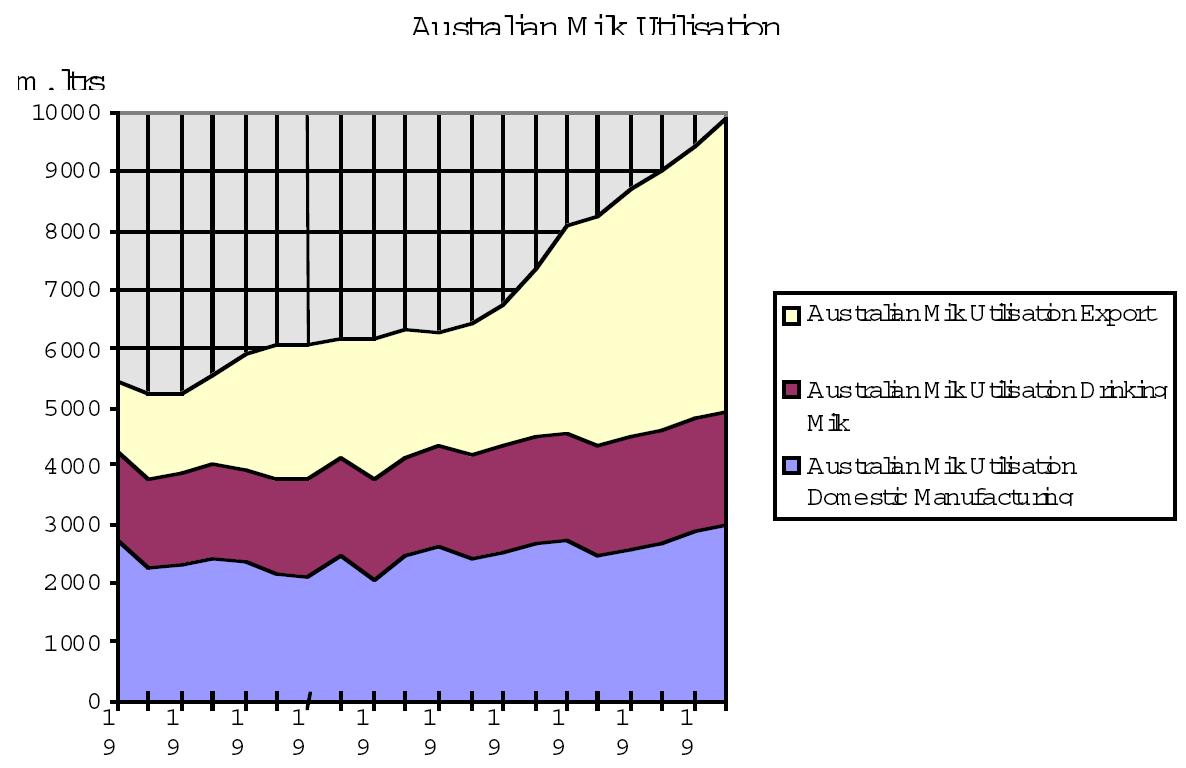
With the accession of the UK into the European Union, Australia lost its then most important export market.  Annual milk production fell from over 7.5 billion litres in 1970 to less than 6 billion litres at the start of the 1980s.  Since then production has steadily risen to over 9 billion litres.  Of the Australian output, over half is exported with the remainder split evenly between drinking milk and manufactured products.

Australia, with some 12 per cent of the world export market, is a major supplier.  Our market share is achieved notwithstanding the protectionist policies of other countries and the considerable export subsidies of the European Union.  According to the Australian Dairy Corporation, production costs in Australia are less than two thirds of those in the EU and three quarters of those in the USA.  New Zealand has a slightly lower cost structure than Australia.

Australian average costs tend to be boosted by production in areas not well suited to the industry.  The parts of Australia ideally suited to milk production happen to be predominantly located in Victoria -- specifically the Gippsland region, which dominates the industry -- and Tasmania.  Areas in South Australia and New South Wales also have conditions supportive of a vigorous industry.

Both in terms of herd size, averaging about 150 dairy cows per farm, and production per cow, output per farm has been increasing.  Average herd size is considerably below the level at which economies of scale are exhausted.  This is believed to approach a herd size of 2,000.  Production per cow has increased by 40 per cent over the past twelve years.  This is now reaching the maximum level readily achievable with existing strains but there will doubtless emerge prospects for increased output as genetic technology develops.  These prospects are likely to become significant over the next few years, first in respect to grasses and perhaps subsequently with the animals themselves.

The number of dairy farms has halved to about 14,000 over the past 25 years, over 8,000 of which are in Victoria.

Victoria's share of national production is currently 62 per cent and has been increasing.  This is a reflection of some liberalisation that has occurred and the trend away from fresh milk consumption.  That latter trend may partly reflect Australia's changing population age profile but is also a reflection of health concerns regarding cholesterol.  The industry's response has been to increase output of reduced fat milk and to find new fresh milk markets, especially flavoured milk.  These product categories have grown from 10 per cent of fresh milk to almost half of the total during the past 12 years.  Their growth is itself attributable in large part to the stimulus of increased competition in the industry.

The industry has also increased exports of liquid milk, largely in the form of UHT, though these still comprise only 3-4 per cent of domestic fresh milk sales.

Export production, which accounts for half of raw milk production, is valued at close to $2 billion.  Exports are dominated by cheese, powdered milk and butter and are largely to Asia.  Having hit a low point in the early 1980s, Australian exports have digested the loss of markets resulting from Britain's accession to the European Union and have been increasing rapidly over the past 15 years.  The Asian crisis has not markedly reduced export growth, though prices have fallen.

The figure below illustrates the trends in production and utilisation.

Figure 1

Source:  Australian Dairy Industry Corporation

Australian producers have long been hostage to the exorbitant subsidies offered to dairy farmers in other developed countries.  In the case of the EU, they suffer the double whammy of negligible market access and EU subsidised exports capturing over 40 per cent of world trade and suppressing prices as a result.

Attempts to improve these market situations have been a major focus of Australian (and New Zealand) trade diplomacy for the past 30 years.  This has brought no relief in the case of the EU, though Japan, as a result of shifting domestic tastes now constitutes a major market for Australian dairy products.  While diplomatic initiatives are of considerable importance to allowing an efficient Australian industry to grow, it would be unsound, especially for a nation of Australia's small size, to attempt to offset protectionist effects by domestic subsidies.  Our industry must live with the competitive environment that is in place, while diplomatic pressures are maintained to improve that environment.


REGULATORY ARRANGEMENTS

The Measures in Place

Across Australia, the dairy industry has been closely regulated over many years.  Regulations have set prices at the farm gate, for cartage and in the retail outlets.  The key aspect has been a dual price system with fresh milk receiving a high price and other milk usages being left to market forces.  In States with a quota system, (NSW, Queensland and WA) the high price is dependent on owning quota (which can be traded).  The other States pool the milk with farmers receiving the premium price for the fresh milk sales.  These regulatory arrangements have been supplemented by formal and informal measures preventing inter-state sales.

The dual price system differs from state to state.  The market milk price varies:  it is 58 cents per litre in Queensland, 51 cents in NSW and 49 cents in Victoria.  Milk for manufacturing purposes commands a price of about 24 cents per litre.  This price differential is moderated somewhat by levies on fresh milk (about 1.9 cents per litre) and on manufactured milk for domestic consumption (around 3.7 cents per litre).  The funds from these is directed to farmers for the milk they supply to manufacturers of dairy products.

Milk is, of course, a homogenous product and there is no difference between the product directed to the fresh milk market compared with that going to manufactured products (or going to the fresh milk market without a quota for the premium price).  As a result of these factors, the producers receive markedly different prices for their output.  Those farmers in States where fresh milk comprises a high share of output receive much higher prices.

Based on the NSW Dairy Corporation estimates, without allowing for the moderating influence of the levies, the average price received by Victorian farmers was 64 per cent of that received by those in NSW and Queensland (Tasmanian milk producers fared even worse, receiving only 59 per cent of the NSW/Queensland price).  Figure 2 below illustrates the average prices received.

Figure 2

Decomposed into their two sub-parts, these prices are as shown in the table below:

 Market
Milk
Manufactured
Milk
NSW/ACT50.925.1
Vic48.122.7
Qld58.924.0
SA51.121.8
WA53.325.6
Tas54.920.4

This price disparity, as well as bringing about a considerable inefficient distortion in the industry nationally, represents a considerable burden on the Australian consumer.  Milk producers, through the monopoly arrangements they have persuaded governments to underwrite, are engaged in price gouging of the Australian fresh milk consumer.  Such actions almost certainly result in reduced consumption of milk products.

Within Victoria the Dairy Industry Act (1992) governs the industry.  Sale of dairy products has been progressively liberalised.  The key regulation remaining is the dual price system which was ostensibly intended to ensure sufficient supplies of market milk while offering "equitable" returns for farmers.  The market for milk products is (and probably always was) sufficiently mature for no economic regulation to be necessary.  As for the need for "equity" for producers, the search for the "just price" outside of the forces of demand and supply has a long and ignoble history.

General Government Regulatory Policy

The regulatory arrangements that allow the vast price dispersion of dairy products to occur are not compatible with those agreed to by Heads of Government in instituting the national competition policy reforms.  Under the Competition Principles Agreement -- 11 April 1995, Governments agreed:

5.(1) The guiding principle is that legislation (including Acts, enactments, Ordinances or regulations) should not restrict competition unless it can be demonstrated that:
(a) the benefits of the restriction to the community as a whole outweigh the costs; and
(b) the objectives of the legislation can only be achieved by restricting competition.

These matters complement the regulation review procedures that are in place in most States.  The Victorian Subordinate Legislation Act 1994 requires economic analysis and public scrutiny of all substantive regulations via a Regulatory Impact Statement (1).  This applies to all existing regulations, which expire ten years after their enactment, and to new regulations.  The Act draws attention to the possibility of regulatory failure and seeks to ensure that any regulation that is deemed necessary is the most efficient solution to the identified problem.  Other States have similar provisions.

Incentives for the Government to Meet the Obligations

Governments have a general incentive to allow increased application of market forces simply because this allows greater wealth creation.  The regulation review procedures that pre-dated the competition policy are testimony to the recognition of this.

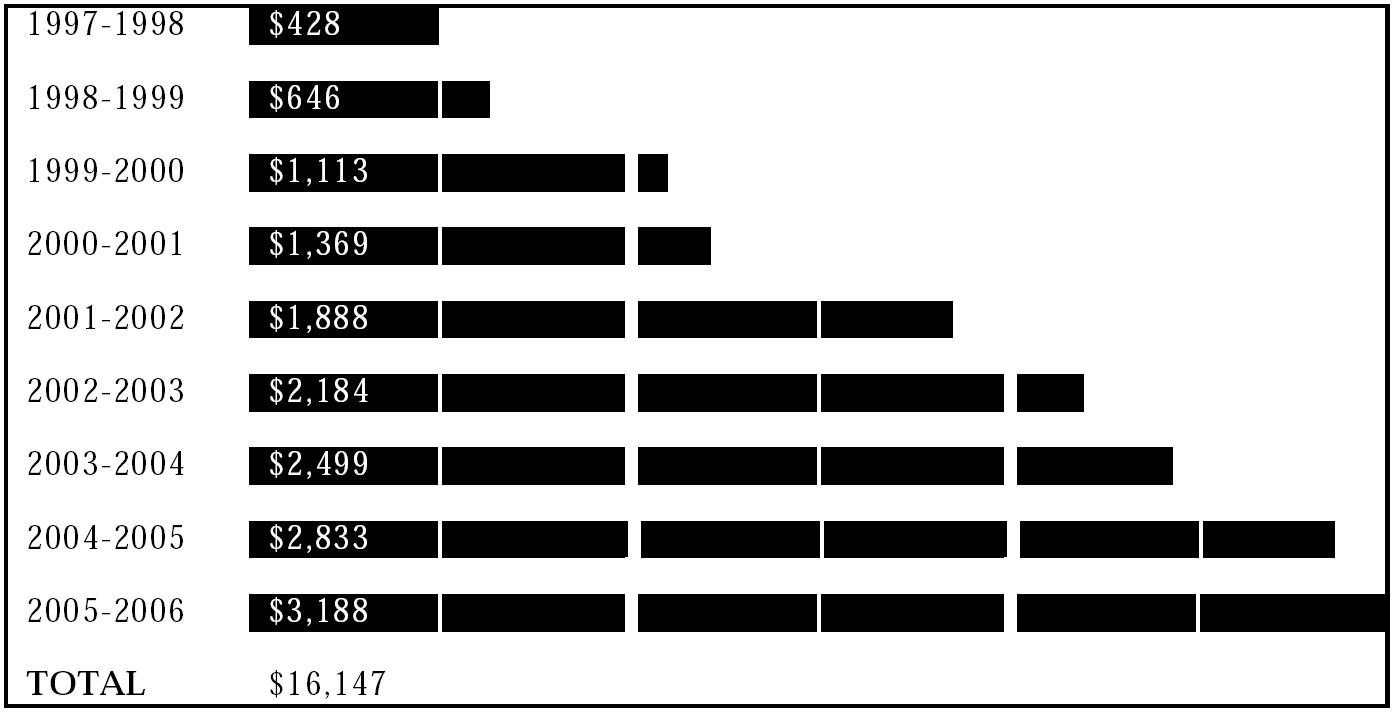
Further disciplines to review competition within the deadlines set by the competition policy have been established by competition payments.  These recognise that there is a national dividend from competition reform and that, at a governmental level, the Commonwealth rather than the States obtains the greater share of this because of the structure of Australia's tax system.

Hence, under the NCP Agreements, the Commonwealth agreed to make special payments to States and Territories that made satisfactory progress in implementing the national competition policy reforms.  If a State or Territory does not take the required action within the specified time, its share of the payments will be withheld.  The National Competition Council (NCC) program is to assess whether the conditions for payments to the States and Territories, have been met.  The first formal assessment was made prior to 1 July 1997, and basically required only that at program be in place.  The next assessments are to be made prior to 1 July 1999 and 1 July 2001 and will examine the outcomes of reforms in greater detail.

The money which has been allocated to these special payments is set out in Figure 3 below (estimated nominal $ million).

Figure 3:  Competition Payments

Source:  National Competition Council Brochure (October 1996)

The NCC has indicated the matters that can be taken into consideration in establishing interventions in the public interest.  The criteria for doing so adopt a deregulatory approach but make clear the ultimate objective is not competition per se but using competition and deregulatory measures to enhance the community's living standards and employment opportunities.

Under Clause 1(3) of the CPA, several issues may be taken into account in determining what constitutes the "public interest".  These cover a wide range of matters including:

  • (d) government legislation and policies relating to ecologically sustainable development;
  • (e) Social welfare and equity considerations including community service obligations;
  • (f) government legislation and policies relating to matters such as occupational health and safety, industrial relations and access and equity;
  • (g) economic and regional development including employment and investment growth;
  • (h) the interests of consumers generally or of a class of consumers;
  • (i) the competitiveness of Australian businesses;  and
  • (j) the efficient allocation of resources.

The NCC noted (2) that there were no weightings to these particular provisions.  It argues that the onus is on those promoting an exemption of an arrangement to demonstrate that it will be a superior approach.  In this respect, the NCC draws attention to the "net public benefit" test applied by the Australian Competition and Consumer Commission (ACCC).  The ACCC approach is that, unless there are clear arguments to the contrary, competition is to be enhanced in order to meet the objectives of the Trade Practices Act (TPA) on which the competition reforms are largely predicated.  The TPA's objective is to "enhance the welfare of Australians through the promotion of competition".

Other Pressures for Deregulation

As well as controlling price within their home States, the different State dairy industry acts allow the State dairy industry authorities to control exports out of their State jurisdictions and promotional activities.

These dairy industry regulations are clearly out of step with those required to generate efficiency and cause resources to be maintained in farming activities that would otherwise be non-viable, while preventing expansion in areas that are well suited to the activity.  It would be exceedingly difficult to make a persuasive case for an exemption from general competition rules on any of the public interest grounds of the Competition Principles Agreement.

Indeed, the provisions that prevent the sale of milk between the different States is contrary to section 92 of the Constitution which requires that trade between the states shall be free.  The de facto cartelisation of milk sales and production with the various State dairy boards, and the cross payments to producers in the more efficient States, has meant that no major interest group has seen a benefit in challenging the inter-State restrictions.  With the deregulation that has already taken place, and the rise of major milk manufacturing businesses, this situation is unlikely to persist.  A High Court challenge to restraints on trading between the States would be likely to succeed.

The major urban markets for fresh milk enjoy a natural distance related degree of protection.  Although producers in the south east of the nation are lower cost, it would be difficult for them to displace fresh milk from the farms located close to the major metropolitan areas of Sydney, Brisbane or Gold Coast (or from Perth).  However, that location protection is likely to come under increasing pressure as a result of a greater acceptance of UHT milk sourced either from inter-state or from New Zealand.

The competition policy is driven by a well-established belief in the potency of open markets and less government intervention in bringing efficiency.  And it is only by having efficient production that industries can be sustained.  Change is a major feature of economies which globalisation has accelerated.  The change itself is due not to some ideological beliefs but in response to the shifting preferences of consumers and the need for producers to respond to them.  Improved information and the competition of all goods for a share of the consumer dollar has meant that no industry can regard itself as stable.  To survive, all industries must adapt to the market.  Nations which turn their backs on market forces and technology trends will face lower living standards than their citizens would wish to have.  And it is the individual operators within the industries, and those contemplating entry, not governments, which are the standard bearers of the change and efficiency enhancements.  Protecting industries from change is a recipe for impoverishment.

These matters may assume greater importance in the future with genetic modifications of crops and, perhaps, livestock.  While at present grasses are not believed to be a priority of genetic plant research, they will doubtless become so.  Genetic modification is likely to allow a saving in inputs like fertiliser, weed control and water.  In North America, genetically modified plant varieties are likely to dominate crops like soy, maize and canola by next year and will rapidly become important throughout the food chain.

At the present juncture, the Europeans have taken a cautious approach to these new varieties and are likely to find the competitiveness of their rural industries further deteriorating.  It is vital that a nation like Australia, with primary production occupying a key place in our overall economy, rapidly embraces the new technologies being developed.  Both here and overseas, genetically modified organisms are likely to bring a vast increase in production from existing farmland and to bring infra-marginal land into production.  This will place downward pressure on prices and farm jurisdictions that reject the new technology will face severe difficulties.

The explosion of new strains based on genetic modifications will mean Australia must expedite approval processes.  Although improvements in this area have been seen over recent years, Australian agriculture in dairy and elsewhere will suffer if our approval processes seek to duplicate those of overseas, especially in North America, on the spurious grounds that there are unique features of the soil and other aspects of Australia.  The new technologies call for a reinvigoration of the policy of automatically adopting the approvals of selected overseas authorities.


IMPLICATIONS OF MARKET DEREGULATION

Different State Effects

The relative efficiency of milk production can be gauged by the share of premium priced milk on a state by state basis.  This is illustrated in the Figure 4 below.

Figure 4

Market milk, according to the latest NSW Dairy Corporation estimates, accounts for only 7.6 per cent of Victorian production, and 10.2 per cent of Tasmanian and 26.7 per cent of South Australian.  The other States' producers are heavily dependent on the regulated premium price.

Victorian farmers benefit in the short term from the regulated price, which doubles their revenues on 7.6 per cent of their production.  They also benefit (by about $6,000 per farm) from cross-payment by inter-state farmers and manufacturers.  Overall, ABARE estimates (3) that this will mean a reduction in incomes of about 4 per cent.  Nonetheless, Victoria as a whole is in a strong position to benefit from deregulation.  The immediate outcome will be both a reduction in price in fresh milk, and some increase in the price paid by manufacturers, which are lower than in the other two eastern States.  The reduced price of fresh milk would be expected to boost demand.  Moreover, Victorian milk would be expected to make some inroads into the State markets of NSW and Queensland, in the process reducing the price differential between market and manufacturing milk.

The State reviews in Queensland and NSW have acknowledged that their domestic industries would be forced to follow Victoria's lead in the event of deregulation.  Although transport costs are an impediment to inter-state trade in fresh milk, some sales would be made by a Victorian industry fully unleashed to sell in markets where the price is double that available within the state.  These pressures will force reductions in the regulated prices and undermine the two price system.

Hence, even if other States resisted deregulation (and forfeited competition policy payments as a result) the subsidies their dairy farmers obtain will be eroded.  The size of their industries will contract and, especially in the manufactured products, production will migrate to Victoria and Tasmania.  The cautious political announcements on deregulation in other States recognises that it may be better to grasp the nettle of deregulation once Victoria has done so and have the industry rationalise in an ordered manner rather than be gradually choked.

Deregulation will also bring milk inputs into line with their real price.  The anomalies created by the dual price system are apparent in products like flavoured milk, where producers are obliged to source their inputs at fresh milk prices.  Milk generally, and especially flavoured milk, competes in the general beverage market.  Although these product lines have been growing strongly, with a 20 cent per litre reduction in their input prices resulting from deregulation, their growth would accelerate.

There has been considerable comment on the effects of different deregulatory moves on prices to the consumer.  In Victoria, deregulation of retail margins did not bring a fall in consumer prices.  In NSW, the retail deregulation in 1998 led to claims by the Minister that supermarkets had increase prices.  While these claims have proved to be ill-informed, supermarket prices were relatively unchanged, retail margins in other outlets have tended to increase.  A similar pattern occurred in New Zealand with deregulation of the fresh milk market in 1993.

Following deregulation, however, there was a vast increase in the variety of milk products being made available and a new enthusiasm for promoting milk by retailers able to obtain a commercial margin on their sales.  In both cases, the previous regulation had led to a reduction in consumer choice and satisfaction, a reduction that is not easily measurable in standard price comparisons.  Deregulation therefore brought increased benefits through allowing sellers profitably to meet consumer demands.

Impacts on Rural and Regional Communities

The trend in production has seen the industry migrate to the most efficient locations.  At the present time Victoria is responsible for some 73 per cent of non-market milk dairy output and Tasmania a further 7 per cent.  Deregulation is likely to see increased concentration of production areas.  This may not mean the demise of production for other than the fresh milk market in areas other than Gippsland and northern Tasmania, the two areas of most obvious comparative advantage.  Deregulation may well result in other areas assuming greater importance, in part because their favourable location close to major fresh milk markets allows them to obtain a higher average price for their product.

Economic models can be built incorporating different costs to offer insights into the future industry structure.  Such models, however, have considerable limitations when used to project changes from a major modification in regulatory arrangements.  Such marked modifications would include the significant change in marketing arrangements that deregulation will bring (or that technological change will force, albeit at a slower pace) makes industry location predictions difficult.

Although deregulation will mean considerable change to the industry, the positive aspects of this for rural Australia must be recognised.  These include an increased rate of migration of primary and secondary production to areas where the activities can flourish.  This is likely to mean expansion of employment in certain parts of Australia.  Other parts will see a continuation -- possibly at an increased pace -- of the long process whereby dairy farms have been converted to wine, broadacre or other farming activities.

Compensation to the Industry

The industry is seeking restructuring assistance, one way or another underwritten by the Commonwealth Government.  There is a case for such assistance where suppliers have quotas that enable them to earn premium returns.  That case exists notwithstanding the fact that the quotas should not have been present in the first place.  After all, quotas have created a property right and these rights should not lightly be abrogated.  Estimates as to the sums involved vary between $1 billion and $1.5 billion.

That said, there are many reasons why no compensation should be offered.  Not the least of these is that buying out quotas is a highly unusual procedure for the Commonwealth Treasury and one that they rightly resist.  Such action sets considerable precedents.  We have seen with analogous cases on the waterfront that the money dispersed to powerful bodies has had little effect in bringing about the necessary rationalisation.  Moreover, tradable quotas are present only in three of the States and quota values have fallen markedly as the industry recognises the inevitability of change.

The normal process by which an industry is eased into a more deregulated structure is to offer a phase-in of the competitive gales.  All manufacturing industries have faced a gradual reduction in tariff assistance over the past 25 years.  Average tariffs on manufactures have been reduced from 28 per cent to about 3 per cent.  The means by which the impact of these measures has been softened is through gradual reductions in assistance.  The dairy industry would be best advised to explore such measures rather than seeking direct assistance.


ENDNOTES

1. See Regulation Impact Statement Handbook, Office of Regulation Reform, Department of State Development, Government of Victoria.

2. Considering the Public Interest under the National Competition Policy, National Competition Council, November 1996.

3. Topp V., Dairy Outlook to 2003-4, OUTLOOK 1999, ABARE, Canberra, April 1999.

Saving Budgets

What has the Coalition Government been up to in its Budgets in the last three years?  Reading them again it is clear that the single most important issue has been to balance the budget;  the rationale has been to improve the nation's savings.  The nation's key economic weakness continues to be an ability to spend and borrow, and an inability to earn and save.  The real economy, the one in which we trade with the rest of the world, is no longer our oyster.  No one owes us a living.  We have a high structural deficit on current account, which consists of an intermittent trade shortfall and a large debt-servicing component.  If the deficit climbs too high it may affect our ability to continue to borrow;  it may affect our ability to trade.  Australia needs amongst other things to save more.

What has the Government been doing about this?

The government sector has a part to play in the national savings and spending/ investment debate.  By and large, although not slavishly, a government should live within its means, if only because it is a proxy for the taxpayers, who should live within their means.  In this regard the Government moved swiftly in its first Budget in bringing its own into balance.  The Budget deficit for 1995-96 was reportedly $10billion, at a time when the economy had been growing for five years.  The political rhetoric at the time was appropriately severe for an incoming government, scolding the former government and righteous in its determination to repair the damage.  The Budget was balanced within 18 months.  It is now well in surplus.  In other words the repair was effected very quickly, which leads one to suspect it was not the stuff of crisis, more a reasonable return to the surplus that the previous government had produced from time to time.

Therein lies the problem, the temporary nature of government financial management.  The present surplus may well be dissipated in a time similarly short as its creation.  Are there any remedies?  One measure is the Charter of Budget honesty, which requires the Heads of Treasury and Finance to sign a document outlining the Commonwealth's Budget position prior to an election.  This is a useful tool for scrutiny of government financial management.  It increases the chance that government will not spend taxpayers' money to buy votes.  Such a regime may improve the chance that governments' are rewarded for good management, not bribery.

The Commonwealth had also accumulated a great deal of debt by running deficits more often than surpluses.  Those debts have been reduced considerably by the sale of government assets, most notably the part sale of Telstra.  Had any of the moneys raised by the sale of Telstra been used to fund current spending, either in the hands of the government or in the hands of the taxpayer, as tax cuts the effect would be wholly unacceptable.  Instead some was devoted to the establishment of the Natural Heritage Trust, and the remainder used to retire debt.  The next time governments need to retire debt there will of course be no access to asset sales.  There won't be any left to sell.  The tools for managing public debt have therefore diminished.  The one that remains, running a balanced budget (on average) will have to be constantly monitored.

The other side of the savings debate is the savings, which taxpayers make.  In this the government's performance has been less satisfactory.  The Government opted for a 15% tax rebate on savings, subsequently scrapped in favour of tax cuts.  These moneys were essentially those that Labor proposed to be paid as an employee co-contribution to the compulsory Superannuation Guarantee levy.  The savings gained from the tax pool are now to be returned to the taxpayer by means of a tax cut.  Labor tried the same ploy for the1993 election.  Returned to government, it had the good conscience to direct the moneys to a compulsory savings vehicle.

The Government assumes that a lower level of government spending and taxing will improve the nation's savings.  It's boast, that spending is to reach 24% of GDP by 2001, down from 27% in 1995, has little to do with the savings issue.  Less money passing through the hands of government increases the choice for taxpayer spending or saving, it does not create savings.  Short of a prolonged recession or defeat in a war the savings ethos is long gone.  In a world of easy access to credit, regardless of price, the ethos is not likely to return.

One area where the government may place a permanent mark on the future prosperity of the nation, in addition to its Charter of Budget honesty and its balanced Budget and debt retirement via asset sales, is an enhanced and renewed effort at lifting private savings.  In the unlikely return to the frugality of earlier times, a bit of compulsion like Labor's Super Guarantee would be a good thing.  The government's preference for a wider array of savings vehicle, like Retirement Savings Accounts, and its lifting of the preservation age to 60 by 2025 are reasonable measures to improve the possibility of higher savings but they do not guarantee it.  It would be better to take the savings debate out of the temporary file that governments like to play with for appearance sake and shift it into the permanent and untouchable one.

The Coalition's fourth Budget, assuming it is not knocked for six by a Senate refusal to pass the GST should lay down a permanent marker in the savings debate.  It will be rewarded at the polls for so doing.


ADVERTISEMENT

Wednesday, April 28, 1999

Victoria's 2001 Electricity Distribution Price Review

Submission to the Office of the Regulator-General (ORG) on the 2001 Price Review


1. SUMMARY

1.1. THE 2001 VICTORIAN PRICE SETTING ARRANGEMENTS

The post 2001 price re-set for Victorian electricity distribution represent a major test for the post-Hilmer regulatory arrangements for industries with market power.  Electricity distribution is considered to have market power.  Both the Victorian Tariff Order and the National Electricity Code specify that it should be regulated by a price cap or similar incentive, rather than by profit controls.  The political risks of price gouging ruled out New Zealand-type light handed regulation which would treat existing line charges as a contractual price cap and leave actual or potential competition as the regulator.


1.2. THE KEY ISSUES

This paper is confined to addressing just two or three of the most important general matters in the 2001 re-set:  the price setting formulation, and the treatment of gains made in the first price setting period.


Price capping

Price capping is likely to regress into a form of profit control if the gains made by the regulated firm are taken automatically by the regulator in the next period.  Such approaches will detract from the efficiency inducing goals of price capping.  Many argue that the business-by-business price caps that the ORG has foreshadowed are no more than profit controls.  The ORG maintains that reliable data is not yet available for more objective industry-wide price setting arrangements, which could employ industry total factor productivity or data envelopment methodologies.

For the post 2001 re-set, we propose a price cap, which should be set on a consistent basis for each of the businesses, combined with a profit sharing arrangement.  The latter would give a distributor's customers a share of profits above a specified level (in terms of price cuts), say on a 50/50 basis.


Treatment of "Unanticipated" Revenues Gained in the Current Period

The distribution businesses maintain that the government gave assurances that the price trajectory for the first re-set would follow a "glide path".  This would effectively allow them to keep half of all the first period's gains during the 2001 quinquennium.  The ORG wishes to confine the glide path to management initiated cost reductions, with windfall gains or losses eliminated at the outset of the new period.

Assurances should be a matter of record and should be kept.

That aside, the division of gains into windfall and management is likely to prove difficult.  Changes in the cost of capital might be regarded as windfalls but increased market growth, O&M savings or economies in capital expenditure are more likely due to management effort.


2. POLICY ISSUES

With the Victorian electricity market reforms and the National Electricity Market, control of the operations of electricity supply has been revolutionised -- the operations are now market rather than production orientated.  As in other commercial markets, price is now the prime driver of efficiency and resource allocation for generation and retailing.  Competition between providers in both generation and retailing means no significant body of opinion considers that regulatory restraints are needed.

Distribution and transmission respectively comprise 30 and 10 per cent of electricity costs and remain regulated.  In New Zealand, distribution and transmission are regulated only under the reserve powers of general competition policy laws.  Although there is much to be said for this approach, the Australian authorities wish to maintain a more "heavy handed" regulation on elements characterised by a degree of monopoly power.

For those elements of the market considered to be natural monopolies, the key regulatory matters to be determined comprise:

  1. The formulation to be used in future price setting;
  2. The treatment of the base year price of the regulatory period -- gradually passing unpre-designated productivity gains to customers made in the previous regulatory period ("roof truss") or immediately delivering them ("P0").

In respect to this second matter, the ORG has also signalled an intention to disaggregate gains (or losses) into windfall and management initiated.  The plan is to leave the latter, in the case of gains, with the regulated business over a longer period.

The key matters are interrelated.  Together, they define the incentives for suppliers to operate efficiently and for consumers to obtain similar benefits to those that would emerge in competitive markets.


3. MEANS OF PRICE CONTROL

3.1. THE GAMUT OF REGULATORY POSSIBILITIES

Conceptually, there are five means of ensuring that profits in the provision of line services are not excessive.  These are not mutually exclusive and comprise:

  • ensuring that there is competition in the provision of the service and/or its close substitutes;
  • controlling the profit level by fixing prices and revenues to cover costs;
  • setting a price cap, based normally on CPI-X, and freeing firms to keep all profits in excess of this;
  • placing a special tax on profits beyond some pre-determined level;
  • establishing some form of benchmarking and setting a price path for each firm to meet this.

3.2. ENSURING COMPETITION

Competition prevents firms from increasing prices above a level that would attract new entrepreneurs or bring losses of business to new or existing players.  It also forces firms to seek cost reductions and better ways of meeting market requirements to retain and/or expand their business.

There is little dispute that competition is the best form of control.  Regulators maintain that they are simply trying to mimic competitive outcomes in markets where competitive provision is either unattainable or inadequate.


3.3. CONTROLLING PROFIT LEVELS

Traditional rate control has focussed on this approach.  Either the utilities were government owned and the government set target rates of return or they were privately owned and regulators determined prices based on a return.

In both cases the outcomes brought inefficiencies -- excessive capitalisation where the utility received a margin on its capital expenditure.  This was compounded in the case of government owned utilities by no incentives to pare costs and generate higher profits (which are not even transiently available) and by corporate decisions being unduly influenced by political considerations.


3.4. CONTROLLING PRICE LEVELS

Price cap controls under a CPI-X formulation were designed to overcome the inadequate incentives that were offered by profit rate controls.  In their purest form price caps allow the regulated firm to keep all profits from its activities as long as prices are maintained at a pre-specified level.  This was established at the general economy-wide level of prices, with some requirement of price reductions to reflect anticipated productivity improvements.

The "US price capping arrangements", used in railroads and telecommunications, establish average revenue standards based on estimates of volume growth, deducting an X factor based on historical (1) industry-wide Total Factor Productivity.  This same X factor is applied to each of the regulated business.

Sometimes within the X factor, the US regulators incorporate a consumer benefit stretch factor or "consumer dividend".  This adds to the historical productivity increases.  Stretch factors have been used to correct for the effects of diminished incentives in previous profit control rate settings.  They may be applied in future to adjust for over-generosity in outcomes from the price cap formula.

This CPI-X formulation often also has a Z factor to account for external factors, like taxes, not reflected in inflation or in the internal costs of the business itself.

These calculations allow an estimate of average revenue per kWh to be made, from which individual prices are developed.

The UK, without the US's long history of rate setting, has adopted a more cautious approach.  This involves detailed examinations of each business to determine reasonable productivity paths unique to each business.  The UK has also, in contrast to the US, set initial adjustments at the start of a subsequent period to reduce that period's opening price where, in the regulator's view, the previous price setting formula had been too generous.


3.5. PROFIT SHARING

An amalgam of the price and profit control is to re-base the price cap, perhaps annually, so that the controlled business passes back to customers, in price reductions, a portion of the profits above a certain threshold.  Commonly the customer share beyond some specified level is 50%.

These rate controls have a history going back 150 years to English gas companies.  Implicitly or explicitly, they have been the normal approach in the US price control of electricity where profit rate controls have not been applied.


3.6. BENCHMARKING

Data envelopment seeks to adjust each business's performance to best practice.  Each firm's performance is adjusted by the different features of its supply base (customer type, density, topography, etc.) and this performance -- effectively its total factor productivity -- is gauged against a best practice frontier.  Alternatively, the same material can be assembled into a multiple regression with each firm measured against the adjusted average.

At least conceptually, these approaches allow individual business productivity measures to be set which offer the most efficient firms continued benefits, while penalizing the less efficient.


4. EXISTING REGULATION OF VICTORIAN DISTRIBUTION BUSINESSES

Maximum tariffs were set for the 1995-2000 period on the basis that:

  • each customer class has the same maximum rate across Victoria;
  • initial network tariff could not be varied by more than 1.25 cents/kWh across each DBs service area;
  • Each DB's average revenue during 1995-2000 is capped in each year by CPI-X with X set to reflect different costs of adjusted ODRC, current cost depreciation expenses and expected O&M costs and expected productivity gains.  The X factor was set at 1% for Eastern and Powercor, 1.5% for Solaris and CitiPower, and 1.92% for United.

The interaction of these charges and the tariffs that were set for franchise customers without an ability to choose their own supplier gave rise to excess franchise profits.  These totalled $632 million in 1995 values and were taken back by the Government as part of the sale process.

Transmission use of system charges were adjusted to create a cross subsidy to rural customers as follows:

TUOS Equalisation Adjustments, 1994/95 $'000

Uncorrected TUOSEqualisation AdjmntCorrected TUOS
CitiPower21,0705,92026,990 (+28.1%)
Eastern Energy17,640(4,939)12,701 (-28.0%)
Powercor45,270(19,011)26,259 (-42.0%)
Solaris Power14,1805,17119,980 (+36.5%)
United Energy26,54012,85939,450 (+48.5%)

Thus, based on replacement costs, the capital component of United's charges are 48.5 per cent above the optimised replacement value, while that of Powercor incorporates a 42 per cent under-recovery.

  • Similarly, the write-up and -down of the distribution lines was made:

Asset Value Adjustments at Privatization (1994/95 values), $m

ODRC ValueAdjustmentAdjustment %Regulatory Value
CitiPower48212926.7%$611
Eastern Energy1046(218)(20.8)%$828
Powercor1227(161)(13.1)%$1066
Solaris Power3616116.9%$422
United Energy74313618.3%$879

Thus, CitiPower charges were set at 26.7% above costs, while those of Eastern were set 20.8% below costs.  These subsidies were to be unwound over a period of 20 years.

The rebalancing adjustments in the Victorian market have created asset prices and line charges that are artificially high in some areas.  This will create an increased vulnerability of by-pass in those areas that have had their charges increased.

Distribution price re-balancing can take place but is limited to an increase of 2% per annum for each tariff category.  The businesses have taken advantage of these provisions to re-base their charges better to reflect costs.  The ORG has some reservations about the efficiency of this re-balancing (Consultation Paper No 3, p. 12).

Cost allocations for unregulated services (like telecommunications and construction on behalf of others) must also be submitted to the ORG.  These costs need to be disaggregated from those incurred on the regulated services, a process that will bring inevitable wrangles where costs are shared.


5. THE REGULATORY APPROACH

5.1. THE ORG'S LEGISLATIVE FRAMEWORK

The Office is required to adopt a post January 2001 price control that utilises "price based regulation adopting a CPI-X approach and not rate of return regulation." (5.10(a) of the Statement of Government Policy September 1995).  The ORG must also use the Distribution Businesses' adjusted asset values in setting price determinations.

In its price setting procedures the ORG must have regard for the need to:

  1. provide each Distributor with incentives to operate efficiently;
  2. ensure a fair sharing of the benefits achieved through efficiency gains between customers and the Distributors;
  3. ensure appropriate incentives for capital expenditure and maintenance in the Distributor's Distribution Systems. (5.10(d)).

Also relevant is the National Electricity Code, which also requires distribution services to be regulated on the basis of "CPI-X", or an "incentive-based variant" of "CPI-X" (clause 6.10.5(a)).

The provisions of both the Tariff Order and the National Electricity Code leave considerable latitude to the ORG.  In this respect, the ORG in its third Consultation Paper states its overriding requirements is to apply "explicit price capping" and since that term is not specifically defined,

"the Office interprets the Tariff Order and the National Electricity Code as giving unequivocal support to incentive-based regulation.  Within this overall framework, however, the Office recognises that there remains considerable flexibility about the detailed form of the price control to be adopted for distribution services." (Consultation Paper No. 3 p. 2)

This has generated considerable controversy and is taken up in Sections 5.2 and 6.


5.2. THE ORG CONSULTATIONS

Consultation Paper No. 1

Consultation Paper No 1 of June 1998 was the first of three Consultation Papers the ORG has issued.  It reaffirmed the intent to pursue a CPI-X approach and explained the balancing required to enable the process to operate in a way that gives adequate incentives to efficiency while preventing monopolistic exploitation.

It addressed the different benchmarking approaches.  In doing so it dismissed the case for independent Total Factor Productivity benchmarks referenced against some external measure of industry or economy-wide productivity, although adding,

"Arguably, that outcome would be generally consistent with the operations of the competitive market which allows firms with lower costs than the marginal firm to earn above normal profits and punishes those firms with higher costs" (p.46).

The ORG's reservations regarding this approach include:

  • the licensees of well performing businesses keep too much of the benefit
  • poor performing businesses may run into financial difficulties
  • the difficulties of developing benchmarks that adequately account for each business's unique operating environment
  • lack of data both on the licensees and the relevant external benchmark.

These reasons are not persuasive.

A well performing business in the market the ORG seeks to mimic would pass back profits in lower prices more slowly provided its performance could not be matched by competitors.  These are precisely the outcomes the ORG should be seeking.  And if a poorly performing business ran into financial difficulties it would be vulnerable to takeover (or its owners would sell it), again an outcome that should be welcomed.

Similarly, it would not be difficult to assemble sufficient data to develop industry wide benchmarks, that take into account different operating environments, perhaps drawing off the experiences in North America and the UK.

One difficulty with applying the Total Factor Productivity approach in 2001 that the ORG did not discuss is how to handle the abrupt upward productivity shift that has occurred in the industry post privatisation.  Productivity levels in the years prior to 1995 might be totally irrelevant to the increases that have taken place since.  In the US, these breaks in data (where regulation has moved from profit control to a more incentivised system) have been handled by "stretch factors" incorporated within the X-factor.  A stretch factor is necessarily arbitrary and in Victoria might need to be quite substantial.  It would detract from the automaticity of the Total Factor Productivity approach, which is one of its most valued facets.

In addressing what it designated as the other end of the spectrum, licensee specific benchmarks, Consultation Paper No. 1 argued that these will better track the performance and costs of each licensee and overcome the other deficiencies it sees with external benchmarking.  It saw independent benchmarks as secondary measures for the present review, for which it prefers a building block approach that:

  • establishes the original performance parameters of each business;
  • assesses performance due to factors within management control (which will receive a longer reward period) and windfall factors (which will be passed to customers more quickly);  these will allow an opening position to be established
  • builds on this opening position with future service standards under a best practice basis and the necessary operating and capital expenditures to estimate revenue requirements;
  • determines levels of X to deliver the revenue in net present value terms;  these revenue requirements are then translated into specific tariff levels.

There are substantial informational demands of this approach.  Some of the information will not be available.  Moreover, since the approach requires material that is normally closely guarded within businesses, there are considerable risks that the information supplied will be distorted, or that the regulator, anticipating this informational distortion, will make inadequately informed adjustments to the data supplied.  These risks are magnified where, as appears to be the case, the regulated entities and the regulator are at serious odds over the allocation of gains over and above those anticipated in 1994 and over the method of determining future price levels.

In addition to the risks of poor determinations being made, the decision making framework is already showing a strong appetite for regulatory/lobbying resources which must be considered largely dead-weight waste.


Consultation Paper No 2

Consultation Paper No 2 amplified some of the matters outlined in Information Paper No 1, in particular the disaggregation of windfall from management induced gains.  This is envisaged to be the prime determinant of the phase-in period for the transfer of gains to customers through lower prices.

Recognising the difficulties of classifying the source of cost savings, the Office has stated an intention to place a prima facie judgement that the different aspects are either windfall or management initiated.  In this regard it indicated its disposition to treat the different components as follows:

Higher than expected market growthWindfall
O&M SavingsManagement
Capital ExpenditureWindfall
Cost of capitalWindfall

Where the prima facie judgement is that the gains are windfall gains, the onus is on each regulated business to demonstrate the contrary.  However, even in the one case where the prima facie judgement is that the gains are management initiated the paper indicates that the matter will be thoroughly scrutinised when it states (p. 25):

The Office will need to ensure, however, that such an assumption is reasonable in the context of each licensee and to be satisfied that reductions in operating and maintenance expenditure will not contribute to declining service standards in future.  The Office is currently initiating a series of asset management audits to ensure, among other things, that the expenditure programs proposed by the licensees are consistent with current and future service standards.  It is also initiating a cost-driver study in co-operation with the distribution licensees which will give important insights into the condition of the networks and the estimated impact of proposed and actual maintenance and capital expenditure on the future performance of the networks.

Consultation Paper No. 3

In Consultation Paper No. 3, the ORG explores price controls based on the National Electricity Code which requires distribution services to be regulated on the basis of "CPI-X", or an "incentive-based variant" of "CPI-X" (clause 6.10.5(a)).  The Code explicitly permits various forms of price regulation under clause 6.10.5(b), which states that:

"the Jurisdictional Regulator shall specify the form of economic regulation to be applied to the Distribution Network Service Provider to be in the form of either:

(1) a revenue cap;  or

(2) a weighted average price cap;  or

(3) a combination of the above."

The ORG is attracted to a hybrid approach.  It argues that the present revenue yield approach may encourage retailers to make sales "below economically efficient levels, in order to increase their overall profitability." (p.11).  It further maintains that this bias is greater in Victoria because of the common ownership of distribution and retailing, and, incongruously in view of its concerns to avoid excessive prices, raises the issue of underpricing and predatory behaviour.

These concerns sit uneasily with the separation of retailing and distribution within each business and the considerable shift of contestable customers from their host retailer.  In view of the fierce competition for retail customers, should a business be using its distribution arm to favour its retail business, the ORG would have received complaints to that effect.  No evidence of such complaints is referred to by the ORG.

The ORG is also concerned that the revenue yield approach will create an incentive to avoid demand management measures.  This concern seems misplaced in view of the incentive that competitive retailing has to seek out the lowest cost solutions for customers in order to win and maintain sales.

The ORG also addresses a pure revenue cap, even though this is not favoured by the Code.  Although attractive to those wishing to see lower sales of electricity and a strong bias towards demand management, revenue capping brings considerable distortions.  In particular, it offers no incentive for a monopoly distributor to seek out increased sales volume and would prove inimical to consumer welfare by encouraging distributors to concentrate only on the most profitable market segments.


5.3. PROFIT SHARING

Of all the approaches in common use, earning sharing mechanisms are notably absent from the ORG's canvas.  Sharing mechanisms offer an incentive to efficiency on the part of the supplier, albeit a reduced incentive to one where the supplier retains all the gains.  At the same time they offer insurance that if the productivity gains are greater than the regulator estimated was likely and reasonable, the customers automatically benefit.  As such mechanisms should apply symmetrically, they also offer some insurance to the supplier by muting the effects of an over-ambitious setting of the X-factor.

One of the reasons cited against sharing mechanisms, that they will cause management to focus on beating the system rather than maximising productivity gains, is equally applicable to the form of CPI-X that the ORG favours.


6. ADDRESSING THE DIFFERENT APPROACHES

6.1. DEFICIENCIES IN THE REGULATED APPROACH

Even the best incentives based regime cannot match the positive and negative incentives that automatically flow from a competitive market based on private (as opposed to government) shareholders.  There is, for example, no direct penalty for inefficiency -- inefficiency may bring loss of profits which may eventually make the firm vulnerable to takeover or restructuring by its parent, but discovery of inefficiency may take the regulator some time.

In addition, there is a need to prevent the regulatory costs assuming a prominence of themselves and the regulatory procedures bringing distortions to commercial operations.  This is made even more complicated by the shared facilities and economies of scope where non-regulated outputs form part of the businesses (e.g. telecommunications and gas sales).

The regulated approach's basic premise of monopoly provision may also prove self-fulfilling.  Where the regulator determines price levels that are below the cost of new entry, competition will be pre-empted.

There is a consensus that regulation is inferior to competition as a means to generating efficiency.  Where a regulatory approach is favoured it is because natural monopoly is deemed inevitable.  The tension in regulatory decisions is on the one hand to provide incentives to suppliers to seek out cost reductions and better allocation of goods and services between the different customer and market classes.  And on the other hand to ensure that the benefits of the economies thus generated flow back to consumers.  This tension is underpinned by a recognition that denial of profit gains will mean inefficiency, and a strong awareness of the dangers of regulatory inconsistency in increasing business risk and hence costs.

Regulation can be extremely destructive if the regulator seeks to apply some economic concepts inappropriately.  In this respect, calls for price setting based on marginal costs are common in Australia.  Marginal cost pricing is a common strategy to ensure a firm's survival in a period of excess supply or as a means for tapping some additional demand that can be isolated from mainline customers.  It cannot be used to set price caps.  Such price setting represents profit confiscation -- the regulator either misunderstands the operations of private enterprise or is playing to a populist gallery.  Whilst its initial effects are likely to be confined to the lower profits of the suppliers, over the longer term it will reduce the capacity of the network efficiently to meet consumer needs.


6.2. THE REGULATORY COMPACT

Much of the regulatory literature over recent decades has, inspired by the work of Stigler, (2) featured the notion of regulatory capture by the regulated entities.  Yet, in more recent years at least, the risk has been in the opposite direction with the regulatory authorities engaging in what Shuttleworth (3) has called "regulatory opportunism" to reduce prices.

Regulatory opportunism tends to bring a bias in favour of insufficient rather than excessive supplier returns because the most important constituency for the regulator is the government and public opinion.  Generally, a regulator's decision will be more welcome to consumers the lower the price levels they bring.  Although setting a price that is too low will rebound on the system's development and eventually on the existing network's reliability, a self-interested regulator's time horizon will place a lower priority on the longer term.  By contrast, a business accountable to private shareholders has a combination of capital maintenance and current income as the focus of its self-interest.

Recently our Energy Forum hosted briefing from Dr Stephen Littlechild, formerly the UK electricity regulator.  Dr Littlechild, who also gave extensive briefings to the staff at the ORG, explained the pragmatic approach that regulators must adopt in balancing the need to incentivise the regulated businesses while ensuring that the consumer is not seen to be exploited by businesses able to collect high profits.

In this respect, he was mindful of the re-opening of the England and Wales regulated tariffs after the 1994 price setting.  In the initial year of the new tariff settings, the UK distribution rates were cut by between 11 and 17 per cent and an X factor established at 2 per cent per annum.  A readjustment was sparked by public criticism that these measures offered excessive gains to the regulated businesses, evidence for which was provided by a steep rise in their market values.  The tariff levels were subsequently adjusted down by a further 9 per cent compared to the rates set only some six months previously and a 3 per cent X factor was imposed.

Dr Littlechild stressed that although regulators are intended to be independent of Government, they cannot be oblivious to the same pressures that impact upon Government in determining the just price.  He noted that the UK 1994/5 price setting experience would have impacted upon the regulatory psyche in Australia.  Perhaps as a result, both the Government and the regulator might have been required to provide more specific assurances about future price paths than they would have preferred.

Assurances of this nature include those said to have been given by the previous Regulator-General about his intention not to utilise an immediate claw back approach profits earned above expected levels (the "P0 approach") but instead to operate the "roof truss" whereby the claw back would take place over the course of the succeeding regulatory period.  Assurances like this cannot be revoked without causing considerable tension to the entire regulatory compact.

Regulatory decisions create distortions even in the US where there is considerable experience in them and an ethos antagonistic to regulatory opportunism.  Spiwak (4) notes that since the forced disagreggation of US generation and transmission, the amount of new transmission building has halved.  He attributes this to the greater risk required of transmission that is not integrated, the requirement for common carriage with a fixed price, and regulated charges based on marginal rather than total costs.

The ORG's claim in Consultation Paper 3 that "explicit price capping" as a regulatory approach is ill-defined and cannot be a criteria against which it will determine future price paths has drawn considerable criticism.  Victorian distributors' submissions all suggest to a greater or lesser degree that abandoning this approach breaks the regulatory compact made at the time of sale.  The criticism represents fears, stemming from all three Consultation Papers, that the ORG will use its discretion to engage in forms of profit expropriation.

The concerns about a departure from a price capping approach are valid if the ORG's claimed flexibility extends to a de facto use of profit control or rate of return regulation.  The degeneration of price capping approaches to forms of profit control has long been observed.  This regression to profit control is seen especially where the regulator must use considerable judgement in setting future X factors.  The risks of this are particularly acute where there is no readily available external productivity measure on which the future paths can be set.  If paths are set for each business based on forecasts of their own individual costs, the businesses will adjust their behaviour accordingly.  These adjustments will take the form of deviations from the most efficient expenditures and concealing their intended expenditures to gain from the price determinations.

These risks were identified by IPART:

Depending on how far this (cost based or building block) approach is pursued, however, the requirement for detailed company information, analysis and judgements about managerial competence can make incentive regulation seem more like cost plus regulation, albeit with a longer control period. (5)

Referring specifically to the approach indicated by the ORG, Dan Fessler, the former Chairman of the Californian Public Utilities Commission, argues that the ORG proposals are rate of return rather than incentive based.  Mr Fessler says:

The only pragmatic difference between the ... proposal and the regime which stifled efficiency incentives in the management of California's investor owned energy utilities is an application of projected cost-derived rates for five rather than three years.

Even so, there is merit in the ORG view that data on total factor productivity is not at this time sufficiently available to set industry-wide prices over the next five years.  The immediate task is to set the prices in the current review without creating distortions, avoiding imposing a high (and ultimately unreliable) paperburden on the regulated businesses, and maintaining the Government's obligations and previous assurances to the those who have bought its interests in the industry.


6.3. INCENTIVE REGULATION THROUGH PROFIT SHARING APPROACHES

The ORG has expressed a clear view that incentive regulation based on the CPI-X approach basing the X factor on some external measure of productivity is not feasible at this time.

As discussed in Sections 3.4 and 5.7, one deviation from a pure price capping approach, profit sharing, may carry considerable merit in offering strong incentive for business efficiency while guaranteeing consumer gains.

A profit sharing CPI-X hybrid could readily be developed.  As the productivity measure is set only on the regulated part of the business, the regulator will already require each business to segment its operations and assets into two streams:  regulated and unregulated.  This need to continue monitoring firms with mixed regulated and non-regulated businesses is a major deficiency of profit sharing compared with a pure price cap based on an industry wide measure of total factor productivity.

The hybrid CPI-X/profit sharing approach might be established so that a given threshold of productivity gain each year beyond the level set by the X-Factor is retained by the business and 50 per cent of any remaining increase is passed back to customers in lower prices.  The cumulative impact of the profit pass back could form the basis of the subsequent period's initial price level.

This approach would offer an improved matching of outcomes to that which automatically occurs where there is no natural monopoly.  Firms that make high profits by dint of their superior management will normally release these gradually to their customers in terms of lower prices.  They will recognise that their improved methods can be replicated by rivals, who will take market share off them unless they pass on their gains to customers.  At the same time they will seek to take advantage of some inertia on the part of their customers to reward their shareholders, in the absence of which the motivation for seeking improvements would be seriously reduced.

Profit sharing also is likely to more closely track outcomes that will develop in the competitive market for electricity distribution that is emerging.  This is evidenced in the protracted review that the ORG is undertaking into the application by Powercor to distribute electricity in CitiPower's dockland area.  The ability of businesses to seize markets presently served by a rival business, or of users to by-pass their host distributor, will force profit sharing and supplement regulatory measures in this direction.  Of course, this could be frustrated by unwise decisions by regulators seeking to maintain controls where such competition renders them unnecessary.


6.4. DIFFERING TREATMENT OF GAINS

The treatment of deviations from the forecast changes to productivity during the period is the other major factor in determining the prices in the period under review.  There are two aspects of this:  cost savings made which reflect an understatement of likely gains at the first price setting in 1995;  and unanticipated gains made in the subsequent years.

The ORG has created considerable animosity with its intent to segregate profit gains into those that are management initiated and those that are windfalls.  If windfall gains are to be removed at the initial price determination, rather than following a "glide path" reduction over the course of the subsequent review, businesses would lose (and customers would obtain) half of the gains.


Adjusting the Starting Point of the First Regulatory Period

Though there is no public information to suggest that the Government was conservative in setting X-factors in 1995, there are grounds for regarding them to be too low.  X-factors were set at 1-1.92% per annum at a time when the UK regulator had decided upon a large initial price reduction and a 3% X-factor.  In addition, the reforms prior to sale had not, in the case of the distribution businesses, included a major reduction in staffing -- and the businesses, particularly those parts formerly owned by the municipalities, were known to be featherbedded.  All the businesses have since moved to reduce overstaffing and/or increase outsourcing.

The 1995-2001 regulatory regime also has a tariff reduction program for franchised customers.  This included a 2% real reduction for households in 1996 and 1% per year for the following years.  For small and medium franchised customers, the reductions were greater (10% in 1995, 5% in 1996 and 1997, and 1% in each of the three subsequent years).  However these reductions followed a large price increase in 1994 and have been accompanied by a reduction, approaching one third, in the cost of energy (accounting for about half of total costs).  The estimated effects of the benefit from higher prices to captive customers in the 1995-2000 period formed part of the privatisation proceeds, as franchise fees, realised by the Government.

The most persuasive case for a one off reduction is that experience of private ownership has revealed far greater cost saving potential than ostensibly anticipated in 1995.  Also credible is a view that the cost of capital has changed markedly and warrants a one off step change.

In both cases, merits of the stepped (P0) price adjustment need to be measured against expectations at the time of privatisation.  These are discussed below.  In the case of adjustments for a "permanent" change in the cost of capital, a further consideration is whether the regulator could convincingly maintain that he would act in a symmetrical manner if capital costs rise.


Windfalls versus Management Initiated Cuts in Costs

Although it is conceptually clear that those profit changes caused by factors outside of the control of management will not have an effect on incentives, there are two reasons why in practice they might.

The first is the nature of the regulatory compact.  If firms had been led to believe that a portion of all gains made in the first controlled period would be carried forward into the next and if their expectation was that most of the gains would be upside, disturbing those expectations would erode confidence in the regulator's integrity.  Such an erosion of confidence would result in higher future risks and would be accompanied by increased costs.  A recent McKinsey report made the following points:

Regulators enjoy considerable discretion in determining prices for a forthcoming control period, so the outcome of the review is not easy to predict.  Uncertainty produces what the market perceives as regulatory risk

This market perception must explain at least some of the increased cost of equity under the UK system.  The beta (a measure of risk) for UK utilities is around 0.9, whereas the corresponding figure for US utilities is around 0.5 when adjusted for similar levels of debt.  Thus the real allowed return in the United Kingdom must typically be more than 1 percent higher than the return in the United States.  The cost to the United Kingdom's economy is between $2 billion and $3 billion a year in higher utility charges (6)

Similar cost implications (7) have been drawn to the attention of the ORG by the Australian finance industry.  The industry had formed a view that there was to be no differentiation between windfall and other gains and that the "roof truss" was to apply generally.

In any event, there is no clear division between windfall and management initiated gains.  Productivity gains are rarely achieved without management initiative.  The complexities in obtaining productivity gains are exemplified by the manning reductions that have been brought about.  Although there was clear evidence of over-manning, downsizing of a highly unionised workforce is not an inevitability.  The Patrick's dispute with the Maritime Union of Australia demonstrates how a well organised union dominated labour force can prevent management action to redress even the most blatant overstaffing.  Difficulties in taking on a determined union were major considerations in the Government not embarking on the task itself prior to privatisation.  In implementing staff reductions in electricity distribution, two of the businesses faced some protracted labour disputes.

Nonetheless, in a situation where a previously inefficient government monopoly is privatised and subjected to truly commercial management there are considerable risks that the regulator may be over-generous in setting price caps.  Again, profit sharing offers a possible solution.

Professor Cave, who was commissioned to advise the ORG on this matter argued strongly against assuming that there exists an easily recognised dichotomy between windfall and management initiated gains.  Even in the case of the cost of capital, firms have hedging instruments available and their skill in using these will be an important adjunct to what might readily be classified as a windfall change.

A matter of key significance in these respects is how the regulatory compact stood at the time of privatisation.  In contrast to the UK, where the electricity businesses sold at a discount to book values, in Victoria the electricity assets sold at a 100 per cent premium to their book values.  It is likely therefore that the Government obtained a very large share of any surplus profits stemming from the quasi monopolies that the distribution businesses hold.  This is evidence of the expectations highlighted in the previously quoted letter from S.G Warburg.

The full extent of assurances about treatment of this issue prior to the sale process is not in the public domain, but if such assurances were given it would raise considerable issues of sovereign risk should a Government agency now seek to renege on them.  Letters from the Treasurer and the Treasury's Energy Policy Division have not confirmed that there were assurances given that a windfall/management initiated dichotomy would not be applied.  However, EPD's letter to the ORG of 17 March 1999 says:

The main issue of interest to EPD in this regard is the Office's approach to controllable and windfall profits.  The glide path approach should always be a partial glide path in so far as gains and losses that are clearly not the result of actions by the business should not carry forward to the subsequent period.  A clear example of such an exogenous gain or loss is a variation in the risk free rate in the CAPM formula used to determine a business's rate of return.

However, the approach outlined by ORG in paper no 2 appears to suggest a more detailed approach which, if pursued, would increase the risk that efficiency incentives faced by the businesses could be substantially compromised.  For example, drawing a distinction between the treatment of operating and maintenance costs and capital expenditure efficiencies as proposed by the ORG could lead to distortions arising between capital expenditures and O&M expenditures, more intense gaming of expenditure classifications and less efficient long term consumer outcomes.  Uncertainty over whether the ORG will classify an investment as giving rise to an exogenous or endogenous gain (thus affecting the returns of the particular investment) may produce a disincentive to invest by the businesses.

Professor Cave's paper concludes that it is not straightforward to classify variations in performance as being attributable to either controllable or uncontrollable factors, and that erring on the side of caution in identifying factors as uncontrollable is warranted in the interests of maintaining incentives for efficiency.  Professor Cave also comments on the allocation of risk for uncontrollable price movements and notes that licensees are best placed to bear the consequences of random shocks unrelated to the business cycle.

This seems to suggest that the Government's understanding of assurances it offered confined windfall gains that might be subject to a P0 correction to changes in the cost of capital.  Professor Cave comes down on the side of regarding changes in the cost of capital as windfall gains.  However he does so guardedly and counsels that there are offsetting factors in terms of business response to exogenous changes in the cost of capital that should be taken into consideration.


ENDNOTES

1.  The X factor is updated in each year of the price set period to reflect each new year's data as it becomes available.  Typically, data availability means the productivity represents that achieved in the period two years prior to the year that to which it applies.

2.  Stigler, G.J. The Economic Theory of Regulation, Bell Journal of Economics, Spring 1971.

3.  Shuttleworth G, Updating Price Controls:  Rationale and Practicalities, a report to the ORG, June 1998

4.  Spiwak L.J., You Say ISO, I Say Transco -- Let's Call the Whole Thing Off, Phoenix Center Policy Paper No. 4, Washington Jan 1999

5.  Independent Pricing And Regulatory Tribunal Of New South Wales, Regulation of electricity network service providers:  Incentives and Principles for Regulation, Discussion Paper DP32 January 1999 (p.4)

6.  Richard Dobbs and Matthew Elson, The McKinsey Quarterly, 1999 Number 1, pp. 133—144.

7.  Letter to the ORG from SG Warburg's