The coronavirus restrictions passed in 2020 requiring courts to go virtual is an under-appreciated but serious threat to the traditions that have been built up over centuries to protect our freedoms and the rule of law.
The first and most striking change from ordinary court process came with the announcements, beginning in March, that jury trials in all states and territories will be suspended for various periods of time.
While for most states and territories waiving the right to a jury trial must be with the consent of the accused, the Australian Capital Territory passed legislation ― the COVID-19 Emergency Response Act 2020 to operate from March 16 to December 31 ― to allow courts to enforce judge-only trials irrespective of the wishes of the accused.
Last month, Victoria's parliament passed the COVID-19 Omnibus (Emergency Measures) Act 2020, briefly infamous for its planned powers to enforce virus containment measures and for giving designated authorised officers the ability to detain people upon suspicion they might break rules. These were rejected. But among more controversial provisions, it also amended the criminal court process to allow for judge-only trials if considered in the "interest of justice".
Currently, challenges to provisions allowing judges to order that a trial be conducted without a jury are yet to be considered by the High Court. There has been, however, a number of cases before lower courts in various states and territories. One of the most significant cases was R v Coleman, which came before the ACT Supreme Court in April. In that case, Justice Michael Elkaim accepted a judge-only trial could be ordered despite the accused arguing that the order would not only be contrary to the Magna Carta, but also the ACT's own Human Rights Act.
The fact that emergency provisions to suspend jury trials have been accepted by the courts is a surprising violation of a pre-existing legal right captured in Article 39 of the Magna Carta that states "no freemen shall be taken or imprisoned except by the lawful judgment of his peers or by the law of the land".
Jury trials have been a centuries-long practice to ensure the administration of justice is consistent with the expectations of the public or, as former High Court Justice Gerard Brennan put it, the jury trial is "the chief guardian of liberty under the law". Even in 1215, Article 39 of the Magna Carta was merely a codification of an existing norm. This norm was subsequently transported to Australia and restated in section 80 of the constitution, which guarantees a jury trial for indictable offences.
Suspension of the jury trial may be the most important change in court process, but is by no means the only one. From March in-person court hearings that bring parties into the same room were replaced by the "virtual courtroom" in order to continue through the coronavirus restrictions. This has serious consequences for the judiciary's capacity to achieve just outcomes. Almost every aspect of the physical court and the processes have been developed over centuries with justice in mind.
Oral evidence gives a chance to test not just the facts but also the reliability of the witness. The practice of bowing towards the coat of arms signals respect for the rule of law. The garb anonymises and symbolises that the judge and lawyers are carrying out a function, rather than acting in a personal capacity. But over video many of these practices have changed beyond recognition. Facial expressions and gestures are low-resolution, delayed or out of shot. The public listening in is not required to participate in customary shows of respect. Lawyers are in chambers or home offices surrounded by personal paraphernalia. The strength of traditions is that their value is not in their practicality ― it is in their symbolism.
It is revealing that in attempting to demonstrate that the ABC is not biased against the views of mainstream Australians, ABC board member Joseph Gersh, writing in The Australian on Tuesday, used as proof the composition of the panel on the ABC's premiere discussion and current affairs program, Q&A.
He described Paul Kelly and Malcolm Turnbull as conservative, which is false. They would not describe themselves as such. They would be more accurately termed small-l liberal.
What Gersh did not mention was that the other three panel members were former NSW Labor premier Bob Carr, left-wing activist Jan Fran and left-wing academic Jenny Hocking, not to mention left-wing host Hamish Macdonald. Not a single conservative among them. (At most maybe one of those six might be an occasional Coalition voter.) The point of mentioning this is that last week's display is representative of the bias the ABC presents daily.
This, after seven years of Coalition government, reveals the truth of Gersh's comment that many on the right side of politics are realising the ABC cannot be reformed.
Throughout history I have always supported more freedom of speech and more diversity in the media. A media organisation owned and operated by the government that every taxpayer is forced to fund is incompatible with a free society. I support the continued existence of the ABC, but not one that is controlled by government and funded by taxpayers.
If the ABC is as necessary, popular and trusted as Gersh makes it out to be, then ABC staff have nothing to fear in operating a successful media business in the private media market. A subscription service, as is being proposed for the BBC in Britain, is a sensible policy the government should adopt.
His assertion that "calls for the abolition or privatisation of the ABC (essentially the same thing) are a thought bubble for which there is no constituency on either side of politics" ignores the fact ABC privatisation motions have succeeded at many Liberal Party branches, including at federal council as recently as 2018. With Labor appearing as out of touch with mainstream Australia as the ABC, it is an entirely reasonable proposition that the Coalition could achieve a workable Senate after the next federal election. Perhaps this reality is why the ABC has been so quick to describe an entirely achievable mainstream policy of ABC reform as lacking support.
However, Gersh's assertion that "the ABC remains Australia's most trusted source of news and current affairs" is inconsistent with the views of mainstream Australians, with recent polling commissioned finding less than one-third of Australians believe the ABC reflects the views of ordinary Australians.
As commentator Gerard Henderson has noted, the ABC is "a conservative-free zone" without one conservative presenter, producer or editor on any of its prominent television, radio, or online outlets.
There is perhaps no better example of the bias of the ABC than the uncritical platform given to former prime minister Kevin Rudd's revenge petition for a "Murdoch royal commission" to examine Australia's media market.
In just over one month since the petition was launched, the ABC across all of its platforms has mentioned "Murdoch" and the petition 3595 times. That is not the ABC providing news coverage; it is the ABC proving its obsession with its own ideological agenda.
The ABC's preoccupation with its left-wing progressive world view is revealed in its coverage of almost every policy issue. A 2014 analysis by iSentia of the ABC's news coverage found that 52 per cent of coverage of renewable energy was favourable, in comparison to 12.1 per cent for coal-seam gas and 15.9 per cent for coalmining. The systemic nature of bias at the ABC demonstrates that only structural change will resolve the problems.
It is revealing that the most passionate defenders of the ABC are the Greens because it uncritically presents their world view while mainstream Australians pay for it. While Rudd's petition has attracted more than 500,000 signatures, that is still only one-third of the Greens' Senate vote in Australia.
Rudd's petition has achieved some success though. The Greens were successful is launching a Senate inquiry into "the state of media diversity, independence and reliability in Australia and the impact that this has on public interest journalism and democracy".
Calls for a royal commission come from an elitist mindset resident in many of our institutions, universities and among ABC staff, that the left-wing world view is so moral and so perfect that everyone who holds a different opinion must be ill informed. A healthy democracy is one in which the media makes life difficult for the government. A society in which the government makes life difficult for the media is inherently dangerous.
The ABC says it wants diversity, but the most important diversity is diversity of opinion. This is the diversity chairwoman Ita Buttrose refuses to accept. She told the ABC last year, "I certainly hadn't thought that Andrew Bolt would be a great fit for the ABC." That is a strange admission given Bolt is Australia's most read journalist.
The debate on ABC reform and privatisation is one worth having. Except Australia's elite has lost the ability to debate, seeking only to censor and control viewpoints such as those you'll find in this newspaper.
Opposition legal affairs spokesman Mark Dreyfus's comment yesterday that Joel Fitzgibbon's opinions on climate change represented the views of "only a handful" of people within the Labor Party is precisely what someone representing the bayside suburbs of Melbourne would say.
And Anthony Albanese's recommitment to Labor's net-zero emissions by 2050 mandate is exactly the type of policy someone from inner-city Sydney would think Australia needs in the middle of a recession.
But rather than seizing on the opportunity to develop an energy and climate policy focused on reliability, affordability and jobs, Coalition governments at the federal and state level continue with their own shortsighted policies.
The federal government remains committed to handcuffing Australian industry and workers to the Paris Agreement, which has imposed on Australia the deepest cuts to emissions on a per capita basis anywhere in the world.
This is despite the fact the agreement permits the single largest emitter, China, to increase its emissions without constraint.
Modelling I prepared in 2018 estimated that the Paris Agreement would cause the cost of generating electricity in Australia to increase by $52bn from 2018 to 2030, which is the equivalent to the cost of building 22 new hospitals.
As foolish as this is, NSW Energy and Environment Minister Matt Kean's proposed energy electricity infrastructure roadmap is promising to go further by handing out billions of taxpayer dollars to subsidise the generation of 12 gigawatts of renewable energy and 2GW of storage.
Even Kean acknowledges the plan will create only about 900 jobs a year on average across the next decade. That compares to the 315,000 workers in NSW employed in the mining and manufacturing sectors whose jobs would be put at terminal risk by the proposal. Kean's argument that his plan will put downward pressure on electricity prices is unscientific and inconsistent with the best available evidence.
Since 2000, residential electricity prices across Australia have risen 220 per cent as the share of renewables on the national energy grid have increased from 8 per cent to 20 per cent. This means that for every one percentage point increase to renewables on the grid, electricity prices have increased by 18 per cent.
Kean also said NSW needed to replace four of the state's five coal-fired power stations during the next 15 years. But the best thing to replace coal with is more coal because it is cheaper, reliable and creates more jobs than wind, solar, and hydro.
The left and its cheerleaders at the ABC, the universities and big corporations have seized on Joe Biden's yet to be officially confirmed accession to the White House to reignite decades' old climate wars. Yet in doing so they have misread the key result of the US presidential election, which is that the future is Florida, not California.
President Donald Trump easily won Florida with its large Hispanic and Latino population by about four percentage points, despite the sunshine state usually being a toss-up.
To take another example, Trump won Zapata County, which sits on the Texas-Mexico border and has 85 per cent Hispanic or Latino population, by more than five percentage points. In 2016, Zapata went for Hillary Clinton by a 33-point margin.
On a national basis the only demographic Trump went backwards on was white men; he made gains with African-Americans, Latinos, women and Hispanics.
The US election shows that the trajectory of Western democracies, including Australia, is towards the aspirations of multiracial, multiethnic, working and middle-class voters who reject divisive identity politics, celebrate their nation, along with its values and history and freedom, and believe all work — whether in a coalmine or as hairdresser — has dignity and meaning.
This is why Fitzgibbon is so right when he said "We (Labor) also need to talk to aspiration — those coalminers on $150,000, $200,000 a year, who have big mortgages but have worked hard, and made big decisions on behalf of their family, who can't afford to have politicians specifically close down their industries."
But it has been years since Labor has spoken to workers and the Australian heartland. Instead, the result of Labor's policies, such as mass migration, emissions reduction, internationalism, higher taxes, more regulation and mandatory superannuation have undermined the jobs, wages and opportunities of working and middle-class Australians.
Labor's propagation of identity politics, support for an Indigenous-only body to advise parliament and attacks on freedom of speech and religion have divided Australians at a time we should unite around our shared values.
Australia might not be Florida — yet — but a realignment is coming, whether the major parties are ready for it or not.
The Morrison government has a key decision to make before the end of this financial year: does it stand with mainstream Australians who have suffered through the lockdown-induced recession, or with the financial sector and industry super elites that are seeking to line their pockets further at the expense of working people?
The compulsory superannuation contribution rate is legislated to rise from 9.5 per cent to 10 per cent next July and steadily increase to 12 per cent five years later. In the wake of the largest economic shock in decades, and the sharpest spike in unemployment and underemployment, increasing the super rate will come at the expense of working people who are already struggling with a rising cost of living.
By scrapping the legislated increase in the super contribution rate, the Morrison government will demonstrate that it prioritises the interests of mainstream Australians above those in the bloated superannuation industry.
There is a misconception that employers pay superannuation contributions. The legal incidence of contributions falls on employers, but it is workers who must pay them through lower wages.
This used to be an uncontested point. Compulsory super was first introduced after Paul Keating as treasurer agreed with the ACTU that it would allow for wage increases without creating inflationary pressures. In a speech in 2007 Keating reaffirmed the point that super was paid by employees: "The cost of superannuation was never borne by employers. It was absorbed into the overall wage cost … In other words, had employers not paid nine percentage points of wages, as superannuation contributions, they would have paid it in cash as wages."
In 2010, in a speech after the Labor government legislated to increase the contribution rate, Bill Shorten as assistant treasurer said: "It's wages, not profits, that will fund super increases in the next few years. Wages are the seedbed of the whole operation."
Keating and Shorten have since sung from different song sheets, arguing that increasing the contribution rate will not come at the expense of wages.
But their change of tune does not alter the fact super is paid by workers through lower wages, which is the agreed wisdom of the Parliamentary Budget Office, the Grattan Institute, a range of academic studies and the Rudd government-commissioned Henry tax review.
Compulsory super was designed to ensure that Australians could retire in comfort without putting too much strain on government pensions. In reality, it prevents a decent working-life standard of living and often diminishes the ability of Australians to buy a home and raise a family. The home ownership rate declined from 71 per cent in 1994-95 to 66 per cent in 2017-18.
In the meantime, things could not be better for the financial services industry with a guaranteed and growing revenue source from super fees. Before compulsory super was introduced, the financial services industry represented 2.4 per cent of the economy. Now it's 6.5 per cent.
The forced savings scheme has allowed the financial services sector to flourish as it enjoys a never-ending transfer of wealth from working Australians. Meanwhile, working people struggle as private sector wage growth has been below its long-run average for the past decade as the cost of living increases.
The government should provide a message of hope and aspiration for Australians as they emerge from the lockdown recession. This means making the case for individuals and families keeping more of their wages, rather than seeing more siphoned off into the accounts of the elites running super funds. It also means making the case for liberal values rather than acquiescing to the technocratic mantra that the government must force people to save for their own good. Australians should be able to make their own decisions about how they spend or save; they are best placed to make the right decision.
According to statistics from the Australian Prudential Regulation Authority, more than 3.3 million Australians have withdrawn an average of $7400 from their super under the COVID-19 early release scheme. This indicates that young people are withdrawing their entire super balance and are voting with their feet; they believe that they are better placed to manage this money than the super funds to which it was previously sacrificed.
The budget contained some sensible reforms of the super system, but there is still a long way to go in ensuring that it works in favour of mainstream Australians. For example, the $450 a month earnings threshold after which contributions must be made has not increased since compulsory super was introduced in 1992, meaning people earning about half as much in real terms today are forced to make contributions to their retirement fund.
For most working Australians, the super system does not serve them well. Forcing them to throw more money at it will do more harm than good.
Labor's push for a so-called federal anti-corruption body would be an undemocratic and illiberal forum for legalised defamation to be weaponised against political opponents.
The most recent call for a federal Independent Commission Against Corruption comes on the heels of last week's revelations that the CEO of Australia Post and the chairman of the Australian Securities & Investments Commission had both been stood aside pending investigations.
The first related to the awarding of luxury watches to Australia Post senior managers in late 2018, and the second to payments made by the corporate regulator for the ASIC chairman's tax advice.
These events have been exposed and are being investigated within the existing regulatory framework. The enthusiasm for a special-purpose anti-corruption body to deal with these kinds of issues deserves greater scrutiny.
The risks of wide-ranging anti-corruption agencies are not insignificant. Tackling corruption is a virtuous mission but agencies committed to this are prone to becoming kangaroo courts running show trials where the rule of law and respecting the legal rights of individuals caught up in their investigations are ignored.
In NSW, the Independent Commission Against Corruption has left a trail of destruction in its wake since its establishment in 1988. It has proved more effective at destroying lives and careers than it has at tackling genuine wrongdoing.
ICAC also has shown a tendency to exceed its legislated authority, as the NSW Court of Appeal found in the commission's pursuits of former NSW premier Nick Greiner in 1994, and the High Court found in its pursuit of former crown prosecutor Margaret Cunneen in 2015.
An explanation for why the political class would be so enthusiastic to take a chance on a federal ICAC is the opportunity to weaponise it to target political enemies.
A federal ICAC would operate as a forum for legalised defamation. As the NSW ICAC has demonstrated over three decades, being referred to ICAC carries a high political cost that can be enough to end careers.
The fact that these bodies are protected from defamation law is deeply concerning. Once they have these powers, defamatory and slanderous claims can be stated as fact, with no legal recourse for the accused.
Federal Labor is an enthusiastic supporter of replicating the NSW ICAC at the commonwealth level. Labor and shadow attorney-general Mark Dreyfus have overseen no fewer than 10 referrals of Coalition MPs to law enforcement bodies since 2015. None has resulted in any charges.
Although in opposition, in 2019 my freedom-of-information request revealed that Dreyfus personally directed the bureaucrats in the Attorney-General's department administering the Foreign Interference and Transparency Scheme to target conservative activists speaking at the Conservative Political Action Conference in Sydney. Conference organiser Andrew Cooper received a letter from the department to produce information and correspondence related to the conference within 14 days or risk being jailed for six months.
One proposal has been introduced to parliament this week. Known as the Australian Federal Integrity Commission and introduced by federal independent MP Helen Haines on Monday, it would allow public hearings to take place when it is in the public interest and allow any member of the public to make complaints.
Public interest is an ambiguous concept that would ultimately only be determined by the commission itself. In other words, it would have the power to run inquiries and hearings at any time and into any matter it chooses at its discretion. Allowing any member of the public to make complaints will be used most of all by the political class.
Like the NSW ICAC, the body proposed by Haines would be empowered to make findings of fact. In a court of law, allegations of facts are fiercely tested and proceedings are governed by the rules of evidence and the presumption of innocence. This is not the case at ICAC.
Over centuries the institution of parliament has developed the traditions and practices, based on intense partisanship and its adversarial structure, to scrutinise its members and hold members of the government to account.
Many modern politicians would prefer to outsource this and have anti-corruption agencies do their work as parliamentary opposition for them.
The federal government is in a no-win position. Since it committed to introducing some kind of anti-corruption body in 2018, it has tried to thread the needle on a proposal that would avoid the excesses of NSW ICAC. Every instance of delay opens it to criticism that it is weak on corruption.
Government wrongdoing and shortcomings in integrity are inevitable consequences when bureaucrats and politicians have vast powers and opportunities to squander taxpayer money. The fact that the preferred solution of so many is to grant more powers to more bureaucrats is indicative that improved governance and management of taxpayer money is not on the agenda.
A new scientific paper, received with great fanfare among international media and Australia's public broadcaster, the ABC, claims half the corals of the Great Barrier Reef are dead.
The paper is by academics at James Cook University's ARC Centre for Excellence for Coral Reef Studies. It is a scary headline. But is it true?
This finding is not based on any tried and proven method. Rather, the researchers from James Cook University have come up with a new method of statistical analysis based on a complicated "proxy" to estimate "colony size".
The study itself was undertaken in 2016 and 2017, just after a coral bleaching event at cyclone-damaged reefs. If they had used traditional methods and longer time frames, it would likely be found that there is actually nothing wrong with the Great Barrier Reef.
Great Barrier Reef photographer Julia Summerling wrote recently about how a section known as North Direction Island, saying that the island's corals were "savaged beyond recognition" due to Cyclone Ita in 2014, cyclone Nathan in 2015, and a coral bleaching event in the summer of 2016. So it was probably not the most representative time to be sampling. But the headlines are based on proxy measures from just a few reefs at that time.
She now says those areas have since recovered. "What I saw — and photographed — I could hardly believe. Young dinner-plate-sized corals were crammed into every available space on the limestone plateau as far as I could see, bristling with iconic fish life, from maori wrasse and coral trout to bumphead parrotfish and sweetlips. I swam a long way on the dive, checking to see how far the coral shelf stretched. The further I swam, the denser the coral fields became".
For a new film, in January this year I visited the Ribbon reefs with Emmy award-winning photographer Clint Hempshall to follow the edge of Australia's continental shelf to find and film coral bleaching. It was meant to be one of the worst-affected regions — 60 per cent dead from bleaching, which the same scientists say is caused by climate change. But we could not find any significant bleaching. We mostly found jewelled curtains of coral, appearing to cascade down underwater cliff faces. So colourful, so beautiful, all in crystal clear and warm waters.
The problem for Professor Terry Hughes, who co-authored the research, is that his study was undertaken in 2016 and 2017 then extrapolated out to cover other years. All of the research and subsequent media attention points to a narrative that the Great Barrier Reef is at risk of imminent collapse from climate change.
It was for questioning this claim, and the quality of science behind it, that Dr Peter Ridd was eventually sacked from James Cook University. Part of those claims by Ridd were that a lot of the science coming out of JCU's ARC Centre for Excellent in Coral Reef Studies "is not properly checked, tested or replicated, and that is a great shame because we really need to be able to trust our scientific institutions, and the fact is I do not think we can anymore".
Neither James Cook University, nor Hughes, have ever rebutted Ridd's criticisms of the research.
This is what objective observers need to put into context when examining Hughes's most recent claims. Ridd also said: "I think that most of the scientists who are pushing out this stuff, I think that they genuinely believe that there are problems with the reef, I just don't think they are very objective about the science they do. I think they're emotionally attached to their subject and you can't blame them the reef is a beautiful thing".
One quick glance at Hughes's Twitter account and you will find he is critical of the Morrison government's gas-led recovery, cheerleading for a royal commission into the Murdoch media and constantly criticises the Adani Coal mine.
The new paper by James Cook University scientists claims both the incidence of coral bleaching and cyclones is increasing, but there is no evidence to support either contention. The available data from 1971 to 2017 indicated there has actually been a decrease in both the number and severity of cyclones in the Australian region.
Coral-bleaching events tend to be cyclical and coincide with periods of exceptionally low sea levels. As discussed in a new book, Climate Change: The Facts 2020, there were dramatic falls in sea levels across the western Pacific Ocean in 2016. These were associated with an El Nino event.
Until recently, coral calcification rates were calculated based on coring of the large Porites corals. There are well-established techniques for coring the Porites corals and then measuring growth rates. So why do Hughes and his colleagues stray from these tried and tested methods?
Since 2005, the Australian Institute of Marine Science has stopped using this technique to measure how well corals are growing at the Great Barrier Reef. The few studies still using the old technique suggest that, as would be expected, as water temperatures have increased marginally, coral growth rates have also increased.
But rather than admit this, key Great Barrier Reef research institutions have moved from such direct measures to new and complicated "proxies". They thus have more flexibility in what they find because the measurement is no longer one that represents coral growth rates or coral cover.
As proxy votes are something delegated, this gives the researchers at JCU the potential to generate what might be considered policy-based evidence. And yet without question, the media reporting of the most recent research is that "there is no time to lose, we must sharply decrease greenhouse gas emissions”.
Far too frequently, climate science has demonstrated noble cause corruption — where the ends justify the means. We will only know exact coral calcification rates, and changing trends in coral cover, when our once esteemed research institutions return to more traditional methods of measuring such important indicators of coral health and growth.
We need a return to real science that is based on real observations and real measurements and then we may find written in journals what we see in the real world when we jump off boats and go under the sea.
Nobody skewered Barack Obama during his presidency like legendary comedian Dennis Miller. "It's not all that dramatic with me and Obama," Miller once told his audience. "It's not racist, it's not classist, it's not ideological. It's just that he's an inept civil servant. He's the guy at the toll booth who's constantly giving out the wrong change."
The same could be said about New Zealand Prime Minister Jacinda Ardern. She's a brilliant politician, but has been a grossly incompetent administrator. And with her seismic re-election on Saturday, New Zealand is in for a dangerous three years.
"There is a distinct chance that if we don't sort out our economic challenges quickly, New Zealand could end up a failed state," says Oliver Hartwich, executive director of leading think tank the New Zealand Initiative.
Hartwich is right to be worried. New Zealand has been hit particularly hard by the Ardern government's heavy-handed coronavirus response. Before COVID-19, tourism was New Zealand's largest export industry, employing 8.4 per cent of its workforce and bringing in over one fifth of the country's foreign exchange earnings. With corona, this key plank of the NZ economy has been shut down for the foreseeable future.
Fundamental economic indicators are even more concerning. According to the OECD, New Zealand's GDP could fall by 10 per cent in 2020. Likewise, unemployment is tipped to rise to just under 9 per cent in 2021 as New Zealand's $14bn corona wage subsidy program ends. Public debt will soar from 19 per cent of GDP in 2019 to 56 per cent in 2026.
Jacinda Ardern is perhaps the worst person to lead New Zealand through this economic turbulence. Her first term has been marked by political triumphs but public policy disasters. Ardern's empathic — even admirable — responses to events like the Christchurch massacre and the White Island volcano have masked a damning suite of failures in government.
Ardern squeaked into office in 2017 promising to deliver 100,000 homes within a decade, but ultimately built just over 500. Other projects, like a rail link from Auckland airport to the CBD and a new hospital for Dunedin were attempted, but quickly abandoned. The $3bn Provincial Growth Fund — extracted by Winston Peters in coalition negotiations — has created more jobs in Wellington than it has in the regions. Labour came to government promising to drive down carbon emissions, homelessness and child poverty; all three have risen.
As for what Ardern has planned for a second term, the details are patchy. Labour ran something of a "small target" strategy during the election, relying on the Prime Minister's star power and perceived success in warding off the coronavirus.
But from what we do know about their "policy-lite" platform, Labour will likely exacerbate New Zealand's economic woes. Hiking income tax, re-regulating the industrial relations system and a bloodcurdling plan for 100 per cent renewable energy by 2030 could turn the corona-induced economic shock into a permanent state of impoverishment for thousands of Kiwis. Worse-still is the possibility — still not ruled out at time of writing — that Ardern will go into coalition with the Green Party, with their plans for a new "wealth tax" and climate change evangelism on par with the Greens' Australian counterparts.
The great shame is that just three years ago, we could look to New Zealand as a beacon of good government and sensible economic and social reforms.
Over their nine years, the National Party governments of John Key and Bill English cut income and company taxes, brought the budget back to surplus, reformed the labour market and privatised state assets.
The hefty economic windfall was deployed towards a revamped welfare system inspired by what Key and English called "social investment". The leaner but substantially better-targeted spend led to dramatic improvements in everything from welfare dependency and school attendance to crime rates.
But sadly, the National Party that submitted itself to the people on Saturday night was a shell of its old self in government. It put forward a mixed bag of policies — some decent, like repealing planning laws and temporary tax cuts to kickstart the economy, and some just silly, like introducing a target for electric vehicles. In any event, the opposition failed to put forward a clear, coherent alternative to Labour.
Throw in the spectacle of having three leaders in five months, constant infighting, and a $4bn hole in its pre-election costings, the Nationals were clearly nowhere near "match fit" in 2020. They got the shellacking they deserved.
But the surge in support for the libertarian ACT party — which went from 0.5 per cent of the vote to 8 per cent — shows that there is still a constituency for lower taxes and smaller government. In other words, many were looking for an alternative to Labour's agenda, but the Nationals just didn't offer it.
The end result should be familiar to Australians. Alarmingly, there are strong parallels between the political dynamics in New Zealand and the state of Victoria: A first-term Labour government that has steamrolled a weak and divided opposition, a popular leader with a big mandate and a hard-left political temperament, a degraded and politicised public sector, and a largely uncritical and compliant media.
The only hope for New Zealand now is that, whatever horrifying plans that Labour has in store, Jacinda Ardern is just as hopeless at actually implementing them in her second term as she was in her first.
This is not Australia's first recession, nor will not be the last, but it is the first recession caused by deliberate actions taken by government.
Creating a depression-era economy is the expert classes' solution to managing COVID-19.
Shutting down the economy and society through social distancing and travel restrictions was considered the only way to slow the spread of the virus.
The problem is that this man-made recession falls unevenly across Australians. It is the young, small businesses, the self-employed, and those in the productive, private parts of the economy who are being smashed, while public servants and bureaucrats have not only been sheltered but they have flourished.
My analysis of data released by the Australian Bureau of Statistics on September 2 estimated that in the June quarter total wages paid to private sector workers dropped by $5.9bn, whereas wages in the public sector rose by $768m.
Every state and territory is divided along these lines. In NSW, private sector wages fell $1.95bn while public rose $185m. In Victoria, the split was $1.91bn versus $88m, and in Queensland $1.66bn versus $136m.
In the ACT, which is home to public servants with the biggest snouts in the biggest trough in the nation, public sector wages rose an astonishing $277m. That accounts for more than a third of the total public sector wage increase while the ACT accounts for less than 2 per cent of Australia's population.
Across the nation more than 22,000 jobs have been added to the public service since lockdowns began in March while more than 572,000 jobs have been destroyed in the private sector. This means that for every job added in the public sector, 26 have been lost elsewhere. And yet it is those in the public sector that decide when those in the private sector can return to work.
The divide goes on.
Young Australians have incurred 35 per cent of net job losses, even though they account for 15 per cent of the workforce. And they will need to pay back the forecast $1 trillion in debt that will be accumulated at the federal level alone over the next three years.
According to the ABS data, 35 per cent of small businesses reported that it would be difficult to meet financial commitments over the next three months, compared with 18 per cent of large businesses.
And a poll undertaken in August found 65 per cent of the self-employed agreed with the statement: "I have either lost my job, had my hours cut, or had my pay cut, or someone I know has, as a result of the lockdown restrictions". This compares with 46 per cent of those working for someone else.
But despite this destruction and the inequitable impacts, governments have doubled down with a virus elimination strategy.
In March and April the objective of the lockdowns was to "flatten the curve" to make sure that the hospital and medical systems were not overwhelmed.
The curve was not flattened, it was smashed by mid-April. Mission accomplished.
But power-hungry premiers, politicians and unelected health bureaucrats weren't going to return the freedoms confiscated on the basis of what we now know are exaggerated claims and highly inaccurate modelling.
Modelling by the federal Department of Health from April infamously reported that under a best-case scenario which included social distancing, travel restrictions and quarantining, a peak of some 5000 Australians would require intensive care while infected with the coronavirus. The peak was about 100. They were out by a factor of 50.
Rather than acknowledging this, which presumably would be too embarrassing and prove the credentialled class has no clothes, governments went to virus suppression and then to virus elimination.
But elimination is a false god, worshipped by those such as the Grattan Institute, the ABC and health bureaucrats, whose jobs and livelihoods aren't hanging in the balance.
Zero COVID-19 cases may mean zero jobs, zero freedom, and zero hope.
To get back our jobs, freedoms, democracy and way of life we must learn to live with the virus, not eliminate it.
If you want to know what is going wrong in Victoria, all you need do is look at a job being advertised on Seek by the state's Department of Justice and Community Safety. The department wishes to hire a "director, inclusion and intersectionality", for which it is offering a generous salary of $192,800-$249,700 plus superannuation.
According to the ad, the incumbent "will be responsible for providing authoritative, strategic and innovative advice in relation to inclusion and intersectionality to justice ministers, DJCS executives and other senior stakeholders".
Furthermore, they "will be able to demonstrate an extensive knowledge of inclusion, intersectionality and society and understanding of historical and contemporary issues".
This ad epitomises everything that is wrong with the Victorian government. In a single job description, it explains the reason the government is incapable of running a quarantine program or looking after the elderly. Instead of doing what it should be doing, which is governing, it is putting all its resources into a vast social experiment based on an ideology of social justice, intersectionality, and identity politics.
We are now watching as Victoria's Department of Health and Human Services, as well as the Department of Jobs, Precincts and Regions, fails the Australian public. This is because they have put identity politics, and the concept of diversity and inclusion, before the health of the people, with deadly consequences.
This has come to light in the past few days with revelations that the DHHS farmed out its responsibilities to the DJPR by putting it in charge of the hotel quarantine program. As revealed in The Age newspaper, the DJPR and its international trade agency, Global Victoria, were responsible for engaging private security firms for hotel quarantine. The reason for selecting Unified Security, an indigenous-owned security company that was not on the government's preferred panel of security suppliers, was supposedly driven by an attempt to provide jobs under "social inclusion" policies.
The bureaucratic elite in Victoria clearly did not see a problem in selecting a company for hotel quarantine based on where it ranked on the intersectionality pyramid. This should have been a strict police or military operation.
According to the DJPR's secretary, who states in the department's Aboriginal Recruitment and Career Strategy 2020-23, "diversity in the workplace is not just a nice thing to have" ... It is "the foundation of good business principles and will ensure the department is best placed to deliver on its purpose".
Under no circumstance would we want the pilot of our A380 or the surgeon performing open-heart surgery on a family member to be selected on the basis of diversity and inclusion rather than merit. Those in charge of the hotel quarantine approached the job at hand as if it were a lavish junket. They even made a self-congratulatory video in which they referred to the task as "one massive inbound super trade mission which keeps rolling ... which has been a really exciting project" rather than a serious quarantine operation in which there was so much at stake.
It is not difficult to see where priorities lie for these Victorian departments.
Two years ago, the DHHS enforced "They Day" for all staff, which mandated that every first Wednesday of the month, its 10,000 employees were to use gender neutral pronouns such as "they" and "them" rather than he and she. Former Victorian deputy chief health officer Annaliese Van Diemen revealed her ideological leanings when she compared COVID-19 to James Cook with her ill-informed and notorious tweet.
The DJPR even has its own deputy secretary for inclusion, which is extraordinary given that the main purpose of the department appears to be the promotion of business and trade. It clearly adheres to the utopian intellectual elite theory that the workforce of the private sector economy can and should be controlled by government.
Victoria, indeed Australia, would not be in today's predicament had these departments spent time and resources on real issues, not activism. We know from reports that the contact tracing and pandemic team in the DHHS was severely under-resourced.
The government of Daniel Andrews appears to be operating in a different kind of reality in which it is blatantly more concerned with social engineering than it is healthcare. This is because most of the government departments are staffed and run by individuals who have spent years in the humanities departments of our universities, which, of course, are mired in identity politics, social justice, postmodernism and pseudo-Marxism.
According the DHHS cultural and diversity plan, it not only has 18 diversity "deliverables" but it also claims that its commitment to diversity is "central to our goal of achieving better outcomes to all Victorians".
Tell this to the people of Victoria who are now living under the most draconian measures imposed on an Australian population since days of the penal colony, thanks to the hotel quarantine fiasco. Tell this to the thousands of Victorians who have lost their jobs — perhaps even family members.
The real crisis we are facing is not being caused by COVID-19 but by the elite's stubborn attachment to identity politics, which is obscuring the real problems and jeopardising the lives and livelihoods of mainstream Australians.
Peter Ridd has decided to fight last week's decision in favour of James Cook University, and the case is of such public importance that the High Court simply must allow the appeal to be heard.
The Ridd case is much more than a mere workplace relations dispute between an academic and his employer. It is even bigger than a dispute about climate change.
It is about the free speech crisis at our universities, and goes to the heart of the "cancel culture" epidemic engulfing the Western world.
Ridd is a Townsville-based marine geophysicist and Great Barrier Reef expert, whose 30-year academic career effectively ended when he started disputing the conventional wisdom that climate change was "killing" the reef. He subsequently took the university to court, winning $1.2m in compensation for his unlawful sacking. Last week, the Federal Court overturned that win in a 2-1 decision.
In deciding whether to grant special leave for the appeal, the High Court will consider whether the case involves "a question of law that is of public importance". The Ridd matter easily meets this threshold. It would be the first time the High Court has been called upon to consider the meaning of "academic and intellectual freedom", which is used in enterprise agreements covering staff at almost all Australian universities.
The court's decision will therefore have very real consequences in terms of university governance, and the extent to which administrators tolerate controversial (and, often, commercially inconvenient) opinions from the professoriate.
Should "intellectual freedom" be limited by the whims of university administrators, as JCU is arguing? Or should it be wide enough to allow for the kind of controversial, but honestly held opinions for which Ridd was ultimately sacked?
The Federal Court's answer to that question is deeply disturbing. In its judgment last week, the majority seemed to suggest that free speech on campus is past its use-by date.
"There is little to be gained in resorting to historical concepts of academic freedom," scoffed justices Griffiths and Derrington. For good measure, the majority judgment quoted — arguably out of context — from an academic textbook outlining "a host of new challenges", like "the rise of social media" and "student demands for accommodations such as content warnings and safe spaces".
If nothing else, the Federal Court has exposed just how much our public institutions have been corroded by modern cancel culture. The free speech crisis at our universities has been apparent for years, but now the hypersensitivity of woke undergraduates is being taken seriously by our penultimate court. It sets a precedent, and a dangerous one. While The Australian does not suggest the judges acted improperly, it is worrying that the idea the boundaries of free speech should be defined by self-appointed cultural arbiters and anonymous Twitter mobs is on the verge of formal legal recognition.
This is not about the polite notion of so-called "acceptable limits" to free speech. It is a radical departure from how our society treats knowledge. Former opinion editor Bari Weiss recognised this dynamic in her sensational resignation from The New York Times recently: "I was always taught that journalists were charged with writing the first rough draft of history," Weiss wrote. "Now, history itself is one more ephemeral thing moulded to fit the needs of a predetermined narrative."
You could replace the words "journalism" and "history" with almost any intellectual discipline. Woke revisionism has trashed the humanities faculties almost beyond repair. Now it is creeping into the "hard sciences". That is how we have arrived at a situation in which a respected academic such as Ridd is put through hell for offering a critique of the "settled science" of climate change.
If our judicial system lets JCU get away with it, every academic in the country — present and future — will be forced to choose between speaking the truth and putting bread on the table.
And for students, the Ridd case will mean the difference between tertiary education as a rigorous intellectual pursuit that invites critical thinking, or as rigid dogma that must be internalised and regurgitated in order to secure an expensive piece of paper with one's name on it.
Intellectual freedom and free speech are not antiquated notions. They are ancient and important rights, and "public institutions" that dispense with them are not public at all.
The issues raised by the Ridd matter must at least be considered by the highest court in the land. The implications for our most basic freedoms give every Australian a stake in its outcome.
Labor senator Raff Ciccone's statement at the weekend that "there is dignity in all work" is something mainstream Australians have always understood, and at last the political class appears to have cottoned on.
Ciccone called for an overhaul of state and federal environmental laws to create more blue-collar jobs, and for limitations on legal injunctions — commonly referred to as "lawfare" — launched by activist green groups.
My research estimated that the lawfare provision, section 487 of the Environment Protection and Biodiversity Conservation Act 1999, has put more than $65bn of investment at risk in Australia by holding up major projects such as dams, coalmines and roads in court for a total of 10,100 days since the year 2000.
Much of this investment is concentrated in job-starved regional communities and includes projects from the $16.5bn Adani coalmine in central Queensland to a $30m salmon farm in Tasmania.
Graeme Samuel's confirmation that there is evidence to support the existence of lawfare, which he spoke of in his joint press conference with Environment Minister Sussan Ley on Monday, reflects a growing consensus that jobs must be put ahead of the inflated concerns of noisy, inner-city green groups.
Even former Labor leader Bill Shorten criticised the government's "go-slow" approach to approving major projects, saying on Twitter yesterday that the "ones who miss out are Australians in need of a secure job".
The climate trigger, long a hobby horse of green activist groups, potentially would have required all greenhouse gas-emitting projects to be approved by the federal environment minister. This would have constituted the de facto nationalisation of approvals for Australia's resources, transport, agricultural and heavy industrial sectors and the destruction of hundreds of thousands of jobs.
Green groups also were expecting that the review would call for a federal government takeover of even more parts of environmental law. Instead, jobs again were put first and the report recommended more devolution and decentralisation of authority to state governments — a recommendation the government has already adopted.
Ley said the government would pursue two bold reforms: to accredit state governments to carry out environmental assessments and approvals on the federal government's behalf, and to explore market-based solutions to habitat rehabilitation.
The move to accredited state governments will substantially reduce duplication and sometimes contradictory regulatory requirements between the state and federal governments, and signals a shift away from Canberra's failed command-and-control approach to regulation.
Seeking market-based reforms to environmental conservations, meanwhile, has long been advocated by organisations such as the government's independent think tank, the Productivity Commission, to attain environmental outcomes with more flexibility and at less cost.
For example, the commission noted in its 2016 Regulation of Australian Agriculture report that "better use could be made of market-based approaches to native vegetation and biodiversity conservation at times".
The fact these two initiatives were announced on the same day as the release of an interim, rather than final, report indicates that the government is starting to understand how important job creation will be to Australia's recovery from the pandemic.
Between March and June, 815,000 jobs had been lost because of the COVID-19 social distancing regulations introduced by federal and state governments. And while the official unemployment rate is 7.4 per cent, the real rate is 11.7 per cent once those who have on net left the labour market since March and those working zero hours are added.
Young Australians have been affected disproportionably by the lockdown measures, with 355,000 15 to 24-year-olds not in full-time education and not working, the equivalent to 29.6 per cent. This is up from 22.3 per cent in March.
Getting Australians back into work will be the most important factor in economic and social recovery. Mass unemployment is not only an economic problem, it is also a humanitarian tragedy.
Work is the epicentre of a good and flourishing life. Those who work are more likely to own their own home, participate in their community and send their kids to good schools. They are also likely to have far superior physiological and psychological health outcomes, and are less likely to become dependent on drugs and alcohol, or to commit crimes and to be in jail.
Losing your job because of coronavirus is one thing. But missing out on the dignity of work because a small group of inner-city, university-credentialed elitists look down on blue-collar jobs and manual labour is not who most Australians are.
Parts of the interim report raise concerns. The suggestion that project actions "must deliver a net gain for critically endangered species habitat and ecological community distribution" is vague and inviting itself to be used as a mechanism for throwing spanners in the works, while the proposed adoption of federal government-enforced national environmental standards could result in a bureaucratic and lawyer-infested investment quagmire. These issues can be ironed out.
By putting jobs for mainstream Australians ahead of the boutique concerns of noisy activists, the government has a unique opportunity to develop a much needed pro-worker and pro-jobs economic recovery strategy.
Australian universities are in quite the pickle. Not only are they watching as potentially $12bn in revenue from foreign student fees slips away, but they are also being accused of racism by the country they rely on for so much of their funding. Last week, Beijing issued a statement in which it warned Chinese students to give Australian universities a wide berth because of both COVID-19 and endemic racism.
In response to Scott Morrison's suggestions that this amounts to "coercion", Beijing has retaliated with the suggestion that Australia needs to do some "soul searching" and that the "racist incidents" were "based on a host of facts".
This is a delicious irony. For years so many Australian universities have been making money out of the racism industry. Now they are on the back foot, having to defend themselves against an accusation that is demonstrably false.
For decades academics employed in our institutions of higher education, especially those in the humanities, have been using taxpayers' money to paint a picture of Australia as a country of racists. They have been using their positions in various faculties to propagate the myth that we are a xenophobic nation.
They have taken every opportunity to berate mainstream Australians about how they should be both ashamed of their history and ashamed of themselves. They have been telling Australians that it is somehow immoral to celebrate Australia Day, that Captain James Cook was an invader, and that the whole existence of the modern state of Australia is a terrible mistake, a crime to be endlessly deplored and for which we must constantly apologise. They have insisted that the values and institutions of Western civilisation are racist, imperialist and outdated, and must be expunged from our society.
The University of Sydney leads the way in the business of race. A couple of years ago, its academics infamously rejected the Ramsay Centre's bachelor of arts in Western civilisation as "white supremacy writ large". The faculty of arts and social science boasts a taxpayer-funded "Resurgent Racism" project, which has concluded that unless something is done by the faculty, Australian society will face a dystopian future of white supremacy. Last year, the university hosted a self-styled "anti-racism educator" from the US to lecture everyone on campus about how racist they all were.
The staff in the history faculty seem to spend significant waking hours thinking, writing and talking about race and racism, all at the expense of the taxpayer. Since 2002, the faculty has received almost $9m from the Australian Research Council to fund 18 historical studies research projects that focus on racism in one form or another.
Nine months ago, the vice-chancellor of the University of Sydney, Michael Spence, appeared to comment that anyone who dared question the existence of Chinese influence on his campus was basically a racist. "We have to be careful that the whole debate doesn't have overtones of the White Australia policy," he told The Sydney Morning Herald. In this way, he ensured next year's income — or so he thought at the time. No one predicted that COVID-19 would wipe out, almost overnight, $884m in international student fees for the University of Sydney, a generous portion of which would come from Chinese students.
Spence is the highest-paid vice-chancellor in Australia, earning $1.5m a year. As yet, he has not taken a pay cut like many of his colleagues.
This episode has revealed another crack in the crumbling facade of the Australian university, which is one of the crucial institutions of Western civilisation yet which fails the Australian public, having lost sight of its purpose. Our universities are facing a systematic crisis and have been exposed as incompetently run businesses more interested in foreign dollars, social justice, diversity and identity politics than they are the pursuit of truth, freedom of speech and intellectual inquiry. They are floundering in the midst of a free speech crisis, with a questionable commitment to academia and a terrible track record in dealing with academics and students who hold a contrary view to the established groupthink. Last year's Independent Review of Freedom of Speech in Higher Education Providers (the French review) found that many of the higher education rules and policies in universities used broad language "capable of impinging on freedom of expression".
Not only have we seen the censure and unlawful sacking of Professor Peter Ridd by James Cook University, but to add insult to injury, JCU's court case is being funded by taxpayers, having already cost $630,000 in legal fees. Meanwhile, the University of Queensland employed one of Australia's top legal firms to pursue philosophy undergraduate Drew Pavlou regarding his robust criticism of the university's connections with China as well as that country's history of human rights abuses.
Our universities have long ceased being institutions interested in the rigorous exercise of freedom or the scientific method and today better resemble elaborate public relations outfits.
The only excuse energy minister Matt Kean could have for recklessly forging ahead with the hard-line policy of net-zero emissions in NSW by 2050 is that he missed the latest jobs report showing 320,000 jobs in NSW had been destroyed since the coronavirus lockdown measures started in March.
The extent of the job losses are the worst in the nation.
At the same time as businesses are shutting and Australians are losing their jobs in numbers never seen before, a senior minister in Australia's largest state apparently has nothing more to offer than mandating that 30 per cent of all new government vehicles be electric or hybrid in three years' time.
And many would be wondering why at a time when getting into and out of the city on public transport is almost impossible due to social distancing, the energy minister would suggest making 8000 of Sydney's buses electric.
At least Treasurer Dominic Perrottet appears alive to the issue, with his proposal to freeze the pay of public servants for a year and for the $3 billion in savings to be reinvested into job creating projects to help get NSW back to work.
The plan to mandate the electrification of NSW government fleet vehicles is being undertaken to help NSW reach its goal of net zero carbon emissions by 2050, which includes the interim aim of a 35 per cent cut to emissions by 2030 on 2005 levels.
This goal is reckless and goes beyond even what the federal government committed to in 2015 when it signed Australia up to the Paris Climate Agreement.
Under that agreement, Australia must cut its emissions by 28 per cent by 2030 ― which are already the deepest cuts to emissions per capita in the developed world.
At the same time, China, which is the world's largest emitter of greenhouse gases, is completely uncontained by the Paris Climate Agreement and is expected to increase its emission by some 1454 per cent.
As the Senator for Queensland and former resources minister, Matt Canavan argued in The Australian on May 27: "We should end our participation in the Paris Agreement, given the more immediate need to secure our manufacturing jobs."
But even Mr Keane's own climate strategy document Net Zero Plan Stage 1: 2020-2030 shows that electric vehicle technology and more renewable energy generation are dud policies.
According to the document, the plan will create just 240 jobs each year for a decade at a cost of $2 billion. That is more than $830,000 per job.
In any event, the number of jobs created is peanuts compared to the number of jobs that are likely to be destroyed through higher electricity prices which inevitably result when more wind and solar are brought onto the electricity grid at the expense of coal.
About 42,000 jobs have been lost in the energy intensive manufacturing sector in NSW since the year 2000 when the commonwealth government first introduced the Renewable Energy Target, which drove more wind and solar onto the energy grid.
Over the time electricity prices have risen by a staggering 237 per cent, or 12 per cent per year, which is four times the rate of economy-wide inflation in NSW.
A report prepared by consulting form Frontier Economics for the government agency NSW Coal Innovation estimated that electricity prices could jump by 15 per cent if there was to be greater emphasis on renewable energy, such as that outlined by the energy minister.
What this means for the future of manufacturing in NSW, or the 75,000 jobs dependent on the coal sector, Mr Kean does not say.
All of this at a time when the unnecessarily prolonged and exaggerated COVID-19 lockdown measures, which continue to force Australians out of business and out of work, remain in place.
In terms of electric vehicles, the mainstream of NSW has already had their say, and they said they don't want them. Again, according to Mr Keane's own analysis just 47,000 motorists in NSW have "opted for an electric or hybrid vehicle" out of a total of 5.2 million vehicles. This is even though electric vehicle battery prices have also fallen by more than 85 per cent since 2010.
The fact remains that none of the policies will make any noticeable difference to the global climate or the global temperature ― much less weather and climatic conditions in NSW.
Humans account for 1.3 per cent of carbon emissions around the world. And NSW accounts for a quarter of Australia's total emissions.
This means that NSW contributes just 0.000075 per cent of global human greenhouse gas emissions.
Many Australians have largely accepted the need for extraordinary government measures to stop the spread of coronavirus which have resulted in job losses and business closures.
But mainstream Australians living in the suburbs, outer suburbs, and regions want to get back to work and to see small businesses up and running again. Not just because of the financial independence that work and business formation bring, but because of the dignity and self-sufficiency that they enable.
Not only does this mean freezing ― and ideally reducing ― public sector pay and reinvesting the savings in job-creating private sector projects, but it means reducing red and green tape, cutting taxes, and, most importantly, getting electricity prices down to support job creation and small businesses.
Margaret Thatcher once remarked that consensus was "the process of abandoning all beliefs, principles, values and policies in search of something in which no one believes, but to which no one objects; the process of avoiding the very issues that have to be solved".
Talking about talking in the name of finding consensus without a specific goal will never be the quickest route to results that will help build a more resilient economy. This is likely to be the fate of Scott Morrison's drum-circle council of unions, big business and employer groups.
At the last election Morrison said he and his government would be the voice of quiet Australians. But it is not clear if the quiet Australians will be heard by the industrial relations working groups outlined by the Prime Minister in his address to the National Press Club last week.
Rather than include mainstream Australians from the outer suburbs who work as mechanics, tradesmen, or own a small business, the government instead invited an ACTU that at most speaks on behalf of just 14 per cent of Australian workers. The Prime Minister didn't mention who would speak on behalf of the other 86 per cent.
The ACTU increasingly represents older public servants who have been shielded from job losses and pay cuts resulting from the COVID-19 lockdown measures, unlike workers in the productive, private sectors of the economy.
The government also left small businesses — the heart and soul of mainstream Australia — out of the National COVID-19 Co-ordination Commission; it includes four commissioners from big business, one from the public service, and one from both the trade union movement and the Labor Party.
An early indication of how the development of a new consensus might evolve was revealed the day after the Prime Minister's speech. Unions representing public sector workers in NSW immediately opposed the NSW government's relatively timid proposal to freeze NSW public sector pay for 12 months.
ACTU president Michele O'Neil said the pay freeze was "a terrible decision" that would be "bad for the economy and for small business", a claim on which she did not expand.
If unions can't agree to delaying pay rises to often well-remunerated public servants for a year there is little hope they'll agree to anything else that will help small businesses such as reforming unfair dismissal laws, dealing with the issue of rising minimum wages, and industry-wide awards.
The way to create jobs and higher wages for Australians is not to have a narrow group of unionists trying to rewrite laws about who can work and how much they are to be paid, but to have governments cut red and green tape, reduce taxes and secure reliable electricity at affordable prices.
But none of these issues, all of which could be quickly dealt with without the need for wide-ranging talks, was specifically mentioned by the Prime Minister last week.
Last Thursday Niki Savva wrote that "Morrison's lack of ideology, his policy flexibility … is not shared by sections of his party, particularly the capital-C conservatives. So when he reaches the crunch points, he will come under pressure to throw out red meat to satisfy the bloodlust of the base and those who cater for it".
But it is less about ideology than belief about what is right for the country and how best to achieve that.
Mainstream Australians may remain mostly quiet. But they are not quitters. They firmly believe in the importance of having a job, being independent and not reliant on taxpayer handouts, the dignity of owning and running a small business, owning their own home, the Australian way of life, freedom of speech and religion, and our egalitarian democratic institutions.
And if Morrison listened more closely to the mainstream Australians who voted for him, he might come to the conclusion he doesn't need the permission of the ACTU to make it easier for businesses and employers to create jobs and get Australians back into work.
We should all care about the case of 20-year-old Drew Pavlou, not only because of the injustice of a university intimidating its own student but also because it is symptomatic of the crisis of universities in Australia.
The University of Queensland's predicament did not begin with the news that it was employing one of the country's top legal firms to pursue a member of its own student body, nor will it end there.
On May 20, philosophy undergraduate Pavlou will be required to defend himself against allegations of misconduct, particularly in respect of his vocal criticism of the university's connections with China. This goes far beyond the acceptable behaviour by a public institution.
The Pavlou affair has exposed two things to the Australian public. First, it has exposed the fact UQ, like so many other Australian universities, is now in an extremely perilous financial position, having made the mistake of putting all its eggs in one international student basket. Last year, the university had an estimated 53,305 students, 20,213 of whom were international, about half of whom hailed from China. Last year, the university raked in $679m in direct tuition fees alone.
Second, this is another example of how Australian universities are more focused on their business model than engaging in free intellectual inquiry. In the same way James Cook University (unlawfully) sacked Peter Ridd for exposing flawed Great Barrier Reef science that was lucrative to its business model, UQ is casting aside an outspoken student.
Last year there were scenes of chaos on campus as 200 pro-Chinese Communist Party students turned up to a peaceful pro-Hong Kong freedom demonstration organised by Pavlou. In several videos shared on social media, pro-CCP students were seen screaming, ripping up posters, playing the Chinese national anthem and assaulting the pro-Hong Kong students. The response of the Chinese consul-general in Brisbane, Xu Jie, who happens to be an adjunct professor at the university, was to praise the pro-CCP students for their actions as "self-motived patriotic behaviour".
The university did nothing to stop 200 pro-CCP students, and its statement following the fracas was unsatisfactory to say the least. It did not name the pro-CCP students as the perpetrators of the violence, nor did it mention disciplinary action. It did not even mention how violent the protests had been, despite viral videos widely available on social media.
When some of the protesters received visits from Beijing's security apparatus, the university failed to protect them, instead siding with Beijing. Moreover, Xu is still ensconced at the school of languages and cultures.
Also well and truly ensconced on the university campus is a Confucius Institute which, according to its website, is a "gateway to Chinese language and culture". While this might be the formal mission of the 480 institutes around the world, their informal mission is to promote a highly uncritical view of Chinese society, and they are considered part of a wider pattern of activities that ensure Beijing's determined narrative is adhered to and disseminated widely in the host countries.
Among other things, this means subjects such as the three Ts — Tibet, Taiwan and Tiananmen Square — cannot be discussed in many classrooms without fear of a backlash.
Australia has 13 Confucius Institutes as well as 54 Confucius Classrooms that claim to support language education in schools. This means we have the third highest number of Confucius Institutes and classrooms in the world, behind the US and Britain. This when many universities in the US — including the University of Chicago — have been closing their Confucius Institutes, and academics have told Human Rights Watch the institutes are an affront to academic freedom.
Even more disturbing is that several of our prominent universities have signed profitable agreements with Hanban, the agency under which China's education ministry oversees the institutes.
Employees at UQ, for example, have signed an agreement in which they "must accept the assessment of the (Confucius Institute) Headquarters on the teaching quality".
China is using the full force of its economic weight to interfere with academic freedom and stifle free speech on campus in the same way it is putting pressure on Australia economically to silence us on an inquiry into COVID-19.
As UQ ponders the unravelling of the basket into which it has placed all its eggs, it should review the almost laughable scope and force of its disciplinary action against Pavlou. The chancellor and the senate must be aware that the creation of martyrs tends to put the spotlight on precisely the issues they are trying to suppress. As Australia becomes more concerned with the sacrifice of free speech in favour of Beijing, UQ may find itself taking direction from governments closer to home.
The economic and social burden of the government-imposed sanctions to manage the health crisis must be shared equally with the public sector, which so far has remained shielded from the fallout while thousands of small businesses, sole traders and tradies go to the wall.
Seven modest measures to cut inefficient and wasteful government spending worth $30bn could be redirected to help fund the commonwealth government economic recovery packages, which assuming an annual salary of $80,000 could save 375,000 jobs.
Inefficient and wasteful spending is any dollar the commonwealth government is spending that does not meet the objectives set out by Scott Morrison of keeping Australians in a job and businesses operating.
Public servants on average have higher wages and higher superannuation contributions than private sector workers in Australia. This is unacceptable in good times but unconscionable in the middle of economic and social Armageddon.
According to the Australian Bureau of Statistics, average weekly private sector earnings are 20 per cent lower than in the public sector, implying a $4.4bn annual commonwealth public service wage premium (20 per cent of the total commonwealth public sector wage bill of $22.12bn).
Commonwealth public servants also receive at least 15.4 per cent superannuation, compared with 9.5 per cent for private sector workers, implying a $1.3bn annual commonwealth public service superannuation premium.
The combined premium is $5.7bn, which (at an annual salary of $80,000) would be equivalent to 71,250 jobs.
Scandalously, according to the Australian Public Service Commissioner's 2018 Remuneration Report, one executive level 2 employee — which is the equivalent to a middle manager who might manage five staff — received $934,612 in 2018. This included an eye-watering "retention bonus" of $91,196, which is higher than Australia's median salary.
No one in the public service should be receiving a productivity or retention bonus until the crisis is over and the unemployment rate drops below 5 per cent.
According to the APSC's report, the average "benefit" component — sign-on, productivity, retention and performance bonuses — of public sector salaries is 15 per cent. Removing this and keeping the remaining 85 per cent base salary would net $3.3bn, or 41,250 jobs.
The Clean Energy Finance Corporation oversees $10bn of investment in clean power that has done little other than give Australia the fourth highest electricity prices in the world. This is the equivalent 125,000 jobs.
The government provided a one-off grant of $444m to the Great Barrier Reef Authority in 2018 when the authority had only six full-time members. This grant should be recalled, to the value of 5500 jobs.
The ABC's property portfolios in Brisbane, Sydney, and Melbourne are worth about $522m. Having the public broadcaster lease premises while selling these would help save more than 6000 jobs.
Selling the National Broadband Network could retrieve just less than $10bn, according to the Parliamentary Budget Office, the equivalent to a further 125,000 jobs.
These are more than just numbers. These are lives and livelihoods.
Every effort must be made to keep Australians in their jobs. A job and a life are more valuable than a windmill or a solar panel, or the ability for a retired public service employee to play golf three times a week instead of twice.
The longer someone is unemployed, the harder it is to get back into work.
Maintaining the relationship between workers and their employers will play the most important role in the nation's recovery.
Yes, many will rely on unemployment benefits. But more than a few of those who now enter the queues outside Centrelink will never work again. The bureaucrats and experts who are re-engineering our society and economy but who themselves might never stand in an unemployment line seem less than fully aware of this stark fact.
The financial costs of unemployment are obvious. But the social, cultural and psychological costs are substantial and, in many cases, permanent.
A job is more than a pay cheque; it is source of meaning, dignity and self-sufficiency. People who do not work are often unable to afford their own home, involve themselves in their communities or build a family. The impacts of joblessness can be felt for generations, as the children of the unemployed fall behind at school and must endure the domestic pressures associated with that loss of income. Some might even come to the conclusion that they have little to live for and nothing to offer the world.
Equality of sacrifice is required to get Australia through this unprecedented challenge. We must all dig in.
"Free speech crisis? What crisis?" Uttered in freaky unison, this frequent denial from university vice-chancellors has allowed them to resume normal programming.
That consists of VCs putting their heads in the sand rather than confronting those trying to nobble intellectual diversity on campus. It includes VCs sending long emails about how proud they are of their diversity programs, with no sense of the irony that diversity of opinion is not part of that program. And it means VCs devoting more energy to attracting foreign students than defending freedom of expression.
How much longer can university leaders ignore the accelerating rhythm to raids on free speech at Australian universities? Today, the most brazen opponents of free speech within universities are those who control student unions. Funded by other students' money, the leaders of student unions use their union muscle to control what other students hear, read and learn. Not content with running social events, defending students' rights or holding university management to account, a small group of students have assumed a new role as campus censor. And they imagine that if they provide a band and a BBQ, they can flex their political arm without reproach.
On Tuesday afternoon, the student association at Melbourne's Monash University, which runs Orientation Week stalls, BBQs and other events aimed at offering students "a diverse introduction to Monash", rejected an application from Generation Liberty to be part of the program's activities.
Generation Liberty is a program run for young Australians, including university students, introducing them to ideas, arguments, and perspectives that they may have missed at school or university. The program is a big hit; its growth, especially over the past 12 months, points to a real hunger for knowledge not addressed by schools and universities.
In an email, events officer Michele Fredregill from the Monash Student Association told fellow Monash student Luca Rossi, a Generation Liberty co-ordinator at the university: "We have carefully reviewed your booking request and discussed it internally. Regretfully we must decline your booking application on the basis of our terms and conditions. Generation Liberty's positions on issues such as climate change do not align with MSA's."
This is what happens when zealotry is threatened by facts. There is nothing in the terms and conditions to justify denying Generation Liberty's application to be part of O-Week, which kicks off on Monday.
In any case, a student union, or any other body, cannot use "Ts & Cs" to contract out of obligations under Victoria's Equal Opportunity Act 2010 not to discriminate against a person on the basis of their political beliefs or activities.
More sinister is MSA's reference to not aligning with "Generation Liberty's positions on issues such as climate change". Generation Liberty has no "position" on climate change. Gen Lib produces research based on facts: the rest is left up to who is reading, listening or watching papers, podcasts or YouTube videos.
Rossi, 19, has hit back at this MSA censorship. "As a student at Monash, it is insulting for your student association, who supposedly represents you, to basically say you can't be trusted with your own thoughts, we have to think for you."
The Monash law/arts student features in a series of Gen Lib YouTube videos launched late last year called What I Wasn't Told.
At last count, What I Wasn't Told … About Climate Change had attracted just shy of 200,000 views. The video includes links for the curious to read the research that justifies every statement.
Rossi says had Gen Lib been given the chance to join O-Week, "we would have set up a stall, handed out some stickers and badges, and if some students want to have a chat with us, then we give them the idea of freedom. And that's it."
What exactly are the officeholders of the student union at Monash afraid of? That some inquisitive students might grab a vegan burger from the MSA BBQ, then wander over to the Gen Lib stall and pick up a free sticker carrying the Jordan Peterson quote "In order to be able to think, you have to risk being offensive"?
Or maybe they fear the badge carrying these words from Ricky Gervais: "Just because you're offended doesn't mean you're right."
Another badge says: "Make Orwell Fiction Again."
The only steadfast position taken by Gen Lib is a belief in open inquiry and students thinking for themselves. Clearly this belief in intellectual diversity does not align with the MSA.
Rossi, one of 16 Gen Lib campus co-ordinators at 15 Australian universities, is frustrated by the lack of transparency, too. "It's shady," he says, alluding to the decision by MSA president James McDonald to fob it off as an "operations issue" in answer to Rossi's request for more details as to why the student union rejected Gen Lib's application.
"It's basically as little transparency as possible: 'You're not allowed to be here because we don't agree with your views. Now please go away'," says Rossi.
Alas, passing the buck about incursions into intellectual diversity happens at the highest levels about an issue that should be embedded in the DNA of every serious university.
When the student guild at the Queensland University of Technology refused Gen Lib's application to be part of Market Week last month, vice-chancellor Margaret Sheil learned about it from the media and responded by saying QUT was committed to "a variety of contesting viewpoints".
But when this asserted belief in contesting viewpoints has not filtered down to the student guild, it is clear that intellectual diversity is not embedded in QUT's culture.
The dirty little secret is that student unions are baying campus censors, too. And it takes only a handful of students who control events such as Market Week at QUT and O-Week at Monash to undermine intellectual diversity for the rest of the student population. My research compiled last year revealed that 59 per cent of students believe they are sometimes prevented from voicing their opinions on controversial issues by other students.
For student unions, freedom of speech is a controversial issue.
It is a stark failure of logic and leadership when VCs try to dodge responsibility by saying student unions are "independent" from university administration. Student unions hold functions on campus, they are meant to represent other university students, and student unions are partly funded by compulsory student services and amenities fees paid by every student, except international ones.
Who then, if not university administrators, will hold these student censors to account?
It is not unreasonable for VCs, acting on behalf of all students, to require students within student unions or guilds to commit, in practice, to freedom of expression, open debate and intellectual diversity. That starts with O-Week activities.
Instead, there is a failure of accountability right up and down the line. Just over a week ago, new Tasmanian Liberal senator Claire Chandler questioned professor Nick Saunders, chief commissioner of the Tertiary Education Quality and Standards Agency, the body charged with holding universities to their part of the funding deal — universities receive federal funding from taxpayers in return for delivering intellectual inquiry on campus. Saunders said the regulatory body has no authority to rein in censorship by student unions.
Chandler tells Inquirer: "One of the real policy questions that has to be answered here is: does a university's obligation to promote free speech on campus extend to student unions … given that these unions are getting funding from universities, through services and amenities fees that are compulsory?"
Of course it should. More than that, it is time to restart the battle over compulsory fees that prop up these student censors. Whereas the Coalition government abolished compulsory student unionism in 2005, the Gillard government reintroduced them in 2010 in the form of the services and amenities fee. Ten years later, student unions are using these compulsory fees to fund their censorship of ideas and people on campus.
Chandler, who is passionate about universities fostering genuine intellectual freedom to sharpen young students' minds, says that if the model code recommended by former High Court chief justice Robert French in his review of free speech at Australian universities doesn't capture obligations of student unions to free speech, then this "gap" needs to be addressed.
Fill the gap, by all means, but a code will not necessarily change a culture.
I saw a similar problem with the ABC board five years ago. There was, and remains, a deeply embedded culture among journalists, producers and higher levels of the tax-funded media behemoth opposed to the intellectual diversity that is explicitly required under its charter.
Internal codes which purported to commit the ABC to their legislative charter made no difference up against that culture. Instead, even egregious cases of bias by journalists were routinely met with management claims that editorial policies are too vague, dodging any finding of a breach of the policy. Management would suggest the ABC board redraft the policies, a useless "make work" exercise, to remove areas of grey.
When another glaringly obvious episode arose of bias, often from the same journalist — recidivists were not hard to find — the board would receive the same response. It's all rather grey so we can't do anything. In other words: go away, our ABC culture trumps a code and even a legislative charter mandating intellectual diversity.
The same scenario will unfold across Australian universities. Even the most beautifully crafted free-speech code will count for nothing until there is meaningful cultural change.
And that will not happen until the Morrison government moves to reduce funding to universities that do not implement cultural change.
Over to Education Minister Dan Tehan to walk the talk, remembering too that academic freedom was thrown under the bus when James Cook University decided to sack professor Peter Ridd on a bogus code of conduct claim. JCU has committed to spending hundreds of thousands of dollars to defend that action in courts, rather than defend intellectual diversity.
In the meantime, we are left to ponder the state of a higher education where codes, laws, regulators and the media are needed to remind VCs and student unions about the core business of a university.
The progressive reaction to calls for capital-C legal conservatives to be appointed to the High Court — that it would politicise the judiciary — is an insincere attempt to retain its power over the legal establishment.
The High Court's decision in February that indigenous Australians should be treated differently in the Constitution because of their racial identity was the most radical judgement in Australian history. It destroyed the idea that Australians have about multiculturalism that there was one law in Australia and that everyone was subject to the law in the same way.
The case concerned attempts by the commonwealth government to detain and deport two individuals who were not Australian citizens and who had failed their migration character tests as a result of being convicted criminals. The individuals descended from indigenous Australians but were born overseas.
The individuals argued — and a majority on the High Court agreed — that a person with these characteristics could not be subject to the commonwealth's constitutional power to make laws with respect to aliens. The court developed a new category of person — non-alien, non-citizen — based on the idea that people of indigenous Australian descent forever "belonged" to the continent in a way that could not apply to others.
The decision distorted the common law to import a new and incomprehensible legal principle that has fundamentally reshaped the relationship Australians have with each other and with the Australian Constitution.
This has emboldened calls for a change in how judicial appointments are made and the kinds of judges who are appointed to Australian courts.
Predictably, this has been met with accusations that conservatives are attempting to make "blatantly political appointments", as the Judicial Conference of Australia's president, Judith Kelly, remarked in The Australian last month.
In this reading the High Court's decision — which until this case was an inconceivable and unimaginable outcome — was a merit-based resolution and the rejecting of this new orthodoxy is inappropriately partisan.
What is happening in Australia is a reflection of something similar in the US. Chuck Schumer, the leader of the Democratic Party in the US Senate, on Wednesday threatened Neil Gorsuch and Brett Kavanaugh, the two judges nominated to the Supreme Court by President Donald Trump.
"I want to tell you, Gorsuch, I want to tell you, Kavanaugh — you have released the whirlwind, and you will pay the price. You won't know what hit you if you go forward with these awful decisions," Schumer told the cheering crowd in response to a hearing into a state law restricting abortion.
Schumer's subsequent apology was likely influenced by the Supreme Court Chief Justice John Roberts's rare rebuke calling the comments "not only inappropriate" but "dangerous".
The instinct to respond in this way is a manifestation of a shared problem. The cultural left has (in Australia) or had (in the US) an uncontested stranglehold on the legal establishment, and is eager to retain that control.
The allegation that conservatives are seeking a political takeover of the courts is wrong. The call from legal conservatives for judges with a conservative disposition to be appointed is in response to the century-long politicisation of the courts by progressive judges. Over this time the Australian Constitution has routinely been rewritten to give untrammelled lawmaking power to the federal government in distant Canberra, dismantle the federal structure, and now to divide Australians on the basis of their racial identity.
The question of what describes a legal conservative includes rejecting the judicial activism that has been a staple of the Australian High Court. Judicial activism is the name of the broad philosophy of judges to import their own values into the Constitution. This is sometimes called "living tree" constitutionalism because the constitutional structure is a growing and evolving entity that needs to be updated by the courts to align with the modern situation.
The obvious problem with this philosophy is that this is fundamentally subjective. Under this school of thought any judge could determine which cultural evolution they would like to import into the Constitution. In any given era the values of the court will change, meaning that over time the judgments of the High Court would be unpredictable but could nonetheless rewrite how the country is governed.
The law is what the politicians intend for it to mean, but judges in Australia have interpreted this to mean that the law is whatever a judge decides it should be.
Due to the important work of organisations such as the Federalist Society, legal conservatism is now firmly ensconced as a mainstream philosophy in the American legal establishment. As the comments from Senator Schumer demonstrate, this has been viciously resisted as a threat to the left's institutional hold on power. The left in Australia knows and fears the same could happen here.
 The first and most striking change from ordinary court process came with the announcements, beginning in March, that jury trials in all states and territories will be suspended for various periods of time.

 He described Paul Kelly and Malcolm Turnbull as conservative, which is false. They would not describe themselves as such. They would be more accurately termed small-l liberal.
 And Anthony Albanese's recommitment to Labor's net-zero emissions by 2050 mandate is exactly the type of policy someone from inner-city Sydney would think Australia needs in the middle of a recession.
 The compulsory superannuation contribution rate is legislated to rise from 9.5 per cent to 10 per cent next July and steadily increase to 12 per cent five years later. In the wake of the largest economic shock in decades, and the sharpest spike in unemployment and underemployment, increasing the super rate will come at the expense of working people who are already struggling with a rising cost of living.
 The most recent call for a federal Independent Commission Against Corruption comes on the heels of last week's revelations that the CEO of Australia Post and the chairman of the Australian Securities & Investments Commission had both been stood aside pending investigations.
 The paper is by academics at James Cook University's ARC Centre for Excellence for Coral Reef Studies. It is a scary headline. But is it true?
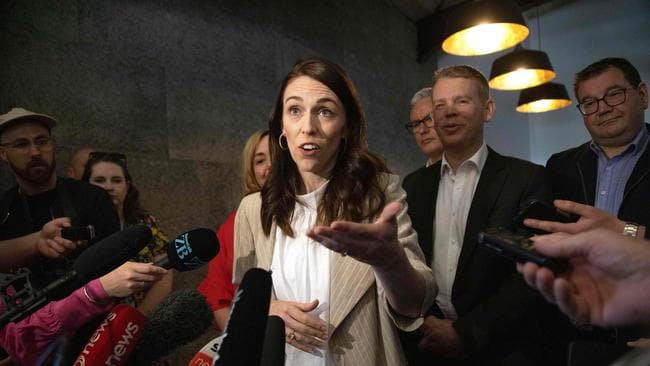 The same could be said about New Zealand Prime Minister Jacinda Ardern. She's a brilliant politician, but has been a grossly incompetent administrator. And with her seismic re-election on Saturday, New Zealand is in for a dangerous three years.
 Creating a depression-era economy is the expert classes' solution to managing COVID-19.
 According to the ad, the incumbent "will be responsible for providing authoritative, strategic and innovative advice in relation to inclusion and intersectionality to justice ministers, DJCS executives and other senior stakeholders".
 The Ridd case is much more than a mere workplace relations dispute between an academic and his employer. It is even bigger than a dispute about climate change.
 Ciccone called for an overhaul of state and federal environmental laws to create more blue-collar jobs, and for limitations on legal injunctions — commonly referred to as "lawfare" — launched by activist green groups.
 In response to Scott Morrison's suggestions that this amounts to "coercion", Beijing has retaliated with the suggestion that Australia needs to do some "soul searching" and that the "racist incidents" were "based on a host of facts".
 The extent of the job losses are the worst in the nation.
 Talking about talking in the name of finding consensus without a specific goal will never be the quickest route to results that will help build a more resilient economy. This is likely to be the fate of Scott Morrison's drum-circle council of unions, big business and employer groups.
 The University of Queensland's predicament did not begin with the news that it was employing one of the country's top legal firms to pursue a member of its own student body, nor will it end there.
 Seven modest measures to cut inefficient and wasteful government spending worth $30bn could be redirected to help fund the commonwealth government economic recovery packages, which assuming an annual salary of $80,000 could save 375,000 jobs.
 That consists of VCs putting their heads in the sand rather than confronting those trying to nobble intellectual diversity on campus. It includes VCs sending long emails about how proud they are of their diversity programs, with no sense of the irony that diversity of opinion is not part of that program. And it means VCs devoting more energy to attracting foreign students than defending freedom of expression.
 The High Court's decision in February that indigenous Australians should be treated differently in the Constitution because of their racial identity was the most radical judgement in Australian history. It destroyed the idea that Australians have about multiculturalism that there was one law in Australia and that everyone was subject to the law in the same way.