Australia's pre-eminent university, Australian National University is the latest institution to take part in the importation of cancel culture, with the university student association's Ethnocultural Department promoting a change.org petition to "remove imperialist statues from the ANU campus", most notably, the statue and bust of Winston Churchill located on campus.
The statue in question is a replica of the Churchill statue in London Square that has been boarded up after continued vandalism. The same day that this famous statue was being boarded up in London Square the petition to remove ANU's replica statue emerged. The petition piously claims that the great British prime minister "upheld principles of white supremacy" and that his "win" for the British Empire renders him thoroughly undeserving of memorialising on campus.
In response to this petition, Generation Liberty contacted organisers and offered a debate between Generation Liberty students and the Ethnocultural Department to debate the matter publicly.
The student group declined Generation Liberty's request for a debate, excusing itself on the grounds that "It is in the best interest of our collective that we not engage in a debate about this particular topic" describing the trauma that even discussing the issue would cause. This is despite being more than happy to discuss the issue with the ANU campus newspaper.
The group also went on to say that "It also becomes extremely emotionally draining to hear counter-arguments to things like 'My ancestors were murdered and enslaved, and the celebration of this history through its perpetrators is painful to me'."
These students have every right to express their views, but if you're going to propose something as drastic as cancelling the West's pre-eminent political opponent of Nazi Germany, at least attempt to articulate those views in a public forum instead of cowering at the idea of debate.
Having taken the stance that the statue and bust of Churchill should be removed, the ethnocultural department has made itself the moral arbiter of right and wrong, and has taken ownership of historical facts.
Many of the same activists and academics who consistently spread an anti-western narrative are the first to adopt the latest cultural wave sweeping those countries.
Churchill was a famously flawed figure, as many of the great men and women of history are. His stubbornness and other divisive traits were only transformed into positives due to the extreme circumstances in which he had to lead both the country and the world.
History should be remembered in all its complexity and context. Yet ANUSA's ethnocultural department claims that the removal of the statue would enable a more accurate reading of history.
It is difficult to imagine how a more accurate picture would be reached without debate. More importantly, a university's most significant role is to allow open and free intellectual debate in the search for truth.
This is another example of how cancel culture manifests and weakens open debate. It started in our universities and is now infecting our media, business and public institutions.
Winston Churchill should be held up in the historical and political context of his time, rather than judging him using the woke, politically correct standards of 2020.
A recent poll conducted by market research firm Dynata, found that 57 per cent of Australians did not want statues of Captain Cook removed, while only 15 per cent supported that proposition. Captain Cook is no Winston Churchill, but it captures the attitude that mainstream Australians have towards historical figures.
Another poll found that 71 per cent of Australians believe "Australia has a history to be proud of" while 85 per cent were proud to be Australians. Mainstream Australians are egalitarian, they acknowledge the shared tragedies of our past, but also celebrate what makes Australia great.
Statues represent a moment in time and should be seen through the context of the time in which they were erected. Their cause has done a great disservice by attempting to erase them due to the wrongs of the past.
We should have more statues not less, so we can both recognise the great institutions of Western Civilisation that we inherited from the British, and also acknowledge the shared history and tragedies of our past.
The ANUSA ethnocultural department should front up to a debate so that these points meet the threshold of what a university should be about, the free and open exchange of ideas in the search of truth, rather than the predetermined position of a selective few.
The news that some schools in NSW are bringing in extra teachers to help 6000 Year 12 students meet minimum standards in reading, writing and numeracy skills to pass their HSC should ring very loud alarm bells for parents.
Much of fault lies with the current NSW curriculum.
One of the most problematic elements of the curriculum is the existence of "cross-curriculum priorities" ― "Sustainability", "Aboriginal and Torres Strait Islander histories and cultures" and "Asia and Australia's engagement with Asia", which were taken directly from the National Curriculum.
The first major problem with these priorities is that they are ideologically driven.
It is true that the curriculum will always be ideological in some way or another because in the basic sense, an ideology is the lens through which we understand the world, the fact is that by calling "Sustainability", "Aboriginal and Torres Strait Islander histories and cultures", and "Asia and Australia's engagement with Asia", priorities, they are being consciously prioritised over everything else in the curriculum.
When the insisting that these three current themes be embedded into all subjects, relevant or not, this means that ideology is being prioritised over knowledge.
When the original authors of the priorities invented the themes in 2011, they did so with the full understanding that this ideology would come to dominate and define Australian education.
They were in fact, deliberately imposing a political agenda on generations of impressionable Australian schoolchildren at a time in their lives where they are at their most vulnerable, and when their understanding of society, environment and politics is shaped by what they hear in the classroom.
The second major problem with these priorities is that they serve no other purpose than to overcrowd an already crowded curriculum, as they are embedded into every subject with complete disregard for whether they are relevant to the subject or not.
Take English for example.
We are told by the NSW Education Standards Authority (NESA) that in learning English, "students have the opportunity to engage with texts that give them experience of the beliefs and value systems of Aboriginal and Torres Strait Islander peoples". NESA also tells us that "English provides learning opportunities for students to explore and appreciate the rich tradition of texts from and about the peoples and countries of Asia, including texts written by Asian authors".
And when it comes to 'Sustainability', the study of English "provides students with the skill required to investigate and understand issues of environmental and social sustainability, to communicate information about sustainability, and to advocate action to improve sustainability".
An examination of the mathematics K-10 course descriptions reveals what can only be described as a tokenistic and artificial shoehorning of the "Aboriginal and Torres Strait Islander histories and cultures" cross curriculum priority.
In the section on how to work out mass, students are asked to "investigate the use of hefting in practical situations, eg the practice used by Aboriginal people of hefting duck eggs to determine whether ducklings will be male or female", while in addition and subtracting students are told that they should "investigate different methods of adding and subtracting used in various cultures, eg. Aboriginal and Torres Strait Islander methods involving special patterns and reason, Asian counting tools such as the abacus."
NESA believes that the "cross-curriculum priorities enable students to develop an understanding about and address the contemporary issues they face".
These are highly ambitious claims indeed, but unfortunately, they have shown to be patently wrong.
The cross-curriculum priorities are not needed in the classroom, either for content or for teaching. There is absolutely no reason for the themes to be repeated in every subject.
The addition of these extra elements into the lessons detracts from the acquisition of real skills, such as literacy and numeracy, which are the fundamental building blocks of education.
This has been proven over the last 18 years, during which time standards in reading, science, and mathematics across every socio-economic quartile — and in government, Catholic and independent schools — have been falling in NSW.
In response to the falling standards, the NSW government has commissioned a review of the curriculum from education expert Professor Geoff Masters.
In his review, Masters concluded that there is too much clutter in most syllabuses and that some students are not getting the solid foundations in English and maths that they need and deserve.
However, he fails to mention the single most obvious solution to the problem ― get rid of the cross-curriculum priorities.
Not once in the 24 recommendations made to the government does Masters even mention cross-curriculum priorities. The only conclusion you can reach is that his silence on the matter means that he must believe in the ideology behind them and wants them to remain embedded into all learning areas.
The government plans to have a new curriculum ready by 2024, claiming that it will prepare students to "meet the challenges and opportunities of the 21st century". This is all very well and good, but they will not be able to meet these challenges if they are unable to read or write.
The ideology-driven cross-curriculum priorities need to go once and for all. Until this happens, students in NSW will find themselves woefully under prepared for the real world.
Last week, Federal Education Minister Dan Tehan announced that the government will be dishing out $90.5 million worth of taxpayers' money to 100 of the 690 applicants who applied to the Australian Research Council for a Future Fellowship grant. A perusal of the project descriptions reveals that the vast majority are extremely worthy ventures which will undoubtedly make a positive and indelible impact on both Australia and Australians' lives.
Predictably however, there is an interesting selection of humanities projects which, for reasons only known to the selection committee, have managed to make the cut. The University of Sydney's Faculty of Arts and Social Sciences, which appears to be staffed entirely by individuals who have devoted their lives to deconstructing knowledge and language while fighting the invisible systems of power, has done pretty well.
Megan Mackenzie, who is Professor of a discipline called "Gender and War" in the Department of Government and International Relations has been awarded $1,052,328 for a project entitled "Eliminating Sexual Violence Within the Military". According to Professor Mackenzie, "Military sexual violence, or sexual violence that occurs within national militaries" is "a complex and gendered international problem". Meanwhile her colleague, Associate Professor Sarah Phillips has been promised $1,006,500 so that she can conduct interviews with people in Yemen, Iraq, Pakistan and Somalia to see how they feel about having to live under the yoke of such terrorists groups as al-Qa'eda, Isis, the Pakistani Taleban and al-Shabaab. I would be willing to wager that they do not feel all that great about it.
While Professor Philips is busy talking to Yemenites in Yemen, anthropologist Associate Professor Holly High will be chatting with Laotians in Laos about socialism and reproduction, as the ARC has thought it prudent to support "Cultural values, birth and parenting. Reproductive Health and Lao socialism" with a generous gift of $922,400. Among other things, the project claims that "anticipated benefits include advanced understandings of Lao culture and society, socialism as it articulates with international health and economic agendas, and the anthropology of human flourishing."
It is of course, not just the folk at the University of Sydney who have received grants. The University of New South Wales has been given $1,011,852 for "A Sonic Approach to Anti-colonialism in Interwar India" which will "apply the methods of Sound Studies to the history of anti-colonialism in India. Extending on earlier work which draws extensively on visual archives to construct historical narratives, this project aims to explicitly trace the reverberations of sound ― especially mediated speech, slogans and song ― in anti-colonial mobilisation in the interwar period." A researcher ensconced at the University of the Sunshine Coast has been awarded $1,014,155 for "Saving Lies: Mapping the influence of Indigenous LGBITQ + creative artists". This project will entail "Using queer and critical race theories and a positively charged mapping of complex identities found in art and art-making."
While this latest funding announcement has been very good news for these academics and their particular pursuits, especially given the extremely precarious state of the Australian university in 2020, it is very bad news for the Australian taxpayer. This is because the Australian taxpayer is paying for a movement whose aim is to obliterate the Australian way of life. As they go about their daily business trying to earn a living in these increasingly difficult times, Australians, through no fault of their own, are funding the very people who are engaged in a culture war which seeks to destroy the values and institutions of Western Civilisation.
Let us take Megan Mackenzie, who has long been generously funded by the taxpayer, as an example. In 2014, she received an Australian Research Council Grant worth $434,692 to fund a project entitled "Women in Combat: a comparative analysis of removing the combat exclusion". Last year, she wrote an article for the taxpayer-funded ABC in which she proposed that masculinity is the biggest obstacle to climate action. While Mackenzie has clearly bought into the notion of white supremacy and the patriarchy, she should be reminded that large numbers of Australian taxpayers who are funding her research are white men. It is both ethically and morally wrong for researchers such as Mackenzie to continue to take money from hard-working Australians who they consistently deride in the public forum.
If academics such as these were to attempt to make a living from propounding identity politics, radical race and gender theory, they would not survive in this world. This is because there is no market among the general populace who naturally have little desire to pay to be insulted or told that they are racist. The harsh reality for those employed in the humanities is that without funding via other people's money, they would struggle to earn their keep. We are in the middle of a very real crisis, yet these academics are still convinced that the most pressing issues of the day are patriarchy, heteronormativity and white supremacy.
The government needs to remember that it is spending the public's money.
Two years ago, Minister Tehan announced the introduction of a National Interest Test (NIT) in which applicants would be asked "the extent to which the research contributes to Australia's national interest through its potential to have economic, commercial, environmental, social or cultural benefits to the Australian community."
According to Minster Tehan, the NIT would give the minister of the day the confidence to look the Australian voter in the eye and say, "your money is being spent wisely". It would certainly take someone of an exceptionally steely disposition to be able look the taxpayer in the eye and tell them that projects about "Lao socialism", "Indigenous LGBITQ + creative artists" or "A Sonic Approach to Anti-colonialism in Interwar India" is their money wisely spent.
By continuing to fund academics obsessed with Marxism and identity politics, the Coalition is supporting a divisive progressive ideology which is contrary to tradition and contrary to what mainstream Australians know is right and true. As long as it keeps financing left-wing institutions, it will continue to lose the culture war.
Peter Ridd has decided to fight last week's decision in favour of James Cook University, and the case is of such public importance that the High Court simply must allow the appeal to be heard.
The Ridd case is much more than a mere workplace relations dispute between an academic and his employer. It is even bigger than a dispute about climate change.
It is about the free speech crisis at our universities, and goes to the heart of the "cancel culture" epidemic engulfing the Western world.
Ridd is a Townsville-based marine geophysicist and Great Barrier Reef expert, whose 30-year academic career effectively ended when he started disputing the conventional wisdom that climate change was "killing" the reef. He subsequently took the university to court, winning $1.2m in compensation for his unlawful sacking. Last week, the Federal Court overturned that win in a 2-1 decision.
In deciding whether to grant special leave for the appeal, the High Court will consider whether the case involves "a question of law that is of public importance". The Ridd matter easily meets this threshold. It would be the first time the High Court has been called upon to consider the meaning of "academic and intellectual freedom", which is used in enterprise agreements covering staff at almost all Australian universities.
The court's decision will therefore have very real consequences in terms of university governance, and the extent to which administrators tolerate controversial (and, often, commercially inconvenient) opinions from the professoriate.
Should "intellectual freedom" be limited by the whims of university administrators, as JCU is arguing? Or should it be wide enough to allow for the kind of controversial, but honestly held opinions for which Ridd was ultimately sacked?
The Federal Court's answer to that question is deeply disturbing. In its judgment last week, the majority seemed to suggest that free speech on campus is past its use-by date.
"There is little to be gained in resorting to historical concepts of academic freedom," scoffed justices Griffiths and Derrington. For good measure, the majority judgment quoted — arguably out of context — from an academic textbook outlining "a host of new challenges", like "the rise of social media" and "student demands for accommodations such as content warnings and safe spaces".
If nothing else, the Federal Court has exposed just how much our public institutions have been corroded by modern cancel culture. The free speech crisis at our universities has been apparent for years, but now the hypersensitivity of woke undergraduates is being taken seriously by our penultimate court. It sets a precedent, and a dangerous one. While The Australian does not suggest the judges acted improperly, it is worrying that the idea the boundaries of free speech should be defined by self-appointed cultural arbiters and anonymous Twitter mobs is on the verge of formal legal recognition.
This is not about the polite notion of so-called "acceptable limits" to free speech. It is a radical departure from how our society treats knowledge. Former opinion editor Bari Weiss recognised this dynamic in her sensational resignation from The New York Times recently: "I was always taught that journalists were charged with writing the first rough draft of history," Weiss wrote. "Now, history itself is one more ephemeral thing moulded to fit the needs of a predetermined narrative."
You could replace the words "journalism" and "history" with almost any intellectual discipline. Woke revisionism has trashed the humanities faculties almost beyond repair. Now it is creeping into the "hard sciences". That is how we have arrived at a situation in which a respected academic such as Ridd is put through hell for offering a critique of the "settled science" of climate change.
If our judicial system lets JCU get away with it, every academic in the country — present and future — will be forced to choose between speaking the truth and putting bread on the table.
And for students, the Ridd case will mean the difference between tertiary education as a rigorous intellectual pursuit that invites critical thinking, or as rigid dogma that must be internalised and regurgitated in order to secure an expensive piece of paper with one's name on it.
Intellectual freedom and free speech are not antiquated notions. They are ancient and important rights, and "public institutions" that dispense with them are not public at all.
The issues raised by the Ridd matter must at least be considered by the highest court in the land. The implications for our most basic freedoms give every Australian a stake in its outcome.
Yesterday Education Minister Dan Tehan announced that university students will now be paying up to $14,500 per year to study the humanities, an increase of over 110 per cent.
On all likelihood, the fee hike will mean a larger bill for the Australian taxpayer as many humanities students leave university without the skills needed to get a job and start to pay back their HECS debt.
This news has of course been greeted with outrage and anger from the National Union of Students as well as the National Tertiary Education Union.
National President of the NUS Molly Willmott, for example, said "These degrees are important. The jobs that come out of them are important. These students deserve better from the government."
This is very true. Students studying the humanities do indeed deserve better. They deserve much, much better. This is because Australian undergraduates who have been enrolled to study degrees in the humanities have not in any way been getting their money's worth.
Students are, in short, being swindled by their institutions.
The idea behind studying the humanities used to be so that students were equipped with the tools to try make sense of and understand the world through the Western tradition of art, culture and philosophy. This is no longer the case. If you think Australian undergraduates are getting Plato or Socrates, Shakespeare or Dante, think again.
Instead, students have been getting fed a very depressing and thoroughly predictable diet of "new humanities" subjects based entirely around the postmodern theory of identity politics.
All subjects, whether it be history, literature, art or geography, must be shoe-horned into the idea that everything in the world is simply a societal power struggle of class, race and gender.
For the entire duration of their university careers, students have the same thing drummed into them repeatedly, by ideologically driven academics who present this single world view to undergraduates.
Let's have a look at some of the courses which have been on offer.
At the University of Western Australia, students have been taking Community, Power and the Common Good in which they have, "explored the community engagement and community empowerment through … social justice, power, equality and inequality, ethical public behaviour (and) theories of community building".
Over at the University of South Australia, undergraduates have been learning about the "social construct of whiteness and representations of whiteness in contemporary Australia" in a unit called Identity and Representation. Those same students, enrolled in Gender, Sexuality and Representation have been spending their days considering "ways in which cultural artefacts reinforce or challenge dominant beliefs about gender and sexuality".
Students studying history have been getting an especially raw deal.
At least if you sign up for a degree in gender studies, you expect a generous dose of feminist studies and Queer Theory. However, students studying both world and Australian history have been finishing their degrees with a completely distorted view of the world in which the past is viewed as a contest between the oppressors and the oppressed.
Australian history especially, has been repackaged and relabelled as a social and political commentary on contemporary issues rather than a study of actual history.
At Monash University, those enrolled in Australian Stories: People, Place, History explored "crime and punishment, gender and sexuality, the environment, family (and) race relations", while students at the University of New South Wales taking Inequality in Australia were asked to consider "how was inequality influenced by race, gender, sexuality, age and disability?" and "when and why did it become a political issue?"
It is clear that Australian taxpayers have been funding the creation of a social warrior underclass of disaffected young Australians who emerge from universities with a particular view of Australia's history which colours their view on Australian society.
It is no wonder that these Australians have been taking to the streets decrying "racism" and wanting to expunge our history by tearing down monuments and statues.
Rather than more technocratic tinkering with university fees, the government should simply cease providing taxpayer support to any organisation that attacks and undermines Australian values.
This not only means ending funding for humanities departments, but also for our national broadcaster, the ABC, which has been a cheerleader of division through its relentless editorialising based on identity politics.
And it means no more funding for government and quasi-government organisations, such as the Australian Human Rights Commission, which spends its days soliciting complaints from Australians about how racist this country supposedly is and censoring freedom of speech.
The main dividing line of our time is not left or right, but identity politics versus mainstream Australian values.
Mainstream Australians, regardless of their race, ethnicity, or background value our egalitarian way of life, liberal democratic institutions, freedom of speech, freedom of religion, hard work, small business, home ownership, and seek a better life for themselves and their children.
There is far more that unites than divides us as a country. The humanities departments at universities must stop their relentless attack on the Australian way of life or lose their funding altogether.
Australian universities are in quite the pickle. Not only are they watching as potentially $12bn in revenue from foreign student fees slips away, but they are also being accused of racism by the country they rely on for so much of their funding. Last week, Beijing issued a statement in which it warned Chinese students to give Australian universities a wide berth because of both COVID-19 and endemic racism.
In response to Scott Morrison's suggestions that this amounts to "coercion", Beijing has retaliated with the suggestion that Australia needs to do some "soul searching" and that the "racist incidents" were "based on a host of facts".
This is a delicious irony. For years so many Australian universities have been making money out of the racism industry. Now they are on the back foot, having to defend themselves against an accusation that is demonstrably false.
For decades academics employed in our institutions of higher education, especially those in the humanities, have been using taxpayers' money to paint a picture of Australia as a country of racists. They have been using their positions in various faculties to propagate the myth that we are a xenophobic nation.
They have taken every opportunity to berate mainstream Australians about how they should be both ashamed of their history and ashamed of themselves. They have been telling Australians that it is somehow immoral to celebrate Australia Day, that Captain James Cook was an invader, and that the whole existence of the modern state of Australia is a terrible mistake, a crime to be endlessly deplored and for which we must constantly apologise. They have insisted that the values and institutions of Western civilisation are racist, imperialist and outdated, and must be expunged from our society.
The University of Sydney leads the way in the business of race. A couple of years ago, its academics infamously rejected the Ramsay Centre's bachelor of arts in Western civilisation as "white supremacy writ large". The faculty of arts and social science boasts a taxpayer-funded "Resurgent Racism" project, which has concluded that unless something is done by the faculty, Australian society will face a dystopian future of white supremacy. Last year, the university hosted a self-styled "anti-racism educator" from the US to lecture everyone on campus about how racist they all were.
The staff in the history faculty seem to spend significant waking hours thinking, writing and talking about race and racism, all at the expense of the taxpayer. Since 2002, the faculty has received almost $9m from the Australian Research Council to fund 18 historical studies research projects that focus on racism in one form or another.
Nine months ago, the vice-chancellor of the University of Sydney, Michael Spence, appeared to comment that anyone who dared question the existence of Chinese influence on his campus was basically a racist. "We have to be careful that the whole debate doesn't have overtones of the White Australia policy," he told The Sydney Morning Herald. In this way, he ensured next year's income — or so he thought at the time. No one predicted that COVID-19 would wipe out, almost overnight, $884m in international student fees for the University of Sydney, a generous portion of which would come from Chinese students.
Spence is the highest-paid vice-chancellor in Australia, earning $1.5m a year. As yet, he has not taken a pay cut like many of his colleagues.
This episode has revealed another crack in the crumbling facade of the Australian university, which is one of the crucial institutions of Western civilisation yet which fails the Australian public, having lost sight of its purpose. Our universities are facing a systematic crisis and have been exposed as incompetently run businesses more interested in foreign dollars, social justice, diversity and identity politics than they are the pursuit of truth, freedom of speech and intellectual inquiry. They are floundering in the midst of a free speech crisis, with a questionable commitment to academia and a terrible track record in dealing with academics and students who hold a contrary view to the established groupthink. Last year's Independent Review of Freedom of Speech in Higher Education Providers (the French review) found that many of the higher education rules and policies in universities used broad language "capable of impinging on freedom of expression".
Not only have we seen the censure and unlawful sacking of Professor Peter Ridd by James Cook University, but to add insult to injury, JCU's court case is being funded by taxpayers, having already cost $630,000 in legal fees. Meanwhile, the University of Queensland employed one of Australia's top legal firms to pursue philosophy undergraduate Drew Pavlou regarding his robust criticism of the university's connections with China as well as that country's history of human rights abuses.
Our universities have long ceased being institutions interested in the rigorous exercise of freedom or the scientific method and today better resemble elaborate public relations outfits.
While Daniel Andrews hands out thousands of dollars to international students in Victoria, domestic students are left to foot the bill as they continue to pay fees for services that do not exist.
The Student Services and Amenities Fee is a compulsory upfront payment of up to $308 introduced by the Gillard government in 2011. This repackaged form of compulsory student unionism, where fees are set by the university but with a large portion going to the union or guild, has resulted in a conflict of interest that has left domestic students without a voice at a crucial time.
Generation Liberty has discovered that the majority of public universities in the state of Victoria are continuing to charge this fee, with the exception of La Trobe, which waived the fee, and Deakin University, which switched all students to the lower online student fee. There are currently no sports events, club meetings or student barbeques, but the money for them is still being collected hand over fist.
This is at a time when a large proportion of university students are suffering from severe financial strain. My research has shown that younger Australians have been some of the hardest hit by the economic lockdown. With sixty per cent of 18 to 24-year-olds having lost their job, had their hours cut or had their salary reduced.
Student unions and guilds have remained strangely silent on this issue. This could be because they receive the lion share of their funding from SSAF. Student unions are supposed to be a voice for students and hold universities to account. Right now, universities is effectively paying off that voice.
Their self-interest is made clear by the fact that they have not been silent when it comes to other student fees. The University of Melbourne Student Union recently released a video calling for fee relief. To support their demand, the USMU sighted their recent survey report of 6,421 students, which revealed 89.41 per cent are in favour of fee reduction. SSAF was not mentioned once in the 15-page report.
UMSU and many other student unions are conveniently choosing to focus on long-term fees, which in most cases will be added HECS and paid at a later date for domestic students, instead of the much more immediate issue of the compulsory SSAF, which is paid upfront.
$308 in students' pockets now would provide much more immediate relief than a slightly reduced HECS fee in 5 years' time. Despite this, the idea of even reducing this payment has not been raised by the UMSU.
This admission is even more glaring when a neighbouring university is doing the right thing and waiving the fee ― La Trobe University is even providing a refund service online for those who have already paid the fee. So obviously this is not an unreasonable request.
Some universities and student unions have claimed these on-campus services will now be provided online. The University of Melbourne explains on their website that "Many SSAF funded services are being redesigned for our virtual campus, with a stronger focus on student wellbeing and a sense of belonging and connectedness across our student community".
"Wellbeing" is a subjective term. For example, UMSU recently held an online workshop event in collaboration with the group Women's Climate Justice Collective — a national group led by women, aiming to mainstream feminist climate justice, entitled Enviro Workshop: Feminist Climate Justice. Which they must have felt would be more beneficial to student body than having the extra money in their pockets. While this may keep the content producers employed, funding it seems to be an unfair burden for students when so many of them have lost their jobs.
What is worse is that many universities, including the University of Monash and Federation University, only charge these fees to domestic students. This is in spite of the fact that the services thereby funded are provided to all students.
Compulsory student unionism was axed under the premise that it was wrong to force students to indirectly fund political campaigns that they disagreed with. It was brought back under the premise that it was only going to be a fee for tangible amenities.
It is clear from the actions of the universities and their unions that this justification was a farce. It is time to scrap the SSAF. Universities should make a point of putting their students first.
We should all care about the case of 20-year-old Drew Pavlou, not only because of the injustice of a university intimidating its own student but also because it is symptomatic of the crisis of universities in Australia.
The University of Queensland's predicament did not begin with the news that it was employing one of the country's top legal firms to pursue a member of its own student body, nor will it end there.
On May 20, philosophy undergraduate Pavlou will be required to defend himself against allegations of misconduct, particularly in respect of his vocal criticism of the university's connections with China. This goes far beyond the acceptable behaviour by a public institution.
The Pavlou affair has exposed two things to the Australian public. First, it has exposed the fact UQ, like so many other Australian universities, is now in an extremely perilous financial position, having made the mistake of putting all its eggs in one international student basket. Last year, the university had an estimated 53,305 students, 20,213 of whom were international, about half of whom hailed from China. Last year, the university raked in $679m in direct tuition fees alone.
Second, this is another example of how Australian universities are more focused on their business model than engaging in free intellectual inquiry. In the same way James Cook University (unlawfully) sacked Peter Ridd for exposing flawed Great Barrier Reef science that was lucrative to its business model, UQ is casting aside an outspoken student.
Last year there were scenes of chaos on campus as 200 pro-Chinese Communist Party students turned up to a peaceful pro-Hong Kong freedom demonstration organised by Pavlou. In several videos shared on social media, pro-CCP students were seen screaming, ripping up posters, playing the Chinese national anthem and assaulting the pro-Hong Kong students. The response of the Chinese consul-general in Brisbane, Xu Jie, who happens to be an adjunct professor at the university, was to praise the pro-CCP students for their actions as "self-motived patriotic behaviour".
The university did nothing to stop 200 pro-CCP students, and its statement following the fracas was unsatisfactory to say the least. It did not name the pro-CCP students as the perpetrators of the violence, nor did it mention disciplinary action. It did not even mention how violent the protests had been, despite viral videos widely available on social media.
When some of the protesters received visits from Beijing's security apparatus, the university failed to protect them, instead siding with Beijing. Moreover, Xu is still ensconced at the school of languages and cultures.
Also well and truly ensconced on the university campus is a Confucius Institute which, according to its website, is a "gateway to Chinese language and culture". While this might be the formal mission of the 480 institutes around the world, their informal mission is to promote a highly uncritical view of Chinese society, and they are considered part of a wider pattern of activities that ensure Beijing's determined narrative is adhered to and disseminated widely in the host countries.
Among other things, this means subjects such as the three Ts — Tibet, Taiwan and Tiananmen Square — cannot be discussed in many classrooms without fear of a backlash.
Australia has 13 Confucius Institutes as well as 54 Confucius Classrooms that claim to support language education in schools. This means we have the third highest number of Confucius Institutes and classrooms in the world, behind the US and Britain. This when many universities in the US — including the University of Chicago — have been closing their Confucius Institutes, and academics have told Human Rights Watch the institutes are an affront to academic freedom.
Even more disturbing is that several of our prominent universities have signed profitable agreements with Hanban, the agency under which China's education ministry oversees the institutes.
Employees at UQ, for example, have signed an agreement in which they "must accept the assessment of the (Confucius Institute) Headquarters on the teaching quality".
China is using the full force of its economic weight to interfere with academic freedom and stifle free speech on campus in the same way it is putting pressure on Australia economically to silence us on an inquiry into COVID-19.
As UQ ponders the unravelling of the basket into which it has placed all its eggs, it should review the almost laughable scope and force of its disciplinary action against Pavlou. The chancellor and the senate must be aware that the creation of martyrs tends to put the spotlight on precisely the issues they are trying to suppress. As Australia becomes more concerned with the sacrifice of free speech in favour of Beijing, UQ may find itself taking direction from governments closer to home.
Like all parents of school-aged children in my state, I recently received an email from the Education Department letting me know that term two will be entirely from home. I have often fancied the idea of homeschooling, but never imagined it would happen, and certainly not during a global pandemic. My middle-class assumptions had us trekking around forests and museums, while my teenage daughter became a child genius, and I turned into one of those Pinterest dads making science craft out of egg cartons.
But really it has been a good opportunity to take a closer look at what she is learning in Secondary school. The evidence shows that the school curriculum is failing our students, with a clear drop in performance over the last eighteen years. This is demonstrated in the latest OECD Program for International Student Assessment, where Australian kids have fallen almost a full school year behind in reading and science. They are already being a year behind in maths. I brought this up to my daughter's teacher at the last interview and was immediately told that this testing is outdated and that children now have a greater ability to think creatively. Well, that's fabulous — but if my daughter is to fulfil her goals of being a pilot, she'll also need to be able to read and write. If you pick up a fourth-grade maths textbook from a hundred years ago, it would be almost tertiary level these days.
I have family and friends who are teachers ― and they are wonderful, hardworking educators, who have also upended everything and moved online for the short term. Overall the problem lies in the National Curriculum, the latest of which was introduced in 2014, and focuses on three key areas: disciplinary knowledge, skills and understanding; general capabilities; and the cross-curriculum priorities of Aboriginal and Torres Strait Islander histories and cultures, Asia and Australia's engagement with Asia; and sustainability. This centralised curriculum is structured in such a way that these priorities are emphasised and incorporated across all subjects. The existence of these core priorities results in less time for essential content, such as literacy and numeracy. The recent school climate strikes show that children are learning more about one side of political activism, with a lot less critical thinking than the curriculum might suggest. Why does the State mandate these priorities, about which parents have no choice in?
So, will this COVID-19 pandemic lead more parents to think about homeschooling? Or at least school choice? Before the lockdown, there were 30,000 students registered for homeschooling in Australia, with each state having their own registration. Currently, they can choose whether to follow the national curriculum or not. Most commonly, it is urban, secular parents disillusioned with the test-driven, one-size-fits-all model.
Compulsory government schooling began in the 1850s in Massachusetts, where an estimated 80 per cent of the population resisted, often with guns, until the final outpost surrendered their children in the 1880s ― when the area was seized by militia and the children were marched off to school under armed guard. Harvard Law School, also in Massachusetts, will be hosting an anti-home-schooling conference in June. One speaker, Professor James Dwyer says that "the reason parent-child relationships exist is because the State confers legal parenthood". That gave me chills. In Germany, homeschooling has been illegal since World War II, and parents must leave the country if they choose this method for their children.
Here in Australia, it was also difficult to enforce, and education became compulsory in the 1870s, apparently to decrease crime and teach children how to be moral law-abiding citizens. Currently, we spend 5.9 per cent of GDP — $111.8 billion — on education, with 60 per cent of our students in government schools, and the rest in independent. Are we getting good value for money? As a dad of three, who has seen a drop in standards, I am going to say no and await the howls. According to John Taylor Gatto, "In our secular society, school has become the replacement for church, and like church, it requires that its teachings be taken on faith." He also said that "school is a twelve-year jail sentence where bad habits are the only curriculum truly learned." Gatto was an award-winning teacher for nearly 30 years before he announced that he no longer wished to "hurt kids to make a living", and then went into a public speaking and writing career promoting open-source learning and unschooling. He felt it was impossible for schooling and education to be the same thing.
Most schools have done reasonably well shifting over to this new method for the short term ― the girl is loving all the extra screen time she's now allowed, and maybe this will lead in a business boom for optometrists. They even have allocated times for exercise, which they record and upload for the teacher to assess. A brave new world indeed, although it gives a good sense of normality for some of the students. But only for the students lucky enough to live in a household where they can afford multiple computers and high-speed Wi-Fi. For the families with parents working from home, or out of work, or especially in abusive households, the idea of education continuing is a fantasy. But will it make much of a difference, given our already tumbling standards? While scrolling online, I came across a photo from a friend with a large family. They have shifted one of the older girls out of her bedroom to convert it into a classroom for all her siblings, and have managed to scramble together enough laptops, iPads, and headphones. This family also run a small business, and several of the children are competitive athletes. My friend really has it all together, but she is already aware that this version of homeschooling as mostly just more computer time ― and it's only been a couple of weeks.
Nevertheless, before we know it, children will be back off to school, and life will slowly return to pre-pandemic normality for those lucky enough to still have a job. But what will the nearly four million students have learnt in this lockdown term? For the first time in a long time, it will be the full responsibility of the parents.
Despite the health advice consistently provided by the Australian Health Protection Principal Committee which says that teachers can and should go back to school, teachers' unions across the country are continuing to dig their heels in and are doing their level best to make sure that this doesn't happen.
The message to the teachers from the Federal Government could not be clearer: it is safe to go back to doing your job with appropriate measures in place.
The recommendation from the National Cabinet is that "on current evidence, schools can be fully open" and that "attendance at a school campus for education represents a very low health risk to students".
The advice also notes that "appropriate practices must be employed at schools, like at other workplaces, to provide a safe working environment for school staff, including teachers".
However, Chief Medical Officer Brendan Murphy said that "we're concerned that our governments are keeping schools closed not from a health recommendation but almost because of parental fear and some reaction in local governments."
It is no coincidence that the politicians who are most opposed to reopening schools are in those states which have the most militant teachers' unions. Daniel Andrews and his cabinet seem to be in the pockets of the Victorian teachers' unions.
This week, the Victorian Education Minister James Merlino even went so far to say that a Melbourne principal's decision to bring back half of the school students next week is "reckless".
The Education Minister's portfolio is to ensure that Victorian children receive the best education possible. He should be working to re-open schools as quickly and as safely as possible. Instead, he is doing his best to ensure that they stay shut.
In NSW, the union is not even prepared to consider implementing Gladys Berejiklian's plan for students to go back from May 11 in a staggered rate so that the schools are ready for full-time schooling to start in July.
In South Australia, the chief public health Officer Dr Nicola Spurrier wrote a twitter message to parents saying that schools were safe to re-open, which the AEU decided to emblazon with the words "Seriously, Spurrier?"
In Queensland, the union is also defying medical consensus by treating to not only close schools if too many children turn up or they run out of cleaning products, but it is also telling no doubt stressed parents that they will have to homeschool until the end of June.
Like everyone else, teachers would have been to the shops, done the groceries, gone for walks, shopped at Bunnings and lined up at Dan Murphy's. However, according to the unions, going to school presents a higher risk.
In WWII, the unions refused to unload cargo.
The wharfies deliberately sabotaged the war effort by destroying vehicles and equipment, stealing food being loaded for soldiers, holding snap strikes and demanding "danger money" for loading biscuits.
Now the unions are depriving children of an education, and at the same time refusing to give much needed relief to millions of parents who are facing an everyday struggle to work from home and educate their children at the same time. Perhaps a solution would be to pay those parents the teachers' salaries while the schools remain closed.
Teachers are not being asked to go to the front line of contagion.
During the Spanish flu pandemic in 1919, school teachers were seen to be the best source of essential workers, and were asked to volunteer to become the nucleus of an organisation to establish District Emergency Relief Depots which were designed to assist people disadvantaged by the pandemic.
This meant that teachers went directly to the houses of the very sick and the unemployed.
Most teachers who are sitting at home want to get back to work and to see their students again. They relish the face-to-face interaction with their pupils — after all, teaching is a vocation. Most of them see online teaching as wasteful, inadequate and boring. The unions speak with the voice of the minority.
Teachers' unions are unique because they mostly involve government jobs. Rather than negotiating with an employer for higher shares of the profits, they instead negotiate for more of our tax dollars.
In a free market, teacher performance and compensation go hand-in-hand, but teachers' unions rely on coercion to increase pay, and they seek to restrict competition through political means.
This may help the teachers' unions, but it is harmful towards children and their parents who pay taxes.
The unions are responsible for many problems in our education system.
Unions do not like competition, so they require teachers to get a university degree because that way they can control what the teachers are being taught.
They demotivate teachers and punish ambition because they are against performance-based pay. It's almost impossible to sack a bad teacher, and for good teachers ambition and excellence are punished.
They undermine other forms of education, other than online learning, such as homeschooling.
Is it any wonder why Australian schoolchildren are behind in literacy and numeracy?
Teachers' unions say they care about children. But their actions during the last month or so has sent a loud and clear message, which is that their primary concern is about themselves.
Few images better capture the out of touch and incompetent nature of Australia's self-described elites as three university academics playing word games to describe the economy as "hibernating" while the lives of millions of normal Australians are being destroyed and disfigured, some permanently.
According to reports in the Nine papers (April 1, 2020), three academics from the Australian National University developed the term "hibernation" to describe the shutting down of the Australian economy as a consequence of the social distancing measures enacted by state and Commonwealth governments. The term is meant to capture the temporary nature of the crisis.
This is no temporary crisis. This is a tragedy of biblical proportions.
Many of the Australians who will become unemployed over the next six months will not simply go into hibernation, to then thaw out and resume business as usual. They will never work again. Their wages will never recover. Their lives will never be the same.
Precious moments will be lost and never recovered, like all of the grandparents who can't see their grandchildren. Like all of the elderly who are trapped isolated, alone and afraid in the homes. And like all of the Australians who have had destroyed in just days the small businesses they built up over years.
Perhaps if you work at a multi-billion-dollar taxpayer funded organization protected by government from competition or wage cuts then it is easy to practice social distancing and talk via Zoom or Skype to play clever word games which mischaracterize reality. It is also not a surprise that the secretary of the Treasury Department, Steven Kennedy, is an alumnus of the ANU, as are many of his colleagues at Treasury and the Reserve Bank of Australia. Such is the incestuous nature of Australia's expert class.
One wonders if any of those involved in the development of the hibernation strategy have ever looked a colleague who has a family and a mortgage in the eye and told them there are not enough customers coming through the door to keep them employed.
If universities wanted to be helpful, perhaps they could open the doors of the dormitories once filled with thousands of foreign students to those who need to be put in quarantine, rather than being put up at taxpayers' expense in five-star accommodation. Or perhaps universities could stop the persecution of those such as Professor Peter Ridd, now the subject of an appeal against his sweeping legal victory last year, to allow for the free exchange of ideas and opinions which is so crucial in a time of uncertainty.
Or perhaps, instead of wasting taxpayer dollars on research programs which tell Australians what awful, racist, and bigoted people they are, the universities could analyse how Australia could improve its pandemic response ability. On this last point, my research found identity politics was the single most common theme in the historical studies discipline to receive funding under the Australian Research Council's Competitive Grants Program.
Famous conservative philosopher Sir Roger Scruton argued that "intellectuals are naturally attracted by the idea of a planned society, in the belief that they will be in charge of it." Trouble is, the intellectuals are in charge ― and only an intellectual could think that our jobs, social relations, and institutions can be temporarily put into hibernation and then brought back to life via government edict. This is why shared sacrifice is so important. Those developing the ideas and policies which are putting Australians out of work must themselves have skin in the game and feel some of the pain of their own decisions and advice.
One suggestion is that for every one tenth of a percentage point increase in the unemployment rate (such as from 5.5 per cent to 5.6 per cent), is accompanied by a one per cent cut to the pay of senior public servants. And if the unemployment rate goes above seven per cent, the Secretary of the Treasury and the Governor of the Reserve Bank must lose their jobs.
Another suggestion is for all of the experts advising the government to be put in front of a rolling set of parliamentary inquiries so Australians can understand the assumptions underpinning government decisions. It would be interesting to see if the health experts who modelled the impact of the coronavirus also modelled the social, cultural, and institutional impacts of economic depression.
"Free speech crisis? What crisis?" Uttered in freaky unison, this frequent denial from university vice-chancellors has allowed them to resume normal programming.
That consists of VCs putting their heads in the sand rather than confronting those trying to nobble intellectual diversity on campus. It includes VCs sending long emails about how proud they are of their diversity programs, with no sense of the irony that diversity of opinion is not part of that program. And it means VCs devoting more energy to attracting foreign students than defending freedom of expression.
How much longer can university leaders ignore the accelerating rhythm to raids on free speech at Australian universities? Today, the most brazen opponents of free speech within universities are those who control student unions. Funded by other students' money, the leaders of student unions use their union muscle to control what other students hear, read and learn. Not content with running social events, defending students' rights or holding university management to account, a small group of students have assumed a new role as campus censor. And they imagine that if they provide a band and a BBQ, they can flex their political arm without reproach.
On Tuesday afternoon, the student association at Melbourne's Monash University, which runs Orientation Week stalls, BBQs and other events aimed at offering students "a diverse introduction to Monash", rejected an application from Generation Liberty to be part of the program's activities.
Generation Liberty is a program run for young Australians, including university students, introducing them to ideas, arguments, and perspectives that they may have missed at school or university. The program is a big hit; its growth, especially over the past 12 months, points to a real hunger for knowledge not addressed by schools and universities.
In an email, events officer Michele Fredregill from the Monash Student Association told fellow Monash student Luca Rossi, a Generation Liberty co-ordinator at the university: "We have carefully reviewed your booking request and discussed it internally. Regretfully we must decline your booking application on the basis of our terms and conditions. Generation Liberty's positions on issues such as climate change do not align with MSA's."
This is what happens when zealotry is threatened by facts. There is nothing in the terms and conditions to justify denying Generation Liberty's application to be part of O-Week, which kicks off on Monday.
In any case, a student union, or any other body, cannot use "Ts & Cs" to contract out of obligations under Victoria's Equal Opportunity Act 2010 not to discriminate against a person on the basis of their political beliefs or activities.
More sinister is MSA's reference to not aligning with "Generation Liberty's positions on issues such as climate change". Generation Liberty has no "position" on climate change. Gen Lib produces research based on facts: the rest is left up to who is reading, listening or watching papers, podcasts or YouTube videos.
Rossi, 19, has hit back at this MSA censorship. "As a student at Monash, it is insulting for your student association, who supposedly represents you, to basically say you can't be trusted with your own thoughts, we have to think for you."
The Monash law/arts student features in a series of Gen Lib YouTube videos launched late last year called What I Wasn't Told.
At last count, What I Wasn't Told … About Climate Change had attracted just shy of 200,000 views. The video includes links for the curious to read the research that justifies every statement.
Rossi says had Gen Lib been given the chance to join O-Week, "we would have set up a stall, handed out some stickers and badges, and if some students want to have a chat with us, then we give them the idea of freedom. And that's it."
What exactly are the officeholders of the student union at Monash afraid of? That some inquisitive students might grab a vegan burger from the MSA BBQ, then wander over to the Gen Lib stall and pick up a free sticker carrying the Jordan Peterson quote "In order to be able to think, you have to risk being offensive"?
Or maybe they fear the badge carrying these words from Ricky Gervais: "Just because you're offended doesn't mean you're right."
Another badge says: "Make Orwell Fiction Again."
The only steadfast position taken by Gen Lib is a belief in open inquiry and students thinking for themselves. Clearly this belief in intellectual diversity does not align with the MSA.
Rossi, one of 16 Gen Lib campus co-ordinators at 15 Australian universities, is frustrated by the lack of transparency, too. "It's shady," he says, alluding to the decision by MSA president James McDonald to fob it off as an "operations issue" in answer to Rossi's request for more details as to why the student union rejected Gen Lib's application.
"It's basically as little transparency as possible: 'You're not allowed to be here because we don't agree with your views. Now please go away'," says Rossi.
Alas, passing the buck about incursions into intellectual diversity happens at the highest levels about an issue that should be embedded in the DNA of every serious university.
When the student guild at the Queensland University of Technology refused Gen Lib's application to be part of Market Week last month, vice-chancellor Margaret Sheil learned about it from the media and responded by saying QUT was committed to "a variety of contesting viewpoints".
But when this asserted belief in contesting viewpoints has not filtered down to the student guild, it is clear that intellectual diversity is not embedded in QUT's culture.
The dirty little secret is that student unions are baying campus censors, too. And it takes only a handful of students who control events such as Market Week at QUT and O-Week at Monash to undermine intellectual diversity for the rest of the student population. My research compiled last year revealed that 59 per cent of students believe they are sometimes prevented from voicing their opinions on controversial issues by other students.
For student unions, freedom of speech is a controversial issue.
It is a stark failure of logic and leadership when VCs try to dodge responsibility by saying student unions are "independent" from university administration. Student unions hold functions on campus, they are meant to represent other university students, and student unions are partly funded by compulsory student services and amenities fees paid by every student, except international ones.
Who then, if not university administrators, will hold these student censors to account?
It is not unreasonable for VCs, acting on behalf of all students, to require students within student unions or guilds to commit, in practice, to freedom of expression, open debate and intellectual diversity. That starts with O-Week activities.
Instead, there is a failure of accountability right up and down the line. Just over a week ago, new Tasmanian Liberal senator Claire Chandler questioned professor Nick Saunders, chief commissioner of the Tertiary Education Quality and Standards Agency, the body charged with holding universities to their part of the funding deal — universities receive federal funding from taxpayers in return for delivering intellectual inquiry on campus. Saunders said the regulatory body has no authority to rein in censorship by student unions.
Chandler tells Inquirer: "One of the real policy questions that has to be answered here is: does a university's obligation to promote free speech on campus extend to student unions … given that these unions are getting funding from universities, through services and amenities fees that are compulsory?"
Of course it should. More than that, it is time to restart the battle over compulsory fees that prop up these student censors. Whereas the Coalition government abolished compulsory student unionism in 2005, the Gillard government reintroduced them in 2010 in the form of the services and amenities fee. Ten years later, student unions are using these compulsory fees to fund their censorship of ideas and people on campus.
Chandler, who is passionate about universities fostering genuine intellectual freedom to sharpen young students' minds, says that if the model code recommended by former High Court chief justice Robert French in his review of free speech at Australian universities doesn't capture obligations of student unions to free speech, then this "gap" needs to be addressed.
Fill the gap, by all means, but a code will not necessarily change a culture.
I saw a similar problem with the ABC board five years ago. There was, and remains, a deeply embedded culture among journalists, producers and higher levels of the tax-funded media behemoth opposed to the intellectual diversity that is explicitly required under its charter.
Internal codes which purported to commit the ABC to their legislative charter made no difference up against that culture. Instead, even egregious cases of bias by journalists were routinely met with management claims that editorial policies are too vague, dodging any finding of a breach of the policy. Management would suggest the ABC board redraft the policies, a useless "make work" exercise, to remove areas of grey.
When another glaringly obvious episode arose of bias, often from the same journalist — recidivists were not hard to find — the board would receive the same response. It's all rather grey so we can't do anything. In other words: go away, our ABC culture trumps a code and even a legislative charter mandating intellectual diversity.
The same scenario will unfold across Australian universities. Even the most beautifully crafted free-speech code will count for nothing until there is meaningful cultural change.
And that will not happen until the Morrison government moves to reduce funding to universities that do not implement cultural change.
Over to Education Minister Dan Tehan to walk the talk, remembering too that academic freedom was thrown under the bus when James Cook University decided to sack professor Peter Ridd on a bogus code of conduct claim. JCU has committed to spending hundreds of thousands of dollars to defend that action in courts, rather than defend intellectual diversity.
In the meantime, we are left to ponder the state of a higher education where codes, laws, regulators and the media are needed to remind VCs and student unions about the core business of a university.
Australian universities should not get a cent of any federal government bailout program or stimulus package in the wake of the coronavirus.
Over the past decade universities have privatised the profits from the fees paid by overseas students. University vice-chancellors in this country enjoy building Taj Mahals to themselves and earning an average annual salary of close to $1 million.
It's true universities are now large operations. The University of Sydney has a $2.8 billion budget and its vice-chancellor is paid $1.5 million a year. But it's not that hard to run a business in an industry that is basically a self-perpetuating oligopoly where the government does you the favour of banning price or product competition.
Australia's universities these days are like our banks. They compete against each other on the basis of the colour of their logo and the strength of their supposed commitment to the latest progressive cause promoted on Twitter. (But, to be fair to universities and the banks, if advertising such fripperies is basically the only thing the government allows you to do to attract customers, that's what you do.)
The University of Sydney said this week it is facing a loss to its revenue of $200 million because of the coronavirus, with 15,000 of its students unable to leave China. According to the university, if these students missed a year of education, up to 1500 full-time jobs would be affected in NSW, in the retail, accommodation, and food services sectors.
This is a revealing argument from the university. It demonstrates that the $17 billion Australian taxpayers pay to our universities is as much about supporting employment in fast food outlets as it is about fulfilling Cardinal John Henry Newman's vision of a university as a place that "educates the intellect to reason well in all matters, to reach outwards towards truth, and grasp it".
The truth is that public universities in this country are today not places of higher learning ― they're certificate factories.
Certainly there are pockets of creativity and scholarship and groundbreaking research in Australian universities, but they are harder and harder to find. The reasons for this are many and varied, ranging from the Labor Party's Whitlamite obsession to bestow a university qualification on as many people as possible regardless of its quality, to the Liberals' complete lack of comprehension about what has happened to universities, to the sector's preference for growth at any expense.
As Peter Hartcher has reported in The Sydney Morning Herald, it was Victorian Liberal senator James Paterson who summed up the universities' situation in the Coalition party room last week.
In a discussion about federal government financial assistance for those affected by the coronavirus, Paterson said: "With the ongoing China travel ban, I'm very sympathetic about the impact of tourism and farmers, but I'm less so with the universities. Because they have been warned for years that they are over-reliant on the Chinese market, and for years they've reassured us that it was all fine, and that if anything they'd be able to withstand it. They rode the cycle up, now they can ride the cycle down."
The argument is often made, usually by the universities themselves, that they've been forced to rely on overseas student income to make up for Coalition funding cuts. This is demonstrably wrong.
As travel bans on students hit university enrolments, the tertiary sector should not be allowed to force taxpayers to socialise their losses.
Universities can't have it both ways. They can't on the one hand declare their autonomy and complain when ministers involve themselves in the allocation of research funding, for example, and then on the other hand, at the first hint of trouble go with their begging bowl to the very same minister, asking for a taxpayer-funded handout.
On Sunday the ABC published an article stating that masculinity is the biggest obstacle to climate action. The highly offensive piece, which was steeped in misandry and titled "Is fragile masculinity the biggest obstacle to climate action?", was written by University of Sydney academic Megan Mackenzie. It was published exactly the way you would expect: with a triple barrel of taxpayer funds.
First, Mackenzie is employed at Sydney University, which is a taxpayer-funded institution. According to its annual report last year, the university pocketed a total of $710.3m in Australian government grants, plus an extra $45.5m in NSW government grants. This is hardly an insignificant amount of taxpayer dollars.
Second, Mackenzie's research work also has been generously funded by the taxpayer. In 2014, she received an Australian Research Council grant worth $434,692 to fund a project entitled Women in Combat: A Comparative Analysis of Removing the Combat Exclusion.
Third, her article has been published by the ABC, which is, of course, another taxpayer-funded institution funded to the tune of more than $1bn a year.
While Mackenzie has completely bought into the notion that white men are the embodiment of evil, she needs to remember that a large number of Australian taxpayers who are funding her research are hardworking white men against whom she rallies.
It is wrong for researchers such as Mackenzie to continue to take benefit from the money of people who they consistently and openly deride in the public forum.
Last year, Sydney University hosted American professor, author and "renowned anti-racism educator" Robin DiAngelo on campus so she could harangue white people about how racist they were. Taxpayer money is being used without the slightest hint of questioning, self-reflection or consideration for the taxpayers themselves. If academics such as Mackenzie were to attempt to make a living from propounding identity politics, radical gender theory and eco-poetics, they would not survive in this world. This is because there is no market among the general populace, who naturally have little desire to pay someone to insult them. The harsh reality for those employed in the humanities is that without funding via other people's money, they would struggle to earn their keep.
What Sydney University academic Mackenzie has done is to connect two diametrically opposed topics that currently obsess the elite of this country: gender and climate change.
This is something at which the university appears to excel. Readers will now be familiar with its FutureFix program, in particular the Multispecies Justice project, which is described by the university as "a post human reconceptualisation of justice via a multispecies lens" and that looks at how "justice across the human and natural world (would) look like and entail". Moreover, a lecturer also proposed that we need to consider seriously the "arguments for the formal inclusion of animal interests in democracies".
The university even has its own all-encompassing Environment Institute, which covers everything from the Great Barrier Reef to justice and culture. In October, the institute hosted a two-day symposium titled Unsettling Ecological Poetics, during which various participants from universities around Australia gathered to read poems about climate change, sustainability, radical feminism, racism and LGBTQ+ issues.
The move to combine disciplines is part of a growing worldwide trend to create new and exciting interdisciplinary studies. In a recent article for The Conversation, a couple of academics from the University of California stated the case for combining climate change science and the humanities with their article "Why science needs the humanities to solve climate change".
There is little doubt that Australian universities are in crisis. This is because academics such as Mackenzie have completely rejected the cornerstones of Western civilisation and, in doing, so are cutting themselves and students off from truth, reason and knowledge. The reason student numbers are falling in the humanities is because academics appear to be indulging in their own interests without consideration for anything else.
These cloistered academics are completely out of touch with mainstream Australians, but even in the face of resounding defeat they refuse to see it. They belong to the elite who were voted out in May by mainstream Australians and rejected en masse by the British public last week.
Yet the government continues to fund agitators who are filled with the zeal of the righteous, and who not only believe their own propaganda but also insist everyone else must believe it, too. By giving money to institutions such as the university, the ARC and the ABC, the Coalition is funding a progressive ideology that is contrary to tradition, contrary to what people believe and contrary to the truth. The Coalition might keep winning elections, but as long as it keeps funding left-wing institutions that promulgate insidious identity politics it will continue to lose the battle of ideas.
The University of Sydney's Faculty of Arts and Social Sciences continues to be the standard bearer for everything that is desperately wrong with modern academia. In October, the university's Environment Institute hosted a two-day symposium entitled "Unsettling Ecological Poetics". For the uninitiated, ecological poetics, also known as ecopoetics, is a relatively new genre of profoundly pessimistic poetry which laments the supposedly irreversible damage that human beings have wreaked upon our planet. Much of the poetry also has a generous dose of feminism, racism, colonialism and LGBTQ+ issues thrown in for good measure. Uplifting it is not.
The subject matter discussed during this convention would have left anyone in the room who was not currently employed in the humanities wondering if they were witnessing the collapse of Western Civilisation. Day one began with a presentation called Ecopotency: Writing blak to power and influence in Australian ecopoetics, which was concluded by "an embodied performance of new poems and an exploration of ecopoetic spaces from the perspective of a young Munanjali queer". Following lunch, the audience enjoyed an afternoon of group self-flagellation while they listened to poems designed to "disrupt the national amnesia of the settler mythscape through dismantling the modern mythology of Australia as a settled space". They were also asked to ponder "much if not most of the built-up and over-built landscape that is the crime scene of post-Invasion Australia". In another presentation Naming without Claiming? Compositing Feminisms in the Environmental Humanities, the audience was told that "from the nature/culture binary to the notion of situation knowledges, feminist conceptual labours are arguably foundational to contemporary environmental humanities scholarship".
Things got a bit more interesting on day two. In Vagrant Desires and the Homely Queer; Intimacy, ecopoetics, and the local, the presenter quoted from Timothy Morton's Queer Ecology. This may well be a work unfamiliar to readers of this periodical, but the main thesis is that nature insists on being too heterosexual. With a knowledge of tree hugging that can only be attributed to empiricism, Morton asserts that "Tree hugging is a form of eroticism, not a chaste Natural unperformance. To contemplate ecology's unfathomable intimacies is to imagine pleasures that are not heteronormative, not genital, not geared to ideologies about where the body starts. Perhaps this is why mysticism contain reserves of unthought zones of materiality." Perhaps.
This excerpt, and indeed the entire contents of the symposium, are as unfathomable as the "intimacies" that preoccupy Timothy Morton. The "Unsettling Ecological Poetics" symposium is not merely unsettling; it is baffling, confounding and discombobulating. It is Sir Roger Scruton's Parisian nonsense machine cranked up to eleven, churning out volumes of indecipherable post-modernist gibberish masquerading as scholarship. None of it means anything at all. How anyone can devote their life to this madness and remain sane in the process is a mystery.
That the University of Sydney's Faculty of Arts and Social Sciences hosted this symposium is not surprising. The current dean lists her research interests as "feminist studies, lesbian/gay studies and queer theory", while her most recent monograph entitled Orgasmology, "takes orgasm as its scholarly object in order to think queerly about questions of politics and pleasure; practice and subjectivity; agency and ethics". Furthermore, the faculty is home to "FutureFix", a program devised by academics in a futile attempt to show tax-paying Australians that their money is being put to good use and which includes such projects as "Resurgent Racism" and "Multispecies Justice".
Sydney's Faculty of Arts and Social Sciences merely exemplifies the depths to which the humanities departments across the nation have sunk. Whether it be History, English, Anthropology or Social Sciences, everything is now geared towards the intellectual equivalent of a totalitarian state governed by one orthodoxy; identity politics. This has been exposed in my latest report The Humanities in Crisis. An Audit of Taxpayer-funded ARC Grants which looks at the sorts of humanities projects which have been funded since 2002.
According to the Australian Research Council, its purpose is "to grow knowledge and innovation for the benefit of the Australian community" and that "the outcomes of ARC-funded research deliver cultural, economic, social and environmental benefits to all Australians". One would hope therefore, that the research undertaken in the last seventeen years would benefit society at large and would make a positive and indelible impact on Australia, improve citizens lives and ensure its continued success as a prosperous, peaceful and stable nation. There is an enormous disconnect between the stated aims of the ARC and the quality of the proposals which have been funded by taxpayers for nearly two decades.
Since 2002, the ARC has distributed a total of $1.34 billion in funding to humanities projects which are narrow in scope, often incomprehensible and which reflect the current obsession with identity politics, cultural studies, critical theory and radical feminism. Examples are as numerous as they are terrible. Academics at the University of Sydney pocketed $735K for a cultural studies research project called "Reconceiving the queer public sphere; an interdisciplinary analysis of same-sex couple domesticity", by "critically analysing queer home life to transform current understandings of the relation between homosexuality, private life and the public sphere". At Melbourne University the ARC awarded $100K to a cultural studies project examining "Female stardom and gay subcultural reception" while James Cook University was given $2.7 million to look at "How gender shapes the world; a linguistic perspective", which would "enhance our nation's capacity to interpret and manage gender roles in multicultural contexts".
There is no doubt the humanities are in a state of crisis because academics have rejected the cornerstones of Western Civilisation. In doing so, they have cut both themselves and their students off from truth, reason and knowledge. They have taken control of, and are despoiling the very culture they are occupying.
If you were not already convinced that Australia's humanities departments have truly lost their way, the latest research project from the faculty of arts and social sciences at the University of Sydney should get you over the line.
Resurgent Racism is the seventh "flagship" theme of FutureFix, a program devised by academics at the university to show taxpaying Australians their money is being put to good use. Resurgent Racism will "address the emergence of new forms of racism manifesting as national populism and far-right extremism". Researchers will "seek to explain the logics of emboldened white racism in Western liberal democracies", which they predict "will be applicable to majoritarian racism elsewhere". These self-appointed sages have looked into the crystal ball and have seen a future blighted by white supremacists.
But we can be pulled back from the brink of this dystopian nightmare if the team at the faculty of arts and sciences is permitted to spend taxpayers' dollars, and the next few years, "mapping the changes of racism, including anti-Semitism, Islamophobia and white supremacism" in Australia.
That Islam is a religion, not a race, seems not to matter because a great many academics have shifted from focusing on what is real to what is not — in this case an imagined crisis of endemic racism. They are knee-deep in the quagmire of identity politics, that most dangerous and divisive of ideas that insists on distinguishing individuals by their differences rather than by their similarities.
Like so many in the humanities, they view the world through a Manichean lens, in which everything can be explained as a struggle between the forces of good (light) and evil (darkness). Everything they think about, write about and talk about in their capacity as historians, sociologists or political scientists must support the belief that Western civilisation is a white male patriarchy that wields power over, and oppresses, women and racial minorities.
Last year, Sydney University invited American professor, author and "renowned anti-racism educator" Robin DiAngelo so she could tell all the white people attending the launch of What Does It Mean to be White? Developing White Racial Literacy just how terribly, but perhaps not irredeemably, racist they were. According to DiAngelo, white people live in a racially insular bubble that renders them quivering wrecks when it comes to talking about race, a phenomenon she calls "White Fragility". "Why does race seem to be the hardest word for white people?" she asked.
If she were to take a closer, impartial look at the Australian university sector, she would encounter many white people who have no problem at all with the word. Many academics are not only not afraid to talk about race but they talk about it so incessantly that if it weren't for gender — the other great preoccupation of 21st-century academe — it would verge on monomania.
Since 2002, the department has received almost $9m from the Australian Research Council to fund 18 historical studies research projects that focus on racism, in one form or another. These included The Construction of Race and Racial Identity at the Antipodes of Empire, 1788-1840 (costing $231,000); Southern Racial Concepts: Comparative Histories and Contemporary Legacies ($2.4m); Immigration Restriction and the Racial state, c. 1880 to the Present ($359,000); Enterprising Women, Race, Gender and Power in the Revolutionary Atlantic, 1770-1820 ($323,000); and The Racial Century ($94,000).
The Resurgent Racism squad comprises, among others, former race discrimination commissioner Tim Soutphommasane, seen by some to have encouraged complaints to the Australian Human Rights Commission following publication of a 2016 cartoon by Bill Leak in this newspaper. Last year Soutphommasane gave the keynote address at the university's National Centre for Cultural Competence, launched in 2013 to the tune of $5.6m of taxpayers' money. It claims its mission is to "roll out cultural competence across the university and broader local national and international community", but in reality it is a concerted effort to convince us Anglo-Celtic white culture is bad.
When vice-chancellor Michael Spence suggested questioning the existence of Chinese influence on his campus was akin to the White Australia policy, he was simply ensuring next year's income. Last year the university pocketed $884m in international student fees, a generous portion from Chinese students.
The Resurgent Racism team is spending taxpayers' money to tell Australians how racist we are. It is evidence the racism industry is flourishing on our university campuses, which are no longer in the business of producing objective and impartial scholarship that will edify, inspire and educate future generations of Australians.
If what happened at RMIT University in Melbourne last week was a one-off event, it could be laughed at as the behaviour of a single rogue academic.
But the pity is that the actions of a senior lecturer in mechanical engineering at RMIT University, Hormoz Marzbani, neatly encapsulates the intellectual crisis at Australia's universities. Our universities now engage in partisan politics and ideological barracking not disinterested intellectual inquiry.
Marzbani informed his students that if they attended the climate strike, they would be awarded full marks for that day's assessment. The students' work requirement was "All you need to do is email me a group selfie in the crowd". Helpfully Marzbani enclosed with his message the details for the time and location of the strike.
The administration of RMIT University, in response to media inquiries, replied: "While the teacher has determined that the conversation at today's global climate strike is educational and relevant to the learning for this project, RMIT will of course be looking at the decision to ensure that assessment integrity is maintained."
Marzbani is only a senior lecturer. At the University of Melbourne, John Prins is a professor and head of its medical school. Last week he wrote to students saying they were "encouraged to consider joining with staff" at the climate strike. Marzbani and Prins occupy positions of trust and respect — positions they're willing to misuse.
At universities a few levels up from professors are vice-chancellors. Earlier this week, it was revealed that Sandra Harding AO, the Vice-Chancellor of James Cook University in Townsville, has authorised the university to appeal against the decision of the Federal Circuit Court that found that in 2018 the university had unlawfully dismissed its professor of physics, Peter Ridd. The university was ordered to pay $1.2 million in damages and penalties. Ridd had questioned the evidence upon which other scientists had based their opinion that the Great Barrier Reef was dying.
For its appeal, JCU has engaged one of the country's leading barristers, Sydney-based Bret Walker, SC, to argue that Ridd as a university employee was not entitled to freedom of academic enquiry. What JCU is paying Walker and its two other barristers is as yet unknown. What is known is that someone of Walker's ilk can command fees of $20,000 a day. It is also known from a freedom-of-information request that until April, JCU had already spent more than $630,000 in legal expenses on the case. JCU's legal bill is paid by taxpayers. Ridd's legal expenses are paid from his own pocket and from donations via an online public appeal.
Lest it be thought that these three examples all relate only to climate change and that intolerance of differing viewpoints doesn't extend to other fields of academic endeavour, the evidence says otherwise. After an outcry from its staff, the Australian National University spurned an offer of funding from the Ramsay Centre for Western Civilisation to provide the sort of undergraduate course that up until a few years ago would have been regarded as completely unexceptional.
Australia's university students are beginning to realise what's happening because they see it in class every day. According to a survey of 500 students commissioned from independent market research company Dynata, 31 per cent of respondents have been made to feel uncomfortable by their university teacher for expressing an opinion. Even more damning, 58 per cent of students feel they are more exposed to new ideas on social media than at university.
Before too long Australia's universities could be hit by another crisis — a financial one.
In 2017, 27 per cent of students enrolled in Australian universities were from overseas and 32 per cent of those students were from China. Analysis by the Centre for Independent Studies reveals at that at University of Sydney, Chinese students account for more than 20 per cent of the university's revenue. Many would argue such a revenue model is unsustainable and that short-term economic profit has taken priority over the maintenance of quality.
Australia's universities need to keep in mind that when institutions are in crisis one of two things happens.
 The statue in question is a replica of the Churchill statue in London Square that has been boarded up after continued vandalism. The same day that this famous statue was being boarded up in London Square the petition to remove ANU's replica statue emerged. The petition piously claims that the great British prime minister "upheld principles of white supremacy" and that his "win" for the British Empire renders him thoroughly undeserving of memorialising on campus.


 Much of fault lies with the current NSW curriculum.
 Predictably however, there is an interesting selection of humanities projects which, for reasons only known to the selection committee, have managed to make the cut. The University of Sydney's Faculty of Arts and Social Sciences, which appears to be staffed entirely by individuals who have devoted their lives to deconstructing knowledge and language while fighting the invisible systems of power, has done pretty well.
 The Ridd case is much more than a mere workplace relations dispute between an academic and his employer. It is even bigger than a dispute about climate change.
 On all likelihood, the fee hike will mean a larger bill for the Australian taxpayer as many humanities students leave university without the skills needed to get a job and start to pay back their HECS debt.
 In response to Scott Morrison's suggestions that this amounts to "coercion", Beijing has retaliated with the suggestion that Australia needs to do some "soul searching" and that the "racist incidents" were "based on a host of facts".
 The Student Services and Amenities Fee is a compulsory upfront payment of up to $308 introduced by the Gillard government in 2011. This repackaged form of compulsory student unionism, where fees are set by the university but with a large portion going to the union or guild, has resulted in a conflict of interest that has left domestic students without a voice at a crucial time.
 The University of Queensland's predicament did not begin with the news that it was employing one of the country's top legal firms to pursue a member of its own student body, nor will it end there.
 But really it has been a good opportunity to take a closer look at what she is learning in Secondary school. The evidence shows that the school curriculum is failing our students, with a clear drop in performance over the last eighteen years. This is demonstrated in the latest OECD Program for International Student Assessment, where Australian kids have fallen almost a full school year behind in reading and science. They are already being a year behind in maths. I brought this up to my daughter's teacher at the last interview and was immediately told that this testing is outdated and that children now have a greater ability to think creatively. Well, that's fabulous — but if my daughter is to fulfil her goals of being a pilot, she'll also need to be able to read and write. If you pick up a fourth-grade maths textbook from a hundred years ago, it would be almost tertiary level these days.
 The message to the teachers from the Federal Government could not be clearer: it is safe to go back to doing your job with appropriate measures in place.
 That consists of VCs putting their heads in the sand rather than confronting those trying to nobble intellectual diversity on campus. It includes VCs sending long emails about how proud they are of their diversity programs, with no sense of the irony that diversity of opinion is not part of that program. And it means VCs devoting more energy to attracting foreign students than defending freedom of expression.
 First, Mackenzie is employed at Sydney University, which is a taxpayer-funded institution. According to its annual report last year, the university pocketed a total of $710.3m in Australian government grants, plus an extra $45.5m in NSW government grants. This is hardly an insignificant amount of taxpayer dollars.
 The subject matter discussed during this convention would have left anyone in the room who was not currently employed in the humanities wondering if they were witnessing the collapse of Western Civilisation. Day one began with a presentation called Ecopotency: Writing blak to power and influence in Australian ecopoetics, which was concluded by "an embodied performance of new poems and an exploration of ecopoetic spaces from the perspective of a young Munanjali queer". Following lunch, the audience enjoyed an afternoon of group self-flagellation while they listened to poems designed to "disrupt the national amnesia of the settler mythscape through dismantling the modern mythology of Australia as a settled space". They were also asked to ponder "much if not most of the built-up and over-built landscape that is the crime scene of post-Invasion Australia". In another presentation Naming without Claiming? Compositing Feminisms in the Environmental Humanities, the audience was told that "from the nature/culture binary to the notion of situation knowledges, feminist conceptual labours are arguably foundational to contemporary environmental humanities scholarship".
 Resurgent Racism is the seventh "flagship" theme of FutureFix, a program devised by academics at the university to show taxpaying Australians their money is being put to good use. Resurgent Racism will "address the emergence of new forms of racism manifesting as national populism and far-right extremism". Researchers will "seek to explain the logics of emboldened white racism in Western liberal democracies", which they predict "will be applicable to majoritarian racism elsewhere". These self-appointed sages have looked into the crystal ball and have seen a future blighted by white supremacists.
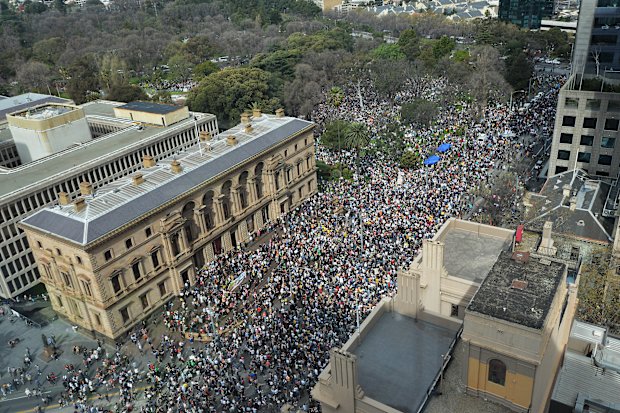 But the pity is that the actions of a senior lecturer in mechanical engineering at RMIT University, Hormoz Marzbani, neatly encapsulates the intellectual crisis at Australia's