Showing posts with label The Age. Show all posts

Friday, August 07, 2020

The Economic Crisis Is Still To Come

It is pretty clear what Victorian Premier Daniel Andrews wants:  the overwhelming majority of Victorians to remain in their homes for, at least, 23 hours a day.  Go out for exercise, and shopping, if you must.  Don't go out between 8pm and 5am at all.  If you don't know, the answer is "no".  Stay at home is the very clear message.

Business is shell-shocked.  The problem being that everyone who can work from home, is working from home.  Those who can't have mostly been stood down.  Nationwide the federal government estimates "effective unemployment" to be about 11 per cent.  When JobKeeper goes many of those people will never work again.  Many businesses will not reopen.

Yet the Victorian government wants still less economic activity.

The economy is already broken.  Devastated.  The economic crisis is still to come.  Realise this:  in 2008-09 the government spent tens of billions of dollars keeping the economy going.  In 2020 the government has already spent hundreds of billions of dollars to stall the economy.  We haven't begun restarting the economy.

Victorians are panic buying.  Again.  Who can blame them when the Premier keeps saying you'll be able to buy what you "need" ― whatever that means ― not necessarily what you "want".  He is trying to be reassuring;  but everyone knows that government has a poor track record in providing what people need, let alone what they want.  The Victorian government is trying to micromanage supply chains and distribution.  This is not going to end well.  It never does.

It gets worse.  Both state and federal government are in denial.  They seem to think that this is a "business-as-usual" crisis.  That somehow when they give the all-clear that we'll emerge ― as if from hibernation ― from our homes, squeeze into our work clothes, give up our day-drinking, and go back to work.  This is the snap-back view.  Similarly many economic commentators seem to think that a good dose of government spending and tax increases will restore our prosperity.

Well, no.  Reflect on the fact that the federal budget never recovered from the global financial crisis.  At best, the federal government was going to deliver a $5 billion surplus in 2019-20.  That forecast surplus is now a $85.8 billion deficit.  This financial year ― before the second Victorian lockdown ― the federal deficit is forecast to be $184.5 billion.

Economies are not about businesses, and unions, and shops, and goods and services.  The economy is about people;  their plans, their expectations, their relationships.  For all the talk about competition, the economy is about co-operation.  The economy is not a machine that can be switched off and on at will.  The interrelated web of co-operative relationships that was the February 2020 economy is gone forever.  The economy that now exists is a lot smaller than what it was just six months ago.  The problem now being that we can't be sure which part of it will revive and which part of it won't.

What we can be sure of is that monetary and fiscal policy will play a small role in recovery ― perhaps no role.  The RBA has been trying to ignite "animal spirits" with low interest rates for a decade.  The government has already borrowed so much money that our grandchildren will be paying it off.  Not that I'm being overly critical ― that spending was necessary to maintain the fabric of our society.  The point being that we have already spent a lot of money just to stall the economy.

I do not want to suggest that debt and deficit don't matter ― that somehow the RBA could just print money to finance our spending.  Modern Monetary Theory is to economics what hydroxychloroquine is to COVID treatment.

Warren Hogan of University of Technology Sydney has suggested that two decades of sustained economic growth will be necessary to pay off the debt.  I agree.

We are going to have to work our way back to prosperity.  Job creation is going to have to be the number-one policy objective for the next generation.  Not make-work job creation that government excels at, but rather private sector jobs.  Not more road building projects, but rather private sector entrepreneurship and innovation.  That means trade and open borders.  There is going to be a lot more technology use, too.

Serious microeconomic reform is needed.  Australia has done it before.  We could have been a banana republic.

There is no excuse why Australia cannot be a wealthy and prosperous nation.  Healthy, kind and caring too.

We have also become used to the trappings of prosperity.  We are going to have to give up some luxuries.  Like the massive regulatory state that has evolved over the past generation.  We can no longer afford to have government agencies suing companies on a whim.  Or have competition authorities making the world safe for incumbents.  To be fair, government has already undertaken some deregulation and instituted some tax cuts, even repaid taxes.

That is a good start.  Going forward cutting more taxes, cutting red tape, green tape, and beige tape will be a priority.  Getting people into jobs and keeping them in jobs will secure our prosperity.

Monday, December 02, 2019

More Regulation Is Not The Solution To Westpac Revelations

Yet another scandal among Australia's banks suggests the industry is in dire need of a clean-out.  Westpac has committed one of the most startling failures of corporate governance in Australian history.  After a year-long investigation, the bank stands accused of failing to report, as required by law, 23 million transactions that it had facilitated, and, in particular, failing to notice a series of suspicious transactions originating from South-east Asia that have been implicated in child exploitation.

The consequences for Westpac continued to mount.  The bank is expected to be fined more than $1 billion.  It lost $6 billion in market capitalisation, or 7 per cent of its value.  Its chairman and chief executive have both resigned.  All of this is fair enough.  The allegations are extremely serious and, if proved, demonstrate an almost-incredible negligence.

Inevitably, these facts raise the question of whether a policy response is required, and what kind.  Given the recent Hayne inquiry into various kinds of malfeasance by Australia's banks, it would be understandable if the first recourse that comes to political minds is more legislation or regulation.  But this would be a mistake.

Banks, as unsympathetic as they are, already labour under the weight of a substantial regulatory burden:  apart from the various civil and criminal laws to which they are subject, my research has shown that banks and the finance industry are governed by 76,000 pages of regulatory dark matter, referring to legislative instruments and bureaucratic guidance.  An earlier report by Deloitte found that one in 11 Australian workers is employed in compliance, with the number in finance estimated to be even higher.

None of this amounts to a defence of Westpac, but it suggests that Australia's banking industry does not suffer for a lack of rules.  Instead, the better question is:  why are Australia's banks so bad?  We ought to consider whether all of these scandals point to a systemic problem.

To begin to answer this question, note first that the big banks, and big business generally, welcome regulation and actively co-operate in its creation.  For example, the act under which Westpac was charged was passed in 2006 after extensive consultation with the sector, and in particular with the then Australian Bankers' Association.  For big businesses, it is well understood that compliance can be useful for limiting competition from smaller rivals that are less able to bear the associated costs.  They have little incentive, then, to adopt an adversarial approach to regulators.

For this reason, it is not surprising that a 2018 Grattan report found businesses in heavily regulated industries put more effort into lobbying than other businesses.  It might be thought that this effort is towards deregulation.  But if that is the case, then it is the least successful lobbying operation in history.  The simpler explanation is that this effort is towards self-interested regulation.

In the case of banking, the most obvious self-interest is the perpetuation of Australia's anti-competitive cartelisation of the industry.  The "four pillars" policy prevents mergers between Australia's biggest four banks.  Despite the Productivity Commission last year advising that the policy be dropped, it has the support of the now Australian Banking Association.  Its chief executive, former Queensland Labor premier Anna Bligh, told the ABC after that report came out that the policy had contributed to stability, which necessarily has to be traded off against competition in the marketplace.

This aversion to competition can also be attributed to the growing role of institutional investors, such as super funds.  Super funds value stability over growth because their product is low-risk guaranteed returns to members.  Not coincidentally, the removal of Westpac chief executive Brian Hartzer reportedly followed a meeting with Australian Council of Superannuation Investors chief executive Louise Davidson.  Her organisation represents all of the major super funds, which control $2.2 trillion of capital, much of which is invested in blue chip Australian companies like the banks.  Super funds own an average of 10 per cent of every ASX 200 company.

The banking industry, then, has been deliberately constructed — by government, its practitioners and its investors — to prefer regulation and stability to competition and dynamism.  This is the context within which the recent scandals have occurred.  It is an industry that knows that no matter what it does, it has the protection of its powerful friends.  So it feels at liberty to behave badly, or negligently.  As risk analyst Nassim Taleb would say, Australia's banking industry has no "skin in the game" — and its performance is worse for it.

Any policy response should target this insularity by instilling some competitive discipline into the industry.  The alternative is more regulation and more compliance costs.  But if the root cause of Australia's banking problems is that the banks, the regulators, the government, the lobby groups and so on are all in it together, then further regulation should be seen for what it is:  the ruling class closing ranks.

Wednesday, October 17, 2018

Moving Embassy To Jerusalem Could Spark Peace Process

The Morrison government's announcement that it will now consider recognising Jerusalem as the capital of Israel is a welcome reiteration of our liberal democratic values in foreign policy.

Australia's embassy is currently in Tel Aviv, which is a fine city — it is a modern cosmopolitan commercial and cultural hub with beautiful beaches and fabulous night life.  But it is not Israel's capital.
Israel's capital is Jerusalem.  Jerusalem is the home of Israel's parliament, the Knesset, the administrative apparatus and the President and Prime Minister.

Israel is the only country that does not get to select its own capital and have that recognised by other nations.  It would be strange for Australia's American embassy to be located in New York and not Washington, DC, or our British high commission to be in Manchester and not London.

A decision to move the embassy would be a welcome affirmation of Israel's right to self-determination like any other nation.

A relocation would follow the lead of the United States under President Donald Trump.  However, the idea is not new.  American presidential candidates have promised it for decades, both Democrats and Republicans including presidents Bill Clinton, Barack Obama and George W. Bush.

In Australia, Senator James Paterson's maiden speech in 2016 declared that, "It would be a symbolic but important step for Australia to formally recognise Jerusalem as Israel's capital city and to move our embassy there."

The Liberal Party's federal council also passed a motion calling for the embassy to be moved.

The Morrison government has reiterated its support for a negotiated two-state solution to the Arab-Israeli conflict.  In recent days, however, it has been claimed that Australia moving the embassy undermines the peace process.  The sad reality is that there are currently no negotiations that moving the embassy could undermine — since the Palestinians are refusing to meet without preconditions.

A potential positive result of Australia and other countries moving their embassies to Jerusalem is that it places pressure on the Palestinians to finally return to the negotiating table.  It also helps address a potential sticking point by pressuring the Palestinians to recognise Israel's right to exist and the thousands-of-years-long bond between the Jewish people and Jerusalem.

Nevertheless, it is important to not exaggerate the implications of moving the embassy.  The religious and historical sites of the Old City in Jerusalem can continue to be accessed by people of all religions.  The facts on the ground, that is, Israel's claim to and physical location in Jerusalem, will continue.  The proof that moving the embassy does not change the reality on the ground already exists.  Following initial protests, there has been no change in the situation in Israel following the US decision earlier this year.

The notion that moving the embassy undermines a future peace settlement is based on a fundamental misunderstanding of history and the peace process.

Israel's capital has been located in Jerusalem since 1950, following the events of the Independence War in which a coalition of Arab states rejected the United Nations partition plan that included both a Jewish and a Palestinian state.  This is notably before the 1967 war that unified West Jerusalem with the east that includes the Old City.

Australia's embassy would inevitably be located in West Jerusalem after a peace settlement.  There is no scenario in which a peace agreement would not include a recognition of Israel's capital in West Jerusalem — with an open possibility for a Palestinian capital located in the east of the city where Australia could locate a Palestinian embassy.

The international community's approach to Israel, most commonly from nations not part of the liberal democratic family, has been one of demonisation.  UN Watch calculated that of the 97 United Nations resolutions criticising countries between 2012 and 2015, a whopping 83 were against Israel.

This is substantially more condemnation than of hermit state North Korea, economic basket case Venezuela, or Saudi Arabia where the big human rights breakthrough in recent months is that women will be able to drive for the first time.

There are some that will never recognise the right of the Jewish people to self-determination;  there are some who will continue to target the one Jewish state for special criticism and treatment.

Australia's foreign policy should be driven by our values — not by the potential for backlash from nations that are both less liberal and less democratic than ourselves.  Israel is the only functioning liberal democracy in the Middle East.  It deserves our moral and symbolic support.  In an increasingly polarised world, we will only be respected by our neighbours and allies if we stay true to our beliefs.  Now is not the time to waiver.

As Winston Churchill is often quoted as saying, "You have enemies?  Good.  That means you've stood up for something, sometime in your life."

An Australian decision to move the embassy would right a historical wrong, stay true to our liberal democratic values, and put the State of Israel on an equal footing with the rest of the international community.

Wednesday, July 11, 2018

Labor Is Setting A New Gold Standard For Changing The Rules

Sometimes you have to wonder how politicians can be so utterly shameless when it comes to their own self-interest.  The Andrews government's changes to the Victorian Electoral Act, currently before Parliament, are the perfect example.  If passed, the bill would allow for the brazen manipulation of the democratic process, at great expense for us, the Victorian taxpayers.

Of course, politicians gaming the system in their favour is nothing new.  But with its Electoral Legislation Amendment Bill, Labor is setting a new gold standard for changing the rules for their own advantage.
One of the bill's most egregious features is limiting the amount of money that individuals can privately donate to political parties and candidates, which will be capped at just $1000 a year.  Such a stringent donations cap would be a grievous attack on freedom of speech and political communication.

It is self-evident that genuine democracy requires that all citizens are free to speak on political issues.  But free speech is more than just the right to literally speak.  Thousands of Australians exercise their right to participate not by speaking themselves, but by supporting other organisations — including political parties — which espouse values and policies with which they agree.  This includes financial support.

Limiting Victorians' ability to donate money to candidates and parties is an unjustified restriction on participation in the democratic process.  It is no different from limiting how many how-to-vote cards a party volunteer can hand out, how much door-knocking they can do, or how many petitions a citizen can sign.

So if there are restrictions on private donation, how will parties fund their election campaigns?  Well, under the government's bill, "public" (that is, taxpayer) funding for political campaigns is going to go through the roof, jumping from $9.6 million in actual payments at the last state election to a staggering $27.6 million under the proposed system.  Currently, the Victorian Electoral Commission forks out about $1.65 per primary vote.  Under the Andrews government's bill, parties will receive $6 per vote in the lower house and $3 per vote in the upper house.

Almost all of this money would flow to the two major parties and the Greens.  This is because Labor's bill retains the requirement that candidates receive a primary vote of more than 4 per cent to qualify.  So minor parties will miss out on almost all of this taxpayer largesse.  (To the Coalition's credit, it opposes the bill, despite the hefty windfall it will receive under the proposed system.)

On top of that, political parties will also receive a new quarterly payment of $10,000 per elected MP to assist with "administrative costs" — such as staff, rent, stationery and the like — slugging Victorians another $5.12 million a year.

The government is quick to point out that it will be unlawful to use these payments on campaign expenses, which is technically right.  But obviously there is an "opportunity cost" factor at play here.  If political parties have the cost of running their offices taken care of, then more of their own money will be freed up for political campaigning.  And once again, the payment will heavily favour the major parties, as it is calculated on the basis of how many elected MPs each party has in Parliament.

Finally, to add insult to injury, the government has snuck in a few loopholes that will mean business as usual for the Labor Party.  For example, the new donations cap does not apply to what the bill calls "affiliation fees", the kind of fees Labor rakes in from its constituent trade unions.  So while private individuals freely donating their money to causes they support is now verboten, unions can continue to give millions in members' money by "affiliating" with the Labor Party.  There is no good reason for this double standard.

The bottom line is that if this stink bomb of a bill passes, Spring Street will be even further removed from the people it is supposed to represent.  Once upon a time, pollies had to rely on the generosity of free individuals to fund their campaigns, largely by reflecting supporters' values and policies.  With this bill, Labor is cutting out the middle man, seizing campaign funds from ordinary Victorians with the force of law.

And so state politics will look less like a reflection of Western democracy, and more like some kind of gigantic boxing match to which every Victorian will be forced to buy a ticket.  Give a few million to the guy in the red corner, a few million to the guy in the blue corner, and watch as they duke it out.  And unlike a real boxing match, the real losers will be the ordinary Victorians who are funding the whole grotesque spectacle.

Friday, March 16, 2018

Labor's Tax Plan Is A Raid On Every Australian's Super Fund

The next federal election campaign got under way this week.  It looks like debt, deficit, and taxation will dominate our lives for the next year or so.  Not nearly as exciting as citizenship and sex scandals, but ultimately more important to the long-term prosperity of the nation.

The differences are quite clear and stark.
The coalition government is arguing, from a position of budget deficit and growing national debt, for lower company and personal taxes.  The Labor opposition is arguing for higher taxation, and presumably higher levels of spending.

What makes this situation particularly interesting is that the government's position, given the budget situation, is weak, while Labor, rightly or wrong, is perceived to be weak on economic management.

All that suggests that we are in for an ugly debate that generates more heat than light.

The government's arguments for lower tax burdens are quite good.  The Australian company tax rate is quite high by international standards.  The consensus amongst economists is that the economic burden of company tax falls on consumers and workers.  So a company tax cut that primarily benefits foreign shareholders will ultimately translate into benefits for Australian consumers and workers.  This was Labor party policy in 2010.

Of course, company tax cuts won't immediately benefit Australians much and so personal tax cuts would provide a bigger economic (and not to mention political) bang for buck.

What makes these arguments a hard sell for the government is the persistent budget deficits and growing debt that Australia has sustained since 2008.  It's all very well the government claiming that tax cuts are factored into the return to surplus, but the very basic problem is that we've heard this before.  Wayne Swan promised surpluses in 2012.  To paraphrase Jerry Maguire — show us the surplus.

Labor's problem is that they are being too clever by half.  They want to increase taxes without clearly saying so.  That is profoundly dishonest.  Receiving a tax refund is not welfare.  In the same way receiving your change from the supermarket isn't corporate charity — it is a return of your own money.  Millions of Australians overpay their tax liabilities each and every year and receive a refund from the government.  Labor proposes to stop paying refunds to older Australians — both now and in the future.

Australia's tax system is quite complex and politicians often rely on that complexity and a lack of community understanding of taxation to their own benefit.  Not just politicians — the Australian Broadcasting Corporation recently published an article arguing against company tax cuts while confusing the difference between revenue and income.

Australia's dividend imputation system was introduced in the late 1980s.  It was intended to tax company distributions at the shareholders' marginal tax rate.  For Australian tax residents the company tax became a withholding tax.  Those Australian shareholders with a marginal tax rate above the company tax rate generally had to pay in and Australian shareholders with a marginal tax rate below the company tax rate generally got a refund.

At the time a pragmatic decision was taken to only refund the amount that extinguished any outstanding tax liability.  Taxpayers entitled to more simply lost out.  In 2000 the Howard government made the principled decision to refund the entire amount that could be owed the taxpayer.  Labor proposes to revert to the pre-2000 pragmatic approach.

So the important question becomes, who are these taxpayers likely to be losing out?  Answer:  current and future elderly Australians are the losers.  Labor's policy is not just a raid on the living standards of the currently retired (former workers), it is a raid on the superannuation funds of every currently working Australian, too.

By invoking a return to Paul Keating's original policy Labor must have hoped to ignite some nostalgia for a bygone era of prosperity when it had a reputation for sound economic management.  Labor's greatest economic asset, Paul Keating, would be in the forefront fighting a weakened coalition government on economic policy.  That does sound like a winning formula.

Yet it immediately contradicts Keating's greatest achievement — superannuation.  The fact is this is just another raid on super.  Now there may be good reasons why super funds should effectively pay more in tax, but it is up to Labor to spell out those reasons and not simply hope that nobody will notice a tax increase.

Wednesday, September 07, 2016

Way too much fuss over a simple T-shirt

This week Target became the latest target of the politically correct warriors.

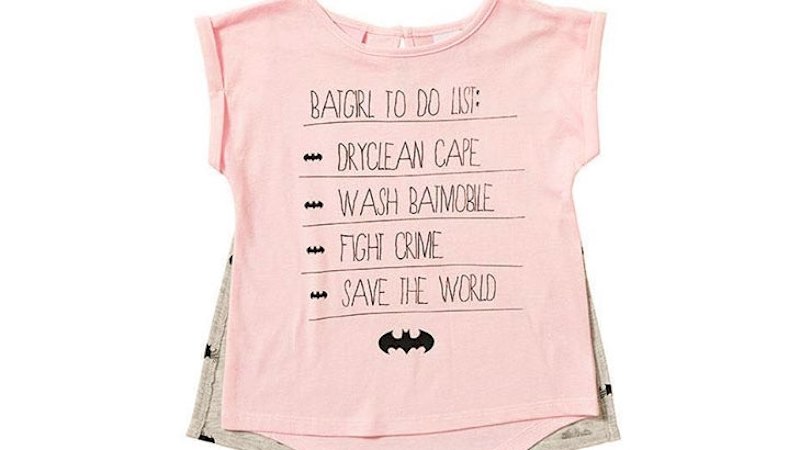
Target's crime of political correctness was to sell a T-shirt.  A pink T-shirt for girls.  The t-shirt read, "Batgirl to-do list:  Dryclean cape, wash batmobile, fight crime, save the world".

And with that, the warriors launched their attack on social media.  The accusations the warriors levelled at Target ranged from the T-shirt being "outrageous", "really inappropriate", sending a "really damaging message" and the final coup de grace, "out of step with 21st century family values ... it is utterly offensive and must be removed".

Target is a business and it isn't in the business of fighting political correctness.  It's in the business of selling affordable clothing to the mass market.  So it withdrew the T-shirt from sale and issued the following statement:  "After reviewing and reading our customers' concerns on the Batgirl tee, we have decided to remove the shirt from our stores.  It was never Target's intention to offend our customers with this item."

The warriors celebrated their victory like a grand final win.  But we should be commiserating.  The surge of political correctness undermines our freedoms, including in this case the freedom to raise our children in a way we choose.

Let's consider a few things.

First, the T-shirt wasn't sexist.  For many, including me, the T-shirt sent an empowering message to girls that they can do anything.  It was far more interesting and sassy than the boys' version of the T-shirt which merely read, "Like father like son, yes my dad is Batman".  No crime-fighting or world saving for the boys.

But the deeper meaning in this two-year-olds' T-shirt was open to interpretation.  For the politically correct warriors who found the T-shirt sexist, was it necessary to attack Target and call for its withdrawal?  If you don't like it, don't buy it.  No one is forcing anyone to buy these clothes.

Why should the moral outrage of a few bind us all to their value systems?  In parenting there are many hotly contested debates about "good parenting" and what sort of messages we should send our children, especially our girls.

As a parent, it is and should be your choice how you raise your children and the values you instil in them, what you dress your children in, what schools you send them to, what language you use with your children.  But inherent in this is "choice" and freedom to choose.  Instances such as the Batgirl T-shirt are indicative of a disturbing trend of the politically correct imposing their value systems on the rest of us.  Next time, warriors, please remember not everyone agrees with you.

Sunday, July 10, 2016

Populism is not a dirty word

The political news right now is Malcolm Turnbull's tenuous hold on government.

But tight elections aren't unusual.  The real significance of the 2016 election is how it reveals the growing dissatisfaction with the political class and mainstream parties.

This is a thread that links the support for Nick Xenophon and Pauline Hanson in Australia with the support for Donald Trump and Bernie Sanders in the United States and for Jeremy Corbyn and Brexit in the United Kingdom.

It's easy to dismiss these movements as "populist".  That word has already been spat out hundreds of times on panel shows and through the quality media since last weekend's election results began to come in.

But "populist" is a strange insult in a democracy.  Democracy is a system by which we come to agree as a group about how we live together.  It has lots of flaws.  The idea that the conclusions it comes to are too popular — too widely accepted — surely aren't one of them.

To call a politician or political movement populist is a dodge.  A comforting, revealing dodge.  An admission that the speaker sees the consent of the governed as a frustrating hurdle, rather than the reason parliament exists in the first place.

But even more than that, it's deeply condescending.  Yes, they're less polished.  They're less refined.  But those apparently dangerous and unacceptable populists deploy much the same arguments and same rhetoric as the major parties.

Consider their approach to foreign investment.  Nick Xenophon and Pauline Hanson both want to "take back the farm" and make it harder for foreigners to buy Australian assets.  This could have catastrophic economic consequences.  Australia needs international capital.

But then again the major parties have been telling us that foreign investment is risky, even dangerous, for years.

The Coalition government has been running a crackdown on foreign investment in housing.  It prevented the sale of the cattle station Kidman & Co to a Chinese company.  It blocked the American firm Archer Daniels Midland from buying GrainCorp.  Kevin Rudd made foreign investment scepticism a key plank of Labor's 2013 election bid.

So if it is agreed by all parties that foreign investment is a bit of a problem, why would anyone vote for a major party whose concern for this issue seems only skin deep?  Why not support a minor party that takes the concerns more seriously?  The majors make the argument, and the minor parties increasingly grab the votes.

Likewise free trade.  The Coalition government signed some important free trade agreements that are important for the future of the Australian economy.  The Labor Party professes support for trade as well.

But too often those free trade agreements are presented by the political class as extracting concessions from foreign countries for Australian exporters, rather than allowing us to import goods cheaper and thereby raise our living standards.

The Labor Party used the Trans-Pacific Partnership for a scare campaign about Chinese workers being brought into the country.  When Qantas moved its operations into Asia a few years back, the Transport Workers Union screamed that the company was being "Asianised".  Who does that sound like?

The Nick Xenophon Team wants the next government to directly support struggling companies — particularly the Arrium steelworks in Whyalla.  On the one hand this flies in the face of every basic principle of sound economics, representing a transfer of wealth from taxpayers to public companies.  On the other hand the major parties do that sort of stuff all the time.  The Napthine government handed money to SPC Ardmona after the Abbott government refused.  The only jobs plan either major party has for South Australia is to pay South Australians to build submarines.

In other words, no major political party has been making the argument for free trade, foreign investment and market competition.  Yet now they blame the voters for being anti-market.

Major party strategists will tell you quietly that they have no choice but to take "populist" positions.  Only the impotent are pure and all that.  If the voters want protectionism the parties need to deliver it.

But this belief confuses policy means with policy ends.  Do voters want higher tariff schedules, or do they want jobs and a sense of economic security?  Do voters want lower immigration quotas or employment opportunities for their children?

The Australian public cannot be expected to know every detail of every policy, or the voluminous literature on trade and migration.  They have families and businesses to worry about.  But the protectionist and interventionist economic policies attracting people to the minor parties won't protect jobs.  They will hurt jobs by slowing the economy.

Basic economics can be counter-intuitive.  It needs to be argued for.  No major party is making that argument.  They're fudging and hedging, trying to be all things to all people, never committing, constantly doing one thing and saying another.  No wonder people are voting for something else.


ADVERTISEMENT

Sunday, January 17, 2016

Poorest members of Trans-Pacific Partnership to benefit most

Why is Australia a party to the Trans-Pacific Partnership agreement?  This regional free trade agreement between 12 Pacific Rim nations, including the United States, Canada, Japan, Vietnam, Malaysia, and Australia, has been almost universally panned, left, right and centre.  Yet it is likely to be signed in New Zealand in February.

A report by the World Bank released last week claimed the benefit to Australia from signing the agreement would be a near imperceptible fraction of a per cent of growth a year — just an added 0.7 per cent of GDP by 2030.  The government's own economic advisory agency, the Productivity Commission, says the Trans-Pacific Partnership will distort trade rather than free trade.  And GetUp calls it the "dirtiest deal you've never heard of", driven by "big business, big pharmaceuticals and big tobacco".

They're all wrong.  Yes, the Trans-Pacific Partnership is not perfect.  It has bad parts.  It might require the government to further crack down on copyright piracy, even as the piracy problem is ebbing away in our world of Netflix and Apple Music.  The Investor-State Dispute Resolution mechanism — which allows firms to sue the Australian government in special tribunals — is, in the words of the American libertarian think tank the Cato Institute, "unnecessary, unreasonable, and unwise".

And the deal's importance for the global economy has been wildly overstated.  The Abbott government tried to desperately pump up the significance of the free trade deals it was signing as it saw its other economic growth strategies slip away.

But trade deals are policy bundles.  The question isn't whether the Trans-Pacific Partnership has bad parts.  It's whether the good parts outweigh the bad parts.  Nor is the question of whether Australia "wins" from the deal.  It's whether it enhances global welfare.

The poorest signatories are likely to be the deal's biggest beneficiaries.  The World Bank believes that the Vietnamese economy will be 10 per cent larger by 2030 thanks to the Trans-Pacific Partnership.

Malaysia will be 8 per cent richer.  Brunei 5 per cent richer.

These figures represent real people in real countries getting better lives thanks to an agreement we will sign.  The benefits dwarf the $90 million a year Australia gives in overseas development assistance — foreign aid — to Vietnam.

Free trade deals exist to solve a political puzzle.  The puzzle is this:  countries that allow foreign imports are richer, all else being equal, than countries which discourage foreign imports.  Protectionism is bad for consumers and bad for the economy.  This is counter-intuitively true even if every other country in the world is protectionist.  On the question of free trade the economics profession is almost unanimous.  Yet in recent decades few countries have been happy to unilaterally reduce trade barriers.

This is where free trade agreements come in.  They allow governments to sell domestic tariff reductions to their voters by pointing to the fact that other countries are reducing tariffs as well.  A lot of people think that international trade has to be done on a "level playing field" to be good.  This is bad economics.

But it is a political reality.  Many voters will accept a reduction in protection only if they see other countries doing the same.

There's another reason why we might want to sign a trade deal:  insurance.  Trade deals reduce the likelihood of a future trade war — that is, the deals prevent countries raising their trade barriers in retaliation for perceived slights.  Taking this insurance effect into account, the economists Richard Harris and Peter Robertson have found the economic benefits from the free trade deal the Howard government signed with the United States have been up to four times larger than previously believed.

This particularly important for Australia as we are highly trade exposed.

I'm not suggesting that the politicians who sign free trade agreements have these sorts of sophisticated reasons for doing so.  Politicians pander to voters.  They talk a lot of nonsense about exports and imports, about how they're forcing opening foreign markets to exporters, extracting concessions from other countries and so forth.

But by pursuing free trade deals they are building a more prosperous world.  The Trans-Pacific Partnership tangles the economic interests of an entire region together.  Call it mutually assured construction.  Being part of this process isn't pointless or "dirty".  If you think international development and international relationships are important, then trade deals are some of the best foreign policy we can do.


ADVERTISEMENT

Sunday, December 27, 2015

Turnbull government little different to Abbott regime but its positive tone wins fans

Leadership transitions are revealing.  Not so much about the characters of the vanquished and victor — although the vast differences between Tony Abbott and Malcolm Turnbull are obvious — but about what hasn't changed.

Whether 2015 is seen in the long run as the end of the instability that has characterised Australian politics since Julia Gillard challenged Kevin Rudd, or just another episode of Canberra's soap opera, it is clear neither Abbott or Turnbull are fully masters of their own destiny.

Yes, Abbott's captain's calls hurt him.  Turnbull's relatively steady hand has helped him.  But both men have really just been pushed around by economic winds, geopolitical squalls, and wherever the permanent bureaucracy wants the ship of state to travel.  George W. Bush once remarked that the biggest surprise he had during his presidency was how little power the leader of the free world really had.

Consider Abbott's attempt to shape the narrative of the spill as a conservative icon cut down by the forces of the Liberal left.  It has been both disingenuous and revealing.

For example, last weekend he warned the Turnbull government not to pursue tax reform for tax reform's sake, arguing that the only good tax reform was that which cut taxes.  Yet in potentially raising the GST to 15 per cent, the Turnbull government is merely following the process set in train by Joe Hockey.  A higher GST is obviously the Treasury line.

For that matter, Abbott's love of lower taxes is hard to reconcile with the deficit levy that the 2014 budget imposed on high-income earners.  There's an interesting little detail in the book Battleground by Peter van Onselen and Wayne Errington that Turnbull opposed the deficit levy in cabinet.

Even the debate about whether the government should focus political attention on the dangers of Islamism rings hollow.  This is a "debate" Abbott could have launched as prime minister, but didn't.  Presumably he was following the same advice Turnbull is receiving now from our security agencies.  It's sadly ironic to see Abbott once again presenting himself as defender of free speech.

And no one should doubt that putting Australian boots on the ground in Iraq and Syria to fight Islamic State is almost entirely dependent on whether the Americans ask for our help, regardless of who the prime minister is.

The continuities between the two governments are even starker, and more worrying, when we turn to economic management.  Every treasurer faces a steep learning curve, and Scott Morrison deserves his chance to grow in his role.  But early signs show a great deal of similarity between Morrison and Hockey.  Where Hockey had poor communications skills, Morrison has brought way too much over from his performance as immigration minister.  The Treasury portfolio demands detail, explanation and argument, not stonewalling.

More importantly, Morrison hasn't yet shown much dexterity navigating the highly complex and controversial issues which the treasurer has to master.  The last thing Australia needs is another treasurer who acts as a figurehead for his department.  Morrison's claim last week that government spending can't be seriously cut because it would harm the economy is exactly what Hockey was saying this time last year, and is as questionable now as it was then.  Another obvious Treasury line.

And yet while there is remarkable policy continuity, it is undeniable that the government is very different after the spill.  The Coalition polled terribly last year, it polls brilliantly now.  This poll reversal is a rudimentary but interesting confirmation of the argument that voters are less interested in policy specifics than what the individual parties seem to symbolise.  Voters know their votes don't count, in any literal sense — no single vote is going to swing an election.  So when they vote they tend to vote as an expression of their values.

Where Abbott looked back to the Labor years, a perpetual opposition underdog looking for something bigger to fight, Turnbull seems to look forwards.  Same policies, different tone.  And tone matters.

This is the big lesson of the spill, and indeed, the big lesson of politics in 2015.  Governments need positivity.  They need to offer the public a sense that things are going to get better.  Negativity works in opposition.  But what successful national leader has been a negative national leader?  Even Abbott's hero, Winston Churchill, offered a sense of hope during the worst days of World War II.

In December Turnbull released the innovation policy package which he had been building up since the spill, and which was to serve as a statement of his priorities as leader.  Policy for policy it was a damp squib, a collection of the standard wasteful spending and ineffective tax credits that have been the mainstay of innovation policy for decades.  But so what?  It sounded great.  Agile.  Innovation.  Technology.  The future.  Isn't it wonderful to be alive.  And sounding great is a big part of politics.


ADVERTISEMENT

Monday, November 23, 2015

Same-sex marriage:  When did dissent become discrimination?

The politics of gay marriage have shifted radically in a very short space of time.  Until 2011, the Labor Party was firmly opposed to gay marriage.  The Coalition was firmly opposed just four months ago.

So it's remarkable that a Catholic archbishop in Tasmania is being dragged to a government anti-discrimination authority for opposing same-sex marriage — the position that was until very recently, shared by both parties.

Last September, Martine Delaney, the Greens candidate for the federal seat of Franklin, took a complaint to the Tasmanian Anti-Discrimination Commissioner that the Catholic Church had produced and distributed a booklet which "does immeasurable harm to the wellbeing of same-sex couples and their families across Tasmania".

This Tasmanian case has Australia-wide significance.  We've just had a sustained national debate about free speech, and are about to go into a national debate about gay marriage.

Polls show that about 70 per cent of Australians support gay marriage, so you might think the plebiscite is an assured success.  Indeed, Tasmania's Liberal-led lower house last week became the third state to agree to a motion supporting legislation of same-sex marriage.  But that success is not at all certain if gay marriage is perceived as the thin end of the wedge for a more general attack on the liberties of religious communities and freedom of conscience.

The booklet in question, Don't Mess With Marriage, offers the basic Christian case against gay marriage:  families are the founding blocks of society and children need a mother and father.

It's hard to overstate how moderate this booklet is.  It offers no fire or brimstone.  It's gentle and Christian, of the suburban pastoral variety.  There's much expression of sympathy for same-sex attracted people who also want to follow religious teachings that preclude their sexuality.  It is a calm explanation of a major position on a prominent political policy issue.

To be offended by the booklet is to be offended by what was, until very recently, the mainstream view on gay marriage, and one still shared by a large minority of the population.

For this reason if nothing else, the complaint ought to have been dismissed as laughably frivolous.  But this month the commission decided that the Catholic Church has a case to answer under Tasmania's Anti-Discrimination Act.

The Tasmanian law almost exactly parallels the controversial section 18C of the Racial Discrimination Act that the conservative commentator Andrew Bolt was found to have breached in 2011, and which Tony Abbott (in opposition) promised to repeal.

There are, however, two revealing differences between the Tasmanian and the federal legislation.

The first is that the Tasmanian law prohibits offensive and insulting speech not only on race and ethnicity, but on 20 different areas from sexuality to religious belief to political affiliation.

In this sense the Tasmanian act resembles the Human Rights and Anti-Discrimination Bill which the Gillard government failed to push through parliament in 2012, which would have made it unlawful to offend someone on virtually everything (including their political opinion!) in the workplace.

It is symptomatic of the spread of no-go areas in Australian public discourse.  Governments increasingly believe that protecting us from being offended — on whatever spurious grounds — is more important than allowing us to speak our mind.

The second difference is that there is no caveat in the Tasmanian act that even purports to protect free expression.  Defenders of the federal Racial Discrimination Act often point out that section 18C is followed by section 18D which provides protection for speech made in good faith on matters of public interest.  This protection is weak.  The court decided in the Bolt case that something could not be considered in good faith if, in the view of a judge, it was too sarcastic and had errors.

However, the Tasmanian legislation doesn't even offer that token concession to basic liberties.  In a parliamentary debate in 2013, the Attorney-General dismissed concerns by insisting the bill "does not impinge on free speech;  it provides protection from bullying".  All words are cheap.  The words of politicians — even when they're interpreting their own legislation — are junk.

Both supporters and opponents of gay marriage should be very unhappy with the Tasmanian case.  Even if the Catholic Church successfully defends against the anti-discrimination complaint, damage has been done.  Free-speech theorists talk about the "chilling effect" when the cost of defending oneself against baseless claims hampers the open expression of views.

And in the event that the plebiscite fails, it will be because voters feel that expanding marriage freedom to one group means limiting the freedom of another.  The date of the vote hasn't even been set, but the debate about gay marriage has already moved from the realm of public discourse to legal sanction.

The Tasmanian legislation also tells us something about the ongoing political contest over free speech in Australia.

All those human rights bodies — such as the government's Australian Human Rights Commission — that flaunt the vital protections of section 18D did not lift a finger to protest the lack of such protections in the Tasmanian legislation.  Just as they fully supported the Gillard government's 2012 bill until its absurdities became politically controversial.

When the Abbott government broke its promise to repeal section 18C in August 2014, many commentators believed a line had been drawn under the arguments over free speech and offensive speech.  Not at all.  Watch Tasmania.  This is the debate we are all about to have.


ADVERTISEMENT

Sunday, October 11, 2015

Tax reform a false start in pursuit of economic growth

The new Turnbull government should stop talking about tax reform.

Tax reform is a poor use of its political capital.  It is a waste of the goodwill Malcolm Turnbull brings to the prime ministership.  The challenge Turnbull faces is not to make our tax system slightly more efficient.  The challenge he faces is how to make the economy grow.

When he became Treasurer, Scott Morrison stated that the Commonwealth has a spending problem, not a revenue problem.  That is, the government wants to focus on spending cuts rather than tax increases.

This is excellent, as far as it goes.  But in truth our real problem is growth.

The International Monetary Fund estimates that the Australian economy is going to grow just 2.5 per cent this year.  Back in the Howard years, growth averaged 3.7 per cent a year.  The Reserve Bank governor has publicly speculated that our lower growth might be the new normal.

If you want to blame the stubborn budget deficit on anything, blame it on this.  John Howard, Kevin Rudd, Julia Gillard, Tony Abbott, Malcolm Turnbull:  they've all been riding the waves of our growth figures.

Some governments have made the problem better and some have made it worse, but the simple fact is that policymakers can no longer rely on the same level of growth that once delivered windfalls to the Commonwealth budget.

The focus on tax is a distraction.  Ever since Kevin Rudd commissioned his own Treasury Secretary to conduct a "root and branch" investigation of Australia's tax system in 2008, tax reform has been an obsession of governments.  Joe Hockey was only following Labor's lead when he launched the Coalition's tax reform process.

It is true that the tax system could be made more economically efficient.  It would be more efficient for taxes on income to be further replaced by taxes on consumption.  This is why many economists have said that the GST should be raised and personal and company tax reduced.  Morrison has been talking about this possible trade-off already.

But it's hard to see why this is a national priority.  Efficiency isn't the only thing we want from a tax system.  Indeed, a theoretical insistence on efficiency was what gave us the Rudd government's mining tax;  a tax which was understood by a tiny fraction of the population but was the inexplicable and unhappy centrepiece of Labor's economic agenda.

And while efficiency makes it easier for governments to extract more money out of us, is that really such a virtue?  We ought to know when we are being taxed.  Voters need to know what their government is doing.  They need to know how taxes are raising the prices of the goods they buy and reducing the money they have to buy those goods.

A budget emergency is the worst time to conduct tax reform.  There's not a person in the country who believes the economy will escape this round of tax reform with a lower total tax burden.

Every incentive in the Treasury department is to edge taxes up.  That's why Joe Hockey cracked down on so-called corporate tax "avoidance".  That's why the GST is now to be levied on online purchases.  And anybody who thinks eliminating superannuation "concessions" will help the economy has rocks in their head.

It's all incredibly counterproductive because the fixation on revenue and tax increases actually holds back the growth we need to encourage.  Taxes take money out of the productive parts of the economy.  Perhaps the government thinks it might be able to use its revenue to lay the foundations of growth — by investing in infrastructure and private education.  In practice, too much of this investment goes to white elephants and degree mills.

Governments — directed as they are by professional politicians with their eyes on marginal seats and swinging voters — aren't that good at spending our money wisely.  Turnbull needs to be careful his interest in innovation doesn't become a stream of taxpayer-funded boondoggles.  Much better to revitalise the Coalition's flagging deregulation agenda, refocus on industrial relations, and eliminate any regulatory burdens holding back employment and production.

Even the constant drumbeat of tax reform is likely to be harming growth.  We've been talking about tax reform for nearly a decade.  Uncertainty about Australia's future tax regime makes companies less eager to invest.  They know the tax system is probably going to change.  They don't know when, or how.

But there's a deeper reason Turnbull should fixate on growth rather than taxes.  Higher growth means increased living standards.  Higher growth means a more prosperous Australia and more prosperous Australians.  This — not spending, not revenue — should be what keeps Malcolm Turnbull and Scott Morrison awake at night.


ADVERTISEMENT

Sunday, July 19, 2015

Why we value the old school tie

It's a very Melbourne thing to be horrified by school fees — and there is much to be horrified about.  The fees at Melbourne's most expensive schools are pushing $30,000 per child.

But take a step back.  These big fees are a positive sign of the financial seriousness that society takes educating the next generation.  Before we get to discussing equality or standards or choice, let us agree, please, that spending money on education is good.

There's a real sense in which anti-private school hostility has nothing to do with education, per se, in that some people are richer than others.

What is the hypothetical alternative to wealthy parents investing in their children's education?  That they splurge on holidays and cars?  Hand the money over as inheritance?  Buy property?  Surely we can welcome the money being used to develop human capital.

The returns on education are vast.  A better secondary education experience leads to more choice of tertiary education, which in turn can translate into higher earnings over a lifetime.

No wonder parents want to buy as much schooling as they can possibly afford.

Individual students reap most of the benefits from their education.  But as education advocates constantly point out, society benefits too.  A more educated population is a more innovative, productive, and ultimately prosperous population.

Thus some investment by wealthy parents on private education — over and above what is churned back to them through the taxation system — flows through to society as a whole.

All this makes the hyperventilating about private schooling that forms such a fundamental part of Melbourne's intellectual life more than a little ridiculous.

In an Age column on Thursday, Julie Szego suggested private schools seem a little like a "con" for those parents who are "bleeding money on private school fees on the assumption this buys their child a competitive advantage".

Perhaps if you imagine modern Australia as a dog-eat-dog fight for prestige, then every attempt to increase human capital formation looks like a brutal feeding frenzy.

But it's true:  there's a puzzle here.  While private schools get better year 12 results, a whole host of evidence shows that once researchers control for things such as family background, the education level of parents, peer performance and so forth, many differences in results between private schools and public schools substantially decrease.  Educated and engaged parents are likely to have educated and engaged kids, regardless of what school those kids are sent to.

So are parents being irrational when they send their kids to private schools?  Of course not.

In many ways, by paying for private education, parents are buying their children friends.  Who you go to school with matters.  It is better have classes with peers that brag about doing too much study than too little.  In his new book, Our Kids, social scientist Robert Putnam argues that in the United States peer effects cause a large part of education disparities.

Also, education is about more than test scores.  All we know about why parents choose individual schools relates that choice to a school's values, facilities, extracurricular activities, location, or how nurturing or driven the staff are.  In other words, how good a fit it is for their child.

Rather than obsessing about the riches hidden behind the private-school fence, why not focus on how to make public schools more appealing?

Public schools would be more competitive against private schools if governments allowed more variation between schools, granted them more independence, and made it easier for more children to attend schools outside their geographic school zones.  Remember, it isn't just money and test scores driving demand for private education.

The obsession with the most expensive schools ignores those smaller, cheaper private schools blossoming around Melbourne, offering marginal improvements and more choice than that offered by the public system.

Funny how the debate about equality is always focused on the lifestyles of the rich, rather than the living standards of the poor.

The Age reported last week some private schools are taking legal action against families who fail to pay fees owed.  But by all accounts private schools go out of their way to be lenient on payment.  If you're going to be in debt to anyone, you'd want it to be a school.

After all, it's hard to imagine much sympathy for families that, for instance, did not pay a builder for a renovation and were subsequently taken to court.

Such is the moral baggage around private schooling that recouping debt fairly incurred is seen as some sort of ethical violation — yet another black mark against these malevolent institutions.

All that fury, all that outrage, directed towards what?  Too much money spent on education?

Monday, July 06, 2015

Coalition boycott of ABC's Q&A program long overdue

It took an editorial disaster for the Coalition to boycott Q&A, but it was a decision that should have been made long ago.

Following Zaky Mallah's now infamous appearance on Q&A, Prime Minister Tony Abbott has issued an order banning the Coalition frontbench from appearing on the ABC's flagship Monday night program.

Abbott's decision has provoked outrage from political opponents.  Some even suggested that it's an attack on freedom of speech.

But no one would suggest Abbott was attacking freedom of speech by declining an interview with Green-Left Weekly.  The political bias of the publication is clear for all to see.

It is perfectly legitimate for politicians — or indeed anyone — to be selective when deciding when to give media interviews or appear on panels.

Unfortunately, this is an accurate comparison.  Despite its attempts at objectivity, the institutional make-up of the ABC is clear.

In a 2013 survey of Australian journalists, 41 per cent of ABC staff declared the Greens most closely reflected their political attitudes.  This is several times larger than the Greens support in the wider community.  A further 32 per cent of ABC journalists surveyed declared they would give their first preference to the ALP.

With these demographics, it is remarkable the ABC's current affairs team has remained as objective as it has.  Unfortunately Q&A has not met this same standard.  And it's not even a good show.

It has healthy ratings in a prime-time timeslot.  But it is a terrible platform for serious policy discussion.  Presented in front of a live studio audience, it is an environment that rewards demagogues who can elicit applause.  Unlike the ABC's traditional current affairs programs, guests on Q&A are rarely asked to back up their broad statements with detail.  This low level of scrutiny would not be possible on 7.30 and Lateline.

This environment is only worsened by the frequent celebrity panelists who are asked to comment on issues of policy often beyond their understanding.  This isn't just a view held by conservatives.  It's a view that's been articulated by a modern ALP hero and at least one former boss of the ABC.

Speaking at the Brisbane Writers Festival in 2011, former prime minister Paul Keating declared that he wouldn't be caught dead on the show.

Keating would never have allowed his ministers to go on the program at all.  As the Sydney Morning Herald reported at the time, Keating said, "If I was the Prime Minister I would not let federal ministers go on that program.  You just wash the government through mud every time you turn up."

As former ABC managing director Jonathan Shier said last week, the show is also plagued by "sensationalist stunts".

Granting Zaky Mallah a platform was merely the latest attempt at a style of "gotcha" journalism that is unbefitting of Australia's national broadcaster.  Q&A's producers have a long track record of outsourcing provocative questions to audience members in an attempt to drum up controversy.

The same stunt was pulled in 2010, when the show hosted former prime minister John Howard and solicited a question from former Guantanamo Bay detainee David Hicks.  And again in 2011, when a video question from WikiLeaks founder Julian Assange was shown to Prime Minister Julia Gillard.

These may be legitimate questions that Australian politicians ought to answer.  But they are presented in a manner designed to elicit controversy, rather than illuminate important issues.  This may elicit applause from the live studio audience, it may create news headlines that increase ratings, but it does not create an environment of serious political discussion.

Q&A is a show that favours demagoguery and gotcha journalism.  A hostile environment for any government interested in serious policy discussion.  And Tony Abbott is right to declare a boycott.


ADVERTISEMENT

Sunday, June 21, 2015

Unelected officials are stifling our democratic freedoms

Finally there's a serious conversation happening about the Australian Parliament's scorn for democratic accountability and the rule of law.

It was always going to be a bit controversial to propose absolute ministerial discretion to strip citizenship from dual nationals on the 800th anniversary of Magna Carta, that great symbol against arbitrary power.

But we've had a rule of law problem for a very long time in Australia.  Long before the Islamic State.  Long before al-Qaeda.  And that problem has gone largely unnoticed — whether due to a lack of awareness or a lack of interest — by those groups now furious about the Abbott government's national security policies.

Let's start with the most basic rule of law principle:  that we all deserve legal protections when accused of an offence, whether that offence is terrorism or traffic violation.

Last year I conducted an audit of all Commonwealth legislation and found 262 provisions of federal law that violated fundamental legal rights.  These either removed the right to silence, removed the privilege against self-incrimination, reversed the burden of proof, or did away with "natural justice" — the suite of rights like the right to a trial, to appeal judgments or to know what we are charged with.

These violations aren't just found in the sorts of laws that the human rights community was talking about this week — anti-terror and immigration laws.  They're found in economic laws like the Australian Competition and Consumer Act 2010 (that regulates mergers and consumer protection) or the Navigation Act 2012 (which regulates shipping) or the Broadcasting Services Act 1992 (which regulates broadcast media).  The Fair Work Act violates all four legal rights.

In other words, they're targeted at people in business, not just people in terrorist organisations.  The Tax Administration Act has nearly as many violations of the right to natural justice as the Migration Act does.

Shortly after the 2013 election, the new attorney-general George Brandis directed the Australian Law Reform Commission to look at laws which limit traditional rights and liberties with a particular focus on workplace, commercial and environmental law.

You'd have thought such an investigation would have been well covered already by the Australian Human Rights Commission.  But the commission, along with Australia's human rights community more generally, have utterly neglected limits on personal freedom when they are bundled up with limits on our freedom to trade, truck and barter.

In a recent speech, the commission's head Gillian Triggs pointed to all the post-September 11 laws which limit rights in the name of anti-terrorism.  What about those which limit rights in the name of market failure?

It's only economists and the occasional corporate lawyer that have been talking about, for instance, the draconian powers of the Australian Securities and Investments Commission.

Of course, rule of law is about more than personal legal protections.  It describes the principle that administrative decisions should be made by elected officials and according to due process.

Parliament should write the laws and control the purse strings.  Many of these principles can be traced back to Magna Carta.  These principles have come under sustained assault in recent decades.

The prospect of ministerial discretion to strip citizenship without judicial review is just a tiny window into a much deeper problem.

For instance, Australian governments have vested more and more decision-making power outside Parliament and into "independent" bureaucratic agencies.  These undemocratic, unelected officials have enough discretionary power to effectively make government policy.

Just last month the Tax Commissioner was granted the power to change tax law if he felt doing so would be in the interest of taxpayers.  But it is Parliament's job to make and amend the law of the land, not the bureaucracy's.  Other regulatory agencies have similar powers.

In many ways Australia is not a liberal democratic state, but a democratic-administrative state, where power is shared between elected representatives and a permanent network of independent bureaucracies who are only loosely answerable to Parliament, let alone voters.  Some of the basic institutions of our government are undemocratic.

Gillian Triggs was right to say our democratic freedoms are under threat.  Still, did she see any irony in the fact that the democratically elected Abbott government obviously wants to fire her but — since she commands an independent statutory agency — it cannot?

In 2012 Parliament passed a bill giving the government blanket authorisation to spend money on basically anything it wanted without having to ask Parliament's permission first.  The bill was rushed through with bipartisan support following the school chaplains case in the High Court.  It was barely noticed by the press.  Yet it was one of the most complete surrenders of parliamentary responsibility in the last half century.

There are serious problems with the Abbott government's citizenship-stripping proposal.  Coalition members might be happy with Peter Dutton holding such power.  But all governments are temporary.  Will they be just as happy when the next Labor immigration minister is able to wield the same powers?

This is the thing about the rule of law.  Just as it protects good people and bad ones, it constrains good governments and bad governments alike.  To abandon the rule of law is not just to abandon those protections, but to erode democracy itself.


ADVERTISEMENT

Sunday, April 26, 2015

Conservative voters blindsided by Coalition tax increases

What exactly is the point of a Coalition government if it offers the same sort of tax increases as voters expect from Labor and the Greens?

It's disturbing how quickly the Abbott government has turned its attention to boosting government revenue rather than reducing government spending.  It's only been in power 18 months.

First, there's the planned deposit tax, a levy imposed on all our bank accounts purportedly to pay for the deposit insurance introduced by Labor during the global financial crisis.

When Kevin Rudd proposed the deposit tax in August 2013, Joe Hockey, then shadow treasurer, said it showed how "Australians end up paying for Labor's waste and mismanagement".  So what does it say now the tax is being mooted by the Coalition?

Then there are all the possible changes to the GST.  The GST-free import threshold of $1000 might be lowered.  The government is drawing up legislation to impose GST on digital downloads — the so-called Netflix tax.  There's even been discussion of broadening the GST base to include things like fresh food, health and education.

There's also a Google tax on the horizon.  Hockey said last month companies that do not pay the "legitimate level" of tax are "thieves".  But tax minimisation is perfectly lawful.  We all do it when we fill out our tax forms.  In fact, firms have an obligation to their shareholders to minimise tax.

To change corporate tax law as Hockey wants wouldn't be recouping money that is rightfully the Treasury's.  It would be increasing the corporate tax burden, and increasing investment uncertainty while it's at it.

Likewise, the government wants to tackle what is described as the superannuation tax "concession".  Here it is on a virtual unity ticket with Labor.

Don't be fooled by the word concession.  It is a euphemism.  The issue here is that while income is taxed progressively — rich people pay proportionally more than poor — superannuation is taxed at a flat rate of 15 per cent.  The government thinks wealthy people are putting too much money into super, avoiding high marginal income tax rates, and depriving Treasury of money.  Let's be blunt:  to eliminate superannuation concessions would be just another tax increase.

But there is a more fundamental point.  Superannuation is taxed at a lower rate to counterbalance the income tax system's bias against savers.  All those so-called loopholes and thresholds and concessions exist for a reason.  Many of them exist to prevent perverse and unfair taxation, to treat different assets equally, to avoid double taxation, to encourage saving.  And all of them were instituted as part of a democratic bargaining process.  Eliminating a loophole is the same as raising a tax.

The Coalition should know this instinctively.  Liberal parliamentarians campaigned under the slogan "Our Plan:  Lower Taxes".  When he became leader Tony Abbott declared "there will not be any new taxes as part of the Coalition's policies".  Now his team are lining up alongside Bill Shorten and Christine Milne to push for new and higher taxes.  Let's hope they're embarrassed.

I haven't even mentioned bracket creep, the process whereby inflation slowly pushes wage-earners into a higher tax bracket without making them wealthier.

The tax system is full of little revenue-scrounging tricks like that, tricks of language and mathematics and perspective that hide who pays and how much.

Funny how those tricks always work in Treasury's favour.  Bracket creep could be done away with once and for all by indexing income tax to inflation.  Malcolm Fraser's government experimented with such a policy, but abandoned it.  It is in the government's political interest to let bracket creep work its subtle expropriating magic.

The government's problem is spending, not revenue.  The public spat this month between Hockey and Peter Costello was revealing.  If you missed it, Costello criticised Hockey's desire to raise tax.  Hockey responded that he wished he had the sort of revenue Costello enjoyed in government.

But hold on:  Hockey does have that sort of revenue.  If we adjust the figures for inflation, Hockey has $18.6 billion more revenue than Costello received in his last budget.  (The most recent reported figures appear in the December Mid-Year Economic and Fiscal Outlook.)

The government's other budget excuse — that the iron-ore price is bottoming out — isn't convincing either.  Yes, iron ore could go as low as $US36 ($46) a tonne.  It was nearly $US200 a few years ago.  But that was under Labor.  Costello hadn't been so lucky.  Iron ore only lurched above $36 after the Howard government left office.

Hockey said he was kicking off a national conversation about tax and efficiency when he launched his tax discussion paper last month.  Economists — particularly the sort of economists that populate treasury departments — spend a lot of time thinking about what is the most efficient tax system.  The discussion paper reflects a lot of that thought.  It judges taxes on how much they distort our incentives to work and produce.

However, efficiency isn't the only thing we want in a tax system.  Too often politicians use the word efficiency as a synonym for ingenious.  The 17th-century French finance minister Jean Baptiste Colbert famously described the art of taxation as "plucking the goose as to get the most feathers with the least hissing".  You can understand his view.  For a treasurer the most important thing is maximising revenue.

But it's not obvious why we should be pleased the government wants to pluck more of our feathers.  A Coalition government, no less.


ADVERTISEMENT

Sunday, March 08, 2015

Pay gap due to women's choices, not gender bias

It has become a fashion to mark International Women's Day each year with discussion about statistical differences between what women and men working full-time earn on average, and how this is a problem requiring urgent redress.  Much of the pay gap between women and men is influenced by the choices people make for themselves, rather than discriminatory attitudes by employers.

For the record, the most recent Australian Bureau of Statistics figures indicate that full-time male workers earn an average of $1587.40 per week, whereas women earn $298.10 less on average.

In other words, the observed gender pay gap in this country presently stands at 18.8 per cent.

For many feminists such an outcome represents an indictment, for the pay gap is often claimed to be grounded in persistent and widespread sexism by employers refusing to extend wages to women on a par with men.

But is it really the case that the pay gap is wholly attributable to gender discrimination in the labour market?

Economic theory and empirical analysis would suggest not.

It is easy to fall into the trap of thinking the average pay gap means a woman with the same qualifications as a man, with similar tastes, and doing exactly the same job will be paid 18.8 per cent less.

But that is an erroneous viewpoint, because it implicitly assumes that individual women and men are heterogeneous workers, which they are not.

Individuals have fairly extensive choice over the quantity and quality of education, skills, and work-relevant experiences they accumulate, and this human capital investment has a major bearing on observed wages earned by women and men.

Studies show that Australian girls generally perform better than boys at school, but tend to prefer enrolling in humanities tertiary courses, which subsequently pay relatively lower wages in employment, rather than the sciences, which offer higher career wages.

Some employees seek relatively higher wages for jobs which may require longer working hours or be more risky to perform, and so "compensating differentials" required by women and men to assume those jobs also influences their wage levels.

It generally appears that women tend to assume working roles which provide more pleasant and safe conditions, and which provide greater flexibility for part-time work to accommodate family responsibilities.

Numerous empirical studies, here and overseas, suggest that factors predominantly captured by observed differences in labour market choices and worker characteristics explain a significant amount, but not all, of the variation in the average gender pay gap between women and men.

And it should also be acknowledged that an undue emphasis on the average pay gap masks important, yet more subtle, wage variations between women and men.  The sorting of women and men into different occupational roles is often blamed for influencing the gender pay gap, but Australian studies have shown that women's earnings would in fact be lowered if the occupations they worked in mirrored those of men.  In other words, if women worked in jobs that men currently dominate, the women's wages would be lower across the board.

This observation is partly due to the fact that there are significant numbers of middle-class female workers in public sector and related service occupations, such as nursing and teaching, but also an ample cohort of lowly paid males in industrial occupations.

Another interesting issue relates to what extent gender pay gaps across income distribution are informed by characteristics embodied in groups of workers.  For example, researchers Juan Baron and Deborah Cobb-Clark found that the (median) gender pay gap for Australian low-paid workers is almost completely explained by variations in productive skills, but not so for those who are highly paid.

There is other interesting research in Australia and abroad examining the drivers of gender pay gaps on the basis of age, and even sexual orientation and gender identity, and further research is needed to provide meaningful interpretations of pay gaps between women and men.

Although the gender pay gap narrows once these factors are considered, these often do not fully explain the variation in the female-male pay gap.  It is argued by many researchers that the pay gap left unexplained by empirical models may be attributed, at least in part, to gender discrimination.

In Australia national equal pay legislation dictates that women performing the same duties as men should receive the same award pay rate, but that doesn't mean sexism has no effect upon labour market outcomes.  For example, young women might be deterred from studying science-related courses at university, which enable access to high-paying jobs, because of stereotypical attitudes to the effect that girls "can't do" STEM subjects at school.

But more immediate policy responses which promote economic freedom in this country could also help mitigate the effects of gender-based pay gaps on the lifetime earnings of women, partly because more competitive markets would impose greater costs on discriminating firms.

Measures promoting economic freedom, such as lowering tax burdens and deregulating the childcare sector, should also encourage more women to invest intensively in their own human capital, and help smooth transitions between work and family responsibilities.

For International Women's Day 2016 it would be ideal to avoid sensationalist, but misleading, average pay-gap statistics, and instead discuss the respective roles of attitudes, preferences, cultural norms, and policies in shaping economic and social opportunities for women.


ADVERTISEMENT

Sunday, March 01, 2015

Curbing free speech would deprive us of powerful tool to wield against Islamist radicalism

Tony Abbott was right about the significance of the massacre at the satirical magazine Charlie Hebdo when it happened in January.

"Freedom of expression is the cornerstone of a free society," the Prime Minister said.  "From time to time people will be upset, offended, insulted, humiliated ... but it is all part of a free society".  He praised the cover illustration of the next Charlie Hebdo edition, which depicted Muhammad crying.  "I believe in free speech.  I absolutely believe in free speech."

These were powerful, important sentiments.  They were a recognition of the threat of Islamist terror to our basic liberties, a threat which we saw manifest in the Danish cartoons crisis of 2006, the murder of the Dutch filmmaker Theo van Gogh, and the fatwa which led to Salman Rushdie's decade in hiding.  Abbott offered them at a moment when they were most needed.

But fast-forward to last Monday, and a central part of the government's national security strategy is to boost laws against speech that is "vilifying, intimidating or inciting hatred".  The government wants to crack down on hate preachers.

So is free speech inviolate, a liberty that needs to be defended as fundamental to civilisation and democracy?  Or must it be restricted for the fight against terrorism?

To understand some of the ructions within the Liberal Party right now, look no further than the government's back and forth on freedom of speech.  The government is struggling with itself on the very idea of liberty.

The Coalition came to power declaring it would pursue a "freedom agenda".  It would be "freedom's bulwark" against a Labor Party that, under Julia Gillard, had attempted to control and regulate the free press.

And the Coalition promised to repeal, at least in part, section 18C of the Racial Discrimination Act, the law which makes it unlawful to offend or insult someone on the basis of their ethnicity, and the law which Andrew Bolt was found to have breached in 2011.

Section 18C is hardly the only anti-speech law on the books, but it is an iconic one, and was used against the country's most prominent conservative commentator.  For many Liberals, Liberal MPs and those on the right of centre, the 18C promise became a symbol of a reinvigorated, confident liberalism.

Yet over the past six months the Prime Minister has been saying that, in the light of the real threat of terrorism, the balance between liberty and security must tilt further towards security.

This is a false choice.

None of have us the liberty to kill, plot to kill, or incite killing.  Preventing and punishing murder is no restraint on freedom.  The problem comes when the government proposes to do much more than just enforce the law.  Like when it proposes to criminalise non-inciting speech.  Like when it proposes to invade everybody's privacy with mandatory data retention — not just the privacy of those suspected of a crime.

Much of the Abbott government's earlier national security legislation was necessary and important, particularly the elements that cracked down on foreign fighters.  The government now proposes to strip dual citizenship from those who go to fight for Islamic State.

At the same time those necessary legislative changes have been mixed in with some extraordinary overreach.  A bill passed in October means journalists who report on "special intelligence operations" could go to jail for 10 years.  Another bill passed that month made it a crime to advocate ("counsel, promote, encourage, or urge") terrorism.  But incitement to violence has always been illegal.  And there have been laws against advocating terrorism on the books for a decade.

Any law that the government might write to target hate preachers will — almost inevitably — expand to encompass other speech.  The government clearly wants to make it illegal to say things like "Osama bin Laden was a hero".  Any legislation that did so would also criminalise the other ideas too.  One current darling of the academy, the shock philosopher Slavoj Žižek, praises the terrors of Mao, Lenin and Robespierre.

Such speech is distasteful and disgraceful, yes.  It shouldn't be illegal.

Legislative mission creep happens.  For instance, when section 18C was first introduced in 1994, its advocates said it had a strict and narrow purpose.  A piece published in The Age in November that year by Colin Rubenstein and Michael Kapel claimed it was only targeted at "the skinhead on the street yelling racist names and other insults at an Asian man, or a woman in traditional Islamic dress, not newspaper articles or anti-immigration pamphlets".  That has not turned out to be the case.

When he announced that they were abandoning section 18C reforms last year, the Prime Minister said it was because the whole thing had become "a complication" when dealing with Australia's Muslim community.  Labor's fear campaign against the proposed changes had worked.

Yet last Monday Abbott criticised Australia's Muslim leaders, wondering why they weren't speaking up against terrorism themselves.  He told them to police their own communities with the proposed anti-hate speech laws.

Which raises the question — does the government think the war against terror requires us to comfort or to confront the Muslim community?

Abbott's instincts after the Charlie Hebdo atrocity were right.  Free speech is a liberty we have to protect, and it is a powerful tool to wield against Islamist radicalism.  Why does he now think it is a weakness?

Sunday, December 28, 2014

Joe Hockey's budget woes overshadow all else in 2014

When Australia's political historians look back at 2014, they will see it as a year defined by its May budget.

Economic policy dominates everything.  Apart from elections, budgets are the focus of the Canberra calendar — the pivot on which governments turn.

Yet even by those standards, this year's budget was truly epic.  Eight months later, it lingers over everything.

For sheer political significance, it is on par with Arthur Fadden's 1951 "horror budget", which boosted taxes, crashed the economy, and nearly cost the Menzies government the 1954 election.

Fadden said after his budget, "I could have had a meeting of all my friends and supporters in a one-man telephone booth."  Poor old Joe Hockey must sympathise.

But today Fadden's horror budget is remembered more fondly — particularly by the Commonwealth Treasury — as it broke the back of the Korean War inflation.  A decade of prosperity followed.

So the question is whether Hockey's budget will look like temporary political pain for future gain, as the 1951 budget was, or a tragically missed opportunity for needed reform.

Put aside, for a moment, the argy-bargy over the budget details and its mixed messages.  The sad fact is that the budget exposed how the political class does not have a directed vision for the future of Australia.

It showed that neither side of politics really has any idea of how to lift the economy out of its slow but steady decline.  Neither side has any real idea of what Australia ought to look like in 10, 20 or 30 years.

To be fair to the Coalition, governments reflect the times.  They do not create them.

Fadden's 1951 budget was the first counter-inflationary budget inspired by John Maynard Keynes.  No doubt if Labor were in power it would have had almost exactly the same horror budget.

Likewise, it's fun to mythologise the great economic reforms of Bob Hawke and Paul Keating but Hawke and Keating were only doing what was also being done around the world.  Ronald Reagan and Margaret Thatcher did the same stuff, in much the same way.  So did many other leaders, from New Zealand to Sweden.

Even the vision of Gough Whitlam, who died in October, was not unique.  He was a man of his times.  The new biography of Dick Hamer by Tim Colebatch emphasises how much policy affinity there was between the Liberal Hamer and Whitlam.  Harold Holt's biographer, Tom Frame also claims Holt practised Whitlamism before Whitlam did.

Economic vision does not come from the people in charge, or even the governments in power.  It comes from the zeitgeist.

In Parliament, Labor and the Coalition hurl insults at each other as if that was the most important thing in the world.  Yet, in government, both are advised by the same bureaucrats offering variations of the same ideas.  That's the essence of the Westminster system.  On the upside, this system ensures continuity of government.  On the downside, it enforces policy conformity.  And it can create a serious problem:  what happens when the public service does not know what to do next?

That conformity is why Hockey's long-term economic strategy looks a lot like Wayne Swan's economic strategy.  The idea is to control spending at the margins, but, for the most part, hope that the economy will grow its way out of trouble.  But the Mid-Year Economic and Fiscal Outlook, released a fortnight ago, confirmed Hockey's forecasts have been just as optimistic as Swan's.

Yes, Prime Minister Tony Abbott has reshuffled the top echelons of the public service.  There is a new Treasury secretary and new secretary of the Department of Prime Minister and Cabinet.  Yet those top executives are themselves being fed the same advice their predecessors were.

It is not that the two major parties are Tweedledum and Tweedledee.  They profess strikingly different ideologies.  Yet, in government, they are constrained by the policy ideas available and the advice they receive.

Labor supporters might object here that there's no way their party would implement a budget as deeply unfair as the Abbott government's.  Yet, it was the Hawke government that reintroduced university fees and first proposed a medical co-payment.

Nothing in the 2014 budget was beyond the pale.  It was all within the normal range.

Of course, the opposition has an interest in pretending otherwise.  This has been a great year for Labor for the simple reason that the party has not been in a debilitating state of civil war.  High poll numbers are a bonus.  No wonder Opposition Leader Bill Shorten looks chuffed.

Shorten says 2014 was a year of "unity and resistance" and 2015 will be the "year of ideas".

Let's hope so.  Truth is we know less of Shorten's plans than we did of Abbott's in his first year as opposition leader.  Back then, it was clear the Coalition wanted to repeal the carbon tax, stop the boats, and introduce paid parental leave.  Abbott's problem is that his agenda was never developed much further.  Yet, it was still more substantial than what Labor offers now.

In his press conference announcing the reshuffle last weekend, Abbott said the new cabinet was all about "jobs and families".  The economy would be "front and centre" in 2015.

But it always is.  The real question for 2015 is whether the government's advisers have any new ideas to boost economic growth.


ADVERTISEMENT

Sunday, December 07, 2014

Anti-terrorism law reform follows legislate in haste, repeal at leisure approach

The national security debate over the past four months has been one of the most revealing about Australian political culture in a long time.

It's exposed serious weaknesses in parliamentary oversight.  It's offered a case study of how big reform needs careful work.  And it's demonstrated how easily public debate slips into well-worn factions.

On August 5, the Abbott government launched its national security legislative agenda — three giant tranches of new anti-terror laws.

For good measure it also announced it was abandoning the proposed reforms of Section 18C of the Racial Discrimination Act.  They were, apparently, a "complication".

This was as complete a philosophical reversal as Australian politics has ever seen.  One day the government was wholeheartedly dedicated to restoring freedom of speech.  The next day Prime Minister Tony Abbott was saying that the delicate balance between liberty and security would have to shift, and not in favour of liberty.

But there were actually good reasons for the government to be in such a rush.

A knee-jerk reaction against any and all national security changes is not merely wrong, it's dangerous.  There is no more basic responsibility of government than security.

It's hard to believe now, but until the 9/11 attacks anti-terrorism policy was the responsibility of the states, not the federal government.  The first proper Commonwealth anti-terror legislation was enacted in 2002.

Even after more than a decade, in 2014 there is still a strong case for national security law change.  The security environment has materially changed over the past 12 months.  The Islamic State has attracted more foreign fighters — Australians travelling to be militants for the caliphate — than any other conflict since the war on terror began.

This is a big problem.  A study published in the American Political Science Review last year found that one in nine Islamist foreign fighters between 1990 and 2010 later attempted terrorist attacks in their home country.

So we need to be talking about passport control and how to prosecute somebody under the Crimes (Foreign Incursions and Recruitment) Act 1978.  Many of the Abbott government's legislative changes reflect recommendations along these lines by the Council of Australian Governments and the Independent National Security Legislation Monitor.

It's all complicated stuff.  It's highly technical and legalistic.  It concerns marginal changes to existing legal frameworks.

Yet the debate over anti-terror law changes has been dominated by that school of thought which believes that to offer anything less than uncritical support of government proposals is to downplay the threat of terrorism.

This is incredible considering the number of extra security changes the government has pushed through the parliament over and above those targeted at the foreign fighter problem — and over and above those recommended by the many inquiries into counter-terrorism law in recent years.

The government hasn't explained why the particular threat of foreign fighters means we need to make it illegal for journalists to report on ASIO operations.

Nor has it explained why IS means we need mandatory internet data retention, a requirement that internet service providers store vast databases of information about their users for two years.

The government's national security laws look more like a shopping list of security desires rather than a targeted response to the specific foreign fighter threat.

Indeed, if you add all the legislative tranches together, it constitutes a reform program of incredible size.  It's a much more ambitious reform program than anything else the government has pursued, even including the budget.  It's more ambitious than you'd expect from any government in its first year.

But pushing through a reform program of this size in such haste has created problems.

For instance, last week parliament passed a follow-up bill to a security bill that was passed in October, designed to fix problems identified in the earlier legislation.

The debate has exposed some remarkable ignorance of the details of the legislation being proposed.

Take Anthony Albanese's objection that the security measures threaten freedom of the press.  This only came after he had supported those measures in parliament.  Labor is terrified of looking soft on security, but that's no reason not to do due diligence.

Likewise, the Attorney-General George Brandis seems to have been caught off guard by the details of his own bill.  First Brandis denied that the restrictions on releasing information about ASIO operations was targeted at the media, then he tried to assure journalists he wouldn't personally approve the prosecution of one of their number.

These issues should have been resolved while the legislation was being drafted.  Not weeks after it was passed.

Then there are the problems the national security reforms have caused for the government's economic agenda.

The time the government spent negotiating with the crossbench on national security issues not directly related to the urgent foreign fighters threat was time not spent negotiating the $7 medical co-payment and the higher education changes.

Now politics has been reset to where it was left in August.  Parliament's focus is back on the budget and the economy.

The foreign fighter threat is likely to ebb when it becomes obvious to Western jihadis that a trip to the Islamic State is a trip to certain, pointless, death.

But the hurried security decisions made in the past few months will stay on the books for a very long time.


ADVERTISEMENT