Thursday, December 09, 1999

Submission on Proposed Labelling Provisions for Genetically Modified Foods under Food Standard A18

Submission

INTRODUCTION AND SUMMARY

Australian and New Zealand Health Ministers meeting as the Australia New Zealand Food Standards Council (ANZFSC) on 22 October sought submissions on the labelling provisions of the draft standard A18 covering Food Produced Using Gene Technology.

Regulation should be tailored in response

  • first, to the level of risk of the untoward occurring;
  • secondly, to the degree that the incentives in the remedies of the normal operations of law inadequately encourage appropriate care;  and
  • thirdly, to the degree that a government expert body can be better informed of dangers and how to avoid them than commercial organisations.

Our recommendations are made cognizant of public concerns on the GM technology but in the light of well founded principles adopted in all jurisdictions designed to reduce regulation.  The recommendations are as follows:

First, the definition of GM products falling under the regulatory oversight of the Gene Technology Regulator (GTR) should exclude those products that involve modification solely within an existing species.  Confining the regulatory oversight to where genes are introduced from a different species will reduce the regulatory costs and improve the regulatory focus of both Government and industry.  It will do so while retaining oversight on those product modifications that pose risks not seen with traditional breeding techniques.
Secondly, we agree with the eminently sensible provision in the Editorial Note in Clause 1 which says,
"a food derived from an animal, which is not itself a product of gene technology but which has been fed on a food produced using gene technology, is not a food produced using gene technology merely because of the feed used."
Thirdly, we favour no mandatory requirement on food suppliers to indicate whether their produce contains GM inputs.  This will allow suppliers to respond to consumer needs rather than regulators determining these needs.
Fourthly, a label "Not sourced from GM products" could be adopted where there is an agreed upper level of possible GM content (say 3% or the level that is adopted in the EU or Japan).
Fifthly, GM-free could be maintained as a label if the supplier is confident that the goods do not contain any GM sourced inputs.

FOOD LAWS INFORMATION IN CONTEXT

Regulatory Approach to Food

The buying and selling of food, like that of most other goods is a transaction offering mutual advantages to both parties.  There is no requirement on buyers, confronted by many alternative offerings, to purchase a particular product.  The seller is in a highly competitive environment and must appeal to sufficient numbers of buyers.

Sellers, if left to determine for themselves the content of the label on their products, subject to the requirement of accuracy, will respond to the needs of their actual and prospective customers.  Their labels will seek both to inform and entice the buyer who has some 30,000 lines to choose from in a supermarket.

Food regulations are primarily aimed at ensuring the product is safe to consume.  Labelling provisions reinforce this.  Thus, with packaged foods, in the interests of consumer health, information must be included on the label about additives to the food which enhance its taste, improve its texture, facilitate a longer shelf life etc..  However, in general, a therapeutic claim cannot be made (1).

Food regulation in legal terms has migrated over the past century from caveat emptor "let the buyer beware", to caveat venditor, "let the seller beware".  As with most shifts in legal liability, there are good common-sense reasons behind this change.  Chief among these is the change from the preponderance of fresh food purchases to packaged food.

In the case of fresh food, it was just as easy for the buyer to satisfy himself of the quality, wholesomeness and freshness of the product as it was for the seller.  By contrast, packaged food has undergone processing.  Its components cannot easily be determined by the customer and it makes sense for the liability for selling goods of below the mutually expected quality to fall upon the seller.

Food as an Experience Good

Food can be described as an "experience" good.  When a particular line is first bought the consumer is unlikely to be convinced it meets her taste and other requirements.  It might be argued, given this initial state of ignorance, that a seller has an incentive to mislead the consumer about the product.  Indeed, although only truthful claims are permitted regarding a product's qualities, some "puffery" (statements like "the world's best chocolate bar", "the tangiest lemon drink") is perfectly acceptable.

However, a new product line involves considerable marketing and formulation expense and no seller could survive on one-off sales.  Hence the seller must attempt to gain repeat sales.

This need to gain repeat sales means there is less chance of major disappointment where a consumer buys food than with durable consumer goods.  It follows that the need for government regulations requiring information is correspondingly reduced.  In addition, where mandatory information is required, this may reduce the available space for information that the seller considers to be more important to the buyer.  In such cases mandatory labelling requirements can detract from consumer benefits.

Labelling Information:  Regulation and Voluntary Provision

Notwithstanding the relatively low costs of a disappointing food purchase, the demand by the regulatory authorities for mandatory information on a food label has been increased considerably over recent years.  This has extended beyond standard physical characteristics and, largely in response to pressure groups, it is also to enhanced consumer awareness and concern with dietary matters.  The focus of the information requirements demanded has been to guard against deceit (food contents, weight, water content) or to ensure people with allergies to certain components are warned in advance of their inclusion in the product.

There are sound reasons both for verifying that a particular food offering is wholesome and for placing particular requirements on its label regarding ingredients and additives.  Some manufacturers are likely to have less knowledge than a specialist government health agency about consumer reaction to an additive.  In some cases, a manufacturer may wish to market a combination of products, which, though wholesome in themselves, are known to have adverse effects when blended together.  Although in such cases liability law would provide redress and therefore cause suppliers to exercise appropriate caution (and potential loss of reputation is a very effective incentive), it is considered preferable to prevent the mishap before the event and require prior approval of the product.

Similar considerations apply with labelling to prevent inadvertent consumption of those with allergies to the product.

Nevertheless, regulations add costs to production that are eventually paid for by consumers.  They also bring costs for regulatory policing that are largely paid for by taxpayers.  In recognition that much -- perhaps most -- regulation detracts from, rather than adds to, national well-being, regulatory reviews under National Competition Policy, adopt a presumption against the need for regulation.

The mutuality of the buyer and seller relationship and the highly competitive environment for food sales means that sellers will respond to market requirements both in the content of their offerings and in describing them.  Beyond a requirement that claims be truthful, there need be little regulation of this to prevent consumer deceit.

If consumers have a need for a particular feature from a food, in a competitive market suppliers will provide this.  It might be argued that this response will be inadequate in some circumstances, hence the requirement of labelling to provide fat, carbohydrate, and protein content.

However, in the main these requirements simply led a labelling trend that was previously in train in response to consumer wishes.  Thus, various forms of sugar free confectionery have been brought to the market to respond to consumer needs as have a variety of "healthy" breakfast cereals.

Moreover, suppliers have over time responded to consumer needs even where these are of a minority nature and cover features of no scientific worth.  Thus, halal and kosher meat are readily available to those who (in Australia) comprise a tiny minority wishing to avoid certain products or preparations on religious grounds.  In these responses, suppliers weigh up the additional costs of the labelling (and more importantly the product segregation and modification that accompanies it) with the benefits that consumers wish to see.

In line with the strictures set out in this submission's Introduction, we consider regulatory oversight should be confined to those products where there may be genuine risk and where regulation might make a difference.


LABELLING COSTS

The KPMG Report's Findings on Costs

It is necessary to preface any discussion of the proposed labelling laws with the reminder that the products concerned are perfectly safe.  Either they have been developed by the same processes that have given the world a safe and abundant food supply or they have been specifically approved on scientific advice as safe.  Some jurisdictions have adopted criteria of "substantially equivalent" as a test beyond which specific regulatory approval may be required.  Australian and New Zealand Health Ministers have indicated that they wish to adopt a more stringent regulatory approach than this.  That disposition reflects the view that the public wishes to be informed, even if the products are safe.

The work undertaken by KPMG evaluates the cost of mandatory GM labelling.  It estimates that the requirement would mean auditing and testing between 18,000,000 and 48,000,000 streams of assessment.  KPMG identify several different types of cost:

  • Set-up costs
  • On-going monitoring costs
  • Indirect costs like training and levies to pay for industry supervision
  • "Opportunity" costs including affect on market shares from making a labelling statement, need to redesign products, and loss of confidence among consumers.

Product costs are estimated to increase by 5-15% and an additional 3% for compliance.  Such estimates are not inconsistent with those published by MacKenzie in the New Scientist (2).

The bottom line estimate for Australia from the KPMG study is $3 billion in the first year, reducing to $1.5 billion per year.

Other Costs Estimates from Mandatory Labelling

MacKenzie, quoting research from Wye College, says US soya bean processors charge 6-9% for segregating beans for their protein and oil content, and Brazilian soya beans are distinguished between GM and non-modified at a premium of 10-15%.  However, these costs are based on a tolerance for GM contamination of around 1%.

The original data on which much of Mackenzie's report was based estimated that Identity Preservation (segregation) can add as much as 150% to costs.  It also cited cases where some tolerance is permitted, with costs as little as 0.1%.  These cost variabilities underline the difficulties involved in attempting to quantify the effects of a regulatory solution and to ensure that solution is compatible with any benefits it might bring in terms of consumer choice.

All the evidence therefore points to a wide range of costs likely to emanate from mandatory labelling.  These reflect the great array of products and the manner in which they are presently handled.

Some products are carefully graded and monitored from grower to final consumer.  McDonald's fries and hamburger beef and foods offered by many other fast food outlets are cases in point.  The total segregation of these products' inputs is required through the chain for quality control to ensure as close a consistency as possible in the final product.

In such cases, the administrative costs of mandatory labelling could be low.  The final seller is already undertaking a considerable surveillance of the product at all stages of its production.  However, even in these cases the firms set their own levels of tolerance for blemishes and presumably do not involve themselves in total testing at each stage.  They certainly would not test for material that is substantially equivalent in all features to the required input.

Costs Stemming from Market Versus Regulation Induced Requirements

The KPMG report may have overstated some costs.  Costs are of two kinds:  those that the consumer and producer willingly incur (and the consumer eventually pays), and those that the consumer is made to incur.  Where producers in response to consumer demand provide more information and as a result need to undertake more control and additional gradings, the costs are offset by the value the consumer places on the increased information.  These costs are recouped in higher prices and all parties benefit.

Information provided as a result of this consumer-oriented outcome is no more a (wasted) cost than the costs involved in flavour enhancers, preservatives and robust packaging.  By contrast, information mandated by government has no such market test of its worth.  Commonly, the information is mandated in response to contemporary and ephemeral health fads, as was the case with additives.  Usually it is associated with prevention of deceit.  More often than not the mandatory information is not valued by the great bulk of consumers and is a deadweight cost.

Kellow (3) points out that many of the claims made of foods being "organic" are absurd since the point of obtaining purity is to eliminate the organic residues.  That said, if the consumer genuinely demands a particular feature, suppliers will meet these demands.  "Genuine" demand is that which is backed up by a capacity and willingness to pay.  We see no end of products the demand for which our predecessors would have considered frivolous, even antinomian, like bottled water and range fed beef.  But demand by the consumer backed by a capacity to pay any extra costs entailed is the ultimate arbiter of worth.

In this respect there are benefits in the ability of suppliers to make the claim "GM free".  Even if the most authoritative scientists and the vast bulk of consumers see little or no value in such a claim, if some consumers value it then it has worth.  We see analogous statements on food that is halal or kosher.  Consumers of these foods are willing to pay a premium for them.

There is however an important difference between this and the GM food issue.  In the case of people wishing to specify a specific form of killing of their meat, a form that would not be objectively considered superior to modern slaughter, they do not insist on all meat being segregated.  They merely insist, quite appropriately that the meat they consume corresponds to these production methods.  As such the increased costs are borne largely by themselves.  Only to the unlikely extent that their requirements deny some scale economies can there be said to be any costs imposed on other users.  And even if there were some such costs, the minorities' requirements would remain legitimate.

The voluntary labelling of halal and kosher products raises issues addressed in Clause 10(e) of the proposal.  This argues that,

"the provisions ... may specify additional labelling or other information requirements in relation to food produced using gene technology listed in column 1 of the Table where ... the genetic modification may raise significant ethical, cultural or religious concerns regarding the origin of the genetic material used in the genetic modification".

With regard to religious objections to GM foods, there appears to be no concern among mainstream Christians.  Indeed Bishop Sgreccia, Vice President of the Vatican's Pontifical Academy for Life, following a two year study by his members has said,

"We are increasingly encouraged that the advantages of genetic engineering of plants and animals are greater than the risks.  The risks should be carefully followed through openness, analysis and controls, but without a sense of alarm." (4)

Similarly, the premier Indian geneticist, Professor M S Swaminathan has not indicated religious concerns with the technology on behalf of Hindus, while two predominantly Muslim nations, Malaysia and Indonesia, have embraced the technology.

We have previously published a ball-park cost estimate for GM segregation of around $1 billion per annum.  This was based on an estimated average 6% increase in the cost of food handling largely representing the dual system required to ensure segregation of foodstuffs.  The estimated 6% average is a blend of figures ranging from negligible costs where rigorous quality control of the product already occurs to costs approaching 50% of the basic food where the product is homogenous and presently has no need for segregating by source.

In few cases will the costs be negligible:  even where agricultural produce is subject to strict gradings -- and the number of wheat grades has risen from 3 to two dozen over the past 20 years -- there is seldom a requirement for strict segregation.  With grading all that is normally important is that the produce meets certain standards, like protein, moisture content etc.  The proposed labelling provisions for genetically modified foods are much more rigorous:

  • there is no provision for minor impurities
  • unlike grade specifications, there is no possibility of offsetting grades
  • in many cases there is no objective test to demonstrate the food is GM free and in other cases specific tests will need to be developed

For these reasons the costs may be greater than the industry expects and some major producers have indicated that they can never make a categorical statement, "GM free", since this would entail constant tests due to there being no possibility of verifying the precise source of every grain.

It is not good regulatory practice to insist on absolute levels of purity.  All things have some level of impurity and food may contain inputs in trivial quantities that might be harmful if consumed in large quantities.  GM is becoming widely adopted across a great many plant species and few processed foods will in future be able confidently to carry a claim "free from genetic modification", especially once food additives and processing aids are included.  Given that much GM derived food is "substantially equivalent" to non-GM food, it may even be difficult to make such absolute claims about the main product inputs.

The Response of Health Ministers to the KPMG Report

Health Ministers did not accept the KPMG cost analysis, arguing that it did not have regard to:

  • changes to the draft standard made after KPMG was commissioned;  and
  • the exercise of due diligence in compliance.

The Health Ministers said, "The draft Standard clarifies the definition of genetically modified food for the purpose of labelling.

"Due diligence in compliance with the Standard relies on appropriate documentation throughout the supply chain.  Testing would only be required where verification of documentation was needed (i.e. where the paper trail is unreliable)."

The effect of these two disagreements is difficult to assess.  The former statement is unlikely to have a substantial impact, especially since, as discussed later, the standard as presently defined is extremely onerous.

With respect to the latter, the effects are likely to be minor:  whether or not testing is required a reputable business would need to fully satisfy itself of the accuracy of a statement prior to making it.  And if there is to be no tolerance of GM product that might inadvertently be part of the overall mix (because a supplier has included it with a more substantial load, it has been transported in containers that previously transported GM product, traces of which remain, and so on) the supplier will need to continuously test the product at each stage.

This gives rise to an unintended consequence, which was not addressed by either KPMG or the ministers.  The spotlight on GM foods means the penalty for making no statement, or making a statement "free from genetic modification" incorrectly, is likely to be severe in terms of publicity and consequent opprobrium.  Thus, major firms with strong brand names and reputations are likely to be risk averse in sourcing product inputs.  They are likely to avoid smaller suppliers who usually have less investment in reputation than larger well known firms.  Aside from reducing opportunities for small businesses -- and especially start-up businesses with no reputation -- the result may be a reduction in competition.  As the Productivity Commission has demonstrated (5), competition is vital to productivity growth.

Implications of Onerous Labelling Laws on Competitiveness

It is therefore quite onerous to require foods to include a "genetically modified"/"may contain" label if it does, or may, contain GM ingredients.  Such provisions may require all the ingredients to be tracked from field to plate.  It may result in the new technology being forestalled.

Denial of lowest cost inputs to Australian food producers and denial of the most productive varieties to growers is particularly serious for Australia.  Some argue that "GM free" could become a positive marketing tool for Australia.  Some even maintain, quite incorrectly that specific sales have been made on the back of this claim (in particular canola to Europe which displaced Canadian canola, allegedly because the latter could not be guaranteed to be GM free).

The enhanced competitiveness of GM products means denial of the technology to a world class and low cost agricultural producer like Australia, and would mean a loss of competitiveness.  The vast variety of minor changes to productivity from GM crops and the importance of agriculture to this country means failure to adopt the technologies would have an outcome well beyond the local level.  Indeed, the impact would be evident beyond the agricultural sector.

Although there is no suggestion in official circles of banning the technology (though many of the voices most strident in the debate seek this), onerous labelling provisions could have an effect similar to a ban.  If the labelling were to require attention to be drawn to a feature of the product's derivation that is totally irrelevant to its composition, consumers may seek to avoid the product.  Consumer avoidance may be even more likely to the degree the information is required by Health Ministers, with the inheritantly strong inference this contains that the product is not wholesome.


REGULATORY PROPOSALS

There are some specific matters covered in the proposal which we wish to address.

First, the regulation should be confined further than is proposed.  The definition in the first part of Clause 1 is too wide.  That definition says

"a food produced using gene technology means a food which has been derived or developed from an organism which has been modified by gene technology, and includes any substance regulated as a food additive or processing aid.

It should be confined only to those aspects of the technology that pose risks not commonly seen with traditional breeding techniques.

It may be useful to classify GM into two sorts of technologies:  those involving manipulation of genes within a species and those involving the introduction of genes from another species.

In the main, Genetic Modification is expediting the traditional cross breeding that has allowed mankind to feed itself.  GM employing genes from the same species does nothing that traditional breeding methods cannot do in a laborious and time consuming way by cross breeding and back-crossing.  In short, it effects changes to a species much more rapidly, more precisely, usefully, and surely even more safely.

All plants have their natural poisons to deter predators and the intensification of such natural poisons through selective breeding or GM techniques could have a harmful effect on consumers.  But the risks are less from manipulating the genome of a particular organism.

Where GM involves introducing genes from an entirely different species, arguably this means a more radical change to the species DNA.  Under such circumstances additional oversight with more comprehensive labelling is more readily justified.

Not only is the intra-species modification no more likely to create risk through GM technologies than through traditional approaches, but public concern with the technology stems from well publicised anxieties that GM products will be developed containing genes introduced from alien species.  Pig genes in GM tomato paste is a case often cited.

It follows that the definition of GM products falling under the regulatory oversight of the GTR should exclude those products that involve modification solely within an existing species.  Confining the regulatory oversight to where genes are introduced from a different species will reduce the regulatory costs and improve the regulatory focus of both Government and industry.  It will do so while retaining oversight on those product modifications that pose risks not seen with traditional breeding techniques.

Secondly, we agree with the eminently sensible provision in the Editorial Note in Clause 1 which says,

"a food derived from an animal, which is not itself a product of gene technology but which has been fed on a food produced using gene technology, is not a food produced using gene technology merely because of the feed used."

To do other than this would open an unmanageable vista of regulatory oversight and offer no possible advantages other than a simple pandering to ill-informed opposition to any innovation in this field.

The digestive systems of animals bombard their with sufficient potency that it is radically transformed prior to forming part of the organism which humans, in turn, would consume.  Animals' feed content, unless it was a poison, could not adversely impact on its nutrition to humans and certainly could not, in the definition the draft uses, "alter the heritable genetic material of living cells or organisms".

Thirdly, the Standard needs to offer consideration of a threshold of where a good is GM.  Earlier we pointed out that it is bad regulatory practice to insist on absolute levels of purity.  In the case of GM inputs into food, the requirement for purity is not even targeted at a health concern.

The bulk of the costs involved in making a claim "GM free" is verification of the paper trail.  GM products will only be adopted where they are superior to the alternatives.  But the superiority is unlikely to be overwhelming and, like organic produce, non-GM products will continue to be available if there is a sufficient market segment prepared to pay a premium price.

Thresholds are commonly used in all regulatory procedures.  Whether it is "pure wool" or "handicraft" goods or even "Made in Australia", some toleration is essential if consumers are to be able to exercise their preferences without being obliged to pay an intolerable price.  Without this, an absolute standard will severely constrict the availability of products as the technology is extended into increasing varieties of basic foods.  Allowing thresholds will enable the products to be marketed under a variety of banners including an absolute "GM free".

All things have some level of impurity and food may contain inputs in trivial quantities that might be harmful if consumed in large quantities.  GM is becoming widely adopted across a great many plant species and few processed foods will in future be able confidently to carry a claim "free from genetic modification", especially once food additives and processing aids are included.  Given that much GM derived food is "substantially equivalent" to non-GM food, it may even be difficult to make such absolute claims about the main product inputs.

We favour the adoption of a spectrum of labels being permitted, largely driven by market rather than regulatory requirements.  The labelling issue under control of the Health Ministers should properly be confined to the area of their Ministerial accountability:  that the food on offer within jurisdictions is safe.  The movement of Health Ministers into consumer and industry policy takes them outside of their area of expertise and could undermine their credibility within that core area.

We favour no mandatory requirement on food suppliers to indicate whether their produce contains GM inputs.  This will allow suppliers to respond to consumer needs rather than regulators determining these needs.

Beyond this we favour the possible use of different labels should suppliers wish to use them.

A label "Not sourced from GM products" could be adopted where there is an agreed upper level of possible GM content (say 3% or the level that is adopted the EU or Japan).

"GM-free" could be maintained as a label if the supplier is confident that the goods do not contain any GM sourced inputs.


ENDNOTES

1.  This provision is becoming increasingly strained both as a result of producers responding to the consumer's increasing health consciousness and because some foods are "healthier" than others.  Some even have demonstrable therapeutic qualities like the prevention of osteoporosis;  GM techniques are likely to create more such products.

2. How to Price What We Put on Our Plate, Debora Mackenzie, New Scientist, 27 February 1999.

3. Risk Assessment and Decision-Making for Genetically Modified Foods, Richard J. Wood, Biotechnology Backgrounder, Oct 1999

4. St Louis Review Oct 12 1999

5. Macreconomic Reforms and Productivity, Productivity Commission, November 1999.

Million locked out of jobs

The union push for more labour market regulation will just make it harder for the unemployed to find work.  The proof is in America.

Australia is now seeing a strong push from unions to extend labour market regulation -- especially through increasing the coverage of State industrial tribunals.

More labour market regulation is the last thing the nation needs.

The latest budget forecasts only expect the unemployment rate to just fall below seven per cent -- after seven years of strong economic growth.

Which shows how poorly the highly-regulated Australian labour market performs.

Of Australians of working age population (15 to 64), about 69 per cent are in employment.  Yet 77 per cent of Americans of working age are in employment.

If Australia had the same employment/population ratio as the US, one million more of us would have jobs.

Let us think about the implications of that for the moment.

If one million more Australians had jobs, government revenue would be higher and government welfare expenses much lower.

Governments would find it much easier to fund schools, hospitals and spending on roads, bridges, etc. and top up the income of low-income households.

Many more Australians would experience the sense of worth and achievement that comes from employment.

One million more Australians in employment:  something worth achieving, surely?

Not if the typically stilted debate about Minister Reith's rather limited "second round" reforms are any indication.

It seems the same old ideological wars are being fought in much the same old ways.  There is a little or no movement at the station.

Until the mid 1970s, Australia and the US had very similar employment/ population ratios.

In both countries, the proportion of those of working-age in employment had climbed from 63 per cent in the late 1940s to the 66-to-68 per cent range depending on economic conditions.

Then a sharp divergence set in.  In the US, the ratio hit 71 per cent, before dropping back to 68 in the recession of the early 1980s and then rising steadily, apart from a small dip in the early 1990s.

Australia's ratio declined steadily, then dropped to a low of 63 per cent in 1980s recession -- a level not seen since the late 1940s -- rose to 70 per cent in the late 1980s, fell sharply to 65 in the recession of the early 1990s before rising again.

Australia's labour market institutions clearly coped much worse than those of the US with economic cycles.  They were also far less successful at dealing with the entry of women into the workforce.

What is the difference in labour market institutions between Australia and the US?  The biggest difference is that we regulate employment relations far more than they do.

Not in matters such as occupational health and safety or anti-discrimination law -- where laws in the two countries are comparable -- but in wages and conditions.

If the point of such regulation is to benefit Australian workers, it is patently not working.

Australian workers earn less on average than American ones.  We have similar rates of working poor.

On the US comparison, one million less Australians are workers than could be.

Why should we deregulate the Australian labour market?  I can think of about a million reasons.


ADVERTISEMENT

Tuesday, December 07, 1999

NGO's:  Lazy Activism

The NGO show at the World Trade Organisation meeting in Seattle last week reminds me of the Irishman who, ten minutes after hitching a ride, taps the driver on the shoulder and asks, "you wouldn't be goin' t'other way would ya?"  So it was with the likes of Greenpeace and Community Aid Abroad and the Australian Conservation Foundation.  They hitched a ride with the WTO in order to showcase their own organisations, which by and large are against free trade and development.

The Greenpeace message came wrapped in a condom, "When practiced responsibly, Safe Trade can prevent various infectious global problems such as poverty, deforestation, desertification, pollution, and the exhaustion of species, natural resources and habitats".

Community Aid Abroad concentrated on the citizens' voice, appealing to "an Australian community standing against global corporate tyranny and the threat posed to democracy, environment, and consumer choice by the WTO".

The ACF wondered whether people would "be forced to eat genetically modified foods without their knowledge, and whether the "mindless free trade agendas" would "undermine the capacity for a nation to properly protect native forests, dolphins and turtles?"

How is it that some interest groups claim a moral superiority over the democratically elected government representatives with whom they compete for public attention and approbation?  How can they be right all the time and governments wrong?  The fact is they seek to undermine the legitimacy of democracy by suggesting an inherent bias against the dispossessed.

For example, the calendar of events for the NGO's at Seattle was more extensive than for WTO ministers.  It included an International Women Workers' forum, A Family Farmers' summit, an Indigenous Peoples' forum, a Peoples' Tribunal, an Ecumenical Worship Service and the one that really caught my eye, "Corporate Accountability:  who rules?"  The latter begs the question;  to who are the NGO's accountable?  Do they really represent the people on whose behalf they claim to speak?  Certainly the elected representatives of poorer nations do not think so.  They resent the impediments that NGO's seek to place on trade, making it harder for these nations to trade their way out of debt.

The WTO consists of 135 member nations, its power derives from the agreement of mostly democratic governments to expand the areas of free trade and resolve trade disputes of member countries in agreed products and services.  On what basis can NGO's demand a place at the table alongside the Ministers?  Did they win an election of the whole of the people, including women, indigenes, family farmers and the religious?  Or do they practice the lazy politics of advocacy?

NGO's consist of mail-order memberships of the wealthy left, content to buy their activism and get on with their consumer lifestyle.  These people take out insurance against global capitalism, just in case democratically elected governments fail to tame the beast.  The insurance strategy does not entitle them to a place at the negotiating table alongside governments.  To do so is to deny governments their legitimacy.

The measure of legitimacy in democracy is an agreed set of procedures for election to ensure a fair contest.  Should the same test be applied to NGO's?  If groups are to have representation at public forums they should be accountable to their members.  NGOs' have a responsibility to their membership for the views they expound on their behalf.  The mechanisms by which voluntary associations are held accountable are not visible, the very criticism these organisations level at the WTO.

Governments should not too readily anoint groups that claim to represent interests.  They should not cede legitimacy to interest groups.  The formal democratic mechanism is being eroded by the status afforded NGO's at government forums.  Their claim to a moral superiority is baseless.  Governments, of course know this, but nevertheless think they are a useful conduit to voters.  That they may be, but they are also irresponsible bodies and must not be given a status they do not warrant.


ADVERTISEMENT

Friday, December 03, 1999

High Income Mobility in the US

Letter to the Editor:

Antonia Feitz's claims (Letters 1/12) that the bottom 60 per cent of the US population have seen their incomes decline since 1979 and that 60 per cent of all US jobs created in that time paid less than $7000 are incorrect.

According to US Bureau of Census figures, the average income of households in the bottom 20 per cent have remained static, those of the next 40 per cent have increased marginally.  But income mobility is very high -- people do not stay at the bottom.

A University of Michigan panel study found that it was people who were in the lowest 20 per cent of income in 1975 who made the biggest gains in income over the next 16 years.

According to the 1999 Economic Report of the President, median hourly wages have remained about $11 an hour since 1979, while average workweek has remained about 35 hours since the mid 1980s, so it is quite impossible for 60 per cent of the almost 33 million jobs created in the US since 1979 (a growth of over 30 per cent) to have paid less than $7000.

Similarly, Jared Pearson (Letters 1/12) in his fulminations against unelected corporations seems to be quite unaware that the WTO is an organisation of governments, most of whom are elected.

Business representatives have observer status only, unless governments chose to include them in their delegations.  The campaign against the WTO is, alas, dominated by such misinformation.


ADVERTISEMENT

Thursday, December 02, 1999

Comments on the Commonwealth Interim Office of the Gene Technology Regulator's Discussion Paper

"Proposed national regulatory system for genetically modified organisms:
How should it work?"

Please note that the paper to which these comments are a response may be accessed:  here.


GENERAL ISSUES

We have sympathy with the thrust of the changes proposed in the above paper.  We see the paper as a response to public concern about a new series of products, and a need for reassurance that the products are safe.

Even so, we do have concerns that the proposals may be excessive regulation.  Regulation should be tailored in response

  • first to the level of risk of the untoward occurring;
  • secondly to the degree that the incentives in the remedies of the normal operations of law inadequately encourage appropriate care;  and
  • thirdly to the degree that a government expert body can be better informed of dangers and how to avoid them than commercial organisations.

Our concerns are in the context of the clear scientific advice that the GM techniques are benign or at least pose no greater threat than the "natural" genetic modification referred to in section 2.5 (p.16) of the paper.  In this respect, we may wish to provide further comment as the proposal progresses to advise about the level of oversight it entails.

We would expect these matters to be rigorously assessed under regulatory review and national competition policies that have been implemented by all Australian jurisdictions and agreed by COAG.

The legislative or alternative regulatory vehicle through which the proposals are implemented should also be sunsetted.  This is of particular relevance to GM technology since its wide adoption is relatively new.  The technology's risks may be recognised as being negligible and the rationale for special, or indeed any, regulatory control would then disappear.


SPECIFIC MATTERS

There are four specific matters covered by the paper where we would wish to offer advice at this stage.  These are:

  • the relationship of the proposed Gene Technology Advisory Committee (GTAC) with the existing Genetic Manipulation Advisory Committee (GMAC);
  • the definition of what constitutes GM products for the purpose of the legislation;
  • the appropriate administrative arrangements;  and
  • the suggested provision for jurisdictions to be able to "opt out" of an approval.

THE CREATION OF GTAC

Our understanding is that GTAC will be introduced as part of a process under which the existing voluntary scrutiny, where GMAC plays a key role, is transformed into a mandatory system of approval.  The information before us does not indicate that GMAC is to be replaced and not continued in some form.  We suggest this be made clear to avoid perceptions of excessive regulation.


THE DEFINITION OF GM PRODUCTS

GM products will only be approved where they are safe.  This has led some jurisdictions to adopt a criteria of "substantially equivalent" as a criteria beyond which regulatory approval may be required.  With respect to food, Australian and New Zealand Health Ministers have indicated that they wish to adopt a more stringent regulatory approach than this.  That disposition reflects the view that the public wish to be informed, even if the products they consume are safe.

In this respect, the public concern appears to be well publicised anxieties that GM products will be developed containing genes introduced from alien species.  Pig genes in GM tomato paste is a case often cited.

It is uncontroversial that GM, through traditional breeding techniques, is the pathway through which most modern foods and pharmaceuticals were developed.  Much of the new technology simply seeks to promote and expedite this approach.  Genetic modification within a genus is a test tube way of following traditional breeding techniques.

It follows that the definition of GM products falling under the regulatory oversight of the GTR should exclude those products that involve modification solely within an existing species.  Indeed, the exclusion could be wider than this since traditional breeding measures sometimes succeed in introducing new genes from related species.

Confining the regulatory oversight to where genes are introduced from a different species will reduce the regulatory costs and improve the regulatory focus both to the Government and industry.  It will do so while leaving oversight with those product modifications that pose risks not seen with traditional breeding techniques.


ADMINISTRATIVE ARRANGEMENTS

The foregoing raises the question of appropriate ministerial control over the regulations.

The proposal does not specify the composition of the Ministerial Council which is to oversee the GTR.  It does argue that the Council should not be permitted to override any individual decision on an organism by the GTR, a position we strongly support.

It further argues GTAC members should be appointed by the Commonwealth Minister for Health (following consultation with other Commonwealth and State Ministers).

The composition of the Ministerial Council requires further consideration.  Health Ministers oversee human safety and would have strong claims to carriage of the issues;  yet the GM controls are often concerned with requirements to provide the appropriate level of public information.  They may also have a bearing on environmental matters and they clearly have a major influence on agriculture and other branches of industry policy.

It is important to avoid having the authority of Health Ministers extended beyond that of their ostensible expertise.


OPT OUT PROVISIONS

The proposal under section 4.9 addresses the possibility that a state or territory could opt out of allowing sale of a product that had been approved by the GTR.  Such a proposal has far-reaching implications for the Australian Constitution (s.92 freedom of trade) and for the mutual recognition provisions of CER with New Zealand.

It would set a precedent that could undermine co-operative federalism and should be dismissed from any further discussion drafts.

Black Truths

Book Reviews

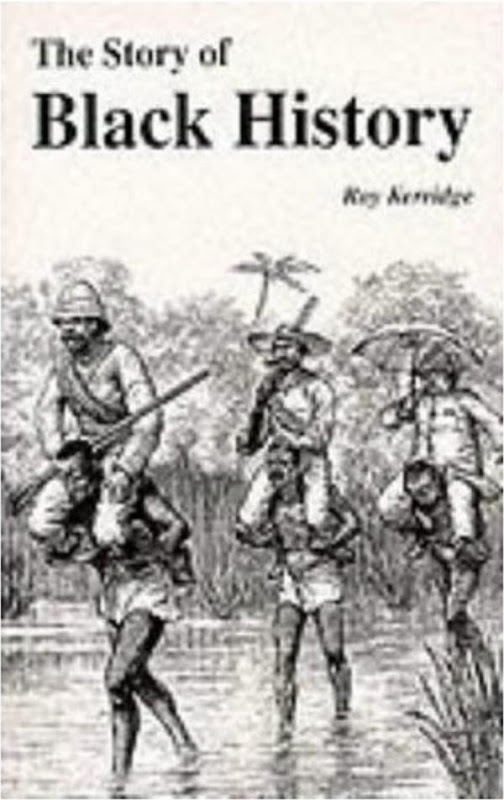
The Story of Black History
by Roy Kerridge
Claridge Press, 72 pages

[Most easily obtained through www.amazon.com]

Roy Kerridge is that most annoying of commentators on a controversial subject -- one who actually knows what he is talking about.  There is probably no white writer with a more intimate and informed knowledge of how English black communities really function.  He was raised by a black family and grew up in black London where his stepfather was secretary of the "African League" and editor of The African Voice.

While this book is mainly about the English experience, its lessons are important for Australia and all other Anglomorph countries with flourishing multiculturalism and race-relations industries.

It is difficult for libertarians to say that anything should be compulsory reading, but The Story of Black History should surely be obligatory for anyone who wants to make a constructive contribution to, or say anything informed about, race relations today.  It is particularly recommended to certain of the buffoons in clerical collars who might like their words on race relations to have some constructive content or at least some relationship to the facts.

It cuts a devastating swathe through cant and politically-correct lies, though it is alarming and depressing in its revelations of just how deep institutionalised lying has now gone, and of the extent to which black people are being pressured to live in a mythology of falsehoods.  Though the implications are chilling, and one may -- and should -- feel outrage at the perversions of truth documented here, there is a kind of appalling fascination in the intellectual and historical rot that Kerridge turns over and exposes.

One of the major points which The Story of Black History makes is that real black history is not a monolithic thing and, despite the patronising assumptions of race relations and black history industries to the contrary, black people in Britain are not anything like a single, homogeneous mass.  The heritages of African and Caribbean migrants are quite different.  So are the cultures of, for example, Jamaica and Barbados.  Nor is the experience of blacks in Britain and America the same, though British blacks are now under the overwhelming cultural pressure of Hollywood mythology.  Kerridge recalls growing up in black London:

The Trinidadians soon allied themselves with Creoles from Sierra Leone, West Africa ... the few Jamaicans we met seemed very odd fish, with their baffling allegiance to God, Queen and Commonwealth ...

Kerridge asks why, if it was true that blacks were brought to Britain to do the jobs that whites didn't want, as "black history" claims, were working-class whites not overjoyed to see them, and did not greet them with cries of:  "Here, take my job!"

He continues:

As I remember it, from my schooldays in the "African League" every boatload of West Indians that arrived in Britain was met by eager con-men from West Africa or Trinidad out to fleece and bamboozle the newcomers ... My friend Virginia Farmer ... spent her first night in London shivering on a station bench as she "waited for the man to come and tell me where to live and get me a job".

Apart from the complexities of West Indian and black American culture, Africa is not -- how odd that one should be need to be told this! -- one country with one language or set of customs.  Kerridge points out, in regard to the mythical "Africa" which exists as a kind of country of the mind:

Until recently, the "African language" proclaimed by "African Americans" was Swahili, an Arab-pidgin used originally by slave traders operating from Zanzibar.  The language (never learned, but often quoted) accorded well with the general "pro-Islam" slant of the New Africans.  Now, after thirty years of glorifying Arabs and Islam, the neo-Africans have at last become dimly aware of the vast Arab involvement in the African slave trade.  Yoruba is replacing Swahili as the "African language" ...

Hollywood and American television add another layer of fantasy and distortion.

Kerridge is a brilliantly economical writer, and one of the feats of this small book is to indicate just how complicated real black history actually is.  Sophisticated neo-Africans, he points out, disown as "low" the genuine African traits which are still to be found in some black American communities.  How ashamed they would be of the black American pastor who greeted him in Louisiana with joy as

A man from England, home of our mother-church, the great Church of England!

Whites who commiserate with blacks over the legacy of slavery may provoke nothing but embarrassment.

The products of the "black history" industry do not seem helpful preparation for life.  Rather, it seems an engine for inculcating paranoid fantasy.  The result of false mythologising is layers of confusion that can shade into outright madness.  There is, for example, the weird history/ cult of Nubianism.  This seems to have little to do with the real black Kushite kingdom which had some important interaction with Pharoanic Egypt, including supplying a Pharoanic Dynasty.  It claims rather that

Nubians are super-beings made in Africa in ancient times by immortals from space adept in arts of genetic engineering, wrongly called God.

There is something terribly wrong when this nonsense seems to be practically beyond criticism and has actually attained a kind of academic status.

I can attest to his from personal experience:  while I was in Britain recently, a television programme was screened in which a "black history" academic solemnly informed us that Cleopatra was black.  Not only is there not a shred of evidence for this (Cleopatra was a Ptolemy, of a Greek dynasty installed following Alexander the contemporary writer paid tribute to her "white breasts" -- and she can hardly have been two-tone.

Kerridge points out that:

Knowing no history, the white English cannot counter-attack the diatribes of Nubian historians, since for all they know the Nubians are telling the truth.

Much of what he writes has devastating implications about the teaching of all history today.

Nation of Islam literature printed in America and distributed in Britain admonishes against eating foods associated with American slave-mythology, such as "deer, possums, coons, turtles or hominy grits", which few British blacks would be inclined to eat anyway.  One bizarre result is that many black (like some white) British schoolchildren now quite literally do not know what country they are living in.  When taught by Nubianism and Nation of Islam that "the white man is the devil", the effect on some blacks:

instead of making them ferocious [is to make them] feel timid and nervous in the presence of white people.

This stuff is, in short, a form of abuse and damage to the people who are subjected to it.

Kerridge writes with wit and grace as well as knowledge, making this book in its way delightful as well as horrifying.  By writing and publishing The Story of Black History, he and Claridge Press have performed a brave public service, and not only blacks should be grateful.

Perils of public ownership

Address to the Energy Market Regulation Conference
Melbourne, 1 December 1999


PRIVATISATION

With the completion of the Victorian process, the hiatus in privatisation has been filled with events in other States.  The blowtorch is on NSW and Queensland with the Financial Review being unkind enough to have assembled a table of losses caused by unwise decisions of bureaucrats and, in Queensland's case, subsidies.  The losses run to $1.6 billion, three quarters of which are due to poor contracting by the state authorities.

The other action is in South Australia, where, perhaps partly because of losses by private and public sector businesses alike, the field for ETSA is thinning out faster than a Grand Prix race on a wet afternoon.

But it is the well-publicised losses, especially the Pacific Power/Powercor debacle, that has brought Treasurer Egan gingerly to once again unfurl his banner and re-enter the NSW privatisation debate.


PUBLIC OWNERSHIP AND REGULATORY NEUTRALITY

The Electricity Code, together with the Hilmer competition reforms, was largely written in an era when we kidded ourselves that the ownership structure -- private or public -- was irrelevant.  Corporatisation was considered to offer all the advantages of private ownership while retaining the family silver.  The adoption of a corporatisation model implied the need for clear commercial objectives, such as the requirement for acceptable rates of return, effective performance monitoring and competitive neutrality in input and product markets.

Part and parcel with this, at the heart of the competition policy reforms has been the requirement for a jurisdictional split between the government as regulator and the government as market operator.

While naked intervention to support a state business against private sector competition is not apparent, the outcome of the corporatisation approach has been mixed.  The corporatised entities have certainly showed improved commercial orientation and have downsized and aligned their outputs better to the needs of the customer.

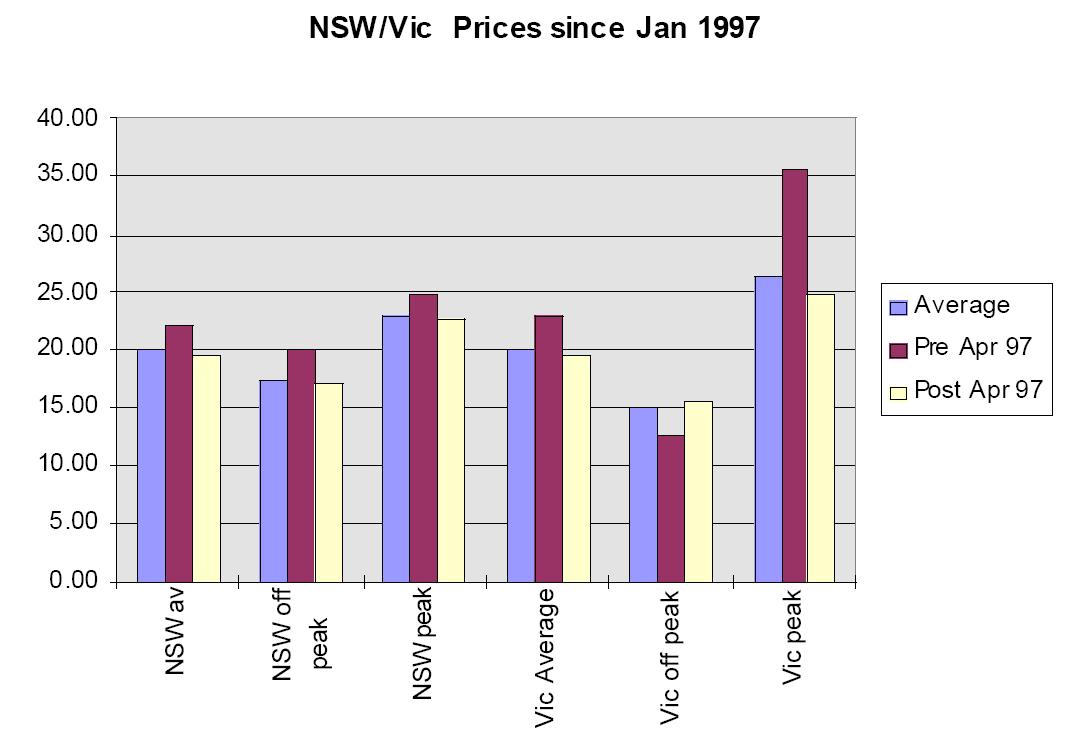
Market prices at some two thirds the new generation price levels have been one frustrating (to the generators) source of stability in the main NSW/Vic market.

The low prices are illustrated in the following chart.

The basic trends in these prices reflects the reality of an over-supplied market.  The Victorian generators claim the state owned nature of the NSW generators causes them to bid on a market share rather than profit maximising fashion.  There may be something in this but the overwhelming cause of the low prices is excess capacity.  Whether that excess capacity would be more readily placed in cold storage by a private sector operator is a difficult question to answer.

The Victorian private sector generators have maintained that their publicly owned competitors in NSW are behaving uncommercially as a result of their ownership structure.  They have also maintained that the NSW Government is recouped from the vesting contracts and the retail and distribution sector, and from the 0.55c/kwh levy on contestable customers.  Even though the ACCC has now forced some reduction in NSW vesting prices, the reduction was rather less than expected and takes place with a delay that is a handy bonus to two year's profits.

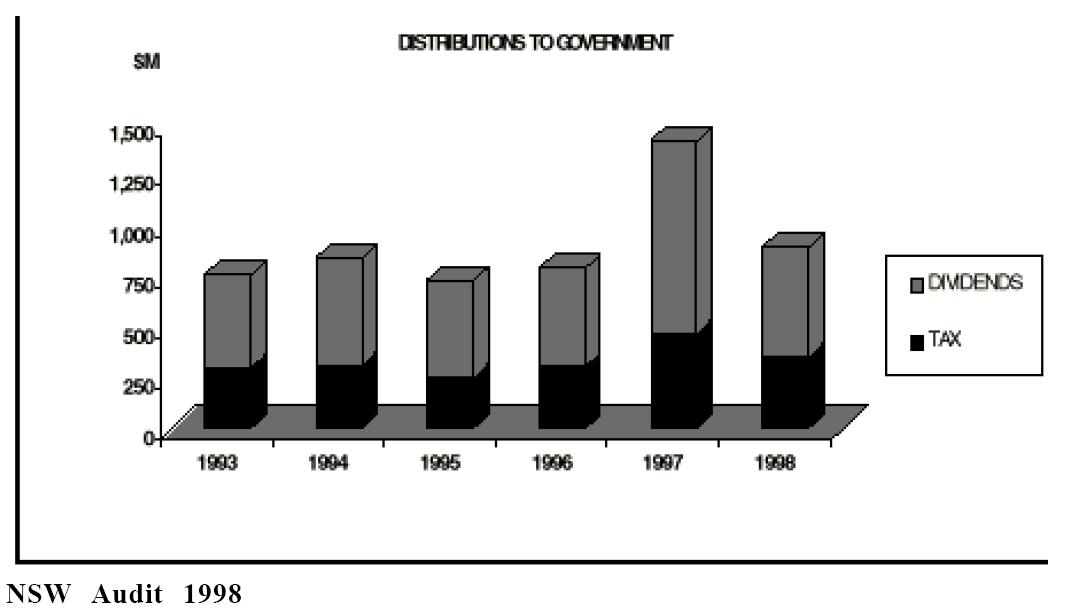
Overall payments of the NSW electricity industry to the Government have been maintained.

Distributors in Victoria, NSW and South Australia have produced solid profit performances on the basis of their regulated prices.  Victorian generators have found themselves losing money as the price war has impacted on their heavy levels of debt.  The NSW generators have been cushioned by being somewhat undercapitalised but nonetheless have found themselves in distress is evident from the Auditor's 1998 report.

The NSW Auditor in last year's report noted that the generators had shown a steady declining return on average equity from 15% to 10% to 3% in the three years to July 1998.  In 1998, Macquarie and Delta had gross profits of around $55 million and Pacific Power about $44 million.

The 1999 results are not yet fully published -- only those of Delta were available at the time of writing.  Delta's results, are quite outstanding.  The business has increased its profits by almost 10%.  This stands in contrast to its expectations of a profit decline from $55 million to less than $20 million.  Macquarie also appears to have bettered last year's profits.  Nonetheless, the NSW generators remain in trouble -- the settlement against Pacific Power is equivalent to $200-$300 million on most estimates, which would account for 5-6 years of profits!

In one important sense, the NSW Government has had some success in shielding itself from the adverse effects of the price war on its own revenues.  But it has done so by grabbing back from the NSW consumer some of the benefits of that price war.  And it remains the case that the dividends it receives from its investment are far less than those it would obtain from retiring debt.  And, as the Pacific Power/Powecor result shows, existing dividend stream is far from secure.


IMPLICATIONS OF GOVERNMENT OWNERSHIP

Although corporatisation has proven to be an improvement on the structures presceding it, some of the deficiencies of the model are illustrated by the NSW performance.  The deficiencies are:

  • the temptation of the government to use the boards to reward faithful retainers.  The worst example of this over the years has been the ABC.  But in the electricity industry we saw some of the outcomes of this in NSW.  The initial board of energyAustralia received a management endorsed consultancy study reportedly recommended a cut its workforce to 1,800 from 3,800 (which is already a reduction from 4,500).  The response of the board of energyAustralia in rejecting the report and dismissing the CEO does not appear consistent with the hard-nosed commercial framework within which businesses should operate.  Eventually, the NSW Treasurer replaced the energyAustralia board for this and other shortcomings
  • The conflicts of interest the minister/shareholder has with the different competitive responses of the companies under his ultimate control and his duty to ensure the best possible return for his shareholders.  Rob Lucas, the SA Treasurer relates the difficulties he faced as a shareholder to be told the plans of one of his generating businesses and subsequently to learn of similar plans by another and other action to mitigate the same problem by ETSA.  Aside from the difficulty of confusing oneself with who had what plans and inadvertently revealing the commercial secrets of a competitor, the shareholder is in a dilemma:  if he tries to prevent expenditure that would be unwise in view of the competitive environment he destroys the vertical and horizontal disaggregation on which the efficiency promoting competitive tensions are based.
  • The minister as shareholder will often have a temptation to exercise influence on the business to promote a particular political line.  I recall myself as a senior official in Victoria fronting one of the then corporatised businesses to persuade the CEO to allocate funds to burying some power lines.  As an emissary of a shareholder minister, my remonstrations would clearly carry much more weight than those of a normal lobbyist.  This is even more likely where, as in Queensland and, at least arguably in Western Australia, the Minister/shareholder is also the regulator.
  • The attitude to risk will tend to schizophrenia.  On the one hand the lack of a genuine shareholder and credit watchers may induce some adventurism on the part of the firms.
    • There are criticisms that the NSW generators are less cautious about insuring against major risk events than private Victorian generators.  Thus, if a VoLL of $25,000 were to occur, the loss of Macquarie assuming its 4640MW is 75% contracted at $30 is $521 million.
    • Great Southern Energy is reputed to have paid nearly twice as much for Wagga gas offered by either AGL or other bidders.
    • And it appears the government owned retailers and generators in NSW and Queensland have been unfortunate in their contracting.

On the other hand, Treasury owned firms are likely to have considerable oversight by Treasury officials of their strategic plans.  Almost by definition this means excessive caution since the rewards for risk taking are not present.


BENEFITS OF PRIVATE OWNERSHIP

GENERAL ISSUES

All the evidence is that the provision of goods and services is more efficiently undertaken by privately owned businesses.

There are many reasons why this should be so.  Not the least of these is the intrinsically greater flexibility of private sector bodies, motivated by the goal of maximising shareholder wealth, to adapt their products to shifting consumer needs and to pare unnecessary costs.

In competitive markets, commercial rivalry will force lower costs to be passed on in lower prices.  Private firms that forego opportunities to reduce costs puts at risk their viability.

By contrast, Government owned businesses are able to survive without such a heavy focus on these costs because they do not face the threat of takeover by others able to spot and implement the opportunities for profit by making savings.

In addition, private ownership markedly reduces the risk of government interference in the terms and conditions under which goods and services are provided.  This better allows the operation of the competitive market conditions that all states and territories have agreed to under CoAG.

Hence, while in principle there is no reason why private rather than public ownership should offer better outcomes to the consumer, the former is spurred more forcefully by profit considerations that require a very close customer focus.  Private businesses flourish when they can establish and hold customer loyalty and avoid poor reputations.  Indeed, the reform process in the Australian electricity industry was stimulated by observations of increased efficiency and lower costs observed in the mainly privately owned US industry and by the gains that were rapidly being seen in the newly privatised UK industry.

Measures that result in excessive costs being carried will fall on the customer.

The initial means of eliminating these excessive costs have been to transform the previous engineering based dispatch to one which embraces the total operations in a market and to require lower prices and efficiency gains by price regulation.


SPECIFIC IMPROVEMENTS ATTRIBUTABLE TO PRIVATE OWNERSHIP

In Victoria, prior to privatisation, resolute government action from 1990 resulted in considerable savings in costs and improvements in efficiency.  Yet, in the period post privatisation of most of the businesses, further substantial improvements were brought about as a result of the focus on increasing shareholder value.  As illustrated below, this cost reduction process had not been at the expense of customer service.

Distribution Service

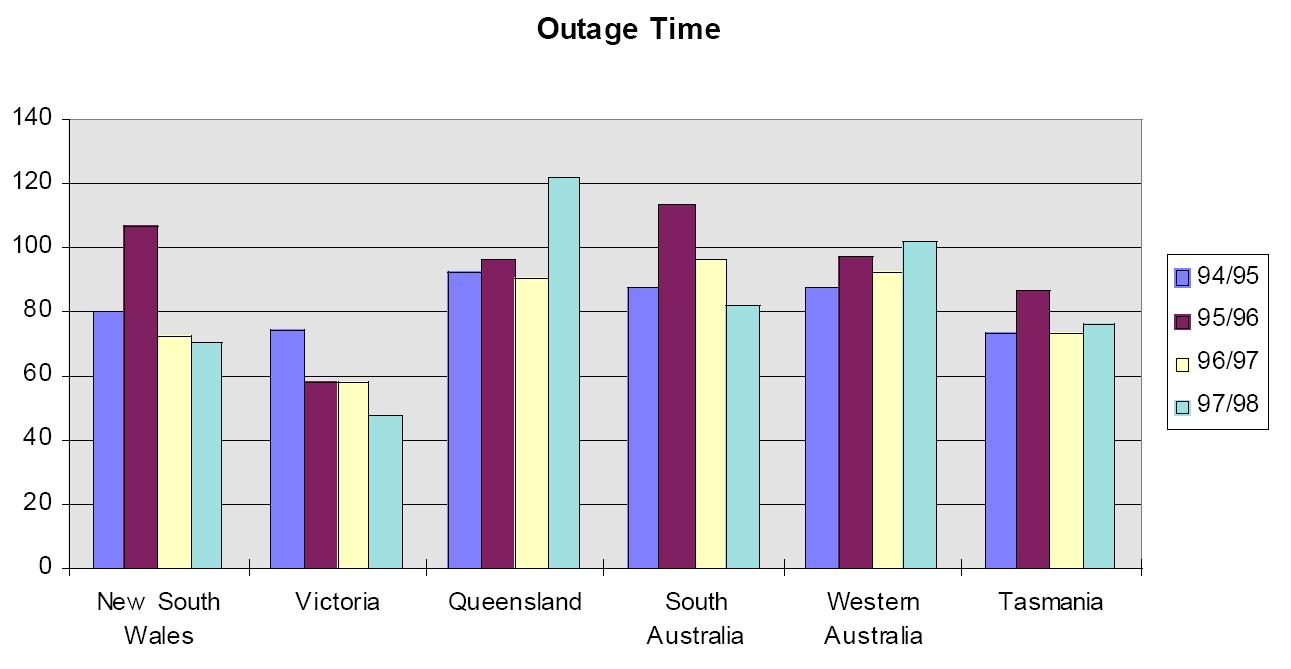
In the case of distribution, outage time is a useful measure and the outcome has been mixed, depending on whether minutes off supply or number of outage occurrences are counted.  On the ESAA data, using minutes off supply, outage time in Victoria has shown the most marked improvement and stands well below that of the other states.

Generation Service

Privatisation generally brings about a more coordinated meeting of demand at affordable costs.  Generally speaking, the Australian ESI -- public and private -- has shown a marked improvement in recent years.

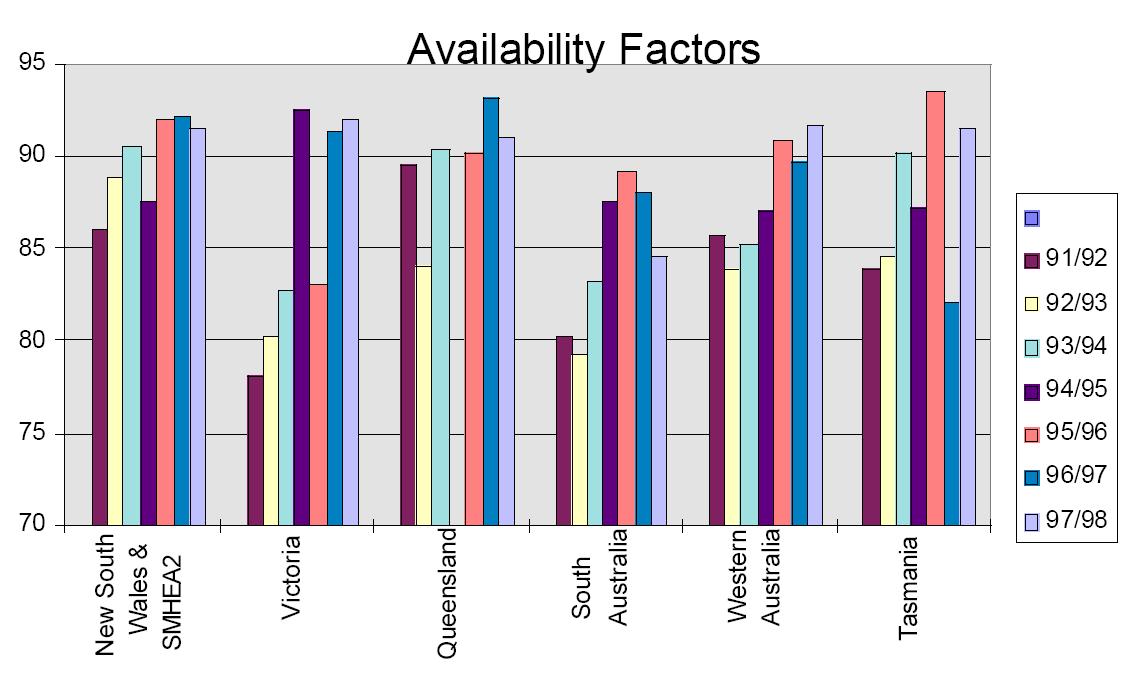
The normal measure of service in generation:  availability to run, saw a particularly strong improvement in the corporatised Victorian system which has been maintained in the subsequently privatised system

Generation Productivity

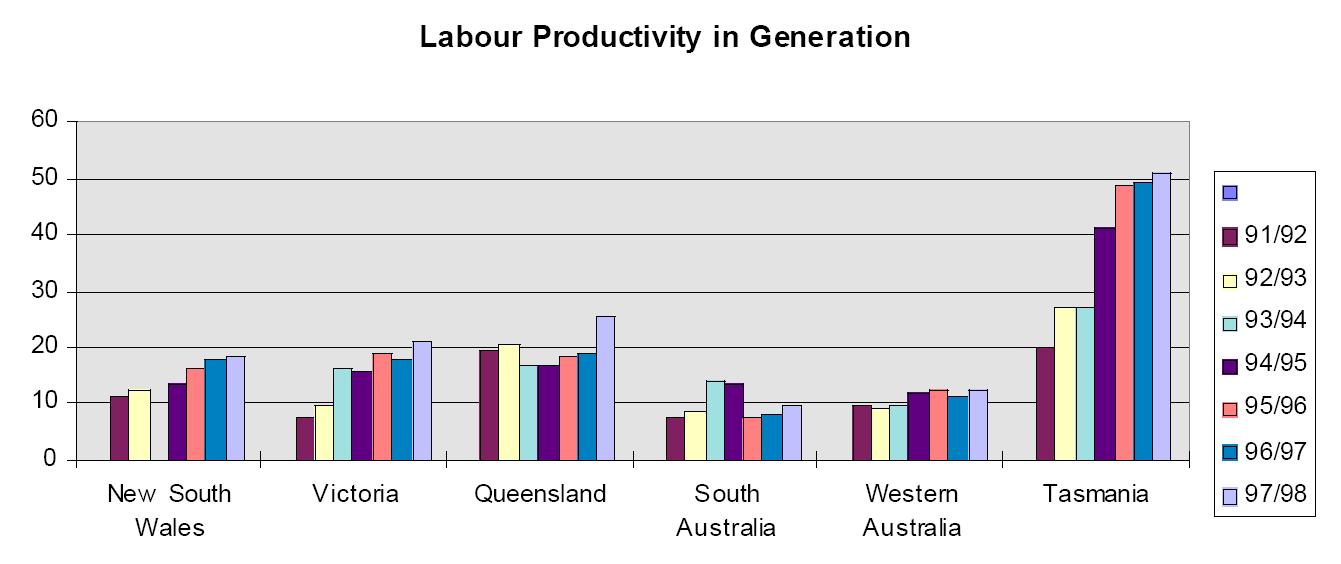
Labour productivity has generally improved across all states but the most marked improvements have been in Victoria (Tasmania's improvement on the data is partly due to the completion of the building program).  Labour productivity has almost trebled in Victoria, with most of the big gains made prior to privatisation -- most in fact made during that ruthless labour-shedding administration of Joan Kirner!

Distribution Productivity

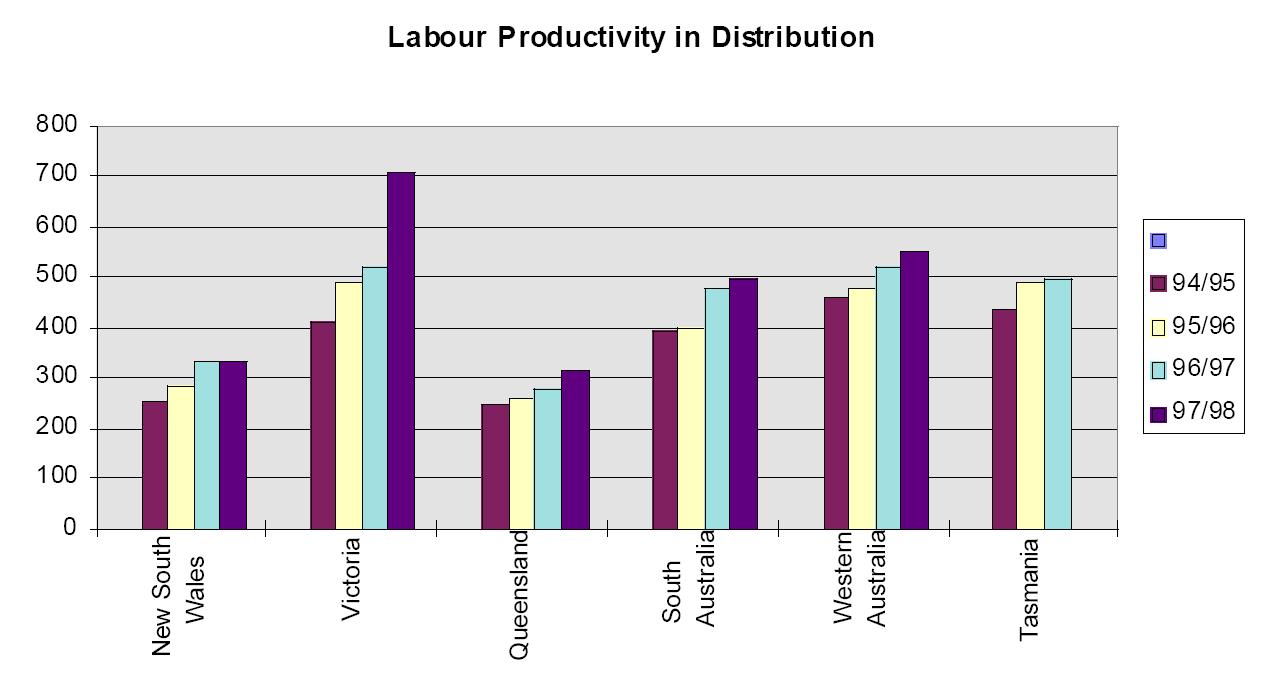
The really spectacular gains in distribution business productivity have been made under the privatised Victorian system.  To some degree these figures are due to outsourcing, which has been more radical in Victoria but there are also businesses that have not markedly reduced their workforce, TUA being one, because they have diversified into synergistic areas (in TUA's case transmission construction).

Even the Kennett Government baulked at tackling the excess labour hoarding in the distribution sector and it was left to the new owners to achieve the rationalisation that the chart demonstrates.  But since corporatisation, the NSW electricity businesses have also moved rapidly to reduce their staffing levels.  Each of the six retail businesses has reduced its workforce by 10-25 per cent.  Even so, it is the privatised Victorian system that has led the pack.  Only as recently as 1994, Victorian manning levels were comparable to those of South and Western Australia but now are 20-30% lower.

As in generation, the rationalisation of labour was accompanied by an improvement in the normal measures of meeting consumer requirements.  And from the publicly available information, it has also been accompanied by increased profits.


CONCLUDING COMMENTS

All the evidence is that privatisation and competitive markets together bring about major gains for consumers, shareholders and, where assets are sold by governments, the taxpayer.

Private ownership is preferable both because of its more concerted focus on profiting from consumer satisfaction, and because it removes the industry away from political direction.  These conceptual advantages have been amply proven by the Victorian experience.

And the People Spoke

The surprising thing about the referenda held on the first Saturday in November is that anyone was surprised by the results.  Of the 13 proposed amendments supported by both the Prime Minister and the Opposition Leader of the day, eight succeeded.  Of the 31 not supported by both, none have succeeded.  Though the indirect-election Republic proposal defeated on Saturday was the only amendment ever put to the people not supported by the incumbent Prime Minister, it conformed to this pattern of bipartisan or bust.

Coincidentally, 31 is also the number of amendment proposals that a majority of the Australian electorate has rejected outright:  or 66% of the 44 amendments put to the people.  University of Melbourne Professor Brian Galligan's advice that progressive elites and federal governments should stop pestering the Australian people with referendum proposals that are unnecessary or that attempt to centralise power in Canberra was not heeded.  Indeed, this record of elite failure to persuade is itself a powerful argument for a popularly elected President.  (And those who say that a popularly elected President would change the way we are governed by creating a competing power centre to the Prime Minister may have to face the dreadful prospect that that may be, in fact, precisely what many people want).

The whining about John Howard's refusal to compromise his monarchist principles demonstrates perfectly the intolerance of Australian "progressives":  no opinion which disagrees with theirs is legitimate.  More to the point -- given the absolutely clear history on the necessity of bipartisanship -- why were the official Republicans so determined to put it up under a monarchist PM anyway?  One can't help feel that a mixture of ego -- wanting their constitutional monument -- and a desire to humiliate John Howard had something to do with it.  John Howard had promised to go ahead with the referendum, but there was nothing stopping the republicans from declining the offer until "further discussion of the proposal" had taken place.

The longstanding media antipathy to John Howard was very much on display throughout the campaign and its aftermath.  This is essentially self-interest on the part of the media.  Journalists have always tended to be captured by whoever is their most important source of stories:  thus crime reporters generally report the police perspective, industrial relations reporters the union perspective, education reporters the teacher union and education bureaucrat perspective, environment reporters the green perspective, and so on.  Modern journalism has discovered an even lower form of professional prostitution:  reporting on the basis of what makes them appear "kosher" in their attitudes to their fellow journalists.  On a range of issues, this involves denigrating the values and aspirations of most of their fellow Australians.

This has been seen with unparalleled explicitness in the republic debate.  According to a February 1998 Morgan opinion poll, if Australia is to be a republic, only 27% of the electorate wanted a republic where the politicians choose the President:  68% wanted one where we do.  But the media "knows" what is good for them and has tried to ram it down their throat.  In exactly the same way they have attempted to do on indigenous issues, immigration, etc. etc.

Hence the self interest in their antipathy for John Howard, for if Howard's social conservatism has any validity, then a whole range of attitudes through which the media (and other members of what Les Murray calls "the Ascendancy" and others "the new class") mutually agree demonstrate their own moral superiority do not:  so despising Howard is a way of defending their status-giving moral assets.  This was particularly notable over the Hanson debacle.  Hanson got prominence by pushing a whole range of issues (migration, crime, indigenous policy) where the gap between the Sneerer's Guild (led by Chief Sneerer Paul Keating) and the general population was greatest.  Yet who did the media blame for Pauline?  John Howard, of course:  when Pauline was fairly obviously Paul's bastard political child.  But to admit that would completely undermine the Ascendancy's moral assets and self-awarded status.  (It is no accident that the Ascendancy's favourite former PMs -- Whitlam and Keating -- are the two most electorally rejected PMs of the last 30 years).

The proposed preamble, on the other hand, falls into that very select group of proposals (now five out of 44) which both the Prime Minister and Opposition Leader supported but was rejected by the electorate.  The people have declined to be told what their values are.  But people were also asked to vote for a preamble not available for a last minute perusal at the ballot box:  it became far too much like buying a "pig in a poke".  Some of us are grateful that no further excuse for judicial frolics by judges rapidly disappearing up their own moral vanity were added to the Constitution.

Only five proposed constitutional amendments (or 11%) have garnered a majority of votes but failed to carry a majority of States.  Special majorities are, however, normal in Federal Constitutions:  the US Constitution requires the support of three-quarters of the States for changes.  Since the Constitution sets the fundamental rules of the political game, such a special majority is entirely proper:  protections against the "tyranny of the majority" should be part of any decent Constitutional structure.  The persistent refusal of voters to support changes to the basic rules of the game which do not have the support of both sides is also quite rational.

Referendum proposals never get significantly more support than the combined Senate vote of political parties endorsing them, though they often get significantly less.  Referendums held separately from general elections have tended to do particularly badly on this score, scoring on average 19 percentage points less than the combined Senate vote of supporting parties:  this average is unchanged by the 1999 referenda.

In other words, it is relatively easy for politicians to convince their supporters to vote "No", harder to convince them to vote "Yes", particularly if voters are considering the issue separate from the distraction of a general election.  The ALP, Democrats and Greens had a combined 1998 Senate vote of 48%.  Add some percent for pro-republic Liberals, and we can see that the Republic proposal's 45% vote represents a better than average failure to persuade.  The preamble, on the other hand -- supported by the Coalition as well with a total combined Senate vote of supporting parties of 86% -- represents a loss on par with the record failure of the "nexus" question of 1967, which proposed to eliminate the requirement that the House of Representatives be no more than twice the size of the Senate.

Another way of looking at it, however, suggests that the republican campaign was a remarkable success.  The ARM only scored 30% of the vote for the Constitutional Convention, on par with the 27% support for a politician-chosen President.  On that basis, pushing the vote up to 45% was a remarkable feat of persuasion.

Yet polling support for a republic has been significantly ahead of support for the monarchy since 1993.  Which leads to the question, not of how did the official republicans do comparatively well in persuading people to vote for a republic they didn't want, but why the republicans did not offer the people the republic they did want?

The official republicans did a remarkably poor job of arguing against a directly-elected President.  The "Yes" campaign had two clear, and unfortunate, subtexts.  One was yes, we know you want to elect the President but we are not going to give you that option.

This was reinforced by the subtext of ... and we don't trust you to choose the right sort of person to be President.

Opinion polling indicated lower income people were particularly strongly against the indirect-election republic, since only popular election of the President enables them to participate:  a result confirmed by the electorate results.  The strong country and outer-State vote against the republic also feeds into this, showing a clear distrust of East Coast urban elites.

It is perfectly clear that there are two Australia's:  an inner city Australia centred in Sydney, Melbourne and Canberra and the rest of Australia.  The fact that the media overwhelmingly lines up on one side and then preaches at the other is not helpful.  One of the best ways to break down the division would be for the Australian media, either directly or through its chosen commentators, to stop preaching:  particularly in such a self-righteous and one-sided way.  Dismissing those who voted No as unpatriotic (before the vote) and as emotional and uneducated (afterwards) just replicates this unsavoury trend.  Given the massive pro-republic media bias, the defeated republicans complaining about an "uneducated" public is a double criticism of themselves and their media supporters.

The republican proposal was clearly not without significant flaws.  The instantly-sackable President was not a positive feature.  Nor was requiring the President to follow advice from the Prime Minister, Executive Council or Minister without any indication of what happened if they disagreed.  Importing into the Constitution terms -- reserve power, convention -- of uncertain ambit was another legal minefield, the result of which would have been to make it quite unclear when Presidential actions were or were not subject to High Court oversight.  But the republicans were under no real pressure to get their hodge-podge proposal right since the media could be, and was, relied upon to avert such scrutiny.

Which suggests a major reason why the republicans served up a republic that the people did not want -- they thought the massed ranks of media support would be enough.  Clearly, it wasn't.  But what does such a calculation say about the Australian media?


ADVERTISEMENT

Prize-winning but Patchy

Book Reviews

Geography for Global Citizens
by B. Parker, K. Lanceley, D. Owens and R. Reeves
Macmillan Education Australia:  Melbourne, paperback, 1999, 350 pages, $34.95

This geography textbook was written for use by students in years 9 and 10.  It consists of twelve chapters organised into three sections.  The first general section (70 pages) comprises two chapters.  The first chapter explains what geography is and what geographers study, very briefly introduces maps and physical landscapes, discusses skills such as using an atlas, drawing maps and field sketches, and raises some global geographical issues such as threatened habitats, access to fresh water, land rights and urban growth and decline.

The next chapter entitled "Global environments and communities" considers landforms, plate tectonics, geomorphological processes, weather and climate, ecosystems and food webs, communities, and the skills of drawing and interpreting graphs and using the Internet.

The second section (169 pages) reviews five major environments:  tropical rainforests, deserts, mountains, coasts and polar lands.  The chapters are of equal length and generally review physical processes, climate, biogeography, environmental management and significant problems.  Sprinkled throughout the chapters are references to acquiring skills such as finding places and showing heights on a topographic map, drawing a cross-section and interpreting photographs.  The third section (105 pages) treats five themes in chapters of varying length.  The themes are urban growth and decline, access to fresh water, changing climate, the impact of tourism and global citizenship.

All the chapters have a common format.  On the first page, students are told what they will be able to do when the chapter has been carefully read.  The various parts of the chapter are separated by a test called "knowledge and understanding" and suggestions for activities, and the chapter generally concludes with case studies.  Various sections are labelled with icons referring to "Geographic issue", "Global citizens" and "Skills".  The book is profusely illustrated with diagrams, photographs, boxes, maps, highlighted quotations and cartoons.  It concludes with a five-page glossary and a very short index of two pages.

The book's strengths are the numerous case studies, some of the illustrations, the references to Websites and the raising of geographical issues such as access to water, deforestation and possible climate change.  The weaknesses are the other illustrations, the lack of detail in some of the core sections of physical geography, the flimsiness of instruction in some skills, the failure to provide balance on some issues , the absence of references to some major geographical issues and the lack of references for assertions and some figures.

I found the huge number of illustrations a distraction from the text and plainly several were not worth a thousand words.  The text might have been designed for readers with a very short attention span;  there are generally three or four different coloured items per page competing for attention.  The items labelled "Did you know?" are sometimes trite ("Did you know that other names used for mountains are alps, highlands and peaks".  page 143) and sometimes inaccurate ("The Arctic and Antarctic are in darkness for six months of the year".  page 210).  Figure 4.47 shows existing deserts and areas at risk of desertification.  Since it carries no source it was presumably drawn by the authors.  It fails to show the Namib Desert in south-west Africa, the Gibson Desert in western Australia and the Taklimika Shamo and Peski Muyunkum in central Asia, and, incorrectly, shows a desert in the northern Shandong plain adjoining the large gulf called Bo Hai [sea] where the delta of the Huang Ho [Yellow River] is located.  This map also shows a large area around Darwin at risk of desertification.

Some sections of the introductory chapters seemed too superficial for students in years 9 and 10.  For example, there is no statement that parallels represent the angular difference with the plane of the equator.  In the glossary, latitude is defined as "distance from the equator".  The international date line is given as an example of a meridian (page 14) when it is no such thing.  Erosion is defined as "... the wearing away of the land surface as rock particles are removed by wind, running water and ice" (page 44) without any recognition that much erosion occurs as a result of these transporting agents being armed with fragments of rock.  That becomes clear for wind and water later in the text (pages 116 and 150).  Chemical weathering is introduced at page 149 without any reference to the weathering and erosion of limestone.  The terms "limestone" and "karst scenery" do not appear in the glossary or the index.  A surprising omission seems to be the lack of any formal connection between maps 1.34 and 2.28 which show the global distributions of physical environments and climates respectively.

The treatment of some skills seems superficial.  The discussion of skills connected with maps (pages 5 and 16) makes no mention of isoline, dot or choropleth maps.  The skills section devoted to research (page 69) notes that you can learn how to acquire information and verify its accuracy but there is no explanation of the techniques you can use to verify the accuracy of information.  It would have been worthwhile to urge students to use a range of diverse and unconnected sources, listing for them the best gazetteers, atlases and encyclopaedias and warning, for example, against the uncritical acceptance of government statistics from dictatorships.  The reference to interpreting photographs is much too glib and air photos, which are a prime source of information, are treated in quarter of a page (page 188).  Then, having told the students that the colour red on an infrared air photo of Monterey Bay usually means living vegetation (page 189), there is no explanation of the red blotches in the sea.  The skills connected with conducting a survey of people's opinions or activities fails to explain the methods by which a representative and adequate sample can be identified or the need to avoid loaded questions.  As I write this, I have a vivid memory of how Sir Humphrey persuaded Bernard to give two opposite answers to the merits of conscription in less than five minutes.

In some instances, it was possible to detect a lack of balance which might have been entirely accidental but which might deceive some students.  For example, the examination of the marked adverse effects of logging in the Solomon Islands (pages 92-4) does not sheet home responsibility for the damage to corrupt governments in that country.  There is an astonishing question on page 139 which seems to raise an unnecessary, indeed ridiculous scare.  The students are asked:

  • Who would have the "right of ownership" to the desert lands?
  • Will the superpowers of the world try to take them over when they run out of land?
  • What about the rights of traditional owners of the land?

It would be very interesting to read the answers which the authors might give to that series of questions.

The prospect of mining in Antarctica in the future is raised (page 221) after referring to the possible depletion of the world's mineral resources.  But there is no discussion of mineral price changes if depletion occurs nor of the relative costs of mining higher-grade deposits in Antarctica and lower-grade deposits in, say, North Africa or Central Australia.  Then it is noted that there is an agreement by the most powerful countries that no mining will take place in Antarctica for fifty years from the early 1990s (page 230).  The analysis of global warming raises the important question "will there be benefits for some and problems for others?" (page 291).  This is a question that most green activists avoid or dismiss because the answer might be inconvenient.  Alas, no answer to the question is provided but there are seven gloomy predictions about global warming (page 295).

Turning to issues that are not treated, the most obvious concerns the oceans.  It is odd that students are told that the oceans occupy 71 per cent of the earth's surface (page 58) but there is no major section on the oceans.  There is no reference to the remarkable enclosure of the oceans by extended claims to exclusive economic zones 370 km wide that have reduced the area of the high seas by one third since the 1960s.  The statement that the air we breathe, the oceans and the polar lands are known as global commons because they are not owned by any particular country (page 336) is well wide of the mark.  Countries own the air space above their lands and territorial waters and they own the seas within 370 km of their coasts.  The Arctic polar lands are owned by Russia, Norway, Denmark, Canada and the United States, who also collectively own about half the Arctic Ocean.  There are claims to most of Antarctica and claims could be made to seas within 370 km of the continent.  How is it possible to discuss coasts (Chapter 6) without reference to the closely related continental margin, where most of the world's fishing industry operates and where large quantities of oil, gas and some minerals are extracted?

It is disappointing that there is no reference to the sources which I imagine the authors consulted in preparing this book.  It is also unfortunate that there are some figures and maps where the sources have not been shown:  they include Figures 7.24, 7.46, 8.6, 8.27, 9.3,9.4 a and b, 9.6 and 9.7.

This book was the overall winner of The Australian's "Awards for Excellence in Academic Publishing".  In presenting the award, Senator Lynn Allison -- who represents the Australian Democrats -- described the book as "technologically with-it", noted that it was about woodchipping, logging, mining, dams, foreign aid, tourism and exploitation, and that "It is subversive but it is objective.  From a parliamentarian's perspective it is ... a serious book about politics" (The Australian, 9 June 1999, page 39).

The OED definition of subversive is "having a tendency to subvert or overthrow" and the relevant definition of subvert is "To undermine the character, loyalty or faith of a person".  It seems unlikely that this book will produce a generation of radicals struggling to protect the world's environments from perceived deterioration or misuse and to improve the lot of unfortunates at home and abroad.  It appears to be rather a comfortable statement about thoughtful planning before development occurs, sympathy for indigenous people, the poor and hungry, people deprived of human rights and women and personal responsibility for rubbish.

At levels 9 and 10, students should be exposed to the realities of political geography.  For example, in the final chapter there are bland statements about the aims of the United Nations and the World Trade Organisation (pages 342-3) without any comment on the United Nations' continuing abysmal failures in Africa that started with the independence of Zaire in June 1960 or any reference to the way in which the major economic powers can avoid the discipline of the World Trade Organisation if it is deemed in the national interest.  If the aim is to make students global citizens they should be given an indication of the total number and scale of problems facing the world that are included in the scope of political geography.  It might be expected that any list would not be confined to the matters recited by Senator Allison.  It might also include civil wars in Africa, Sri Lanka, parts of Indonesia, Afghanistan and the Balkans;  oppressive regimes in the Middle East and parts of Asia;  the plight of new countries cast adrift without proper preparation by the disintegration of the Soviet empire or Yugoslavia or by Portugal's irresponsible decolonisation of overseas territories in 1975;  the corrupt plundering of national treasuries which has impoverished some states;  the scourge of HIV-AIDS along the major transport routes from Uganda to Zimbabwe which has left many families consisting of only children or grandparents and children;  the dreadful activities in various continents which have spawned the new term "ethnic-cleansing".

I recommend that geography teachers should obtain an inspection copy of the atlas and consider carefully whether they are prepared to ask their students to purchase it for use throughout Years 9 and 10.  There is also a Teacher disk which I have not seen that costs about $72.95.  Enquiries can be made to following telephone numbers:  Victoria and Tasmania, 03 9825 1025;  New South Wales, 02 9719 8944;  South Australia and Northern Territory, 08 8362 2640;  Queensland, 07 3391 5391;  Western Australia, 08 9470 9930.

Ideology and Self-interest:  A Little Refresher

Book Reviews

The Great Divide:  Immigration Politics in Australia,
by Katharine Betts,
Duffy & Snellgrove, Sydney, 1999, 426 pages, $19.95.

&

Labor without Class:  The Gentrification of the ALP,
by Michael Thompson,
Pluto Press, Sydney, 1999, 118 pages, $19.95.

&

This Tired Brown Land,
Mark O’Connor,
Duffy & Snellgrove, Sydney, 1998, 335 pages, $19.95.

Here's a curious combination:  Katharine Betts' book The Great Divide about the cultural gap on immigration policy between Australia's new elite and the rest of society;  Michael Thompson's about the gentrification of the ALP, Labor without Class;  and Mark O'Connor's This Tired Brown Land about an alleged suppression of the population debate by the politically correct.  These provide fertile ground for a little refresher on two great pillars of politics:  ideology and self-interest.

Betts suggests that, in the absence of any actual rational argument in favour of high immigration there has to be another explanation for its acceptance among the group she calls the new intellectual elite.  The explanation is that the policy became an ideological badge of membership of the elite, a concept she labelled "ideological correctness".  The appeal was not to the rational consequences of the policy but to the cosmopolitan, anti-parochial values much sought by the educated middle class.  As sensible as the idea that we should be open to the world is, it does not, on this occasion, excuse the blind allegiance to the policy.  The ideological position of the elite when combined with the self-interest of the ethnic lobby -- and the latter's apparent ability to corral votes, which made them very attractive to politicians -- was a sure winner.  The combination held out against the clear majority of the electorate for quite a while.  This is a very good insight into the twin pillars at work.  In this case, two clear minorities out-voted the majority and ignored the public interest.

Betts also describes the takeover of the ALP by a middle class which eschews an interest in the economic needs of the old working class and pursues a New Left agenda of the new social movements:  women, ethnics, blacks, gays and greens.  The only trouble is the New Left chose the vehicle of the Old Left, the ALP.  Essentially, this is Thompson's lament.  He wants Labor returned to the blue-collar classes, to the issues of wages and the concerns of women at home.  In this case, the one organisation is stuck with two very different ideologies, two very different sets of interests.

Thompson's difficulty is that, while the history of the ALP may be all blokes, ballots and booze, there is no reason it should not now be sheilas, consensus and chardonnay.  The ALP is what its members (well, the more articulate of them) say it is.  It is also a vehicle to attain government;  so it needs to deliver to group interests on either real or ideological grounds wide enough to get elected.  It also cannot reveal to one constituency the losses implied in the victory for the other.  It's all supposed to be win-win politics.  It needs to be pointed out, for example, that an attempt to have 52 per cent of Labor seats set aside for women -- all of whom will be middle-class workers -- will absolutely ensure the further demise of the interests of women at home.  Thompson is right in this respect:  it is only a certain kind of woman who took over Labor.

The logical conclusion to Thompson's analysis is that Labor should split in two as has occurred in New Zealand, except that here it would be the Democrats and Labor instead of Alliance and Labour.  A proportional voting system for the House of Representatives would almost certainly see this come to pass.

As it is, the single-electorate system makes for strange bedfellows:  like big ugly, bruising trade unionists, often male, and simpering human rights lawyers of any gender or persuasion, sitting side by side in caucus.  The ideology and self-interest of each are a million kilometres apart, which perhaps explains why Kim Beazley hasn't struck a blow for sound policy in four years as Leader of the Opposition.  His difficulty is that the rationale for solidarity -- a singular self-interest driving a singular ideology -- just doesn't exist.  For Labor, new ideologies and interests are forcing out old ones, but not completely.  Beazley has too many masters, but he's not alone in that dilemma.

Labor set out to capture the new social movements 25 years ago.  No surprise then that they, in turn, captured it!  In the absence of the earlier ideology of socialism, the demise of working-class solidarity, and the fall in numbers of those who identify as working class, what else was Labor to do?  The fact that it has succumbed to the interests of a new class intent on saving the world for themselves is neither here nor there for non-Laborites.  That Labor remains a vehicle for group interests can hardly be a cause for complaint by those who want it to pursue other interests.  The important part is:  what are they saying and how are they trying to justify it?  Criticism is only valid if either the policy outcomes are manifestly wrong or the means of garnering support for certain interests -- for example, stacking branches -- is wrong.  In regard to the latter, there are no better masters than our trade union leaders and their university-educated protégés.

O'Connor's complaint is as perverse as Thompson's is misplaced.  It is that Australia's booming population is destroying the environment and that discussion of this has been stifled by the politically correct.  While he is on Betts' side when criticising "fashionable commentators on immigration drift[ing] with the tides of ideology", as an environmentalist, he is surely also in the new class.  There is a difference between claiming that a debate has been "suppressed", and losing a debate.  O'Connor appears to claim the status of the politically incorrect, yet he does not face headlines that scream "econocide" at him in the same what that they scream "genocide" against the politically incorrect in Aboriginal matters, or "racism" on immigration matters.  While I have some sympathy for O'Connor's environmental analysis, I have none for the claim that his message is unheard.  He just needs to do a lot more convincing.

There seems to be some gamesmanship going on here.  If you can't win the argument or attach yourself to the fashionable elite, then you claim that you are a victim.  That is the pot calling the kettle black when it comes from a member of the elite.  Nor can one complain if one's favourite vehicle for one's favourite values is overtaken by events.  The only thing to be done is to go to the heart of the matter and ask the key questions:  whose interests are being served by the policy When someone claims the high moral ground and implies that you are bad if you do not agree -- not just that you are wrong or have different and equally valid values -- then you have to be prepared to say "humbug!".

That is my job, helping to sort the humbug from the truth no matter how fancy the wrapping.

Wednesday, December 01, 1999

Power to the people controlling the people

A year after the Australian waterfront war the debate over industrial relations reform remains hot although not visibly violent.  Three competitive directional forces are apparent which are impacting on how Australians are organised in their working lives.

The item attracting most national attention is the Federal Government's Second Wave legislation which seeks to further soften the power of the centralised system.  In direct legislative opposition is the new Queensland IR Act which has delivered an unheralded degree of power to the IRC and unions.  The third force is represented by the significant growth of working arrangements outside of any imposed IR system.

These three forces are manifestations of starkly different conceptual models operating in a society which is evolving towards greater individual freedom and equality.  The greater the levels of individual freedom and equality a society can deliver to citizens, the greater are the levels of creativity, productivity and sense of self worth achieved by citizens.

Regulation of people's working lives has always been justified on grounds that employees are in an unequal power relationship with employers.  This inequality is ensured through the legal basis of employment where the employer has the presumptive "right to control" the employee.  It is a situation out of step with where society is heading.

For example, the power of one partner in a marriage to have legal control of the other partner has been removed through statute.  The right of one class, race or religion to have power over or to discriminate against others has been legally removed.  In a just society our parliaments look to create laws which give people the presumption of legal equality.

Yet with employment law the reverse is the case.  Employment law, regulations and the regulating institutions impose legal presumptions of unequal power relationships.  Centralised IR systems operate on the premise that inequality of power at work is best resolved by creating a third, more powerful authority which can impose its will on employers and employees alike.  Rather than removing legal inequality of power the IR system creates more inequality.

With this issue of power in mind the three identified trends can be observed.

The Federal Government's Second Wave legislation is a mild adjustment to its initial legislation.  It doesn't seek to address the legal unequal power inherent in employment but does aim to further diminish the power of the third party and to push employers and employees to solve issues directly through individual agreements.  The warrior cry of the unions in opposition is motivated by their progressive removal from the interplay between employer and employee.  Unions contend that "controlled" individual employees cannot protect themselves from legally dominant employers, an argument that has some moral resonance.

Moving within a different paradigm to industrial relations legislation is the community shift to working under commercial contracts where the legal presumption is of equality between the parties.  With well over 10% of the workforce working this way, equality within commercial contracts has become a significant factor affecting people's working behaviour.  This trend is likely to expand given that the Federal Governments tax reform package is closing any tax loopholes normally associated with contracting.  As businesses discover the new tax legitimacy of independent contracting they will feel more comfortable utilising managerial approaches which look for equality in the work relationship.

In many respects the second wave legislation and independent contracting are moving in a coherent direction but with different structures and timeframes towards a society where legal equality in working relationships is the desired if not actual goal.

In the opposite direction are the forces which seek to deny the trend to legal equality and instead seek to reimpose and reinforce notions of unequal power between people at work.  A high mark of this counterforce is the 1999 Queensland IR legislation, which delivers to the IRC and unions a near total legislative authority to intervene in work situations.  Further, the Queensland Act seeks to intervene in relationships where equality under commercial contracts exists.  The forces pushing for this Queensland-style legislation deny that equality at work can ever be achieved and so seek to impose third-party authority on all people who work.

Whatever is the real life behavior of people it is socially progressive to construct legislation which delivers to people at least the presumption of legal equality.  This has been achieved in the areas of marriage, race, religion and other areas of human activity but in the area of our working lives the struggle for legal equality is furtive.


ADVERTISEMENT

Conformity at the ABC

With the announcement of Jonathan Shier as the new managing director of the ABC, ABC staff have been active in the media arguing for three propositions:  that Shier needs to prove himself effective at getting increased funding for the ABC;  that the culture of the ABC must preserved;  and that private sector involvement with the ABC (for example, through advertising) should not be increased and should ideally be decreased.

The tension between increased funding and no advertising is obvious.  Equally obvious is the preferred solution:  more taxpayer funding.  This would certainly not do anything to upset the current culture in the ABC.

What seems less obvious to the ABC staff offering the public the benefit of their wisdom is that there is a very real tension between the current culture of the ABC and increased funding.

First, since that culture is very much seen as hostile to the Coalition, why would any Coalition government increase funding to the ABC?

More importantly, if that culture does not change, funding to the ABC ought not be increased.

The ABC is funded by all Australians.  It therefore has an obligation to reflect the intellectual and opinion diversity of the Australian nation.  This it clearly fails to do -- there is not a single conservative, libertarian or even classical liberal voice on the ABC.

If the ABC only reflects a narrow range of opinion -- as it does -- it has no right to dip further into the public purse.

Not only does it not reflect the country's diversity of opinion, significant ABC resources are put in to enforcing ideological conformity.

A presenter deemed "suspect" will find what they can say is policed, with battles over which phrases and what ideas will be deemed acceptable to presented to the tender ears of the public.  Too many such battles, and they will be eased out.  Aunty has a long history of this -- for example, members of the PLO were never to be called "terrorists" while West Bank settlers were "Jewish extremists".

This is a straightforward waste of public funds and abuse of position which alienates potential supporters of the ABC.  Diversity is, in fact, efficient:  conformity is costly.

The problem is, opinions have become markers of status, of being a "good" person:  they therefore become moral assets to be defended.  This encourages conformity and intellectual sterility since genuine debate makes the opinions contestable -- just another opinion -- and thus not indicators of status.

The ideological conformity in the ABC is the most obvious sign of staff capture, with public funds being used to polish and defend the moral vanity of staff.

But if the ABC cannot be bothered to reflect the intellectual diversity of Australia, why should any government -- but particularly a Coalition one -- be bothered to increase its funding?

Sunday, November 28, 1999

Let's Make A Quid From Our Asylum

Should the government set aside a few thousand places in Australia's annual refugee intake to be sold to the highest bidders?

Such a suggestion probably seems outrageous, a heartless sacrifice of human concerns on the altar of economic rationalism and the free market.  But it is not so different from the current situation, where Australia faces what amounts to an illicit market in refugee places.

People claiming to be refugees are paying crime syndicates to bring them to Australia illegally, and to instruct them in the most effective ways of taking advantage of our comparatively liberal immigration and welfare programs.  As there are only a fixed number of refugee places available, wealthy asylum-seekers are displacing those in genuine need who are too poor -- or maybe too scrupulous -- to jump the queue.

Reports suggest that illegal immigrants are willing to pay as much as $45,000 to the criminals who are transporting them to Australia.  It is true that some of these people may actually meet the United Nations definition of a refugee, having a well-founded fear of being persecuted in their own countries because of their political opinions, ethnicity, social group or religion.

But it is also certain that many of the illegal entrants are simply attempting to get around Australia's migration requirements by falsely stating that they are escaping from persecution.  Some do not even come from the countries they claim to be fleeing, and destroy their passports and other documents in the hope of preventing authorities from discovering the identity of their true homeland.

Others are "forum shoppers".  These are people who qualify as refugees, but who have residency rights in another country which, while offering them a safe haven, is not a place where they wish to remain, because the economic or social conditions are not sufficiently to their liking.

Despite the heavy penalties Australian law lays down for people smugglers -- up to 20 years in prison and fines of $220,000, as well as confiscation of their boats -- it is a growing racket, as lucrative as drug trafficking, but with much less risk.  And as experience with the narcotics trade around the world has clearly shown, the threat of life imprisonment or even capital punishment is not enough to deter criminal gangs who stand to make millions of dollars on a single deal.

But why should all the money go to foreign crooks?  Surely it would be preferable if the large sums that illegal entrants seem ready to pay went into Australian public coffers, where they could help to provide a higher level of post-arrival services so as to integrate needy refugees more effectively into the wider community.  The money could even be used to give us a better coastal surveillance system, allowing surfers and fishermen to concentrate on their recreation without having to double as guardians of our shores.

It seems reasonable to expect that were the government to put them on the market, refugee places would fetch as least as much as the criminal syndicates are now charging, perhaps considerably more.  Auctioning, say, 2,500 places a year at an average of $40,000 each would bring in $100 million.

Those who were able to purchase places would obtain a comfortable risk-free trip to Australia, secure in the knowledge that on arrival they would be given the benefit of the doubt, and treated as though they might actually be genuine refugees.  Such a scheme would cut much of the ground from under the illegal people-traffickers by siphoning off their most lucrative potential customers.  It might even serve to allay at least some of the opposition to immigration by cutting its costs to the Australian taxpayer.

Another major benefit would be that the successful bidders could commence their new lives in Australia without first breaking our immigration laws.  Given that many of the desirable aspects of our way of life depend on a widespread respect for the rule of law, new arrivals should not gain the impression that Australia condones -- and even rewards -- illegal behaviour and rorting.  This would be a further step towards reducing public disquiet about immigration.

So although a government-run market in refugee places would clearly disadvantage the poor, it would still be morally and practically superior to the current illicit market, which is just as discriminatory.  Nevertheless, such a scheme is never likely to be adopted.  It would cause apoplexy amongst the soft-hearted spokespeople for the Uniting Church, the Australian Democrats, and all the other self-appointed keepers of the nation's conscience.

Yet these same groups are bitterly attacking the Federal Government which, with somewhat reluctant Labor support, is attempting to make Australia less of a soft touch, and so reduce the "pull factor" which sustains the illicit market.

Certainly, it is valid to question whether or not the government's measures will actually work.  While I believe we should maintain a generous immigration and refugee program -- though one that gives due consideration to social harmony and the national interest -- I think the real problem with the recent moves against illegal entrants is that they may not do enough to undermine the "pull factor".

It is fanciful to suppose that diplomatic moves and stronger actions against people smugglers will make much of an impact on the illicit trade in asylum-seekers, without correspondingly tough measures designed to make Australia far less attractive to would-be illegal immigrants.  And given the nature of the problem, it is also wrong to think that such tough measures are somehow unfair or unjust.

Unless they realise this, the caring advocates from the refugee lobby will only be manifesting a failing they share with many of their kind -- so preoccupied with displaying their tender hearts that they ignore the need to develop hard heads that might offer genuinely equitable and effective solutions to difficult social problems.


ADVERTISEMENT