Wednesday, July 05, 2000

Submission to the Victorian Industrial Relations Taskforce

Submission

EXECUTIVE SUMMARY

This Submission argues strongly that any changes to Victorian labour market regulations should be in the direction of reducing barriers to entry to employment and the costs of regulatory complexity.

In particular the Submission;

  • expresses no view about whether particular matters should be regulated at a State or a Commonwealth level or the use of different voluntary mediation services;
  • notes that Victorian labour market outcomes are broadly in line with Australian experience and do not support possible claims that Victoria now has general labour market difficulties which are unusual in Australia (section 1.2);
  • argues strongly against giving official discretions to declare arrangements freely entered into are of a different type than the contracting parties believe them to be (section 1.18);
  • argues strongly against unfair dismissals legislation, particularly for its burdens on smaller employers (Section 1.5);
  • argues strongly against additional regulatory intrusion into the labour market as being unwarranted -- in particular, that, with at best minor exceptions, they are unnecessary to protect worker's interests (Sections 1.12, 1.13, 1.16);
  • argues strongly that the costs of such regulatory intrusion and regulatory complexity constitute major barriers to entry into employment (Sections 1.3, 1.7, 1.8);
  • argues strongly that full employment (within the rule of law) is the first-best protection of the interests of workers (Section 1.12);
  • is based firmly on a position that efficient use of capital and labour flowing from allowing people to make the arrangements which best suit them within a system of open contracts, freedom of association and protection of property and person is the best long-term protection of living standards (Sections 1.4, 1.14);
  • argues strongly that burdening their choices with complex and costly regulatory structures constitutes a costly burden not justified by its putative benefits (Section 1.6, 1.10, 1.11, 1.14 to 1.16, 1.19);  and
  • argues strongly that complex regulatory structures get in the way of people making arrangements that genuinely best suit them and that such structures advantage the well-placed and the organised at the expense of others (Sections 1.9, 1.19).

In the light of the above, as the Submission (Section 1.19) says, it is particularly important that there be very clear voices speaking for those whose interests are not served by regulatory complexity and its costs -- ordinary workers, employers, taxpayers.  It is even more important that those charged with considering the public interest in such matters look past the well-connected, the articulate and the powerful and look to those -- the young job-seeker, the home-maker juggling family and work, the migrant, ordinary workers, small businesses -- who bear the burden of the costs of regulatory complexity, and consider their interests.  We are strongly of the view that that their choices should have a strong presumption of being reasonable, that they are to be respected, and that the proper role of policy is to expand, not restrict, those choices.


1.1. INTRODUCTION

As the largest single source of income, the labour market is the most important market in Australia.  Since 1963-64, the ratio of compensation to employees to GDP has not fallen below 52 per cent and has been as high as just over 60 per cent. (1)  As with any market, the question is not whether there shall be rules, but which rules shall there be.  Despite some winding back of regulation in recent times, particularly with the passage of the Workplace Relations Act, Australia retains a highly regulated labour market.  Indeed, a highly regulated labour market was one of the key planks of the "Deakinite Settlement" which dominated Australian public policy for most of the twentieth century (see Appendix).  There is strong reason to doubt that Australia has been well-served by its labour market regulations.


1.2. VICTORIA BROADLY SHARES AUSTRALIAN EXPERIENCE

We do not support any contention that Victoria has some special labour market difficulties over and above those which afflict Australia in general.  Victoria has broadly followed Australian patterns for industrial disputes, for example.

Graph 1
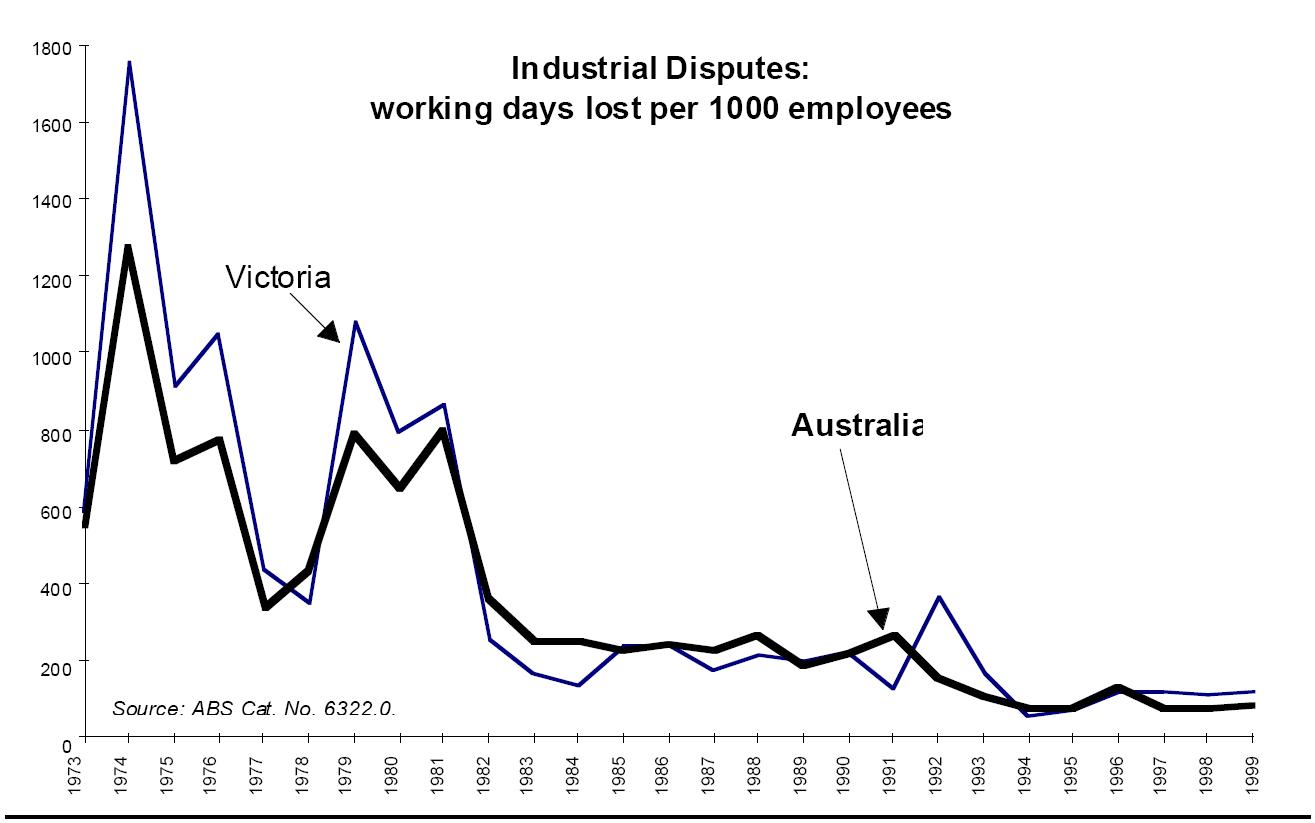
Moreover, Victoria has experienced employment growth very close to the Australian average over the recent economic expansion (change in employment/population ratio is used as an indicator, as that compensates for changes in population).

Graph 2

This performance is in noted contrast to Victoria's dismal relative performance over the previous 10 years, from recession to recession.

Graph 3

We also agree with the Taskforce Chair, Professor McCallum statement in his Whitlam Lecture Crafting a New Collective Labour Law for Australia that:

The protection of workers, however, must not be at the expense of the young, the aged, the unemployed and those not engaged in the labour force.  In other words, a modern labour law framework cannot be constructed in isolation, for cognisance must be taken of economic growth, the size of national debt, the social security laws and the levels of direct and indirect taxation.

Which is why this Submission provides an Appendix setting out the broad historical and policy context and why, given that Victoria follows broad Australian trends, this Submission will concentrate on the general circumstances Australia finds itself in.

It seems particularly important to do so as Professor McCallum seems to share the common delusion that the last two decades have seen a shrinking of government activity, saying in his Whitlam Lecture that:

They [the economic reformers] advocated labour market flexibility at a time when federal and State governments were shrinking their public sectors and reigning in their spending.  Governments bought the idea that greater labour market flexibility would limit unemployment.  At this time, the social capacity of governments to cope with welfare programs and payments was diminishing, but if it would limit unemployment then deregulation was worth a try.

In fact, as the Appendix lays out, government welfare activity has grown markedly over all the last three decades.  Indeed, fiscal pressure from this growth has been a prime driver of reform.  Moreover, it is particularly ironic that Professor McCallum should articulate such claims in a lecture named in honour of the Prime Minister whose expansion of the welfare state set in train events which fatally undermined the Deakinite Settlement and who is, in many ways, the father of "economic rationalism". (2)


1.3. HISTORICAL BACKGROUND

The Deakinite Settlement can be usefully thought of as a risk-management policy structure (see Appendix).  Much of the policy push behind its establishment flowed from Australia poor performance during the Depression of the 1890s.  Ironically, the system adopted was based on the Victorian model, yet protectionist Victoria had handled the 1890s Depression much worse than free-trading New South Wales:  between 1891 and 1901, male employment in NSW grew by 69,000 or 19 per cent;  in Victoria it fell by 3,000 or 1 per cent. (3)

The key elements of the Deakinite Settlement were established by the Deakin Government of 1905 to 1908.  At that time, Australians enjoyed the highest living standards in the world.  In the century leading up to the First World War, Australian GDP per capita was higher than the US's.

Graph 4

During the period of the two World Wars and the Depression it slipped behind until, by 1950, American per capita GDP was a third higher than Australia's, a ratio which has remained in place since.  It was precisely in the crisis period of the century when the ability of institutions and economies to cope with shocks was under the greatest stress–from 1914 to 1945 -- that Australia's relative income slipped most.  Australia also did notably worse than comparable countries under the shock of the Depression of the 1930s.  The pattern continued:  in each of the major postwar global downturns -- of 1961/62, 1973/74, 1982/83 and early 1990s -- Australia performed worse than the previous occasion and comparable countries.  Its capacity to maintain economic balance in the face of external shocks was clearly declining.  Only the recent Asian crisis has seen a (spectacular) reversal of the trend -- the floating exchange rate performed admirably as a shock absorber.  The Deakinite Settlement was very much one of protection and market restriction -- of trade protection and labour market regulation.  Yet long-run economic data tends to support the contention that small trading economies suffer particularly badly from protectionism.  It restricts their capacity to take advantage of economies of scale and scope in external markets and makes them more prey to exploitative cartels and monopolies:  a process that the Australian arbitration system facilitates.

The almost 30 years from the end of the Second World War to the 1973 Oil Shock was the only period this century when Australia has enjoyed sustained full-employment.

Graph 5

Since the 1970s, Australia has been moving further and further away from full employment.  The period since the Whitlam Government has seen Australia's worst sustained period of unemployment this century -- 22 years during which annual average unemployment rate has not fallen below 6 per cent.

Australia has been experiencing what might be described as the "rising mountain" pattern of unemployment, where the peak of unemployment in each recession is higher than in the previous recession, and unemployment generally does not quite recover to its low at the peak of the previous economic boom.

Graph 6

Part of this increase in unemployment has been attributed to the increase in the labour force to a historically high proportion of the population, largely due to the entry of women into the workforce.  Wrongly so, in our opinion.

Graph 7
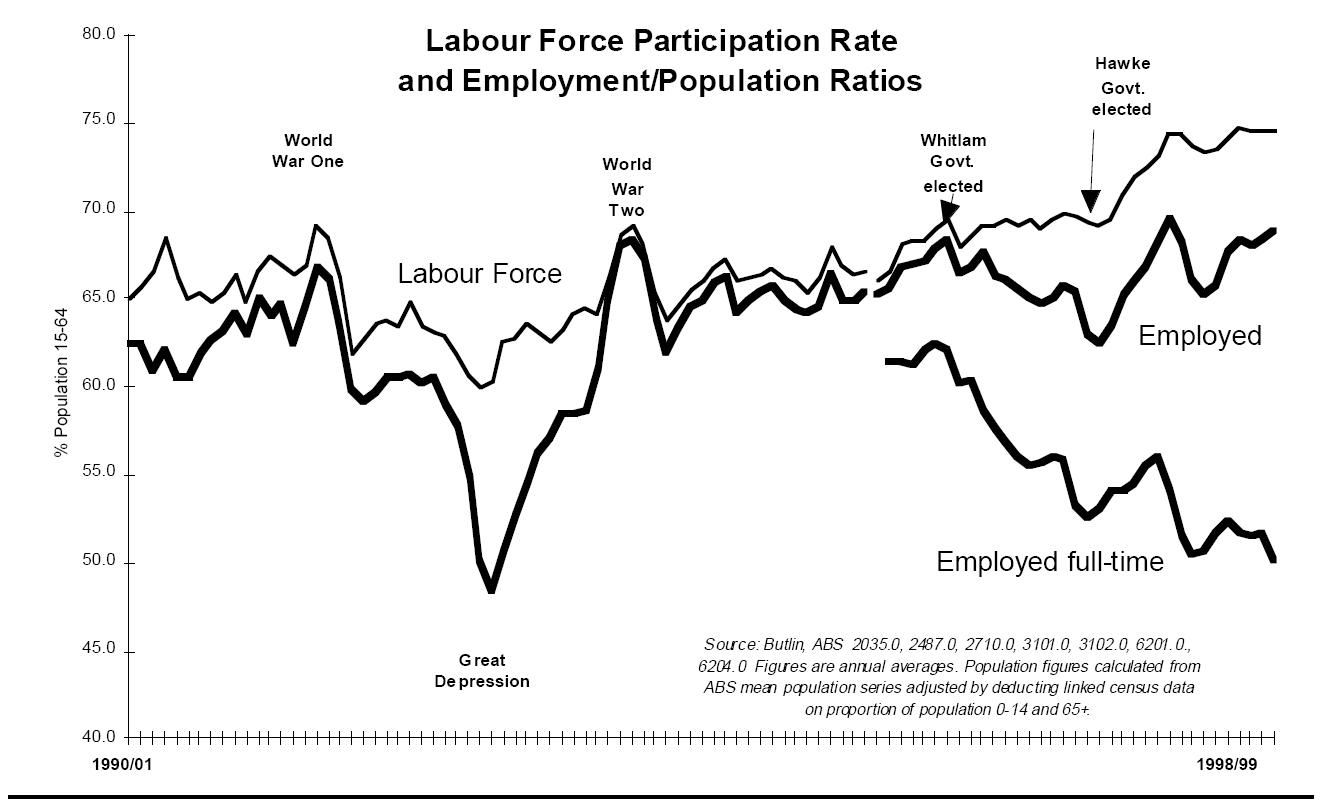
The declining proportion of the working-age population in full-time employment and the fall in the proportion of the working-age population in employment during the later 1970s and early 1980s tends to undermine any such argument.  More fundamentally, it is reasonable to expect economic institutions to be able to adapt to reflect changing preferences.  There is no known limit to the useful goods and services that might be produced if people are permitted to produce them at prices that people are prepared to pay.  The more that is produced, the greater the resources of the community as a whole.  (Distribution of the rewards of that production is discussed in the following.)

International comparisons weaken even further the argument that unemployment is caused by the increased supply of labour, and provide more evidence of the deterioration in Australia's overall labour market performance.

Throughout the OECD nations, an increased proportion of women have entered the paid workforce yet, prior to 1975, Australia's rate of unemployment was consistently below the OECD average.  From 1975 to 1988 it moved up to around the OECD average.  Since 1988 it has been above the OECD average.

Graph 8
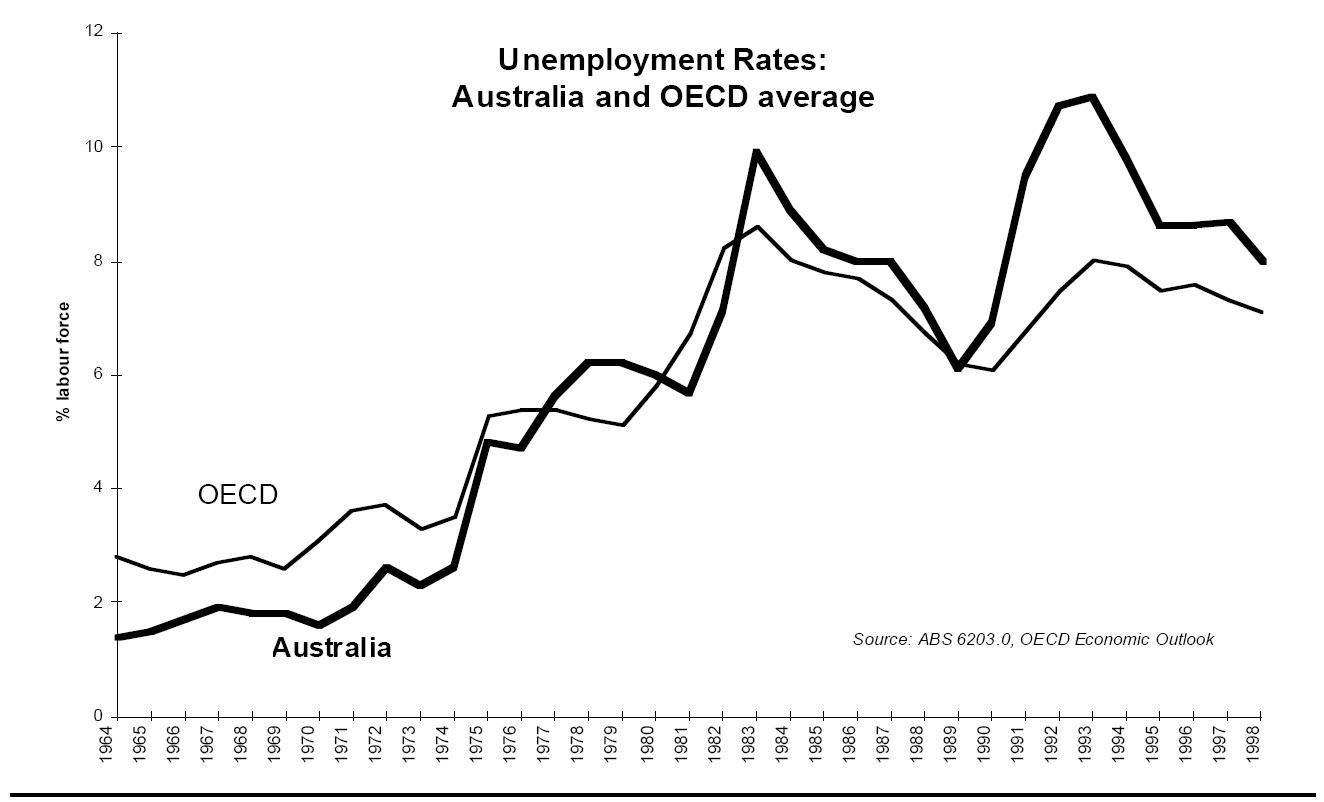
Yet another stark indicator of Australia's deteriorating labour market performance is shown by comparison with the United States.  Prior to 1974, Australia and the US had very similar proportions of their working-age population in employment.  Since 1974, the US has employed a higher proportion of its working-age population than Australia, a gap that has tended to increase over time.

Graph 9

In the United States, where women have entered the workforce in great numbers, a greater proportion of the population is working age is in the labour market than in Australia, yet unemployment is lower there than in Australia.  Americans, including black Americans, are more likely to be employed than Australians -- in December 1999 the Australian employment/population ratio was 59.0 per cent, the African-American was 60.7 per cent while the overall American rate was 64.4 per cent. (4)  If translated to Australia, that would mean an extra 816,000 Australians in employment.  (Even the African-American rate would mean an extra 257,000 Australians in employment.)

A point sometimes used to argue against use of American comparisons on labour market performance is the increasing number of American being imprisoned and thereby removed from the labour market statistics, which only cover civilian population.  While it is true that the American prison population has been increasing, this has been more than compensated for by the decline in the American armed forces.  In fact, the US now has less people removed from the civilian population by institutionalisation than at any time since the end of the Second World War, despite its total population almost doubling in that period.

Graph 10

A final piece of telling evidence that labour markets can cope with people who want to work is the manner in which Australia itself absorbed the return of the troops, and then high levels of post-war immigration, without suffering unemployment.

We do not claim that the economic adjustment is immediate and that therefore a sudden increase in the supply of labour cannot cause temporary unemployment, but that is not what Australia is facing.  What is more, the experience of Hong Kong was that, when refugees caused a sudden and unexpected increase in the number of people seeking work, these were absorbed very quickly by the colony's relatively unfettered labour markets.

If unemployment is not caused by the increased supply of labour, then another cause of Australia moving up to the OECD average rate of unemployment, and the diverging Australian and US employment/population ratio, must be found.  These tendencies began with the wage surge of the Whitlam years.  The Australian labour market was not able to recover full employment afterwards -- in contrast to the greater wage surge in the Korean War "wool boom".  In the wool boom case, however, the wage surge had been a result of a genuine upward shift in national income from a dramatic increase in exports.  Employees were sharing the increase in national wealth.  The Whitlam-period wage surge was a result of political deals at a time when Australia was actually under significant negative economic stresses (see Appendix).

Graph 11 (5)

While the lower earnings growth of the later 1980s was associated with higher employment growth, the Australian labour market has not yet regained full employment, nor does it seem likely to.  We submit that this is because of a highly-regulated system which

  • generates wage-surges not based on genuinely improved economic conditions;
  • prevents their reversal;  and
  • imposes additional costs upon employment (which would, if wages were totally responsive to supply and demand, not cause unemployment but lower wages instead.  Wages are, however, not totally responsive).

The costs of regulatory complexity is an important focus of this Submission.  An even more stark indicator of Australia's declining labour market performance has been the increase in the average duration of unemployed, from about 13 weeks in 1975 to about a year now.  This is a record which contrasts markedly with the USA's generally steady average duration of unemployment.

Graph 12


1.4. MUTUALLY BENEFICIAL EXCHANGE

For most markets for goods and services, the common intuition is that the seller of the product is, somehow, typically "the winner" in the exchange -- hence commentary on international trade on the basis that imports are bad and exports are good.  In the case of labour markets, the common intuition is that the buyer of labour services (the employer) is deemed to be inherently the winner:  certainly as the one from whom the sellers need extra protection.  In fact, if market exchanges did not generally leave both sides better off, they simply would not happen.  Yet political debate is filled with commentary that shows no real understanding of this basic truth about market activity -- the gains from trade as they are known in economics.  The two real issues are whether these gains are maximised and whether they are optimally or fairly shared.

Employment exchanges occur when an employer offers a wage rate and conditions that a prospective employee thinks is an improvement on his or her present situation and when an employee offers services such that a prospective employer can expect an improvement in his or her situation. (6)  Raise the cost of employing someone, increase the risks of employing someone, reduce the output of the employee, reduce the price of what is produced, then the job is less likely to be offered.  Lower the wage and other benefits of moving into employment, increase the costs of qualifying for, and finding employment and getting to and from work, and increase the alternative sources of income and/or non-monetary satisfaction and then the employee's services are less likely to be offered.

Except where employment is compulsory, unemployment is the inevitable consequence of employers' and employees' inability (without flouting the law) or unwillingness to offer benefits to each other.  Any steps toward removing impediments to finding the gains from exchange are improvements to labour market law.

Although poverty (either relative or absolute) is very strongly associated with unemployment (7) there would -- even in that theoretical construct the totally flexible labour market -- always be a small proportion of the currently unemployed whose productivity is so low that, although employed, they would remain in absolute poverty defined at any reasonable level.  These people need help.  It is, however, better to subsidise them in work than out of it.  This is, first, because productivity is not innate but tends to increase markedly with experience, and second, because there is satisfaction in producing.  (Everyone can bring to mind at least one example of a slow learner or otherwise severely disabled person who has worked his way into gainful employment and would not have it otherwise.)  One of the worst faults of Australia's dis-functional labour market is that it denies the dignity of work to so many.

In most cases, even in the current environment, the gains from exchange are quite large, certainly large enough to raise the issue of how they are distributed between the bargaining parties.  Two centuries of evolving economic understanding have reached a generally accepted view of circumstances that will cause any market to maximise aggregate welfare.  Conversely, there is also a very fair understanding of the circumstances that cause markets to depart from optimum prices and of conditions of asymetric bargaining strength.

Employers typically engage more than one employee and are therefore able to spread the considerable costs of information gathering and formalising the deals over several employees.  Where employers are relatively few in number, it is probably possible for them to collude to keep prices and conditions down -- even if only informally by one watching what the other does.  It is fair and efficient that employees should countervail this power by forming unions.  It is, however, neither fair nor efficient that employees or employers should be able to combine as monopolies to engage in holdout strategies against the other party.

For the government to legislate to provide the countervailing power -- either directly or through subordinate legislation such as decisions of industrial relations commissions -- is a particularly egregious exercise of monopoly power.  It has, among other ills, seen 22 years in which the average annual unemployment rate has never fallen below six per cent.

It is a particularly striking feature of the Australian labour market that many commercial acts between consenting adults are rendered illegal.  Indeed, the general trend of policy -- until the Workplace Relations Act 1996 -- was for the labour market to become more regulated over time. (8)  And the Workplace Relations Act 1996 was, at best, a very mild relaxation of a very highly regulated market.


1.5. "UNFAIR DISMISSALS" -- A COSTLY REGULATORY INTRUSION

In most human affairs, conventions grow up to deal with interactions between people.  The sanctions vary, but reputation effects from behaviour -- which encourage good behaviour on both sides -- can be particularly important.  Governments should always be wary about intervening in such conventions, because they often rest on a delicate balance of interests and trade-offs.  Upsetting such a balance can easily lead to outcomes notably worse than the preceding circumstances.

Legislation against "unfair dismissals" provides a classic example of this.  First, the concern is very one-sided.  There is no suggestion that there should be legislative protection for employers against "unfair resignations" even though an employer may be subject to very real costs if a key employee suddenly walks out.  "Unfair dismissal" legislation creates a quasi-property right for employees in their job (9) (just as legislating against "unfair resignation" would create a quasi-property right for employers in employees' labour services).

By creating this quasi-property right, such legislation changes quite significantly the incentives facing the parties involved.  The risks inherent in hiring a new person are considerably increased and, if wages or other conditions of employment are not allowed to fall, then fewer jobs are offered.

This may suit labour market "insiders" -- those already in employment, those with appropriate certification, track record and networks able to vouch for reputation are advantaged.  New labour market entrants -- with no track record -- and other "outsiders" are disadvantaged.  Since big companies can spread the inherent costs and risks better than small employers, unfair dismissals legislation advantages them against small business competitors.  It is not surprising, therefore that an ACCI survey of employers found that concern about unfair dismissals is strongly related to the size of the business. (10)  This is of particular concern given that 90 per cent of all additional jobs in Australia between 1985 and 1995 were in firms with 20 or fewer employees. (11)

Unfair dismissals was introduced into Commonweath law by the Industrial Relations Reform Act 1993.  The Act was given Royal Assent in December 1993 and its provisions were fully in operation by June 1994.  Given lags for people to become aware of the changes, information to spread on their operation and changes in incentives to be manifested in employment outcomes, one would expect results to show up from 1995/96 onwards.  It is therefore somewhat suggestive that the current economy recovery and the post 19982/83 recovery have had very similar rates of per capita GDP growth (in fact, per capita GDP growth has been slightly higher in this recovery) and equivalent rates of growth in full-time employment until after the third year of the current recovery (1994/95) when the growth of full-time employment in the recent economic recovery began to be notably lower than in the previous recovery.  Given full-time employment represents the greatest inherent risk in a new employee, is more likely to be permanent rather than casual, and the importance of small business in employment, the results are certainly compatible with unfair dismissal legislation discouraging employment.

Graph 13


1.6. A GENERAL PROBLEM

There are many other examples of the want of wisdom in attempts to replace complex, time-honoured customs including informal penalties by regulation that is at once too simple and too complex.  The words of noted US economist Paul Krugman talking about French employment regulation also ring true for labour market regulation in Australia:

The French have no monopoly on intellectual pretensions or on muddled thinking.  They may not even be more likely than other people to combine the two.  There is, however, something special about the way the French political class discusses economics.  In no other advanced country is the elite so willing to let fine phrases overrule hard thinking, to reject the lessons of experience in favor of delusions of grandeur

To an Anglo-Saxon economist, France's current problems do not seem particularly mysterious.  Jobs in France are like apartments in New York City:  Those who provide them are subject to detailed regulation by a government that is very solicitous of their occupants.  A French employer must pay his workers well and provide generous benefits, and it is almost as hard to fire those workers as it is to evict a New York tenant.  New York's pro-tenant policies have produced very good deals for some people, but they have also made it very hard for newcomers to find a place to live.  France's policies have produced nice work if you can get it.  But many people, especially the young, can't get it.  And, given the generosity of unemployment benefits, many don't even try.

True, some problems are easy to diagnose but hard to deal with.  If [New York Governor] George Pataki can't end rent control, why should we expect [French President] Jacques Chirac to be able to cure Eurosclerosis?  But what is mysterious about France is that as far as one can tell, absolutely nobody of consequence accepts the obvious diagnosis.  On the contrary, there seems to be an emerging consensus that what France needs is -- guess what? -- more regulation. (12)

Comparisons of employment growth make it easy enough to see why an informed US commentator would be vastly unimpressed by Europe's performance.

Graph 14

In Australia, it is not delusions of national but of moral grandeur which provide a destructive conjunction with sectional interest.  A whole range of possible solutions to our dis-functional labour market are deemed unacceptable because their advocacy is taken to be a sign of moral turpitude.  Those playing such moral vanity games are patently more concerned with being seen to be a "good person" because they have the "approved" opinions than improving the job prospects of their fellow Australians.  It requires no undue humility to concede that we are still as incapable of redesigning well a social system that has evolved over centuries as we are of redesigning an eco-system.


1.7. THE "NATURAL" RATE OF UNEMPLOYMENT

Economics has developed the concept of the non-accelerating inflation rate of unemployment (NAIRU), sometimes misleadingly known as the "natural" rate of unemployment.  The NAIRU is the rate of unemployment which -- given current institutional structures -- macroeconomic policy cannot reduce unemployment below without inflation increasing.

In other words, if unemployment is to be reduced further, there has to be institutional reform.  That is clearly the case in Australia.  Substantial, sustained improvement in unemployment cannot be expected without major structural reform in the labour market.  Any improvement achieved merely through economic growth will be vulnerable to the next economic downturn.  Nor is economic growth itself independent of the efficiency of the labour market.  Major regulatory and institutional reform is required.


1.8. INSIDERS AND OUTSIDERS

Unemployment is not an evenly spread experience.  University graduates, for example, experience very low rates of unemployment -- and they are the people making the key decisions and writing commentaries on public policy issues.

Since 1982/83, from one to three per cent of the working-age population have been unemployed for 12 months or more.  This is a proportion which has tended to go up over time.

Graph 15

Unemployment is concentrated in specific groups who have differing experiences.  While about 60 per cent of the unemployed are under 35 this age group accounts for only about 40 per cent of the long-term unemployed.  About 65 per cent of the long-term unemployed are in the 25-54 age groups.  Though members of older age groups are much less likely to be unemployed, if they become unemployed they are more likely to become trapped in long-term unemployment.

Graph 16

The Australian labour market operates as one of advantaged "insiders" and disadvantaged "outsiders".  If one removes unemployed teenagers and the long-term unemployed -- creating what might be called the "politically significant rate of unemployment" -- unemployment rates are markedly lower.  If one excludes all unemployed youth as well as the long-term unemployed, the unemployment rate has spent much of the past two decades in the two-to-four per cent range.  This may explain why unemployment has been the subject of many pious political words but little effective political action.

Graph 17

Excluding the young and the long-term unemployed identifies "frictional" unemployment -- which is fairly stable, though above the one-to-two per cent it was in the 1950s and 1960s.  Youth unemployment has risen as youth wages have increased relative to adult wages, undermining their capacity to compete (given their lower level of skills, experience and established track record) (13) with older workers and with women entering the workforce.  Long-term unemployed youth provide the basis for the development of an Australian "underclass" -- a welfare-dependant group with a high rate of drug use and petty crime.  Older unemployed can suffer problems of not having appropriate skills in a changing economy while the expansion in family support in welfare provides less pressure to accept work of lower-status or requiring other major changes, such as shifting house (which may be particularly difficult if that means going to an area with much higher housing costs).  In all cases, not being able to "bid" for employment at a level commensurate with their actual productivity is a barrier to employment.  Claims that such barriers are to stop "exploitation" are merely the self-justification of an anti-competitive cartel -- the unemployment which is generated by such barriers most certainly being the result of exploitation of regulatory privilege for private gain.  The pattern of such people not moving quickly into employment during upturns is not a inherent "law" of labour economics, but a function of particular institutional arrangements.  The behaviour Professor McCallum alludes to in his Whitlam lecture when he says:

When a firm wishes to hire labour, it has two choices:  It can either hire from the ranks of the unemployed, or can offer employment to workers who are currently employed in other undertakings and who possess motivation.  While in the short-run it might be cheaper to hire from the unemployed, in the long-run, it will make commercial sense to pay for more expensive labour from other undertakings.  In other words, although there is a large supply of unemployed labour, the demand to fill jobs from this labour pool is less than most people imagine.

can be overcome by institutional reform, though we agree with Professor McCallum that, given the build-up of people alienated from employment by long-term unemployment, bridging measures do have an important role.

The failure to substantially improve the deteriorating performance of the Australian labour market is the most powerful evidence that the Australian political system, in practice, rates more highly goals other than restoring full employment -- such as not antagonising the advantaged labour market "insiders".  Indeed, so far from being, in practice, seriously interested in reducing unemployment, the political process has regularly produced outcomes whose most likely effect would be to make unemployment higher than it would otherwise have been -- such as unfair dismissals legislation, legally-imposed wage minimums unconnected with productivity, legally enforcing benefits to employees, increased employer liability for employee actions and increased legal obligations consequent on employment.


1.9. UNIONS AS INSIDERS

The union movement is generally strongly in favour of Australia's highly regulated labour market structures and against substantial de-regulation.  They have generally supported increased regulation, even treated that as a major goal -- as was seen recently with the controversy over youth wages.

The point of unions is to deliver advantages to their members.  Clearly, they will seek to advantage their members and pursue their own institutional interests.  This is in itself not a problem, provided the regulatory power of the state is not enlisted in this cause.

The unions' basic approach is to defend the interests of incumbent, organised "insiders".  Historically, these have been male, full-time workers, particularly in manufacturing, construction and other large work-sites.  The groups who threaten the interests of these "insiders" are not the employers -- they are the source of income.  The groups who threaten the interests of the labour market "insiders" are their competitors -- new labour market entrants, such as young people and women, those wishing to work under arrangements which are not easily organised, such as part-time and contract work.  The power of unions has rested on the ability to provide services to their members.  These services have included the wages and conditions for which only a labour monopoly could successfully bargain.  The power and security of unions officials is similarly enhanced by monopoly power.  Monopoly is the exclusion of competitors -- "scabs" are simply competing suppliers of labour.  The losers are the "outsiders" -- those who have never become employed and the marginally employed.  Typically, these are young, in some industries female, and play no effective part in union affairs.

Rules such as "first in-first out", unfair dismissal laws (which raise the risks in hiring new, unknown workers but give incumbents quasi-property rights in their job) and raising youth wages (so less experienced, skilled and productive young labour market entrants cannot compete against the incumbent unionised workers) (14) are all based on this pattern of union defence of labour market "insiders" against their competitors.  Unfortunately for the union movement, "outsider" groups have become increasingly important in the workplace.

Similarly, complex rule demarcations and specialist arbitration structures provide a role for union officials to acts as intermediaries between workers and management.  Impediments to efficient labour and capital use retard living standards below those otherwise attainable.  Expanding the legislative privileges of unions would entrench and extend such behaviour.

Union officials strenuously deny that their activities were based on self-interest against the interests of other workers (and sometimes even their own members).  But an epigram Ben Chifley was fond of quoting comes to mind -- "in the race of life, back self-interest, it is the only horse that's trying".


1.10. AWARDS AS THIRD PARTY IMPOSITIONS

The award structure itself is morally offensive.  It imposes, via the regulatory power of the state, conditions on employers and employees to which they have not consented.  Where the effect is to destroy their prospects of employment, it become utterly morally retrograde.  Awards provide a form of price-maintenance and inhibition of competition which is explicitly banned for other goods and services under the Trade Practices Act.  Given that unions cover less than 20 per cent of the private sector workforce (and union membership in some industries is less than entirely voluntary), the award structure cannot be defended on the ground that it is, at least, democratic.  It is something which has completely outlived whatever usefulness it may once have had.


1.11. AWARDS AFFECT COMPETITION BETWEEN EMPLOYERS

Union power and labour market regulation often enforce implicit or explicit barriers to competition.  Complex regulations imposing high administrative costs advantage large companies (who can spread the costs over more units of production) against smaller competitors.  Unions can be relied upon to oppose, by political and industrial action, competition among employers which reduce their own opportunities for rent-seeking.  Union opposition to the break-up of electricity and telecommunications monopolies and to the imports of motor cars and clothing provide examples of how effective they have been, and sometimes still are, at opposing competition.  Unions are confident they can share the economic rents while employers with access to such rents would sooner share than forego them.  Consumers, of course, pay these rents -- which are typically highly regressive in their effects.

Unions provide real benefits to their members and to the economy.  It is because of their special legal privileges within a vast regulatory apparatus creating a highly dis-functional labour market that the costs they impose are said to, and may in fact, outweigh their benefits.  The solution is not to ban or to regulate them in any special way, but to make ordinary corporate citizens of them.  Changes to workplace law should be directed to that end.  It should certainly not move in the opposite direction.


1.12. UNEQUAL BARGAINING POWER

It is perfectly reasonable for unions to play the role of improving the capacity of workers to bargain with their employers.  This is a fundamental service they can offer to current and potential members.  It is an entirely different matter for them to be granted special legal privileges to pursue this aim.  After all, the declining rate of unionisation to its current level of less than 20 per cent of private sector employees itself indicates that workers do not feel this is a necessary service for the conduct of their employment activities.

The best single protection for workers is to have skills in demand, to be in a full employment situation, to have employers competing for their services.  A recent speech by Roger Kerr, Executive Director of the New Zealand Business Roundtable expresses these points well:

Behind these developments is the same ideology that was rightly set aside in reforming most other features of New Zealand's labour law, namely that helpless employees must be protected from omnipotent employers.  We all deal satisfactorily with banks, retailers and other firms with far greater resources than we have, without the aid of laws on minimum deposit rates and maximum retail prices, and without resorting to unions of savers or consumers.  This alone suggests that there must be a strong measure of myth in the doctrine of unequal bargaining power.  If bargaining power was a systematically one-sided problem -- as opposed to something which fluctuates with market conditions and which affects employers and employees alike -- we would expect to see wages driven down towards zero in countries without minimum wages, employees without the power to quit at will, and the prices of goods sold by big firms tending towards infinity.

Of course, none of this happens, because it is not the difference in resources between buyer and seller that matters, but the alternatives available to each.  Employers and workers are not in competition with each other:  employers are in competition with other employers for workers and employees are in competition with other employees for jobs.  In all markets, including the labour market, the best protections for savers, consumers and workers are freedom of entry and exit on both sides of the market, and openness to competition.  Hong Kong has no minimum wage or unfair dismissal laws.  Because these freedoms have helped it to maintain virtually full employment (15) despite massive structural change, its workers are not easily exploited and they now enjoy average incomes 50 percent higher than those of New Zealand workers.

This is not to say that employers and employees have no inclination to behave opportunistically.  Rather, the circumstances in which opportunistic behaviour is profitable are relatively rare.  One reason is that it is normally profitable to strive to achieve and maintain a reputation as a good employer.  Another is that contractual arrangements have evolved through market processes to safeguard against opportunistic behaviour on the part of both parties to an employment contract.

The legal scholar Richard Epstein has repeatedly emphasised the folly of judicial intrusion into routine affairs such as employment contracts:

It is one thing to set aside the occasional transaction that reflects only the momentary aberrations of particular parties who are overwhelmed by major personal and social dislocations.  It is quite another to announce that a rule to which vast numbers of individuals adhere is so fundamentally corrupt that it does not deserve the minimum respect of the law.  With employment contracts we are not dealing with the widow who sold her inheritance for a song to a man with a thin moustache.  Instead we are dealing with the routine stuff of ordinary life;  people who are competent enough to marry, vote, and pray are not unable to protect themselves in their day-to-day business transactions.

Beyond the issues that arise in standard contract law -- such as fraud, misrepresentation, and duress -- employment contracts do not leave gaps or implied terms that courts need to fill.  Employment contracts are made every day;  the costs of contracting are low;  and people can evaluate realistically the risks and costs of contingencies such as dismissal.  If it is optimal for workers to have a job security or just dismissal provision they will negotiate one voluntarily because the barriers to doing so are trivial.  If not, they will choose to avoid the costs to them of lower wages or other less favourable terms in their contract which are the inevitable trade-off for greater job security.  In short, mandatory unjustifiable dismissal provisions diminish the value of the compensation bundle for most employees.

Thus the problem that activist legislators or courts seek to address is an imaginary one, and their decisions harm the very parties they hope to benefit as a class.  Activist judges often find meddling in other people's affairs a rather pleasant burden, but this tendency lends itself to abuses of power.  The law has no economic rationale for a good faith or fair dealing intervention in labour relations.  Economic competition does not create a perfect world, but on both the demand and supply sides of the market it provides incentives for civil and cooperative behaviour.  Firms do not sack workers willy nilly;  such practices are virtually unheard of as they are bad business and the costs of changing staff can be high.  New Zealand employers have every incentive to keep and reward quality employees - after all, there are over 200,000 firms that can bid them away at any moment.  The at-will contract is often the best mechanism for establishing terms of employment which avoid vulnerabilities, opportunism, one-sidedness and monopoly by either party in an employment relationship.  If, subject to the terms of a contract, an employee can quit at any time, the firm has every reason to be responsive to the employee's concerns.  If, subject to the terms of a contract, an employee can be dismissed at any time and for any reason, that employee has every reason to be productive.  Productivity creates job security. (16)

Unequal bargaining power is not a reason to maintain Australia's complex and intrusive structure of labour market regulation, nor to do other than to treat unions as ordinary corporate citizens.


1.13. WHY REGULATION OFTEN FAILS

There is nothing particularly mysterious about why government regulation in markets is often counter-productive -- it has been well, if not exhaustively, analysed.  In practice, there is usually very little real quality control on regulatory provisions, either before or after the fact.  Determining effects is often quite difficult, (17) few resources are put into systematically doing so and there is very limited feedback into the legislative process from such measurement as does occur.  Worse, such feedback and measurement as does occur is often left to the regulators, who have a vested interests in the regulations they administer. (18)  This situation was much improved by the creation of the Industries Assistance Commission in 1975 but, 25 years later, there is still far to go.  There are also obvious conflicts of interest in government funding evaluation, since governments are not likely to want to be publicly and authoritatively told that their policies are not working.

Furthermore, interest in public policy itself is a "public good", subject to considerable "free-riding", so therefore tends to be under-provided.  By contrast, those with concentrated special interests often have powerful incentives to be involved, leading to intrusive regulation tending to favour those with such interests (e.g. by raising market-entry costs in, say, law and medicine).

Unlike ordinary commercial exchanges -- where people only come together in expectation of benefit, where people have to know only their own situations and preferences -- regulatory action is the application of centralised coercion.  The regulator cannot learn of the diversity of ever-changing personal preferences, aptitudes and resources.  Even if they could, they much adopt a "one size fits all" approach, even though they know perfectly well that it does not.  Were they to adopt the "flexible" approach, so often advocated by business, they would very soon find themselves accused of favouritism, of corruption.  The operation of centralised coercion is such an excellent way of gaining benefits while passing the costs on to others that those who impose regulations -- even of the "one size fits all" type -- do not escape moral hazard.

There is a place for judicious regulation (they can reduce transactions costs, for example) but there are also powerful reasons why there should be no presumption that extensive regulation is socially beneficial.  The experience of Australia's highly-regulated labour market certainly provides evidence of the cost of over-regulation and regulation imposed at the behest of particular interests.


1.14. THE ROLE OF REGULATION

Some forms of economic regulation do add enormously to human welfare.  The basic laws protecting persons and property provide a necessary set of rules which allow economic activity to flourish.  Over time, those societies which allow people to go about their business secure in their person and property are enormously more productive than those that fail to do so.

Graph 18

But that flourishing is based on people being able to make their own judgements about the exchanges and trade-offs they wish to engage in.  Unless regulation does genuinely encourage greater productivity -- which, beyond those basic laws, very little of it does -- it merely re-arranges existing benefits.  Indeed, given the costs in enforcing and complying with the laws, and the regulators' isolation from the consequences of their actions (often very difficult to determine anyway), there is every likelihood that the regulation will impose a net social cost.

Labour regulation provides a good illustration of this.  Such regulation is typically justified on the grounds that it provides extra benefits to workers.  If such benefits were of low cost, employers would almost certainly already offer them -- if workers want such things, and they are of little or no cost, it would be foolish employer who did not offer them.

If the benefits are not offered as a normal part of employment contracts, this must be because there are significant costs involved in doing so.  That being so, if they are imposed, those costs have to be recouped.  If they make workers more productive, the costs can be recouped from improved returns from employing people.  But if they added to productivity, it would again be a foolish employer who did not already offer them.

So such costs will have to be recouped either by reducing the return to capital or by rearranging the returns of labour.  The former will discourage the use of labour.  The latter will just mean the new benefits are paid for by reducing alternative benefits to labour.  So the regulation will provide some benefits at the cost of other benefits and/or the level of employment that would otherwise occur.  It is very unlikely there will be any net social benefit from this.

Of course, the direct benefits of the regulation will be obvious, while its knock-on effects will not be.  The situation will be made worse if the advocacy of such regulation is widely taken to be a sign of status as a "good person", and scepticism or opposition to such legislation, as a sign of being a "bad" one.  This is, of course, commonly the case, as it is easy to portray the sceptic as being hostile to "the workers".  Moreover, the shouting the virtue of the intention of the regulation is very easy advocacy, arguing about the knock-on effects much more difficult.  Thus, one would expect, over time, for the level of regulation to tend to increase:  which, over the longer term, is clearly the case in the Australian labour market, despite the limited liberalising effects of the Workplace Relations Act and the growth of workplace agreements (themselves a highly regulated instrument.)  The higher the initial level of regulation, the more likely such increases are to impose inordinate costs.

As Labor employment spokesman Martin Ferguson says, the best social security cheque is a wages cheque.  Over 800,000 less wage cheques each week (including about 240,000 less Victorian wage cheques each week) seems a rather large social cost for having one of the most regulated labour markets in the developed World.

Regulation is not free:  the argument for deregulation simply says transactions should be cheaper, easier, and more in line with what people actually want


1.15. EXAGGERATED CONCERNS

Argument against de-regulation of the labour market are often based on concerns about increasing income inequality and allegedly increasing poverty rates.  Regarding the former, there seems little doubt that market incomes have been becoming more unequal.  This is largely explained by life-time earning paths becoming notably steeper.  Evidence from the US is particularly pertinent, as the US is usually used as the "horror" example of income inequality.  Whereas, in 1951, earnings in the US peaked in the 35-44 age group at about 50 per cent greater than the earnings of 20-24 year olds, they now peak in the 45-54 year age group at about three times the earnings of 20-24 year olds, as human services and knowledge skills become increasingly important in the economy.  This pattern of steeper life-time income paths -- a not very surprising consequence of increasing importance of human capital in the economy and increased participation in higher education -- has certainly significantly increased income inequality.  That is, however, not something that public policy should be concerned with.

Graph 19
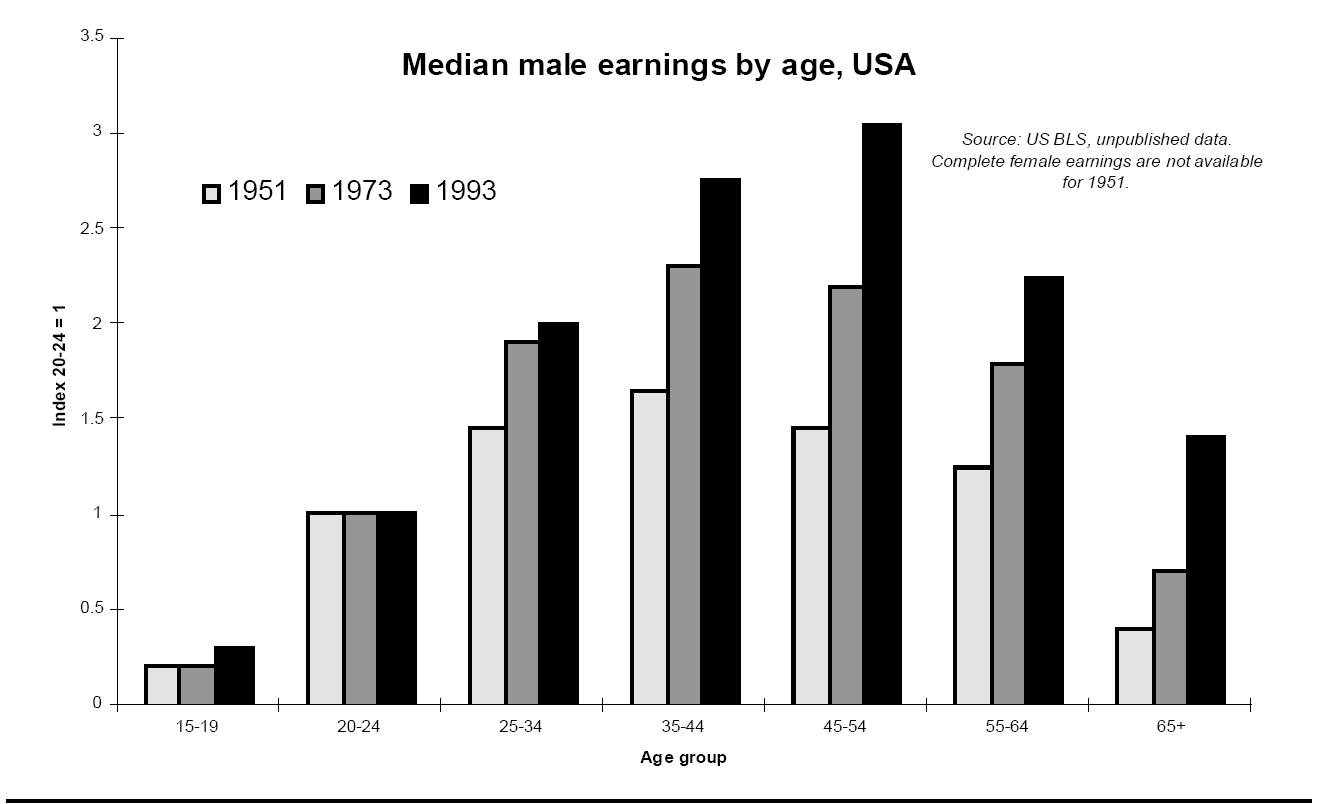
Although poverty even in well-to-do Australia should concern us, claims about increasing poverty are wrong, since it is actually decreasing, both here and in the US.  One US study found that, if households were assessed against the official US poverty standard (three times the income needed to purchase a nutritionally adequate diet) according to their actual consumption patterns, poverty in the US has declined from 31 per cent of the population in 1949 to 13 per cent in 1965 and 2 per cent by the late 1980s. (19)  Applying the official, income-based, definition of poverty, in the early 1990s, the median duration of a poverty spell in the US was 4.2 months.  Only a third of those classified as poor by the Census Bureau had been below the poverty line for 24 or more months reducing the long-term poverty rate (measured by income) to about 4 per cent of the US population. (20)  A University of Michigan study of households tracked over a 16 year period (1975 to 1991) found that only 5 per cent of the households who were in the lowest fifth of income in 1975 were still there by 1991.  A far larger proportion (29 per cent) had made it to the top quintile (21) -- employment growth and steeper lifetime earnings in operation.

Despite claims to the contrary, the United States is not a nation in which poverty is increasing -- quite the reverse!  Indeed, poor American households had rates of ownership of consumer durables in 1994 that were equivalent to, or greater than, the American average less than 25 years earlier. (22)  Moreover, while comparisons are difficult, it appears that Australia has a similar rate of working poverty to the US. (23)

Concerns over inequality and poverty are not good reasons to fail to embrace major labour market reform.  Particularly reforms that would increase employment and decrease unemployment which would therefore reduce poverty and, by lifting the incomes of the poorest people, reduce the disparity of incomes a little.  There are no good reasons for Australia not to learn the lessons of American success nor to follow the path of European failure.  On the contrary, getting people into jobs and up the employment ladder is the best path away from poverty.

While it is inherently difficult to maintain real growth in average wages while employment growth is booming at the rate it has been in the US, claims about stagnation in US real wages have also been greatly exaggerated.  First, they can fail to take account of income mobility.  Secondly, employers have used increased non-wage, and generally non-taxable, benefits (such as health care) to compensate workers, so using only direct wage payments is a misleading measure. (24)

We therefore do not agree, either with Professor McCallum's statement of the evidence or, where we do agree, with the construction he puts on its in his Whitlam Lecture when he says:

Arguments can be mounted which show - to my satisfaction at least - that through a comparison of similar countries, free market economics and labour relations deregulation will reduce real wages and increase poverty.

On the contrary, a freer and more flexible labour market can be a great boon to the elimination of poverty and its benefits there, and in spreading access to employment, are much more important than any effects on income equality -- which are far better tackled through targeted welfare measures.  Indeed, recent evidence from the work of Professor Ann Harding (Canberra University) that the rate of income growth of the bottom income decile has been 30 per cent -- more than twice that of any other income group -- is testimony what a targeted welfare system can achieve.


1.16. REGULATIONS ARE NOT FREE

Advocates of labour market regulation have a tendency to talk as if the costs of regulation are either insignificant or automatically less than benefits.  The above information constitutes considerable evidence that this is not so.  There is also more direct evidence:  that companies such as Rio Tinto and BHP have been able to offer workers individual contracts which increase their incomes indicates the gains to be achieved by sidestepping the costs of regulatory complexity.

There is also suggestive evidence in the changes of the modes of employment.  Over the last three decades, there has been very little change in job duration.

Graph 20

There has, however, been considerable changes in modes of employment.  The proportion of the workforce employed casually has increased markedly until the mid-1990s, and has plateaued since.  Casual employment allows both workers and employers to avoid many of the regulatory costs imposed on permanent employment:  both sides get greater flexibility, the workers get higher hourly rates and the employers avoid some on-costs -- another example of the mutual gains to be had from avoiding regulatory complexity.  While international comparisons are, at best, very rough, it is conspicuous that within Europe the use of temporary workers (who are roughly parallel to Australian casuals, in that they also represent a mode of employment which avoids many of the costs of regulatory complexity) seems to be directly connected to the level of regulation -- those countries with more highly regulated labour markets tend to have more temporary workers. (25)

Graph 21

The proportion of the Australian workforce who are self-employed tended to increase until the mid-1980s and has roughly plateaued since.  Self-employed Australians are the more stable in job duration than either permanent or casual employees (26) is hardly a sign of exploitation, even though they are more likely to want to work less hours. (27)

Graph 22

There has also been increased use of labour hire agencies, though reliable statistics on this are hard to come by.

The growth in casualisation has been seen in some quarters as proof of increased job insecurity, although the job duration figures do not support this.  Taskforce Chair, Professor McCallum, in his Whitlam Lecture, said in that lecture of casual employees that

"This growing army of persons are crying out for both recognition and protection."

It seems to be a cry they are not demonstrating in their behaviour, as their rate of unionisation has been falling steadily.

Graph 23

Moreover, in Victoria, most employed people (65 per cent) are in the form of employment of their choice, (28) a remarkably high figure since employment is an exchange between the provider and the user of labour.  Clearly, any attempt to further restrict their options is hardly likely to increase satisfaction.


1.17. TRENDS IN UNIONISATION

Casual workers are not alone as a segment of their market that unions are failing to entice as members.  The general rate of unionisation, both overall and in the public and private sectors has been falling steadily.

Graph 24

This decline is a long-term one.  The rate of decline increased during the post-1983 reform period, but seems to be fairly consistent over that period.

Graph 25

While there was a notable drop in the rate of public sector unionisation from 1994 to 1995, the private sector unionisation rates shows a fairly steady decline over the entire period.  Professor McCallum's claim, in the Third Whitlam Lecture, that:

it is clear in my judgment that the fall in trade union membership is also due to the down-grading of Australian conciliation and arbitration and to the enactment of voluntary trade union laws which now cover the entire nation.

does not appear to be supported by the evidence, since such laws did not "cover the entire nation" until 1993 at the earliest with the passing of the Industrial Relations Reform Act, the so-called "Brereton" Act, and the rate of decline in private sector unionisation in the three periods 1982-1990, 1990-1996 and post 1996 are not notably different.

It is notable that rates of union membership among women are lower than those among men for all categories of employment, (29) yet female employment has been growing much faster than male employment.  This points to a failure by unions to adapt to their changing marketplace.

There are also some interesting shifts in relative numbers:

  • In Victoria, more people are union members than are self-employed, but the numbers are comparable.  In August 1998, 417,200 were self-employed, (30) while, in August 1999, 455,800 were union members. (31)
    • The number of self-employed climbed by 10,100 (2.5 per cent) from October 1997 to August 1998 (32) while the number of union members has fallen by 59,900 (12 per cent) from August 1997 to August 1998, (33) continuing a long-term trend.  On current trends, the number of self-employed will exceed union members in a few years.
    • In the private sector, significantly more people are self-employed than are union members.  Victorian specific private-sector unionisation figures are not available from the published ABS data, but the overall Victorian unionisation rate is only just below the national rate, and the national private sector unionisation rate is now 19.6 per cent. (34)  Given that there were 1,432,500 private sector employees in Victoria in August 1999, (35) at a unionisation rate of 19.6 per cent, that would mean there would be about 280,800 private sector union members, compared to 417,100 self-employed. (36)

In response to the pressures unions are under, they have two broad possible responses.  One is to seek to adapt to their changing market place by offering services that workers want at prices they are willing to pay -- to live and die by their ability to provide real benefits to others.  The second path is to seek to change their market place by political action in the hope that people will make different choices in different circumstances.  Since union officials tend to be politically-minded and focused, rather than commercially-minded and focused, the latter option is perhaps more natural to them.  The recent ACTU Congress -- with it calls for major public policy changes -- certainly suggests it is the preferred option among union officials.  Unfortunately for their hopes, however, their institutional problems are very unlikely to outweigh, even in the minds of a federal Labor government, the underlying fiscal and other pressures which have driven economic reform (see Appendix), particularly as the failure of Australia's labour market institutions to deliver full employment have been a significant driver of those pressures.  Moreover, it is one thing to call for changes which broaden people's choices, quite another to call for those which narrow them.


1.18. THE "DEPENDANT CONTRACTOR" MYTH

As part of a strategy of changing the institutional environment to foster unionisation, there has, in recent times, been an attempt to create a concept of "dependant contractor".  In Queensland, Section 275 of the Industrial Relations Act gives the Industrial Relations Commission the power to declare any contract for services to be a contract of service (i.e. employment).  A similar legislative provision was recently put before the New South Wales Parliament.  There is no empirical justification for such measures.

Looking at self-employed Victorians, in October 1997, 118,600 (29 per cent) were contractors, 38,000 (9 per cent) were consultants, 8,000 (2 per cent) were franchisees while 242,400 (60 per cent) were other businesspersons. (37)

  • Of self-employed Australians in August 1998, only 15 per cent of owner-managers (253,600) were dependant on a client, and they were more likely to undertake contract work (i.e. formalise their working arrangement:  they presumably include franchisees) than other self-employed, 74 per cent to 30 per cent: (38)
    • those contracts sometimes ensured that contractor was the provider -- 70,900 (23 per cent) prevent subcontracting -- some 49,500 (16 per cent) prevented other clients while 192,200 (62 per cent) gave the client control over working procedures, the rates not being much different for owner-managers of incorporated and unincorporated enterprises (39)
    • translating that rate of 15 per cent to self-employed Victorians produces an estimate of 63,400 Victorians coming under the ABS classification of "dependant".  That is a mere 2.9 per cent of employed Victorians.

Any suggestion that officials should be given such enormous official discretions as those set out in Section 275 of the Queensland Industrial Relations Act is an outrageous restriction on the liberties of Victorians to engage in undertakings in good faith.  It is particularly ludicrous on the basis of an extremely dubious characterisation of a mere three per cent of the workforce.  Apart from being morally offensive, it imposes real uncertainty costs that cannot do other than discourage commercial activity.

Moreover, there is very little evidence of undue constraints on people's choices.  On the contrary, there is much evidence of a lively process of mutually beneficial exchange.  Of employed Victorians who changed their employment conditions in the previous 5 years to October 1997:

  • Those running their own business were the least likely to have changed their form of employment (only 12 per cent had done so) followed by permanent employees (23 per cent), those on fixed-term contracts (33 per cent) and casual employees (51 per cent). (40)

Of those Victorian employees whose conditions changed in the 5 years to October 1997:

  • most changes in employment conditions were the worker's choice.  53 per cent of such changes were the worker's choice, compared to 19 per cent from changed conditions at the workplace, 14 per cent from redundancy or closure, 7 per cent due to a promotion and 7 per cent for other reasons;
  • most changes in payment type were the worker's choice.  59 per cent of such changes were the worker's choice, compared to 12 per cent from changed conditions at the workplace, 14 per cent from redundancy or closure, 7 per cent due to a promotion and 8 per cent for other reasons.
  • the most common change in payment type was from hourly/casual rates.  45 per cent moved from hourly/casual rates, 27 per cent from wages and salaries, 7 per cent from contract, 6 per cent from commission or similar, 36 per cent from other arrangements. (41)

1.19. WHO WHOM?

As in so much of life, the key question is who? whom? -- who will make decisions for whom and under what conditions and constraints?  Those who wish to claim the right to decide on behalf of others must either be able to show some voluntary act of delegation or claim an authority which overrides that of others.  De-legitimising ordinary choices is a key part of the latter.  The entire ideological assault on markets is an attempt to deny legitimacy to the choices people make within them, thereby justifying the movement of decisions to other people and other fora.

Many groups can have a vested interest in legislative complexity.  The regulatory authorities themselves, advocates before those authorities (such as lawyers, union officials and employer organisations and their employees:  an interest often accentuated if appointment to the regulatory body is a potential career path), those who gain benefits from possessing inside knowledge of the complexities of the system (such as corporate HR departments), those who are disadvantaged significantly less than their competitors by the costs of the system (such as larger corporations), those who feel they can publicly display their superior virtue by advocating ever more complex structures of "rights".  They can be expected to speak up loud and clear for their interests.

It is therefore particularly important that there be very clear voices speaking for those whose interests are not served by regulatory complexity and its costs -- ordinary workers, employers, taxpayers.  It is even more important that those charged with considering the public interest in such matters look past the well-connected, the articulate and the powerful and look to those -- the young job-seeker, the home-maker juggling family and work, the migrant, ordinary workers, small businesses -- who bear the burden of the costs of regulatory complexity, and consider their interests.  We are strongly of the view that that their choices should have a strong presumption of being reasonable, that they are to be respected, and that the proper role of policy is to expand, not restrict, those choices.


1.20. WHERE REGULATORY POLICY SHOULD BE DIRECTED

Wage Arbitration remains the last great survival of the Deakinite Settlement (see Appendix).  Indeed, with the exception of some very partial freeing up in the Workplace Relations Act 1996, the labour market has been a conspicuous holdout from the process of de-regulation in factor and product markets with measures such as unfair dismissal laws and affirmative action and equal opportunity legislation, or indirectly, through health and safety regulations, welfare changes and so forth adding to the regulation of the labour market.

Australia has tried increasing government regulation of the labour market, and it has been a notable failure.  It is time to change direction.  In particular, it is time to stop loading onto labour market regulation redistributive goals which should be pursued through the tax-and-transfer system.

Current regulatory structures create or entrench the insider/outsider divisions in the Australian labour market.  Regulatory reform should therefore be systematically directed to abolishing or reducing provisions which create barriers to entry to employment.  It should not be directed to increasing regulatory complexity.

We are happy to support this Submission by appearing at a public hearing.


ENDNOTES

1.  Data from ABS Cat. No. 5206.0.  The profit share ranges between 12 and 17 per cent of GDP.

2.  See Richard J. Wood, "The Father of Economic Rationalism", Canberra Times, 4 Sept. 1999, also published in The West Australian (17 Sept. 1999), and The Age (4 Oct. 1999).

3.  Vamplew, W. (ed), Australians:  Historical Statistics, Fairfax, Syme & Weldon Associates, 1987, page 147.

4.  Figures taken from Economic Report of the President and ABS Cat. No. 6203.0.  Employment population ratio is ratio of employed persons to civilian population 15 and over (Australia), and 16 and over (US).

5.  Information on female average earnings is not available prior to September quarter 1981.

6.  The operation of features such as implicit contracts, etc. add to the subtleties of the labour market exchanges without changing the essential details.

7.  See Bob Gregory and Peter Sheehan, "The Collapse of Full Employment", in Fincher, R. and Nieuwenhusen, J. (eds), Australian Poverty then and Now, Mebourne University Press, Melbourne, 1998, pages 103 to 126.

8.  Consider, for example, the widening ambit of anti-discrimination legislation, with the liabilities of employers from employee actions tending to increase, thereby increasing the risks to employers of taking on new, untested, employees.

9.  Steven Kates, "Unfair Dismissals", Paper to the H.R. Nicholls Society Conference, August 28, 1999.

10.  Ibid.

11.  Gregory and Sheehan, Op. Cit., page 111.

12.  Paul Krugman "Unmitigated Gauls:  Pardon my French about French economics", Slate, posted Thursday, June 5, 1997.

13.  The element missing in the old refrain of "can't get a job because I don't have experience and can't get experience because I don't have a job" is being able to put a bid to start off on a wage sufficiently low that it is worth the employer's while to have a punt on an inexperienced person.

14.  That raising youth wages can be seen as "benefiting" young workers -- indeed, if they are abolished all together one can parade one's opposition to "discrimination" -- provides an excellent example of conspicuous benevolence and sectional interest marching together.

15.  Since December 1998, the Hong Kong unemployment rate has been 6.0 to 6.3 per cent, during a period of deep economic stress.  Australia could only manage a rate that low for some months in 1989 after six years of economic recovery and has not managed it since.

16.  "Obstacles to Employment and Productivity Growth in New Zealand's Labour Market", speech to Institute for International Research, 11th Annual Industrial Relations Conference, 3 March 1997.

17.  Effects of any particular provision tend to be very hard to pick out from a mass of government action.  The enormous increase in legislative activity (see Appendix) militates further against effective quality control.

18.  Not least, in preserving the "human capital" of intimate knowledge of the regulatory structure, with potential future earning potential.

19.  Slesnick, Daniel T., "Gaining Ground:  Poverty in the Postwar United States", Journal of Political Economy, February 1993, pages 1-38, cited in Cox, W. Michael and Alm, Richard, Myths of Rich and Poor:  Why we're better off than we think, Basic Books, New York, 1999, page 16.

20.  Cox and Alm, Page 74.

21.  Cox and Alm, Page 73.

22.  Cox and Alm, Page 15.

23.  Des Moore, The Case for Further Deregulation of the Labour Market, November 1998, Page 138.

24.  Bruce Bartlett, The Truth About Wages, NCPA Brief Analysis No. 177

25.  "Western Europe's job-seekers limber up, The Economist, June 10, 2000, Pages 49-50.

26.  ABS Cat. No. 6359.0.

27.  ABS Cat. No. 6310.0.

28.  ABS Cat. No. 6358.2.

29.  ABS Cat. No. 6310.0.

30.  ABS Cat. No. 6359.0.

31.  ABS Cat. No. 6310.0.

32.  ABS Cat. Nos. 6358.2, 6359.0.

33.  ABS Cat. No. 6310.0.

34.  ABS Cat. No. 6310.0

35.  ABS Cat. No. 6248.0

36.  ABS Cat. No. 6359.0.

37.  ABS Cat. No. 6358.2

38.  ABS Cat. No. 6359.0.

39.  ABS Cat. No. 6359.0.

40.  ABS Cat. No. 6358.2.

41.  ABS Cat. No. 6358.2.

Sunday, July 02, 2000

The facts on the income distribution

Are the rich getting richer and the poor getting poorer?

According to popular opinion and recent debate not only is this trend a reality but threatening the nation's social fabric and out-stripping the capacity of the welfare system.

The data by the National Centre for Social and Economic Modelling (NATSEM) however provides a somewhat different and more optimistic picture.

The NATSEM data shows that although the rich have got richer, the poor have not got poorer.  Indeed it shows that thanks to a well targeted welfare system, the poor have improved done remarkably well.

Between 1982 and 1997, households in the highest income group experienced growth income (after-tax basis and including government transfers) of 14 per cent or $229 per week in real terms.  This represents a high rate of growth when compared to previous periods.

This trend is hardly surprising.  Globalisation has opened-up many new and lucrative markets and opportunities particularly for the mobile and educated.  Women are working more and earning more and high income-earning women tend to marry high income-earning men.  There has also been solid growth in housing values which has tended to help the wealthy most.

What is surprising is the outcome for the poor.  Over the 1982-97 period the average income of the poorest 10 per cent of households grew by more than a third in real terms.  The next poorest group of households (in the second lowest 10 per cent) also did very well over the period with income growth of 15 per cent.  And these figures will tend to understate the gains achieved by the poorer household as they are based on data which does not include a host of services provide free or at subsidies rates by government such as health, education, public transport, child care, and recreation.

How did the poor gain by so much?  Simple.  Governments have been both generous with and very good at targeting financial assistance to the poor.  The bulk of income gains made by the bottom twenty percent of household over the last twenty years has come from government transfers.

Are governments going to be able or willing to continue this level of generosity and targeting into the future?  Thanks to the globalisation and tax reform, governments are unlikely to suffer from shortage of money.  The GST may bolster the total tax-take by bringing into the tax net services and sections of the black economy.  High income tax rates applied to the rapidly growing incomes of the well-to-do will also add to a growing pool of funds (despite recent tax cuts high income earner in Australia still confront very high rates of tax by world standards).

The challenge to funding of the welfare state is likely to come from the middle class.  Although the income of middle income households has increased over the last twenty years, they have not benefited anywhere near as much as poor households in relative or absolute terms.  This is despite middle class families often working two jobs and longer hours.

In short, the concern should not be so much with the rich or the poor but with the middle.


ADVERTISEMENT

Social justice's endless maw

It is amazing how many commentators seem to think they have said something morally uplifting -- indeed the final word -- when they grandly declare that more money should be spent on schools, health, pensions, welfare, indigenous advancement or whatever.

In fact, that is precisely what we have been doing now for many years.  The amounts governments spend, for example, on education or on income support per Australian have both more than quadrupled in the last 40 years, that on health has increased more than tenfold.  In the same period, GDP per Australian slightly more than doubled.  So government expenditure on these classic welfare-state activities has been growing faster than the economy, much faster than population.  Indeed, they have been going up faster than taxes -- taxes per Australian went up a bit more than threefold in the period (all figures adjusted for inflation).

So there is nothing mysterious about what is driving welfare reform.  The general trends are easily identifiable from budget papers and national account data -- my August 1998 Backgrounder From Workfare State to Transfer State sets them out.  The welfare state, and welfare dependency, has been growing at a rate which is simply not indefinitely sustainable.  In 1970, less than15% of those aged 15 and over were on income support;  now over 30% are and the upward trend continues.

Since 1983, the scope of government action has narrowed, while the size of government has continued to grow, with the latter driving the former.  When the Whitlam Government came to power, taxes were 23% of GDP:  they recently hit a peace-time record of 31% of GDP, yet the general government sector's rate of saving has fallen dramatically.  The fiscal pressure from the increase in the welfare state has generally been greater than increases in revenue through taxes, economic reform and growth.

Between the fall of the Whitlam Government and the election of the Howard Government, all levels of government spent $119bn or $7,000 per Australian more on recurrent (i.e. non-capital) expenditure than they took in revenue.  Pensions and salaries were paid for by selling assets or borrowing money.  Politicians are perennially tempted to "do a Harradine" -- to be in favour of expenditure, but not of the taxes to pay for it.  This is welfare on the national Bankcard:  it is buying the present by selling the future.  And it is not only a matter of selling government businesses, private assets are also sold overseas to satisfy our welfare-inflated demand for capital.  It is not merely the State Bank, but companies such as Arnotts, which are sold to foreign-capital providers to pay for welfare expenditure.

But we can't only blame the politicians.  The appeal of government expenditure is the idea that someone else will pay for it.  If we all get into that game, the easiest someone else to agree upon are those in the future.

Under this sort of fiscal pressure as the ethic of self-reliance has eroded, governments have been less and less willing to support mendicant industries.  The job of industry is to provide revenue to support the growing welfare state, it is not to be a mendicant itself.  Fiscal pressure has driven governments to rationalise government activities, to reduce liabilities and to increase economic efficiency in order to increase revenues and reduce non-welfare costs.  That has led to de-regulation -- to improve the efficiency of markets -- and privatisation -- to pay off debts accumulated through rising expenditure, reduce infrastructure costs for industry and improve the efficiency of asset use and service delivery.

The Hawke Government used asset tests and provision of family assistance to low-income working families to improve the targeting of welfare.  This process has been successful, with the lowest incomes having had the highest rates of income growth over the last 15 years -- over 30% growth compared to less than 15% for the top income decile (all income deciles have experienced income growth).  There has also been increased delivery of welfare services through non-government bodies -- most dramatically through the replacement of the Commonwealth Employment Service with Job Network.  Nevertheless, the growing rate of welfare dependency has not been directly tackled.

From 1988 to 1998, excluding various forms of age pension, the total number of pensioners went up by almost a half or 350,000 to over one million.  Disability pensioners increased by 260,000 or two-thirds to over 650,000.  Parenting payment (single) increased by 134,000 or 56% to over 370,000.

In the five years from 1993 to 1998, the total number of pensioners and other income support recipients -- excluding age pensioners, veterans and students -- went up by almost 106,000 or six%, to almost two million.  This occurred while employment grew by twelve% to 8.6 million and unemployment fell 19% to 730,000.  Yet the number on benefits directly driven by unemployment only fell by almost 44,000 or four%.

So, in a five-year period when employment is going up and unemployment is falling, we still get an six% increase in welfare dependency (in line with the six% growth in total population).  The prospects when there is an economic downturn, and unemployment rises, are clearly worse.

The welfare system was originally designed to catch those who slipped through the cracks of work and family support.  We now have about two million non-age welfare dependants in a population of 19 million with 9 million employed.  Welfare has clearly expanded way beyond its original intention -- and is continuing to expand.

While policy changes -- most obviously in the labour market -- could make the economy more efficient, and so make the burden of a growing welfare state easier to bear, long-term trends (and US experience) clearly indicate that will not be enough.

If government is merely about doing good then there is no limit to how large it will grow:  there is always more good to do.  But the spruikers for social justice conceived as endlessly more government expenditure resent any suggestion that limits to government should be considered.

So the fiscal pressure marches on.  Ironically, some of the strongest voices for this simple-mindedness are in the ABC and higher education.  Since both represent regressive middle-class welfare at its worst, they are natural points for the fiscal pressure to be manifested -- so they are encouraging the pressures which lead governments to look for other ways to fund them.

The issues have gone way beyond public-sector-equals-compassion and private-sector equals-selfishness.  They can only be properly resolved by some clear thinking about what really is the proper role of government.  Welfare reform will only be effective if it grapples seriously with those limits.  Mutual obligation -- the notion that welfare is something to be used and then grown beyond and should be structured to do this -- is clearly one aspect of this.

Growing welfare dependency can only be effectively tackled by policies which target dependency directly.  The introduction of work-for-the-dole and the appointment by the Howard Government of the McClure Committee into welfare reform hopefully indicate that this is the next stage in policy.

Correction:

My article in the June issue Every Australian Child Deserves a Private Education should have read "the almost $5bn spent on capital investment and on income support for students".  The slip was mine, not the Adelaide Review's.


ADVERTISEMENT

The Value of Nothing

Letter to the Editor:

Peter Slezak's fascinating discussion of the concept of zero would have been even better if it had connected two points he made.

One can only applaud his critique of social constructivist views of science.  But such views are part of a wider trend in academia which does much to explain the commercialism he also deplores.  Academics who have undermined concepts of truth and beauty, indeed any conception of cultural achievement, particularly Western cultural achievement, cannot complain if their students concentrate on material achievement:  what else of any seriousness have they left them to strive for in their educational experience?

Nor can they complain if governments fund on narrowly utilitarian grounds:  again, what other basis have they left to justify their public funding?


ADVERTISEMENT

Saturday, July 01, 2000

Pricing Water for Conservation

Address to Earthwatch's Shearwater Conference,
30 June 2000


INTRODUCTION

One view of water regulations and ownership is that they follow a cyclical pattern oscillating between common and private ownership.  Some substance to this view can be offered in these days of privatisation and attempts to loosen regulatory controls by the knowledge that one of the earliest large scale irrigation programs was constructed by one of the earliest sophisticated governments.  This was the Assyrian system of 3000 years ago interconnecting the Tigris and the Euphrates, and named Hammurabi the Abundance of the People, after the founding monarch.

The highly efficient irrigation system made possible by government control, eventually decayed into disuse once the power of government weakened.  Modern water and irrigation systems, needed wherever water is scarce, have likewise depended on some central authority


USES OF WATER

Water usage can be classified into several categories:

  • Drinking
  • Industrial production
  • irrigation
  • recreation
  • power
  • environmental

This list is offered to remind us that environmental uses are only one set of such uses for water.  Like all other uses, environmental uses assume higher worths the greater the value we place on environmental assets.  And that value tends to increase as these assets become more scarce.  It is also important to recognise that environmental values comprise several forms:

  • those that impinge upon the ability of others to produce goods and services that make use of those assets -- in other words, destructive use;
  • those producing goods and services that make use of the assets but do not change them or use them in any destructive way;
  • and those that involve no use except that which goes with their existence.

Water conservation contains all three elements.


ENVIRONMENTAL GOALS

We need to ensure that water is allocated appropriately to these sometimes conflicting uses.  These are the issues before us.

To set the stage, let me give vent to some cynicism.  Many of us will have read statements like "As a nation/state, we are presently using 70%/30% etc. of our available water resources".

Such statements imply that usage is a one and only event.  In fact water usage has several dimensions, most of which can occur several times with the same molecule.  Thus it is estimated that the average Londoner drinks water that has been used for half a dozen purposes prior to it meeting its final use value in the human gut.

Similarly, we have all seen the ABC programs graphically illustrating the effect of salinisation on the land.  Such alarmist pictures have been given a new lease of life as a result of the rural whinge we have experienced over recent years and the NFF/ACF alliance designed to screw money out of the taxpayer for rural reconstruction.

Yet, If we look at agricultural output, we find more encouraging signs.  In the past forty years, Australia's farm production has increased by 130 per cent.  Performance in other countries has been comparable.  Table 1 offers some quantification of this in Australia.

Table 1:  Average % Increase in Volume of Farm Output

1951-19621962-19721972-19821977/8-1998/9
4.03.51.02.6

Source:  ABARE


Even though many claim we are approaching the limits to increased productivity, and that a downturn is imminent, in recent years, output has continued to increase faster than inputs.  There is frequent concern about sustainability of present productivity trends.  Thus, Bartle in the NFF publication, Reform Autumn 2000 notes that the WA Salinity Plan is estimated to expand to cover 32% of the land area from the present 9% in the coming decades.  The numbers however refer to affected land which in the main remains productive.  Like other parts of Australia, overall, WA land productivity has not shown signs of falling.

These facts suggest scepticism is warranted with regard to the recent report published by the ACF and NFF. (1)  The report calls for annually an additional $3.7 billion of government spending and a total $6.5 billion.

The report claims that, currently, degradation costs at least $2 billion each year, and is increasing at an accelerating rate.  It estimates the investment expenditure it advocates has the potential to generate a 6.5% annual return, for the next 100 years.  The bulk of the benefits are in forestry and the report envisages a 20 fold growth in that industry.  Such an increase is highly improbable, especially since forest cover is already at least half of its level at the time of European settlement.


EXTERNALITIES

Nonetheless, we do have a classical externalities situation.  And this might be enough to frustrate the smooth operations of Adam Smith's evocatively phrased "invisible hand" -- the uncoordinated process under which men, pursuing in the main their individual interests, are able to discover needs for goods and apply their knowledge and capabilities to satisfying these needs by making use of price signals.

Individuals will seek to make intensive use of free inputs whilst economising on inputs for which they have to pay.  Under such circumstances, where the free input has a value, society will not be making the best use of its factor endowments.  Property which is unowned will lead each individual to maximise his own value with little regard to the ongoing value of the resource.  Failure of the individual to take the value for himself will simply mean others will do so.  Baden and Stroup (2) liken the process to five young boys sucking soda from a glass -- the law of capture prevails and no conservation control or temporal allocation of the depletable resource is possible.  If the asset's ownership is vested the owner will attempt to maximise its present value, taking into account future alternative uses.  By ensuring that others are excluded, a landowner can determine whether the property merits conservation or modification;  whether it warrants spending resources to improve its fertility, accessibility, aesthetic qualities etc.

For this reason, Hayek maintained "The aim of the rules of law is merely to prevent, as much as possible, by drawing boundaries, the actions of different individuals from interfering with each other".  Drawing of boundaries and further defining them as the need arises has been a major force in allowing efficient trade to take place on the basis of separate pursuit of the individual's own interest.  Boundary drawing and minimizing communal and especially unowned property allows the assignment of appropriate values to different inputs.

An indispensable key to efficiency is the clear allocation of property rights together with the rule of law and the ability to trade.

Externalities are the most persuasive reason why markets may not provide efficient development.  These are costs or benefits emanating from an uncontracted use of resources or spillovers from transactions where contracting parties make mutually acceptable gains but in the process impose costs (or confer benefits) on others.


ALLOCATING THE USE OF WATER THROUGH PRICING

Pricing comes with property rights to produce the best allocation of resources.  Prices condense all manner of values into a single item.  The system requires three things:

  • first that the resource be scarce, and for much of mankind's history water was not scarce, at least in a great many locations and at many times, and would therefor command no price.  But even in relatively primitive places where water was scarce, it was husbanded and charged to ensure its rationing.  Instructive in this respect is the scene from Lawrence of Arabia where Lawrence's guide was killed for drinking from a well owned by the Arab chieftain played by Omar Sharrif.  Although Lawrence saw this as an example of the Arabs being a cruel and barbaric race, firm water rights was the only means they could ensure its conservation and use for the most pressing purposes;
  • secondly the right has to be defineable, measureable and hence able to be policed
  • third, the water has to be tradeable.  If, like indigenous land rights, the commodity is required to be used by the owners or not used at all, its value is drastically reduced and the signals the market might offer are severely attenuated.

URBAN WATER USE

Where, as in most urban situations, water is based on property values rather than its actual usage, there is too little incentive to frugal usage.  But for urban households, water pricing is really about ensuring an adequate cost recovery for the distribution and waste water disposal systems rather than putting a price on virgin water.

The scarcity value of water itself is not a large component of the final cost to the urban householder -- probably only 10%.  This means that a price that was more cost reflective of the value of the water per se would have little effect on the consumption pattern.  In other words, while there are good reasons to bring a better alignment of costs and prices in urban water use, there would be little conservation of the water itself as a result.


WATER FOR AGRICULTURAL USE

But some 80% of water is used in agricultural areas and here the virgin water/total water cost differential is much closer.  Not only that, but the costs of dams and irrigation channels are rarely fully recouped in the charges to farmers.  And there are considerable numbers of ways that water can be conserved on the farm -- ways that range from drip rather than spray injections to changing crops from water intensive to low water usage varieties.


LOOKING AT SOLUTIONS TO OVER-USE
AND ENVIRONMENTAL DEBITS

APPLICATION TO USE VALUES

Water rights usually have accompanied title to land.  Water in a system that was fully allocated therefore needed to be acquired alongside the land to which it was attached.  Moreover, the quantity and security of supply over the water rights were frequently unclear.

Separating water entitlements from land titles allows much greater flexibility.  Water can be bought to meet particular needs, for example seasonal requirements or as supplements where there are drought conditions.  The price in such circumstances is likely to be high.  Trade takes place however where sellers value the loss or deterioration of their own crop less than the money the buyer is prepared to pay to ensure the survival of his crop.  Permanent trades can also be made so that there is adequate insurance for a long term farming investment.

According to the National Competition Council, in Victorian irrigation areas, between 1-4% of water rights are traded permanently every year, and up to 17% are traded on a temporary basis.  The NCC points out that the same megalitre of water that produces a kilogram of rice may provide five to twenty times the financial return when applied to wine grapes.  These sorts of these sorts of differentials to stimulate more efficient allocation water use is demonstrated once the water itself is vested and tradable.  John Dainton, Chairman of the Goulburn Broken Catchment Management Authority has provided information that over the past 10 years 80 per cent of farms in the region have moved to re-use their water.

Properly pricing water will have beneficial effects by deterring its over-use and consequent washing out of salts from the soil bringing salinity problems.  Not only does the farm itself have incentives to economise on water use but the greater value attached to the water encourages conservation in channels with gains from evaporation.

But if this indirect means of arranging for the externalities of pollution/salinity fails it is difficult to find practical ways of addressing the problem.  In principle it would be possible to measure use of water and run-off from each property and apply forms of tax or tradeable pollution rights to encourage reduced run off or reduced salt contamination.  But effecting such a program is daunting.  Aside from issues of measurement from each property adjoining a river system, there is the issue of properties inland from the one being measured, issues where different properties adjoin the two banks of each river and so on.

Some suggestions for addressing salinity have included taxes on fertilizer, an approach apparently used in Denmark.  Aside from the fact that this is an extremely blunt instrument that takes no account of the degree to which run-off affects different river systems and the diverse degree to which run-off occurs farm-by-farm, there is the vexed issue of farmer lobby power to overcome.

The recent Victorian election brought to a head the bubbling discontent about the once feted diversion of he Snowy.  This brings into relief the issue of valuing water for direct conservation, and for use values due to the alleged benefits the Snowy waters bring through flushing of fishing grounds.

If 17% of the Snowy waters were to be redirects away from the current hydro system this could be interpreted as reducing the capital value of the system by $400 million or more.  Part and parcel with this would be an increase in the prices paid by all customers and a reduction in the security of supply for electricity.  In addition, since all the water is allocated the present irrigator, industrial and urban beneficiaries would seek compensation.  It is doubtful that the new beneficiaries would contemplate paying anything like the sums necessary.

Hence water pricing in that case would need to be a tax.

In other cases, some pricing of water could be put in place for recreational uses, including fishing and boating.  Offering salt bonds for tree planting might also be a fruitful approach.  But it is doubtful that the sums needed to satisfy some environmentalists could be raised by these sorts of means.  Moreover, it would not be appropriate to raise money to combat salinity from boating or (probably) fishing since these outputs of the water are not related to its salinity.


CONCLUDING COMMENTS

Salinity and other water issues have been elevated to considerable importance in Australia.  The issue actually comprises dry land farming in Western Australia and over-use plus salinity through leeching in the Murray system.

Allocating specific individual ownership rights to water and allowing its trade is a well founded means of maximising the use value.  It would also be likely to have the beneficial side effects of reducing salinity and farm based pollutants caused by intensive use.  We should grab such opportunities.  But if the problem is as great as some claim, we need other solutions which might well include market type pricing within a regulated framework of reduced water availability.  But we also may need to live with salt levels that were higher than in previous eras.  Technology, including biotechnology, may provide some solutions in this respect.


ENDNOTES

1. National Investment in Rural Landscapes, NFF and ACF, May 2000.

2. Baden R and Stroup J "Property Rights and Natural Resource Management" Literature of Liberty Vol II No 4, September-December 1979.

Tuesday, June 27, 2000

Market Based Regulation:  the Best Way to Regulate Community Services?

Paper to the Productivity Commission Conference,
Canberra, 26 June 2000


THE ISSUES

LIABILITY LAW AND REGULATION

Liability law and regulation are often thought of as alternatives.

Liability law is based on a notion of fairness in commercial dealings that is adapted and refined through judges deciding contested cases in commercial dealings.

Regulation often starts with the system of law based on fair exchange and, in a sense, codifies it.  Often regulation simply gives a statutory expression to what has been common practice.  But sometimes it tries to refashion the law by seeking out greater equity and it is here that distortions are created.  Regulation also suffers from having less flexibility than liability law, which is inherently organic, and adaptable to changing circumstances.

Liability law operates by penalising those who do not offer the value they promised.  Regulation often seeks to operate by preventing the unwanted from happening in the first place.

In many respects, the choice between the two approaches is a reflection of the choices we have in operating the economy.  The private enterprise system is based on people deciding for themselves how to spend their money and on producers competing for the consumer's dollar.  In order for the producers to be successful, competition forces them to bear down on costs and ensure their offerings are attractive.  The private enterprise system is based on atomised decision making.  This also allows the users to decide price/quality trade-offs without others imposing their, undoubtedly well considered, trade-offs on the rest of the community.

Intuitively, the regulatory approach has some merits:

  • Its preventative rather than reactive approach appears to give bloodless benefits
  • The experts, by definition appear to be better placed than the average decision maker
  • There are economies in search activity where regulations bring minimum standards which allows consumers to avoid time-consuming reviews of different providers.

But, in practice, there are many deficiencies in the regulatory approach.  These include:

  • its standards might not match the consumers' wishes and its uniformity might not be appropriate
  • regulated supply of goods and services is susceptible to capture by producers, meaning excessive costs are introduced
  • the standards often bring weak incentives to adapt to shifting demands
  • the need, which is frequently the case in regulated systems, to have goods or services approved prior to being allowed to trade brings paper-burden costs and often either abuse or great inflexibilities.

Liability law performs better.  But liability law is not always the best approach.  Indeed, under the custodianship of liberal jurists in the US and elsewhere, it wandered from the traditional liability that sought to pursue efficiency by allocating responsibility to the party able to achieve it most cheaply.  Liability has been shifted onto the supplier and we have had the crazy lawsuits like the burglar who fell through a plate glass roof and successfully sued, or the motorist who inflated his tyres to several fold the pressure recommended on the rim and was able to collect after the inevitable mishap.

But this change was only partly because lawyers started to seek to impose their brand of justice rather than interpret the law.  It was also partly because modern life meant the old principles of caveat emptor could not be applied when the buyer could not easily examine goods prior to purchase.


OUTPUT VERSUS INPUT REGULATION

While liability law in principle represents the full market monty, output regulation allows a partial application of market mechanisms.  It specifies the outcomes and leaves the operators to seek out the lowest cost means of supplying these.

Like the dichotomy between liability law and regulation, the choice between output and input regulation is superficially straightforward but may be less so on reflection.

Many of us cut our teeth on some of the more egregious examples of input regulations:  laws which specified the size of fishing boats, their engine capacity, their net size and the times they might fish.  Some of us were around when building regulations specified the precise details of a door support and made it extremely difficult for anyone who developed a superior system to have it agreed to.  Having been pilloried as dreamers ideologically fastened to a free market, I think there are now very few who would deny the superiority and inherently greater flexibility of output controls.

That said, such controls are not always easy to devise.


THE COMMUNITY SERVICES TO BE ADDRESSED

While the concept of community services includes hospitals and police stations, the services I shall address are child and aged care.  These plumb the depths of the arena for market solutions because of the parties they operate with.  Children are not themselves capable of exercising informed choice, while the infirm may also have impaired faculties in these regards.

The lack of full information and capabilities on the part of the consumer does not rule out having a liability rather than a regulatory based system.  Whether we are talking car repairs, share purchase decisions, computers, or a great many other goods and services, markets work because the consumer either treats the supplier as his agent (and a poor reputation will starve the agent of business) or because an external agent is used.  This is because of the previously mentioned migration of onus for poor outcomes, under pressure of increased complexity of modern life, from buyer to seller.

In any event, these markets are generally agreed to be working efficiently with little regulatory control.

Similarly, the use of output based measurements is now generally seen to be superior in such areas as education and hospitals (with casemix).  Casemix, and the success of US HMOs, demonstrates that there is every reason to expect that health services work better under an output-based system rather than one regulated through inputs.  The HMO's demonstrate the benefits of moving still further along the true market path.


CHILDCARE

DEVELOPMENTS IN PROVISION AND COSTS

Childcare centres illustrate the deficiencies of controls, especially input controls.

Over the past dozen years, there have been three very significant directional changes in provision.

  • The first of these has been a shift to have the Government pay a greater share of costs.  Commonwealth spending in dollar terms rose fourfold during the 1990's and children being cared for appear to have almost doubled.  The Commonwealth presently furnishes about 60% of centres' revenues.
  • Secondly, there has been a remarkable shift from public (community) to private provision.  There are now about three times as many private as government or other non-profit places
  • Thirdly we have seen an avalanche of new regulations.

As a result of the increased regulation, from 1991 to 1998 real costs increased by 37 per cent in the case of community centres, 34 per cent for private centres and 12 per cent in the case of family day care.  These costs are still increasing since the facilities are given time to have their workers trained up and some existing workers with no formal qualifications are "grandfathered".

The relatively low increase in family day care came about in spite of an administration levy being imposed for the first time in 1997.  Family day care started the decade costing almost exactly the same as the other systems but by 1998 was 26 per cent cheaper than community centres and 21 per cent cheaper than private centres.  The relatively faster increase in community centre fees is partly due to the discontinuance of centre specific subsidies and their replacement by subsidies to the parents.

These trends are tabled below.

Commonwealth funding has increased considerably over recent years and was over $1 billion in 1997/98.  About 42% of children are financed to the maximum degree by the government assistance (which provides some 70% of the costs) and about 33% receive partial support.  Hence government funding amounts to just over 60% of total revenues of the centres.

Government assistance has increased at twice the rate of the CPI but has failed to keep pace with the fee increases.  There is a growing gap in money terms between the maximum fee payable and average price for the services.  But the service is clearly competitive and there can be no suggestion of "market failure" in the observation that the fees have increased as much as they have.

In terms of provision, private centres had assumed the most important role by 1998 and have almost trebled in places;  community based centres had increased by only 31 per cent and family day care by 50%.

It might have been thought that, given the relatively stellar performance of the family day care sector, (recall that their cost increases were only one third of other centres') the authorities would wish to nurture it.  After all, the service was demonstrating consumer appeal by winning market share.

However, their increased market share can be attributed to lower costs resulting from a lesser obligation to have child-specific facilities and for training of the staff.  Hence, the regulatory authorities find themselves at odds with this class of service because it is proving itself more attractive to the market than the regulators think is good for the consumer.  As a result, the low cost of family day care, though the stats have not fully caught up with this, is largely a thing of the past.  As from mid 1999, NSW, Queensland, and WA have regulated these, and other States had also implemented some form of regulation (such as minimum standards, child-staff ratios).


A CLOSER LOOK AT COSTS

For the purposes we are discussing today, the most important of the three features I previously drew attention to is the cost increase.  The increase in fees can hardly be because of some natural increase in costs, the basic costs involve labour with skills which, since time immemorial, have come naturally.  And they involve facilities that most families have if they are bringing up children.


Impact of Credentialism

The increase in the costs that new regulations are causing must be sheeted home in large part to the credentialism that is being specified.  Rearing and caring for the young is something that requires no qualifications.  It is a natural function of all creatures.  Millions of generations have demonstrated that it requires no scholastic preparation.

But there has been a progressive extension in the requirements of having qualified staff employed in the centres.  Commonly, state regulations require a minimum of two such staff to be in attendance at all times children are present.

Some may argued that child care is part of education and that qualified staff are equally important in this service as in schools themselves.  If this is the case, the preferred approach is act directly and to lower the school attendance age.

The adverse impacts of credentialism can be crystalised under three headings:

  • First, there is the needless cost of acquiring the qualifications.  If two years are taken to obtain the diploma, and the normal working period is twenty years, society incurs a front loaded cost increase of 10%.  That cost is paid for by the hapless consumer/taxpayer.
  • Secondly, and related to this, the regulations will directly increase wage costs.  According to the Victorian RIS (p.31) credentialled workers are paid 29-50% more than other workers.  This must be reflected in fees.
  • Thirdly, it denies some of the least-privileged members of society an opportunity to use their skills.  The qualifications will prove too onerous for many willing carers.  For others the need to obtain the credentials and forego paid employment will prove to be financially forbidding.  The impact is likely to be on people, especially women, from poor backgrounds, including indigenous Australians, and migrants.

Other Cost Increases:

Staff:Child Ratios

There have been progressive increases in required staffing in all centres.  A better approach is to abandon mandatory staffing levels and replace them by a requirement that all centres prominently display up-to-date information on the numbers of children and numbers (and qualifications) of all staff and their hours of operations.  This will give parents the opportunity to select the services that suit their situations.

Facilities

Commonly, the Regulations cover the facilities in great detail.  These specify space per child, require natural light outdoor areas, child-specific toilets and wash basins and an ability of staff to observe children at all times.  While these requirements are doubtless inspired by well-meaning considerations, a moment's reflection leads one to realize that a great many homes fall far short of these standards of appointment.

Should we not, therefore, require such facilities as a pre-condition of people having and bringing up their own children?  The logic of requiring such standards in child care centres is that they should be extended to all facilities where children are cared for.  Indeed, they are all the more necessary where the child is living in premises for 24 hours per day rather than the 40 hours per week in a centre.

The logic of current regulations could dictate:

  • that children should not be brought up in tall apartment blocks, especially where there is little natural light;
  • that nobody should be allowed to have children unless they have first completed the required tertiary qualification;
  • that there should be at least two people present to supervise children at all times, especially where there are more than three infants in the family;
  • that homes in which children reside should be remodelled to ensure the wash basins and toilets are appropriate for those of small stature and that those using the facilities can be observed at all times.

The child-care regulations represent a requirement that parents abandon to a bureaucracy their decision-taking with regard to their children.  The parents are the agents of their children.  They take decisions for them.  Interceding a government bureaucracy into this process both undermines this and has adverse cost implications.

Doubtless the increase in costs over the years has been moderated by the enlistment of the private sector into supplying an increasing share of child care.  But we can have lower costs -- reducing the burden on working families -- if we opt for a lesser role in prescriptive regulations.


DIFFERING APPROACHES TO CHILDCARE

In summary, the approaches to the provision of child care can follow one of two routes.  The first is having government specify in considerable detail:

  • who may provide the service,
  • the facilities in which it may be provided
  • the staff who may support the provider
  • the times that the facility may be open
  • the age profile of each facility's group of children
  • the proportion of staff to children and the nature of that proportion as between staff of different levels of credentialled expertise
  • the prices at which the service should be provided.

The alternative is to insist on rigorous publication of information on the centre so that parents can choose the quality they consider appropriate to their needs, preferences and resources.

Child care is an important matter for parents.  By its nature, it is also a "repeat purchase" and dissatisfaction will lead to changing the supplier.  This places pressure on the centre to perform in order to gain and retain its customer base.  With open access to the provision of child care services, each centre must continuously strive to provide value.  This market-based approach allows needs and offerings to be matched without the intercession of a bureaucracy.

The usurping by the State of the need for the parent to exercise control may also lead to a form of "moral hazard".  Where a bureaucracy is vested with responsibility to ensure a standard is maintained, it is likely that users will be less vigilant in undertaking these tasks themselves.  Users will assume that others are undertaking the scrutiny role that they themselves would previously have performed.  This may lead to reduced resources being applied to the scrutiny.  It also may mean a less effective scrutiny where those undertaking it are focused on a rule.

The present regulatory tumescence is bringing high costs and denying capable carers without the skills or resources to pursue a university degree the possibility of offering the service.  Parents should be allowed to make choices about the class of childcare they wish to afford for their children just as they do about the nutritiousness of the food they serve or the quality of the housing they live in.


AGED CARE

While children are a relatively declining business, old folks are a growth industry.  Various estimates put the numbers of Australians with "profound or severe core activity restriction" at 800,000 in 1981, 1,210,000 in 2001 and growing to over 2 million thirty years from now.

While parents are properly the guardians and agents of their children, and the children can make their views readily known to the parents, this same link is present far less strongly with aged care.  Many older people are less articulate than children and the parental link with their own children is often weaker.  Moreover, current policy approaches mean a shortage of aged care places compared to a demand-driven number of child care places, where alternative providers need to operate on a highly competitive footing.

There are about 76,000 nursing home places and 64,000 hostel places.  The present system followed an explosive growth with the introduction of benefits in 1963 and policy since then has been designed to hold back public expenditure.  The Commonwealth subsidy to nursing homes is put at $30,000 per bed year, which accounts for roughly 80% of costs.  The Commonwealth also controls numbers of subsidised beds and requires accreditation and building code requirements.  State regulations usually specify staff ratios and other matters.

Most nursing homes are "for profit" with the remainder generally run by charitable bodies.  The proportions are reversed for hostels, which remain free to negotiate prices.

Aged Care Standards and an Accreditation Agency replaced the Outcome Standards Monitoring Program established 1987.  Inputs are, and were previously, the main controls used.  The Core Aggregated Module (CAM) determines the subsidy and homes themselves have to pay anything greater than 1.5% above this;  (they keep only the first 1% of savings below the CAM).  The inflexibilities have been subject to a number of criticisms, including by Gregory in 1994 and the PC in 1999.

Even so, the current scheme remains inflexible and perhaps inevitably so.  We have a confluence of:

  • first, costs being largely picked up by the government with demand therefore well above a market-determined capacity to pay.  And, unlike child care, the government is not wedded to the idea of wishing to maximise the number of those being cared for;
  • secondly, resident contributions are fixed by a series of caps, the most important being a contributions at 87.5% of the single income pension.  Some asset testing is in place but this is estimated to bring in only 2.5% of revenues even by 2007.  Some of the complexity emanated from the government's failed attempt to bring about greater user-pays in 1997.

The PC made several recommendations to increase greater flexibility.  These included sensible tidying up approaches to a system that they envisaged would remain input controlled, like:

  • allowing people to pay for greater services and thereby allowing differentials and alternatives;  and
  • avoiding incentives to use up all the subsidy available.

The PC saw the task as mainly continuing the focus on input controls.  There may be little option to this.  After all, we have a system where not only are the costs basically picked up by the government but inputs:  wages, facilities, treatment are also controlled.  Add to this the inability of many users to make their own decisions (or have a family member as their agent) and we are left to fall back on devising a better set of benchmarks on which the system might be managed.

One matter I don't think the PC addressed directly was the allocation system.  At present, to rein in costs, new beds are licensed according to a formula based on the needs in each region.  Applicants submit proposals and the Secretary of DHSS conducts a "beauty contest" based on these applications.  The allocation of the permits is valuable -- worth and estimated $27,000 per bed, hence a better approach from the public policy perspective would be to specify standards and allocate on price or bid.

An approach canvassed by the Victorian DHS offers a path to inject some greater efficiencies via enhancing competitive tensions in provision.  Victoria proposed a subsidy per person with the recipient able to purchase home based or institutional based care.  This approach shows some promise of allowing consumer choice and competition to have a role.

That said, as the AIHW maintains, outcome-based measures are not all that useful with chronic care.

Sunday, June 25, 2000

SOSE Sells Jumbled Key Values

There can be little doubt that the creators of the Studies of Society and Environment syllabus find capitalism and consumerism very distasteful.  This much is clear from their presentation of the "key values" that form part of the "rationale" for the new syllabus for Years 1 to 10 in Queensland schools.

The SOSE syllabus stresses the need for "relationships between people and environments that have a regard for the spiritual dimension of life", and the importance of challenging "the inequalities inherent in social institutions and structures", to enable children to "deconstruct dominant views of society".  It says nothing about the value of creating and maintaining a vibrant and competitive economy.

Indeed, you can bet that the gentle souls from the Queensland School Curriculum Council who penned this unctuous prose become quite distressed when they contemplate the vast array of goods and services that a modern economy can produce and distribute.

They must shudder when they think of the damage all this economic activity does to the spiritual qualities of those who are involved in it, or the havoc that it wreaks on our fragile natural environment.  Instead of making people realise that true fulfilment comes from hugging trees in an old growth forest, or attending a branch meeting of the Greens or Australian Democrats, our capitalist culture distracts them from criticising the terrible wrongs of our society.

But the irony is that the SOSE syllabus is itself an expression of the supermarket mentality its creators seem to despise, the notion that all the things you want and that make you feel good can be jumbled up in the great shopping trolley of life without any rhyme or reason, and without any trade-offs.

Reading the syllabus materials, there is no indication that its designers realise that there might be any serious inconsistencies amongst the "key values" they have outlined -- such as attacking discrimination on the basis of gender, sexuality, religion, race, age and half a dozen other named grounds, while also celebrating cultural diversity in a world full of cultures whose "key values" involve just such discriminations.

It is a syllabus without a coherent and rigorous intellectual framework, just a series of disjointed dollops intended to keep the children amused as well as to indulge the muddled political and social beliefs of its designers.  Students will complete the SOSE "learning area" with a trolley full of mainly politically correct names and organisations -- a box of trade unions, an economy pack of Eddie Mabo, a barrel of Mao Zedong, a big stick of Greenpeace and a Michelangelo postcard.  But they will have little idea of how these might fit into the broader scheme of things.

And the documentation for the SOSE syllabus is a mixture of breathtakingly vacuous bumf -- "students bring to Studies of Society and Environment their understandings about what it means to be young at this time" -- and extravagant promises of the kind more commonly associated with the marketing of toiletries.  Just as Brand X toothpaste is supposed to transform your mouth into the human equivalent of a sparkling mountain spring, so 10 years of SOSE is designed to make children into "lifelong learners".

Such wonderful creatures are not just people with an interest in the world around them who are always keen to enhance their education.  That would be too ordinary;  a bit like buying the house-brand toothpaste.  In the brave new Queensland that is being engineered for your children a "lifelong learner" is all the following:

  • a knowledgeable person with deep understanding;
  • a complex thinker;
  • a creative person;
  • an active investigator;
  • an effective communicator;
  • a participant in an interdependent world;  and
  • a reflective and self-directed learner. 

But if you think the new SOSE syllabus will actually create people with these marvellous qualities, then you probably believe that the supermarket's new $24.99 jar of beauty cream with the magical herbal ingredients will make you physically irresistible.

Of course, there is one major difference between the supermarket where you purchase your groceries and the kind that the Curriculum Council is running.  Your local merchant doesn't really care what goes into your shopping trolley;  macrobiotic tofu or a carton of cigarettes, it is all the same to him as long as he makes a profit.

Not so with the SOSE crowd.  They are selling only a carefully selected range of products, especially chosen to make children feel that their own society is pretty rotten.

But the soft leftist ideology that informs the SOSE syllabus is only part of the child abuse that the Education Department is inflicting on Queensland, and arguably even the lesser part.

After all, if children are given the sound intellectual grounding that seems necessary for instilling a love of learning, they can usually slough off their teachers' political propaganda as they grow up and come into contact with information and ideas that were not offered to them at school.  As they mature they also tend to look more critically at many of the things they were never encouraged to question.  If this was not the case, my own generation would all be monarchists calling for the restoration of the British Empire.

The real sin of the SOSE syllabus is that it will not provide students with the cumulative and properly structured intellectual frameworks and knowledge necessary for comprehending how the world works and how it developed into its present form.  And it makes no attempt to foster the shared common culture and basic understandings which are necessary for the continuing vitality of Australia's liberal democratic institutions.

So despite the impressive sounding "learning outcomes" it promises, it will not give rise to large numbers of well-informed and independently minded citizens.  Intentionally or otherwise, it is a syllabus for producing mentally apathetic consumers who will always be vulnerable to the gaudy marketing campaigns of political and cultural elites and their relish for rewriting history to suit contemporary agendas.  No wonder these elites are so keen on it.


ADVERTISEMENT

Thursday, June 15, 2000

Free Shearers Don't Click with the Union

Walk into a shearing shed today and up to half the workers are women, many are degree educated, most well traveled and many talk of careers in the wool industry.  How far Australian society has shifted is starkly apparent in this new shearing industry now under attack by an aggressive labor movement.

The sun may still scorch the body on 45-degree days.  The shearing sheds may still provide a good movie set for a remake of Jack Thompson's famous film, Sunday Too Far Away, but little else remains the same.  The 1970's classic depicted the hard, violent and beer soaked life of the Australian outback shearer.  This rugged, matey and sexist environment gave birth to the Australian union movement and the images have long been ingrained in the romantic psyche of a nation eager to pinpoint its identity.

In the new shearing industry frequently all workers are staunchly independent contractors.  The shearing award in place since the 1920's is ignored because of its millstone like effect on shearers' incomes.  Sure, the beer is still there (something has to take the sting out of the heat) but the workers themselves do not tolerate drunken workers, as they destroy the productivity of the whole team.

Moera and Barry Hammonds' shearing operation based in Charleville Queensland, provides a colorful case study of this new Australian environment.  Of the 300 or so free contractors who work through their operation each year, large numbers are in their early 20's and many are women.  This is a big turnaround for an industry until recently dominated by ageing men and a looming workforce shortage.

Men may continue to do most of the shearing, but the days of rough handling and abusing the sheep being shorn are diminishing.  A shearer causing harm to a sheep is likely to receive verbal abuse from any one of the female wool classers, who are sensitive to the sheep's well being.

And it is in wool classing that the revolution is most stark.  Wool prices vary according to the quality of the wool.  Most baled wool leaving the farm gate averages 20 microns and fetches $3.  50 kg for the woolgrower.  In comparison 19 micron baled wool can be worth $7.  00 kg and 16 micron (relatively rare) $100 plus kg.  Through better people systems in the shed, more exacting baling and treatment of wool can occur.  The future of wool growing rests largely on higher prices through better quality.  This is the free contractors focus.

Moera Hammonds is a gun wool classer.  She came 4th at the prestigious International Golden Shears wool handling championships in New Zealand, the highest ever achieved by an Australian.  Her professionalism with wool classing is reflected in the training she gives new contractors, the standards she and her teams expect of themselves and the business mentality of the contractors toward doing a quality job.

The outcome according to farmers is a better wool clip and higher wool prices.  And for this the farmers pay more.  The contractors remuneration consistently outstrips that of the antiquated award which tends to "dumb down" both attitudes and pay.

Against this backdrop the free contractors working through the Hammonds are having their new life's values challenged by the doyens of the old economy.  The AWU have made application under Section 275 of the Queensland IR Act to force the free contractors to be bonded employees and required to work under the shearing award on less remuneration under inferior conditions.  In the IRC process the contractors are forced to make public their private tax returns.

This is the same, aggressive, anti-independent, anti-new economy type legislation that the NSW government tried to ram through parliament late last week.  The labor movement is obsessed with forcing people into award wage slavery.  They hate the tide of history in the swing to independence and the 20% of Australian working men and women who classify themselves as independently self employed.

In the shearing industry the AWU claim that nothing has changed and see no reason to change.  They hold to a view of society based on warring classes.  Yet the independent contractors working with the Hammonds see their future tied to commercial co-operation not disputation.

This Queensland case and the NSW Bill involve more than a battle of legal semantics.  On trial is the old verses the new;  new thinkers realising the challenge, satisfaction and financial rewards of being in charge of ones own future, verses those who hanker for class structures of the past.  On trial, are Australian values!


ADVERTISEMENT

Sunday, June 11, 2000

Coffee Coups of the Café Set

The passage of thirteen years may have played tricks with my memory.  But it seems to me that the kind of people who delight in public displays of moral outrage have been less incensed by George Speight's recent coup in Fiji than they were by the two coups his countryman Lieutenant-Colonel Sitiveni Rabuka staged in 1987.

Perhaps it is simply a loss of innocence among the café latte set -- their belated realisation that idyllic Pacific island states are just as likely to degenerate into thuggery and corruption as any other Third World country.

After all, since 1987 we have seen an attempted coup in Vanuatu, the assassination of a government minister in Samoa and a plot to kill a number of other leaders, a long-running and murderous rebellion in Bougainville, a whole smorgasbord of political and military mayhem in the rest of Papua New Guinea, and the extensive criminalisation of politics throughout the region.  And earlier this week there was a coup in the Solomons, capping off eighteen months of gruesome ethnic violence which arose out of attempts by indigenous Guadalcanal islanders around Honiara to force settlers from neighbouring Malaita to return to their own island.

So while they still like to haul out the ragged banner of "colonialism" to excuse it all, even the most sentimental members of the "outraged" classes must be feeling drained of some of their righteousness in regards to the Pacific, just as they have become weary of thinking about African politics.

But I suspect there is more to it than a simple matter of coup fatigue.  I think there are two main differences between the situation in 1987 and today.

The government that Rabuka ousted in 1987 was a coalition between the Indian-dominated National Federation Party and the multiracial Fiji Labour Party.  It was led by Labour's Dr Timoci Bavadra, a rather naïve ethnic Fijian who readily adopted the soft Marxism and hostility to Western nuclear powers that our left-wingers expected of any genuine Third World politician.  Bavadra's party had come under the influence of Australian unionists and University of the South Pacific academics who believed that the real struggle in Fiji had to be between the Indian and Fijian working class on one side, and foreign capitalists and their local henchmen on the other.

Rabuka, on the other hand, was the kind of black man who filled the left with dismay.  Not only was he strongly anti-Communist and favourably disposed towards Western powers, he also spoke openly of his desire to convert all citizens of Fiji to Christianity -- a project which put him offside with most of the leaders of Australia's churches.

But this time round, the media-wise and articulate George Speight knows that there are certain buttons he can push to neutralise much of the hostility that might otherwise be directed against him.

He has cunningly phrased his attack on parliamentary democracy in terms that few progressive intellectuals can resist -- it is a "Western import", thus raising the hated spectre of cultural imperialism.  He also made a nice bow to the multiculturalists, saying that he would "like to encourage" the Indians "to continue to practise their cultures".  And he wants to restore the affirmative action programs for indigenous Fijians that the now-captive government of Mahendra Chaudhry had set aside.

But Speight's master stroke was to arrange a press conference for two Maori activists from Aotearoa (or New Zealand as some people still call it), who came to support his role in the common struggle of Fijians, Maoris and Aborigines for indigenous rights.  As an added bonus, they denounced every caring person's Great Satan, John Howard, as a "racist".  How dare he think that settlers -- whether Indians or Europeans -- should have equal rights with "first peoples"?

And that brings us to the second major difference between the 1987 coups and today.  Back then, the notion of special indigenous rights wasn't quite as attractive to the intelligentsia as it has become over the last decade.  The fine ideals of universal human rights and a colour-blind society still had their followers, and "racists" were those who believed that people's race or ethnic identity should play a part in determining their civic or legal rights and obligations.

Now of course, all that has been stood on its head.  I think that the crucial turnaround came when the socialist light finally petered out at the end of the 1980s.  All the tatty dreams of a revolutionary working class that would sweep away the oppressive structures of capitalism and create a wonderfully free and just society had to be abandoned, even in the most third-rate universities.

"Progressives" who once saw an emphasis on racial or ethnic identity as reactionary now celebrate "the politics of difference" as their major weapon against the liberal and democratic capitalist institutions they despise.  Indigenous peoples have an honoured place in the new pantheon, as their rhetorical commitment to strengthening their "traditional culture" against the hated forces of "economic rationalism" and "globalisation" meets many of the intelligentsia's own psychological and political needs.

So while they remain wrapped in the "first peoples" mantle, Speight and his thugs can urge Fijians to unite against "our common enemy the Indians", and the Isatabu savages on Guadalcanal can even parade the severed heads of Malaitan migrants without causing too many members of the café latte set to spill their coffee.  The dangerous notion of "indigenous rights" has become too precious to be challenged by any critical consideration of the real nastiness to which it can lead.


ADVERTISEMENT

Friday, June 02, 2000

Multicultural Blues

Book Reviews

After Multiculturalism
by Yasmin Alibhai-Brown
The Foreign Policy Centre, London, 2000;  ISBN:  0-9535598-8-2, 88 + x pages, £9.95

Multiculturalism has never achieved the same currency and salience in Britain as it has in countries of recent settlement such as Canada, Australia and the US, where large shares of the population are descendants of recent immigrants, if not immigrants themselves.  Nevertheless, Britain's ethnic Caribbean and Asian minorities are nowadays officially expected not to assimilate to the dominant culture but are encouraged to maintain their native cultures, and all are encouraged to welcome the consequent "diversity".

Yasmin Alibhai-Brown's thesis is that diversity so understood has become a source of social division and is hindering, rather than fostering, any comparative advantage that Britain might enjoy from its combination of established and immigrant communities.  She argues that globalisation is challenging everyone's sense of identity and no-one can expect to have any particular identity fixed and protected indefinitely.  She envisages a world of evolving and overlapping identities that offer opportunities from which everyone can benefit.

The author is particularly well qualified to argue in this way.  A member of the Asian community that was expelled from Uganda 30 years ago and resettled largely in the UK, she was born in Africa into an Indian culture and with a British passport.  Having grown up mainly in Britain, she insists that she is as British as anyone born in the UK.  But she is also acutely aware that the British identity is itself now being challenged by devolution (a response to the rise of Scottish nationalism) and by the British establishment's determination to involve Britain in the European Union's quest for "ever closer union".  These forces have sharpened the sense of "Britishness" among people like herself, who are not members of any of the four nations that make up the United Kingdom but whose identity is largely a product of the British Empire.

Yasmin Alibhai-Brown writes in a very lively, if rather breathless, way, and makes some devastating observations about "traditional multiculturalism".  Some immigrants have successfully invoked cultural relativism to defend brutal patriarchal practices that would not be tolerated in other contexts.  In education inspired by multiculturalism, "home cultures of black and Asian children are revered and those of white children ignored ... It does not focus on the need to extend the appeal of Shakespeare to enable black and Asian children to feel this is part of their heritage and cannot see that white children need to see Benjamin Zefaniah as their poet too" (page 70).  Her interviews with a selection of people aged between 15 and 24 suggest that multiculturalism will fade as the present generation of lobbyists and policy-makers retires.  Asked what the term "multiculturalism" meant to them, a black female aged 17 said, "I really don't use it.  I prefer to say British".  A black man aged 18 said, "I think it is a stupid word used for black people when white people think they want to be polite" (page 24).  A 20-year-old Muslim female said "I am a proud British Muslim ... We are developing a modern, cosmopolitan Islamic network across the world" (page 25).

People do seem to be able to envisage, without anxiety, multiple identities for themselves:  French and European, Australian and Asian, Muslim and British.  As international trade in goods, services and capital increases, and as pressure mounts for more freedom of international migration as well, identities will undoubtedly be challenged and evolve faster than in the past.  But it's not clear that anything needs to be done other than abandoning experiments in social engineering like multiculturalism.  The book's publisher, the Foreign Policy Centre (for which the author works), is a "New Labour" think-tank.  Reflecting this provenance, Yasmin Alibhai-Brown writes about "projects", "strategies", and "renegotiations":  the self-aggrandising rhetoric of Blairite hyper-activism that likes to think of itself as being in touch with, and shaping, all the emerging trends.  But, of all social phenomena, identities are quintessentially unintended and unforeseeable outcomes of human action, and can't be controlled by human design.  The real message of this book is that multiculturalism, as a set of policies for cultural maintenance, is finished.  Only the rent-seeking apparatus remains.

All Australian Children Deserve a Private Education

Also published on 3 June 2000 by Canberra Times as "Adding Reform to the Three Rs"

Why are Australian parents voting with their children's feet and fleeing to private schooling of all persuasions?  Since the Howard Government removed the restrictions on creating new private schools, the increase in the number of private schools students has been more than twice as much as the increase in government school enrolments, giving private schools an enrolment growth rate more than five times that of government schools.

That this is so represents a tragedy of several dimensions.  I speak with some feeling, being a child of public education trained as a teacher, the nephew of a teacher in the public school system, the son of a father who trained for the same and the grandson of a founder-member of the NSW Teacher's Federation.  My teacher Aunt epitomises this long-term trend, sending both her children to private schools to complete their secondary education.

It is not as if government does not spend enough money.  Back in 1972/73, Australian governments spent about $600 per Australian on education services, now they spend about $1100, not including the almost $5bn spent on [capital investment and on] income support for students (inclusion of which would raise expenditure to over $1300 per Australian).  Private spending has gone up much more, however.  In 1972/73, households spent about $90 per Australian on education services, now they spent almost $440 per Australian.  (All figures are adjusted for inflation).  Household spending on education services has increased from about 15% of total spending to 30%.

People are voting with their children's feet and their wallets.  Why this is so is a mixture of increased prosperity -- as people become more prosperous, they spend more on education -- as well as cultural and institutional factors.

There was a time when the public school system attracted as teachers people of serious intellect and cultural aspiration who were barred by mere accident of birth from university.  Alas, the cream of the working class has long since been replaced by the also-rans of the middle class (and please do not write in to say you are an honourable exception, as an Adelaide Review reader I am sure you are).

The rot is, apparently, nowhere near as bad in France and Germany as it is in the Anglomorph countries.  But in the former, concepts of cultural achievement, aspiration and preservation are in much healthier state than they are in the Anglo countries, where the sustained assault on any concept of possessing a Western culture worth preserving has had the predictable effects of a student body directed overwhelmingly to material achievement -- cultural achievement being largely denied them -- and governments with crassly utilitarian concepts of education, particularly higher education.  What other language of justification for expenditure is left to them?  Especially given the "social justice" propagandising that has mostly replaced cultural achievement rests largely on a rejection of the mainstream values most parents believe in.

With the collapse of a strong sense of providing access to a rich and invigorating culture, the inherent institutional failings of public education have come to the fore.

Who is the body responsible for setting the rules under which the education industry operates?  The State government, particularly the Minister for Education.  Who is the body responsible for ensuring those rules are enforced?  The same.  Who is the biggest producer of education?  The same.

Having the same person be rule-maker, rule-enforcer and most important player represents a colossal conflict of interest.  We certainly would not run the AFL like that -- imagine having the Collingwood Club board set the AFL's rules and the Collingwood coach being the chief umpire.  So why do we run our schools that way?

This conflict of interest is fatal both to proper accountability and to achieving quality education.  After all, is any Minister of Education or Ministry of Education going to get up and tell the public they are doing a bad job?  And are they likely to seriously set up and maintain systems that would provide information leading to that conclusion?

The conflict of interest is even greater if teacher unions and teachers are major participants in candidate preselection in a governing political party, as is the case with the ALP in Australia and the Democratic Party in the US.

A perfect example is provided by the "normalising" of tertiary-entrance (TER) scores, so that they form a nice neat bell-curve distribution.  This has two major effects.  First, it makes it impossible to use published TER scores to compare the performance of the public school system from year to year.  Second, because students' scores are adjusted for the ranking of their school, it penalises good students from low-rated schools (whose scores get "normalised" downwards) and rewards poor students from high-rated schools (whose scores get "normalised" upwards).  This process can become incredibly perverse -- for example, because non-English speaking background is a sign of "disadvantage", adjusting down the scores of students from migrant backgrounds because above-average success shows they have been "overmarked".

Normalising is allegedly done to allow easy ranking of students.  This is nonsense:  the raw scores would do just as well.  Indeed, the raw scores are the only information from each individual student the entire process uses.  Normalising is bureaucratic make-work which shields the system from effective accountability about its year-to-year performance.  It is also an unjust system because its penalises bright students from schools which are typically in low-income areas and rewards students typically from high-income suburbs.  But since the watchdog of the public interest is also the producer being protected, this unjust frustration of accountability marches on.

While, because of this conflict of interest, there is little systematic evidence about the year-to-year performance of the school system, get a group of people who teach in higher education together and it is not hard to turn the conversation to the quality of the students coming through.  The news is pretty depressing:  stories of declining knowledge and literacy, universities setting up disguised remedial English classes, the pattern of decline being so obvious that one can see it year by year.

The standard cry is more money is needed.  This, unfortunately, is nonsense.  It would be nice if education was a simple "black box" affair where one shoved money and intentions in one end and appropriate results poured out the other.  The black box theory is certainly one education bureaucrats and teaching unions are very fond of, as it means that the answer to every problem is more money, more teachers and smaller classes.

But education is not a simple black box.  There is a great deal of evidence that education outcomes are, at best, only weakly connected to expenditure.

The United States has provided the definitive proof that the solution is not money.  In Kansas City, over a 12 year period from 1985 to 1997, US Federal District Judge Clark took charge of the school district of 36,000 students, mandating the spending of almost $US2 billion.  A lot was bought with the money -- 15 new schools, student-teacher ratios of 12 or 13 to 1 (the lowest in the US) and opulent facilities.  The one thing which was not bought with all that money was improved educational outcomes.  The students' test scores did not improve, the black-white gap did not diminish and the schools became less, not more, racially integrated.  International comparison of student skills also show no clear connection between expenditure and achievement.

If the black box theory is wrong, then we have to look at the performance of education bureaucrats and teachers, at their accountability and the incentives they face -- something highly uncongenial for them.

At which point we are back to the besetting problem of public ownership -- having the person setting and enforcing the rules also being a major player.  Governments just can't help themselves, they give themselves free kicks.

The resistance to publishing test results by schools, to testing students for literacy and numeracy are further instances of how having the main producer set the rules creates a conflict of interest which fundamentally undermines accountability and any real pressure to perform.

Dissatisfaction with the public school system has been longstanding and has lead to wave after wave of "reforms" such that reform fatigue is now a real issue.  Yet none of the reforms has seriously tackled this conflict of interest.  (Apart from the Federal governments' freeing up of the ability to set up new private schools, which has seen a boom in private schooling despite it being more expensive for parents).  So the dissatisfaction continues, leading to endless reshuffling while schools and students remain trapped within the institutionalised conflict of interest.  Australian children do not deserve the public education most of them now get.

The first thing which needs to be done is to separate regulation of education from schooling provision.  The ideal way to do that is to turn public schools into individual corporations owned by the parents and completely separate from the Education Department and the Minister.

This is the direction education reform is heading in the US.  Over 500 "charter schools" -- autonomously run schools -- have been created in the last few years.  About 10% are run as for-profit operations, with the number growing.  Given that only about half all public school employees in the US are teachers (2.4 million out of 4.5 million), that public schools operate with five times more noninstructional personnel per student than parochial schools and that noninstructional and support activities consume 42 per cent of public education spending in the US, it is not surprising that there turns out to be considerable scope for improved efficiency.  Such figures are typical results of the "producer capture" that comes from government ownership with the consequent lack of an effective owner combined with the producer-as-regulator conflict of interest.

Soviet-style, centralised command-and-control methods of production have been thoroughly discredited.  Our school system should be liberated from them as well.

Instead of funding schools, funding should be directed to students and paid by Treasury Departments.  Education Departments should be corporatised and be required to offer their services on the open market to schools, who can choose to purchase them or not.  There should be a points system -- on a scale of, say, five to ten -- based purely on indicators of educational disadvantage.  The more "points", the higher the funding that student attracts.

There should be compulsory testing of literacy and numeracy, with the average results by school being published -- both the basic average and compared to the disadvantage profile of the school, with bonuses being paid if results are significantly better than the disadvantage profile would predict.  Tertiary entrance should be by an examination run by an independent body with a system which allows results to be compared from year to year.

Schools would become far more accountable, the body setting and enforcing the rules would no longer have a crippling conflict of interest, funding would be directed to where need was greatest, and schools would be given powerful incentives to do better.

Teacher unions -- who have turned defending mediocrity and failure into an art form -- and education bureaucrats would scream.  As would all those who value public education mainly as a way to propagandise at children.  But primary and secondary education would no longer be an expensive scandal and our children would get the educations they deserve.


ADVERTISEMENT

Toll roads are good policy

Toll roads may be unpopular with many motorist and taboo with the Bracks Government, but they play a part in any coherent transport strategy for Victoria.

The need for an integrated network of radial and orbital expressways in Melbourne has been recognised since the 1970s.  Until the early 1990s the idea did not progress due to resistance from interest groups and lack of government funding.  During its dying months, the Kirner Government, broke and desperate for economic development, did seek to its credit seek proposals from private parties to build and fund a western and southern bypass on a toll road basis.  However, no decision was made prior to the election of 1992.

The Kennett Government faced a stark choice;  either a toll road or no road.  They wisely choose toll option.  It also expanded the scope of the project and introduced a radical new electronic tolling system that lays the foundation for future road pricing.

The task now is to complete the Melbourne network.  This includes completing the eastern freeway to Ringwood and the Scoresby Freeway, thus linking the Frankston industrial belt to the City Link system, as well as addressing the remaining bottle necks in the orbital system;  the Hume Freeway from Craigieburn to the Metropolitan Ring Road, the Western Freeway from Rockbank to the Metropolitan Ring Road at Deer Park and the link between the Eastern Freeway to City Link.

In my column two weeks ago I accused the Bracks Government of lacking a commitment to completing this network.  Mr Batchelor -- the Transport Minister -- says otherwise.  However, despite being flush with funds and committing $1.5 billion to new transport infrastructure in the budget, the government has committed funding to only one part of the task;  the extension of the eastern freeway.  The other components have received no mention or funding in the budget.  The Government appears to support the construction of the other sections but only as long as the Commonwealth provides all the funds.

The fact is, the State and Commonwealth Governments could fund the completion of the entire network out of taxes or new borrowing but will not do so this decade because of higher priorities, particularly in rural areas.

Of course, tolls are not suitable for linking the western ring road to the Hume and Western Highways, as theses are relatively small add-ons to existing public funded freeways.  However, tolls are worth considering for the Scoresby Highway and a tunnel linking the Eastern Freeway to City Link.  The Scoresby Highway would be a new, large venture costing at least $1 billion and is unlikely to start this decade if it depends on government funding.  The tunnel linking Eastern Freeway to City Link would be extensions of the existing toll system.

The public quite rightly feels ripped-off by toll roads, forced to pay twice for roads:  once through fuel taxes and another via tolls.  The fact is, governments have long treated fuel taxes as just another tax and have collected far more in fuel taxes than they ever spend on roads.  This is unlikely to change.

If Victorians want Melbourne's radial and orbital road network -- which is essential to State competitiveness -- to be complete this decade then expansion of the existing toll system must considered.


ADVERTISEMENT

Who's Insecure

Facts

Download PDF

Thursday, June 01, 2000

The Gravy Train Ride

No critic can deny the Bracks Government strong marks in its first 200 days.  It has hastened slowly on the issues like the Snowy water while making sympathetic noises.  It has offered no comfort to the Save Albert park wowsers.  Above all, it has brought down a budget worthy of the State's best ever Treasurer, Alan Stockdale.

And in the budget, it produced a surplus while sterilising one billion dollars in the Infrastructure Reserve.  Though this may turn out to be a re-election slush fund, the appointment of Lynn Kosky as Finance Minister (by all accounts a hard nosed value-for-money taskmaster) offers the prospect of taxpayer benefit.

Some disturbing trends are however emerging.  The ban on smoking in restaurants is a typical "nanny state" action.  It forces people to do what the political elite thinks is good for them.  Similarly, the knee jerk reduction in speed limits on urban roads does not appear to have been taken with the benefit of a Regulation Impact Statement, which used to be an insurance against superficially attractive measures that turn out to be rotten.  And if moving from 60 kph to 50 saves lives (surely not 200 as some have suggested) then why not save more by moving to 40 or more still by moving to 30?

But it is in the company Labor Governments keep that have traditionally brought their downfall.  It was Paul Keating who noted that whenever Labor got elected to Government a whole set of people, with claims to have provided assistance, fell out of trees into lucrative taxpayer funded jobs.

The Bracks Government seems to be infected with this traditional Labor malady.  Its appointments of aiders and abettors and just plain sympathisers is already causing raised eyebrows.  While some like Bernie Fraser (the new head of the Superannuation Office) are well credentialled, and others like Tom Hogg have long experience, their appointments do not pass the probity test that the former Kennett Government had established.  They are clearly being rewarded as Labor mates.

Moreover, still other appointments are more blatant examples of political patronage.  These include public funding for some of Joan's boys:

  • former planning minister Evan Walker received a handsome fee for his opinion on the City Square shards,
  • former industrial relations minister Neil Pope was well rewarded for his failed attempted arbitration of the Yallourn Power dispute,
  • and ex Cain staffer Terry Moran has been brought in to run the Premiers Department. 

These are only the most visible parts of the ice berg of panels, commissions and inquiries which are being staffed by political has-beens and activists.  These include ALP stalwart Lyndsay Connors appointed to chair a commission reviewing public education, and Jack Keating a former Victorian Teachers Association radical, appointed a member of the post-compulsory education review.

Moreover, we have yet to see the full extent of spoils being claimed by those who offered copious funding and helpers for the Bracks accession.  The teachers union, in particular will surely extract more of the favours that government can make available.  And those favours can cost us plenty in wage increases and/or a denial of access to information that will allow schools to be compared with each other.

Premier Bracks spent his university days watching social radicals cause the Whitlam Government's fall from grace.  He will surely have to remain alert to ensuring his government does not suffer a similar fate.  He might well have the big picture budget matters under control but he remains vulnerable in the host of appointments and minor decisions that can eat into such solid foundations.


ADVERTISEMENT