Sunday, May 13, 2001

Cook Plays Racism Card

What is the most effective way of making race a political issue?

In the United Kingdom, the Commission for Racial Equality has provided a simple answer in the lead up to next month's general election -- a demand that politicians sign a pledge promising not to exploit racial matters.  This has stirred up a hornet's nest of charge and counter-charge as political parties scramble for the moral high ground.

The pledge has also been a great trap for the opposition Conservative Party.  This was probably its real purpose from the start.

Although the Commission for Racial Equality is supposedly independent, a majority of its executive members either belong to the governing Labour Party, or have close links with Labour-leaning bodies.  Dr Raj Chandran, a former commissioner of the CRE, has accused the organisation of acting in collusion with the government.  He also claims that the CRE has consistently refused to investigate serious allegations of racism against Labour.

The trap works in two ways.  Firstly, the names of politicians who refuse to sign are published, leading to demands that they be punished.  While some Labour backbenchers have acted honourably, criticising the pledge as irrelevant, most of the miscreants are Conservatives.

No doubt the British Labour Party contains its fair share of racists.  But as a result of the general confusion between race and culture that afflicts contemporary thinking, the greater willingness of Conservative politicians to celebrate and defend British traditions makes them more vulnerable to the "racist" smear.

This confusion is also the key to the second part of the trap.  A number of legitimate but controversial social questions have a cultural or ethnic aspect.  So opposition politicians who voice popular concerns about rising numbers of illegal immigrants, or preferential treatment for some ethnic groups, or certain other matters that are troublesome for Labour, can be attacked for "breaking the pledge", thus distracting attention from the issues themselves.

Unfortunately, events over the past few weeks confirm this cynical interpretation.  Even more unfortunately, they also show that sometimes the "racist" tag is justified.

Last month, in a speech to the Social Market Foundation, the British Foreign Minister, Robin Cook, said there was no such thing as a British race.  He pointed out that the racial composition of the British people has always been in flux, as individuals from many places have come to the British Isles over the centuries, contributing to the cultural and economic strength of the nation.  He added that "the modern notion of national identity cannot be based on race and ethnicity, but must be based on shared ideals and aspirations".

The sentiments and the history are sound.  Africans and other non-Europeans have lived in England and intermarried with the locals since Elizabethan times.  In 1788, for instance, at least a dozen blacks arrived in Australia on the First Fleet.

But Mr Cook wasn't just offering an innocent statement of historical facts and noble ideals.  Rather, despite having signed the CRE pledge on race, he was clearly attempting to heighten tensions in the Conservative Party over immigration and national identity.

The legitimate aspect of the foreign minister's message was further compromised by the dopey illustration he gave of Britain's ability to absorb and adapt external influences.  According to Mr Cook, chicken tikka masala had become the country's national dish, created by adding masala sauce to the dry Indian dish of chicken tikka, in order "to satisfy the desire of British people to have their meat served in gravy".

This means nothing, of course.  A lager lout could happily sit down to a curry or chicken tikka masala before venturing out to bash some "Pakis".

It would have made more sense to state that, provided they are welcomed and given appropriate incentives to integrate, non-European immigrants can frequently become stronger supporters of the "British way of life" than many locals.  The plight of countries they are leaving often helps them to appreciate the political and cultural strengths of liberal Western nations.

But even if Cook foolishly confounded culinary taste with racial tolerance, some Conservatives took the bait, causing just the row he was obviously hoping to trigger.  Yorkshire MP John Townend, one of the Conservatives who refused to sign the pledge, and whose previous comments on immigration had already caused problems for his party, suggested that Labour ministers wanted to transform the British into a "mongrel race".

Not surprisingly, these offensive and genuinely racist comments upset many people.  Lord Taylor of Warwick, who became the first black Tory peer in 1996, said that Mr Townend should be thrown out of the Conservative Party.

Conservative leader William Hague initially responded that as Townend was retiring at the forthcoming election, it would simply be "gesture politics" to expel him, as it would only make him a martyr.  Perhaps he knows enough about Australia to remember what happened to Pauline Hanson after she lost her Liberal Party endorsement in the 1996 elections under somewhat comparable circumstances.

But with the controversy dragging on, Hague forced Townend to sign a letter of apology last week, retracting his comments.  A few days later, the Yorkshire MP was reported to have withdrawn his retraction, claiming that he had only made it under pressure.

This unpleasant episode shows that sanctimonious politicians and activists are rarely willing to put racial harmony ahead of struggles for political advantage.  But people genuinely committed to a colour-blind society would never have allowed a counter-productive quango like the Commission for Racial Equality to exist in the first place.


ADVERTISEMENT

Saturday, May 12, 2001

Third Sector

Third Sector:  the contribution of nonprofit and cooperative enterprises in Australia
by Mark Lyons
Allen and Unwin, 2001, 248 pages

Mark Lyons is a dedicated third sector person, he has been writing of voluntary associations in all their many guises -- nonprofits, nongovernment organisations, civil society organisations -- for a very long time.  He brings a fidelity to the study of a sector of society, which is the subject of the aspirations of the political left, right and centre.  The sector is variously lauded as the training ground of democracy, a bulwark against the state, a bulwark against capitalist excess, the net below the welfare net and more.  It is also regarded as the milieu of the lady bountiful, and of the new moral entrepreneurs -- human rights and environmental activists -- engaged in an associational revolution of global proportions.

This is why much of the book is devoted to defining and locating the third sector in Australian society.  Its extraordinary diversity -- 700, 000 organisations with a combined income of over $60 billion, employing 630, 000 workers -- makes the job of taxonomy a difficult one.  Nevertheless, Lyons manages to impose some order without collectivising beyond recognition the various activities, fields of endeavour, legal form and roles played by third sector organisations.

The heart of the book is the analysis and policy discussion, why the sector is growing in parts, declining in others.  A major source of decline is business offering services where none existed or where they were provided by government or the third sector.  Banks and superannuation funds displace mutuals;  the needs of professional sport impacts local clubs;  pubs and pokies displace social clubs;  employment services and hospitals run by nonprofits are taken over.

Lyons' major dip at politics, apart from critical comment on the impact of the GST, is his support for the view that business should operate for the community as a whole, not just shareholders.  This, combined with his view that the major challenge for the third sector is for Australians to see themselves not just as consumers, but as active citizens lies behind an otherwise benign exercise.  He is keen on the third way model, which sees government as no more than facilitator for groups, citizens and communities to work out their own solutions.  I disagree with the editorial, but there are few better qualified than Lyons to state it.


ADVERTISEMENT

Sunday, May 06, 2001

Time to Stop Bashing Petrol Companies

It is time that pollies and the regulators stopped playing politics with petrol.

Their frequent claims of price gouging by the petrol companies are false.  Moreover they are undermining public trust in markets and the regulatory system.

The petroleum industry is one of the most intensely investigated industries in this country.  Over the last twenty years there has been by forty-two formal inquiries into the industry with a new one currently underway.  Moreover every aspect of the industry from pricing to ownership, to location is monitored on a on-going basis by states and federal governments,

Governments and the regulators know from the accumulated mountain of evidence that the petrol industry is hellishly competitive and produces some of the lowest priced petrol in the world.  But they choose to turn a blind eye.

Two years ago when world oil price were rising rapidly, the major petrol companies were roundly accused of excessive price increases.  Australian Competition and Consumer Commission (ACCC) eventually took a look at the evidence and found that instead of over-recovering the petrol companies were under-recovering.  That is, between January 1999 and August 1999 "actual unleaded prices were below the retail import price indicator by 1.65 cents per litre (cpl) for the five major metropolitan cities;  and actual diesel prices were below the retail import price indicator by 2.93 cpl for the five major metropolitan cities".

In March this year politicians and the ACCC berated the companies for supposedly failing to pass-on the 1.7 cpl cut in excise tax.  When the ACCC finally got around to looking at the evidence, it found that the companies had passed on the excise cuts immediately and in full.

Last week the pollies and regulators were at it again.  The Chairman of the ACCC, Professor Alan Fels claiming that the petrol companies were "un-Australian" for raising petrol prices on ANZAC Day.  The evidence shows however that the average price of petrol at the bowser actually fell on ANZAC day in Melbourne, Perth and Adelaide.  The average price did rise on the day in Brisbane and Sydney, but this was in line with the established weekly cycle rather than because of the holiday.

Australia has the lowest cost petrol on a pre-tax basis in the developed world.  This has been achieved by major improvements in efficiency with refining and marketing expenses declining by about 30 per cent in real terms since 1992.  The highly competitive nature of the industry has ensured that the lion's share of these cost reductions have been passed on to consumers.  Over the last decade petrol price before tax have declined 40 per cent after adjusting for inflation.  Moreover, the petrol industry's return on its refining and marketing operations on an after-tax basis has declined steadily over the last decade and now averages around 2%.  This is about a quarter of the average rate of return received by listed companies.

The regulators and the politicians know that Australian consumers are getting a tremendous deal from the local petrol industry.  However, they choosing to pander to populist myth.

The result will be a further decline in public support for market-based outcomes and tighter regulations -- as it is currently underway in South Australian and Western Australian Government.

It will also inexorably result in more costly petrol.


ADVERTISEMENT

Wednesday, May 02, 2001

Funding End-User Advocacy

Supplementary Submission to the Productivity Commission's
Inquiry Into Clause 6 of the Competition Principles Agreement
and Part IIIA of the Trade Practices Act 1974


1 SUMMARY

The Commission sought views on ways to facilitate the participation of consumer interests in Part IIIA (and other access) decision making.

There are proposals to ensure greater consultation in the electricity and gas industries with bodies claiming to represent end-users.  Such proposals are usually accompanied by calls for levying suppliers to fund bodies claiming to represent consumers.

There is presently considerable opportunity for almost any organisation or individual to comment on regulators' proposals regarding electricity and gas.  Accordingly, we see no reason to support the proposal that the bodies claiming to represent consumers be afforded rights, in excess of those they already have, to be involved in the decision making process.

The proposals amount to a tax on market participants (in the final analysis, the consumers) with the sums raised to be allocated to groups that claim to represent consumers.  We consider that:

  • A consumer representative role can have merit only where provision of the good or service is through a natural monopoly.  The responsibilities for verifying that such markets meet consumer needs fall to agencies of government like departments of consumer affairs, the ACCC, state regulatory bodies and Ombudsmen. (1)  Within the limits of their budgets and legislative and ministerial guidelines, such agencies may seek advice from any bodies they consider to be useful.  Unless accompanied by a reduction in funding to existing regulatory agencies, the proposal to fund outside bodies would, de facto, increase the funding for these purposes.
  • There will be many bodies claiming to represent consumers, most of which represent only their sponsors and seek to obtain revenue through compulsion rather than by demonstrating their ability to provide value.  Associations claiming to represent consumer interests rarely have the appropriate accountability or governance structure and are often dominated by and express the views of a small clique.  If those groups are given preferred access, this could actually undermine consumer interests.
  • It will be difficult to control the cost, and the coalition of interests necessary to agree a budget is likely to ensure a progressive increase year by year.
  • In well-functioning markets, like the emerging gas and electricity markets, it is retailers that represent the interests of consumers;  they do so not out of benevolence but out of necessity, since the retailer failing to supply goods and services that meet consumers' needs will lose market share and eventually be forced out of business.

2 CONSIDERATION OF THE FUNDING ISSUES

2.1 TAXATION TO FUND ADVOCACY GROUPS

2.1.1 Rational for Funding

It has been said that levies to fund consumer representation are common.  However, such arrangements in gas and electricity pre-date the existence of markets.  Where monopolies are in place, it is not unreasonable that the monopolist funds some voice from the users (though this would not obviate the normal problems of capture either by radical consumerists or by sectional user groups).  We are now in the process of shifting to a full market where all customers are contestable and where retailers will be anxious to win sales by acting in the customers' interests.


2.1.2 Who Pays

Some suggest that a levy will be derived from suppliers' profits.  This is not possible.  If it were to occur resources would leave the industry to seek out better avenues for income.  This would frustrate the development of the efficiency these industries are capable of achieving.  Hence, a levy is quite clearly a tax on the retailers, the impact of which must be passed back onto the customer.

Current funding of regulatory agencies is determined by Parliaments.  These provisions can be modified in the light of changing circumstances.  However, an end-user advocacy function, in effect, introduces a major new body.  Its funding through an impost on suppliers (and hence consumers) is the equivalent of governments hypothecating a tax to it.


2.1.3 Current Telecommunications Arrangements

One Australian industry which is in an analogous situation is telecommunications.  Under the previous monopoly Telecom used to fund independent representation and research.  Parliament agreed to section 593(1) of the Telecommunications Act (1997).  This makes provision for Parliament to appropriate, and the Minister to disburse, funds for consumer representation and research.  The funds are recouped from carrier licence fees.

The telecommunications model has a number of differences from a proposal sent to the ACCC by NECA. (2)  These include provision for:

  • an annual appropriation made by the Parliament with the Minister (not as in the proposal, an appointee) determining how much of this shall be actually spent;
  • a strict requirement for any consumer funded representation to demonstrate its consumer ties (and for this reason the Communications Law Centre is not significantly funded).

Most funding, around $800,000 last year, actually went to three organisations:  the Consumers' Telecommunications Network, the Small Enterprise Telecommunications Centre and the National Federation of the Blind Citizens of Australia.


2.2 GOVERNMENT AGENCIES AS CONSUMERS' REPRESENTATIVES

It is our view that a formally constituted and funded consumer advocacy body would assume functions which are already being undertaken.

Bodies charged with ensuring efficient outcomes and taking into consideration all interests include NECA, the ACCC, and the Office of the Regulator-General and the Ombudsman in Victoria (with other jurisdictions having comparable agencies).  As previously mentioned, the Victorian Government is even suggesting a further agency, the Essential Utility Services Consumer Advocacy Centre (EUSCAC), as an additional tier.  The body the proposal would create is at best a waste of money and at worst could lead to inefficiencies.  The proposal is akin to that about which the Commission has sought advice.

The regulatory bodies act as honest brokers between different interests to take decisions on price and service in monopoly areas.  They must necessarily provide their own input where they consider a party is insufficiently represented.

It is the deemed existence of monopoly elements in the electricity and gas supply industries (the wires and pipes) that gives rise to the need for regulatory oversight and regulatory bodies at the state and national levels.  The price and service controls that the regulatory bodies possess are designed precisely to prevent monopoly elements exploiting their positions in the marketplace.  To the degree these bodies with the designated responsibilities consider they need to solicit additional views that canvas a consumer perspective, they are funded to do so.  In fact several agencies already provide some such funding to ensure they are fully appraised of views that take this perspective.

However, determining the prices and/or revenues for these natural monopoly facets of supply is a matter of estimating costs of supply and putting in place appropriate incentives to ensure efficiency.  It is not obvious that consumer representatives have expertise in these matters.


2.3 CONTROLLING THE COSTS AND DETERMINING WHO SHOULD BE FUNDED

The only rationale for any funding or regulatory control is the existence of natural monopoly.  Already we are seeing entrepreneurial interconnects undermining monopoly in electricity transmission and developments like Powercor's Docklands grid impacting on the monopoly of local distribution.  Distributed energy in the form of co-generation will further diminish the need for regulation.

In the case of gas, the Australian Competition Tribunal has recognised the superiority of commercial rivalry over regulation in overturning the NCC's decision to regulate the Duke Energy pipeline into Sydney.

In these circumstances, even if there were a justification to do so, it is not advisable to introduce yet another rate-payer funded body into the energy supply industry.

In addition, deciding the aggregate level of funding for the group will be difficult.  In the case of the national electricity market, the starting bid for those seeking funding was $2.7 million per annum, most of which was to be spent on their own remuneration and travel.

The Energy Users Group, in its Submission to NECA on this matter, said "Determining funding priorities is a matter best left to end-users themselves through the National End-User Council, which end users have already moved to establish".  In this regard, the Public Interest Advocacy Centre (PIAC) has drawn attention to the likelihood of a coalition of advocates carving up the cake between themselves (and presumably leaving too little for PIAC).  PIAC argues that there is nothing to be gained from research financed by a levy that simply benefits business and other large users who should be capable of funding their own research.

We see merit in the arguments PIAC raises.  We also maintain that if an organisation is to have claims on public funding it should demonstrate it is truly representative.  We know of no organisation that purports to represent consumers that has a mass support base of consumers.  The most widely known organisation is the Australian Consumers Association (ACA).  This has just 650 members.  ACA claims it does not accept money from governments at least on an "on-going" basis.

Representational claims on the part of self-appointed consumer cadres are reminiscent of analogous claims of groups maintaining that they were the "vanguard of the proletariat".  People claiming to speak for consumers without having a mandate from them may no more represent their views and interests than did East European socialist parties who made a similar claim on behalf of workers.

Indeed, many "consumerist" organisations out of ignorance of the way that markets operate will act in ways that are inimical to consumer interests.  Such actions may include seeking that suppliers take measures to connect remote areas at no extra cost or that they extend non-commercial payment terms to customers in arrears.  Measures like this are founded on a false premise that the cost is borne by the supplier.  In fact, the operations of markets and of financial systems are such that the costs are ultimately paid by other consumers, either in higher prices or in reduced levels of service.

This raises the issue of what are the true costs of regulation that requires a compulsory payment from consumers which is hypothecated to particular activities.  The costs imposed by regulations or taxes are rarely confined to the immediate impact or the sums directly raised.  Numerous studies have identified two other sorts of costs accompanying the direct costs.  These are, first the paperburden and corresponding lobbying costs the regulated businesses are obliged (or feel obliged) to incur as a result of the regulations.  Secondly, they are the market distortion costs resulting from their compliance.  While we are not in a position to estimate the magnitude of these additional costs, on average the paperburden costs are twice the direct costs and the distortions caused by compliance are tenfold the direct costs.


2.4 RETAILERS AS CONSUMER REPRESENTATIVES

The analysis used to justify the proposal for a levy to fund "representative" bodies is that consumers are diffuse, inclined to "free ride" and individually gain little to make it worthwhile for them to fund a lobby organisation.  On this basis, it would be possible to argue for a levy to finance such bodies for almost every activity.  After all, do not the same issues arise with motor cars and houses, to say nothing of small item and "impulse" purchases?  We do not have such bodies generally because markets that comprise many buyers and many sellers ensure adequate disciplines on suppliers, who are required to give good value and respond to consumers' needs.

The retailer becomes the customers' agent in most markets, discovering consumer needs, matching these with the producers' offerings and in the process bringing about revisions to these needs and offerings.  Competition, and the wish of all parties to maximise their welfare, brings efficient outcomes from this interaction.

Littlechild (3) identifies and describes the valuable functions that electricity retailers undertake.  Once the retail function ceased to be regulated, retailers asked their customers what price system they wanted:  uniform time of day, interruptible and so on.  At the same time they asked generators what could be supplied and went about matching these requirements and offerings.  Customers for their own part shopped around to get the best deals.

This has allowed consumers, retailers and generators to make better informed decisions about what is available, in the process raising the performance of suppliers and reshaping the demands of users.  Like gas and electricity, most lines in supermarkets have margins of only a few percentage points of the final price, yet the retailers are major interpreters of the consumer needs and hence value-drivers.


3 CONCLUDING COMMENTS

As far as supporting the consumer is concerned, we subscribe to Adam Smith's view "Consumption is the sole end and purpose of all production, and the interests of producers ought to be attended to, only insofar as it may be necessary for promoting that of the consumer."

Some of the bodies campaigning most vigorously for funding are represented by experienced people with useful analytical perspectives on the electricity industry.  In spite of this, we question whether any of them have any legitimate representational claims.  Some may draw attention to a high readership of their literature, but on that basis the Sydney Daily Telegraph could mount much more powerful claims to be representative.

We have no objection to regulatory and quasi-regulatory bodies, consistent with their charters, financing the provision of advice from able people.  However to introduce a new charge for this would be an unjustified impost on the consumer.  And to set up a body at arms length from the accountability process is not acceptable.

We are conscious of the ability of taxpayer funded advocacy groups to obtain influence out of all proportion to their representation and, once established, to perpetuate themselves indefinitely.  We therefore urge the Productivity Commission to reject this proposal.


ENDNOTES

1.  And in Victoria, it is proposed to add a further tier, the Essential Utility Services Consumer Advocacy Centre (EUSCAC).

2.  NECA, End-user advocacy in the national electricity market, November 2000.

3.  Stephen C Littlechild Why we need electricity retailers:  A reply to Joskow on wholesale spot price pass-through, The Judge Institute of Management Studies, University of Cambridge, 22 August 2000

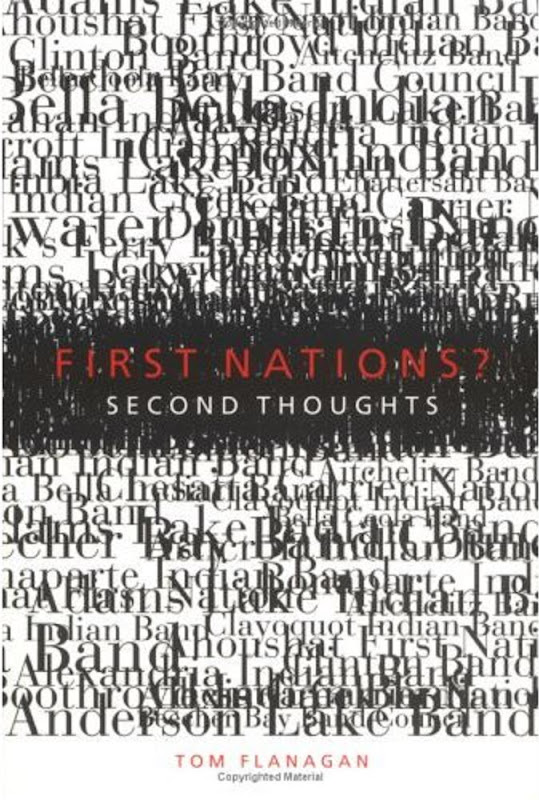
First Nations?  Second Thoughts

First Nations?  Second Thoughts
by Tom Flanagan
Montreal:  McGill-Queen's University Press.  2000

Tom Flanagan has been writing on Canadian aboriginal issues for 25 years.  After observing and participating in the Royal Commission on Aboriginal Peoples -- which produced a 3500 page report at a cost of $54 million and recommended a completely new level of aboriginal government, and a bucket-load of new money for aboriginal affairs -- Flanagan has blown the whistle on the whole damn show!

He decided to sketch the orthodoxy that surrounds aboriginal policy in Canada, and tell the story of the great harm its separatist and romantic notions are doing to Canadian aborigines.  There are immense lessons in Flanagan's analysis for Australian policy-makers.  Especially those who are slaves to fashionable ideas.  I note with fear and trepidation the "next big thing" in aboriginal orthodoxy, "the indigenous order of governance".  This notion has been taken up with gusto by The Australia Institute in its September 2000 paper for ATSIC, "Resourcing Indigenous Development and Self Determination." It borrows heavily from the Canadian orthodoxy and recommends that Australian aboriginal governments -- indigenous governance structures to be correct -- should receive a guaranteed share of national tax revenue, i.e., a bucket-load of new money!

The Canadian orthodoxy consists of eight propositions:

  1. Aboriginals differ from other Canadians because they were there first.  As first nations, they have unique rights, including the inherent right of self-government.
  2. Aboriginal cultures were on the same level as those of European colonists.  The distinction between civilised and uncivilised is a racist instrument of oppression.
  3. Aboriginal peoples possessed sovereignty.  They still do, even if they choose to call it "the inherent right of self-government".
  4. Aboriginal peoples were and are nations in both the cultural and political senses of this term.  Their nationhood is concomitant with their sovereignty.
  5. Aboriginal people can successfully exercise their inherent rights of self-government on Indian reserves.
  6. Aboriginal property rights should be recognised as full ownership rights in Canadian law and entrenched, not extinguished, through land-claims agreements.
  7. The land-surrender treaties in Ontario and the Prairie Provinces mean something other than the words indicate.  Their wording needs to be modernised -- reinterpreted or renegotiated -- to recognise an ongoing relationship between nations.
  8. Aboriginal people, living and working on their own land base, will become prosperous and self-sufficient by combining transfer payments, resource revenues and local employment.

Flanagan answers each of these propositions, one per chapter, in a systematic and effective way.  I will not give you his responses, because I want you to buy the book and arm yourselves for the same fight that is unfolding in Australia.  However, in case you need convincing that there is certain madness in Canada on these matters, try these morsels, which Tom has sent me, extracted from a recent lecture.

Annual federal expenditure on Indians is about $6.5 billion (more than $10,000 per capita).

Last year, the Squamish Nation (about 2000 people) in British Columbia received $92.5 million compensation for "historical injustice".  The alleged injustice is that the federal government did not stop the BC government from relocating the Squamish reserve 100 years ago.  The Squamish surrendered no land rights and continue to maintain their claim for aboriginal rights and title.

The cost of the newly approved Nisga'a Treaty is conservatively estimated at $500 million (for about 6,000 people).  Between 50-80 similar agreements will be needed to complete the treaty process in British Columbia.

In 1998, the federal government set aside $23.4 million to buy farmland in southwestern Ontario to create a reserve for the "Caldwell First Nation".  The latter embraces people who claim their ancestors were missed in a treaty signed in the 1790s.  They have been living as ordinary Canadians for over 200 years but now want to become registered Indians.

I think it is high time in Australia that someone takes a big stick to the home-grown variety of the Aboriginal Orthodoxy:  treaty-talk, recognition of customary law, self-determination, separate funding and more.  In fact, that is precisely what a group of aboriginal and non-aboriginal writers is doing at this very time.  The fruits of their labour will be published in the near future.

Sunday, April 29, 2001

Little More Than Fiction

It's an oldie, but a goodie.  People who live in glass houses shouldn't throw stones.  And media watchdogs should be sure that their facts are right before attacking others for "deplorable journalism".

A couple of weeks ago, Stuart Littlemore used his program on ABC TV to put his boot into me.  He was obviously displeased with my recent and widely-reported Backgrounder, "Their ABC or Our ABC?", which he portrayed as an "Incredible Propaganda Achievement".

Littlemore put on quite a performance.  If nothing else, it provided the proof of bias that he wrongly claimed I couldn't produce.  But surely he did not intend to offer such powerful ammunition to the ABC's critics?  Why didn't he realise what he was actually doing?

Perhaps it was his stratospheric ego.  Or an organisational culture in the ABC that is too cloistered to appreciate how outsiders might see it.  Or confidence that ABC management does not care about implementing the organisation's charter, which requires it to present information which "is accurate and impartial according to the recognised standards of objective journalism".

As Peter Charlton pointed out in the Courier-Mail a few days later, Littlemore does not attempt to present information in any objective and independent sense.  Rather, he follows the model of his day job as a barrister, smugly and sarcastically arguing what he thinks will be the best possible brief for his client, which in this case was the ABC itself.

So Littlemore conveniently neglected to tell his viewers that the Backgrounder included a politically and philosophically diverse group of speakers, half of whom were individuals currently or formerly employed by, or contracted to, the ABC.  Their presentations ranged from a call to break up and privatise the organisation, through to Quentin Dempster's claim that nearly all the perceived flaws resulted from a 15 year long "war of funding attrition against the ABC".

The speakers who found fault with the ABC did so for a variety of reasons, and offered appropriate evidence for their arguments.  A number specifically dismissed attempts to see the broadcaster's defects in terms of shibboleths favoured by "the left" or "the right", pointing to generational problems arising out of a "baby boomer" mindset, and a failure to genuinely embrace the diversity of today's Australia.

If all this was a Backgrounder designed to peddle "right-wing propaganda", as Littlemore wanted viewers to believe, the organisers made an appallingly inept choice of speakers.

Peter Charlton's criticisms focused on Littlemore's sins of omission and his hypocritical cracks at "capitalism", given the barrister's evident eagerness to build his own stash of capital.  Certainly, these sins were serious enough to transform a supposed program of media analysis into café latte society's equivalent of mud wrestling.

But this is not the whole story.  For Littlemore also did something that even Sydney barristers are not supposed to do.  He told some whoppers about me, my supporters and my work, even though the facts had previously been made absolutely clear to his research team.

In claiming that I was a hired gun for various unsavoury interests, Littlemore flashed various articles on the screen, clearly expecting his audience to take his word for it, as they could only read the titles, not the text.  Thus one of my Courier-Mail columns, called "Healthy concern a smokescreen for pushing a political point", was presented as supposed proof that I am doing the bidding of tobacco companies.

But if that is true, the tobacco industry is now happily promoting the message that "smoking greatly increases the risk of lung cancer, as well as other diseases", because that is what I wrote.  In fact the column criticised anti-cancer groups for not publicising apparent links between abortion and breast cancer.

In case anyone had failed to get the message, towards the end Littlemore gave us a photo of Adolf Hitler, together with a quotation from Mein Kampf stating that "the broad mass of a nation ...  will more easily fall victim to a big lie than to a small one".  As offensive as this was, perhaps it should be cherished as revealing more of Littlemore than of anything else;  a little voice of conscience struggling to get out.

Wednesday, April 25, 2001

It's A Sad Day for Australian Investors

It is rare that a government can add to its nation's economy at the stroke of a pen.  It is much easier, as the Howard Government demonstrated with the Woodside decision, to destroy national value.  Aside from reducing the value of Woodside shares by 12 per cent, the immediate response to the decision to block Shell was to bring about a two percent devaluation of the Australian dollar.

Essentially this means that all Australian dollar incomes and all Australian dollar denominated assets were reduced in value by two percent.  Nice one Peter!

Treasurer Costello's decision to block the proposed takeover of Woodside Petroleum by Shell went beyond undermining the rights of shareholders to buy and sell their property.

Although the effect on the North West Shelf (NWS) Project will be minimal, at least in the short-to-medium term, and Shell will not, after 100 years, pull out of Australia, the effect on the dollar and wealth creation in the long term will be significant.

The fact is Australia can not afford to shut out foreign investment, particularly in capital intensive and technologically-advanced industries such as petroleum.  Our domestic saving is far too low -- we have one of the lowest rates of saving in the world and so one of the highest current account deficits in the developed world.  Local firms do not possess the size, the market reach and, most importantly, the technology to develop out vast petroleum potential.

This was recognised from the inception of the NWS Project.  Foreign companies have put up most of the money -- about 67 per cent -- used their contacts in Japan to develop the market and most important they -- and overwhelmingly Shell -- provided the essential advanced technology.

In short, without Shell and its other foreign joint-venture partners, there would be no NWS project and Australia would be without its largest export industries.

The decision was never going to be easy.  Xenophobia has infected a large proportion of the Liberal Party, particularly in Western Australia, as well as the electorate.  And the cry for the government to draw a line in the sand on the beaches of Karratha was loud and threatening.

Nonetheless, the proposal required addressing on its technical merits rather than on the numbers in the party room.  Unfortunately, the Howard Government has failed to do so.  The Labor Party on the other hand -- at Federal level and in Western Australia -- have acted like a responsible Opposition.  They have avoided political point-scoring, recognised the importance of foreign investment and argued that the proposal be addressed on it merits.

None of the technical questions the Shell takeover proposal raised warranted blocking the bid.

First, there was the issue of foreign control.  The project is already under foreign control and would always be so.

Second, there is the concern with the takeover Shell would be willing and able to "mothball" the NWS project in favour of one of its many other LNG investment around the world.  While it is true the takeover would have given Shell 57 per cent of Woodside, this does not translate into control over the project.  The NWS project is a joint venture between Shell, Woodside and four other partners.  Each partner has equal voting rights.  Thus, Shell would have been in the minority of two out of six.  Moreover, most crucial decisions in the project require unanimous agreement of all partners.  It is inconceivable that BP, BHP, Chevron or Mitsubishi/ Mitsui -- the other joint venture partners in the project -- would allow Shell to drag the chain their assets in favour of another Shell asset.  Even if it could, Shell would not stymie the development of a project in which it had invested $10 billion and which represents 70 per cent of it gas reserves in the region.

Third, there was the concern that Woodside's head office and corporate culture would gradually migrant from Perth to The Hague.  Now one can understand the concern of Western Australians.  Woodside is the largest WA-based corporation and is a particularly good employer and corporate citizen.  The fact is, however, Shell's culture is already indelibly part of Woodside's.  Shell is the major shareholders of Woodside and has, from the start, provided a large proportion of its senior management and technical staff.  Moreover, the takeover bid made clear that if successful, Woodside would remain a WA-based firm, that it would retain control over its expanded asset base and that it would have independent directors.  The bid even promised that Shell would greatly expand its research facilities in WA.

Fourth, there was a concern that the takeover would give Shell, which has investments in other petroleum fields in the North West, a dominant position in this highly prospective area.  This concern however, fails again to recognise the ownership structure.  All Shell's interests in the north west are joint ventures, in which it is dominant in terms of neither ownership nor control.

Finally, there is the concern voiced most vociferously by Colin Barnett the WA Liberal leader, that the takeover would, in effect, usurp the rights and power of the State.  That is, that a foreign dominated Woodside would be less open to the suasion of State politicians when it came to investments.  Some may see this as a benefit of the bid but the truth is that the old days when local pollies could convince firms to undertake dud investments are long gone no matter who owns the firm.

In summary, the none of the many concerns raised against the proposed takeover hold up to scrutiny.  Australia is dependent on foreign investment, perhaps excessively so since our taxation system impacts adversely on domestic savings.  But we seem not to have the fortitude to prevent the double taxation of income that is saved and we must therefore either accept reduced investment levels or attract foreign investment.  The Treasurer's decision on Shell has just made the latter course more expensive.


ADVERTISEMENT

Sunday, April 22, 2001

When Is a Tax Not a Tax?

Few things anger businesses more than governments tying them down with layers of regulation and then charging them rapaciously for the privilege.

The racket has been going on since the year dot, but it has become noticeably worse in recent years with the growth in the number and powers of "independent" regulators and agencies and the adoption of a policy of "cost recovery".

The problem for business has been the absence of hard evidence to prove that it was happening.  Data on user charges has been quietly dropped from the budget papers of all governments.  Individual departments are typically silent on the issue and complaints are addressed on a case-by case basis and fobbed off as isolated anomalies.

Thanks to an inquiry by the Productivity Commission -- Cost Recovery, Draft Report, April 2001 -- hard evidence is now available and it shows what we have long thought:  regulators have been fleecing us.

Since the mid-1990s fee income from Commonwealth agencies has grown by 24 per cent -- adjusted for inflation -- and now stands a $3.2 billion.  Although there is no data on user charges levied by the states, one can confidently predict a similar level of revenue and pattern of growth.

How have these charge been allowed to grow so rapidly?  Well, it turns out no one was looking.  The Commonwealth -- and the states -- have largely left the question of the level and pattern of fees up to individual agencies, allowed them to keep a large share of the booty raised and hide the revenue from the scrutiny of parliament by adopting "net appropriations" reporting.

Not surprisingly, the Commission has found that "there is no uniform approach as to which activities are subject to cost recovery and there are wide variations in the proportion of costs recovered for comparable activity by different agencies".

Some agencies, particularly financial regulators, have been allowed to turned themselves into independent taxing agencies.  The Australian Prudential Regulation Authority (APRA) raised just over $88 million last year via fees, yielding a cost recovery ratio of 150%.  Even worse, the Australian Securities and Investment Commission (ASIC) has been allowed to double its fee levied on businesses over the last four years generating a cost recovery ratio of 249 per cent.  In plain language, ASIC's fees income now exceeds its costs by over $200 million.  And the typical fee for establishing a new small business of around $900 could be reduced to $360 while still allowing the ASIC to cover it costs.

The Australian Communication Authority and the National Registration Authority for Agricultural and Veterinary Chemicals also collected more in fees than they paid-out in expenses.  Many other regulatory agencies have pushed up their fee income to near full cost recover.

Now, cost recovery has it merits.  If well targeted, it can provides a link between costs and service provided which brings with it a number of efficiency and equity benefits.  However, if there is no discretion on the part of the consumer, as is the case for most regulations;  if the fees are levied according to the agencies' costs rather than the services rendered;  and if fees are allowed to exceed benefits;  then cost recovery has a perverse and destructive impact.  The Productive Commission has found much evidence of this.

The solution is simple.  Government should take back the power to tax and regulate their regulators.


ADVERTISEMENT

Saturday, April 21, 2001

Having Some Faith in Our Democracy

What are the great wrongs that will be set right by an Australian Bill of Rights?  Aboriginal deaths in custody?  Unlikely, death rates for Aboriginal non-custodial offenders are even higher than for those in custody.  The detention of illegal immigrants?  Unlikely, the risk of allowing criminals free in the Australian community is too great.  That is how nazi-sympathisers got through after WWII.  What about the right of the poor to be housed?  No, that is a matter of resources.  Only the taxpayers, collectively, can decide.  The great liberating potential of the human rights discourse is a dud.  It seeks to undermine rules established in common law and in the parliament, rules tested by different generations under different circumstances.  We are a civilised and generous society;  we trust each other and our government to be reasonable.  Ah, but that is not good enough it seems.  Some want perfect justice, total justice and an instrument into which they can pour all manner of values.  Values not necessarily acceptable to most people.

Like what?  Homosexual women should have access to reproductive technology, thus overcoming the male heterosexual domination of reproduction.  Children should have access to counselling, thus overcoming the parental monopoly on moral guidance.  Animals are not to be gaoled or used in experiments to satisfy the curiosity and vanity of humans.  Men who injure a fellow worker should not have to suffer the fear of being sued when the boss is available to take the blame.  Any of these and thousands of other matters could be the subject of a BoR, it just depends on how long the list is.  The New Zealand Bill of Rights Act has so many grounds of discrimination, nearly fifty in all, that it caused one wit to remark, "discrimination for the connoisseur"!  In fact, the unsurprising thing about the NZ BoR is that it generates a large number of appeals from criminals.

What about the recent incorporation into British law of the European Convention on Human Rights?  A senior British judge noted its historical context and its aspiration, "While the Gestapo and the death camps are the Conventions backdrop, its stage is now often a battleground against much lesser evils, such as corporal punishment in schools".  He may also have added that no BoR would have halted Hitler.  No judges could have done so.  Only the determination and sacrifice of allies who, with the consent of their people, decided to fight him.

There are perhaps five levels of human rights.  The first is the familiar civil and political rights that attach to individuals.  These have been progressively imbedded in Australian political culture -- common law, parliament, free press -- for over 200 years.  In the absence of this culture, a BoR may have been useful.  The second are reasonably familiar, economic, social and cultural rights.  These may be individual, the so-called right to strike, or to a pension.  They may be collective, the right to a language.  Trouble is, none of these is an unassailable right.  Each of these has various levels of protection or entitlement dependent on prevailing values.  The balance has been worked out over time and is a work in progress.  The third and fourth are collective rights, usually of post-colonial or indigenous people.  We are in the throes of the fourth level now with the call for a treaty with aborigines.  This is a heavily contested issue.nbsp; I have a feeling that once aboriginal people work out the downside, having a cousin or uncle decide who should get what rather than the present democratic-legal system, they will not have a bar of it.  The fifth level is just appearing on the horizon, the rights of nature and beasts (matters that only humans can decide).  Mmmmm, who is to represent them?  Plaintiff lawyers will surely come up with a (publicly funded) scheme!

Take the simplest case of a BoR as suggested by George Williams (The Australian, 17/4/01).  Why not support a parliamentary bill covering just the basic procedural, political and civil rights.  Such a bill supposedly overcomes the objection of the primacy of the judges inherent in a constitutional bill.  It leaves aside the highly contested menu of second and higher level rights.  However, it changes the onus.  The parliament will be asked to defend its actions against the list of agreed rights, as interpreted by the courts.  There will be a further fetter on the actions of parliament, which will place any lobby in the box seat.  A small group will be able to create a solid bloc of votes for their particular claim, the public will be indifferent to the extent that their vote will probably not change on this issue alone.

The left pursues collective rights, the right pursues individual rights.  Whether the object is to favour individual liberty or the public good, a BoR will cause harm to both because it will diminish the trust that is the heart of our democracy.


ADVERTISEMENT

Friday, April 20, 2001

Imprisoned by the Old Ways

In May 1968, while campuses around the world were in open revolt against Western society, the Bulletin magazine wrote about a serious threat to New Zealand's tourist industry.  Maoris were becoming so integrated into New Zealand life that "traditional colour" would soon be gone from the tribal regions.  Ancient practices were losing out to rugby, television and the excitements of city life.

The industry's fears turned out to be groundless.  Spurred by increasing disaffection with Western civilisation amongst sections of the educated white middle class, and the not-unrelated growth of political movements linking indigenous peoples across many different countries, a remarkable revival of tribal cultures has taken place since the late 1960s.

Aborigines, Maoris and other indigenous peoples who were once told that their only hope for health and prosperity was to assimilate to Western culture are now rejoicing in the assurance that it is their cultures that offer the real road to salvation.  Greens urge us to adopt the indigenous attitude of reverence and collective responsibility towards Mother Earth.  Social idealists enthuse over the egalitarianism, harmony, and "caring and sharing" ethic of traditional Aboriginal life.  Jaded clerics whose faith has long ebbed away discover a profound spirituality in Aboriginal religious beliefs.

At first glance, this seems harmless enough, allowing Aborigines to regain a dignity that was long denied to them.  Assimilation programs may have been well-meaning, but in practice Aborigines were often subject to humiliating restrictions and surveillance, which only reinforced the message of inferiority which assimilation was intended to overcome.

Now the key to Aboriginal well being is seen in revitalising moribund or declining cultures and ways of life.  Various bureaucratic, legal and social incentives -- including requirements necessary for successful native title claims -- have induced the "retribalisation" of some previously assimilated Aborigines.  Other people, whose traditions were more intact, have been encouraged to turn away from making effective adaptations to modern Australian life.

Certainly, some Aborigines have done well out of the widespread enthusiasm for all things indigenous.  But at the same time, it is obvious that conditions in many Aboriginal settlements, particularly in remote areas, have deteriorated, with appalling levels of alcohol-induced violence, illness, and social breakdown.

Over ten years ago, Professor Colin Tatz, a long-time campaigner for indigenous rights, wrote despairingly of the "crisis of violence to self and to kin" he encountered during research among 70 Aboriginal communities across the country.  Why was this occurring, he asked, when the external conditions for Aborigines seemed so much better than they had been 30 years previously?

Today it is becoming even harder to explain away the social devastation by invoking the undeniable injustices of the past.  Nevertheless, the urgent question of whether the problems may result more from factors internal to Aboriginal culture and society than from racism and dispossession is virtually taboo amongst educated Australians.

According to Roger Sandall, whose book attacking "romantic primitivism", The Culture Cult, was discussed by Nicholas Rothwell in last Saturday's Weekend Australian, this is because spoiled and discontented suburbanites are loathe to shed cherished beliefs about tribal cultures.  Those who challenge these beliefs are denounced as "assimilationists", and reviled for their wickedness.

And here there is a terrible irony.  For those who condemn assimilation are blind to their own acts of assimilation, which have transformed the often brutal realities of traditional indigenous life and cultures into a fantasy projection of Western ideals and yearnings.

The much vaunted environmentalism, social harmony and deep religiosity of Aboriginal cultures says more about the dissatisfactions and spiritual hunger of many white Australians than it does about life in this land before European settlement.  Even the "abiding reverence for mother Earth", supposedly a universal feature of indigenous cultures, has a Western provenance.

Australians are rightly told that the statistics for Aboriginal health, employment, education, incarceration and other social indicators are shameful.  Little more than a generation ago, many anthropologists would have argued that traditional notions about such matters as violence, personal responsibility, social obligation, and disease causation would hinder significant progress in dealing with these problems.  Even in the mid-1970s, Charles Perkins warned that traditional Aboriginal culture "is in some ways incompatible with western society.  The two just really can't go together".

Don't get me wrong.  I am utterly opposed to any form of coerced assimilation, or to the old paternalism.  All Australians have the right to choose their own way of life within the confines of the law.  But governments and opinion leaders need to be candid about the possibility that there are major contradictions at the heart of ameliorative policies, and to canvass the prospect that traditional lifestyles and institutions will not enhance the well-being of most Aborigines.

Roger Sandall may have portrayed the "big ditch" that separates tribal and modern worlds in starker terms than is really warranted.  He himself would acknowledge the genuine creative advances that have come from bringing together modern and traditional Aboriginal expressive arts.  But if his book encourages our intellectual elites to reconsider their illusions, he will have done more long term good for Aborigines than a sea of 100,000 hands or a million signatures in sorry books.


ADVERTISEMENT

Sunday, April 15, 2001

Planet Earth Put on Hold

One of the qualities that make the greens so interesting is their ability to get away with the most alarming and fatuous exaggerations.  Who else would have said, as Greens Senator Bob Brown did two weeks ago, that we have just reached "a low point in world environmental history"?

This is quite a statement, given the damage we humans have inflicted on our poor planet in the past, particularly before the current wave of environmental concern began three decades ago.  Brown's seemingly chilling assessment was occasioned by US President Bush's decision to abandon the 1997 Kyoto Protocol on Climate Change, signed by the previous Clinton administration and more than 100 other countries.

But despite the moral panic that President Bush's decision has caused, the demise of the Kyoto agreement should not cause much concern, even if we accept that human activities are affecting the world's climate through an increase in greenhouse gases.  From the start, the agreement was deeply flawed.

For one thing, irrespective of the Bush administration's position, the Kyoto agreement in its present form would never have been ratified by the United States Senate.  Shortly before the Protocol was signed, the Senate -- a body with at least a few green-thinking members in its ranks -- voted 95 to zero to reject any climate treaty which would result in serious economic harm to the US, and which did not force developing nations to cut greenhouse gas emissions.  Kyoto fails both of these requirements.

Developing countries are exempt, even though some, like India and China, produce substantial and rapidly increasing amounts of greenhouse gases.  And the protocol is much tougher on the US than on any other country.  Estimates of the total costs America would face in complying with its Kyoto targets vary widely, but some respectable assessments indicate that it could be as much as $A600 billion a year, or $A5,400 per household.

Part of the problem is the aversion that greens and European governments have towards using market mechanisms such as emission trading.  This would allow countries which are below their Kyoto targets, such as Russia, to receive credits which they could then sell to countries which are unable to meet their targets, such as the United States.

Although this would be a cheaper and more flexible way of reducing the overall global level of greenhouse gases, most greens find the idea that a country could buy "rights to pollute" morally unacceptable.  They seem to think that, as the United States accounts for around a quarter of the world's human-induced greenhouse gases, it should be made to suffer for its profligacy.  European governments may also like the prospect of imposing pain on a rival economic power.

But it is fanciful to think that harming the American economy would be good for the world's environment.  Prosperity, rather than a declining economy, is more likely to foster the kind of technical and social innovation and commitment necessary to solve environmental problems.

Kyoto also has another serious failing.  Despite its high economic costs, it would have only a minimal effect on possible temperature increases.

Estimates vary, because the computer models which predict the effects of climate change are still fairly crude, and important unknowns remain about the world's climate system -- matters to remember when considering the frightening forecasts of temperature and sea level rises and more frequent storms.  But at best, Kyoto is unlikely to reduce global average temperatures by more than 0.2 degrees centigrade by the year 2050.

Supporters of the agreement would probably respond that we have to start somewhere, and imposing tough initial requirements on the developed nations will force people to face up to the problem of climate change.  While this argument has some merit in principle, a closer examination suggests that our local greens don't treat it too seriously in practice.

Take Senator Bob Brown, for instance.  This weekend he is hosting a Global Greens conference in Canberra, which will have climate change as a major focus.  Over the past fortnight his office has put out 5 media releases railing against John Howard for not demanding that President Bush reverse his decision on Kyoto, and attacking the Labor opposition's unwillingness to take a tougher stand.

One of these releases had the hip Senator picking up "street vibes", which supposedly indicate that the Kyoto Protocol "will rival the GST" as an election issue.  But where were Bob Brown and the "street vibes" in the six months before March, when the Howard government finally succumbed to intense pressure to cut fuel prices and abandon the automatic indexation of the petrol excise?

There are many ways to achieve the Kyoto targets, but lower petrol prices is almost certainly not one of them.  The greens had a great opportunity to stand shoulder-to-shoulder with John Howard on a major issue.  They could have told Australians that our petrol prices are among the cheapest in the world, and that higher prices would provide incentives for the adoption of more fuel efficient cars.

In fact, this is what Michael Krockenberger, strategies director with the Australian Conservation Foundation, said this week, in an article published in some southern newspapers.  He made a few sensible points, but why weren't he and his influential organisation shouting the message from the rooftops before Howard's humiliating and foolish petrol price backflip?

There is an obvious but depressing answer.  When greens are faced with the choice of saving the planet or lining up against a hated conservative politician, the interests of the planet have to give way.


ADVERTISEMENT

Friday, April 13, 2001

Staffer No Last-minute Inclusion

Letter to the Editor:

Point of clarification to Amanda Meade's otherwise fine article on the conference on the ABC (Bias questions at ABC talkfest, Media, 5/4).  While Quentin Dempster was a last minute addition as a speaker, it was always the intention to have a speaker from insider the ABC.  Ian Henschke, the staff-elected Director and Tom Morton (former producer of Background Briefing) were going to be speakers.  Both were prevented by family reasons.  Stephen Crittenden (ABC Religious Affairs) was to replace Tom Morton, but schedule changes meant he could not.  Kirsten Garrett and Geraldine Doogue politely declined due to other commitments.

Kerry O'Brien was also invited.

Richard Fidler, who was due to speak, was prevented by last-minute re-scheduling of the shooting of his latest programme.

Regarding the Brent Cunningham article on the New York domination of US Media (Power of the Manhattan pack, Media, 5/4), Australia has a similar problem with Sydney.  With our conference on the ABC, we had a choice of Melbourne, and having a larger attendance, or Sydney, and getting media coverage.  We chose the latter option.

The resultant media coverage suggests it was the correct decision.  That we faced the choice suggests that the concentration of media in Sydney (one-third of Australian journalists work in Sydney) is a problem.

Sunday, April 08, 2001

A Difficult Position

Can the "stolen generations" issue ever be resolved?  Last week, during a debate with me on the ABC's 7.30 Report, prominent historian and public intellectual Robert Manne said that three things are needed to deal with the shameful legacy of past removals of part-Aboriginal children.

He wanted an official Commonwealth apology to Aborigines.  He called for a tribunal to provide compensation to the separated children, with the onus of proof on the government to show why payments should not be made in individual cases.  And he demanded that the "conservatives and right-wingers" who have denigrated Bringing Them Home -- the report on the "stolen generations" -- should show some sympathy for the suffering of Aborigines.

I endorse the call for an apology, provided it is not the glib kind of "sorry" that rolls off hypocrites' tongues and which posturers wear on their suits.  Such an apology only debases our moral language.

If an apology is to be truly constructive it should provoke Australians into pondering the underlying causes of the humiliation and distress that Aborigines suffered during the course of our history.  It should acknowledge that most of the wrongs were the consequence of two destructive notions.

The first is the belief that Aborigines were a different kind of human being to other Australians, requiring special legislation and programs based on race rather than individual circumstance.  The second is the enthusiasm for the kind of government social engineering that undermines legitimate individual freedoms.

Unfortunately, both of these notions are still prevalent today, often promoted by the people who are most prone to conspicuous displays of identification with Aboriginal suffering.  This is why it is appropriate for John Howard to apologise for not doing more to undermine these harmful ideas.

The kind of compensation tribunal Manne proposes would be an invitation to deceit, as well as providing the grounds for many people to dismiss the "stolen generations" issue as just another grab for money.  Aborigines who experienced criminal abuse in institutions should be entitled to compensation, but they should be expected to demonstrate that such acts really took place.

Furthermore, any compensation should come from the organisations or individuals responsible for the abuse.  The recent Cubillo and Gunner "stolen generations" court case showed that, at least in the Northern Territory, it was usually church organisations who employed unsuitable personnel in their institutions, and who turned a blind eye to the excesses that were sometimes inflicted on Aboriginal children.

Manne's final point, which effectively demands that critics of Bringing Them Home belt up, is strange indeed.  As Andrew Bolt pointed out in the Courier-Mail last week, Manne's new book, In Denial:  The Stolen Generations and the Right, finally concedes that Bringing Them Home is badly flawed.

But at the same time, Manne bitterly attacks those of us who first marshalled the evidence to demonstrate these flaws, calling us "mean-spirited", and implying that we are racists.  It seems that he is in an awful quandary.  On the one hand, he realises that the credibility of Bringing Them Home is crumbling, with even left-leaning historians like Bain Attwood criticising its defects.

On the other hand however, having only recently managed to extricate himself from the smear of being a "right-winger", he seems terrified that his new-found leftist friends will accuse him of backsliding.  So he is desperate to distance himself from the "right", but in doing so he destroys his own credibility even more than he would had he continued to pretend that Bringing Them Home is an accurate report.

For instance, he uses quotation marks creatively to make it appear as though his opponents have made statements they have never made and that are contrary to their actual views.  And he makes claims that he almost certainly knows to be false.  I have prepared a point by point demonstration of the fabrications, serious errors of fact, and other scholarly failings that occur in Manne's book in relation to my work.

By writing In Denial, Robert Manne is now in a most difficult position.  He has demonstrated that he cannot be relied upon to present an honest account of documents that he has examined.  For a professional historian, that is a major problem.


ADVERTISEMENT

Thursday, April 05, 2001

Corporate Australia Has Failed to Defend Itself

Don't weep for corporate Australia;  it has brought the current political heat upon itself through inaction and silence.

After taking the high moral ground and spearheading the reform process in the 1980s.  corporate Australia has largely vacated the public debate on a range of crucial issues.  Moreover, in recent times, their participation has focused more on pleading for more government largess than improving general interest.  Importantly, corporate Australia has failed to defend itself against the concerted assault by the "stakeholder" lobby.

As a result, the social consensus for reform -- which was always weak -- is waning.  Corporations are on the nose with the public and therefore are viewed as fair game by populist politicians.  More importantly, the fundamental role that corporations play in creating wealth, jobs and new services and in building a truly civil society is being undermined.

The corporate sector, along with farmers, have led the long march for a more flexible labour market.  Although less has been achieved in this area than in others, progress has been made.  There is widespread -- but incorrect -- belief in the community that the reform process has resulted in job insecurity, longer working hours, greater inequality of earnings and conditions and higher levels of industrial conflict.  The corporate sector is rightly seen as a main beneficiaries of this process.  These beliefs lie at the heart of public discontent about reform and the corporate sector.  Although corporate Australia has continued to lobby for IR reform -- though the BCA has now decided to stopping doing even this -- it has largely avoided the general debate about the effects of this reform.  The fact is that, in a democratic society, you cannot get reform for long without providing supporting arguments on outcomes.

Corporate Australia, through its associations and individual leaders, has been the spearhead of tax reform and the GST.  They pushed for Option C in the mid 1980s.  They pushed Hewsons's into the GST in Fightback!.  They led the campaign to convince Mr Howard of the GST and they have been intimately involved in the development of the A New Tax System.  But they may have been active behind closed doors negotiating the detail, they have been silent in defence of tax reform.  Most pointedly, they have said nothing about the benefits that have flowed to them from the exemption of exports under the GST.

Corporate Australia -- specifically the Business Council of Australia -- was the originator and main proponent of the National Competition Policy.  Yet again, except for a few submission to inquiries, they have sat by reaping the benefits of reform but saying little.  Moreover their submissions to various inquiries have focused more on procuring commercial advantage and getting cheap energy rather than achieving a regulatory system based on respect for risk-taking and property rights, minimal interference and neutral outcomes.

Concerns about globalisation underlie much of the public angst about economic reform and the corporate sector.  Economic reform is seen as accommodating globalisation -- which it is -- and stripping away protective arrangements and accentuating the pace of change.  Corporations are also rightly seen as the main vehicle and beneficiaries of globalisation and change.  And, the mistrust of corporate sector lies predominantly with its increased global nature .  Yet again, the corporate sector has played a reactionary and reluctant role in the debate about globalisation.  If the corporate sector -- which has the most intricate knowledge of the process -- is quiet, then who will speak?

Over the last decade, the corporation -- particularly the Anglo-American variety -- has been subject to a sustained attack by the stakeholder lobby.  This movement's aim is not to destroy corporations but to regulate and guide them in direction they wish and away from the wishes of shareholders.  This movement acts not through the marketplace or necessarily through the formal regulatory process, but rather through public opinion and threat to corporate reputations.  The movement vigorously promotes a vision of systemic corporate failure -- on accountability, on governance, on performance, on contribution to society, on treatment of workers, and on impacts on the environment.

Rather then stand-up to this assault, corporations, here and abroad, have largely sought appeasement.  The appeasement has taken two forms:  intellectual and financial.  They have failed to defend the crucial value of capitalism and corporations to democracy, wealth creation, environmental preservation, and an open society.  And they have poured shareholder money into the pockets of those seeking to undermine the corporation and shareholders wealth.  As the American commentator Michael Novak recently said, "Such executives no longer sell their enemies the rope by which they are hanged;  they give it to them as a grant".

Public advocacy by business leaders is a necessary part of the political cover politicians need to keep economic reform going.  It was central to reform push by politicians in the 1980s and its absence has been central to return to populism during the 1990s.

Of course business leaders are under the hammer like never before, struggling to beat the world's best.  Moreover, any CEO that does stand-up and defend the capitalist system will receive the wrath of the stakeholder lobby and endanger the reputation of her firm.  Nonetheless, public support for the process of economic reform and the corporation is essential to success.  If the CEO's can do it, get someone else to do so.  But just do it.


ADVERTISEMENT

Response to Cynthia Banham

Letter to the Editor:

While I am delighted that Cynthia Banham, in her piece on the conference on the ABC (The Trouble with Aunty, April 2), drew attention to my bringing a touch of Melbourne fashion flair to staid, casual Sydney by referring to my flashy green vest and red coat, her piece trivialised an excellent conference.

Her condescending coverage of Col from Wollongong exemplified my complaint about middle-class journalists sneering at working-class Australians for failing to express themselves in the nuanced language of the tertiary-educated.

Rather than displaying such class prejudice, she could have better spent the space mentioning the excellent paper by Tony Moore, publisher of Pluto Press.  But that would have got in the way of the simplistic story of Right v ABC.

Banham's piece read like something written by someone with very little experience of life or of ideas outside the standard narrow media range -- thereby exemplifying the points Pru Goward and I both made about the narrowness of Australia's intellectual culture and the failures of contemporary Australian journalism.

Tuesday, April 03, 2001

Bush Gives Howard a Green Light

The Commonwealth Government has a ready opportunity to fill the $185 million hole in its budget as a result of the backdown on beer excise.  President Bush's rejection of a greenhouse treaty offers Australia a heaven-sent opportunity to avoid needless expenditure.  Following the US decision, the Government can rein-in its fastest growing and most socially wasteful area of expenditure -- that on the Australian Greenhouse Office (AGO).

The office had a major fillip in its budget as a result of the minority parties in the Senate requiring ideologically driven expenditures as a price for their support of the GST.  This required a Prime Ministerial commitment to $400 million additional funding for greenhouse over the next four years.  Reflecting this, the AGO's budget for 2000/2001 shows a massive increase to $230 million.

The AGO itself has enjoyed one of the fastest increases in staffing of any agency in Canberra.  It now has 165 staff.  And, though the agency has more than its fair share of fanatics, the staff are not operating on a labour of love.  Indeed, it has one of the highest average wage bills in Canberra and last year no less than 6 of its 136 officers earned more than $140,000.

ATO provides seed money that diverts scarce scientific resources from agencies like CSIRO and the Bureau of Meteorology into research of little value.  It is the financier of a range of marginal value activities including subsidies to solar energy, wind farms and photovoltaics.  But the waste that the AGO has generated is only the imperial topping of a vast apparatus of officials, studies, grants and international travel that stems from government departments in Canberra and at the state level.

Under Labor, Australia dug a hole for itself in eagerly embracing the greenhouse myth, an embrace that was continued by the present government.  European governments are comfortable with reducing CO2 emissions.  The changing structure of their energy industries makes this possible -- and foisting such policies on other countries offers a prospective competitive advantage.  Not so for Australia.  For all the puffery about the dotcom economy, Australia cannot jettison its low cost energy in pursuit of the mirage of low cost renewables.  We are a resource and agriculturally rich nation that requires competitive priced energy for added value activities.

And let us not forget, the greenhouse gas theory of global warming remains far from proven -- indeed satellites offer the only accurate records of global temperatures and these show no increase over the twenty three years that they are available.  Moreover, even if the global warming theory has substance, the measures proposed at Kyoto would have only a trivial effect on global temperatures.

Notwithstanding the universal rejection of the Kyoto Treaty by the US Senate, as with Clinton a Gore Administration would have maintained funding of greenhouse activities.  There are just too many supporters of the Democrats among the greenhouse believers for a Democrat Administration to cut off the funding tap.  Bush is able to show leadership.  He has started the process of abandoning the whole exercise.


ADVERTISEMENT

Monday, April 02, 2001

Club Virtue:  The Intelligentsia We Deserve?

Of all the shameless untruths which disfigure Australian public debate, none is greater than the claim or implication that the welfare state is shrinking.  Before Gough Whitlam came to power, expenditure by all levels of government on health, education and welfare was about 10% of GDP.  Such expenditure is now over 20% of GDP (or over $6,500 per year per man, woman and child), a growth in resources that no other areas of the economy comes even close to matching.

The breast-beating about cutbacks flow from other factors.  In desperate attempts to keep growth in spending somewhere in range of the electorate's willingness to be taxed, policy-makers have been forced to shift resources from areas of declining demand to areas of rising demand.  Such cuts make much bigger news than the expansion.

Furthermore, governments now channel almost $10bn a year through non-profit organisations, creating a huge sector always willing to claim that more is needed.

As many of the services of the welfare state are "free", demand exceeds supply, leading to rationing by queue (such as hospital waiting lists).  Delivery of services by command-and-control -- the Soviet mode of production -- leads to Soviet-style outcomes in inefficiency and poor quality (particularly in education), creating the impression that the problem is insufficient spending.

The expansion in the welfare state is also implicated in the growth of foreign ownership and foreign debt.  The increase in the welfare state under Whitlam led immediately to a collapse in government saving to such an extent that, from the late Fraser Government to the election of the Howard Government (with the exception of Peter Walsh's term as Commonwealth Finance Minister) the Australian government sector funded pensions, salaries and other non-capital expenditure by borrowing money and selling assets.  At the same time, inflation (itself a way of funding an expanding welfare state) and increasing tax rates were major factors leading to a slide in private saving.  To keep investment up (and to fund welfare on the national bankcard), capital had to be imported.  As foreigners don't let us have use of their savings for free, assets were sold and money borrowed -- hence increasing foreign ownership and foreign debt.

Policy makers tried various ways of keeping the show on the road.  Fraser and Anthony promised resources booms would save us.  The Club of Rome prediction of declining resources such ideas were derived from proved to be nonsense on stilts, based on total ignorance of the economics of resources.  Various governments tried public-private partnerships.  That led to the disasters of WA Inc, the SA State Bank, VEDC and Tricontinental in Victoria.  The Cain-Kirner Government tried pump-priming and ended up in a state of near fiscal-collapse, borrowing money to pay superannuation obligations.

The only path that has shown any sustained success is that of economic reform:  of trying to squeeze more economic efficiency out of the economy so it grows faster and is able to better provide the revenue the growing welfare state requires.  Hence the pattern of economic reform:  corporatisation to squeeze more revenues out of government business enterprises;  privatisation to reduce liabilities and increase efficiency;  free trade and competition policy to force greater efficiencies.

Mostly it has worked.  Productivity growth has improved, government debt has been brought under control, economic growth has moved to about the developed world average -- after being the second-lowest in the developed world for most of the twentieth century.

Unfortunately, the welfare state has not stopped growing, and growing faster than population and faster than the economy.  Economic reform to pay for it has become a never-ending race.

Willingness to receive benefits always exceed the willingness to pay for them, and much of the point of welfarism is to separate (or appear to separate) the two.  Moreover, since welfarist politics defines the role of the state as to "do good" -- and the range of potential good is infinite -- there are no natural limits to its expansion unless and until the range of things the state is deemed competent to do is accepted as being limited and institutional factors enforce that.  Until then, the welfare state is set to keep growing, and to do so faster than revenue.

What is more, by offering "free" alternatives funded by taxation, the welfare state undermines other forms of provisions of such services -- hence the decline of the working-class Friendly Societies of the nineteenth century.  More importantly, the steadily increasing nationalisation of the household steadily encroaches on, and undermines, the traditional role of the family in providing social support, pooling risks and intergenerational support.

Moreover, public debate on the issue is deeply mendacious.  Shameless untruth is being continuously pumped out by commentators to such an extent that it is just not widely understood that the welfare state has been growing, and that the fiscal pressure that generates has been the main driver of economic reform.  Instead, people are fed nonsense about shrinking government and economic reform as some mad, destructive, ideological illusion.

The Australian intelligentsia has become deeply corrupt.  The parading of one's finer feelings constantly triumphs over logic, truth or evidence.  Attacking "economic rationalism" and beating the welfarist drum are signs of virtue -- and so are too often not subject to proper scrutiny by journalists and academics eager to display their own virtue.  Defending market reforms and querying the cost and rise of the welfare state are signs of wickedness -- and so subject to denigration and abuse (so why bother?).  The progressivist ascendancy -- Club Virtue -- regularly hijacks public debate in the cause of its own moral vanity.  And so people are, understandably, deeply confused about what is going on.

This aggravates the perverse dynamics of economic reform.  As UK Labour Peer and economist Lord Desai points out, the welfare state relies on the surplus-producing classes to continue to produce the surplus it lives off.  Government is taking more and more from people in taxes and imposing all the insecurities and pressures of increased competition to increase economic efficiency.  Yet much of the benefits of those reforms are being siphoned off into paying for the welfare state.

Marginal members of the surplus-producing classes -- many farmers, small-business-people and self-employed plus workers in declining industries -- get the increased taxes and insecurities but don't get much of the benefits.  No wonder they get angry.

Meanwhile, they are told that government is shrinking, local services are being cut back and economic reform is being imposed because of mad ideological delusions and meanspiritedness.

If the Constitution was amended to clearly ensure that destruction of property by regulatory action -- including by State governments -- had to be compensated for (a matter of simple justice) this would do much to reduce the angst over economic reform.

As it is, tax-payers get exploited all round.  And the intelligentsia -- which is supposed to be explaining to people what is going on in their society -- is systematically pumping out falsehoods at them:  exploiting them for its own moral masturbation from -- in Kenneth Slessor's words -- the ecstasies of moral rectitude.

And none of the major parties -- the political polyglots -- has bothered to explain properly to them what is going on.

All that can fuel a lot of electoral revolt.

Added to this is the way that Club Virtue seeks to use cultural issues as the prime vehicles of moral vanity.  At least in economic policy, politicians have to deal with real consequences and our economic and business journalists are generally pretty good, so the debate does not get completely corrupted by Club Virtue's posturings.

In issues like immigration, indigenous affairs and multiculturalism, it is much easier for Club Virtue to privatise public debate more or less completely for its own preening.  Especially as that handy term of abuse "racist" can be used to silence and denigrate any dissenters.  So the public debate in these areas has become almost completely corrupt.  The fabricated "secret women's business" was one manifestation of that corruption.  The fictional genocide of the "stolen generation" is another.  That about 10% of Aboriginal children were separated from their families from 1900 to 1970 is really not that surprising, given the turmoil and disruption that indigenous Australians faced in that period.  It is nothing even remotely like a genocide, nor were most of the separated children stolen.

And, if you tell me that intrusive and paternalistic government bureaucracies granted far too much power over people's lives sometimes made bad decisions, I will be less than shocked or, indeed, surprised.  But, unlike most of those so keen on expatiating over the issue, I do not actually support intrusive government.

The visiting writer on the Holocaust who asked

What is going on in this country that people cannot tell the difference between taking children away to be educated and the gas chambers?

had not realised how completely the journalists and academics of Club Virtue -- of the progressivist ascendancy -- have hijacked public debate.

The younger members of Club Virtue are products of an education system thoroughly corrupted by the culture of virtue awarding moral vanguard status on the basis of approved attitudes (Soviet-style production is very good at producing propaganda).  This encourages, even requires, the submerging of concern with truth, logic, sceptical reasoning or the transmission of culture.  The combination expands the ego while it shrinks the mind and creates a mindset largely impervious to dissenting ideas (or even inconvenient truths).

Australia cannot afford the costs of such a corrupt intelligentsia.  It is very notable that most of the worst offenders -- academics, government school teachers and the ABC -- are in the public sector.  But they are far more shielded from consumer demand and accountability for the quality of their product.  This points to at least a partial solution:  complete privatisation, with funding for education being channelled completely through students and research grants.

But argument and exposure has to be the key element in the fight back against the corruption of public debate, and of our schools and universities.


ADVERTISEMENT

Do You Think Our Petrol's Expensive?

Facts

Download PDF

Sunday, April 01, 2001

Paying the Price of a Western Fantasy

All nations have their myths.  The ones to our immediate north and north east -- Papua New Guinea, the Solomon Islands, Vanuatu -- like to pretend that they always settle disputes through the "Melanesian way" of discussion and compromise.

The peaceful conclusion to last week's army mutiny in Port Moresby brought the usual self-congratulatory claims about Melanesians' ability to "solve conflict by talking things through".  In this case, "talking things through" meant abandoning essential reforms, weakening the position of a principled and sensible prime minister, and allowing soldiers who had criminally repudiated their obligations to get off scot-free.  This was capitulation, not compromise.

And while this crisis may have ended without bloodshed, the same cannot be said of the long-running and ruinous Bougainville rebellion, the bitter violence between Guadalcanal and Malaita islanders in the Solomons, or the recurrent episodes of tribal warfare in the PNG Highlands in which dozens of people are killed.

So the "Melanesian way" is not so apparent in contemporary Melanesia.  Like similar myths elsewhere, it was initially promoted by foreign educated intellectuals -- particularly by men such as Bernard Narokobi, a Papua New Guinean lawyer and politician who studied at Sydney University in the late 1960s and early 1970s.

Narokobi saw traditional Melanesian communities as being harmonious and egalitarian, committed to the collective ownership of property, and with a mystical attachment to the land.  It was a view that was attractive not only to indigenous political elites, but to many expatriates as well, who actually believed that the best hope for the future lay in recovering aspects of a romanticised Melanesian past.

This broad appeal is hardly surprising, for as the anthropologist Colin Filer has pointed out, the notion of the "Melanesian way" is just the old European fantasy of utopia recast into a Pacific setting.  But the reality was very different.  In the blunt words of Sir Pita Lus, a veteran politician from the East Sepik, the real Melanesian way is "you shoot me, I shoot you".

Indeed, traditional Melanesia was a remarkably fractious, distrustful and violent place.  The size of the largest political community was tiny, seldom more than a few hundred people.  Communities usually teetered on the brink of disintegration, threatened by personal rivalries, disputes over women and property, accusations of sorcery, and the settling of old scores.

With the exception of only a few societies, the notion of legitimate authority held by men occupying a particular status or political office was absent.  Men jealously asserted their own autonomy, which made co-operative ventures difficult to organise.  When people did pull together, it was usually due to the efforts of "big men", ambitious individuals who achieved their limited power through a combination of wheeling and dealing, cajolery and intimidation.

In some areas, one out every three deaths was due to homicide or warfare.  In the Vanuatu village where I carried out anthropological research, the whole population, with the exception of one man, had been killed in fighting with their close neighbours during the latter part of the nineteenth century, although warfare there had become more deadly through the introduction of rifles.

If there was ever a time when the "Melanesian way" of compromise and peace was prevalent in the south-west Pacific, it was during the few decades when colonial rule held sway.  To say this is not to hanker after some golden age when white officials kept Melanesians in their place, for whatever its short-term benefits, in the long run colonialism usually has damaging and degrading consequences for both the rulers and the ruled.

Rather, it is to recognise that peaceful relations and effective consensus building amongst tribal people required the presence of a credible external power which made it clear that violence would not be tolerated.  Anthropologists working in some parts of Melanesia, particularly the PNG Highlands, have noted that people quickly saw the advantages, economic and social, of going along with the colonial administration.

Although there were occasional displays of colonial force, there were also many cases of what has been called "voluntary pacification", where villagers would effectively collude with patrol officers to exaggerate the mystique of the new regime and its ability to intervene quickly in local affairs.  Had this not been the case, it would not have been possible for a mere handful of officers to establish control so rapidly in places such as the Highlands, where they were vastly outnumbered by the local population in an often unfavourable terrain.

Once regions were pacified, traditionally-derived mechanisms for resolving conflicts and promoting co-operation could flourish and achieve an effectiveness that was rarely possible before the imposition of state control.  But the continuation of this benign situation was only possible while the state retained its legitimacy.

This meant being able to preserve law and order, maintain an appropriate degree of neutrality between rival tribes and clans, and provide basic services, such as health, education, infrastructure and assistance with economic development.  The capacity of the post-colonial Melanesian states to meet these requirements has declined markedly -- corruption and lawlessness is rampant, and in some areas the provision of even the most essential services is virtually non-existent.

There was nothing inevitable about this deterioration.  But unfortunately, the indigenous elites and expatriate advisers responsible for developing new national institutions in the late colonial and early independence years were in thrall to a naïve and sentimental view of traditional societies and their relationship to modern states.  The poor villagers of today's Melanesia are paying the price for the Western-based fantasy of the "Melanesian way".


ADVERTISEMENT