Tuesday, March 11, 2008

Myths on food miles

Last week federal Minister for Agriculture, Fisheries and Forestry, Tony Burke, exposed the ''food miles'' campaign as ''nothing more than protectionism''.  Burke is right, but beneath such transparent protectionism, the food miles emperor is still naked.

Food miles is the latest chic campaign for environmental activists to reduce CO2 emissions.  But perhaps counter-intuitively, if activists and consumers want to reduce their CO2 footprint they may want to support their food travelling longer, not shorter, distances.

The principle of the food miles campaign is simple.  There is a significant -- and, activists argue, an unnecessary -- CO2 footprint associated with transporting produce.  The solution is therefore to avoid these emissions by ''buying local'' and exercising caution when purchasing imports.

Late last year a Melbourne organisation, Community Environment Park, released a report drawing attention to the carbon footprint of food purchased by Melbourne consumers.  The report unsurprisingly outlined the large footprint for much of the food bought in Melbourne's supermarkets, regardless of whether it was produced domestically or internationally.

It may seem logical that the further the distance a product travels, the bigger its CO2 footprint.  But as Trade Minister, Simon Crean yesterday pointed out, this view is simplistic.

First, only a full life-cycle carbon footprint can accurately measure total emissions.  A life-cycle assessment would require a calculation of the total CO2 emissions from the seeding of crops and the birth of livestock, to their delivery to the consumer.

Second, the fuel efficiency that comes with bulk transport, and the mode of transport itself, need to be factored in.  Agricultural products from our region transported by sea to England can produce equivalent emissions as comparable products travelling by road to England from southern Europe.

In his address to the trade ministers' meeting held alongside the UN's Bali climate change summit in December last year, director-general of the World Trade Organisation, Pascal Lamy, made this point clear.  Lamy argued that ''90 per cent of internationally traded goods are carried by sea.  And maritime transport is by far the most carbon-efficient mode of transport, with only 14g of CO2 emissions per tonne-kilometre''.

In many cases, a more accurate life-cycle assessment will show that importing food that travels long distances can be better for the environment than producing it locally.

The inputs would not simply be limited to transportation costs, but would also consider such items as fertiliser, electricity, feed, tools and housing.

A recent study done by New Zealand's Lincoln University demonstrated this well.  The study looked at the life-cycle carbon footprint of apples, onions and lamb exported to Europe.  For all three items, the total energy input per tonne of output was substantially less if the product was produced in NZ and exported to Europe, than if it was produced locally.  In the case of lamb, the CO2 emissions were more than four times less.

Third, the food miles campaign ignores the environmental benefits of international trade.

The primary determinant of a product's life-cycle carbon footprint is the level of inputs.  The costs of inputs are not ignored by competitive food producers.  If a producer successfully reduces these inputs, it will be able to bring its product to market at a lower price, with the added benefit of a smaller footprint.  Free markets are environmentally sustainable because they seek the maximum output for the minimum input.

And herein lies the challenge for the Labor Government.  Despite Kevin Rudd's general commitment to the efficiency of free markets, many of his MPs are not so sure.  Among the ranks of Labor's caucus is a number of protectionists who question the environmental benefits of free trade.

Equally Rudd has a number of climate evangelists who actively support reducing CO2 emissions at all costs.

And following the change of the Senate in July, the Greens are likely to move from the fringe of public policy debate to the centre.  The Australian Greens should follow their NZ counterparts.  In 2006, co-party leader of the NZ Greens highlighted the Greens' opposition to food miles and argued that environmental activists ''need to consider the emissions released during production, not just the transport emissions''.

Despite the evidence not stacking up, too many advocates of food miles ignore the complexity of proper accounting for carbon footprints, and instead rely on anti-trade rhetoric to get their message across.  And even fewer consider the beneficial role international trade and free markets can play in reducing emissions.

Agriculture is a diminishing but still vital component of the Australian economy.  Burke is right to expose the food miles campaign as a front for protectionism and should campaign heavily against it.


ADVERTISEMENT

Monday, March 10, 2008

Pedestal to the metal

The car is doomed announced two Melbourne academics in The Age last week.  According to them, carbon emissions targets compel us to reduce automobile travel by 80%.  And the State Government should probably stop building new roads.  We won't need them anyway.

Sure, it's easy to criticise research that is little more than media bait.  But after years of abuse, the humble car still can't catch a break.  And the reasons the car still has a long, healthy life ahead of it highlight the biggest problem in the debate over public transport.  When people choose to drive, they do so because it is more comfortable and more convenient than the alternatives.  No public transport policy is going to change that.

A lot of factors stack up in favour of the car.  As Roads Minister Tim Pallas pointed out on Wednesday, public transport may be convenient for those living in the inner suburbs, where the average distance to a train station is less than a kilometre, but in the outer suburbs that distance expands to 10 kilometres.

A more critical issue is that only a small, declining percentage of journeys are from the suburbs into the city, as workplaces move out of the CBD.  And it is these journeys that are the most suitable for public transport -- when everybody is travelling the same direction it is easy to map out a new train line.

The remaining suburb-to-suburb journeys are exponentially harder to service, not least because the origins and destinations are dispersed.  It is impossible for transport planners to account for the huge variety of journeys taken every day in modern Melbourne.

To put it simply, people like having a car.  For most Australians, owning a car means having the freedom to travel wherever you want, whenever you want -- just ask any giddy teenager with their newly acquired driver's licence.

The urban historian Graeme Davidson describes how the automobile was a major impetus behind postwar gender equality in Australia, as women recognised that the freedom to drive also meant the freedom to do a lot more things.  And, for a young person, owning a car -- or even just being able to borrow their parents' car -- has long represented a degree of personal autonomy.

No matter how many billions the Victorian Government spends on public transport, it will never be able to challenge the independence provided by an automobile.

You don't have to wait for your car to arrive, unlike public transport.  There is ample room to put your bags of shopping or new flat-packed furniture.  Your children can't run wild in your car like they can in public transport -- after all, they're strapped down.  And, unlike a tram, there is no chance that your car will be so full of fellow commuters that you have to hang halfway out the door with someone's armpit in your face while the driver yells indiscriminately over a damaged loudspeaker.

These objections may seem trivial in comparison to the grave importance of saving the planet.  Public transport fantasists -- like all radicals who want to change our behaviour -- dismiss such considerations as minor.  But it is these sorts of minor considerations that inform our everyday transport choices.

In the trade-off between environmental concerns and the importance of the automobile, the Federal Government is trying to have it both ways.

Eager to placate its traditional union support base, but also wanting to be seen as concerned about the environment, Labor is happy to pay $500 million for more cars to be produced in Australia.  But it only wants hybrid cars.  Industry assistance is getting awfully picky.

A similar mixed message greeted the announcement of the Indian Tata Nano, the world's cheapest car.  The chance that personal motorised transport was suddenly within the reach of some of the poorest people in the world was described by one prominent environmental scientist as a nightmare.

In the developed world, the automobile has been one of the most important sources of social freedom in the 20th century.

How can we think of denying such freedom to the developing world?

For some journeys, public transport is indispensable.  Melbourne's experience since privatisation has shown how trains and trams can be better used -- patronage has gone sharply up with the new management.

Similarly, when building new roads, the Government has been aware of the increasing popularity of bicycles.  For nearly a decade now, more bikes have been sold each year than cars.  New dedicated bicycle lanes may have had some influence on this.

But cars continue to sell in increasing numbers.

The Federal Chamber of Automotive Industries reported last week that monthly sales have been up nearly 10% over last year's figures.  Sales of the much-hated SUVs have gone up even more.

Cars have been getting cheaper and cleaner almost since they were first invented.  But the hard reality is that no matter how many train lines or bicycle paths the Government builds, people will continue to use the transport method that they believe best suits their needs.  And for most trips in Melbourne, that will continue to be the car.

A responsible government will therefore continue to spend money building roads and relieving traffic congestion -- just as taxpayers seem to want it to.


ADVERTISEMENT

Sunday, March 09, 2008

Let's cool it in heat of great debate

Hundreds of prominent scientists this week attended a conference in New York hosted by the US Heartland Institute.

The scientists rejected claims that we are seeing catastrophic human-induced global warming.

They concluded that the earth may be undergoing a period of modest warming but that it and cooling are constant features of the earth's climate.  There was agreement that present global temperatures are not abnormal.

The debate on global warming has displaced the struggle about whether socialism or capitalism was the best approach to running an economy.

Radicals once sought to replace private enterprise with state control.  Now they want the removal of coal, oil and gas to justify a new and more comprehensive form of state control.

As with the march of socialism, even politicians sceptical about the claims of an impending catastrophe are being forced to go along with measures promoted by the radicals.

Taxes and regulations to reduce carbon emissions are being steadily introduced while governments pray that their effect will be minor.

The all-embracing of measures being touted, for example in the Garnaut report, involve everyone in the world being allocated the same amount of carbon dioxide and this being steadily reduced.

For Australia, average emissions would be reduced to a fifth of their existing levels, from around 16 tonnes per person of carbon dioxide equivalent to less than 3 tonnes.

Victorians would be particularly badly placed because of our reliance on the Latrobe Valley's fabulous deposits of brown coal for cheap electricity generation.

Nobody knows how an economy could operate with standards of living like Australia's while adopting the sorts of measures proposed.

Carbon dioxide emissions are the automatic outcome of driving cars, generating electricity, smelting metals, making concrete and just about every other activity.

To reduce carbon dioxide emissions to a fifth of present levels would require, at the very least, replacement of coal by nuclear -- something the present government has refused even to contemplate.

It would require an almost complete ban on car use.

It would certainly be the end of any holidays overseas or on the Gold Coast -- and air-conditioning and central heating too.

Victorians have pioneered the use of low-quality brown coal as feedstock for power stations that produce some of the cheapest electricity in the world.  This has been the backbone of our economy and it is impossible to envisage how we could be competitive with the rest of the world without it.

Not only would the emission control proposals cause a trebling of electricity costs to households -- especially without nuclear -- but Victoria would lose its low-cost energy advantage.

We would see the departure of aluminium smelting, metal production, the chemical industry, and car manufacturing.

Costs of services like retailing would rise considerably.

Before further dangerous excursions into energy-control policies, governments need to take note of the grave doubts of so many of the world's eminent scientists at the Heartland Institute conference.


ADVERTISEMENT

Saturday, March 08, 2008

Building a tangible policy

We have seen many versions of the "next big thing" during the first 100 days.  There was Labor's education revolution.  Then there was the climate change revolution.  Now there's the infrastructure revolution.  Hardly a day goes by without a federal minister promising that better and more infrastructure is the solution to the nation's economic ills.

Infrastructure has been enlisted in the fight against inflation, global warming and the skills shortage.  In the Prime Minister's glossy brochure celebrating his three months in office, infrastructure is mentioned no less than 24 times.

Infrastructure Minister Anthony Albanese has proclaimed that "nation building" is back in style.  He's committed the Rudd administration to proudly follow in the footsteps of Chifley, Whitlam, Hawke and Keating.  Thankfully he didn't say the Labor government would attempt to nationalise the banks, ransack the commonwealth budget and try to cause a recession.  Rather, he was invoking an altogether more positive Labor tradition that recalled Ben Chifley's Snowy Mountains project, and the urban renewal schemes of the 1970s and 1980s.

But for all of this talk about infrastructure there remains one question.  What exactly are we going to build?

As yet the government has been scant on specifics.  Its infrastructure strategy looks suspiciously like a slogan in search of a policy.  We don't know much beyond the fact that Labor wants to "reduce bottlenecks" and "ease congestion".  We do know that a new committee, Infrastructure Australia, will spend a year undertaking an audit to create an infrastructure priority list.  It's unclear why such an audit would take so long given the myriad reports on the subject over the past decade.

Labor characterises Australia's infrastructure problems as the failure to build enough things.  What Labor doesn't acknowledge is that the regulatory regimes governing the use of infrastructure don't encourage the efficient use of the infrastructure we already have.

And, to a large extent, any lack of investment in infrastructure is the inevitable consequence of those regulatory regimes.  A fibre to the node broadband network could have been built by now if the regulatory environment were different.  A recent Organisation for Economic Co-operation and Development report lists Australia as having one of the most rigid sets of telco regulations in the developed world.

Albanese has cited the examples of the coal export bottlenecks at the Port of Newcastle and Dalrymple Bay.  Those bottlenecks are not the result of any absence of enthusiasm for "nation building" on the part of the previous government -- they are the result of bad regulation.  A minister complaining about bad regulation stifling competitiveness doesn't provide as catchy a headline as does a minster blaming the previous government for a "failure to invest in nation building".

A closer examination of the so-called infrastructure problems cited by Albanese reveals that his examples have less to do with a failure to spend money and more to do with a reluctance by governments to confront vested interests.  Water policy is controlled by Queensland and NSW -- the two states that have resolutely resisted reform.  Telco policy is controlled by the Australian Competition and Consumer Commission.  Schools and hospitals policy is controlled by the producers of education and health services.  And transport policy is the province of state government departments that are either afraid or incapable of making decisions.

A joint federal/state working group on infrastructure met for the first time in January -- a meeting that was hailed by Albanese as a resounding success.  He said everyone knew "that the time for talk is over" because the meeting was scheduled to last for three hours but finished after two.  One interpretation is that the meeting concluded early because the public servants were in heated agreement.  Another is that it finished before time because there was nothing much to discuss and everyone assumed it would be business as usual.

The Rudd government's first 100 days have been replete with symbolism.  A new administration committed to infrastructure reform could have made no better start than to tackle the closed shop which prevents competition on air routes between Australia and the United States.  But when it came to real policy, as opposed to mere symbolism, Labor blinked.  Last month the federal government announced that it would maintain the ban on foreign carriers operating between Australia and the US.  That's not a great start to an infrastructure revolution.


ADVERTISEMENT

Friday, March 07, 2008

Cattle versus Ducks down in The Marshes

NSW Water Minister, Nathan Rees, has allocated $400,000 to conduct an audit of water diversion structures in the Macquarie Marshes, north of Warren.

This move follows the release of a report by Professor Richard Kingsford from the University of NSW suggesting the illegal diversion send environmental water in the Macquarie River system to cattle pastures instead of key bird breeding areas.

Some upstream irrigators -- the people most targeted in the publicity of the report's release -- have been trying to draw government attention to this water diversion issue for years.  Their claims were mostly ignored before Professor Kingsford report.

The Macquarie Marshes is a large non-terminal wetland covering about 200,000 hectares.  Most of this area (88 percent) is privately owned and grazed.

There are two publicly-owned nature reserves where cattle are excluded and which are Ramsar-listed, meaning they are considered of international importance for migratory bird species.

It will be good if the issue of levee banks within the Macquarie Marshes depriving the nature reserves of water is tackled.

In the past, a lot of environmental water flow, which should have made it to the northern nature reserve in particular, was instead used to fatten cattle on private land.

I am not opposed to grazing within the marshes, but there needs to be some balance between downstream grazing, upstream irrigation and the protection of important wetlands.

Last year I published a monograph on the ecological history of the Macquarie Marshes.  It explains buying environmental water flow is an expensive option when it comes to saving the marshes and will not solve the problems without the removal of the levee banks and diversions impacting on the nature reserves.

It also outlined the need for the construction of effective erosion control structures and investigations into the salinity problems of the North Marsh.

A lot of public money is already available for wetland conservation including $26.8 million as part of a "Wetland Recovery Program", $105 million under the "Riverbank Program" and $72 million to purchase water.

But of course, all the money in the world will not improve the situation in the marshes if it is wasted on audits, plans and more plans.

I hope it is not too long before a bulldozer or two starts removing some of the levees which currently prevent environmental flow water reaching the nature reserves.

After all, and with the recent good rains, there should be enough water to promote both fat ducks and fat cattle.


ADVERTISEMENT

Thursday, March 06, 2008

Set traps for rats in the ranks

When Wollongong City Council was sacked late yesterday, it gained the dubious honour of being the eighth council to be dismissed in NSW within the past five years.  This is an embarrassing record for the tier of government that is supposed to be the closest to its constituents.  The federal government in far-away Canberra has been sacked only once.

The Wollongong council scandal has everything:  sex, bribery and an impersonation of a corruption watchdog officer.  But, most of all, Wollongong council has inadvertently highlighted the deep problems with local government administration across the country.  Compared with other levels of government, there is little accountability and scrutiny of local government.  It is no wonder it often makes expensive mistakes and is susceptible to corruption.

Part of the fault lies in the sorts of people who are drawn to council office.  Local government politics tends to attract those excited by the machinations and manipulations of political life but disinterested in public policy.

There is one good thing to be said for politicians motivated by ideological fervour:  at least they want the best for their constituents.

Too many people stand for local government with little interest in responsible governing.

As Wollongong has been virtually a one-party city for the better part of a century, it is little more than a sandpit for Labor's factional warfare.

A main cause of the corruption in local government is the often cited problem of lack of transparency and accountability.  Few media organisations are interested in the day to day goings-on of individual councils, at least until a corruption watchdog puts a councillor in front of a judge.

Free from the close scrutiny that federal and state governments are subject to, councils are free to follow their whims.  It is perhaps indicative that some of the earliest casualties of the sub-prime crisis have been local government investment portfolios.

If the market had not so spectacularly imploded during the past few months, NSW's Wingecarribee Shire Council would never have been asked why it was investing in mortgages in Houston and Orlando.

One possible remedy for this sense that corruption is endemic in councils has been raised by the Queensland Local Government Association:  politicians would be less likely to accept bribes and gifts from property developers if there were more extensive scrutiny of political donations.

This echoes Kevin Rudd's declaration yesterday that the federal Government plans to drastically limit campaign donations in the name of good government.

Limiting political donations creates its own problems, not least that doing so tends to favour incumbent politicians who are able to harness the full resources of their government.

But, more crucially, limiting political donations to local councillors does not tackle the real problem.  Local governments have too much power over questions of property development.

After all, this is virtually the only reason that bribery occurs between councillors and property developers.  Most of the time, local governments are doing little more than imposing petty, nanny state, regulations:  putting up noise restrictions for street parties;  forcing us to use smaller rubbish bins;  ensuring that nobody paints their front door red;  and other similar important things.  But when they deal with the issue of property development, these councillors suddenly hold vast levels of discretionary power, able to approve or reject multimillion-dollar investments with a stroke of a pen.

Furthermore, the approach that many councils take towards property development is also a leading cause of Australia's housing crisis.  Local government tends to resist urban infill, putting extra pressure on our already critical land shortage.  It doesn't take long for councillors to realise that being caught between NIMBY activists and property developers is potentially a lucrative position.

When councillors and their staff have the power to determine town planning restrictions according to their subjective judgment, and the discretionary power to impose heritage restrictions on properties barely a decade old, it is no wonder that developers feel the need to flatter those councillors with friendship, gifts, and brown envelopes full of money.

Corruption exists where there are opportunities for the manipulation of political power for personal gain.  So local governments provide the corrupt-minded with ample opportunities.  If we are to solve the corruption problem, we should remove the discretionary power and regulations that make that corruption so profitable.


ADVERTISEMENT

Future carbon

In 1897 Lord Kelvin, a former President of the Royal Society in London declared that the atmosphere would exhaust its oxygen in some 300 years as a result of burning coal.  He was wrong about the atmosphere.  So what about the reliability of present forecasts of atmospheric evolution?

The processes at work in the atmosphere are complicated, coupled to external and surface influences, in particular the ocean.  Their interactions may be beyond computer simulation over the tens of years' time scales used in climate modelling.

Any approach to determining economic policy for climate change should take into account the possibility that the current understanding of the atmosphere may not be translatable into reliable forecasts with a precision that allows the design of an economic response.

Further, any economic forecasts that are used to construct models of future carbon use and carbon dioxide emissions will be unable to deal with technical innovations.  Their success cannot be predicted.  This impacts on policy in two ways, first the obvious uncertainty in estimating economic development but more immediately the desire of governments to stimulate technical solutions.  The need to be seen to be taking action frequently descends to picking winners and creating classes of rent seekers.

The problem faced by the Garnaut Enquiry may be reduced to the question "What is the magnitude of the risk of human induced climate change?"  The first question should be "How do we assure ourselves that the risk assessments are reliable?"  After all the assessments are based on climate modelling.  A quote from a well known IPCC scientist Dr Kevin Trenberth should act as a caution:

None of the models used by the IPCC are initialised to the observed state, and none of the climate states in the models correspond even remotely to the current observed climate.

In the 20th century, policy makers based decisions on scientific knowledge and understanding and where possible experimental confirmation.  This was the case in the development of atomic weapons.  In these programs there were issues of risk.  Would a controlled chain reaction in an atomic pile at the University of Chicago run out of control and destroy the south side of the city?  Some hoped that it might.  Would a hydrogen bomb set off a chain reaction in the ocean that would consume the planet?  Could the yield of the weapons be accurately estimated?  There were answers to these questions and there were experimental demonstrations to check calculations.  In some cases there were substantial errors in calculation which pointed to a gap in understanding.

For our atmosphere we have a much more complicated set of interactions than those in nuclear physics.  We need to have some ways of checking climate predictions.  It is well known that weather forecasts are useful for only a matter of days.  Temperatures are the best forecast variable, with rain and wind speed being substantially worse.  There do not appear to be any statistical analyses that cover the accuracy of yearly or five-yearly forecasts.  Until there is some measure of performance it seems unwise to take 50 or 100 year forecasts as providing any guidance.

The second problem, the inability to forecast innovation is not surprising.  The Garnaut Enquiry is required to look forward 100 years.  Models of energy use are needed for stationary and moving energy users.

Consider the start of the 20th century and ask if it were possible to predict, let alone model, the industrial development that occurred in that century?

We have examples within our own lifetimes of inventions that have changed the way we live.  In the second half of the 20th century, the invention of the transistor followed by the integrated circuit has led to an extraordinary flowering of micro-electronics.  Most appliances from pacemakers to telephones to motorcars have integrated circuits imbedded in them or central to their function.  The change in energy use in moving from thermionic valves to transistors can be illustrated by the comparison of a pentode vacuum valve using some 10 watts of electrical power, mostly for heating a filament to produce electrons, with a Pentium processor of 10 to 15 million transistors using 20 watts.

The growth of the Internet, like the creation of a nervous system, continues with consequences for living and working which will take some time to appear.  The consequences of the reduction of energy demand in appliances, the use of wireless communications and other technologies will doubtless play a large part in the less energy intensive economic improvements of the developing world.

So policy should not be prescriptive about technology choices.  There are real and imagined problems with any choice of energy source.  Frequently the response of society to technical development shows a mismatch between public perceived risk and expert assessment of risk.  The choice and promotion of technical solutions is often pitched to public concerns.  These concerns are picked up by government and may help shape policy development.

As an example the present subsidies for wind farms are a response to demands for action from Green groups and green politicians.  The result is a new rent seeking group.  There is little cost benefit analysis to guide policy development.  Rather policy is set to subsidise non-competitive technologies that may produce unquantified benefits.  A simple comparison with the more conventional alternative of natural gas shows the use of gas to be more cost effective and useful as gas turbine generators produce electricity on demand.

General encouragement of innovation should be the limit of government policy.  It is hard enough in business to develop innovations and well beyond the reach of general government.

Policy development should be mindful of these two problems.  The primary issue of long-term uncertainty requires a cautious approach so that our economy is not disadvantaged compared to that of other countries.


ADVERTISEMENT

Sunday, March 02, 2008

Doctrines come cheap

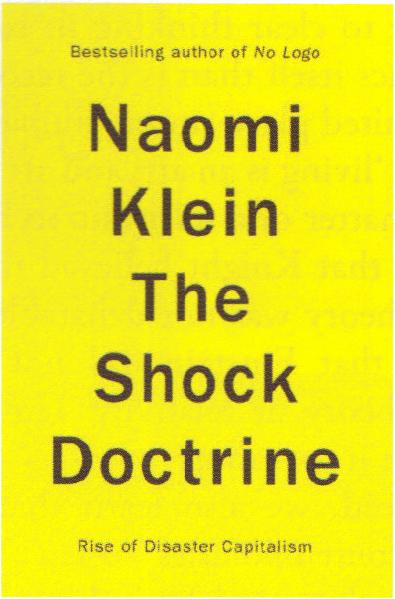
The Shock Doctrine:  Rise of Disaster Capitalism
by Naomi Klein
(Penguin, 2007, 576 pages)

Naomi Klein's latest offering, The Shock Doctrine, is a valuable study of how Milton Friedman will kill your children and abduct your parents.

In this breathless book, the "shock doctrine" refers to the use of crises by free market supporters to implement policies that might otherwise not be accepted through a democratic process.  The villain of the book is the late economist Milton Friedman.  In the Australian edition of the book, a quote from Friedman is written in big bold letters in the inside cover of the book:

Only a crisis -- actual or perceived -- produces real change.  When that crisis occurs, the actions that are taken depend on the ideas that are lying around.

This short quote forms the foundation of Klein's 466 page tome.  Indeed, if the key to understanding the book is this very quote, it is also the key to understanding why the book is fundamentally flawed from the start.

Of all the "doctrines" one could mould out of Friedman's giant catalogue of writings, Klein has taken two minor sentences from the preface to the second edition of a book, labelled it a doctrine, and assigned it as the root ideology behind humanity's suffering at the hands of capitalist policies.  Indeed, Klein describes it as Friedman's "influential passage".

But nevertheless, from this tangential intellectual origin, arises Klein's "disaster capitalism".  So many claims are made and implied in The Shock Doctrine, that it is difficult to know where to begin.  Klein tries to establish a link between psychological torture and economic policy -- that is, the wiping out of memory and identity and its replacement with something new (and something worse).  A similar strategy is necessary when trying to implement free market programs, argues Klein, as democracy typically rejects radical market reforms, and as a consequence authoritarian and inhumane policies are needed to implement them.

Klein's focus on the political injustices imposed by various governments is not entirely without merit.  On a purely political level, Klein's concern for individual rights and human freedom is her greatest strength, but that is not the purpose of this book.  Rather, Klein draws a correlative link between these political injustices and the so called economic injustices of free market reforms.  The two are inextricably linked, argues Klein, with political injustice and authoritarianism embedded within free market ideology.

"I am not arguing that all forms of market systems are inherently violent", argues Klein, but "the Chicago School strain of capitalism does indeed have something in common with other dangerous ideologies".

This is a fascinating hypothesis.  Firstly, it is the opposite approach of the historical revisionism that most left-wing historians have adopted since the Russian Revolution.  Klein explicitly ties economic ideology with political oppression.  The new left historians have spilt much ink in trying to separate the intellectual concept of economic socialism with the political oppression that occurred during the twentieth century.  The result of this is a reverse Road to Serfdom -- Hayek turned on his head with free markets replacing socialism.

But where Hayek's book was the result of decades of research and his own gradual conversion from fabianism, Klein's book is the product of a few years of travel and lazy research, based on a life-long hatred for capitalism passed down to her by her parents.

Indeed, Klein's powers are limited by her own obsessions, anger and at times, idiocy.  For a work that tries to be so ambitious, Klein has applied too much oi her ordinary journalistic research skills to a project that requires enormous skill and attention to detail.  Interviews are worthwhile when asking questions related to the individual.  They are not however useful economic indicators, nor are they trustworthy when the individual is asked to generalise about the state of the country.

Little use is made of primary sources in discussing the economics of free market policies.  Rather, much of her "evidence" is footnoted to another polemic like the very one she is writing, or to an opinion piece written by a like-minded journalist.  This is the equivalent of arguing against evolution and then referencing last Sunday's sermon as your evidence.

Klein's chronic tendency to misquote articles to the point of absurdity is disturbing.  Take for instance her argument that Friedman's ideas weren't taken seriously before Thatcher and Reagan's rise to power.  Her only evidence is an article in Time magazine -- "Friedman was dismissively described in Time in 1969 is a "pixie or a pest", and revered as a prophet by only a select few".

This is the actual passage of the Time article that Klein quotes from:

Friedman, a 57-year-old economics professor at the University of Chicago, is still regarded by critics as a pixie or a pest, but he has reached the scholar's pinnacle:  leadership of a whole school of economic thought ... Friedman has succeeded in persuading many leading economists to adopt his monetary theories, at least in part.

So while the article itself actually praises Friedman, Klein selectively makes the article take the opposite view.

Such a criticism may be nitpicking, but Klein's book is full of such misleading quotations.  That the author relies heavily on quotations from articles and books for evidence, serves only to compound the problem.

Her research into the Chicago School is particularly deplorable.  She characterises economist Frank Knight as someone who "thought professors should "inculcate" in their students the belief that each economic theory is a "sacred feature of the system", not a debatable hypotheses".

Frank Knight of course was famous for taking the opposite position.  Knight wrote in The Economic Organisation that "there is no more important pre-requisite to clear thinking in regard to economics itself than is the recognition of its limited place among human interests" and "living is an art:  and art is more than a matter of a scientific technique".  Arguing that Knight believed that economic theory was not debatable is like arguing that Einstein did not believe in the theory of relativity.  How could Klein get it so wrong?

Indeed, we also learn that Friedman's contemporaries often referred to themselves as "classical economists" (a term that actually describes a particular branch of economics in the nineteenth century, of which people like David Ricardo and Karl Marx are included).

If there is a real evil to Klein's book however, it is her mission to seek out any correlation between free market or US endorsed policies and economic depression and then claim causation.  The book as a whole is a chronic abuse of one of the most important rules of social science.

Take the case of Bolivia.  Klein describes how the eradication of coca crops in Bolivia in 1984 (funded by the United States) "cut off the source of roughly half of the country's export revenues" which "pushed the country over the edge".  "It was in those circumstances" writes Klein, "with inflation up 14,000 per cent, that Bolivia entered its historic 1985 national elections".

This is the only explanation given to the cause of Bolivia's now famous hyperinflation crisis in the 1980s.  Yet inflation was already reaching 300 per cent by 1982.  Klein does not discuss the heavy borrowing by Bolivia in the decade before nor the fact that the country was cut off from borrowing internationally at the beginning of the 1980s, initiating the hyperinflation.

Instead, Klein invites her readers to believe that it was Ronald Reagan who was responsible for Bolivia's economic strife.  Furthermore, no mention is made of the improvements to Bolivia that have occurred since the reforms, with GDP per capita up, adult literacy up, school enrolments up and the child mortality rate down.

Ignorance of these improvements reflects Klein's tendency to focus only on short term consequences while ignoring longer term impacts.  Readers will learn for instance, that Chile's inflation rate rose significantly following its market reforms.  Had Klein extended her time period, readers instead would have learnt that inflation in Chile fell from a peak of 1000 per cent to nearly 10 per cent.  The Shock Doctrine also makes the less than compelling argument that China is now worse off than it was before the market reforms.

Despite Klein's technique of dealing with most reform case studies in crude generalities, she still manages to confuse her rhetoric.  In one case, Klein describes the "Holy Trinity" of free market economics as "privatisation, deregulation, and cuts to social spending".  Of course, the reason why free market economics proposes privatisation and deregulation is precisely because it will allow social spending to increase, only this time from individuals and families rather than governments.

The Shock Doctrine's greatest strength is to serve as a warning to future writers, one which screams out the dangers of ideological prejudice and the damage it does to research and intellectual integrity.  Klein rose to stardom as an articulate spokesperson for the anti-globalisation movement, whose strong rhetoric introduced many young activists to the cause through her best-selling book No LogoThe Shock Doctrine will cement her as another political fanatic, adored by her acolytes but destined to be superseded and eventually forgotten.

The four ways of reading

How to Read the Bible
by James Kugel
(Free Press, 2007, 848 pages)

Who wrote the Bible and how should it be read?  Christians, like Muslims with their Qur'an, are increasingly signing up for a literalist belief in the good book as not merely divinely inspired, but as a set of instructions direct from God.  The rise of fundamentalism in religion is a topic of our time and often the response has come from atheists and secularists, determined to "prove" religion is bunk -- Richard Dawkin's The God Delusion and Hitchen's God is Not Great:  How Religion Poisons Everything have been heralded as representing a "new atheism".  James Kugels How to Read the Bible is not an atheist manifesto -- the author is in fact an observant Jew -- yet Kugel may yet strike the most telling blow against fundamentalism.

This is a beautifully written, erudite book.  To discard it because one is not religious is to miss a reading treat;  to refuse it because one is religious is to admit a profound shallowness of faith.

Kugel sets out to compare different traditions in reading and understanding the Jewish Bible, but his arguments are just as relevant for the Christian Bible.  Kugel does more than merely pit traditional interpretations against modern biblical scholarship, although indeed that is part of his aim.  But more crucially, he argues that the current literalist interpretations of the Bible are just as out of step with traditional religious interpretations as they are with modern biblical scholarship that sets out to "prove", in an archaeological sense, where the bible came from.

Kugel steps the reader through four methods of Biblical exegesis:  that of the ancient interpreters, early Christians, modern scholars and modern fundamentalists.  The ancient interpreters understood the Bible through a set of assumptions which dictated to them what it "meant".  Foremost among those assumptions was that the Bible was a cryptic document, full of hidden meanings which needed interpretation to be understood.  The remnants of this approach are alive today in the Jewish Kabbalah.  Another assumption was that the Bible as a divinely given text contains no mistakes.  As a result where the Bible presents God in a poor light, as with the story of Abraham and Isaac, the ancients argued it could not actually mean God expected Abraham to slay his only son, and to do so without expressing any sorrow or misgivings.

Early Christians modified the ancient interpreters' approach in three important ways.  Firstly they saw the Bible's stories as allegories;  as representations of abstract ideas or virtues and vices.  This took away any need to believe everything in the Bible actually happened.  Next, early Christian writers saw the Jewish Bible as primarily important as a precursor of the New Testament so went looking for biblical predictions that come true in the New Testament.  Like the allegorical approach this way of reading the Bible sees the details of the Bible as representative of something else.  Early Christian writers made a final change to traditional Jewish ways of reading the Bible when they chucked out observance of most of the 613 rules listed in the Pentateuch.  Saint Paul wrote at length in Corinthians that Christianity required only faith in God and His grace, not keeping to the letter of Jewish law.

This way of reading the Bible remains orthodox for Roman Catholics and Orthodox Christians and is antithetical to Kugel's third way of reading the Bible -- as a literalist text.  Sola scriptura, (by scripture alone), became a rallying cry for the Protestant reformation as it meant the Pope and Catholic Church had no divine right to be the arbiter of what scripture meant.  This has morphed into what is now seen as Christian Fundamentalism -- the use of highly selective Bible verses to support political or ideological positions because "the Good Book says it's so".  Such a literal approach to the Bible would not be recognised by early Protestants such as Martin Luther, let alone by those in traditional Christian and Jewish traditions.

Modern biblical scholarship, through extensive use of archaeology and the discovery of various ancient manuscripts, has demolished many of the traditional ways the Bible is understood.  For example, there is no evidence of the exile from Egypt or that the walls of Jericho came tumbling down (Jericho, it appears, had no walls).  Modern scholars believe the Bible was written by at least four people, with very different motivations for doing so.  No wonder, as any casual reader of the Bible knows, there are multiple and unrecognisable differences at every turn.

Much of the commentary on Kugel's book has concentrated on what it means for the religious now that modern scholars have shown that the Bible is not a single, divinely dictated, document.  Without doubt, the way Kugel presents the conclusions of modern biblical scholarship is deeply interesting, learned and yet accessible to even a person outside the Judeo Christian tradition.  For anyone with even a skerrick of inquisitiveness, this book delivers in spades.  But to merely read it for evidence Judaism and Christianity are false because now there's proof that large chunks of the Bible are definitively man made is to miss the point of faith and the point of this book.

A disappointing cool down

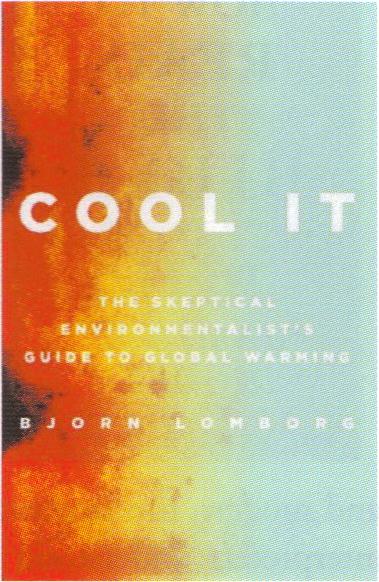
Cool It: The Skeptical Environmentalist's Guide to Global Warming
by Bjorn Lomborg
(Knopf, 2007, 272 pages)

We have a choice:  we can save 49 polar bears a year by banning hunting or 0.06 bears by subscribing to the Kyoto Protocol.  Of course nothing in the real world is ever this simple -- though Bjorn Lomborg suggests otherwise in his new book Cool It:  the Skeptical Environmentalist's Guide to Global Warming.

Lomborg begins by claiming that global warming is real and man-made, that the immediate consequences of global warming are often exaggerated, that we need simpler and more efficient solutions for global warming, and that there are other more important issues including HIV/ AIDS.  Even if this were the case, it doesn't make for a comprehensive, or even simple, guide to global warming.

The book continues the theme that Lomborg effectively dealt with in 2001's The Skeptical Environmentalist:  Measuring the Real State of the World, that those who want to do good need to better prioritise issues, but his writing falls flat this time around.  Indeed why should those interested in reading "a guide to global warming" concern themselves with HIV/ AIDS, drinking water and sanitation?  Lomborg implies that these, and other issues, are related because he appears to accept the popular notion that stopping global warming and curing the sick are primarily moral issues.  They do indeed have a moral dimension, but global warming is essentially a technological and economic issue, while hunger and sickness are often a consequence of poverty which cannot be fixed in developing countries without also addressing issues of property rights and the rule of law -- no matter how much money and conspicuous compassion is thrown that way.

The front flap describes Cool It as, "a groundbreaking book that transforms the debate about global warming by offering a fresh perspective based on human needs as well as environmental concerns".  In reality, many global warming activists have dismissed the book while criticizing Lomborg for using issues relating to developing world poverty to attack proposals to mitigate warming.  On the other side some global warming sceptics complain Lomborg provides no evidence to show there is human-induced global warming.  Lomborg claims he tries to take a "centrist point of view" but in reality he avoids many real issues and also the complexity of the real world.

Take for example the issue of polar bears (and putting aside a valid criticism that Lomborg should have used the latest 2006 report from the Polar Bear Specialist Group of the World Conservation Union rather than relying on the somewhat dated 2001 report), why should the Inuit people of the Arctic be banned from hunting polar bears if numbers are indeed increasing?  In the opening chapter Lomborg correctly explains that over the past decades the global polar bear population has increased from about 5,000 to 25,000 through the introduction of a quota system for hunters.  Lomborg also makes the point that this information is ignored by many technical and media reports which overwhelmingly suggest the demise of polar bears.  But Lomborg then goes on to suggest that the solution is to ban hunting altogether.  But if the quota system is working why destroy it?

Lomborg conveniently side-steps the entire potentially contentious issue of hunting and just assumes that if there was no hunting there would be more polar bears and that more polar bears is an intrinsically good thing.  In the same chapter Lomborg claims a concern for people's quality of life as well as the environment, so why does he want to deny the Inuit people there tradition of hunting polar bears when the evidence suggests that the practice, given current regulations, is sustainable?

Cool It raises issues which could challenge the armchair environmentalist's often romantic, but false, ideas about the natural world, and the left's outdated notion that we can "make poverty history" if only first-world governments gave more aid to developing nations.  But after The Skeptical Environmentalist -- surely a classic of its genre and an heir to Julian Simon's The Ultimate Resource -- which had 25 chapters and 173 data-rich figures, Cool It, which, in its American edition features just five chapters and not a single graph, is a disappointment.  It lacks real substance, side steps critical issues and promotes unrealistic solutions to some of the world's most pressing problems.

The Stalin enigma

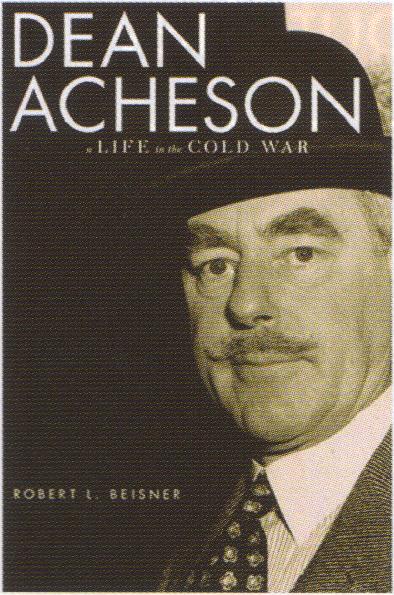
Dean Acheson:  A Life in the Cold War
by Robert L Beisner
(Oxford University Press, 2006, 800 pages)

&

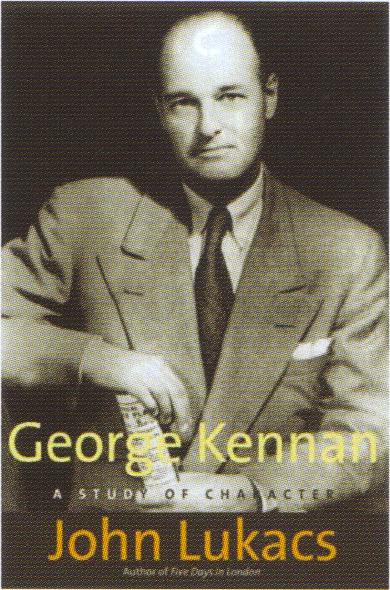
George Kennan:  A Study of Character
John Lukacs
(Yale University Press, 2007, 207 pages)

The history of the twentieth century doesn't lack for big questions.  And some of the biggest questions inevitably revolve around Germany and Russia.  For example, was the rise of Hitler an inevitable consequence flowing from the "character" of the German people -- or was 1933 to 1945 an aberration?

Then there are the questions about Stalin, the Russian people, and the nature of tire Soviet Union.  Were (and are) the Russian people doomed to totalitarianism?  Did Stalin conceive his objective to be to secure the future of the Soviet Union or to ensure the worldwide success of communism?

As academically interesting as these questions are today, half a century ago the answers to them had very real consequences.  If it were thought that Stalin's objective was merely to ensure the territorial integrity of the Soviet Union then presumably there was little immediate risk to the West from his subjugation of eastern Europe.  Perhaps there might even have been a chance that he could be susceptible to negotiation.  On the other hand, if he was in fact an ideologue motivated by the expansionist ideology of communism, ceding eastern Europe to Stalin would give him a stepping stone into Europe's western half -- and therefore he had to be contained and ultimately stopped.

On either side of this debate were George Kennan and Dean Acheson.  Broadly, Kennan held the first position, and Acheson the second.  Each occupies a central place in the history of die Cold War.  Kennan was the adviser and diplomat who wrote long papers hypodio-sising about Russia and the quality of "Oriental" tyranny.  As Harry Truman's Secretary of State Acheson was the "do-er".  He gave the orders, did the negotiating with foreign leaders, and he fronted (and sometimes confronted) the media and the US Congress.

Robert Beisner's biography of Acheson and John Lukacs biography of Kennan are quite different in scope and style, yet at the heart of each is the question of the character of Stalin and communism.  Beisner as an academic historian of American foreign policy has grounded his book in the documentary evidence -- there are 106 pages of footnotes.  There's not much abour Acheson's personal life but there's ten pages of detail about what meetings he attended in June 1950 during the first week of the Korean War.

Lukacs's work is slight by comparison.  There are no voluminous footnotes and few documentary sources.  It's not that sufficient material doesn't exist for a budding biography -- the problem is that there is too much material.  Kennan died in 2005 at the age of one hundred and one, and for eighty years he kept detailed diaries, journals, and notes of his articles and speeches.  And he had a not uninteresting personal and professional life.  Starting in the Foreign Service in 1927 as a twenty-three year old, Kennan variously held positions at the US embassies in Prague in 1938, in Berlin from 1939 until 1942, and then in Moscow as deputy head of the mission from 1944 to 1946.  He followed this with various policy roles in the State Department until in 1952 he became US ambassador to the Soviet Union.

It was a position he held for a mere four months.  En route to a meeting in London he was asked by a journalist at Berlin airport whether he had many social contacts with Russians in Moscow.  Kennan replied rhat the Soviet government prevented him from being able to meet regular Moscow citizens and the conditions for him in that city were comparable to those he suffered when he was interned by the Nazis in Germany.  When these remarks were published he was declared persona non grata by the Soviet government -- he wasn't even allowed to return to Moscow to gather his personal belongings.

Perhaps it was because Lukacs knew Keenan personally that he's not forced to rely on the written sources.  Lukacs is an accomplished story-teller being best known for his Five Days in London, May 1940 and this biography is really a story about Kennan's character and his thoughts.

Although Keenan is famous as the architect of Americas policy of "containment" against the Soviet Union, the strategy he consistently advocated for the United States was more sophisticated than one of simple opposition.  Kennan was concerned that "anti-communism" blinded Washington's policymakers tc the real nature of what was occurring in the Soviet Union in die 1940s.  According to Kennan, Stalin's communism was merely a "fig leaf" that the dictator used to justify his despotism.  "[W]hat Stalin wanted were people, not always necessarily communists, but people entirely subservient to Moscow."  In 1938 Kennan argued:  "We will get nearer to the truth if we abandon for a time the hackneyed question of how far Bolshevism has changed Russia and turn our attention to die question of how far Russia has changed Bolshevism."

Kennan's famous "Long Telegram" written from Moscow in 1946 attempted to explain to his superiors in Washington the Russian mentality.  In eight thousand words Kennan argued that Russia's attitude to the West was dictated by fear and paranoia -- it was an attitude that was not dictated by communism.  As Lukacs puts it, Kennan's "reading of Marx and, even more, his experiences made him see -- and astonishingly early -- that the so-called class struggle was not the main force in history or, indeed, in human nature;  that the struggle of nations and of states were infinitely more important;  that nationality was more decisive than class."  Kennan maintained that the best way to respond to Russia was through the threat offeree -- which was the only thing that the Russians understood.

In later years Kennan became immensely frustrated that "force" was interpreted to mean only military force, when in fact his aim was to have the Western powers appreciate that economic and political force can in the long run be more effective than military action.  He predicted the ultimate collapse of the Soviet Union on the basis that its ideology and its economic system were unsustainable.  The only problem was that he never predicted when that collapse would occur.

The Long Telegram arrived in Washington on 22 February 1946, and, by coincidence, two weeks later Churchill gave his "Iron Curtain" speech at Westminster College in Fulton, Missouri.  The sentiments of Kennan's telegram and Churchill's speech were not the received wisdom.  Both came at a time when many thought that it was still possible that the wartime alliance between the United State and the Soviet Union could continue into the peace.  The conservative columnist Walter Lippmann described Churchill's comments as an "almost catastrophic blunder" and accused him of being a warmonger while the main concern of British foreign minister Ernest Bevin was that Stalin might be offended by the speech.

By the time Dean Acheson became US Secretary of State in 1949 notions about co-operation with the Soviet Union had disappeared.  Acheson saw communism itself as the foe that the United States was fighting.  While he regarded Stalin as little different from Peter the Great or Ivan the Terrible, Marxism-Leninism provided an "ideological zeal and fighting power" that had been absent in the Russian leaders of the past.  Communism "had transformed the Soviet regime into an inexorable force, like a river."  Furthermore, "you can dam it up, you can put it to useful purposes, you can defeat it, but you can't argue with it".

Critics of Acheson's cold war strategy then and since have maintained that the threat the Soviet Union posed was only ever minimal, considering the economic dominance of the United States and the advantage the Americans had in nuclear weapons.  But as Beisner writes this "ignores the ability to feel fear and confidence simultaneously".  That combination of fear and confidence is what stimulated the Marshall Plan, the Truman Doctrine, and the creation of NATO.  These were all postwar creations that Acheson regarded as important.  By contrast, for him the United Nations was not important.  Acheson's attitude to the United Nations could be summed up as:

people who could not face the truth about human nature were for the UN;  people who fairly squished with the juice of human kindness but who had a pretty soggy brain were also for the UN;  people who preferred to preserve their illusions intact favoured the UN.

Acheson was happy to engage in diplomatic debates "but he considered such debates valuable only when they occurred among those already in agreement on fundamentals" -- and communists and liberal democrats didn't share such agreement.  His criticism of the UN is just as powerful now as it was half a century ago.

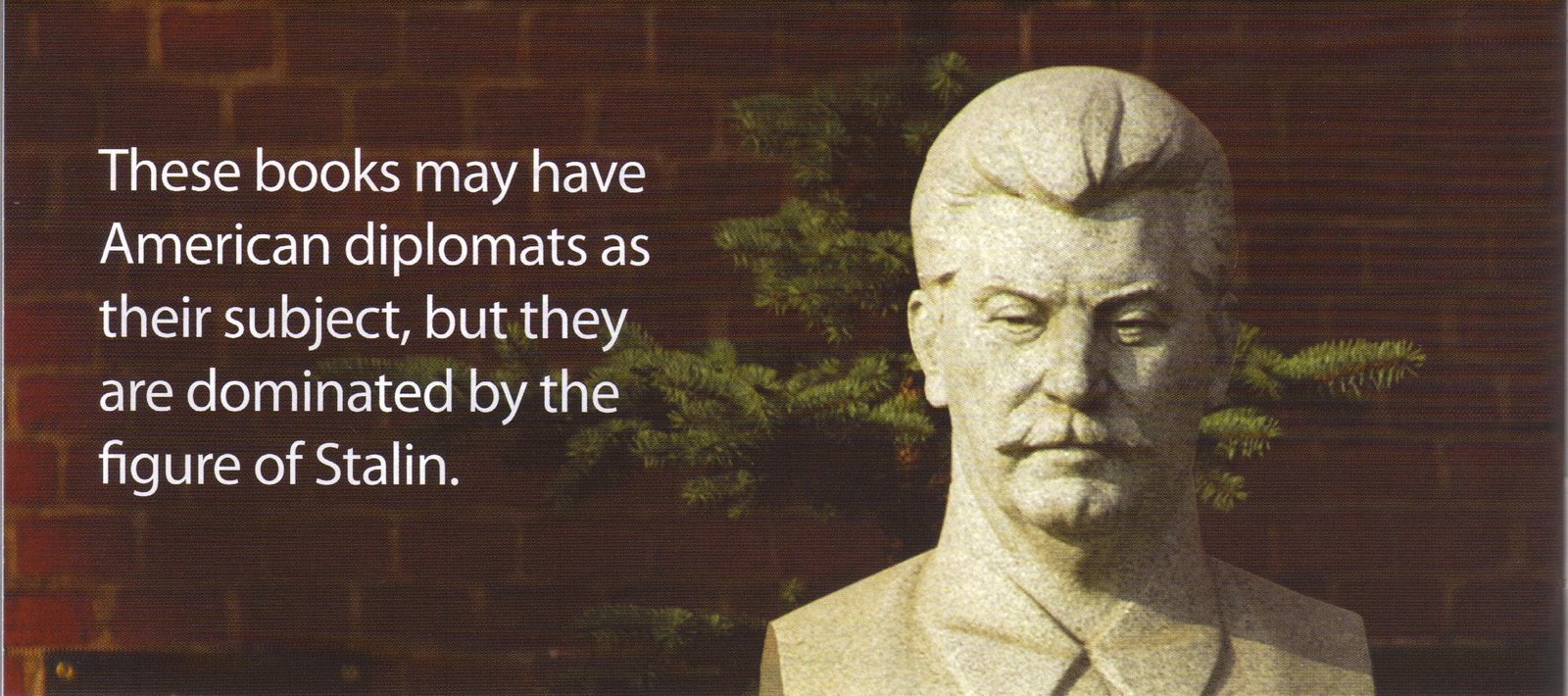
These books may have American diplomats as their subject, but they are dominated by the figure of Stalin.  Kennan and Acheson may have disagreed about the relationship between Stalinism and ideological communism, but whatever they were fighting, they were united against it.

Ilf and Petrov's excellent adventure

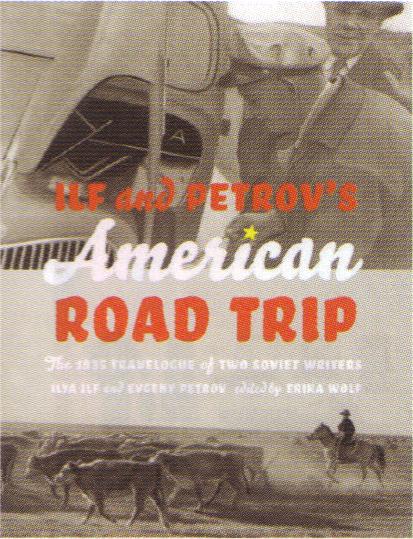
Ilf and Petrov's American Road Trip
by Ilya Ilf and Evgeny Petrov
(Cabinet, 2007, 156 pages)

In 1931, some 10,000 American tourists travelled to the Soviet Union in order to see what the great Soviet Experiment could offer their depression ravaged country.

But the tourist traffic heading the other direction was much lighter.  Ilf and Petrov's American Road Trip is the travelogue of two Soviet satirists, Ilya Ilf and Evgeny Petrov, as they crossed the United States, scribbling reports for Pravda readers back home.  Like the American fellow-travellers who were merrily shuttled from Potemkin village to Potemkin village, the report of their journey reveals more about their home country and culture than the country they ostensibly went to investigate.

The resulting photoessay, which was originally published in the Russian magazine Ogonek, (roughly equivalent to Life) reproduced the snapshots taken by Ilya Ilf on their journey with their satirical impressions of their trip.  American Road Trip is a delightfully naive interpretation of American society in the depression era.

In this book edited by Erika Wolf, a historian of Soviet art, Ilf's photographs are affectionately reproduced for die first time in an English language publication.

Ilf's photographs are more happy-snaps than Ansell Adams.  Many photos appear to have been taken by sucking the camera out of the windows of their car.  The book is full of slightly askew pictures of things the two Russians found interesting, or at least notable -- some "handsome and unusually elaborate species of cactus, the childhood home of Mark Twain, an advertisement for whiskey that incorporated a statue of a horse, and a sign that notified visitors they were entering the little town of Moscow, Ohio.

There are some photographs of more political importance.  A swaying sign in the street with the lettering "REVOLUTION IS A FORM OF GOVERNMENT ABROAD" is, to Ilf and Petrov, bourgeois intimidation of the working class.  (As Erika Wolf notes, the joke was on the Russians -- the sign was instead an advertisement for a popular humour anthology illustrated by Dr Seuss.  Ilf and Petrov were the foremost satirists of the Soviet Union, but they were unable to recognise the work of their American colleagues.)

For the most part, Ilf's camera is non-political.  Indeed, American Road Trip generally avoids direct political criticism.  Ilf and Petrov are obviously fond of the country they are studying.  They are fascinated by the advertising they see plastered across their trip, and direct much of their satirical energy towards Coca-Cola and cigarette advertising:

The fiery writing burns all night long above America and all day long the garish billboards hurt your eyes:  "The Best in the World!  Toasted Cigarettes!  They Bring You Success!  The Best in the Solar System!"

When we read how foreign the most basic and innocuous advertising seems to the two Russians -- they are surprised that that towns advertise themselves on billboards beside the highway -- we don't gain a better picture of the United States in the 1930s, but of die Soviet Union.

They are highly sympathetic to the Native Americans living on reservations, predictably seeing them as remnants of a social structure in opposition to the dynamic capitalism of the east and west coasts.  (Although as Erika Wolf notes, Ilf and Petrov are once again tricked, as a Native American who pretends to be unaware of civilisation was actually a famous photographer and clown dancer on tour.)  Similarly, a trip through North Carolina confirms their Soviet views about American race relations -- deep in the Jim Crow era, it is fair to say they had a point.

What does surprise the modern reader is the unfocused rage they direct towards American filmmaking.  "We watched at least a hundred picture shows and were simply depressed by the amount of vulgarity, stupidity and lies".  Certainly, it would be hard to defend the vast piles of films which were produced to fulfil contractual obligations in the studio system during Hollywood's Golden Age, but cheaply written and produced movies are hardly a unique feature of American cinema.  The cookie-cutter productions of Soviet cinema during the ideologically rigid Stalin era are, on average, of a far lower quality than comparable American films, and have certainly held up worse over time.  Ilf and Petrov may have been outraged more by the ideological content of Hollywood films than their quality.

American Road Trip is certainly at the margins of Soviet culture in the 1930s, but it is more than a historical curiosity.  Satire was a major part of Russian culture before and after the October Revolution.  The lives of Ilya Ilf and Evgeny Petrov illustrate how mixed the bureaucratic approach to political satire could be.  Their 1928 novel The Twelve Chairs flirts with political criticism, but they remained in favour -- other well-known satirists, such as those in OBERIU literary collective, were killed in Stalin's purges for sedition.

Ilf and Petrov do little more than reflect dominant Soviet thinking about their ideological opponent, but they are never heavy handed or propagandistic.  American Road Trip purports to be a study of the United States, but instead fascinatingly reveals the strength of Soviet ideology and the Russian mindset.

Intolerance as ideology

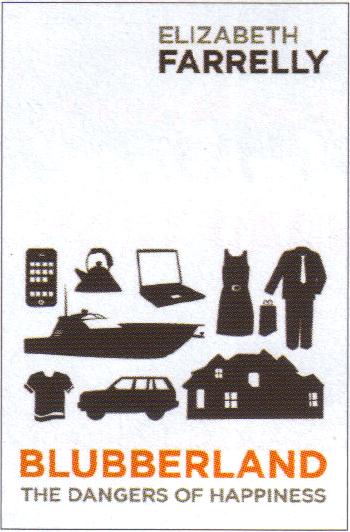
Blubberland: The Dangers of Happiness
by Elizabeth Farrelly
(UNSW Press, 2007, 224 pages)

Perhaps surprisingly for somebody who is nominally on the "progressive" side of politics, Elizabeth Farrelly is no fan of post-modernism, or even modernism.  She doesn't even like the nanny state.

For instance, in Blubberland:  The Dangers of Happiness, Farrelly laments literatures move from being "the Victorian era's primary moral carrier to being, in the subsequent century, mere entertainment" and also the fact dial the search for beauty is not only unfashionable in art, but considered positively banal.  She argues that, while it originally set out to find real beauty, abstract art achieved the exact opposite.  Indeed, it became "so remote and inaccessible that most people saw nothing in it at all".

Post-modernism is also held responsible for the lack of respect for professionals such as doctors and architects and Farrelly believes that as consumers we are getting worse outcomes as a result.  While many community groups opposing property developments demand more community consultation, as an architect, Farrelly believes that "public participation is as likely to mitigate against good architecture and beautiful cities as against ugly or bad ones".  She argues, correctly, that "legislation, especially planning legislation, must be as impersonal as the weather".

This book does not have a clear thesis, rather being a litany of complaints against consumerism and ugliness in contemporary Australia.

But on aspects of certain issues, such as the environment and feminism, she can make acute observations.  Farrelly points out that residents of New York are living much greener lives than "hippies ... living in mud brick".  She also attacks Victim mentality, nanny statism and the liability crisis diat kills street theatre and removes play equipment from public parks' and ridicules one school's ban on kicking balls in the school yard.

However, the thought-provoking parts are heavily outweighed by this book's manifest flaws.  It lacks a logical structure and the author is too inclined to use every quote and example she has ever stumbled across.  To use one double-page spread as an illustration, the reader is taken from classical Greece, via the views of an eighteenth century commentator, through six modernist painters, to Ivan Illich, to Paul Keating, to a debate between varying views of architecture, to Lucien Freud, via passing references to Kate Moss, Jerry Hall, Princess Diana and Richard Alston.  The net effect makes the book read like the end of a long, well-lubricated lunch -- after most of the participants have evacuated to anodier table.

In the extensive list of quotes are several from The Spectator, including the likes of Paul Johnson, Petronella Wyatt and Mark Steyn.  In die case of Steyn, Farrelly is either ignorant or mischievous when she interprets his comments on French friends refusing to visit the US because Americans are too fat as an attack on Americans.  One does not need to have read much Steyn to know that it is, in fact, an attack on die French.

More fundamentally, the book suffers from an atrocious beginning and end.  Farrelly begins by arguing that having lots of stuff is not only not making us happy, it is making us unhappy.  I just do not buy it.  The people I see around, especially the younger people, appear far happier than my angst-ridden teenage friends did back in 1978.

Her claims about our alleged lack of happiness are not the only examples of creating facts to fit her argument.  She twice claims that food allergies are the result of actions which "over-sanitise childhood" when die experts, in fact, are still trying to discover what has caused the allergy explosion in the past three decades.  Hers' is a plausible theory, but unfortunately once Farrelly gets onto anything relating to food, houses or the size of cars, she quickly becomes a zealot.

One source of our alleged problems is apparently having too much choice -- "360 types of shampoo in one store".  It is funny how people who complain about capitalism delivering too much choice never advocate reduction of choice in the arts.  There are already far more books published and pictures painted that anyone can absorb in a lifetime -- why do we need any more?

Any semblance of diis being a serious book disappears in the final chapter.  Entitled "I have a dream ..." it tries to draw a post-catastrophic climate change scenario where "rain hasn't fallen in the eastern half of the country for a decade" and most of us have upped sticks and moved to nirvana land in the Kimberley.  This "paradise" in her words "hums with energy", but as you read on it sounds a most unpleasant place to live.

The ultimate problem Farrelly has is a lack of tolerance.  One might very well share her distaste for McMansions, four-wheel drives, post-modern literature and abstract art, but hey, if other people think any or all of those is the way to happiness, let them give it a go.

And, if under her climate change scenarios petrol does reach twenty dollars per litre, people will choose to change their behaviour, just as now they somehow manage to choose a brand of shampoo out of the three hundred and sixty options.

The world is getting better

The Improving State of the World:  Why We're Living Longer, Healthier, More Comfortable Lives on a Cleaner Planet
by Indur Goklany
(Cato Institute, 2007, 450 pages)

The Escape from Hunger and Premature Death, 1700-2100:  Europe, America, and the Third World
by Robert William Fogel
(Cambridge, 2004, 216 pages)

Contours of the World Economy 1-2030 AD:  Essays in Macro-Economic History
by Angus Maddison
(Oxford, 2007, 448 pages)

In 1850, London was a miserable place.  A baby boy born in that year and at that location could only expect to live to 40.

The world that baby was born into had raw sewage running in the streets, heavy fogs of air pollution and such putrid drinking water most people drank beer.  A mere one hundred years later -- within the lifetime of that baby's grandchildren -- a child born in England could expect to live to 73.

The story of what happened to make this possible demonstrates the capacity of societies to adapt in positive ways to change and provides evidence to argue the future will be much brighter than the past.

The casual consumer of current affairs could be forgiven for concluding we are all going to hell in a handbasket -- the never-ending procession of depressing stories report that there is a rainforest disappearing here or a famine there, the monotony only broken up with truly horrific disasters like the 2006 Boxing Day tsunami.  And the solutions to future catastrophes proposed are even gloomier -- Jared Diamond would like to force population control on the developing world, and rich countries seem intent on imposing a myriad of micro controls on consumer behaviour.  But what all of these proposals share is a profound pessimism -- at worst the world's population has to reduce consumption (that is, wealth) substantially, and at best it just needs to share around the current amount.  With all this gloom it is a rare person who thinks that, by and large, the massive gains in health and wealth over the past century will be repeated in this one.

But this pessimism doesn't match the empirical evidence.  Two recent books, Robert Fogel's The Escape from Hunger and Premature Death, 1700-2100:  Europe, America, and the Third World and Indr Goklany's The Improving State of the World:  Why We're Living Longer, Healthier, More Comfortable Lives on a Cleaner Planet reveal that these perceptions do not match the reality.  Contrary to the depressing prognostications of Ian Lowe, Al Gore, James Lovelock and Jared Diamond, the world is, indeed, getting better.
But just how these improving conditions reveal themselves is instructive.  In the nineteenth century Dutch men were on average 164cm (5' 4") tall.  Today the average Dutch man is 181cm (6').  All other rich nations show similar, if slightly less pronounced, increases in height.  As Nobel Prize winning economist Robert Fogel shows in The Escape from Hunger and Premature Death, the reason for this dramatic height increase was the eradication of the persistent and prevalent malnutrition that existed prior to the industrial revolution.  Fogel's demonstrates clearly the link between economic development and nutrition.  Until the 1880's, most people just didn't get enough food to do a full day's work and as a result they were not productive as required to earn what they needed to buy enough to eat.  This vicious circle existed until the massive leaps in productivity from the industrial revolution were coupled with the equally important transformations in public health and sanitation.  Together, these factors meant that all people, most especially the poorest, had the energy to be productive members of society to the benefit of all.


HOW DEVELOPING NATIONS COULD GO FROM WOOD-FIRED
STOVES TO PINK REFRIGERATORS IN JUST 22 YEARS

One of the outcomes of Fogel's work is an understanding of the symbiosis between nutrition, sanitation and technological progress.  Instead of technological improvements merely facilitating physiological improvements, for example when the invention of a vaccine eliminates a lethal disease, it now appears that improvements in nutrition and physiology contribute significantly to the process of economic growth and technological progress.  By feeding the world properly the current enormous drain on the world's resources through subsistence is eliminated enabling humanity to develop the technologies necessary to drive further advances in the future.
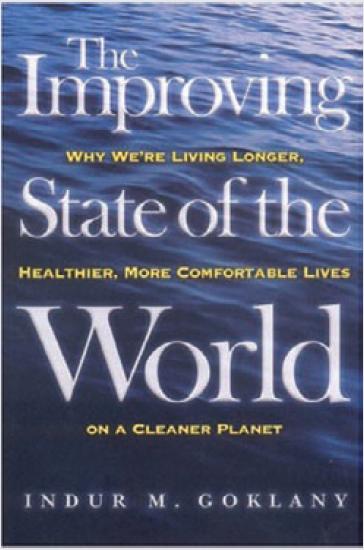
In his The Improving State of the World, Indur Goklany reveals that as societies get richer their impact on the environment at first goes up before declining significantly and then levelling out.  At first, people place the highest priority on economic development -- alleviating the cold is more important than avoiding bad air pollution from burning wood and coal inside the home -- and due to lack of education or knowledge people may in fact be unaware of environmental problems.  But as a society becomes wealthier and gains more knowledge, reducing environmental impacts rises on its priority list.  Certainly, working out how to do so can be a slow process.  As a consequence, those societies developing first take longer than those who can simply copy what worked -- Japan's rapid industrialisation after the Second World War benefited enormously from the experience of western industrialisation.  What this means is that there is no logical reason to assume that today's developing nations will need to wreak the environmental havoc seen when Europe and Northern America industrialised.  Nor is there any necessity to attempt to limit China and India's quest for developed world living standards.  Indeed, the evidence from Fogel and Goklany suggests that the planet is best served by pursuing global growth towards new technological frontiers.

If developing countries are allowed to pursue growth without being limited, then they will have a greater chance of lifting out of mass poverty to the point where they voluntarily seek improved environmental outcomes.  A corollary of this is that the rules which the developed world attempts to impose upon developing nations will, in the long run, harm, rather than help the environment.  For example, European import laws that force Chinese factories to match Europe's air pollution standards reduce China's growth and therefore reduce China's capacity to lift very poor people out of poverty -- rather than allowing China to decide when improving air pollution is a priority.

The advocates of imposing developed world environmental rules on the developing world assume that the only way to achieve improved environmental outcomes is to legislate.  Yet this has not been the experience of the developed nations.  Clean air and water laws were enacted in the United States inearly 1970's, but the major improvements in cleaning up air and water-borne pollutants occurred much earlier.  Indeed, most pollutants peaked in the 1950s and 1960s and declined thereafter -- well before environmental legislation, as individuals and firms gave themselves the benefit of breathable air and safe drinking water.  The force of law is useful in forcing laggards to catch up with society's evolving standards but its main value comes after the society has voluntarily adopted those standards.

The group of activists who see the world as a glass half-empty have a patron saint in Thomas Malthus, the eighteenth century English economist most famous for predicting population growth will always outstrip food production leading to "gigantic inevitable famine". Today's neo-Malthusians blame environmental problems as a product of population, affluence and technological progress, and believe that technology is unable to keep-up with the destruction on the environment.  They disregard the evidence that shows how rising affluence has been correlated with a cleaner environment in every society, and contend that humanity is now at a tipping point;  unable to develop the needed new technologies to avert the apocalypse.  And all this gloom is before any discussion of global warming evaporates what little joy remains for these doomsayers.

Goklany collects an impressive amount of evidence to refill the half-empty glasses of the pessimists.  On every measure -- life expectancy, healthiness, access to clean water, infant mortality, child labour or literacy rates -- global measures of the human condition show an improvement, not backsliding.  Most people alive today are poor, but they are less poor than they were and, with the sorry exception of sub-Saharan Africa, are continuing to both grow richer and dramatically improve the quality and length of their lives.
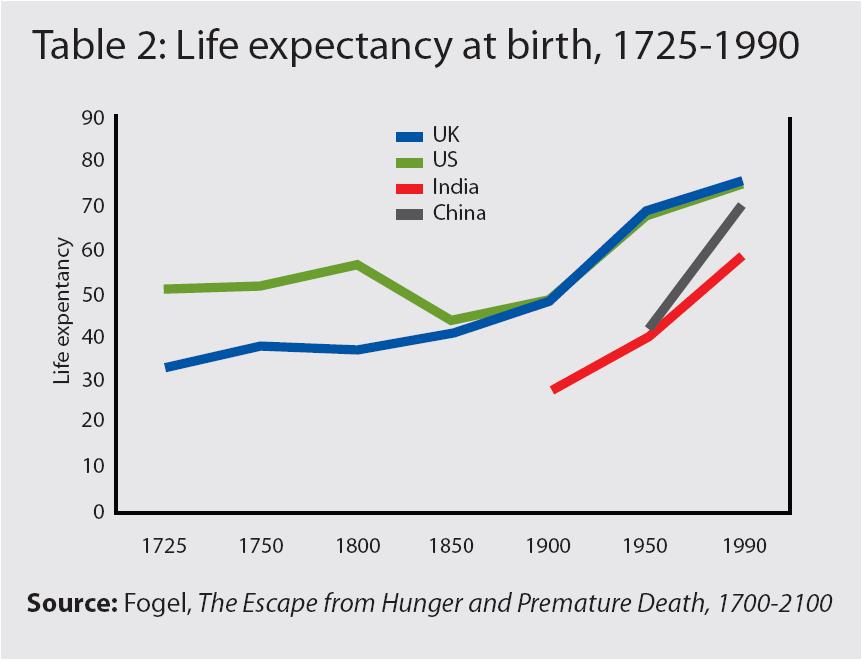
The pattern of improvement over even just the past fifty years is evident in many other key indicators of wellbeing -- global infant mortality has fallen from 157 deaths per 1,000 live births to 57 today, about where the developed world was in 1955.  Malnutrition has declined dramatically, particularly for the forty per cent of the planet's population living in China and India where food supplies have increased 80 per cent and 50 per cent respectively.  Education is an important precondition for improvements in a range of life giving behaviours such as sanitation, nutrition and hygiene, as well as the key driver of technology adoption that leads to greater development.  Between 1970 and 2000 global illiteracy rates dropped from 46 per cent to 18 per cent.  Instead of almost half the world's population being unable to read, that figure is now fewer than one in five.

For the first time in history less than fifty per cent of the world's population are absolutely poor but even more revealingly, the absolute numbers of the poorest have stabilised since 1950 despite a doubling of the total human population in that time.

While income is not a perfect indicator of wellbeing, the biggest issue confronting the world's leaders today must still be poverty reduction.  Despite impressive advances over the past 50 years, 2.7 billion people lived on less than US$2 a day in 2001 while the comparable measure for the average person in a developed country is US$100 a day, fifty times that of the poorest.  In a compelling rebuttal to the popular view that globalisation is driving inequality, average global income inequality has decreased over the past fifty years although remains at unacceptable levels.
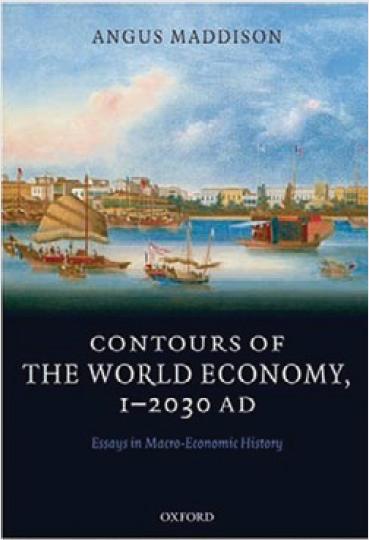
There are persuasive reasons to believe that the eradication of utter poverty can be achieved over the next century.  Doing so remains the single most humanitarian act possible.  And it does not take heroic growth assumptions to envisage it.  In his sweeping 2008 survey of global economic history, Contours of the World Economy, 1-2030 AD, Angus Maddison coalesces the current state of thought on long-run economic growth to venture into predicting the next thirty years.  The world economy grew by 3.9 per cent annually from 1950 to 2003.  The per capita GDP of poor countries more than trebled from US$1,094 to US$3,816 over that period despite a doubling of population.  Over that period the average annual rate of GDP growth for poor countries was 4.3 per cent with China delivering an astounding 8.6 per cent annual growth since 1990.  If we look forward to 2030 -- even if the annual growth rate for developing countries fell back to a much more conservative 3.5 per cent -- 22 years from now the average GDP per capita in poor countries in 2030 would be US$6,090, well above the average per capita value of the rich countries in 1950.  In one generation, using growth assumptions well below what the countries are actually achieving today, all bar sub-Saharan Africa will be richer than Australia was in 1950.

Forecasting is an inexact science and averages can obscure wide variations within countries.  However, without any doubt by 2030, on existing patterns, the number of people living in abject poverty will be less than a quarter of today's number even despite continuing population growth in poor parts of the world.  In 2030 there will still be 600 million very poor people, overwhelmingly in sub-Saharan Africa.  But for almost everybody else life will be longer, healthier and easier.  Women especially will face a brighter future with increased literacy rates and additional opportunities.

Importantly these predictions hold true irrespective of uncertainties over climate change -- in fact, the greatest mitigation of the effects of climate change will come from economic growth providing currently extremely poor people with choices about where they live and how they earn a living.


BUT THERE ARE STILL BARRIERS TO POVERTY ERADICATION
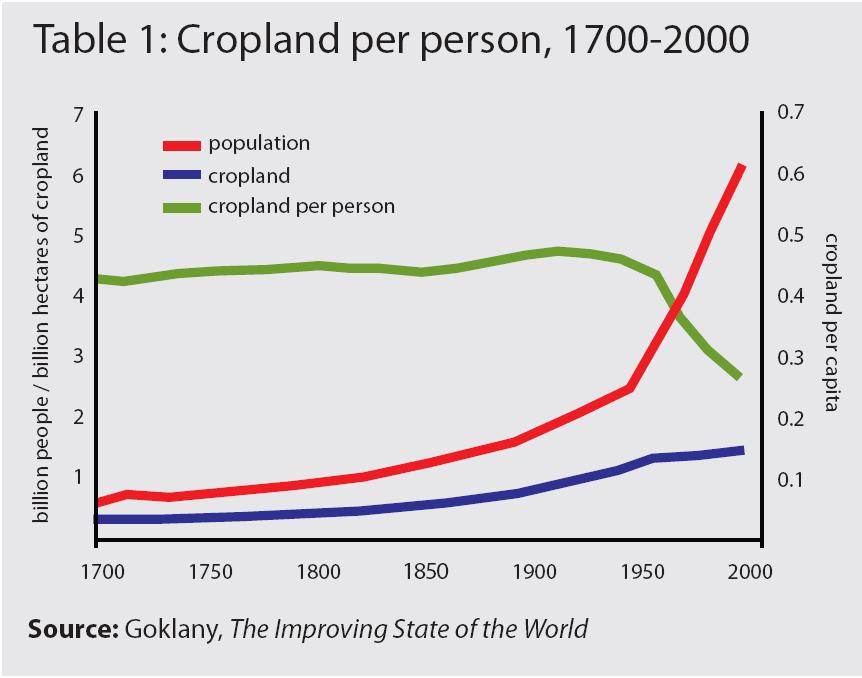
Despite the predictions of Malthus being utterly wrong for 200 years, his doom-saying descendants argue that his predictions will be nevertheless proved correct in the next fifty years -- as population at last out runs food production.  A key reason the world is apparently going to run out of food and become an environmental wasteland is attributed to the nouveau riche Indians and especially Chinese scoffing far more meat than in the past.  In addition to the deep racism that consigns the currently poor to being ever poor in the name of environmental salvation, the facts do not meet the pessimists' claims.  Food remains cheaper than in 1960 when it was in turn cheaper than 1820.  Indian agriculture was transformed by the green revolution from mass starvation in the mid 1960s when the US made vast emergency shipments to wade off widespread famine to be self-sufficient in grain by 1974.  Chinese agriculture continues to make enormous advances in productivity as a range of modern agricultural practices are adopted.  Developing world agricultural productivity still lags that of the developed world by a large factor strongly suggesting further possible yield growth from existing farmland.

Certainly, grain and oilseed prices have doubled in two years -- evidence, say the sceptics, that we are eating more than is sustainable and there is little room for additional consumption.  But most of the increase in the cost of grain and oilseed is not pressures of population but from policy decisions.  Rich countries are taking massive tracts of prime farmland out of food production.  Increasing amounts of oilseeds are grown not for food, but to support a misplaced policy of so-called energy security for the US and a warm feeling of environmental goodness for the Europeans.  In a series of deeply inequitable and misguided policies, US and European governments have mandated the use of biofuel despite it adding as much to global warming as fossil fuels once all the inputs of growing it are included.  The impact of these policies has been to dramatically raise grain prices -- the key food for most of the world's poor -- by subsidizing some of the richest farmers on the planet.

The causes of today's poverty are well known:  corrupt officials stealing resources, trade barriers stopping exports, poorly developed property rights and appalling infrastructure coupled with chronic malnutrition and disease, lack of sanitation and drinking water and significant illiteracy.  All of these obstacles inhibit the right of poor subsistence farmers, the world's poorest people, from escaping utter depredation.

The governments of the poorest nations -- which by no coincidence are usually deeply corrupt dictatorships -- are the root cause of poverty in the developing world.  Nevertheless, increasingly the actions of rich outsiders, both nations and NGOs, must be blamed for exacerbating misery.  Some non-government opponents of science have been remarkably successful at stopping beneficial developed world technology being used in the developing world.  Two striking examples illustrate the rank hypocrisy of those who say they want to help the poor but act to harm them.

First is the successful banning of the pesticide DDT for malaria control by many developing countries' governments.  This action was urged particularly by Scandinavian environmentalists.  Today, malaria kills approximately 1.3 million people a year (by comparison there are an estimated 172,000 deaths from war annually).  Yet malaria was eliminated from many countries by the use of DDT and no other method has been found to be as effective.  Data from KwaZulu-Natal in South Africa showed around 600 cases in 1992.  With DDT banned in 1996 the number of cases rose to 40,000 in 2000 when it was, thankfully, reintroduced.  By 2002 the number of cases was 3,500.

Second are the actions by Greenpeace and Actionaid in 2002 to convince the increasingly dictatorial Zambian President to reject food aid for his starving people because it may have contained genetically modified (GM) maize.  At the time some GM food had begun to be distributed and its withdrawal caused rioting.  Zambia continues to suffer from mass starvation and its government continues to prefer the accolades of Greenpeace to feeding its people.

To meet the challenges of an increasingly richer population that will consume far greater quantities of food than is currently the case existing farmland will need to become more productive.  As discussed above there is significant scope for developing countries to achieve the sorts of yields seen in developed countries and through technology diffusion to climb the productivity ladder much faster than the current leaders.  Already China is the third biggest producer of GM crops in the world (after the US and Canada) and is aggressively buying premium genetics in dairy and beef cattle to improve its herds.

Feeding everyone adequately must be the key to creating the conditions whereby the entire planet is not dragged down by the environmental catastrophe caused by abject poverty.  A bit of development can be an ugly thing for the environment as trees are cut down for firewood and to clear the land, fisheries are depleted, air pollution soars and waterways are fouled.  The key to minimising those effects is to lift people out of poverty as rapidly as possible as they themselves will demand clean air and clean water as soon as they have the energy to do more than scratch out a bare living.
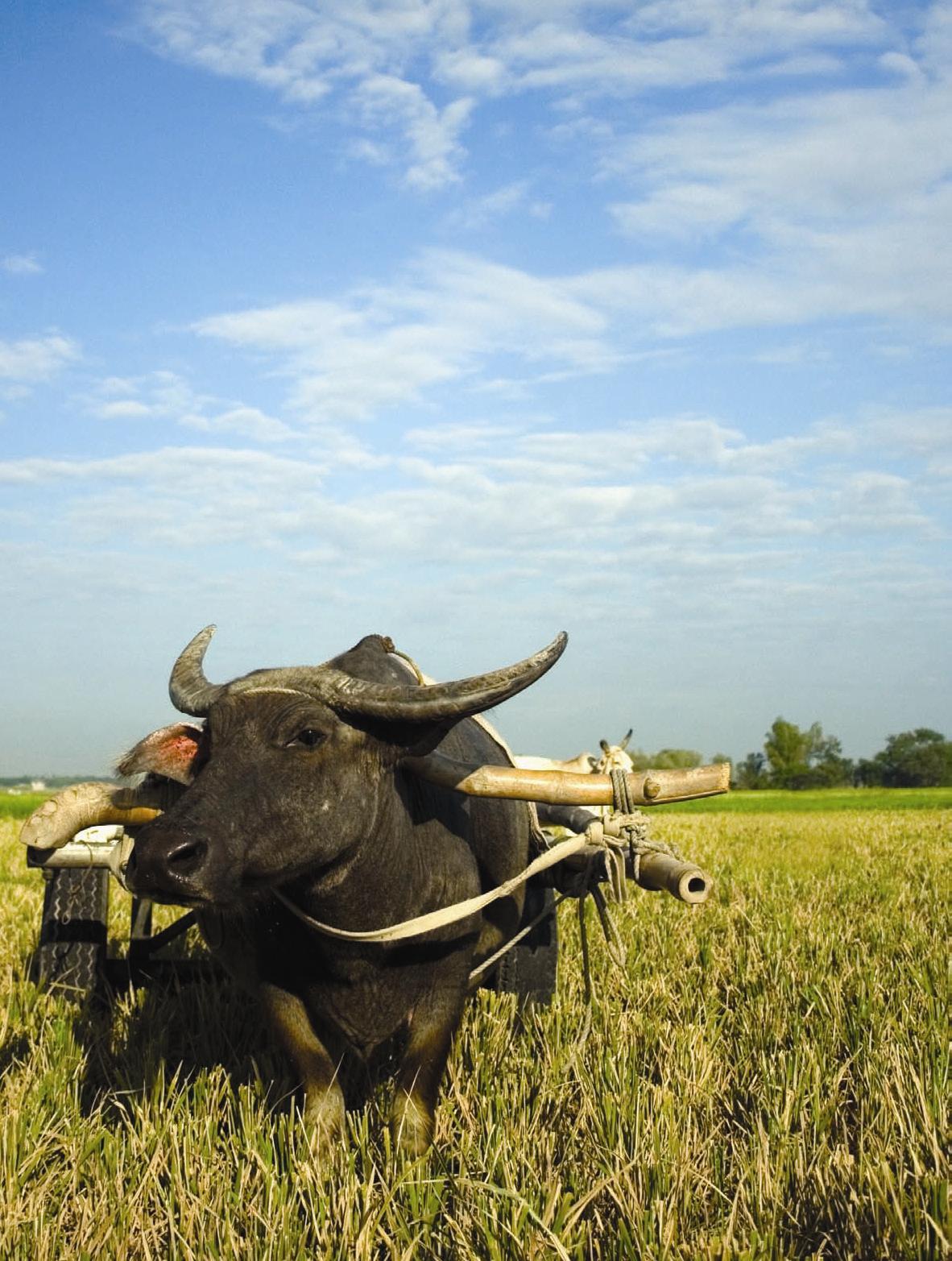
This might be wrong way to get petrol prices right

Immediately before the last election, Chris Bowen, now Minister for Competition Policy and Consumer Affairs and Assistant Treasurer, criticised the Howard government over high petrol prices.  Families apparently were under pressure because petrol was ''getting out of hand''.

Labor's solution was to appoint a national petrol commissioner who would monitor and investigate petrol gouging and collusion.  Never mind that no evidence of gouging or collusion has ever stood up in court, despite years of harassment by the Australian Competition and Consumer Commission of the oil industry.

In the past week the Rudd government made good on its promise, and not too soon.  Between November and January, average petrol prices in Australian capital cities rose by 7.8 cents.

The commissioner, Patrick Walker, is highly experienced in the area, having been commissioner for consumer protection and prices commissioner in Western Australia for nearly 10 years.  He was the architect of Western Australia's Fuelwatch service.  No doubt it is this experience that led him to play down expectations of petrol price relief or savings by saying decreases of between 15 cents and 20 cents a litre were unrealistic.

The WA government set up Fuelwatch, which has monitored fuel prices since January 2001.  At its website, Fuelwatch describes itself as being ''single-minded'', having been responsible for a rule whereby petrol prices cannot change in a 24-hour period, and also as having ''empowered motorists to save money''.

Walker claims Fuelwatch reduced unleaded petrol prices in Perth from one of the dearest across capital cities ''to the cheapest''.  Unfortunately for Walker, and Fuelwatch, the facts do not support these statements.  Data collected by the Australian Automobile Association shows Fuelwatch failed to have any significant effect on unleaded petrol prices, relative to price movements in other capital cities.

A plot of average monthly WA unleaded petrol prices from January 1999 to January 2008 shows very little difference in the average monthly price for all capitals.  The correlation between the two price series is more than 99 per cent.  There is also no marked difference before and after January 2001, when Fuelwatch began operations.  Also, the average unleaded WA petrol price was lower than the average for all capitals in only 42 of 85 months -- 49.4 per cent of the time.

Averages can hide all sorts of variation.  But the picture doesn't get any better if we consider the total price rise since Fuelwatch began its work.  Since January 2001, the average unleaded petrol price in Perth has risen from 84.9 cents a litre to 138.9 cents a litre, in total 54 cents a litre.  That is the second highest price rise across all capitals (Brisbane being the highest at 55.4 cents).  But Brisbane still has cheaper average unleaded petrol prices than does WA, so it is not clear whether Fuelwatch has delivered cheaper fuel relative to the other states and territories.

If the Rudd government is serious about this appointment and wishes to be accountable for its election promises, it needs to set benchmarks and targets for petrol price savings.  It seems the petrol commissioner is simply another symbolic gesture.


ADVERTISEMENT