Friday, May 02, 2008

Australian history's forgotten capitalists

Colonial Ambition:  Foundations of Australian Democracy
by Peter Cochrane
(Melbourne University Press, 2006, 600 pages)

Melbourne University's strategy for marketing Peter Cochrane's Colonial Ambition:  Foundations of Australian Democracy is almost as interesting as the book itself.  This is a book placed firmly in the centre of politics of Australian publishing, and, indeed, the "history wars".

The publicity blurb on the back cover of Colonial Ambition is revealing.  The book is described as being written with "great brio and verve" and moving like a "fast-paced novel".  (For those who don't know, "brio" according to the Shorter Oxford Dictionary means "liveliness").  Maybe "brio and verve" is what the marketing department of Melbourne University Press believes is these days required to sell books about Australian political history.

MUP must have also assumed that potential buyers of a book about the historical development of concepts such as representative government and parliamentary democracy are also looking for a bit of fast-paced action.  Unfortunately, as good a work as Colonial Ambition is, and as important as it is, not much "brio and verve" is contained within its pages.  Anyone thinking they're buying a John Grisham thriller will be sadly disappointed.  The full extent of what excitement there is in Colonial Ambition are the images of drunken Sydney mobs assembled at the Rocks, and the description of the death of Lady Mary Fitzroy, the wife of Governor Charles Fitzroy, killed in 1847 when the carriage she was riding in with her husband turned over on the road from Parramatta to Sydney.

MUP has taken out an insurance policy just in case promises of "brio and verve" don't work.  On the front cover is an endorsement by none other than Graham Freudenberg, Gough Whitlam's speechwriter.  According to Freudenberg "Peter Cochrane has written the definitive account of Australia's most difficult and enduring political achievement".  This might be true, but why we need to be told this by Freudenberg is a mystery.  No doubt the publisher calculated that more people would be attracted than scared off by his recommendation.

It seems that so far the efforts of the bright young things in the marketing department at MUP have been to no avail.  According to newspaper reports up until the end of last year Colonial Ambition had sold 4,000 copies.  Not a bad result but it pales in comparison to sales of 100,000 for Les Carlyon's The Great War (reviewed in December 2006).

In 2007 the two books shared the inaugural Prime Minister's prize for history.  The outcome was not uncontroversial for it has been reported that a majority of the judging panel believed that Colonial Ambition should have been the sole recipient.  However, the award was structured in such a way that the panel provided a shortlist to the Prime Minister who then personally decided upon the winner.  Following this result, it was claimed by the then Prime Minister's critics that the shared award given to The Great War "smacked of a PM over-eager to distribute the spoils of victory in the culture wars".

If Colonial Ambition had been the sole winner there's every chance those critics would have claimed exactly the same thing.  If anything, Colonial Ambition more closely fulfils John Howard's alleged cultural and historical agenda than does The Great War.  Carlyon writes about the experience of Australian soldiers on the western front during the First World War.  In as much as there are political overtones to the book they run counter to those which it is assumed John Howard would favour.  Carlyon emphasises the separateness of the Australians from their British commanders, and he compares the resourcefulness of the colonials to the bureaucratic, hide-bound ways of the British.  Anyone who took their political cues from The Great War would be more likely to emerge a republican than a monarchist, but the politics of Carlyon are subtle.

By contrast, in Colonial Ambition the politics is obvious and overt.  The story Peter Cochrane charts is the battle between two competing images of the economic and social destiny of Australia.  And the small-time capitalists win.  Cochrane is accurate when he calls it a victory for a "middle class vision".  The furious reaction of the burghers of Sydney to the attempted resumption of convict transportation in the 1850s was not only a product of the humanitarianism.  They were reacting against the great landowners and squatters who wanted cheap convict labour to maintain their holdings, and they were reacting against the sort of economic development that the squatters demanded.  As Cochrane writes, those who attended the anti-transportation meetings

embraced a vision of a new kind of economy -- based not on one product [the wool of the squatters] but on many, not just on landed wealth but on a dynamic capitalism in the urban sector.  They put the case for a free working class recognising the necessity of mass consumer demand as opposed to the narrow "contractor's economy" of a penal society.  They wanted a diversified productive sector sustained by local demand, rather than a plantation-type society dependent on the British call for wool.

Cochrane succeeds in placing the debate about the franchise within the broader context of the different conceptions of how New South Wales should develop.  Too often in Australian history the arguments from the 1840s and 1850s over the franchise have been presented as merely a debate between stuck-in-the-mud conservatives and radical Chartists.  In reality there was much more at play.  Squatters defended their disproportionate voting influence because they believed they had to stand against urban mobs that were too easily swayed by appeals from demagogues, and they argued that rural interests, far removed from the temptations of city life were more pure and less corruptible.

To the magnates like William Wentworth and James Macarthur it was entirely reasonable that economic elites such as themselves guide the government of the colony -- after all, it was they who generated the colony's wealth.  According to Henry Dangar, a squatter with 300,000 acres of leaseholdings "a man would have to be maniac to argue that the thousands of idlers who inhabited the alleyways of Sydney were equal to the squatter.  The squatter could buy and sell Sydney twice over ... Sydney would be nothing without the woolgrowers of the interior.  The wool-growers were the blood and sinew of the colony, while Sydney and the townships were no more than dependencies".

The idea that nineteenth century Australian political history is the story of the bosses against the workers has a powerful hold on the popular imagination.  But this image -- if indeed there is any truth to it -- has its origins in the later part of the century:  in the industrial turmoil of the 1890s.  In the middle of the century the picture was more complicated.  It wasn't the workers that the conservatives feared -- it was the capitalists.  The squatters were no friend of the mercantile class.  Wentworth left no doubt as to what he thought of the "lords of the Exchange":

What interest does the population of Sydney represent?  True there are hosts of people in the city calling themselves merchants, and I admit these give employment to a large number of others of lower degree.  These merchants, however, are simply engaged in exchanging one commodity for another -- in sending the produce of the colony home and getting the goods of foreign countries instead.  But they as a class, with the exception of the ship owners, are productive of absolutely nothing to add to the wealth of the colony.  There is no urgent necessity for them -- the colony could do without them:  all that this class of people have done for me, for instance, I could have done for myself.

These words uttered by Wentworth in 1853 would not have been out of place from the mouth of the most ardent socialist (excepting perhaps the reference to the usefulness of ship owners -- for without ship owners Wentworth would not have been able to get his wool to England).  The only words missing from this tirade are bourgeosie and rentier.

Although Cochrane is not explicit about the parallels, there are similarities in the way the political debate was framed in the United States in the closing decades of the eighteenth century and what occurred in Australia fifty years later.  In America the dominant political arguments were between Alexander Hamilton's ideal of economic development based on advanced commerce and industry, and Thomas Jefferson's ideal of individual, self-reliant landowners providing the backbone of the nation's democracy.  Some have argued that this debate was not finally settled until the beginning of the twentieth century.  In Australia it was a debate started and ended within a twenty year period between the 1840s and 1860s.  Although the question of how land should be distributed would be an ongoing saga in New South Wales politics, the question of how the politics and the economy of the colony would develop was decided as soon as the squatters were prevented from gerrymandering the electoral system.

Political ideas are not taken seriously in this country because Australia's march towards liberal democracy is assumed to have been inevitable.  Those ideas that are taken seriously by historians and political scientists are usually just reheated mid-century progressivism.  Colonial Ambition demonstrates that politics in Australia started a long time before 1972.

Rewriting Murray History for a Fish

With the many problems besetting the Murray Darling Basin, the last thing a group of scientists was expecting to find was a new species of fish in the lower lakes.

Initially, the group from Adelaide University thought the small greenish perch was new to science, but on further examination realised it was the Yarra Pygmy Perch (Edelia obscura).

In fact, the species no longer occurs in the Yarra River in Victoria.  It was thought to be extinct there due to all the development associated with what is now the city of Melbourne.

The scientists who discovered the rare species in 2001 were quick to point out that the find had implications for the management of the Murray River.

The species prefers freshwater and the only way to ensure the lower lakes stays fresh is to keep the barrages in place on the Murray's mouth at Lake Alexandrina and Lake Albert below Wellington, South Australia.

The barrages were built 80 years ago to stop salt water from flowing in and freshwater from flowing out through the mouth of the river.

Because the barrages have changed the ecology of the region, I thought many of the Adelaide-based scientists would be pleased to see them go.  But local ecologists tell me they want the barrages to stay, including to protect the habitat of the Yarra Pygmy Perch.

European perceptions of the Murray River have changed with time.  Charles Sturt described the mouth of the Murray River as being at Wellington, upstream of the Lakes.  But try telling that to a South Australian now and they assume you are playing politics and trying to deprive the Lakes of a Murray water allocation.

Many South Australians also like to pretend that once the water from the Snowy Mountains flowed mostly to South Australia, but in reality before the dams and weirs, it would have gushed from the mountains and then spread across the central Murray Valley, regularly flooding what is now the rice growing region of Deniliquin.

I suspect the Yarra Pygmy Perch existed in Lake Alexandrina long before European settlement -- we just never noticed it.  Furthermore, I suspect that the removal of the barrages would not result in its extinction -- it might just be pushed further upstream back towards Victoria.


ADVERTISEMENT

News flash:  war exciting, federation dull

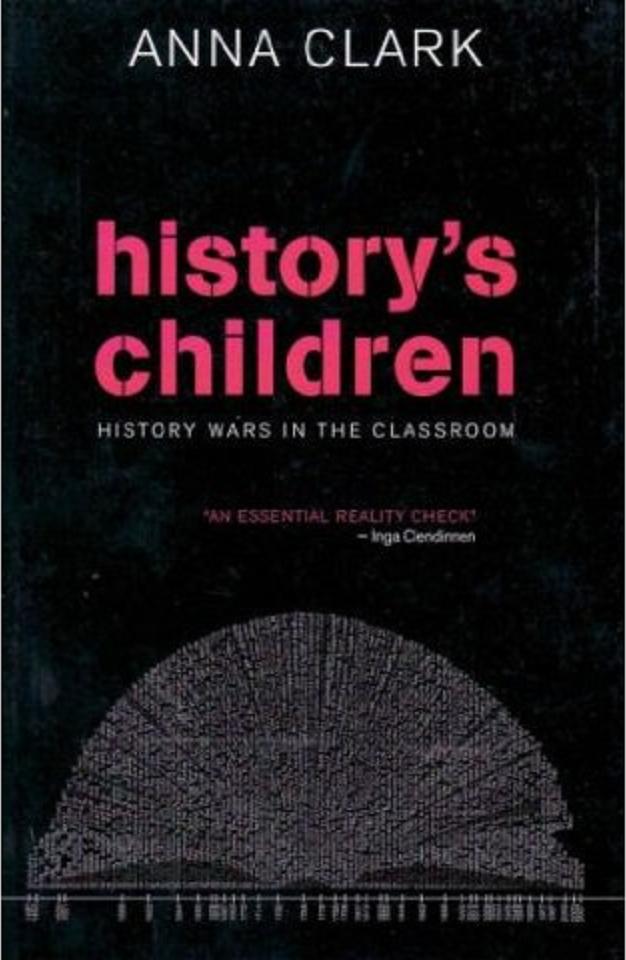
History's children:  History wars in the classroom
by Anna Clark
(University of New South Wales Press, 2008, 178 pages)

This would be an easy book to ridicule.  Manning Clark's grand-daughter leaves the politically correct university staff room and discovers that in real world school classrooms students love learning about war and hate learning indigenous history.

However, that would be churlish.  Anna Clark deserves credit for actually going out into the field and recording the views of students about the Australian history they have been taught, even when those views clearly disagree with her own preconceptions.  On the Anzacs she "wasn't expecting them to express such passion when talking about the topic" and when they explained their overwhelming boredom with indigenous history "to be honest, their views came as a bit of a surprise".

This is not Clark's first writing about how the history wars have impacted on Australian schools, having contributed a chapter on the topic to Stuart Macintyre's highly partisan 2003 book The History Wars.

For History's Children, Clark conducted focus groups with 182 students (in groups of five and six), from years nine to twelve, at 34 schools located in every state and territory;  with a reasonable mix of government and non-government, and metropolitan and rural.  She also interviewed teachers and bureaucrats.  While she attempted to talk to education ministers, oddly none were available for interview.

Along with indigenous history and war, the other Australian history topic to which Clark devotes a full chapter is federation;  which students find as dull as indigenous history and for similar reasons.  It keeps popping up at different year levels, has repetitive and vague content, and lacks the drama and international significance that makes war such an engaging topic for teenagers.

The overwhelming sentiment of the contemporary students is that Australian history is important, but dull.  In considering this finding, it would have been valuable if Clark had done some more questioning of students' attitudes to their experiences being taught the history of countries other than Australia.  It is a failing of many participants on both sides of the history wars, that there has been too great a focus on the ideological content of what is taught about Australia, rather than considering the even more fundamental question of what proportion of school history should actually be about Australia.

The other concern with Clark's work is her unshakable assumption that learning facts is inherently dull.  Interestingly, most of the anti-facts comments she reports from the classroom come from teachers, not students.  Teachers argue that it is hard to teach facts and dates "on a Friday afternoon in a class of noisy, tired teenagers", as if teaching a more nebulous curriculum would be easier.  Yet there is Tahlia, a student at a school in outer Melbourne, who would like to learn more about our Prime Ministers, a sentiment shared by Edie at a public school in central Australia.

Clark at least acknowledges the existence of such children, and cites the further example of Colin, a year twelve student in Perth, who said "I like textbooks because the information's there and you just learn it".  In a spirit of understanding Clark says "there's no doubt these students need to be catered for -- they feel much more comfortable with a concrete, content-oriented history lesson", but hastens to add "I want to emphasis (sic) that they were a very small minority of the students I spoke with".

Naturally, the education establishment share Clark's anti-facts bias.  NSW Board of Studies head and History Summit participant, Jenny Lawless, argues against "rote learning facts ... is a very lower order skill".  Instead, she wants students "to actually engage in history" as part of what Clark refers to as "historical literacy", something that "includes a rich taxomony of historical skills".

Nobody would argue that at university -- or even in years eleven and twelve -- those who have elected to do history should be able to do far more than rote learn facts.  However, in trying to develop these analytic schools in earlier years, there is a risk that students learn little actual history.  One of Britain's leading historians, David Strachey, has argued that far too much emphasis is placed on the process of discovery about historical events, rather than the events themselves.  He argues that the study of original documents and the search for evidence should not come until university level.  He asks "what's the point in having a teacher if not to teach students what the facts are?"

Obviously, the choice of which historical facts and dates to teach can be contentious, but at least armed with a few facts about the history of Australia and the world, students might feel they had gained something from their time in the history classroom.

Clark has performed a valuable service in showing what some of the problems with the current history curriculum and teaching methods are.  She may not have the answers as to how to improve the status quo, but that in no way invalidates her findings.

"God is love":  the politics of bills of rights

Bills of Rights and Decolonisation
by Charles O.H. Parkinson
(Oxford University Press, 2007, 299 pages)

In 1988, Sir Anthony Mason stood before the Bicentennial Conference of the Australian Bar Association and announced his tentative support for a national bill of rights.  It was a watershed moment.  No other Australian Chief Justice had before him dared utter such views.

Sir Anthony claimed that human rights had become a "rallying cry across the world", that there had been "widespread entrenchment of fundamental rights in constitutions throughout the world", and that Australia's failure to follow suit would "emphasise our legal isolation".  It was a line of reasoning that would occasion constant repetition in the years to come by fellow advocates.

But those who follow Sir Anthony in demanding some form of constitutional comity amongst nations often pitch their argument at a level too superficial to warrant serious consideration.  They fail to acknowledge the basic proposition that the constitutional arrangements of each nation must respond to matters of history and experience unique to that country alone.  The existence of a bill of rights in one country does not provide an inherent mandate for the adoption of a similar instrument in another.  Often, all such an instrument will do is stand as a testament to the intricate, and at times rather unflattering, political exigencies that existed at the time of enactment.

Bills of Rights and Decolonisation provides a clear demonstration of this point.  Charles O.H. Parkinson has entered the vast ignorance currently masquerading as bill of rights discourse and provided a masterful study of the constitutional politicking that surrounded the enactment of bills of rights in Britain's non-Dominion African, Asian and West Indian territories.  Set during the end of Empire, Parkinson gives the reader a guided empirical tour, often with the aid of private diary entries and hitherto unseen correspondence and archival material, of the complete reversal of official Colonial Office policy into one that ultimately mandated the insertion of bills of rights in all overseas territories.

To read the details of this metamorphosis is as rewarding as it is startling, with numerous treasures of information scattered along the way.  There is the explanation for the absence of a constitutionally protected right to vote in the Sudan (namely the necessity of assuaging traditional Islamic resistance to universal suffrage), Oliver Lyttelton's ridiculing of the Nigerians (to his mind, the insertion of a bill of rights was the equivalent of writing "God is love" into a constitution), and Lord Reid's exacerbation that, with respect to the Malayan Constitutional Commission, there "never was an important commission for which less preparation was made".  (The contribution of Andrew Gaze to the Diceyan tradition had not yet begun in earnest.)

But the most astonishing feature of Bills of Rights and Decolonisation lies in its conclusion:  bills of rights were ultimately offered by the British government to its former colonies and adopted by local political interests for entirely political reasons unconnected with any belief in the intrinsic importance of the rights recorded.  In fact, the British government was openly dismissive of the capacity for such instruments to offer any protection of minority or individual rights.

The British were correct.  Many of the former colonies, notwithstanding their bill of rights armoury, quickly fell apart.  Of this phenomenon, Dr Parkinson notes that a "bill of rights cannot guarantee the protection of rights or the continuation of a civil society".  South Africa, which has extremely high levels of crime and violence, enjoys the protection of the world's most progressive bill of rights regime.

People may be quick to dismiss the relevance of Parkinson's work to that debate on the grounds that the subject matter is little more than a footnote of history rooted in a far away time and place.  After all, in New Zealand, Victoria, the ACT, and even the mother country herself, rights instruments have now been introduced, and it is to these far more contemporaneous examples that we should look when deciding our own constitutional arrangements.

But Bills of Rights and Decolonisation reveals how the most recent bills of rights, both here and abroad, are not the result of some grand civilising mission, nor are they the result of groundswells of community support, of some widespread consensus that transcends the political, legal and academic divide.  Put simply, these instruments do not represent a victory in the contest of ideas.  Instead, they are instruments introduced by social democratic parties, over the objection of their mainstream conservative opponents, for the chief purpose of placating that core activist constituency whose support these parties continue to pocket in their accumulation of political successes.

With that in mind, those wishing nonetheless to engage in serious intellectual analysis about the instrumental entrenchment of rights are well advised to read this book.  Those who do not may continue to observe that, when it comes to bills of rights, Australia is the odd man out.

Microtrends may be small, but that doesn't mean they are important

Microtrends:  The small forces behind today's big changes
by Mark J Penn with E Kinney Zalesne
(Penguin, 2007, 448 pages)

On January 20, 2009 it will be clear whether Mark Penn is a brilliant political strategist, or just a statistician with an eye for the unusual.  Penn was, until early April, a central figure in Senator Hillary Clinton's campaign for the US Presidency and devised much of her strategy around the intellectual underpinnings of Microtrends:  The small forces behind today's big changes.

Penn bases his microtrends theory on "the idea that the most powerful forces in our society are the emerging, counter-intuitive trends that are shaping tomorrow right before us".  Microtrends attempts to identify the small steps in the big processes of change throughout American society and connects them to broader themes of change -- from why interracial marriage has become more acceptable and how obscure social groups are being brought together through the internet.

And what he identifies is the explosion of diversity within American society.  It is a reference guide for a vast assortment of microtrends in contemporary society.  While it can be read cover-to-cover, it will probably serve the reader best as one of the select few books that can be quickly cited for counter-intuitive points.

Penn also uses Microtrends to explain that, despite their often counter-intuitive nature, decisions by individuals are rooted in rational thought.

But for the most part, Penn's book is simply a collection of sampled data with supporting analysis.  Typical microtrends include the political and religious attitudes of "moderate Muslims", to the effect of "late breaking gays" on their heterosexual spouses, to the explosion of "uptown tattooed" Republicans.

The book consists of small chapters that identify and analyse each microtrend bookended by introductory and concluding chapters that justify the need to understand, and the challenges posed from, emerging microtrends.

One of the earliest and most interesting chapters focuses on the increasing trend of one in three women between 40 and 69 dating younger men;  without the social stigma of "dirty" old men dating younger women.  Penn identifies three of the primary drivers are divorce, professional success and sex becoming for more mature women what it has always been for younger men -- recreational.

And women are not the only ones becoming more sexually liberated.

The accessibility and anonymity of the internet has delivered an increased consumption of pornography.  As Penn puts it, pornography, not baseball, is becoming America's past time.  Penn also details the rise of the "do-it-yourself doctor" -- individuals who now self diagnose and treat themselves, evidenced by the growth in sales of over the counter medicines without consultation.

And a trend similarly reflected in Australia where the elite classes no longer care about the "economic and strategy challenges" faced by their society driven by an increased distance from engaging in the day-to-day realities and challenges of modern life.

Penn writes that "while today's elites are reading Tom Friedman's The World is Flat, the rest of America is living it".

Penn uses the book to detail the challenges for political candidates in America, identifying that an explosion of individual differences and personal expression has significant political consequences.

There is no doubt he is right.  The coalitions that make up the US Republican and Democratic parties will become increasingly strained as people demand that their political parties reflect their individual political tastes and preferences.

The microtrends thesis also presents another challenge for politicians.

Should political leaders try to lead social trends, or merely follow them?

Penn never directly addresses this issue in the book, but based on his logic in Microtrends it would be hard not to interpret that the political class of America should be poll driven when charting a vision.

Penn identifies the fragility of American society, and justifies classical liberalism as the only political and philosophical system that can hold society together while respecting individualism.

But after reading Microtrends there can be no doubt that there is no such thing as "One America".

Misbehaving models and missing mammals

Science and Public Policy:  The Virtuous Corruption of Virtual Environmental Science
by Aynsley Keliow
(Edward Elgar, 2007, 218 pages)

In 2000 the International Union for the Conservation of Nature (IUCN) claimed a species of Cambodian mountain goat, Pseudonovibos spiralis, was endangered with a fragmented population of 2,500 mature individuals.  The species was included in the 2003 and 2006 edition of the IUCN Red List of Threatend Species.

But the Pseudonovibos spiralis never existed.

Cambodian artisans had been fooling collectors for years by removing the sheath from the horns of domestic cattle, soaking them in vinegar, heating them in palm sugar and bamboo leaves before moulding and carving the horns and then selling them as wall mounts.  There had been no sightings of the goats, and DNA analysis indicated the skull bones to be those of cattle, but the idea of a rare creature that needed saving captured the imagination of the local Worldwide Fund for Nature (WWF) program manager and he featured the IUCN listing in his fight against land mines and rainforest destruction.

In a new book Science and Public Policy:  The Virtuous Corruption of Virtual Environmental Science Aynsley Keliow, Professor and Head of the School of Government at the University of Tasmania, uses this and other case studies from conservation biology and climate science as examples of "noble cause corruption".  The phenomenon is recognised in law enforcement circles where police officers manufacture evidence to ensure a conviction.

The thesis of Kellow's book is that noble cause corruption gives as much cause for concern about the reliability of science as the potential influence of money.

Kellow shows that noble cause corruption is rife in the environmental sciences, and he shows how the corruption is facilitated by the virtual nature of much of the science.

After opening with the somewhat comical example of the bogus listing of the mythical Cambodian mountain goat, Kellow gets into the history of conservation biology.  He explains how in the early 1980s ecology lacked a scientifically respectable method for studying life.  The ecosystem approach potentially provided scientific respectability by supplying ecologists with mathematical tools developed by physicists beginning with the species-area equation and the theory of island biogeography.

While the theory could explain the number of insect and arthropod species colonising mangrove islands off the coast of Florida as a function of their distance from the mainland, the theory's extrapolation to non-island situations and terrestrial ecology more generally was not justified.

And predicting species loss by extrapolating backwards to suggest, for example, that a reduction in the area of forest will produce the same rate of species reduction as does its growth, has no basis in observational data but is common practice in conservation biology.

It is this approach, in particular the dominance of mathematical models, which makes it possible for groups like Greenpeace to use figures of 50,000-100,000 species becoming extinct every year, with support from the scientific literature, when they would be hard pressed to provide evidence of any actual extinctions.

Furthermore, an ecosystem as Kellow explains is nothing more than a construction:  "Ecologists tried to study ponds as examples of ecosystems, but soon found even they were not closed systems but connected to the watertable, and affected by groundwater flows, spring run-off and migrating waterfowl."

In Science and Public Policy, Kellow shows how the misguided approach to the complexity of "ecosystems" facilitated the subsequent development of climate science as "post-normal" science.  Kellow begins by explaining that climate change is an area of science where models inevitably play an important role -- there is little scope for laboratory experimentation.

Climate models are constructed using historical data and then tested against the same data.  Until about 1996 they produced a warming climate even with constant carbon dioxide.  It is a vast undertaking and many scientists involved in modelling future climates have to assume the results of others are correct, and so it becomes partly a construct -- dealing with enormous complexity and non-linear processes.

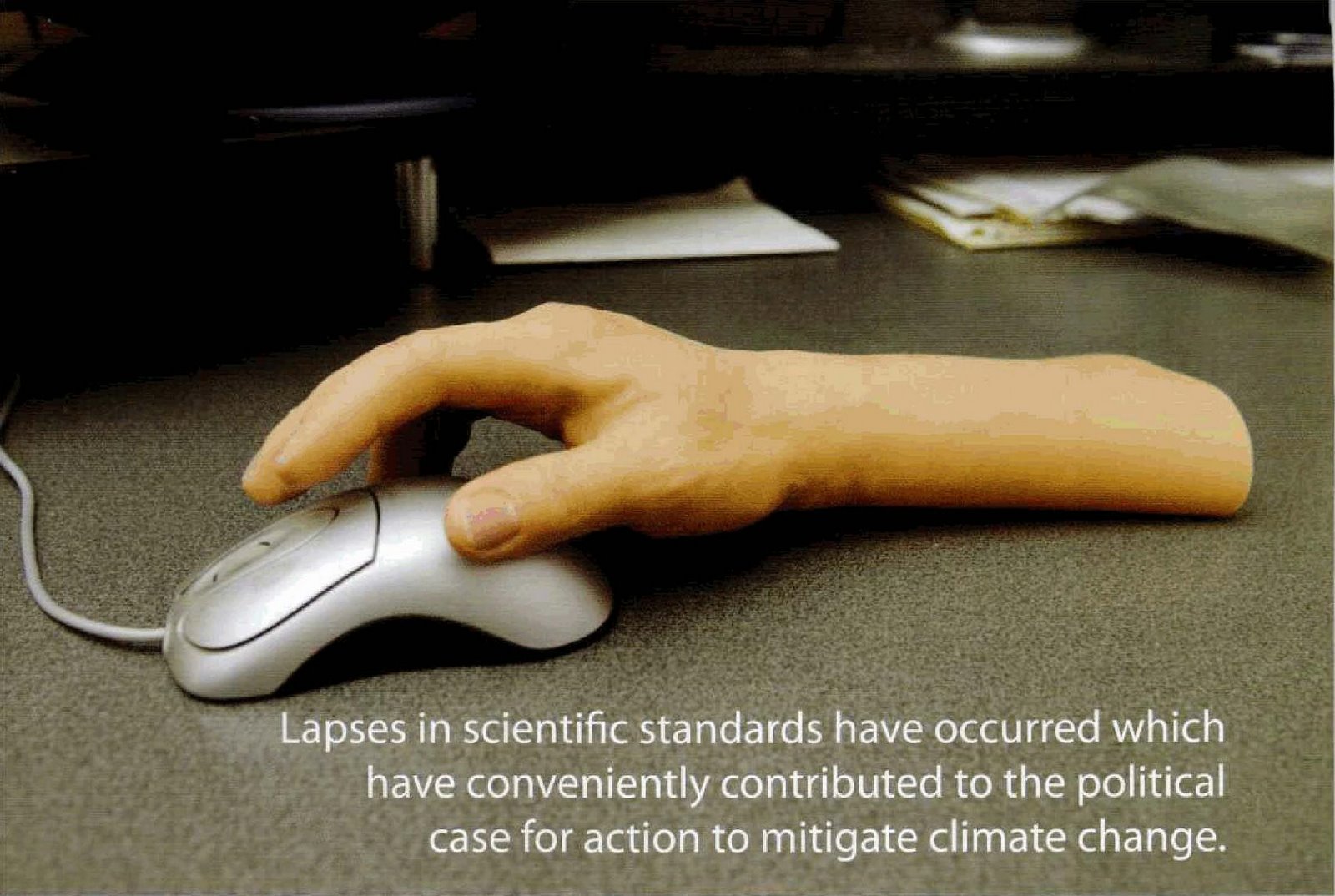
Furthermore, Kellow details how lapses in scientific standards have occurred -- involving the misuse of statistics on emissions scenarios and the incorrect reinterpretation of tree-ring data -- which have had the effect of conveniently contributing to the political case for action to mitigate climate change.

The second half of the book is very much about politics beginning with a detailed analysis of the campaign by scientists against statistician Bjorn Lomborg and his book The Skeptical Environmentalist:  Measuring the Real State of the World and following with a critique of why there seems to be a closer affinity between environmentalism and left-leaning parties in western democracies and greater hostility towards environmental protection from right-leaning parties.

Kellow argues that there are cultural factors associated with the appreciation of nature that align with political ideologies and that these factors become exaggerated by the now virtual nature of many scientific disciplines.  This further facilitates the corruption of science and public policy.

Kellow disputes the claim that the rise of environmentalism simply reflects increasing affluence and a progressive agenda, and considers the history of environmentalism and the myth of the balance of nature in the context of a long tradition of Western thought often involving catastrophic decline from some idyllic past -- usually as a result of sin.

The idea of the "balance of nature" persists, even though it is not supported by the observational data, because, if we accept this myth, any change in ecosystems can be attributed to human activity and imparted with a deep social meaning.

Within this paradigm, ecology involves all manner of projections of human values onto observed nature including through the use of terms such as "invasive species" and "alien".

Quoting Robert Kirkman, Kellow suggests that a belief in ecologism provides a moral compass pointing in the direction of holistic harmony, but it is an illusion.

This shift of environmentalism onto a religious plane, coupled with the descent of much of ecology into the virtual world of mathematical modelling has seen the marriage of environmental science to political activism.  Classic liberalism, Kellow explains, with its emphasis on separation between the individual and the state, can provide a protection against "the darker possibilities of environmentalism".

The book ends with a warning to scientists to not usurp the role of policy-makers.  But rather provide those policy-makers with informed choices.

Indeed public policy is almost never resolved by some piece of scientific information.  When science is used to arbitrate it eventually loses its independent status and disqualifies itself.

Science and Public Policy is an important book as a philosophical and historical analysis of environmental activism particularly over the last 30 years.

It will be especially appreciated by naturalists and biologists who remember the good old days when tramping about in work boots observing wild goats at close range or, in my case, collecting live lepidopteron, was encouraged -- that is, before the advent of environmental science and sitting at desks crunching numbers for computer models.

John Stuart Mill's odd combination:  philosopher kings & laissez faire

John Stuart Mill:  Victorian Firebrand
by Richard Reeves
(Reeves Atlantic Books, 2007, 616 pages)

To many, John Stuart Mill was the greatest "public intellectual" of the last 200 years.  His topics of interest were limitless -- his Collected Works span 33 volumes.  His written word remains staggering in its intensity of thought.

And so preparing a biography of John Stuart Mill is an enormous task.  The polymath is a dying breed, and a good biography of Mill would require several experts in the field of philosophy, economics, politics and history.

Richard Reeves is a social and political commentator, and perhaps recognising his own limitations, has written a biography that concentrates on the character and values of Mill.  This is not an intellectual biography.  The reader will not learn of Mill's influence on modern neoclassical economics, or of the finer details of his System of Logic.  The reader will, however, come away with a clear idea of who Mill was as a person, and how his values directed his intellectual conduct.

Seen in this light, Reeves succeeds remarkably well in achieving his intended aims.

There is a clear theme running through Victorian Firebrand.  Reeves makes a deliberate effort to move Mill out of "left" and "right" labels of political thought and place him squarely in his own time.  It is not necessarily what Mill thought that made him the giant he is today, but the disciplined manner in which he formed his own opinions.

Reeves argues that open-mindedness was perhaps Mill's strongest virtue.  Perhaps in rebellion to the strict utilitarian upbringing which he received, Mill rejected any single philosophical model of institutions that could direct the endeavours of government.  Rather, Mill saw that philosophy "was to supply, not a set of model institutions, but principles from which the institutions suitable to any given circumstances might be deduced".

Where his contemporaries would identify the radical rationalism of Benthem and romantic conservatism of Coleridge as conflicting opposites, Mill would rather describe them as "competing counterparts".

Of course, like all great intellectuals, Mill struggled to understand those whose ideas deviated from his own.  His vulnerability lay in his impatience for reform.  His dissatisfaction with the radicals in British parliament was evident by the 1830s -- "now would be the time for knitting a powerful party", he wrote, "and nobody holds the scattered threads of it in his hands except me".

There was occasionally a self-pitying arrogance to Mill's writing.  Economist Thomas Sowell has gone so far as to suggest that Mill's central idea in On Liberty -- the tyranny of the majority -- was born out of his own anger in not being listened to enough.  Reeves also hints at this.  Whatever his motives, Mill's work was always alight with passion, and was always directed towards a passionate audience.  He deliberately did not write for the less well-educated, and it was the illiterate class that initially made Mill averse to the prospects of universal suffrage.

Indeed, the idea of Plato's "philosopher kings" often underpins Mill's perception of the proper structure of society.  Particularly in his early years, Mill saw great advantages in having a small but influential intellectual class having the ears of the government.  But this elitist attitude did not however dominate Mill's philosophic and political thought.  He was not altogether sympathetic to the redistribution of wealth, noting that "all classes are ready enough, without prompting, to believe that whatever ails them is not their fault, but the crime of somebody else".

Mill was generally opposed to state welfare provision and a paternalistic government.  In this however, his biographer is more sympathetic to Mill's ideological opponents.  Reeves argues that "the working classes in the 1840s were a very long way from the personal economic circumstances necessary for any reasonable conception of individual choice and agency".

Indeed, sometimes Reeves empathises with the sentiments of the very people Mill explicitly hated:  "the social reformers of the age worried about how to get workers more food, money, leisure and health.  Mill worried about how to get them more freedom".

If Reeves is trying to argue that because Mill was arguing for X, he was not thinking about Y and Z, than perhaps a ninth edition of Mill's The System of Logic is in order.

Reeve's book is a worthy introduction to Mill's life and his ideas.  But it is far from a definitive biography, preferring to focus on the events that formed Mill's ideas rather than carefully looking at his intellectual achievements.

Why smart people believe stupid things

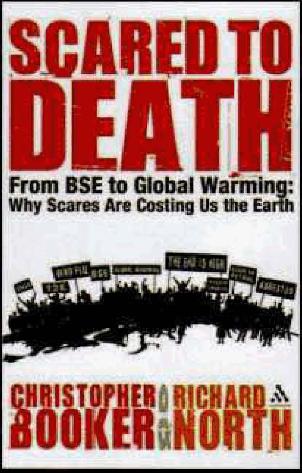
Scared to Death:  From BSE to Global Warming
by Christopher Booker & Richard North
(Continuum, 2007, 512 pages)

Counterknowledge:  How we surrendered to conspiracy theories, quack medicine, bogus science and fake history
by Damian Thompson
(Atlantic Books, 2008, 256 pages)

Curious Obsessions in the History of Science and Spirituality
by Rachael Kohn
(ABC Books, 2007, 272 pages)

In February this year I organised a colloquium on what we called "Weird History".  It focused on some of the strange and downright preposterous versions of history that are currently floating around.  These included Gavin Menzies' fiction masquerading as fact that a giant Chinese fleet sailed around the world in the early fifteenth century and the very popular writings of the Russian Anatoly Fomenko who apparently believes that Ghengis Khan was actually a Russian.

One of the things that came out of that colloquium was that many of the writers of weird history, and those who take it seriously, are intelligent and sophisticated people.  Fomenko, for example, is a leading mathematician.  Such a realisation immediately opens up interesting questions about the nature and efficacy of education.  The old nineteenth century idea was that education, especially university education, would make individuals more rational, more capable of distinguishing between good and bad arguments, and able to judge if the evidence supported an argument.  Put another way, education was meant to inoculate individuals against the foolishness of rumour and unsubstantiated opinion.

Yet we now live in age in which the level of education is at its peak, but also in which the human capacity to believe in weird and wonderful things has never been so strong.  One could almost argue that the advance in education has been parallelled by a growth in human gullibility.  Why should this be so?

Three recent books provide different perspectives on the human capacity to believe in things that on close inspection are weird, fraudulent or simply unbelievable.  In Counterknowledge:  How we surrendered to conspiracy theories, quack medicine, bogus science and fake history, Damian Thompson discusses a whole range of forms of what he terms "counter knowledge", a type of knowledge that runs counter to real knowledge, ranging from strange medical notions to bogus history to creation science and get rich schemes.  Christopher Booker and Richard North chronicle in Scared to Death:  From BSE to Global Warming the extraordinary number of scares that have erupted in Britain over the past twenty-five years beginning with the various food scares, such as Salmonella in eggs, through to ritual satanic abuse and culminating in climate change.  And Rachael Kohn's Curious Obsessions In the History of Science and Spirituality explores some of the more exotic and wonderful religious beliefs, many of them having a scientific dimension, which have been held by individuals, especially of the more educated variety.

Counter knowledge, for Thompson, is essentially a betrayal of the Enlightenment.  There is a sound body of knowledge that has been established by an equally sound set of methods, and then there is the dubious counter knowledge that is advocated for a variety of reasons.  One reason is ideological;  there are groups who want to claim "their" knowledge as being equal or superior to that of science.  Such groups include those who want to make Africa the source not just of homo-sapiens as a species but also of all human civilisation as a means of building up African pride.  The only problem is that they can only do so by twisting the facts to fit the politics.

Then there are those who advocate creation science, interpreting the natural world to fit in with their biblical fundamentalism.  Thompson points out that creation science is not just a Christian phenomenon and that there are versions of it rampant throughout the Islamic world.  There are some eighty "museums" of creationism across Turkey while in most Islamic countries less than ten per cent of the population is willing to accept Darwin's theory of evolution.

Then there are those who peddle all sorts of quack remedies, both for the body and the soul.  These include all sorts of alternative medicine.  Such advocates are the descendants of the merchants of the wonder pills of the nineteenth century;  in fact, in some cases they are still selling the quack remedies of the nineteenth century such as chiropractic manipulation and homeopathy.  The problem with most forms of "alternative medicine" is that they there is no evidence that they actually work.  Thompson quotes surgeon Michael Baum to the effect that "Homeopathy is to medicine what astrology is to astronomy".

Finally there are those out simply to make money by selling lots of books, such as Gavin Menzies and the host of diet gurus.  Now it may not matter if these were simply eccentrics -- part of the rich tapestry of existence -- but, as Thompson observes, they are taken seriously.  Alternative medicine is now studied in many universities.  It is the middle classes who lap it up.

Thompson blames a number of things for the success of counter knowledge, including the way in which the internet spreads all sorts of ideas, the loss of respect for traditional experts and the post modern belief that one form of knowledge is as good as another.  People can no longer distinguish between reputable and bogus knowledge.  This is despite the "fact", which our educationalists tell us ad nauseam, that today's students may not know anything, but nevertheless possesses advanced critical skills.

Thompson may be right that one of the major problems is a decline in the authority of traditional science but, as Booker and North argue, one of the causes of the numerous scares to which Britain, along with many other Western countries, have endured over the past twenty years is a sort of unholy alliance between science and over-zealous bureaucrats.  The problem seems to be twofold.  The first is that while scientific knowledge generally might be reliable it is invariably provisional and open to further investigation.  Of course there are occasions when the science is totally bogus, as in the case of ritualised satanic child abuse where a highly dubious technique was devised to "prove" that children had been "abused".  But generally there is a lack of certainty regarding the science in most matters.  Interpreting the evidence, scientists simply make mistakes and draw incorrect conclusions.  This would not matter if the interpretation of data was a mere academic matter, but when such judgements are used as the basis of government policy and action the consequences can be disastrous.

The second part of the problem is the way in which these incorrect interpretations are used by activists, particularly those employed by the government, to exaggerate problems, and even to create them.  Booker and North point out that it is government officials who are generally more important in driving such scares than politicians who simply follow the advice of their bureaucrats.  Once set in motion these scares accelerate for a number of reasons.  One is the expectation in the contemporary world that any risk should be avoided and the way in which minor risks can suddenly be blown up.  Another is the way in which particular interest groups, such as lawyers, can exploit such circumstances to their advantage.  A final factor is the capacity of the media to get hold of a scare and drive public panic forward.

There are two major features of the scares chronicled by Booker and North.  The first is how regular they have become.  The second is the expense that they cause, particularly to those who get caught up in the attempts by bureaucrats, politicians, journalists and activists to minimise what they see as the risks involved.  Something like a million chickens were slaughtered in response to a salmonella scare, eight million animals were slaughtered at a cost of £3.45 billion in response to the BSE scare.  This was a small cost compared to the billions in repairs and compensation generated by the asbestos scare.  And yet even that is only small change compared to the potential costs of the biggest scare of them all -- climate change.

Booker and North demonstrate how the whole climate change scare has been driven by the selective use of scientific evidence by scientific activists and politicians.  Their picture of Al Gore is unflattering, in particular his political manipulation of scientific evidence.  Their account raises real problems for people like Thompson who would want to solve the problem of bogus knowledge by placing more trust in the expert.  Experts may turn out to be less than model exemplars of the Enlightenment tradition.  They not only may choose what to believe on the basis of what increases their career prospects, but also they share in our common humanity and can be carried away by moral panics.

Rachael Kohn provides us with a collection of essays that describe some of the stranger religious obsessions that have taken hold of people.  These include such things as the search for the "lost" tribes of Israel in some of the most unlikely places ranging from Native Americans to the Maori.  Mormonism is based on the belief that Israelites settled in America in about 600 BC.  Then there is Theosophy, like Homeopathy, a nineteenth century concoction, much of which was found to be fraudulent at the time but which nonetheless appealed greatly to certain segments of the educated classes.

What runs through much of what Kohn discusses, from Giordano Bruno (after whom 2GB in Sydney is named) to John Dee to the Mormons and theosophy is the idea of hidden spiritual knowledge, or gnosis, to which the chosen few alone have access.  This has long been an attractive idea to a class of educated people who wish to distinguish themselves from the mere masses.  This Gnostic tradition runs right through the history of the West, was a subterranean element of the Enlightenment and blossomed in America.  As Catherine Albanese demonstrates in her recent study of American "metaphysical religion", Mormonism -- now one of the world's fastest growing religions -- incorporated a lot from Masonry and this Gnostic tradition.

All of this suggests that the search for hidden knowledge and the spiritual illumination that goes with it is far from dead in the twenty-first century, a fact illustrated by the large New Age section to be found in most bookshops.

The Enlightenment project saw history as progress, as a path from superstitious and "primitive" beliefs to a state in which human beings have become rational and "enlightened".  What these three recent books indicate is just how susceptible human beings are both to believing in weird things and to "moral panics".  Education does not "inoculate" individuals against such things.  In some ways the educated can be worse than their less educated neighbours, something we already knew from the past fondness of many of them for Communism.

These books raise real problems for anyone seeking their way in the contemporary world.  The first is how to decide, even when dealing with science that is apparently "mainstream", whether scientific statement is true, or at least plausible, or just a load of cobblers.  We are accustomed to accept much science on authority.  After all, who outside of a small minority can hope to understand quantum mechanics in all its complexity?  But what happens when that authority is abused?  Does any lay individual, no matter how intelligent, have the time and the capacity to master the science relating to climate change?  The second is how to make a judgement when confronted by the various scares and moral panics that now seem to erupt on a regular basis.  A bogus scare can waste a lot of money.

The lesson is that in a free society the garden will contain as many weeds as it does flowers.  Many of these weeds are relatively harmless, and simply make us smile.  Others, however, especially when they have a major impact on public policy, have the potential to do a lot of harm.

Despite massive increases in the level of education, human beings are still basically the same creatures that they have always been.  The task of arguing for sane and sensible policies and ideas is a never ending one.

Thursday, May 01, 2008

New evidence of old concerns:  Fair trade myths exposed ... Again

EXECUTIVE SUMMARY

Fair Trade Fortnight is held every year to celebrate the "benefits" of fair trade for fair trade developing world producers.  In 2008 Fair Trade Fortnight is being held from the 3rd to the 28th of May.

In 2007, we wrote to the ACCC raising concern about the failure to enforce fair trade certification standards and highlighting that consumers were being duped.  The ACCC did not investigate the claims because it argued the material provided "may be subject to different interpretations".

Since Fair Trade Fortnight 2007 two major studies have been published identifying new, shocking concerns about fair trade's alleged environmental, social and economic "benefits".

This paper outlines new evidence questioning the benefits of fair trade;  and demonstrates that concerns about fair trade's environmental, social and economic benefits are not merely differing "interpretations".  The two new studies have found:

  • Fair trade coffee is not speciality, quality coffee, but only slightly higher-grade commodity coffee.
  • Despite fair trade advocates employing the principles and rhetoric underpinning the International Coffee Agreement (ICA), the evidence shows the ICA did nothing to reduce poverty.
  • Fair trade encourages people to stay in poverty and excommunicates successful farmers.
  • There is an abundance of fair trade product, and not enough buyers;  causing over-supply that harms non-fair trade producers and is stopping new farmers from joining fair trade.
  • Fair trade producers are selling their better quality product on the free market because it delivers better prices and sells its inferior product through fair trade.
  • The costs of fair trade regulations absorb much of the fair trade "premium" consumers pay.
  • Fair trade advocates are misrepresenting the benefits of fair trade through promotions claiming new schools and clinics are being built with fair trade money.  Developing country producers, however, argue that fair trade makes little contribution in this area.
  • Fair trade relies on anecdotes to justify its affect, not hard evidence.

Organisers of Fair Trade Fortnight 2008, Oxfam International and the Fair Trade Association of Australia and New Zealand, need to address these shocking problems in the fair trade system.  Further, the ACCC should investigate the legitimacy of the fair trade campaign's claims.


INTRODUCTION

Fair Trade Fortnight (FTF) is held from the 3rd to the 18th of May this year.  FTF is an annual umbrella event for fair trade activists to promote fair trade as an alternative to the poverty-eradicating free market system.  In Australia, FTF is organised by Oxfam and the Fair Trade Association of Australia and New Zealand.

Fair trade is a certification program for goods and services that are produced according to specified standards outlined by the Fair Trade Labelling Organisation (FLO).  Producers or collectives of fair trade products are certified against these standards after payment of fees.  Being certified allows the producer or collective's product to then carry the fair trade certification mark and be identified as a fair trade product.  The certification mark identifies the product to consumers who choose to buy into the idea of fair trade.

Fair trade is promoted as a means to promote environmental, social and economic development in developing countries by harnessing market forces and consumer-behaviour.  But there is increasing evidence that the foundation for these "benefits" is hollow.  Further, there are questions about the level to which these certification standards are being enforced.

In 2007 we wrote to the Australian Competition and Consumer Commission raising concerns that fair trade certification standards were not being enforced.  This followed a number of media reports making the same allegations.

Since FTF 2007 two new studies have been released that have detailed new evidence which contradicts the supposed "benefits" being promoted by fair trade advocates.  This paper identifies new evidence and demonstrates a compounding concern about the "benefits" of fair trade.


NEW STUDIES QUESTION FAIR TRADE'S "BENEFITS"

Since FTF 2007 two new studies have been published raising concerns about the questionable benefits of fair trade.  The studies include:

  • Assistant Professor at San Jose University, Colleen Berndt, has completed an extensive field study on how fair trade is operating in Costa Rice and Guatemala for the Mercatus Center at George Mason University titled "Does fair trade help the poor?:  Evidence from Costa Rica and Guatemala". (1)
  • Marc Sidwell from the Adam Smith Institute in London has completed a macro-analysis of the benefits of fair trade titled "Unfair trade". (2)

DOES FAIR TRADE COFFEE HELP THE POOR?:  EVIDENCE FROM COSTA RICA AND GUATEMALA

Berndt has completed a major study based on research and field work in Guatemala and Costa Rica.  In her research Berndt breaks down the individual problems that fair trade causes and the myths supporting fair trade's "benefits".  In particular, Berndt identifies:

  • Fair trade is not speciality coffee:  Despite the claims of fair trade advocates, fair trade coffee is not speciality, quality coffee, it is only labelled as such.  Fair trade coffee is only a slightly higher grade than commodity-traded coffee.  It is treated as speciality coffee because of the fair trade standards that limit its trade with commodity coffee.  (Page 4)
  • Fair trade coffee is made up of off cuts, not quality product:  In an interview with representatives from the US-based Transfair, fair trade advocates conceded that fair trade producers provided lower-grade coffee for sale through the fair trade system.  Fair trade producers sell their best coffee on the free market when it commands a higher speciality price than fair trade.  Producers then keep their lower-grade quality through the fair trade system where they receive a guaranteed price.  They do this because there is an oversupply of fair trade coffee and an undersupply of buyers for fair trade coffee.  (Page 22)
  • The International Coffee Agreement did nothing to alleviate poverty:  The philosophical foundations of fair trade and many of the fair trade certification standards are based on the principles underlying the International Coffee Agreement (ICA) that was administered by the United Nation's International Coffee Organisation.  The ICA essentially fixed prices by balancing available supply to demand to promote price stabilisation and economic development.  Despite the ICA operating for more than twenty years studies have shown it had no effect on poverty reduction.  (Page 9)
  • Fair trade encourages non-success:  Fair trade certification standards require that coffee farms not be structurally dependent on hired labour.  Fair trade standards only allow for the use of a family-labour force, with occasional assistance from hired labour.  Therefore, if you run a successful coffee farm and can afford to hire labour to manage the farm, you are either ineligible to apply for certification or your certification is revoked.  As an example, plantation-style farms, such as those operating in Brazil, are ineligible for fair trade certification.  Having such strict rules inhibits a producer's capacity to permanently lift themselves and their family out of poverty.  Further, by disallowing permanent hired labour, it undermines producers who may have the potential to help lift other workers out of poverty.  (Page 13)
  • The fair trade club doesn't want new farmers:  There is a significant oversupply of fair trade-produced coffee, and not enough buyers.  In order for new producers to join the fair trade club they are required to bring a new buyer for their product before they can join.  (Page 15)
  • The development benefits of fair trade are sketchy:  An investigation found that the manager of a fair trade cooperative in Guatemala argues the fair trade premium delivered little real benefits.  The farmer further advised that many fair trade organisations go to Guatemala and take photos of schools and health clinics for fair trade promotions alleging that these facilities were a result of fair trade.  Yet the local fair trade manager argues that these facilities were not normally delivered because of fair trade.  (page 23)
  • Fair trade certification requirements consume much of the fair trade "premium":  In order to achieve and maintain FLO certification, farms are required to meet FLO certification standards which include expensive adjustment costs and certification fees.  The price premium provided by fair trade above the free market price is nominal and hence, to achieve certification, much of the cost is lost in fair trade compliance.  One fair trade cooperative admitted that none of the fair trade premium was passed onto farmers.  (Page 27)

UNFAIR TRADE

Sidwell raises many of the same concerns as the Berndt study.  Additionally Sidwell identifies:

  • There is no hard evidence that fair trade works:  Hard evidence supporting the benefits of fair trade is exceptionally weak.  Instead fair trade advocates rely heavily on "anecdotes" from fair trade farmers, rather than environmental, social and economic indicators and statistics that would provide real evidence of fair trade's success.  (Page 10)
  • Fair trade harms non-fair trade producers:  Fair trade buffers producers against market signals of oversupply.  By doing so fair trade producers rarely reduce their output.  During periods of oversupply prices plummet.  By removing the disincentive to produce product during periods of over-supply fair trade pushes down the price for producers who cannot afford fair trade certification.  (Page 13)

THESE ARE NOT NEW CONCERNS

Concerns about fair trade are not new.  In addition to the concerns raised by Berndt and Sidwell, we have raised our own concerns previously (3), including the voluntary nature of fair trade and whether fair trade certification standards are being enforced.


THE VOLUNTARY NATURE OF FAIR TRADE

Fair trade is currently promoted as a consumer-driven campaign.  Yet Oxfam has made it clear that they want to end the voluntary nature of fair trade through their international campaign to Make Trade Fair. (4)  The campaign attempts to introduce principles of free trade where Oxfam identifies benefits to developing countries;  while maintaining hostility to the principles of free trade where developing countries are not advantaged.

One of the core focuses of the Make Trade Fair campaign is supporting the voluntary sale and consumption of fair trade certified coffee in developed country markets.  Yet behind the public efforts to promote voluntary consumption of fair trade goods, Oxfam is also advocating regulation of the international coffee market to achieve compulsory consumption of fair trade products.

In its 2002 report "Mugged:  Poverty in your coffee cup", (5) Oxfam International identifies numerous criticisms against the contemporary international coffee trade that could be addressed through increased consumption of fair trade certified coffee.  But in the recommendations section of the report, of the 48 recommendations made, 5 are directed to consumers.  The remaining 43 include recommendations such as:

  • destroying at least five million bags of coffee
  • organising producer governments to stop commodities entering the market that cannot be sold;  and
  • establishing a long-term commodity management initiative. (6)

FAIR TRADE STANDARDS ARE NOT BEING ENFORCED

In 2007 the authors of this report wrote to the Australian Competition and Consumer Commission (ACCC) raising concerns about the certification standards used by FLO and whether they were being enforced based on consumer expectations.

Fair trade certification standards require fair trade producers to pay any hired labour at minimum wage.  Yet an investigation by the Financial Times in 2006 found that a number of coffee producers in Peru were being paid below the minimum wage. (7)  By failing to enforce the standards, fair trade is deliberately misleading consumers about its benefits.

In its letter responding to the request for an investigation the ACCC stated that the evidence "provided in support of (the) allegations comprises newspaper articles, reports and analysis of these reports which may be subject to different interpretations".  Yet the number of serious studies being produced questioning the benefits of fair trade is becoming more significant each year.  The ACCC can no longer claim that the questions about fair trade are merely caused by differing interpretations.

Further, the ACCC stated that they are "mindful there is a history of disagreement between Mr Wood and Oxfam over the pros and cons of fair trade coffee".  It is clear that there is a difference of opinion between us and Oxfam;  but the evidence and number of opponents openly questioning fair trade's "benefits" are mounting.

Conversely, as the new studies show, the material supporting fair trade is not dependent on hard studies, but anecdotes and misrepresentations.


CONCLUSION

New studies demonstrate that the evidence supporting fair trade's contribution to development for the world's poor is dubious, at best.  The studies also show that fair trade creates a number of problems for fair trade and non-fair trade producers.

Despite constant assertions by fair trade advocates that fair trade:

  • delivers high-quality product
  • encourages people to lift themselves out of poverty
  • delivers a premium to poor producers

The evidence suggests otherwise.

Fair trade fortnight is held annually to promote the "benefits" of fair trade to consumers.  Yet consumers are being deceived into supporting a pro-development campaign with a bitter after-taste.

Fair trade advocates need to address the outcomes of these new studies.  And the ACCC needs to reconsider the honesty of fair trade's claims to consumers.


ENDNOTES

1.  Berndt, C., "Does fair trade coffee help the poor:  Evidence from Costa Rica and Guatemala", Mercatus Policy Series, Policy Comment Number 11, Mercatus Center, George Mason University, June 2007.

2.  Sidwell, M., "Unfair trade", Adam Smith Institute, London, 2008.

3.  Wood, R.J., "Fair trade coffee only brews more poverty", Australian Financial Review, 12/08/2006

4Make Trade Fair, Oxfam International

5.  Gresser, C. & Tickell, S., "Mugged:  Poverty in your coffee cup", Oxfam International, 2002.

6Ibid., 2002, pp49-51

7.  Weitzman, H., "Bitter taste of 'fair trade' coffee", Financial Times, 08/09/2006.

Submission to Select Committee on State Government Financial Management

INTRODUCTION

This submission considers two aspects of Commonwealth–state fiscal management.  First, the issue of state debt is considered.  In particular the issue of state owned enterprises accumulating debt and paying dividends to state governments.  Second, the issue of fiscal federalism is considered.  It is not possible to review or reform state finances without also reviewing and reforming the tax system.  Our views on these two issues are as follows:

  • The states have accumulated debt in their commercial subsidiaries
  • It is possible that this could contribute to some macroeconomic dislocation
  • Given the massive surpluses of the Commonwealth government over the past decade, it is unlikely that state debt has contributed to any macroeconomic problems that Australia is currently experiencing
  • The Commonwealth should exit the financing and/or provision of redistributive public goods
  • The Commonwealth should give up all personal income tax powers and allow the states and territories to levy their own personal income tax.

1. STATE DEBT AND DIVIDENDS

1.1 WHEN SHOULD GOVERNMENT BORROW?

Following James M. Buchanan we argue that government should only ever use debt to finance the acquisition of assets that will generate long term benefits, or assets that are ultimately self-funding. (1)  As Buchanan has correctly noted, the burden of public debt is shifted onto future tax payers.  This occurs because future taxpayers repay the debt and their taxes are associated with deadweight losses.  Current taxpayers (who may overlap with future taxpayers) cannot accurately forecast the magnitude of future deadweight losses and so cannot entirely discount future interest payments.  On the basis that those individuals who directly benefit from government spending should pay for those benefits, government debt should not be used for day-to-day financing of government activity.

Government debt in Australia is low but only because of the efforts that have been made over the recent past to bring debt levels down.  According to Australian Bureau of Statistics data (ABS Cat. 5512.0) general government (all levels) is a net lender.  The state based non-financial public sector, however, is a net borrower.  The ABS defines the function of these organisations as being "to provide goods and services which are predominantly market, non-regulatory and non-financial in nature, and mostly financed through sales to consumers".  The question becomes whether it is appropriate that these organisations have any debt at all?  It is not all clear that they should not have debt.  After all, these organisations are characterised only by their ownership status.  In some jurisdictions many of these organisations would operate as private firms and their capital structure would be of little concern.

On a total public sector basis all levels of Australian government are in surplus.  On a cash basis, however, three of the states are running a deficit with an accumulated deficit of $9.7 billion.  The total public sector position for all Australian governments on a cash operating basis is positive.

When evaluating the debt position of the non-financial public sector only two questions arise.  First, is the capital structure of public utilities significantly different from those of similar private utilities?  Second, are public utilities borrowing money using the state government credit rating?  If the answer to both these question is "no" then it is difficult to see any policy or macroeconomic problem arising from this debt.

It is very likely that public utilities are borrowing money using the state government credit rating. (2)  If this is the case, then state governments need to include that debt on their own balance sheets.  At the very minimum the debt amount should be included as a contingent liability.  The issue of interest to us is not related to competitive neutrality, rather it is related to exposure taxpayers have to government guaranteed debt and the proper disclosure of that exposure.


1.2 EMPIRICAL EVIDENCE

The Productivity Commission (PC) publishes an annual series of reports looking at state-owned enterprises in Australia, "Financial Performance of Government Trading Enterprises".  The latest report is for the years 2004-05 to 2005-06.  Unfortunately, the accounting principles underlying the series have changed in the latest year and comparisons with previous years are highly misleading.  The PC is able to show consistent data for the latest two years.

Table 1: Selected data on SOE for 2005-06

Return
on
assets
Cost
recovery
Debt to
total
assets
Dividend
payout
ratio
Electricity7.8126.841.268.5
Water5.5163.519.977.9
Urban Transport3.066.444.4440.2
Railways3.893.717.710.0
Ports7.1159.222.639.3
Forestry2.3115.45.591.7

Source: Financial Performance of Government Trading Enterprises 2004-05 to 2005-06 (various tables).  Cost recovery is the ratio of revenue from operations to expenses from operations expressed as a percentage.  The dividend payout ratio for urban transport is upwardly biased due to a special payment made by TransAdelaide.  No other PC monitored urban transport organisation paid a dividend in 2005-06.


To provide some comparison data for utility firms was captured from the Osiris database for 114 UK and US utility firms.  Most of these firms were energy utilities.  The overall average return on assets was 4.18 per cent and the overall average dividend payout ratio was 61.24 per cent.  The overall average debt to total assets ratio was 34.8 per cent.  It is not immediately clear that the Australian data is that different from the UK and US comparison firms.


1.3 CONCLUSION

At present it is unlikely that state debt, via their commercial subsidiaries, is the source of inflation or any other macroeconomic dislocation in the economy.  That, however, does not preclude state owned enterprises from causing macroeconomic problems in future.


2. FEDERALISM

2.1 ALLOCATION OF FUNCTIONS

There is a large economic literature that investigates Federalism.  That literature usually recommends that redistributive powers be allocated to the highest level of government and allocative powers to lower levels of government. (3)  The problem with the economic literature, however, is that economists have a very generous definition of what constitutes a federal structure.  Wallace E. Oates has argued that economists are concerned with the allocation of resources and income distribution and less concerned with constitutional powers and government autonomy. (4)  That may well be true;  yet it immediately raises a fundamental problem.  When most economists analyse federalism they are not analysing political federations, rather they are comparing the advantages of a centralised, versus decentralised, decision making process.  It is unsurprising that a decentralised decision making process is superior to a centralised decision making process.

The Australian Constitution did not originally allocate redistributive powers to the Commonwealth.  Section 51 of the Constitution sets out a whole range of matters where the Commonwealth Parliament may legislate for the peace, order and good government of the Commonwealth.  Section 51 (xxiiiA) was inserted by referendum in 1946.  This allows, but does not require, the Commonwealth to legislate for a range of benefits and family allowances.  This section forms the basis of a very large portion of the Australian welfare system.  The Commonwealth allocated nearly 67 per cent of the 2007-08 budget to education, health, social security and welfare.

It is common to argue within Australia that national solutions need be found for problems and that harmonisation across the states and territories is desirable.  Indeed, many individuals have called for the abolition of the states.  This is precisely incorrect.  Building on George Stigler's two principles of government

  • Representative government works best the closer government is to its constituency
  • Subsets of voters have the right to vote for different kinds and amounts of public services for themselves

it is clear that government decision making and resource allocation need to be pushed down the hierarchy of government, not pushed up.

Of course, the Commonwealth does provide benefits in terms of facilitating a large internal market and by maintaining trade between the states and territories.  The Commonwealth should maintain those functions and allocate all redistributive functions back to the states and territories.


2.2 ALLOCATION OF TAXATION

In addition to exiting the provision of social services, health and education the Commonwealth should give up all its personal income tax powers.  This would enable the states and territories to levy their own personal income taxes.  This would also allow the states and territories to give up the inefficient transactions taxes that they currently levy.  The Commonwealth should continue to levy the corporate income tax and GST and other excise taxes that it currently levies and should continue to allocate funds (in excess of its own requirements) to the states and territories.  Using the 2007-08 Budget papers as a guide this implies that the Commonwealth would give up almost half (excluding the GST) of the revenue it currently raises.  In contrast by exiting its redistributive functions the commonwealth would reduce its own expenditure by almost two-thirds.  In other words there may still be a large role for the Commonwealth in allocating funding to the states and territories.


2.3 PRACTICALITIES

Our proposal has a number of practical advantages.  First it does not require any amendment to the Australian Constitution.  Second, it places the states and territories on a sound financial footing.  There are, however, a number of practical problems and objections that will need to be addressed.

  • The state and territory governments' may not wish to levy their own personal income tax.  That is their own choice, but if the Commonwealth were to unilaterally exit the provision of funding to health, education and social services, the states will either have to introduce their own income tax, or dramatically cut services.
  • A mechanism whereby the states and territories levy the personal income tax would need to be devised.  Our proposal is not that the Commonwealth allocate the personal income tax to the states and territories as it does the GST.  Each state and territory would levy its own personal income tax with its own rate and base.  There may be Constitutional impediments to the Australian Tax Office collecting the state based personal income tax.
  • Differential state and territory personal income taxes and differential service delivery standards may give rise to population mobility.  This should not be seen as a disadvantage or objection.  Policy competition is a stated advantage of federal systems of government, not a disadvantage.


ENDNOTES

1.  James M. Buchanan, 1958, Public Principles of Public Debt:  A Defence and Restatement, (Liberty Fund, Indianapolis, 1999), chapter 12.

2.  See the Productivity Commission, 2002, Financial Performance of Government Trading Enterprises, 1996-97 to 2000-01, (Canberra), chapter 5.

3.  Richard W. Tresch, 2002, Public Finance:  A Normative Theory, (Academic Press, San Diego), pg. 841.

4.  Wallace E. Oates, 1972, Fiscal Federalism, (Gregg Revivals, Aldershot), pg. 17.

Submission to the Review of the National Innovation System

INTRODUCTION

Contrary to popular perception, government intervention in innovation does not work well.  It is true that the US government has fostered a lot of innovation but that is largely due to civilian application of military R&D and NASA.  Government subsidies and grants are likely to drive up wages of R&D specialists but not necessarily lead to more or better R&D. (1)

Simple solutions to a perceived underinvestment in innovation are flawed.  Simply relying on the university system to drive national innovation ignores the meagre record of university innovation in Australia.  Spin-offs from university research in Australia have been poor. (2)  Tax concessions per se are open to manipulation and allegations of tax avoidance/evasion.  In an environment of low corporate taxation the value of the concession falls dramatically.  Tax concessions also target "new-to-the-world innovations" and discriminate against continual incremental innovation.  While intellectual property is important for innovation, some proposals for strengthening intellectual property rights could give rise to "patent thickets" whereby legal entrepreneurs stifle innovation. (3)

There is no magic bullet or formula that will deliver on-going sustainable innovation.  The best government can do is provide a stable and coherent institutional and policy environment that will foster innovation as it develops and evolves in the private sector.  While this type of argument lacks a dramatic solution to a pressing problem, nonetheless it is not a "do-nothing" solution.  As we set out below there are several reforms that could be undertaken that will enhance innovation in Australia in particular, and promote greater economic growth in general.


PROPOSALS

(1) EDUCATION

Innovation does not require a large cadre of research-trained university graduates.  There is a disconnect between what universities understand as "research" (the creation of new knowledge) and what private industry understands as "research" (both the discovery of new knowledge, but also the application of previously known knowledge to a new problem – in other words "library" research).  Education needs to be aimed at the mastery and understanding of the extant body of knowledge – this implies that good and better teaching need to be subsidised or encouraged over research per se. (4)

(2) TAX

Tax concessions per se are likely to have a small effect on innovation.  Lower overall tax rates are likely to stimulate innovative behaviour.  The corporate tax rate should be reduced and the progressivity of the personal tax system also reduced.  The benefits of lower personal income tax on entrepreneurial entry have been well documented in a range of careful US studies. (5)  Similarly, the benefits of low corporate tax rates on innovation and business entry have recently been estimated by the World Bank. (6)

(3) FREEDOM OF ENTRY AND EXIT AND ACCESS TO LIMITED LIABILITY

Most innovation is likely to occur in large organisations.  Small start-up firms, however, still have an important role to play.  Public policy should be aimed at simplifying the regulatory burden in establishing and maintaining small business.  In particular we argue it should be easier for individual entrepreneurs to access limited liability provisions.  In particular Australia should consider a South African innovation known as Close Corporations.  This type of business structure is a hybrid between a sole proprietorship and a company. (7)  In addition, the role of the bankruptcy system may be important in stifling innovation by increasing levels of risk-aversion.

(4) VENTURE CAPITAL

A major problem for small start-up firms is access to venture capital.  While Australia does have a large financial market and large amounts invested in superannuation it is not clear that super funds should be invested in high risk activities (after all super exists to fund retirement when individuals are risk-averse).  It is important to understand the myth of time diversification when advocating superannuation investment into innovation.  Paul Samuelson has shown that it is not the case that investors should invest in risky assets simply because they have a long time horizon. (8)  In other words, superannuation should not be viewed as a source of cheap finance for high risk investment projects.

Investment is superannuation is highly tax advantaged and this may well crowd out other forms of investment.  To the best of our knowledge this has not been investigated in Australia.  To some extent it is a value judgement as to whether this is desirable or not.

(5) A NATIONAL INNOVATION DATABASE

There has been a lot of discussion in industry consultations about the need for a national innovation database.  The argument put forward for a national innovation database is that the government has a role to assist in face-lifting ideas, technology and innovators to promote innovation.

Australia already has the ground work completed for a national innovation database through IP Australia’s AusPat system. (9)  A standard principle for a patented invention (including product or method) is the obligation of public disclosure.  AusPat provides for a searchable database of patented inventions.  While AusPat does not include details for non-patented inventions or copyrighted works (such as computer software), it does provide the foundations for a national innovation database.

However, it is questionable whether there would be any significant benefits in developing a national innovation database.  Innovation is not constrained to the technology within individual nations.  Innovation is achieved through ideas and technology sourced both domestically and internationally.  In any form of intellectual property, protected technology is often built on existing technology or an existing technology is included as a component of a newly innovated technology.  It is rare that innovations built on existing technology are limited to those within a particular country.  Instead they are often the result of bringing together technologies from numerous countries.  Building a national innovation database will encourage myopia from Australian inventors on the potential best sources for the technology to;

  • create new technology
  • improve existing technology;  or
  • license components to be included in technology.

Additionally, it is questionable what benefit the Australian government could play as a facilitator.  There are already a number of international innovation databases that fulfil this role. (10)


ENDNOTES

1.  Paul M. Romer, 2001, "Should the government subsidize supply or demand in the market for scientists and engineers?", Innovation Policy and the Economy, vol. 1, MIT Press.

2.  See ABS cat. 8158.0, 2003, Innovation in Australian Business, and Richard J. Wood, 2006, Back to basics:  Why government funding of science is a waste of money, Backgrounder

3.  See Carl Shapiro, 2001, "Navigating the patent thicket:  Cross licences, patent pools, and standard setting", Innovation Policy and the Economy, vol. 1, MIT Press and Marc Gugliotti and Sinclair Davidson, 2004, Patents as an indicator of value in Australian biotechs, Accounting Research Journal. 17(2) 164 – 173.

4.  See William Baumol, 2005, "Education for innovation:  Entrepreneurial breakthroughs versus corporate incremental improvements", Innovation Policy and the Economy, vol. 5, MIT Press

5.  See the collection of studies in Joel B. Slemrod (ed), 2000, Does Atlas shrug?  The economic consequences of taxing the rich. Harvard University Press.

6.  See Simeon Djankov, Tim Ganser, Caralee McLiesh, Rita Ramalho, Andrei Shleifer, 2008, The effect of corporate taxes on investment and entrepreneurship, Working paper

7.  Additional details can be found at http://www.cipro.co.za/products_services/close_corps.asp

8.  The literature in this area is highly technical.  Layperson accounts can be found in Jack Duval, 2006, The myth of time diversification:  Analysis, application, and incorrect new account forms, PIABA Bar Journal.  Also see Mark Kritzmann, 1995, The portable financial analysts:  What practitioners need to know.  Irwin.

9.  Found at http://www.ipaustralia.gov.au/auspat/

10.  See for example, the ZIM Innovation Database