Backgrounder
ABSTRACT
Participatory democracy assumes that all citizens are political actors and will spend considerable time in defence of their interests and ideas. In fact, democracy is much more elitist -- it rests heavily on the idea that people delegate most of their political participation to an agent. Almost every citizen delegates participation to a public agent, a member of parliament. In addition, some delegate participation to a private agent, for example a business or industrial union or other non-government organisation.
An essential element of democracy is the process by which public agents respond to the demands of private agents, and how an essentially unorganised non-political public passes judgement on their performance. Institutional arrangements such as public elections, public servants, the law and the courts, and press scrutiny assist this process.
Participatory democracy, however, takes the primary institutional arrangement -- that is, public elections -- for granted, and in so doing can diminish trust in governing institutions. In fact, participation merely crowds the field with agents (for example, non-government organisations) who may or may not provide solutions to those issues that require government action. When NGOs and their demands multiply, governments and corporations cope by engaging more readily with the community. Engaging with the community, however, encounters problems of unequal participation, which may disenfranchise citizens and shareholders.
The tendency to "corporatise" government is not new. Labor governments have sat trade union officials on boards and committees, and Coalition governments have done the same with corporate representatives. The new NGOs -- non-union and non-business -- constitute a third wave of corporatism. They, too, are sitting on boards and committees. They are entitled to a place in the sun, but the price is that they are likely to become as closely scrutinised as the earlier incumbents.
Five case studies are presented to indicate how governments and corporations delegate governance irresponsibly. There are antidotes to irresponsible governance; such as a greater awareness by government and corporations of the status they grant NGOs, and greater transparency when assistance is granted to NGOs.
PROBLEMS WITH COMMUNITY ENGAGEMENT
Participatory democracy assumes that most people will do more than vote; it assumes that most will be politically active. Engagement with the community is a response by governments and corporations to the rise of participatory democracy, especially the rise of NGOs. The primary rationale for engaging communities is that people expect "to have a say" (1) in government and in organisations that "affect their interests". These phrases are pregnant with assumptions about the role of government (and business), and the extent to which government should "encourage" participation. Participatory democracy and community engagement assume an enthusiasm on the part of many to be involved in politics. They assume that the "proper" course is for people to be self-governing in a direct sense, and eschew the alternative course, which is for people to elect representatives to govern on their behalf, leaving citizens free to pursue other matters.
Community engagement involves collective decisions, and collective decisions require answers to basic questions such as, who are to decide? In other words, community engagement is a political issue that involves the difficult task of representation. Moreover, whole classes of decisions about public issues are made collectively, but at a distance from the intended recipient(s). The reasons for this are to ensure the objective and equitable application of agreed rules and programmes. Community engagement also implies that the community is inherently better placed to decide what is good. It confounds participation with knowledge. While participation may increase knowledge of events, it usually results in having to choose between options. The issues in community engagement are whether the options are any different to those that officials have to choose, and whether the sense of ownership, which engagement is meant to enhance, make the options more likely to be successful.
The enthusiasm for engagement does not solve fundamental problems of governance, such as defining the general interest or the allocation of benefits and costs of any decision or programme. (2) By contrast, the bureaucratic state brings certainty, expertise, low decision-making costs and powerful enforcement to issues of governance. Even if the community is engaged in establishing norms and standards, these matters are not made by a continuous application of community engagement. As interesting is the propensity for individuals and communities to not be involved, to be relieved of the costs of decision-making. Neither is it clear just how much of a say is sufficient, and how remote one's interest may be before they are reasonably excluded from the debate. There are classes of issues, moreover, where community engagement does not help. For example, location of waste-hazard decisions where every group will opt for a Not-In-My-Back-Yard solution. Engagement will not help to resolve allocation problems, where funds are to be made available to some groups and not to others. Neither does engagement assist in decisions about transfer payments to individuals: these need to be administered by those who are specifically not recipients of the benefit. Engagement can be well-managed, and suggestions are made in this regard but, in many respects, it is not feasible to be self-governing, other than through elected representatives.
In the film, "The Rise and Rise of Michael Rimmer" (1970), English comedian Peter Cook starred as a political anti-hero, a Prime Minister intent on holding power by any means. His vehicle was participatory democracy! He had Her Majesty's Post deliver to voters, daily, ballots for them to decide on all manner of problems. There were scenes of working-class semi-detached bungalows and middle-class rural cottages being inundated by posties. In the face of the assault, the masses gave up and pleaded to have the Prime Minister do the job he was paid to do -- make decisions. Cook gleefully acceded to their demands and the daily ballots ceased. While examples of direct democracy, such as citizen initiated referenda can enhance good government, or at least constrain bad government, it nevertheless was a delightful illustration that there are real limits to the extent to which people can take, or want, the responsibility of making collective decisions. This is not to argue that governance is best left to government and the public service, or indeed to a corporatist model of collective interests -- big business and trade unions -- to rule in conjunction with government. However, there is a need to ensure that the enthusiasm for engagement is not merely an opportunity to privilege some interests at the expense of others, or indeed for government-funded activism.
PARTICIPATION AND INEQUALITY
The way in which policy communities are formed can make a big difference to policy. In the absence of a sure direction, sitting everyone around the table becomes political management, not policy formulation. The consensus method so typical of participation becomes even less likely to produce good policy when the participants represent supporter values rather than members. The tendency for error is expanded when some agents have no mandate from a membership, either because there can be no membership -- for example, the environment -- or because the members work for the constituency -- for example, social workers representing the poor. The environment lobby claims to give a voice to the environment, the welfare lobby to the poor and disadvantaged, the human rights lobby to refugees and others, the indigenous lobby to Aborigines and so on. These claims have to be verified, otherwise government may be dealing with a policy clique rather than a lobby of constituents.
Consider the following examples. The environment lobby could consist of those who believe in sustained development based on technological innovation as the best means to preserve the environment. It does not. Instead, it consists of the sustainable development lobby that assumes limits to physical resources, and prefers abstinence to innovation. The welfare lobby believes in neither liberal nor meritocratic concepts of fairness: only an egalitarian version. It believes that equality is a more important objective than the living standards of the poor, a view not shared by most Australians. Indeed, "only 1 in 20 Australians thinks fairness is solely to do with achieving more equal outcomes". (3) The human rights lobby prefers to use "international norms" to achieve ends that they are unable to achieve by a combination of a national majority tempered by the equitable application of the national law, including in countries with liberal common-law traditions. The indigenous policy community is dominated by those who believe in a collectivist idealisation of Aboriginal culture, which undermines matters such as private property, contract, obligations to seek work and to attend school.
While participatory democracy values knowledge and expertise in citizens, it devalues those same characteristics among policy makers. (4) Participation by policy communities, each gaining formal access to the policy apparatus is increasingly becoming the norm. It is driving up the price of governing and the likelihood of sub-optimal solutions. It is also increasing the tendency for government intervention where none is warranted. Participatory democracy deepens and extends access to political decisions, but it lacks representative democracy's "one person, one vote". For example, by the very nature of their volunteering for the job, policy communities form an elite. This is as true of the local activist as of the national politician. For instance, 84 per cent of candidates for the 2001 Federal election had completed some form of post-secondary study, (5) while only 44 per cent had done so in the population at large. (6) The politician, however, is largely constrained by means of a public election to seek a wide view of values and needs in the community and to achieve a satisfactory balance between them. Social status inequality is present among non-elected activists as well, yet this class of political activity is not constrained by means of a public election.
By way of illustration, the Figure, Education and Participation in Politics Australia 2003, is based on a sample of over 4,000 adults derived from the Australian Survey of Social Attitudes for 2003. It displays the percentage of those from different educational backgrounds -- low, middle and high -- who participate in different forms of political activity. The activities are arranged approximately in descending order of participation. Only in the most basic form of political participation -- voting in an election -- is there an equivalent rate of participation between people of differing educational backgrounds. To the question, "did you vote in the Federal election 2001", the answer was "yes" for between 97 per cent and 99 per cent of respondents in each category, which means that there is no statistically significant inequality between education categories. (7)
The category, campaign activity, consists of those people who were working with people of the same concern, or boycotted or bought a product as a form of political statement, or contacted a politician or government official. (8) The data showed that such activity was overall less common than voting and highly unequal, ranging between 45 per cent of the least-educated population and 60 per cent of the most-educated population. The data also contained questions relating to membership of non-government organisations. These were divided into two classes, service NGOs and policy NGOs. (9) Service NGOs consist of those people who joined a self-help/consumer health, special needs, neighbourhood or community-based group.
Education and Participation in Politics Australia 2003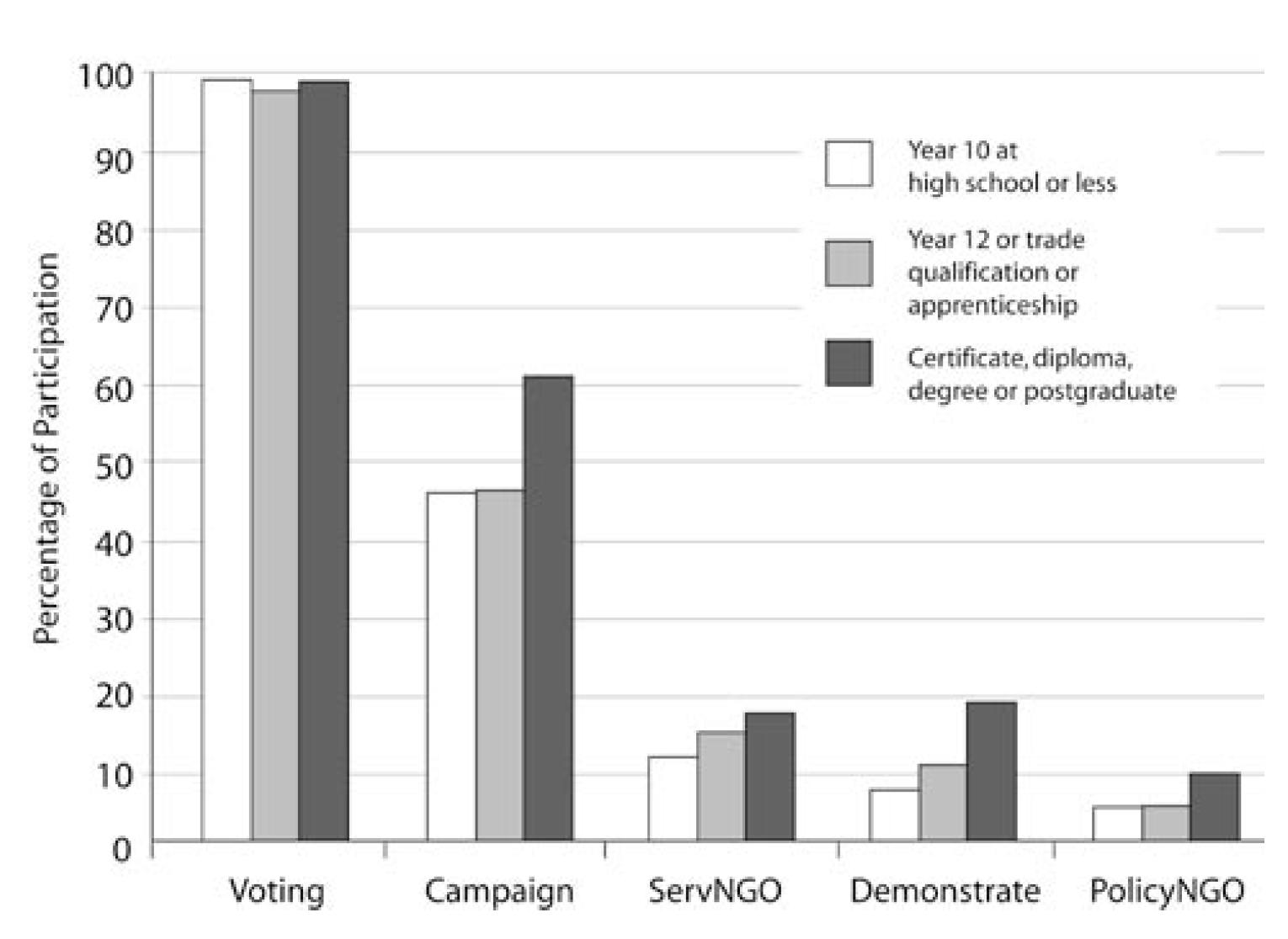 Dataset: The Australian Survey of Social Attitudes 2003.
Figure: Author.
Participation was low for all and unequal, ranging between 11 per cent of the least educated and 17 per cent of the most educated. The demonstration category -- protest, march or demonstration (10) -- showed very low levels of participation and high inequality in participation, ranging between 7 per cent of the least educated to 18 per cent of the most educated. (11) Policy NGOs consist of those people who were members of a political party, or a lobby group to change specific government policies, or a group working to improve the environment, or an environmental or aid organisation, or a group that promotes rights. These groups showed the lowest level of participation of all activities and a high degree of inequality in participation, ranging between 5 per cent of the least educated and 9 per cent of the most educated. (12)
Overall, the Australian data show that, as the requirements of greater commitment on the part of the citizen increase, the overall level of participation declines, and the inequality in participation rises in favour of the more highly educated. These results place in doubt claims made by NGOs that they represent civil society and clearly show that advocacy or participatory democracy suffers from the problem of very unequal use. It also seems to suggest that increased public access to political activity places greater demands on citizens. Clearly, there are limits to the extent to which citizens can participate in ruling themselves. When these limits are reached, as they are in any activity more extensive than voting or seeking out the help of a politician or a local group, questions arise about the representative nature of those prepared to make the sacrifices required for higher order participation. A recent study of the internal democracy of a selection of advocacy NGOs, for example, found that "in most [NGOs] policy is initiated by a small group that includes CEOs and some board members, including the chairperson". (13) NGOs are policy communities, people who share a viewpoint. Whether their viewpoint should be granted privileges above others is an essential question for government and corporate managers who wish to engage with these communities.
TRUST IN POLITICAL INSTITUTIONS
One of the stimulants to the interest in engaging communities is the apparent "reduce[d] trust in public and private institutions", especially disillusionment with politicians, political parties, and political institutions. (14) There are two major explanations for the decline-of-confidence thesis. The first concentrates on information and expectation. It is clear that voters have, over time, become better informed about their governments' performance. Voters expect more of government and their expectations are more divergent; consequently it becomes more difficult for government to "identify any feasible set of policies that would satisfy its constituents". (15) The second relies on changes in the economy and in social attitudes. The information society has caused a "creative destruction ... disrupt[ing] existing social patterns. This, in turn, creates anxiety and dissatisfaction in large parts of the public". Changes in social and cultural attitudes have caused a "change in the balance between the individual and the community", which has led to a long-term trend toward the individual, a trend which "undercuts the authority of institutions". (16) At the same time, government is now seen as an arbiter of social relations, gender, race, family, and so on. Expectations of government, once confined to safety and the administration of justice, have risen to include "prosperity and various norms of social stability". (17)
Into the "institutional authority gap" have stepped NGOs -- not only as political actors, but also as governance institutions in their own right. As Furedi puts it: "Widespread disenchantment with conventional institutions has created an opening for new, alternative forms of authority". (18) Indeed, he further suggests that mistrust is not confined to government and officialdom but extends towards other members of the public. Fear of risk and the over-specification of danger are raising levels of mistrust across the board, "Safety has become the fundamental value of our times". (19)
Encouraging people to fear, mistrust, complain and litigate is seen as a socially responsible act. Consequently, consumer advocates do not merely reflect the existing state of mistrust: they play an active role in educating people to believe the worst in most circumstances. (20)
The danger in these trends is that it is simply not popular to believe in government. In this context, NGOs approach government in increasing numbers and in a more professional and organised manner. The desire by citizens to take a greater role in determining their future lies at the heart of the desire to "democratise" democracy as a means of restoring faith in the institutions of government. Although entirely laudable, the desire has some major conceptual problems. Civil society, for example, may split "into warring factions ... or degenerat[e] into a congeries of rent-seeking 'special interests'." (21) Those in the civil society "utopia" camp who see civil society as a counterweight to the state must concede that it can be a counterweight to a good state as well as a bad one. Civil society and its activists may simply monopolise public resources, they may spend all their time battling one another for control, and they may polarise society. The missing variable in the civil society argument, and indeed the claim of NGOs to political legitimacy, is politics itself.
Who is to play the important role of political compromise and restraint, accommodation and reconciliation in an orderly and peaceful way? Ultimately this is the role of the public agents, political parties, and parliamentary representatives. Most important are the institutions that govern the means by which settlements are reached, the important and hard-won rules of play, the determination of what are acceptable and what are not acceptable outcomes.
A democratic civil society seems to require a democratic state, and a strong civil society seems to require a strong and responsive state. The strength and responsiveness of a democracy may depend upon the character of its civil society ... reinforcing both the democratic functioning and strength of the state. But such effects depend on the prior achievement of both democracy and a strong state. (22)
The strength and role of NGOs may give the appearance of an active democracy, indeed, it may be an active democracy, but it is primarily a sign of an active citizenship. The quality of the democracy will be measured by the ability to incorporate and resolve issues, not just voice them.
CASE STUDIES
A more accurate picture of democracy is obtained by conceiving it to be not participative in the broad sense, but as a competition among elites. An important element of the relationship between elites and the public is that,
when the public is well informed and closely monitors elite actions, the chances that some of its members will join the elites are increased. In this manner the probability for the renewal of the elites grows, and the elites that are constantly rejuvenated from the public are inclined to represent its interests, or those of a sizable part within it. (23)
Although Etsioni-Halevy had in mind NGOs as a counter to the "elites", the fact that the most prominent NGOs have become part of the policy community elite does not invalidate the general proposition that elites should compete. Further, they should be relatively autonomous from the state, but not have such power that together they can use the public's resources to satisfy each main platform without regard to the costs to the public. In this regard, the only defence is to keep government-elite relations and corporation-elite relations (in pursuit of public policy) as transparent as possible. The following five case studies of government-NGO and corporate-NGO relations demonstrate the growing resort to community engagement, and some of its pitfalls.
COMMUNITY CONSULTATION -- LEGISLATED NGO REPRESENTATION
Government and NGO relations tend to be by direction of the relevant Minister. Sometimes, however, such arrangements are more formal, and are specified in legislation. For example, the Murray-Darling Basin Act 1993 specifies the appointment of a Community Advisory Committee. The Aboriginal Land Rights (Northern Territory) Act 1976 specifies that "where a Land Council receives an application for consent to the grant of an exploration licence, it shall, consult any Aboriginal community or group that may be affected by the grant of the licence". The Privacy Act 1988 establishes an Advisory Committee, "to engage in and promote community education, and community consultation", in relation to the protection of individual privacy. The Spam Act 2003 specifies that the Australian Communications Authority will "conduct and/or co-ordinate community education programs, in consultation with relevant industry and consumer groups and government agencies". The Fisheries Administration Act 1991 authorises the Australian Fisheries Management Authority (AFMA) to consult with persons or bodies "representative of the whole or a part of the industry or recreational fishing; and persons (including members of the scientific community) having a particular interest in matters associated with the industry". The AFMA Board Environment Committee has a "Non-Government environment/conservation member" as well as industry representatives.
There are also examples where a "representative organisation" has been named in legislation. The most common types are in industry and workplace relations contexts. For example, the Australian Wine and Brandy Corporation Act 1980 enables the Minister to declare that an organisation is a "national organisation which is representative of winemakers" and thereby recognises its representative status (it does not give them a board seat, despite the fact that participating producers pay a levy to support the corporation). Such arrangements are common in the primary industries portfolio where marketing and research efforts are pooled and government-assisted. For example, in relation to each R&D Corporation and Council under the Primary Industries and Energy Research and Development Act 1989, the Minister must declare at least one organisation to be a representative organisation. For instance, the research and development corporation Land & Water Australia, "is accountable to two representative organisations", the Australian Conservation Foundation, and the National Farmers' Federation. The specification of the ACF as a representative group is quite extraordinary. It is one among many policy communities in the environment lobby and could not therefore be representative. Nor is it an expert body -- it is simply an advocacy organisation. The NFF has mechanisms to represent farmer interests, although its role is also problematic because there is an array of other agricultural interests that may need to be represented.
The Product Stewardship (Oil) Act 2000 states that the Minister must ensure that the membership of the Oil Stewardship Advisory Council established under the Act includes: "a national organisation representing oil producers; a national organisation representing oil recyclers; the users of recycled oils; the body known as the Australian and New Zealand Environment and Conservation Council (now the Natural Resource Management Ministerial Council); local government; a national consumer organisation; and, a national non-governmental organisation that has a substantial interest in sustainable industry". This is another example of placing NGOs in a representative role. Although in this instance none is named, it is not clear what is gained by allowing any NGO to fulfil a representative role. If there is a need for expertise, the Minister may seek advice from time to time from interested parties. Nominating and defining interested parties and locking them into a legislative structure, and granting NGOs the same status as the Ministerial Council is absurd.
The Workplace Relations Act 1996 and its many predecessors in industrial relations not only accepts representative organisations as the basis of its operations, but ensures that employee and employer organisations registered under the Act are representative of and accountable to their members, and are able to operate effectively. For example, the Act requires such organisations to "encourage members to participate in the affairs of organisations to which they belong"; and "encourage[s] the efficient management of organisations and high standards of accountability of organisations to their members"; and "provide[s] for the democratic functioning and control of organisations". The industrial relations organisations are among the oldest NGOs to be named in legislation. A consequence of the privileges they share in being part of the "IR Club", however, is that they are regulated, and must perform to certain standards.
If the newer NGOs are to also be given the privilege of representation, they too will have to be regulated. Moreover, their positions should be contestable; having a Minister use the assigning rights to government posts encourages a grace-and-favour relationship. Governments must have the power to appoint, but they must become more aware that in doing so they privilege some voices at the expense of others. They do so of course in the hope that they can win the influence that the appointed groups have with a "constituency". The risk is that they are lumbered with poor advice that is nevertheless acceded to as the payoff for participation.
THE AUSTRALIAN GOVERNMENT AND GREENS -- CONFUSED OBJECTIVES
A prime example of a government attempt to buy a constituency through an NGO has occurred in the environment portfolio, where the Australian Government has been playing favourites with "greens". "The weight of available evidence ... suggests that there are strong grounds for questioning whether WWF Australia can legitimately continue to describe itself as independent". (24) This strong criticism of WWF comes from the Australia Institute, a left-wing think tank and fellow traveller of the environment movement. Its analysis of government funding of environment groups shows that the government has played one group off against others. Such is the nature of the trade in votes when NGOs are brought into the government camp. Similar relations -- different groups, same arrangement and money -- occurred under previous governments. The question is whether such a trade represents the best policy for money, and whether, as a means of controlling it, the trade can be made more transparent.
The Australia Institute study found that a significant proportion of WWF-Australia's rapid growth over the last decade could be attributed to the Australian government, with almost $13.5 million being received after the negotiations concerning the Environment Protection and Biodiversity Conservation Act 1999 commenced. By contrast, the government reduced funding for other environmental organisations. The Institute noted that there was disagreement amongst the environment groups about the merits of the legislative changes. WWF-Australia, the Humane Society International (HSI), Queensland Conservation Council (QCC), and the Tasmanian Conservation Trust (TCT) endorsed the Act. Criticism came from the Australian Conservation Foundation, The Wilderness Society, and Greenpeace. "People associated with WWF Australia, QCC and TCT were appointed to serve on Federal government environmental advisory committees and WWF Australia (in conjunction with HSI and TCT) was awarded a contract to disseminate information about the Act amongst environment NGOs". (25)
An extension of the government-WWF deal is the management of the Threatened Species Network (TSN). The Network is a community-based programme of the Australian Government's Natural Heritage Trust and WWF-Australia. The Australian Government's Natural Heritage Trust was set up in 1997 "to help restore and conserve Australia's environment and natural resources". Since then, thousands of community groups have received funding for environmental and natural resource management projects.
The Natural Heritage Trust Advisory Committee and its various advisory councils appear to consist of people who have been selected for their expertise. The various NGOs associated with the Trust, such as Flora for Fauna, Greening Australia, Landcare Australia Limited, Conservation Volunteers Australia are practical conservation organisations. The mixture of expert advisory panel and practical NGOs to facilitate volunteer effort seems to a proper one. The peculiarity appears in the Threatened Species Network where the applications for Trust funds are accessed from WWF. (26) The WWF has never been a large grass-roots organisation, its reputation has been sustained by the participation of very well connected society players. By designating the WWF as the gatekeeper for the TSN, the government has given WWF a network of local groups which it not only never had access to, but can now use to expand its base.
WWF-Australia is a top-down organisation, and has been since its inception in the 1960s. It is a "supporter-based" not a member-based organisation. It is governed by a Board of Directors, which is elected at the Annual General Meeting from 43 governors. Current governors, appointed by the Board of Directors, can nominate new governors. WWF is a self-perpetuating club. This model is repeated throughout its worldwide network. Another feature is that about 22 per cent of its global income comes from governments (and aid agencies, including AusAID). Moreover, while the WWF-Australia Board selects a scientific advisory committee, it does so without any apparent peer review process. (27)
WWF is, in essence, a large multinational public relations firm for environmental causes. Internationally, it operates in 100 countries, it employs 4,000 people and raises $US380 million a year. (28) Governments may be perfectly sensible to use this company to promote environmental programmes, but the normal means of hiring help is to send matters to tender. A normal means of selecting expertise for an advisory panel is to use the relevant profession to nominate experts, from which a government chooses. Where specific tasks are required, for example, the management of the TSN, a normal process is to establish a supplier by competitive tender. None of these occurred in the appointment of WWF-Australia to manage the TSN.
The Australia Institute study and the TSN example raise three longstanding issues in government-community relations. First, NGOs that receive considerable privileges from government may lose their independence. The loss of independence can be so great as to "misle[a]d ... supporters and the general public". (29) Second, government can spend public resources on NGOs for its own political purposes, not necessarily in the pursuit of the best policy options. Third, when government embraces participation through NGO engagement, there is the tendency to fold multiple objectives, such as community consultation, influence purchasing, public relations, expert advice, and the achievement of specific contractual obligations for services rendered, all wrapped into one government-NGO relationship. Without a clear objective, government can end up with poor community consultation, poor value for money in terms of buying influence, poor public relations, inexpert advice, and poorly performed contractual duties.
Governments need to think carefully about how best to accomplish each task and the objectives they wish to achieve in NGO relations. We have raised these matters for a number of years. It is refreshing that the Australia Institute has come on board. Presumably, the Institute would agree that only a transparent and readily accessible regime of disclosure could ameliorate the situation.
FOREST MANAGEMENT AND BUSHFIRES (30) -- IRRESPONSIBLE REGULATION
In 2002 and 2003, one-quarter of NSW National Parks were virtually destroyed by fire, despite the application of unprecedented funding and technology. Many icons and "jewels in the crown" disappeared. Hazard-reduction in parks had declined to a derisory level, mainly focused on the protection of life and property around the urban fringe. More active hazard-reduction and fire control measures resulted in much smaller destruction in State forests. All subsequent reports on the fires proposed more vigorous hazard-reduction in the future.
The Nature Conservation Council of NSW sat on the Inter-departmental Committee (IDC) that established the processes for approval of hazard-reduction proposals in 2001. It was the only non-government agency to do so. Indeed, the NCC sits on 300 government committees! (31) In contrast, the majority of real stakeholders affected by the laws -- people who manage the vast private land area -- were excluded. The IDC was to deal with the "perception" in the mind of the public that the regulations were too complex. A glance at the regulations will confirm the soundness of the so-called perception.
Nevertheless, the IDC recommended a streamlined environmental assessment process for hazard-reduction proposals. In the end, however, the NCC view prevailed and the resultant code is the familiar administrative nightmare of surveys, restrictions and multiple permissions. The "streamlined" code is so complex that the Rural Fire Service now undertakes the environmental assessment for private landholders to simplify the process for them.
On the ground in NSW, the responsibility for bushfire management rests with the State Bushfire Coordinating Committee, which sets out the model guidelines for the 100-plus local bushfire management plans. The local committees prepare their own plans, which require approval from the central committee. The central and local committees all allow for significant representation from the NCC. The NCC's bushfire policy gives overall priority to its interpretation of ecological sustainability, involving minimal human intervention. Application of this principle by the committees has resulted in very restrictive fire intervals for prescribed burning and heavily conditional licensing.
The NCC has been given a privileged position in the formulation of policy for mitigation of fire in NSW, equal to the politicians and government departments responsible for policy and to the State Forests and Parks agencies that manage the vast areas of public land. It has influence far beyond the tens of thousands of private landowners and managers who are responsible for managing most land in the State, who have enormous collective experience and actually depend on the land for a living. It is profoundly unfair and anti-democratic that a single unrepresentative group should be paid to have influence of this kind over the interests of those with most at stake. Yet, the NCC represents a negligible constituency. Until recently, the bulk of its funding was provided by taxpayers.
The NCC suffers no consequences from the failure of the policies it advocates. It does not have to clear up in the aftermath. At another level, the conservation groups bear special responsibility. They have actively promoted the policies and been given privileged participation in their formulation and supervision. In effect, their policies have been in force for the past two decades. When disasters like 2002-2003 occur, they are not called to account.
MINES CERTIFICATION EVALUATION PROJECT -- UNDERMINING THE REGULATOR
The International Council on Mining and Metals (ICMM), which represents mineral and metals corporations such as BHP Billiton, Rio Tinto, and Alcoa world-wide has spent a great deal of time to reposition itself, by taking on the objectives of environmental sustainability. One aspect of this positioning is mine rehabilitation. With reference to Australia, a Mine Certification Evaluation Project (MCEP) paper has been prepared by a working group, whose participants include BHP Billiton, Construction Forestry Mining and Energy Union, CSIRO, Environment Australia, Minerals Council of Australia, Newmont, Office of the Aboriginal and Torres Strait Islander Social Justice Commissioner, Oxfam Community Aid Abroad, Placer Dome, PricewaterhouseCoopers, Rio Tinto, SAM Sustainable Asset Management, University of Melbourne, WMC Resources and WWF-Australia. (32)
The purpose of the project is to determine the feasibility of establishing a programme through which independent, third-party certifiers would evaluate the environmental and social performance of mine sites. "They would reward performance that met appropriate criteria, with an internationally-recognised certificate. This would allow well-managed mine sites to demonstrate their achievements in developing and implementing better environmental and social practices". Field trials were scheduled for completion in April 2005, and thereafter the focus will move to identify governance and institutional arrangements for a potential certification scheme. Should the research demonstrate the value of a model, the ICMM may seek to promote a scheme of "independent" certification of mine sites.
The Project Team managing the MCEP consists of three staff from WWF, and WWF claim that they (emphasis added) are coordinating a research and development project that aims to determine "whether a system of independently audited standards for mine site environmental and social performance can be developed". Moreover, Oxfam is involved, despite, or perhaps because of, the fact that they run the Mining Ombudsman campaign against Australian mining companies operating offshore in the Asia-Pacific region. (33)
The extraordinary aspect of the project is that nowhere is government or a government regulator to be seen. The standard public policy formulation is to have the players, particularly the proponent, in this case the mining corporations, deal with environment protection agencies as the standard-setter. For example, the Queensland Resources Council, which represents mining interests in Queensland, works with the Environment Protection Agency and The Department of Natural Resources and Mines, not NGOs, to establish standards of environmental regulation of the industry. The EPA is responsible for ensuring adequate rehabilitation and for enforcing compliance with environmental controls, while the Department of Natural Resources and Mines is responsible for monitoring and managing the rehabilitation of abandoned mine sites.
The system of environmental standard-setting and monitoring is hardly backward. For example, the Technical Guidelines for Environmental Management of Exploration and Mining in Queensland, which identifies recommended practices for environmental management during all phases of a mining operation, were developed by the Department of Mines and Energy with assistance from the Queensland Mining Council (as it was then known), the Department of Primary Industries, the Department of Environment and the University of Queensland.
In addition, a miner seeking an exploration permit or mineral development licence must have an environmental management plan that specifies measurable and auditable environmental protection commitments. As well, rehabilitation and financial bonds are mandatory to provide for default in payment of rent and restoration, and financial assurance is required under the EP Act to provide for default in rehabilitation work and environmental management.
Furthermore, applications for environmental authorities for mining claims and mining leases are publicly notified. During the public objection period, any person may make a submission to the Department of Natural Resources and Mines about the proposed conditions of the draft environmental authority or any other aspect of the project. Objections are referred to the Land and Resources Tribunal, which hears all environment matters up to the grant of tenure.
The amount of regulation in Queensland is mirrored in other States. The environment rules have been established and continue to improve through government processes, with all parties informed. The question is, what is the MCEP up to? Clearly, the process is designed to mollify NGOs rather than governments. At the very least, the cost of the extra process of compliance with the "NGO regulator" should be written down as a cost of compliance and relayed to shareholders.
CONSUMER ADVOCACY PANEL IN THE ELECTRICITY INDUSTRY -- NO VALUE
In 2000, the National Electricity Code Administrator (NECA) reported that domestic customers lacked resources to participate in decisions in the national electricity market (NEM). In 2001, the Australian Competition and Consumer Commission authorised the establishment of the NECA Advocacy Panel to fund end-user advocacy in the NEM. The panel has four representative members, for domestic and business customers and for electricity retailers and generators, and an independent chair. It is constituted under the National Electricity Code and is "independent" of government and industry regulators. The panel's funds are included in market participant fees under the code. (34)
The Panel began distributing funds in 2003. Recent grantees are Energy Users Association of Australia, which consists of the country's largest energy consumers such as Alcoa, City councils, Telstra, Westfield and so on. The energy users associations in the States are similarly large private and government-sector businesses. Why these would need to apply for funding is unclear. Their reports tend to concentrate on advocacy to the regulator about its powers, matters they are quite able to address without funding.
On the domestic consumer side, there are two examples of issues raised. The Tenants Union Victoria (TUV) was funded to examine the vulnerability of tenants as a class of consumers in terms of access and affordability of energy. Remarkably, the TUV "tenants were extremely vulnerable in terms of their capacity to access and pay for energy". The TUV used the 2001 Victorian Utility Consumption Survey, conducted for the Concessions Unit (emphasis added) of the Victorian Department of Human Services. This report found that tenants made up a disproportionate percentage of applicants to the Concession Unit for energy assistance rebates. The Survey results recorded 27 per cent of private tenants and 25 per cent of public tenants had acknowledged difficulty in paying electricity and gas bills. (35)
The study suggests, all other things considered, that tenants should be given assistance to pay energy bills. This is hardly news, especially as the State taxpayer already pays for a concession. The advocacy has added nothing to the sum of knowledge of the regulator, except perhaps to add pressure for rate reductions, which are already accounted for by another arm of government.
Further on the domestic consumer front, funding was granted for a consumer education session in Hobart for the community services sector throughout Tasmania. The session was hosted by Hydro Tasmania. Eleven people attended, including from: Anglicare Financial Counselling Service, Anglicare Social and Action Research Centre, the Salvation Army, the Tenants Union of Tasmania, Community Support for Refugees and the Tasmanian Environment Centre. Officers from the State Office of Energy Planning, the Office of the Tasmanian Energy Regulator, the Australian Competition & Consumer Commission, the Electricity Ombudsman, and Regulation Hydro Tasmania all gave detailed briefings of their role. (36) In other words, these people were treated to the normal information session that any consumer would be able to receive from this long list of regulators and representatives from regulated industries. What were the consumer groups adding to the work of these regulators, who have a statutory role to "protect" the consumer?
There is also debate about new arrangements for consumer advocacy. In June 2003, the Consumer Law Centre Victoria was funded to establish a national network of community agencies (including consumer, welfare, and environment agencies) to strengthen their capacity to participate in the NEM Project. Members of the steering committee for the Project were: the consumer representative on the NECA Advocacy Panel; the Australian Consumers' Association; the Centre for Credit and Consumer Law (Griffith University); the Consumer Utilities Advocacy Centre; and the St Vincent de Paul Society. This work was followed by two recent reports recommending an enhanced system of advocacy. The Consumers Federation of Australia was granted $31,000 by the Advocacy Panel for a report by Allen Consulting (37) into a best model for long-term consumer advocacy in the NEM. Allen Consulting recommended a unified national consumer voice. The report by KPMG, (38) commissioned by a committee of State energy officials, called the User Participation Working Group, recommending four options for consumer advocacy. (39)
The debate about charging electricity consumers to fund consumer advocates is peculiar. What does the Ministerial Council on Energy do, what does the Australian Energy Market Commission do, and the Australian Energy Regulator? Does none of these have any responsibility to the consumer? Do retailers not act as agents of consumers by competing for their custom? The industry is vastly regulated and the small consumer, about whom there is most debate, constitutes the bulk of the electorate. This means that every politician is a consumer advocate! Deeming policy communities to be consumer advocates does not promote a consumer voice. Between energy retailers, politicians and voters, not to mention special programmes to subsidise the vulnerable, these voices are well catered for. Artificial devices for representing consumer interests are misplaced philanthropy. If a regulator or a supplier needs to know the consumers' requirements, why not ask?
MAKING COMMUNITY ENGAGEMENT RESPONSIBLE
Community engagement sits in a camp that favours a large degree of state intervention, and government is a willing participant in the game of state-sponsored activism and regulation. Justifications for government intervention have traditionally been the supply of public goods and the prevention or amelioration of the consequences of market failure. They have also sought to achieve equality of opportunity and at times equality in outcomes, but as the latter has proved impossible, attention has shifted to risk- or harm-minimisation. It is most comfortable with doomsday scenarios typified by the likes of Ulrich Beck, (40) who believes that capitalism is producing greater environmental and social harm than has ever been the case, despite overwhelming evidence to the contrary. His work is emblematic of much of the "concerned community" outlook. It collaborates a form of democracy that thrives on the perception of crisis. The problem-generating, participatory form of democracy suffers regulatory problems, and from unequal access which results in skewed values. These are not easily remedied without invoking problems of diminished freedom. One remedy is to insist on a cost/benefit approach to the analysis of public policy, (41) which to some extent reweights the tendency noted by Dalton (42) to devalue expertise among policy-makers. Another is to ensure that there are transparent relations between those governments and corporations that encourage community participation on the one hand, and the groups encouraged on the other.
In a liberal democracy such as Australia, with its emphasis on open dialogue, the emphasis should be on ensuring transparent relations between organised voices and the government. A recent study for the Australian government on government-NGO relations, "The Protocol: Managing Relations with NGOs", (43) noted a lack of awareness of the need to disclose relations and to make evidence available in a comparable and assessable format. The study recommended that the Australian government initiate the public reporting of its relationships with NGOs. Specifically, it recommended that a system of public disclosure and reporting -- a protocol -- about Australian government department/NGO relationships be implemented.
In addition, the vast majority of NGOs are granted charity status and accorded taxation privileges. Moreover, many of these operate in a far more politically active mode than was once the case; they are advocates as much as they are providers. Restricting the amount of advocacy that a charity may undertake as a condition of charity status, runs the risk of offending basic principles of freedom of association. One way of satisfying the public need for a well-informed donor market, for whom charities act as agents, and at the same time not offending freedom of political activity (beyond partisan activity) would be to ensure that, as a condition of registration for charity status, government establishes a national standard of transparency and reporting for charities. This model has been recommended in a paper, "Informed Giving: Ensuring Charities Inform Donors", (44) where it was argued that regulation does not imply a loss of freedom to speak, nor does it preclude a debate about the proper use of charity funds -- for example, for advocacy. The idea of a powerful disclosure regime is to place much of the work of the scrutiny of charities into the hands of the donor to ensure scrutiny by the widest constituency.
Participatory democracy, and its response, community engagement, has its darker side. It is, at times, nothing more than a device to privilege some voices at the expense of others. It can enhance the tendency of government to buy favour with sections of the community with public money and not necessarily in the interests of the public. The problems of advanced liberalism and participatory democracy need to be recognised and corralled by regimes of transparency that keep a proper relationship between responsible officials and activists to protect the interests of all.
REFERENCES
1. These phrases are drawn from an International Conference on Engaging Communities, sponsored by the United Nations and the Queensland government (http://www.engagingcommunities2005.org/) to be held in August 2005.
2. Sunstein uses the term, the cost/benefit state. Sunstein C. (2002), Risk and Reason: Safety, Law, and the Environment, Cambridge University Press, Cambridge.
3. Saunders P. (2004), "What is Fair About 'A Fair Go'?" Policy, 20 (1): 9.
4. Dalton R., S. Scarrow and B. Cain (2004), "Advanced Democracies and the New Politics", Journal of Democracy, 15 (1): 136.
5. Australian Candidate Study (2001) Australian Social Science Data Archive. "How many years of study have you completed since you left secondary school?"
6. Australian Social Science Data Archive (2005) Australian Survey of Social Attitudes 2003. "What is the highest level of education you have completed?"
7. In the Australian system of compulsory voting five per cent of the eligible voters fail to enrol, and a further five per cent fail to turnout on the day, which suggests that either the sample is slightly more "active" than the norm, or some respondents are giving the answer expected of them!
8. "In the past two years have you ..."
9. Included, "members", "active members" and "office-holders". The latter two were less than 1 per cent.
10. "In the past two years have you ..."
11. A question was asked about participation in a strike or industrial action. It is arguable that such activity is political activity. Including industrial action would have lowered the level of participation but made it more equal.
12. A question was asked about membership of a trade union. It is arguable that union membership is a political activity. If the argument was accepted, however, the same would hold, for example, for membership of a professional association. Including trade union membership would increase the level of participation and make it more equal. Including professional association membership would lower the level of participation and make it more unequal.
13. Dalton B. and M. Lyons (2005), "Representing the Disadvantaged in Australian Politics". For the Democratic Audit of Australia, The Australian National University, Report No. 5, 38.
14. Pharr S., R. Putnam and R. Dalton (2000), "A Quarter Century of Declining Confidence", Journal of Democracy, 11 (2): 13.
15. Pharr et al., 2000, 20.
16. Nye J. and P. Zelikow (1997), "Reflections, Conjectures and Puzzles", in Nye J., P. Zelikow and D. King (eds) Why People Don't Trust Government, Harvard University Press, Mass, 271.
17. Nye and Zelikow, 1997, 272.
18. Furedi F, (2002), Culture of Fear: Risk-Taking and the Morality of Low Expectation, Continuum, London, 184.
19. Furedi, 1.
20. Furedi, 185.
21. Foley M. and B. Edwards (1996), "The Paradox of Civil Society", The Journal of Democracy, 7 (3): 39.
22. Foley and Edwards, 1996, 48.
23. Etsioni-Halevy, E. (1993), The Elite Connection: Problems and Potential of Western Democracy. Polity Press, Cambridge, 107.
24. Hamilton C. and A. Macintosh (2004), "Taming the Panda: The Relationship between WWF Australia and the Howard Government", Discussion Paper. Number 68, ix. The Australia Institute.
25. Hamilton and Macintosh, 2004, viii.
26. Worldwide Fund for Nature http://wwf.org.au
27. http://www.wwf.org.au/News_and_information/Publications/PDF/Annual_report/annual_report_2004.pdf
28. http://www.panda.org/about_wwf/how_we_work/gaa/index.cfm
29. Hamilton and Macintosh, 2004, ix.
30. Our case study.
31. "The NSW and Federal Governments are to be commended for their funding of our programs, which among other things, support [their] work with ... over 300 representatives on government committees and boards throughout the State". Nature Conservation Council of NSW, 2004 Annual Report, 32-37.
32. http://www.icmm.com
33. http://www.oxfam.org.au/campaigns/mining/ombudsman/index.html See also R. Phillips (2002), Corporate Engagement, the Evolution of NGO-Corporate Relationships: A Case Study of CAA's Mining Campaign. Doctoral thesis, School of Social Science and Policy, University of NSW.
34. http://advocacypanel.com.au/
35. On the Wire, National Electricity Market Capacity Building in the Community Sector, September 2004.
36. TASCOSS, Domestic End User Electricity Training Project Second Progress Report, 16 July 2004.
37. The Allen Consulting Group (2004), "National Energy Market Consumer Advocacy: Emerging Needs and Institutional Models". Final Report to the Consumers' Federation of Australia.
38. Ministerial Council on Energy (2005), Review of Consumer Advocacy Requirements -- Report for User Participation Working Group, KPMG, March.
39. See NECA Advocacy Panel chair response. http://www.advocacypanel.com.au/
40. Beck U. (1992), Risk Society: Towards a New Modernity, Sage, London.
41. Sunstein, 2002.
42. Dalton et al., 2004, 136.
43. Johns G. and J. Roskam (2004), "The Protocol: Managing Relations with NGOs". Report to the Prime Minister's Community Business Partnership.
44. Johns G. (2004), "Informed Giving: Ensuring Charities Inform Donors", Backgrounder 16,(3).


 Dataset: The Australian Survey of Social Attitudes 2003.