Saturday, October 22, 2005

The Death of Federalism?

Hal Clough Lecture 2005,
Perth, 25 October 2005


The Australian federal system is at a crossroads.

It needs to be reinvigorated or it will become a costly vestige of a noble but failed experiment.

There is no possibility of the states disappearing altogether.  Australians are far too constitutionally conservative to allow this to happen.  The states are however on a path to become little more than administrative units of the Commonwealth -- and costly ones at that.

While theoretically a federal system remains the optimal system of government for a large, economically diverse country in a rapidly globalising world, it depends on how the system is structured and how well it works.  Federal systems can and do fail.  They can increase the size of government rather than limit it.  They can enhance the power of vested interests over the general interest.

Federalism is inherently messy.  By design it disperses power vertically and horizontally across jurisdictions, resulting in a multiplicity of programmes, policies, taxes, regulations, bureaucracies, legislatures and lobbyists.  In the absence of countervailing benefits, federalism will result in excessive government.

This point has not been reached in Australia, but it is fast approaching.  The task of renewing the federal compact will be difficult, as it will go against the flow of over a century of steady centralisation.  But it is worth the effort.

The task is to rediscover the virtues of federalism and then to start rebuilding the institutions which support it.


THE BENEFITS OF FEDERALISM

TAMING THE LEVIATHAN (1)

Good government is an enormously valuable asset -- not only in terms of assisting economic growth but in protecting human rights.  On the other hand, bad government has the capacity to hold people in abject misery and be captured by those who control its levers.

As James Buchanan said, "Government is indeed Leviathan, a giant that can help us or crush us". (2)

In 1995 I stated, "The critical and never ending task with which society has to struggle, therefore is to create devices that constrain the politicians and the bureaucrats so that they act in the interest of the citizen [which is] the real principle of governance". (3)

Over the centuries, societies have built many mechanisms to control the Leviathan.  The most successful has been the Western liberal democratic tradition of government.  The elements of this tradition are well known:  representative democracy, sovereignty resting with the people, the rule of law, equality before the law, the right to own and trade property, and the recognition of -- and the respect for -- basic rights and freedoms.

The American Revolution added one more layer to that tradition -- what we in Australia understand as "checks and balances".  To foster these, American founders enumerated and divided power between different levels of government.  The aim was to disperse power so as to limit its accumulations and abuse.  Dispersed power is limited power.

Federalism offers the possibility of refuge from exploitation.  This is a valid concern in modern Australia.  One need only cast their memory back fifteen years to Joan Kirner's Victoria when her big government policies were undermining the Victorian economy and allowing political activists to gain undue control over the instruments of state.

Our federal system came to their rescue.  Other states, particularly Queensland, pursued markedly different policies, and provided a refuge for many hundreds of thousand Victorians.

Or think back closer to home in Western Australia just four years ago, when the Gallop Government effectively removed the basic right of people and businesses to freely enter into individual labour contracts.

The individual contracts were, after decades of prohibition, introduced by the Court Government in the mid 1990s.  They were widely adopted, particularly in the State's mining sector, and contributed greatly to industrial harmony and improved competitiveness.  Their removal in 2001 could not have come at a worse time.  Individual contracts were a crucial plank in the mining sector's restructuring and expansion aimed at reaping the benefits of rising China.

The federal system came to the rescue.  The Howard Government's 1996 industrial relations laws also allowed individual contracts, and most of the mining sector was able -- albeit at substantial cost -- to shift over to the Commonwealth system.  This enabled the sector to retain its competitive arrangements, make necessary investments and to tap into Chinese markets.  The lifeline provided by the Commonwealth's legislation has had profound and positive benefits for Western Australians.

States are not always the white knights of federalism.  They can be as abusive to their own citizens as can the Commonwealth.  Moreover, the benefits of federalism arise from the contestability amongst government vertically as well as horizontally.

The most important benefit of federalism in Australia is its ability to inject competition into the processes of government.  It gives people choice as to how they will be governed.

Seen in this light, federalism is a kind of competition policy for government.

By its very nature, government displays all the characteristics of monopoly, with the added twists that it is sanctioned and enforced by law.  But once mobility and choice of jurisdiction is introduced, the potential for competition follows.

Given that the big picture reforms of the future lie in injecting competition into the government services of health, education, welfare and environmental protection, federalism has the potential to play a key role.

Examples of the benefits of constructive federal competition abound.

Sir Joh Bjelke-Petersen in Queensland pursued a markedly different set of economic policies to the other states.  He ran the State's finances as he ran his farm.  He hired a good, conservative accountant as Treasurer, who balanced the books, built-up cash balances in case of drought, kept taxes low, ensured that government businesses were efficient and self sufficient and set aside funds for future liabilities such as public service superannuation.  But Sir Joh was not too keen on fiscal transparency.  Indeed, he went to great length to hide the surpluses.

Derided as simple and undemocratic -- which, in part, they were -- most of Sir Joh's policies contributed to the sweeping improvements in state finances over the last fifteen years.  Sir Joh's fiscal approach -- with exception of his poor standards of transparency -- has become the norm at least until recently.

Sir Joh did not achieve this feat of conversion through the power of his intellect or eloquence of oration.  Rather he did it through the force of competition transmitted through the federal system.

The other states watched as people, businesses and jobs migrated north to Queensland in response to the sunshine state's more attractive economic environment and quality of life.  Other states also finally caught on to the inherent failure of Keynesian policies at a state level.

Clearly not too many people are going to pull-up stakes and move to Queensland to avoid land tax or other state policies.  But some will -- and it is movement of people at the margin that counts.  Moreover, while people may be reluctant to move, businesses activity and capital are much more mobile.  And this is where the real competitive pressures come.

It isn't necessarily movement of economic activity per se that drives competition, but rather the threat of it. (4)  The threat comes from evidence and knowledge that there are significant differences between states and that the home state is unwilling or unable to match the performance of others -- a key motivating force of competitive federalism.

Federalism offers other powerful benefits.

It has the potential if properly structured to limit free-riders.  One of the key distortions of government is it tends to offer the lure of a free lunch.  It provides valuable services paid-for by others.  This induces a positive response and excessive demand for these goods.  It also gives rise to people depending on others rather than themselves for funding of services.  Since most spillover benefits of government actions are limited geographically, splitting a nation into sub-national jurisdictions makes it easier to align the payment for and benefit from government services.

Federalism also supports the application of the related principle of subsidiarity.  The subsidiarity principle is that decision making power should be exercised at the lowest collective unit that produces efficient results.  The argument is that the smaller the collective unit the better or more democratic the decision.  That is, the closer the decision point is to those who are effected by it, the better.  Indeed this was an underlying principle of the Australia's Founder in allocating responsibilities between the state and Commonwealth.

Federal systems are particularly suitable in the modern, rapidly globalising, world.

It is true that the globalisation of markets, communities and ideas are pulling the loci of some decisions and law-making away from local to the national and international sphere.  These include laws governing trade, accounting and operating standards for business, some environmental issues such as global warming and even policing in the age of international terrorism.

But at the same time, "place" matters more in a globalising world.  As the geographic reach of markets expands from local to global, regional economies tend to specialise and differentiate themselves more and more.  As their links with global and national markets increase, they become more different from one another.

Industries cluster in regions most suitable for their productions, which results in even further specialisations.

Accordingly there needs to be often subtle, but significant, differences in policy across regions.

Take Western Australia and New South Wales.  Sydney is steadily becoming the business services and financial center of the Australia-Pacific region.  Western Australia has in recent decades become a regional centre for the various industries focused on finding, developing and exporting minerals on a huge scale and as a home base for the many skilled professionals working in the region in these activities.

As such the economies of Sydney and Perth have diverged.  While their development paths are logical and successful, they require a different mix of policies.  Their differences foster divergent values.  For example in Sydney the provisioning of extensive national parks, as well as the imposition of environmental restrictions on mining and agricultural development help attract and retain the wealthy financial services workforce.  Sydney can also afford to heavily tax housing and promote concentrated high-rise urban living, as the location with which it competes are the high priced financial clusters of Hong Kong, Singapore, London and San Francisco.

In contrast, Western Australia's specialisation is rooted in gaining access to new ore bodies and the development of a large resource base.  As a regional home base, the Perth economy is very sensitive to housing prices and needs to place a premium on maintaining the traditional suburban living environment.

Centralised government, with its tendency to promote one-approach fits all policies, will fail to understand, let alone foster, these regional differences.  And being controlled by a largely majoritarian political system, they will always tend to see the world through the prism of the larger centres.

But does the Australian federal system work?

So much for theory, the real question is:  does the Australian Federal system perform to its potential and, if not, why not?

It does not, because it is not allowed to.

The problem started from the beginning, with the Australian Constitution.

While the Australian founders were well acquainted with the workings of the federal systems in the United States, Canada, and Switzerland, they chose a weaker form of federalism.  Although they were aware of the dangers of the Commonwealth Government acquiring excessive taxing powers, they put in place inadequate safeguards against such an eventuality.

They chose a less than complete separation of powers between the executive and legislature.  They specified the powers of the Commonwealth and not those of the States, and shared many powers between the two jurisdictions.  They specified that, in a conflict of laws, the Federal law would prevail.  They allocated considerable taxing power to the Commonwealth.

These decisions provided the capacity and motivation for the Commonwealth to steadily takeover the State powers -- undermining the functioning of the federal system.

The Constitution's greatest weakness is its failure to reconcile the conflicting Washingtonian and Westminster traditions.  The primary concern in the Washingtonian tradition is to limit government by dispersing powers across levels and sections of government and embedding then these in a constitution.  The Westminster tradition is based on the idea of responsible government where the focus is on the need to empower a single national parliament, unencumbered by a written constitution.

The Australia Founders combined the two traditions into what has been labeled the Washminister Model.  Predictably, at least in hindsight, the Australian politicians, Federal and State, have preferred the less restrictive and more positive Westminster perspective

Federalism is not a system of choice for people who believe in the inherent benevolence of government.  Nor is it a system that pleases politicians.  Politicians do not take kindly to competitive pressures over their powers.  Perhaps understandably they try to respond to the every demand of their constituency, even if it concerns issues outside of their constitutional responsibility.

The dominance of the responsible government ideal, in combination with the relatively weak limits placed on the Commonwealth, has allowed the steady accretion of power in Canberra.

This has been assisted by the failure of the institutions established to buttress the federal system -- the Senate, the High Court, and the Interstate Commission.


TAX AND FEDERALISM

The dominant factor behind the failure of federalism has been the steady accumulation of taxing powers by the Commonwealth.

The states' share of total government tax revenue has declined from 75 per cent at the time of federation to less than 20 per cent today.  (Figure 1)

Figure 1: State Own Source Revenues, % Commonwealth and State Revenues
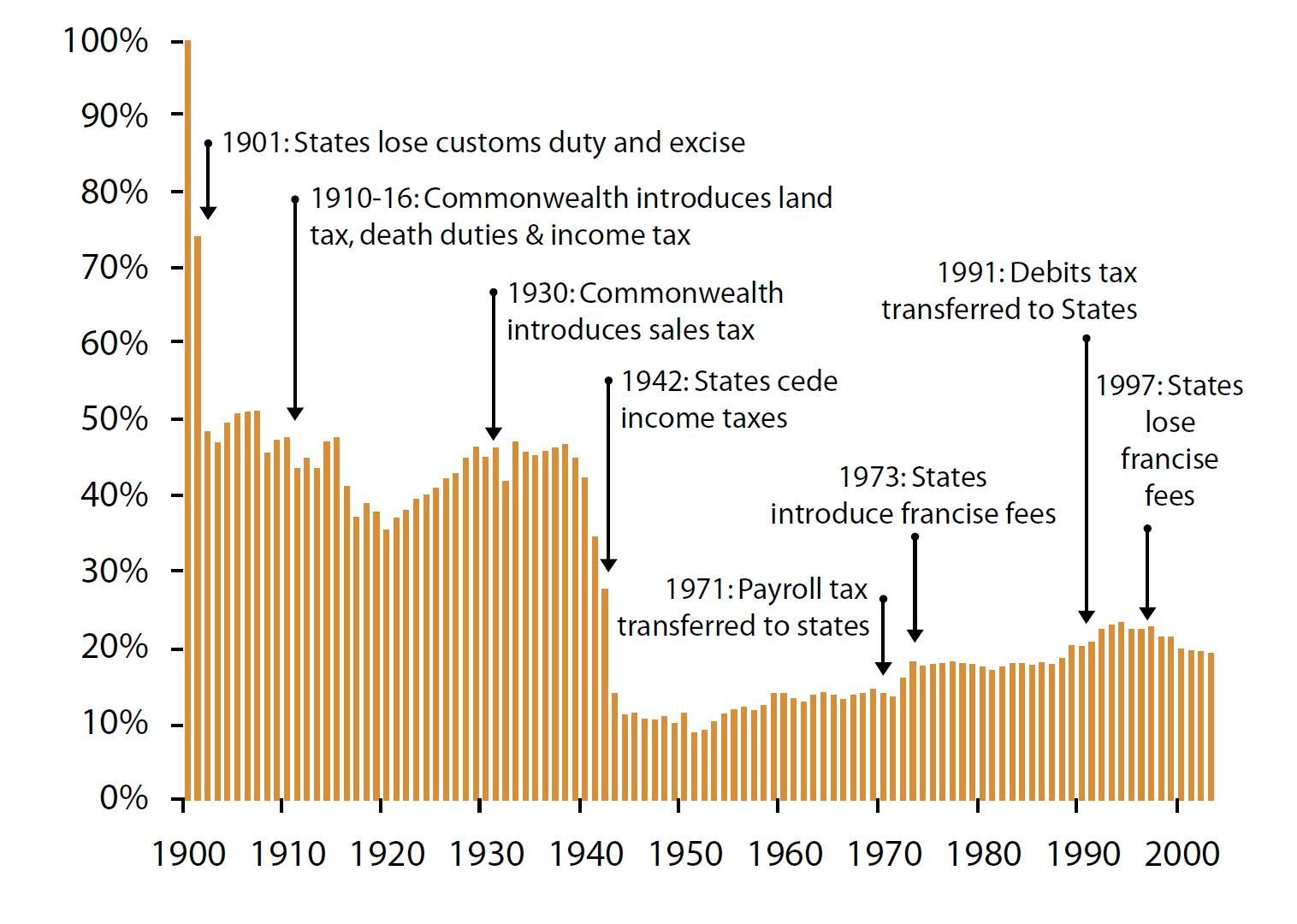
Between 1910 and 1942 the states share declined largely as a result of the expansion of the Commonwealths tax base.  In 1942, the states' share decline sharply as a result of the Commonwealth taking over income taxing powers from the states.  This was initially put forward as a temporary war measure, but remained.

The states were "given" a series of new taxes over the succeeding 50 years;  including payroll, franchise fee, debit tax, and more recently the GST (though neither the Commonwealth or the States claim this tax for themselves).  These new taxes did allow their share of the tax base to increase from its low of 8 per cent in 1952.  Nonetheless, the states' share of tax revenue remains much lower than that envisaged by the Founders and is once again declining.

The so-called vertical fiscal imbalance -- the difference between spending and revenue raising at Commonwealth and State levels -- is large.  It is much larger than in comparable federal nations.  (Figure 2)

Figure 2: Vertical Fiscal Imbalance, Ratios.  Own Source to Own Purpose Outlays
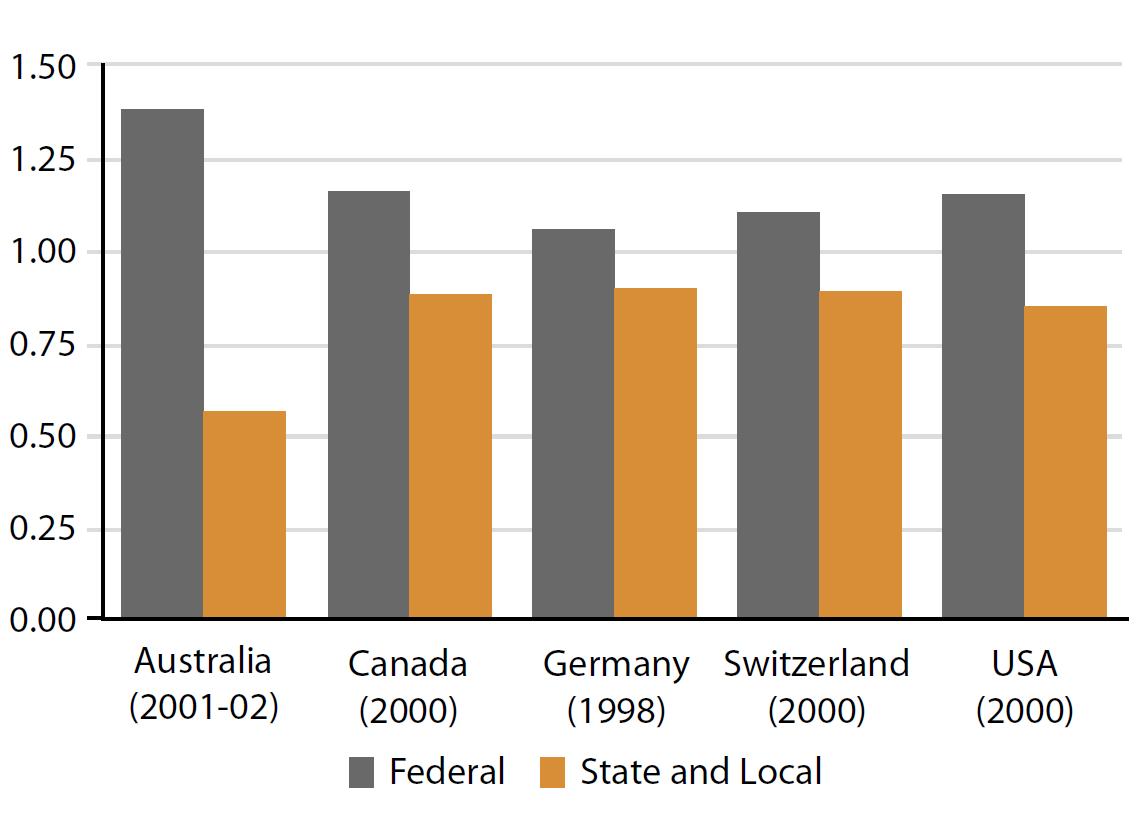
The critical assumption that underlies the benefits of a federal system is that each level of government is responsible for raising its own funds.  In order for competitive federalism to work the states must have the powers to vary their taxing and spending policies to compete for economic activity.  If the Commonwealth raises the bulk of tax revenue in a nationally uniform manner, then the potential for this competition is muted.  If central government collects money from all to provide service to a limit number then free riding is encouraged.

The potential for a federal system to act as protection against the accretion of power is dependent upon revenue raising being shared across the jurisdictions according to their responsibilities.  If the central government retains spending power far in excess of it own spending requirements, as is the case in Australia, its powers are not limited but augmented.

Importantly the GST has significantly increased the dependence of the states upon the Commonwealth.  (Figure 3)

Figure 3: Revenue Sources, All States, 1999-2000 and 2005-06
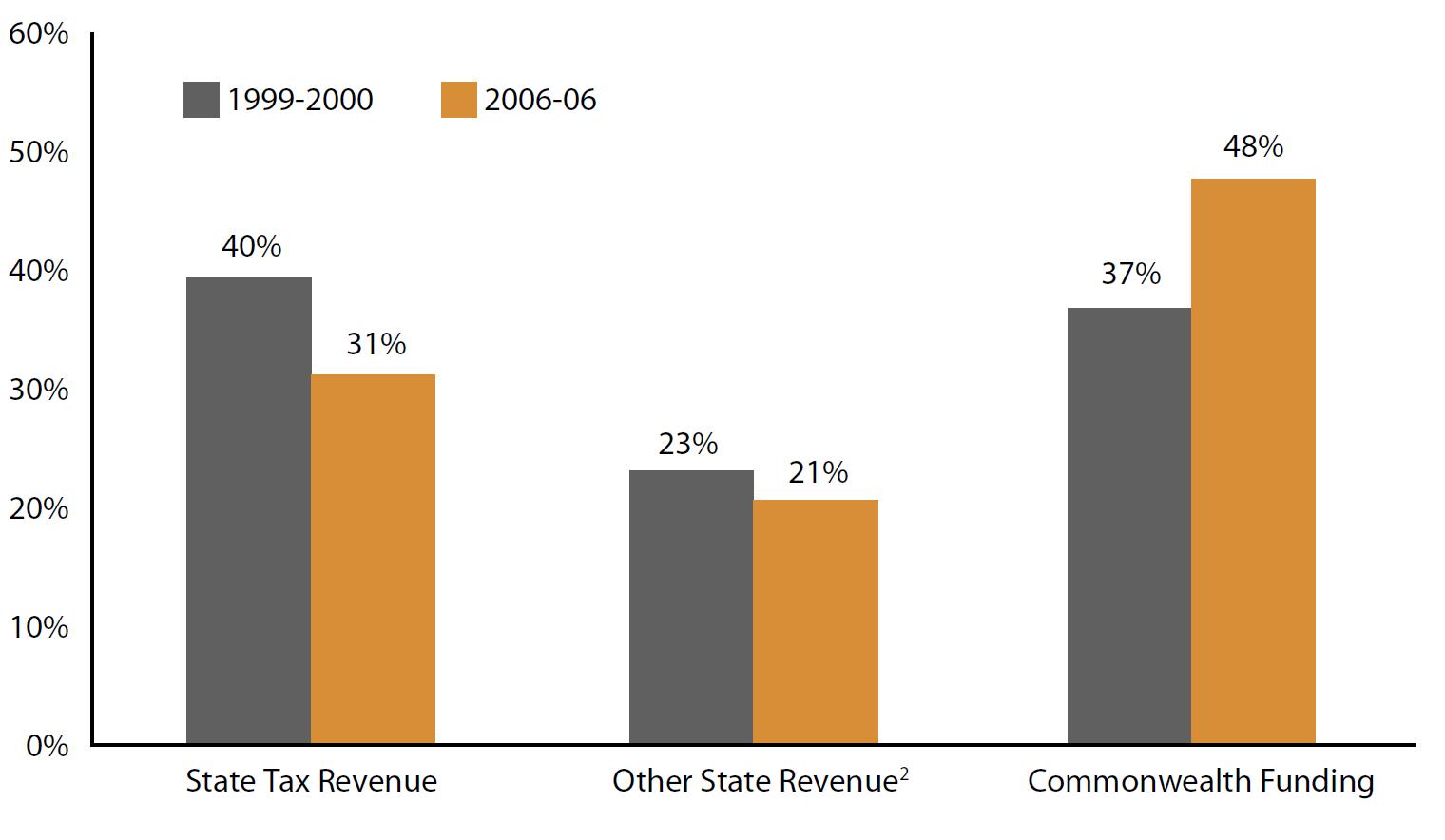
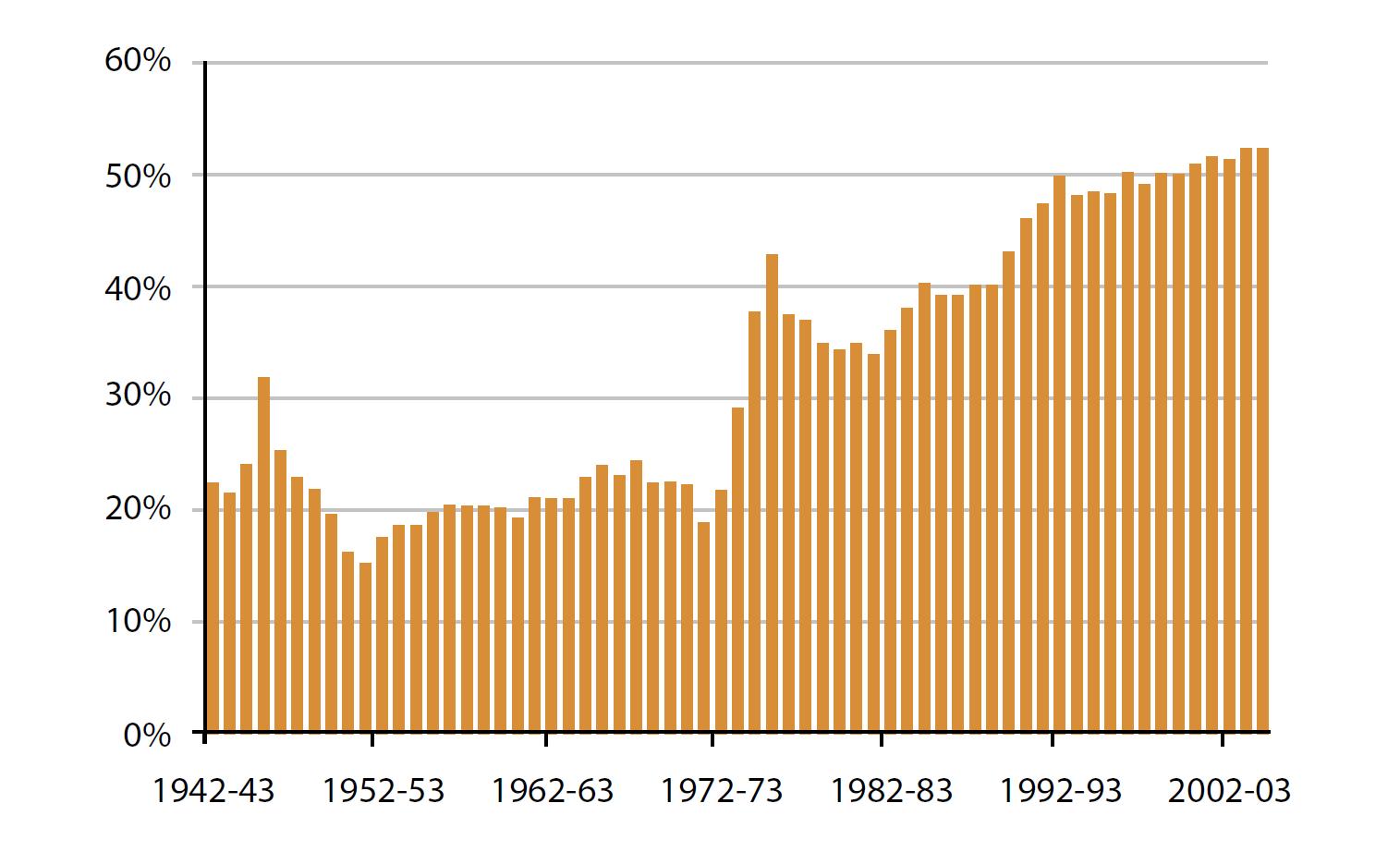
The Commonwealth has used this control over the taxing power to become involved in spending activities of the states.  The share of Commonwealth Grants with strings attached has grown dramatically.

It has increasingly used its control over the public purse and its constitutional powers -- particularly its external affairs and corporation powers -- to directly takeover state powers.

As a result, the Commonwealth and the states share responsibility for over half of the functions provided by the public sector.  This has not only blurred the lines of responsibility but has resulted in most areas being run by large bureaucracies.  It has also led to wasteful levels of overlap and duplications.

The best, and really the only, detailed research on the extent of overlap and duplication in the public sector was undertaken by us ten years ago. (5)  It found that in 1995-96 there were 466 separate inter-government sub-committees involved in managing Commonwealth tied grants to the States, each with different and often complex rules.  The study also found that parliaments, particularly state parliaments, played a minor role in authorising administrative arrangements, setting objectives and assessing the performance of the grants.  Instead of being responsible to democratic bodies, programmes were in the main initiated and managed by the bureaucracy.

In a separate study, the National Audit Office concluded that "for many programmes [tied grants] accountability to the Commonwealth is poor". (6)  State programmes are far worse.  The study also found that few tied grants had clear performance objectives and that their matching requirements bore no relationship to the spillover effects that they were supposedly meant to address.

To add to this is the allocation of general purpose grants administered by the Commonwealth Grants Commission (CGC).  The CGC methodology aims to provide each state and territory the financial capacity to provide a uniform set and level of services irrespective of differences in cost and revenue raising ability.  This set of services is very comprehensive, including debt levels and superannuation liabilities.  The benchmarks used in the assessment are based on current policies and cost structures.  The benchmarks do not consider best practice, efficiency or effectiveness.

The methodology is designed to be policy neutral.  But of course it isn't.  Instead, it provides an incentive for uniformity, it compensates for inefficiency, it dulls the incentive for reform and experimentation, and it facilitates expansion in the size and function of government.

More money is now being poured through the system than is needed.  Even if one accepts the need for equalisation through the CGC, the $37 billion in GST revenue now being allocated is far in excess of what is needed to achieve an equalisation of capacity.  The over-funding further distorts the incentives to State governments.

It is wrong to assume that the erosion of fiscal independence of the states has been totally foisted on the states by the Commonwealth.  While the states have -- at times -- resisted the process, they have more likely to either quietly accept it or actively promote it.

Sir Joh's famous statement "the only good tax, is a Commonwealth tax" was not made as comment on optimal tax policy, but rather his desire for the Commonwealth to "pluck the goose" for him.  This view has been widely held by Premiers through history.

The CGC process is of the states' making.  And as the Howard Government has made clear, it is in the states' collective power to reform it.

It is also wrong to see all the efforts of co-operation amongst government as wrong.  Over the last 100 years some powers have naturally and appropriately migrated to the Commonwealth.

Some degree of co-operation is necessary between government -- for instance agreement as to the rules under which states compete.  A good example of this has been the National Competition Policy process.

Nonetheless, the centralisation of taxing and spending powers and the intermingling of responsibilities have grown far beyond the requires of an effective federal system.

Figure 4: Special Purpose Payments, % Total Payments to the States

SUMMARY

While federalism has the potential to be the optimal system of government for a modern Australia, the current system falls far short of that optimum.

In order for competitive federalism to work, states must be responsible for raising their own revenue and controlling their spending.  Under the Australian system they do not.

The signs of a failing federal system abound.  Innovation in the provision of state services has ground to a halt.  The focus of all states, now that the GST has delivered the growth tax wanted, is on spending.

States are receiving near record revenue growth -- an average of 8.5 per cent per year over the last few years.  This has been generated by a booming economy, the GST, and high rates of state taxes.

Despite their overflowing wealth, the States have shown an intense unwillingness to reduce taxes, even those that are small, destructive relics of the pre-GST era.

Instead, the States are spending money on virtually everything.  State spending over the last two years has been growing at 8.6 per cent per annum.  Public servant salaries have been growing at between 5 and 7 per cent per year and in some states the salaries bill is growing at a rate of in excess of 10 per cent per year.

Innovation in the state sector has ground to a virtual halt.

Most of the reform that is coming through is being forced on the states through the lure of National Competition Policy (NCP) money.

Moreover, there is growing trend amongst state governments to seek national agreements which limit the scope for policy variation.  In short, they are colluding to limit competition.

Of course, the good economic times have lured the states into complacency -- the money is easy, so they take it easy.  But there is little doubt that the perverse incentives of our crippled federal system is encouraging them down this route.


WHAT TO DO

Supporters of a functioning federal system must seek to go back to something close to the original constitutional settlement, where the states were responsible for the majority of government powers -- and were required to raise their own funding.

Such a reconstituted settlement would mean:

  • states regaining access to a share of income taxing powers
  • far fewer funds distributed through the Grants Commission's process
  • special purpose grants and inter-government committees reduced in number and made more outcome focused and transparent.

This should be the agenda.  The redesign of the federal system will require a concerted effort as well as leadership and institutional support.  Australians are a pragmatic lot -- change for its own sake is not in the Australian nature.  While many recognise in a general way the failings of the federal system and the need for its reform, they need to be convinced of a workable alternative.

Moreover, given the current tax and spending policies of the states, I doubt that many people would want to hand the states even partial control over income tax.

The initial leadership for reform of the federal system must come from voters and specifically from policy-makers -- the individuals and organisations which develop debate and market ideas.

During the 1980s and early 1990s reform of the federal system was on the agenda.  The rationale and agenda for reform was widely debated and supported, albeit not uniformly.  The result was two major attempts at reform of the federal system -- the Hawke New Federalism Initiative of 1990 and the National Competition Policy initiative of 1995.

During the last ten years, federalism has fallen off the agenda.  But there is now movement again.

We plan to re-enter in the debate with the re-establishment of the States Policy Unit.  The Chamber of Commerce and Industry of Western Australia has also been a long standing participant in the debate on improving the federal system.  It plans to soon release a document on the issue.  Similarly the Productivity Commission has organised a conference on productive reform in the Federal system later this week.

It is also vital that academia be brought back into the debate.  With the demise of the Federalism Centre at the Australian National University, research on federalism at Australian universities has waned.


THERE IS THE NEED FOR GREATER SCRUTINY OF STATE SPENDING AND TAXING POLICIES

As Professor Walsh (former Director of the ANU's Federalism Centre) recently stated,

"... competition must ultimately be explained by citizen-voters using some form of benchmarking of their State government against others, and that this is what effectively make state governments compete with each other". (7)

The benchmarking work undertaken in the past by us, CCIWA and others played a vital role not only driving competition between states but enhancing state accountability.

The states face a veritable army of social advocacy groups whose survival lies in keeping the government funding taps open.  These groups not only act as lobbyists for more spending but assist the states as they seek more money from the Commonwealth.  At the same time the states -- who employ the majority of the country's public servants -- are under the thumb of public sector unions like never before.

Advocacy groups and public sector unions are very satisfied with the status quo.  Money is more easily extracted from unaccountable governments than those that must directly face their taxpayers.


THE STATES WILL AGAIN BE BENCHMARKED

Eventually states and the Commonwealth Government must jointly take on the mantle of leadership.  To be successful, leadership must come from both levels of government with support of the major parties.

This will not be easy.  The current federal government has many centralist tendencies.  The Labor Party -- which is in government in all States and territories -- has been at best agnostic towards federalism.

While all governments recognise that the system is not working well and is holding back essential reform, few have been willing to wear the political cost that comes with change.

The redesign process must include reform to the CGC process, re-alignment of roles and responsibilities, and strengthened competition policy.

The states need to take the lead on reforming the Grants Commission process.  This will not be easy, as the smaller states and the territories have become highly dependent on interstate subsidies.  But it is clearly necessary, and there are a range of options readily to hand

The process of redesigning the federal system must avoid a narrow "states rights" perspective.  States do not have rights, people have rights.  States have roles and responsibilities, which change over time.  Indeed, they have changed significantly over the last 100 plus years.  Thus the process must include a pragmatic review of the role of the states not only of their relationship with the Commonwealth, but also with regard to their own citizens.

As the CCIWA recently pointed out, "the concept of subsidiarity ... has broader implications and applications than managing the boundaries of government jurisdictions.  It means that government should not interfere in the activities of individuals, families, businesses and civil society except where these are not capable of effective self-management or where their activities might spill over to affect others". (8)

Governments -- state and federal -- have interfered too much.  It is time to begin peeling back the role of government by placing greater reliance on competitive markets, innovation, and individual responsibility.

This process has begun but needs to be expanded and accelerated.

Any reform of the federal system must facilitate this, while at the same time realigning the role and responsibilities between the levels of government.

Two areas stand out for realignment:  health and schools.


HEALTH

The Australian health system remains mired in bureaucratic control.  It suffers from the undue influence of medical providers, its balkanisation into over 60 different programs, and its funding source -- largely Commonwealth through a mishmash of uncapped budgets and run-away entitlements.

The states' role in health has largely been relegated to owning and managing public hospitals -- which in turn are half funded and indirectly controlled by the Commonwealth.

It is time to move to an unified national health market driven by individual needs and with a diversity of competitive providers.  The role of the states would change radically under such a system.  They will no longer be required to fund it.  They may wish to continue to operate public hospitals but as businesses paid for by user charges.  Some states may wish to convert their hospitals to non-profit organisations or to privatise them.  They will necessarily retain a role in planning and over sight of the heath market, but broadly speaking, their role in health would greatly be reduced.


EDUCATION

Currently, the Commonwealth's role in primary and secondary education is limited to providing quasi-vouchers for non-government schools, providing some funding for government schools, and trying to ensure that national goals are met.

It is time to simplify these arrangements by shifting responsibility for funding and oversight of government and non-government schools to the states -- subject to meeting and reporting on a few valid national standards and to continue to make payment to non- government schools.

These changes -- the shift of health to the Commonwealth and schools to the states -- would greatly reduce overlap and duplication.  It also has the potential to substantially reduce the imbalance in spending and taxing.

In some areas -- where the role of state and federal government are inextricably intertwined and where a reform template is available -- the responsibility for reform should be part of a renewed mandate for the National Competition Policy.

With the funding set to run out soon, the initial NCP agenda is coming to an end.  Governments are currently considering what to do next.  All agree that the process was successful in inducing the states to put into effect market-based reforms more thoroughly and quickly than would other wise be the case.  Federalists might lament the need for a national approach and the need for fiscal inducement, but given the distorted incentives in the federal system it was probably necessary.

The NCP has enhanced the status of the states by buttressing them against the slide into dirigisme.

The NCP's core principals -- transparency, market-based competition and measurement of cost and benefits of regulation -- are simply the underpinnings of good government.  These principals can and should be applied to a wide range of government services.  A nationally coordinated approach is particularly suitable for those areas where the roles of state and federal governments are inextricable intertwined and where there is a agreed reform agenda.

For instance, suitable candidates of an expanded NCP are vocational education and aged care.

Environmental policy is another area where all levels of government interfere with each other, often resulting in illiberal and duplicative policies.  The states are particularly guilty of undermining basic rights, including the protection of private property and due process.  The Commonwealth's approach is a little better, but not much.  However, rather than trying to improve the approach of the States, the Commonwealth invariably seeks to duplicate and/or override the states to impose uniformity

Here expanding the NCP process of subjecting environment regulation to cost -- benefit analysis and requiring market-based approaches may be helpful.

For environment policy however, the real solution lies with constitutional reform at the state level.  While the Australian Constitution places limits on the Commonwealth's ability to take property without compensation, state constitutions do not.  This needs to be addressed.

A debate about state constitutions would also facilitate wider public dialogue on the role of the states -- essential to renewing the federal system

In the end, the key reform will be for the states to be able to level an income tax through the Commonwealth system, as in the United States.  Only when the states are responsible for raising a greater share of their own revenue can a federal system function properly.

There is work to do, and federalists must get to the task.


REFERENCES

1.  The next two sections draw heavily from:  Wood, R.J. (1996), Restoring the Balance:  Tax Reform for the Australian Federation.

2.  Buchanan, J (1975), The Limits of Liberty:  Between Anarchy and Leviathon, Chicago:  Chicago University Press.

3.  Wood, R.J. (1995), Competitive Federalism:  Promoting Freedom and Prosperity, Federalism Issues Paper No. 3, January.

4.  Walsh, C. (2005) Competitive Federalism:  Wasteful or Welfare Enhancing?, Productivity Commission Roundtable:  Productivity Reform in a Federal System, October.

5.  Wood. R.J. (1996), Roles and Responsibilities in the Australian Federal System.

6.  ANAO (1995), Specific Purpose Payments to and through the States and Territories' Report No. 21, 1994-95, Australian National Audit Office, AGPS.

7.  Walsh, C. (2005), page 23.

8.  CCIWA (2005) Federalism in Australia:  A Discussion Paper, Chamber of Commerce and Industry of Western Australia, Draft, September 2005.

Friday, October 21, 2005

Nuclear waste site in outback makes cents

The Northern Territory Chief Minister, Clare Martin, has said she will fight "tooth and nail" the building of even a small nuclear waste facility in the Territory.

Australia produces nuclear waste at Lucus Heights., where the Sydney facility undertakes nuclear-related research including for diagnosing and treating cancer, Alzheimer's and multiple sclerosis.

The preferred site for the Lucas Height waste, which is apparently a Federal Government responsibility, is Woomera, but the South Australian government has said "no".

The Northern Territory looks set to end up with the waste facility because the Commonwealth can force it on a Territory.

This issue alone has both sides of politics in the NT united against the Federal Government.

There will be risks associated with the storage of nuclear waste, but as I see it, the stuff needs to be stored somewhere.

While the state and federal governments argue about what to do with the relatively small amount of waste from Lucas Heights, others worry about waste from the 440 commercial nuclear power reactors currently operating in 31 countries across the globe.

These nuclear reactors include power stations which supply 17 per cent of the world's electricity without producing the greenhouse gases associated with the use of coal and other fossil fuels.

A few weeks ago former Prime Minister, Bob Hawke, suggested Australia should take the whole world's nuclear waste.

He said it would be an act of environmental responsibility and economic sanity.

Countries can apparently earn more from storing waste than selling uranium, and when you think about it, no where is as safe as outback Australia.

We live in a politically stable country and outback facilities could be made very secure from terrorists.

Places like the US, Japan and Pakistan are on fault lines and are thus geologically unstable -- in contrast outback Australia sits on a single tectonic plate.

Also, correctly managed, arid regions can be made safe from bushfires and the corrosive potential of dripping water.

Outback Australia is away from the sea and the risk of tsunamis.

The environmental movement once promoted the slogan "think globally, act locally".

It is perhaps this concept that Bob Hawke had in mind when he made the suggestion that we take the world's nuclear waste.

I wonder whether Clare Martin, would reconsider the proposal if it was about taking waste from, for example, her near neighbor Indonesia, rather than from Sydney?

Indonesia has three nuclear reactors, but so far no nuclear power stations.


ADVERTISEMENT

Tuesday, October 18, 2005

The Energy Efficiency Opportunities Bill 2005

Submission to the Senate Economics Legislation Committee


"Ladies and gentlemen, the Treasurer and I have called this news conference to announce the appointment of a taskforce to identify practical options for alleviating the compliance burden on businesses from Commonwealth Government regulation.  The taskforce will examine and report on areas where regulatory reform can provide significant, immediate gains to productivity and for business.  Regulation is necessary to protect the public interest but it can become too burdensome and there has been a growing chorus of concern expressed by both small and large businesses about the regulatory burden."

The Prime Minister's Press Conference, 12 October 2005


ENERGY REGULATIONS AND RED TAPE

At a time when the Government has just launched its Task Force to reduce the regulation on business, it is simultaneously introducing new measures like the Energy Efficiency Opportunities Bill which will needlessly intensify that regulation.

It is an unfortunate commentary on the efficiency of government that no conflict is apparently recorded in the simultaneous pursuit of goals that on the one hand seek to reduce the impost government has on business efficiency and on the other seek to impose a greater impact.  It is even more regrettable that the increased regulatory activities require firms to take measures in their own interests on matters and in ways in which the government itself has scant information.


DEVELOPMENTS IN ENERGY USE

The events that centred on oil in the 1970s led to the development of a quite massive change in attitudinal approach to energy.  The effects of higher crude oil prices on overall energy prices in Australia were moderated by a switch to coal, the cost of which has risen less than that of crude oil.  Other countries have also seen their aggregate energy prices moderated by coal (and, in many cases, nuclear energy) assuming an increased importance.

The switch in energy use over the long term was founded upon a general view that the OPEC oil cartel, supported by a scarcity of low cost energy, would bring a steady increase in the price of energy.  The attitude change also had concrete effects in bringing a rapid shift of demand into existing and innovatory energy saving methods and of research and development effort into energy efficiency improvements.

The ensuing introduction of energy saving technology and supply side economies appear to have broken the previous relationship between GNP growth and energy growth.  Prior to the early 1970s, the use of energy in developed countries increased more rapidly than real levels of income.  Since then, energy growth has been below the growth in real GDP.

For Australia, between 1973/74 and 1990/91, energy consumption increased by only 51 percent compared with a growth of GDP of 63 percent.  This represents a ratio of energy use to GDP of 0.8:1.  Moreover, the reduction took place in spite of a rapid expansion of energy intensive industries like aluminium that took place as the industry migrated from Japan to lower cost energy locations like Australia.

The trends to lower ratios of GDP to energy are expected to be maintained.  Over the medium term ABARE forecasts an annual growth in energy demand in Australia of under 2 per cent, only two thirds of the average 3 per cent annual GDP growth forecast. (1)


THE EVOLUTION AND MERITS OF GOVERNMENT
ENERGY SAVINGS POLICIES

Prior to the 1970s energy crises, the focus of government policies towards energy was in regard to exploration and, given its inelastic demand, taxation.  This changed markedly from the mid 1970s.

Government policy of promoting energy saving had their genesis in the long discredited Club of Rome notions that the world was about to run out of energy and many other resources.  This gradually infiltrated government thinking and was the basis of many of the energy saving regulatory polices that are in place today.  Among these are the star system for refrigerators, and regulations covering other domestic appliances.

No sooner had the excitable claims about an energy crisis been dampened by reality when the greenhouse scare emerged.  Without skipping a beat the same pressure groups that once urged us to conserve energy to prevent its depletion now told us that government must regulate to prevent carbon dioxide emissions building up.  The policies to prevent energy use were pulled off the shelf and mutated into policies to reduce carbon dioxide emitting energy use.  Government under pressure from the elites in the media (and in some cases persuaded by the arguments) acted to implement a new phase of regulatory measures.

Stemming from these developments there arose a plethora of regulatory measures targeted particularly at energy conservation.  These gave expression to some politicians' views that they are better able to recognise what is good for businesses than firms' managers and directors.  Thus, in his Earth Day address back in 1993, President Clinton offered a view that lower use of energy is beneficial in itself.  He said that energy savings mean there is, "More to invest in new jobs and providing better living standards".  In a statement that he would obviously not wish to be remembered for, he suggested that higher energy efficiency is, "One of the reasons why over the last couple of years, for example, the average German factory worker has come to make over 20 per cent more than his American counterpart".  It is doubtful that Mr Clinton, or those writing his speeches, would now view the reversal of the productivity gap between Germany and the US as evidence of the benefits of increased per capita energy consumption.

In truth, it is very easy to sacrifice overall efficiency on the alter of energy efficiency.  European energy usage is less than that of the US (or Australia) because of energy taxes and the different availabilities of local low cost energy sources.

Obviously, raising the price of energy means less will be used.  But this is no more a contribution to efficiency than are Japanese and European agricultural policies raising domestic beef prices and reducing its consumption.

Although reduced energy use per unit of output, like reduced labour input or reduced raw material input, brings gains to productivity and to real incomes, the means by which the reduction is achieved is critical in determining whether or not it is real.  Government imposed cost increases for one input will lead to substitutions away from it.  But this is very different from saying they will bring net economies.  Gains to income levels are best achieved through the government adopting a neutral stance on their attainment.  Cases where markets, left alone, fail to achieve the best outcomes are much rarer than many choose to think.

President Clinton's remarks refer to a partial concept of efficiency, one that focuses entirely on the use of energy.  Yet, greater energy use may be more efficient than conserving energy if it results in a lower use of other factors of production.  That Clinton's view is widely shared reveals deep popular misunderstandings of the nature of market forces and of demand.  They are posited on the notion that government measures are required to combat adverse decisions taken by individuals in the marketplace.  However, satisfaction of demand brings benefits;  where regulation, forces managerial resources to focus attention on a particular area of business will shift demand and supply and result in output migrating to less productive sectors.

Where any one input into production and its supply is required to receive special attention, other inputs are denied attention by an equivalent amount.  The blend of inputs is shifted away from those with the lowest costs;  and consumers' preferences no longer fully determine final outputs.  These distortions reduce the economy's level of real income.  They bring some consumers to shift their purchases to goods and services that they would not have chosen in the absence of the differential tax rate.  And they rearrange relative costs, causing producers to shift their own purchases to inputs that would give less value if goods were treated similarly.

In some cases, these outcomes are the very ones that governments want to bring about, as they consider themselves better judges of individuals' true interests.  This can be true if there is inadequate information on which individuals can base their decisions or if there are monopolistic situations in the market.

The case for the sorts of taxes that President Clinton's Earth Day remarks may presage rejects this view.  It rests on the government being superior than the market at collecting and sifting the complex amalgam of information on costs, preferences, and changes in demand and supply.  The absence within governments of the strong personal interest that individuals have in obtaining the best value for their money, and their frequent bending to the power of interest groups makes this unlikely.

Moreover, under close scrutiny the sorts of claims of major savings becoming possible if there were less consumer ignorance have been shown to be groundless.  People's decisions on matters like avoiding up-front expenditures that save future on-going costs are generally in accord with their budget constraints and the risks and opportunities that they face with their outlays.  For example, many people have avoided tying up capital in innovatory new lighting systems, even though it could be demonstrated that future savings offer a high return.  Such actions reflect a need to avoid being locked into one form of capital when the future might bring something even better.  Such measures receive even greater scrutiny in business situations where people are specifically tasked with taking a view on the most productive course of actions.  Moreover, in so being tasked, there are abundant opportunities for those seeing to win business from them to point out the savings available by adopting a different expenditure pattern.


THE ENERGY EFFICIENCIES OPPORTUNITIES BILL

As the paper accompanying the invitation to offer submissions to this Review has noted, the Productivity Commission has expressed grave reservations about the Energy Efficiencies Opportunities Program. (2)

According to the Explanatory Memorandum (the Regulation Impact Statement) circulated by the Minister, there are many available free lunches, of which private sector businesses are unaware.  Essentially, according to the framers of the RIS, business firms, not having the same level of skill that the public servants who have drafted the RIS claim for themselves, should be required to undertake measures for their own shareholders' good.  We would not support this conclusion.  On the contrary, we consider it risible to imagine that a government agency without the day to day operational responsibility of managing businesses and without the motivation that comes from private sector pursuit of profits can know better what is in firms' interests than their management.

The RIS, in arguing that there are major savings from the regulatory route proposed draws upon information prepared by Victoria's Environment Protection Authority (EPA).  The EPA is charged with implementing the Protocol for Environmental Management (PEM) as part of its Greenhouse Gas Emissions and Energy Efficiency in Industry Program.  Under the PEM, EPA license holders are required to undertake an energy audit if usage and emissions are above threshold values.  All identified action items that provide financial payback within three years or less must then be incorporated in action plans and undertaken.  Table 1 illustrates the anticipated GHG savings from action plans approved to date.

TABLE 1:  Anticipated Annual GHG Savings -- EPA PEM Program

Action CategoryNumber of ActionsGHG emission reductions, (kt CO2-e/yr)
Air conditioning / heating / refrigeration / ventilation12056.7
Appliances / office equipment150.4
Boilers / steam plant / steam reticulation18899.8
Building construction / modification182.7
Compressed air systems23240.8
Energy management systems30073.7
Hot water systems344.7
Industrial / manufacturing process modifications517374.6
Lighting30543.1
Plant drives (motors)27882.2
Power generation105.59
Other62123.6
Non-energy related45134.0
TOTAL2,1241,041.8

Greenhouse Gas Emissions And Energy Efficiency In Industry -- EPA Victoria's Role In The Victorian Greenhouse Strategy, John A Marsiglio


The report estimated that these measures will achieve financial payback between 1.5 to 2 years on average, with a net financial saving of around $30 million per annum.

It is it is unusual for such savings opportunities to be discovered by government agencies and their existence would mean the Directors of the businesses concerned have been ignoring profitable opportunities to improve the wealth of their shareholders.  There is now a very broad consensus agreeing that private sector provision of business outputs is more efficient than public sector provision.  Accordingly, legislators should examine critically claims that the latter have insights that would allow them better to operate the formers' businesses.

The RIS takes two lines of argument.  The first emphasises the market failure of corporate ignorance.  The second addresses the externality benefits that regulation might bring but the RIS itself does not estimate these or discuss them other than in passing.

In developing its case for regulation, the RIS argues, "While the relatively lower price of energy in Australia may explain some of the difference, Australia has lower rates of energy efficiency improvements than countries with similar energy prices, such as Canada and the USA".  No evidence is provided for such a sweeping statement.  If this is true (and not simply a result of the different aggregation of supply within GDP), the statement would seem to suggest that there are shortcomings in our nation's entrepreneurial culture.  This would, indeed, be a grave issue facing the nation.

More generally, the paper claims that there is an "energy efficiency gap".  The Commonwealth's RIS on this matter, to demonstrate that its authors have read the requisite literature says,

"The existence of an energy efficiency gap may appear counter-intuitive.  Generally, firms would be expected to take up cost-saving energy efficiency opportunities without any need for government intervention.  Firms which use large amounts of energy would have a particular incentive to increase energy efficiency and reduce their input costs."

As is typical of such pieces of work designed to prove the need for regulation, the RIS then says that, "However, empirical evidence has established that an energy efficiency gap exists.  There are a number of possible explanations for the energy efficiency gap.  These include:

  • Market failures, including imperfect information, split incentives and externalities;
  • Organisational failure and behavioural norms;  and
  • Other reasons, including hidden costs". (4)

The sophistry such statements encapsulate is breathtaking.  The RIS simply entails trotting out the textbook reasons for non-intervention to disarm future detractors by maintaining that it is on the right wavelength before proceeding to undermine the reasons against government intervention with spurious empirical data.

This has been the classic approach used by all pro-regulationists.  Historically, those favouring protection would assure everybody that they were in favour of free trade -- with its demonstrable income enhancing features -- but, for reasons like those sketched out above, would maintain that the particular industry for which they were batting was different.

In support of the regulatory requirements, the RIS refers to a report quoted in the PC Draft Report on Energy Efficiency by Energetics.  This argued that over 90 per cent of firms with annual energy bills exceeding $5 million did not do what Energetics regarded as being adequate energy management diagnostics.  Doubtless encouraging firms to do more such diagnostics would proved beneficial to Energetics and this might have given the authors of the RIS cause for concern about the dispassionate nature of the advice.

The RIS then constructs hypothetical scenarios on the basis of which it estimates major savings to the economy (and to the firms on which its regulations are imposed).  These involve three options (5) against which totally fabricated estimates of savings are made.  On the basis of these a net benefit is claimed in Net Present Value terms of between $239 and $497 million for Option 2 and $279 and $557 million for Option 3.  This extrapolation of fanciful assumptions to detailed pseudo-scientific estimates provides no basis for supporting the Bill.  Rather, it underlines the considerable politicisation inherent in government agencies' decisions, a politicisation that is one reason why government businesses are seldom able to compete successfully with those of the private sector.

The PC's Draft Report on Energy Efficiency discusses many reasons why firms and individuals do not wait to assemble all the possible information before making a decision.  The notion of "bounded rationality" helps to explain why perfection is never achieved -- in order to thoroughly examine all options before taking a decision would require spending inordinate amounts of time.  It makes sense that decisions are made on partial information and that the more important a decision is, the greater the amount of time spent acquiring and processing information.  Thus we spend more time assessing our needs and the offerings available in buying a house or a car than in buying a computer.  In the case of very low cost goods we may spend hardly any time -- some may be "impulse" purchases.

The PC (p. 93), drawing on research from ABARE also marshals evidence that half of the recommendations of energy audits are not taken up.  This is thought to be because the implementation costs are not adequately recognised by the audits.  It also suggests that there may be some double counting in the cost saving estimates.


CONCLUDING COMMENTS

It is instructive in this regard to recall the words of Arthur Seldon, the immensely influential recently deceased head of the British IEA, who confronted the frequent cry of "market failure" with the charge of what he called "incorrigible government failure".  The trouble he diagnosed was "that politicians are not generally saints pursuing the long-term public interest, but party politicians responding to demands from organised lobbies". (6)

The cynical would argue that the proposed provisions were put in place as a sop to those seeking more draconian measures like steeper energy taxes.  They would maintain that the obligations to be put in place are unlikely to entail significant costs since most firms should carry out energy audits in any event.  Requiring actions simply to allay misplaced concerns and to forestall even more onerous regulation impact may be preferable to the sort of policies that those same concerns have fostered in the EU, particularly Germany with its aggressive energy taxes and consequential economic lassitude.

Even so, putting in place a set of second best requirements is hardly a noble and efficient basis for the formulation of government policy.  Passing legislation on the basis of palpably deficient evidence placed before it sets a poor standard for Parliamentary democracy.


ENDNOTES

1.  Australian energy:  national and state projections to 2029-30, ABARE eReport 05.9

2.  Productivity Commission, Energy Efficiency, Draft Report, April 2005

4.  http://www.comlaw.gov.au/comlaw/legislation/bills1.nsf/0/0285C33447F2CF3BCA25707D00062087/$file/05158em.pdf (p. 9).

5.  Option 1 is the status quo scenario;  Option 2 is the initial proposal for a mandatory scheme, entailing assessments with minimum performance standards;  Option 3 is the revised proposal for a mandatory scheme, without minimum performance standards.

6.  http://www.telegraph.co.uk

It's enough red tape to sink a ship

It is ironic that the Prime Minister has chosen Productivity Commission chairman Gary Banks to head his new red tape taskforce, when it has recently issued a report calling for new regulatory intrusions in the provision of liner shipping.

Reversing the position it took five years ago, the commission now says that liner shipping conference agreements should be subject to the general provisions of the Trade Practices Act.  Regular liner shipping carries nearly half our exports and 80 per cent of imports.  Conference agreements between independent shipping companies involve them collaborating to service a particular route with a uniform freight rate and a schedule of sailings.  There are also other agreements between shipping companies involving looser arrangements.

The commission argues that all such agreements -- about a dozen conference agreements plus 70 other agreements -- should be scrutinised by the Australian Competition and Consumer Commission.  It says that agreements of this nature can be price-gouging, exploitative monopolies.

Conferences do not have a place on the very thin routes such as those between Australia and the Pacific islands, where capacity cannot justify multiple providers.  Nor are they as important for densely served routes (such as Europe-China and China-North America) where sailings are so frequent and competition so fierce that agreements on prices and schedules are unnecessary.  But they are ideal for many of the routes serving Australia -- they dominate our trade with the US west coast, Europe and, together with looser agreements, Asia.

The conference system has evolved over time as a means of allowing greater certainty and risk management.  It is about risk sharing for independent shipping businesses that do not want to put too many eggs in one basket of ports.  And it provides trade-enhancing risk reduction on the part of the producers, who have greater certainty about the price required for carrying their cargoes and that the capacity will be there to transport them.  In short, the system adds major trading benefits, especially to Australia with its remoteness from the world's major markets and production centres.

The commission recognises that benefits from conference agreements may be evident and argues that only agreements with explicit price-fixing or capacity management should require authorisation.  Even if looser agreements were to be exempt, in many cases, without price and capacity components, the supplier, domestic and overseas consumer benefits of a conference system is much reduced.

The commission's mind change on shipping conferences shifts it towards a crude parody of Adam Smith's economics, and it has slavishly adopted a line that companies allowed to make agreements will naturally collude to exploit the consumer.  It considers that such agreements could hold.  Unlike Smith, they think they may not collapse from being assailed by outside competitors sniffing a chance for good profits, or from their own internal tensions, due to the willingness of their participating companies to steal marches on each other if this pays better than co-operation.

The commission also has a touching faith in the ability of an institution as demonstrably cumbersome as the ACCC to exercise tutelage efficiently over a market with hundreds of suppliers.  It considers the ACCC's bureaucratic systems would be superior to the profit-searching activities of rival shipping providers.  As well as defying logic, the commission's fears defy 100 years' experience of shipping conference arrangements, whereby excess prices have never been able to be maintained by the participants.

Market forces will always unravel consumer exploitative monopolies.  This is especially so where the industry comprises a relatively homogeneous capital base (most liner ships are standard designs) and a straightforwardly organised marketing structure.  Globalisation, and the ease with which information is transmitted and to which producers can react, has reduced the need for the heavy-handed oversight that institutions such as the ACCC provide.  This is except, arguably, in sectors where a monopoly provides essential services, such as electricity.

One factor behind the more recent push by some exporters to have the ACCC regulate prices is a steep increase in freight rates for exports to Asia.  Because most of the liner trade is into Australia, competition meant exports from Australia benefited from very low rates.  This has changed as the world, in 2003, experienced a shortage of capacity and rates more than doubled in some cases.  The response has been a massive new shipbuilding program and doubtless, in real terms, rates will decline in future.  It is this, not regulation by the ACCC, which would bring lower prices.

The fact is that the parties in a shipping conference are independent, and undercut the prices agreed with their associates should those prices prove over-attractive.  They will do so even if this means the conference dissolves.  Moreover, there are multiple non-conference shipping providers eager to muscle in on a business that might offer higher than normal profits.  Both of these factors ensure that conferences will remain pro-consumer without any intercession by consumerist government-appointed busybodies building bureaucratic empires and gumming up the wheels of commerce.

Mr Banks may well be the best man to head the Government's red tape review, but the commission's recommendations on the regulation of liner shipping show that his own agency is often part of the problem.


ADVERTISEMENT

Right must take fight to the universities

The state of Australian conservatism is, in a number of respects, probably the healthiest it has been for many decades.  But in spite of the progress being made on a range of public policy fronts, there are no grounds for smug complacency by conservatives.  Much work remains to be done and, in some cases, the conservative cause is actually going backwards.

Business continues to be strangled by ever greater levels of red tape and regulation.  Welfare expenditure continues to grow during buoyant economic conditions when it should be falling.  Unemployment rates, while improving, are still too high.  Much of our previously healthy civil society has been crowded out by the encroachment of government at all levels and important social institutions, such as marriage and the family, appear to be in a state of slow but steady decline.

Perhaps the main intellectual and political task facing Australian conservatives is the need to make the case for smaller, less intrusive government and to restore the pre-eminence of such notions as personal responsibility and self-reliance in Australian society.  Recent events such as legislation to privatise Telstra, the announcement of a red-tape task force, and the impending industrial relations reforms are all steps in the right direction in this regard.  However, much still remains to be done, particularly with regard to taxation and the size of government in the economy, which remains far too high.

It is important to note that these recent announcements are all primarily economic in nature.  Another challenge for Australian conservatives is to bring about a renewed focus on social and cultural issues.

Given the nature of many of the social problems now apparent in Australian society in spite of many years of buoyant economic growth, there is a need to move away from a common mindset which claims that if you get the economy right, everything else will fall into place.  Economic growth, while helpful, is not going to be enough to overcome the problems of communities such as Macquarie Fields -- the western Sydney suburb hit by riots in March this year -- parts of which are suffering from cultural breakdown.

The starting point in coming to grips with social and cultural issues lies with the state of the universities, particularly the social science and humanities faculties.  Arts faculties in Australia and across the Western world have mostly abandoned their traditional role as the guardians and promoters of the Judeo-Christian tradition, as a result of being largely captured by the counter-cultural radical Left.

There has been an assumption that while the takeover of universities by left-wing radicals is annoying, it is of little real long-term consequence.  The assumption is that most students, upon joining the real world of work, will leave the infantile preoccupations of university behind them, resulting in little long-term damage.  Although there is a strong element of truth in this, a great deal of damage is nonetheless still being done to our culture by ideas coming out of universities.

Since their takeover by the Left, many universities have used their position to try to indoctrinate future generations of societal elites against the very values upon which our civilisation is built, which constitutes a total reversal of their original mission.  There is an urgent need to think of means that would restore balance to the universities and return them to their original role as the guardians of our civilisation and culture.  This is something with which conservative thinkers and policy-makers have not as yet come to grips.

Perhaps the most obvious example of the negative implications of the left-wing takeover of universities is the impact it has had on schooling.  As federal Education Minister Brendan Nelson has pointed out, many university education departments have now become little more than quasi-sociology departments.  Many of these departments teach their education graduates to see their mission as one of using education as a subversive vehicle to bring about radical social change, rather than to provide a traditional education for their students.  The result is a generation of schoolchildren who have been fed all manner of politically correct beliefs (such as black-armband history), but who are all too often functionally illiterate and innumerate and hence incapable of playing a full role in society.

The damage wrought to our culture by the Left is also becoming increasingly prominent in the growing number of badly dysfunctional communities in Australia, perhaps best typified by Macquarie Fields, which is, however, only one of many.  It seems reasonable to suggest that, in these communities, there has been a terrible cultural breakdown and a perversion of the important social values and civility that most Australians are thankfully still able to take for granted.

The challenge for Australian conservatives is to mount a sustained critique of the intellectual forces and government policies that have unleashed this chaos on our poorest and most vulnerable communities.  This is a project that has been undertaken to great effect by conservatives in the US, but strangely, similar progress in Australia has not occurred.

Most thinking about the problems of our least fortunate communities has instead by and large been left to socialist academics and the social welfare lobby.  Leaving this task to these representatives of the intellectual Left, which has been reduced to continually chanting the vapid slogan of social justice and asking for money to be thrown at the problem, has been nothing less than a total disaster for these communities.  The conservative critique of poverty and dysfunctional communities has much more to offer than that of the political and intellectual Left in this regard.  But most Australian conservatives do not take enough of an interest in these issues, perhaps finding the parts of society they personally inhabit to be more interesting and important than its other parts further out in the suburbs.  This is a great shame.

The final challenge facing Australian conservatism is to become better organised.  There remains a great gulf between the intellectual forces of conservatism operating in think-tanks, business groups and isolated pockets of academe on the one hand, and the political forces of conservatism sitting in the various Australian parliaments on the other.  There is a need for better communication and co-ordination between the intellectual wings and the political wings of conservatism.

The intellectual side of the conservative movement in Australia is also in an institutional mess.  There are too many small, underfunded organisations that are barely capable of communicating with each other, let alone providing a coherent, credible source of advice for potentially sympathetic policy-makers.  There is an urgent need for a larger, better funded and more professional conservative movement in Australia, possibly loosely modelled along similar lines to the successful movement in the US.


ADVERTISEMENT

Wednesday, October 12, 2005

IR Reform:  These are not radical changes

Prime Minister John Howard is a conservative, as is Industrial Relations Minister Kevin Andrews.  They are against change for its own sake.  They are, however, also politicians who want to remain in power and know that the key to doing so is sustaining economic growth.  Their workplace reform agenda illustrates both characteristics.  It is not a radical initiative in concept or detail.

Every proverbial backyard galah has been squawking about the need for workplace reform for more than 20 years.  Australia developed, behind protective tariff walls, one of the most restrictive systems of workplace regulations in the world.  It was a system developed primarily to redistribute wealth rather than create it.

Once the protective walls were pulled down -- by, let us not forget, Labor governments -- the writing was on the wall for the Australian industrial relations system.

Ideally, reform of the labour market should have preceded liberalisation of the goods and capital markets.  Unfortunately, Labor governments could not get the sequencing of the big-picture reforms right.  As result, workers bore a disproportionate share of the cost of structural adjustment in the form of higher unemployment and lower wages.

The Hawke and Keating Labor governments did recognise the need to move to a more flexible system.  The union movement, in the face of a declining industrial base and the need to be internationally competitive, also recognised the need for change.  But the labour movement has proven to be incapable of reforming the system.  Labor, in government federally, made numerous attempts at reform of the industrial relations system, but all were modest in scope and incremental in effects.

The Keating government's Industrial Relations Reform Act of 1993 did introduce an enterprise-based bargaining stream, but it turned out to be little more than a top-up arrangement.  Moreover, the act introduced unfair dismissal rights, which significantly increased the risk of hiring.

The Howard Government, under Peter Reith, tried to introduce more radical reform of industrial relations laws in 1996.  However, his attempts were in the large part thwarted in the Senate.  The subsequent act did introduce an individual agreements stream (Australian Workplace Agreements) and a more wide-ranging enterprise-based agreements system.  While these changes were positive, they were modest in impact as the act retained many restrictions to their application.  Reith also failed, after many attempts, to rectify the burgeoning growth of unfair dismissal claims.

At the state level, IR reforms followed a similarly thwarted path.  Following failure to get its proposed reform through Victoria's upper house, the Kennett government gave up and handed the state's industrial relations powers to the commonwealth.  In Western Australia, the Court government's reforms were eliminated in the end by its Labor successor, the Gallop Government.

During this period of thwarted reforms, just about every independent research group, including the Organisation for Economic Co-operation and Development, the World Economic Forum, the Productivity Commission and the Business Council of Australia, argued for more reform of Australia's industrial relation systems.

Moreover, while Australia has been going down a slow path to reform, other countries such as New Zealand and Britain have been more radical and successful in reducing unemployment.  On the other hand, countries such as Germany and France, which have maintained highly restricted labour laws, suffer high rates of unemployment.

Thus even a conservative must conclude that the IR system is in need of significant reform.  Howard has known this for decades and would have been pilloried in posterity if, on gaining control of the Senate, he failed to carry out the task.  Not just because it's the right thing to do but also because only his Government can do it.  The Labor Party, because of its ties to the union movement, is incapable of effective reform of the labour market.

During the past decade Australia's economy has boomed, producing near-record levels of employment growth.  Indeed, Australia has outperformed just about all other developed countries, with the possible exception of the US and Ireland, onthese scores.  While the labour movement has said this shows there is no need for change, in fact it does the opposite.

The key message from the past decade is that market-based reforms are good for growth and good for retaining political power.  Indeed, the many warnings of economic shut-down or the creation of 20-80 society (with 20 per cent employed and 80 per cent unemployed) that dominated the scribbling of our social commentators and academics such as Robert Manne in the 1990s have proven to be fundamentally wrong.  The IR reforms in the past have helped, but more would have been better.  Indeed, most of the growth in jobs during the past decade has taken place despite the existing system.

Moreover, with the economy booming, there are sectors, in particular the manufacturing and construction sectors, that are being held back by our IR system.  Manufacturing, which has long been the apex of the IR system, is facing a do-or-die challenge from rising competition from China.  It will need to reinvent itself to survive, which it is failing to do under the existing IR system.

Why then has Howard not been more radical?  After all, he has a once in a generation chance to reform the system.  And Howard's proposal is not radical.  The Australian Industrial Relations Commission stays and retains significant powers;  there will be minimal changes to award conditions;  the new base-line for minimum conditions is generous, with high minimum wages.  Indeed, the changes concentrate on providing greater access to, and negotiating space under, individual contracts.  His proposal is far milder than the systems being applied under Labour governments in New Zealand and Britain.

In large part, the mild approach emanates from Howard's conservative nature and his desire not to get too far ahead of popular opinion.  He is, I think rightly, also betting on the popularity of greater self-responsibility and empowerment that will spring from the changes.

The labour markets of the future will be sellers' markets.  Thus award minimum standards will gradually become less important.

The greatest growth in new workers will come from women re-entering the work force and from older people staying employed on a part-time basis.  These trends will put a premium on flexible and personally tailored working arrangements.

More important, people are increasingly demanding greater control over all facets of their life, from education through health to retirement.  And this, if allowed, will include work.

In large part this trend emanates from the market-based reforms put in place during the past 20 years.  Thus, while the reforms may be conservative, they aim to tap into radical underlying changes in society.


ADVERTISEMENT

Tuesday, October 11, 2005

Watchdog set to rebuild construction

The construction industry has been on high alert since October 1, having to be careful of the Federal Government's new construction industry watchdog.  The Australian Building and Construction Commission is equivalent to the Australian Competition and Consumer Commission, but deals exclusively with the construction sector.  The ABCC is set to have a far-reaching impact on the very structure of construction sector.

The following story highlights why.

About two years ago in one sector of the construction industry, the union covering that sector began its round of pattern bargaining negotiations.  As had always happened in the past, the union went to the employer association expecting a period of hard negotiations, but with the association striking a deal that all its members would adopt.

What this dealing making always delivered was a competition "level playing field", where everyone in the industry operated on the same labour arrangements.  The union sold this as a key benefit to the big companies in the sector.

But in the new round of negotiations something changed.  The members of the employer association decided they were fed up with the pattern agreements and many wanted to deal directly with their workforces.  As a consequence, the union negotiations with the employer association became tense.

It never came to strikes, thanks to good communication strategies by the employer association and the companies with the workers on the ground.  What did emerge, however, was a classic piece of Machiavellian subterfuge by one of the largest businesses in the association.

During negotiations, this particular business kept pushing for the union agreement, causing great dissent within the employer group.  It later transpired that this business had just secured one of the largest tenders going in the sector, and had done so under a union deal.  The company was in fact deeply involved with the union.

The problem the company now had was that it needed every other business in the sector to sign up to the union pattern agreement to ensure no competitor had cost or operational advantages over them.  The company put enormous but underhand pressure on the employer association to agree to the union pattern agreement.  It leaked information to the union and tried to have the association's negotiators removed.  It didn't succeed.

The outcome was that few signed the union agreement, and most businesses struck a deal directly with their workers.

Recently the major business involved with the union went broke.  What it feared would happen, occurred.  It had a union agreement that kept its cost and operational structures higher and less efficient than the outcomes achieved by other players in the industry.  These locked-in costs and inefficiencies contributed to its collapse.  Another union-aligned business also recently went under.

This story demonstrates that industrial relations issues in the construction sector are only partly about union muscle.  Union strength only exists while it serves the perceived commercial interests of some companies to the disadvantage of others.  In effect, industrial relations processes in construction act as a mask covering collusive, anti-competitive activity that would ordinarily breach the Trade Practices Act.

For a long time this anti-competitive mask has dominated every major project in commercial construction.  The ACCC has been ineffective in stopping this.  This was a finding of the Cole Commission, the Government's long inquiry into the construction sector.

The setting up of the ABCC is to instill competition into commercial construction in the way the ACCC aims at maintaining competition in the general economy.

The ABCC has similar, wide powers of investigation, enforcement and prosecutions to the ACCC.  If the ABCC acts like the ACCC, commercial construction is set for a massive shake-up.

Construction companies that have structured their businesses around union deal-making to block competitors will have difficulty.  Being union friendly could become a competitive disadvantage.  A new and very different Australian construction sector is likely to emerge.


ADVERTISEMENT

Bastion of wage slavery

IN the light of yesterday's Government announcement on the detail of its industrial relations reforms, the political and public relations battle from here is really about who owns the high moral ground.  The Government says it is promoting individual rights under employment contracts.  The unions claim they have to protect workers from being screwed by bosses.

But in this traditional environment of worker versus bosses ideology, it might seem an odd thing to allege that unions have become both the last bastion of wage slavery and lobbyists for institutionalised exploitation.

This has occurred because of unions' objections to, and attempts to destroy, the independent contractor community.  And in objecting to an independent workforce, unions are significantly out of step with the progress of society towards achieving equality between people.

Central to the legal and moral position of unions is the employment contract, which is indisputably a legal contract of control and hence inequality.  Any legal finding of the employment contract must discover that the employer has a "legal right to control" the employee.

Labour law theorises that as a consequence and by virtue of legal status, employees will and must always be exploited by employers.  This allegedly is the nature of capitalism, corporations and globalisation.  To counteract this inevitable exploitation employees must reject their individuality at work and act collectively.  Unions and industrial relations systems are the institutions that manage the collective behaviour of employees and the only way exploitation can be prevented, so the theory concludes.

This moral underpinning of labour law and unions is held by its believers with a passion and sincerity that is real.  It is why the believers' heap vitriol and scorn on the Howard Government's IR reforms.  They genuinely believe that without unions having state-sanctioned authority to manage the actions of employers and employees that employee exploitation must occur.

However, there has been a massive shift away from employment.  Large numbers of people now work as independent contractors, are self-employed or consultants.  They have one thing in common.  They earn their living through the commercial contract, not the employment contract.

What binds them, even though it's not intellectually analysed, is that the commercial contract is a contract of equality.  Each party to the contract has equal bargaining rights recognised and enforced at law.

These independent workers now constitute about 1.9 million people in the Australian workforce and represent more than 28 per cent of the private sector.  They are spread from the lowest paid of the workforce in traditional blue-collar jobs, right through to the highest paid of professionals.  Their position will be entrenched under the Independent Contractors Act planned for November.

But unions reject this.  They reject that the commercial contract is or can be a contract of equality.  They reject that the commercial contract can be used by individual workers to earn their living.  Instead, unions insist that the independent workforce must be a sham and an employer conspiracy, particularly in traditional factory and lower paid jobs.

They have one clear objective and that is to eliminate the use of independent contractors.  Globally, unions have long tried to use the International Labour Organisation to create international conventions that would declare independent contractors to be employees.  They have failed three times in 10 years but are trying again in 2006.

Australian state governments have repeatedly tried to change legal definitions to declare independent contractors to be employees.  NSW, Victoria and Queensland have created fall-back positions where they selectively regulate independent contractors as if they are employees.  Each one of these has occurred on the demand of unions and will be overridden by the Independent Contractors Act.

In effect, unions insist it is impossible for any worker to be independent.  They insist that laws must be created to force every worker to be a dependent employee.  This is perverse.

For generations, Australians have moved to create a society of equality.  Women are no longer legally subservient to men in marriage.  Skin colour no longer determines one's legal position.  But at work, the status of the employment contract continues to create legal differences between people thus enforcing notions of class based on employers and employees.  Unions maintain that consequently class warfare is inevitable and that they must lead employees in a class war.

But when people reject this class consciousness and class warfare, when people reject employment and seek to be independent and legally equal at work, unions says this is a sham and must be stopped.  Effectively, unions say that the law must stop equality.  In saying this, unions have truly become the last bastions for the enforcement of class consciousness, class warfare and wage slavery in the workplace.


ADVERTISEMENT

Political conservatives must act now

The two great political traditions of liberalism and conservatism have underpinned the expansion of human freedom.  With its emphasis on individual rights, personal choice and limited government, liberalism is rightly regarded as the philosophy that provided the framework for the acceptance of political and economic liberty.

Economic liberalisation has improved the living conditions for hundreds of millions of individuals around the globe, and the free market still remains the best hope for overcoming the poverty in which so much of the world remains mired.

Conservatism, on the other hand, hasn't had such a good press.

Some of the problem is with terminology.  When the words social and conservative are put together, the usual image conjured up is of Big Brother censoring choice and casting moral judgement.

Often, those in academia or in the media who are neither liberal nor conservative, but who are simply left-wing, attempt to portray every social policy question as one between social conservatives and social liberals.  Certainly there are many differences in the community over social issues, but to frame social policy debate as having only two sides is wrong, just as it is to label those sides as either conservative or liberal.

In its true sense, and as expressed by its most significant theorist Edmund Burke, conservatism is actually a political philosophy.  Political conservatives are not resistant to change but they are opposed to change for the sake of change.  If change is undertaken, the case for change must be clearly articulated.

Changing political arrangements is particularly perilous.  Systems of government affect every single person in a society, and the consequences of change in those systems are unpredictable and potentially irreversible.  But at its core, conservatism is not really a philosophy about change.  Despite what their opponents might argue, conservatives are not obsessed with maintaining the status quo.

Opponents of conservatism use similar tactics to those employed by critics of economic liberalisation when they claim that economic liberals are concerned only about money.

The basis of political conservatism is the recognition that the best way to make decisions is to allow individuals to make decisions for themselves.  Individuals will act according to their own biases, preferences, traditions, and their collective and personal histories.

The knowledge gained from the accumulation of those individual experiences will be a far better guide to future conduct than anything that could be provided by an external authority.

Political conservatism is profoundly democratic because it embraces the idea that in the masses there is wisdom.

Individuals themselves not only know what is in their best interest, they also understand their own situation better than anyone else and, perhaps most importantly, they know what they don't know.  Such information might be imperfect, but it will still be better than anything that could be collected by government.

For these reasons, central planning, of any sort, will always fail in the long run.

The principles of political conservatism are precisely those of economic liberalism.  The question that arises, therefore, is:  why doesn't political conservatism have the same sort of influence in politics as is enjoyed by economic liberalism in economics?  Where have all the conservatives gone?

Some of the explanation is that because of the connotations associated with social conservatism, political conservatives have been reluctant to espouse their position openly.

Another reason is that, in Australia, there is no intellectual heritage of conservatism as exists in Britain and the United States.

Also, it should not be forgotten that economic liberalisation of Australia in the 1980s was forced upon the country as a result of an acute financial crisis and, perhaps fortunately, no such crisis has yet occurred to our political system.  (1975 was a product of one political institution, the Federal Parliament -- it was not the outcome of our political system as a whole).

The consequences of Australian political conservatives having gone missing are profound.

Increasing regulation that hands decision-making powers from individuals to government means that company directors can't run their businesses, farmers can't manage their land, and consumers can't make choices.

The gains of two decades of economic reform are being undone by regulation.  The community simply cannot afford to have political conservatives missing from the public debate.


ADVERTISEMENT

Sunday, October 09, 2005

Business loses more rights in Victoria

Businesses in Victoria are set to lose their rights to defend themselves against egregious defamation.

The Bracks Government has submitted a bill to Victorian Parliament which among other things removes the right of corporations, employing more than 10 people, to sue for defamation.

This will potentially affect many thousands of small-to-medium business including farms, as well as larger corporations.

Most businesses today rely on their reputations as ethical, honest operators to retain customer and employees.  Indeed for many businesses reputation is everything.  This has not gone unnoticed.  Activist groups and lobbyists are increasingly resorting to undermine the reputation of firms to achieve their aims.

As the Victoria Bar stated in its submission on the bill "the removal of the rights (under the bill) simply gives the green light to publishers of the world to defame Australian companies at will".

Importantly the main perpetrators of corporate brand mail -- unions, non-government organisations (NGOs) and vexatious individuals -- retain their rights.  While most unions and large NGOs are corporations, they are registered as non-profit corporations and under the bill retain the right to sue for defamation.  The bill also maintains the right of individuals to defend themselves.

Thus the bill not only creates an incentive for activist and vexatious individuals to defame corporations with impunity, it provides a defence for these groups against retaliation.  That is, it removes a business corporation's ability to defend itself in the court of law and in the court of public opinion.

Why the bill?  The official explanation is that it is part of an initiative by the states to put in place uniform defamation laws.

The defamation laws across the nation are complex and vary enormously.  This has created incentives for forum shopping by litigants, caused a high degree of uncertainty about the law and resulted in vastly different decisions.  Thus experts have long pushed for a higher degree of uniformity.

However, a move to a uniformity does necessitate or justify removing the rights of corporations.  Moreover, the adoption of uniform laws has merits only if it puts in place good law.

The bill's removal of the rights of people undertaking legitimate business activity through a corporate structure makes it bad law.

Indeed as the Victorian Bar stated, in law "There is no justification for this (aspect of the bill)".

It can only be explained as an attempt by the Bracks Government to distort the law to favour its political supporters -- the unions, green groups and other activist groups.  As such it is undemocratic, destructive and discriminatory.

This is not the first example of bad, anti-business law proposed by this Government.  In 2001 it introduced a Corporate Manslaughter Bill which would have made employees of corporations criminally responsible for workplace accidents even if they had not been involved.

During the same year it enacted the Racial Vilification and Tolerance Act which holds businesses responsible for imposing draconian restrictions of speech in their workplaces.

Luckily for Victorian businesses Federal Attorney-General Philip Ruddock is planning federal legislation to override the states and reinstate their rights to defend themselves.


ADVERTISEMENT

Saturday, October 08, 2005

Make business, not war

Recent events across the Tasman Sea have done nothing to dispel Australia's sense of superiority over our Anzac neighbours.  New Zealand's voting system, which no one wanted and which no one understands, has failed to produce an outcome two weeks after the country's general election.  This, combined with a foreign policy that only Mark Latham could love has hardly made NZ a model for Australians to aspire to.

In the 1980s, NZ's economic and labour reforms led the Western world.  Twenty years ago we viewed the country with admiration.  Now we look at with condescension.

Therefore it comes as something of a surprise that in an international survey published last month NZ was rated the third most economically-free country in the world.  It ranked behind only Hong Kong and Singapore.  Ranked equal with NZ were Switzerland and the United States.  Next followed the UK, Canada, and Ireland.  Australia was classed ninth, level with Estonia, Luxembourg and the United Arab Emirates.

The Canada-based Fraser Institute, in its Economic Freedom of the World:  2005 Annual Report, measured the economic freedom of 127 countries according to the most recent and comparable data available, which was from 2003.  Thirty-eight separate components were assessed under the headings of size of government, legal rights, inflation rates, freedom to trade, and government regulation.  The sources from which information was collected came from verifiable third parties, including the World Bank, the International Monetary Fund, and the World Economic Forum.

Australia and NZ had similar scores for their legal systems, monetary policies, and processes of government regulation.  However, on the question of the size of government NZ did significantly better, and its income tax system was judged to be more conducive to economic freedom than Australia's.  On a scale of zero to 10, with zero being least free and 10 being most free, NZ's income tax regime scored five, while Australia's, because of its relatively high marginal rates, scored only three.  NZ was also judged to be more open to international trade, particularly when it came to the ability of foreigners to make capital investments.

Across the whole index, NZ scored better than Australia on 20 components, compared to the eight on which Australia ranked higher, with the countries scoring the same on 10 items.

In a global context economic freedom is advancing.  Measuring the situation in 109 countries over the past two decades, 96 countries became more free, with Brazil, Poland, Uganda and Zambia recording significant gains.  Seven countries went backwards, including Burma and Zimbabwe.

The figures also contain a powerful reminder to all of those anti-globalisation protesters who profess a concern about child labour.  Countries with economic freedom scores in the top 20 per cent have one-tenth of 1 per cent of their children in the labour force.  In the least economically free countries 22 per cent of children are working.

Released as part of the Economic Freedom of the World report was some ground-breaking research based on the index conducted by Erik Gartzke, a political scientist at Columbia University.  He asked the question:  What is more likely to lead to international peace:  democracy or economic freedom?

Based on a statistical analysis he concluded that economic freedom was almost 50 times more effective than democracy at diminishing violent conflict between countries.  Democracy was not a statistically significant predictor of conflict, but economic freedom was.

Gartzke identifies two main reasons why economic freedom encourages peace.  First, leaders in market economies are less likely to engage in military activities that discourage investment and lower local economic conditions.  Put simply, war is bad for business.

Second, modern economies whose factors of production are intellectual and financial rather than based in land are less dependent upon gaining territory.

These conclusions have a direct application to the war in Iraq.  For Gartzke, efforts to bring democracy to poor countries, whether they are in the Middle East or elsewhere, won't produce peace unless there is also substantial economic development.  Therefore we should export capitalism first, and democracy second.

Gartzke concludes his study with the following.

"Adam Smith had the great insight two centuries ago that self-interest, unfettered by bureaucratic guidance or constraints, served the common good better than state control ... Today, there is increasing evidence that an invisible hand also acts on the foreign policies of nations ... The flowering of economic freedom, what some have derisively labelled "greed", has begun to dampen the fires of war ..."

We can only hope.


ADVERTISEMENT

Friday, October 07, 2005

NSW Parks and Wildlife Service:  from brickbats to bouquets

There was a collective sigh of relief when NSW Parks and Wildlife Service (NPWS) recently gave the go ahead for baiting with 1080 in some National Parks and announced that baiting would be considered for others on a case-by-case basis.

This follows results from aerial baiting trials that measured the impact of the poison on spotted-tail quoll populations in northern NSW in the first year, and northern and southern sites during a second year of trials, as well as considering recent research from Queensland.

Quoll fatalities were lower than predicted but did occur.

It is a credit to NPWS that it weighted up not only the risk of baiting, but also the benefits to quolls and other native animals.

The Steering Committee overseeing the trials agreed that aerial baiting should be part of an integrated approach that employs a range of techniques, including ground baiting, trapping, shooting and exclusion fencing.

The same week I was faxed through the summary of the quoll research findings, I read that Park managers plan to conduct more burn-offs in Brindabella National Park to reduce the threat of bushfires.

It was in January 2003 that a lightning strike in this park went on to caused one of several fires that devastated Canberra.

Following the Canberra fires, NPWS was roundly criticised for inadequate controlled burning.

Now it plans to conduct more burn-offs, and perhaps this is good reason for us all to breathe a second collective sigh of relief.

The "hands off leave it to nature" approach that has dominated over recent decades can be traced to the writings of the early English romantic poets.

Influenced by them, US President Theodore Roosevelt commented in 1903 "Leave it as it is.  The ages have been at work on it and man can only mar it".

It is interesting to contrast this view with the aboriginal view.

In the US and Australia there is a growing realisation that people have always been a part of the landscape and that the beauty of a seemingly wild place may be an artifact of careful management by earlier inhabitants -- Indians or Aboriginals.

The renewed commitment to burning and baiting from the NPWS is indeed good news for the environment -- a bouquet from me to the park managers.


ADVERTISEMENT

Planet in the Balance

I have just got back from Forster, on the New South Wales mid north coast.  Everyone there was raving about a visit from a southern right whale that passed close to the beach and within a few metres of a crowd gathered at a vantage point.

Whales are increasing in number and this year 7,000 humpbacks migrated along the east coast of Australia.  This is perhaps a sign that we are getting better at protecting our natural heritage.

I am an optimist and often marvel at how salt levels have halved in the Murray River over the last 20 years, the increase in area reserved as national park, improved air quality in our cities -- all this despite increasing population pressure.  Perth was running out of water and now they are going to build a wind powered desalination plant.  It is possible to run cars on electricity, ethanol and perhaps one day hydrogen.  Is there no limit to our ingenuity?

I am someone who tends to see the glass half full.

In contrast, Professor Ian Lowe, President of the Australian Conservation Foundation, has written a book, A big fix:  radical solutions for Australia's environmental crisis that predicts civilisation as we know it will not survive the next 100 years.

Lowe, who is also an emeritus professor of science at Griffith University, suggests the situation is so desperate that we should abandon science in favor of what he calls "sustainability science".

"Sustainability science differs fundamentally from most science as we know it.  The traditional scientific method is based on sequential phases of inquiry:  conceptualising the problem, collecting data, developing theories, then applying the results ... Sustainability science will have to employ new methods, such as semi-quantitative modelling of qualitative data, or inverse approaches that work backwards from undesirable consequences to identify better ways to progress", the Professor writes.

I thank science on a daily basis for my hot shower in the morning and the nutritious three meals that usually follow.

Indeed, the quality of life we enjoy as Australians is a result of technological breakthroughs that have been made possible because of science.

But according to A Big Fix, none of this is sustainable.

The Professor suggests that instead of our present market-based approach to economics we should move to a form of central planning where environmental scientists tell us how much of various commodities we can use sustainably.

Lowe is suggesting that environmental scientists take on the role of "philosopher king" and use "sustainability science" to tell us how to run our lives and our economies.

I guess it is possible to justify just about anything if you apply the "Chicken Little Principle".  That is imagine the worst, that the sky is falling, then there is no time to go through the normal rigour of the scientific method, because by that time the sky will have fallen.  The same logic, applied to milk souring in the middle ages, led to little old ladies being drowned in duck ponds.

It is also the approach increasingly taken by the doomsayers to talk up the threat of global warming.  According to the Professor, global warming is the most serious environment problem and likely to destroy the Great Barrier Reef.

But hang-on, most of the coral species found on the Reef are also found in areas with much warmer water.  There has been a small, but statistically significant, increase in the growth rate of corals at the GBR because of the small but significant increase in temperatures over the last 100 years.

Furthermore, as long as sea levels keep rising, corals can keep growing up.  It is the next ice age that will leave the Reef high and dry.

Lowe tends to sees the glass half empty.  It is preciously because people have a tendency to impose their views that the Chicken Little approach is so dangerous.

Science is a method of inquiry and a way of finding the truth.  A hypothesis is advanced, but to be proven it needs to be predictive, so predictions based on the hypothesis are devised.  There is no way the steps can be taken out of sequence.  An adjective like "sustainability" can only qualify the noun, it can't negate it.

If we are to fix remaining environmental problems and secure energy and water supplies into the future we must approach issues anchored in reality.  There is no place for "semi-quantitative modeling of qualitative data".  Quantitative is a digital concept, it doesn't come in shades.

If we open our eyes and count our blessing there is much to celebrate including the 7,000 hump back whales that have passing us by this year.  The professor may enjoy writing about the end of civilisation, but I want to keep on living it.


ADVERTISEMENT

Thursday, October 06, 2005

Legislation bites as interlopers play the prosecutor

If you are driving a car, have an accident and kill someone, you can be charged by the police and prosecuted for offences under the road laws, or even criminal manslaughter.

It would be strange if the law allowed the tow-truck driver called to the scene to prosecute you -- yet this is what happens under NSW work safety laws.  Unions are allowed to prosecute.  They do it all the time.  And it's disrupting the proper processes of prosecutions and justice.

This has been demonstrated by a feud between WorkCover and the Construction, Forestry, Mining and Energy Union.  The union recently blocked a WorkCover prosecution over the death of a young building worker in 2003.  The death was painstakingly investigated by the police and WorkCover inspectors, and a full coronial inquiry was undertaken.

Throughout the rest of Australia, only the workers compensation authorities can prosecute under work safety laws.  They do so impartially and without vested interest.

But in this case the union used powers that are available only in NSW, and lodged a prosecution before WorkCover could act.  WorkCover claims its trained investigators and the sizeable evidence it has gathered have been neutered.

Not only can NSW unions prosecute, but they can receive up to half of the fines awarded.  Further, the unions can have their legal fees paid by the person being charged.

In 2002 the Public Service Association prosecuted the NSW Roads and Traffic Authority over an LPG bottle explosion.  The RTA was fined $90,000.  The association received $45,000.

The Public Service Association also prosecuted the NSW Department of Education in 2003 over attacks on teachers by violent students.  The department was fined $160,000.  The association received $80,000.

In 2003 the Finance Sector Union prosecuted the ANZ Bank over an armed robbery.  The bank was fined $156,000.  The union received $78,000.

And in March Patrick Stevedores was fined $115,000 over work practices that risked, but did not cause, repetitive strain injury.  The Maritime Union of Australia was the prosecutor and received $57,500.  Patrick had to pay the union's legal bill of about $529,000.

Unions getting a share of the fines make the NSW work safety laws look like a money-making scam.

If work safety laws are to have integrity, prosecutions must be done only by independent, state-run authorities who have nothing personal to gain from the outcome.  This is the role of the police and WorkCover.  This is the situation in every state except NSW.

Facts must motivate work safety prosecutions, not the allure of possible financial gain.

But now the Construction, Forestry, Mining and Energy Union will run this particular prosecution of the 2003 building site death.  WorkCover says it has been forced out of the prosecution loop.  Unfortunately the NSW Government cannot stop the unions blocking WorkCover's proper role because it made the law in 2000 which allows them to do just that.  Now the people of NSW are living with the consequences.

Work safety laws are too important to risk being compromised.  Safety laws must set high standards and be strongly enforced.  But to produce safer worksites, people must be confident that the laws and processes are fair.

Allowing unions to prosecute and to receive money from prosecutions damages community confidence and compromises work safety.


ADVERTISEMENT

Forget about boosting Research and Development

As night follows day, no sooner has the Bureau of Statistics announced the latest business research and development performance measure 0.89 per cent of GDP for 2003-2004 than a chorus of "not good enough" follows.

After 14 years of uninterrupted growth, Australia remains in the lower half of the league table for R&D.  Should we be concerned?

It is useful to look behind this headline number at where research and development takes place.  The best data is to be found in the annual report OECD in Figures.

This table shows how R&D expenditure is distributed across industries.  "High-tech" industries are aerospace;  office and computing equipment;  drugs and medicines;  radio, TV and communication equipment, and professional goods.  "Medium high-tech" industries are motor vehicles;  chemicals;  electrical machinery, and other transport machinery.  "Medium low-tech" and "Low-tech" industries are rubber and plastics;  non-metallic mineral products;  ferrous and non-ferrous metals;  metal products;  petroleum, and other manufacturing industries.

The most obvious point to be made is that there are structural differences in the make-up of business from country to country.  There are very different rates in high-tech R&D.

In Finland, the electronics sector's R&D is 1.3 per cent of GDP.  The major contribution comes from one business, Nokia.  Italy, on the other hand, is a low-rate performer within the European Union, but the EU rates represent an averaging over countries of strikingly different evolution.

The rates for the United States and Canada show the interaction of the world's largest economy with one of its neighbours.  In many industrial sectors Canada is a market, not a development base.  Large corporations tend to keep their R&D close to headquarters.

Japan, with its large economy and its world markets, does everything from its offshore position on the Pacific Rim.

Australia does not compete in the high-tech or medium high-tech industries.  We do have emerging businesses that compete, but it will take many years to reach a significant size globally.  By way of comparison Merck, Intel and Microsoft each spend as much on R&D as the sum of all Australian businesses.

Where we seem quite large spenders is the low-tech industries with mineral processing.  The surprising sector is the service industries.  Performance here is apparently good, with a high level of spending.  Perhaps this is because we are early adopters of consumer technology, the workforce is flexible, the sector is fast-growing and management is alert to technical developments.  All this is very positive for the future of the country.

So the conclusion ought to be that business leads R&D, not the other way round.

Business sectors with high R&D intensity do not exist to a significant degree in Australia.  Should we try to create them through government programs to encourage innovation?  This is dangerous ground for politicians and bureaucrats.  The urge to pick winners is powerful:  windmills and ethanol immediately come to mind.

There is a long and well-documented history of failure from many countries and by many governments.  Former French president Georges Pompidou is supposed to have counselled his successor, Valery Giscard d'Estaing, that the three great dangers for politicians were wine, women and technologists.

The Australian government turns to universities to play their part with research geared to Australia's needs.  Experience and data show that universities make a very small contribution from research to direct innovation and a large contribution from education of graduates who move into business.  We would do better to build up our tertiary education sector and let the complicated interplay of ideas and customers' needs in the market find new directions and products.

There is no compelling evidence that R&D is really the critical determinant for the economic wellbeing of the country.  In fact, it is arguable that marketing and selling are more important, and that the interaction with customers and markets sets the direction for innovation which then drives R&D.

Boosting R&D will not help.  It will be the market and business opportunities and opportunists that create the way forward.


ADVERTISEMENT