 Backgrounder
Over the years, we have been told that coral-eating starfish, oil pollution, overfishing, fertiliser runoff, silt, agrichemicals, sewerage, anchor damage, people walking on the reef, ship groundings and global warming were each imminent threats to the reef.
We look at the evidence behind these claims and find that the reality is much different.
INTRODUCTION
For more than four decades, not a year has passed without media announcements of dire threats to the Great Barrier Reef (GBR). Some have been new threats; others, old ones, refurbished or just reiterated. Always, the source is presented as an "expert".
Over the years, we have been told that coral-eating starfish, oil pollution, overfishing, fertiliser runoff, silt, agrichemicals, sewerage, anchor damage, people walking on the reef, ship groundings and global warming were each imminent threats to the reef. None of these prophecies of doom, however, have become real and the GBR continues to be a vast and essentially pristine natural region where measurable human effects remain rare or trivial. Still, unlike the boy who cried "Wolf!", or Chicken Little who claimed the sky was falling, the GBR doomsayers never seem to lose credibility. The big problem for truth and reality in this regard is that the reef is largely inaccessible. It's underwater and it's vast. Anyone can claim anything and who's to know differently?
With so many alleged experts asserting there are problems, why should anyone believe me if I disagree? The fact is that they shouldn't, but nor should they believe any other so-called expert either. Proper science is based not on authority, but solely on reason and evidence. History is littered with examples of widely accepted ideas being overturned by new ones that better explain the evidence. When alleged experts fail to address evidence, try to engage in pissing contests over credentials, or impugn credibility on the basis of affiliation -- this is not scientific debate, but simply politics masquerading as science. So, let's look at the evidence, I'll offer my interpretation, and readers can make up their own minds.
"EXPERT" VIEWS
To begin, it is important to understand that the term "expert" is a relative one. The detailed study of reef biology is a recent phenomenon, and scientific understanding of reefs is still very sketchy. Only a handful of researchers in the world have both the scientific background and the broad experience of reefs necessary to make reasonably informed judgements about conditions on the GBR, and whether those conditions are most probably due to natural variability or human causes. Almost all of the so-called experts given credence by the media are office workers with academic credentials but very limited direct experience of reefs. Their claims often amount to hypothetical explanations for very limited observations that, more often than not, describe entirely natural conditions, or are based on computer models that predict imaginary futures.
Let's consider some generalities and comparisons for perspective. The GBR comprises almost 350,000 km2 of reef and lagoon area, of which about 30 per cent is actually reef area. By comparison, the entire West Indian/Caribbean reef area is less than half that of the GBR. The population of the coastal region adjacent to the GBR is about half a million. The population of the region adjacent to the Caribbean basin is about 120 million (Burke & Maidens, 2004). The drainage area emptying into the GBR is about 420,000 km2. The drainage into the Caribbean/West Indies area is about 7.8 million km2, with a population of some 290 million. Of the estimated 2,900 reefs that make up the GBR complex, only a couple of dozen situated near population centres are regularly visited. Even on these, only one to a few boats are usually present, and for most of the reef, most of the time, boats are rarely present.
Now let's examine the threats. We'll just go down the list previously mentioned and briefly examine each.
CROWN-OF-THORNS STARFISH
Population explosions of the coral-eating Crown-of-Thorns starfish (CoT) first came to scientific and public attention in the late 1960s. The starfish threat was soon deemed by experts to be unprecedented and on a scale that might damage the entire reef. When it was discovered that the Triton's trumpet shell was a natural predator of the CoT, it was immediately concluded that shell collectors were to blame for the starfish outbreaks. This theory was eventually discredited, but its serious consideration for some time reveals the profound ignorance of the experts. Trumpet shells are never abundant enough anywhere to control an outbreak of starfish, and most of the reefs involved had never been subjected to shell collecting. As for being unprecedented, earlier knowledge of reefs was simply too sparse for such a claim to be credible. Geologists have found strong evidence for ongoing earlier CoT outbreaks on the basis of varying amounts of their distinctive skeletal elements at different levels in the sediments.
Following the initial burst of publicity, CoT population outbreaks were soon reported from many places all over the tropical Indian and Pacific Oceans, from East Africa to Panama. No correlation with any human activity has ever been found, nor should it be expected. Many marine creatures (including the CoT starfish) produce hundreds of thousands and even millions of eggs per individual spawning female. Their larvae often have extended periods of early development while drifting with the currents. Small variations in predation, temperature, currents, and other oceanic conditions can result in large differences in the numbers that reach a given area in a given year. Large population fluctuations in such creatures are typical and perfectly natural.
Despite all the dire predictions, CoT population fluctuations continue to come and go on the GBR, and infested reefs invariably recover within a few years. In fact, it is quite possible that starfish outbreaks even play a beneficial role in promoting coral diversity. Every year, tropical cyclones cross the reef and leave wide trails of massive coral destruction in their track. After a few years, the fastest growing corals have repopulated such areas. These branching and plate-like species form dense thickets which prevent the slower growing, more massive species from recovering. The former, however, are the preferred food of the CoT, and when an outbreak occurs, they thin out the fast growing species and give the slower ones a chance to re-establish.
Over the past four decades, tens of millions of dollars have been spent researching the CoT but, despite determined efforts, no credible human causation has been found. The latest such theory almost inevitably has involved computer modelling to link CoT larval survival to increased nutrients that are reputed to come from farm runoff. Computer modelling is a current fad in science. It is only as valid as our knowledge of the amount and effects of all relevant factors. In the case of the CoT starfish, we know virtually nothing and the model is almost entirely hypothetical. In reality, it shows only what we already know, which is that small changes in larval survival can produce big differences in population density. Even if nutrients were shown to be involved, there is no evidence for what portion (if any) derives from farm runoff, and there are numerous records of CoT outbreaks on oceanic reefs where land runoff can not be a factor.
OIL POLLUTION
This bug-a-boo was first conjured up to oppose oil exploration in GBR waters. It is periodically revived to oppose shipping, and to whip up media drama whenever a vessel runs aground or a temporary slick is spotted in reef waters. Oil floats, coral doesn't and oil has never caused extensive damage to reefs anywhere. Oil is mainly a threat to sea birds, marine mammals, and intertidal life. It is not very toxic and follow-up surveys of spills have repeatedly found that the damage is never as extensive or long-lasting as initially predicted. It has also been repeatedly found that clean-up efforts are not only ineffectual but actually result in worse damage than where nothing is done. Still, under pressure from environmental activists, we persist to engage in hugely expensive and damaging clean-up charades, especially when an oil company can be made to pay the cost.
The ultimate worst-case scenario for a coral reef oil spill occurred in the Persian Gulf War in 1991 when Saddam Hussein ordered the release of 6 to 8 million tons of oil into the Gulf. This was not only the largest spill of all time, but it occurred in an enclosed body of shallow water containing numerous reefs. Greenpeace proclaimed it "an unprecedented disaster".
With no oil company to pay for a clean-up, and the even bigger problem of there being over a thousand burning oil wells to deal with, nothing was done, save some extensive surveys. The result was that in four months most of the oil had naturally degraded and within four years the affected areas were largely to fully recovered. Damage to reefs was minimal and temporary. The greatest and longest lasting damage was restricted to the top of the intertidal zone. Even here, however, by 1995, recovery was rated as being 83-100 per cent of the conditions which obtain on similar but unpolluted shores (Lomborg, 1998:191-192).
Tanker traffic in GBR waters is limited to a few small vessels supplying the needs of a relatively small regional population. In addition, sea conditions inside the reef and the nature of the reefs themselves are such that the occasional ship grounding has resulted in little damage and no spillage. The threat of oil pollution to the GBR is therefore remote, and even in a worst-case occurrence would be very limited in both extent and duration with no long-term effects.
OVERFISHING
Two key indicators in fisheries management everywhere are the annual catch and the catch per unit of effort. Although these statistics are readily available for the GBR (e.g. Williams, 2002), curiously, they never seem to be mentioned by those claiming that overfishing has occurred on the GBR. Queensland Department of Primary Industry (DPI) statistics show that the current annual commercial catch of reef fishes from the GBR is just over 4,000 tonnes and the recreational catch is estimated to be about 2,000 tonnes. Over time, the annual harvest has gradually increased and an approximate doubling has occurred in the past two decades.
Figure 1: Commercial fishing harvests compared.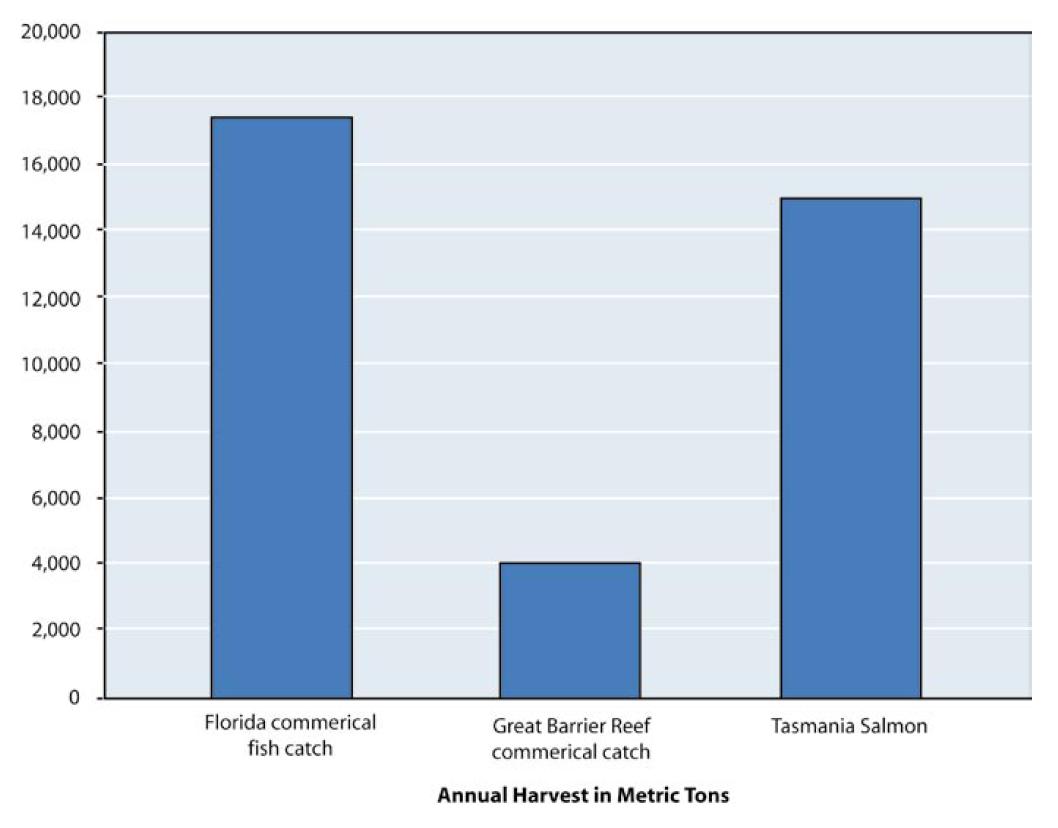
Four thousand tonnes can be an impressive quantity of fish or a negligible one, depending upon the size of the region from which it is produced. Salmon farming, for example, currently produces about 12,000 tonnes annually from a few small bays in Tasmania.
In reef fisheries assessment, the yield per unit of area is also a widely used and important measure. Normally this is quantified in terms of annual yield in tonnes per square kilometre of reef and lagoon area. This most important measure also seems never to be provided or even mentioned in GBR management discussion or decisions. To ignore key measurements of harvest in the context of a discussion of overfishing cannot but be either incompetent or deliberately deceptive.
ANNUAL YIELD
Catch per unit of area for the GBR is easy to derive. It is simply the total annual yield divided by the area of reef and lagoon from which it is harvested. With some 346,000 km2 of reef and lagoon area on the GBR, the total annual catch in recent years is about 17 kg/km2 (Fig. 2).
Figure 2: Harvest rates for various Pacific reef areas.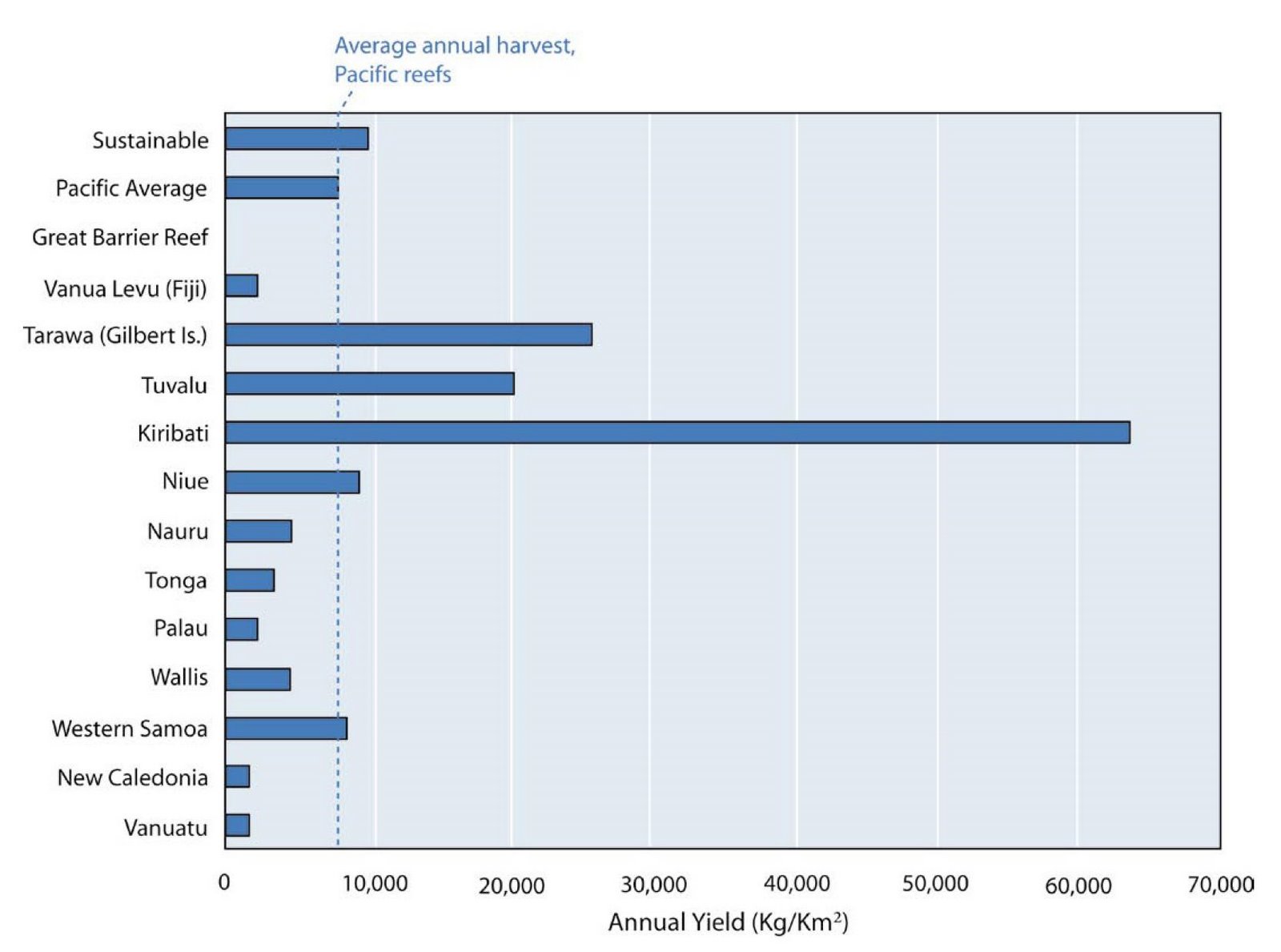
Yield figures from Adams et al. (1996). The sustainable figure is an estimated average for reefs. In practice, all of the above fisheries are ongoing and sustainable, and the differences between them are due mainly to population and the range of species utilised. Note -- the GBR bar was plotted but the amount is too small to appear as a whole pixel at screen resolution.
This is a minuscule figure on which to base a claim of overfishing. Elsewhere, over a wide range of Pacific reefs, the annual harvest averages some 7,700 kg/km2, (Fig. 2) and these reefs are generally considered by fisheries biologists to be sustainably harvested (Adams et al., 1996). Because in actual practice this level of catch is ongoing, expert opinion in this instance is consistent with observable fact.
Maintaining that the GBR is overfished at an annual harvest of 17 kg/km2, when over a broad range of other Pacific reef areas an average of 7,700 kg/km2 (Fig. 2) is sustainable, is beyond ridiculous. It is incompetent. It amounts to claiming that the GBR is the most unproductive reef area in the world with less than 1 per cent of the productivity of other reefs.
Although I have presented these figures in recent public debate on GBR fishing activity, the proponents of overfishing claims have been unwilling to address them. The sole response (other than uninformed personal attacks) has been to argue that the actual reef area only comprises about 30 per cent of the total area. Even if one were to consider the entire harvest to come from just 30 per cent of the area, however, the catch per unit of area would still amount to less than 60 kg/km2. In actual fact, though, over half of the total GBR catch does not come from reefs themselves but from the lagoon areas between reefs. The only counter-argument offered is thus not only quantitatively insignificant if granted but, worse still, indicates a fundamental lack of knowledge of the actual fishery about which the same opinions are being cited as expert.
CATCH PER UNIT EFFORT
In conjunction with annual yield, catch per unit of effort is perhaps the other most important measure of fishing pressure and, in particular, overfishing. The theoretical ideal of fisheries management is maximum sustained yield. When the harvest exceeds the sustainable yield, the population left to spawn is inadequate to provide the number of new recruits necessary to replenish the population. A progressive population decline results. When this occurs, the total harvest and the catch per unit of fishing effort decline in tandem.
Figures for catch per unit of effort in Great Barrier Reef waters are also maintained by the Queensland Department of Primary Industries (Fig. 3). This long-established and globally-used measure of fishing sustainability is therefore readily available but, strangely, it too remains unmentioned by those making the claims of overfishing on the GBR.
Figure 3: Great Barrier Reef commercial fishing statistics
from Queensland Department of Primary Industries.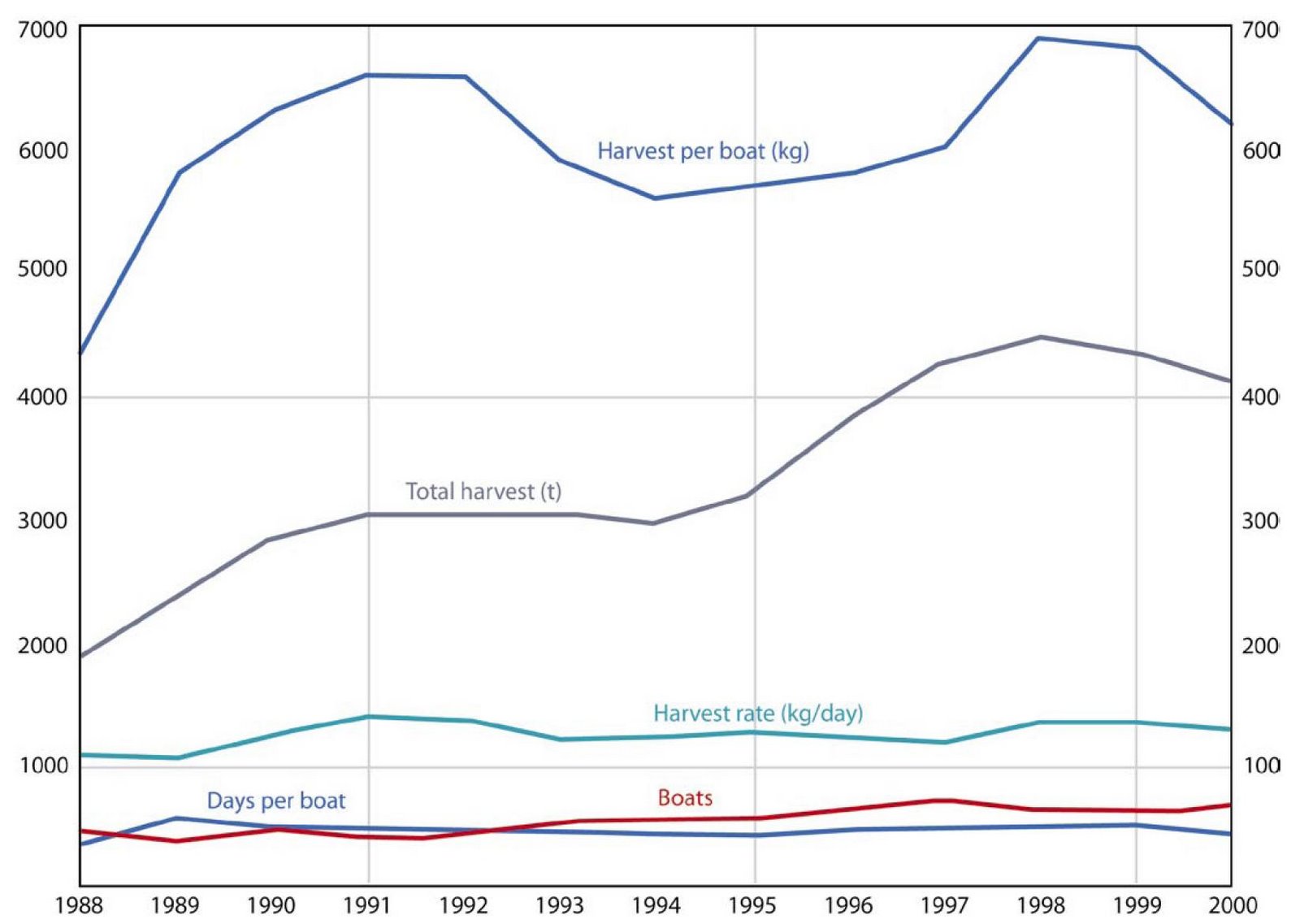
Great Barrier Reef commerical line fishery catch statistics, 1988-2000.
Days per boat and harvest rate use right side scale. All others use left scale
Data from Williams (2002)
From 1988 to 2000, the number of boats participating in the GBR commercial line fishery ranged from 415 in 1989 to 674 in 1997. In 2003, the figure was 527 boats. The harvest rate in kg/day/boat ranged from 119 in 1989 to 141 in 2000, with the 2003 rate being 127 kg/day/boat.
The average number of days per boat per year varied from 40 to 71, while the total harvest per boat ranged from 4.9 tonnes in 1988 to 9.4 tonnes in 2001. The catch per unit of effort simply does not show any evidence of decline, as would be expected if overfishing was indeed taking place.
DPI statistics irrefutably show that the GBR line fishery harvest is extremely low. On an area basis, it is less than 1 per cent of what reefs elsewhere commonly yield on a sustainable basis. The catch per day per boat over recent years has in fact increased. Unlike the theoretical arguments, imaginary models, anecdotal observations and unsubstantiated opinions used to support claims of overfishing, these statistics are actual measures of real catch and effort. Even granting allowance for any quibbles about their accuracy, the statistics leave the claims of overfishing without a shred of credibility.
FISH CENSUS DATA: CORAL TROUT
If overfishing were occurring on the GBR it would surely be reflected in declining populations of the most heavily targeted species. Coral trout are the most heavily fished species on the GBR and constitute 40-45 per cent of the catch. Over the past two decades, the Great Barrier Reef Marine Park Authority (GBRMPA) has contracted for extensive underwater surveys of coral trout numbers on the GBR. This body of information now totals hundreds of surveys encompassing the entire region. These surveys are based on a well designed and conducted methodology, and the results have been treated with appropriate and powerful statistical analysis. In fact, they make up the most extensive and long-term body of population information available for any reef fish anywhere in the world (see Ayling reference series in the References below).
It is also important to bear in mind that this work is not based on estimates or models, but on actual counts of individual fish. These are conducted by making counts along a series of lines across a reef. As each count is made by a single diver moving along a line there is effectively no chance of counting the same fish twice. These samples are then averaged to arrive at a population density for a given reef at that time. Statistical analysis has shown the methodology used to have a high level of sampling validity. The only reasonable probability for error is that coral trout are somewhat cryptic and there will normally be some fish present that will be hidden in the coral and not seen. Actual numbers on the reef, therefore, may be somewhat higher but can never be less than are counted.
These surveys show that coral trout are abundant everywhere, and that there is little to no difference between the most frequently fished reefs near population centres and remote rarely visited ones, nor between reefs which are open to fishing and those closed to it. The figures clearly indicate that our most heavily fished species is, in fact, being only lightly harvested. They also strongly imply that no environmental benefits whatever should be expected to accrue from the recently increased restrictions on fishing.
Remarkably, this exceptionally valuable body of survey information exists only as unpublished reports in the library of the Marine Park Authority. Certainly, GBRMPA must have deemed this work important and competently conducted to have continued to support it at substantial expense for so long. It is difficult to avoid wondering if the reason for the non-publication of these studies is that it was not desired that this information be readily available to the public. Had the findings revealed evidence for overfishing, it seems unlikely they would have been left to languish in a small regional library.
Most disturbing of all, the existence of this exceptional body of knowledge and its total disregard by GBRMPA raises serious questions about the factual basis, scientific quality, and, indeed, even the integrity with which GBRMPA's management of the reef is being conducted.
THE CONCEPT OF "CATCHABILITY"
The absence of figures to indicate any decrease in fish abundance has not prevented a popular view that a decline has occurred in Great Barrier Reef fish catches over recent decades. The idea that fishing used to be much better in bygone days reflects a natural human tendency that is common and widespread. In many places, factual information shows that the phenomenon is a real one, and may also show it to stem from overfishing (for example, in the Philippines and Indonesia). This belief is, however, also common where catch statistics provide no support for it.
There are two aspects to this perception. One is imaginary. The other is real but not a result of overfishing. The imaginary aspect stems from a mix of nostalgia, selective memory and seniority. We tend to remember the times when we had good catches and forget the times when we did not. Relating tales of experience inaccessible to one's audience also has its appeal by confirming one's own senior status.
Where it can be factually demonstrated that catches have declined, there are two main possible explanations. Overfishing is one. The other rests on the fact that intensive fishing makes fish wary and harder to catch. A common example of the latter situation occurs around many docks and piers, where one can often find dense schools of resident fishes exposed to almost constant fishing, but which are extremely difficult to catch. At the other extreme, on isolated oceanic reefs that have rarely or never been fished, fish are very easy to catch. Any small object dropped in the water will attract attention and may be mouthed by curious fish. Under such circumstances, fish may even be caught with a bare un-baited hook.
On the GBR, a few reefs near population centres are relatively frequently fished and fish there are harder to catch. But as the coral trout surveys have shown, populations of the most heavily fished species on these reefs show little difference from those on reefs which have been closed to fishing. It is worth noting also that it is these same few readily accessible reefs that are the source of most local residents' experience of the GBR.
Catchability, then, rather than actual abundance, is the basis for many fishermen's perception of overfishing. It is widely known among fishermen and fishing lure manufacturers that new techniques and lures that are at first highly effective become much less so as they become widely used. Good fishermen are always experimenting with new methods, baits, and lures. Poor fishermen do nothing different until they see everyone else doing it. They remain behind the curve and blame their poor catches on a lack of fish.
ELF
In addition to the coral trout surveys, GBRMPA has also funded a large-scale, long-term study of the Effects of Line fishing (ELF) on the GBR. The conclusions of this study (Mapstone et al., 2004) were:
- Coral trout populations are predicted to remain "robust" under all the future projections that were considered.
- The likely effect of additional area closures will be poorer fishing.
- No evidence was found that fishing had any detrimental effect on biodiversity, or on the ecological integrity of the broader reef community.
- Closing more areas to fishing could be expected to increase the impact of fishing in areas left open.
The findings of this study have repeatedly been claimed by GBRMPA to support the need for increasing the areas closed to fishing. However, the study was not released until just after the closed area increases were established. Even now, few people are aware of these conclusions which belie GBRMPA claims, because they are buried in an obscure technical report and cloaked in techno-jargon incomprehensible to the non-specialist.
SUMMARY
The readily available DPI statistics and the extensive but unpublished coral trout surveys both paint a clear and unequivocal picture. The GBR line fishery, far from being overfished, harvests only a small fraction of the potential sustainable yield. Although one can always argue over details of statistics, these are so overwhelming that any errors in percentages are irrelevant. It would require orders-of-magnitude greater fishing pressure to begin to approach a level at which a credible assertion could be made for overfishing.
Where, then, is the evidence for overfishing? The answer is simple. There isn't any. The claims of overfishing are based not on evidence and analysis, but simply on opinion and belief. Instead of following the argument and the evidence where they lead, the proponents of "overfishing" ignore or dismiss the facts and denigrate or attempt to discredit those who present them.
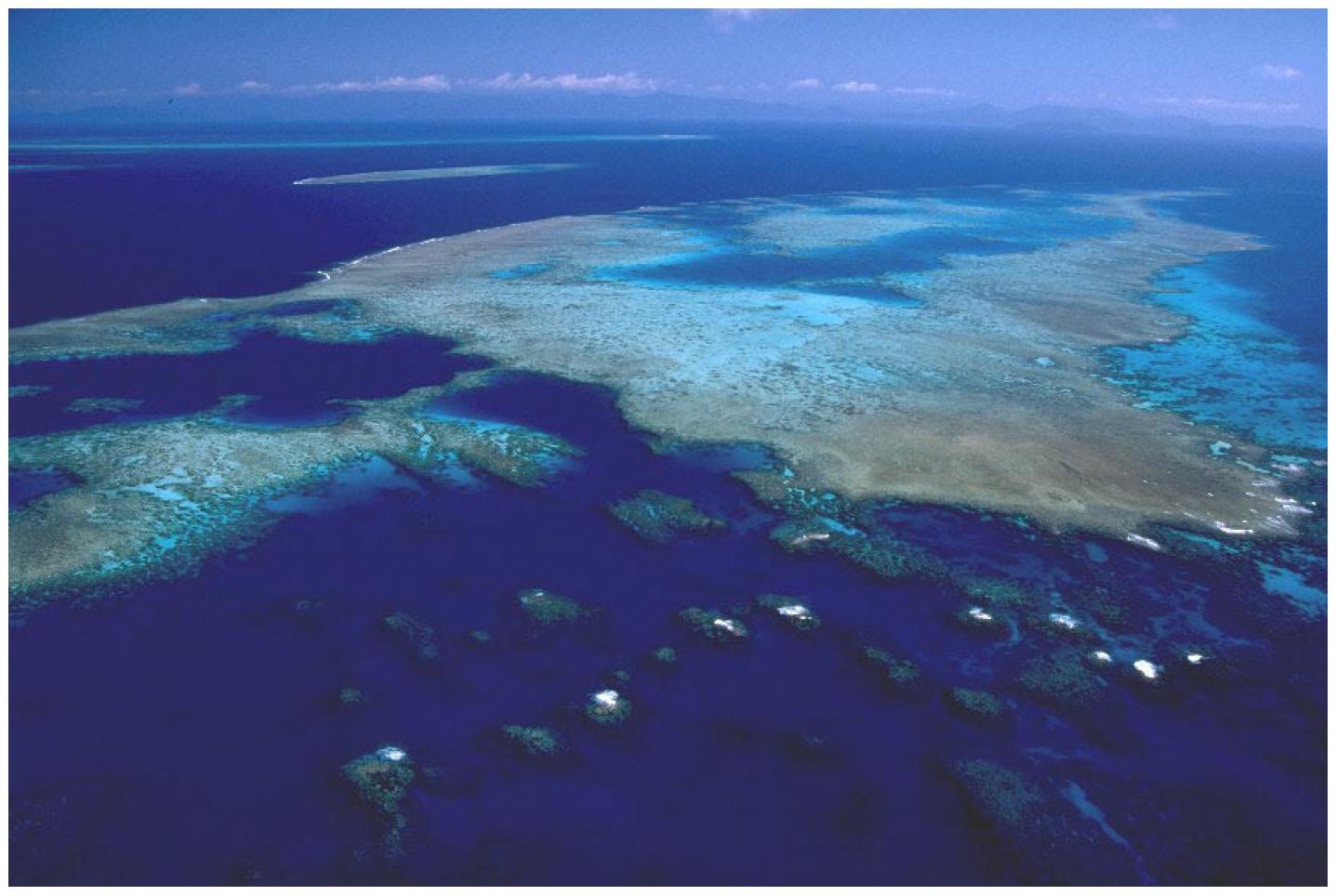
A midshelf reef off Cairns presents a typical reef aerial panorama without a boat in sight.
WATER QUALITY
Land runoff containing fertiliser, silt, and agrichemicals, together with sewerage from island resorts and boats, have long been cited as threats to the reef. In recent years, these scares have been revived and re-badged. What used to be called pollution has been re-marketed under the more important sounding, but less specific, "Water Quality" label.
Technocrats love to come up with important sounding new terminology for ordinary concepts. This gives the appearance of advanced understanding without the risk of conveying anything likely to raise questions. It's a bit like going to the doctor with a rash. If the doctor said "You have a rash", you wouldn't be very impressed and would most likely ask what was causing it. But, if the doctor says "You have dermatitis", that sounds like he knows what he is talking about, and tends to discourage further questions. Both statements mean exactly the same thing. Dermatitis is just a medical term for a skin rash.
NUTRIENTS
The idea that a small increase in nutrients will cause corals to die and be replaced by algae arose from an occurrence in Kaneohe Bay in Hawaii. Here, corals died and were covered in green algae at a time when sewerage was being pumped into the Bay. The University of Hawaii has a marine biological field station at Kaneohe Bay. Thus, the situation received detailed attention, and the coral/nutrient problem became established as a received truth.
When interpreting the Kaneohe Bay events, and their possible application elsewhere, one must bear in mind a number of important factors:
- Kaneohe Bay is a small, shallow, enclosed bay surrounded on three sides by steep hillsides and high-density urban development. The affected area is about 2 km2 in extent.
- The sewerage did not simply contain nutrients, but a whole spectrum of modern domestic toxic waste.
- In addition to the sewerage and toxins, hillside erosion from new earthworks dumped substantial amounts of sediment into the bay.
- The coral fauna of Hawaii is comprised almost entirely of outer reef species adapted to the clear water fringing reefs of geologically young oceanic islands. They have little tolerance for turbid lagoon situations which are almost non-existent in Hawaii.
- In Hawaii, the reefs are immediately accessible to a large population and are heavily fished by people who eat a broad range of sea food. The populations of herbivorous fishes and invertebrates which normally keep algal growth cropped are reduced to remnants. Even on normal healthy reefs, if such herbivores are kept fenced off from a portion of the reef, then algae quickly take over.
- Researchers are always looking for some greater importance to attach to their work. Suggestions that findings may have widespread applicability beyond the immediate circumstance are common, but tend to be more hope than reality.
In short, a range of factors was involved in the situation at Kaneohe Bay, probably the least important of which was nutrients.
The circumstances of the GBR are somewhat different:
- The GBR is situated in open water swept by strong tides and ocean currents, and the GBR region is about 175,000 times larger and 10 to 20 times deeper than Kaneohe Bay.
- There has been no measurable increase in nutrients or toxins on the GBR.
- The inshore waters of the GBR have a specialised coral fauna of silt-resistant species that are able to flourish in naturally turbid lagoon conditions.
- Herbivorous fishes and sea urchins are not harvested at all on the GBR.
- None of the GBR is immediately adjacent to urban development and over 99.9 per cent of the reef is located many kilometres from the nearest human influence.
A few years ago, GBRMPA funded an extensive study aimed at better understanding the coral/nutrient problem. The research involved pumping various combinations and concentrations of nutrients directly onto a reef. Contrary to expectations, the algal bloom did not occur, even when the nutrient level was raised to many times natural levels. At very high levels, effects on coral reproduction were observed and these were quickly touted as representing the replacement phenomenon. In fact, the experiments were not designed or properly controlled to determine this effect, and no follow-up experiments have been conducted.
At the start, when the experiments were allegedly going to prove how bad nutrients are for the reef, this work received national news coverage. Predictably, however, when the really good news was discovered that the nutrients were not the problem so feared, it received scant publicity. Interestingly also, GBRMPA has done nothing to follow up on the alleged reproduction problem with further investigations. It appears that GBRMPA may consider a suggested problem to be better than the real risk of finding no problem at all.
Recently, it has begun to be realised that internal waves at the interface between the warm upper layer of the ocean and the cold zone below it frequently surge up the outer face of the GBR and suddenly bathe the outer reefs in nutrient-rich deep water. This can, and regularly does, produce surges in nutrient levels many times anything being washed in from the land. Far from being damaging to the reefs, it is now thought to enrich them.
Despite such understanding, we still have brainwashed young marine biologists telling reef visitors nonsense about not urinating while swimming, as one person's urine could damage a hectare or more of reef! Strangely, it never seems to occur to these biologists that urea is a basic by-product of all animal metabolism, and that one person's contribution, diluted over a hectare, would be immeasurably small compared with what is already there. Nor do they seem to notice that swarming sea bird colonies on nearby reef islets can be excreting as much urea as a thousand humans do every day with no noticeable ill effect.
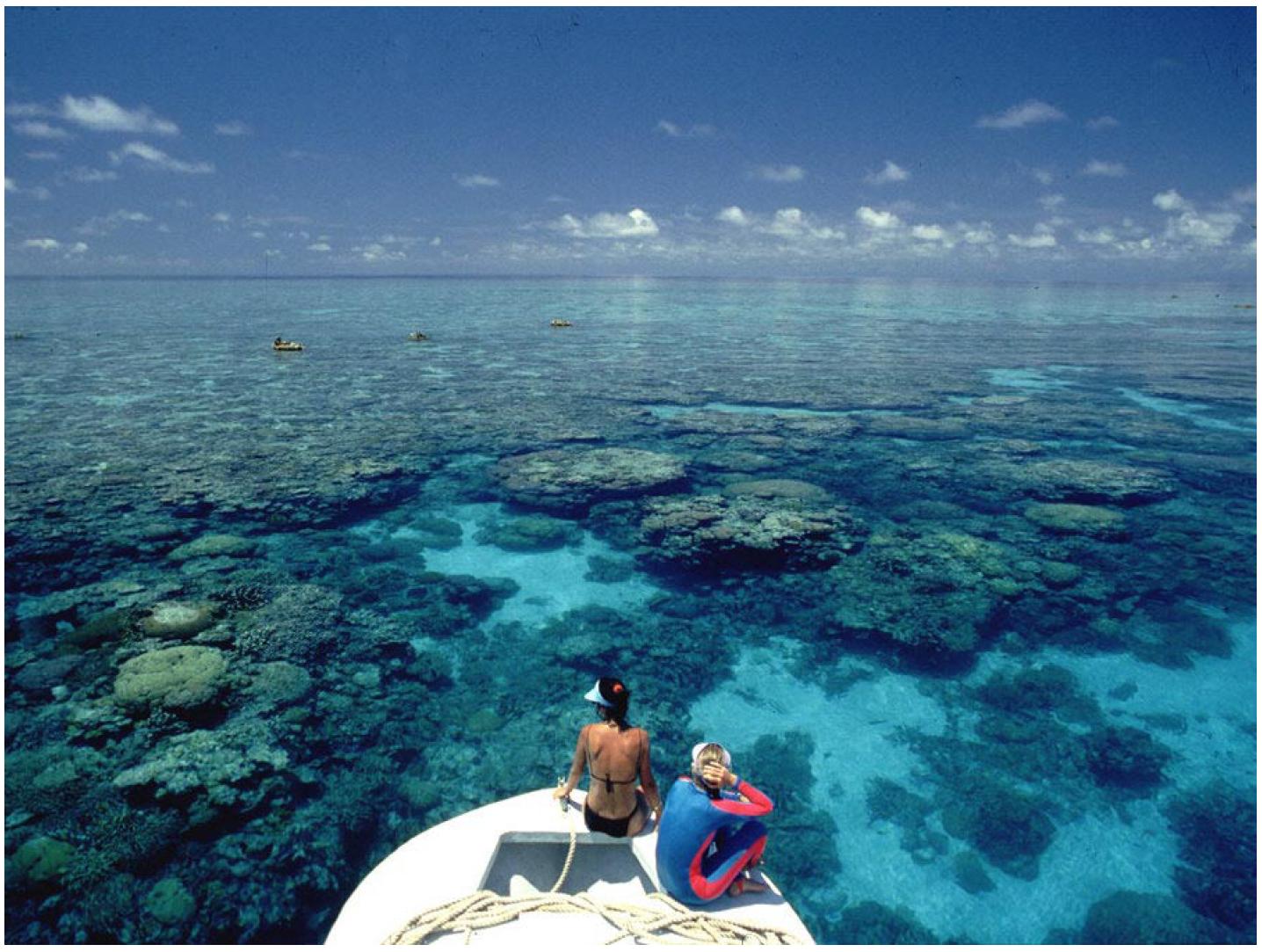
A magic carpet ride over the reef on a calm day.
AGRICULTURAL RUNOFF
Recently, nutrients from farm runoff have become a major focus of concern for environmental lobbyists. One could go on at length over this imaginary scare, but the bottom line is that no increase in nutrients is detectable on the reef. The warm surface layer of tropical oceans is normally very low in nutrients. Along coasts and around islands, upwelling, turbulent mixing and internal waves tend to increase nutrients by bringing up nutrient-rich deep water. Runoff from the land contributes nutrients too, and often plays an important role in ensuring the health of nearshore ecosystems.
The rivers flowing into GBR waters are all relatively small and much of the catchment area is sparsely inhabited and undeveloped. The mean population density of the area is only about 1 person per km2. By comparison, the drainage area of the Caribbean reef region is about eight times larger, with a population density over 35 times greater. Even so, few reefs there reflect any adverse effect from increased nutrients.
On the GBR, river discharge over most of the year is very low, and is significant only in the wet season. Even then, most discharge is confined to brief flood events that normally last for only a few days. If farms were contributing significantly to river nutrients, then nutrients would be expected to be highest in the wet season when most of the runoff from farmland occurs. In the dry season, river flow decreases to a trickle, coming mainly from the mountainous and forested headwaters. One might expect this to be when nutrients would drop. The reality is exactly the opposite. Nutrient levels in the rivers are relatively low in the wet season and increase over the dry season. Natural sources are contributing more nutrients than farming.
More important than where nutrients come from, however, is their quantity and effect. Estimates for the overall human contribution to the nutrient budget of the GBR are that it may amount, at most, to a few per cent. In view of the low level to start with, the most likely effects of such a modest increase in nutrients would be beneficial. As it is, the nutrients in river outflows are diluted and taken up by marine life within a few kilometres of the river mouths. No increase in levels can be detected on offshore reefs.
In summary, then, human-induced nutrients on the GBR are trivial, undetectable, and to the extent that enhanced levels do occur, are likely to be beneficial.
Finally, convincing and irrefutable proof that human nutrient pollution is not a significant factor in GBR waters comes from satellite measurements of chlorophyll concentrations (Fig. 4). These measurements are made every few days at 1 km. resolution over the entire region. The figure depicts an average derived from 5 years of measurements. It is obvious that nutrients from natural sources are inducing much greater phytoplankton concentration along the northern coast of Australia and southern coast of New Guinea than any nutrient runoff from the relatively small catchments of rivers draining into GBR waters. It is also interesting to note the high chlorophyll concentration at the western end of New Guinea. This area has recently been found to support the greatest reef biodiversity known from any place on Earth, and the reefs are generally deemed to be in near pristine condition as well.
Figure 4: Average chlorophyll A concentration from Oct. 1997-April 2002 (NASA SeaWiFS image)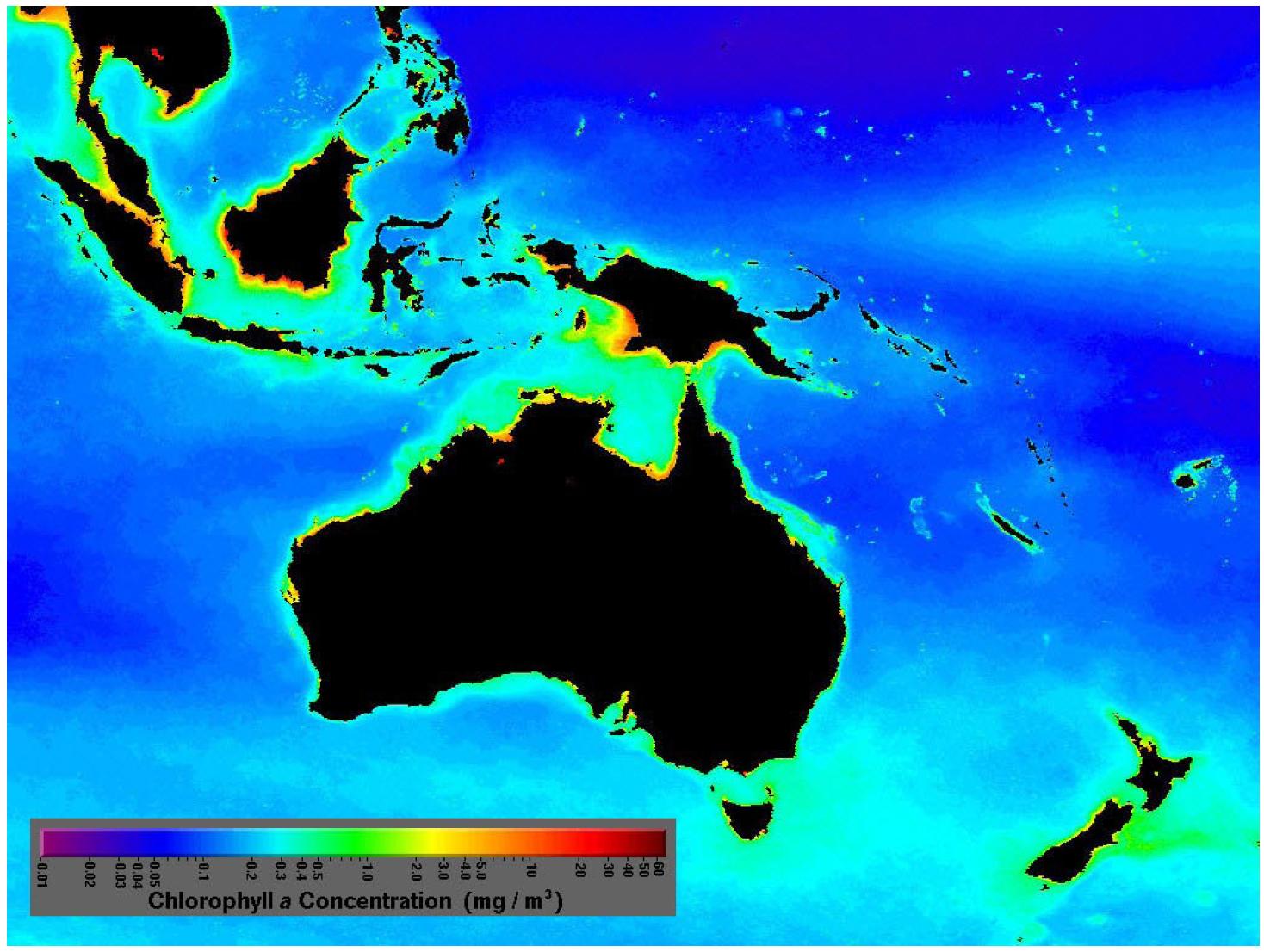
HOW MISGUIDED PERCEPTIONS BECOME POLICY AND EVEN SCIENTIFIC "FACT"
Green Island is a coral reef sand cay off Cairns. It is a popular tourist reef day-trip. In years past, the lunch food scraps from up to a thousand visitors a day were dumped off the pier there. This food source supported a huge resident population of reef fishes that lived under the pier. They swarmed out to devour all of the scraps within a few minutes of their being dumped. Visitors were able to swim among thousands of tame fishes of many sizes and species. It was both a superb experience and an elegant solution to disposal of the scrap food.
Then, in a fit of ecological correctness, GBRMPA decided that this procedure was "unnatural" and prohibited it. Since then, the scraps have been taken back to Cairns for disposal. Out of sight, out of mind -- but what actually happens to them? They go to the city dump. This is an area where mangroves are being flattened and filled in. There the food scraps contribute to breeding clouds of flies, and in the wet season putrefying water regularly overflows into the adjacent inlet, resulting in fish kills. An elegant solution has been replaced by an idiotic one.
Another example of such misperception occurred at Low Isles off Port Douglas. Over the span of a decade, I observed the reef there to be demolished by a storm, after which it went from algae covered rubble, to dominance by soft corals, followed by the development of dense thickets of branching and plate-like hard corals, and then back to rubble following another storm. Researchers visiting during a rubble phase decided it must have been killed by farm nutrients from the Daintree River which is some 12 nautical miles away. I lived on the Daintree River for this entire period and know the flood plume never reached Low Isles. What the researchers saw was simply the result of a cyclone, but this erroneous interpretation is still cited as scientific evidence of nutrient damage (for example, Bell, 1992).
Interestingly, during this same time period a lush fringing reef was maintained around Snapper Island located immediately to the north of the Daintree River mouth. Despite being subjected to frequent flood plumes, healthy and profuse coral growth was present from 1979 when I first observed it until a massive flood event in 1996 resulted in a large coral mortality from low salinity water reaching the south side of the island. Even then, the corals along the north shore survived.
SILTATION
The inshore waters of the GBR are naturally very turbid. Large areas of the sea floor are covered in many metres of fine silt. This material comes from both the land and from the reef itself. During extended periods of calm weather the inshore waters can become crystal clear, but such periods are rare and short-lived. The GBR is normally a windy region and wave action stirs up the silt, making inshore waters very turbid. While most of the GBR is well offshore where the water is clearer, healthy turbid water reefs occur scattered throughout the nearshore area. These exhibit a quite different ecology from the reefs further offshore. Plant life is much more prevalent, there are many fewer fishes, and the corals are predominantly silt-resistant species adapted to these conditions.
Such inshore reefs exist at the extremes of coral tolerance. They flourish whenever a few favourable years permit, but are often devastated by storms, floods and even by extended periods of calm weather. This last can damage them by removing the shade that turbid water normally provides, and also by allowing very shallow water to become dangerously warm. Such coral reefs live "on the edge", and their frequent mishaps provide ready evidence for naive biologists to discover "dying" reefs. Primed to seek some adverse human effect, biologists simply assume such links without ever considering the possibility that what they are seeing may be both perfectly natural and temporary.
It is widely believed that siltation from erosion has greatly increased as a result of European habitation of the region. Recent estimates are of a three- to four-fold increase. Such estimates, however, are not based on actual measurement of the sediments but are derived by various indirect evidence or "proxies", which are often calculated through computer modelling. Such models are subject to a number of uncertainties and assumptions and, at best, offer a view of an imaginary future or past. That is to say, at best they equate to an educated guess. Certainly forest-clearing, mining, and earthworks do often result in some immediate erosion, but other human activity, such as agricultural plantings, can also substantially reduce it, or, as with dam-building, trap the sediment yield long before it reaches the coast.
Pre-European Aboriginal inhabitants of GBR coastal regions regularly burned large areas of the countryside. Cessation of this practice has recently reduced this source of erosion. Natural hill slope erosion in rainforest is quite high because of the lack of ground cover in the forest itself. Clearing of rainforest and its replacement by grass or sugar cane can actually reduce erosion. Likewise, improved pasturage, and even introduced weeds, can also provide better ground cover than the sparser native grasses they replace. In making such comments I am not making recommendations as to what should be done, but simply reporting some facts in a complex web of effects and that the net balance is unknown.
One of the most influential studies that is cited for the deleterious effects of increased siltation involved the measurement of barium isotopes (McCulloch et al., 2003) in coral cores. These measurements, made on coral cores from off the mouth of the Herbert River, were then used as an indicator of sediment discharge from the second largest river in the region, the Burdekin. Barium recorded a noticeable and abrupt increased level in the sediment beginning in 1870. This increase was attributed to the introduction of some 50,000 head of cattle into the region at that time. The conclusion seems plausible, but is too hasty. For if such a change can be produced by 50,000 head of cattle in 1870, imagine the damage that must be wrought by the million head of cattle and by the extensive farming now practised in the same catchment. Yet, the barium level shows no further significant increase! McCulloch et al.'s (2003) conclusions also fail to consider if the long period of low rainfall which ended in 1870 might not have a lot to do with the abrupt increase.
Whether siltation has increased four-fold, or even decreased, is in the end irrelevant to the health of the GBR. Adding a few millimetres of silt to the several metres-thick layer that already blankets the inshore sea floor has no discernible effect whatever. The inshore water becomes just as turbid with or without this extra layer, for when the wind blows, it simply resuspends the materials of the existing seafloor willy-nilly.
AGRICHEMICAL POLLUTION
Pesticides and herbicides have recently been added to the list of GBR water quality suspects. According to environmental activists, the chemical of greatest current concern on the GBR is the herbicide diuron. Widely used in cane-farming in the region, traces of diuron have been measured in sediments adjacent to rivers along the high rainfall coast between Port Douglas and Townsville, and also near the Fitzroy River further south. Traces of diuron have also been detected in intertidal seagrasses and this chemical is claimed to be a potential threat to them. Our ability to detect trace quantities of such substances, however, is now extremely sensitive, and the levels detected are well below those known to inhibit the growth of seagrasses. In any event, these traces are restricted to a very limited area immediately around a few river mouths, and are well removed from any reef. In such places, the freshwater discharges alone are far more toxic to reef organisms than minute traces of herbicide.
The tissues of marine mammals are accepted to be perhaps the best indicator of chemical pollutants, which become concentrated up the food chain. A recent study of tissue samples from 53 dugong reported concentrations of organochlorines similar to those found in dugong 20 years earlier. These were low in comparison to concentrations found in marine mammals elsewhere in the world.
Away from the coast, in the main reef tract, chemical pollution has never been measured. The GBR is situated in one of the least polluted and sparsely populated parts of our planet. Chemical pollution here is not an observable fact or even a reasonable suspicion, but only another hypothetical possibility tossed into the water quality list for added impact.
SEWERAGE
Island resorts on the GBR now all have their own tertiary sewerage treatment, and the larger tourist vessels use holding tanks that are emptied into municipal sewerage systems when they return to port. No municipal sewerage is emptied into GBR waters. The only sewerage actually going into reef waters is from small pleasure vessels. This is minuscule and harmless. It would total less than a small fraction of that of the seabirds on a single sand cay or the fishes around a good sized coral bommie.
WATER QUALITY SUMMARY
In a comprehensive survey of GBR water quality knowledge, Williams (2001) came to the following conclusions:
"It is believed that increased sediment supply to the Great Barrier Reef will not increase sediment accumulation or turbidity at most coral reefs, because these factors are not currently limited by sediment supply. Turbidity in nearshore areas is primarily caused by wind-driven re-suspension of bottom sediment. Most of this sediment is not recent but has accumulated over the last five or six thousand years as the sea has inundated the continental shelf and risen to its current level.
The extent to which ... run-off has increased the total amount of nutrients to the marine environment, and the nearshore zone in particular, is uncertain.
[E]xtensive phytoplankton studies have found biomass and composition consistent with an unimpacted system and failed to find evidence of large-scale eutrophication.
Studies to date have generally found low concentrations of ... pollutants, indicative of a relatively unpolluted environment.
[C]lear impacts of enhanced run-off of sediments, nutrients and contaminants (as a result of land use) on coral reefs of the Great Barrier Reef ecosystem have proven difficult to detect. Impacts are unlikely for the majority of reefs that are located well offshore.
It is tempting to conclude that the water quality status of the central Great Barrier Reef is not at immediate risk and that at current nutrient input rates, external sources will have little future impact on water quality within the central Great Barrier Reef region."
In short, no water quality problems are detectable. All of the concerns receiving so much publicity are only hypothetical possibilities of which neither presence nor effects have been found on the reef itself.
PHYSICAL DAMAGE
Physical damage to the reef from such things as anchors, people walking on the reef and ship groundings does occur, but needs to be seen in perspective. Of the estimated 2,900 reefs making up the GBR complex, only a fraction of one per cent are regularly visited by people, and even at those visited, only a tiny fraction of the reef area is actually used. Boats do not usually drop their anchors directly into coral, not only because it damages it, but because one may very well not be able to get an anchor back if it becomes hooked in the coral. It is also safer to anchor far enough from a reef to provide swinging room should the wind shift or a squall come up in the night. An occasional piece of broken coral is well within the capacity of the reef to regenerate. Only at a few frequently used locations does damage from anchors, divers and walkers become a problem. In these places, it is very much in the interests of the tourism operators using these areas to limit the damage as much as possible, which they do.
Every few years, some ship runs aground on the GBR. Invariably the damage to both ship and reef is minor, but in recent years these events have become the focus for an elaborate circus. The media, politicians, environmental organisations and sundry government bodies all charter boats and aircraft to access the situation. The opinions of various reef "experts" are sought and reported, and major media attention is given to all the goings on. After a few days or weeks, depending on the tidal cycle, high tides permit the vessel to be freed. Then a few hundred thousand dollars are wasted on surveying, monitoring and pretending to repair damage that amounts to nothing and, with or without any intervention, will fully repair naturally anyway. As a final act of folly, the shipping company is then found guilty of damaging the reef and is fined.
This is a bit like fining an airline company if they have a crash. The reason for such incidents is almost always human error and beyond the reasonable control of the owners. The ultimate stupidity of adding a fine to the already huge cost of such mishaps is that, ultimately, the court is fining Australia. Such fines are simply added to the cost of doing business with Australia and built into the shipping rates for Australian ports. We collect a few fines and then pay the cost many times over in increased charges.
The total area of coral temporarily damaged in a year by anchors, walkers, divers and ships would be less than a hectare, or about one ten-millionth of the GBR coral area. Meanwhile, as a natural random event, tropical cyclones cross the reef every year leaving thousands of hectares of demolished reef in their wake (Puotinen, 1997). This, too, recovers and it does so without any circus, useless remediation efforts, or fines.
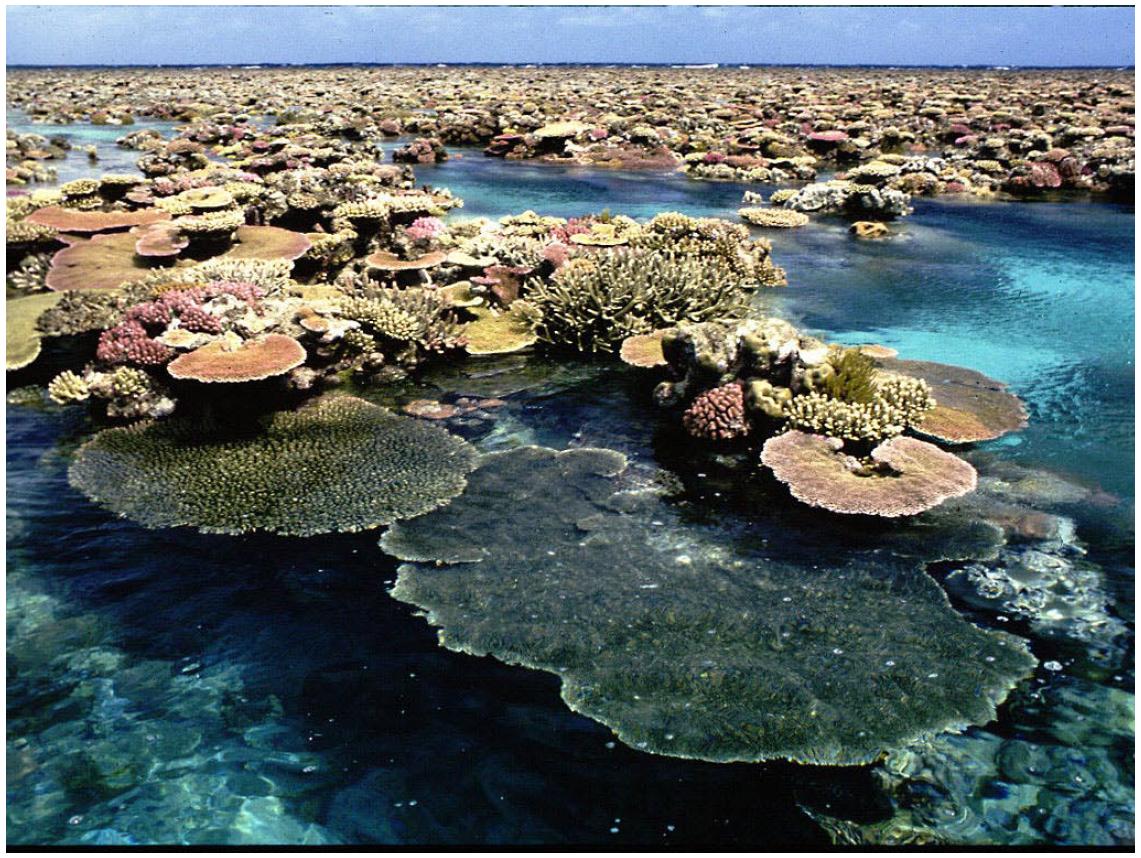
For a few hours on a few days in most years, exceptionally low tides leave reef top corals exposed to the atmosphere. They protect themselves by secreting copious mucous, but a rain shower at this time can kill leave entire reef tops dead. Natural catastrophes from various causes are not uncommon on reefs, but biologists are rarely on hand to witness them. In a climate of imagined eco-threats, it is all too easy for naive biologists coming along after these events to assume that such dead coral is evidence of human effects.
GLOBAL WARMING (GW) AND CORAL BLEACHING
Despite claims of scientific consensus, the extent and consequences of climate change are far from certain or agreed upon. Although large numbers of biologists accept global warming by greenhouse gases as being a certainty, they have little relevant expertise or understanding of the matter. For such persons, the global warming bandwagon seems to account for recent warming, lends great import to biological changes that otherwise would be of little significance and is easy to hop onto, but difficult, even risky, to question.
Geologists, on the other hand, have powerful tools for investigating past climate and relevant expertise regarding climate variability. Many of them are much less alarmist. To them, the recent warming trend is not unprecedented or even unusual, but simply the current phase of a millennial-scale cycle last experienced as the Medieval warm period and a thousand years earlier still as the Roman warm period. This means that whatever the climatic effect of increasing CO2, it must be much smaller than the climate change alarmists claim because a natural cycle accounts for most if not all of the observed change. Beyond this, they offer varied and voluminous evidence raising serious uncertainties regarding the popular greenhouse scenario. Although the topic of global warming is somewhat beyond the scope of this present consideration, suffice it to say that GW is far from having the overwhelming evidence or scientific consensus that its proponents claim.
On the GBR, extensive coral bleaching events occurred in the summers of 1998 and 2002. Such bleaching is associated with unusually high water temperatures. From 60 to 95 per cent of reefs are estimated to have been affected, though this percentage figure is somewhat misleading in that it is not an estimate of the actual proportion of total coral affected but only the percentage of reefs in which any bleaching at all was seen. Where it occurred, bleaching generally only affected variable portions of the shallow tops of particular reefs.
About all we can say at present is that GW probably isn't going to be as dramatic as the alarmists predict, that recent coral bleaching on the GBR is not unprecedented, that corals can adapt to considerably warmer water than that which produced the recent bleaching, and that the damage done is less than claimed. As far as temperatures go, nearly all GW modelling studies predict only small warming in tropical areas, much more in temperate regions and greatest warming in polar regions. If global warming does become significant, whether anthropogenic or natural, the most likely effect on reefs will be to expand the area of ocean suitable to them while at the same time causing weaker El Niño patterns with fewer associated bleaching events.
IMAGINARY THREATS AND HYPOTHETICAL DISASTERS
The repeated claims of threats and disasters to the GBR are simply untrue. They stem from ignorance, misinformation and self-interest on behalf of those who benefit from promoting the idea of problems. The problems are all hypotheticals, that is, they are things that might be or that are predicted for the future. In reality, each problem either can't actually be demonstrated, or can be foreseen as trivial and temporary. The best way to judge the health of the GBR for oneself is to take an extended flight or boat cruise over the reef. At any time, in any region of the reef, only occasional boats are to be seen. The reality is that, on most of the reef, for most of the time, no human activity or influence can be seen or detected. For all practical purposes, 90 per cent of the GBR is already a protected zone.
My own impression of the GBR compared to other reef areas is essentially that of an un-fished reef but with a greater abundance of large fishes than is typical of isolated oceanic reefs, probably because of greater natural nutrient supply.
WHY REAL EXPERTS DON'T SPEAK OUT
Despite appearances, I am not alone in my view. There are a handful of academics and administrators who do have both the credentials and experience to know that the claims of threats to the Great Barrier Reef are almost entirely fabricated and alarmist. Why, then, do they not speak out?
The answer, regrettably, is that it is rarely possible even for senior scientists to speak out because of the strong personal ostracism to which they will be subjected as a result. Speaking out against the politically correct version of an environmental problem, be it reef-related or otherwise, is a no-win situation. No matter how experienced, senior or well-qualified they may be, people who choose to question the conventional wisdom won't be believed, and, one way or the other, end up being denigrated. More junior persons, rightly, fear for their employment or career and, should they work for government agencies or specialist research centres, are even subject to compulsory managerial direction regarding their public statements. The peer review process, used both in grant applications and when studies are submitted for publication, also imposes a strong and undesirable pressure for scientists to conform to prevailing views. It is not surprising, therefore, that the public remains uniformed.
THE BIGGEST REEF THREAT
The only real and apparent threat to the reef is the ongoing proliferation of ill-conceived, unnecessary and ineffectual regulations, and the bureaucracy which attends their implementation. This not only prevents the sensible sustainable utilisation of a major resource, but also impedes even the most harmless low-level recreational use of the reef. The growing morass of regulations has already reached the level that one almost needs to have a lawyer in the boat to advise as to what, where, when, and how one may do anything on the Great Barrier Reef.
Meanwhile, the staff and facilities of the Great Barrier Reef Marine Park Authority have continued to grow exponentially, with their staff pretending to "manage" the reef via remote control from airconditioned offices. With little knowledge of reefs or what is actually happening on the GBR, GBRMPA staff apply hypothetical solutions to imaginary problems with minimal assessment of either the reality of the purported problems or the efficacy of their solutions. In the absence of any reality checks, GBRMPA is free to proclaim successes and dream up an endless litany of threats to justify an ever-expanding budget (Fig. 5) GBRMPA badly needs restructuring to become reef-focused rather than office-focused, to foster the collection of the sound information necessary for effective management, to concentrate on demonstrable problems, and to become accountable in terms of assessment of the real world outcome of their activities and management. As it is now, GBRMPA has become a sheltered workshop for bureaucrats who enjoy almost complete absence of realistic oversight, assessment or accountability.
Figure 5: Great Barrier Reef Marine Park Authority annual expenditure.
Compiled from GBRMPA Annual Reports.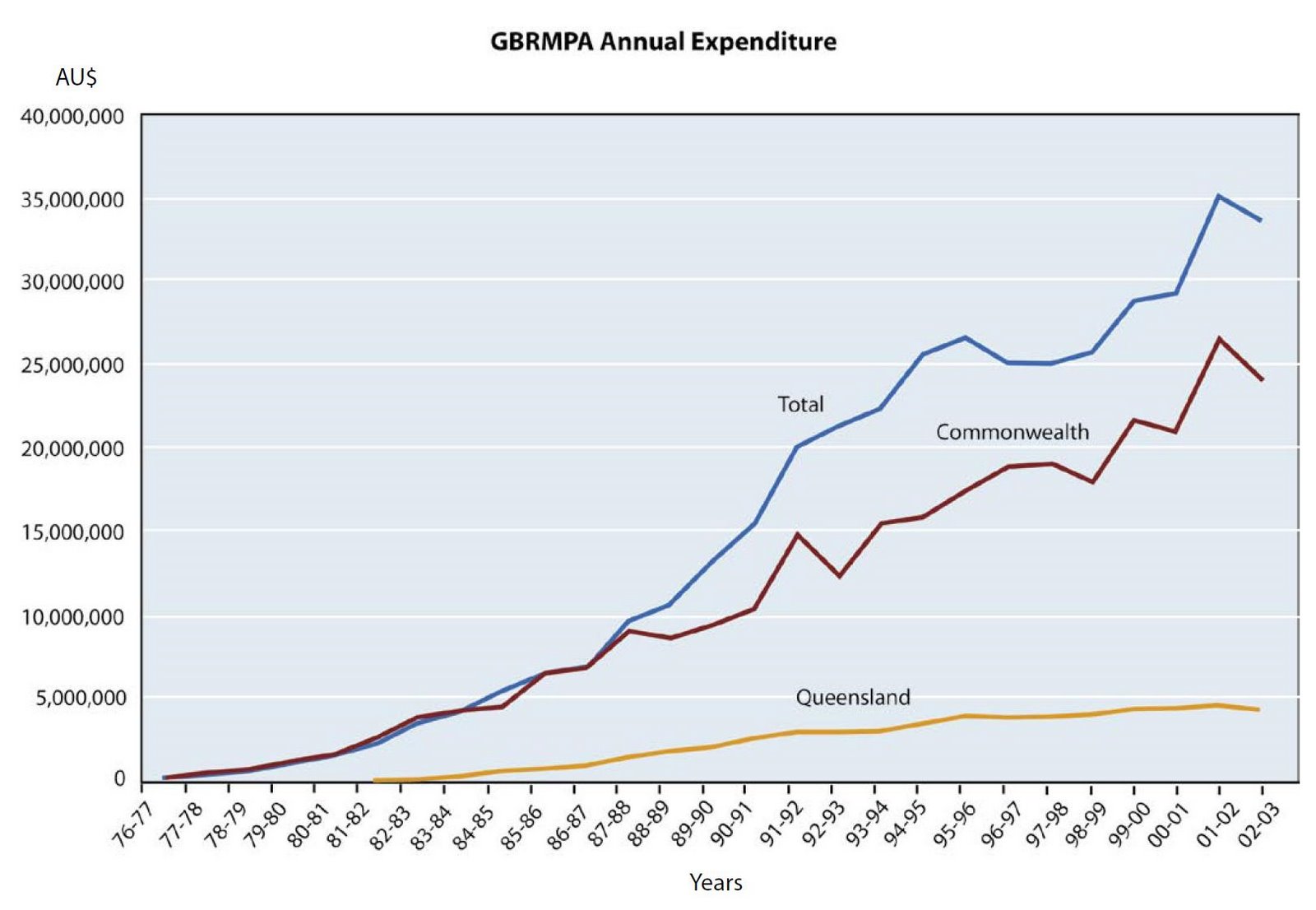
PRECAUTION IS NOT WITHOUT RISK
Many will say "Provided the GBR is 'saved', why should we care about whether or not the reasons given are fraudulent? Isn't it better to err on the side of caution in protecting a unique and beautiful natural heritage?" Well, perhaps. But only if there was any real threat, and if the effect of our actions was indeed beneficial. In reality, neither is the case.
There may appear to be no financial or environmental cost to precautionary restrictions, but in fact there are very real though non-obvious costs. Ecology, like economics, is by nature holistic, and not all effects are immediate or obvious. A balanced, sustainable use of resources makes possible a healthy human ecology. Unnecessary restrictions on particular resources only puts more pressure on others. The recently imposed increase in restrictions on fishing and taxpayer-subsidised downsizing of what was only a very small harvest to begin with is a clear example.
The GBR is vast, only very lightly utilised and well removed from the small population and modest development of the region. It could effortlessly meet the total local demand for seafood, with spare to sell-on, but because of the many unnecessary and growing restrictions on fishing it does not. When such a valuable local economic and employment activity as reef fishing is needlessly limited, the supermarkets of the area turn instead to selling mostly imported seafood. First, therefore, there is a negative effect on employment of those formerly working in the fishing industry, and on the local economy from which income must be removed to pay for the imports. Second, the environmental impact does not disappear but is merely transferred elsewhere.
Generally, where substitute seafood is imported, the environmental impact is added to that associated with already overexploited marine resources, often in underdeveloped countries. It also has to be paid for by local economic activity which, whatever it may be, has its own environmental impacts. Should former seafood consumption be replaced, for example, by red meat consumption instead, there are still attendant downstream environmental consequences. The logic, not to mention morality, of such a chain of events is at the very least questionable, and it is little short of amazing that politicians can introduce restrictive legislation without first demonstrating to the public that they have fully comprehended and analysed these various issues.
Australia can have a significant GBR reef fishery, a reef tourism industry, coastal farming and considerably more development in the region while still maintaining a beautiful reef. These things are not in conflict. Reef waters are capable of sustaining a much larger fishery than the present one and still maintaining a healthy ecosystem; and there is no evidence that land-based activity is affecting the reef. Various Pacific island reefs have sustained much higher levels of fishing for hundreds and even thousands of years. No reef fish has ever been exterminated by line fishing. There is no risk in permitting the GBR fishery to expand, and in imposing restrictions only when and where evidence of some need develops.
CONCLUSIONS
Beyond the misuse of a valuable resource, the false claims of threats to the GBR also entail a broader and an even more important problem, the misuse of science itself. Modern environmentalism has become much more than simply a concern for a healthy environment. It has developed into a peculiar quasi-religious blend of new-age nature worship, science, leftwing political activism, and anti-profit economics.
Environmentalism incorporates a strong element of political correctness, whereby reason and evidence are welcome only so far as they support the predetermined agenda. Information which contests the environmental scare-of-the-day is ignored or denied, and those who attempt to bring it to public attention are attacked and denigrated.
Finally, and probably of most concern of all, many of the scientists who are currently involved in studying environmental issues have taken up attitudes and approaches similar to those of the activists. Science, by becoming advocacy, has made itself and its practitioners part of the problem. As a result, it has greatly weakened its power to provide real solutions for real problems.
No reasonable person will deny that our exploding population, technology and consumption has an environmental effect. But, equally undeniably, humans are part of the ecology of this planet. Ecology is holistic. Everything we do or do not do has its effects and these may often be remote and unforeseen. Nature is not perfect and balanced, but rather always in a state of flux. Human actions can improve as well as degrade the abundance, diversity and condition of life.
The relationship between environmentalism, politics and science is complex. We must find the best solutions and focus on real problems. We do not have the time and resources to deal with an unlimited scope of hypothetical possibilities. Simplistic assumptions and restrictions only serve to exacerbate problems by detracting from real issues, and redirecting pressures into new or increased damage elsewhere.
Science as a methodology is our best hope. Open, objective, rational, evidence-based analysis is essential to identifying real environmental problems and finding workable solutions. When some problems turn out to not be real, or are less bad than feared, this must be acknowledged and investigated, not denied and denigrated. There is no shortage of real problems. We have no need to manufacture imaginary ones.
REFERENCES
Adams, T., P. Dalzell and R. Farman (1996), "Status of Pacific Island Coral Reef Fisheries", 8th International Coral Reef Symposium, Panama, 1996, pages 1-7.
Anonymous (2003), Queensland Population, Queensland Government Office of Economic and Statistical Research. Census 2001 Bulletin No. 5, 4 pages.
Ayling, A.M. (undated), Are Trout Overfished? WHERE ARE ALL THE CORAL TROUT? Internet document.
Ayling, A.M. (1982), Distribution and abundance of piscivorous reef fishes around Lizard Island, unpublished report to Great Barrier Reef Marine Park Authority.
Ayling, A.M. and A.L. Ayling, (1983a), "Distribution and abundance of coral trout species (Plectropomus spp.) in the Cairns section of the Great Barrier Reef Marine Park", unpublished report to Great Barrier Reef Marine Park Authority.
——(1983b), "Distribution and abundance of coral trout species (Plectropomus spp.) in the Townsville and Whitsunday area of the Great Barrier Reef Marine Park", unpublished report to GBRMPA.
——(1984a), "Distribution and abundance of coral trout species (Plectropomus spp.) in the Swain group of reefs", unpublished report to GBRMPA.
——(1984b), "A biological survey of selected reefs in the far north section of the Great Barrier Reef Marine Park", unpublished report to GBRMPA.
——(1985c), "A biological survey of selected reefs in the Central Section of the Great Barrier Reef Marine Park", unpublished report to GBRMPA.
——(1986a), "A biological survey of selected reefs in the Capricorn and Capricornia Sections of the Great Barrier Reef Marine Park", unpublished report to GBRMPA.
——(1986b), "Coral trout survey data: raw data sheets and abundance summaries from all surveys of coral trout species (Plectropomus spp.) carried out by Sea Research for the GBRMPA between Feb. 1983 and July 1986", unpublished report to GBRMPA.
——(1992), "Visual surveys on Cairns Section closed reefs that will be opened under the new Zoning Plan", unpublished report to the GBRMPA.
Ayling, T., M. Samoilys and D. Ryan (2000), Trends in common coral trout populations on the Great Barrier Reef: report to the Queensland Fisheries Management Authority, Brisbane, Queensland Department of Primary Industries.
Bell, P.R.F. (1992), "Eutrophication and coral reefs—some examples in the Great Barrier Reef lagoon", Water Res., 26. pages 553-568.
Burke, L. and J. Maidens (eds) (2004), Reefs at Risk in the Caribbean, World Resources Institute, Washington, D.C., pages 1-80.
Jennings, S. and N.V.C. Polunin (1995), "Comparative size and composition of yield from six Fijian reef fisheries", Journal of Fish Biology, 46, pages 28-46.
Lomborg, B. (1998), The Skeptical Environmentalist, Cambridge University Press, i-xxix + 1-515 pages.
McCulloch, M., S. Fallon, T. Wyndham, E. Hendy, J. Lough and D. Barnes (2003), "Coral record of increased sediment flux to the inner Great Barrier Reef since European settlement", Nature, 421, pages 727-730.
Mapstone B.D., C.R. Davies, L.R. Little, A.E. Punt, A.D.M. Smith, F. Pantus, D.C. Lou, A.J. Williams, A. Jones, A.M. Ayling, G.R. Russ and A.D. McDonald (2004), "The Effects of Line Fishing on the Great Barrier Reef and Evaluations of Alternative Potential Management Strategies", CRC Reef Research Centre, Technical Report No 52, pages i-xi + 1-205, CRC Reef Research Centre, Townsville, Australia.
Puotinen, M.L., T.J. Done and W.C. Skelly (1997), "An atlas of tropical cyclones in the Great Barrier Reef Region, 1969-1997", Technical Report No. 19, Townsville, CRC Reef Research Centre Ltd, 201 pages.
Williams, David McB (2001), "Review of Impacts of Terrestrial Run-off on the Great Barrier Reef World Heritage Area", CRC Reef Research Centre Ltd and Australian Institute of Marine Science.
Williams, L.E. (2002), "Queensland's fisheries resources, current condition and recent trends 1988-2000, Qld. Dept. of Primary Industries, Information Series Q102012: pages 63-74.


 Backgrounder
