Thursday, August 10, 2006

No more excuses

Once upon a time, when there was drought, communities could only dance or pray in the hope that it would rain.  That was before desalination plants were invented.

The first water supply service in southeast Queensland involved private operators carrying barrelled water in the back of carts.  In Ipswich, the first public water supply was created when a spring was bricked and slabbed in 1861.

In 1892 the first reticulated water system was built from a pumping station at Mt Crosby.

During the 1900s dams were built to shore up supply.  Somerset Dam was completed in 1959, North Pine in 1976 and Wivenhoe in 1985.

There are plans to build more dams including the Mary River Traveston Dam.  But more sophisticated options are now also available.  According to the Australian Water Association, up to half of southeast Queensland's water needs could be met through recycling.

We also have the technology to create drinking water on a large scale from seawater through desalination.

Recycling enables communities to reuse water that fell before the drought and, of course, a desalination plant manufactures fresh water whether it rains or not.

Given we are a rich society, living beside the sea with engineers willing and able to build these water factories, how can Premier Peter Beattie claim there is a water crisis?

Malcolm Turnbull, Parliamentary Secretary to the Prime Minister, recently told a gathering at the Brisbane Institute that:  In the final analysis we can desalinate anywhere on the coast for a cost of between $1.00 and $1.50 a kilolitre at the factory gate -- not much more than the retail price in Sydney.

Recycled drinking water should be a bit cheaper because less energy is used in its production.  But it may cost $1.00 a kilolitre to distribute.

The Australian Water Association has suggested an all-up cost for recycled water for the southeast of about $1.50 a kilolitre and desalinated water at about $2.00 a kilolitre.

The average Brisbane household uses 268 litres a person each day, so the average household could be paying $196 a person a year for their household water needs at $2.00 a kilolitre.  That's less than many women spend at the hairdresser and less than my electricity bill last winter.

There is a Regional Drought Strategy Contingency Supply Plan for southeast Queensland and it includes a Gold Coast regional desalination plant and a recycled water substitution to industries plan.  There is no plan for recycled drinking water except as a last resort.

The last resort could apparently be easily implemented once the Western Corridor Recycled Water Scheme, which will take recycled water from Brisbane to the Tarong and Swanbank power stations, is in place.

The pipeline to Swanbank is due for completion in July 2007 and the desalination plant in June 2008 -- that's just before we are due to run out of water completely if it doesn't rain this summer.  But surely both projects can be fast-tracked?

Caboolture already has its own water recycling plant and it was built in just nine months, seven years ago, and produces nine megalitres of water a day.  That's 25 per cent of Caboolture's total water needs.

But the people of Caboolture don't have the privilege of drinking the recycled water, not because the water doesn't taste OK, but because a percentage of local residents oppose the concept of drinking recycled water.  We've all heard that 62 per cent of Toowoomba's residents voted against drinking recycled water.  But I'm still trying to work out why Beattie promised $23 million for water recycling in Toowoomba, but didn't publicly back the plan until just a few days before the referendum which was forced on the local council by the Federal Government.

Our dams may be in a catchment where it hasn't rained for some time, but this is no excuse for a water crisis.  Like the health crisis, the water crisis is a creation of government and can be fixed, but it will require the fast-tracking of some proven technologies.

We don't have time for a referendum on recycling.  It is simply time the State Government got on with the job of building the necessary infrastructure to avert a real water crisis -- whether it rains or not.


ADVERTISEMENT

Tuesday, August 08, 2006

Some children have only one shot at history

The funny thing about the debate over the teaching of history is that it's not actually much of a debate.  Both sides fighting the so-called "history wars" agree that history is important, and that there are some basic facts that all Australian schoolchildren should know.  The problem is getting agreement on exactly what the "facts" are that students should learn.

The "history summit" called by federal Education Minister Julie Bishop, which will be held in Canberra next week, will attempt to do a few things.  First, it will consider why Australian history has fallen out of favour with both teachers and students.  Second, it will inquire into what can be done to restore history teaching to classrooms.  Finally, assuming that there is a consensus that history can make a comeback, it will examine the content of a future Australian history curriculum.  This last challenge is the most difficult.

Part of the explanation for the decline of history, both in schools and universities, is that the point of learning history has been lost.  Theory has replaced content.  While history can lend itself to the application of various theories, and while there can be arguments as to what "really happened" the subject shouldn't be dominated by these issues.

The study of history, like the study of English literature, has fallen prey to academics who use these disciplines as vehicles to push various Marxist, and postmodern theories about class, gender, and race.  In some of the humanities, it is almost as if students are positively discouraged from experiencing enthusiasm for the subject they are studying.

Politicians are also to blame for the decline of history.  On the one hand, they complain about history not getting the attention it deserves in a "crowded curriculum".  But on the other hand, schools are expected to provide information on an ever-expanding range of issues from health and nutrition, to money management, even to driver education.

This development is the manifestation of a much wider issue about the way in which we call on schools and teachers to fix every social ill.  We can't have it both ways.  If more time is devoted to history, some things now in the curriculum will have to go.

What often gets lots in the discussion about history is that there is an interest in history not just from students but from the public as a whole.  The evidence can be seen in the popularity of works such as The Da Vinci Code.  At one level the book is a well-written thriller, but it is also a story set against the backdrop of ancient history and the Middle Ages as well as the present.  Its status as a bestseller is partly a reflection of a desire by people to know about the past.

There are a few relevant lessons from the success of The Da Vinci Code.  What Dan Brown writes is fiction, not history, but history doesn't need a novelist's imagination to be made engaging.  And if students don't have access to information about actual history, and their only exposure to the past is through fiction, there is the risk of an even greater danger than students suffering from a lack of knowledge.  There's the potential that students will believe things that are simply not true.

When social experiments fail, those who suffer are the most vulnerable -- and experiments in education are the most dangerous.  Those attending the history summit should acknowledge that the attempt to replace facts with theories has failed, and this failure has had a disastrous impact on history teaching.  A generation of students will finish schooling and events such as the First Fleet, Gallipoli and the Battle of the Coral Sea will mean nothing to them.

Earlier this year, Prime Minister John Howard started the discussion on history when he said there should be "root and branch renewal" of history teaching.  He listed a number of reasons an understanding of history was important -- it develops informed citizens, and encourages the recognition of the importance of parliamentary democracy.

By far the most important justification the Prime Minister gave for the teaching of history was that without knowledge of our past, "young people are at risk of being disinherited from their community".

If history isn't taught in our schools, the students who will end up being disinherited from their community are not those from Melbourne's middle-class eastern suburbs.  Such students will probably learn history anyway.  Such students will read newspapers and journals, they'll be taken by their parents to galleries and museums, and they'll watch documentaries on ABC television.

However other students, from less privileged backgrounds, might only get one chance to experience the joys of learning history.  And the only place in which they will get that chance is in the classroom and from their teachers.


ADVERTISEMENT

Saturday, August 05, 2006

Samuel's rules deny Telstra its just reward

Talking about a new $3 billion fibre to the node telecommunications network, Communications Minister Helen Coonan said:  "I gather that the ball is very much in Telstra's court and I urge them to get on to it".

Coonan seems unable to understand issues of business risk and the need to make profits.

Telstra's proposal to replace its copper wire network is severely testing the merits of Australian Competition and Consumer Commission chairman Graeme Samuel's regulatory model.

This involves building a network and letting the ACCC set the rate of return on the investment.  From Telstra's perspective, it would be handing its shareholders' funds to a body which it believes has created new rivals by giving its competitors a leg up.

It may be, as Samuel says, that the ACCC is "bound by law to administer regulations in a manner that allows Telstra a reasonable return".  But there are many different means of setting such a return.

Often the formula entails a rate of one or two percentage points above the long-term government bond rate.  This would not provide sufficient comfort for any telecommunications business contemplating building a fibre to the node network.  Such a facility presents too great a risk of being technologically superseded within a couple of years by microwave transmissions or telecommunications using gas and electricity lines.

The ACCC sets an upper limit only on charges and conditions -- it has no power to force the use of the system and telecom businesses will cease using a network as soon as a better system turns up.

Samuel claims to represent the 20 million Australians using Telstra lines.  As their representative he wants to force a business to invest for the good of the nation, not the good of the company.  That is not the way free enterprise works.

And his approach is certainly not in the real interests of users, who are best served by the fast network that Telstra wishes to build.

Having built it, Telstra has to be the judge of how to market it since, like the ACCC, it has no power to force consumers to use it.  This illustrates the deficiencies in the ACCC's competition textbook.

Requiring access to gas, electricity and telecom lines built under government protection is quite appropriate.  Requiring access to innovations that have enjoyed no such privilege is a different matter.

Such a formula would compel Microsoft to allow all to use its Windows source code at a price deemed fair by a regulator.  Or it would set price and access arrangements for Apple's iTunes.

That sort of regulatory regime would very quickly kill off the great breakthroughs that innovations have brought.  This is because those pioneering the breakthroughs do not want a "fair" return;  they want as high a return as possible.

The bounds of their pricing are set by the willingness of consumers to pay and by the knowledge that high returns will attract competitors and the returns would then be reduced.

The current regulatory model was designed to force the sharing of networks that have been built.  In trying to apply this to those that have not been built it guarantees they will remain on the drawing board.

The impasse means Australia is falling behind the world in broadband.  And unless the impasse is broken, the copper wire system will degrade, putting reliability at risk.

The ACCC is conscious that a new network could leave Telstra's competitors with stranded investments in the form of their add-ons to Telstra's copper wire.  The ACCC has itself fostered such investments with generous access prices to the Telstra network.

The ACCC, in requiring that it be given marketing control over a new service, is seeking to safeguard competition.  But the competition it is preserving is within a delivery mode that is rapidly becoming archaic.

The highly respected economist Joseph Schumpeter discussed "the howling gales of creative destruction", competition for the whole industry, which he considered to be so much more important than competition within the existing framework as to render the benefits of the latter trivial.

All great technological advances have displaced previous providers.  Whether this was in steel replacing cast-iron railway lines, fuel injection displacing spark plugs or telegraphy replacing the pony express, there were losers.  The newcomers often became monopolies, at least temporarily, and doubtless sought to profit from this.

The ACCC wants to prevent innovators achieving market dominance.  Forcing firms to provide competitors with access to their facilities under terms they would not willingly choose might have policy pluses where the industry is technologically mature;  but it undermines productivity in technologically dynamic industries.

In order to preserve traditional competition, Samuel is acting like the potentate of a desert kingdom in refusing to permit the introduction of motorised vehicles.  The rivalry of different camel breeders might bring the development of a highly competitive camel supply industry, but it would not be efficient.

Friday, August 04, 2006

Property Rights in Western Australia:  Time for a changed direction

Occasional Paper


THE CURRENT APPROACH:
AD HOC AND UNFAIR

The old adage that "your home is your castle" is no longer true for many Western Australians.  As community attitudes to heritage conservation and environmental management have changed, Government has imposed more and more controls on what can be done with privately owned property in many cases without consultation with or compensation for long-term owners.

Because of the reach and volume of the regulations, the Government's approach necessarily calls for too much interpretation by quite junior bureaucrats.  The law becomes arbitrary.  There is, for instance, no appeal against heritage listing, despite the fact that this imposes significant restrictions on what can then be done with a property.  Current law even allows a precinct to be listed notwithstanding that not every property within it has heritage significance.

Building development is allowed or denied apparently at whim.  Increasingly stringent conditions have been imposed on development, denying landowners income earning opportunities and increasing land costs for housing and other uses.  Accusations of favouritism, which are no doubt not always justified, are commonplace.

Although the case was subsequently dropped, a farmer was prosecuted for breaking a branch from a fenceline track.  Agriculturists have been prevented for several years from cultivating and grazing while bureaucrats take inordinate time to respond to applications to do what, at the time they acquired their properties, the owners purchased the right to do.  Bureaucrats have actually changed the basis of refusal during a period of negotiation.  In short, the law in these matters is to an unusual extent ad hoc and unfair.

What is more, this overly prescriptive regulation often fails its primary aim.  Attempts to protect heritage and rare species are sometimes having the opposite effect.  All too often we see heritage listed buildings being left to fall into disrepair or hear of farmers who do not report what they suspect are rare or endangered fauna or flora from fear of losing the use of their land.  What started out as a desire to protect heritage and native vegetation is instead having the opposite effect.


A BETTER APPROACH:
PROTECTION AND COMPENSATION

Preserving and enhancing the physical environment and heritage should be supported.  However, measures to achieve this inevitably impose costs.  These costs may or may not be justified in particular cases and their justification calls for technical judgments that are beyond the scope of this paper.  However, the questions of how much cost, who should bear it and what are the methods that impose the lowest cost, must be addressed rather than the current approach of pretending that no costs are incurred.  If there is a public benefit then it should come at public not individual private cost.

Government regulatory intrusion in land use has become so great as to undermine previous notions of landowner rights.  This intrusion and permit requirement system should be rolled back.  At the very least, existing property owners deserve compensation when new controls reduce the value of the homes or land in which they have put their savings;  moreover they are entitled to be consulted about changes to controls on their properties and to have avenues of appeal open to them to oppose unfair government regulation.

By adopting a whole of government approach to the protection of property rights, all Western Australian can be protected from the power of Government to unilaterally act against property owners' interests.  Of immediate concern are heritage listed buildings, farmland vegetation and water.

Most people want to do "the right thing" with heritage and environmental management;  this approach will help them to achieve the outcomes the community expects from the owners of properties of heritage value or environmentally sensitive farmland.


WHAT ARE PROPERTY RIGHTS?

At their most basic, property rights involve two fundamental aspects:  possession or control of the resources available from property, and title which is the expectation that others will recognize rights to control a resource, even when it is not in possession.  But what does that mean really?  Over time, the protection of property rights has evolved to mean owners have the right to obtain benefits from their property, including the right to put it to productive use, and to dispose of it through sale.  These rights exist because of, and to the extent that, the existing law supported by social customs, secure them.

Does it mean an owner can do whatever she wants to with her property, including for example dumping toxic waste on it or hunting every animal and bird until none remains?  The short answer has always been no.  Property owners have always been subject to some state regulation, usually in relation to allowing others to enjoy their own property, but in recent years the level of regulation has spiralled out of control to the extent that for many property owners a substantial part of the value of their property has been destroyed.

Governments have always possessed the power, to be exercised presumably only in the public interest, to restrict or remove property owners' rights by transferring them to someone else, say a utility, or cancelling them.  Our own Constitution limits the Commonwealth Government, but not State Governments, to taking "on just terms".  In recent years the level of regulation of property has escalated, often stripping owners' rights unfairly to the extent that for many property owners a substantial part of the value of their investment has been destroyed.


WHY SHOULD ANYONE CARE ABOUT PROPERTY RIGHTS?

It is not an overstatement to claim that the maintenance of private property rights is at the base of our society, wealth and safety.  Everyday millions of people make decisions based on property rights.  Perhaps most people take it for granted when they buy a home that there is secure title that can be mortgaged or sold.  Yet it is the secure system of property rights that makes this possible, just as it makes possible share investment or building a business.


PROTECTION FROM BULLIES IS SLIPPING AWAY

Integral to a functioning system of private property is the rule of law.  This means the law is administered according to rules, either laws passed in parliament or rules based on precedents of other cases.  The rule of law offers protection of the weak against the strong because everyone is treated by the same rules.  For example, a person cannot cut down her neighbour's tree just because it is blocking the view.  Was someone to do that she could be taken to court and compelled to compensate the owner of the tree.

The most powerful entity in any society is the state because it has the power to make and change the laws.  A power government is using to infringe on the existing rights of property owners and often without compensation.  Examples include heritage listing, native vegetation controls, water allocations and many others.  The tree owner above must appeal to the government through the courts to compel her neighbour to compensate.

State Governments have no constitutional necessity to pay compensation when forcibly acquiring property.  There is no question that the WA parliament has the authority, if not always the wisdom, to enact these laws, However, every time it brings in a new law that reduces the value of someone's private property three adverse effects occur.  First, there is the direct reduction in value for the affected property owners, which can be trivial or substantial depending on the regulation in question.  Second, and far more pernicious, there is the impact on future investment and therefore growth and jobs.  Put simply, if government can destroy the value of my property today, what is to stop it doing the same thing to you tomorrow?  To account for such a risk investors either decide not to invest or to demand higher rates of return from the investment.  Either way, less money is invested in productive projects leading to lower economic growth.

The final effect is upon democratic process itself.  In a liberal democracy all citizens, including minorities, merit not only equitable treatment but the benefits of the rule of law.  These regulations often rely so heavily on the judgment of officials that they go some considerable way to substituting the rule of bureaucrat for the rule of law.

These regulations are not costless.  The value of people's and firms' wealth is reduced every time a new regulation is passed which restricts the ability of property owners to use their property to the best advantage.  However, when there have been but a few of these laws passed without affecting that many people, both bureaucrats and the general public forget about the private costs and focus on the supposed public benefit.  City environmentalists focus on habitat saved by native vegetation laws, history buffs, (or maybe just those who share Prince Charles' preference for old architecture over new) support heritage overlays and listings and it seems everyone worries about water.  It becomes accepted that "community values" can be imposed without the community paying.  This has potentially profound implications for liberal democracy.  Pluralist society is not mob rule.  The capacity of property owners to have a reasonable belief that no government will take or devalue their property without compensation or to have the ability to take action through the courts if that happens is an important break on the excesses of government.  In recent times there has been an insidious creeping of these restrictions, to the extent that many people may think it is normal and reasonable to routinely use regulation instead of other ways, including market mechanisms or compensation, to achieve the outcomes now demanded by some vocal sections of the community.

Justice, prosperity and certainty are also community values.  The good news is that, by consistently supporting the rights of property owners, heritage protection, environmental conservation and water saving can be achieved while preserving these community values.  Indeed they can be better achieved at lower cost by means that allow the reasonable property owner to cooperate.


HERITAGE

The building heritage of Western Australia is under threat because property owners have a strong disincentive to maintain and preserve their buildings.  At the moment the law says that when your property is placed on the heritage register there is no appeal and no compensation if this reduces its value.  Property owners are stuck with a building that in many cases can't be developed or even renovated, certainly can't be pulled down, and the owner has to pay for the heritage maintenance.

Western Australia [has the] power to order restoration.  That is, if a person is convicted on non-approved development under the Heritage Act, he/she can be ordered to make good, to the satisfaction of the minister, any damage done by their action.  The minister can also undertake the activity and recover any costs from the owner.  (Productivity Commission, Conservation of Australia's Historic Heritage Places, 2006:  61).

Further penalties, including jail can apply for failing to comply with heritage orders.

The effect of this approach is unfortunate, if predictable.  Some property owners, particularly those with buildings of marginal heritage value allow them to deteriorate to the point where all heritage value is lost and the buildings are condemned.  Others risk the fines and conviction to bring the bulldozers in at midnight, making a calculation that the risks are outweighed by the potential for making a reasonable return from redevelopment.  At least one caught fire!

In addition, Western Australia allows a precinct to be listed on the register, notwithstanding that each place within that precinct does not have heritage significance.  This means whole suburbs can be listed because of a general streetscape or ambiance.  Too bad if this means sub-standard housing is preserved to maintain a heritage flavour.

Because whole suburbs can be listed, often individual property owners get it wrong when they paint their house or pull down an old garden shed only to later find out they have breached a heritage order they weren't even aware of.  Apart from the affects on actual property value due to heritage listing, there is also the problem of increasing complexity with multiple Acts of Parliament impacting on homeowners.  Ignorance of the law is no defence against breaking the law but an average family would find it difficult to wade through, understand and act on the plethora of legislation affecting what can be done with their home if it becomes heritage listed.  The mental anguish suffered by people trying to comply is impossible to quantify but the cost incurred from having to hire a lawyer to interpret the legislation can be valued and is yet another measure of the reduction in property rights.


HOUSING AND LAND

Government intervention in the form of zoning has created shortages of land for housing and other such uses and has been the major factor that has priced many young Western Australians out of the housing market.

Western Australia has the dubious honour of being the first Australian jurisdiction to legislate to control the use of private land with the Town Planning and Development Act in 1928.  Originally little more than a codification of normal practice, planning policies have become increasingly intrusive and have brought rationing of land for housing.

The results have been predictable -- as the supply is restricted, prices have ballooned upwards.  Since 1973, in real terms, average new house prices have doubled.  But the cost of building houses themselves have remained constant, while the land on which they stand has increased over eightfold.  This is illustrated in Figure 1.

Figure 1: New house prices in Perth (inflation adjusted)
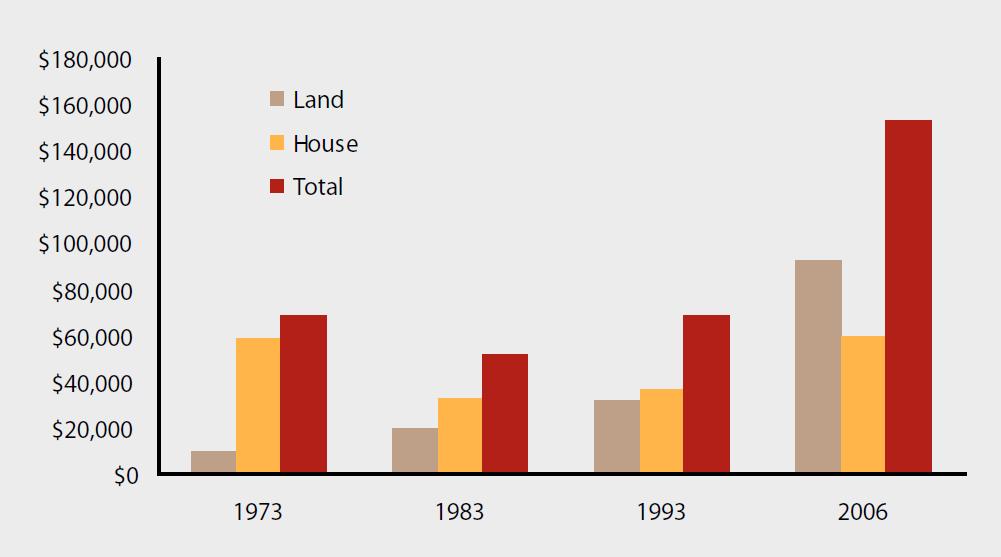
Source: HIA


However, though land values for housing and other development purposes have increased quite dramatically, this has not resulted in a gain for any but a few landowners.  The inflexibility of property use stemming from the regulatory planning controls on land for housing and other urban types of usage has created a two tier system.  It has brought greater value for those landowners with property close to urban areas and zoned for housing.  Such property comprises a mere 0.1 per cent of the aggregate supply of land in the state.  Much of the benefit is in any event pre-empted by swollen state-imposed development charges.

It has had negative effects on other property values.  Increased planning stringency that is the corollary of rationing land for housing and other purposes has reduced land values in many cases by preventing landowners in areas not zoned for development from subdividing their land or building additional houses on it.


FARMLAND VEGETATION

Farmers are major custodians of environmentally sensitive land, including habitats of endangered species.  Their natural instinct upon finding an endangered species may be to protect and nurture it by including preservation in farm planning but under the current legislation this is not only discouraged, but penalised.

The Productivity Commission Inquiry into the Impacts of Native Vegetation and Biodiversity Regulations observes:

The Commission has concluded that the current heavy reliance on regulating the clearance of native vegetation on private rural land, typically without compensating landholders, has imposed substantial costs on many landholders who have retained native vegetation on their properties.  Nor does regulation appear to have been particularly effective in achieving environmental goals -- in some situations, it seems to have been counter-productive.

All over Western Australia farming land is being assessed for its environmental and amenity value.  Once assessed, any patches of native vegetation or wetlands are in effect ceded to the state since no development can then occur on them.  This occurs without landowners knowing about it until a so-called consultation process starts and then it is too late.  Under the current system, the consultation process starts once the government has set the regional principles of assessment, usually in conjunction with the actual assessments but only the resulting assessments can be appealed against and the appeal is only on whether what is assessed meets the principles.  It is unacceptable to consult with affected landowners only after the principles of assessment have been set because this means if your land meets the principles it is affected and there is no compensation and no right of appeal.

The Western Australian Environmental Protection Act (1986) as amended in 2004 makes it criminally illegal for anyone to harm the environment and in particular damage any native flora or fauna, dead or alive, intentionally or by accident without a permit.  The problem is compounded by the fact that only environmental damage in excess of $20,000 will be prosecuted but there is no means of calculating the value of environmental damage.

There are examples in Western Australia of virtually entire farms being assessed as having conservation value, often when their owner has voluntarily chosen to fence off wetlands, plant native species, retain old trees for habitat and keep stock out of waterways.  Yet having done all this, the farmer effectively loses control of his ability to farm his land.  By contrast, the environmentally irresponsible farmer is much less likely to face restrictions because there is nothing left to protect.

No compensation is payable to farmers for the loss of previously productive land.  The land is often classified or zoned for conservation, but not actually reserved for that purpose so the capacity of the property owner to use it is removed but there is no avenue for compensation or acquisition by government.  In some cases "conservation covenants" are imposed which force the landowner to maintain, manage or improve the conservation or landscape values of a site.  In these cases the unfortunate landowner may have to pay to maintain or create an area with conservation value which at the same time reduces the saleable value of the land, a pay now and pay later scheme!


WATER

Western Australia's water must serve many users including urban populations, farmers, industry and environmental conservation.  Each will value an additional unit of water differently and each may change his/her valuation following a change of plans or even something as unexceptional as dry weather.  Mediating between these users is a complex task and relevant rights are not always as certain as they are with land.

Like all scarce goods, the most equitable way to allocate water is to allow price to direct it to its most valued use -- to allow owners of water rights to sell to whomever will pay them best.  At the same time, current use may not be the most valued use.  Values can change over time as, for example, the environment is more highly valued now than in the past or population expansion makes piping water to urban centres the most valued use.  Even within one industry the most valued use can change over time as, for example, cropping replaces wool and vineyards irrigated pasture.  To best accommodate these changes water needs to be able to be moved from one use to another and price is the most equitable as well as efficient way to do this.

Irrigation farmers have invested in properties with attendant water rights that are a large part of the value of their undertakings.  If water rights are to be divorced from the land, as they should be, then owners must be given a title to the water that is the equivalent of their title to the land.  The government's first responsibility is to make ownership of water rights as certain and enduring as is the ownership of land, to protect them with the equivalent of a Torrens title.  Land holders' bankers also require as much.

What then of the environment?  Many people believe that ‘environmental flows' ought to be increased.  If the government wants to increase these then, as custodian of the public interest, it must pay existing water holders for that right, just as it does when it acquires land.  A government should have the authority to ‘resume' water for public amenity, just as it may resume land, but only on just terms.  Because over-allocated water usage in Western Australia, unlike much of the Eastern States, is uncommon, this requirement should present this State Government with no serious difficulty.  It should however move promptly to clarify the several water rights in those catchments where water is approaching or has exceeded full allocation.  In catchments where the marginal value of water is low there is less urgency but there too owners deserve clear title.

When determining water policy within a property rights framework, the key principle must be the protection of existing rights to water.  It is unacceptable for current users of water to have the rules changed and massive additional charges imposed or complete withdrawal of water when they have made investment decisions based on current rights.  Moreover, water policy must explicitly account for long practice.  There are many who have made major investment decisions over sixty or more years based on access to water.  Even in cases where this use of water is not legislatively permitted, the long-standing legal principle of adverse possession must be applied.

Just as the law provides for long-standing practice to be recognised as a form of title, the same law limits that title to the extent the property has been possessed.  In the case of water, this means a right to the quantity of water taken, not to a general right to take as much as possible.  So, if a farming family, over many generations have pumped water from a creek to fill their damns, with no argument from government but also no permit, that property should be allowed to hold title to the average amount of water pumped.  However, this right does not extend to that property being able to increase the flow ten-fold so the farm can begin irrigating crops.  Existing water users, therefore should have legal rights to water, even when long-standing use has never been approved, but these are limited rights.

Water rights must be legislatively protected to allow holders the opportunity to exploit, mortgage or sell them as best serves their circumstances.  Not all landholders may want to utilise their entire entitlement.  The beauty of applying property rights principles to water is that by making it tradeable, some users, perhaps those in ill health or past retirement who cannot work the land in the same way but need additional income, can remain on their farm and gain the income from selling part of their water entitlement to someone who wants to irrigate, or to an urban authority or to an environmental pool.


A SOLUTION

A just society does not confiscate people's property without compensation.  A just society does not restrict the use and devalue people's property without compensation.  A just society treats everyone, rich and powerful or poor and weak, the same in the eyes of the law.  Under these criteria, Western Australia is no longer a just society.

A fair system is based on four principles:  consistency, openness, compensation, and right of appeal.


CONSISTENCY

All existing legislation needs to be reviewed to introduce consistency for how landholders are treated by all levels of government.  In addition to heritage and farmland vegetation highlighted in this document, the review will include planning laws, water entitlements and use, and any other aspect of Western Australian law which affects private property ownership and use.

Legislation arising from such a review will;

  • require all state government departments and local government to apply a uniform process to detail any actual harm or public nuisance that proposed regulations are designed to stop or prevent, the extent to which they affect private property owners, and whether the goals of the proposed regulations can be achieved using less prescriptive means, such as voluntary programs,
  • introduce mandatory benefit-cost analysis of proposed regulation using a standardised framework across government which values economic, environmental and, where possible, social benefits and costs from proposed property regulation.  No legislation is to be enacted without the results of such analysis being made public for an adequate time period,
  • prohibit state and local governments from using their compulsory acquisition powers to expropriate private property for private development in order to generate more tax revenue, and,
  • prohibit non-legislative policies which have the effect of placing restrictions over the use of private property.  All limitations on private property must be legislative and open to usual accountability mechanisms.  Property owners who believe non-legislated mechanisms are adversely affecting them should have access to appeal mechanisms.
  • progressively remove zoning restrictions on new housing development.

OPENNESS

All government agencies, including statutory authorities, must be required to contribute to a central database, operated by the Valuer General, of any covenants, heritage listings, environmental restrictions or other listings which place restrictions on individual properties, including heritage overlays of entire suburbs.  Landowners and potential purchasers must, at a minimum, be able to easily, and at low cost, discover what they can and cannot do to their own property.


COMPENSATION

At a minimum the WA constitution should be amended to match that of the Federal constitution to pay just compensation when property is taken from private landholders by the government.  However, often regulation reduces the value of property without actually changing title so the law needs to go further.  An appropriate protection for property owners would be legislation with constitutional effect which requires the state to compensate land owners when land use restrictions reduce the value of their property by excision of existing rights.

Such a measure would have the added blessing of providing a financial incentive to the government that it does not now have to prioritise its heritage, environmental and water use goals, concentrating on the most important.


RIGHT OF APPEAL

Establish a Private Property Tribunal to rule on the reasonableness of compensation paid by government to private property owners when their property is expropriated or devalued due to restrictions.


CONCLUSION

Western Australia will best balance community calls for environmental and heritage protection with the benefits of economic growth from development by getting the incentives right.  This package of reforms achieves that balance through compensating property owners where appropriate and opening up the process to proper, independent scrutiny.  The result will be better protection of all the assets that the community values.

Land-based wealth an illusion

Inflationary pressures are the immediate impetus for interest rate increases.  Aside from short-term movements, those pressures emanate from an imbalance between savings and current levels of consumption.  Savings that are too low in the long run reduce the capacity of the economy to produce income and mean lower growth and consumption.

Australia's real level of household savings has been declining for more than 20 years in a trend that has gathered pace.

In spite of these lower savings levels, according to Treasury data, household wealth is continuing to increase.  Treasury estimates aggregate private wealth in 2005 nominal dollars at $6076 billion, or at $305,500 a person.  In real 2003-04 dollars, wealth is estimated to have grown fourfold since 1975, as illustrated here.

In per capita terms, the real growth has been 2½-fold over the same period.

Obviously there is an inconsistency between private wealth and real savings levels.  The answer lies in housing, which accounts for nearly 60 per cent of private wealth.

Much of the wealth represented by housing is illusory.  It is created by government rationing of land.  This causes inflation in land prices.

The building component of new house prices has changed little in real terms over the past 30 years.  However, over the same period, the land component has outpaced general inflation by between tenfold (Adelaide) and twofold (Melbourne).  This is nothing to do with real land shortages -- urban land comprises only 0.3 per cent of the national land stock.  It is caused by increasingly stringent zoning rules that have reduced the supply of land that can be developed and boosted prices in new and established houses.

The interest rate rise is designed to curb some particularly strong house price rises that have been seen over the past year or so.

While this represents a sound response to an immediate problem, the issue is much longer term.  Land supply constraints are inflating house prices.  This is creating an illusion of wealth and affecting savings levels.  More importantly, it is pricing non-home owners out of the market.


ADVERTISEMENT

Time for a fuel change

Petrol prices continue to climb and Federal Treasurer, Peter Costello, recently responded to increasing community concerns by explaining it was not his fault because he had no control over international oil prices.

But there are alternatives to oil and some claim the Australian government should and could do more to promote an alternative fuels industry.

Swedish Prime Minister, Goran Persson, has plans for his country to be independent of oil by 2020.

He wants Swedish farms to produce enough ethanol to run the countries motorcars.

It's ambitious, but perhaps not as ambitious as British airline boss, Richard Branson's plan for all of Virgin and Virgin Blue planes to one day run on ethanol.

Mr Branson wants to break his company's dependence on oil for two reasons:  because the price keeps going up and also because it isn't environmentally friendly.

He believes ethanol will replace oil over the next 20 or 30 years.

In the US, ethanol is produced from corn and this year it is estimated that ethanol production will consume 20 percent of the US corn crop, pushing up prices of not just corn, but also Australian sorghum, as world markets respond to increasing demand.

According to the US Department of Agriculture, ethanol production adds US30 cents to the value of each bushel of corn, and according to the Renewable Fuels Association $US4.5 billion to US farm income annually.

Brazil is the world's most efficient producer of ethanol and it uses sugar cane as the primary source.  Last year Brazil produced 4.2 billion gallons of ethanol at an estimated production cost of US$0.81/gallon, excluding capital costs.

By comparison it costs US$1.03/gallon to produce ethanol from corn in the US.

Interesting, in his State of the Union address earlier this year, US President George Bush, suggested it was hydrogen rather than ethanol which would emerge as the dominant transport fuel of tomorrow.

He said:  "With a new national commitment, our scientists and engineers will overcome obstacles to taking these cars from laboratory to showroom, so the first car driven by a child born today could be powered by hydrogen, and pollution-free".

The US President has backed this vision with at a $1.2 billion commitment to research into the new technology.

It's fair to conclude there will be a worldwide transition from oil to something else, but we don't know how rough or smooth this transition might be, nor whether in 20 years time ethanol, or hydrogen, or something else, will be the dominant transport fuel.

But as one former Saudi Arabian oil minister famously commented:  the Stone Age didn't end because the world ran out of stones and so the oil age will end before we run out of oil.


ADVERTISEMENT

Tuesday, August 01, 2006

Democracy versus leadership in Poowoomba

Why did Prime Minister John Howard insist that the people of Toowoomba vote on the issue of waste water recycling?  Why didn't he just give the Mayor of Toowoomba Di Thorley the $23 million she requested to build a state-of-the-art water recycling facility?  The project met all the criteria for funding under the National Water Initiative.

Perhaps, like me, the Prime Minister assumed the vote would get up.  He assumed that the people of Toowoomba, perched on the edge of the Great Diving Range at the headwaters of the Murray Darling Basin, would accept this was the best option.

Safe water yields in Toowoomba were exceeded in 1998 and the population has kept growing.  In the immediate to short term, the city needs to find an additional 7,000 megalitres a year and in the medium-to-long term another 12,500 megalitres.

The Queensland Government has ruled out the possibility of a new dam as it would be upstream of Wivenhoe Dam, the main water supply for Brisbane.  Queensland Gas Company has claimed it could supply Toowoomba with water from its coal-seam gas mines, but the Toowoomba City Council claims supply would be unreliable and the water too salty for drinking without expensive treatment.

Toowoomba is too far from the coast to consider desalination and pumping from groundwater is not sustainable in the longer term.

But all of these options may need to be revisited as the recycling option was voted down on Saturday.  Over 60 per cent of residents voted "no" to the city council's proposal for waste-water recycling.

Toowoomba's Mayor Di Thorley has been a great ambassador for both recycling and for an independent, self-reliant Toowoomba.  But on conceding defeat she suggested Queensland Premier Peter Beattie now take over responsibility for providing Toowoomba's water needs.

Until a week ago the Premier would not publicly support the project and had ruled out the possibility of Brisbane residents ever drinking recycled sewage.

But the weekend before the referendum, the Premier had what On Line Opinion chief editor Graham Young described as a "Damascus Road conversion" and came out publicly supporting waste-water recycling.  It was the same weekend Brisbane hosted Earth Dialogues and former Soviet President Mikhail Gorbachev spoke in favour of waste-water recycling for Toowoomba.

There was never any shortage of proponents for the "yes" vote.  Democrat Senator Andrew Bartlett campaigned for the "yes" vote, as did Parliamentary Secretary to the Prime Minister Malcolm Turnbull.  Don Burke from Burke's Backyard and chair of new environment group the Australian Environment Foundation, issued a media release just before the referendum suggesting that Toowoomba was leading the way, addressing an issue that other cities had so far failed to address.

Ian Kiernan from Clean Up Australia gave his backing to the plan claiming that with the right science and technology waste-water recycling is 100 per cent safe.  Even the Australian Greens support the technology on the basis it will decrease per capita consumption of freshwater.

So what went wrong?  Why did the referendum fail?  Who opposed the project?

Citizens Against Drinking Sewage (CADS) formed in opposition to the project and ran a simple local campaign playing on distrust of technology, aversion to human excreta, and claimed there were alternatives to recycling sewage as drinking water.  Property developer and "no" campaigner Clive Berghofer said if the project went ahead the city would become known as "Poowoomba".

The "no" campaign was also supported by local farmers who have been using the city's sewage to water their crops for about 60 years.  These irrigators would have lost this water supply when the new facility was built.  Indeed the outcome could be seen as one group of resource users out-smarting a city council to retain access to "cheap water" so they can keep growing lucerne for their cows?

These farmers were supported by the Queensland National Party and it is possible that it was lobbying by this alliance that resulted in the Prime Minister insisting on a referendum.

The economics and science were clear -- recycling waste water was the obvious solution.  The future is now less clear for everyone except perhaps the irrigators.

Australian lags behind the rest of the world in the adoption of several key technologies including genetically modified food crops and nuclear power.  We can now perhaps add to this list waste-water recycling.  The technology is operational in Africa, Asia and the United States but still not a reality in Australia.

Prime Minister John Howard could have approved funding for the project last year but because it was controversial he forced a referendum on to a democratically elected local government for a proven technology that polling shows is not politically popular.

In insisting on the referendum and then seeing it fail, John Howard has increased the level of participatory democracy at the expense of good governance.

Instead of planning to secure her city's water future, the Mayor Di Thorley is now reduced to just praying for rain.


ADVERTISEMENT

Sunday, July 30, 2006

Going through hell for a slice of heaven

One of the best instincts in us is that which induces us to have a little piece of earth with a house and garden which is ours.

-- Sir Robert Menzies

The Great Australian Dream, to which Sir Robert referred, is rapidly becoming a nightmare for our kids.

In the early 1980s, the price of the median land and house package in all major Australian cities, except Sydney, was equal to three times median household income.  On top of this the block sizes were large, by international standards and taxes and charges were low.  As a result home ownership in Australia was among the highest in the world.

Since then, but largely since 1996, the price of that "little piece of earth" has moved out of sight of the financial capacity of the average family.

In all of the nation's major cities the ratio of median house price to median income now exceeds 6 with Melbourne being 6.4.

The culprit is land rationing masquerading as "zoning" and State Government taxation.

The National Housing Affordability Conference, held in Canberra this week, highlighted many of the symptoms of runaway housing prices.

Among them was the concern that it locks young people out of the dream altogether or entraps them with horrifically high mortgages or relegates them to dense, high rise living unsuitable to rearing children.

This in turn acts as a disincentive to have children;  care for elderly and save -- things the younger are increasingly being expected to do.

On top of this it absorbs and wastes a large and growing proportion of the nation's wealth.  Housing accounts for just over 58 per cent of the nation's wealth.  This is very high by world standards and has increased sharply over the past few decades.

While investment in housing is both necessary and healthy, a large share of the investment in housing in Australia is illusory.  It reflects in price inflation and regulatory-driven scarcity.

Until the late 1980s state and local governments focused on insuring a large, accessible supply of low cost land.  Then under the misguided pursuit of controlling sprawl, the focus shifted to limiting the supply of land particularly on the city fringe.

The law of supply and demand drove the price of land ever higher.

Governments contributed further to the high prices.  They pushed up taxes on housing by 300 per cent over the past decade.

Don't expect things to change.  Too many people have too much at risk.

This includes many of the leading lights of the Affording Housing Summit who seek to treat the symptoms rather then the cause by seeking to require builders to increase the amount of low cost housing.

Governments are also hooked on the easy money generated by house price inflation.  The banks and developers are locked into the inflated prices and fear for their investments if the regulatory measures underpinning them were removed.

And many thousands of investors are geared to the hilt betting that prices will only rise.

Most significantly the agencies and professions that regulate the housing sector have succumbed to an anti-growth, they-know-best ideology.

In other words, the guardian is committed to destroying the dream.  Pity our children.


ADVERTISEMENT

Saturday, July 29, 2006

Hand-outs come at a price

If you're willing to spend enough money you can buy almost anything.

This basic rule of thumb applies to both individuals and governments.  But there's an essential difference between spending by individuals and spending by governments.

When individuals buy something they are using their own money.  When governments buy something they are using other people's money.  When individuals buy something they tend to look for value for money and consider the opportunity cost of their purchases.  Governments usually don't.

The financial constraints on individuals that don't apply to governments produce the sort of ills that taxpayers are familiar with.

Governments believe they can buy all sorts of things -- success for the nation's sporting teams, a thriving arts and cultural sector, a program of events and festivals running from January to December.  Once upon a time Australian governments even thought they could buy a viable manufacturing sector.

It is not just governments that refuse to consider the cost of what they are buying.  The lobby groups urging ever greater amounts of government spending are often also reluctant to consider the cost of government purchases.  The last week has provided two examples.

On Monday the ABC's 7.30 Report bemoaned the "lack of support" from government for the wind-power industry that was "driving Australian jobs and know-how offshore".

The next day the Australian Manufacturing Workers Union released a report that called for government to invest $1 billion a year in the manufacturing industry.

The complaint from the wind-power industry is that, if the federal government does not guarantee its market share, further investment is financially unviable and therefore it will move to countries such as China.  (Presumably the wind-power industry has learnt a thing or two from car manufacturers about threats to go offshore if taxpayer assistance is not forthcoming).

The problem for wind-power advocates is that their product (electricity from wind power) is twice the cost of its competitor (electricity from coal).  Wind power can't compete commercially with its alternatives, which is why the industry is using the supposed greenhouse-gas benefits of wind power as a lever for government regulations that guarantee the industry's profitability.  The ethanol industry plays the same sort of game.

In response to the claims of the wind-power industry, Agriculture Minister Peter McGauran captured the point perfectly:  "There are many industries we could keep in Australia with a taxpayer subsidy and, as a result, if those companies decide there are countries in the world that will pay dearly for their services, so be it".

Instead of government directly spending taxpayers' funds to ensure the viability of an industry, the cost of having a domestic industry is borne by consumers who end up paying more for their electricity.  The number of jobs created by the development of a renewable-energy sector will be dwarfed by the resulting job losses in all the other sectors of the economy.

A key sector to suffer from higher power prices will be manufacturing, so there's a neat symmetry in that industry following the lobbyists for renewable energy to Canberra in search of the helping hand of government.

The AMWU has called for the government to change its hands-off approach to manufacturing.  It wants tax concessions and export grants to ensure the survival of the industry.  The stated justification of such spending is that Australia needs manufacturing.  But do we need a manufacturing industry if the cost is the impoverishment of those industries in which the country has a comparative advantage?

At least the AMWU isn't calling (as yet) for the reintroduction of tariffs.  This is not to say, though, that the union has embraced every aspect of reality.  While it seeks high-skilled, well-paid jobs for its members, it also campaigns against free trade.

The best-paid employment for the highly skilled is mainly in those sectors of the economy that are not protected.  In the short run protection and subsidies might slow the loss of jobs, but in the medium run it breeds management lethargy and kills enterprise.  Further, in the long run protection and subsidies are unsustainable.  The tragedy of Australian manufacturing is that, for the past two decades, it has been paying the price for the policy mistakes of a century ago.

Finally, it appears that politicians now appreciate that simply because government can buy something, it doesn't necessarily mean that it should.  Sometimes the price is just too high.

Hopefully one day all of those sectors seeking taxpayer handouts will also realise this truth.  But until then, it seems that tariffs might be dead, but demands for industry protection are alive and well.


ADVERTISEMENT

Friday, July 21, 2006

State's energy measures tax credulity

The Victorian Government is seeking to demonstrate its green credentials.  It proposes to introduce an energy tax that will force all electricity users to increase the renewable content of their electricity supply from the present 4 per cent to 10 per cent.  The tax is to be set at $43 per megawatt hour.  This means a doubling of the cost compared with the coal-fired electricity that provides 90 per cent of Victoria's electricity.

In releasing the proposals, Energy Minister Theo Theophanous and Environment Minister John Thwaites claim the cost to households will be a mere $1 a month.  They also say that the measures will create 2200 jobs.  One can only assume that among the contenders for next week's press release are the proposals to turn water to wine and transform lead into gold!

Surely we have advanced beyond notions that regulatory measures come with negligible penalties.  If we can create 2200 jobs at $1 a month per household, why not quadruple the penalty and create 8800 jobs?

The fact is that the proposed measures have been devised in an analytical vacuum.  Far from bringing increased wealth and job growth, the regulatory tax, if passed by Parliament, will gnaw at the state's economic health.  This is all the more likely as the tax imposts and subsequent subsidies are designed to apply until 2030 and the legislation only allows for costs to rise.

The notion that the costs will be trivial is contradicted by the supporting material, scant as it is, that the ministers have released.  This says that the measures will bring an increase in exotic renewables of 385,000 MWh a year.  At the $43 per MWh penalty tax deemed necessary to bring this about, that means an annual cost of $164 million, amounting to more than $2 billion over the course of its life.

Presumably the ministers' estimated monthly cost of $1 per household assumes that the bulk of the charges will be incurred by industry and commerce.  This incorporates the regrettable notion that if we slug business the costs will not be noticed and nobody will be the worse off.  How many governments have run aground on that particular reef?

The only rigorous analysis of the proposal was undertaken by highly regarded independent consultants Access Economics.  This estimated a real net economic loss to the state of $829 million in net present value terms.  Far from anticipating more jobs, Access Economics estimated the regulatory tax would bring at least 1100 job losses.  And, because much of this cost involves a transfer of activity overseas and interstate to avoid the higher regulatory costs the Victorian Government will impose, the overall effect on emissions is small.

Hard on the heels of those proposals, ABARE, the Commonwealth's leading economic research agency, released a report on greenhouse gas emission restraint measures.  That report, prepared for the CSIRO, estimates the tax-equivalent measures necessary to reduce Australia's greenhouse gas emissions by 36-68 per cent of business-as-usual levels.

Naturally this involves much higher taxes than the $43 involved in the Victorian program, which would reduce the state's emissions by, at best, 6 per cent.  And ABARE minces no words about the costs:  it estimates real wage reductions of 4 to 21 per cent, depending on the severity of the emission-reduction program.

Though the proposal's priority is on reducing carbon dioxide emissions, the Victorian renewable energy proposal also sets out to achieve a potpourri of other goals, including regional development and fostering a new industry.

Meaningful gains will be achieved in none of the areas targeted, and the Government knows this.  It confirms its lack of real interest in reducing emission levels by provisions within the proposal to prevent the renewable energy being supplied from outside Victoria.  Such a provision is of doubtful constitutional legitimacy and denies the ability of energy suppliers to meet the goals at the lowest cost.

What the measures really seek is continued funding support from the beneficiaries of the subsidies and electoral appeal to mindless inner-suburban green voters.

This is politics at its most cynical.

The Victorian Government claims it is exercising leadership in the energy debate.  If so, its leadership is demonstrating how to reduce living standards.


ADVERTISEMENT

Tuesday, July 18, 2006

Truth hard to find in new IR

Do the Howard Government's new industrial relations laws let bosses screw workers?  If they do, the Government should be tossed out at the next election.

The unions say this is the case and they keep raising examples claiming they are right.  One example they used was the alleged sacking of 29 meat workers at the Cowra Abattoir in early April.  But the Government says the unions are wrong and the new laws are fair.  What's the truth?

We know the unions hate the Howard Government so we can expect they will always claim the worst.  Unions say the Government loves big business and not the little guy.  However Howard has constantly won elections based on strong worker support.  Why would he let business screw the workers who vote for him?  Wouldn't this cause him to lose the next election?

It's hard to find the truth.  But we now know what happened at Cowra.

It is true that 29 meat workers were sacked with redundancy packages and 20 were offered work on different conditions.  Unions complained and ran a media blitz.  The Government sent in inspectors from their new Office of Workplace Services.  The inspectors recently issued a report.

According to the report, Cowra Abattoirs is in serious financial trouble and could possibly close.  They have unprofitable pig and beef processing lines operating under different industrial agreements.  Business is declining.  They wanted to combine the operations into one line using another industrial agreement.  It was legal to do this even under the old laws.

The unions said the workers were being discriminated against because of their union membership.  The report says that according to the workers, they had not experienced any discrimination by the company.

Cowra Abattoirs put the men back to work under the old arrangements when the media story became hot.  They have now done a deal with the unions on a new workplace agreement covering their pig, beef and mutton lines.  Under the union agreement about six jobs will go.  "Base" pay rates will be maintained.  But it's not clear if the union agreement results in higher, lower or the same take home pay as before.  One thing however is certain;  if the abattoir does not control costs, it risks closing.

Now that most facts seem to be known, what conclusions can be drawn?  Both the old and the new industrial relations laws are complicated.  Like many companies, Cowra Abattoirs has had to choose between one of potentially four industrial agreements, all with different pay and conditions.  And every agreement is legal.  It's confusing.

Further, under the old and new laws companies are legally able to move workers from one agreement to another.  The company did nothing wrong.  Were the workers exploited?  It's hard to say.  It seems that if companies make changes without unions, the unions say the workers are being screwed.  But if unions agree to the changes unions say it's OK.

The main reason unions are angry is that the new laws give them less legal power to control how companies operate.  But does this mean workers are unprotected?  Some say yes.  However the Government has put a lot of money into the new inspection and prosecution service, the OWS.  In the Cowra Abattoirs case the inspectors moved in the day after complaints were known.

In many respects the OWS is designed to do what unions used to do, stop worker exploitation.

A big test for the new laws will be how effective is the new inspection service.  It can be said that the Howard Government has dramatically changed the industrial relations laws.  But it's not fair to say they have created a worker exploitation free-for-all.  Maybe some companies might have thought this could be the case but the new inspection service seems strong.  Ultimately though the main test of the new laws is how well business interests are balanced with worker protections.  If businesses can perform better because of the new laws, more jobs should be created.

About the only thing that appears certain is that we are going to have claims and counter claims for a long time.  For the rest of us we will need to be sceptical of all sides and media hype.  Mostly we will have to judge the new laws on how they affect each of us and our families and friends.  That will be the most important test.


ADVERTISEMENT

Sunday, July 16, 2006

Urgent reform needed to stop federal flaws

Reform of the federal system is the missing link in the reform agenda.

The system has deep, systemic flaws that are getting worse.

It is undermining our ability to address some of the key challenges facing the nation, including in areas of health and education.  It is undermining the quality of government and wasting scarce funds.

While every political leader at federal and state level over the past 30 years has recognised the flaws of the system and the need for reform, very little real progress has been made.

Bob Hawke gave it the best shot, with his New Federalism Initiative in 1990.  Hawke attempted to directly tackle the main flaws of the existing system which is the excessive overlap and duplication between the states and federal government and the excessive dependence of the states on federal funding.

However, this initiative was shot down by Paul Keating in his successful push for the Lodge.

Keating subsequently introduced his own reforms through the National Competition Policy.

While the NCP process generated substantial benefits early on, it did not address the fundamental flaws in the federal system.

John Howard and Peter Costello contributed to the states via the GST.  While this gave the states access to a large growth tax and a lot more money, it made the flaws of the system -- in particular rising state dependence on federal revenue -- even greater.

Apart from Nick Greiner of NSW and Wayne Goss of Queensland, no state political leader has to date taken up the cudgel of reform in a coherent and thorough manner.

Enter the latest debate about federal reform and yesterday's Council of Australian Governments meeting.

Mr Bracks, to his credit, carried the banner of reform to COAG and he received support from other state leaders and the Prime Minister.

While Bracks' program has many positive aspects, it falls far short of systemic reform.  Stripped of its rhetoric, it is largely about getting more federal money to do more of what the states are already or should be doing.

The Bracks agenda makes no attempt to eliminate systemic flaws.  Instead of attempting to eliminate overlap and duplication it tries to manage it better with a new set of committees.  Instead of pushing for greater responsibility for revenue-raising, it seeks more federal money.

Bracks' advisers have rationalised this as trying to make the best of a poor system and to work within the constraints on them by the Federal Government.  It is a second-best approach, but better than nothing.

Bracks, with the exception for confirmed access to more money, got what he wanted.

COAG has largely adopted his agenda including the renewed focus on human capital formation and co-operative planning and delivery of service.

The challenge now is to make the agenda work and it will not be easy.  The flaws in the system remain and they will work against co-operation and good policy delivery.

One thing is clear, reform of the federal system remains very much on the top of the agenda.


ADVERTISEMENT

Saturday, July 15, 2006

It's a small price to pay

There's one issue not on the agenda at today's meeting between the Prime Minister and the premiers in Canberra.  But it is the issue that everyone will be thinking about -- and that issue is of course the future of John Howard as prime minister.

What will be on the agenda are initiatives such as Victoria's proposals for improvement to the delivery of health and education services, the implementation of a national approach to business regulation, and a new funding program for indigenous communities.

Steve Bracks has gone so far as to call the meeting "an historic occasion".  While the description might be a little overdrawn, it is true that the outcomes of the discussions could be very significant.

There's the potential to give real impetus to the next round of national policy reform, and to take the stimulus of competition and consumer choice into new areas they have not previously reached, particularly hospitals and schools.

The possibility that the politics of the Liberal leadership could derail the reform process has been widely lamented.  It will be difficult for the Prime Minister and premiers to strike a deal if the premiers believe that in six months they could be dealing with someone who has a completely different approach to federalism and who has no commitment to any agreement reached by his predecessor.  This is exactly the fear that the premiers have voiced.

The open barracking of the Labor premiers for Howard against Peter Costello has as much to do with the premiers' genuine personal preferences as it has with their desire to perpetuate mayhem against their political opponents.

Business is being directly affected by the Liberals' convulsions.  In the energy sector, for example, several companies are waiting to make investment decisions.  But they can't until the regulatory regime is known, and to finalise the relevant regulations requires the agreement of the federal and state governments.  If federal/state co-operation grinds to a halt, business activities are put at risk.

There have been other events that have dramatically demonstrated the collision between politics and good policy.  The cancellation of the float of Snowy Hydro last month, after 150,000 investors had already registered for a prospectus and just days before the start of the initial public offering road-show, wasn't an example of world's best-practice decision-making.

In this context the call for more policy stability is understandable.  But before we rush to eliminate the politics from policy, we must consider what would happen if we actually succeeded.

With democracy comes politics, and with politics comes uncertainty, and at times instability.  If there is a leadership challenge, the person who becomes prime minister is a decision that will be made in the party room -- comprising MPs and senators, who themselves have been elected through a free vote.  The price we pay for this system is that, as the contenders jostle for the leadership, their attention is diverted from the all-important, long-term national reform agenda.

The rule of law and property rights also come with democracy.  These features of liberal democracies are benefits to individuals and businesses that far outweigh any of the disadvantages of the democratic political process.

When the sale of Snowy Hydro was abandoned last month, the ABC radio program PM reported the comment that the actions of the federal government made "Australia look like a Third-World country".  Hardly.

The majority of Third-World countries are poverty-stricken dictatorships whose governments rule without regard to the will or the benefit of their citizens.  A Third-World country would have carried through with the sale of Snowy Hydro regardless of popular opinion.

The remark was also made that because "the government can flip-flop around on policy on a day-to-day basis" on issues such as Snowy Hydro, it would be more difficult to sell Telstra.  This assessment is accurate, but it doesn't mean, as was asserted, that therefore potential investors will regard Australia as "risky", in the same way as they consider India or Thailand.

Those countries might be preferred as investment destinations, but it's not because they have better legal and political systems than Australia.

A week ago the chances of today's meeting being the "historic occasion" hoped for by Steve Bracks were no better than 50/50.  The events of the past week have reduced those odds even further.

If the meeting collapses, politics will be blamed for the failure.  That would be true -- but if we want to enjoy the benefits of freedom there's no alternative to politics.


ADVERTISEMENT

Friday, July 14, 2006

"Poowoomba" on the right track

Toowoomba, Australia's largest inland regional city, is situated at the headwaters of the Murray Darling Basin on the edge of the Great Dividing Range and is running out of water.

There was much talk during the weekend about the referendum to be held at the end of this month when the residents of Toowoomba get to vote on whether to begin recycling sewage as drinking water -- or not.

If a majority of residents vote yes, it will be a first for Australia.

The technology is already in place overseas and providing drinking water for Singapore, Atlanta (Georgia, USA) and Windhoek (Namibia).

London is an example of what's called "unplanned potable reuse", with 360 waste water treatment plants discharging into the Thames River upstream of London.

The Toowoomba City Council has been hoping to follow Singapore's lead for some time, but has been waiting on funding from the National Water Initiative.

The decision on funding should have been made by the Prime Minister at the end of last year.

Instead, Federal Member for Wentworth and Parliamentary Secretary to the Prime Minister, Malcolm Turnbull, announced that the federal government would let the people of Toowoomba decide.

If a majority vote yes on the 29th July, the Federal Government will provide $23 million for the water treatment plant.  The Queensland government will match this amount, but not publicly support the plan.

Citizens Against Drinking Sewage (CADS) formed over a year ago and they've lobbied hard against recycling claiming their city will become know as "Poowoomba".

They claim no-one should have to drink excreta.

But, hang-on there, many people have been drinking "Toowoomba's poo" for a long time.

Toowoomba's treated sewerage is currently discharged into Gowrie Creek which empties into Oakey Creek which empties into the Condamine River.

The town of Dalby draws its water from the Condamine.

It's also interesting to ponder that some of the treated sewerage from Canberra will probably find its way to Wagga Wagga, Griffith, Hay, Balranald and, eventually, Adelaide.

In fact, cities throughout the world discharge treated and untreated sewerage to rivers and streams that supply downstream users with drinking water.

In the referendum at the end of the month, I would definitely vote yes.

There's no point in being precious when it comes to securing a water supply.

City councils should be able to use different options including the reuse of sewerage.

In fact, I would feel less guilty drinking my third cup of tea in the morning, if it was officially recycled water.

I could perhaps claim I was doing my bit for the environment -- sipping the recycled sewerage.


ADVERTISEMENT

Twisting the facts is not the answer

Prime Minister John Howard called for a national debate on nuclear power.  But first he wanted the facts.

Some time back, that wise senator from New York state, Daniel Patrick Moynihan, said:  "Everyone is entitled to their own opinion, but not their own facts".

The Prime Minister has got it right and no more so than in assessing Helen Caldicott's contribution with her latest book on nuclear power, Nuclear Power is Not the Answer to Global Warming or Anything Else.

This is a shrill, cantankerous and ranting work.  In it, Caldicott plays the family great aunt cackling interminably over the personality failures of her lively nephews and nieces.

Caldicott's method is to kick off with a spectacular but completely wrong attempt at a knock-out blow on each phase of the nuclear cycle.

On mining, for instance, Caldicott makes the amazing assertion that to extract low-grade uranium ore much more energy is used in winning the yellowcake than burning it.

Evidence?  She provides the example of mining granite that yields four grams of uranium per tonne of rock and requires 30 times the energy to mine and mill than it ultimately yields from a reactor.

But a quick look at the energy input and output at Ranger, where grades are 2000 grams per tonne of rock shows the energy output is a return of 1000 times the mining and milling energy and 60 times more than the energy input including all processes before and after burning the fuel in a reactor.

On power generation she quotes the real cost of nuclear power at US$0.14 per kilowatt-hour from the New Scientist magazine.  But the Australian Nuclear Science and Technology Organisation report Introducing Nuclear Power to Australia might get to half that value.  It is only when reactor plant life is 15 years, as opposed to 30 or more years and the discount rate has moved to 15 per cent that Caldicott's quoted electricity cost emerges.

On nuclear disasters, she says that the plaintiffs in the Three Mile Island suits against the plant owner settled when they could no longer afford to continue.

In fact, in June 1996 District Court judge Sylvia Rambo dismissed the lawsuit granting summary judgement in favour of the defendants.

Finally, in presenting renewable energy as the answer, she shows how much wind energy is available on the planet but shows no understanding of the impact of its intermittent behaviour when wind farms generate electricity.

How the book will be received by the public and how it might influence opinion is uncertain.  For those with some knowledge of the subject it will be assessed on its merits.  But, worringly like the treatment of literature and language in secondary schools, teachers might take the book as an important and unquestioned text.


ADVERTISEMENT

Thursday, July 13, 2006

Paternalist gimmicks won't help parents, teachers or children

How can parents be encouraged to care about their child's education?

This is at the heart of the proposal from the Victorian Association of State Secondary Principals that parents be required to sign a "contract" with their child's school.  The agreement would cover matters such as parents guaranteeing to attend parent-teacher interviews, ensuring that their child's homework is completed, and committing to take an "active interest in their children's learning".

Parent "contracts" are already in place in some state government and private schools, and the Liberal Party may include the suggestion in its education policy for the next election.  The proposal is an understandable reaction from school principals.  Their job is getting increasingly difficult as families, either deliberately or not, shift the task of parenting on to teachers.

The education function of schools is being replaced by a welfare function.  Having parents acknowledge their role in their child's education is one way of putting responsibility for bringing up children back onto families.

The question is whether contracts between schools and parents are the best way of achieving this.  And the answer is no -- for three reasons.

Firstly, the parents at whom this initiative is aimed are unlikely to have their behaviour influenced by being forced to sign a contract.  Certainly there will be some parents who may be encouraged to act differently, but they will be relatively few.  As Principals Association president Andrew Blair said:  "We are seeing more and more kids in a terrible state of repair turning up to school".  Parents sending children to a school in this state are likely to be known to the school and to welfare agencies and will probably already be receiving help and counselling.

For a variety of reasons, some of those parents will simply be incapable of providing their children with the sort of support required under an education contract.  Parents who fail to help their child's learning are likely to fail their children in many other ways.

Secondly, there's the matter of consequences when the contract is broken.  The most serious sanction is expulsion, and a student from a disadvantaged background is only going to be punished further if he or she must change schools because a parent has breached the contract.  And it would be unfair to penalise a student if a parent refused to sign a contract.

It would also be a mistake to think of contracts as being one-way.  If schools do not fulfil their side of the bargain, it is unclear what sort of redress parents would have.

If, for example, by the end of primary school, a child was unable to read and write, who should be held accountable -- the school or the parents?  In theory, there's no reason why contracts shouldn't be available to all parents at a school.  This potential for an administrative and legal nightmare leads to the third argument against contracts in this context.

A successful educational experience for a child is the result of a partnership between the child, the family and the school.  This partnership is based on shared assumptions and understandings, and fundamentally it centres on trust.  Parents trust teachers to apply their professional judgement and skills in the classroom, and teachers trust that parents will ensure that when children arrive at school they are able and ready to learn.  This trust can't be captured in a contract.

Regulating social relationships, whether by contract as in this case, or through government legislation in other situations, is rarely the solution.  The application of bureaucratic and legalistic rules to relationships has as much chance of destroying relationships as it has of strengthening them.

At first glance it might appear that a contract between a parent and a school would help clarify the expectations of each to the other.  However, no piece of paper can cover every possible contingency and, regardless of what is written, ultimately the parties are going to have to rely on common sense.

If parents came to believe that their obligation to their child's education started and ended with what was contained in the contract with their school, the cause of encouraging parents to undertake greater responsibility might even be set back.

Contracts and regulation are the easy way out to the problem of what to do when parents can't or won't care for their child's education.  Principals and teachers are confronted daily with the consequences of dysfunctional families, and most of the time principals and teachers are left to fend for themselves.

The real challenge is to change the attitude and behaviour of parents -- and this is not the role of schools.


ADVERTISEMENT

Saturday, July 08, 2006

Regulator should butt out on fibre-optic broadband

It is unfortunate for consumers and businesses that Telstra's potential $3 billion-plus investment in a large-scale fibre-optic network and the coming T3 sale have coincided.

The debate over the two have rarely been separated, but at stake are two very separate issues, with very separate stakeholders.  Treasury officials are concerned with maximising the price of Telstra's sale, but consumers and businesses should be concerned about the circumstances in which we allow infrastructure investment in this country.

As Australian Competition and Consumer Commission chairman Graeme Samuel has correctly noted, Telstra's fibre-optic plan is "not the only game in town".  A consortium of Telstra's competitors, including Optus, Macquarie Telecom, Primus and Internode, have proposed an open-access network.  Tellingly, all their proposals would require heavy investment from Telstra.

Telstra's competitors are merely following Telstra chief executive Sol Trujillo's lead and conducting regulatory negotiations through press statements.

Unfortunately for the regulator, the obstinate Telstra refuses to sign up to its competitors' plans.  Telstra has the money to do so, but, under the current regulatory framework, no desire.  And why should it?  The ACCC has argued that any investment by the carrier would be subject to a "fair" return.  But it is not the ACCC embarking on this risky business venture -- Telstra is a company that at least in theory should be aiming to maximise its financial returns.  If a company, or individual for that matter, makes an investment in the market, they should be subject to their own judgement of what constitutes a fair return, not what a national regulator considers one to be.

But such thinking is largely alien to the ACCC, which has long believed itself to be the patriarch of large infrastructure investment in Australia.

The classic justification for the imposition by a regulator of shared access does not apply to Telstra's fibre-to-the-node (FTTN) proposal.

The carrier built its copper-wire network under a government-imposed monopoly.  It used taxpayers' funds to do so.  Under these circumstances, it was perhaps reasonable to have a regulator open the network up to ensure at least the vestiges of competition.  But there are very real problems with such a regulatory regime.

Access-based competition encourages service providers, initially leeching off the monopoly provider's network, to step up the "ladder of investment" -- slowly investing more and more in the existing infrastructure.  This has its advantages in a marketplace with little innovation.

But having now invested a great deal in the existing network, these carriers are faced with the prospect of being abandoned by Telstra as it jumps into a largely separate new network.

The ACCC's framework has encouraged the growth of small, fly-by-night internet service providers, whose business model is nothing more than a reliance on the ACCC-determined access prices.  Country-wide, there are more than 250 of these ISPs, encouraged not by the whim of the free market, but by the decrees of the regulator.  Given their perilous profitability, they are ill-equipped to withstand the rapid technological change of the sector.

Access sharing does nothing to encourage true, facilities-based competition.  And there are few other industries where facilities-based competition, and the innovation which propels it, are of such paramount importance.  Given the ever-increasing range of technology by which high-speed broadband can be delivered to the home -- and to the mobile phone -- we cannot afford to discourage entrepreneurs from experimenting with new business models and products.

And, not least, access sharing constitutes a massive taking of property rights.  This may not have been of much concern to regulators a decade ago, when they were faced with the taxpayer-supported Telecom, but with a nominally private company whose investments are subject to free will, this should be of great concern.

The communications market has been liberalised for the past decade and subject to a radical shift in emphasis.  It is important to remember that consumer demand has moved from the basic telephone service to mobile telephones, to video-playing iPods.  There are now large numbers of telecommunications providers, many of which are justly proud of their investments in infrastructure across the country.

But Telstra's competitors and the ACCC want to migrate the access-sharing framework, developed a decade ago for a monopoly network provider, onto a fibre-optic network developed by an entrepreneurial company with private capital.  The FTTN network is highly speculative.  Given the current state of technological innovation, it is a risky investment.  Telstra must bear this risk alone.

The FTTN network will not be the last investment Australian firms make in telecommunications infrastructure.  Rapid technological change makes it a certainty that every few years significant upgrades will be made to our national communications networks.  But if regulators are given a right of reply to every investment and pricing adjustment, Australian broadband will lag well behind what a wealthy, prosperous nation should have.