Thursday, September 14, 2006

Universities should focus on research

The Productivity Commission is conducting a research study on public support for science and innovation.  Submissions to the study can be found on the commission's website.  University submissions should be central to the study.  After all, they educate those who may become scientists or innovators.

Where, for example, is the Australian Vice-Chancellors' Committee going?  And will the universities follow?  It looks as though the universities may be diverging from their vice-chancellors.  Not only has the AVCC put in a 91-page document but the Group of Eight and the Innovative Research Universities Australia have also made (shorter and more reasoned) submissions.

The vice-chancellors open the batting with the "chronic underfunding" of universities, while showing how well they perform against a selection of indices.  Some would see this as a measure of great value for money.

The vice-chancellors believe that international comparisons of research and development are valid and our low performance cannot be explained solely by industry structure.  They are correct that the explanation is not simple.  History, size, acquisitions, capital and markets have all shaped us.

The usual suspects, including Finland (with Nokia), are paraded.  All we need is an Intel-like corporation or two and we would be well away.  News Corp is an Australian-born success that has thrived on new technology applications but how much R&D does it perform?  Our low R&D funding "retards" our growth.  Yes, we finished a decade of growth, second highest in the Organisation for Economic Co-operation and Development, but still behind Ireland.

The government is invited to put up high-risk capital for seed funding of start-up companies and somehow create a "stronger technology-focused business sector with which universities can partner".

This is an echo of the ritual rhetoric of the Dawkins era.  It is also extraordinarily condescending.  What it suggests is that business, which spends 3 per cent of its R&D funds in the higher education sector, must shape itself to the wishes of the universities.  But universities are not for innovations, they are for educating innovators.

The Innovative Research Universities Australia approach makes a number of good points that stress the need for university independence in strategic research planning, the full support of excellence wherever it is found and a recognition of the long-term nature of much research.  Worrying is the "first-tier innovator nation" target as a variant of the old "sunrise industries" or "clever country" slogans.

As a contrast, the Group of Eight approach is refreshing.  It acknowledges the complexities of innovation and stresses the importance of people, first-class research and the broad contribution of many fields to innovation.  It also points out that universities cannot expect to derive significant revenue from commercialisation activities.


ADVERTISEMENT

Sunday, September 10, 2006

Too many obstacles to cheap housing

The average price of new houses in Melbourne, according to the Housing Industry Association, was $300,000 in June of this year.

Though Adelaide and Hobart are cheaper, Sydney and Brisbane are a fair bit more expensive.

Treasurer John Brumby has long been concerned to ensure low-cost housing in the state but his views have not always prevailed against the elitists within the Cabinet.

Too many state and local politicians and their planning advisers place obstacles in the way of people seeking to buy new homes.

Their preferred homes are scorned as McMansions.  They are denigrated as short-sighted by those who claim to be better informed about the direction of energy prices in wanting to live in distant suburbs.

Many of this view have an emotional attachment to public transport.  They also have an outdated view of cities, in which travel patterns today are no longer dominated by journeys to the central business district.

New suburban developments are also said to be using up too much land or to require too much water.

In fact Victoria has masses of developable land -- only half of 1 per cent of the state's 227,000 square kilometres is urbanised.

Nor is water a problem, except in so far as the government refuses to build more dams.

After all we live in a climate zone known as "Mediterranean" with a population density one-tenth of that of the Mediterranean area itself.

Following the recent publication of my book, The Tragedy of Planning, the Treasurer, Prime Minister and chairman of the Reserve Bank all came supported my findings that the housing crisis we face is due to government policies in restricting land availability.

Current planning laws in Victoria, at a stroke of a regulatory pen, vastly increase the value of land.  A farming property worth a few thousand dollars per hectare if zoned for housing is worth half a million dollars or more per hectare.

Laws responsible for such outcomes are highly discriminatory.

They are also a disgraceful intrusion on to the property rights of landowners who are prevented from using their land as they see fit.

And the enormous profits available mean the planning laws are open to all sorts of corrupt practices in getting land redesignated.

Above all, planning regulations prevent first-home buyers from getting a foot on the housing ladder.

A housing block on the Melbourne periphery costs only $40,000 to fully service with roads, drainage, water, electricity, etc.

Yet the planning laws create a land scarcity which boosts that cost to an average of $180,000.  That boosts the cost of a housing land package from less than $160,000 to the $300,000 we now see.

In Victoria, the Opposition has turned up the heat by calling for a scrapping of Melbourne 2030 and its restrictions on land development.

Action is also evident in South Australia and Western Australia where the governments are now talking about making more land available for housing.

This week's GDP figures show Victoria is falling behind other states in income growth.

Freeing up land for housing would offer both a development boost and an easing of the regulatory burden the government has imposed on those who cannot step onto the housing ladder.


ADVERTISEMENT

Saturday, September 09, 2006

Alarm on global warming just a load of hot air

Alarmist stories about greenhouse gases causing catastrophic warming continue to be aired in the media.

Notwithstanding the lack of evidence, global warming is even being blamed for hurricanes and an apocryphal disappearance of polar bears.

Yet, the only solid measure of the warming, the NASA satellite data, shows that over the 27 years that data has been available, warming has been at a negligible rate of 0.13°C per decade.  This level is engulfed by the statistical variation for reliability.  Although there is an increasing level of carbon dioxide in the atmosphere, carbon dioxide is not a pollutant nor does it pose health risks.  Its effects, other things being equal, are to raise temperatures, but by how much is highly contentious.

Also contentious is the effect of the higher temperatures that some people predict.  Some argue it will mean an erosion of the ice caps.  Others point out that higher temperatures mean increased precipitation and the ice caps should thicken.

Similar arguments rage around climate changes in Australia and other regions.

At issue beyond the scientific debate is what to do about it and does it really matter.

The much-violated obligations that nations agreed to at Kyoto in 1990 have proven difficult to meet.  Some, like Australia, have changed the basis of measurement and claimed victory.

That aside, if all developed countries were to meet their obligations by the target year of 2012, the effect would be negligible.  The outcome would, on the basis of the climate models, retard the forecast rise in temperature by just six years.

Over recent years, we also have seen the economic rise of non-participants, India and China in particular, which are determined to do nothing about their carbon dioxide emissions.

The rise of these colossuses places the stabilisation of emission levels as an ever-receding mirage.  They make any reductions from a Kyoto Mark II even more unlikely to be achieved than those that are falling short of commitments in the original agreement.

For Australia to get in front and lead on programs of emission reduction is futile and extravagant.  Our economy depends on low-cost energy.  The cost of saddling ourselves with another tax impost undermines our future prosperity.

Moreover, the effect of reducing a tonne of carbon dioxide in Australia will result in increased emissions elsewhere.  Aluminium will continue to be smelted whether in the Persian Gulf, China or Australia.

Indeed, as the Australian power industry is relatively efficient, displacing a tonne of carbon dioxide is likely to result in more than a tonne elsewhere.

The arguments against imposing costs in Australia are all the more persuasive in their application to state schemes.  The Bracks Government is proposing a tax on emissions, the Victorian Renewable Emissions Target, designed to foster windmills that are twice the cost of conventional energy.  NSW already has such a scheme.

These measures mean that energy-intensive industries and electricity generation will migrate elsewhere.

No politician in the Queensland election campaign is suggesting saddling local industry with the sort of imposts that the southern states have or are contemplating.

Victoria's scheme is designed to take out 4.9 million tonnes of carbon dioxide a year, at a cost to the Victorian economy of $146 million a year.

We could achieve the same curtailment of emissions by reducing air travel.  Every return air trip to Europe costs 5.2 tonnes of carbon dioxide per person, enough to heat five houses for a year.  Each long-haul jumbo return trip from Australia produces, on average, about 1700 tonnes of carbon dioxide.  There are about 3000 such flights each month.  If 8 per cent of long-haul international flights were cancelled, we would achieve the same reduction in carbon dioxide.

Any number of permutations would achieve the sort of carbon dioxide reductions the VRET scheme will buy if the goal were considered worthwhile.

But few would bail out the ALP-supporting union super funds that have invested heavily in wind farms.  Better to soak the public for money that contributes to the re-election of the Labor Government, eh, Mr Bracks?


ADVERTISEMENT

Voters like strong leaders

More than 4000 books on leadership are available from online retailer Amazon.  Leadership is a hot topic.  A particular favourite of authors is to pick the lessons of leadership from the great men (and women) of history.

There are dozens of works about the obvious contenders in the leadership stakes, usually those who governed in times of war -- such as Washington, Lincoln and Churchill.  Military leaders themselves figure prominently and readers can learn the leadership secrets of everyone from Alexander the Great, and Attila the Hun, to Ulysses S. Grant and Douglas MacArthur.

For those seeking a gentler, kinder type of leadership there are descriptions of the management methods of Gandhi, and Martin Luther King jnr, and even Florence Nightingale.  The ultimate example of a book in this category is Jesus CEO.  Meanwhile, there are few retired chief executives of Fortune 500 companies who haven't committed their thoughts about leadership to paper.  And then of course there are the books that rejoice in titles such as Horses never lie:  The heart of passive leadership.

Studies of leadership approach the topic in a huge variety of ways but they all have one thing in common -- every one of them is about leadership.  Leadership might be an elusive concept, leaders might come in all shapes and sizes, and there are as many different styles of leadership as personality types -- but you know leadership when you see it.

Those in business are more comfortable with the concept of leadership than are politicians.  CEOs can shape the direction, and therefore the success of their own companies.  By comparison the power of politicians over their own parties is more limited.  The history and philosophy of a political party circumscribes what a political leader can do, as does the fact that at their core political parties are voluntary organisations.

For many politicians good politics is about having good policies.  Good leadership comes a distant second.  The media encourages this attitude that puts policy above leadership.  Commentators complain that the voting public doesn't pay enough attention to the issues.  Journalists regularly lament the rise in this country of American-inspired presidential campaigning whereby political parties attempt to focus the attention of the electorate exclusively on their respective leaders.

The reason that parties adopt such personality-driven strategies is not because they don't have policies.  At any state or federal election there will be dozens of policies from the parties.  Whether or not those policies are any good is a different question, but it is impossible to argue that there is an absence of policy.

Political parties shape their campaigns around their leaders in response to the demands of an electorate that wants to know who it is voting for.

To most voters, personality is more important than policy or politics.  Voters aren't stupid.  There's a reason they think this way.  Politics and the events that determine politics are unpredictable -- and voters know this.  In two days it will be the fifth anniversary of an event that few Australians would ever have contemplated the possibility of.  Even fewer would have imagined the potential of their country being "at war" in 2006.

Voters assess the personality of their political leaders in order to make a judgement about how their leaders will react to the unpredictable and the unforeseen.  Voters need to be able to trust their political leaders.  The focus on personality is not the bane of Australian politics that it is often made out to be, and in fact it is an essential component of politics.

Queensland Premier Peter Beattie is better than most at personality politics.  He has taken presidential campaigning to new heights.  His whole term of office has been one long photo opportunity.  If there's a problem he'll fix it -- personally.  And the more money he can spend on a problem the better.  Any semblance of a commitment to structural reform has been abandoned in favour of financial solutions that come courtesy of a resources boom and ever-growing GST revenues.

No one is quite sure what Labor's policies are, but it doesn't seem to matter because Queenslanders like Beattie as a leader.  Regardless of the outcome of the state election tomorrow, this is the lesson from Queensland for federal Labor, and the coalition parties in opposition in the states and territories.

A good leader with bad policies will beat a bad leader with good policies every time.


ADVERTISEMENT

Science, Innovation and the role of Government

Submission to the Productivity Commission Study into Science and Innovation


EXECUTIVE SUMMARY

It is our contention that the direct contribution to innovation from science, including scientists, science research centres and academia, is small, indirect and dwarfed by other factors.

It is our further contention that the most important contribution of science to innovation comes through the education system -- that is, in ensuring high quality output of engineers and scientists from institutions whose performance can be measured against the best in the world.

The policy focus on science as a driver of innovation and the funding of science to achieve innovation is misguided and may have had a negative effect on tertiary institutions in setting priorities on which they cannot deliver.

The tendency of governments, state and federal, to focus funding on a limited set of technological drivers such as biotechnology, ICT and advanced materials not only directs funding to a minor input in the innovation process but tends to limit choice in a `picking winners" manner.

We suspect that the removal of regulatory restrictions on developing technology or applying it might enable the development or application of innovative ideas.

Further, the present measures of innovative performance are deeply flawed and are of little value.  It is clear to us that unless a direct measure of innovations such as counting the introduction of new products or processes is adopted, that there will be any useful advance in this area.  We suspect that if government policy is ineffective in spurring innovation there is not much point in worrying about measuring its impact.


INTRODUCTION

Innovation is a complicated, uncertain and market driven process with many inputs.  The Government has focussed on the contribution that science makes to innovation.  This raises the immediate question of the contribution, both direct and indirect, of science per se and to its significance.  The direct contribution is the invention or creation of ideas, products and processes in tertiary institutions and research institutes that are taken up commercially.  The indirect contribution is through the education system at the level of a pool of understanding found in tertiary institutions and a stream of well-educated scientists, engineers and technologists.

Innovation is not the smooth progression of an idea from a university research laboratory through "commercialisation" to a successful business.  The interaction of governments, academia, business and the commercial markets has a random pattern of success and failure.  Further, a misreading of the innovation process may raise false and undeliverable expectations from universities and damage general education as priorities are shifted from what is well done towards what is not.

Perhaps the best critical writing on this subject was an article published in The Economist in 1982 (The Economist June 26, 1982, page 91, "The pitfalls of trying to promote innovation").


THE SIGNIFICANCE OF SCIENCE FOR
DIRECTLY DRIVING INNOVATION

The commercial market is the final arbiter of innovative ideas.  While a market of ideas exists in science and in research institutions, it is not the place where innovations are fashioned.  Two recent publications, one a book by the eminent economist John Kay, The Truth about Markets (Penguin Books 2004) and the other an essay by an Industrial Visitor to Cambridge, Stephen Allott, "From Science to Growth", touch on how innovations come about in the market.

Table 1 shows studies of European and United States innovation in the 1980s, confirmed by United Kingdom data in 2001 and now preliminary results from Australia in 2003.

Table 1:  Sources of Innovation

Sources of Innovation1980's
Survey in
Europe and
USA+
UK
Innovation
Survey
2001++
Australian
Innovation
Survey
2003+++
Business-general trade80%79%88%
Competitors6%5%
Customers8%12%
Higher Education4%2%
Government Laboratories2%2%
Total100%100%100%

+ The Economist 1986
++ UK Innovation Survey 2001 Economic Trends 580 March 2002
+++ Innovation in Australian Business ABC 8158, 2005


Australian data on Research and Development Expenditure and Licence Fees and Royalties paid by business tells a similar story in Table 2.  This is a proxy for the importance business places on academia for innovation and problem solving.

Table 2:  Measures of Business Expenditure for 2002-2003

Business
expenditure
through:
 
R&D ExpenditureRoyalties and
Licence fees
paid by business
(millions)
millionspercentage
Internal Group$5,35489.5%
Other$3736.2%
Higher Education$1742.9%$64
CSIRO$781.3%$14
Total$5,979100.0%$78

Sources:  ABS, DEST


Another measure of the importance is royalties received from patented innovations.  This is shown in Table 3 and should be regarded as indicative only.  One of the immediate problems with royalties is that a significant proportion of patents are licensed to overseas corporations and the benefits are largely gained offshore.  This, on reflection, is not surprising.  Researchers operate in a global competitive business.  Their discoveries and ideas command worldwide attention.  This exposes a fatal flaw in the linkage of Australian research to Australian business.  Frequently we do not have businesses that could benefit.

Table 3:  Estimate of Innovation for 2002-2003

millions% Total
Business
Revenue
(income)
Expenses paid by business
Royalties and Licence Fees++$780.01%
Business R&D at universities & CSIRO$2520.02%
Total Business R&D+$7,1670.44%
Total Business Innovation Expenses+$20,2971.24%
Revenue (income) received by business
Total Sales generated from licences with an assumed 1.5% royalty++$5,2000.32 %
Total Business Revenue (income)$1,640,300100.00%

+ from Innovation in Australian Business ABS 8158, 2005
++ a most uncertain value and upper limit derived from private communications from institutions with mostly overseas licensing.


Universities and government laboratories are minor direct contributors to innovation.  Other surveys within companies show commercial staff were twice as successful as the technical staff in choosing winners, but still had a success rate of only 55 percent.  The worst performers were CEOs.  This is a mirror of the position of academia, as the equivalent of the technical staff, with the government as the CEO.

Being in the right place, in the market and in the business, are key attributes for successful innovation.


DISTORTION OF RESEARCH DIRECTIONS

There are fears that government policy may distort university research directions.  There are four National Research Priorities set by the Federal Government:

  • An Environmentally Sustainable Australia;
  • Promoting and Maintaining Good Health;
  • Frontier Technologies for Building And Transforming Australian Industries and
  • Safeguarding Australia.

A whole of government approach aims to improve research and deliver significant long-term benefits.  All government research and research funding agencies are to be judged against these priorities.  However research with its own global marketplace will not be seriously affected by national priorities.  Leading research universities will look at their particular areas of interest, hire leaders, present or future, and will contribute globally to their fields.  We should expect that discoveries will have global appeal and be pursued by worldwide interests -- and not contained within Australia.

There has been no study to our knowledge of possible distortions in research direction as a result of governments setting priorities.  There is anecdotal evidence of distortions with researchers finding it easier to win funding with a commercial twist while regretting that it was not their preferred choice.  There is also a temptation to claim a project is nearer to a commercial development state than is realistic.

In direct government funding of R&D through commercial grants such as Start and Commercial Ready, there are restrictions on how much of the grant may be spent overseas.  The intent is to have work performed in Australia.  This is a non-market intervention that can prevent work being carried out by those best qualified to do it.  There can also be mismatched policies from government where departments have different aims, such as research funding and industry development, that have different time horizons.

There are overseas examples such as the UK industrial enzyme research funding of the 1970s, the Nixon "War on Cancer", the Alvey programme for the computer industry that included research funding.  None of these could be judged a success but whether they diverted research efforts is not known.


UNIVERSITIES AND THEIR CONTRIBUTION TO INNOVATION

Universities make their contribution by the general education of graduates.  Degrees in science, engineering and medicine may supply future technology based innovation.  Degrees in the arts, law and commerce may do it for non-technology based innovation, a powerful area often overlooked.  They enter businesses and the professions.  They have to understand and solve problems in their own businesses.  They have customers or clients who provide needs and opportunities.

Transfer of technology is most effective when people migrate out of universities and into business.  The lessons are learned in business.  Frequently staff depart to "go out on their own".  The most famous example of this is the "Traitorous Eight", the under-thirty engineers who walked out of Shockley Semiconductor in 1957.  Robert Noyce and Gordon Moore went on to found Intel.  Eugene Kleiner launched the premier venture capital firm Kleiner Perkins Caufield & Byers.  These engineers along with the more mature founders of Hewlett-Packard seeded Silicon Valley.  They used their wealth to fund the next generation of engineering entrepreneurs and so begat further wealth.  (There is in fact a poster that shows the family tree of Silicon Valley starting from Fairchild Semiconductor.)

Research is part of a virtuous circle.  Universities acquire prestige by being old and being good at research and their reputations attract good students.  Second, innovations may still have their start in ideas, observations and interpretations.  These are the classic outputs for university scholars.  Their contributions are vital, as they "know why" things happen, not "know how" to make things happen.

Assessing the performance of the higher education institutions is best done within an education framework, taking into account international standards and education demand.


MEASURING INNOVATION

How to measure innovation and its precursors is an interesting and vexing question.  The Innovation Report chooses measures that enable comparison with the OECD group of countries.  Fifteen measures are grouped into knowledge creation, human resources, finance, knowledge diffusion, international collaboration and market outcomes.

Knowledge creation includes government and higher education and business Research and Development (R&D) as a percentage of GDP.  R&D is defined as creative work undertaken on a systematic basis in order to increase the stock of knowledge, including knowledge of man, culture and society, and the use of this stock of knowledge to devise new applications.

This measure is frequently used as the lead indicator for judging Australia's R&D performance against that of other countries.  Its weakness is that OECD countries differ in their R&D mixes.  Business R&D is particularly sensitive to R&D intensive industries.

Table 4 with selective country measures illustrates the difficulty of using the broad measures.  There is no analysis of the industrial mix in Australia so that a more useful comparison could be made.

Table 4:  Estimate of Innovation for 2002-2003

GDP %
Growth
Total
R&D
Business
R&D
Business R & DHigher
Education
R&D
1992 to
2002
% GDP
2001
% GDP
2001
% Business R & D 2001% GDP
2001
High-techMedium
high-tech
Low-techService
Sweden294.273.3149.129.17.112.80.83
United States372.822.139.419.46.134.40.4
Australia471.530.7221.415.413.739.90.41

Source:  OECD in Figures 2003:  Selected data from Tables on pages 14, 70 & 72


Australian Treasury economists have recently published two papers (Davis and Tunny, Economic Roundup, Spring 2005, Tunny, Economic Roundup, Summer 2006) that cast doubt on the use of gross R&D data as an indicator of performance.  They suggest that industry structure and geographical context are important in determining expenditure.

Australia is a small country with few "high tech" businesses.  Total Australian business R&D spending was $6 billion in 2002 while Intel Corporation spent US$4 billion.  Intel on the other hand has a market capitalisation of US$140 billion and a skill base that covers every aspect of semi-conductor and integrated circuit development.  They are arguably the original source of the IT revolution with their enabling electronics.  We cannot possibly expect to match such a skill base.

Foreign and local ownership of business also needs to be taken into account.  International business tends to keep R&D close to headquarters.

While Australia's R&D expenditure is seen as average, GDP growth over ten years places Australia second in the OECD behind Ireland.  As a result absolute R&D expenditure has been carried up with the GDP growth.  Further a comparison with our performance in the 1980s shows that along with other low-tech countries, we have lifted our industrial R&D expenditure significantly as a fraction of GDP.  This represents no more than the general industrial shift to the use of more advanced technology.  Clearly high national R&D spending is not a prerequisite of growth over the medium term.  Fifteen years after the Dawkin's era there should have been some detectable impact on national performance.  Is there any evidence that R&D has driven GDP growth?

In order to probe further into R&D expenditure, it is necessary to examine industry activity.  A good starting point is to look at fully integrated businesses that are corporations, are profitable, and have sales, marketing and manufacturing.  The simplest measure is the level of R&D as a percentage of sales.  This should be compared to the performance of industry leaders.  Other measures are patent and trademark activity but these are indirect output measures.

Table 5 shows selective worldwide and local corporations.  The R&D intense pharmaceutical industry reflects its foreign origin with R&D expenditure four times more intense offshore.  Home-grown CSL and Cochlear (although medical devices) reflect their local origin of R&D.  Likewise the local software companies are R&D driven as much as the overseas giants.

Table 5:  Research and Development Expenditure

CompanyRevenueR & DR&D/
Revenue
(%)
GMWorldwide$268,774$9,0283.4
GMAustralia$6,395$3134.9
FordWorldwide$204,353$10,2785.0
Ford (estimate)Australia$4,500$781.7
GlaxoSmithKlineWorldwide$47,302$6,58613.9
GlaxoSmithKlineAustralia$1,169$393.3
Eli LillyWorldwide$19,247$3,73819.4
Eli LillyAustralia$358$143.9
CSL LimitedAustralia$1,840$1015.5
Cochlear LimitedAustralia$285$4415.4
Varian AssociatesWorldwide$1,272$685.3
Varian AssociatesAustralia$121$129.9
MicrosoftWorldwide$51,160$10,80421.1
OracleWorldwide$14,106$1,77512.6
Solution 6 HoldingsAustralia$180$3418.9
MYOB LimitedAustralia$90$1213.3
BHP BillitonWorldwide$25,393$260.1
BHP incl. ExplorationWorldwide$6312.6
RioTintoWorldwide$19,632$350.2
RioTinto incl. ExplorationWorldwide$3031.7

Sources:  Annual Reports and IPRIA Report 2005


Mergers play an important part in where R&D is performed.  GlaxoSmithKline has become a major multinational with research centres in Europe and the United States.  Varian Associates has its local subsidiary perform at twice the level of the corporation as a whole.  This is a result of its origins with Techtron and a highly successful laboratory analyser.  GM also shows relatively high R&D levels.  All of this is probably also a reflection of the quality of scientists and engineers trained here.

Finally BHP Billiton and RioTinto, our giants who are frequently criticised for not performing enough R&D, are really victims of the narrow definition of R&D since driving their R&D is exploration.

The examples show that R&D has different intensities within different industries.  Further, it does not reflect the full range of innovative activities.  In particular it ignores exploration for the mining and energy sectors.  Further past history may determine where R&D is performed and mergers and acquisitions all have a secondary influence


GOVERNMENT UNDERMINING INNOVATION

One of the golden rules of public policy is "first do no harm" and this rule is where government should focus.  Governments -- at state and federal level -- are undermining the innovation process, limiting the funding and development of science in many areas even those that are government priorities.


BIOTECHNOLOGY

For example, biotechnology is a major focus of government funding and assistance.  It is seen as a driver of innovation, new business and products.  Governments, at all levels are spending hundreds of millions of dollars of taxpayer funds every year to train biotechnologists, undertake research, develop biotech products and businesses and promote the commercialisation of products.

While much is made of biotech applications in the medical fields, the truth is that the scope for full-scale commercialisation of biomedical product in Australia is greatly limited by the size of its market, the absence of large, local firms and barriers to overseas markets.  Most local biomedical discoveries will be developed overseas particularly in the US where the market is huge, prices not regulated or capped by government and where the regulatory approval is essential to worldwide success.

Australia's greatest potential lies in the application of biotechnology to agriculture and food.  Here the local markets are large and there are many large firms that export to the world.  In addition there is a large local research base, a body of expertise and an industry with a long track record of innovation and a need to continue innovative developments.

Governments recognise the potential of agricultural biotechnology yet five states have placed moratoriums on the use of new biotech crops.  They have applied these bans to the use of GM Canola despite the crop gaining clearance from the gene technology regulator.  The moratorium is based on the need to protect the overseas markets of domestic Canola producers.  Yet all the evidence commissioned by the said governments clearly indicate that the crop poses no threat to markets, on the contrary, the failure to adopt the technology poses a real threat to the viability of the growers.

The Northern Territory has put in place a ban on local development and use of GM Cotton.  Western Australia is currently considering a similar ban.  This ban comes despite the unequivocal and documented success of GM cotton elsewhere in Australia.

As a result of these bans, research into agricultural biotechnology is being restricted, commercialisation trials are going off-shore, research facilities are closing, business opportunities are being lost and the viability of growers is under threat.


NUCLEAR ENERGY

The development of nuclear energy and the production and disposal of nuclear fuel are now back on the world's agenda, with hundreds of new nuclear plants on the drawing board.

Despite Australia having the largest know reserves of uranium and being the second largest exporting country for yellow cake, Australian Governments have effectively banned the commercial use of nuclear technology, other than the small reactor at Lucas Height that is used largely for nuclear medicine.

As a result, the expertise and research in nuclear energy in Australia is all but lost.  In fact there is more local knowledge invested in windmills than nuclear energy despite the later generating 20 times more of the world's energy both at present and into the future.

In the 1960s and 1970s Australia had developed world class expertise in various area of nuclear energy including the crucial area of waste disposal.  As a result of government bans, this research has not advanced.  Given that Australia provides the most geological and politically suitable sights for large scale disposal of nuclear waste, this loss of knowledge, skill and innovation has been costly.

Again as with restriction on biotechnology, the most potent contribution of government to the advancement of science and innovation in nuclear energy is to remove the unwarranted restrictions on it.


STEM CELL RESEARCH

A similar scenario exists for stem cell research.  Governments, federal and state, simultaneously promote research and development into stem cells while placing restriction on the collection of embryonic stem cells for research purposes.

It is recognised that unlike the ban on biotech crops, the restriction on the collection of embryonic stems cells for research purpose does have wide spread public support.


COMMUNICATIONS TECHNOLOGY

It is entirely possible that the regulation of media and telecommunications has limited innovation.  The choice of frequency bands and the setting of broadcasting standards for "high definition television" and the invention of "datacasting" may isolate Australia technically.  However, the spread of the internet, like a new nervous system, with its accumulating functions may well save us from isolation.


CONCLUSION

Australia possesses few fully integrated "high-tech" companies.  We have a beginning but it takes ten to twenty years to build a substantial business.

How can government assist?  It is remote from the action.  Its bureaucracy does not get direct market signals.  So governments should not be too prescriptive in setting research directions.  They should support infrastructure and ensure a continuing high standard of general undergraduate education.  It should be possible to establish an encouraging regulatory framework, both technical and financial, so that development is not constrained.  Progress will be made more by example than policy.

Governments should not think that research will directly lead to wealth creation or that royalties will be an important source of revenue for higher education.

Friday, September 08, 2006

Environment lost in rush to build dams

Since the emergence of the Greens as a political force in the early 1980s and their successful protests against the proposed Franklin Dam in Tasmania, few politicians, let alone political parties, have dared to propose a new dam.

But this Queensland election, the Labor Party is proposing not one, but two new dams for south eastern Queensland and three new dams for central and north Queensland.  The Coalition initially proposed three new dams (pdf 360KB) for the south east, a new dam at Emu Creek (pdf 119KB) for Toowoomba and now four new dams (pdf 69KB) for central and north Queensland.

No-one mentioned the word "dam" during the last state election.  Tree clearing was the big environmental issue in February 2004.  The Government will have completely phased out broad-scale tree clearing in Queensland by the end of this year and the Wilderness Society has moved its campaign to Sydney.

The ban on tree clearing means the federal government is now on track to reach its Kyoto target.  Australia hasn't ratified Kyoto, but the government does report on greenhouse gas emissions and a saving of about a 100 million tonnes is projected due to "land use, land use change and forestry".  This saving has helped offset emissions growth in the energy sector nationally.

The Queensland election was announced the day before the premiers of NSW, Victoria and South Australia launched a blueprint for a proposed new energy industry trading scheme designed to cut emissions Australia wide.  Premier Peter Beattie has rejected the scheme and the Coalition is saying nothing.

But Mr Beattie has blamed climate change for our current "water crisis".  Speaking at the Brisbane Institute the day he announced the election, he said we already have climate change and that's why Wivenhoe dam is nearly empty.  Mr Beattie then went on to say because of climate change we can expect more intense storms and more cyclones.  Extending this logic, the dams in south east Queensland should be filled some time soon.

It is hard to know what Opposition Leader Lawrence Springborg really thinks about climate change.  There is no mention of it at his Internet home page where he details his opinion on national parks and a "Graffiti Wipe-Out" policy -- to stop visual pollution.

Liberal leader Bruce Flegg has also avoided the issue while former Liberal leader Bob Quinn suggested that the premier should stop blaming the water crisis on climate change and start building some infrastructure.  He also said the premier was "flip-flopping" on the issue of waste water recycling.

The Australian Water Association has detailed why water recycling is the most cost effective and immediate solution to the water crisis in south east Queensland -- but this solution it is yet to be promoted by either Labor or the Coalition.  The Coalition says water should be recycled for industry, but not for drinking.

Mr Springborg says he supports the mandating of ethanol in our fuel as part of his "pursuit for greener fuels".  Mr Beattie has also promised to mandate ethanol but for economic rather than environmental reasons with his ethanol policy entitled "Ethanol -- Cutting the burden at the bowser".  But ethanol is unlikely to reduce the cost of petrol and it's not environmentally friendly when one counts up the fertilisers, pesticides and water used to grow the crop of corn or cane.

Some local environmental issues have come to prominence including horse riding in national parks and the cruise terminal at the Gold Coast.

But there has been no honest discussion or clever policies put forward by Labor, the Coalition or the Greens to deal with the key underlying environmental issue which is population pressure -- locally and globally.

There are likely to be another three billion people in the world in 50 years time with most of this growth happening in Asia.  This will put tremendous pressure on the global environment.  Queensland is rich in natural resources and currently exports huge quantities of coal, beef and sugar to Asia and beyond.

Even if Queensland's population doubles by 2056, the state will still only have eight million people.

According to various environmental indices, low population density, economic vitality and quality of governance are important determinants of environmental well being.

Queensland has a low population density, we are relatively rich particularly in natural resources, but I see few signs of good governance.  Let's hope who ever wins this state election doesn't squander our natural wealth or build too many new dams.


ADVERTISEMENT

Thursday, September 07, 2006

Nuclear Waste Management in Australia

Submission to the Uranium Mining, Processing and Nuclear Energy Review


INTRODUCTION

Australia possesses a very large proportion of the world's identified reserves of uranium.  With three mines in operation, 110,000 tonnes of U3O8 have been exported since 1986 and this after enrichment has probably yielded 13,000 tonnes of fuel for nuclear reactors.  Current exports at the annual rate of 11,000 tonnes yield 1,100 tonnes of enriched uranium.

The development of laser enrichment by Silex Systems Limited and Synroc, a method of immobilising high level radioactive waste from nuclear fuel, invented by Ted Ringwood and refined by ANSTO, are both local contributions to the technology of the nuclear fuel cycle.  However Australia is yet to benefit by developing businesses around these opportunities.

It is clear looking at the added value through the nuclear fuel cycle (Table 1) that mining uranium and its enrichment are significant value added parts of the fuel cycle.

However the great unmet need is the final disposal of spent fuel or the extracted wastes from reprocessed fuel.  Many countries are searching for a publicly acceptable system for nuclear waste disposal.

Australia may be in a unique position to offer safe long term burial of waste.  This will not only make a substantial contribution to world security but also offer a very large business opportunity.  The key element is the development of an internationally accepted and approved high isolation disposal site that would be unique.

The waste management system would include a disposal site, a railway and the associated seaport docking facilities.

A repository would establish contracts with waste generators.  The contracts would cover:

  • Stable solid waste shipments to the dedicated port of the repository;
  • transport of the wastes to the repository location;
  • encapsulation of the wastes in a disposal container;
  • storage of the wastes at the surface of the repository;  and
  • disposal of the wastes.

It should be noted that these operations are not bulk handling but rather special high-tech handling of hundreds of tonnes of material at a time.

The Australian repository may accept title to the materials for disposal at the point of acceptance for shipping or depending on the contractual negotiations at the point where it touches Australian soil.  Title will be retained throughout all operations until closure of the repository.  Title will then be passed to the national government.


RADIOACTIVE WASTE DISPOSAL

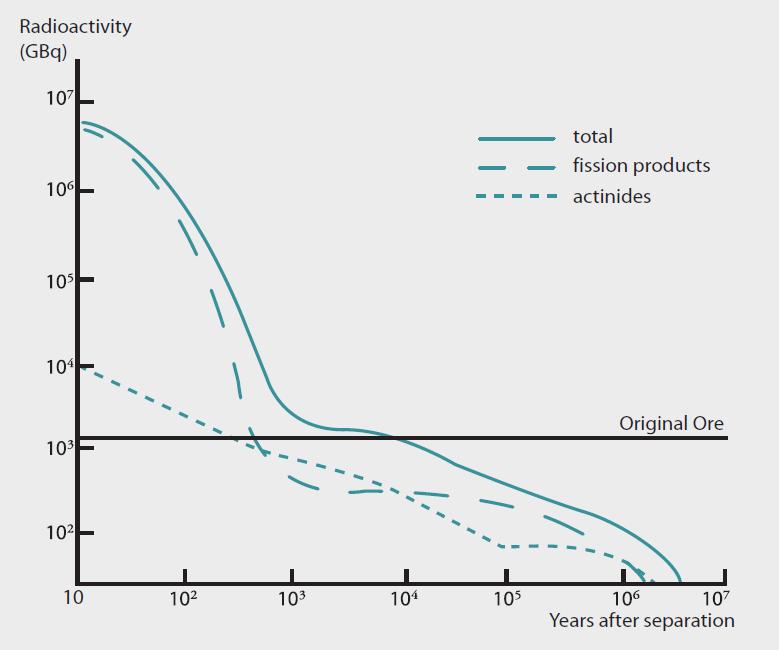
The problem of long term disposal of radioactive waste affects all developed countries.  Even countries with no nuclear power or research reactors use radioactive isotopes for medical and industrial purposes and these isotopes must be safely stored until their levels of radioactivity are no longer dangerous.  Countries which produce nuclear energy or have research reactors such as Australia have an even greater challenge, as nuclear reactors produce wastes which have very high initial levels of radioactivity.  The time needed for safe disposal is neatly illustrated below.  High level waste takes at least 5,000 years before its activity becomes similar to that of a uranium orebody.  Thus wastes need to be safely isolated for extremely long times, up to a million years, if the highest standards of radiation safety are to be met.

Nuclear power utilities throughout the world have already produced 270,000 tonnes of spent nuclear fuel.  During the next 25 years, this inventory will increase by approximately 12,000 tonnes annually, assuming that no new power plants are constructed.

Table 1:  Fuel cycle costs for 1kg of UO2 reactor fuel in US$, 2006

ProcessAmount
required
Unit
Cost
CostFraction of
Total
Fuel Front End
U3O8 :8 kg$90$72027%
conversion:7 kg U$12$843%
enrichment:4.8 SWU$122$58622%
fuel fabrication:kg$2409%
Total Fuel In$1,63062%
Fuel Back End
Reprocessing/Disposalkg$1,00038%
Total Fuel Cycle$2,630100%

Source:  Uranium Information Centre


Every country that has reviewed the problem of long term disposal of their radioactive waste has reached the same conclusion:  for the greatest long term security, their wastes should be placed in a geologically stable underground repository (see Table 2).  Such a repository is typically designed much like an underground mine, with ramps or shafts and elevators to access the underground workings, and waste packages inserted into the walls or floors of excavated tunnels.  The repository protects people against direct exposure to radiation from the unwanted nuclear materials and must be sited and designed so that there will be no transport mechanisms capable of moving significant amounts of radioactivity to the point where humans, or other terrestrial or aquatic animals might be exposed.

Since the 1960s, extensive research programs have been underway to develop the technology required to identify and characterise suitable disposal sites, to encapsulate and store the wastes, and to demonstrate the long term safety of a disposal facility.  With few exceptions, the scientists and engineers involved in these programs have concluded that the technology exists to safely dispose of these wastes.

Despite these efforts, however, no repositories for disposal of spent nuclear fuel or high level waste have been constructed.  Additionally, the majority of the public believe that the problems of disposing of radioactive waste have not been solved and that radioactive wastes represent a serious threat to the environment.  Why is there such a discrepancy between the opinions of informed scientists and those of the public?  One reason for this lack of public confidence lies in distrust of the necessarily untried technological solutions that are being proposed for the different disposal programs.  While most scientists have confidence that all of the key questions have been answered, the public is not yet convinced.  Given a requirement for engineered components to survive intact for orders of magnitude longer than any existing human works, the public's scepticism may not be unreasonable.

If the public is sceptical of high technology solutions, why not seek out disposal sites whose geological properties would intrinsically provide reliable long term containment or better isolation of the wastes?  There are several geological formations, worldwide, that have been highly stable for hundreds of millions of years.  If such geological formations exist, and they support no processes capable of transporting buried wastes to the human environment, it would be possible to avoid reliance on these engineered barriers.

While it may appear obvious that countries should seek the best available sites for radioactive waste disposal, it turns out that essentially all of the countries currently planning for radioactive waste repositories have limited choices in the types of geological system in which they could bury the wastes.  Some of these countries are geologically active, with complex and unstable geological structures.  Others have older, more stable geology, but have to deal with active groundwater flowing in the rock fractures, which could eventually start to dissolve the radioactive wastes and bring them up to the biosphere.  While such sites can be perfectly safe, they require highly effective underground engineered barriers in order to be safe for all time.  Lastly, many countries over the time periods that must be considered have regularly experienced periods of glaciation, which can profoundly affect the climate, flow of surface and subsurface waters, and erosion.

A useful approach is to identify the characteristics of "a high-isolation region", which could contain one or more repositories, sites that would be intrinsically safe, and to then look for its characteristic signatures worldwide.  If such regions could be found, in countries that are politically stable and which have safe transportation routes, they could be a key to solving the world's radioactive waste disposal problem.

Figure 1:  Decay in radioactivity of high-level waste
from reprocessing one tonne of spent PWR fuel

GBq = 109 becquerel
The straight line shows the radioactivity of the corresponding amount of uranium ore.
Both scales are logarithmic
Source:  OECD NEA 1996, Radioactive Waste Management in Perspective


Table 2:  Waste Management for Spent Fuel from Nuclear Power Reactors

CountryPolicyFacilities and progress towards final repositories
BelgiumReprocessing
  • Central waste storage & underground laboratory established
  • Construction of repository to begin about 2035
CanadaDirect Disposal
  • Underground repository laboratory established
  • Repository planned for use 2025
ChinaReprocessing
  • Central spent fuel storage in LanZhou
FinlandDirect Disposal
  • Spent fuel storages in operation
  • Low & intermediate-level repositories in operation since 1992
  • Site near Olkiluoto selected for deep repository for spent fuel, from 2020
FranceReprocessing
  • Two facilities for storage of short-lived wastes
  • Site selection studies underway for deep repository for commissioning 2020
GermanyReprocessing but moving to direct disposal
  • Low-level waste sites in use since 1975
  • Intermediate-level wastes stored at Ahaus
  • Spent fuel storage at Ahaus and Gorleben
  • High-level repository to be operational after 2010
IndiaReprocessing
  • Research on deep geological disposal for HLW
JapanReprocessing
  • Low-level waste repository in operation
  • High-level waste storage facility at Rokkasho-mura since 1995
  • Investigations for deep geological repository site begun, operation from 2035
RussiaReprocessing
  • Sites for final disposal under investigation
  • Central repository for low and intemediate-level wastes planned from 2008
South KoreaDirect Disposal
  • Central interim HLW store planned for 2016
  • Central low- & ILW repository planned from 2008
  • Investigating deep HLW repository sites
SpainDirect Disposal
  • Low & intermediate-level waste repository in operation
  • Final HLW repository site selection program for commissioning 2020
SwedenDirect Disposal
  • Central spent fuel storage facility in operation since 1985
  • Final repository for low to intermediate waste in operation since 1988
  • Underground research laboratory for HLW repository
  • Site selection for repository in two volunteered locations
SwitzerlandReprocessing
  • Central interim storage for high-level wastes at Zwilag since 2001
  • Central low and intermediate-level storages operating since 1993
  • Underground research laboratory for high-level waste repository, with deep repository to be finished by 2020.
United KingdomReprocessing
  • Low-level waste repository in operation since 1959
  • High-level waste is vitrified and stored at Sellafield.  Underground HLW repository planned.
USADirect Disposal
  • Three low-level waste sites in operation
  • 2002 decision to proceed with geological repository at Yucca Mountain

Sources:  Uranium Information Centre, OECD NEA, 1996, Radioactive waste Management in Perspective, IAEA, 1992, Radioactive Waste Management An IAEA Source Book, & IAEA Bulletin 40,1;  1998, OECD NEA 1999, Geological Disposal of Radioactive Waste -- review of developments in the last decade.


RADIOACTIVE WASTE DISPOSAL WITH A HIGH ISOLATION SITE

The concept of a natural site means that the repository must be simple and superior in safety terms to other disposal systems.  A high isolation region profile was selected after reviewing geologic formations around the world, and considering the types of natural barriers inherent in the geology and in the present and possible future conditions at or near the surface called collectively the biosphere.

Signatures of a high isolation site are listed in Table 3.  The following sections discuss the key signatures selected to identify high isolation regions, and how they contribute to isolation of a repository in the region.

Table 3:  Signatures of a High Isolation Site

SignatureDescriptionPurpose
1Very flat topographic surfaceLow flow, max. travel time
2Low annual precipitation (desert or near-desert)Low flow, max. travel time
3High potential evaporation ratesLow flow, max. travel time
4Dense sedimentary (clay/shale) formationLow flow, max. travel time
5Saline or brackish, un-drinkable groundwaterLow flow, max. travel time, min. exposure
6No fresh water aquifersMin. exposure
7No underlying mineral resourcesMin. exposure, long term stability
8Climate stable for a very long timeLong term stability
9Low erosion ratesLong term stability
10Flat geologic units, simple stratigraphyLong term stability, predictability
11Low seismicityLong term stability
12At least 200 metre thick disposal unitEngineering requirement
13Disposal units well below groundwater tablePredictability

MINIMISING GROUNDWATER FLOW VOLUMES

The primary driving pressures for groundwater flow come from water's propensity to flow from higher to lower elevations, which is just as significant for groundwater as it is for rivers and streams.  Rainfall seeps into the ground at higher elevations, and percolates down to emerge in valley-floors.  Thus, a site with very flat topography (Signature 1) has very low driving forces to move groundwater.

Similarly, a flat site with minimal precipitation, and high potential evaporation (Signatures 2 and 3), minimises the amount of water infiltrating into the ground, and reduces the volume of flowing groundwater.  Such sites typically have a deep, flat water table, where the small amount of net precipitation which reaches the water table flows along its upper portions to discharge in low-lying evaporative marshes or playas.  In a warm, dry climate the air may have the potential to evaporate far more water than the annual precipitation.  Also desert plants are very efficient at collecting and using soil moisture, which is then evaporated by the process of transpiration.  As a result, very little water actually reaches the water table.

A dense sedimentary formation (Signature 4) may have a very low permeability and few fractures capable of transmitting water, so that even under high pressure gradients negligible flow would occur.  (For example, oil and gas reservoirs, which are typically capped by dense sedimentary formations, are able to contain high-pressure fluids for geological times.) Unlike crystalline rocks (such as granites), sedimentary rocks can have a small ability to slowly deform, so that ancient fractures in the rock can be completely healed.

Saline groundwater (Signatures 5 and 6), which are often associated with desert sites, are denser than fresh water, and tend to collect in stagnant or near-stagnant underground "pools" beneath shallow, faster moving, fresher waters.  Particularly if the salinity increases with depth, such pools may be essentially completely immobile, with no deep groundwater flow occurring at all.  Also, a repository in such conditions could be robust even if accidentally drilled into by a future generation, as there would be no driving force to lift contaminated water up the borehole, which would tend to eventually plug itself naturally with filling sediment.


MAXIMISING THE TIME TO REACH THE BIOSPHERE

All of the factors that reduce the amount of flowing groundwater also act to increase the time that it would take to transport radioactivity from the repository to the biosphere.  In addition, a dense sedimentary formation (Signature 4) may also have chemical properties that act to retard the transport of many dissolved radionuclides.  If the groundwater at the site is essentially stagnant, the only significant release mechanism might be the extremely slow process of diffusion through the rock pores.


MINIMISING THE POSSIBILITY OF HUMAN EXPOSURE

Signatures 5 and 6, requiring saline groundwater, mean that it is unlikely that future generations will utilise the water for drinking, stock, or irrigation.  In an arid environment, the ultimate destiny of shallow saline groundwater is likely to be a salt marsh or saline lake bed, where it is highly unlikely that significant human populations would be exposed to radioactivity.

Signature 7, requiring that there be no underlying mineral resources, serves to minimise the potential for accidentally drilling through the repository in the distant future.  Such drilling would not destabilise a high-integrity site, but could result in accidentally exhumed wastes creating a local area of higher radioactivity.


OTHER FACTORS

Most of the other signatures sought relate to ensuring that the site will be stable for at least a million years, and to "predictability", which refers to having a simple, testable geology and being controlled by simple geological/hydro geological processes that are well understood.  As discussed below, geological simplicity may be an essential prerequisite for successfully proving a site's safety.


HIGH-ISOLATION SITE CONCEPT COMPARED TO OTHERS

Different countries have selected different geologic media, and engineered barrier systems, to evaluate for potential repositories.  The Table 4 indicates the level of reliance on the different types of barriers for some of the major national repository programs, and compares them to the High Isolation site.

Table 4:  Isolation Barriers Used in Different Repository Concepts

Site ClassificationEngineered BarriersNatural Barriers
See text and Table 3 Signatures
Waste
Form
ContainerEBSLowTravel
Time
Max.
Dilution
Min.
Exposure
Swedish (granite)EHEEE
Other European, Canadian, Japanese (granite)EΦEE
Belgian (clay)EΦHE
United States (unsaturated welded tuff)EΦEMM
Sub-seabed (irretrievable)EΦHEHH
High isolation siteEΦHHH

Symbols
H = Highly effective barrier (adequate on its own to meet long term safety requirements)
E = Effective barrier (two or more, combined, required to meet long term safety requirements)
M = Minimal barrier (sufficient on its own to prevent catastrophic releases, but inadequate for long term safety requirements)
Φ = A relatively short lived (thousand year plus) container provides a robust package for emplacement operations, and to protect the wastes during their period of most intense radioactivity
(blank) = No significant barrier
EBS = Engineered Barrier System


WORLD WIDE LOCATIONS OF HIGH ISOLATION REGIONS

A preliminary global survey points to several regions that may contain sites matching the high isolation signature.  However, many apparently promising areas do not meet all of the criteria.  For example, the Sahara desert is flat and dry, but is geologically very young, does not offer long term climatic stability, and contains fresh water aquifers.  The only extensive areas that appear to have the potential for high isolation sites are in Australia, Namibia/South Africa, the Terim Basin (in China), and in southern Argentina.

In addition to the signatures discussed above, there are a number of non-geological criteria that limit the number of possible locations for a repository site.  For example, suitable transportation corridors must exist.  Also, the host country must be politically stable, must accept the presence of a repository, and must have the necessary institutions and technology to safely oversee its development and operation.  After considering all such considerations, truly ideal high-isolation sites are very rare, and in their own way represent a geological resource of great value to humanity.


NATIONAL AND INTERNATIONAL POLITICAL
AND COMMERCIAL CONSEQUENCES

The political and commercial consequences of a repository in Australia are potentially far reaching.  The public and political hurdles that must be overcome are well known and have been delineated by opinion polls over many years.


INTERNATIONAL SECURITY CONSIDERATIONS

Those countries that have produced nuclear weapons must deal not only with the reactor wastes, but also with quantities of plutonium and highly enriched uranium, which, while not themselves highly radioactive, are the essential components for creating nuclear explosives.  (The US spent fuel standard calls for spiking plutonium with high level waste in preparation for burial.) With the waning of the global nuclear arms race, and inventories of tens of thousands of nuclear bombs, the risk of nuclear weapons and the fissile materials necessary to make them falling into the hands of terrorists or rogue states is alarming.  The problem of safely protecting for the indefinite future materials coming from the disassembly and destruction of these weapons is one of the most urgent international issues of our time.  Geological disposal into a secure Australian repository has been identified as one of the few promising ways to solve this problem.  While other countries might be politically stable no other countries with "high isolation characteristics" would meet the mandatory test of political stability.

Anything that will rapidly improve the ability of responsible governments to remove these dangerous materials from inadequately protected and unguarded sites will be regarded as a significant step forward in world security.

International validation of the disposal of commercial fuel in regional or international repositories for environmental and efficiency reasons has been validated by the recent completion of negotiations of a Vienna Convention on the safe management of radioactive wastes and spent fuel (IAEA).  This convention, supported by Australia contains provisions for the transfer of radioactive wastes across international boundaries for disposal.  It is likely that at least two international repositories will be required.  This means that Australia would not be the only international repository for the nuclear waste products from commercial nuclear power production.


NATIONAL CONSIDERATIONS

The greenhouse debate has heightened the view that the world should be searching for sources of energy that do not generate greenhouse gases.  Australia will be making a substantial contribution to this search by encouraging the nuclear power option to be responsibly considered.


MARKET FOR WASTE DISPOSAL

The amount of material available for disposal and the pricing of its disposal are key elements in the development of a repository and are discussed below.


i) MARKET SIZE

Data for the amount of spent fuel discharged and forecast to be discharged until the year 2025 yields the following conclusions:

  • There are about 270,000 tonnes of spent fuel and its derivatives (from reprocessing) in inventory throughout the world.
  • Until the year 2020, about 12,000 tonnes will be discharged annually,
  • Omitting the US, Russia and the fuel sent to reprocessing accounts for a reduction of 4,500 tonnes annually leaves an effective annual market of 7,500 tonnes.

Considering the amount of fuel in inventory today as well as the annual discharge rates for the foreseeable future there is ample market for a high isolation site.  Even restricting the inventory to Australian sourced uranium would be a substantial market.


ii) PRICING

An industry estimate at a price for disposal is $1M per tonne of spent fuel.  This price is comparable to the cost of nuclear fuel reprocessing.  There are, however, estimates of the burial cost available in most countries that have repository programs.  These estimates range from $0.56M per tonne in Sweden to $0.39M per tonne in the United States.  It should be noted that these costs have been revised significantly upward on a regular basis in recent years, further there is some evidence that the present sites will be found to be unsuitable, and that no one is utilising a high isolation site

It should be noted that the projected price corresponds to a cost of approximately 0.4 cents per kwh for a light water reactor plant.


CONCLUSION

Australia may be in a unique position to offer safe, long-term burial of spent fuel and high level waste given the geology of our continent.  Even restricting the waste to Australian-sourced uranium would be a substantial market of 1,000 to 2,000 tonnes of spent fuel annually.  The repository, which is essentially a deep underground mine, would cost between $1.5 billion and $2.5 billion.  There are very good reasons to host waste from any source.  Australia's twin stabilities, geological and political, offer splendid advantages.  Both Indonesia and Japan lack our geological stability and providing a repository would enable their sensible development of nuclear energy.

The disposal of spent fuel and high level waste in Australia is a major opportunity.  It is not only a significant business but also a major enabling step for the use of nuclear power, an important contribution to nuclear safety, countering proliferation and a major contribution to our region.

Wednesday, September 06, 2006

Steve Irwin's legacy to conservation

There was nothing conventional about Steve Irwin.  He lived at a zoo in Queensland, he travelled the world making wildlife documentaries and he had strong opinions on conservation which often put him at odds with the experts.

He died yesterday while filming:  struck in the chest by a stingray.

Two years ago Irwin was investigated by the Australian Environment Department for getting too close to penguins, a seal and humpback whales while filming a documentary in the Antarctic.  After a month-long investigation Prime Minister John Howard announced that no action would be taken, no charge laid.  The documentary Ice Breaker was aired on the Animal Planet network.  My favorite scene was of Irwin on his stomach skimming down an icy slope looking something like an Emperor penguin with a big grin.

Of course Irwin denied any wrongdoing.  He denied that he had got too close to the animals in the Antarctic.

It was not the first time he had been investigated for getting too close to an animal.  Earlier the same year he was interviewed by the Office of Workplace Health and Safety for holding his baby son while feeding chicken to a crocodile at his famous zoo.  Again he denied any wrong-doing explaining that he was in complete control and that "It's all about perceived danger".

When Irwin swam over the top of a stingray buried in the sand off Lowe Island in far north Queensland yesterday he presumably thought it would make good footage.  There is always the perception of danger when Irwin is close to a wild animal.  He was so close that the stingray could strike him in the chest with the serrated barb on its tail.  The stingray was presumably acting in self-defence.

The barb lodged in Irwin's chest and the toxins it injected caused Irwin to die of cardiac arrest.  There are only 17 people known to have died from stingray attacks and this may be the only death ever recorded on film.

Steve Irwin will be remembered by the public as a larger-than-life character who taught us about animals, although he had no formal training as a biologist or zoologist.

He became famous through the series Crocodile Hunter in which he always featured in khaki shorts and shirt with his mouth and arms half open in anticipation.  He taught the world the catch-phrase "Crikey!" and that Australia has lots of crocodiles.

While Steve Irwin will be remembered as a champion of crocodile conservation, he was at odds with leaders of the crocodile conservation program in the Northern Territory.

It is hard to believe there were once fewer than 5,000 saltwater crocodiles in the Northern Territory.  The population was decimated in the late 1940s and 1950s by crocodile hunters.  A ban was placed on hunting and the exportation of skins in the early 1970s.  Crocodile numbers have bounced back and are now estimated at 70,000.

But it didn't just happen.  Ecologist Dr Grahame Webb lead the program to rebuild crocodile numbers through public education and giving crocodiles a commercial value -- so that landholders would see them as an economic asset rather than a pest.

In particular landholders were given the opportunity to harvest and sell crocodile eggs and crocodiles each year, under a strict quota system, so it was in their interests to preserve suitable crocodile habitat on farms and in aboriginal reserves.  In the Northern Territory 20,000 eggs are sold each year for about $40 each and 600 crocodiles are harvested and sold for about $500 each.

Grahame Webb and the Northern Territory Government have lobbied hard for many years to have the program expanded to include big game hunters from Europe and the United States who would pay $10,000 to shoot a single crocodile.  But these rich tourists will only spend the money if they can take the souvenir -- the crocodile head and skin -- back with them.

The Northern Territory Government asked the Federal Government for approval to export 25 skins from safari-hunted crocodile each year and in this way further increase the commercial value of crocodiles to landholders.  Federal Environment Minister Ian Campbell has repeatedly rejected the request on the advice of Steve Irwin.  Irwin passionately opposed trade in products from wild animals.  He only believed in shooting crocodiles with cameras.

This somewhat romantic approach to wildlife conservation is increasingly opposed by specialists in the field who claim the best chance of saving endangered species across the world is by legalising and regulating trade in accordance with strict quota systems.

Steve Irwin will live on as an Australian icon and his documentaries on wild animals will continue to amaze and amuse us.  His up-close and personal approach got us more interested than ever in saving the world's unique fauna.  But pictures can not save animal species from extinction.  The survival of tigers in India, freshwater dolphins in China and elephants in Africa may require a less personal and more pragmatic approach to wildlife conservation.


ADVERTISEMENT

Tuesday, September 05, 2006

The Heart of James McAuley

Comments at the Launch of the book by Peter Coleman


I am surprised and delighted to have been invited to launch this book account of one of Australia's great big men of the 20th century, by Peter Coleman, one of Australia's most distinguished intellectuals.

Peter has drawn from the ideas and ideals in which he has believed and can now be seen to have been on the right side of history.

I am often asked "Richard, how do you keep in touch with the real world?"  I answered, "by reading poetry";  you can imagine the looks on their faces!

In the "real" world of political belief and action, James McAuley's poetry had a huge impact on me.  When I had some big and lonely decisions to make, James McAuley's work inspired me, and gave me the courage to act.

Two McAuley poems gave me the courage to do what I had to do.  One of which was "Innocent by Definition", the other, the savagely satirical, "Letter to John Dryden", in which he coins phrases like "democracy has become democratism", amongst others.

His railing against obsessive materialism without conviction or values is as relevant today as it was when he wrote it many years ago.

Most of his life he was torn between hope and despair, between joy and sadness, concerned with matters of good and evil, and the meaning, or lack of meaning, of it all.

He was a great warrior for his beliefs, as can be seen in "Letter to John Dryden".  However, he could also write with intimate poignancy about the human condition.  He wrote these words about his mother and his father

My father and my mother never quarreled.
There were united in a kind of love
As daily as the Sydney Morning Herald
Rather than like the eagle or the dove

I never saw them casually touch,
Or show a moment's joy in one another
Why should this matter to me so much?
I think it bore more hardly on my mother

Who had more generous feelings to express.
My father had dammed up his Irish blood
Against all drinking praying fecklessness
And stiffened into stone and creaking wood

Her lips would make a twitching sound, as though
Spontaneous impulse must be kept at bay
That it was mainly weakness I see now,
But then my feelings curled back in dismay.

Small things can pit the memory like a cyst:
Having seen other father greet their sons
I put my childish face up to be kissed
After an absence.  The rebuff still burns.

My blood.  The poor man's curt embarrassment
At such a delicate proffer of affection
Cut like a saw.  But home the lesson went
My tenderness henceforth escaped detection.

But James himself was capable of writing with joy and tenderness:

Wet mirrors covering soft peat.
Swag-bellied graceful mares in foal.
Red-umber bulls on plashing feet
With mild white face and curly poll.

Crutching time;  each heavy ewe
Is trimmed and slides off down the chute.
The mountains are cut out in blue.
An opalescent sky is mute.

Ducks loiter.  Children play before tea.
In the home paddock a lone goose
Follows the cows for company.
It is a world of sense and use.

But then, finally, a more atypical and pessimistic note

Christ, you walked on the sea,
But cannot walk in a poem,
Not in our century.

There's something deeply wrong
Either with us or with you.
Our bright loud word is strong

And better in some ways
Than the old haunting kingdoms;
I don't reject our days

Peter, we are deeply in your debt for your extraordinary comprehension of the life and times of a great Australian.  Your work is a timely reminder of James McAuley's convictions, commitment, and his values, and I am proud to launch this book.


The publication of a new edition of The Heart of James McAuley testifies to the continuing significance of our foremost poet/advocate and also to the lasting quality of this 1980 essay.  The writer is a former member for Wentworth in the Commonwealth parliament, leader of the NSW opposition, state minister of the crown, editor of The Bulletin and Quadrant magazines and author of at least six other books but this extended essay still stands out among the many achievements of Peter Coleman's crowded life.

Like another author/MP, Sir Paul Hasluck, Coleman was an under-estimated politician, perhaps because he sought to be judged on his merits rather than his self- assessment.  It's worth mentioning that on the last occasion Coleman contested party preselection someone who is now spoken of as a potential future Prime Minister came second!  Coleman entered politics without ego and left without rancour.  He is one of the very few former party leaders never to have made a hero of himself by taking pot shots at his successors.  In every sense, he has been an adornment to our public life.

Today's launch is an act of fealty to some of the great ideas and individuals that have shaped our society and formed our lives.  It is the acknowledgment of a cultural indebtedness for which we should be grateful rather than resentful.  This is the kind of debt that makes us rich not the debt that makes us poor.

Whether as a conservative Catholic raging against the world, an indulgent radical tearaway, a poet of soaring emotional power, or a sympathetic student of development in the third world, McAuley is a modern man for all seasons.  The combination of passion and reason, poetry and politics, faith and sin, conservative instincts with total immersion in the contemporary world should keep his life instructive and interesting to new readers, especially those who are, as Robert Stove says of McAuley in his muscular introduction, "never quite comfortable ... inside (their) own skin".

Reading biography is, of course, one of the principal ways in which the living pay tribute to the great departed.  It can also help successive generations avoid making at least some of their predecessors' mistakes.  It is a sound conservative instinct with a good practical outcome.  A living person's life is largely what he makes of it.  It is his possession.  A historical figure's life belongs to the world.  In this way, the glorious dead can sometimes be more effective inspirations and role models than the people who might forget to return our phone calls.  In this sense, the communion of saints can be no less necessary than the company of the living.

McAuley must have done much right because the academic left is still trying to exorcise his ghost, most notably in a book called The Devil and James McAuley.  The reissue of the Coleman essay is an overdue antidote.  Coleman has enough on each aspect of his story to whet the appetite for a full biography.  He has a good ear for the poetry which is at the heart of McAuley's life and struggle and, no less important, a clear sense of what the poet really meant.

From the McAuley tapestry, permit me to pick one thread of particular relevance to the current debate about religion and politics.

Doe Evatt's 1954 denunciation of the industrial groups did not just lead to a fight inside the Labor Party but also to a fight inside the Catholic Church.  Essentially, it pitted those (like McAuley) who believed that the Church should back activists inside the party against those (like Archbishop James Carroll) who thought that the Church should back the Labor Party itself.  Eventually the Vatican decided that Church organisations could not be involved in politics and that political organisations could not be endorsed by the Church.  In Rome, the Church resolved the matter by reiterating the full separation of church and state.  In Sydney, the Church hierarchy continued to regard itself as the religious wing of the ALP, leading McAuley (in his epic poem Captain Quiros) to describe a cardinal whose "right hand blessed the victims of his left".

McAuley and his allies swiftly discovered that their crime was not to bring religion into politics but to ally religion with the wrong side.  The groupers had plenty of reasons to oppose communist influence in the union movement, reasons which had nothing to do with religion.  Their mistake, in seeking the bishops' blessing, was to give people the impression that their motivation was primarily religious.  For their part, the groupers' critics failed to appreciate the difference between religious arguments and arguments by people who happened to take religion seriously.  They failed to notice not only that the groupers' arguments had nothing to do with religion but also that the groupers' religion explicitly precluded them from claiming religious validation for their position.

At least since the great social encyclicals starting with Rerum Novarum in 1891, it has been an axiom of the Church to keep religious arguments out of political debate.  Catholics in politics were encouraged to promote Catholic social teaching not because it was taught by the Church but because it conformed to the best human reason;  not because it was religious but because it was right.  A dictum attributed to Cardinal Newman is that if truth and Catholicism appear to be in conflict, it's not really Catholic, it's not really true or there's no real conflict.

Deep down, I suspect that the nervousness towards religion-in-politics is about the concept of truth as much as religion.  People could respectfully reject, for instance, the "Catholic position" on human cloning but tend to react with furious indignation when what they regard as a mere religious construct is presented as a universal truth;  when the ethical objection to human cloning, for instance, is presented as a truth binding on all, not just on Catholics.

The modern world is not comfortable with notions of truth that are not attended by sets of inverted commas.  It is especially uncomfortable with any truth that a venerable institution (rather than sovereign individuals) might have discerned over centuries of observing human folly and refining human values.  The critics of religion-in-politics have largely failed to notice that in making universal claims for its moral teaching the Church has explicitly abandoned any reliance on religious revelation.  Like Quadrant under McAuley's editorship, the Church's social teaching is designed to "command respect even from the dubious".  It is the argument that counts, not the fact that the Church is putting it.

The fact that 63 per cent of Australians (according to a very detailed Swinburne University study) are uncomfortable, and 30 per cent "profoundly uncomfortable", with scientific research using cloned embryos suggests that the Church does not just make these positions up.

Something the anti-groupers failed to notice in MeAuley's time (and has equally escaped contemporary worriers about religion-in-politics) is the centrality of religious inspiration to our most cherished secular values.  The idea that each individual has inherent rights and intrinsic dignity, along with the injunction to treat others as you would have them treat you, are at the heart of modern western society.  Both propositions are central to Christian social teaching although they can also be discerned from human reason alone.

In Chapter three, Coleman well summarises the light touch of Christianity on politics:

... There is no particular Christian form of government but a requirement that, whatever form it takes, it respects the moral law and the rights of the person;  no peculiarly Christian commerce but an insistence on honesty and justice;  no Christian biology but a requirement that the soul and the unity of the human race are not denied.  Within such limits ... the institutions of society are left free to develop according to their own principles and traditions.  Not to understand this and the freedoms involved is not to understand Christianity and the West.

It's no accident that the chief features of the modern polity:  freedom under the law, welfare systems for people struggling to cope, impartial public administration, and so on all developed first and most fully in societies under strong Christian influence.  The West's modem version of human rights is almost inconceivable without the insights of Erasmus, Thomas More and the other Catholic humanists.

The Enlightenment was, in part, a reaction against religious dogmatism but many of its leading thinkers were personally devout.  Christianity eventually accommodated its lessons and also helped to temper its excesses.  It can hardly be a coincidence that the values of the Enlightenment took root in Christian countries.  After all, it was not Rousseau but Jesus who first proclaimed "love your neighbour as you love yourself".  Indeed, this second commandment flowed from the first because everyone was equally God's creature.

As Hobbes recognised, in a state of nature there are only two rules:  might is right and look after your own.  Those concerned about religion-in-politics should also pose the alternative question:  what might a polity without any Christian inspiration actually look like?  This is not to say that explicitly Christian values should dominate public life let alone that the best politicians are self-consciously Christian.  Political debate should turn on human values not religious teaching.  It's just that, in this sense at least, the keep-religion-out-of-politics brigade and the Church are in furious agreement.

The modern challenge is not a surfeit of religion in politics but whether "love thy neighbour" political pluralism can survive without the religious values that spawned it.  Religion doesn't make people perfect but it usually improves them.  Rather than worry obsessively about the "religious right" commentators might more often pause to consider whether business ethics, family life, or personal motivation is likely to be improved in a society with less Christian consciousness.  They should ponder the loss of Kevin Rudd and Tim Costello, as well as that of Brian Harradine and George Pell, before seeking to exclude religious believers from our public space.

It was McAuley's fate to be the advocate of traditional values throughout the time Francis Fukuyama has dubbed "the great disruption".  Perhaps the social consequences of the permissive society might soon prompt the conclusion that there's something to be said for traditional values after all.  As McAuley put it in a poem thought to have been inspired by the experiences of his friend, BA Santamaria:

Nor is failure our disgrace:
By ways we cannot know
He keeps the merit in his hand,
And suddenly as no one planned,
Behold the kingdom grow!

One of the first things that struck you about Jim McAuley was his sense of fun.  The world remembers him as poet, critic and editor.  He was indeed a serious poet -- tragic, sentimentalisch.  But he was a very funny man too.  Only a great humorist could have written Ern Malley's poems.  How can you help laughing as you read Ern's preposterous nonsense?

Princess, you lived in Princess St.,
Where the urchins pick their nose in the sun
With the left hand.

Another of Jim's sallies that deserves to be better celebrated was his project of setting up Poets Anonymous, modelled on Alcoholics Anonymous.  It would help the clapped-out poet who has nothing to say but who just can't beat the demon verse.  Every day he reaches for the pencil, no matter what pain his addiction inflicts on family or friends.  But at a meeting of Poets Anonymous, he will hear fellow sufferers, who have conquered the habit, stand up and declare frankly:  "I am a poet.  One small lyric is too much for me, and one endless epic is not enough.  I used to write sonnets, two, three or even four a day.  Then odes, then epics.  Then I found Poets Anonymous ...".  Jim said he was also having talks with Treasurer Bill McMahon about giving grants to poets who undertake not to write a word for the period of the grant.  That might help them give up the addiction.

Still, it is Jim McAuley the poet I want to talk about today.  When Peter Coleman began writing The Heart of James McAuley, Jim had only recently died -- in October 1976.  His legend was fresh in memory and he was widely and deeply honoured.  Peter's contribution to the obsequies then was to bring out a memorial issue of Quadrant.

Looking back on it now -- Quadrant's March 1977 edition -- it confirms the general goodwill towards Jim at that time.  It begins with a tribute by his friend, the poet A.D. Hope:

Standing on this late promontory of time,
I match our spirits, the laggard and the swifi:
Though we shared much beside the gift of rhyme,
Yours was the surer gift.

It ends with a note by Douglas Stewart, another poet and literary editor, on the Requiem Mass held for McAuley at St John's College at the University of Sydney.  "How well the Catholic Church can do these things!" Stewart wrote.

No Catholic himself, and perhaps more humanist than Christian, he was, he reminded his readers, something of a connoisseur of funerals -- he had attended the services for Hugh McCrae, Mary Gilmore, Kenneth Slessor, Norman Lindsay and many others.  McAuley's was, he said, the most beautiful service, the most perfectly in keeping of them all.  This was because McAuley's poems -- read by Ron Haddrick and Peter Steele -- and his hymns pervaded the whole event.

Between these tributes -- Hope's and Stewart's -- were the homages of other poets (Vivian Smith, Peter Skrzynecki, Les Murray);  old New Guinea hands (Harry Jackman);  political collaborators (Richard Krygier, Bob Santamaria);  and a number of friends and critics (Donald Horne, Peter Hastings).

There are too many to list them all, so let me mention a couple.  The scholar Grahame Johnston described his desolation at what he and our country had lost by McAuley's death.  Behind the poetry, Johnston felt the pressure of all that Europe and Western civilisation meant and still means.  The poet Gwen Harwood, in a different mode, wrote of "the simple, generous and compassionate man that I came to love", the friend who knew it was better to be vulnerable, and wounded, than to hold oneself aloof in critical reserve.  The composer Richard Connolly wrote:  "Ah, James McAuley.  Strange, great, loving, knowing, lonely man.  I shall have other friends, but none will remotely resemble you.  I think I shall not know anther man remotely like you.  Vale.  Pax tecum".

All that was barely thirty years ago.  But -- and this is the point -- what an extraordinary transformation a New Dunciad has wreaked on McAuley's reputation in those few years!

Today it is the received view among most OzLit scholars that he is a poor poet, of reactionary politics, and of bad character:  no calumny is too gross but someone will pass it on.  He is, they tell us, deservedly forgotten -- while at the same time they produce a library of books and articles that keep his memory vibrantly alive.

Why these bitter attacks?  Where do they come from?  One squad of critics is the modernists and postmodernists still seeking revenge for the enormous success of the Ern Malley hoax -- played on them by Jim McAuley and Harold Stewart.

Having licked their wounds since 1944, they now pretend that Ern's forced rhetoric, absurd bathos and banal ideas are not only advanced high art but McAuley's (and Harold Stewart's) best work.  They republish or anthologise it and sponsor magazines devoted to its genius.

The hoax can be read at several levels.  At one level is the great joke at the heart of the affair.  Only the humourless can fail to laugh at Ern's demented Faustian.  At a deeper level there is the hoaxers' self-purging.  The real target of the hoax is McAuley himself and the sort of poetry he used to write at a younger man.  Michael Heyward's The Ern Malley Affair overlooks this essential point and even disposes of McAuley's key to the hoax, his The End of Modernity, in one dismissive sentence.

At another level still -- and this is a lasting achievement -- Ern's story, as told in the poems and in the letters of his sister Ethel, is one of the great creations of Australian fiction:  the tragic-comic tale of the dying, despairing bohemian poet nursed by his loving sister as he coughs out his last masterwork, sixteen spasms of gibberish.  The modernists miss all these readings.

A second cohort of campaigners against McAuley has been the liberal humanists, the freethinkers of Australian Orthodoxy.  Early in the 1950's McAuley abandoned the anarchist secularism of his youth and returned to Christ.  Worse still, he even wrote poems about it.  But as Les Murray warned us all, the non-god of Australian atheism is a jealous absence, and the unbelievers will smite the Christian faithful, hip and thigh.

They may tolerate Buddhism or Islam or any superstition from astrology to scientology to the Da Vinci code ... but not the faith of our fathers.  Michael Ackland, for example, in his Damaged Men, writes with sympathy of Harold Stewart's unworldly Buddhism but shows no sympathy for McAuley's unworldly Christianity.

When McAuley, for example, published his Letter to John Dryden with its appeal, deep in the heart's abyss, to the ground-plan of the Christian mystery, the godless were furious.  Some remained unforgiving.  Jack Lindsay, Amy Witting and A.D. Hope ridiculed him in song and ballad.  His old collaborator, Harold Stewart, the other half of Ern Malley, called him a "Popish pomposity".  Max Harris alerted Quadrant readers to the tell-tale detail that McAuley was rumoured to contribute to a Jesuit journal.  These poets form a sort of "unity ticket" with those "smorgasbord Christians", the liberals who pick and choose among doctrines as their fancy suggests.  McAuley had satirised them in his 1963 poem "Liberal or Innocent by Definition":

Unbiassed between good and evil ...
They can never be convicted,
They have no record of convictions.

A third and vociferous cohort of the New Dunciad is political.  McAuley was one of the few Australian poets, perhaps the only one, whose life's quest comprehended not only poetry and religion but also politics and social life.  He was for over fifteen years deeply involved in the crisis in New Guinea and wrote some of the most enduring essays in the literature of decolonisation.  When he then moved to academia, he wrote wisely and urgently on the crisis in our schools and universities.

His polemics provoked controversy.  But the most furious critics of all have been the Left, enraged that McAuley's anti-Communism turned out to be right all along.  He was one of the very few Australian writers who engaged with the great theme of his age -- the totalitarian temptation that gave the world Auschwitz and the Gulag.  At every stage of his life from youthful anarchist to ALP pamphleteer to DLP cold warrior to self-styled "friend of the Liberal party", he left behind poetry and polemic of permanent value.

In his last public statement, a sort of dying declaration, he was able to say:

I am now fortunate enough to be able to say that never in my life have Ibeen an advocate or an apologist for movements or regimes that trample systematically on liberal principles and human rights and are essentially based on murder and lies.  I have never defended the misdeeds of any terrorist organisation or dictatorial regime of any complexion.  I have never been a retailer of propaganda made in Moscow or Peking or Hanoi or any other centre devoted to the subversion of free countries like Australia.  I have never blurred the distinction between free and unfree systems or exalted an unfree system above ours.  I have never denied that offensive action by a totalitarian power is aggression;  I have never stigmatised defensive action by the victims as provocation.

For some leftists -- Cassandra Pybus in The Devil and James McAuley is a recent case -- this merely demonstrates what a neurotic Cold Warrior he was.  He must have been, she thought, a repressed homosexual.  Such critics set the tone.

There have been exceptions.  One is Dame Leonie Kramer's James McAuley -- her selection of his poetry and essays and her perceptive commentary on them.  Another is Lyn McCredden's James McAuley Her style is, for my taste, too burdened with the arcane argot of poststructuralism but she responds to the beauty of McAuley's poetry and communicates this to readers.

In writing The Heart of James McAuley, Peter Coleman set out to do what Graham Johnston had called for in the 1977 memorial issue of Quadrant, that is, to do justice to all aspects of Jim's work -- his poetry, his politics, his religion:  the whole man.  I am grateful that Anthony Cappello decided to republish it after some 26 years.  My hope is that it will do a little to combat the dunces who are determined to devalue or nullify the work of one of Australia's greatest poets, perhaps its greatest.

But I do not want to close on too combative a note.  It is time for reconciliation.  Time for Jim's partisans to recognise that he was sometimes too dogmatic, even abrasive.  Time for Jim's critics to acknowledge his greatness.  So let me end with a story from an eyewitness (me) of the first meeting of those old combatants, Jim and Max Harris, many years after the Ern Malley hoax but while the passions, rage, and hatred it had aroused still reverberated.  (Remember Sid Nolan's venomous painting of Jim.)

The meeting was in the old Quadrant office.  Each of them had been putting out feelers to the other.  Jim plainly had respect for Max as a critic.  What would be the point of hoaxing a fool?  Still, the tension was tangible as we waited.  Finally Max strolled in, large as life in bow-tie and cane, looking like Bunyip Bluegum in The Magic Pudding.  Jim looked a bit like Rumpus Bumpus the Poet.

Max stood in the middle of the office, silent.  Work stopped.  Jim looked up.  Each caught the other's eye.  Jim nodded "Hullo Max".  Max nodded "Hullo Jim" ... and they settled down to discuss the article Jim had asked Max to write for Quadrant on the achievement of Max's magazine Angry Penguins.  Each recognised the other's integrity.  There's a lesson there for all of us.