


Communications Minister Helen Coonan's attempts at policy reform have so far been conspicuous failures. Telstra's fibre to the node network was scuttled by her requirement that Telstra build it and then give control over it to the regulator. And now what was already a timid "media reform" package has been watered down almost to the level of pointlessness.
The coalition's proposed changes to media laws were obsolete on the day they were released. They were an attempt to deal policy into the frenzied technological change taking place in the unregulated parts of the media and telecommunications sector.
In March, the day the government released its media discussion paper, Apple released for download and purchase on its iTunes service High School Musical. The movie has been a huge success with the "tween" market (children between the ages of eight and 12). It cannot be seen at the cinemas, it's available only on DVD and via the internet. Movie distributors had learnt the lesson from music distributors' failure half a decade ago -- consumers are migrating their entertainment onto the internet, and are happy to pay for the privilege.
This week we saw the final watering down of the media package and the sale of YouTube to Google -- $US1.65 billion ($2.2 billion) for 67 employees and a website.
None of Apple, YouTube, Google or Microsoft made submissions or appeared at the Senate inquiry into the government's media legislation. Telstra gave evidence only about the mobile television licence. These companies didn't need to get involved in debates about old media. No reform package can stop the migration of consumers from traditional media into more exciting and more flexible formats.
Now, with the release of Telstra's Next G network, the transition from old to new media is firmly under way. Certainly, the wireless network is slower than the scuttled fibre to the node network, but it doesn't take much to happily stream a YouTube video onto a mobile phone. Next G speeds are already faster than those that many consumers have piped into their home, and are set to increase in speed tenfold.
When Prime Minister John Howard says media reform is only a second-order priority, he is more prescient than he realises. The creative storms of change will blow no matter what is in the Broadcasting Services Act.
The Holy Grail of modern communications has long been obvious: high-speed internet. If this is available on mobile devices, consumers can watch video from any service, read their email from any provider and browse any website with the same freedom they have in front of their computers at home. But Australia has a regulatory environment dramatically at odds with technological and cultural developments here and overseas.
What was the debate about? The "diversity" cry rings hollow -- on the internet, an infinite array of content and opinion is available to anybody who cares to look. Online media services, still in their infancy, can deliver more diverse content than can be consumed in a lifetime.
But political debate about media ownership always ends up with politicians pontificating about the relative merits of media content. Genuine deregulation means that this decision would be made entirely by consumers. In a deregulated market, what people want on television or radio, people get.
By forcing local radio stations to broadcast a minimum of local content, the politicians say they know better than consumers what should be broadcast. It is an attempt to force consumers to pay for politicians' public visibility -- elsewhere this would be called corruption. By restricting the ability for stations to respond to consumer demand, the reform package condemns many independent broadcasters to failure.
Local media produces niche products that can be supplied by other vehicles. Whether product is supplied on the same radio transmitter as 50 years ago, or a podcast inaugurated 50 days ago, should be of no concern to legislators.
Outside the realm of government regulation, we have innovative, dynamic companies responsive to market demand. Within its reach, we have an industry being variously protected and attacked by flawed public policy and political manoeuvring. Unsurprisingly, audiences for unregulated new media are growing faster.
Traditional media still have a role. But when the government imposes new regulations and fails to strip away the old ones, that role is looking more and more perilous.
Federal Education Minister Julie Bishop was wrong to retreat from her accusation that state education departments were forcing Mao-like ideologies upon students. It's true that bureaucrats aren't advocating mass murder, as did the Chinese dictator, but Bishop's essential point was correct.
For decades, school curriculums have been manipulated to serve a particular world view.
This is a world view that regards morals as relative, and that refuses to acknowledge that Shakespeare is better literature than a comic book. Indeed it is a view that doesn't believe that literature, music, fine art, or any other product of Western civilisation can be judged as "better" than anything else. That's why in English classes, students are seldom required to read books any more. They can watch television and play computer games instead.
The reason used to justify this approach to teaching is the claim that education has been the instrument of class, gender, and race oppression. It is a doctrine that advocates radical solutions.
The evidence of what Bishop is talking about is not hard to find. Her now famous claim about secondary students being required to undertake a Marxist deconstruction of Hamlet is just one example of a phenomenon. Another is "outcomes-based education", a model of learning being implemented by the Western Australian Government that doesn't attempt to impart knowledge to students; it merely aims to teach students how to learn.
The minister should be supported in her desire to improve the quality of education and she has raised some valid issues. However, her proposed solution -- a national curriculum -- is completely the wrong way to fix the problem.
Giving control to a single authority, in this case the Commonwealth Department of Education, over what's studied by Australia's 3 million school students is a disaster waiting to happen. It is a power that will inevitably be abused.
For as long as Julie Bishop remains Education Minister there might not be anything to worry about. And there might not be any cause for concern if it could be guaranteed that every federal education minister into the future, Liberal or Labor, exercised their responsibilities sensibly. But the problem is that there is no such guarantee in politics.
The whole point of a federal system, and of dividing power between different levels of government is to dilute that power and limit the reach of government. Having each state and territory administering its own curriculums might be expensive and inefficient. But arguments based on expense and inefficiency have their limits.
Newspapers might be cheaper if there was only one media outlet in the country, but in free societies citizens are happy to pay the price for choice and diversity.
The claim that Australia as a country of 20 million people is too small to have eight different education systems is similarly flawed. If we really believed that a student in Melbourne should be taught the same science course as a student in Brisbane, then in theory there's no reason Australian students shouldn't get the same science curriculum as students in New Zealand.
Attempts to centralise the curriculum ignore one of the key advantages of a federal system. A mistake made by one state government affects only the people unlucky enough to be living in that state. Exactly that principle applies to education.
If Joan Kirner, instead of being Victorian education minister 20 years ago had been federal education minister, Australia could have had the national equivalent of the Victorian Certificate of Education. Around the country, competitive examinations would have been abolished and competitive grading eliminated. Only students in Victoria suffered from the excesses contained in the VCE. Bob Carr, the New South Wales premier of the time, promised that he would not repeat Victoria's mistakes.
Ultimately, the VCE was made less bad, and one of the things that drove the Victorian Labor government and then the Kennett government to improve the certificate was the fact that it was noticeably inferior to that of New South Wales.
There's no certainty that a Canberra-controlled curriculum would be any improvement on what the states now offer.
Curriculums are always the product of consultation and compromise, and often the lowest common denominator prevails.
At the state level, this can be controlled and managed and sometimes products of quality are produced.
If the curriculum was written at the national level, it would be a process eight times more complicated than now, and with eight times as many compromises.
Some of the biggest administrative blunders of recent years have been made by the Federal Government. It wasn't a state government department that accidentally deported Vivian Alvarez Solon. Or mistakenly locked up Cornelia Rau. Or failed to notice that the Australian Wheat Board was paying bribes to the Saddam Hussein.
Throughout the history of Federation there's not much evidence that Commonwealth bureaucrats do their job any better than their state counterparts. They might have more money to spend, but that's about it. Because something is run by Canberra doesn't make it superior to the state alternative. And federal politicians don't have a monopoly on wisdom either.
There's no easy answer to the best way to improve the standard of what is taught in our schools and if Julie Bishop has started a debate about curriculums, that's a good thing. But it would be a bad thing if, at the end of that debate, Australia finished up with a single, national curriculum.
ADVERTISEMENT
Victoria probably leads the world in the percentage of the population that is inebriated on the first Tuesday of November each year.
We also head the list in another seemingly trivial but actually very important measure.
Victorians lead the world in switching electricity retailers.
Some 75 per cent of us have changed our electricity retailer since 2002 when the market was opened up to competition. This is considerably ahead of the top US jurisdiction, Texas, where only about 25 per cent of retail consumers have switched.
With 32 licensed retailers, Victoria may also be the best served in terms of supplier numbers.
Why does this matter? After all, we get hassled by telephone sellers, shift to another retailer and save a few dollars or get cheap footy club membership. And to us the shift is virtually meaningless. Electricity is electricity. It's the ultimate commodity with no quality differences and reliability levels we take for granted.
The cut-throat competition we are seeing actually provides many pro-consumer benefits aside from price.
Important among these is that retailer rivalry has brought a realisation that many of us find direct billing acceptable. Retailers offering this make paperwork savings and offer customers a share of these.
More fundamentally, vigorous competition forces retailers to search out the lowest cost supplies and to match these with customer demands. Competitive markets provide a particularly strong incentive.
This is because the price retailers charge is only about $0.14 a kilowatt hour (over half of which is wire costs).
But the cost of the electricity itself can rise to $10 a kilowatt hour. This forces retailers to place a very high priority on contracting ahead for their electricity needs.
In the past, with a monopoly retailer, if a shortage occurred, supplies could be just cut off. The industry lost a sliver of revenue and the customer was inconvenienced.
Now the industry faces a real penalty for non-performance, it takes special care to meet customer demands. In Victoria and elsewhere in Australia this has meant a spate of new plants built by Alinta, AGL, Tru, Origin and Snowy to cover peak demand. The outcome has been a bonus of much better reliability at lower cost.
Retail competition also offers other benefits. For example it facilitates a variety of different product offerings. Among these has been "green" power packages obtainable by those prepared to pay a premium for this form of electricity supply.
Many are keen to see "smart" meters being installed so that power use by time of day can be measured.
This would allow a matching of the electricity costs with prices for those using air conditioners during peak hours. It would drive correspondingly lower charges to other customers.
The overall benefit of this turns on the potential cost saving against the installation costs of smart meters.
Australia has come a long way in transforming the lumbering State Electricity Commission into a set of consumer oriented businesses which have carved out excessive costs and provided better reliability.
Electricity retailers, once the Cinderellas of the industry, have been indispensable in this process.
ADVERTISEMENT
To small shareholders, the intricacies of corporate governance can be complicated. In the midst of the flood of forms and paperwork required of public companies, it can be a battle simply to find out where the sandwiches are going to be served after the AGM.
When it comes to large public companies, one issue is particularly complicated. Although their reports might contain dozens of pages discussing the workings of the remuneration committee, performance hurdles, comparison benchmarks and sector relativities, it's not easy to calculate what their executives are actually paid.
And it is even more difficult to determine what those executives might be entitled to in future years.
Shareholders' frustration at not being told the details of salary packages is motivating the frenzy of inquiries into backdating of stock options at some of Silicon Valley's biggest technology firms.
It's no wonder public companies are reluctant to be completely open and transparent about what they pay senior executives. They know that as soon as they announce what their chief executive earns, someone will complain it's too much.
Last week was a perfect example of the typical course of events in the cycle of CEO salary stories. To the surprise of no one, it was revealed that the rate of growth in the salaries of the CEOs of the country's 100 largest companies bears no relationship to the performance of their company. The top earner, Macquarie Bank's Allan Moss, was reported as last year taking home $18 million -- a 200 per cent increase on what he earned three years ago, while total shareholder return over the same time rose by 50 per cent.
Some CEOs improved their pay while their companies' profits were either falling or non-existent.
There once was an easy response to shareholders who thought their CEO was paid too much. Shareholders could sell their shares in the company. It was the corporate equivalent of "if you don't like it, you can leave".
Today the situation is more complicated. Nine million Australians have compulsory superannuation. They can't simply tell their superannuation fund to not invest in companies paying exorbitant amounts to their CEOs.
Compulsory superannuation has changed the issue of executive salaries. No longer is it just a purely private matter between the management of public companies and their owners. Now, because share ownership is so widespread, and because such a regime is mandated by legislation, executive remuneration has become an issue of legitimate public debate.
The question of how much is "too" much to pay a CEO is beside the point. Relative to the annual minimum wage of $25,000, a yearly salary of $10 million is a great deal. But this $10 million pales into insignificance when compared with the value of the decisions that CEOs make which add or subtract billions of dollars to shareholder value.
The real question is not the level of CEO salaries, but how those salaries are determined. Individual shareholders hold such a tiny fraction of voting power that they can have no say in setting salaries, while institutional shareholders are reluctant to exercise the power they have. The matter is usually left to the company board.
This is a demonstration of what happens when companies become so large and have so many owners that control moves from the owners to the managers. Precisely this phenomenon was predicted in the 1940s by one of the 20th century's greatest economists, Joseph Schumpeter.
In Capitalism, Socialism and Democracy (1942, Harper and Brothers), Schumpeter argued that the "depersonalisation" of corporations would threaten the existence of capitalism and could even hasten the onset of socialism. He was concerned that as companies grew in size, they would become bureaucratised, executives would acquire "habits of mind similar to those of civil servants" and "capitalist motivations" would wilt away.
As yet, Schumpeter's fears have proved unfounded. This is despite the best efforts of corporate regulators to get executives to think like civil servants by removing from company managers any capacity for initiative or risk-taking for fear of being sued.
One of the measures that would surely hasten capitalism down the path predicted by Schumpeter would be any attempt by government to regulate how companies determine CEO salaries.
But unless shareholders, either individually or collectively, can demonstrate that they are genuinely involved in setting CEO salaries, such regulation might not be too far away.
Only yesterday, corporate governance advisers CGI Glass Lewis recommended shareholders oppose an increase in directors' salaries at funds management company Perpetual. Such actions might stall the day of regulated limits on executive pay. But the risk remains.
ADVERTISEMENT
Smoking bans seem to have strong public support and are being rolled out all over the world. In Australia, graphic warnings have been introduced on cigarette packaging, and many states have banned smoking on public transport and at tram, bus and train shelters. Already, in Victoria, more than 330 on-the-spot fines have been issued to commuters since the bans came into effect on March 1, 2006. On July 31 this year, smoking was made illegal in Western Australian pubs and clubs. Victoria, South Australia and Tasmania will ban smoking in clubs and bars in 2007 and bans have applied in NSW for more than 12 months.
But policy-makers need to consider the consequences of this unprecedented government intervention being imposed on our lives. Smoking is, after all, legal.
It is questionable whether smoking bans inside venues will even have their intended effect. A paper published by the Australian National University's Centre for Economic Policy Research this year found that while taxes on cigarettes had a significant impact on reducing passive smoking, banning smoking in public places had, on average, no effect at all. Instead, bans can adversely increase people's exposure by displacing smokers to private places where they contaminate non-smokers, primarily children. It seems perverse to be shifting smoking back into the home, particularly considering that 94 per cent of the $5 billion spent on health care costs relating to passive smoking were spent on children.
Bans on popular activities like smoking always have unintended effects -- it is hard to stop individuals from doing the things they enjoy, legal or illegal. One of the more unexpected problems from the smoking bans that has already been noticed in some venues is problems from the smoking bans that has already been noticed in some venues is problems with sweat and other odours. According to Scotland's Sunday Mail, nightclub owners are pumping scented smoke on to dance-floors to deodorise sweat and flatulence smells which were formerly masked by cigarette smoke. From personal experience in Sydney nightclubs, where bans are already in place, it seems that Australian clubs are having a similar problem, and clubs in Melbourne are spending money preparing their venues for this consequence.
In New Zealand, where bans have been implemented since 2004, the New Zealand Press Association reported in September that illegal bars have been set up in garages and basements with people taking advantage and charging for admittance.
In Calabasas, in California, smoking was effectively banned in all outdoor places. No doubt Australia will move towards regulations such as these in the future. But governments should remember that while they can make any regulations they like, they can never predict the consequences of such regulations -- such as body odour and flatulence problems.
ADVERTISEMENT
Adam Smith and the pursuit of perfect liberty
by James Buchan
(Profile Books, 2006, 288 pages)

If an economic philosopher is to be judged by his sound bites, then Adam Smith's best lines come not from his great masterpieces, but from a paper delivered in 1755, as reported by a friend:
Little else is requisite to carry a state to the highest degree of opulence from the lowest barbarism, but peace, easy taxes and a tolerable administration of justice.
All governments which thwart this natural course, which force things into another channel, or which endeavour to arrest the progress of society at a particular point, are unnatural, and to support themselves are obliged to be oppressive and tyrannical.
Twenty years later, his masterwork An Inquiry into the Nature and Causes of the Wealth of Nations would contain nothing so radical.
James Buchan's short intellectual biography of Adam Smith pivots around the publication of his Wealth of Nations and the earlier The Theory of Moral Sentiments. Spartanly but engagingly written, Buchan depicts an Adam Smith cursed by ill-health for his whole life. The racy novelist Marie-Jeanne Riccoboni, who befriended him while he stayed in France, described him as "ugly as a devil" -- she hated his voice and found him terribly absent-minded, but loved his sentimental philosophy.
Buchan describes in his introduction how both sides of politics have tried to claim themselves as the heirs of Adam Smith -- long adored by the free-market right, reform-minded Social Democrats now try to co-opt his legacy. Buchan chastises both Alan Greenspan and Gordon Brown for inappropriately calling upon Smith's ghost, but it would be interesting to see where the biographer ultimately stands on this.
Certainly Smith was not a dogmatic libertarian by modern standards. He saw a role for the State in education, if under a peculiar justification. The division of labour, he worried, would make the poor into specialised idiots, men who were "mutilated and deformed". Public education would help alleviate their intellectual isolation, and lower the chances that their minds could be corrupted by the baser elements of political thought. He had a remarkably unenlightened view of women, but subsequent feminist authors made much of his theories by applying them more equitably.
Buchan rightly makes note of the misuse of what has wrongly become Smith's signature term "the invisible hand". Indeed, the "invisible hand" was rarely used in Smith's writings, only once in each of the Wealth of Nations and The Theory. An out-of-context quotation from the Wealth of Nations has imparted upon it the meaning it has for modern commentators: an economic actor is "led by an invisible hand to promote an end which was no part of his intention". Smith, in this case, is talking about merchants who choose to store their wealth at home rather than overseas for security purposes, and therefore raise the aggregate wealth of their home nation.
However misquoted or misunderstood, the "invisible hand" has since become the universal metaphor for the workings of a free market. Buchan notes that while Adam Smith was not a particularly religious man, his metaphor helped illuminate his message to his students, most of whom were training for religious careers. The Theory is peppered with such references: Smith refers to the Great Superintendent, the Great Conductor, Benevolent Nature and the Superintendent of the Universe.
But, co-opted by economics teachers as a metaphor for Hayekian spontaneous order, its use just about gives the game away. If all that is required to shift resources efficiently throughout an economy is an omniscient designing mind, could not a sufficiently enlightened public servant, equipped with the best technology and intellectual expertise, do well enough to make it worth trying? But it is the process of voluntary exchange that creates the order of a market, and without perfect omniscience, no planner could replicate its results. While the metaphor holds, it also leads to unfortunate hubris on the part of planners who presume to replicate the invisible hand with their visible fist.
A short postscript he wrote for his friend David Hume's autobiography, who had attacked the religious sensitivities of establishment England at the time, caused Smith much greater problems than the Wealth of Nations, which had attacked the entire British commercial system. Buchan's brief overview of Smith's life gives us an engaging account of this man whose greatest work is now gathering the controversy it deserves.
Arthur Tange -- Last of the mandarins
by Peter Edwards
(Allen and Unwin, 2006, 336 pages)
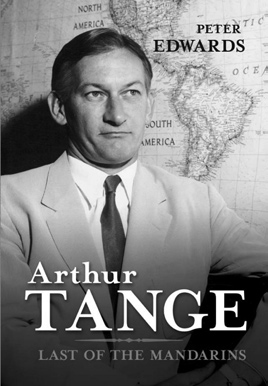
Australians like to think they live in a democracy and that, in democracies, elected politicians determine what governments do. This outstanding biography proves much of that theory wrong.
Few people other than public service aficionados have ever heard of Arthur Tange. But as Secretary of the Department of External Affairs for a decade from 1954, and then as Secretary of the Department of Defence from 1970 to 1979, Tange had a decisive influence on the country's foreign and defence policy. He was at least as important as any of his ministers and he was more important than most.
We are still managing the aftermath of the decision that Tange and others made in 1958 to not go to war with Indonesia over West Guinea -- a decision that ultimately led to what is today called West Papua being incorporated into Indonesia. In the 1970s, Tange was one of the earliest advocates of what is known as the "Defence of Australia" doctrine, under which Australian military forces would concentrate on defending national territory rather than engaging in "expeditionary" activities overseas. Debate about the doctrine is alive and well today.
Arthur Tange -- Last of the mandarins reveals the consequences of what happens when governments and ministers come and go, but public servants don't. Public servants can gain immense power, and generations of the public servants have sought to disguise this power by claiming that they merely gave advice to ministers which is "frank and fearless" -- ministers are free to come to their own conclusions.
If only it were that simple. Forceful and intelligent personalities, such as Tange, have the capacity to direct policy in a myriad of ways -- and they do. Under Fraser, Tange reached the apogee of his influence. Fraser had greater trust in Tange than he did in many of his ministers.
Peter Edwards is Australia's leading diplomatic historian and his latest work is much more than the life story of a long-serving bureaucrat. Edwards achieves his ambitious task of putting Tange's career into the context of the domestic and international events of the period. He particularly succeeds in rescuing the forgotten years of Australian history from 1945 to 1972. Historians usually take this to be the period of Menzies-inspired somnolence -- it was anything but. Post-war Coalition Governments had to manage their way through the Cold War, the Korean War, Suez, West Papua, the Indonesian Konfrontasi with Malaysia, and then Vietnam.
Reading about unpleasant people is always more interesting than reading about nice people, and Edwards has some good material with which to work. Tange was a dictatorial bully who enjoyed his subordinates cowering in fear. It sounds as though he didn't even say good morning to his secretary:
He [Tange] would enter the office with the curtest of greetings to his loyal and long-suffering secretary, Sylvia Brown, and whichever young male diplomat was serving at his executive assistant, then slam the door to this office as if it had no right to be there. Often the slam would displace the same picture on the same wall by the same amount as it had the previous day, and the day before that. At his insistence he would be brought a cup of tea at precisely 10 each morning and another at precisely 10.10. Their arrival and the removal of the empty cup would pass without thanks or other time-wasting courtesies.
The fact that Tange kept on getting promoted speaks volumes about the condition of the post-war public service. Thankfully Edwards doesn't delve too far into the realms of psychology to explain such behaviour, except to note the comment of Roden Cutler which was that Tange's rudeness was a product of his shyness. Shy or not, Tange was someone who few wanted to work for, or work with. On his retirement, he was not appointed to the board of any private or public sector company.
The other side of Tange was his steel-trap mind, and this, together with total lack of fear of anyone made him indispensable to ministers. Garfield Barwick, like Tange in many ways, particularly appreciated these qualities. In contrast, Paul Hasluck and Tange had a hearty dislike of each other. Hasluck thought that Tange was the representative of a particular class of public servant -- those who were "inbred", self-satisfied, and who believed their own publicity. Hasluck was to write that the External Affairs department in the 1950s and 1960s:
had the attitude that foreign affairs was a mystery in their own keeping". While other departments kept Cabinet will informed of their hopes and fears, "External Affairs often seemed to have the attitude to Cabinet that bright young men have to their parents: "It's no use trying to explain it to you. You would not understand".
One of the many strengths of the book is the way in which Edwards captures the mentality that Hasluck described. What emerges starkly from the pages is the sense of superiority possessed by Tange and his compatriots. The diplomatic "professionals" understood the world far more clearly than did ministers and governments, and it didn't much matter whether those ministers and governments were Coalition or Labor.
Tange did much to establish the "department line" from External Affairs -- a line described by Edwards as "a sort of middle way" between the policies of the two sides of politics. On the one hand, there was "the fervent idealism of Evatt and some of his close associates, who treated the United Nations as the best means to solve virtually all international disputes". Against this, there was "the dismissive condescension of Menzies and Casey, who resented the time and effort they had to give to what they regarded as an ineffective talking-shop, increasingly dominated by countries with views hostile to Australia and its friends". As Edwards documents it, neither of these "extremes" appealed to people such as Tange because diplomats "are trained to pursue their national interests, but with a professional preference for conciliation rather than confrontation".
The problem arises when diplomats' perceptions of what is in the "national interest" conflict with those of the democratically-elected government. And such was the case with Indonesia. In the face of suspicion and hostility towards that country by both the Coalition and the ALP, External Affairs consistently pursued a policy of engagement, arguing that it was in Australia's best interest to be on good terms with whatever government (either communist or not) controlled the Indonesian archipelago.
The readiness of diplomats to abandon principle in favour of "balance" and "conciliation" is demonstrated in Edwards' revealing discussion of Tange's time as High Commissioner to India in the late 1960s. At a meeting with Krishna Menon, the rabid anti-American, pro-Chinese Indian politician, Tange was concerned that because he was Australian, Menon would automatically assume that therefore he was pro-American. The fact that Australia was allied to the United States seems to have escaped Tange.
Another thing that seems to have escaped Tange was that of the two sides fighting the Cold War, one side was clearly preferable to the other. The implication of Edwards' research is that Tange had difficulty appreciating that the Soviet Union was not the moral equivalent of America. In 1966, Tange complained that the Coalition Government was using value-laden terms such as "communist aggression" and "free countries". He asked rhetorically whether it was "unnecessarily provocative to talk about the "free world". Free from what? If Tange didn't know what, in 1966, the "free" world was free of -- as it appears he didn't -- then he laboured under some very serious misconceptions.
Arguably Tange's greatest success came in November 1976 with the publication of a Defence White Paper. As secretary of the Department of Defence, the paper carried Tange's imprimatur. The paper was the "foundation document" of national strategic policy for next 25 years, and it argued that the country's defence forces would not be involved in any large-scale deployments beyond Australia's shores -- instead the focus was to be on the defence of the continent. This "isolationist" outlook was first endorsed by Whitlam, and a few years later it was blithely accepted by Fraser. (Of course it is the very opposite of the position taken under John Howard). Edwards notes that "Tange found it immensely satisfying that a conservative government had endorsed many of the principles that he had been pressing on Labor and coalition governments for years, and that had been considered controversial and dangerous when adopted by the Whitlam government". Indeed.
Arthur Tange -- Last of the mandarins is an essential companion to an understanding of Australian post-war diplomacy and politics. The conclusions one can draw from it are more than a little concerning.
The Cube and the Cathedral: Europe, America and Politics Without God
by George Weigel
(Basic Books, 2005, 202 pages)

Anyone who takes an interest in foreign policy will know that the relationship between the United States and continental Europe has been becoming increasingly rocky over recent years. Growing disagreement over foreign policy across the Atlantic has been at its most obvious since the argument over whether to go to war with Iraq, although tensions have been rising for a much longer period of time.
The reasons for this transatlantic split were analysed a few years ago by Robert Kagan in his short but brilliant book Of Paradise and Power. His basic thesis was that after the horrors of the twentieth century, Europe had decided to move beyond power politics into post-history, a "self-contained world of laws and rules and transnational negotiation and cooperation". In doing so, Europe became increasingly hostile to the exercise of military power, even by traditional allies such as the United States. However, in this lay a great paradox -- it was only because the United States remained mired in history and was still willing to continue to exercise military power in the Hobbesian world outside of Europe, that Europe was actually able to enter into post-history.
In The Cube and the Cathedral, the noted Catholic thinker George Weigel has made a further contribution to this debate. While acknowledging the brilliance of Kagan's analysis, he thinks that it does not go far enough, and that the roots of the growing trans-atlantic divide are in fact much deeper. Furthermore, those deeper differences, when properly understood, raise a whole set of new issues not addressed by Kagan that go to the heart of the future of Western civilisation.
Fundamental to Weigel's thesis is the idea that culture, including religious belief, is the primary driving force of history. To understand what has happened in Europe requires an understanding of the cultural and religious forces that have been working in the continent over many centuries, rather than a conventional economic or political analysis such as that undertaken by Kagan.
Weigel begins by contemplating La Grande Arche in Paris: a gigantic cube almost 40 stories tall built as a human rights monument to mark the bicentenary of the French Revolution and the Declaration of the Rights of Man and Citizen. La Grande Arche is so large that it would swallow the Cathedral of Notre Dame in its entirety. Thinking about this gigantic monument causes Weigel to wonder which culture would better protect human rights and more firmly secure the moral foundations of democracy -- the culture that produced the stunning but featureless cube or the earlier and now rapidly fading culture that produced the cathedral.
It does not take long to ascertain that Weigel believes it is the cathedral that would in fact better protect human rights and democracy. It is clear, however, that Europe has in fact gone down the opposite path and turned its back on the cathedral -- as Weigel puts it: "European man has convinced himself that to be modern and free, he must be radically secular". In a historical tour de force that takes up most of the book, Weigel then suggests that it was the development of atheistic humanism over a period of hundreds of years that led to the horrors of World War I, which has in turn led to a resulting crisis of "civilisational morale" that has been afflicting Europe ever since, although this crisis has only become visible since the end of the Cold War.
The implications of the crisis of civilisational morale that has engulfed Europe are enormous -- perhaps the most obvious one being that it is failing to reproduce itself. Fertility rates in many European countries have dropped to extremely low levels. As a result, Europe will soon no longer have the workers to pay for its enormous and ever-growing welfare state. Furthermore, the demographic vacuum is being rapidly filled with immigrants from Muslim countries, a growing number of whom are adherents to fundamentalist Islam. These are developments that threaten to completely change the very nature of Europe within the next one or two generations.
For those who don't live in Europe, why does this matter? Weigel suggests three answers to this question. First, as members of Western civilisation, we should not be indifferent to our European cultural roots. Second, Europe's demographic meltdown and the possible filling of the vacuum by an increase in the influence of militant Islamic populations in Europe would represent a profound threat to the security of the United States (and, by implication, much of the rest of the world). Third, there are numerous disturbing parallels between what has already happened in Europe and what is increasingly starting to happen in the United States (and again, by implication, many other Western democracies). If we do not learn from Europe's mistakes, we may be doomed to repeat them.
Even though written from a Catholic perspective, people of other faiths or even no faith at all should still find the over-arching thesis to be extremely thought-provoking. Weigel fills an important niche in this broad topic by not being afraid to talk about religion in his attempt to understand what has happened to Europe. Indeed, it is almost a certainty that religion is going to be one of (if not the) defining influences of the twenty-first century, with the increasing influence of Islam in the West and the rapid rise of Christianity in the South. Those who neglect the impact of religion will find the world an increasingly difficult place to understand as the twenty-first century progresses.
There is an important warning for both Australia and other Western democracies in this book. We should not forget our cultural roots and where we have come from. If we do, we run the risk of creating our own crisis in civilisational morale.

Please Just F* off, It's Our Turn Now
by Ryan Heath,
(Pluto, 2006, 228 pages)
&
The Education of a Young Liberal
by John Hyde Page
(MUP, 2006, 328 pages)

Please Just F* Off, It's Our Turn Now, and Education of a Young Liberal say considerably more about their authors than they do about anything else, despite the fact that one is about matters of policy, the other about pure politics. Ryan Heath, author of Please Just F* Off, It's Our Turn Now has been a student politician, an ALP staffer, a "refugee advocate", and now lives in London where he is a bureaucrat. Heath has a tendency to rely on personal example for his arguments, which is largely unconvincing: "I know in my bones that Australia is no longer the lucky country it thinks it is".

John Hyde Page, author of Education of a Young Liberal graduated from the highly regarded Cranbrook School in Sydney and, fuelled with an overwhelming desire to become President of the NSW Young Liberals, and then move into politics, which he claims as his main motivation throughout most of the book, rose through the ranks of the "Moderate" faction of the NSW Liberal Party to become a notorious branch-stacker and all round political hack.
Heath's basic argument is that the Baby Boomer generation has harmed Australia, and that the cost is being borne by those born after 1970. Heath premises the need for Boomers to fuck off on the predictable basis that Australia is greatly inferior to the rest of the world. Because our cities "have none of the chaos and atmosphere of Asian cities, are not over-the-top like the US, lack the sheer depth of historic Europe", he opines, we are in danger of falling behind the rest of the world, and intelligent 20-somethings are leaving as quickly as they can.
According to Heath, his generation defies conventional labelling, such as "Baby Boomer" or "Generation X". However, he goes on to explain that this generation could be considered the "responsible" generation, because of connotations of inclusiveness and diversity. Heath goes on to cite the example of illegal drug use -- his belief that young people these days take drugs in a more responsible manner than say, baby boomers did, is presented as an example for such responsibility. Whether taking drugs at all is responsible is a question that seems to have slipped his mind.
Another chapter of the book, "I ♥ Capitalism, it's not 1968", is a refreshing piece of realism that many of his former colleagues in the National Union of Students would do well to read. To the rest of the population, it is no great revelation. Heath also profiles charitable initiatives in which young people are involved, which are certainly worthwhile and encouraging. Two trends he identifies are those of increasing media diversity, and the increasing tendency for individuals to spend only short periods of time in any one job. It is disappointing, however, that for all the time and effort spent in identifying trends, Heath is unable, or unwilling, to nominate policies that should logically follow, such as deregulating the media and labour markets.
Heath's best piece of analysis is that of the housing market, especially how it is increasingly difficult for young people to purchase homes, largely as a result of existing property owners, baby boomers, lobbying against development, and in favour of tax breaks for property ownership such as negative gearing. "[W]hen you watch these people ... sign petitions against freeways and then petitions against a proposed block of flats down the road that, if built, would mean the freeways for commuters wouldn't be necessary, it's hard not to be cynical". Unfortunately, Heath neglects to mention the vital issue in driving up house prices, that is, the government-created shortfall in land available for development. In Sydney, for example, land as a percentage of the overall cost of a home has risen from 33 per cent to 78 per cent. A reduction in the land rationing caused by planning, which would let the market, not the government, determine the best use of land would have a far greater effect on housing affordability than abolishing negative gearing.
"Australian under-achievement" is explored in considerable detail. This includes unoriginal arguments against HECS fees, arguments about the need for so-called "Corporate Social Responsibility", the alleged exodus from Australia by young people, the lack of media diversity, and a boring political scene. These arguments vary in depth and quality, the highlights being a sound analysis of the ABC "domain of the white over-forties", and criticism on the restriction of entry into the media market, such as government controls on radio bandwidth. Heath concludes with some policy ideas to increase young people's engagement in the political process, such as extreme environmental policies, and more money for education.
Heath's work makes for an interesting contrast with John Hyde Page's, Education of a Young Liberal. Hyde Page's biographical work provides a fascinating insight into the inner workings of political parties, a topic which has, with the exception of The Latham Diaries, been the subject of very little attention in the popular press. Indeed, the front cover of the book features a quotation from Mark Latham about the "corrosive impact of machine politics on young people in this country". The book is largely a collection of anecdotes, which vary between humorous and disturbing, while illustrating a culture of factionalism and branch-stacking in the Young Liberals which is of considerable concern.
Hyde Page's introduction to the Young Liberals is fairly innocuous, attending a number of social functions and doing some basic campaigning, before working his way to near the top of the moderate faction. His mentor was a man named Michael Braddon, whose relationship with Hyde Page is the focus of much of the book. Braddon was a political hack par excellence, blessed with a quick wit and charm, and as Hyde Page puts it "a rare and dangerous gift of being able to instil psychological and emotional dependence on those around him". Braddon was also emotionally unstable. Although Braddon and Hyde Page later have a drastic falling out, his influence on Hyde Page is profound.
The battle between the Moderate and Right Wing factions is often amusing, bordering on the absurd. Hyde Page details how two Liberal Clubs would set up stalls at O-Week at University, one with stickers containing slogans such as "Socialism Sux", or "Fuck off Lefty Scum", and petitions supporting VSU, while another Liberal stall would have pamphlets from ATSIC, the Australian Republican Movement, and the Australian Conservation Foundation, as well as a petition opposing VSU. From this it is difficult to reach a conclusion -- other than that the Right are somewhat more attuned to the mainstream of the Liberal Party and indeed of Australia as a whole.
Factionalism proves to be destructive for both the Liberal Party and the individuals within it. Many talented and interested people either quit the Party or were stacked out of their positions. Hyde Page himself has feelings of doubt early on, "I don't think I will ever forget the ashen look on Lachlan Bennett's face when the people he had welcomed into his branch appeared out of the blue and took it all away from him". Hyde Page goes into some detail on the lifestyle that factional hacks live, many resorting to alcohol and almost cut off from mainstream society, for the sole purpose of having power within the Liberal Party.
The book is a great insight into the workings of the Liberal Party in NSW. However, it is doubtful that Hyde Page can be divorced from his standing as a factional player. Pseudonyms are used for certain members of the Moderate faction, but never for those from the Right Wing. Hyde Page's claimed justification for leaving the Young Liberals was that he was disillusioned with factionalism. However, it also came at the time when he had finally realised that his ambition to become President of the NSW Young Liberals was unable to be fulfilled. Often, criticisms of the Right-Wing seem to be petulant and take the factional line, as opposed to being a serious critique of individuals or policies espoused.
The lack of life experience of both writers manifests itself in their work. Ryan Heath has provided an interesting policy agenda, but is severely limited in his analysis. Although at times he can provide the reader with thought-provoking and common sense argument, too often he has a tendency to back up argument with little more than personal experience, and occasionally, simple prejudice towards baby boomers. Hyde Page writes from a biographical perspective, but unquestionably many of his actions in the book were reckless and damaging to himself and others around him. Undoubtedly, he was immature and to some extent vulnerable to manipulation, although this cannot excuse his conduct. Irrespective of what one thinks of his personal conduct, Hyde Page tells a fascinating story, which anyone interested in Australian politics should find as interesting as it is disturbing.
One significant reason the Bracks Government is performing so well in the opinion polls is that it is substantially a business-friendly government. The reasons are clear.
It has controlled the state budget, keeping it in surplus, paid down debt and kept the workers' compensation scheme in the black. It is positioned to cover the state's looming public sector superannuation liabilities. State finances are generally stable. This has contributed to a fairly positive economic environment.
The Government has made a range of important changes to occupational health and safety laws, small-business policies and has pushed along infrastructure development.
Naturally, not all is perfect. Stupid things have happened, such as the ban on genetically modified food. This damages Victoria as a centre for biotech excellence. The 2030 planning scheme has made some land speculators rich at the expense of young home buyers. New housing costs are consequently higher than they should be, thus restricting home building activity.
The scorecard overall, however, is positive and reflected in the continued Victorian economic growth. This compares with NSW, which is in significant economic difficulty.
Much of the reason for the Bracks Government's success in the business area relates to the unusual relationship with Victorian unions. Last time the ALP was in government under Cain and Kirner, it was captured and ultimately destroyed by anti-business unions. But the Bracks Government has kept this key constituency at arm's-length from vital economic decision making.
In fact, the relationship between the Government and Victoria's unions is strained and often icy. Radical Victorian unions wage war behind the scenes with the Bracks team but it's mostly contained inside ALP factional power plays.
The key indicator of how Victorian unions have been kept at bay is the refusal of Bracks/ Brumby to reintroduce a state industrial relations system. This has caused tension with Victoria's unions. But it has meant that Victorian business has a significant advantage over other states.
For example, NSW business is gridlocked by an industrial relations system that micro-manages business activity. One NSW transport company recently had to supply 50,000 pages of financial records to a union as part of an industrial relations compliance requirement. This sort of detailed industrial relations interference in business operations is surprisingly frequent in NSW.
Even more startling is that commercial and even criminal cases can be heard in the NSW Industrial Relations Commission, where appeals against decisions are prohibited. NSW cuts business to death in thousands of ways.
So far Bracks and Brumby have kept this NSW-type anti-business disease largely out of Victoria. This is important. Victoria's construction sector underperforms because of entrenched union control. This makes Victorian infrastructure construction much more expensive than Queensland, for example. The Federal Government's new construction industry policemen are starting to clean this up and Victoria should be a major beneficiary. The Government is letting this play out, which may fix a construction union problem the it can't fix. But within these positives there are some signals of creeping special privilege being delivered to unions.
This year, the Government introduced owner-driver legislation. It does a number of good things by tightening up contract obligations in the transport sector. But it also does something else that is surprising. It introduces a process of union-influenced price fixing over commercial contracts in the transport sector. Proof that the intent is to do this, is that the act removes itself from the Trade Practices Act. This means the TPA will not be able to block price manipulation when it starts to take effect.
To stay in the Government's good books, some industry bodies have agreed to this.
This mirrors the interference in business that developed in NSW. In that state, business interference laws built up over a decade in many small ways. Industry bodies were gradually seduced into agreement. NSW unions achieved new anti-business powers over time. Business and the voters didn't realise what was unfolding.
The Victorian owner-driver laws indicate that this process is under way in Victoria. It is masked by political spin.
The Bracks Government so far has a sound pro-business track record. But signs are emerging of seemingly small political trade-offs to unions.
ADVERTISEMENT


Former US Vice-President, Al Gore, and his new movie "An Inconvenient Truth" have triggered a remarkable amount of public interest and discussion on the subject of global warming.
But it's not really a documentary. Gore presents some interesting information, but he also leaves a lot out. Indeed he omits a lot of inconvenient truths.
In the movie Gore suggests that carbon dioxide from the burning of fossil fuels is the sole cause of global warming.
This carbon dioxide is shown as responsible for the melting of the world's glaciers, bleaching coral reefs and hurricane Katrina.
But hang-on. There was coral bleaching, category five hurricanes and glacial melt before motorcars and oil refineries.
In failing to distinguish between possible human-caused warming and natural variability Gore does his cause and science a terrible disservice.
Students of geology known that over the last 2.5 million years there have been 50 ice ages initially of 40,000 years but more recently of about 100,000 years. Between these ice ages have been warm periods of about 10,000 years.
The last interglacial warm period was 120,000 years ago. Back then carbon dioxide levels were almost as high as they are now, but sea levels were about 6 metres higher and the earth was about two degrees warmer than it is now.
Like Al Gore, I'm concerned about the current high levels of atmospheric carbon dioxide, but unlike Gore I haven't observed any global climate crisis.
It's been dry in western NSW, but it has been dry in the past -- remember the early 1980s, and the Murray River ran dry in 1914.
Ice sheets melt during interglacial warm periods, but it is wrong to suggest, as Gore does in the movie, that polar bears are in trouble -- drowning on mass. Numbers of polar bears have actually increased over the last 40 years from about 5,000 polar bears when there were no controls on hunting, to about 25,000 polar bears now existing as 19 discrete populations.
It is interesting that in "An Inconvenient Truth" Gore only shows the hurricane record since 1970. There are good records back to 1851 for the US, and this data shows the 1940s were particularly bad years.
Further, global warming won't destroy coral reefs. They occur in tropical waters because they like it warm. As sea temperatures warm, southern hemisphere reefs may extend their range a little further south.
It will be the next ice age and falling sea levels that leave the Great Barrier Reef high and dry.
Then again, as Gore explains in the movie, for him global warming is a moral issue rather than a scientific issue and "An Inconvenient Truth" is part of his campaign of public persuasion.
So let's stop calling it a documentary. It is full of misinformation including the assertion that there is currently a global climate crisis.
When I study the climate record all I can find are a lot of inconvenient truths for this politician come-environmental crusader.
ADVERTISEMENT
The debate about whether to allow students to pay for their place at university was reignited this week. On Monday it was revealed that some regional universities had unfilled vacancies, while other universities offering essentially the same course were charging students full fees. This provided the ammunition for critics of the Howard Government to attack on two fronts.
First, it was claimed that the finding that some universities had unwanted places was evidence that the level of HECS fees was driving students away.
Second, it was argued that the Government's policy on universities was "illogical" because some students were attending institutions that charged full fees when they could be undertaking similar courses at another institution and pay a fraction of the price. To some, including the Labor Party, this provides a further reason why universities should be forbidden from charging full fees.
On the first point, whether the level of HECS debt is discouraging potential applicants from tertiary study is unclear. A vacancy in a course might simply be the result of students deciding that better alternatives are available elsewhere.
In any case, it isn't necessarily a cause for concern that students might be deterred by the size of their future HECS debt. The average HECS liability carried by graduates is $10,000. This represents their own contribution to the costs of the education they received. Given that HECS debts are not required to be paid back until a taxpayer's annual income reaches $38,000, it is difficult to claim that the costs of education are a deterrent to students applying for university entry.
The contribution of taxpayers to the cost of tertiary students' education, via the Commonwealth Government's funding of universities, is about three times the amount that the students themselves are required to pay through HECS.
A university education is not an absolute right, nor is it a right that should be guaranteed to be free. In return for paying for part of the costs of their education, graduates gain the opportunity to earn substantially higher incomes than those without tertiary qualifications. It is unreasonable to demand that taxpayers fund the education of those who are unwilling to make even a token financial sacrifice to gain the personal benefits of a university degree.
On the second point, there's nothing illogical about students choosing to pay more to enrol in higher quality courses. What would be illogical would be to prevent students from enrolling in full-fee courses at their preferred university until all the vacancies at every other university were filled. Yet this is precisely what some university administrators are saying should happen.
But beyond these administrative intricacies of tertiary funding there is a more fundamental issue.
It is the question of whether students should be allowed to gain a place at university by paying for the cost of their course themselves. These costs could be very substantial. Next year the price of a full-fee place in medicine at the University of Melbourne will be more than $200,000. According to the Labor Party, some students cannot afford to pay this amount, and therefore those students who can afford to pay should be prevented from doing so.
The ALP's higher education policy is a case of bizarre reverse discrimination. Universities will be stopped from offering full-fee courses to local students, although they are allowed to do so to overseas students. (At the moment 3 per cent of all local undergraduates in Australia's universities pay full fees).
The ALP believes it isn't "fair" that school leavers who miss out by a few points on a HECS place at their preferred university are then forced to pay tens of thousands of dollars if they wish to undertake the same course as a full-fee student.
Of course, in an ideal world this wouldn't happen as there would be an unlimited supply of free university places. But the reality is different. In the real world both funding and places are limited. Students should be allowed to pay full fees and make the financial investment in their own future if they choose.
The fact that some students might have their fees paid for by their wealthy parents, while others will be forced to take out a loan is irrelevant. Labor's ban on full-fee places hurts both poor students and rich students alike. Students from poorer backgrounds may even be relatively more disadvantaged because they have fewer options than those from affluent backgrounds.
Unfortunately, it appears that envy is a key motivation behind Labor's promise to abolish full-fee places. At the last federal election envy motivated the ALP's "hit list" attack on wealthy private schools. Just as Mark Latham disappeared after the election, so too did his policy.
Hopefully, Labor's current higher education policy will go the same way as Mark Latham's schools policy.
ADVERTISEMENT
The Federal Government's universal service obligation is designed to ensure all Australians have access to standard telephone services and payphones.
For country people, the USO ensures everyone can receive a basic telephone service installed at a reasonable cost.
Without the USO, the cost of installing a phone line would be way beyond the realms of possibility for most rural and remote Australians.
At the moment the USO is paid for by the telephone companies, in proportion to their market share across urban and rural Australia.
Each company's contribution is put into the USO funding pool, which is then used by Telstra to maintain and connect rural and remote networks.
But there's a problem.
To start with, the last time the regulator calculated the cost of providing the USO, it came up with $550 million. That was in 1997.
Back then petrol cost 73 cents a litre and wages were 30 per cent lower than now.
Yet for next year the Government has set the cost of the USO at $157 million.
This is bizarre, because in 2007 installation and maintenance costs to provide telecommunications services to remote users are sure to be higher than a decade ago.
On the Government regulator's own figures, there will be at least a $400 million shortfall on the USO next year.
That's the difference between what the USO costs to provide and what is collected from phone companies.
That means Telstra has to find the shortfall.
Services to rural Australia are still being delivered by Telstra because this is a condition of its licence, even though it is not fully funded to do so.
Someone must be paying the difference between what the Government sets as the figure telecommunications companies pay for the USO and what it actually costs.
The most likely group is the very one set up to benefit from the USO -- rural and remote Australians.
Would we be surprised if rural, regional and remote telephone users are paying higher STD call charges to cover the shortfall in USO funding?
There are three groups of phone users that could be bearing the cost of paying for the USO shortfall -- city consumers, business, or country consumers.
It is unlikely that Telstra is able to extract the shortfall from its business markets, which are highly competitive.
The same applies to Telstra's residential market in major cities.
By contrast, although there is significant competition in rural areas, (we all suffer from those dreadful telemarketing calls on bad lines from phone companies nobody has ever heard of), by international standards STD and mobile phone charges remain high for many country users.
There is no way of proving whether the reason we have so many STD areas and such high STD costs is to make up for the shortfall in USO funding.
After all, in the US it costs as little as two cents a minute to make a call from one side of the country to the other. But the lowest price in Australia is many times that amount, unless the service is bundled with other products.
And it is not as if distance is any longer the reason for higher charges.
In Queensland, business and government customers can sign up for a flat rate of 10 cents a call to anywhere in the state.
Similarly, the distance from one side of Melbourne to the other is much further than across most STD zones in country Victoria. Yet all Melburnians enjoy local calls to the other 3.5 million in their city.
The remaining 1.3 million Victorians, living in country areas, must pay STD rates, sometimes just to the next town.
A great deal more transparency is needed to ensure that the figure the Government sets as the cost of the USO is as close as possible to its real cost.
Then all of us, country people, phone companies, the Government and urban people, can have an informed conversation about how much we value everybody in this nation having access to telecommunications.
Only then can country people be sure that they are not subsidising the connection and maintenance of new rural and remote customers by paying higher STD charges than necessary.
In spite of heady rhetoric, the Bracks Government has failed to pursue vigorous regulatory reform, and this is beginning to impact on the economy. Transport expenditure is misaligned with user needs, we are seeing ballooning expenditure on bureaucrats, and we have seen bans on new, well-proven technology in agriculture.
These measures have been followed by the imposition of additional energy costs on consumers, with the requirement of the Victorian Renewable Energy Target to provide subsidies to new, exotic renewable sources.
Victorian governments have an ignoble history of providing subsidies to new developments and encouraging the Commonwealth Government to provide tariff assistance to support businesses that cannot compete.
This has changed over the past 25 years. In the early 1980s, led by the Hawke government, Australia commenced a process of gradually winding down its protectionist policy approach.
This entailed eliminating regulations that created monopolies or offered price advantages to some companies.
Part of this was a gradual removal of the long-standing mollycoddling of domestic industries, shielding them from overseas competition.
The reform program encompassed businesses involved in energy, telecommunications, transport and many other industries that had been protected from the realities of competition and had grown fat and inefficient as a result. Forcing businesses to stand on their own feet and face competition toe-to-toe has been the midwife of Australia's economic success.
As a result, John Howard has been able to lay claim to a record 10 years of solid uninterrupted growth during his stewardship. But it was an ALP Commonwealth government that planted the seed initially.
Under the Kennett government, Victoria played an important role in the national scene, with reforms that transformed the state from basket case to national dynamo.
The Bracks Government did not reverse the Kennett-era reforms, but it has not pursued the same path of reform. The Victorian economy is starting to languish.
On most measures, during the past quarter Victoria was propping up the states and territories at the bottom of the national growth league.
Victoria's policy on renewable power seems set to add a further straw. Independent research estimates that the requirement placed on us all to use 10 per cent renewables will cost Victorians over $800 million, and will have a negligible impact on the reduction of greenhouse gasses.
The Government says its program will bring benefits, but that is based on internal research it has refused to release. Indeed, in welcoming a new hydro electric power station in Bogong, Bracks said: "This new power station would not have been possible without the Victorian Renewable Energy Target which was approved by Parliament last week".
The Opposition has pledged to scrap the legislation if elected. And, unfortunately for the Premier's credibility, a spokesman for the company concerned, AGL, the very next day said such action would not destroy the economics of its new hydro project. At least therefore, with the Kiewa scheme hydro facility, Victoria is not being saddled with an investment that is intrinsically uneconomic. This is not the case with the many wind facilities under construction and planned, some of which must be even less viable as a result of the Opposition's statement.
AGL, like any other well run business, is alive to the possibilities of earnings from government subsidies and is likely to time its investment decisions accordingly. But in giving a renewed impetus to subsidies and regulatory constraints, the Bracks Government is taking us back to a future that will once more leave the state as the nation's economic laggard.
This is regrettable. With its regulation review initiatives, the Bracks administration demonstrated an awareness of government culpabilities and how they could detract from economic growth. Although it has reduced regulation in some areas, like planning approvals, there are few examples where it has put its fine words into policy outcomes.
ADVERTISEMENT
Long-established home owners have seen the equity value of their homes rise as a result of the rationing of new land subdivisions. While existing home owners may actually feel better off as a result, this is an artificial addition to their wealth. It is offset by de facto reductions in the real wealth of those who have not mounted the house price escalator and face a formidable cost barrier. Overall national wealth is diminished by regulatory measures that restrict the supply and flexibility of land.
The regulation of land for housing and other urban activities vividly illustrates the interconnectedness of all things economic. Planning restraints on land subdivisions for residential and commercial uses have restricted supply and brought excessive house prices.
Aside from pricing younger people out of home ownership, these regulatory distortions pervade the whole economy.
One important outcome follows from the overstatement of home owners' real wealth that regulatory induced scarcity creates. Notwithstanding a reduction in Australian household savings -- partly due to definitional factors -- measured levels of household wealth have increased. Treasury estimates that real per capita private wealth has grown 120 per cent over the past 10 years. But two-thirds of the growth is accounted for by housing and this is overwhelmingly a function of inflated house prices driven by government-induced land scarcity.
Hence, much of the increased household wealth -- that part created by regulatory restraint of land supply -- is apparent rather than real. It does not add to genuine savings, investment and productivity. Indeed, escalating land prices are cannibalising real saving levels and productive investment. They represent a deadweight loss that sucks up savings but does not invest them productively.
People who receive windfall gains tend to spend them. Many people with substantial equity in a home that land scarcity has inflated in value change the pattern of their consumption and savings.
The Reserve Bank has surveyed house owners who have made withdrawals from the equity they hold in their houses. It found that withdrawals into direct consumption comprised 17.6 per cent of the total in 2004. But a further 7.6 per cent might have indirectly been so diverted in that it comprised repayment of other debt, while some of the sums lodged as deposits (33 per cent of the total) might also have eventually been spent in areas other than asset accumulation. Only about 25 per cent (which went to superannuation, business and investments) could be said unambiguously to be reinvestment.
The regulatory fomented inflation of urban land also has other impacts. Urban land rationing restricts retail development as well as housing. This has a direct effect in reducing competitive pressures on retail outlets and therefore raising retail prices. That effect, like the effect on housing, may well be amplified by lobbying costs. Businesses have a great deal to gain in getting the political process to favourably designate their own land and reject such applications with regard to land owned by a competitor.
There are additional knock-on effects. One among these was recognised by the Productivity Commission in its recent report on airport charges. Because most Australian airports were originally under Commonwealth rather than state control, they benefit from less stringent planning restraints than those on the land in their vicinity. Under private enterprise, airports have moved to allow their surplus land to be used for retail activities that state governments rejected.
While this, especially in the form of direct factory outlets, has moderated the price increases brought about by state governments' restraint of competition, it also boosts the value of the land for the main business of airports and puts upward pressure on airport charges.
We need to wind back the restrictions on land availability for home building and retail uses. This would bring about lower costs for new housing and lower retail prices. Moreover, it would free up more income for genuine productivity enhancing saving and investment.
An abundant supply of land is as much a part of Australia's comparative advantage as mineral wealth. By erecting restraints to its use, we are not only raising costs of those without their own homes but we are denying ourselves a valuable area of wealth and competitiveness.
ADVERTISEMENT
Submission to the Australian Energy Market Commission
THE CONCEPTUAL FRAMEWORK
The NEM objective is to promote efficient investment. Price levels in the proposed rule cover the allocation of costs and the levying of charges that cover those costs to promote efficiency.
The Objective is seen to have implications for the means by which the regulatory arrangements operate as well as the ends. With regard to the former, it sees goals of "stability and predictability" and of "transparency".
Stability as a goal is different from predictability. Rules set out to create stability can be inimical to efficiency when the underlying conditions are highly unstable. Predictability can also be questioned as a goal of regulations in conditions where market conditions are not predictable.
In seeking to promote stability where volatility is the normal situation, regulatory agencies might involve themselves in attempting to smooth out pricing perturbations. While this appears to be a meritorious goal it can be harmful where the regulatory agency is mistaken on the overall trends of the market. A regulatory agency under a form of political control is especially vulnerable to such errors. One of the more injurious failures of an agency pursuing this approach was that of the Australian Wool Corporation which set an intervention price for wool during the 1980s that was too high and which culminated in vast over production and a stockpile that overhung the market for a decade proving ruinous to many farmers. Even regulatory agencies not explicitly favouring a particular interest group may well get things wrong -- the more spectacular market failures as in California were certainly compounded by the regulator seeking to favour consumers in the narrow sense of shielding them from necessary price rises.
Similarly, in seeking to promote predictability inappropriate signals could be given. Thus the spot market for electricity is highly unpredictable at certain junctures. Trying to prevent such unpredictability is the goal of those promoting a price cap and an associated capacity payment to generators. The nature of electricity is that it is at times inherently unpredictable and attempting to reduce that can reduce incentives that firms have to ameliorate it.
Setting a price cap offers retailers a degree of security that the regulator is unable to deliver in any scenario likely to prove acceptable in Australia. One possible such initiative would involve the regulator fully owning a dedicated reserve supply of electricity to be called upon only in extreme price periods. Even if this worked, it is unlikely to be realistic for the government to hold a plant fully in reserve. That aside, promoting greater predictability than is inherently present can bring inadequate signals to market participants to contract for or supply capacity needed for those occasions where the unpredicted occurs.
There are limits to what a regulator can and should try to achieve. Regulation is not introduced to improve the operations of the market. Rather it is in place because it is perceived that the market itself cannot work: that there is market failure. In the case of electricity transmission lines (and even more so with distribution lines) this is because there are seen to be valuable externalities that cannot be fully captured by the provider, "free rider" features that might bring the buyer to seek to avoid payment and natural monopoly traits that prevent suppliers and customers from finding alternative means of transacting business with each other.
Ambition to create conditions that are more potent in reducing risk than might be the outcome of the free play of demand and supply can be dashed on the shoals of unforeseen surprises. It may well be that the Commission is aware of these considerations and its proposed measures to promote means as well as ends are a codicil that is intended better to describe the main ends and not to supplant them should there ever be any conflict. In that event it should specify the limits to its rule making and ensure that participants are aware that it is simply recreating the conditions normally found in markets, departing from these only where it has a clear political requirement to do so.
REDUCING THE NEED TO INTERVENE IN MARKETS
THE OVERALL APPROACH
The Commission sees its role as providing the best signals for investment and to combat market power on the part of network operators.
The Commission considers that these outcomes can be best achieved by:
It generally regards the current approach whereby generators only pay "shallow" connection costs and the mix between locational and "postage stamp" price detemination as being satisfactory.
REVENUE BASED REGULATION
It endorses the revenue regulation approach rather than its cost based alternative. This leads to a provision for "prudent discounts" and a consequent additional impost on those parties that do not receive the benefit of the discounts.
Revenue as a base for charges rather than costs is set because the service is considered to have no material affect in encouraging increased usage of the product due to its relatively low (10 per cent) share in overall costs. In previous times and perhaps still, there was also the notion that increased usage of electricity should not be encouraged and that a revenue cap avoids network providers seeking to promote usage by reducing prices.
The Commission traverses the arguments for and against price and revenue caps. It considers the main deficiency of price caps is that they may not be applied to take fully into consideration the future network investment. This is however not an argument that has persuaded the distribution regulators which see price cap regulation as offering more potent efficiency driving signals than revenue cap regulation. In opting to retain a revenue cap approach the Commission offers no arguments in its favour.
CAUSER PAYS
The Commission also sees the need for "causer pays" principles which offer a more market based signal to investment.
It argues, "In order to promote allocative efficiency, transmission prices should be set on a 'causer pays' basis where possible. This means that where transmission costs are incurred following a direct request by (or agreement with) a particular network user or users, those user(s) should be required to pay the relevant costs." (p. 27).
It takes the view that the meshed nature of the network makes this difficult to assign to particular parties and that as most transmission investment is undertaken to meet reliability obligations to satisfy consumers, the main locus of charges should remain with consumers. With regard to this latter factor, it matters little why the obligations are in place since, whether levied initially on consumers or suppliers, the charges will always fall upon the former. More persuasive in not modifying the present arrangements is the fact, acknowledged by the Commission, that they are in place and changing them would create transitional gains and losses without any apparent improvement in efficiency resulting.
The Commission recognizes that investments may be inappropriately located because of the charging approach. It favours prices being set on the basis of short run marginal costs which it argues is supported by economic theory and competitive market experience.
This is subject to a great many caveats. Importantly, prices set on the basis of marginal costs are not found in many markets—they are characteristic of markets under stress (for example where there are few suppliers engaged in a "price war") or facing long term decline (so that sunk costs need not be recouped). Even the market for highly perishable goods like vegetables seldom sees produce offered at marginal cost and only then is this seen at the end of the trading day.
The Commission recognizes that if charges are set to meet short run marginal costs and there is spare capacity, consumers may locate too far away from generation, especially if reliability standards are in place to fortify the initial decision.
It considers that prices based on long run marginal costs may lead to inefficient by-pass. This leads it to support the notion of efficient discounts being offered which may be recouped by de facto surcharges on other customers. It is likely that the conditions under which these would be permitted would be accompanied by protracted and heated negotiations.
One suggestion draws on and amplifies our published work. (1) Put forward in two submissions by a group of generators and by AGL, it seeks to introduce a mechanism that would provide greater market orientation to transmission investment other than the meshed network which supplies major consumer loads.
The latter are more akin to distribution systems in that their usage cannot be ascribed to particular generation facilities or groups of such facilities. By contrast, the long lines connecting a single generation unit or a series of such units are supplying electricity to major nodes, often in competition with each other.
The practice in Australia is to charge the customers for the transmission use, rather than generators. Generators do not however have a property right to the transmission to the major hub. This means that a new generator with costs and a consequent a bidding strategy lower than an incumbent generator would force the latter off the line once it was at full capacity. This might mean an alternative supplier with a higher total cost (including transmission costs to the major node) would replace the incumbent generator.
This is illustrated in the diagram below.

If generator B locates next to generator A, the latter is constrained out and replaced by the higher cost generator C. Costs are $1000 higher. Generators A or B may have incentives to build additional transmission capacity but only if they can be assured of some exclusivity or some priority in its use. A customer coalition would also be willing to finance such an investment but the transmission business may face no such incentive, while generators B, C and D would prefer the augmentation not take place since they are beneficiaries of the higher price set by generator C. Allocation of a form of property right would bring about the optimal investment without the rancour of a series of bureaucratic hearings and extensive lobbying.
A more complete depiction of the different costs and the appropriate strategies for payment is below.

In determining the best means of arranging for new capacity it is useful to consider four models. The first is that which normally applies to roads and bridges. The usage both origin and destination is highly atomized. Governments charge road specific taxes and provide new and improved facilities according to their measures of demand. Road specific taxation is about twice the level of road specific expenditure and in many areas roads are clearly underprovided and the consequent congestion brings about a political reaction as well as increasing travel time and its variability.
A second model is that for new housing subdivisions. In the local road, electricity, water and other service provision, the new home builder (and hence the home buyer) pays for the infrastructure. This has generally been found to be satisfactory, although it does bring about a fairness issue since established areas were paid for by debt and much of their on-going upkeep is paid out of general revenue.
A third model is that in place for most gas, electricity and rail infrastructure. An independent operator is in charge of the main transport system and operates it as a common facility. Normally the access to this and its price is controlled by a government agency.
A fourth model has the producer controlling its own transport system. In one sense this is the model operating in manufacturing industry where an automated car plant is the transport medium for a firm which combines bought-in and internally produced components into a finally assembled product. Most manufacturers would resist having to make their facilities available to other businesses, even if they were not competitors because of the difficulties of ensuring against disruption.
The Hilmer recommendations and the Part IIIA provisions of the Trade Practices Act were careful to exclude manufacturing facilities from the ambit of control. Rio successfully argued before Justice Kenny in the Federal Court that its iron ore transportation facility in the Pilbara was akin to a manufacturing facility and thereby avoided a requirement to have it covered by Part IIIA (the applicant for coverage was actually bought by Rio and there was therefore no further appeal).
Nonetheless, the NCC and ACCC continue to regard such facilities as being prospectively subject to coverage. In the case of telecommunications, the ACCC's refusal to give Telstra assurances on coverage matters has led the firm to abandon plans to build a national fibre network.
Most gas carriage is contracted under arrangements whereby the supplier has some priority to use a specific level of capacity on a pipeline (Victoria has a unique "market carriage" system under which no such rights are involved). The gas "contract carriage" approach is a variant of the fourth model.
All of these models have their strengths and weaknesses.
A new generation unit or an expansion of an existing unit should be required to pay for any augmentation needed to allow its power to be transmitted. This, implicit in which is some form of nodal pricing, gives a better market signal than if the determination is left to a regulator or to a transmission business since it allows the transposition of commercial forces for those that are actually or mainly controlled. As AGL argue, "Applying deep connection charging to generators at the time of connection would allow the network costs to be included in their decision process on location and allow for appropriate development of networks to efficiently transfer power from generators to customers." (3)
With rights over their current levels of service, existing generators have options about augmentation that ensure the full costs of their decisions are taken into account. They may also downsize by selling part of their carriage rights to a new player thereby avoiding wasteful duplication of capital.
The advantages of such are best seen in allowing a market based decision to be made on where a transmission augmentation should best be made. There may be several alternatives (e.g. in Victoria by reinforcing the lines from the Latrobe Valley as opposed to the interlink with Snowy and NSW) but requiring a new supplier to undertake the expenditure (or buy out the rights of an existing unit) introduces a market mechanism.
A market mechanism along these lines is consistent with the Code (4) and with the light handed regulation that governments and their agencies promote in the electricity market.
REFERENCES
1. Richard J. Wood, Firm access rights: The key to efficient management of transmission, Submission to the NECA transmission pricing review, Energy Issues paper no. 12, June 1999
2. The common law evolved to ensure that at some time the monopoly was required to open up its services to all comers. Frequently, as in the case of nineteenth century railways, this led to political control, under-pricing and reduced efficiency of operations.
3. http://www.aemc.gov.au/pdfs/reviews/Review%20of%20electricity%20transmission%20revenue%20and%20pricing%20Rules/Issues%20paper%20submissions/Issues%20Paper%20Transmission/000AGL.PDF
4. 5.5 (f) of the Code specifies
The Network Service Provider and the Generator shall negotiate in good faith to reach agreement as appropriate on the:
