Backgrounder
EXECUTIVE SUMMARY The policy of privatising Melbourne's public transport system can be judged as a reasonable success. Key outcomes have been:
On the basis of performance, public transport in Melbourne should continue to be operated by the private sector. To further improve performance there should be more competition which, with the franchise model, means ensuring regular competition between operators for access to the subsidies that government provides. |
INTRODUCTION
In April 1997, the Kennett Government announced that Victoria's public transport services would be privatised.
Nearly two and a half years later, on Sunday, 29 August, 1999, this landmark reform was implemented. Three private operators commenced running five franchises for Victoria's metropolitan rail (two franchises), metropolitan tram (two franchises) and provincial rail.
It proved to be the Kennett Government's last major public policy initiative. Within two months it had been replaced by the Bracks Labor Government.
In Opposition, the Labor Party had opposed the privatisation in principle but in Government it has, with the exception of provincial rail, maintained private operation.
However, the original privatised model has seen significant changes. The most dramatic change came in December 2002 when the operator of three of the five franchises, National Express, walked away from their contracts. Their departure prompted the Government to resume control of the country passenger operations, while the other operators, Connex and Yarra Trams, gained monopoly control of the metropolitan train and tram systems respectively.
Public transport privatisation has had few vigourous defenders. The Bracks Government has regularly described it as a flawed privatisation but, other than in country areas, has not sought to re-nationalise. In many ways, this has given Labor the best of both worlds -- any failures can continue to be sheeted home to the previous government's policy, while any successes can be ascribed to the careful management of the current administration.
The Liberal Opposition has had few reasons to support the outcomes of the privatisation as it sees its role as an Opposition to find failings in services and attack the Government. Even ex-Premier Kennett, normally a staunch defender of all the actions of his Government has said that the privatisation has turned out differently from what was intended. (1)
The operators do not have a clear incentive to talk up their successes as, if they do, people will almost certainly query the quantum of the subsidies they are receiving.
With neither politicians nor operators defending the privatisation, the field has been left open for the ideological critics of the privatisation to dominate. Their case was summarised in a document written by Melbourne's highest-profile transport commentator, Dr. Paul Mees, and three other academics and published in April, 2006 under the title Putting the Public Interest Back Into Public Transport. (2) This booklet claimed that "privatisation has not served the public interest" and that any proposed improvements "cannot be delivered affordably or effectively under the current institutional arrangements".
The closest anyone has come to undertaking a critical and balanced study of the privatisation was the Auditor-General who in 2005 produced a report entitled Franchising Melbourne's Train and Tram System. (3) However, its focus was directed at assessing how the Government undertook the re-franchising process after the departure of National Express, rather than providing a comprehensive overview.
Also in 2005, the World Bank undertook a study of railway privatisation in Australasia. This mainly focused on freight railways, but it did include a section on "Melbourne Rail Passenger Franchising". (4) This excluded trams, but nonetheless provided some useful insights.
There has yet to be a detailed study of all aspects of the privatisation.
This Backgrounder will consider the history of the railways and tramways in Victoria. How they came to be in government ownership, how successful or otherwise they had been through many decades of that ownership, what led to the privatisation, how it was undertaken and what the results have been.
The current train and tram franchises expire on 30 November, 2008, unless the Government gives notice by 30 November, 2007 that it wants to extend them. The opponents of privatisation will no doubt be applying increasing pressure to the Government during 2007 that it should re-nationalise both trains and trams.
This paper will demonstrate that, while there are lessons to be learned from the privatisation, re-nationalisation would be a retrograde step.
Note
This paper is confined to the privatisation of passenger trains and trams only. It will not consider rail freight services or residual government bus services, both of which were also privatised.
V-Line Freight was privatised in early 1999 and given a 45 year lease to control non-metropolitan rail track. At the start of the 2006 election campaign, the Government announced that it would re-nationalise the country track, a promise that was matched by the Liberal Opposition.
Privatising the remaining part of the government bus service, Met Bus, was not such a cutting-edge policy as the majority of Melbourne's bus services had been operated by the private sector for many years.
EARLIER PRIVATE PUBLIC TRANSPORT
1850s TO 1920s
As it had in the birth place of fixed rail transport, Britain, the initial impetus to build both railways and tramways in Victoria came from the private sector. However, compared to Britain, and indeed many other countries, train and tram services in Victoria were nationalised much earlier.
New South Wales began building its first railway in 1850 and it was natural that the newly independent colony of Victoria would seek to emulate it. The dramatic increase in both population and available capital caused by the gold rush that began in 1851 made the possibility seem more realistic.
Eight companies were formed, with three receiving government approval early in 1853 to commence building lines. The shortest, cheapest and first to be completed was the Melbourne to Sandridge (Port Melbourne) line, built by a firm called the Melbourne and Hobson's Bay Railway. It opened on 12 September, 1854.
Government intervention in the railways in Victoria even pre-dated the introduction of responsible government in mid-1856. Only 18 months after the first service had opened from Melbourne to Sandridge, the Legislative Council voted on 19 March, 1856 to purchase the Melbourne, Mount Alexander and Murray River Railway Company which had run out of money in its attempts to build a railway line to Williamstown.
Having taken over two other railway companies the Melbourne and Hobson's Bay Railway was itself taken over by the Victorian Railways in 1878. This signalled the end of any likelihood of private enterprise being the principal provider of rail services in Victoria. There were other private ventures such as the ill-fated Rosstown Railway, but during the land boom of the 1880s, it was much easier for land developers to get a railway approved by parliament than to stump up the capital for one themselves.
Trams were introduced to Melbourne in the 1880s using three different technologies -- horse-drawn, cable and electric. The first horse-drawn and electric trams were private ventures, with horse-drawn trams remaining in private operation for their forty years of operation (they ended as an indirect victim of the 1923 police strike when vandals destroyed the horses' feed bin).
Cable tram lines were built and owned by the Tramways Trust, a body formed by the City of Melbourne and eleven adjoining municipalities. The operation of this infrastructure was then leased to the Melbourne Tramway & Omnibus Company (MTOC), which had to supply the rolling stock, depots, cables and staff.
The cable tram system was hugely successful, so that by the later years of its lease MTOC could pay a 20 per cent share dividend as well as giving every employee a 5 per cent bonus. These profits proved very tempting for the State Government, so in 1911 the Government established two Royal Commissions largely to examine how the profits could be transferred to the Government and determining whether the Trust could acquire the company before the end of the lease. The Royal Commission found that the contract between the Trust and the MTOC was iron-clad, and guaranteed the Company cost-free infrastructure for the duration of the lease.
Eventually, when the MTOC lease expired in 1916, the Government was able to consolidate trams under the control of one operator, the Melbourne and Metropolitan Tramways Board (M&MTB), operated with an interim board for three years before a fully constituted board was established in 1919. The interim board spent its three years focused on legal action against the MTOC in a case which ended up going as far as the Privy Council. In a pointer to how government owned and operated public transport was to act for decades to come the interim board spent little on new capital works and undertook no new initiatives.
The interim Board spent the three years of its existence in masterly inaction, enjoying large surpluses generated by its effective monopoly on urban street transport in inner Melbourne. (5)
The M&MTB took over the operations of the last remaining private company, the North Melbourne Electric Tramway and Lighting Company in 1922.
Private train and tram commuter services were not to return to Melbourne until 1999.
GOVERNMENT OPERATION OF PUBLIC TRANSPORT
1920s TO 1990s
Trains
From the time of its nationalisation, the metropolitan rail system was a burden to Victorian taxpayers. Under government control the railways was a large operation, with its 25,000 employees making it the largest employer in the state for many years. The failings of the government-owned and controlled railways were apparent decades before the Kennett Government took the decision to privatise it. In his landmark 1932 study of the operation of government enterprises in Victoria, FW Eggleston commented that:
Experience as Minister of Railways converted the author from being a believer in State control of all common services to an advocate of private enterprise wherever possible. (6)
Many of the problems that were to bedevil public transport late in the 20th century were already observed by Eggleston as he made the obvious point that a service which habitually loses money is bound to adopt lax financial methods.
At least at the time Eggleston was writing, the railways did meet the needs of its users reasonably well. The electrified rail system established by the 1920s was one of the most extensive of any city in the world. As late as 1951, 57 percent of Melbournians travelled to work by public transport (a high figure even by European standards) and just 16 per cent used a car for that purpose.
However, rail, without any profit motive to drive innovation and wrapped in highly restrictive work practices, was to prove completely unable to respond to the threat posed by the new competing technology of the car.
Rail suffered from a series of disadvantages:
- Cars were serviced in ever more efficient private sector garages while trains were serviced at the notoriously inefficient Jolimont rail yards.
- The initial electric trains (the Tait, better known as "red rattlers") operated from the 1920s to the 1980s, still forming more than 25 per cent of the fleet in 1980, akin to asking motorists to travel in Model T Fords.
- Apart from a couple of outer suburban electrifications, the last actual extension to the rail network involving completely new track was from Darling to Glen Waverley in 1930 -- compare that to the growth in Melbourne's road system.
- New major post-war draw cards such as Monash and La Trobe universities, Tullamarine Airport, major mall style shopping centres such as Chadstone and Waverley football ground were all built well away from the rail system.
The other huge advantage of cars was that their use by citizens was unlikely to be affected by union militancy. Just to cite some examples, there was a nine day rail strike in 1946, followed by a 24 day strike in 1947 and then the daddy of them all, a 55 day strike in 1950. There were no Sunday services in Melbourne for almost all of 1960 due to industrial action limiting overtime. During the period when this ban was in place fares went up 10 per cent, hardly a great encouragement to use the service. In 1975-76 there were eight 24 hour stoppages.
Just to show how big a threat to public transport the unions were, the 1950 strike came in the aftermath of the abolition of petrol rationing on 8 February, 1950. The combination of the car and the transport unions decimated rail patronage:
Table 1: Rail patronage, 1949-1979 (7)
| Year | Rail passenger trips |
| 1949-50 | 173 million |
| 1955-56 | 161 million |
| 1968-69 | 140 million |
| 1978-79 | 93 million |
By the mid-1970s the railways were locked in a vicious cycle of falling patronage and ballooning deficits. While for many years deficits had run to several million dollars, the combination of rail's own problems and the rampant inflation of the era saw deficits positively balloon, leaping from $86,086,361 to $139,320,766 between 1973-74 and 1975-76.
It was perhaps understandable that in an environment where rail patronage was falling and costs to taxpayers were increasing governments were reluctant to invest in new rolling stock and network extensions.
When it did become time to invest the method chosen was the hugely expensive City Loop. The act of Parliament authorising it was passed in 1960, but construction did not actually commence until 1971, with the Loop and the first of its three stations not coming into service until 1981.
Trams
The history of trams matches that of trains in terms of patronage patterns and industrial relations, however, in relation to cost to the taxpayer it had a somewhat different history.
The original reason government had been so keen to nationalise tram services was to gain access to the strong revenue stream and profits tramways delivered.
Financial returns on the trams remained sufficient to cross-subsidise other parts of government until the early 1950s -- payments to cover the Fire Brigades Board were removed in 1952 and those for the Infectious Diseases Hospital at Fairfield ceased in 1954. The tram supremo, Robert Risson, then pressed for a State Government subsidy to cover fare concessions granted to pensioners and students which he felt was not a fair charge on the M&MTB. With constant lobbying he was successful in achieving a partial subsidy of £100,000 per year for pensioners as from 1958-59, but could not achieve any better result during his tenure.
Post-World War Two patronage on Melbourne's tram system fell even more steeply than that of its rail system, declining from 284 million in 1945 to less than 100 million in the late 1970s. This was due to the fact that the trams were operating in inner suburbs with declining populations, whereas large parts of the rail system were located in the rapidly growing outer suburbs, which at least provided some potential for attracting new customers.
Table 2: Tram patronage, 1948-1980 (8)
| Year | Rail passenger trips |
| 1948-49 | 266 million |
| 1959-60 | 178 million |
| 1969-70 | 110 million |
| 1979-80 | 99 million |
The falls in tram patronage resulted in closure of tram systems in all other Australian capital cities yet Melbourne's system survived, apart from the closure of the Sandringham-Black Rock line in 1956 and the St Kilda-Brighton Beach line in 1959. Traditionally, the credit for the retention of Melbourne trams has been given to the Chairman of the M&MTB from 1949 to 1970 Robert Risson. However, Fares Please highlights a key financial reason why trams survived in Melbourne:
To a large degree the Board's survival was the result of the original legislation enabling the Board requiring it to maintain a generous sinking fund for realistic depreciation provisions. Therefore the M&MTB could maintain its assets in good condition as a result of this conservative financial management strategy. In contrast, the Sydney tramway system made no such provisions. During the boom years of the 1940s, when the M&MTB was making profits due to record patronage, the Sydney system was making a loss on every passenger, as its worn out rolling stock and infrastructure required excessive maintenance to cope with the wartime traffic increases. Therefore, despite record revenues and patronage, the Sydney tramways became more run-down with no financial reserves to remedy the situation when peace returned.
Very simply, the State Government could not afford to write off the investment in the tram system, as it would have needed to depreciate fully infrastructure worth in excess of 25 million dollars, as well as covering the outstanding loan liability of the Board. (9)
Ironically, a further factor that helped maintain tram operation was union resistance to one person bus operation. The fact that conductors remained on buses removed some of the economic incentive to shift from tram to bus -- no-one at that stage was contemplating removing conductors from trams.
As with trains, 1950 was a bad year for tram industrial relations. A strike that began in February lasted 60 days, only ending when the Tramways Board agreed not to oppose the re-registration of the union. When taken together with the effect of the coal industry strike from the previous July-August, passenger numbers and revenue fell sharply in 1949-50.
Two decades later Melbourne's trams were the battleground for one of the most famous incidents in Australian industrial relations history, the gaoling of Tramways' Union boss Clarrie O'Shea. O'Shea was sent to gaol by John Kerr for contempt of the Industrial Court for refusing to pay fines imposed on the union for a litany of acts of industrial militancy. The day he was gaoled saw the union stop works and the following day a general strike. The industrial mayhem lasted only six days as a benefactor paid the union's fines, but it had served to underline again how the power of the unions was the single greatest enemy of delivering effective public transport in Melbourne.
Despite the endeavours of the unions to deny the tramways the opportunity to act as an effective enterprise, the tramways did not actually receive an operating subsidy from government until 1970. However, the system had been surviving on borrowings for some time until then, to the point where the M&MTB actually became technically insolvent. As the history of the M&MTB comments:
The rules for Government-owned enterprises are different to those under which the private sector operates -- had the M&MTB been a private undertaking, the Board members could have been charged with the offence of trading while insolvent. (10)
The era of operating subsidies was well summed up by the M&MTB historians:
The dependence of the M&MTB from 1970-71 on State Government subsidies to enable day-to-day operation placed the Board under a greater degree of political control ... Therefore both tactical and strategic decisions began to come under the authority of the Minister for Transport rather than the Chairman of the M&MTB, and it began to take on the character of a social service rather than a business.
The M&MTB during its final period can be viewed as a perfect case study of the corrupting effects of subsidies. At a simplistic level, the primary product of the Board was vehicle kilometres measured in kilometres per employee, and its revenue was determined on passengers per kilometre. Basically there was no improvement in the Board's productivity to offset the decline in passengers per vehicle kilometre, nor was there any incentive to do so as the State Government could be relied upon to make up the operational shortfall. Under these conditions, the Board began to be operated more for the benefit of its employees rather than its customers and shareholders -- a situation very similar to that of the Australian sugar industry at the start of the twenty-first century. (11)
By 1981-82 the State Government's annual subsidy to the tramways was $49,850,000, but, even with this generous subsidy, the Board still failed to balance the books producing an operating deficit of $6,265,147.
Melbourne's trains and trams seemed to have become trapped in a vicious cycle of falling patronage and increasing subsidy and without the will to undertake fundamental reform, service cuts loomed as the only remaining solution.
The Cain and Kirner Governments
Shortly before the end of 27 years of Liberal rule in Victoria, the Lonie Report (commissioned by the Hamer Government in 1980) recommended sweeping cuts to night, off-peak and weekend services on both trains and trams. Opposition to these proposals and support for public transport thus became an important part of the pitch for the Labor Opposition in its successful 1982 State Election campaign.
The incoming Cain Government restructured the transport bureaucracy replacing the modal-based Victorian Railways and M&MTB with the geographically-based Metropolitan Transit Authority (known as the Met) and the State Transit Authority (trading as V-Line). In a further re-structure in 1989, the two authorities were incorporated under the Public Transport Corporation (PTC), although the Met and V-Line were retained as trading names.
In the generally comfortable economic circumstances of its first two terms the Government spent more money, employed more staff and improved some services. As a result of these actions, it could point to halting the long-term decline in public transport patronage as an achievement.
However, this approach was not sustainable and when in its third term the Cain Government attempted some serious reform, it ran into serious trouble.
The key third term transport initiative was the implementation of a system of pre-purchasing tickets, which would enable conductors to be removed from trams. As John Cain subsequently commented, the reform "was hardly radical: it was in essence what every other comparable transport service had undertaken in recent times". (12)
However, Victoria's ever-powerful transport unions bitterly opposed the reforms and in one of their more memorable industrial actions "parked" trams in city streets for several weeks in early 1990. The combination of the power of the unions, factional battles within the ALP and Labor's poor result in Victoria at the 1990 Federal Election killed off any hope of the implementation of transport reform. As Cain wrote:
The reform program in transport was progressively dismantled in the months that followed and we moved to a policy of adhockery and perceived populism. (13)
John Cain has commented that "this vital public sector industry was controlled for the perceived benefit of a small part of the workforce" (14) and the unions' position meant that "the prospects of improving the system's public acceptability and its capacity to deliver services are diminished". (15)
With any hopes of reform dashed, the Government's only option for balancing the public transport books was to resort to massive fare increases which in turn led to losses in patronage (to which the severe recession were also contributing) and seemingly condemned public transport to continuing decline as a viable transport option in Victoria.
REFORM OF PUBLIC TRANSPORT
1992 TO 1997
The Kennett Government inherited a public transport system in crisis. The situation was so bad that the PTC was not paying its creditors for months after the supply of services.
One of the first steps the new Minister for Public Transport, Alan Brown, took was to remove the conductor on the restaurant tram. While the cost of the individual conductor riding around on the back of the restaurant tram reading a book each evening was not large, it symbolised how inefficient the service was. If public transport was to have a future someone had to stand up and tell the union that they could no longer hold the private company running the restaurant tram to ransom.
In January, 1993 Transport Minister Alan Brown unveiled his blueprint for reform From A System to A Service. This reform program was designed to reduce the subsidy from Government to the PTC by $250 million per annum. It initially contained some significant cuts to services, in particular the closing of a number of rail lines.
Through negotiations with the unions, initially with Lou De Gregorio and the Tramways Union, and then with the Railways Union, a different suite of proposals was put together that retained all metropolitan train and tram services, but still led to the replacement of select country passenger rail services by coaches. It could be argued that for just about the first time in Victoria's transport history the unions had been persuaded, by Alan Brown, to play a constructive rather than a destructive role.
By the time the agreements were coming to an end, in the 1996-97 financial year, Victoria's government-owned public transport service employed half as many staff and was costing taxpayers just half as much as it had four years earlier, figures confirmed by a 1998 Auditor-General's Report. (16)
Yet, at the same time, it was actually providing more services and at lower real fares.
The quality of service had improved dramatically. For instance, Met Train peak punctuality increased from 86.7 per cent to 92.4 per cent between 1994 and 1997.
Commuters were also voting with their feet. By 1996-97, patronage had shown strong increases:
- Met Train patronage was the highest since 1975-76.
- Met Tram patronage was the second highest since 1968-69; and
- V-Line Passenger patronage was the highest since 1954-55.
However, the Kennett Government did have one significant public transport failure. In 1993, it had sought tenders to deliver an automated ticketing system for Melbourne's trains, trams and buses. In selecting the cheapest bid (from the Onelink consortium -- headed by Western Australian company, ERG), the Government consigned itself to years of delays and then poor performance upon delivery.
Automated ticketing aside, it was a period of significant improvement in public transport.
However, the issue for the Government was how to ensure this new virtuous cycle in public transport was maintained. History has shown that this is very hard to achieve in the public sector. However, the next logical step in the reform process of contracting-out the services was also a radical one. The Government had not come to a conclusion on this issue.
In its first term, the Government had undertaken some comparatively modest transport privatisations. It had privatised 80 per cent of the Government's bus fleet but, as the majority of Melbourne's bus fleet was already in private hands, this was hardly too radical. More adventurous had been the contracting out of two country rail passenger services to the private sector -- the Shepparton line to a regional bus company, Hoys, and the Warrnambool line to a company formed by a group of private rail entrepreneurs, West Coast Rail.
The unions settled the privatisation issue. The original 1993 Reform Agreement and the Enterprise Bargaining Agreement both expired in early 1997 and the new Transport Minister, Robin Cooper, and the unions entered into negotiations for new agreements. There was general optimism that further agreements could be reached which would enable further efficiency savings to be achieved while retaining all existing services.
However, by going on strike during the 1997 motor racing Grand Prix, the transport unions convinced the Government that the only way to guarantee that high quality services could be provided on a sustainable basis was to move the operation of public transport services to the private sector.
THE PRIVATISATION PROCESS
1997 TO 1999
Announcing the April 1997 decision to privatise Victoria's public transport services Transport Minister Cooper stated, in a media release headed "New era for public transport", that:
The Government's intention was to privatise Victoria's public transport service by the end of next year to provide the best possible service for public transport users at least cost to taxpayers.
Through a range of reforms over the last four years we have moved "from a system to a service" providing a far more efficient and reliable network which has resulted in major gains in patronage.
However, latest comparisons from the Commonwealth Grants Commission shows subsidies paid by Victorians to run the system are still the highest in Australia.
Further reforms will provide the opportunity to take the many improvements already made to the next stage. (17)
The Policy Objectives
The Government set out five overriding objectives that the privatisation was to achieve:
- To secure a progressive improvement in the quality of services available to public transport users in Victoria.
- To secure a substantial and sustained increase in the number of passengers using the public transport system.
- To minimise the long term costs of public transport to the taxpayer.
- To transfer risk to the private sector; and
- To ensure that the highest standards of safety were maintained at all times.
These objectives were consistent with those the Government had originally adopted in its 1993 From A System To A Service reforms and also picked up on the goals in its 1996 policy document Transporting Melbourne that had adopted a target of increasing Melbourne's public transport use by 50 per cent over the next 15-20 years.
The Mechanics
In order to deliver the privatisation the Government set up a Transport Reform Unit (TRU) made up in approximately equal numbers of officials from the Department of Infrastructure and Treasury, supplemented by other specialist staff and a team of external consultants. From December, 1997 the TRU was headed by ex-Macquarie Bank executive Jim McMeckan.
Policy proposals from the TRU went to a Cabinet sub-committee, the Public Transport Cabinet Committee (PTCC) which was made up of the Treasurer (Alan Stockdale), Minister for Transport (Robin Cooper) and Minister for Youth and Community Services (Denis Napthine), which in turn reported to the full Cabinet.
The one-off costs of undertaking the privatisation process, between the establishment of the TRU in July, 1997 and its wind-up in November, 1999 totalled $116.2 million, made up of direct costs of the unit of $70.6 million and industry restructuring costs of $45.6 million.
The Government created a new position of Director of Public Transport and Office of the Director of Public Transport within the Department of Infrastructure to administer the contracts, monitor compliance with service requirements and to pay incentive and impose penalties as required. The Office was established on 1 January, 1999 and built-up its team in readiness for the August, 1999 handover.
The original date that the government set for the completion of the franchising process was December, 1998 but the degree of detail involved in the process meant that the handover to the private operators did not take place until August, 1999.
The key decisions
It was obvious that public transport services in Victoria would not exist, at least for the foreseeable future, without some level of taxpayer-funded government subsidy. This fact precluded the more conventional asset-sale style privatisation that the Commonwealth Labor Government had completed earlier in the 1990s with enterprises such as the Commonwealth Bank and Qantas, or that the Kennett Government had itself undertaken with its energy assets.
A number of models for private sector involvement were considered by the Government. These included the outright sale of the PTC, or its constituent businesses, with some form of long-term subsidy regime attached to the sale. Another option was a fee-for-service contracting- out arrangement in which the state retained revenue and other commercial risk and operators were paid a fixed amount to operate a fixed bundle of services.
The Government settled on a franchise model which transferred significant commercial risk to the operators. Franchising by means of fixed term, re-tenderable contracts enabled the State to test the market to ensure that it was receiving the most competitive possible deal and to regularly re-test to ensure that remained the case. As well as transferring risk from the State to private operators, the model chosen provided incentives for operators to grow patronage.
One of the key decisions taken was to split both metropolitan train and tram services into two parts. The rationale was that this would allow competition by comparison to encourage the provision of the most efficient possible services and avoid handing services over to a private monopoly.
As well as providing scope for comparison and benchmarking through publicising comparative data of service delivery, there were other arguments in favour of restructuring the industry in this way:
- Introducing multiple franchisees, each with a distinctive approach, would lead to greater innovation and fresh approaches, particularly to marketing and increasing patronage.
- Smaller businesses would enable senior managers to focus more closely on local issues.
- Having more than one operator in each market would reduce the risk to government if an operator defaulted on its contract or got into financial or other difficulty.
Modelling indicated that the creation of two metropolitan train and tram businesses was possible, without any significant loss of economies of scale or administrative efficiency.
This decision was announced in October, 1997 and the new corporatised train (Bayside and Hillside) and tram (Swanston and Yarra) businesses replaced the PTC's train and tram divisions on 1 July, 1998. It was decided not to split V/Line Passenger as it was already too small to allow further disaggregation, especially given the existing private operators to Warrnambool and Shepparton.
Having decided on the basic model for privatisation, a number of other key decisions were taken about how to structure the franchises. These included:
Passenger service requirements
Operators would be required to provide at least the same level of service (measured in train and tram kilometres) as that provided at the beginning of the franchise, but with some flexibility to adjust service levels to match changes in demand.
Performance incentives / penalties
While commercial pressure to grow revenue would be the main incentive to improve service quality, it was decided to benchmark performance outcomes against targets and pay incentives to operators who exceeded targets and penalise operators who failed to meet them.
Regulated fares
Multi-modal ticketing was retained and increases in these regulated fares would be capped in line with the CPI. Operators could also issue their own tickets.
Safety
Operators were required to gain safety accreditation from the Government's Director of Public Transport Safety.
Vertical integration
Franchisees would have infrastructure lease agreements for track, signalling etc. that would make them responsible for improving infrastructure to cater for growing patronage.
Rolling stock control
Franchisees were to have control of trains and trams to give them responsibility for their operating environment.
Table 3: Successful francise tenderers
| Date announced | Franchise | Successful bidder |
| 18 June 1999 | Yarra Trams | MetroLink |
| 25 June 1999 | Bayside Trams | National Express |
| Swanston Trams | National Express | |
| V/Line Passenger | National Express | |
| 13 July 1999 | Hillside Trains | Melbourne Transport Enterprises |
Note: Hillside Trains was subsequently re-branded as Connex, while the two metropolitan National Express franchises were re-branded M-Train and M-Tram respectively.
Both vertical integration and having franchisees control their own rolling stock were different policy settings to those that had been implemented in the UK, but were agreed in light of lessons learnt in the UK and different circumstances pertaining in Melbourne. Both these policy settings would preclude attempts by operators to buck-pass to separate controllers of infrastructure on rolling stock
As part of the process, Government also took the opportunity to sell rail workshops at Newport and Spotswood to private sector engineering concerns which enabled them to improve their long-term viability through diversification and gave rail companies the opportunity to purchase services from the most competitive supplier.
Tendering outcomes
After evaluation of tenders by the TRU, successful tenderers were announced in June and July, 1999.
The Government was able to point to a suite of juicy outcomes that were planned to be delivered over the life of the contracts:
- Over the terms of the five franchises Victorian taxpayers would save $1.8 billion.
- Projected patronage growth of 71 per cent over the coming 15 years.
- An increase in service levels of 11 per cent, with most of the increase occurring in the first three years.
- Capital investment of $1.6 billion in new and refurbished rolling stock and a further $600 million to be spent in maintaining and renewing the existing network.
At the end of the franchising process the Government was confident that it had fulfilled, if not exceeded, the objectives set at the beginning of the process. If the terms of the franchise agreements were carried out there would be a massive capital investment in public transport and that new investment allied with improved service frequencies, greater reliability and better marketing would drive patronage growth.
The aim was that by introducing commercially-driven private sector operators, trains and trams would cease to operate as a social service for those without an alternative, instead becoming a real competitor to the private car.
PRIVATISATION IN PRACTICE
1999 TO 2007
The handover to private operators took place in the early hours of Sunday, 29 August, 1999. Two of the operators marked their arrival by announcing cuts to some fares.
Performance data for the first three weeks of private operation was good enough for the Government to issue an enthusiastic press release on the eve of the State Election in September, 1999. Certainly there was no evidence that the privatisation had any negative impact on the Government in any metropolitan electorates. By contrast, a February 1999 Cabinet decision not to take the opportunity provided by the large projected savings to restore passenger rail services to select regional locations had disastrous electoral consequences in certain provincial seats.
While privatisation did not impact on the election result, there is no doubt that the election result had a significant impact on the privatisation.
The arrival of a new government completely changed the environment in which the privatisation experiment would be conducted. In Opposition, the Labor Party had opposed the privatisation. Now, in Government, Labor regularly described it as a "flawed" privatisation, especially after the departure of National Express and the Government's supposed need to cover the cost of that by imposing tolls on the Scoresby Freeway.
In many ways, Labor was presented with the best of both worlds -- any failures in public transport could continue to be sheeted home to the previous government's decision to privatise, while any successes could be ascribed to the careful management of the current administration.
The Liberal Opposition has had few reasons to support the outcomes of the privatisation as it saw its role as an Opposition to find failings in services and attack the Government.
However, at least for some time, there was little opportunity to do this as under private operation, the services continued to improve on all indicators.
However, by mid-2001 operators were beginning to express concerns about their financial positions. One problem was the on-going problems caused by the poor performance of automated ticketing provider, OneLink. At one stage, early in the franchise period, 30 per cent of machines on the rail system were out-of-order. This factor, combined with the fare increases associated with the GST, the failure to deliver on short-term bullish patronage forecasts and an inability to find significant cost savings all contributed to these difficulties in meeting budget.
Responding to these concerns, the Bracks Government set up a Franchise Review Task Force. This body negotiated settlement deeds and Interim Operating Agreements with the franchisees.
However, National Express could not reach a satisfactory agreement with the Government and, in December, 2002, it walked away from its three franchises. In doing so, it forfeited Performance Bonds totalling $135 million and suffered overall write-offs of more than double this amount.
The fact that it was a seamless transition to other operators underlines how well the default provisions in the original franchise agreements had been constructed.
The Government had three choices. It could either re-tender the three National Express franchises in an open tender process; it could re-nationalise the franchises or it could seek a negotiated outcome with the remaining franchisees to take over the abandoned franchises. It chose the negotiation path for the two metropolitan franchises and decided not to re-franchise V/Line Passenger, at least until the Regional Fast Rail projects were completed.
The negotiated re-franchising is examined in detail in an Auditor-General's Report, Franchising Melbourne's train and tram system released in September, 2005.
The Auditor-General found that the resulting contracts "represent reasonable value-for-money". He continued:
This conclusion is principally based on our assessment that the payments the government negotiated with train and tram franchisees were close to the best possible prices it could have negotiated for the sustainable operation of the metropolitan train and tram system. (18)

The remaining franchisees
Connex Melbourne is part of Veolia Transport, the transport division of Veolia Environment, which is a world leader in the operation of passenger transport services.
Present in 25 countries, Connex's turnover in 2005 was $A7 billion (€4.4 billion). Connex has more than 72,300 employees worldwide, operates more than 30,700 road and railway vehicles and carries over 2.5 billion passengers a year.
Yarra Trams is a joint venture partnership between the major Australian company Transfield Services and the leading European transport operator, Transdev.
Transfield has extensive experience in rail and track services, from operations and maintenance to the construction and operation of rail links. The company also has a history of partnering governments, both in Australia and overseas, and in making the successful transition of contracts to the private sector.
Transdev is one of Europe's leading private tram operators and one of France's largest public transport operators. The company specialises in the development and operation of mass transit systems including bus, underground, light-rail and modern tramway networks.
The other new factor in Melbourne's public transport post the re-franchising was MetLink, a new company designed to bring together network-wide functions. The company is jointly owned by Connex and Yarra Trams, but provides services to all operators including V/Line and the Bus Association of Victoria, plus to the State under contract. Its responsibilities include revenue allocation and management of the automated ticketing system, providing customer information through a call centre, website etc. and providing integrated marketing of public transport across all modes.
Table 4: The Melbourne network (19)
| Connex | Yarra Trams | |
| Length of network (km) | 372 | 245 |
| Number of services per week | 11,981 | 31,356 |
| Vehicle kms of service per week | 327,392 | 440,922 |
FINANCIAL
Over the past year it has been constantly stated in the media that "government subsidies to public transport have more than doubled since privatisation", claims based on the report written by Professor Paul Mees and others, Putting The Public Interest Back Into Public Transport. (20)
Yet, the Public Interest report bases its figures on the September 2005 Auditor-General's Report which states that under privatisation:
The cost has remained (and is expected to remain) relatively constant over time. (21)
This presents a huge discrepancy. What is the truth?
The obvious starting point for assessing the financial performance of privatisation is the last full financial year of government-operation i.e. 1998-99. (22)
According to the Public Interest report, "in its last year of operation (1998-99) the Public Transport Corporation received total subsidies of around $280 million to run Melbourne's trains and trams".
First, there are two points that need to be made before we consider the quantum of the subsidy:
- The Public Interest report inaccurately refers to the Public Transport Corporation operating services in 1998-9. The PTC stopped operating services on 30 June, 1998 and, in 1998-99, services were operated by disaggregated businesses.
- The report notes with approval "the PTC's subsidy had been reduced dramatically during the 1990s, and was expected to decline further with continuing efficiency improvements". There is a rich irony here as Professor Mees opposed the majority of the reforms that he is now lauding for having got the subsidy down to $280 million.
Next, the figure of $280 million does not allow for a like-with-like comparison with the current subsidy figure. If wanting to make a realistic comparison with the current position the starting figure needs to be $318 million, as demonstrated in Table Five.
Table 5: Comparable state funding 1998-99
| $ million | |
| Public interest figure for 1998-99 state funding | 280 |
| Add state contribution for concession fare top-up | 31 |
| Add revised farebox arrangements (State now recieves 20 per cent, as opposed to 17.3 per cent in 1998-99) | 7 |
| Comparable state funding 1998-99 | 318 |
Even with that adjustment it still appears as if there has been a significant increase from $318 million to the current subsidy of $569 million. However, in reality the figures are almost identical, if the following are taken into account:
Table 6: Subsidy comparison
| $ million | |
| 1998-99 subsidy | 318 |
| Inflation adjustment | 75 |
| New rolling stock lease costs -- a quarter of the vehicle fleet has been replaced with 65 new six car trains and 95 new trams | 132 |
| Salaries for 350 extra customer service staff | 26 |
| Remaining shortfall (This covers everything else, including additional service levels following extension of the rail network to Sydenham and of the tram network to Box Hill and Vermont South, plus extra late night and Sunday services. The total number of trip kilometres has increased by 11.4 per cent) | 18 |
| Current subsidy | 569 |
The Public Interest report included a graph from the Auditor-General's Report to illustrate the claimed subsidy increase. It chose one of two graphs that the Auditor-General used. The other one appears in Chart One.
The graph the Public Interest document used was one that included rolling stock lease payments. If that cost of new rolling stock had been borne by government, it would have been a capital allocation and would not have appeared in the recurrent subsidy figures.
Considering the overall growth in the quantum of State Government spending in Victoria since 1999 ($19 billion to $32 billion), the comparative stability in the subsidy to public transport is a tribute to the discipline of private operation.
However, while the State Government subsidy to public transport has remained stable, it is certainly true that the savings projected by the successful bidders in 1999 have failed to materialise. Predictions of total savings of $1.8 billion over the life of the franchises have proved completely unachievable.
The crucial point is that just because the cost reductions projected by the bidders have not been achieved, it does not mean the service is costing more to operate than it did prior to privatisation.
Chart 1: Total cost of operating Melbourne's trains and trams ($ million per year)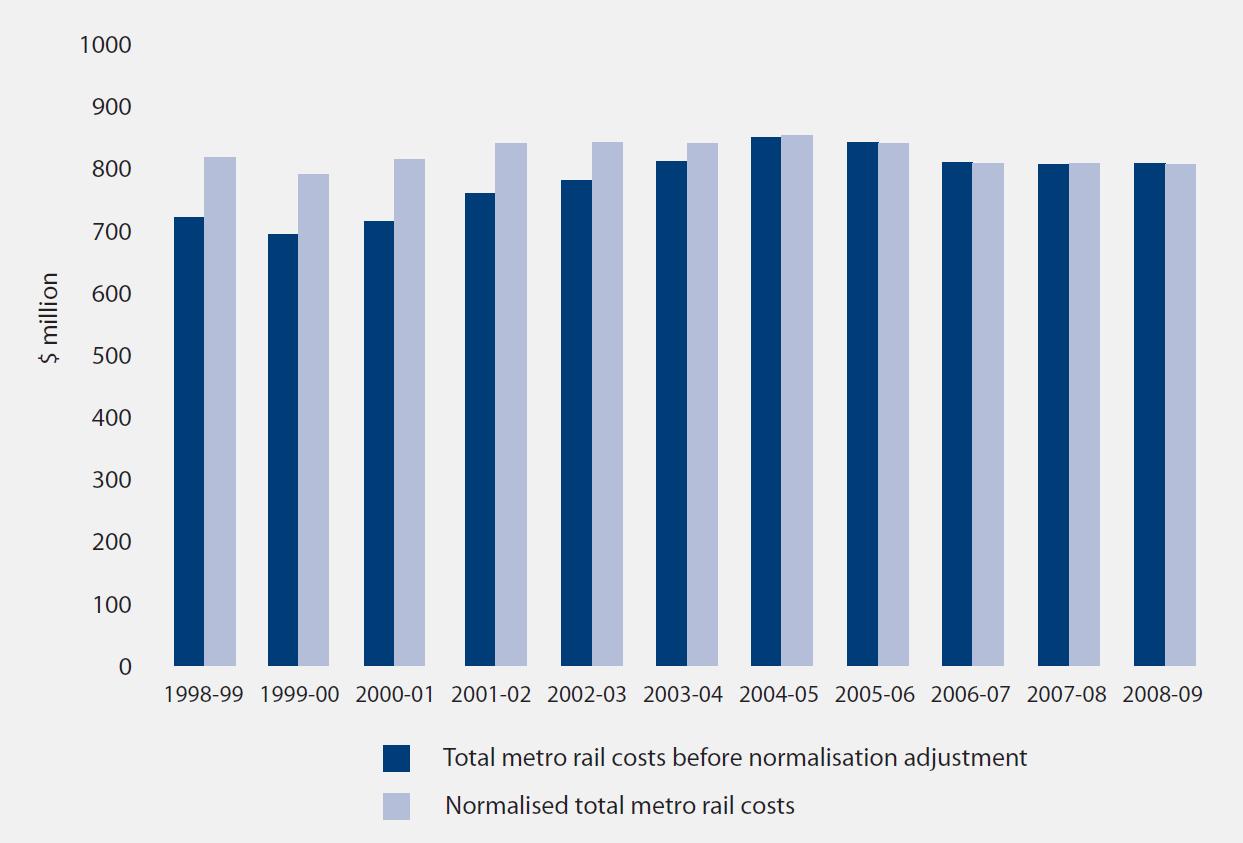 Note: Normalised costs include adjustments made to present the results on a comparable basis. These mainly include constant investment in rolling stock. Figures are in net present value terms.
Source: Auditor-General Victoria, Franchising Melbourne's Train and Tram System, 2005
Thus, the way the State Government used the budgetary position in public transport as the main excuse for tolling the Mitcham-Frankston Freeway was highly misleading. In announcing the need for tolls Premier Bracks said:
The failure of the privatised public transport experiment -- which resulted in the withdrawal of private transport operator National Express -- has now left a $1 billion bill. (23)
The claimed "increase in the Government subsidy of around $1 billion over the next five years alone" was in fact also an acknowledgement that the Government would already have been paying increased subsidies of that order between 1999 to 2003, if the so-called "failed experiment" had never taken place.
However, while stressing that all that was happening was a return to the late 1990s financial status quo, it is certainly worth asking why the bullish financial predictions of tenderers in 1999 did not come to pass?
The overly aggressive and optimistic bidding by tenderers in 1999 was caused in part by their experiences in the UK that had, to that stage, shown significant capacity for savings and, in part, by the sort of bidder fever where tenderers find it hard to walk away having already invested a lot of time, money and emotion into their bids.
It is also true that the bidders, and indeed some members of the TRU, failed to appreciate the degree of the savings that had been achieved in the first term of the Kennett Government and the consequent limited scope for "easy win" savings.
It is hard to know what the Government and its advisers should have done about this. When a competitive process is underway it is impossible to tell bidders not to sharpen their pencils, but to blunt them.
Undertaking that extraordinary step was actually advocated in one paper that considered the transport privatisation as the authors posed the question of the TRU "Why did they accept bids that, to a seasoned transport planner, were unsustainable?" (24)
Because with all due respect to "seasoned transport planners", history is littered with examples of markets delivering results that were not predicted by planners, or purchasers of businesses delivering results that embarrass vendors. The best way to test this is to allow people to invest their own money to test the proposition. National Express did that and suffered the financial loss to prove it.
As the 2005 World Bank study commented:
This is a difficult area because governments and their advisors are not necessarily better at forecasting demand than are operators with commercial and marketing experience and their own money at stake. (25)
When it became obvious that the savings were not going to be delivered (particularly in the aftermath of National Express' departure) and that a similar real level of funding as in the late 1990s would be required, it suited the political purposes of the Bracks Government to paint the situation as if this were some unprecedented new amount of money.
What was really happening was that public transport was going to continue to need the same quantum of taxpayer support it had been receiving in the late 1990s i.e. about half what it had been receiving in the early 1990s.
While the total amount of the subsidy is similar to the late 1990s, an important part of the financial settings in the franchised environment is the regime of incentives and penalties. Having a component of the subsidy payment from government delivered on a performance basis has contributed to the improvements in operational performance that have occurred since privatisation. (See Service Scope and Quality, Page 16.)
FARES
Apart from the Government subsidy, the major revenue source for public transport is the farebox.
It is clear that one of the goals of effective public transport policy is to have as much revenue as possible provided by the farebox, rather than taxpayers.
While reducing the burden on the taxpayer is a laudable objective in itself, in a public transport context, significant farebox contribution also demonstrates more powerfully than any other indicator that the service being provided is one for which customers are prepared to pay. Less appealing is if farebox revenue rises, not through increasing custom, but simply by increasing fares beyond the CPI.
The policy of the Kennett Government from 1993 onwards, which was then enshrined in the contracts with the private operators, was that "increases in regulated fares would be capped in line with the CPI". Since privatisation, farebox revenue has risen, both for positive reasons (increasing patronage and reduced fare evasion) and for negative reasons (a Government-imposed above CPI fare increase).
There have actually been two above-CPI fare increases since 1999. The first on 1 July, 2000 was outside the control of operators or the State Government -- it was a 5 per cent increase due to the Federal Government's introduction of the GST. The second on 1 January 2004 was initiated by the Bracks Government to allegedly cover the unbudgeted extra costs above those forecast in the original tendering process. These of course were the same costs that had already been allegedly covered by the April 2003 decision to toll the Mitcham-Frankston Freeway. Announcing the January 2004 increase Transport Minister, Peter Batchelor, gave the following explanation:
"The Government's first priority is to ensure the long term viability of the public transport system," he said.
"The Government is in the process of negotiating new franchise arrangements with private operators to put the system on a sustainable footing and establish one tram and one train operator.
"As part of those negotiations, a fare increase over and above the annual CPI increase is necessary to keep the system operating without cuts to services or the closing of lines.
"The revenue generated by the new fare structure will be directed back into the day to day operation of the public transport system." (26)
Once again it is worth repeating that just because the costs to government were higher than those projected by the bidders in 1999, it did not mean that the service was costing more to operate than it did prior to privatisation.
More salient may be Table Seven, which compares three periods of seven years -- the last seven years of the Cain/Kirner Government, the seven years of the Kennett Government and the seven years since privatisation.
It shows just how drastic the fare increases were in the latter days of the Cain/Kirner Government, once attempts at reform had been abandoned (see page 5).
By contrast, the Kennett Government, after one large initial increase, was able to keep fares close to CPI levels for its remaining six years in office. The twin effects of the GST and the Bracks Government's misleading rationale have meant that fare increases have outstripped inflation since privatisation.
Beyond the prices of standard tickets, there have also been changes such as the introduction of the Sunday Saver ticket in 2005 and the abolition of Zone 3 in March, 2007.
While the abolition of Zone 3 was no doubt welcome by commuters in the outer eastern and south eastern suburbs of Melbourne, it highlights how fares fall victim to the twin vagaries of government involvement -- budgetary expediency and political populism. The abolition of Zone 3 had been announced as a policy by the Liberal Party at the 2002 State Election and when they announced it again in 2006, it was copied by the State Government. (The issue of fares policy is discussed later in this Backgrounder -- page 22).
The other variable that affects farebox revenue is fare evasion. Recent Metlink surveys have shown that fare evasion has been reduced from previous highs, but estimates are that there is still $50 million in revenue foregone due to evasion, making it an important area for ongoing action.
Table 7: Average fare increases, 1985-2006
| Year | Average increase (%) | Year | Average increase (%) | Year | Average increase (%) |
| 1985-86 | 7.1 | 1992-93 | 10.0 | 1990-2000 | - |
| 1986-87 | 5.7 | 1993-94 | 4.5 | 2000-01 | 5.0 (GST) 8.3 |
| 1987-88 | 6.1 | 1994-95 | 3.0 | 2001-02 | 2.0 |
| 1988-89 | - | 1995-96 | - | 2002-03 | 3.1 |
| 1989-90 | 4.1 | 1996-97 | 3.4 | 2003-04 | 9.8 |
| 1990-91 | 15.0 10.0 | 1997-98 | - | 2004-05 | 2.25 |
| 1991-92 | 6.0 | 1998-99 | 3.0 | 2005-06 | 3.1 |
| Compound fare increase | 67.7 | 26.1 | 38.4 | ||
| Compound CPI for period | 53.9 | 14.0 | 26.2 | ||
| Percentage above / below CPI | + 13.8 | + 12.1 | + 12.2 |
Note: For over a decade the date for the CPI adjustment fare increase had been the start of January, but in late 2006 the Government announced that the 2007 increase, averaging 3.4 per cent, would not be implemented until 4 March 2007. To compensate commuters for the problems with the Siemens trains, the increase was further delayed until June.
INVESTMENT
By the 1990s the clear priority for capital investment in Melbourne's public transport system was new rolling stock, in both trains and trams.
Rolling stock
One of the promised outcomes of the privatisation that has been delivered in full is new rolling stock.
New trains were desperately needed to replace the aging Hitachi fleet, while new trams were needed to replace Z1 and Z2 vehicles and to aid compliance with Commonwealth Government disability discrimination legislation.
As per their contracts, franchisees purchased the following new trains and trams:
Table 8: Rolling stock investments
| Type of train / tram | Number purchased | |
| National Express | Siemens Nexas | 36 6-car sets |
| Connex | Alstom X'trapolis | 29 6-car sets |
| National Express | Combino 3 and 5 | 59 |
| Yarra Trams | Citadis | 36 |
The new rolling stock was delivered on-time and on-budget (in 1999 capital value terms) and has generally been well received by commuters. As the World Bank report commented:
The Government, through concessioning, was able to make use of private sector financing (although there was a hump in subsidy during the period when rolling stock was being delivered) and to benefit from competitive tension to indirectly achieve good prices from manufacturers. It avoided the temptation to over-specify the new rolling stock or to demand local design and manufacture, which enabled standard units to be supplied resulting in significant savings. (27)
However, the new rolling stock has not been without controversy. Problems with the brakes on the Siemens' trains became one of the highest profile public transport issues in Melbourne for some years. Having been a minor issue in the November, 2006 election campaign, it became a major issue in early 2007 as the trains were removed from service causing significant disruption to timetables and inconvenience to commuters.
This degree of problem is actually not unusual in public transport systems around the world. Previous new trains in Melbourne, the Hitachis in the 1970s and Comeng in the 1980s had significant teething problems. Sydney's "Millenium" trains have been afflicted with far greater problems than either of the new Melbourne models.
One advantage that Connex as a large multi-national operator has had is that it has had far greater capacity to extract action out of Siemens, compared to the degree of influence that an Australian State Government authority would be able to achieve.
More problematic was Connex's handling of the public relations debate in Melbourne. Its spokespeople correctly pointed out that their company was not the one that took the decision to purchase the Siemens trains. However, while criticising National Express for its choice of new train may be legitimate, Connex also attempted to place some of the blame for this situation at the feet of the original privatisation. Drawing a long bow, Connex claimed that part of the reason for the predicament was the original decision to split the system into two parts prior to the franchising.
What this fails to acknowledge is that in all likelihood, if the system had been tendered as a whole, National Express, not Connex, would have been the successful tenderer for the complete rail network. In turn, it would have meant that, not only would there not have been a seamless transition to an alternative operator when National Express departed, but the whole system would have been saddled with new Siemens trains rather than the seemingly more reliable alternative chosen by Connex for its original franchise.
As well as the purchase of new rolling stock, the Comeng train fleet has been completely refurbished, while Yarra Trams has refurbished all 316 existing (Z3, A and B class) trams. Also rubber boot technology has been used in trams to reduce vibration and wear of tracks, resulting in less noise, longer durability and an improved ride for passengers.
Infrastructure
With the focus on new rolling stock, less new infrastructure has entered the system.
The metropolitan train network was extended when the electrification to Sydenham opened in January, 2002.
The tram system has seen track extensions to Box Hill and Vermont South, plus services have now been extended into the Docklands via Flinders Street West, Collins Street, Harbour Esplanade and La Trobe Street for routes 30, 48, 86 and the City Circle.
There has been the construction of 15 Superstops which include platforms, glass shelters, real-time information and upgraded passenger information, plus an overhead renewal program has seen certain wires placed underground and reduced overhead clutter in locations such as Camberwell Junction and St Vincent's Plaza.
The initial maintenance regime for infrastructure, which involved a monitoring regime based on a condition index, fell victim to competing judgements about condition. As part of the re-franchising it was replaced with a system where the Government sets a framework and the operator submits a management plan. Reports are that this system is working better than its predecessor.
INDUSTRIAL DISRUPTION
Given the history of industrial action on the Melbourne public transport network, there has been remarkable industrial calm in the past seven years.
The only industrial action was a stoppage by rail signalling staff citing security concerns in the wake of the 7 July 2005 London bombings. Even on the day this action took place Melbourne's rail system had better performance figures than the Sydney system.
The lack of industrial disruption is one of the key benefits of the post-privatisation period compared to previous decades. Ironically, this improvement has removed a short-term financial benefit that used to accrue to the operator. The removal of wage costs during strikes meant that the loss-making system actually lost less money when not operating, so this improvement has done nothing to assist the financial comparisons with pre-privatisation operations
Significantly, since its return to government ownership V-Line Passenger has experienced more industrial disputation than the privately operated metropolitan train and tram combined.
Privatisation has delivered some advantages for unions. They can negotiate directly with their employer knowing that the employer is the final decision maker. They no longer have to be compared to teachers, nurses and public servants.
There may be further opportunities for workplace reform, such as having more split shifts where workers can provide services in the peaks, with a break in the middle.
Overall, the absence of strikes in the modern public transport system provides the biggest contrast with the problems that beset the government-operated system for much of the 20th century.
SERVICE SCOPE AND QUALITY
Franchisees now operate services on two extensions of the public transport network that were mandated in the existing contracts:
- Extension of the metropolitan rail system from St Albans to the growing outer suburb of Sydenham.
- Extension of tram route 109 from Union Road, Surrey Hills to the major transport hub of Box Hill.
In addition, tram route 75 was extended from Blackburn Road to Vermont South (a far less logical extension than the two above).
These have contributed to a significant overall increase in service kilometres of 11.4 per cent, with features including the extension of operating times by an hour on Friday and Saturday nights and the re-introduction of trams along William St on Sundays.
However, there is no point in extending networks if the service delivery on the existing network is not up to scratch. Trying to cater for an expanded network will only compound existing problems.
So the key criteria for assessment of any public transport system are those that affect passengers in their day-to-day use of the system.
Commuters will be happy if the service operates (i.e. is not cancelled) and if it runs on time (i.e. is punctual).
Beyond those two basic factors are issues of cleanliness, security (particularly off-peak) and customer service.
Trains and trams have followed a different trajectory in the quality of their service delivery in the seven years since privatisation took place.
For the first three years of private operation, both demonstrated significant improvement in reliability and punctuality. Yarra Trams has been able to hold onto these gains. However, following the departure of National Express, the performance of the rail network declined significantly, although it never consistently fell below pre-privatisation standards.
Table 9: Cancellations of trains and trams as a percentage of services scheduled (28)
| 1998-99 | 1999-00 | 2000-01 | 2001-02 | 2002-03 | 2003-04 | 2004-05 | 2005-06 | |
| Metropolitan trains | 1.0 | 1.4 | 0.7 | 0.5 | 0.5 | 1.2 | 1.3 | 0.9 |
| Metropolitan trams | 1.5 | 1.2 | 0.7 | 0.4 | 0.4 | 0.4 | 0.6 | 0.3 |
Table 10: On-time performance for trains and trams as a percentage of services run (29)
| 1998-99 | 1999-00 | 2000-01 | 2001-02 | 2002-03 | 2003-04 | 2004-05 | 2005-06 | |
| Metropolitan trains | 94.0 | 95.9 | 96.6 | 96.7 | 96.9 | 95.9 | 93.9 | 93.0 |
| Metropolitan trams | ||||||||
| Average | 83.0 | 81.1 | 81.1 | 82.0 | 82.9 | |||
| At destination | 67.3 | 72.3 | 72.6 | 70.8 | 68.1 | 67.6 | 69.5 | 72.7 |
There is no doubt that the initial combination of farebox revenue retention and the incentive / penalty payments regime drove significant service quality improvement. The fixed allocation of the farebox after the re-franchising removed one of the drivers of individual company improvement, but the retention of the operational performance regime has continued to provide significant incentive to meet targets.
Operators are clearly frustrated when circumstances beyond their control affect their payments. However, external factors affect many businesses and it is important to judge operators on their outputs, without allowing too much mitigation.
The factors (internal and external) that have contributed to the decline in the quality of the rail service from its 2002 peak have included the following:
- The refranchising process in 2003-04 distracting management from operational performance.
- Severe driver shortages.
- Disruption caused by major infrastructure projects.
- Problems with new rolling stock; and
- Heavy train loads causing delays.
The first four of these factors have all been removed or addressed in a way which means the impact on Connex's operation is past the worst. The fifth factor is an on-going problem and is discussed in greater detail in the following section -- Patronage.
While tram punctuality has improved the Melbourne system is still slow and has poor punctuality by international standards.
The key cause of this is that less than one fifth of Melbourne's network operates in its own right of way, which is a very low proportion by international standards.
Surveys show that approximately half of all tram users are time dependent and so, if trams are to be a viable commercial option, they must deliver competitive journey times and improve punctuality. Further, the slow journey times are a cost to both the operator and ultimately the taxpayer. Slow journey times mean that more trams and tram drivers are required to operate the service.
While this is not the place to debate the merits of the various tram priority measures that Yarra Trams advocates (some of which are being implemented in a program overseen by the Director of Public Transport, Vic Roads and Yarra Trams), the fact that they are advocating them is a very important benefit of public transport privatisation. It has always seemed more likely than an international business, armed with the latest comparative data, and able to express the costs of tram congestion in economic terms will be far more likely to be able to convince both governments and business lobby groups of the need to address issues of tram priority, and reduction in short tram stop spacing etc.
Reported crime around the public transport system declined by 33.2 per cent in the four years from 2001-02 to 2005-06, however surveys show that perceptions of personal safety on the network remain virtually unchanged in recent years. The combination of increased use of CCTV and increased deployment of both customer service and revenue protection staff has clearly helped the actual situation, although obviously it is important to also address perceptions of personal safety as these will impact on patronage levels.
Another area of improvement in recent times has been the increased use of railway station buildings on both the rail and light rail systems for facilities such as cafes. Not only does the rent provide an extra income stream for public transport operators, this type of concurrent commercial activity delivers a whole range of benefits in both improving the experience of commuters (coffee, enclosed surroundings, security etc.) and attracting potential new customers to the system.

PATRONAGE
The sum total of the effect of fares, investment in rolling stock and infrastructure, the amount of industrial disruption and the quality of the service being provided is reflected in the patronage figures.
Patronage figures show that private operators have been providing a service that customers are prepared to use.
Table 11: Tram and train patronage, 1998-2006 (30)
| Year | Metropolitan train patronage (millions) | Metropolitan tram patronage (millions) |
| 1998-99 | 118.0 | 120.4 |
| 1999-00 | 124.2 | 127.3 |
| 2000-01 | 130.3 | 129.4 |
| 2001-02 | 131.8 | 131.9 |
| 2002-03 | 133.8 | 134.7 |
| 2003-04 | 134.9 | 135.9 |
| 2004-05 | 146.0 | 145.3 |
| 2005-06 | 162.4 | 151.1 |
| Percentage increase from 1998-99 to 2005-06 | 37.6 | 25.5 |
The patronage growth for train and tram was reasonably consistent until the past two years. However, in the two years from July 2004 to June 2006, train operator, Connex, saw spectacular patronage growth. On current trends, rail patronage is predicted to grow a further 7 per cent in 2006-07. With these figures, the original projected patronage increases of 84 per cent and 64 per cent over 15 years in the two rail franchises do not look as unrealistic as critics of the privatisation have charged. (31)
It is true that there have been some external factors that have contributed towards the growth in patronage. In 2005-06 specifically, there was the impact of additional patronage associated with the Commonwealth Games, which was estimated to be a spike of close to 2 per cent. More generally in recent years there has been the increased cost of motoring due to rising petrol prices and the increased cost of CBD parking. Further, private operators have benefited from trends such as the closure of the Waverley Park football ground and the opening of Docklands.
However, these factors have been balanced by the rail network having to cope with the disruption caused by a number of infrastructure projects (Spencer Street Station re-development, works at Flinders St Station and the building of the pedestrian bridge across the Jolimont yards), a severe shortage of drivers and most significantly problems caused by the system's inability to cope with increasing patronage.
The increase in patronage has contributed to some of the service delivery problems that the system has experienced. Higher loadings on trains increase dwell times at stations, which may mean that trains fall behind their scheduled timetable. This tends to have a cascading effect as the later a train is the more passengers will have presented and be making attempts to catch it.
The seating capacity of Melbourne's trains varies from 528 to 556 seats (in a 6-car train) and in the franchise agreements the maximum allowable loadings are 800 passengers. Based on a Public Transport Division survey in late 2005, multiple trains on several lines were carrying in excess of 800 in the morning peak, with the Dandenong line experiencing the biggest problem with some trains carrying over 1000 passengers and people standing from as far out as Yarraman, meaning a standing journey of over half an hour.
It is an issue of keen debate whether there are capacity constraints in the system. Mees and his colleagues argue that "there is no such problem" arguing that the rail system currently has far fewer trains than it did in the past. (32) Connex and the Government's Public Transport Division respond by pointing out that when assessing the system of earlier eras it is important to remember that it was servicing a more compact city. Around World War II Melbourne had a population of just over one million people, 70 per cent of whom lived within 10km of the GPO. Thus, the rail network did not need to run express services to cater for a large outer-suburban market. In 1939, there were no express services beyond Caulfield at the height of the afternoon peak and only 7 per cent of services to Camberwell ran express, compared to 64 per cent today. It is much easier to run a rail network with regular stopping patterns and not have to cater for expresses.
It is crucial that the contractual arrangements between government and operators continue to provide an incentive to increase patronage, but also to do so in a way that provides the incentive for operators to do it without imposing unnecessary demands on government for increased infrastructure spending.
ASSESSMENT A QUALIFIED SUCCESS Measured against the five objectives (see page 7), privatisation scores reasonably well.
On the basis of performance, there is no doubt that there should be a continuation of private sector operation. |
THE WAY FORWARD
2007 AND BEYOND
Extending private operation
The current train and tram franchises expire on 30 November, 2008, unless the Government gives notice by 30 November, 2007 that it wants to extend them.
On the basis of performance there is no doubt that there should be a continuation of private sector operation. The indications are that the State Government appreciates this and will continue private operation. During the election campaign Premier Bracks indicated that it would be too costly to bring the system back into public operation and then in February, 2007 The Age published an interview with newly appointed Public Transport Minister, Lynne Kosky:
In her most revealing comments on privatisation yet, Ms Kosky told The Age she opposed the Government taking back the system, sold by the Kennett government eight years ago. "Do I want to run a train system? I don't think so," she said. "My advice to cabinet will be that I don't think it should be brought back into public hands." (33)
The State Government should spell out as soon as possible what its plans are for the period after the current francises have expired in 2008.
Assuming that private operation continues it is also important to consider the consequent question is how that should be done:
- Negotiation;
- Tender.
There will no doubt be significant pressure from the incumbent operators to have a negotiated process.
Given the degree of disruption in the public transport system in recent years there is at least a reasonable argument to provide a short extension (3 years) to the existing arrangements so that the performance of the incumbents can be tested in a more stable environment. This will also enable the New Ticketing System to be implemented without any other dislocation.
Tendering should be undertaken in 2010-11 to allow new contracts to be in place by 30 November 2011.
The tenders should be for the original four metropolitan franchises however, unlike in 1999, bidders should be allowed to bid for the two parts of either train and tram, and be awarded the contract for the whole system if the bidding process demonstrates that it is the most efficient model.
The risk of entrenched incumbency is ending up with operations such as those traditionally provided by the Victorian bus industry, where operators had no incentive to attract new customers, but instead ran services on routes that suited historic, rather than current, needs. It is perhaps no coincidence that the Executive Director of the Bus Association of Victoria co-authored a paper on the public transport privatisation which concluded that "once private sector public transport providers are in place, negotiated contracts may provide the best opportunity to move closer to a social optimum in service provision than competitively tendered contracts". (34)
It is very important that any future arrangements address the issue of risk and move back closer to the 1999 model than the 2004 model, in line with the view expressed by the Auditor-General:
In future arrangements for the metropolitan train and tram system, there may be an opportunity to increase value-for-money to the state by allocating some risks back to train and tram operators. (35)
The critics' alternative
As has been shown earlier in this Backgrounder, critics of the privatisation have not painted an accurate picture of the outcome of the process. Then to compound this error, not content with having misrepresented the facts about privatisation's outcome, the alternatives that are offered are both misleading and naïve.
Having spent the two decades until 1999 criticising the actual governmental operation of public transport in Melbourne, Dr Paul Mees, lead author of Putting the Public Interest Back Into Public Transport, was smart enough to realise that advocating a return to the pre-privatisation status quo would look a bit odd.
So, in one of the more amusing parts of Putting the Public Interest Back Into Public Transport, he and his colleagues address the appropriate re-nationalised model:
The choice is not between continuing a failed privatisation and reinstating a poorly-performing public agency; rather, the alternative to privatisation is a new, more dynamic public body of the type that runs the best public transport systems in the world -- bodies like Vancouver's Translink, or Zurich's Zurcher Verkehrsverbund (ZVV) or even Perth's Transperth. (36)
Zurich has long been a favourite of Dr Mees. He devoted a whole chapter of his 2000 book, A Very Public Solution, to its alleged charms and relevancy. (37) He follows up in his 2006 document by saying that "because Melbourne would be seeking to build a dynamic public transport management culture from scratch ... we therefore recommend a public transport only agency -- i.e. the Zurich model, not the Vancouver model."
The ZVV in Zurich only has 35 staff (in total -- i.e. including receptionists and typists, and an equivalent body in Melbourne should require no more than this ... It is essential to have small staff to create a cohesive organisation with high morale and clear lines of accountability. Not over-staffing is also important because the skills to run a best-practice transport agency are relatively rare internationally. (38)
There is no doubt that Zurich does have an excellent public transport system, but it has a population one-tenth that of Melbourne's and covers an area one-hundredth the size of Melbourne. Even with these assisting factors, its public transport market share is still only slightly double Melbourne's. (39) More misleadingly, the report fails to acknowledge that Mees' beloved ZVV is, in fact, but one of the authorities responsible for delivering public transport in the city.
Similarly, Perth hardly works as a comparison. As well as the obvious population difference with Melbourne, the WA Government has ploughed significant investment over the past two decades to modernise and expand the previously small and antiquated network. With such new infrastructure, it does not have to cope with the issues that arise from the inheritance of the much larger and older infrastructure bequeathed to transport operators in Melbourne.
And yet despite this massive investment, in 2005-06 the Perth system's total boarding increased by a far smaller amount than Melbourne's, just 3.7 per cent. In the three years from 2002-03 to 2005-06, total expenditure on the Perth system increased from $291.6 million to $514.2 million. Even the more narrowly defined operating expenditure increased by almost 50 per cent.
In terms of scale, Sydney makes the obvious comparison but anyone who followed this year's NSW State Election will realise why Mees and the others never compare Melbourne's privatised system to the government run service in Sydney. (See Daily Telegraph, below.)
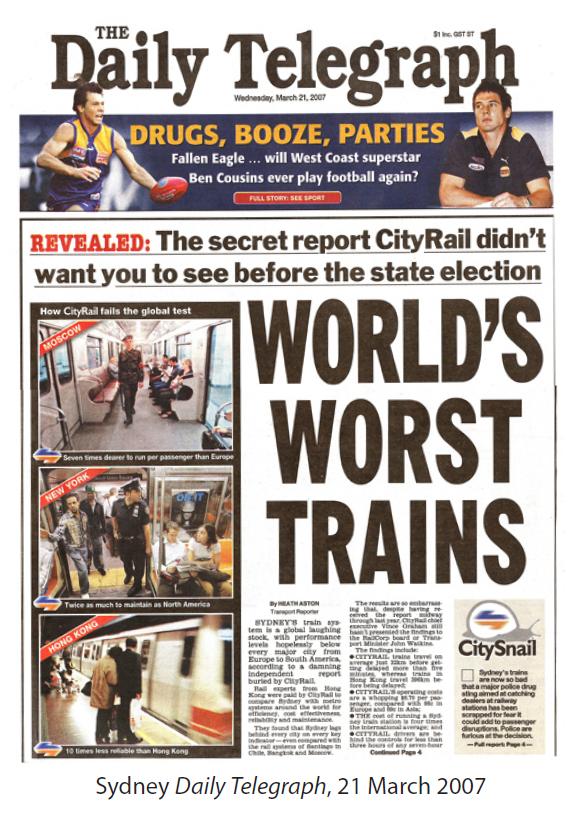
There is something touchingly naïve in Dr Mees' search for the true bureaucrat who will deliver his vision for public transport in Melbourne. In reality, the transport bureaucrats in Melbourne have probably been no better, or no worse, than those located elsewhere.
That said, it is important to have clear lines about what is the responsibility of the Government regulator and what is the responsibility of the operators. The franchisees must have the right commercial incentives, but as they are receiving significant subsidies from the taxpayer, the Government must ensure that the interests of those providing the subsidies are protected, protecting the public interest so to speak.
This involves not only procuring efficiency from the operators, but also delivering it themselves. The one point that Public Interest makes that has some validity relates to the total number of officials that are employed to manage the contracts. Across many areas of government the Bracks Government has employed too many bureaucrats and public transport is no exception.
Once the next set of contractual arrangements is put in place, it should be a priority for the State Government to assess whether there is scope to downsize the number of staff required to manage contracts, particularly as the next franchise period is unlikely to experience the range of problems thrown up by the initial round of franchising.
In a further twist, Dr Mees seems to have recently softened his position on privatisation per se. In a Melbourne Weekly Magazine cover story, Mees' views were described as follows:
For Mees, privatisation itself is not necessarily the problem, as he's "agnostic" about whether Yarra Trams should be kept on considering it appears to be a reasonably well-run company. (40)
This weakening of the resolve to renationalise was also reflected in an opinion piece by Kenneth Davidson in The Age who while lamenting that the Government "could have re-established the Met without payment of compensation" when the private operators first came asking for increased subsidies in 2001, now proposes the following:
The franchises should be converted into operating contracts, where the government pays a fee to the operators for services. The operators would be given the routes, timetables and rolling stock by an authority made up of no more than 50 staff, based on the successful Zurich model. They would then be directly accountable to the government and the public. (41)
Making public transport viable in the longer term
The fact that the reasonably successful privatisation of Melbourne's train and tram services has been painted in a negative light by ideologically-driven public transport activists should not really come as a surprise.
The debate around public transport has been riddled with red herrings for many years.
Too often public transport has been seen not as a transport option for potential customers, but as a social service structured to meet social needs. It has been regarded as a means of providing jobs for its employees, mobility for the socially disadvantaged, or environmental benefits for the community.
Too often in its life in the public sector, it has been the battle ground between competing interest groups, such as when the heritage and disability lobbies battled over the deployment of historic, but inaccessible, W-Class trams.
Too often it has been advocated by planning fanatics who see it as the panacea for urban sprawl and yet at the same time it has suffered from the inability to commercially develop its property, or conduct maintenance, due to local residents using planning processes to stifle activity.
Its long-time association with unions, social welfare bodies, environmental groups and other assorted left-wing causes has tended to obscure the significant role mass transit has played in the economic life of Melbourne. While it is true that public transport's share of motorised trips has declined to around 8 per cent, public transport does have 70 per cent market share of trips to the CBD, with 55 per cent of total journeys to work in the CBD being undertaken by train.
There will always be a legitimate debate about how government-spending should be allocated between roads and public transport. This was highlighted when both road and public transport advocates debated their respective allocations in the State Government's May 2006 paper, Meeting Our Transport Challenges.
While this is not the place to debate the roads versus public transport break-down, a positive aspect of the funding in Meeting Our Transport Challenges was that a focus of the public transport component was on improving capacity in the area where public transport is most viable -- peak journey to work in the CBD and inner suburbs. (42)
The advantage of rail expenditure in this area is that it also frees up capacity on the road network. Congestion costs in Melbourne were estimated some years ago at $3 billion per annum (43) and it is estimated that a single peak hour car trip between Dandenong and the city adds some $12.80 to road congestion costs. An extra freeway lane has the capacity to move 2000 vehicles (2400 people at current peak car occupancy rates) per hour. This is the equivalent of 2.5 six-car trains.
The project to build the third rail track from Caulfield to Springvale and ultimately to Dandenong will allow 4 to 5 extra trains per hour and is thus a key way to address the twin problems of overcrowding on the rail system and congestion on the roads.
By contrast, the constant drive by the public transport activists to massively increase investment in neighbourhood bus services is fatally flawed. First, there is no congestion problem to address and more fundamentally it is clear most people recognise that the private car is the optimal means of local travel. Anyone who believes that the trip out in the car to buy some things at the shop, pick up one child from school, collect another child from sport and then purchase the takeaway dinner will be done by providing a more regular bus service through the housing estate is not living in the real world.
The car's role as the pre-eminent vehicle for those tasks has only increased since the mode first became common in the 1950s, a process well documented in Graeme Davison's book Car Wars, where he describes the freedom and confidence that cars brought to those in new housing estates in the 1950s. (44) Trying to change this behaviour is a futile exercise in social engineering. It should also be pointed out that running a fleet of empty buses around suburban housing estates is also hardly best-practice environmental behaviour.
What is clear is that to compete with the private motor car in markets in which it has some inherent advantages, public transport needs to be operated in a way that attracts customers. It needs to attract customers on its merits, because it meets their travel needs. In particular, public transport needs to be a service for which customers are prepared to pay.
That is why suggestions over the past year to provide "free" public transport, to either the whole community (the Sunday Age), or to students (the Liberal Party's State Election policy), should be rejected. The problem from which public transport has suffered for decades is lack of exposure to market forces, so removing the element of them that does exist would be counterproductive.
The willingness of people to pay fares is the best indicator that operators and government will have that the service is meeting the community's needs. The industry needs more market signals, not fewer. The fact that peak-hour overcrowding (particularly in trains) is currently the biggest problem facing the system only serves to highlight that "free" travel would actually add to the system's problems.
The irony is that proponents of free public transport and re-nationalisation paint themselves as supporters of public transport -- they are in fact its enemies.
The Government monopoly of train and tram operation continued from the 1920s to the 1990s -- seven decades. In contrast, private operation has been given seven years.
The choice is clear: Re-nationalise and return to the seven decades of decline; persist with private operation and continue down a path of building a virtuous cycle of commercially driven growth.
OVERSEAS EXPERIENCE
At the time it was decided to undertake the Victorian privatisation, the reference project for both advocates and opponents was the privatisation of British Rail undertaken by the Major Government. Given that, it is worth briefly noting what the experience has been there.
In the United Kingdom the conventional wisdom is that railway privatisation failed to deliver benefits to either passengers or taxpayers.
Parts of the conventional wisdom were challenged in a 2004 World Bank Report which found that "it is virtually impossible to draw uncontested lessons from the BR privatisation experience". (45) The report explained this difficulty came about because the industry was completely restructured, from being vertical to separated, at the same time it was privatised and that both processes were done with great haste. It concluded that neither "failed per se" as safety standards improved, there were efficiency gains and the "enhanced market focus of the private sector franchisees ... did yield benefits".
A more recent study was undertaken by the Institute of Economic Affairs in 2006. (46) This study, entitled The Railways, the Market and the Government, found that:
- The number of passenger kilometres has grown rapidly since privatisation.
- Train punctuality improved considerably after privatisation -- improvements only came to a halt as a result of government meddling after the Hatfield incident.
- Safety improved faster after privatisation than before privatisation for all classes of accidents.
- In 2003 the rate of broken rails per million train kilometres was the lowest for 40 years.
- Capital spending increased by £4.6billion between 1990 and 2002, partly to make up for decades of under-investment before privatisation.
Nevertheless, it is true that costs and government support did not decline after privatisation. To a large extent, this can be blamed on the structure of privatisation. David Tyrrall of Cass Business School argues that, "A ludicrously complex structure was imposed on the industry at privatisation that has since been made more complex. No private railway has ever found the structure imposed on the UK rail industry at privatisation to be efficient". Also, as in Victoria, the particular public sector operation, British Rail, was not as inefficiently run as many other parts of the public sector. As one former Tory MP of the time has commented:
"We had persuaded ourselves that because BR was (sort of) in the public sector, it must be being run wastefully -- ergo privatisation would bring huge and immediate economies. But in fact BR was being run as a tight ship ..." (47)
Not all the authors in the IEA report agree on the way forward. Richard Wellings and Oliver Knipping believe that the industry should be free to determine its own structure. Chris Nash, Rico Merkert and Rana Roy propose alternatives that are closer to the present structure of privatisation. Nevertheless, all the authors agree that privatisation has worked and will in the future work far more effectively than is popularly perceived.
REFERENCES
1. Sunday Age, 5 March, 2006 p.4
2. Mees, Moriarty, Stone & Buxton, Putting the Public Interest Back Into Public Transport: A Report to the Victorian Community p. i
3. Auditor-General Victoria, Franchising Melbourne's Train and Tram System, Performance Audit Report No 11, 2005
4. Williams, Greig & Wallace, Results of Rail Privatization in Australia and New Zealand, (The World Bank, Washington, 2005) Section 4.2
5. Russell Jones, Fares Please! An Economic History of the Melbourne & Metropolitan Tramways Board
6. FW Eggleston, State Socialism In Victoria (London, 1932) p. 128
7. Marc Fiddian, Trains, Tracks, Travellers: A History of the Victorian Railways (Melbourne, 1997) p. 100 and p. 134
8. Marc Fiddian, Australasia's Tramways, (Melbourne, 2002) p 72-74
9. Fares Please! op. cit.
10. Fares Please! op. cit.
11. Fares Please! op. cit.
12. John Cain, John Cain's Years (Melbourne, 1995) p. 206
13. Cain p. 217
14. Cain p. 205
15. Cain p. 216
16. Auditor-General Victoria, Public Transport Reforms: Moving From A System To A Service, Special Report No 57, May 1998
17. Media Release, Transport Minister, 17 April, 1997
18. Auditor-General Victoria, 2005 p. 4
19. Meeting Our Transport Challenges (2006) p. 4
20. For example, Nicholas Low, The Age, 17 February, 2007 p. 9 (Insight section)
21. Auditor-General Victoria, 2005, p. 24
22. One could, in fact, argue that the starting point should be the 1991-92 financial year, as the privatisation was in fact a continuation of the reform program begun in January, 1993.
23. Media Release, Premier Bracks, 14 April, 2003
24. John Stanley and David Hensher, Melbourne's Public Transport Franchising: lessons for PPPs (2003) p. 14
25. Williams, Greig & Wallace op. cit. p. 45
26. Press release, Transport Minister, 25 November 2003
27. Williams, Greig & Wallace op. cit. p. 42
28. Track Record 27, April-June 2006
29. Track Record 27, April-June 2006
30. Victorian Government Budget Papers
31. What does look completely unrealistic is the aim expressed in the State Government's 2002 planning blueprint, Melbourne 2030, in which the stated aim was to lift the then level of 9 per cent of motorised trips within the metropolitan area to a target of 20 per cent by 2020. Given the continuing rise in the total number of motorised trips, public transport would need to treble its trip numbers to double its market share in that sort of timeframe.
32. Mees et. al. 2006, p.5
33. The Age, 26 February, 2007
34. Stanley and Hensher, op. cit. p. 20
35. Auditor-General Victoria, p. 5
36. Mees et. al. 2006 p. 7
37. Paul Mees, A Very Public Solution: Transport in the Dispersed City (Melbourne, 2000) Chapter 5 p. 120-151.
38. Mees et. al. 2006 p. 9
39. Information on international public transport market share can be found at the Demographia website (www.demographia.com)
40. Melbourne Weekly Magazine, March 21-27, 2007, p.25
41. Kenneth Davidson, "Put the public back in public transport", The Age, 1 March, 2007
42. Meeting Our Transport Challenges p. 39-41. It should also be noted that the projects to increase the capacity on the metropolitan rail system are part of a program called the Rail Network Capacity Improvement Program: 2006-2030. While it is pleasing to see public transport adopting a long-term infrastructure development program similar to the way VicRoads has identified road projects, one should also maintain a healthy cynicism about timescales to which current incumbents will never be held accountable.
43. Linking Melbourne: Metropolitan Transport Plan (2004) p. 25
44. Graeme Davison, Car Wars: How The Car Won our Hearts and Conquered Our Cities (Sydney, 2004) p. 41
45. Louis S. Thompson, Privatizing British Railways: Are there Lessons for the World Bank and Its Borrowers? (World Bank, Washington, 2004)
46. The Railways, The Market and The Government, Institute of Economic Affairs (London, 2006)
47. Matthew Parris, "In a Swedish log cabin, I grasped the core truth about New Labour," The Spectator, 3 March, 2007 p. 26


 Note: a = preliminary figures
 Source: Commonwealth Treasury (2005:92, Chart 3)
 Source: Australian Bureau of Statistics (2006)
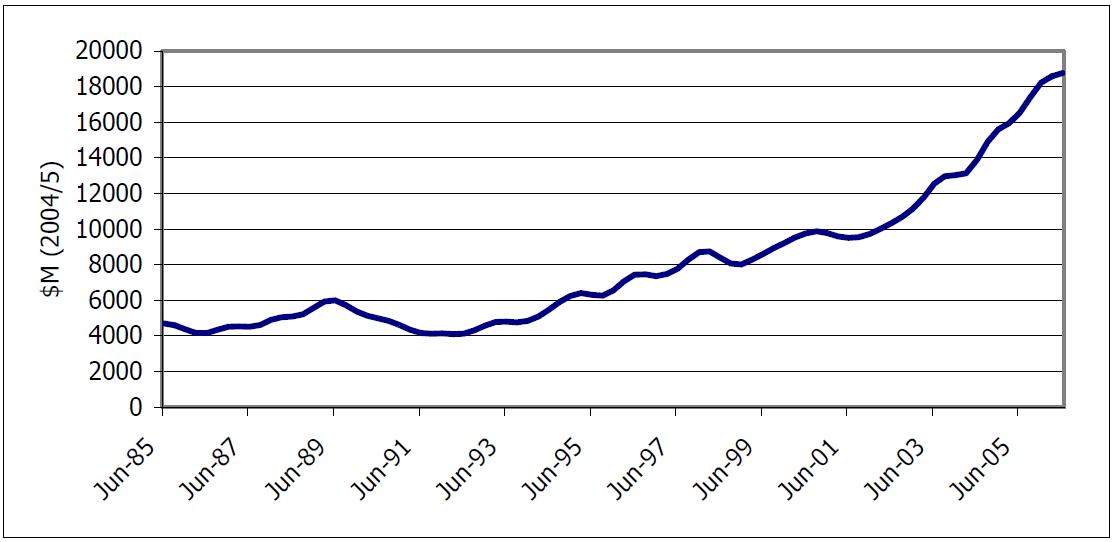 Source: Australian Bureau of Statistics (2006)