Saturday, March 02, 2002

WWF Says "Jump!", Governments Ask "How High?"

A case study suggests that governments need to better scrutinise allegations of environmental harm and those who make them


"[We] base our work on sound science."

WWF Vision Statement 2002

INTRODUCTION

The World Wide Fund for Nature (WWF) has mounted a campaign that has led to both the Commonwealth and Queensland Governments recently recommending urgent and significant changes to land management practices in catchments that drain onto the Great Barrier Reef.  These recommendations are purported to have a basis in science.  In particular, it is alleged that there is evidence for localised deterioration of nearshore reefs from agricultural runoff.  The scientific literature, however, provides no such evidence.  So, what, and who, made these two governments jump to the wrong conclusions?

We review the process that resulted in governments' recommending significant land-use changes that are likely to have a substantial economic cost.  We conclude that government is increasingly abrogating its responsibility to make decisions in the best long-term interests of its citizens, and is instead reacting to pressure groups without first scrutinising their motivations or the evidence to support their allegations.

WWF has targeted rural industries in Queensland over the past two years.  This campaign is believed to have been funded out of the United States of America through donations generated in response to media interest in the 1998 coral-bleaching episode that affected reefs across the world.  The bleaching was attributed by WWF to global warming.  It was later acknowledged, however, that the bleaching was a short-term phenomenon and therefore likely to be related to an El-NiƱo episode, not global warming.  The World Wildlife Fund capitalised on the media coverage and secured significant funds to pay for a campaign to "Save the Great Barrier Reef".  In 1999, it established headquarters in Brisbane and a simple media strategy was developed whereby the Great Barrier Reef would be portrayed as a victim of industry, in particular the grazing and sugarcane industries.

The Queensland and Commonwealth Governments reacted to the initial WWF campaign allegations, not by evaluating them, but by wanting to be seen to save an environmental icon.

In particular, the Queensland Government maintained an emphasis on evaluating land-based sources of pollution, despite evidence that none was apparent, because of an election commitment to the conservation movement.  But what are they saving the reef from?  Governments need to evaluate reports produced by environmental organisations more critically, in order to safeguard the integrity of public policy decision-making.  In addition to ensuring that environmental decisions are based on sound science, governments must reassert their primacy as representatives of the public interest by demanding that those they invite to participate in government forums have legitimate standing, by way of expertise, representation and direct involvement.


CREATING A NEED FOR GOVERNMENT ACTION

In June 2001, WWF published a Great Barrier Reef Pollution Report Card (WWF, 2001a).  The principal conclusion of the 40-page document was that, "the Great Barrier Reef is being threatened by land-based pollution.  Inshore reefs and seagrass meadows, habitat for the threatened dugong and green turtle, are suffering from what we do on the land".  Imogen Zethoven, WWF Australia's Great Barrier Reef campaign manager said that 750 inshore reefs were at risk from land-based pollution, chiefly agricultural runoff.  "Those reefs that are located within 10 km of the coast are at a higher risk of pollution impact.  The reefs of greatest concern are located between Port Douglas and Hinchinbrook, and between Bowen and Mackay -- an area which includes the major tourism centres of Cairns and the Whitsundays." (Press release, wwf.org.au, 23 January 2002).

The report indicated that the cattle-grazing industry contributed significantly to the sediment load, while the sugarcane growing industry was principally responsible for pollution from pesticides, herbicides and nutrients.  While the report made many allegations of an impact from agriculture on the Reef, it did not substantiate any of the claims.  Claims of scientific consensus were made without citing a single published reference (pages 7, 13).  The report cited studies that identified potential methods of recognising human-induced impacts (for example, Van Woesik et al., 1a possible impact from chemicals or nutrients (for example, Haynes et al., 2000b;  Smith etal., 1981).  It suggested that the studies provided actual documented evidence of a huminduced impact on the Reef.  In fact, the studies did not identify any such impact.  The extenof agriculture in a catchment was used as a measure of the condition of catchments and of adjacent inshore reefs without reference to a single environmental indicator, for example, water quality (pages 20, 22, 24).

In summary, the WWF report played on the current global preoccupation with what Lomborg (2001), in The Skeptical Environmentalist, labels the "Litany":  that the environment is in poor shape, resources are running out, the air and water are becoming more polluted, and industries must be heavily regulated.  The Litany is a pessimistic mindset that eschews science for doomsday scenarios;  it pays lip service to the concept of ecologically sustainable development, but in fact pays no regard to the sustainability of industry.

WWF has not always been so gullible or eager to promote the Litany.  It claims to have a clear scientific direction and to base its grants (US$1.1 billion since 1985) "on the best scientific knowledge available."  Indeed, one of the most important figures in WWF's early history was the British biologist, Sir Julian Huxley, the first Director General of UNESCO, and a founder of the scientific research-based conservation institution, the IUCN (The World Conservation Union).  Nevertheless, even at its inception in 1961, WWF gathered not only scientists, but also advertising and public relations experts.  It, no doubt, has always sought to balance the need for accurate science with the necessity to raise funds for its projects.  The difficulty is that fundraising needs "good" stories, and science does not always provide good stories.  WWF, along with other leading environmental non-governmental organisations (NGOs), has been susceptible to overstating doomsday scenarios, often at the expense of its practical conservation work, of which it is justifiably proud.  The fact that it boasts five million supporters worldwide means that it has considerable political influence.  But it has also become conscious of its own place, its own survival among leading NGOs.  It has been swept along by the need to keep the message fresh and appealing, to keep the story interesting, and the dollars flowing.  The WWF Great Barrier Reef Pollution Report Card is an example of a practical conservation organisation, with a scientific strength, abandoning it to the siren call of prominence.

The lack of scientific evidence in the WWF Reef Report was enhanced by the uncritical response of the media.  Features in local, state and national newspapers quoted extensively from the Report with headlines including "Cane land pollution hitting reef hard" (Daily Mercury, Mackay, 6 June 2001) and text lamenting the slow death of the Great Barrier Reef, as a consequence of "sediments and nutrients pouring out of our rivers ... and the pesticides from cane lands" (The Courier-Mail, 9 June 2001).  Townsville 4QR radio news (6 June 2001) reported, "The World Wide Fund for Nature says dugong populations near Townsville are suffering because of huge amounts of sediment and chemical run-off into their habitat ... mainly because of cane farming" and Cairns WIN TV State Television News (5 June 2001) reported, "The World Wide Fund for Nature report says cane farmers are the culprit for the failing health of the Great Barrier Reef".

The Great Barrier Reef Marine Park Authority (GBRMPA) issued a media statement (GBRMPA, Media Release Townsville, 6 June 2001) the same day the WWF report was released, with the Authority's Chair commenting that, "the report will raise awareness of the issues affecting water quality in the Marine Park".  The Queensland Premier used the report as an opportunity to criticise the Commonwealth government for its lack of bipartisan support in protecting the Great Barrier Reef (Cairns Post, 8 June 2001).  Interestingly, a locally based conservation group with an established reef-monitoring programme, the Cairns and Far North Environment Centre (CAFNEC), disputed the WWF allegations.  Geoff Weir, the conservation group's reef-monitoring coordinator, was quoted by the Cairns Post (20 June 2001) stating, "People are saying the reef is not as good as it used to be but so far that's been based on anecdotal evidence".

The launch of the WWF document was planned to coincide with a meeting of the Great Barrier Reef Ministerial Council on 8 June 2001.  In the Canberra Times (7 June 2001) journalist Phil Dickie suggested that "The shift in attitude since the last meeting six months ago could not be greater.  Gone is the pervading sense of complacency that the reef is in good hands and that disasters afflicting reefs around the world could not happen to Australia's Great Barrier Reef".  At the meeting, the Council established a scientific working group with the charter to review the available data and existing national water quality guidelines and to prioritise catchments according to the ecological risk they presented to the Reef (GBRMPA, 2001).

Three months later, the Commonwealth Environment Minister released the Great Barrier Reef Water Quality Action Plan (GBRMPA, 2001).  This document, produced by an unnamed author(s) focuses on agriculture and concludes that "A range of pollutants are evident in measurable quantities in river outflows and these are causing the continued decline of inshore ecosystems of the Reef".  Like the WWF report, however, the allegations of Reef impact from agriculture are not substantiated.  In particular, the document alleges declining water quality but again does not substantiate this claim.  Indeed, there are no data presented to indicate whether water quality is currently improving or deteriorating in either the catchments or the Great Barrier Reef World Heritage Area.  Furthermore, no reference is made to the recognised national ANZECC water quality standards (ANZECC, 2001).

Nevertheless, the action plan proposed end-of-catchment targets developed by "pre-eminent scientists working in water quality ... to reverse water quality decline and eventually allow for the recovery of the inshore reefal ecosystems" (GBRMPA, 2001).  The document recommended that these targets be implemented by the Queensland Government through "the development of integrated catchment management plans that set out the actions required to meet the water quality targets".

In the report, each catchment is placed into a risk group based on the calculated increase in sediment and nutrient export from the year 1850 to the present.  The data and methodology from which the targets have been developed, however, are not published and not available for public scrutiny.  This is apparently because the report had to be compiled very quickly in advance of the federal election (G. Mason, GBRMPA, pers. comm., December 2001).  Incredibly, the reference list in the report is prefaced with the comment that, "references listed in this report are not necessarily cited in the scope of the document, but have been mentioned to provide a framework and information source for the current water quality targets".

The Queensland Government has not accepted the GBRMPA report.  The Queensland Government responded to pressure from the WWF campaign by establishing a Reef Protection Taskforce with terms of reference that included, "advise the Queensland government on processes for establishing appropriate water quality goals and targets to protect the Great Barrier Reef World Heritage Area" through the development of a Reef Protection Plan.  The focus of the Reef Protection Plan was to "reduce the impacts on the Great Barrier Reef of land based sources of nutrients, sediment and pollution." (Reef Protection Taskforce, Draft Report, October 2001, Version 3).  The WWF campaign progress report of December 2001 (WWF, 2001b) claimed the establishment of the Taskforce and WWF representation on the Taskforce as key WWF "anti-pollution achievements".

Membership of the Taskforce was purportedly determined to ensure representation for critical stakeholders groups, with a Commonwealth Scientific and Industrial Research Organisation (CSIRO) scientist as the nominal scientific adviser.  The process of establishing membership, however, was not normal or transparent.  The Taskforce was to focus on agriculture, yet Queensland's peak rural industry body, the Queensland Farmers Federation (QFF), was not consulted and was excluded from membership on the Taskforce (Terry Wall, Department of Premier and Cabinet, pers. comm., 12 August 2001).  On behalf of member organisations, QFF registered a protest with the Queensland Government, queried the apparent informal nature of the process of determining membership, and queried the excessive representation from the fishing and marine conservation lobby on the Taskforce (Brianna Casey, QFF, pers. comm., 20 August 2001).

An overriding theme of the Executive Summary of the Report, prepared by the Taskforce in November 2001, was that in order to achieve the goals of reducing impacts on the reef from land-based sources of pollution, industries would need to make substantial changes to the way they manage land.  Further, this was likely to have a substantial economic cost that should not be borne by industry alone but shared by "Queensland's communities, regions and business sectors" (Queensland Government, Reef Protection Taskforce Draft Report, November 2001, Version 7).

Public criticism of the Queensland cane-growing industry intensified during the latter half of 2001.  Senior State and Commonwealth Government ministerial advisers stated their reluctance to support sugar industry initiatives on the basis that the sugar industry was damaging the Great Barrier Reef.  WWF were invited to give talks to Year 8 students at Queensland high schools during which Queensland agriculture was blamed for "damage to the entire Great Barrier Reef ecosystem in a number of ways from affecting water clarity and dugong survival to the possible triggering of Crown-of-thorns starfish outbreaks" (WWF, 2001c).  In a letter from the Commonwealth Environment Minister to the General Manager of Queensland Cane Growers Organisation Ltd, the sugarcane-growing industry was accused of contaminating the Great Barrier Reef with nutrients, sediment, herbicides and pesticides (Senator Robert Hill, 20 November 2001).


EVIDENCE OF IMPACTS FROM AGRICULTURAL POLLUTION ON THE GREAT BARRIER REEF

The WWF report (2001a) and the subsequent Great Barrier Reef Catchment Water Quality Action Plan (GBRMPA, 2001) focused on the quantities of nutrients and sediment being discharged from Queensland catchments that flow into the Great Barrier Reef lagoon.  The reports make two allegations, that:

  1. Discharge from agriculture has increased over the last 150 years and,
  2. Discharge must now be damaging to the reef.

It is unclear what methodologies and data have been used to support the first allegation.  No consistent methodology appears to have been used in the WWF report.  The data and methodology apparently used to calculate targets for the GBRMPA action plan (GBRMPA, 2001) remain unpublished and unavailable for public scrutiny.  The second allegation, that there is damage to the reef, should be verifiable.

Representatives on the Reef Protection Taskforce asked that the current level of scientific understanding on impacts of terrestrial run-off on the Great Barrier Reef be provided to the Taskforce.  The science representative on the Taskforce coordinated the development of a science statement in consultation with experts at the CRC Reef Research Centre, the Department of Natural Resources and Mines, and James Cook University (Roth et al., 2001b).

The first 3-page science statement was developed for the Reef Protection Taskforce to provide a "consolidated view of our current understanding of the impacts of terrestrial run-off on the Great Barrier Reef World Heritage Area" (Roth et al., 2001a).  Further, "the statement seeks to allay concerns that there are conflicting views in the scientific community".  This document presented to the Taskforce on the 12 November discussed threats to the reef, but provided no reference of actual damage to the reef.

Several Taskforce members noted this fact, with the following comments being made by Taskforce members at the meeting on 12 November:

"So the widespread impact (of terrestrial run-off on the GBRWHA) is not substantiated."

"Let's put the anecdotal data together as a science paper."

"But the scientists have tried very hard to prove there is an impact."

"Let's not get hung up on the science."

"Let's go forward on the basis of the precautionary principle."

"Let's bring science along with a balanced view from other things."

"This document (the science statement) has been written for this Taskforce and should not go to Cabinet."

At the insistence of several Taskforce members, including the WWF representative, the science adviser agreed to redraft the science statement (Roth et al., 2001a).  We protested that the document should be either the work of scientists or the work of the Taskforce.  Nevertheless, Dr Roth, the CSIRO representative, scientific adviser on the Taskforce, and senior author of the science statement, said that he would consult with his scientific colleagues with a view to redrafting the document.  The next day a revised science statement was issued (Roth et al., 2001b), with the comment in the e-mail to the Chairman of the Taskforce that "We wish to clearly point out that whilst there is no evidence of widespread deterioration, there is documented evidence of localised deterioration on individual nearshore reefs".  The revised document states, "whilst there is currently little evidence for widespread deterioration of nearshore systems (localised impacts have been documented) (brackets in original document)."

This was the first statement that we had ever read from reputable scientists clearly alleging an impact from land-based runoff on the Great Barrier Reef.  We immediately asked the science adviser for the references to the localised impacts.  Three days later the Science Adviser on the Reef Protection Taskforce and Dr David Williams (Deputy Chief Executive Officer of the CRC Reef Research Centre), provided us with references to five published scientific papers and one unpublished report as the best examples of localised deterioration on nearshore reefs (Dr Christian Roth, CSIRO, and Dr David Williams, CRC Reef Research Centre, pers. comm., 16 November 2001).  These documents are listed in Table 1.  Interestingly, only two of these papers (Haynes et al., 2000 and van Woesik et al., 1999) are also cited in the WWF report.

Professor Bob Carter (Marine Geophysical Laboratory, James Cook University), who has more than 20 years of research experience on Great Barrier Reef Sediments, has informed us that he is unaware of any published, refereed articles, which demonstrate damage to the Great Barrier Reef from increased sediment runoff or turbidity.  Further, Professor Carter agrees with our assessment of the papers provided by Dr Williams, which is that the papers do not provide evidence that coastal plain agriculture is damaging the Reef.  (Prof. Carter, pers. comm., February 2002).  George Rayment, Principal Scientist, Queensland Department of Natural Resources and Mines, and a co-author of the science statements, has indicated that at least three of the papers (Duke et al., 2001;  Haynes et al., 2000 and Wachenfeld, 1995) provide no evidence that agriculture is having an impact on the Reef (Rayment, pers. comm., February 2002).  Dr Piers Larcombe of the Marine Geophysical Laboratory, James Cook University, has advised that of the three papers he has read, none provides any evidence of land-based run-off impacting on the reef.  An undated handwritten note from Dr David Williams received by us in January 2002 confirms the assessment of Wachenfeld (1995).  Dr Williams writes, "I do not believe that this paper (Wachenfeld, 1995) supports local impacts of runoff."  This paper, however, had headed the list of references in Dr William's e-mail to us on 16 November 2001 (Williams, pers. comm., 16 November 2001).

Two of the papers (Haynes et al., 2000;  Udy et al., 1999) focus on seagrass and suggest a potential impact from agriculture (see Table 1).  Udy et al. (1999) suggest that nutrients in runoff from agriculture may result in a super-abundance of seagrass, while Haynes et al. (2000) suggest that the presence of herbicides in runoff may reduce seagrass abundance (Table 1).  Neither paper presents direct evidence of an impact from agriculture on seagrass abundance.

The paper by Haynes et al. (2000) is also cited in the WWF report (WWF, 2001a) as evidence of pesticide and herbicide contamination of the Great Barrier Reef from agriculture and, in particular, cane-growing.  In the study, sediments and seagrass from 16 intertidal and 25 subtidal sites were analysed for pesticide and herbicide residue.  At most sites, no chemical residue could be detected in both the intertidal and subtidal sediments.  Low levels of the herbicide diuron were found at the mouths of some rivers in the Wet Tropics and were detected in seagrass from the vicinity of Cairns, Cardwell, Townsville and Brisbane.  Sugarcane is not grown near the sites that yielded the highest concentrations of diuron in the seagrasses.  These areas have marinas, and diuron is an active ingredient in 30 registered formulations used on boat hulls and for anti-fouling slime control purposes (Rayment, 2000).  Haynes et al. (2000) provide no evidence that would enable the reader to distinguish the likely source of the diuron, yet conclude that, "contamination is associated with intensive agricultural land use (primarily sugarcane production)."

Duke et al., (2001), in an unpublished report commissioned by the Queensland Department of Fisheries, hypothesised that diuron from cane lands was the cause of the mangrove dieback that occurred at the mouth of the Pioneer River in 1999, and this report was listed by Roth and Williams (pers. comm., 16 November 2001) as evidence for localised deterioration of individual nearshore reefs (Table 1).  The release of the Duke report in 2001 was accompanied by a great deal of media interest (Mackay Mercury, 29 June 2001).  We assessed damage to the mangroves in the Pioneer catchment at this time.  The dieback was concentrated at the mouth of the river in the middle of the city of Mackay.  Sugarcane is grown several kilometres upstream and the mangroves on, and adjacent to, the cane farms were very healthy.  Mangroves tend to colonise tidal drains on cane farms and consequently the cane-growing industry has a government-endorsed code of practice for the management of marine plants, including mangroves in on-farm drains (Tapsell et al., 1999).  At this time, We asked Dr Norm Duke whether he had inspected the mangroves on the cane farms;  he indicated he had not and was surprised when we indicated that they were healthy.

Table 1. Purported evidence for localised deterioration on individual nearshore reefs from land-based sources of pollution.

ReferenceIssueComment
Duke et al., 2001Mangrove dieback in the Mackay regionNo evidence provided to support the hypothesis that diuron was the mostly likely cause of the dieback
Haynes et al., 2000Diuron detected in seagrass tissue at 4 of 16 sites and in intertidal sediment at 3 of 16 sitesEntire live plants were sampled, no evidence provided for an impact on the seagrass from the diuron
Udy et al., 1999Increase in area of seagrass at Green Island since the 1950s as a result of increased nutrient availabilityNo evidence provided to support hypothesis that increase in seagrass due to agricultural runoff
van Woesik & Done 1997Wide reefs can be assumed to have maintained favourable environmental conditions for reef growth through the past 5500 years while narrow or poorly developed reefs have experienced unfavourable conditionsPaper provides a method for identifying human-induced impacts, but did not identify any such impacts
van Woesik et al., 1999Reef communities appear to lack an ability to accrete carbonates at 2 of 7 sites in the WhitsundaysPaper makes assertions about impacts from agriculture but does not provide evidence or scientific argument to substantiate the assertions
Wachenfeld 1995At 4 of 14 locations markedly less hard coral on the reef flats, at least 1 of these locations has been badly impacted by recent cyclonesPaper concludes, "photographs ... throw doubt on the proposition that the GBR is subject to broad scale decline."

It is unclear why Dr Duke hypothesised that diuron was the cause of the dieback.  Only four of 21 potential sites were tested for diuron.  Traces of diuron were found in the sediment at all four sites.  This included the control site at which there was no mangrove dieback.  In other words, diuron was found at one site where there was no mangrove dieback as well as at three sites where there was mangrove dieback.  No evidence was presented to indicate that the levels of diuron at any of the sites were herbicidal.  The type and quantity of heavy metals found at those sites analysed for heavy metals is consistent with discharge from a sewerage outlet, and these sites are immediately downstream of the Mackay city sewerage outlet (George Rayment, Queensland Department of Natural Resources and Mines, pers. comm., 2001).

Interestingly, a year earlier, in a Sunfish Newsletter (Whitehead, 2000), Dr Duke was quoted as having prepared an initial report with the following observations as to possible causes for the dieback:

  1. Encroachment on tidal lands and associated freshwater wetlands by reclamation works associated with urban and industrial expansion and construction of access corridors for road and rail traffic using levee embankments with apparently limited drainage,
  2. A nearby relatively large sewerage treatment facility, and
  3. A large rubbish disposal facility nearby.

The Duke report was released several weeks after the WWF report (2001a).  The WWF report (WWF, 2001a) refers to new colonies of mangroves in the Hinchinbrook and Johnstone regions as indicators of declining water quality!

The two papers by van Woesik (van Woesik & Done, 1997;  van Woesik et al., 1999) were cited by Roth and Williams (pers. comm., 16 November 2001) as evidence of localised damage to nearshore reefs (Table 1).  The WWF report card (WWF 2001a, page 13) cites van Woesik et al. (1999) as directly linking increased nitrate pollution to a reduction in the abundance and composition of corals in the Whitsundays.

The 1997 paper by van Woesik & Done (Table 1) establishes baseline information from which the authors argue how a determination might be made as to whether conditions at a particular site have been favourable to coral reef growth.  The paper does not provide evidence, and does not purport to provide evidence, for any deterioration in coral reef communities on the Great Barrier Reef.

Van Woesik and Done (1997) is a significant contribution to improving our understanding of coral-reef formation and established a methodology that was applied in the second paper to a survey of 7 localities in the Whitsunday islands (van Woesik et al., 1999, Table 1).  At two of the localities the reef-building capacity of the coral communities was considered inconsistent with the site's inferred geological history (van Woesik et al., 1999), despite the fact that no geological data was actually taken from the reefs concerned.  The authors suggested that some types of corals do not occur at these sites because of their proximity to the mouths of the Proserpine and O'Connell rivers and the associated harsh environmental conditions that have allegedly been intensified by human activities.  This paper explicitly asserts that anthropogenic impacts have occurred, but assertion is not evidence.  No scientific argument that, for example, links cause and effect, is provided and the likelihood of natural cycles noted in the first paper (van Woesik & Done, 1997) are apparently ignored.

Wachenfeld (1995, Table 1) compares historical photos of reef-flats exposed at low tide concluding that, "the large number of locations that do not appear to have changed since the historical photographs were Barrier Reef is subject to broad scale decline".  This taken throws doubt on the proposition that the Great paper was subsequently withdrawn by David Williams as an example of localised impact (Williams pers. comm., January 2002) and is not cited in the WWF report (WWF, 2001a).

In summary, collectively, the papers do provide evidence that mangrove dieback has occurred at least once in one region, that seagrass beds have expanded in at least one region, and that there have been changes in the ability of some reef communities to grow coral.  Allegations of an impact from agriculture are made in several of the papers.  There is, however, no evidence presented in any of the papers to indicate that:  the death of the mangroves;  the increase in seagrass abundance;  or the changes in coral cover are not all part of the normal process of living and dying in the biologically diverse and dynamic ecosystems of the Great Barrier Reef.  Two of the papers provide evidence for traces of man-made chemicals in marine sediments along the Queensland coast.  There is, however, no evidence to suggest that these low levels are having an impact and the source of the chemical has not been determined.

Further to the above issues, the WWF report (WWF, 2001a, page 15) states that high concentrations of a dioxin are found in dugongs from the Great Barrier Reef and that the dioxin "is not found in such high concentrations in dugongs living in areas remote from agricultural activity".  A detailed study of the occurrence of this dioxin in Queensland, including an investigation of a link between the occurrence of this dioxin and sugarcane production, has established that this chemical apparently occurs naturally in Queensland and other parts of the world.  Further, it "cannot be attributed to any of the environments, land-users or industry types investigated" including agriculture (Prange et al., 2001).

The cane-growing industry has adopted a transparent approach to risk-management in the area of chemical use, with publicly available, comprehensive audits of pesticide use on a product and catchment basis (Hamilton & Haydon, 1996).  Rayment (2001) has suggested that because other pesticide users who share catchments and active ingredients in common with the sugar industry have not quantified their patterns and quantities of use, it is common for the sugar industry to be the perceived source because there is detailed published information available.

A third "science statement" (Williams et al., 2001) was developed independently of the Reef Taskforce and distributed to various organisations within and outside of government by the CRC Reef Research Centre.  According to journalist Phil Dickie (The Courier Mail, 5 February 2002) this statement was developed for State and Federal Governments to stress, "a continued urgency to work towards a reduction in the runoff of sediments, nutrients, herbicides and other pollutants" into reef waters.  This statement, however, like the very first science statement, suggests that there is no evidence for actual damage to the Reef from land-based sources of pollution.

We do not dispute that Queensland agriculture has an impact on catchments in which it is undertaken, and we acknowledge that, over the last 150 years, changed land use may have resulted in increased runoff of sediment and associated nutrient and contaminant delivery to nearshore regions of the GBRHWA, as stated in the science statements (Roth et al., 2001a, b;  Williams et al., 2001) and the WWF report (WWF, 2001a).  There is evidence for a detrimental impact from human land-based activities, including agriculture, on freshwater aquatic systems in some regions.  We acknowledge the connections between different physical environments and that improved land management practices are likely to reduce the pressure on downstream environments, including the Great Barrier Reef.  We conclude, however, that there is no evidence of damage to the Great Barrier Reef from agricultural pollution.  Nevertheless, many Queensland agricultural industries, including cane growers, have sought to reduce their potential impact on downstream environments through the widespread adoption of minimum tillage systems and the adoption of other best management practices (Casey, 2001).  Consequently, pressures from agriculture, and cane-growing in particular, are likely to be reducing, not increasing (Azzopardi et al., 2002).


CURRENT STATE OF THE GREAT BARRIER REEF

Contrary to popular belief, published scientific studies (Larcombe & Woolfe, 1999;  Larcombe, 2001) note that evidence on the Great Barrier Reef shelf of either increased sediment input or increased turbidity is absent, but both of which are held by many to have accompanied post-European settlement and to have been detrimental to the Great Barrier Reef.  Further, there has been no measurable change in the nutrient status of the waters of the Great Barrier Reef (Furnas et al., 1995;  Wachenfeld et al., 1998).  Finally, contrary to popular belief, some types of coral reef, and many inshore benthic communities, thrive under conditions of relatively high sediment influx, or high turbidity (Done, 1982;  Woolfe & Larcombe, 1998).  The best published studies indicate that sediment input from land-based sources, even under flood conditions, is far less than that held in suspension by natural swell waves on more than 200 days per year in the naturally muddy inner shelf of the central Great Barrier Reef (Larcombe, 2001).  This region between Cairns and Bowen is naturally muddy because of sediment deposition that has occurred over many thousands of years (Larcombe, 2001).

Most of these "good news stories" have been published in peer-reviewed scientific publications, but they do not accord with the current paradigm and are thus largely ignored by environmental activists, celebrity scientists and governments.

The most comprehensive summary of the major environmental attributes of the Great Barrier Reef, their state and pressures, is summarised in "Summary of environmental attributes of the Great Barrier Reef" contained in the State of the Great Barrier Reef World Heritage Area (Wachenfeld et al., 1998).  This table suggests that there are "no obvious adverse trends" in:  water quality, mangroves and seagrasses.  In contrast, there is "decline" or "substantial impacts" upon:  birds, marine turtles, dugongs and inter-reefal and lagoonal benthos.  Significant pressures on specific attributes are identified as:  human disturbance from visitation (birds), bycatch in trawl and shark nets (turtles), hunting both locally and overseas (turtles), predation of eggs and young by feral animals (turtles), boat strike (dugongs), indigenous hunting (dugongs), trawling (benthos), potentially increased sediments and nutrients in run-off (inter-reefal and lagoonal benthos -- nearshore communities only).

This information was provided to the Reef Protection Taskforce with a request that all potential impacts including fishing, tourism, urban sewerage, stormwater, aquaculture, agriculture, shipping and natural phenomenon (cyclones, inherent climatic variability, wave-driven resuspension of sediments, etc.) be considered and these potential impacts prioritised (Letter from us to Chair of Reef Protection Taskforce, 2 October 2001).  The Taskforce, however, determined that the emphasis on land-based sources of pollution should be maintained, primarily on the basis that this was the original election commitment from the Queensland Government to the conservation movement.

The abstract from the most recent, peer-reviewed assessment of the Status of Coral Reefs of Australasia:  Australia and Papua New Guinea, (Maniwavie, Sweatman, Marshall & Munday, 2000) states:

Australia's coral reefs are well described and monitored, and are generally in good condition.  These reefs have exceptionally high biodiversity, favoured by the massive size and diversity of habitats.  This biodiversity is, in general, well studied.  They are well protected from the relatively low level of human pressures resulting from a small population that is not dependent on reefs for subsistence.  An extensive system of marine protected areas is being implemented, the best known of these is the Great Barrier Reef Marine Park (which is also a World Heritage Area).  This is the largest marine protected area in the world and serves as a model for the establishment of many other similar multi-user areas.  The monitoring programmes on the Great Barrier Reef (GBR) are also probably the largest and most extensive in the world and are used as models for other projects.  These are amongst the best-studied coral reefs in the world with very high capacity in all areas of coral reef science, management and education.  Large numbers of Crown-of-thorns starfish have damaged some regions of the GBR in the past, although recovery is good in most areas.  A damaging outbreak is again threatening.  Coral bleaching seriously affected a small part of the inner GBR in 1998 with relatively low levels of mortality generally confined to shallower areas (in depths <6 m), whereas there was extensive coral mortality on the offshore reefs on the NW Shelf off Western Australia at the same time.

The WWF report links Crown-of-thorns starfish outbreaks with river catchment modifications and agricultural runoff.  Despite an extensive published scientific literature which indicates that Crown-of-thorn starfish outbreaks are natural phenomena with an 8,000-year history of outbreak, population crash and reef recovery (Walbran et al., 1989;  Henderson & Walbran, 1992;  Larcombe, 2001), the WWF report chooses to cite a single unpublished report to support the litany.  In particular, the WWF report alleged that because of increased sediment and nutrient runoff, outbreaks are becoming more regular and damaging to the Great Barrier Reef (pages 15 and 16).  This is yet another example where the "good news" in peer-reviewed scientific publications does not accord with the current paradigm and is thus ignored by environmental activists.


POLITICS AND SCIENCE

It is understood that the WWF reef campaign has helped generate over 7,000 new supporters in Australia alone during 2001.  The increase in WWF membership has come at the price of undermining community confidence in Queensland agriculture, in particular, sugarcane-growing and beef-grazing.  The beef-grazing industry has been worth $2.5 billion annually in direct earnings to the Australian economy over the last two years.  The sugar industry is worth $1.6 billion annually in direct income to the Australian economy and the total output value of the industry and associated services would be approximately $2.9 billion.  Both industries are major contributors to Queensland's economy and underpin the economic stability of many rural and regional communities.

The Reef Campaign has also come at the price of undermining scientific integrity.  According to Professor Carter of James Cook University:

one of the relatively new problems that faces us is that governments are increasingly basing their actions on advice provided by unnamed consultants, or on unrefereed reports from government agencies, some of which are not even released into the public domain.  This is a recipe for disaster.  Good science operates on a consensus basis, using material that has been subjected to rigorous peer review and published in journals of international standing.  It is therefore at their own peril that democratic governments attempt to "control" the scientific process for political ends.

It is unfortunate that scientists are increasingly dependent for their work upon short-term funding, which is now generally allocated on a project basis.  Many (and perhaps all) government-funded projects have a political dimension.  Accordingly, the "politically correct" will tend to be funded over the "politically incorrect".  Incredibly "good news" stories about the reef are currently "politically incorrect".

Castles (2001) analyses the extent to which the science community's commitment to the truth has become corrupted by a commitment to the Litany.  Castle's (2001) quote from a Professor of Science at Stanford is relevant:

... like most people (we scientists) would like to see the world a better place, ... To do this we need to get some broad based support, to capture the public's imagination.  That, of course, entails getting loads of media coverage.  So we have to offer up scary scenarios, make simplified dramatic statements, and make little mention of any doubts we might have.  This "double ethical bind" we find ourselves in cannot be solved by any formula.  Each of us has to decide what the right balance is between being effective and being honest.

In the case of the debate over land-based sources of pollution potentially affecting the Great Barrier Reef, some scientists seem to put self-interest before honesty.

It is a dereliction of duty for governments to devise standards for water quality and runoff regimes without direct studies of impact.  That some scientists would play along with them suggests that politics and science are no strangers.  The issues could have been resolved if government had been prepared to scrutinise the evidence in the published scientific literature.  Governments, however, appear increasingly reluctant, or lack the capacity, to assess information independently.  Instead, they hand the referee's whistle to self-interested aggrandisers like WWF.

WWF may have played a useful role in saving the Panda from Mao's China, and the Siberian Tiger from the Soviets.  But the Great Barrier Reef is arguably the best-protected coral reef in the world.  The reason WWF suggests otherwise has more to do with raising its profile than protecting the Reef.  The irony is that many reefs in the near north around Indonesia are under threat.  As for the Australian campaign, WWF adds no value whatsoever to the science, awareness, or protection of the Reef.  Two governments and a string of agencies already regulate activities within its vicinity.

WWF is a globalised multinational organisation that wants to ensure its own survival, its own revenue sources.  WWF is entirely dependent on maintaining a public profile and generating funding through offering up environmental disaster scenarios and dramatic statements about the catastrophic impacts of humans on the natural environment.  In other words, it is a political entity.  To the extent that it seeks to save the environment, it does not represent the environment, it represents people.  These supporters have a view as to how the organisation should operate;  they have beliefs about the purpose of conservation that may be at odds with the rest of the community.  Environmental NGOs represent activists, they do not represent the electorate, so it is imperative that governments are clear just whom NGOs, in this case WWF, purport to represent.

At present, WWF publishes in its Annual Reports a reasonable amount of information about its operations.  These reports are available to the public.  Half of WWF funding, however, comes either from AUSAID or from overseas, and this source of major funding, including funding from foreign governments, and from overseas fundraising, is not mentioned by name in the Annual Reports.  We suggest that a more comprehensive body of data on NGOs that seek to influence public policy should be made available to the public and be scrutinised by governments.  To this end, governments should establish a protocol against which groups that seeks significant access to government can establish their standing.  The protocol would be an invitation to provide sufficient information upon which a government can make an informed judgement about whom it is dealing with.  When a government grants standing to an organisation, the data on which that standing was granted should be made available to the public.  Such a process will enhance the transparency of government, and diminish the prospects of interest groups who simply use the cloak of superior motives of "doing good", which may not be in the public interest (Wood, 2001).

In the fields of resource management and environmental protection, policies will only stand the test of time if they are based on an accurate assessment of the evidence.  As important as the science is, it is also important for the community to know with whom their representatives in government are dealing (Wood, 2001).  This means not only ensuring the validity of arguments put to government, but the credentials of those putting the arguments.  In most areas of government endeavour, especially those with a strong interest-group component, and even where the science is complete, choices have to be made that may impact on any constituency.  In the case of WWF and the Reef Campaign, the Queensland and Commonwealth Governments have a responsibility to develop public policies that will stand the test of time and that are in the best long-term interests of their citizens.  This will only be achieved when governments are prepared independently to scrutinise the science literature and the standing of non-government organisations that seek to influence policy.


ACKNOWLEDGMENTS

Diana Dawson BSc MSc, Environment and Resources Officer, Queensland Cane Growers Organisation Ltd., has undertaken a parallel but broader review of the science literature pertaining to agricultural runoff and the Reef and has reached similar conclusions.  Her encouragement and advice is appreciated.


REFERENCES

ANZECC, 1992.  Australian Water Quality Guidelines for Fresh and Marine Waters.  (Australian & New Zealand Environment & Conservation Council, November).

Azzopardi, M., J. Marohasy, I. Christiansen, D. Dawson, 2002.  "Environmental Management Initiatives of the Queensland Sugar Industry", In R.C. Bruce (editor), Managing soils, nutrients and the environment for sustainable sugar production, CRC Short Course Manual.  CRC for Sustainable Sugar Production.  Townsville, February 12-13.

Casey, B., 2001.  Industry Codes and Best Practice -- Progress, Outcomes and Other Industry Actions to Protect Aquatic Environments.  Proceedings of the Sustaining Aquatic Environments -- Implementing Solutions Conference, Townsville, November 2001.  Editor G. Rayment.

Castles, I., 2001.  "Scientists, Statisticians and the Prophets of Doom", Review, 53(4):  6-10.

Done T.J., 1982.  "Patterns in the distribution of coral communities across the central Great Barrier Reef", Coral Reefs, 1, 95-107.

Duke, N.C., C. Roelfsema, D. Tracey, L. Godson, 2001.  "Preliminary investigation into dieback of mangroves in the Mackay region:  Initial assessment and possible causes", Report to Queensland Fisheries Service, Northern Region and the community of Mackay Region.  May, University of Queensland.

Furnas, M.J., A.W. Mitchell, M. Skuza, 1995.  "Nitrogen and phosphorous budgets for the central Great Barrier Reef shelf", Great Barrier Reef Marine Park Authority Research Report, 36.

GBRMPA.  2001.  Great Barrier Reef Catchment Water Quality Action Plan -- A Report to Ministerial Council on targets for pollutant loads.  Great Barrier Reef Marine Park Authority, September.

Hamilton, D and Haydon G. 1996.  "Pesticides and Fertilisers in the Queensland Sugar Industry -- Estimates of Usage and Likely Environmental Fate", Pesticides, Vol. 1., Department of Primary Industries, Queensland.  Brisbane.  131pp.

Haynes, D et al., 2000.  "Pesticide and Herbicide Residues in Sediments and Seagrasses from the Great Barrier Reef World heritage Area and Queensland coast", Marine Pollution Bulletin, 41:  279-287.

Henderson, R.A. & Walbran, P.D., 1992.  Interpretation of the fossil record of Acanthaster planci from the Great Barrier Reef:  a reply to criticism.  Coral Reefs, Vol. 11, 95-101.

Larcombe, P. and K.J. Woolfe, 1999.  "Increased sediment supply to the Great Barrier Reef will not increase sediment accumulation at most coral reefs", Coral Reefs, 18, 163-169.

Larcombe, P., 2001.  "Holocene Great Barrier Reef:  sedimentary controls and implications for environmental management", Geological Society of Australia Special Publication, 21, 281-294.

Lomborg, B., 2001.  The Skeptical Environmentalist -- Measuring the Real State of the World, Cambridge University Press.

Maniwavie T., H. Sweatman, P. Marshall, P. Munday, V. Rei, 2000.  "Status of Coral Reefs of Australasia:  Australia and Papua New Guinea", In Status of the Coral Reefs of the World 2000.  Edited by Clive Wilkinson, 141-158.  Global Coral Reef Monitoring Network.

Prange, J.A., C. Gaus, O. Papke, J.F. Muller, 2001.  Investigations into the PCDD contamination of topsoil, river sediments and kaolinite clay in Queensland, Australia.  Chemosphere (accepted 24 January 2001 in press).

Queensland Government, 2001.  "Reef Protection Taskforce Draft Report Version 3", 11 October 2001.

Queensland Government, 2001.  "Reef Protection Taskforce Draft Report Version 7", 21 November 2001.

Rayment, 2001.  "Minimising Environmental Risks from Metals, Pesticides, Waste Recycling and Acid Sulfate Soils", In Proceedings of the 24th International Sugar Cane Technologists Congress, Brisbane, 17-21 September, Vol 2, 123-125.

Roth, C.H., D. McB. Williams, P. Ridd and G.E. Rayment, 2001a.  "The current level of scientific understanding on impacts of terrestrial run-off on the Great Barrier Reef World Heritage Area", Statement Prepared for the Reef Protection Taskforce, Queensland Government, 12 November 2001.

Roth, C.H., D. McB. Williams, P. Ridd and G.E. Rayment, 2001b.  "The current level of scientific understanding on impacts of terrestrial run-off on the Great Barrier Reef World Heritage Area", Statement Prepared for the Reef Protection Taskforce, Queensland Government, 13 November 2001.

Tapsell, S., J. Beumer, D. Couchman, J. Marohasy.  2000.  Cane growers on-farm maintenance of drains with marine plants -- Fish habitat code of practice for use with strategic permits issued under section 51 of the Fisheries Act 1994, Department of Primary Industries, Queensland, Fish Habitat Code of Practice FHC 003, 36pp.

Udy J.W., W.C. Dennison, W. Lee Long, L.J. McKenzie, 1999.  "Responses of seagrass to nutrients in the Great Barrier Reef, Australia", Marine Ecology Progress Series, 164:  199-211.

van Woesik R. and Done T.J., 1997.  "Coral communities and reef growth in the southern Great Barrier Reef", Coral Reefs 16:103-115.

van Woesik, R, Tomascik, T. and Blake, S., 1999.  "Coral assemblages and physico-chemical characteristics of the Whitsunday Islands:  evidence of recent community changes", Marine and Freshwater Research 50:  427-440.

Wachenfeld, D.R., 1995.  "Long term trends in the status of coral reef-flat benthos -- the use of historical photographs", State of the Great Barrier Reef World Heritage Area Workshop, GBRMPA Workshop Series 23:  134-148

Wachenfeld, D.R., J.K. Oliver, J.I. Morrissey, 1998.  State of the Great Barrier Reef World Heritage Area 1998, Great Barrier Reef Marine Park Authority.

Walbran, P.D., Henderson, R.A., Jull, A.J. & Head J.M., 1989.  "Evidence from sediments of long-term Acanthaster planci predation on corals of the Great Barrier Reef".  Science, Vol 245, 847-850.

Whitehead, N., 2000.  "Continuing Saga of Dieback in Bassett Basin Mackay", Sunfish Newsletter, July, 5-6.

Williams, McB. D., C.H. Roth, R. Reichelt, P. Ridd, G.E. Rayment, P. Larcombe, J. Brodie, R. Pearson, C. Wilkinson, F. Talbot, M. Furnas, K. Fabricius, L. McCook 2001, "The current level of scientific understanding on impacts of terrestrial run-off on the Great Barrier Reef World Heritage Area", CRC Reef Research Centre, December.

Williams et al., 2001.  The current level of scientific understanding on impacts of terrestrial run-off on the Great Barrier Reef World Heritage Area, CRC Reef Research Centre.

Wood, R., 2001.  "Protocols With NGOs:  The Need To Know", Backgrounder, 13/1.

Woolfe, K.J. & Larcombe, P., 1998.  "Terrigenous sediment accumulation as a regional control upon the distribution of reef carbonates", In Reefs and Carbonate Platforms in the Pacific and Indian Oceans, Editors Camoin G.F. & Davies, P.J. editors, International Association of Sedimentologists Special Publication 25, 295-310.

WWF 2001a, "Great Barrier Reef Pollution Report Card", WWF Great Barrier Reef Campaign, June 2001.

WWF 2001b, Campaign Progress Report December 2001, www.grb.wwf.org.au, February 2002.

WWF 2001c, Get Active Now to Protect the Great Barrier Reef Information Package, WWF, Sydney, 2001.

Impacts of Kyoto on Australian Power Costs

Originally delivered as an Address to APEC Conference
Kyoto -- The Impact on Australia, 13 February 1998.
Updated and Revised in March 2002.


ENERGY PRICES AND EFFECTS ON INCOME

In 1973/4 when the first energy crisis was underway, there were many risks perceived to result from the quadrupling of oil prices that OPEC engineered.  One of these stemmed from a long standing relationship between energy and GDP.  At that time each percentage point increase in GDP was considered to require a 1.5% increase in energy.

Hence, aside from the fears over how petro-dollars were to be recycled, there was real concern that the reduced energy demand from higher energy prices would mean a sharp contraction in growth rates.

Among OECD countries such a contraction did take place.  But it was not as a result of any automatic relationship between energy prices and GDP growth.  Had that been the case, we would not have witnessed the growth of many developing countries from then onwards -- growth rates that remain astonishing even though events last year have taken the froth off them.

The energy crises of the 1970s did have one permanent effect.  They brought a marked increase in effort on behalf of business to reduce energy inputs.  We saw such phenomenon as steel making being converted to ensure that the coking coal it used was employed for heat as well as a carbon input.  Motor car design placed a new accent on fuel economy.  These economies broke the 1.5:1 relationship between energy and overall GDP.  At present the ratio stands at a little over 0.8:1 for Australia.

Economies in energy use are continuing.  This is not a matter that should cause much surprise to business since half the driving force of the profit motive is based on the benefits that accrue from saving inputs.  Firms out to preserve their market positions and to gain increased margins are constantly seeking to reduce inputs.  We can see the outcome of this in outputs as diverse as the thickness of cans and other containers, to the layout of supermarkets.  In the latter case, over the past few years, Coles has managed to operate its stores without increasing its energy usage, in spite of having increased the floorspace of the main energy user -- frozen and cooled areas -- from 15% to 35%.

A major recent catalyst for change has been the deregulation of the electricity market, the prominence this has received and the increased gains to be made from focusing on energy savings.

These remarks underline just how flexible the economy is.  Adding cost to one factor of production will rapidly see substitutes being found for it and economies in its usage.  This accounts for the fact that government regulation of production and high and distortionary taxes will rarely have the massive economy-wide adverse impacts that a static analysis of the effects of the measures would indicate.  And this is reflected in the economy-wide estimates of the effects of emission restrictions undertaken by respected bodies like ABARE.  ABARE's scenario based on emissions 10% below 1990 levels by the year 2020 brought an output decline in Australia of only 1.5%.  The corollary is that an 8% increase in emissions allowed by 2012 would have an even smaller overall effect.


ECONOMIC CONSEQUENCES OF KYOTO

For the vast number of countries in the world, the consequences of international agreements on greenhouse emissions will be trivial. (1)  But for some, including Australia, adverse outcomes are possible as a result of costs involved in transferring resources to uses involving lower energy inputs or different forms of energy input.

For the European Union, achieving its targeted 8% reduction in emissions by 2010 will not be difficult.  Europe is shifting its electricity fuel source from coal to gas.  It is doing so for perfectly sound reasons unrelated to greenhouse.  But, as a by-product, the shift reduces carbon dioxide emissions by one third.  Closing down East Germany's massively inefficient power industry added a further bonus.  This also allowed Europe to adopt differentiation whereby Greece and Spain were allocated very large increases in emissions.  European enthusiasm for lower emission levels also contains a self-serving element -- saddling others with a real burden confers a competitive advantage to their own energy-intensive industries.

The US is a different matter.  The US is one country where the Government's actions require ratification in the legislature.  Congress voted 95-0 against an agreement that does not include the developing nations.  China and India are also adamantly opposed to any sort of greenhouse gas reduction strategy that impacts upon them.  Congressional ratification is made all the more unlikely by forecasts that implementing the agreement would double energy prices and bring annual costs of $2,000 per household. (2)  Following an early stumble where it played to an Enron inspired agenda seeking ratification with tradeable emission rights, the Bush Administration has now set its sails firmly against Kyoto.


SPECIFIC AUSTRALIAN CONSEQUENCES

Australia has been allocated an 8% increase in emissions over the 1990 baseline.  It is now clear that this will not be enough for a nation with a far more resource intensive profile than others.  But the result could have been a lot worse.

Prime Minister Howard's statements back in 1997 (3) encapsulated the most recent estimates of where Australia stands.  They also point to various market interventions in pursuit of the greenhouse Holy Grail.

The measures announced are designed to reduce emission growth, excluding land clearance, to 18 per cent by 2010.  This leaves a gap of 10 per cent to be filled on the 2010 business-as-usual estimates.  By 2012 this is equivalent to a 12 per cent shortfall on the Pledge.

There are therefore three elements of the Australian approach.  These comprise land clearance measures, which are not addressed in this piece, and:

  • Regulatory and tax based measures designed to redirect output or energy inputs so that 10 per cent of the estimated net 31 per cent emissions growth is staunched;
  • Any residual measures that would ensure the target is met.

Others are addressing the land clearance matters.


REGULATORY AND TAX-BASED MEASURES

There are several elements involved here.  One rather pernicious measure that was slipped in was the specialist renewable energy innovation investment fund.  As well as a well resourced Internet site, this entails loans and grants totalling some $64 million for the subsidy of greenhouse gas free electricity generation.  Conspicuously absent from mention were the two best sources of greenhouse free energy production:  nuclear and hydro.

Not costed in this respect is a requirement that 2 per cent additional energy from electricity is to come from renewable energy sources by 2010.  It may be that such supplies will be forthcoming as a result of improvements in technology by then.  But such dividends from technology have long been promised and have failed to materialise.  Moreover, it would appear that the Commonwealth does not expect them to materialise without some industry planning sticks and carrots, since the Prime Minister's statement says that the proposal will stimulate a new industry that will export its technology to the world.  The prospects from such capital seeding has rarely lived up to potential in the past.

At present costs requiring politically correct renewable energy sources would more than double the price of the electricity supplied. (4)  At 2 percent of electricity, it would require these doubled costs to be incurred for some 4,000 GWhs of electricity.  If the premium is only 5 cents per KWh, this entails additional costs of some $20 million per annum.

Other costs will emerge from the increased use of regulatory Codes for housing and commercial building insulation including the minimum energy performance for new houses and minimum energy performance for a range of appliances.  In addition we have an assured bureaucratic presence with the Commonwealth Greenhouse Office and an extension of the Greenhouse Challenge program.

These measures are not entirely new.  In NSW, a retail electricity licensee is required to prepare annual reports on:

  • the implementation of its demand management strategies;
  • carbon dioxide emissions arising from electricity supplied by it as measured by a methodology approved by the Environment Protection Authority;
  • the proportions supplied by each of its sources of electricity;
  • strategies to achieve reduced greenhouse emissions "from electricity supplied to customers in NSW" and developed in negotiation with the Minister and independently verified.

The penalty for non-compliance is a fine of up to $100,000 and/or cancellation of the licence.  To reinforce these provisions, the Government has established a watchdog Licence Compliance Advisory Board comprising two members appointed by the Minister of Energy and one each by the Nature Conservation Council and the Australian Consumers Association.  Clearly the latter two members will be strongly agenda driven and will seek to pressure retailers into sourcing their contracts from suppliers which they consider most appropriate.  Brown coal, with its intrinsically higher greenhouse gas emissions would be especially targeted.


TACKLING FURTHER REDUCTIONS

Normally, the best way to estimate what will be the outcome of a regulatory action is to measure its effects as a tax.  Where a specific level of reduction is to be put in place, the tax is set at a rate to encourage consumers and businesses to find ways to meet this.  The tax chokes off the least economical inputs and encourages substitution of other inputs.

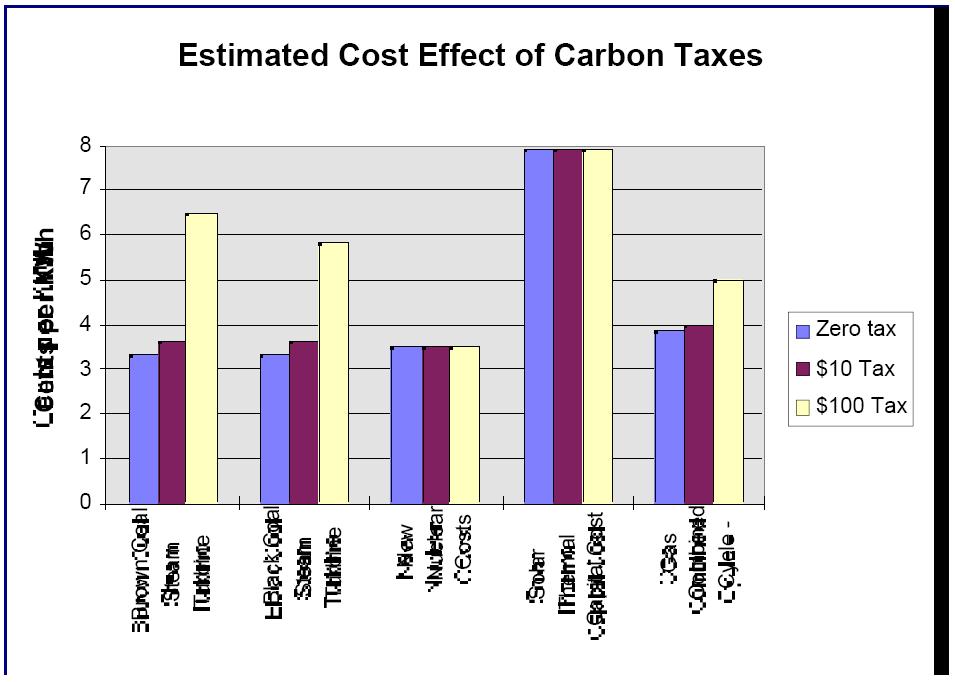
Estimating the effects of tax changes on price and then output is difficult enough one year hence and it is well nigh impossible a dozen years into the future.  But to reduce greenhouse emissions would require some sort of tax or assignment of tradeable rights.  The effects of these on prices are best modelled in the form of a tax and the table below indicates the effects of a tax at $10 and $100 per tonne of carbon on sources of power for electricity.  Broadly speaking, the more carbon per unit of energy a fuel source contains the higher the tax and price.  Based on present estimates of costs of different fuel sources, even a $10 carbon tax tilts the competitive advantage away from brown coal.  A $100 tax makes gas a cheaper option than black or brown coal providing the increased demand does not result in a scarcity driven price increase for gas.  For renewables to be competitive, a carbon tax of at least $215 would be required.  This would apply to a solar based system and even with such a tax advantage, the value of the renewable energy is likely to be discounted because of its dependence on weather conditions.

In the case of most naturally occurring materials and capital goods, a change in demand allows them to be shifted to other uses.  However, this is not the case with brown coal.  When brown coal is priced out of energy competitiveness, it cannot be diverted to other uses.  Nor is there scope to concentrate only on the lowest cost brown coal mines.  All areas are mined and supplied to generators at comparable cost.  Beyond a point, imposing a cost penalty on brown coal supplied stations means they cease to be viable and the power source becomes redefined as dirt.  There is therefore a wealth effect with brown coal.

It will doubtless be said that the knock on effect to electricity users of a tax even if it were $100 per tonne would be minor.  After all, some will say, a 3 cents increase in price would translate into less than a 25% increase in fuel bills once transmission and distribution costs are included.  And a tax increase on electricity is more neutral than some of the other taxes it could replace.

Such views miss the point.  We have a comparative advantage in low power costs just as California has a comparative advantage in the IT industries.  We have just emerged from a period when State ownership of electricity had allowed the assets to fall way behind those overseas in terms of their productivity.  Australia's future development is critically dependent on low cost power.  Power intensive industries focus heavily on the price of electricity in their location decisions.

Victoria is especially vulnerable to measures that force reduced greenhouse gas emissions.  Brown coal, on which the State's low cost electricity is based, emits more carbon dioxide per unit of energy than other fuel sources.

Tough greenhouse emission targets would have been the death knell of Latrobe Valley.  We would have been forced to write off both the Valley's national asset of limitless (proven reserves amount to over 1,000 years of current usage) supply of coal, and the power stations themselves.  Recent privatisations place a worth of over $11 billion on Victoria's five coal-fuelled power stations.  Funds would have had to be found to replace these assets.  And even then, households and industry would have faced skyrocketing electricity bills.  Many industries would simply re-locate, further adding to costs and reducing jobs in the State.

A tight target would also mean the eventual closure of coal-based power stations in other States.  This would mean increased quantities of Australian black coal would be diverted to exports and burned in those developing countries that were sensible enough to reject a target.  The net effect on greenhouse would have been trivial.

The Australian Government's costs from reduced emissions would have been far greater than those of other nations and those costs would have been borne most harshly in Victoria.  Australia's negotiators deserve credit for refusing to blink in the light of the chorus from other developed countries and the publicity-seeking antics of some non-government organisations.


CONCLUDING COMMENTS

The Kyoto conference allowed world leaders to introduce feel-good measures and pontificate about saving the environment.  This has a positive side to it.  Cooperation rather than conflict is in stark contrast to the era of international relations which characterised the last century.

But nations have made unwise agreements in the past.  The developing country exemption means that any restraints agreed to by the industrial world will be negated -- perhaps more than offset if less efficient energy industries replace existing ones.  There are considerable uncertainties about global warming and low penalties that would follow from deferring action.  Given these factors and the certain costs of forcing emission restrictions, it is to be hoped that the feelgood measures are not translated into regulations with a price bite that would bring serious dislocation to energy intensive economies like Australia.

These comments are against the backdrop that:

  • Global warming remains a theory and the most accurate measure we have to validate it, satellite measurements have shown no temperature increase since measurements began in 1979.
  • The sort of warming that is predicted by global climate models, 0.5-3.3 degrees Centigrade, is well within the range that has been common throughout human history without causing distress
  • The steps painstakingly agreed to at international conventions have yet to be implemented.  And even if they are fully implemented they will have only a trivial on the build up of greenhouse gases and a possible consequent warming effect.


ENDNOTES

1.  Under the Kyoto Agreement, countries other than the developed nations are not obliged to reduce their emission levels.  Moreover the former Soviet Bloc used energy very inefficiently and easily able to achieve higher living standards while scrapping much of its previous coal based plant.  Within the EU, some nations also are able readily able to meet greenhouse gas emission targets due to Germany's absorption of East Germany and the UK's switch from coal to lower carbon dioxide emitting gas

2.  The Energy Information Administration, US Department of Energy, Washington, December 2000.

3.  The Prime Minister's Safeguarding the Future Statement, 20 November 1997

4.  Others put the relative costs higher, see "Extracting one kilowatt/hour of energy from the wind costs four times as much as using fossil fuels", Germany:  Tilting At Windmills, Hartmut Wewetzer, UNESCO Courier, March 2000

Submission to IPART's Review of Regulated Retail Tariffs

Submission

INTRODUCTION

We are pleased to offer its advice to IPART in this submission.

For over six years, we have been an advocate of reduced government intervention in markets.  Competitive markets with secure and privately owned property rights have proven to be the only guarantors of low prices and entrepreneurial advance across the spectrum of industries in Australia and worldwide.

NSW has a retail and generation market that is potentially rivalrous.  Political impediments have unfortunately prevented the NSW Government from adding private ownership to this market framework.  We believe this has detracted from the commerciality of the NSW industry and is having a progressively debilitating effect on the various businesses in terms of their corporate development.  Moreover, in spite of the best intentions of the government, its ownership of the industry inevitably leads it to intervene in commercial decisions in ways that will eventually prove harmful.

In this respect, public ownership of the industry has offered increased opportunity for the government to introduce the Electricity Tariff Equalisation Fund (ETEF).  This dominates the market structure in NSW.  It sets a government determined price for small customer's energy (about half the market), with the generators and retailers compensating each other when the wholesale price deviates from that specified level.

A review of the ETEF arrangements goes beyond the terms of reference of the Review of Regulated Retail Tariffs that the Minister for Energy has sought from IPART.  Nonetheless, these wider issues are germane to two matters on which the Minister has sought advice, namely "an appropriate retail margin" and his requirement that the Tribunal take account of "arrangements for the recovery of all reasonable full retail competition costs".


THE ROLE OF THE RETAILER

While we have no special expertise on the precise level of prices that would prevail in a truly competitive market in NSW, we have firm views on the role of the retailer in competitive markets.  In many markets the retailer enjoys the most slender of margins -- in grocery supermarkets a profit margin of perhaps only 1-2 percent -- but even so the retailer is a crucial link between the manufacturer or primary producer and the customer.  The retailer, in competitive markets, is the agent of the customer, not out of any benign camaraderie but because the alternative is that customers are lost and bankruptcy looms.  To ensure its continued profitable existence the retailer must be constantly on the look-out for different consumer requirements and must ensure its own service costs are constantly pared back.

This process of competition is now generally accepted as offering the best means of setting the price and quality mix that gives consumers the best value.  It operates in both the static sense of bringing about the lowest cost outcomes for a given set of demand and supply configurations, and in the dynamic sense of encouraging a ceaseless search for improving upon this in the light of shifting demands and input costs.

All regulatory bodies claim that they are seeking to replicate this competitive outcome in the context of a market in which there are some natural monopoly elements that require synthetic costs to be developed.  No reputable authority would nowadays claim, outside of specific circumstances, that regulatory overrides offer superior outcomes to those of a free and competitive market.  Regulators simply do not have the capability to assemble and process the information that profit-driven suppliers routinely undertake.

A regulatory role is reserved for where there is natural monopoly or important unpriced spill-overs from an activity (neither of which occur with electricity retailing) or under certain limited circumstances where the market might provide inadequate information for customers to take informed choices.  Normally the favoured regulatory response in such circumstances is to insist upon providers supplying more information than they would otherwise provide or for the authorities themselves to supplement the market provision of information.


RETAIL REGULATION

Ostensibly because of informational issues, most jurisdictions on moving to a disaggregated electricity system have also introduced a phasing system with vesting contracts at a specified price.  The current NSW arrangements have also been undertaken to allow a smooth transition to genuine markets.  IPART recognises that it would be poor public policy to use such a mechanism to depress the price below that which would prevail under competitive conditions.

But contracts specified by the government are clearly an anathema to a market where the parties seek out their own deals and in doing so bring about the optimal level of demand and supply.  With the price fixed for half of the NSW market, the signals that allow this to take place are severely muted.  There is no "appropriate" retail margin because the risks have been taken out of the business and assumed by the taxpayer.  Similarly, if the government sets the price and requires the participants to buy and sell at that price, this brings no incentive to the retailer to seek out new needs nor for the generator to set up new capacity, especially new capacity that will operate only occasionally and therefore requires a high price.  Taken over the longer term these features are likely to mean an industry that does not correspond to market needs and is vulnerable to supply failure.

Hence, ETEF and its associated retail regulation is likely to have a most damaging effect on the long-term health of the NSW industry and deny the NSW consumer benefits in terms of sustainable lower prices.  While there is considerable merit in short term measures phasing in of competitive conditions that allow markets to adjust to changes in arrangements that have prevailed for many decades, those measures must be swiftly phased out.  Maintaining this regulatory environment over a period of several years will prevent the supply side developments that provide the only guarantee of an industry constantly seeking out changed consumer needs and finding ways to respond to them.

In short, the regulatory narcotic will need to be administered in constant, and perhaps increasing, doses to maintain the patient's basic functionality unless measures are taken to ween it off the drug.


RETAIL OPERATING MARGINS

The price setting for retail margins has proven to be highly controversial.  The Victorian Government's decision on standing prices for below 160 MWh customers has produced levels of competitive activity below that expected in a full retail competition environment.  Only about 4,000 households have switched retailer and the marketing activity of host retailers has been subdued, while the decision prompted the owner of one retailer to announce that it is seeking a buyer.

Table 1 summarizes some recent data on retail margins.  IPART will need to judge how meaningful such comparisons are.

Table 1

Average
($/Customer)
Range
($/customer)
Europe (DataMonitor)7350-95
Australia (IPART, ACTEW, Aurora)7540-116
United Kingdom (OFGEM)108100-117
Victoria (ORG)6550-80

Sources:  Origin EnergyORG

One indication of the openness of a market that has price restrictions in place is to examine customer churn rates.  Low rates of churn are indicative of low incentives for competitors to seek customers and this in turn indicates that prices are being held too low.  The result is the market is failing to achieve the level of competition required to create the optimal price/quality mix for customers.

In this respect, after nearly three months, the number of household customers that have shifted from their host retailer in NSW amounts to only a few hundred.  The UK now has a level of churn for both gas and electricity of about 38 per cent, a level that has prompted the regulator to lift all price restraints.  To get to the UK benchmark of 38% of the market switching after 3 years would need upwards of a million customers in NSW to switch.


IMPACT OF GOVERNMENT INTERVENTION ON INDUSTRY LIQUIDITY

Liquidity in the market is important both in allowing businesses to cover immediate shortfalls or shortages of energy and to allow retailers to offer longer term contracts to generators, especially those seeking such security to finance new plants.

The recent Issues Paper of the Energy Market Review recognised that the availability of such liquidity with "Innovative and sophisticated financial markets (is) crucial to the development of energy markets as they enhance market participants' capacity to manage the new commercial risks associated with these markets, particularly exposure to volatile wholesale electricity markets." (p.8)

One feature of government controls, and a manifestation of their effect in preventing competition is the dampening effect this has on the development of alternative financial instruments.  Such instruments like swaps, caps and a whole host of exotic names develop in response to the need to defray risk.  That said, these derivatives are no different from the now ancient notion of futures to which Shakespeare gave such a bad name in The Merchant of Venice.

Bad name or not, it is to the mutual advantage of buyers and sellers to obtain greater certainty of expenditures and revenues.  This allows them to plan ahead without the innovatory-sapping and potentially financially devastating effect of government control.

There have been claims that the Victorian market has been short on liquidity.  The force of such claims was particularly strong in the period leading up to what was expected to be a tight supply/demand situation during this year's summer months.  Lack of liquidity is more likely to occur where there are only few suppliers or customers.  The relatively isolated markets in Australia will always run such risks.

Whatever the merits of the claims for Victoria -- and any retailer that was under-contracted has in the event been fortunate -- there is a very rapid growth in derivative or futures contracts.  AFMA data is the best we have available on contract transactions.  AFMA's Over-The-Counter data indicates a very strong growth in liquidity -- over 50% last year for the market as a whole.  Chart 1 illustrates this.

Chart 1

A notable feature of Chart 1 is that in relation to the energy market, the turnover of contracts in NSW declined last year while that of Victoria increased fivefold.  Whilst the Victorian market is far from mature in terms of trading activity (typically commodity markets have a physical delivery to trade turnover ratio of 1:6) there is far greater trading than in NSW.  Victorian retailers and generators were seeking out ways of defraying their risks but in NSW there was far less need to do so because the Government has mandated a form of insurance through ETEF.

Particularly strong growth was recorded in swaptions, an instrument that gives retailers the ability to pursue business opportunities without being locked into energy.  In contract numbers, swaptions in Victoria increased fourfold while in NSW they decreased.  This is a most significant feature since an instrument like this gives marketers an opportunity, at low cost, to seek new custom secure in the knowledge that they have contract coverage in the event that they are successful.  Chart 2 shows the changing demand of different derivatives.

Chart 2

The compulsory insurance scheme ETEF is clearly the main reason for the difference between NSW and Victoria.  In NSW this is stunting the growth in the market and denying consumers the best deals.


USE OF MARGINAL COSTS IN SETTING WHOLESALE PRICES

The ETEF defines long run marginal costs to incorporate a "reasonable" profit.  Even so, the true price that a new generator would enter the market must cover all, not just the marginal costs.  And it is that price of new generation that dictates the long run price of generation.

The following analysis of the use of marginal cost is taken from Brennan. (1)

The "marginal" generator has to expect that prices will, on average, cover not just its variable costs but its fixed capital costs as well.  This can lead in simple cases to prices substantially above average variable costs in peak periods.
To get a feel for the flaw in the marginal costs test, let us turn first to a more familiar industry—resort hotels.  Imagine that in a seaside town, one can build hotels.  The optimal size for a hotel is 100 rooms.  Once built, it costs $50/day to maintain a room, including cleaning, electricity, water, and predictable wear-and-tear from usage.  The fixed annual capital costs for the hotel are $1,095,000 per year ($30/day/room, for 365 days and 100 rooms).  There is no relevant restriction on entry, i.e., if one thinks that one can profitably operate a 100-room hotel in this town, one can build it.  Firms are assumed to be acting competitively, i.e., take the going room rate as given in making decisions whether to build a new hotel.
Suppose first that demand to use this resort is roughly the same all year round.  In that case, hotels will enter up to the point where the price of a room is $80/day.  $50 of that $80 covers the cost of maintaining a room—the average variable cost.  $30 of that $80 goes to cover the capital cost of the hotel.  At prices above $80, more hotels would be built.  If price were forecast to be below $80, say $50, no one would enter.  The marginal costs test would fail to predict competitive prices in the market.
Next, imagine that demand for hotel rooms at this resort town is seasonal.  For three months out of the year, people really want to come to the beach.  The rest of the time, demand for rooms is weak.  In such a situation, a decision to build a new hotel will be predicated on filling it up during the summer season.  Accordingly, the price of hotels in the summer will be $170/day.  $50 of this rate is the average variable cost, and $120 is needed to cover the cost of the hotel entirely from summer occupancy.  However, because every hotel gets to charge this rate during the summer, not only those hotels built to serve summer clients, they all will capture their capital costs at that time.  The price of a room off-season would then be only $50.  The marginal costs standard would predict off-peak rates, but would fail on-peak rates.  Holding hotels to a marginal costs standard would mean that not only that none would be built to serve summer visitors to the resort.  It would also imply that year-round hotels would be unable to recover their capital costs as well.
Back to electricity
The fundamental peak-load pricing principles that hold for hotels regarding peak-load pricing hold for electricity as well.  First imagine that there is only one kind of electricity generator with 100 megawatts of capacity, with average variable costs of (say) $30 per megawatt-hour (MWh).  Suppose also that of the 8760 hours in a year, demand is at peak for 450 hours, about 2% of the time.  Finally, suppose that the fixed annualized costs of building and maintaining the generator is $7.65 million, a figure chosen to come out to $170 per MW per peak hour.  (This is also about 30% of the total variable cost of running a plant full out.) For simplicity, again, assume that at off-peak times capacity exceeds the amount of electricity demanded at $30/MWh.  By analogy with the hotel example, the price of electricity would be $30/MWh off peak and $200/MWh ($30 + $170) on-peak.

To these sorts of issues can be added a range of others.  Thus Littlechild (2) cites Joskow and Kahn as saying that market power may be inferred where the short run marginal cost of supplying electricity from the last unit that clears the market in each half hour is frequently below the clearing price.  In doing so, however, he points out that such analytical frameworks are based on perfect knowledge, markets in equilibrium, and a structure where the suppliers have made the optimal decisions about scale, technology, etc.

He adds that in the real world of plant breakdowns, water shortages, changes in demand,

"It would be commercial suicide for a generator to assume that the market will always be in equilibrium and that it should price at marginal cost.  The world is too risky for that.  Investment in new plant is very expensive and typically takes a long time to recover.  This is not to argue that the generation market is different from other markets ... in the real world, competitive markets generally are not characterised by price equal to marginal cost.  That is the wrong benchmark for judging possibly anti-competitive behaviour.  Life is more complex and in particular more risky than the marginal cost criterion recognises.  In a competitive market each participant will seek to reduce its risks and cover its investment whenever and wherever it can.  It cannot price at any time on the basis that each of its assets will earn an equilibrium return for the rest of its life." (p. 10)

These risk-associated features require a premium and are unlikely to be factored-into the price level set for the regulated customer classes under ETEF.  Accordingly, that price level is likely to be lower than the true competitive rate.  Of course, there would be an additional (sovereign risk) premium required to the degree that suppliers expect price capping to reduce future price levels.


OUTCOMES WHERE PRICES ARE SET TOO LOW

In setting wholesale price levels below true competitive levels for half of the market demand, the regulations would be seriously distorting the messages that the market might give regarding new capacity.  Prices held artificially low are unsustainable and will lead to market distress.  They are likely, for example, to provide inadequate signals for new capacity to be brought into the market.

Compared to setting the price too low, the dangers of setting excessive prices are considerably less.  This is not the least because excessive prices bring their own remedy -- competitors find ways of winning the ostensibly captive markets.  The recent Productivity Commission draft report on Part IIIA of the Trade Practices Act drew attention to this asymmetry in the context of "essential services" and advocated erring on the side of allowing a higher price rather than risking an excessively low price.

These approaches are even more appropriate in retailing which does not have the long lived capital assets of network services and consequent ability temporarily to serve customers at marginal cost.

Indeed, as soon as full retail competition is in place, it is difficult to see any scope for price setting.  Any price that is set above market levels will mean customers will be won away from the incumbent supplier by a rival seeking to take advantage of a profitable opportunity.  In fact, an existing retailer may be vulnerable to a rival who is able to better its price because the target customers are complementary to others that it presently serves.  This might allow a rival to make price offers below the cost of the incumbent even if the latter is technically efficient.


CONCLUDING COMMENTS

Synthetic price setting is always difficult and should be terminated as soon as possible.  Even the most well informed and skilled regulatory authority cannot assemble and analyse all the information that are routinely used by markets.  We need commercial forces to determine prices and undertake the discovery process whereby new products and services are designed and capacity is tailored to market needs.

This submission points to a number of matters which lead us to the view that regulated prices are set too low in NSW.  The evidence for this is:

  • retail operating margins seem to be set somewhat lower than those set in the UK, the one market where regulation has proven to be a successful bridge to full competition;  they are also comparable to those of Victoria where evidence to date has shown little competitive activity in the regulated customer classes;
  • the notion of cost pass through for generation is likely to understate the true costs of generation;  perhaps some assessment of what these might be could be undertaken by examining contract market prices in NSW and other states
  • the fact that NSW has seen even less retail churning than Victoria is strong prima facie evidence that there is insufficient "headroom" for rival retailers to make profitable offers in the regulated customer class.

Finally, we would reitterate that with markets like electricity retailing where there are no entry barriers, the authorities should err on the side of setting price ceilings too high rather than too low, since competition provides an antidote for the former but not the latter.


ENDNOTES

1.  Timothy J. Brennan, Checking for Market Power in Electricity:  The Perils of Price-Cost Margins, (forthcoming).

2.  Stephen Littlechild Electricity:  Regulatory Developments Around the World , The Beesley Lectures on Regulation Series XI, IEA/LBS, London 9 October 2001 (Revised version 12 November 2001)

The Ultimate Insider

Bias:  A CBS Insider Exposes How the Media Distort the News
by Bernard Goldberg
New York, Regency, 2002, 232 pages

Bias was released in the United States amid considerable controversy and fan-fare.  After years of railing against what US conservatives saw as the media's liberal bias, one of America's liberal media Ć©lite finally confirmed most of their charges.

Reading Goldberg's book it is easy to see why it has made such an impact.  Goldberg is not a Rush Limbaugh.  All too often, even the best critiques of the media on the question of bias have been easily dismissed by the media simply by pointing to the background or ideology of the author.  Another common tactic has been simply to say that it is in the eye of the beholder.

Bias makes this task far more difficult because Bernard Goldberg is one of them.  Not only that, but as the winner of seven Emmy Awards and a journalist with almost 30 years' experience as a reporter and producer for CBS News, Goldbderg is the ultimate insider.

He is at pains to point out that his book is not an attack on liberal values, many of which Goldberg personally espouses;  rather, it is an attack on liberal bias which he sees as endemic within the news media.

Goldberg takes aim at what he sees as the corruption of straight news reporting on television by an arrogant, insular media Ć©lite which shares similar liberal values, with little time or inclination for introspection and certainly no time for criticism.  It is a portrait of a medium that proclaims its love of diversity (whether it is on the basis of race, religion, gender or sexual orientation), but not diversity of opinion.  There are times when Australian readers might imagine that they are reading about parts of our media.

As an insider, his revelations are not as easy for America's media Ć©lite to dismiss;  although the American media did make a reasonable attempt at it.

Goldberg is simple and fairly old-fashioned in his belief that journalism should be about balance and presenting all the facts, not just the ones that you think will help your argument, or those which you think the public is too unsophisticated to digest or about which it may become confused.

Bias became a book after Goldberg wrote an op-ed piece in the Wall Street Journal in 1996, methodically dissecting a piece on a so-called CBS News Reality Check on Republican presidential candidate Steve Forbes' flat tax proposal.  Frustrated by years of having his misgivings ignored by colleagues, he went public.  It was a devastating critique, both for CBS and for Goldberg personally.

An intriguing and disturbing part of the book is Goldberg's account of how his colleagues reacted to his voicing his concerns over bias publicly.  His treatment by his colleagues, many of whom had known him for almost 30 years, is fascinating given his supposed transgression -- speaking out.  It would appear that the media love whistle-blowers, except when the whistle being blown is on their own profession.

Goldberg's treatment for blowing the whistle at CBS is all the more fascinating when one realizes that it was CBS which introduced the concept of the corporate "whistleblower".

Given that the media are often the most vocal defenders of free speech, the attempts by his networks and colleagues to muzzle him reeks of grotesque hypocrisy.

Bias maybe written for an American audience, but many of Goldberg's criticisms and observations are eerily prescient concerning the Australian media.  When he writes that "big-time TV journalism' has become ‘a showcase for smart-ass reporters with attitudes, reporters who don't even pretend to hide their disdain for certain people and certain ideas that they and their sophisticated friends don't particularly like" (page 15), Goldberg could quite easily be writing about sections of the media in Australia.

Bias is an enjoyable and engaging book, often extremely amusing.  His personal portraits of senior American journalists will amuse anyone familiar with their names.  But it is also a searing indictment of the profession of journalism at times, which leaves one profoundly depressed.

Still, the fact that we have Goldberg's book should be seen as a source of hope.  We can only hope that an insider of similar credentials at the ABC has a similar outbreak of conscience and pens an Australian equivalent.

If you're interested in the media, Bias is one book that it is worthy of your attention.

Can development be environmentally sustainable?

Sustainable development as a term came into its own with the 1987 publication of the Brundtland Report.  Brundtland herself was a Norwegian Socialist, and the report itself showed that influence.  For example, reminiscent of earlier, flawed analysis by the Club of Rome, the report looked to replace existing energy usage with "green power", claiming that energy was being used in an unsustainable way.


DEVELOPMENT AND RESOURCE DEPLETION

The Club of Rome projected forward usage rates of different minerals and combined these projections with existing proven reserves.  The result was an apparent unsustainable level of usage and a looming depletion of a great many of the world's resources.  We were, for example to run out of oil in 1992, of lead in 1993 and of aluminium (based on one of the world's most abundant raw materials) by 2003.

Absurd though these predictions turned out to be, they created a whole environmental industry that continues to prophesy "The End of the World is Nigh" but just moves the dates forward for each new cohort of wide-eyed gullibles.  Thus, Paul Ehrlich, a high priest in the environmental movement, realizing in the 1980s that oil remained plentiful, put the oil crisis back to the 1990s.  Environmentalists who pay inadequate attention to the interconnectedness of people's wants and their wherewithal to pay for them often make such basic errors.  The fact is that when goods become scarce their price rises and this leads to them being used more sparingly, a search for new sources and a search for substitutes.  This process applies to environmental services just as it does to the resources we use.


SUSTAINABILITY AND OTHER ENVIRONMENTAL SERVICES

While physical limits to the supply of many materials remains, during the 1990s the focus of concern shifted to the alleged conflict between environmental "goods and services" and the private goods and services that make up our conventionally-described living standards.  That focus has a great many dimensions.  These include loss of environmental values due to human pressures on the environment;  among other features, these values are said to include:

depletion of forests and agricultural land;  air pollution;  species loss;  and catastrophic environmental outcomes said to follow from a global warming largely due to burning fossil fuels.  Examination of these dimensions of environmental sustainability demonstrates that the worries are misplaced, or that the only conflict between them and development is a result of poor political institutions.  The latter were most notably evident in the former socialist countries, where considerable environmental damage accompanied such economic development as took place.  Among the Socialist states, urban pollution was the worst in the world, forests had been severely depleted, seas poisoned, and increasing amounts of land were being brought under cultivation without accompanying increases in food output.

Observing such outcomes and contrasting them to those in countries like Australia provide the key to understanding how economic development and an environmentally sustainable outcomes are not only compatible but are mutually reinforcing.


SUSTAINABLE DEVELOPMENT WITH AGRICULTURE AND FORESTRY

Private ownership provides good incentives for conservation and careful usage for many of the reasons that explain why privately owned houses are better cared for than those owned by the government.  Ownership confers a personal benefit, which is optimised by combining usage and conservation.  If someone owns in perpetuity a timbered area of land they will harvest and resuscitate the timber to maximise its value.  If they have no on-going rights they will harvest it as quickly as possible.  Not to do so would mean no gain since others would take the value.

Australian forest areas have tended to increase over the past 100 years.  Until recently this reflected the value of the wood for commercial purposes.  This conservation force is being undermined by the reduced security in such ownership brought about by Regional Forest Agreements (or rather governments' ready willingness to overturn them).  Future conservation will rely increasingly on reserving forests from woodcutting, with the accent on preservation rather than conservation and a likelihood of forest degradation by severe fire.

Private ownership also is responsible for the increase in Australian agricultural productivity.  In the past forty years, Australia's farm production has increased by 130 per cent.  Performance in other countries has been comparable.  Table 1 offers some quantification of this in Australia.

Average % Increase in Annual Volume of Farm Output
1951-1962: 4.0
1962-1972: 3.5
1972-1982: 1.0
1977/8-1998/9: 2.6

Source:  ABARE


SUSTAINABLE DEVELOPMENT AND SPECIES CONSERVATION

In terms of extinctions, since European settlement of Australia some 20 mammals have become extinct and 97 plant species are also known to be extinct.  While any species loss is a matter of regret, two factors need to be considered.  First, the extent of the loss comprises about 7 per cent of the pre-European mammals and a tiny fraction of the 25,000 plant and 40,000-plus other vegetation species identified in Australia.  The mammalian loss was not caused by deliberate extirpation but as a consequence of new species.  The previous isolation of Australia made it inevitable that native species would be vulnerable to competition from new strains.  Other isolated areas like Hawaii and the south west of the US suffered comparable species loss.

Secondly, species loss occurred in the period prior to 1920.  In that period, the premium on species preservation was much weaker than it is today.  If it has not been arrested, species loss has certainly been considerably reduced in recent decades.  This casts doubt on the estimates of future loss ("3329 plant categories threatened" and an estimated "50% of Australia's woodland birds will become extinct") in an ACF/NFF report.


URBAN POLLUTION

Urban pollution has been radically reduced over the past century.  This outcome has been maintained over the more recent decades.  Thus, in Melbourne the EPA reports that nitrogen dioxide levels halved from the early 1980s, carbon monoxide levels fell by one third, and ozone levels by 40 per cent.  Most other cities in the developed world experienced comparable improvements.  These reflect several factors including the general reduction in heavy industry and its associated pollution with higher living standards, and the greater affordability of mandated pollution standards.


GLOBAL WARMING

More intractable than these matters is the possibility of catastrophic global warming as a result of human activity.  The possibility of this is far from proven.  Indeed, the only reliable tracking of world temperatures, the NASA satellite data, show only a trivial temperature trend over the 22 years it has been available.

The greenhouse effect has spawned a considerable regulatory apparatus, globally and nationally.  Yet, hardly any country is reducing the level of its greenhouse (mainly carbon dioxide) emissions along the lines agreed to at Kyoto in 1997 -- and even meeting the Kyoto targets would have a negligible effect on any man-made warming that might be taking place.

In the event that there is a need to reduce emissions of carbon dioxide the outlook is for much higher prices for energy (with attendant losses of real income).  Perhaps these outcomes would be cushioned by vast increases in nuclear power if that proved politically acceptable in those countries like Australia which continue to resist this form of energy.  It is most unlikely that sufficient cost breakthroughs will be available to allow (politically correct) solar-based energy to fill the gap.  In any event, should greenhouse be seen to be likely, a resilient economy provides the best means of coping with the reduced income levels it may require.


CONCLUDING REMARKS

Development has been and can remain sustainable.  The world's environmental resources are vast.  Human impingement upon these resources creates its own antidote where the resources are valued by humans as long as our ownership structures allow ways that valued environmental resources can profitably be traded for other goods and services.


ADVERTISEMENT

Wednesday, February 20, 2002

Recourse and clarity the keys to partnerships

According to The Australian Financial Review, community support for public-private partnerships depends on transparency and accountability.  (Editorial, p54, February 18).  This raises the true challenge for state and federal governments:  to develop appropriate measures against which performance under the contract can be assessed.

Performance measurement is an area in which governments had no experience, and needed none, until relatively recently.  Many of the problems that have arisen where services have been contracted out are because of the inability of governments to adequately manage their contracts.

Take education as an example of what could be achieved under a properly designed contract regime.  For over a century, since the introduction of legislation to enforce compulsory schooling, governments have assumed that to ensure that every child receives an education, government has to provide that education.  But it doesn't have to be that way.  Whether a child attends a government or private school is irrelevant to the state fulfilling its responsibility of compulsory education.

Private companies could receive payments according to specified criteria such as attendance levels, test scores, and employment rates after the students have left school.

The performance of schools does affect student achievement, just like the management of hospitals effects patients.  A broader conception of contracting out government services in addition to improving the quality of service would also force governments, and in turn the community itself, to ask exactly what is expected of government services.

Contrary to what critics claim, this could herald a new era of transparency, because for the first time the public would be told what it could expect from government and from private providers.

If we are to gain the full potential from the emergence of more public/ private partnerships, both governments and the private sector must deal with some threshold issues.

As a matter of principle both parties must accept that unless there are extraordinary circumstances all contracts should be public.

Part of the reluctance of the community to accept public/ private partnerships is due to secrecy provisions in contracts.

Private operators must come to appreciate that at least initially they will be subject to far greater scrutiny than applied to government undertaking the same activity.

Companies in partnership with governments will learn that their obligations will extend not just to the other contract party but also to the clients of the service and the community more generally.

Governments and public servants must also understand that accountability does not end when a signature is placed at the bottom of the page.  Regardless of whether a service is contracted out or not, the community will expect a right to ultimate recourse.  We have already seen this expressed with the resignation of the responsible ministers in various jurisdictions throughout Australia.


ADVERTISEMENT

Sunday, February 17, 2002

Meltdown in the Land of the Rising Sun

The world economy is facing a full blown crisis with its epicentre in Japan.

The world's second largest economy -- and Australia's largest trading partner -- has failed to address is severe structural problems and is now running out of policy options.  What is worse the Koizumi Government is proving bereft of leadership.

The Japanese miracle burst in late 1989.  While the Japanese economy contained many world class manufacturers, its service sector, which makes up over 60 per of the economy, remained highly inefficient and uncompetitive.  The economy was badly bloated and distorted by unsustainable levels of corporate debt.  On top of this, the banking system was opaque, corrupt and incompetent and the political system was incapable of leading changing.

In 1989 when the bubble economy started to haemorrhage, instead of trying to address its root causes -- as the US did for it savings and loan crisis in the mid-1980s -- the Japanese tried to stem the leak with government largess.  The government put in place one massive spending spree after another, to no avail.  The economy limped from one recession to another.  Now there are no more rivers to straighten or bridges to be built and Japan has become the most indebted nation in the developed world.  Goldman Sachs estimates that total household, corporate and government debt in Japan at about $58 trillion or six times Japan GDP.  (US debt levels are about twice GDP).

The government also tried to stimulate the economy via monetary policy, but again to no avail.  The official interest is now virtually zero with no room for further cuts.

The trend on the asset side of the ledger has been if anything been worse.  The Japanese stock market (Nikki 225) has lost 75 per cent of its value over the last dozen years and last week hit a18 year low.  Indeed the Nikki which at its peak in 1989 was 15 times higher than the Dow Jones Industrial Average is now below the Dow Jones for the first time in 45 years.

The reasons for the decline in asset prices are clear.  First they were grossly overvalued in the first place.  Second, investors knew that that many firms and their banks were loaded with dud debt and discounted them accordingly.  Third the Japanese economy became trapped in a deflationary spiral with the wholesale price index declining at an annual rate of 4 per cent.  Deflation not only makes the debt burden greater but puts down ward pressure on profits and asset prices.

The concerns for the world is threefold.  First, it means that the world's second largest economy will remain a drag on the world economy.  Second, Japan could drag the rest of the world into its deflation spiral -- remember deflation was a major cause of the great depression.  This is real risk if Japan tries to solve it problem by devaluing the yen.  Finally despite rapid build-up of debt, Japan remains the world largest creditor and largely responsible for funding the current account deficits of the US and Australia.  If its banks are panicked into calling-in overseas loans -- to for example shore up losses at home -- a economic disaster could well sweep the world.

Even the Australia's teflon economy would not be able to shrug-off a tsunami from Japan.


ADVERTISEMENT

Friday, February 15, 2002

Integration the Only Way to Break the Cycle of Despair

Another day, another story of Aboriginal tragedy in a remote community.  The Australian newspaper's report of publicans selling alcohol to Aborigines, and using their bank access cards to pay, creates the predictable response:  do something!  Right on cue, the Premier of Western Australia leaps into action.  "Find me a power to stop this terrible practice".  The fact is, it is common in non-English speaking Aboriginal communities for Aboriginal people to leave their credit cards and PIN numbers with trusted white people -- shop managers, charter aircraft operators, outstation managers and so on.  Publicans are no different in that regard.

How do we make sense of the fact that many Aborigines, especially in remote communities spend much of their money, which we give them, on grog?

The answer lies in the fact that we have made Aborigines radically dependent on whites, and in such a way that prevents them from living in the modern world.  The missionaries who developed the first outstations wanted to help Aborigines escape the pressures of contact with the outside world, especially alcohol.  The intention was to allow for a degree of self-government, and to provide a buffer as Aboriginal people were drawn inexorably into mainstream life.

The idea was hijacked.  Funding grew and more non-Aboriginal "support" personnel were needed.  Secular white missionaries and new Aboriginal leaders wanted to convert the buffers into permanent monuments to difference.  As outstations have proliferated in the post missionary era, the original rationale has been dramatically altered.  They may now be the most blatant example of spiritual destruction caused by uncontrolled, well-funded, white "benevolence" ever invented.

Remote Aboriginal people have been dragged onto the median strip of change and cannot go back to a traditional lifestyle.  They want to integrate, but they desperately want control.  While this may be naĆÆve on their part, so too are our contradictory beliefs that remote Aboriginal people are authentically and unchangingly indigenous yet are somehow able to deal, without our help, with the unstoppable incoming modernity.  Aborigines need proper protection to buy time and build skills and confidence.

We want Aboriginal people to have equal access to school, but we insist they continue to master their own cultural learning.  Our ignorance of their culture is no disadvantage to us.  Their ignorance of ours is killing them.  We want Aboriginal people to have the freedom to drink despite the genocidal impact of alcohol on remote communities, despite the strong voice of many Aboriginal organisations calling for legislatively imposed control on their own people's drinking.

People who learn to operate in the society into which they are born, do not, by and large, spend most of their money on grog and hand over their bank cards to pay for it.  Despair, ignorance and a radical dependence combine to ensure they do.  But dependence is not abolished by the imposition of a black power structure, at least not one intent on cornering white wealth.  Almost every Aboriginal person is cynical about both the Land Councils and especially about ATSIC.

There have always been two Aboriginal policies, integration and separation.  The first has been practiced in a quiet way in the last thirty years, teaching people the skills they need to compete in the modern world.  The second has been promoted and shouted from the rooftops, "look how we have freed our indigenous people"!  And the more we freed them into the hands of their own politicians and their white agents and programs, the worse it became.

The pretence that a separate Aboriginal society, a collective solution to "the Aboriginal problem" exists, should be exposed.  The real successes in Aboriginal policy are those people of Aboriginal descent who have learned the skills to help them cope with the modern world.  When we are more honest with ourselves, Aboriginal leaders will be forced to be more honest too.  Policy must be explicitly aimed at integration, the long experiment in separatism must end.

The Commonwealth Minister's hands are full at present, but if he or another can give the question their undivided attention, there is a radical task to think outside the orthodoxy of Aboriginal separatist self-determination.


ADVERTISEMENT

Tuesday, February 05, 2002

Entitlements, by any Other Name, are Forced Loans

The core problem with worker entitlements is the very use of the term entitlements which confuses the focus of the debate and policy options.  Worker entitlements are in fact forced loans from employees to their employers.  A person on a wage of say $500 a week has about $90 a week or 18% of their wage not paid to them.  Every week $90 is held by the employer, accumulates and is returned to the employee when they take holidays or leave.  In a year a minimum paid worker loans their employer over $4,000 on which no interest is paid.

Seen within this reality of forced loans the problems and solutions become clearer.  Where employees are forced to maker a loan they should have an automatic right to security from the employer and whoever enforces the loan.

The problem afflicts the 5.2 million permanent employees in Australia but could spread to the entire workforce if protections are not considered.  The 1.5 million casuals employed and the 1.6 million independent contractors engaged do not suffer from forced loans.  They receive their full payment regularly with nothing withheld.  However campaigns to stop casualisation and independent contracting will remove the security of payment enjoyed by these Australians.

Three groups force the loans and permanent employees are powerless as are many employers to prevent the enforcement.

The first enforcer is government through the instrument of industrial relations acts.  Under awards and other industrial instruments the Industrial Relations Commission is required to force employers to withhold money from permanent employees.  The reasons are historical but the idea is illogical!  If the law mandates worker loans to employers, on principles of equity taxpayers must secure forced loans in the event of employer insolvency.  This has been achieved under the Federal Governments employee entitlements and redundancy scheme (GEERS) but which has been limited to amounts that must be withheld under minimum award requirements.  Quite reasonably where an employer, for example Ansett agreed to redundancy amounts above the award minimums the Federal Government has refused to use the taxpayer as guarantor.

The second enforcer is usually assumed to be businesses that want worker loans, both to gain access to free credit but also as a management tool.  The need to withhold money for holidays and leave has traditionally been an employer control mechanism to ensure employees work at the employers managerial convenience.  But tradition has given way to more sophisticated management demonstrated by the use of casuals and independent contractors.  Where employers choose or are required to withhold workers money they should be required to provide security.  The current debate is excessively focused on this single issue of trust accounts and other possible financial security mechanisms.  The problem with Manusafe type ideas, is suspicion that they would be rorted like some superannuation and long service leave funds as career and income sources for special interest groups.

The final enforcer of employee loans to employers are unions.  Some influential unions believe membership can only be secured through permanent employment.  The moral posturing and campaigning against casualisation and independent contracting smokescreens union motivation for its own business survival.  But this union campaigning puts workers money at risk when enforced loans come with permanency.

To be fair many unions guard employee security interest by accepting and accommodating casualisation.  The retail sector is an example.

If, for example as is often alleged, unions coercively "negotiated" redundancy entitlements at the defunct Ansett way beyond the capacity of the company to pay, those unions should at least admit some responsibility to secure workers lost money.  This idea may appear politically fanciful but the principle is sound!  For future reference, employers faced with coercion from unions should consider placing requests for union supplied, asset security on the negotiation table.

Eventually through the problem needs to be addressed at it root.  It's a human rights issue.  Permanent employees don't have a choice.  They are forced to give employers interest free, unsecured loans.  They should have a right to choose.  Casual employment and independent contracting should be available to them without hindrance.  Even if permanent employment is the choice employees should have the right to decide if and how much money is withheld from them and how and where it is secured.

The political reality however, is that the solution of worker choice is too radically simple to attract universal support either from employers, unions or political parties.  The idea challenges too many entrenched institutional and economic interests.  Instead employees are likely to continue to find their money used as a bargaining tool in complex political and commercial games over which they have no control.  That's the normal fate of employees!


ADVERTISEMENT

Sunday, February 03, 2002

Power to the People

On 13 January of this year, the Victorian Government introduced Full Retail Competition for electricity.  Household customers became free to seek better deals from retailers.  But at the end of last week there were only 3,600 Victorian applications to change retailer (even this was better than in the NSW government owned system where hardly any applications were made).

Why are so few people are seeking better electricity supply deals when electricity retailing has lots of scope for competition?

One reason is that the competitors are less keen to win new business during the summer months when energy costs are high.

But the most important reason is price controls.  Soon after its election, the Bracks Government decided that households' electricity supply was too politically sensitive to be left to the cut and thrust of the market and foreshadowed competition accompanied by price caps.  Such policies were not adopted for business customers groups, which were progressively allowed choice of retailer over the past half a dozen years.  Nor were they needed -- competition ensured that most business customers saw lower prices.

Recent rising energy costs have increased Government fears of a backlash from higher electricity prices to household consumers.  These developments led electricity retailers to seek average price increases of between 15 and 21 per cent.  On the advice of the Essential Services Commission, the Government pared these back to between 2.5 and 15.5 per cent.

Though this price dampening offers a short term benefit to many consumers, price controls risk undermining business economics.  At the extreme, holding customer prices down puts retailers at risk of the Californian nightmare, crushed between the hammer of rising costs and the anvil of fixed prices.

In addition to caps on overall prices, electricity retailers are required to keep price increases for each customer class to less than 3 per cent of the benchmark.  This cements-in distortions, making it easier for new retailers to avoid those customer classes whose tariffs have become highly unprofitable -- for example those with off-peak water heating.  The danger is that the host retailers will gradually be left servicing the highest cost customers.

This distortion will be intensified by the lack of "smart" household meters, which means all household customers are treated as having the same daily electricity use profile.  Such treatment may be unavoidable but encourages firms to cross-subsidise high volume customers, even those with air conditioning units that cut in just when the energy costs are highest.

The Victorian Clayton's form of Full Retail Competition was introduced during the same week as the UK announced a total deregulation of electricity prices.  Previously, the UK had Victorian-style price caps to phase-in full price deregulation.  This worked, because the price caps were introduced when energy costs were falling and therefore did not bite.

Victoria is unlikely to have such luck.

Price caps that hold down average prices and prevent them adjusting to shifting costs sap business innovation, deny customer choice and increase firms' risks of incurring huge losses.  Victoria must therefore avoid further delays to Full Retail Competition and allow competition its rightful role as the price regulator.


ADVERTISEMENT

Thursday, January 31, 2002

Why Champions of Causes Need Close Scrutiny

The Smith Family was caught out recently doing what civil activists do, defining a problem, in this case poverty, in a way that keeps them in the advocacy business.  The Smith Family, along with other non-government organisations represent the charitable, the consumer, the greenie, the humanitarian.  They add to the already crowded field of interest groups, like pensioner, professional, trade and employer unions that seek to influence public policy.

The likes of the Australian Council Of Social Services purport to represent the poor;  the Australian Consumers Association -- consumers;  the Australian Conservation Foundation -- the environment;  the Australian Council for Overseas Aid -- the poor overseas;  Amnesty International -- the world's oppressed, and so on.

These NGOs, among a host of others, consist of private activists organising for public purposes.  They are a sign of a healthy civil society.  After all, there is no reason to leave all the politics to the politicians.  That is, unless NGO interests do not coincide with our own.  In politics, organised lobbies crowd out unorganised lobbies.  A certain amount of displacement occurs when the organised are granted access to government.  This is not necessarily a bad thing -- NGOs, like political parties, help to aggregate and filter opinion, and in doing so, they contribute to the work of politics.

NGOs are clearly free to express their views, but what is the basis for them to speak on behalf of the public, or at least sections of it?  Are there legitimate grounds to test the credentials of those who purport to represent society?

The opinion of an NGO must, of necessity, be weighed against the opinions of other NGOs, and the electorate.  Although each constituent has access to their member of parliament, the weight of an individual opinion is not great, unless their standing is exceptional.  The exception depends on their expertise in the field, or on their direct involvement in an issue or on their ability to represent a class of people.

Governments should not grant NGOs privileges greater than those accorded any citizen.  They should not assist NGOs nor give them access to policy forums, unless they have standing.  One way of managing the relationship with NGOs is to use a protocol, in this case a statement of credentials, which a government can use to establish the standing of an advocacy body.  Those NGOs granted standing should make information available by way of a publicly accessible register.  The key assumption of the protocol strategy is the primacy of democratic government and the public right to know with whom it is dealing.

NGOs frequently serve their interests by claiming a superior mandate to the parliament.  For example, the ACF, "by 2050 Australia will be a civil society.  There will be a high level of community engagement in decision-making processes, ... a higher level of trust ... with their decision-making institutions".  ACF suggests community engagement is to come about through a grant to NGOs of $60 million per year.  It seems that trust comes at a price!  At present, nearly 200 Green NGOs receive tax-assisted donations of more than $25 million per year.  The public knows next to nothing about them.

ACOSS plays the civil society game too, "We want the major political parties to commit to a new deal, a formal Agreement that better defines the Federal Government's relationship with the community sector -- a negotiated relationship which respects our full role, not just in service delivery but in policy development".  The welfare peak lobbies, including ACOSS, receive over $3 million a year to play this game.  Something is known of the peak welfare bodies, but details are not available to the public.

ACA also plays the game.  It wants all electricity consumers to be taxed to fund a consumer voice among the electricity distributors.  This end-user advocacy in the electricity and myriad other markets supposes an election of consumer representatives.  How can this be achieved when the ACA has only 650 members?  In reality, only those activists who run the NGOs are chosen.

Over 15,000 NGOs have Deductible Gift Status with the Tax Office, they may do good work, but the public knows nothing about them.  For example, the CFMEU recently questioned the use to which the Wilderness Society was putting tax-assisted anti-logging funds.

The recent Inquiry into Charities recommended NGOs not be regulated in terms of lobbying, so long as they did not support or oppose a party or candidate.  The Greens, Churches, Human Rights groups and a swag of others have made their views quite clear in the recent election, they all but suggested how to cast a vote.  At the very least, where taxpayers assist these groups, or they have access to government greater than the voter, more should be known about them.  The alternative is to follow the practice in the US and Canada, which deny tax-free status to groups who spend more than 20 and 10 per cent respectively of their income on advocacy.


ADVERTISEMENT