Tuesday, March 20, 2007

Amending TRIPS:  Protecting Property Rights and Public Health

Submission to the DFAT review of the
TRIPS and Public Health Amendment


INTRODUCTION

The Department of Foreign Affairs and Trade is currently seeking input into the “TRIPS and Public Health” Amendment to the Trade Related Aspects of Intellectual Property Rights (TRIPS) Agreement of the World Trade Organisation.  This amendment is currently being considered for adoption by WTO members, including Australia.

It is recognised that the proposed amendments are merely the formalisation of existing waivers to the Agreement on the grounds of public health concerns.  However, this should not ignore the central role that intellectual property rights play in the promotion of solutions to public health concerns.


THE IMPORTANCE OF INTELLECTUAL PROPERTY RIGHTS

Intellectual Property rights should be treated akin to all other property rights;  they should be recognised and enforced.  Any relaxing of property rights law comes to the detriment of all property rights and the lack of security property owners can place in their property.  While these property owners suffer from direct risk to their property, it should not be ignored that society at large also suffers.

The pharmaceutical industry provides a very good demonstration of this.  The pharmaceutical industry relies heavily on an intangible good for its ongoing existence, its intellectual property.  Undermining their intellectual property rights directly undermines the ongoing viability of their business to create life preserving and enhancing medicines.  Their intellectual property provides them with an asset to raise capital from the marketplace to invest into the research and production of goods that promote public health.

While the short term benefits of addressing immediate public health crises can be alleviated by undermining intellectual property, this alleviation is short term gain for long term pain.  It comes at the expense of the long term sustainability of the industry’s development of new medicines for diseases that have not yet been cured or that have not yet impacted on society.


PROTECTING PUBLIC HEALTH AND
INTELLECTUAL PROPERTY RIGHTS

The proposed amendment attempts to balance out the public health challenges that flow from intellectual property protection and the suggested need for parallel imports for patented pharmaceuticals where a country does not have the manufacturing capacity in a public health crisis;  while also recognising the need for protection of intellectual property rights for patent holders.

The proposed amendment reasonably addresses this balance.  In particular the requirements for parallel imports produced under a compulsory license should be branded in a different form than patented medicines to minimise its trade on the black-market.  It is also essential that compensation be paid to the patent holder under a compulsory license regime for the use of their patented material.

It is also too often ignored that many pharmaceutical companies engage in voluntary licensing to assist with public health problems removing the need for compulsory licensing.  This is always preferable to compulsory licensing and the interference of Government in the licensing arrangements of patents.

While these amendments will help to secure the alleviation of public health concerns that arise out of intellectual property rights protection, it should not be used as a method for developing countries to obfuscate their responsibilities.  The pharmaceutical industry has been abused for too long for the public health problems in developing countries.  Any person with a reasonable understanding of public health problems in developing countries is aware that the availability of patented medicines is a minor problem in comparison to other public health challenges;  including the availability of qualified health professionals and facilities, distribution methods for goods, corruption and access to clean drinking water.


THE CAMPAIGN AGAINST PROPERTY RIGHTS

Since the establishment of the WTO and TRIPS there has been an ongoing campaign against pharmaceutical companies to blame them for public health challenges in developing countries.  Concurrently too little attention has been given to these simple problems that would have a much greater impact on improving public health in developing countries.

This campaign has been run by professional anti-property rights, anti-market activists.  They are merely using this campaign as part of an incremental step in a long-term campaign against free markets and intellectual property rights.  This runs contrary to Australia’s national interest and the interest of addressing many of the real public health concerns throughout the developing world.

In addition, there has been a paucity of effort made by developed countries to recognise the important role and success these companies have had in promoting public health.  They have allowed the impression to build in the media and other avenues of public commentary that pharmaceutical company’s are coveting their IP like a spoilt child with a bag of lollies;  rather than recognising the significant role they play in research and development of life saving and preserving medicines.


SUMMARY COMMENTS

Regardless, Australia should accept the proposed amendment to the TRIPS Agreement;  but it should be done in concert with ensuring developed and developing countries address the real challenges facing developing country public health.

Monday, March 19, 2007

Inventing market failure

Governments need problems.  Without them, there would be nothing to solve.  Australia's broadband situation has presented governments across the country with ample opportunity to intervene.  But is Australian broadband caught in a trap of underinvestment and market failure?

The importance of high-speed internet access to a nation's economy is encouraging a great deal of policy experimentation around the world, and Australia's state governments are enthusiastically embracing them.  The Western Australian government pledged $1 billion to invest in a state-wide broadband network, modelled on a similar network in Alberta, Canada.

The New South Wales Government is tendering out a wireless broadband service, which is to echo the trend in the United States and Europe towards municipal WiFi.  Municipal wireless networks tend to haemorrhage money, get bogged down in politics, and in the end deliver far less than they promise, so Sydney consumers should be glad that there are already a number of private wireless operators able to meet their demand.

There is perceived political benefit in attempting to deliver broadband to consumers.  Queensland Premier Peter Beattie announced late last year a plan to pipe fibre directly into Brisbane homes, but private companies would have to pay for it, build it, and operate it.  Beattie's grand broadband initiative consisted of little more than a press release about how good a new network could be.

The federal government, having subsidised rural telecommunications since we first got a federal government, now feels compelled to update those subsidies to include broadband at increasing speeds.

If the prevailing political winds are to be trusted, it seems that governments have concluded that the marketplace cannot provide the level of telecommunications expected by consumers in the 21st century.  But there is little good reason for their pessimism.

In the United States, Verizon is investing US$18 billion in fibre-optic cable straight to the home.  It's an enormously risky investment, and has its fair share of critics who note how uncertain the industry's terrain will be when the rollout is completed in 2010.  But nevertheless, Verizon has laid US$18 billion worth of chips on the table, to the benefit of US consumers.

An investment the size of Verizon's would be almost impossible in Australia.  Australia's forced access policy would place any investment immediately into the hands of the ACCC, which would be likely to require it to give access to its competitors at a price of the regulator's choosing.  The disincentive to invest is obvious.

But the federal government has refused to reform the Trade Practices Act to encourage greater infrastructure investment.  Instead, we are left with a set of telecommunications regulations which are designed to induce competition into a government-owned, 20th century telecommunications monolith, rather than regulations more suited for the 21st century consumer demand and technology.

The access provisions of the Trade Practices Act are far more draconian than in other jurisdictions.  But entrepreneurial firms need to be given the freedom to invest on terms of their own choosing.

Some commentators have argued that the government should do that investment itself, but it would be better if the risk inherent in building a new network is borne by the companies that will profit from it, not Australian taxpayers.  Would the government also commit to building every telecommunications network into the future?  It is unlikely that a fibre optic network will be the last network Australian consumers demand.

Politicians are always eager to assert market failure -- it gives them opportunities to gain publicity, deliver services which might translate into votes, and forge reputations for "getting things done".

But Australian telecommunications is caught in a trap of poor public policy, not market failure.  If the government wants to encourage investment, it should at least try to fix the problem.

Thursday, March 15, 2007

The Values Deficit

Address to the Australian Financial Review Housing Conference
9 March 2007


HOUSE PRICE TRENDS IN AUSTRALIA

The two most salient indicators of the housing market are the comparisons of median prices over time and the comparison of those prices in different Australian cities and in cities worldwide.

Using the HIA standardised price at 2006 prices for new houses and land, we can see the pattern shown in Chart 1.

Chart 1:  Real House and Land PricesSources:  Sydney:  REI of NSW;  Melbourne, Brisbane and Adelaide:  UDIA;  WA:  HIA.
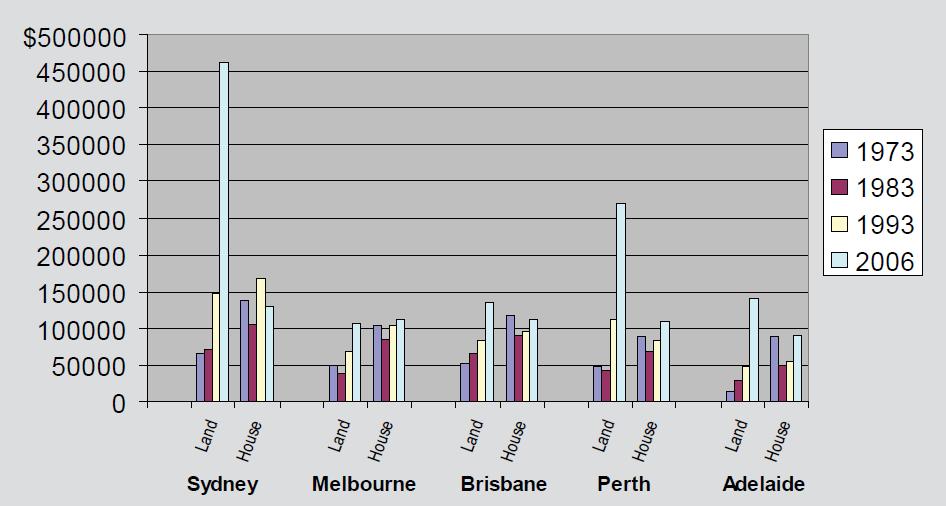

The building component cost of new house prices has changed little in real terms since 1973.

Not so land supply.  Since 1973 the price of the land component has outpaced general inflation by between tenfold (Adelaide, albeit from a low base) and threefold (Melbourne).  Sydney, which has long experienced higher prices than elsewhere in Australia, saw an increase eight times greater than the overall rate of inflation over the period.

There is nothing predestined about these contrasting trends of stable building costs and escalating land prices.

Building costs have remained stable in spite of regulatory impositions, especially those concerning energy where recent 5-Star measures according to the industry increased cost by some $7,000 plus per home.  The increased imposts placed on new housing raises its costs.  As a result the value of existing housing increases.  Such measures are therefore a means by which the incumbent home owners salve their consciousnesses about global warming, shortage of water and so on, at the expense of those without their own homes.

For house building there remains a relative ease of entry into an industry characterised by a highly efficient non-unionised sub-contracting structure.  Both of these features are under some pressure by governments keen on promoting credentialism and disadvantaging the independent contractor over the unionised employee.

The industry itself has absorbed the regulatory cost imposts, though without them we would see modest but welcome reduction in house prices, and has to date successfully resisted continued government attempts to deem the "subbies" as employees and make them eligible for unionisation.


CROSS-COUNTRY COMPARISONS

In the case of land prices, Australian trends are seen in other but not all jurisdictions.  Demographia publishes an annual survey of median house prices against median family incomes.  The 2007 study examines 159 Anglosphere cities, dividing them into "affordable" where prices are under threefold the median family income and highly unaffordable where they are over 6.5 times the median family income.  Forty two of the 159 fall in the affordable category and 25 fall in the highly unaffordable, with the rest in between.

Table 1:  25 Most Unaffordable Housing Markets

#NationMarketMedian Multiple
1United StatesLos Angeles-Orange County, CA11.4
2United StatesSan Diego, CA10.5
3United StatesHonolulu, HI10.3
4United StatesSan Francisco, CA10.1
5United StatesVentura County, CA9.4
6United StatesStockton, CA8.6
7AustraliaSydney8.5
8United StatesSan Jose, CA8.4
9United KingdomLondon (GLA)8.3
10United KingdomBoumemouth-Dorset8.2
11AustraliaPerth8.0
12Unted StatesRiverside-San Bernadino. CA7.9
13CanadaVancouver7.7
14United StatesMiami West Palm Beach, FL7.6
14United StatesModesto, CA7.6
16United KingdomCardiff7.5
17United KindomBristol7.3
18United StatesFresno, CA7.2
18United StatesNew York, NY-NJ,-CT-PA7.2
20AustraliaHobart7.0
21New ZealandAuckland6.9
21United KingdomLondon Exurbs6.9
23AustraliaMelbourne6.6
23United StatesSacramento, CA6.6
23United StatesSarasota, FL6.6
23CanadaVictoria6.6

Sydney, Perth, Hobart and Melbourne fall in the highest cost 25 and Brisbane falls just outside.

It costs over 6.6 median income levels to buy the median house in Australian cities.  The average house requires only 3.2 years of average income in Canada, 3.7 years in the US and 5.5 years in Britain.

The fact is that house prices are highly conditioned by government policies -- if this were not so we would see a more consistent pattern of prices and price changes.  Having established the facts we need to dig beneath them to find out what is driving the price changes.


DEMAND, SUPPLY, COSTS AND PRICES

In its "Inquiry into First Home Ownership 2004", the Productivity Commission understated the importance of supply constraints in pushing up prices.  The report saw accretions to supply as being relatively low and therefore of limited influence in the market as a whole.  In point of fact new house supply can respond quickly to increased demand and does so where land is not rationed.  For example, in Houston, the vast expansion in demand that followed people leaving New Orleans after Hurricane Katrina placed only minor upward movement on house prices.

The PC also placed undue emphasis on the effect of new demand being dominated by people trading up in house value.  This may in part be a consequence of land scarcity causing prices of new houses to be beyond the reach of first home buyers.  More pertinently, it matters little who is buying the new property since if it is people trading up this should release stocks of existing houses and depress their prices.

Glaeser, Gyourko and Saks (2005) analysed housing costs in the context of different variables.  They developed a proxy for regulatory restraints though noting that, "The very richness of the regulatory environment means that there is no one law or regulatory structure that would allow us to identify some metropolitan areas as being more onerously regulated compared with others".  Their analysis indicated that in areas where the regulatory restraints were considerable the effect of a 10 per cent increase in demand led to a $60,000 price increase;  in areas with lower levels of regulatory restraint, the increase was $5,000.

Some have argued that we are now seeing an overheated market that new demand cannot cope with.  This view is difficult to sustain from the data.  Commencements remain below the levels of the early 1990s and are considerably below those of the 1970s.

In NSW current levels at under 30,000 per annum compare with 50,000 in the early 1990s.  Victoria was suffering from the Kirner ALP blues in that period but its present level at 30,000 is fewer than the 36,000 of 2002.  Queensland in the early 90s and again in 2002 was starting 40-50,000, well above last year’s level and South Australia’s 11,000 compares with 14,000 in the early 1980s.  Even Perth is commencing fewer dwellings than in the late 1980s.

Chart 2:  Dwellings Commenced
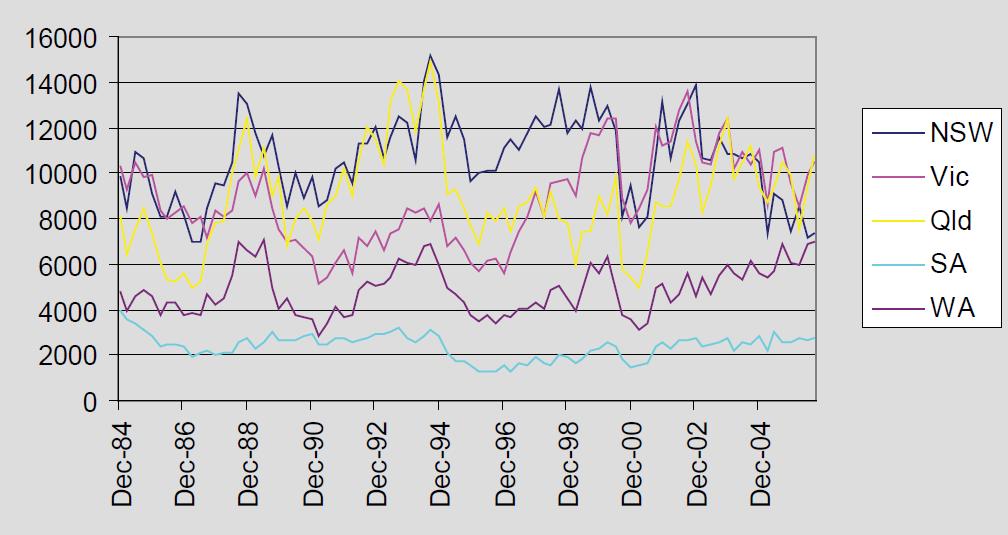

DWELLINGS COMMENCED

Charts 3-7 from the UDIA show how the price of new broadhectare housing blocks has risen over the past decade in the different Australian cities.

Chart 3:  Adelaide Lot Supply v Ave. Price ($)
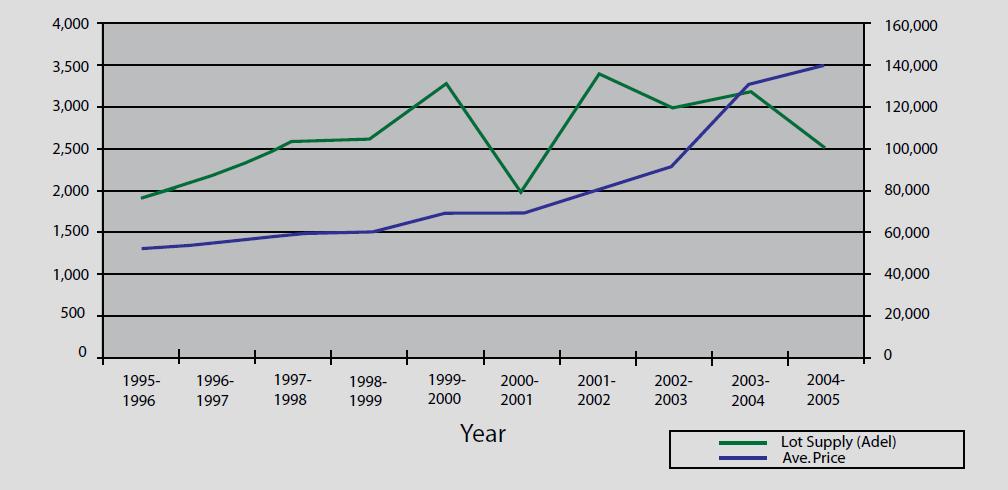
Chart 4:  Brisbane Lot Supply v Median Price ($)
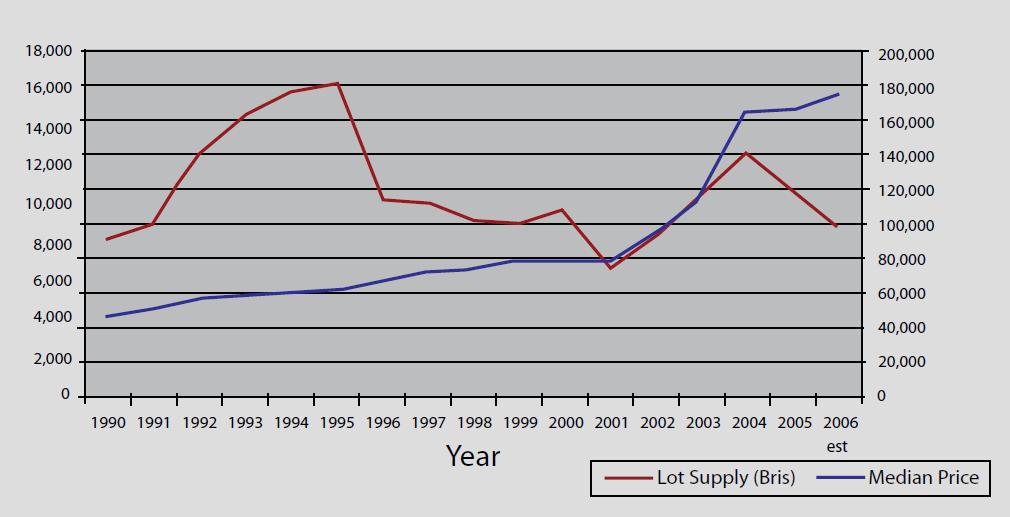
Chart 5:  Melbourne Lot Supply v Ave. Price ($)
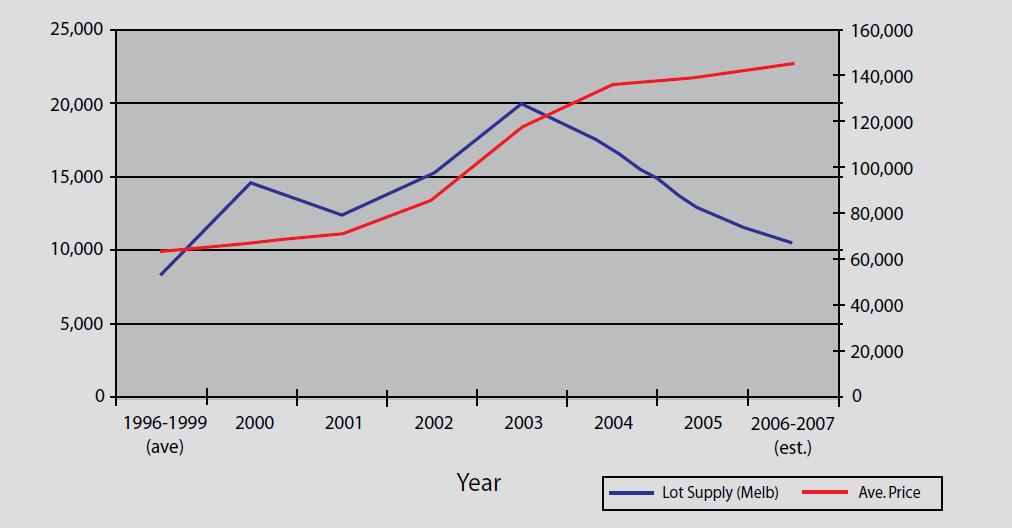
Chart 6:  Perth Lot Supply v Ave. Price ($)
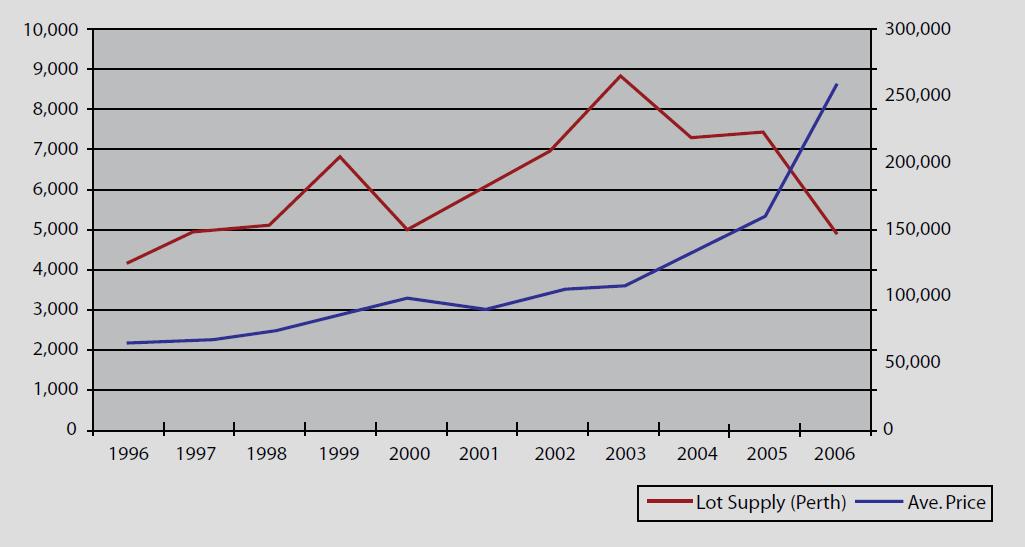
Chart 7:  Sydney Land Supply v Ave. Price ($)
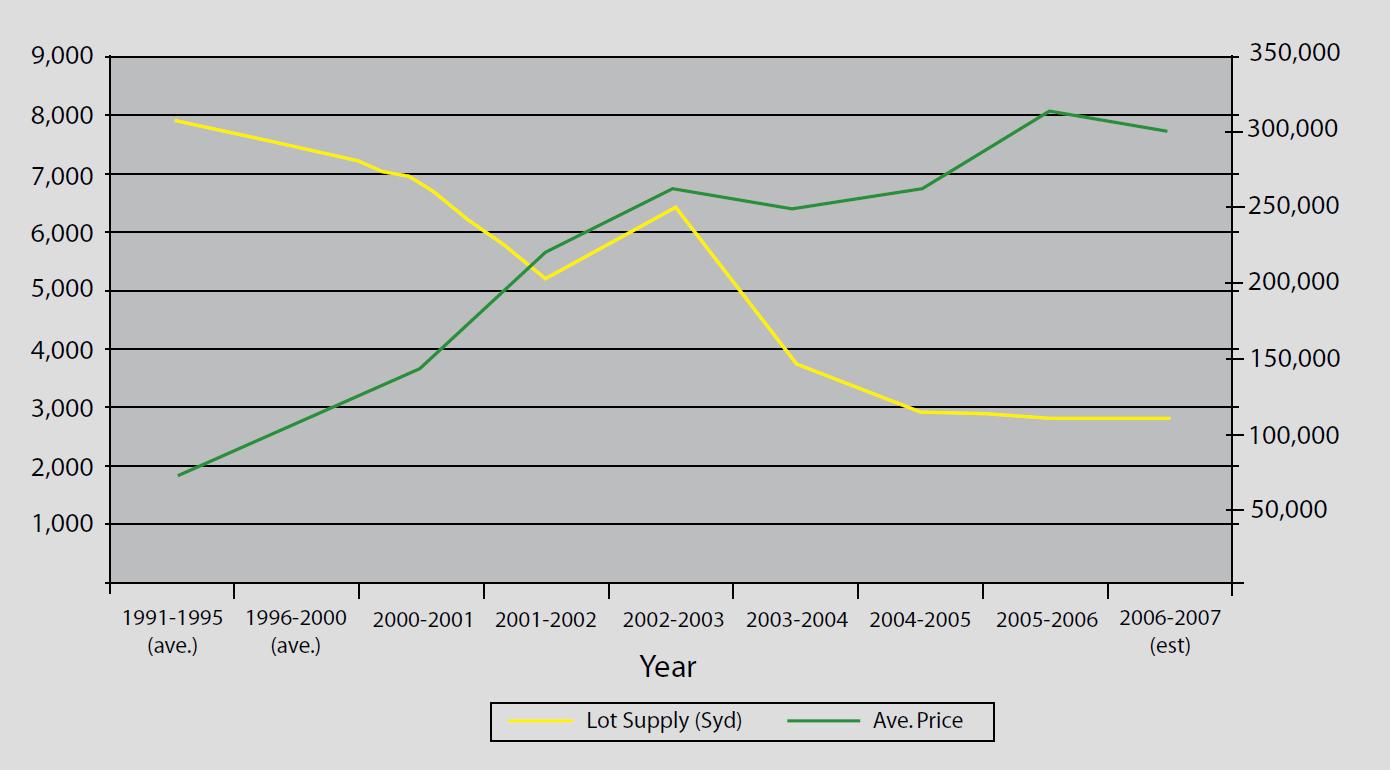
In Adelaide we can see the price rising precipitously especially as the supply headed south in the past year or so.  A similar pattern is observed in Brisbane with prices surging from the year 2000 and lot availability actually falling.  A similar fall in lot supply can be seen in Melbourne.  And in Perth the picture is especially dramatic with lot supply almost halving in the past three years while prices more than doubled.  Finally, Sydney is far and away the worst placed city -- an economy stagnating, house prices high and rising and land releases halving over the past decade.

The cost escalation is all about the land component.  Land prices are high not because it is either expensive or time-costly to prepare land for development.  Land can be brought on-stream in a matter of months once an approval is given.  Preparing a piece of land for a housing development is not an expensive process.

The following shows costs per allotment in a South Australian development some 50 minutes from the Adelaide CBD.  Total costs averaged $36,000 which with selling costs and so on might come to $45,000.

The virgin land in its normal usage as farmland is worth at most some $4000 per hectare and, even with the requirements for set asides, schools and other non-housing usages there are at least ten 600 square metre blocks per hectare.

These sorts of data demonstrate the fallacy in statements that maintain we must have a greater concentration of housing because preparing infrastructure outside of existing areas is exorbitant.  Not only is the preparation of land not vastly expensive but it is by no means certain that urban renewal is cheaper than building on the fringe given the fact that all infrastructure in the end needs to be replaced.  It is actually cheaper in a great many case to start anew rather than tear down and rebuild outdated or decaying infrastructure.

Some state housing and planning ministers claim there is an abundance of land available but that developers are hoarding it.  This is not credible.  There are dozens of developers and it would need collusion on a massive scale if they were purposely seeking to drive up prices.

The fact is that developers are planning their businesses years ahead and need a land inventory.  They also face the problem of slow approval processes including sequential approval processes that can take a decade between land release and the ability to actually build on the land.  Governments should be able to do something about this, much of which is caused by the accumulation of heritage, environment and other laws that they have introduced.  Victoria is piloting an on-line clearance system which should be helpful in speeding up approvals.

In any event, if the problem is a reluctance of developers to prepare and build on land that has been released, that is easily resolved by releasing more land.  There is no land shortage -- even in Sydney with its extensive national parks funnelling growth there is room for a million plus new homes on the Cumberland Plain alone.  Less than 0.3 per cent (less than one per cent in Victoria) is urbanized, far less than the US areas where land releases are keeping pace with demand.  An average sized block on the fringe of any Australian city would cost $50,000 if the government were to release more land for development.  This compares with costs that are at least twice that and in Sydney and Perth several multiples of that.

There are those who argue that it is only demand that is forcing up house prices.

Macquarie Bank’s Rory Robertson is of this view.  Mr Robertson thinks the reason why house price have gone up in some places but not others is because some places are "sexy".  He defines these as those cities he likes:  Australia is rather flattered by this perspective because all our capital cities are sexy.  They are joined by US cities including New York, LA, San Francisco, and Honolulu, as well as British cities like London, Bournemouth (Fawlty Towers territory) and Cardiff (famous only when the Wallabies or All Blacks visit!).  New Zealand, with Auckland also scores a heart as does Vancouver in Canada.

Those cities he evidently considers to be "dull" include bustling Toronto;  Houston the world’s space industry capital;  Cosmopolitan Quebec;  Dallas, one of the premier energy and high-tech centres in the world.  If people in these cities were aware of Hobart and Adelaide they could be forgiven a quiet snigger at having their cities compared unfavourable to those and perhaps other Australian cities.  He also argues, "Important coastal cities are expensive everywhere".  Presumably those that aren’t expensive -- including Halifax, Nova Scotia;  Toronto (on a Great Lake) New Orleans and Melbourne (that’ll be Melbourne, Florida) as well as Houston, are not in Mr Robertson’s view "important".

Like Beauty, sexy and important is in the eye of the beholder.  What really distinguishes cities that have affordable prices from other cities, sadly including all of Australian capitals, is the supply of land on which the authorities allow new houses to be built.  Some cities like Houston, Dallas and Atlanta are kept affordable despite growing faster than any Australian cities.

Another element of demand that is often blamed for high house prices is interest rates.  Interest rates are important for house prices but they will only inflate prices if supply cannot be increased.  Other high value consumer durables like yachts, light planes, and Mercedes cars did not increase in price with lower interest rates.  Just as in cities like Houston, Dallas, Atlanta and a host of others in the US, this was because supply is flexible and not regulated by government

The dominant factor for prices of housing in general is government created scarcity.  Aside from taxes there are three factors in the price of a house:  the cost of preparing the land, which with selling costs should not be more than $50,000 per block;  the cost of building a house and we can open up any national weekend newspaper to find that this is anywhere from $110,000 to over $200,000.  Finally there is the cost of the virgin land.  The dominant use of such land is for farming and hardly any of it would sell for more than $4,000 per hectare.  At 10 houses per hectare the virgin land cost is only $400;  a trivial amount.

The artificially induced price escalation also has an effect in encouraging greater in-fill.  This increased pressure has induced an amplified NIMBY presence and which has to a greater or lesser extent been successful in preventing "inappropriate development".  This has tended to cut off an alternative, if inferior means of augmenting supply by more intensive development in existing urban areas.


TAXATION AND POSITIONAL SCARCITY

It is sometimes difficult to determine whether specific taxes add to prices or are absorbed by the supply chain.

In general taxes that comprise general charges like GST, stamp duty and land tax are in the main a further impost that the consumer pays.  In this respect, the taxes boost the value of existing houses to the degree that the impost on these was originally lower.

Some other taxes probably get absorbed by the suppliers.  This is likely to occur where government restrictions in land availability have created a scarcity and boosted land prices.  In Sydney local and state wide specific infrastructure charges offer no value to the new house owner but are simply a convenient way of clawing back to the government some of the regulatory tax created by their policies in restricting land supply.  Such charges in Sydney amount to $42,000-$83,000 per block.

The discussion of these costs should not overlook that some land and houses that are positioned well are likely to be more costly than others.  And with higher levels of discretionary income, one might hypothesise that the more desirable places will see higher than average price increases.  Even cities with no planning restraints like Houston have their $2 million houses.  Doubtless, whatever is done about the availability of land on the fringe of Sydney would have only a minor effect on property prices in Rose Bay.

Table 2:  Costs per allotment in Adelaide CBD

Nature of costCost per allotment
Civil works construction costs including: 
   Establishment & Disestablishment
   Sedimentation Control Works
   Allotment filling
   Road Formation works
   Roads, pavements & gutters
   Hot-mix seal coat
   Stormwater drainage works
   Sewer reticulation
   Water reticulation
   Common Service Trenching
   ETSA/Telstra conduits materials
   Survey Certificate
   CITB levy
$30,415
Sewer$2,495
Water Supply$500
Survey & Engineering$3,000
Planning, registration, title fees$110
TOTAL$36,520

But this is immaterial to the main problem whereby artificially induced scarcity is boosting prices and resulting in excessive prices which ration supply.  The losers are the first home buyers.  Compared to previous years, the first home buyer on average in Australia faces a median house price at 6.6 times median household income levels.  For decades this ratio was 3:1.  The median household looking to buy their first home is likely to have a combined income under $90,000.  This limits borrowing levels to $270,000, and little more than half of this with only one breadwinner.  Denying young families the opportunity to own their own home constitutes a sever failure of public policy.  This failure is even more acute when the solution to the problem is well-known.

Hot air and hot cars may suit pollies, but do they serve us?

Victorians are proud of Melbourne as the sport and major events capital of the country.  But few bother asking:  is that title worth the money?  This week's formula one Grand Prix will cost the state's taxpayers at least $30 million.  The World Swimming Championships, starting on Saturday, will cost more than $50 million.

To put these amounts into context, State Government spending on these two events alone is equal to every adult Victorian making a compulsory payment of $20 to the organisers.  Some Victorians would gladly hand over $20 for the privilege of Melbourne hosting a car race and a swimming carnival, but most wouldn't.  So why have governments (Labor and Liberal) been allowed to get away with spending hundreds of millions of dollars on such activities?

The lack of public curiosity about the cost of major events seems to encourage ministers to make increasingly extravagant promises to promoters.  Governments have little incentive to seek value for money when they can make secret deals exempt from parliamentary and public scrutiny.  The Grand Prix contract remains a secret, while the cost of security for the swimming championships has not been revealed and probably never will be.

The usual justification is that major events spending provides economic benefits for the state through additional employment, increased tourism and international advertising exposure.  This is true.  However, it ignores one obvious point:  any sort of government spending, whether it is for worthwhile purposes or wasteful purposes, has economic benefits.

If the Government decided to devote an additional $80 million to recruiting extra literacy teachers in primary schools, there would be economic benefits.  Better educated students will be more productive once they are in the workforce.  But if the Government chose to use the money to have the rocks at the bottom of the Yarra painted red, there would also be economic benefits:  paint would be purchased, painters employed and tourists would flock to see a river that was red instead of brown.  Such a stunt would certainly generate worldwide headlines.

The question for Victoria is not whether there are economic benefits from taxpayer-subsidised major events, because obviously there are.  The question is whether there are better alternative uses for the money.

In some circumstances, government financial support for major events may be justified.  But those circumstances are rare.  There shouldn't be a situation, as exists now, where any major event offered to Victoria is greeted with an open chequebook.

When Melbourne won the Grand Prix from Adelaide in 1993, the dilapidated parks and ovals of Albert Park were restored.  Thanks to the Grand Prix, substantially improved sports and recreational facilities are now available to the public.  There are isolated instances of long-term public benefit from spending on major events, but those instances are rare.

Victoria spends four times more on major events than any other state.  But then no other state suffers from the same sort of inferiority complex as does Victoria.  NSW has Australia's international city, and Queensland and Western Australia power the nation's resources boom.  Meanwhile, Victoria prides itself on winning the right to host the World Hot Air Balloon Championships and have formula one racing cars travel at 60 km/h down Lygon Street.

Major events have as much to do with the political benefit for the party in power as they do with any economic benefits for the state.  The line about giving the people "bread and circuses" is true enough, but in Victoria it increasingly seems to be all circus and no bread.

In the midst of a water crisis that everyone saw coming except the Government, and while Melbourne's public transport system lurches from problem to disaster, it is convenient for Premier Steve Bracks to spend his time discussing the gold medal prospects of swimmer Pieter van den Hoogenband.

Achieving a reassessment of the state's major events strategy is not going to be easy.  The major events industry will have to learn that it can't rely indefinitely on taxpayer-funded bail-outs.  Politicians won't like being separated from their photo opportunities.  Spectators at major events might have to pay more because ticket prices will no longer be subsidised by taxpayers.

It truly would be a major event if Victorians started to question the cost of our major events.  But hopefully that will happen sooner rather than later.


ADVERTISEMENT

Poll will trigger power shake-out

The courtship of Origin Energy by AGL will not be the final chapter of the turmoil in the energy market that began almost as soon as Victoria privatised its electricity industry.

Nobody anticipated the developments that have occurred in the 10 years since the first privatisations and the simultaneous creation of genuine markets for electricity.  That process unleashed a whirlwind of activity as firms jostled with different product offerings, sought economies by downsizing and pursued alliances to reduce risks of trading a commodity that can have its price increase one hundredfold within minutes.

The pedestrian process of converting coal to electricity and transmitting power to users was transformed by competition and the prospects of higher profits.  The outcome drove an unprecedented search for greater efficiencies, the result of which is arguably the world's most efficient, and lightly regulated, electricity supply industry.

Of the 14 Victorian electricity and gas firms privatised out of the state's gas and electricity monopolies, not one has been untouched by merger, spin-off and ownership changes.

This private-sector competition also infected the remaining government-owned firms to the extent that they are barely different in their management approaches.

There has also been an almost casual commingling of private and public equity.  This is the case with the largest NSW retail business, EnergyAustralia, which has a strategic alliance with privately owned generator-cum-retailer International Power that gets close to being a merger.

The Queensland government's sale of its two retailers is another landmark.  Ten years ago most analysts placed a negligible value on electricity retailing.  It was stapled together with electricity distribution because that was seen as the only way it could be offloaded.  Very soon Origin saw the value of retailing in its own right.  At the same time the Chinese owners of Powercor and Alinta recognised that the distribution and retail functions attracted different sorts of equity and that there was greater value in them being in separate corporate entities.  Previous fears that joint ownership would lead to monopolistic practices proved totally unfounded.  The retail and distribution arms simply had to operate independently if the latter were to offer sufficient assurances to non-affiliated businesses that they were genuinely independent.  In selling its two retail businesses, Powerdirect and Energex, Queensland raised $2.4 billion.  Based on the Queensland values, NSW has more than $4 billion tied up in retail assets alone, assets that serve no public purpose in the highly competitive market we see today.

The NSW electricity supply is the elephant in the room that nobody wants to mention, fearing that its privatisation might be derailed by a "who's selling the family silver" campaign.  Whoever wins the March 24 state election, some privatisation is certain.  But our politicians have little faith in the voters' common sense.  Hence, in a conspiracy of silence, all Australian governments have acquiesced in shelving the report of the Energy Reform Implementation Group (ERIG).  That report's predictable exhortations include further privatisation of an industry most of which now has no justification for government ownership.

With the NSW election out of the way and publication of the ERIG report we will see a flurry of new activity in ownership and structure of the energy supply businesses.

This will also cover generation since, simultaneous with the retail/ distribution separation, a process of generator and retailer merging began.  The imperative for this, one facet of which is the Energy Australia/ IP alliance, was risk mitigation.  Both retailers and generators see at least a partial mutual ownership as the best form of insurance against very high prices.  The Queensland and NSW governments will therefore see increasing value in privatising their generation assets and this will bring a further round of asset redistribution.

Hence, even if AGL is eventually successful in persuading Origin to mop up some synergies in an asset exchange, this will not be the last piece of the jigsaw being put in place.  However, with 50 per cent of the retail electricity market, that merger would present the Australian Competition and Consumer Commission with its first genuine grounds to insist on some divestment.  In the interest of continual searches for efficiency gains, hopefully such interventions will be rare and confined to real cases of monopoly and not ones the regulators contrive simply to deal themselves into the industry policymaking process.


ADVERTISEMENT

Sunday, March 11, 2007

Regulation creates climate for political deals

The Commonwealth's productivity commission and the Victorian Competition and Efficiency Commission have produced admirable reports highlighting over-regulation.

VCEC estimates Victorian regulations introduced last year will cost more than $2 billion.

There are few benefits offsetting these costs, which it acknowledges exclude costs of a stack of measures.

But in spite of regulations being in the spotlight and facing more frequent reviews, each year more regulatory layers are piled on.

Maybe one year we will see the bonfire of ordinances, orders, rules and bylaws heralded by the Bracks Government's target of reducing regulations by 25 per cent.

There is a fat chance of this happening, but at least setting a target shows the government is on a guilt trip about its impositions.  And increased scrutiny of new proposals might slow the regulatory steamroller.

However, governments thrive on crises which are often fomented by noisy advocates and provide the fodder for new regulatory measures.

This year we have a new swag of restrictions stemming from the government-inflicted urban water shortages.  Last year, wailing about global warming provided a rationalisation for new housing regulations.

Though these were damaging to new home buyers, they brought little political fallout because they left existing home owners untouched.

Most businesses see regulations as bureaucratic hoops to be jumped through to make a living.

But the travails in WA illustrate a darker side of regulations and the loopholes that accompany them.

Brian Burke was brokering MPs' pre-selections and electoral support in return for favours for clients.  His currency was ministerial discretion over the vagaries of regulation.

Having, as in Victoria, a Premier and Treasurer of high personal integrity provides no immunity.

In WA, influence buying was not at the top.  Premier Alan Carpenter himself is beyond reproach but this was not the case with junior ministers with powers to decide planning, mining and environmental issues.

There are also backbench MPs with early access to ministerial decisions who have been guilty in at least one case of exchanging this for electoral funding.

Victoria has also had its fair share of issues.  A case that came to light concerns Cr Mohamed Abbouche from the City of Hume.  Steve Bracks forced him to quit the ALP because, through an "honest oversight", he failed to report a campaign donation from a developer whose planning application he supported.

In WA, the companies on Brian Burke's books were heavily into areas where regulation creates the opportunity for fortunes to be made by using political rather than business skills.

Many of these companies were looking to recruit political muscle to circumvent regulations or out-manoeuvre rivals.

Not only is the buying of such favours unfair but it undermines commercial values and, with them, efficient businesses.

Regulation -- and the discretion it gives to politicians in administering it -- offers considerable potential for replacing market with political decision making.

If we allow political savvy to trump market skills, we raise the costs of doing business and move towards the bribe-based economy we so rightly deplore.


ADVERTISEMENT

Saturday, March 10, 2007

Unions beholden to the past

It is not often that John Howard and the government receive a compliment from a union official.  Yet that's what happened this week after Holden's decision to cut 600 workers from its plant in Elizabeth, Adelaide.

The announcement provoked the national secretary of the Australian Manufacturing Workers Union, Doug Cameron, to bemoan that "the government's got a hands-off approach to manufacturing" and there "is no plan for the future of manufacturing in this country".  They weren't intended to be, but these comments are high praise.

It's a welcome relief that for once the Prime Minister doesn't have a plan.  In recent weeks there have been a surfeit of plans:  plans for Canberra to manage the water of the Murray-Darling basin;  plans for Canberra to write the curriculum for schools;  plans for Canberra to install broadband internet around the nation.  Any issue, large or small, now requires a plan.  Strangely enough, government plans seldom allow for free operation of markets.  More often they are about distorting or stopping competition.

Industry Minister Ian Macfarlane is sensible enough to realise that if manufacturing is to be viable it won't be because of government planning.  Wisely, he's refused to back down from the decision to cut car tariffs from 10 per cent to 5 per cent in 2010.

According to Cameron, more than 200 jobs have been lost in manufacturing for every week the coalition has been in office.  What Cameron hasn't revealed is the price consumers would have had to pay to keep those jobs.  Decades of intervention have left Australian manufacturing dependent on protection and unable to compete internationally.  In the case of the car industry, 50 years of industry policies haven't yet secured its future and there is no indication that another 50 years of planning would make any difference.

Another industry plan is the last thing car manufacturers should get.  Or, put more precisely, the last thing the country needs is a plan that has taxpayers and car buyers subsidising inefficient and uncompetitive automobile companies.

Government industry plans don't work.  From Kodak to Blundstone Boots, the evidence is clear.  A competitive advantage provided courtesy of tariff protection is not sustainable in the long run.

The Australian Council of Trade Unions is dogged in its refusal to consider the facts of economic history.  Its commitment to the policies of the past is almost admirable.

After Holden's decision was made public, ACTU president Sharan Burrow pondered:  "Why on earth aren't we asking them to manufacture a small-to-medium car that might be popular in the domestic market?"  If only picking winners was so easy.

This question could be answered by posing another question:  "Why would consumers buy a domestically produced small car when a better and cheaper imported model is available?"  Another might be:  "What on earth would government know about the sort of cars that would be popular with consumers?"  Maybe the ACTU believes there is a government department with access to information about the preferences of vehicle purchasers that isn't available to the car makers.

Planning ACTU-style is reminiscent of East German economic policy circa 1957.  In that year the Trabant was put into production.  A product of government diktat, the Trabant was a car with a two-stroke engine that had a top speed of 100 kilometres per hour and which suffocated driver and passenger alike in exhaust fumes.  The Trabant sold well because it was the only car available.

Productivity is the new economic mantra of the Labor Party, and the ALP is absolutely correct to identify the slow rate of productivity improvement as a major policy challenge.  But Labor can't have it both ways.  It can't demand policies to boost productivity and at the same time blame the coalition for job losses that are the result of more efficient work practices.  The $500 million that Holden has invested in new plant means it can produce the same number of cars as previously, but with 600 fewer workers.

This equation neatly sums up the conundrum of manufacturing.  As manufacturing becomes more efficient it is inevitable that jobs will be shed.  The challenge for governments is to manage this process instead of trying to stop it.

We have become accustomed to measuring the success or otherwise of our manufacturing sector purely in terms of the number of people it employs.  This attitude is as old-fashioned as the Trabant.


ADVERTISEMENT

Thursday, March 08, 2007

Nothing radical about equal opportunities for all citizens

It's no surprise that the Prime Minister is considering reforming access to government benefits for same-sex couples.  Based on his own brand of conservatism, John Howard should support equal recognition for same-sex couples.

In 2005 Howard gave a speech to launch the publication The Conservative.  He articulated his interpretation of conservatism, its values and how it is held in Australian society.  The Prime Minister discussed the role of institutions and said conservatives "believe that if institutions have demonstrably failed, they ought to be changed or reformed".

There is little doubt the institutions charged with respecting the legitimacy and choices of same-sex couples have failed them.

Government institutions are perpetuating discrimination against same-sex couples in superannuation law, Medicare payments, migration law and taxation.

Liberal values and a belief in small government should promote downscaling these benefits, but if they are to be available, they should be provided without discrimination.

In the same speech Howard confessed to being a "profound opponent of radically changing the social context in which we live".  It would be hard to argue that providing access for benefits to existing relationships would radically change the way homosexual or heterosexual individuals live their lives.

Same-sex relationships are an irreversible feature of Australian society.  If there were a radical change in our social context that recognised same-sex relationships, it happened years ago when Will & Grace gained a prime-time television slot.  Howard aligned his personal values to the values of average Australians:  "[We] live in a classless society [where] a person's worth should be determined by a person's character and hard work".

Those Liberal MPs pushing for reform have shown that, as yet, the PM's words have not been put into practice.  Warren Entsch became the proponent for equalisation of government benefits to same-sex couples following a constituent complaint from a gay military serviceman denied resettlement benefits for his partner.  This example should directly offend Howard's ethic.  Perhaps most poignantly, Howard articulated his strong belief "in the concept of mutual obligation, the reasonable expectation of a society built on individual achievement that, having given a fair go, they will return the compliment".  Same-sex couples have paid their taxes, taken responsibility for their lives and are active contributors to society.  Unlike other debates in society, the lapse in mutual obligation in this debate is not on the individuals.  The Government cannot say the same for itself.

Howard also professed his support for the institution of the family because it provides emotional support and reassurance as "the best social welfare policy that mankind has ever devised".

The Prime Minister's interpretation of the family was traditional, but that needn't mean its social welfare capacity doesn't apply to other mutually supportive relationships outside his model.  Pushing gay rights is hardly Howard's wheelbarrow, but the move to provide government benefits to same-sex relationships shouldn't cause social conservatives discomfort.  The Liberal Party is a combination of two distinct political traditions, liberalism and conservatism.  Whether conservatives believe sexuality is by choice or design, respecting individual choices is a shared position of conservatives and liberals.  Still, this action may seem surprising in light of Howard's efforts to overturn the ACT civil unions bill.  It shouldn't.  The ALP used the gay community as patsies to try to retrieve its credibility on gay issues.

Gay activists felt abandoned by Mark Latham's support for Howard's commitment that marriage should be between a man and a woman.  The ACT Government's bill was designed to enrage the federal Government and be overturned for Labor's political benefit.  Had a state government passed the same bill it may have stood, but sections would likely have been in conflict with federal law and the federal government's constitutional responsibility to define and establish marriage.

Political pragmatism has always ensured the PM is attuned to backbenchers' concerns because they are often attuned to voter sentiment.  Voters may not support gay marriage but they don't believe same-sex couples should be locked out of government benefits.  Debate on gay marriage has been suffocated by a failing to consider why government is regulating marriage in the first place.

Regardless, Howard faces the challenge that many gay Australians vote Liberal because of their support for small government and fiscal conservatism.  But their patience has been wearing thin.

In the face of a difficult election the PM is also playing smart politics.  Reforming government attitudes to same-sex relationships may even appeal to doctors' wives.  It will also pre-empt the forthcoming Human Rights and Equal Opportunity Commission report that details government discrimination against same-sex couples.  Howard should be able to take confidence that, according to his values, he is delivering conservative reform for same-sex couples.


ADVERTISEMENT

Wednesday, March 07, 2007

Chance for safer workplaces, if laws matched the new attitude

The NSW Government has launched a new attack on the unacceptably high death and injury rate in the state's workplaces.  In 2004-05 there were 125 deaths and 50,000 serious injuries in work-related incidents in NSW.

The new campaign is a multimedia blitz, Homecomings, and is based on a successful Victorian campaign last year, punching the message that work safety is about coming home to your family.  If you are injured or killed at work your loved ones and friends bear the emotional and other consequences as much as you suffer.

This psychological tilt at work safety attitudes targets a great weakness:  one of the hardest attitudes to create at work is to have everyone thinking about safety every moment of every day.  Injuries and deaths too often occur because of inexplicable lapses of safety attitude.

Accident case studies groan with such instances.  A big trick in work safety is to achieve a 100 per cent safety focus all day every day.  Homecomings says:  "For your families' sake, think safe".

If work safety is to be improved, state governments need to learn from each other.  Best practice needs to be repeated across Australia.  But this is where NSW needs to learn a lot more.

The Homecomings campaign in Victoria emerged from a 2004 sea change in Victorian work safety laws.  This produced a big shift in the approach of the Victorian WorkCover Authority to how it relates to businesses and workers on safety.

Before 2004 Victoria had experimented with highly aggressive prosecutions against employers.  Because work safety is such an emotional issue, often the reaction is to blame someone.  This reaction reasons that employers always cause work safety incidents and that tough laws and aggressive prosecutions are needed to scare employers into behaving.

This is the policy approach used in NSW.  It's the design feature of NSW work safety legislation and is the force underpinning NSW prosecutions.  But after much public debate Victoria rejected this approach.  The 2004 Victorian laws are built around the recognition that everyone at work contributes to safety.  The laws hold everyone, employers and employees, equally responsible over what they control.  Prosecutions target everyone who may have contributed to a safety breach.

Further, the Victorian laws removed legal blockages to the WorkCover Authority's capacity to advise and help business with work safety procedures.  Co-operation rather than aggression is seen as the first, essential part of a total package to improving work safety.  Out of this new approach the creative Homecomings campaign was born.

But the NSW approach of aggressive, fearsome attacks against business is at odds with Victoria's.  So obsessed is NSW with instilling employer fear that natural criminal justice has been stripped from the system.  Occupational health and safety criminal prosecutions impose presumption of guilt, apply unachievable criteria for proving innocence and deny full rights to appeal or trial before jury.

This stripping of justice is justified on the grounds of needing to obtain convictions regardless of safety behaviour, to create a culture of employer fear.  Academic literature on the topic openly promotes this.  But inevitably injustices occur under such a regime.

Many cases have emerged of clearly blameless persons being convicted.  Irregularities in prosecution processes have been documented.  And the judiciary is concerned.  A senior NSW judge recently described one prosecution as "constituting more than prosecution and amounting to persecution of the defendants", said the prosecutor had acted "inappropriately", and argued for fixing of the laws and the sacking of the NSW WorkCover Authority as the Government's prosecuting department.

Last year the Government seemed to recognise the problem.  It tried to reform the laws but NSW unions campaigned against them.  The Government backed down and the laws and culture of employer-hate on work safety remain.  Co-operation and guidance as the first benchmark for safety are not part of the NSW Occupation Health and Safety system design or practice.

NSW is at a threshold on work safety.  The Homecomings campaign is a great initiative.  But the Victorian ads are underpinned by a realistic and practical approach to achieving better work safety cultures.  NSW does not have this.  The NSW campaign may fail because it's marketing spin lacks policy substance.

For work safety's sake, NSW needs to take the next step and fix its laws.


ADVERTISEMENT

Friday, March 02, 2007

Friends in a naughty world

The Partnership:  The inside story of the US-Australian alliance under Bush and Howard
by Greg Sheridan
(UNSW Press, 2006, 260 pages)

There's a saying about the Cold War.  "The right side lost, but the wrong side won."  This is the attitude of most Australians writing about their country's foreign policy.  This is not to say that it's the attitude of most Australians.  It's just that in this country practically anyone who puts pen to paper about international affairs comes from an instinctively anti-American position.  What passes for foreign policy analysis is usually little more than a recounting of America's sins, which are variations on a theme:  America is too rich, America is too unilateralist, or America is too imperial.

So if being American is bad, being an ally of America is just as bad.

Greg Sheridan is different.  For more than a decade as Foreign Editor of The Australian newspaper he has consistently supported freedom for individuals, and liberal democracy for nations.  He's never believed that the economic and political privileges we have in "the West" should be confined only to those lucky enough living there.  What's more he's been prepared to support those who argue that the West has a moral obligation to do what it can to spread liberal democracy.  This makes him almost unique in Australia.  And it places him at odds with those in the domestic foreign policy establishment who, if they had to choose, would prefer the countries they deal with to be predictable rather than free.

At the same time though Sheridan is realist enough to appreciate Australia's alliance with the United States is not a product of convenience or an inferiority complex.  The alliance has been supported by both major parties because its maintenance is in Australia's national interest.

The philosophical perspective from which Sheridan approaches the alliance is made clear early in The Partnership.  Sheridan presents his case honestly and sincerely.

One of the reasons I always hated Marxism, which was fashionable when I was an undergraduate, was because of its determinism:  its view that history had an inevitable course that it must follow.  I don't believe anything is inevitable, and think that history is enacted, un-predictably, by independent human beings who made unpredictable judgments.

For all its sins, the United States has stressed in its founding and defining documents, in its highest public leadership, and in most of the life of the nation, qualities which accord with the deepest nature of human beings -- liberty, self-determination, democracy, hard work, the rule of law, civic equality, religious equality.

The Partnership is presented as "the inside story of the Australia-US alliance under Bush and Howard".  Much of what Sheridan writes about in relation to the operation of the alliance, particularly regarding military and security operations in Afghanistan and Iraq is revealed publicly for the first time.  The book has already become a vital source document on the alliance.

Many Australians would genuinely be surprised by the extent to which the American military rely on the skills of the Australian Special Air Service Regiment (the "SAS").  Sheridan uses Operation Anaconda to demonstrate the importance of military cooperation between the allies.  Anaconda was a Coalition forces action against al-Qaeda and Taliban fighters in Afghanistan in February 2002 and if it had not been for the performance of the Australian SAS the mission would almost certainly have failed.

However The Partnership is important not only because of its detailed examination of the alliance.  The book also provides an engaging and often engrossing account of the themes of Australia's defence and foreign policy since the Second World War.  Sheridan brings his vast practical experience and his deep learning to bear on questions such as whether we should have an "independent" foreign policy, the failures of the "Defence of Australia" doctrine, and the phenomenon of international terrorism.

The idea that Australia must have an "independent" foreign policy is one of our nation's great moral hypocrisies.  To stand aside and to not become involved in a battle between two sides is effectively to condone the actions of both.  For the last century this country's foreign policy choices have been clear.  "Independence" was an idea pursued by Doc Evatt, Labor's foreign affairs minister of the 1940s, and someone who is still a hero to the Left.  Evatt wasted no opportunity to display his "even-handedness" between the Soviet Union and the United States.  Notoriously, he defended the post-war imposition of Soviet totalitarian rule on eastern Europe as Stalin simply engaging in an act of self-defence.  Evatt, like many of his confreres, was in awe of the sacrifices made by the Soviet Union during the Second World War and he was blind to the failings of communism, both in theory and in practice.  He didn't understand that the alliance of Roosevelt and Churchill with Stalin, was nothing more than an arrangement formed with one evil regime in order to defeat another evil regime.

In the Second World War it would have been unimaginable for Australia to have done anything other than what it did.  Similarly during the wars in Korea and Vietnam it was in our national interest to intervene.  The same applies to our battle with radical Islamism.

The "defence of Australia" doctrine (DOA) is the modern manifestation of the sort of thinking behind an "independent" foreign policy.  Sheridan's discussion and dissection of DOA is one of the highlights of The Partnership.  Put simply DOA asserts that Australia's only defence interest is to protect our own shores and therefore we don't need an army because it will be the navy and air force that will stop potential invaders.  As Sheridan says "This unnatural and frankly weird doctrine lead to many bizarre results".  Yet DOA was official policy under Labor, and under Kim Beazley as defence minister.  The result of DOA was that the army was starved of resources.  For example, when a coup occurred in Fiji in 1987 the then Labor government considered employing the Australian military to restore democracy.

Sheridan's comment about Labor's Fiji strategy is acute.  "That [strategy] may in any circumstance have been a very problematic proposition, but it was entirely irrelevant because Australia had absolutely no way of transporting the troops there and mounting any kind of operation."

Very perceptively Sheridan unpacks the ideology behind DOA.  It was based on the myth that in 1942 Labor prime minister John Curtin "brought home" the troops to protect Australia, rather than having them overseas to protect Britain's imperial interests.  Sheridan notes that of course those troops that were "brought home" were actually sent overseas to New Guinea.  "But the myth served the Labor Right well, because it allowed them to steer the Labor Left away from outright pacifism and to maintain some defence spending, rather than abolishing almost all modern defence capabilities in the mode of New Zealand".

Sheridan's final remarks in The Partnership about the Australia-US alliance are accurate:  "In a naughty world, it is a candle in the darkness."

What's wrong with retail

Wal-Mart:  The High Cost of Low Price
Robert Greenwald (dir.)
(Brave New Films, 2005)

&

The Wal-Mart Revolution:  How Big Box Stores Benefit Consumers, Workers, and the Economy
by Richard Vedder & Wendell Cox
(AEI Press, Washington DC, 2007, 175 pages)

Is it ironic that Wal-Mart has spurred a successful supply chain of criticism?  One of Wal-Mart's greatest innovations is its state-of-the-art logistical network that dramatically reduces the cost of delivering products from producers to consumers.

Criticism of Wal-Mart is not new.  As with other successful big businesses and multinationals, it is the latest vehicle for "exposing" the evils of capitalism, globalisation and the "exploitation" of cheap, foreign labour.

The film Wal-Mart:  The high cost of low price by producer Robert Greenwald is the latest contribution by the anti-business chorus.  There is no ambiguity about the films agenda.  The name says it all.

To counter the recent rash of anti-Wal-Mart sentiment, the American Enterprise Institute has released its monograph The Wal-Mart Revolution.  The authors, Richard Vedder and Wendell Cox, soberly assess the role of Wal-Mart in the US economy, trying to write a fair-minded assessment of the benefits and ills of America's largest retailer.  The book was published following the release of the film and the authors use this advantage diligently.

Not surprisingly, the film and book differ in many regards.  In style, the film is designed to be an easily consumable puff piece of resentful tales of Wal-Mart employees, consumers and social justice activists.  The book is a justification for, and defence against populist criticism of, the Wal-Mart business empire.

As a piece of propaganda, the film rates highly.  It successfully draws a linear relationship between the success of Wal-Mart at the expense of the environment, small business, subsidised healthcare and worker's wages and conditions.  The benefits are few and limited mostly to those at the top of the food chain, particularly the Walton family, who own the chain.

The book takes a very different approach.  It is a didactic tale.  Rather than lambasting readers with evidence and hearsay, it tells the story of retail and creative destruction in the industry.  The book is written with a narrative that places its evolution and current business practice in context.  The authors also provide a beginner's lesson on economics for readers who do not understand the distinctions between consumer and producer surpluses and the theory of comparative advantage.

The book places Wal-Mart in its retail context, as part of a super-store industry that has developed over a decade.  It reminds us that every time a business becomes overtly successful, from railways in the 1800s to Wal-Mart in more recent times, public scepticism leads to calls for the business to be regulated;  and that that regulation acts as a hidden tax on the public.  It is not a ripping yarn, but it puts Wal-Marts's role and contribution in perspective.  It leaves behind hysteria and emotive language to ensure that it communicates a consumable message which educates at the same time.

The book is much broader than Wal-Mart alone.  Its role in contextualising the growth of Wal-Mart ensures that the reader gains a primer in basic economics, retail history and globalisation wrapped into one.

The film, by contrast, strings together interviews with frustrated people who have had their lives in some way adversely affected by Wal-Mart.  Obviously, they have nothing positive to say.  No contribution of Wal-Mart's to the community is shown:  instead, viewers are hit with tale after tale of aggrieved individuals who have personal interests in an alternative to the status quo.  It is the output one might expect when you cash-up unreconstructed university activists with a compassion surplus.

To be fair, the film should be recognised for what it is -- produced solely to bash Wal-Mart.  It successfully delivers an emotive and passionate image of the lives challenged by Wal-Mart's shortcomings.  You know you are not getting the whole story, but it doesn't change the fact that you have sympathy for the "victims".

Indeed, the notion of victimhood is central to the film's message.  Societal attitudes to victimhood seem to be legitimised when the decisions of the "few" affect the "many" for a personal benefit.  Following the Kodak factory's closure in Victoria some years ago, there were few tears for the factory workers who lost their jobs.  Most people just shrugged, acknowledging that it was the result of creative destruction following the adoption of digital cameras.  Yet Wal-Mart's creative destruction does not attract the same ambivalence.

Sadly, the film also uses this footage to preach to entrenched prejudices against foreign workers.  It is not just cheap Chinese labour, but Bangladeshi and Hon-durian labour as well -- stealing American jobs and undermining employment standards back home.  It is the same sort of hysteria in which Australian unions indulge when discussing the proposed Australia-China Free Trade Agreement.

In apportioning blame for people's woes, apparently size matters.  And not just in terms of customer base and turnover, but also in market capitalisation.  The term "billion dollar corporation" is often bandied around throughout the film to justify aggrieved persons' expectations.  It seems that once a business get over the billion dollar mark, its made enough money and should stop being hawkish in pursuing its -- and its shareholders' -- interests.

The book and the film do find some common ground over Wal-Mart's acceptance of subsidies.  It aptly demonstrates that Milton Friedman was correct when he remarked that businessfolk are often the worst enemies of capitalism.  Wal-Mart, in some areas, receives subsidies as high as $2.3 million just to set up shop.

Of course, while they both share this distaste for subsidies, they do so for quite different reasons.  The book criticises subsidies because they distort market outcomes.  The film, on the other hand, is more concerned with the damage done to local business and by the fact that subsidies are not equitably shared.  If one follows the film's logic, at this point, Wal-Mart is the harbinger of all evil for local business.

The authors of The Wal-Mart Revolution use its post-film publishing date to include a chapter at the end titled "Critiquing the critics", but it would have been more appropriately named "What's wrong with that anti-Wal-Mart movie".  This section provides a powerful retort of The high cost of low prices arguments, but, having covered most of this in the body of the book, it seems redundant to summarise it again.  This is a common flaw in books written primarily to influence public policy debates -- readability and flow is too often sacrificed to contend with all possible criticisms.

But, when contrasted with the conclusion of The high cost of low prices, this is a minor flaw.  The film tries to frame the crusade against Wal-Mart as religious in nature.  The producers selected religious figures who opposed Wal-Mart and its role in society to tell viewers why the Wal-Mart empire was against Christian values.  They then had opponents chanting "David beat Goliath" after ballot measures knocked back Wal-Mart's authority to establish stores in some counties.  The final moments of the film show the word "Victory" emblazoned across the screen.  Please!

This was one of the core efforts of the film:  to contextualise criticism of Wal-Mart within the framework of American conservatism.  Waving flags and self-identified "conservatives" were littered throughout it.

Yet, for all its proselytising about Wal-Mart's abandoning America and its values, the DVD comes in a slip case that doesn't identify itself as "Made in the USA".

Like Churchill, but no cigar

A History of the English-Speaking Peoples Since 1900
by Andrew Roberts
(Weidenfeld & Nicholson, 2006, 736 pages)

Presidents and Prime Ministers are busy people.  So the fact that, in recent months, it has been reported that both George W Bush and John Howard have been reading the same lengthy book might be considered surprising.  In fact, the absence of any reports that Tony Blair has been a fellow reader is arguably more the surprise.

The reason for Andrew Roberts' A History of the English-Speaking Peoples Since 1900 Since 1900 being the set text for the "coalition of the willing" is that, in many ways, it reads as a lengthy historical rationale for the positions of Bush, Blair and Howard in relation to the Iraq war.

Somewhat immodestly, Andrew Roberts declares that his purpose is similar to what Thucydides did in linking the various conflicts between Athens and Sparta into one great Peloponnesian War.  Roberts argues that "the four distinct but successive attacks on the English-speaking peoples, by Wilhelmine Germany, the Axis powers, Soviet communism, and now Islamic fundamentalism ought to be seen as one overall century-long struggle between the English-speaking peoples' democratic pluralism and fascist intolerance of different varieties".

In recognising antecedent historians, Roberts is more obviously following in the footsteps of Winston Churchill, whose four volumes of A History of the English-Speaking Peoples were published in the late 1950s.  There is a thematic similarity between the two writers in that both emphasise political history, but there are also significant differences.

Churchill stopped his narrative nearly half a century before his time of writing -- Roberts has brought his as close to the current day as possible.  While the fact that Churchill was writing about events including the English and American Civil Wars, the American War of Independence and the War of 1812 meant that he could hardly present the English-speaking peoples as a constant united force, Roberts has more symmetric interests to portray.  Finally, their writing styles are very different.  One critic wrote of Churchill's work that "one would gladly have sacrificed some of the carefulness of narration -- the product of many hands on many proofs -- for a few more of Churchill's own judgements on men and affairs".  In Roberts' case the reverse very much applies -- fewer judgements and more hands on the proofs would have made this a much better book.

Roberts' penchant for passing judgement starts to grate after a while, especially as his hero-worship of some individuals, such as both Presidents Roosevelt, and his hatred of some others borders on the eccentric.  Even when the issue is within the English-speaking camp and has no political overtones, Roberts will not let us make up our own minds -- he adjudicates, for example, on which of Alexander Fleming and Howard Florey actually discovered penicillin.

The opinionated style also leads him to use lines that may be appropriate in certain contexts, but which jar in what is meant to be a serious historical work.  For instance, he retrospectively "hopes that the great man (Franklin Delano Roosevelt) did indeed find some happiness with his lissom secretary" and later, when expressing scepticism about the benefits of the US space programme, comments that "Osama bin Laden was deeply irritated that "the Infidels survived the blasphemy of walking on the moon", so it wasn't all money wasted".  There are also regular references to unusual bets between individuals at London clubs -- a leitmotif that is both distracting and irritating.

More "hands on many proofs" may have eliminated some of the book's far too many factual or typographical errors.  The Brighton bombing which almost claimed the life of Margaret Thatcher was not in 1985, Nelson Mandela was not released from gaol in 1994 and the Twin Towers were not bombed in 2003.  There is no city called Phnom Perth, nor does one travel east from London to get to Herefordshire.  An Australian proofreader may have pointed out that Joseph Chifley was universally known as Ben and that Menzies was not Prime Minister in 1938.  At least Roberts does correctly say that the twentieth century started on 1 January 1901, not 1 January 1900.

There is no doubt that writing any sort of global or broad history of this type makes the maintenance of a smoothly flowing narrative a challenge, but others have done a better job than Roberts.  Roberts constantly changes topics.  For instance, readers are asked to consider the Mabo judgment in Australia, American eating habits, the 1968 US Presidential election, and Man's landing on the moon all on just one double-page spread.

However, despite the fact that Roberts will probably not rank with Thucydides and Churchill when one assesses histories, he has nonetheless produced a book which, despite its various faults, is eminently readable.  His writing is never dull and, while he may present too many arguments, it must be acknowledged that he often manages to be both entertaining and persuasive, especially when contradicting many of the received wisdoms of the day.

He justifies every war undertaken by the English-speaking peoples from the Boer War to Iraq and comments that usually things start badly before victory is achieved in the end.  The only times when victories were not achieved were Suez and Vietnam, both of which were failures of will rather than arms.  However, in relation to Vietnam, he does note that the prosecution of the war, even though it ended in defeat, gave the countries of South East Asia an invaluable twelve-year breathing space in which to develop their societies peacefully.  Ironically, the price of holding the Communist threat at bay in Vietnam has been decades of ridicule of the domino theory from the Left.

As well as defending causes that have been treated unfairly by history, Roberts is a great defender of unfairly maligned individuals.  Given Roberts' views on prosecuting wars to their conclusion, it is perhaps surprising that he wants to rehabilitate Lord Lansdowne, who sought a negotiated peace in 1917, but Roberts says that there were arguments in favour and that Lansdowne deserves credit for having pursued it "at the right time and in the right way".

More predictably, Roberts seeks to rehabilitate Rex Dyer, the subject of a recent biography entitled The Butcher of Amritsar.  Roberts says that while Dyer was responsible for the deaths of 379 people, his actions in ordering the 1919 massacre at Amritsar, in India, prevented the deaths of many more.  Roberts' argument on this incident foreshadows his justification of Hiroshima.  In this regard, Roberts arguably achieves a consistency that eluded Churchill.  Churchill shared Roberts' view of Hiroshima but, in volume two of his history, condemned Cromwell for the massacre of 3,000 soldiers who refused to surrender at Drogheda in Ireland, despite Cromwell (like Dyer and the Allies in 1945) arguing that the example of their deaths produced a net increase in the number of lives saved.

Although most of Roberts' book is devoted to the great assaults on the democratic West during the past 100 years, there is also some coverage given to economic issues, such as the Depression and the establishment of Britain's welfare state.  On the latter, he points out how, in the lengthy debates in Parliament as its establishment was being considered, only a minuscule amount of time was spent considering the issue of how it was to be funded.

There is very little social history in the work, although when it does appear, Roberts is sound.  He refutes suggestions that American gangsterism between the wars was the result of laissez-faire capitalism, commenting that "since it arose largely through the gross restraint of trade involved in Prohibition, one might more profitably blame the rise of gangsterism on the nanny state".

While the heroes of Roberts' work are select leaders of English-speaking countries, the villains are not only the Kaiser, Hider, Stalin and bin Laden, but "those amongst the English-speaking peoples prepared to appease, apologise for and even on occasion to laud and aid their mortal enemies".  Certainly the well-deserved attacks on those in this category provide the most entertaining feature of the book.  As well as a myriad of British and American examples, Australians are not forgotten, with Wilfred Burchett, Manning Clark, Germaine Greer, and John Pilger all being recognised.

But it is not just those on the extreme Left who incur Roberts' wrath.  He particularly does not like Louis Mountbatten, John Major, Bill Clinton and almost anyone from Ireland.  His vitriolic attacks on Ted Heath are classic invective.

While the references to the English-speaking countries beyond the United States and Britain occasionally seem a little contrived, he does sometimes work them into the main narrative effectively.  In his discussion of Britain's role in the European community, he captures the frustration of Australians standing in the foreigners' line at Heathrow, while the nationals of countries who spent much of the twentieth century attacking English-speaking peoples breeze through the domestic line.

Before this work, Andrew Roberts was best known for his biographies of Halifax and Salisbury.  While his transition to big-picture historian has not been an unqualified success, he should be commended for at least producing a work that goes some way towards rebalancing the history shelves of our bookshops and libraries that are currently weighed down by the tomes of Noam Chomsky, John Pilger and Tariq Ali.

Dissent in the herd

The Elephant in the Room:  Evangelicals, Libertarians and the Battle to Control the Republican Party
by Ryan Sager
(Wiley, 2006, 256 pages)

Ryan Sager's The Elephant in the Room ends with an interview with he former Republican Speaker of the U.S. House of Representatives, Newt Gingrich.

"I think the Republican brand is in trouble", argues Gingrich.  "The party is confused as to its identity".

Written by a Republican sympathiser, Elephant is an attempt to explain what has led to this unfortunate conclusion by Gingrich.

This is a story of constant conflict, a tug-of-war that involves libertarians pulling for individual freedom, economic and social, and the "Religious Right", pulling for the age-old traditions of "family, personal safety, and middle class financial security".

What has kept these two factions, seemingly polar-opposite groups, together?  Sager describes it as "fusionism", a concept originally created by Frank Meyer, a former editor of the National Review and libertarian thinker, who saw a role for small government in preserving the moral foundations of society that were so strongly emphasised by the traditional Judeo-Christian thinkers.

This powerful alliance, according to Sager, led to the "conservative revolutions" of 1964 (Barry Goldwater's presidential campaign), 1980 (Reagan's ascendancy) and 1994 (the Gingrich-led House of Representatives).

What is now occurring is a political perversion of this fusion, which has given rise to the "conservative big government" era of George W. Bush.  No longer do Republican leaders endorse smaller government as the means to preserve moral values, but instead rely on the biggest increases in federal spending since LBJ, and on programmes and "reforms" that offer minimal improvement at maximum cost.

Sager calls for a return to the original fusion -- the one which worked so well in '64, '80, and '94.  The Republican Party thus far has moved "toward big government and away from small government.  Toward politics and away from principle ... toward moralism and away from morality." The party must roll back the moralising of the religious Right and re-embrace a more balanced form of fusion-ism.

The most notable thing about Elephant is the inability of the author to define conservatism properly.  This is important, because, in Sager's treatment, both libertarians and traditionalists fall under that label.  He makes his strongest attempt in the second last page of the book -- "Conservatism, from its earliest days, has always meant a fusion between liberty and tradition, freedom and responsibility".  But isn't this what the Democrat Party also believes?  These generalisations are not pointed enough, and the argument cannot advance because of it.  Sager would do well to read Hayek's "Why I am not a Conservative".

And yet, if conservatism to the Republicans means compromise on all fronts, then its supporters must accept the fact that they have to work under the compromise insisted upon by the most influential faction at the time.  Fusion will always mean balance, but not everyone carries the same measuring stick.

The Elephant in the Room is at its best when it details descriptions of Bush's policy failures -- the ineffectiveness of the "No Child Left Behind" reform, the drug benefit reform of 2003 that's estimated to blow out by an extra $320 billion over 10 years, and the failure to reform social security.

As an attempt to provide a blueprint of the future, Sager is less clear.  It doesn't appear to have occurred to him that the original inception of "fusion" may have laid the groundwork for the party's own destruction, right from the beginning.  While Frank Meyer may have thought that liberty and morality went hand in hand, many social conservatives do not.  It is no surprise to see libertarians being tempted by the Democratic Party.  Why not go with social freedom and big government if the only other alternative is social restriction and big government?  Such a conflict was, perhaps, bound to happen.

Measuring the money, not the mouths

Who realty cares:  America's charity divide
by Arthur C Brooks
(Basic Books, 2006, 256 pages)

Who are more likely to be more compassionate when it comes to giving money and doing things for other people:  conservatives who believe in cutting taxes and reducing welfare or liberals (in the American sense) who want to increase taxes and welfare?

Well, it certainly isn't liberals who, according to Arthur C. Brooks' new study, Who Really Cares, are much happier spending other peoples' money than donating their own.

Brooks has analysed the data about giving in America and the results are not at all what he initially expected.  He initially believed, like many academics, that conservatives were cold and lacking in compassion, while liberals were, in terms of their giving, liberal.

Instead he discovered that "conservatives are, on average, more personally charitable than liberals".  This does not mean that all conservatives are more charitable than all liberals or that all conservatives are charitable.  Seventy-five million Americans, or about a quarter of the population, never give money to charity;  some of them are conservatives.

However, on average, if one encounters a conservative, not only will he or she be more likely to give to charity, but he or she will also be more likely to give more than a comparable liberal.  Moreover, donors to charity are more likely to volunteer to give their time, their blood, are more likely to give money informally to family and friends, and are also more likely to be tolerant and sympathetic than non-givers.

For the most part, givers do not give for the selfish reason of wanting to receive a tax deduction;  some 96 per cent of volunteers give because they "felt compassion toward other people".  At the same time, members of the working poor are more likely to give money to charity than a member of the middle classes.

What Brooks presents is a picture of givers who are compassionate, generous and more likely to be of the Right than the Left.  Why should this be so?

The simple answer is that it is not political orientation that matters in looking for those who are likely to give to charity.  As he puts it, there are four forces primarily responsible for making people charitable:  "religion, scepticism about the government in economic life, strong families, and personal entrepreneurism".  It is simply that the people who have these characteristics are also more likely to be conservative in their political orientation.

Giving to charity is a practice that is taught by parents to their children and is an expression of a particular culture.  Religious people give more because of the traditions of giving within the major world religions;  poor people are good givers because they have a much greater likelihood of being members of a church that tithes.  And, it should be pointed out, people from a religious background give more to both religious and secular charities, as well as being more generous with their time.

It is when those cultural traditions break down in the modern world -- when families disintegrate and individuals adopt a more secular approach and when they move onto welfare -- that the practice of giving declines.  Instead, these secular individuals begin to look to the state rather than themselves as the source of charity.

It should come as no surprise to learn that Europeans are much less charitable than Americans, both in terms of giving money and volunteering.  Europeans are not only less likely to go to church and profess a religious faith, they are also more likely to be hostile to religion.  They are also more likely to suffer from unstable family conditions, as is shown by their low birth rate, and more likely to believe that it is the government's job to redistribute income.

Brooks does not discuss Australia, which from our point of view is a pity.  Nevertheless, his general arguments probably apply just as much to Australia as they do to America and Europe.

The Left tends not to believe in charity but in what it calls "justice".  By justice it seems to mean that the task of looking after one's neighbour should be taken away from individuals and placed in the hands of the state.  This often means that individuals of a left-ish persuasion are not personally very charitable -- in fact, they have an aversion to helping other people except in the special case of offering them advice about how the government should do more.  They replace actions, and money, with words.

A world in which "justice" had completely replaced charity would be a cold and heartless place composed of uncaring individuals dependent on the state.

That is not to say that we could have a tolerable world that relied entirely on charity;  human beings are not angels.

Nevertheless, as Brooks argues, there is a lot to be said for a community that maximises the charitable potential of its members.  Charitable people seek opportunity rather than forced equality, and the act of charitable giving has a positive impact on their personal development.  People who give are more likely to be personally happy, to enjoy good health and to involve themselves in political activity.

Essentially what Brooks is arguing is that charitable giving, both in monetary terms and volunteering, is a life-enhancing activity that reinforces, and is reinforced by, other forms of activity such as family life and religious belief.  These activities are central to any society that wants to maintain a healthy, well-functioning democracy.

Brooks argues that we should be looking at ways to maintain and increase charity.  He advocates that parents provide a role model for their children both by giving and by ensuring that they understand that giving is their personal responsibility, not that of the government.  Children, he argues, are more likely to learn charity in a religious environment.

Brooks also wants the state and its bureaucracy not to provide disincentives for giving and volunteering.  The new obsession with such things as risk management and occupational health and safety often discourage people from giving their time.

What emerges from this study is that a vibrant democratic society is one in which people willingly give in order to help others.  People give because they see giving as the flip-side of achieving.  In other words, the stereotypical picture painted by the Left of entrepreneurs and business people as a collection of gradgrinds could not be further from die truth.  The really miserable and sour members of modern society are those on die Left who are too mean to give, but who spend much of their time arguing why the state should spend other peoples' money.