Thursday, November 05, 1998

Prospering from Freedom's Riches

Why do some countries prosper and grow rich while others do not?

According to the great moral philosopher Adam Smith, the key to prosperity is freedom -- economic freedom.

People produce more when they have economic freedom to go into business and occupations of their own choosing, when they can reap profit (and suffer losses) from their activities, when they can save and invest in productive projects, and when they are free to trade with each other.  Economic freedom opens up the path to prosperity.

Of course freedom is also valuable in itself.  Restrictions on the freedom to choose and engage in voluntary exchange deny human beings something they value -- something that is integral to their humanity.

Yet, the idea, that economic freedom and prosperity are mutually reinforcing, or even compatible, is increasingly being questioned.  Indeed, during the last federal election over 60 per cent of the electorate voted for political parties which promised to reduce economic freedom in the belief that that would bring prosperity.  Of course, the critics are also concerned that freedom brings with it greater social inequities.

Despite its pivotal role, the notion of economic freedom has received surprisingly little systematic attention.

To address this gap, the Fraser Institute in Canada, with the assistance of 53 other similar organisations from around the world, has published the Economic Freedom of the World Report 1998 -- the fourth such report.

The Report rates the performance of 119 countries.  The ratings are done on the basis of 25 factors including freedom to trade, freedom to keep one's earnings and the freedom to own and use property.

The Report, once again, found that Hong Kong had the freest economy in 1998.  Singapore, New Zealand, the United States and the United Kingdom round out the top five.

Australia was tied for eighth place along with Canada, Panama and Ireland.  At the other end of the spectrum, Myanmar, Guinea-Bissau, Congo, Rwanda and Romania were the world's least free.  Africa remains the least free -- and the least prosperous -- continent.

Interestingly, the biggest improvers came from outside the usual ranks.  The Dominican Republic lead the improvers list followed by Hungary, Ireland, Mauritius Panama, Philippines Poland and Portugal.  Malaysia and Indonesia were among the countries with the largest falls in the freedom ranking from 1990 to 1997 -- a period which preceded their recent economic woes.

Australia's economic freedom rating has registered steady improvement during the last decade.  Its ranking has risen to it present ranking of eighth from twenty-fourth in 1975.

Several factors have contributed to the improvement in Australia's rating.  Tariffs have been reduced and other trade barriers relaxed.  The size of the trade sector has doubled.  Inflation has, during the last seven years, been relatively low and stable.  Government share of total consumption has declined.  The top marginal tax rate on personal income has been reduced.

Australia shines in terms of having the most open currency markets, the least controls on interest rates, low government ownership of banks, and the best legal structure and property rights measured in terms of the risks of expropriation and contract violations (though if land rights issues were included the rating may have been different).

The Report shows a robust positive relationship between the change in economic freedom and the growth of GDP.  The top 20% most economically free countries had an average per capita GDP $US18,142 and an average GDP growth rate of 1.8 per cent over the last seven years.  As freedom declined so did GDP per capita and GDP growth rate.  The bottom 20 per cent least economically free countries had an average per capita GDP of just $US1,538 and an average growth rate of -2.1 per cent.

Research conducted using the index found that the level of economic freedom explained about 65 per cent of the variation in national income.  Indeed, the same research found that a 10 per cent increase in economic freedom can be expected to bring about an increase in GDP per capita of between 7 and 14 per cent.

Contrary to concern's of the critics, the evidence shows that economic freedom tends to re-inforce social cohesion rather than damage it.  Research undertaken by Winton Bates using the index found that low-income earners tend to be relatively better off in countries with high levels of economic freedom.  More importantly, there appears to be a strong, positive relationship between level of economic freedom and the share of benefits flowing to low income groups.  For example, in the most economically free countries, families in the lowest 20 per cent of income distribution experienced income growth of over twice the national average.  In other words, economic freedom tends to empower the poor to help themselves.

The 1998 Economic Freedom Report provides powerful evidence that Adam Smith was right more than 200 years ago.  There is a strong link between freedom, prosperity and social cohesion.


ADVERTISEMENT

Wednesday, November 04, 1998

Preselection by Voting Diminishes Value of Parties

Two things occurred at the Federal election, the major parties won all the seats (bar one), but not not all the votes, just 85% of the first preference vote, down from 93% at the '93 and '96 elections.  Ian Henderson wrote on October 22, "that voters are less than enthusiastic about the main political parties".  He advocates the parties open up procedures for selecting candidates.  The preferred method is a public preselection or primary as the Americans call it.

Is there a problem requiring a solution, and if so is a primary the right solution?  I think there is a problem of party legitimacy, although it may be a transitional one and not overly connected to candidate selection.  Nevertheless, the parties do not garner previous levels of support, their membership as a percentage of the voting population has declined, they are heavily subsidised by the public purse and the the chance of internal disputes being publicly aired in a court of law is increasing.

However, we have in the parties a very valuable tool for identifying and settling the major divisions of opinion in the electorate.  They have a long established place in politics, Labor since 1901, National since 1922, Liberal since 1945.  Only the Democrats are new on the block 1977.  Any method that seeks to increase public involvement in the parties may well loosen the ties that bind and enable them to do their important work for the electorate.  Notice I do not use the word in the electorate.  The parties are not heavily immersed in the electorate, they are at most a link between the state and the electorate, and increasingly a service provided by the state to the electorate.

The Americans set out to destroy their parties at the beginning of the century, they pretty well suceeded.  The tool they used was the primary.  A candidate who wins a primary really has little use for the party.  The US parties are weak and ill-disciplined and US politics is subject to the lowest form of vote trading in order to build a majority for each proposition.  The finance for their campaigns comes from interest groups who, in the end, buy their majority.  US political scientists and commentators have ever since wished for responsible government based on the discipline of parties.

So choose your poison voters, parties which have a history, a platform and a method of filtering candidates, or an interest group free-for-all, a market place for policy and candidate carpetbaggers?

There is an alternative means of assisting the legitimacy of the parties through public involvement, without destroying their internal discipline.  To make sure their rules and procedures for preselection are democratic.  Registered parties should, in addition to lodging their constitution with the Australian Electoral Commission ensure that their rules are registered, updated and made publicly available.  This is a mild means of inspection that may make the parties more aware of their public duties and ensure candidates are selected fairly.  This step does not give the public or the government the right to interfere, as would happen in a primary, the rights of private political association would be preserved.

Public debate about the parties can then proceed on the basis of good information.  This does not ensure that procedures are fair or democratic, but it does allow whoever wishes to apply their own test.  For example, I have just subjected the parties rules to an audit.  The parties have different rules in different states which made 20 sets in all which they kindly supplied.  Using six basic criteria as set out in the Commonwealth Electoral Act, which is the rule book of fair play for Federal elections I was able to judge the fairness of the preselection system of the major parties.  The first time any such audit has been undertaken outside the parties.  On the criteria chosen, such as the use of secret ballots, the integrity of rolls of voters, equal weight of votes and so on the score was not particularly encouraging.  This, despite a long history of struggling to overcome the rorts that people dream up.

Others may apply other tests from time to time.  What is promising about this approach is that public scrutiny, but not public voting is a chance for the parties to make the transition to a new era and preserve what is a very good system.


ADVERTISEMENT

Tuesday, November 03, 1998

Submission to the Productivity Commission's Inquiry into Australia's Gambling Industries

EXECUTIVE SUMMARY

Recorded expenditure on gaming has grown over recent years.  Part of this may be due to the recording of previously illegal activity.  However there has also been rapid growth fuelled by the availability of new gambling forms, in particular casinos, electronic gaming machines (EGMs) and new forms of lottery.

The fundamental approach to assessing the benefits of gaming is to recognise that these represent the preferences that people express in their spending decisions.  Where gambling is prevented, consumers' expenditures are redirected towards goods and services from which they would expect to enjoy less satisfaction.

The increase in consumer benefits will not always be recorded in measured estimates of gross domestic product but are, nonetheless, significant.  The benefits are substantial and potentially measurable in the attraction of tourists and the reduction in siphoning of expenditures to areas which enjoy more liberal gambling regulations.  These benefits represent the equivalence of an increase in competitiveness of the locale where gambling is liberalised.

Gaming also represents a relatively easy source of taxation revenue.  Although such taxation represents a distortion to consumer choice, the relatively low demand elasticity exhibited by gaming and the "guilt" felt by gamblers has meant governments have had little difficulty raising revenues from the sector.  This matter has assumed considerable importance in Australia due to the State Governments' reduced access to certain forms of taxation.  As a result of this and the reduced availability of other taxes, gaming, which already accounts for up to 15% of the States' own revenue raising, is likely to amount to some one-fifth in future years.

The freedom of the individual to spend his or her money as he or she sees fit is fundamental both to economic welfare and to individual liberty.  Some people characterise gambling as a form of "sinful" activity.  This facilitates government imposition of punitive taxation on the activity.  The level of tax, at 42 per cent on a wholesale sales tax basis, is far in excess of that imposed on almost all other goods and services.

While there is a case for restraining activities that might cause social harm, gambling does not fall within that category.  It is an activity that has long been firmly established in most cultures.  Although small numbers of people are afflicted with pathological problems regarding gambling, these amount to only some one per cent of the adult population.  Their affliction does not threaten the overall peace and security of the community.  Moreover, similar, if not greater numbers are afflicted with eating or alcohol related disorders and a great many more engage in certain sports with what many would regard as recklessness.  It would not be reasonable to curtail the enjoyment that the vast majority obtain from the activity because of a tiny minority.

As well as being very heavily taxed, gambling is and remains highly regulated.  In addition, the tax rate varies considerably both between forms of gambling and between gambling venues.  For example, in Victoria pubs pay an effective 33 per cent more tax than licensed clubs on EGM revenues.  Even if gambling is to remain more heavily taxed than most other activities, there should be some consistency in taxation between the different forms and venues.  Without this there is a distortion to spending patterns and a reduction in the value consumers obtain.

These principles are even more appropriate in the case of the regulatory structure.  Limitations on numbers of gaming machines (and their outlawing outside of casinos in Western Australia) creates shortages and monopoly "rents" for those operators who have machines.  The high profits are extracted from the benefits that would otherwise accrue to the consumer.

Similarly, the exclusive licences granted to casinos reduce availability of this form of gambling and increase the profits of the operators at the expense of the consumer.  Where those profits are, in part, required by government regulations or tendering processes to be redirected to other venues in the casino complex, they would tend to distort the competitive framework and disadvantage other retailers and activities vying for the consumer dollar.


RECOMMENDATIONS

1. Governments should remove regulations that prevent or impede gambling activity other than those regulations designed to protect minors.

2. Taxation of gambling should be reviewed so that it is brought into line with taxation rates on other goods and services;  or at least made consistent across different types of gambling and different venues.

3. Monopolies on the supply of gaming machines and requirements on market sharing for these machines should be abolished.

4. Although the "property rights" in the form of exclusive contracts that have been extended to existing casinos should not be rescinded, new casinos that do not infringe on those rights should be readily permitted.


THE NATURE OF GAMBLING

The Commission in its Issues Paper identified the main gambling products as

  • gaming machines (49% of activity)
  • racing (17% of activity)
  • casinos (19% of activity)
  • lottery products (12% of activity).
  • This is reasonable classification of the industry components.  All the products should be included in the Inquiry.

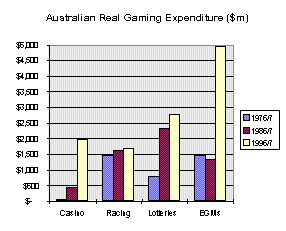
    As the Issues Paper illustrates, total measured gaming expenditure was growing relatively slowly until the 1990s but has expanded rapidly since then.  Although part of this growth may be due to legalisation of some forms of gaming which were previously illegal and unrecorded, it is clearly in the main due to the increased availability of casinos and electronic gaming machines (EGMs).

    The following chart illustrates the real growth of the different products.

    Source:  Tasmanian Gaming Commission

    Although all products are within the Inquiry's ambit, the terms of reference puts particular emphasis on the social impacts of the industry, its regulatory arrangements and the revenue implications to governments.  Accordingly, our own submission places its main focus on casinos and EGMs which have rapidly grown to dominate expenditure in the industry, and about which most concern has been expressed.


    NET ECONOMIC BENEFITS OF GAMBLING

    INCREASED ECONOMIC ACTIVITY

    Many see tourism and support for industries like racing, building and employment generally as the main value of gambling activity.  Walker, for example, suggests tourism as the main benefit from casinos. (1)  Others see an expenditure multiplier providing a benefit.  Dickerson (2) places this at between 1.3 and 1.7 to arrive at an expenditure impact for the Sydney casino of $459 million for 1993/4 compared to expenditure, less costs, of $270 million.

    Neither of these bases are the correct way of analysing the benefits of casinos.  Indeed, the application of a multiplier is flawed because it assumes that the money spent on one good produces more expenditure than would occur if it was spent on the goods that would otherwise be bought.  In addition, the notion of expenditure as a guide to income and wealth needs to be treated carefully.  Clearly, we would be no better off if expenditure were to be increased merely because of an expansion in the number of links in the chain from producer to consumer.

    The benefit of gaming to those undertaking the activity is the enjoyment they obtain from it compared with the enjoyment they would obtain from their next best form of expenditure and activity.  Those benefits are gained either when tastes change so that people prefer to allocate more of their expenditure to gambling, or, more commonly, when a latent demand is tapped due to reduced regulatory restraints.

    Those benefits normally stem from shifts in consumption expenditure.  They may also stem from a shift out of savings towards consumption.  Indeed, this was the finding of a report published by the Victorian Casino and Gaming Authority in March 1997. (3)  That report found that increased gaming expenditure in Victoria following the introduction of EGMs and the casino, had not led to lower retail spending but had brought about lower levels of savings.  The report did not standardise for the changes in the taxation regime confronting savings, e.g. in superannuation.  Hence it is not clear whether the availability of a new form of expenditure led to a shift in the inter-temporal spending patterns (savings representing deferred consumption) or whether it was coincident with other measures that reduced the relative attractiveness of deferring consumption.  It may be that the retail sector would have enjoyed even greater growth had it not been for gambling expenditure.  In overseas jurisdictions that the report examined, rapid increases in gaming activity did appear to lead to some offsetting reduction in other retail activity.

    Individuals' benefits from gambling are obtained both by the people in the location where gambling is relaxed and by those who undertake travel from areas where gaming controls remain stringent.  In the case of the former, the relaxation of gaming controls allows greater benefits per dollar spent.  It is not likely that such improved benefits would be reflected in measured levels of increased GDP.

    Part of the benefits from increased tourism are similar to those gained by gamblers if the previous measures forbidding the activity were suppressing some preference on the part of consumers.  The growth of gaming wherever its control has been relaxed is overwhelming evidence that the people who increase their spending on the activity perceive such benefits.  And this measure of benefit is the only one that can be legitimately used in a democratic society.

    In the presence of constraints on gambling more relaxed regime, some expenditure may leak from the economy to other locations.  This would tend to be reflected in lower measured GDP levels -- economic activity would be transferred outside the area itself.  In the case of a particular country, those lower income levels may be transmitted via a slight devaluation of the exchange rate to enable the restoration of the previous equilibrium in the balance of payments through choking off some imports and stimulating greater exports.

    For these same reasons, the attraction of expenditure from areas that have not benefited from a relaxed regulatory regime brings a tourist gain in income.  This is akin to a gain made from increased exports of goods that have become more competitive.  That gain is magnified if the availability of gaming increases demand for other goods and services sought incidental to or jointly with gaming.  Of course, if gaming expenditure merely replaces other tourist expenditure, the gain is less, though still positive -- the tourists by their actions will have shown a preference for gaming expenditures and can be presumed to have obtained greater satisfaction from the holiday experience.  They would be all the more likely to repeat it and to promote its merits to others.

    Many people would be attracted to a location only because it offers gambling facilities.  At least prior to the recent economic downturn, the "Asian high-roller" market was a much publicised and clearly significant part of the Victorian casino business.  Similarly, one of the driving forces in the liberalisation of State controls on gaming has been the observance of income leakage to other States.  This was visible in the growth of gaming activity north of the Murray to cater for Victorians prior to that State's market liberalisation.

    To the degree that gaming activity enhances the general attraction of a location, there are additional benefits in the form of increased real demand for associated goods and services.  Those benefits can also be seen on a smaller scale in the case of EGMs in pubs.  Work conducted for the Australian Hotels Association by the Tasman Institute in 1993 indicated that the introduction of EGMs to pubs was accompanied by a 40% increase in turnover with only half of this due to the revenue from the machines themselves.


    INCREASED EFFICIENCY OF TAXATION

    Gaming accounted for between 8 and 15 per cent of State Governments' revenues in 1996/97.

    The considerable reliance of State Government finances on gambling taxes was amplified by the High Court judgement that ruled franchise fees on petroleum, alcohol and tobacco unconstitutional.  That reliance will further be enhanced with the removal of nine taxes imposed at the State level if the Commonwealth enacts the Government tax reforms.  Collectively, these nine taxes are estimated to reduce State Government revenues by over $12 billion in 2001/2 and be replaced by the States gaining all the GST revenues and facing a balancing reduction in Financial Assistance Grants. (4)

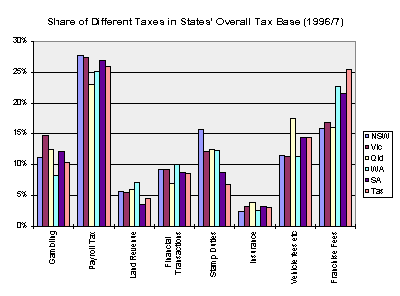
    The $12 billion eliminated taxes and the loss (transfer to the Commonwealth) of the franchise tax collections ($5.2 billion in 1996/7) reduces the States' own tax raising base to less than half its 1996/7 level.  The chart below illustrates that level.  The importance of gambling taxes, even if their growth were to be a the same rate as expenditures generally, is therefore more than doubled in terms of the tax base State Governments have under their own control.

    Source:  Commonwealth Grants Commission

    The loss of gambling taxation revenues to the States would force a complete overhaul of State taxation and perhaps expenditure.  Ways of recouping the loss would be very difficult.  For example, it would require a lift in Payroll taxes from the present top rates of 6.85% in NSW and 6.25% in Victoria to about 10% in both cases, an increase that would, at least during a transition, have some significant effects on employment rates.  (If the loss of gambling revenues was due to an enforced cessation of gambling, the loss in income/employment would be permanent).

    Taxes on gaming have proven a more effective and less painful way for governments to pluck the taxpayer goose than alternative taxes.  Indeed, in order to ameliorate pressure groups opposed to gaming, State Governments have set up special funds in the form of casino and gambling levies and have used these funds to staff gambling related agencies and finance studies into the effects of gaming.  Thus, in the case of the Sydney Casino, over 9 per cent of tax revenues are paid to the Casino Community Benefit Trust.  The readiness of State Governments to incur such expenditure is a reflection of the great ease of raising the revenues in the first place.

    There may also be some advantage to government in promoting pressure groups that oppose gaming.  Those groups create a general climate that gives gamblers a feeling of guilt in the exercise of their consumer choices.  This facilitates placing a tax burden on them far in excess of that on most goods.  In wholesale sales tax equivalence, the tax on gambling is 42 per cent, (5) compared to the average level of tax on all goods and services of less than 6 per cent.

    The facility of raising money through gaming is a clear benefit to government exchequers.  To the extent the collection costs are relatively low, there is a real benefit in terms of conserving resources in the economy.

    That aside, there is little merit in raising taxes from gaming rather than other means.  One line of argument in favour of this particular form of taxation can be developed through assessing the consumer response.  In general, it can be argued that taxes that lead to the least response in expenditure patterns are most efficient. (6)  However, it is not clear that taxes that leave demand for the targeted goods relatively unaffected do not have a offsetting deleterious effect on all other goods by their effect on the available levels of expenditure.  In other words, although a tax on a particular good may have little effect on its demand, by reducing the income available for other spending, its distortion on overall activity can be just as great as a tax on a good that exhibited a more responsive demand.


    JUXTAPOSING INDIVIDUAL FREEDOMS WITH THE PROBLEM GAMBLER ISSUE

    The freedom of people to engage in gambling activities is not commonly associated with individual liberties.  Even so, the ability of the individual peaceably to behave and spend his or her money as he or she pleases is an important test of a free society.  Even if it is only a minority of the people who want to engage in an activity ( and gambling is far from a minority pastime in Australia) their ability to do so should be respected.

    This is not to argue against any laws that forbid certain activities.  There is wide support for laws aimed at protecting minors from activities that are widely tolerated for adults, and are sometimes even intrinsic to a great deal of adult social intercourse­alcohol consumption falls within this category.  Similarly, there is general agreement on the need for restraints on minors engaging in gambling activity.

    Of course, some activities that may be labelled "victimless crimes" may be legitimately prevented.  Thus, most western societies have long banned activities like dog and cock fighting in spite of the lack of harm this apparently imposes on other individuals.  Many also place impediments on the access to pornographic material.  And most forbid the general consumption of many forms of narcotic drugs.  The general reasoning behind such restraints is that the activities have a capacity to undermine some basic features of the social fabric.  Thus, the lack of respect for living creatures that is characterised in having animals fight to the death may be transposed to human life.

    General restraints on people engaging in gambling activity cannot be classed within such categories.  The activity is one which has had a place within almost all societies since time immemorial.  It clearly has not had a destructive effect on society as it has developed.  And there are very few voices who would judge it wise -- or even practicable -- to forbid all forms of gambling.  Even so, governments, have often been slow to permit newer forms of gambling.  Bowing to pressure from those with a moral objection to gambling and to fears that gambling may engender anti-social activities on the part of the gambler, new forms have often been allowed to emerge only when their suppression became too difficult.  This has been the case in Australia, notwithstanding the major revenue gains that gambling activity allows.

    Excessive behaviour is a major rationale for limiting access to gaming and has been the subject of several studies in Australia. (7)  Yet, excessive behaviour patterns are common to almost all human activities.  They are certainly present with alcohol and even with eating.  The conditions that cause such disorders are serious for the individuals and for society.  But, unless they undermine some basic foundations of society, their resolution is best left to the individuals most directly concerned to rectify.  This rests on the well founded premise of a democratic society that the individual is primarily responsible for his or her actions.  It is not to argue against the community offering assistance to people seeking to combat activities that cause harm to themselves and others.

    It is also important to place the magnitude of problem gambling in perspective.  A recent Harvard study synthesized information from 120 different studies and found that approximately 1.29 percent of the adult general population could be classified as having serious pathological problems with gambling.  This represented an increase from 0.84 percent from the position in the 1970's.  The study indicated that the increase was due to a number of reasons other than the increase in gaming activity.  These included an increased social acceptance of gambling as well as an increasing desire to participate in risk-taking activities. (8)

    The level of problem gamblers estimated in the Harvard study appears to have received corroboration from a number of other studies. (9)  Hence, serious though the problem is to the individuals afflicted with the pathology, it is not of a sufficient magnitude to justify denying the population as a whole of their liberties.


    CONTROLS TO PREVENT CRIMINAL ACTIVITY

    Gambling has long been associated with criminal activity.  Ostensibly, a major reason why Victoria had no casino prior to 1995 was the report of the Connors Inquiry in 1983, (10) which recommended against a casino due to fears about the effect on crime and corruption.

    The cash nature of gambling will always give rise to criminal money laundering.  Moreover, high profits associated with an activity that has monopoly power is likely to bring corruption, if not conventionally perceived criminal activity.  However, the risks of this are far greater if the activity itself takes place outside of the law.  In contrast to the judgements made in the Victorian Inquiry by Justice Connors, the NSW inquiries saw legalized casinos as a means to prevent illegal activity that has widespread public appeal and the capacity to bring about corruption in the police force. (11)

    Commonly, the allegations of harm as a result of reducing the regulatory impediments to gambling are most forcefully supported by those that have most to lose, often because of the privileged position they currently hold.  The licensed clubs were forceful opponents of the NSW legalisation of casinos as was the Liberal Opposition. (12)


    REGULATORY ISSUES

    GAMING MACHINE LIMITATIONS IN OUTLETS

    The Regulatory Structure

    Gaming machines are controlled in all States, with the NSW regime being the most liberal and Western Australia, where they are allowed only in casino, the most restrictive.  Victoria introduced machines pursuant to the Gaming Machines Control Act 1991 (the "Act") which sets out the general principles for the operation of the Victorian gaming industry.

    The Act and its ancillary regulation have created the following market framework.

  • The total number of gaming machines allowed to operate in Victoria is set by the Government.  Under the current moratorium, that number is set at 27,500.
  • Two gaming operators, Tattersalls and TAB, own all gaming machines.  Each gaming operator is entitled to own 50 percent of the total number of machines allowed in Victoria.
  • Machines are operated in licensed venues by venue operators.  Either pubs or clubs may be venue operators.  Each class of venue operator, that is, clubs and pubs, is entitled to a maximum of 50 percent of the total number of machines allowed in Victoria.
  • Machines are distributed to venue operators throughout metropolitan Melbourne and country Victoria on a 80/20 split.
  • The number of machines clubs and pubs may operate is limited to a maximum of 100 machines with no bet limit in restricted areas.  A maximum of 5 machines with a $2 bet limit is permitted in unrestricted areas.
  • Employees working in restricted areas must be licensed by the Victorian Gaming and Casino Authority.
  • The Victorian Gaming and Casino Authority is responsible for overseeing the gaming machine industry, issuing licences and researching the impact of gaming machines in Victoria.

    No less than 87% of the total amount wagered must be returned to players for clubs and pubs.  At present the machines are returning approximately 91%-92%.

    The taxation position varies between pubs and clubs:

    Clubs:

    Venue Operator:  33 ⅓% of net daily take.

    Gaming Machine Operator:  33 ⅓% of net daily take.

    Government Consolidated Revenue:  33 ⅓% of net daily take, to be paid into either

    (i) the Hospitals and Charities Fund;  or
    (ii) the Mental Hospitals Fund

    Pubs:

    Venue Operator:  25% of net daily take.

    Gaming Machine Operator:  33 ⅓% of net daily take.

    Consolidated Revenue:  33 ⅓% of net daily take, to be paid into either

    (i) the Hospitals and Charities Fund;  or
    (ii) the Mental Hospitals Fund

    Community Support Fund:  8 ⅓% of net daily take to be paid:

    (i) towards the expenses of the Victorian Gaming and Casino Authority (VGCA);
    (ii) to the Research and Development Fund (established by the VGCA);
    (iii) not less than 70% of the remainder to the Minister for Sport and Recreation to be spent for the benefit of Sport and Recreation Clubs, and the Minister for Community Services, for the provision of financial counselling services, gambling or for the treatment or rehabilitation of persons who are problem gamblers;  and
    (iv) the balance to Ministers for:  the Arts, for the promotion of the arts;  and the Minister for Tourism, to be applied for the promotion of tourism.

    Most of these measures -- and other States have their own variations -- distort the exercise of consumers' preferences and producers' abilities to meet these.  In the case of NSW, the limitation on pub installation numbers offers a major advantage to clubs.

    Where governments confer advantages on particular outlets at the expense of others, this is always likely to offer benefits to the former at the expense of the consumer.  With such advantages made available by regulation, the beneficiaries are likely to offer rewards to the political organisations promoting them (or to penalize political parties that seek to take them away).  Buying support through regulatory measures that bring a net loss to the community is a corruption of the political process.

    Effects of the EGM Limitations

    The restriction on EGM numbers reduces the benefits consumers obtain by restricting the choice of venue and diminishing competition.  As a result, those pubs (the restriction on clubs is largely redundant because demand is fully accommodated) with machines obtain excess profits (economic rent).  The number of machines allowed in Victoria, (27,500) represent a shortfall of the number that consumers would prefer of over 30,000 based on the number of machines in NSW, (91,000).  This is a conservative estimate, since there is a limit of 10 on the number of machines in NSW pubs, (with no limit in clubs).

    Aside from loss of Government revenue, the limitations mean reduced consumer satisfaction and risks of locking in a less than optimal industry structure.

    Reduction in consumers satisfaction levels.
    By and large, a regulatory intrusion which prevents consumers spending their own money in ways they prefer -- and businesses from moving to meet these consumers' demands -- brings about less value to consumers per dollar spent.  Economists refer to this as a loss of consumer welfare.  Distortion of demand by regulatory measures means that people's spending pattern's are shifted away from that which gives them what they judge to be best value for their money.  The consumer is disadvantaged by a distortion to the market which has an effect equivalent to a loss in measured national income.
     
    Risks of creating and locking in excess profit levels.
    With a mature market and no barriers to new entrants offering to supply the service (as long as they conform to standards of integrity, etc. common to all providers), there will be no "super" profits earned.  This does not deny that well managed pubs might make high returns but simply maintains that, as a whole, the industry will receive incomes which provide for a "normal" return on capital and labour.
     
    If this were not the case, the very profitable opportunities would bring more entrepreneurs to enter the marketplace.  The increased supply leading to pressure on margins until an equilibrium 'normal' profit levels are reached.  With a limitation of supply, there is, however, a grave risk of "normal" returns being brought about by a revaluation of assets.  This would be the counterpart of what happened with taxi-plates.  Government limits on the number of taxi-plates has resulted in a premium in the price at which they change hands.  As has been amply demonstrated (Swan (13)) the upshot is an increased capital value which the consumer pays for but for which the lucky holders of the scarce licence achieve super profits.  (Economists call these "economic rents".)

    As a form of passive shareholder in the revenue of gaming machines, through their revenue shares, Governments would also be major losers from the capitalisation of scarcity rents that would inevitably accompany a continued supply limitation.

    Taxation Arrangements.  The Tilted Playing Field

    Under the present distribution, arrangements are discriminatory.  In Victoria, the government and gaming operators each receive 33 ⅓ percent of net gaming revenue.  Where the venue operator is a club, the venue operator keeps the remaining 33 ⅓ per cent.  However, where the venue operator is a pub, ¼ of the remaining 33 ⅓ (8 ⅓ of the total net gaming revenue) is paid to the Community Support Fund.

    This means that on gross returns of 9 percent, the pubs receive 2.25 percent while clubs receive 3 percent.  This competitive advantage is equivalent to pubs paying an additional 33 percent tax to that of the clubs.

    Offering one class of institutions preferred treatment over others is seldom beneficial to the community as a whole.  It is argued that clubs are not-for-profit organisations and undertake valued community work (like assisting in continued viability of the world's greatest code of football) and as such warrant government assistance.  However, incorporating a hidden extra tax is an inefficient method of providing this assistance.  In the final analysis, all taxes are passed through to the final consumer, either through higher charges or through costs being added on.  Accordingly, the measures in place represent a hidden extra tax on the pubs' customers and confer a competitive advantage on clubs.

    Moreover, such additional taxes are inimical to Governments' preferred administrative approach.  Governments are attempting to remove hidden taxes and even subsidies (eg., on water and electricity provision) for the very good reasons that they distort output, thereby generating excessive costs, and that they are difficult to monitor, making it difficult to determine whether they do in fact provide the value intended of them.  The result of a discriminatory tax is that consumers adjust their behaviour so that due to distortionary losses the true costs cannot be determined.

    If a Government wishes to support the types of activities undertaken by clubs, it should do so in an open, transparent and readily scrutinised subsidy specifically targeted on the activities favoured.

    The present lack of visibility and contrived distortion is, arguably, all the more regrettable because, in the main those being discriminated against by the present taxation arrangements are small businessmen and women, who are the proprietors of pubs.  Over recent years, changing social behaviour and tougher drink-driving laws have contributed to a marked downturn in their business levels.

    Other Distortions

    Gaming machines have been introduced successfully throughout most of Australia.  They have brought financial advantage to both pubs and clubs and have augmented Government revenue.  Moreover, there is competition and no suggestion of the criminal involvement, often accompanying gaming machines.  Even so, the introduction was one of excessive government intrusion into what should have been purely commercial decision For Victoria, that intrusion includes

  • the 50/50 club/pub installation rate rules;
  • the strict 50/50 rule between TAB and Tattslotto machines and the illegality of other machines;
  • the 80/20 city/country rule;  and
  • the maximum capacity levels on numbers and a location of certain machines.
  • Discrimination between EGM Availability at Clubs and Pubs

    Setting a parity between clubs and pubs cover no purpose.  Clubs are far less numerous than pubs.  The would be unlikely to have a similar demand for machines to that of pubs even if there were a relaxation on number of machines per establishment.

    The parity rule therefore essentially means clubs can obtain machines more readily than can pubs.  Like the taxation arrangements, this favours clubs.  And while this is understandable, even if not legitimate in the case of sports clubs, it is of doubtful merit in the case of other large class of clubs:  those based on ethnic origin or supporting a particular political party.  There is, of course, nothing wrong with people of different ethnic backgrounds or preferences or other values setting themselves up in a club that excludes or limits the presence of outsiders.  However, it would seem to be quite wrong for governments to be setting out to favour such venues at the expense of those like pubs which seek to offer their services equally to all.

    At the present juncture the 50/50 pub/club rule in Victoria is misdirecting the available machines towards clubs where demand for machines is close to maturity (at least on present maximum machine number rules) and the community, the government and the operators would all gain from a relaxation of this 50/50 rule so that commercial considerations would direct a greater share of available machines to pubs.


    THE TAB/TATTSLOTTO MONOPOLY

    The present arrangements in Victoria allow only TAB and Tatts to offer machines in Victoria.  They also require a strict 50/50 installation rule.  This goes much further than the long discredited duopoly that once characterised airline operations.  It insists that, irrespective of consumer preferences or costs, each supplier will service the same share of the market.  These measures constrain the greater efficiency, lower costs and enhanced market orientation that is the natural outcome of competition.

    Not only does the forced duopoly constrain competitive effort between the two suppliers, it prevents any of the dozens of alternative suppliers from offering their services.  A duopoly tends to limit competition in ways that do not generate the diversity of service the market would normally want.


    THE PRIVILEGED POSITION OF LICENSED CASINOS

    All the Australian jurisdictions have granted forms of exclusive licenses to casino operations.  The limitation on machines in pubs in Victoria and preventing their installation forbid is an added protection to casinos (as well as to clubs).

    Government licensing of casinos has the purpose of, and is designed to, limit their supply.  By restricting supply, Governments are thereby increasing the costs to the gambler.  In these terms, the regulatory restrictions are a form of tax on those wanting to use casinos.

    With no further restrictions, the holders of the licenses obtain the financial benefit.  But governments have usually required some of these "rents" be dissipated in other developments.  Casino projects have usually been associated with planning schemes designed to increase the attractiveness of the casino complex.  The casino's approval is made conditional on other facilities being constructed, facilities that are, in effect, subsidised by the high profits from the casino operations.  Favouring a particular area in this way is likely to have an offsetting effect on rival geographic locations.  In net terms the privileges extended to the favoured area are more likely to bring a net reduction of aggregate real income than an increase.

    Accordingly, the preferred approach is to readily approve casino developments, although this should not be done in ways that abrogate agreements that governments have previously entered into.


    ENDNOTES

    1. Walker M. Gambling Government, UNSW Press, 1998.

    2. Dickerson M., Allcock C., Blaszczyski A., Nicholls B. and Maddern R., A Report to the Casino Community Benefit Fund, NSW 1996.

    3. Victorian Casino and Gaming Authority, The impact of the expansion of gaming on the Victorian retail sector, prepared by National Institute of Economic and Industry Research and Spiller Gibbins Swan, March 1997.

    4. Tax Reform:  not a new tax, a new tax system, the Commonwealth Treasurer, August 1998, p. 103.

    5. see Moran A., Soaking the Poor, IPA Backgrounder Vol 8/6 1996.

    6. Such taxes are referred to as Ramsey taxes.

    7. See for example, Definition and Incidence of Problem Gambling, Including the Socio-Economic Distribution of Gamblers -- Victorian Casino and Gaming Authority, August 1997.

    8. Shaffer Howard J., Estimating the Prevalence of Disordered Gambling Behavior in the United States and Canada:  A Meta-analysis -- Harvard Medical School Division on Addictions, 1998.

    9. Submission by the New Zealand Business Roundtable, Toward a more efficient Policy framework for gaming, December 1996.  Insight Canada Research, Prevalence of Problem & Pathological Gambling in Ottowa Using The South Oaks Gambling Screen, www.cfeg.on.ca/prevale.htm

    10. Connors F.X., Report of the Board of Inquiry into Casinos, Victorian Government, 1983.

    11. Lusher E.A., Report on the Inquiry into Legalization of Gambling Casinos in New South Wales, Parliament of NSW, 1977.  Lloyd Jones, Report on the Inquiry into Legalization of Gambling Casinos in New South Wales, 1895.

    12. In this respect, all major liberalizations of gambling laws in Australia have been implemented by Labor Governments.  This is arguably because they were less beholden to those that might suffer loss of business as a result of new competition for the consumer's dollar and because their expenditure policies had a more urgent need for increased revenue.

    13. On Buying a Job:  the Regulation of Taxi Cabs in Canberra, Swan P., Centre for Independent Studies monograph, 1979.

    Monday, November 02, 1998

    Improving Media Regulation

    CHAPTER EIGHT

    Australian broadcasting has long been subject to regulations in three main areas:  control of entry through licensing;  restrictions on foreign and broad ownership;  and control of content.  The print media were not subject to special regulation until the cross-media ownership rules were introduced in 1987.  The regulations affecting the media industries have evolved over the years in response to various forces including the advent of new technologies, changes in consumer demands and the decline of the "social responsibility" approach.  While these changes have been broadly in the direction of greater liberalisation, the media industries remain heavily regulated compared with most other industry groups.

    In this study I have described, explained and evaluated Australian media regulations.  The approach is both retrospective and prospective.  The regulations have not always served well what I understand to be "the public interest".  While characteristics of public good, natural monopoly and spectrum scarcity have meant that the market cannot be relied on totally to produce an efficient outcome, regulations have not always led to an improvement or, when they have, not to the maximum possible improvement.  In this concluding chapter I canvass some possibilities for alternative regulatory directions that avoid some of the shortcomings inherent in the existing regulatory structure.  The recommendations are based on four guiding principles:

    1. Regulation should be retained or introduced only when correction of market failure is strictly necessary and justified or to achieve a clearly identified social goal whose benefits to society clearly outweigh all the cost associated with the regulation.
    2. Regulation should be based on a clear, well-defined, transparent and predictable framework.
    3. Regulation should be directed to outcomes and not to the way in which the outcomes are generated or delivered.
    4. Regulation should be neutral in its impact on delivery technologies and on services with substantially similar attributes.

    SPECIFIC POLICY IMPLICATIONS

    1. Freer Entry into Broadcasting

    Regulation of entry into broadcasting has been overly restrictive, limiting the number of particular services in particular markets, and delaying the introduction of emerging services based on new technologies.  Without these restrictions it appears that the present size, structure and performance of broadcasting services would have been substantially different from that observed.  High licence values reflect the rents accruing to their holders and the presence of these rents is prima facie evidence of excessive restriction.  There is also evidence that in the case of all new services based on new technologies (monochrome television, FM radio and pay-television in particular), introduction was unnecessarily delayed with consequent efficiency costs.  Further, the combination of carriage (signal transmission) and content (programme production) in Australian broadcasting has been a source of regulatory difficulties and has restricted policy flexibility.  There are several elements that could help establish a freer and more coherent approach to broadcasting licensing:


    Reduce entry barriers

    I recommend much freer entry into broadcasting.  The only "public interest" grounds for limiting entry are those of natural monopoly (economies of scale or scope) and technical considerations such as spectrum scarcity.  However, natural monopoly provides only a prima facie case for intervention (it provides only a necessary condition for restriction, not a sufficient one).  New entry that duplicates investment in infrastructure is not necessarily wasteful.  Its benefits such as greater programme diversity and choice to consumers or lower prices for advertising could well exceed the cost of the investment.  Technological changes have greatly reduced spectrum scarcity constraints and new delivery platforms, such as the Internet and international satellite, are largely beyond the reach of national regulations.  Increased adoption of these technological advances will continue to reduce the effectiveness of restrictive entry barriers and would make their retention increasingly questionable.


    Continue the auction system

    Where entry is to be restricted on public interest grounds, including spectrum scarcity, a market mechanism should continue to be used to allocate the available licences.  However, there may be a case for consideration of alternative auction designs that facilitate a more efficient approach to market allocation and avoid some of the pitfalls experienced in recent years (e.g., allocation of satellite pay television licences).


    Separation of carriage and content

    There is a case for the means of carriage and the content of free-to-air broadcasting services to be licensed separately as is the case in the United Kingdom.  This would be easy to apply to all new services immediately, but would be difficult for existing services.  One approach for existing services would be a requirement that, after an appropriate period of notice, owners divest themselves of either the carriage or content element of their current licences.


    Limit licence periods

    Currently, although licences are issued for a nominal period, they are held virtually in perpetuity.  Separation of carriage and content would help establish enforceable fixed licence periods.  Unless completely free entry were justifiable, the content licences should be allocated initially, and re-allocated when they expire, by a market mechanism, such as an auction, to secure any scarcity value for the government.  The government could also retain the right to impose obligatory content clauses and would then be free to amend them each time a licence is re-allocated.  Owners of transmission facilities would not necessarily be excluded from holding a content licence.  The effectiveness of this approach has been demonstrated in the United Kingdom where it is used to allocate programming licences for free-to-air television.


    Spectrum management

    Efficient use of the scarce radio frequency spectrum would require broadcasters to purchase spectrum rights in competition with users in other industries.  It would provide broadcasters with the flexibility to choose alternative delivery mechanisms (e.g. cable, satellites) should they prove to be more commercially attractive.  The introduction of a tradeable spectrum-access rights system would need to give special consideration to the terms and conditions under which existing broadcasters could continue to retain tenure of the broadcasting frequencies currently assigned to them.


    Technological neutrality

    The BSA sought to establish a technologically-neutral framework for the development of broadcasting.  However, those intentions of the Act have not always been pursued in practice.  In the short period since the enactment of the legislation the concept of technological neutrality has been overridden by two policy initiatives (pay television and HDTV), which have had major implications for the development of broadcasting services.  Issues surrounding the management of new technologies were treated at length in Chapter 7.  In brief, wherever regulation is justified, considerable care should be exercised to ensure that it is not distortionary in its application to different technologies.  My recommendation is that any such regulation should be applied to outcomes irrespective of the technology by which they are delivered.


    2. Fewer Restrictions on Ownership and Control

    When evaluated on economic criteria, restrictions on audience reach, foreign ownership and cross-media ownership all have a number of adverse effects.  In particular they have limited the development of industry structures exploiting economies of scale and scope, prevented the formation of multi-media groups, and given incentives to the creation of new financial instruments and other arrangements to avoid the regulations.  At the same time, substantial diversification of the media industry has weakened the non-economic case for ownership restrictions, and, as the delivery of media services by non-traditional means becomes more widespread, the justification for continued restrictions on ownership of traditional media will be further eroded.  In the case of restrictions on population reach, these have effectively been circumvented by television programming affiliation agreements.  In the light of these considerations it is difficult to mount a case for continuing to restrict audience reach, foreign ownership and cross-media ownership.


    3. Use More Efficient Means of Promoting Australian Content

    Programme standards in television are quite extensive and include requirements for overall Australian content (type and quantity) of television programmes, children's programmes, Australian content in advertising (80 per cent must be produced in Australia) and limits on time devoted to advertising (maximum of 13 minutes an hour in prime time and 15 minutes an hour at other times).

    The discussion of programme standards in Papandrea (1997) considered the desirability and appropriateness of Australian content requirements and found evidence that there was a willingness to pay for the additional cost of local content, but that the current means of delivery are inefficient.  They distort broadcasters' programming decisions and provide a substantial, but hidden, level of assistance to drama production and employment.

    Assuming that the current assistance is desirable, it would be possible to eliminate some of the current distortions and improve the efficiency of the scheme without significantly affecting its outcome.  It is proposed that a direct and more transparent mechanism should be used to assist film and television programme production.  A mechanism other than quota (e.g. a bounty or other direct assistance to production) which removed the relative price differential between Australian drama and foreign drama or other Australian programmes would allow programmers greater flexibility in choosing programmes on the basis of audience response.


    OVERALL CONCLUSION

    My broad conclusion is that, while there have been substantial improvements in the regulatory structure and its outcomes (especially with the BSA), there are still problems in the approach and results in the three major areas of regulation:  licensing, ownership controls and content regulation.  The traditional regulatory structure continues to be challenged by new technologies and the convergence of existing ones.  The media industry needs to be managed very carefully to produce results that maximise the "public interest".

    This leads us to reflect on how different the broadcasting landscape may have been with a more liberal, market based approach to the licensing of new services.  Additional broadcasting services and new technologies such as FM radio, television and pay television would probably have been introduced much earlier.  For instance, notwithstanding the invention of FM radio in the 1930s, its successful use overseas and in local test stations for decades, the existence of many unsatisfied applications for new radio services and 60 per cent receiver penetration by 1978 (Postal and Telecommunications Department, 1978), FM radio services were not introduced until 1980.  The use of FM was prohibited by legislation in 1956 and the FM spectrum was allocated for use by television in 1961.  Similarly, the introduction of television was delayed until 1956 even though the technology had been developed much earlier, and 20 applications for commercial television licences had been lodged as early as 1944 (Curthoys, 1986).  The same pattern is repeated in the case of subscription television whose introduction "as soon as practicable" had been recommended as early as 1982 in a report by the ABT (1982).  The government ignored the report until 1986 and then decided to impose a four-year moratorium on the introduction of subscription television.  The moratorium was extended in subsequent years and pay television was finally introduced in 1995.  A similar pattern is also evident with the introduction of digital television.  Of course, had the timely introduction of these technologies occurred in response to market demand, the community at large, rather than a select few, would probably have gained substantial social benefits and the present size, structure and performance of broadcasting services would be very different.


    APPENDIX:  HISTORICAL OUTLINE OF MEDIA REGULATION

    Different media are subject to different levels of regulation.  The principle of press freedom, for example, has ensured the development of a print media largely unconstrained by regulation.  New electronic media, such as online services, are also largely unconstrained by regulation, but for different reasons.  In their case, the technological developments that have made the new media possible have also led to the demise of effective regulation using traditional means.  Regulation, however, has always been a feature of broadcasting and many aspects of the industry are subject to extensive controls.  This appendix outlines the development of broadcasting regulation in Australia highlighting the factors that have a significant impact on the current structure of the broadcasting industry.


    EARLY DEVELOPMENT OF RADIO

    Experimentation with radio broadcasting attracted increasing attention in the years following the First World War.  By 1920 radio stations were already broadcasting regularly overseas.  The first regular radio service was established in Sydney in late 1923 and was quickly followed by the establishment of another service in Melbourne in early 1924.  The Commonwealth Government used the powers of the Wireless Telegraphy Act 1905 to license transmission and reception of radio signals and to set operational standards for stations.  The initial regulations introduced in 1923 were concerned with:  technical and financial aspects of broadcasting;  prevention of interference between stations;  ensuring availability of frequencies for services throughout the country;  and establishing mechanisms for financial compensation of service providers.

    Initially, to access the service of a radio station listeners were required to pay a subscription fee to the broadcaster, including a receiver licence fee collected on behalf of the government for the right to use a radio receiver permanently tuned to that station's frequency (referred to as a "sealed" set).  This arrangement was difficult to implement and control.  Theoretically, listeners wanting to have access to more than one station were required to pay a separate fee to each station and to operate a separate radio receiver for each station.  In practice, adjustments to a radio receiver to enable reception of more than one station were simple to carry out while enforcement of the sealed set arrangement was difficult.  Also, many listeners quickly discovered that they could avoid payment of subscriptions to stations altogether by the simple expedient of purchasing an "experimental" receiver licence which enabled them to operate an unrestricted receiver that could be tuned to the frequency of any station.

    New arrangements to replace the "sealed" set scheme were introduced in 1924.  These authorised two types of stations, Class A, financed from receiver licence fees and limited advertising up to one hour per day;  and Class B, financed solely from unlimited amounts of advertising.  The establishment of a national radio service led to the government's takeover of the Class A stations as their licences expired in 1929 and 1930.  Initially, programming for the national stations was contracted to the Australian Broadcasting Company, and then became the responsibility of the Australian Broadcasting Commission, later Corporation (ABC) when it was established in 1932.  The legislation establishing the ABC incorporated most of the earlier established conditions of the programming contract assigned to the programming company (see table A.1 for details).  Some, including provisions for programme diversity, adequate and comprehensive programmes, quality programmes, local content, and protection of good taste, are still clearly identifiable in the ABC's current charter.

    Table A.1 Australian Broadcasting Company --
    Conditions of Programming Contract

    1. That the programmes, both in their compilation and rendition, shall be to the satisfaction of the Postmaster-General;
    2. That they shall be of general interest and of sufficient diversity to cater for the reasonable tastes of the community as a whole;
    3. That they shall contain news items and market reports suitable for the relevant localities;
    4. That the Company will exercise its expert knowledge to the full and make the maximum use of all the facilities available for securing the greatest possible variety of items and subjects of merit and interest;
    5. That the Company shall do all in its power to cultivate a public desire for transmission of educational items, musical items of merit and generally, for all items and subjects which tend to elevate the mind;
    6. That the Company shall make all reasonable arrangements for the rendering of items provided by Orchestras, Choral Societies and organisations of high standing, and shall pursue a reasonable policy in inducing the establishment and maintenance of organisations devoting their talent to the rendering of high class compositions;
    7. That the Company shall, so far as practicable, encourage local talent by utilising the services of persons who may possess attributes rendering them suitable for providing broadcasting items;
    8. That the Company shall avoid monotony, tedious repetition of items and unduly prolonged use of an artist in a particular State;
    9. That the Company shall ensure that no matter is broadcast which might be repugnant to good taste.

    Source:  Postmaster-General's Department (1931).


    Cultural enhancement and protection of good taste were particular concerns of the early programming controls imposed on radio stations.  Programmes on the national stations were scrutinised for suitability by the Postmaster-General's Department prior to transmission and those of commercial stations were kept under observation.  Authorities were also concerned with ensuring equitable treatment of political broadcasts during elections, and the provision of educational, children's and religious programmes.

    Although the government was initially anxious to promote the expansion of commercial services, particularly in non-metropolitan areas, demand for licences soon outstripped supply.  By 1942, 99 commercial stations were in operation and 695 applications were unsatisfied.  Increased ownership concentration of licences caused the government to become concerned about "the inherent dangers of allowing the control of commercial broadcasting to become a monopoly or a partial monopoly" and led to the introduction of ownership controls in 1935.  However, the initial regulatory instruments were watered down within several weeks of their introduction following concerted action by the broadcasters (Gibson, 1942).


    GIBSON COMMITTEE

    In 1942, the Joint Parliamentary Committee on Wireless Broadcasting (Gibson Committee) completed a report to Parliament that was to have a major influence on Australian broadcasting for many years.  The report led not only to the framing of the Broadcasting Act 1942, but also to the establishment of the Parliamentary Standing Committee on Broadcasting.  Many of the provisions of the Broadcasting Act remained in force for more than half a century and the Standing Committee exerted considerable influence on the development of broadcasting regulations throughout the 1940s.

    The Gibson Committee's report raised several concerns about the power and influence of broadcasters.  The Committee was particularly concerned about the potential of broadcasters to influence the political process during election campaigns and recommended prohibition of broadcasts of political speeches in the 48 hours preceding election day.  Although not proceeded with immediately, the recommended prohibition was introduced in 1949.

    The Gibson Committee was also influential in the establishment of domestic content quotas for broadcasting stations to promote Australian culture and to assist the development and employment of Australian artists.


    THE AUSTRALIAN BROADCASTING CONTROL BOARD

    The introduction of limits on multiple ownership of radio stations in 1935 stimulated demands for the establishment of a statutory authority to regulate broadcasting at arm's length from the government.  Subsequent events, such as the 1938 revocation of 2KY's licence for being critical of the Minister and the 1941 revocation of licences associated with Jehovah's Witnesses for allegedly obstructing the war effort, kept alive broadcasters' fears of undesirable government interference in their affairs.  The government's reluctance to allow increases in the transmitter power of commercial broadcasters after the war rekindled the campaign for a statutory authority and eventually the Australian Broadcasting Control Board (ABCB) was established in 1948.

    The principal functions of the ABCB were:

    • planning of broadcasting services;
    • determination of technical operating standards for broadcasters;  and
    • ensuring the provision of adequate and comprehensive programmes by commercial broadcasters to serve the best interests of the general public.

    Although a statutory body, the ABCB was largely confined to making recommendations to the Minister who continued to exercise most of the major powers with respect to broadcasting.  Lacking significant independent powers, the ABCB was careful to remain in accord with both the government and powerful commercial interests.  It largely confined itself to issues such as standards for programming and technical operations of services.  From its early days, the ABCB clearly saw commercial broadcasters as its constituents;  and its actions were largely concerned with protecting their interests.  For example, as early as 1952, the ABCB indicated that its policy for the granting of new licences included considerations of the commercial viability of incumbent broadcasters.  The effect of that policy was that virtually no new stations were established for more than a quarter of a century.

    Foreign ownership of broadcasting became a contentious issue in 1951 when British press principals acquired a controlling interest in the Macquarie Network.  The acquisition was the catalyst for a resolution by both Houses of Parliament declaring foreign ownership and control of broadcasting stations to be undesirable.  Controls on foreign ownership of broadcasting, however, were not introduced until 1956.


    INTRODUCTION OF TELEVISION

    To cater for the introduction of television, the principal legislation was amended and became the Broadcasting and Television Act 1956.  The Act extended the pre-existing radio regulations to television, and gave the ABCB an enhanced role in licensing.  The amended legislation required the ABCB to hold a public inquiry before the responsible Minister could grant, revoke or refuse to renew a licence.

    The period immediately after the introduction of television was concerned primarily with the granting of television licences and with related ownership and control issues.  Foreign interests were precluded from owning or controlling television licences and domestic interests were prohibited from controlling more than two licences.  As was the case for radio thirty years earlier, ownership of television stations was dominated by newspaper interests and revived the issue of the desirability of media concentration.

    Television licences were very valuable assets in the hands of the lucky few who were allocated one.  Each licence was allocated after a public inquiry by the ABCB to determine the best applicant for the licence (colloquially referred to as a "beauty contest").  Because of their value, licences were keenly sought and the public inquiry process was quickly demonstrated to be ineffective in determining the ultimate ownership of stations.  Unsuccessful applicants wishing to enter the industry simply bought out the beauty contest winners after the licences were allocated.  Provisions to regulate share transactions in stations were first introduced in 1960 and were strengthened in 1965.

    Programming controls in the form of local content requirements for television were introduced in the early 1960s.  Initially they required the broadcast of locally produced programmes in much the same way as the Australian music content did for radio.  Eventually, as stations sought to reduce their compliance costs by producing inexpensive programmes, such as game shows, specific requirements for the broadcast of Australian drama were introduced.  Subsequent changes introduced additional specific requirements for children's programming and, more recently, for documentaries.


    TURMOIL IN THE 1970s

    By the end of the 1960s the broadcasting industry in Australia had settled into a cosy relationship with the regulatory authorities.  Television services had been extended throughout the country.  Licensing of new radio services was strictly controlled and very few new licences, particularly in capital cities, had been issued for more than three decades.

    Responding to the increasing pressure for additional radio services, the ABCB finally recommended the introduction of FM radio in Australia.  However, its recommendation was for the introduction of FM radio in the UHF band rather than in the VHF that was reserved internationally for FM radio because a previous shortsighted decision had allocated part of that band to television stations.  The internationally unique effect of the recommendation caused much debate and opposition culminating in the government's establishment of an independent inquiry into the issue.  The inquiry recommended the use of the international FM band for radio services and the relocation of television stations using that band.  The first FM station was licensed in 1974.  Concurrently with the FM inquiry, the ABCB belatedly adopted "new planning guidelines" which led to a major expansion of AM radio services.

    The early 1970s also saw concerted campaigns by acting and television production interests for effective domestic content quotas, particularly drama, for television programming.  The domestic content scheme for television programmes was amended several times during the following decade.

    Several other public reviews or inquiries concerning commercial and other broadcasting were conducted during the 1970s and had considerable impact on the structure of broadcasting in Australia.  A major report comprehensively reviewing the structure of the broadcasting system was conducted by the Secretary of the Postal and Telecommunications Department in 1976 (Green Report).  The report favoured a less interventionist approach to some aspects of regulation and provided the basis for many legislative changes in 1976 and 1977.

    One of the changes was the abolition of the ABCB and the establishment of the Australian Broadcasting Tribunal (ABT) to implement the new regulatory approach.  The ABT was assigned the licensing, ownership and control powers that had been held by the Minister since the inception of broadcasting as well as the powers and functions of the ABCB (other than the planning and technical functions, which were transferred to the Postal and Telecommunications Department).  In something of a contrast to the less interventionist approach in other areas, one of the amendments to the legislation formally incorporated protection of the commercial viability of incumbent broadcasters as a consideration in the granting of new licences.

    Attempts to introduce different forms of self-regulation in broadcasting in the late 1970s and early 1980s were largely unsuccessful.  The ABT's inquiry into self-regulation recommended greater public accountability by broadcasters in return for reduced regulatory intervention in programming.  Although the government announced it had accepted the recommendations, the legislative amendments introduced in Parliament in 1980 bore little resemblance to them.  The proposals would have replaced the existing programme and advertising standards with self-regulation.  Although the proposals were supported by commercial broadcasters and advertisers, they were strongly opposed by other groups and were allowed to lapse in Parliament without becoming law.


    THE 1980s AND BEYOND

    Ownership and control and pay television issues were prominent throughout the 1980s.  Two major amendments to ownership and control regulations were made during this period.  The first, in 1981, removed the requirement for prior approval of the takeover of a licensee company (one of the amendments commonly known as the "Murdoch amendments").  The second, in 1987, replaced the "two-station rule" with a rule permitting ownership or control of any number of stations provided that their aggregate audience reach did not exceed 60 per cent of the Australian population (extended to 75 per cent in 1992).

    Cross-media ownership rules were introduced for the first time in 1987 and prohibited common ownership of television stations and radio stations or newspapers with the same geographic coverage.  The prohibitions were extended in 1988 to include common ownership of radio stations and newspapers with the same coverage area.

    The 1980s witnessed the transformation of an early interest in cable and pay television into a saga prohibiting the introduction of such services.  In 1980 the government announced that it had decided that cable television services should be introduced and the ABT was asked to inquire and report on the best way to introduce the services.  The ABT's report of 1982 recommended introduction as soon as practicable but recommended against monopoly control by the telephony network operator.  It also recommended against the operation of subscription television services by the ABC and SBS.  The recommendations were opposed strongly by commercial television operators and other interests and no action was taken by the government of the day.  After its election in 1983, the Hawke Government decided that introduction of cable television was unjustified.  In 1986 it went further and imposed a four-year moratorium on the introduction of pay television services of any kind.  The moratorium was later extended to 1992.

    In 1982, licensing arrangements prohibiting the control of more than one licence in any one area were loosened with the introduction of supplementary licences.  The purpose of supplementary licences was to enable radio and television station operators in areas with a single service to provide a second service.  This mechanism was used primarily for the expansion of radio services.  For television, the government decided that regional centres should receive three commercial television services, as was the case for large metropolitan centres.  This became known as the "equalisation" policy.  It was announced in 1985 and legislation to implement it was enacted in 1987.  The equalisation policy was implemented by aggregating the licence areas of three adjacent regional areas, each receiving a single commercial television service, and allowing each of the incumbents to provide a service throughout the aggregated area.

    The late 1980s saw the introduction of auctions for the allocation of FM radio licences in metropolitan areas.  This was the first time that auctions were used to allocate broadcasting frequencies and related to the allocation of rights to convert some existing AM stations to FM and introduce new FM services.


    BROADCASTING SERVICES ACT 1992

    The BSA followed an extensive review of the existing broadcasting legislation and introduced major changes in the regulatory framework for broadcasting.  It also provided for the establishment of the Australian Broadcasting Authority (ABA) to replace the Australian Broadcasting Tribunal.  The new legislation represented a major step towards a more market based, less interventionist approach to regulation.  For example, protection of the commercial viability of incumbents as a major consideration of the licensing of new services was repealed.  The major changes instituted by the new Act included:  the introduction of a price-based licensing system for new commercial radio and television services;  a new broadcasting planning regime administered by the ABA;  provisions for the introduction of new services such as subscription services and narrowcasting;  and greater reliance on industry codes and standards.


    CURRENT REGULATORY STRUCTURE

    As in the past the principal elements of the current regulatory arrangements relate to ownership and control of licences and programming requirements.

    Various provisions of the Act restrict the extent to which an individual may own and control commercial broadcasting in Australia.  These provisions include limits on the number of stations an individual or a corporation may own or control within a licence area and cumulatively in Australia.  They also restrict common ownership of television and radio in the same area or the common ownership of either television or radio and a daily newspaper in the same area, and the extent of foreign ownership and control of television licences.

    In the absence of proof to the contrary, a person is deemed to be in a position to exercise control of a licence if that person holds directly or indirectly 15 per cent or more of the shares except in the case where another person holds over 50 per cent of the shares.

    In summary, the ownership provisions of the legislation are as follows:

    • A person must not control more than one television station in the same licence area or a combination of stations in different areas whose combined licence area populations exceed 75 per cent of the population of Australia (s 53(1)).
    • A person must not be in a position to control more than two radio licences in the same licence area (s 55(1)).
    • A person must not control a television licence and a radio licence in the same licence area (s 60(a)).
    • A person must not control a television licence and a newspaper associated with the licence area of that licence (s 60(b)).
    • A person must not control a radio licence and a newspaper associated with the licence area of that licence (s 60(c)).
    • A foreign person must not control a television licence or have interests in a licence exceeding 15 per cent of the shares.  Two or more foreign persons must not have combined interests in a licence exceeding 20 per cent of the shares (s 57).  There are no restrictions on foreign ownership of radio.

    Parallel provisions restrict the holding of directorships in licensee companies.

    Commercial broadcasting licences are issued for a period of five years.  Renewal, at least 20 weeks before the expiry date, is virtually automatic on payment of the prescribed fee.  Commercial licences may be transferred freely without prior approval of the ABA.

    As part of its decision on the introduction of digital television, the government has banned the granting of new commercial free-to-air television licences before the end of 2006.

    The principal controls on programming take the form of licence conditions, registered codes of practice drafted by the industry and standards defined by the industry regulator.  Both television and radio are subject to detailed codes of practice, administered by the respective industry association, on matters such as fairness and accuracy in news services, protection of children and community morals and decency, programme classifications, advertising codes, and requirements for minimum levels of domestic programming.  The domestic content requirement for radio takes the form of an industry code and relates to the broadcast of minimum levels of music performed by Australians.  The domestic-content requirements for television are administered by the ABA.

    Reflecting the objective of the BSA, the ABA's Australian Content Standard states that its objective is "to promote the role of commercial television in developing and reflecting a sense of Australian identity, character and cultural diversity by supporting the community's continued access to television programmes produced under Australian creative control".  The main programming obligations imposed by the current Australian Content and Children's Programmes standards require commercial stations to:

    • Broadcast Australian programmes for at least 55 per cent of all programming broadcast between 6.00am and midnight.
    • Broadcast sufficient first release Australian drama programmes between 5.00pm and midnight to score at least 775 points in each succeeding period of three years and at least 225 points in any year.  The points are the product of a "format factor" and the duration of the programme.  The format factor takes three different values depending on the type of programme.  Serials and series produced at the rate of more than one hour a week are assigned a format factor of 1;  for those produced at the rate of one hour or less a week the format factor is 2;  and, for feature films, telemovies, mini-series and self-contained drama of less than 90 minutes, the factor is 3.2.
    • Broadcast at least 32 hours of first release children's drama in the appropriate time band in 1996.  In addition, stations are required to broadcast at least eight hours of non-first release children's drama each year.
    • Broadcast at least 260 hours of children's programming per year of which 50 per cent must be first release Australian children's programmes.
    • Broadcast at least 130 hours a year of Australian pre-school children's programming.  A pre-school children's programme must not be broadcast on more than three occasions in a period of five years.
    • Broadcast at least 10 hours of first release Australian documentary programmes a year of not less than 30 minutes each.

    Different regulatory arrangements apply to subscription television services.  Subscription television operators are not required to comply with any overall transmission requirements for Australian programmes.  However, predominantly drama channels are required to use 10 per cent of their programming expenditure to fund first release Australian programmes.  The BSA also imposes a special regime to prevent subscription television from securing exclusive rights to the broadcast of major events.  Known as the "anti-siphoning" provision, it empowers the Minister to issue a list of events whose broadcast should be available free to the general public.  The list includes most major national sporting events.

    The amount of advertising is also controlled.  No advertising is permitted during prescribed pre-school programme times and no more than five minutes per half hour is permitted during other children's programming times.  Advertising time is restricted to an average of 13 minutes an hour between 6.00pm and midnight, and an average 15 minutes an hour at other times.  Between 6.00pm and midnight no more than 15 minutes may be used for advertising in any hour, and no more than 14 minutes an hour in any four hours.  A maximum of 16 minutes is permitted at other times.  Overall, Australian produced advertisements must be used for at least 80 per cent of the total annual advertising time broadcast between 6.00am and midnight.


    REFERENCES

    ABA (1996), "Music, new music and all that:  Teenage radio in the 90s", Sydney (Monograph No. 5).

    — (1997), "Digital Terrestrial Television Broadcasting", paper for the Minister for Communications and the Arts and the Department of Communications and the Arts, Sydney.

    — (1998a), Broadcasting Financial Results 1996–97, Sydney (diskette).

    — (1998b), News Release NR 63/1998, Sydney, 26 June.

    Australian Content Standard.

    ABCB (1952), Annual Report 1951-52, Commonwealth Government Printer, Canberra.

    — (1958), Report and Recommendations to the Postmaster-General on Applications for Commercial Television Licences for the Brisbane and Adelaide Areas, Commonwealth Government Printer, Canberra.

    ABT (1982), Cable and Subscription Television Services for Australia (Volume 1), Report, AGPS, Canberra.

    ACNielsen (1998a), Metro Television Facts, Sydney.

    — (1998b), Regional Television Facts, Sydney.

    Alston, R. (1998), "Digital:  A Personal Message", Media Statement (36/98) by Senator The Hon Richard Alston, Minister for Communications, the Information Economy and the Arts, 24 March.

    Australian Broadcasting Corporation Act 1983 (Cwlth).

    Australian Financial Review (1998a), 25 March.

    Australian Financial Review (1998b), 11 May.

    Barry, P. (1993), The Rise and Rise of Kerry Packer, Bantam & ABC Books, Sydney.

    Broadcasting Act 1942 (Cwlth).

    Broadcasting Services Act 1992 (Cwlth).

    BTCE (1991a), Economic Aspects of Broadcasting Regulation, Report 71, AGPS, Canberra.

    — (1991b), Valuation of Commercial Broadcasting Licences, AGPS, Canberra (Occasional Paper No. 105).

    — (1993), Elements of Broadcasting Economics, Report 83, AGPS, Canberra.

    — (1996), Australian Commercial Television 1986-1995:  Structure and Performance, Report 93, AGPS, Canberra.

    Busterna, J. (1987), "The Cross Elasticity of Demand for National Newspaper Advertising", Journalism Quarterly, 64, Summer-Autumn, pages 346-51.

    Carrol, S. and H. Howard (1998), "The Economics of the Cable Industry", pages 151-74 in A. Alexander, J. Owers and R. Carveth (eds)(1998), Media Economics Theory and Practice, Second Edition, Lawrence Erlbaum and Associates, Mahwah, New Jersey.

    Carveth, R., J. Owers and A. Alexander (1998), "The Economics of Online Media", pages 247-73 in A. Alexander, J. Owers and R. Carveth (eds) (1998), Media Economics Theory and Practice, Second Edition, Lawrence Erlbaum and Associates, Mahwah, New Jersey.

    CEASA (1998), Advertising Expenditure in Main Media Year ended 31 December 1997, Sydney.

    Cole, B. (1966), "What's Really Preventing the Expansion of Broadcasting Services?", The Australian Quarterly, 38(3), pages 72-87.

    Commonwealth of Australia Gazette (1991), No. GN44, 13 November.

    Communications Update (1998), issue 140, February.

    Curthoys, A. (1986), "The getting of television:  dilemmas in ownership, control and culture, 1941-56", pages 123-54 in A. Curthoys and J. Merritt (eds), Better Dead Than Red:  Australia's First Cold War, 1945-1959, Vol. 2, Allen & Unwin, Sydney.

    DTC (1989), Future Directions for Pay Television in Australia, Vols 1 and 2, AGPS, Canberra.

    Duffy, M. (MP, the Hon.) (1987), "Second Reading Speech", House of Representatives Debates, 29 April, page 2194.

    Gibson (1942), See Joint Parliamentary Committee on Wireless Broadcasting (1942).

    Given, J. (1998), The Death of Broadcasting?  Media's Digital Future, UNSW Press, Sydney.

    Hotelling, H. (1929), "Stability in Competition", Economic Journal, 34, pages 41-57.

    House of Representatives (1951), Debates, Vol. 215.

    House of Representatives Select Committee on the Print Media (1992), News and Fair Facts:  The Australian Print Media Industry, Report, AGPS, Canberra.

    House of Representatives Standing Committee on Transport, Communications and Infrastructure (1989), To Pay or Not to Pay:  Pay Television and Other New Broadcasting-Related Services, AGPS, Canberra (J. Saunderson, Chair).

    Joint Parliamentary Committee on Wireless Broadcasting (1942), Report, Government Printing Office, Canberra (W.G. Gibson, Chair).

    Jones, R. (1998), "Australia's Digital TV Giveaway", Agenda, 5(4), pages 521-28.

    Maiden, M. and K. Simpson (1997), "Pay's $3 billion black hole", The Age, 15 November.

    Mathieson, C. (1998), "Ten forces rethink of TV licence values", The Australian, 10 March, page 22.

    Papandrea, F. (1997), Cultural Regulation of Australian Television Programmes, Bureau of Transport and Communications Economics, AGPS, Canberra (Occasional Paper 114).

    Parish, R. (1968), The Political Economy of Broadcasting, University of New England (Inaugural Public Lecture delivered in Armidale, New South Wales, 30 September).

    Pay TV News (1998), Vol. 5, issue 10, 10 July.

    Picard, R. (1989), Media Economics, Sage, Newbury Park.

    Postmaster-General's Department (1931), "National Broadcasting Service – General Report of Activities during the first year 1929-30" (unpublished manuscript).

    Postal and Telecommunications Department (1976), Australian Broadcasting:  A Report on the Structure of the Australian Broadcasting System with Particular Regard to the Control, Planning, Licensing, Regulation, Funding and Administration of the System (F.J. Green, Secretary), AGPS, Canberra.

    — (1978), Research Report:  Penetration of FM Radio Receivers, Canberra.  Radiocommunications Act 1992 (Cwlth).

    Royal Commission on Television (1954), Report, Government Printing Office, Canberra (G. Paton, Chair).

    Special Broadcasting Service Act 1991 (Cwlth).

    Television Broadcasting Services (Digital Conversion) Act 1998 (Cwlth).

    Trengove, C. (1983), "Whither Communications Policy in Australia?", pages 83-111 in Centre of Policy Studies, State Enterprise and Deregulation, Monash University, Melbourne (Special Study No. 5).

    Windschuttle, K. (1985), The Media, Penguin, Melbourne.