Showing posts with label The Conversation. Show all posts

Friday, August 05, 2016

Latest PBO costings won't hold any parties to account

While the Parliamentary Budget Office's (PBO) 2016 post-election report represents a massive undertaking in time and effort, it won't hold any political party to account, nor provide any additional transparency to the electoral process.
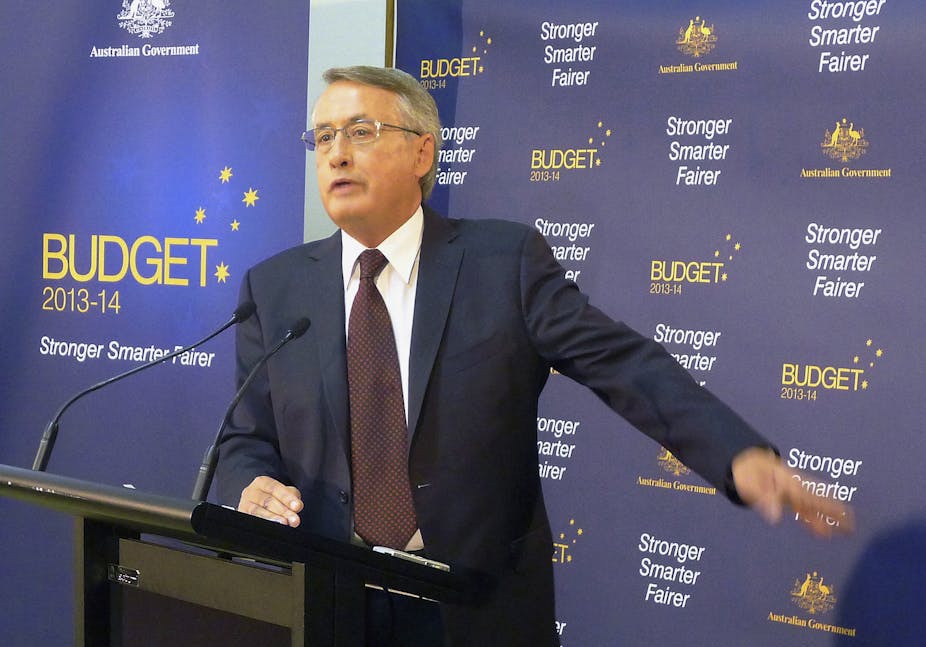
In 2013, then treasurer Wayne Swan announced that the PBO would provide full costings for all election promises made by political parties within 30 days of an election being held.

"Transparency would be further enhanced if the PBO were to prepare a post-election audit of all political parties, publishing full costings of their election commitments and their budget bottom line 30 days after an election.  This will remove the capacity of any political party to try to mislead the Australian people and punish those that do."

Who could possibly be against more transparency?  Or opposed to holding political parties to account?  No doubt Swan thought he was being clever.

Certainly he was hoping to cast the then opposition as being fiscally irresponsible.  Swan would soon lose his position as treasurer, but the post-election audit lives on.

In one sense the fact that budgets and budgeting make up a large proportion of political debate is a good thing.  Australians intuitively understand that underpinning a flourishing civil society is a sound economy.

To the extent that Australians are not as "relaxed and comfortable" as they were under John Howard, this is due to angst over the economy.  The downside of the obsession with budgets and budgeting is that many Australians don't have the time or inclination to explore the numbers in any detail.

The first problem with the PBO's latest release is that the material is published after the election.  By the 2019 election few voters will be interested in the PBO costings of the last election.

Policy tragics may well want to point to past mistakes, but overwhelmingly voters are forward-looking.  After all, Labor was able to win the 2007 election after its 2004 costing disaster.  The Coalition won in 2013 after its 2010 difficulties.

To avoid misleading the voters, this information needs to be available before the election.  That, of course, is not practicable.

The second problem with the numbers is that they lack context and proportion.  For example, we now "know" that the Greens policies would improve the budget bottom line by $8.2 billion over the forward estimates.

The Coalition's policies improved the bottom line by a mere $1.1 billion, while Labor's policies would have resulted in a $16.6 billion deterioration.  We're invited to believe that anyone concerned about debt and deficit should vote for the Greens.  Well, maybe not.

The Greens proposed tax increases of some $104.9 billion and increased spending of a mere $96.4 billion.  There are several problems here.  First, it beggars belief that an additional $100 billion of tax revenue could be extracted from the economy with no adverse effects.

For example, the Greens would abolish accelerated depreciation for aircraft, the oil and gas industry and motor vehicles.  The costing assumes "there is no change to the overall level or timing of investment as a result of this proposal".  But how plausible is that assumption?  This is a general problem with all political budgeting in Australia — the costings simply determine if the numbers are correctly calculated, not whether the policy is plausible or even sensible.

Costing methodology does not investigate the broader macroeconomic consequences of policy proposals.  To be sure, there are good reasons for this oversight, but it is a serious limitation of the usefulness of these costing exercises.

Then there is an implementation problem.  Pre-election policies are simply a wish-list.  There is no point in holding parties to account for pre-election wish-lists when actual policy outcomes are determined by the election itself.

In 2010, Julia Gillard had to promise there would be no carbon tax under her government.  Yet after the election, in order to actually form government, she had to break that promise.

Similarly, who would have expected four One Nation senators after the recent election?  The costs of any policy will be determined by the horse-trading necessary to pass legislation through the parliament.

To be clear, the ability to undertake plausible and sensible policy costings and prepare coherent budgets is an important part of winning office.  Yet those numbers need to be placed in a broader framework and narrative, which is lacking in the PBO report.

Tuesday, June 28, 2016

The Rise of the Joyful Economy

The relationship between the art world and the market economy has long been one of Sturm und Drang.  Deep down, a battle of weltanschauung plays out between light and dark, sky and earth, imagination and rationality, between two different value systems that still must occupy the same physical, political and moral universe.

The great value of modern cultural economics is to have brokered a grand reconciliation between these worlds, with the analytic concepts of market failure and externalities in cultural production and consumption, and the application of non-market valuation techniques to, as it were, price the priceless.  The result is a formula to transfer resources from the economy to the arts that is allocatively efficient, maximising the value of both.

And while the target of various grumblings from those who would prefer such decisions were determined more historically or politically, rather than economically, there is a rigorous beauty to this way of counting.

So it is an interesting development when a preeminent cultural economist (and economic sociologist) publishes a new book of broad historical sweep, arguing that the deep relationship between these two worlds (between the arts and the economy) is not what we have previously thought.  The book was the subject of a special, standing-room-only panel at the recent International Conference of Cultural Economists.

Michael Hutter's The Rise of the Joyful Economy (2015), which focuses on the visual arts, begins in 1420 with the development of linear perspective, and traces how that artistic development played out in the economy of the day, creating surprising new opportunities.

He then examines the paintings of conversations, of among others Joseph Wright, Francis Hayman and William Hogarth, and the way this focused a consumer revolution in the emergence of social taste.  Moving into the 1950s and 1960s, Hutter traces the translation of artworks into experience goods through case studies of repetition in the modernist architecture of Ludwig Mies van der Rohe (the Seagram building) and in Andy Warhol's Flowers series.

Later in the book he maps these artistic revolutions to three associated periods of economic growth:  the period of exploiting cognitive illusion (1430-1860);  the period of exploiting social relations (1730-1890);  and the period of exploiting serial variations (1920s-present).

Hutter then runs the argument the other way, examining artistic responses to economic change.  First in the "silent narratives of assertion" in merchant society in the paintings of Flemish artists Petrus Christus (Goldsmith in his Shop, 1449) and Pieter Aertsen (Meat Stall with the Holy family, 1551).  Then in the painting of new consumer entertainment of Parisian artists Antoine Watteau (Shop Sign, 1720) and Édouard Manet (Bar at the Folies-Bergère, 1882).  And thirdly in the intentional entanglements between high art and high commerce in, for example, Andreas Gursky's digital photograph 99 Cent (1999) and in Takashi Murakami's installation Vuitton Shop (2007).

These micro-sociological case studies in art history illustrate an overarching idea about the nature of the dynamics in the arts, culture, and the economy.  The idea is to conceive of distinct arts and economic worlds, or "plays of value" as Hutter frames it, and to propose a general theory of change that arises from the clash between these worlds.  This approach fundamentally recasts the relation between arts and economy by showing them to be statically distinct, but dynamically coupled.

Consider what this implies about the dynamics of both the arts world and the economy.  In the standard account, growth and change originate from within each world, from the artist and from the entrepreneur respectively.  The arts world and the economy are self-contained, linked only by brokered side payments (cultural policy) to generate efficient levels of output.  That understanding, in which the different worlds are distinct, is part of the modern consensus and the grand reconciliation between the cultural sector and the market economy.

But if Hutter is right, then that understanding is wrong.  If dynamics in each world originate from the clashes and irritations between each world (which Hutter both theorises and extensively documents) then we may need to rethink the basic relationships between economic and cultural policy.

Yet the book isn't about policy — a third "play of value", in Hutter's terms.  It's about a new type of economy that he seeks to differentiate from such policy fashionable neologisms as knowledge economy, creative industries, or experience economy.

Joyful Economy argues for us to redirect our attention away from isolated industry sectors towards the dynamics of tension and resolution, created by interactions between different "logics of worth".

The joy in The Joyful Economy is an answer to the brilliant but pessimistic Hungarian-American economist Tibor Scitovsky, who argued that a growing consumer economy that failed to nurture ever enhanced consumer sophistication in high quality experience goods would plunge society into, as he put it in the title of his 1976 book, a Joyless Economy.

Hutter does not fault the logic of Scitovsky's diagnosis, but finds that Scitovsky failed to understand the deeper co-evolutionary dynamics at play.  That difference matters because it is from those outworkings that the Joyful Economy emerges.


ADVERTISEMENT

Monday, June 27, 2016

Labor costings pass, but scare tactics detract

The ALP have just released their budget costings document.  I have mixed feelings — on the one hand it is a necessary feature of "democracy by auction", while on the other, it is necessary to prevent irresponsible and unaffordable promises hoodwinking the electorate.  It is also a game where the government of the day has an inbuilt advantage.

It seems to me that budget costings have to tell a plausible story about policy without being bogged down in gory detail.  The ALP failed this test in 2004, while the Liberals failed in 2010.

This time I think the ALP have a good story to tell — I'm just not convinced they tell it well.  Quite rightly, they point out that the Tony Abbott-Malcolm Turnbull government have done little to repair the budget damage inflicted by the previous Rudd-Gillard government.

Therein lays the problem — yes, the first two Hockey budgets were poorly conceived and poorly received.  That the ALP has managed to convince the electorate that Hockey's increased spending over Wayne Swan's last budget somehow represented "unfair" cuts reflects poorly on the government's communication strategy.

It is true that budget deficits have grown and public debt too.  One of the biggest mistakes the Abbott government made was to abolish the debt-ceiling.  If the ALP wanted to demonstrate its commitment to budget responsibility it would commit to re-introducing the debt ceiling.  This is one "hard decison" that both the government and opposition could commit to, yet neither does.

An additional criticism of the ALP costings is the petty and trivial examples given in the initial press release.  This is "form above substance" politics.  The first is to cap at $5000 the cost of managing tax affairs — this excludes small business and is aimed at a very small number of high income individuals.

It will "save" $1.7 billion over ten years (that is $170 million per year or 0.038% of this year's budgeted expenditure).  Then there is the removal of "junk" private health care policies that will "save" $384 million over ten years ($38.4 million per year or 0.009% of this year's budgeted expenditure).  These "savings" are highly speculative, but ultimately will make no contribution to budget repair.  Why mention them at all?

The ALP does two things well in its budget costings.  First it keeps emphasising that it has worked closely with the Parliamentary Budget Office.  This office was created expressly for the purpose of providing sound advice to politicians and to allow the electorate to have some confidence in electoral promises.  Second, it has invited a distinguished panel of public intellectuals — Robert Officer, Michael Keating and James MacKenzie to evaluate their costings and assumptions.

Importantly for our purposes the panel concludes:

All of the costings in Labor's Budget Plan are of a similar quality as budget estimates generally, and therefore represent a reasonable basis for assessing the net financial impact on the Commonwealth Budget.

Now make of that what you will — the Opposition's costings are just as good or bad as the government's costings.  In one sense that is very pleasing because we can then focus on the substance of the policies and abstract from the numbers themselves.  Mind you, the ALP doesn't reveal its assumptions, it provides long lists of budget estimates (so see for yourself that despite criticising the government on the NBN the ALP won't be spending anymore on it than the government will).

What is worrying is that both the government and the Opposition have a 10 year plan, and both plan to return the budget to balance in the same year, 2020-21.  In other words, a long time from now — after the next election.  That is simply not plausible.

The other difficulty is that the policy costings are long on slogans, long on criticism of the government and short on actual budget repair.

To be fair, the Abbott-Turnbull government is easy to criticise.  To be even fairer, the Abbott-Turnbull government has failed in precisely the same (economic) area where the Rudd-Gillard government failed.  The Shorten opposition don't address that collective failing anywhere in their budget costings.  Why will the ALP succeed now in its economic management, when it failed so comprehensively in its last term of government?

The ALP tells us it has a six point plan:

  1. Investing in people
  2. Building Australia
  3. Driving investment in new industry and renewables
  4. Supporting innovation and startups
  5. Helping small business
  6. Budget repair that's fair

That sounds like the long version of "Jobs and growth".  It is here that the ALP has to engage in scare tactics.  It is not clear what "privatising" Medicare even means.  How are we going to spend even more money on education — last time the ALP were in office we were tearing down perfectly good school halls and then rebuilding them.  Let's rather focus on increasing the quality of education before increasing the quantity of money thrown at education.  So the scare tactics are not serious policy work, they are transparent tactics to detract from the similarity in overall policy.

Of course in a democracy we expect the government and opposition to converge towards similar policies — and that, I think, is what is happening here.  Very similar policies and costings that are as good or bad as each other, however, don't suggest that a change in government is warranted.

So we have a competent attempt at policy budget costing — that must be good for the democratic process.  What is missing, to my mind, is a competent attempt to grapple with the actual budget deficit.  Mind you, they are hardly alone in that failing.


ADVERTISEMENT

Tuesday, May 17, 2016

Why public funding of the arts should always be temporary

Last Friday, the Australia Council announced what it called "a $112 million investment over four years to focus on small and medium sized arts companies".  Let's skip past the misleading polly-speak use of the word "investment" in that announcement (it's a grant, not an investment), and focus on the other clause "over four years".

The Australia Council's funding announcement contained some pleasant surprises for some organisations, and much disappointment for others.  One of the unfunded was Quadrant, a right-of-centre literary magazine, whose editor-in-chief lamented how unfair it was that the Australia Council continued to fund left-of-centre literary magazines.

But it's not the distribution of favours here that is the problem.  Rather, it is the unquestioned expectation of perpetual funding, whether from the right or the left irrespective of however worthy.

So it was good to see Arts minister Mitch Fifield emphasise, in a follow-up press release, not the case for the level of funding or the justice of the distributional consequences, but rather the temporary nature of Australia Council funding:

"It was always intended that slightly fewer companies would be funded at a higher level ... The Australia Council's funding contracts are for fixed terms, and are not in perpetuity.  Four year funding rounds provide new organisations the opportunity to apply for funding in a competitive environment, based on the Council's independent assessment.  A third of those receiving funding are new organisations."

Economic theory suggests that this is indeed the right way to frame this issue.

Government funding for arts organisations should always be viewed as temporary because there are significant costs and dangers that arise from an implicit contract to permanent funding.

Some government activities certainly should be permanent wards of the State.  National defence is a good example, and the Courts and Justice system is perhaps another.  And in a democracy with the power to tax and redistribute income, there may certainly arise a stable equilibrium about what that particular level of public funding for the arts should be (i.e. about AU$7 billion in Australia it seems).  But the idea that certain organisations should have perpetual access to that funding is anathema.

It is perfectly consistent to say that the Australian taxpayer should generously fund public arts and culture while at the same time arguing that no organisation should ever receive funding twice.  Why is that?

A central reason is the costs of capture.  Any organisation that is permanently publicly funded is much better integrated into government so that it can be effectively governed, brought under control, and subjected to voter scrutiny.  The exceptions to this rule mostly fall under the headings of national security.  The arts are not among them.

The offer of a permanent arms-length funding commitment veritably invites corruption.  Not the stashing-millions-in-a-Panama-account type of corruption, but the softer sort that happens as sinecures pile up on governing bodies, creating fiefdoms that entirely benefit the insiders who run them.  The benefit of temporary funding is that it minimises the window of capture.

This is not to say that temporary funding is inherently better than ongoing funding, but that governments are not the best source of ongoing funding.  Governments are much better suited to a temporary seed funding approach in order to get something started.  This can generate a public benefit without the expectation of a quid pro quo relation with the government of the day.

Ongoing patronage is much better suited to corporate or private funding, where building a close relationship is a good thing because it invites mutual monitoring and reduces transactions costs.  This is because both parties do indeed expect to benefit from the relationship.  A close relationship between a private organisation and a government patron, however, is inherently open to abuse and corruption because the relation is completely one-sided in terms of benefit.

Another reason is that turnover of funding creates competition that incentivises all parties to bring their best work forward.  Those in favour of permanent funding say it brings certainty to enable long term planning.  But in reality it has the opposite effect by removing all consequences for institutions that fail to engage in effective long term strategic planning for growth.

Permanent funding removes the hard incentive to develop new business models to grow the operation or organisation beyond the initial period.  It militates against long term thinking.

So how long is temporary?  This is the question we should be asking.  One or two years is too short to get anything started, and to get beyond initial experimentation.  Eight to ten years is probably too long, as it invites complacency.  Four years is probably about right, because it's long enough for things to be tried and for learning to take place, but short enough to concentrate the mind on ongoing viability from day one.

So I'd like to suggest an addition to the Minister's emphasis that Australia Council contracts not be imagined in perpetuity.  Why not consider a lifetime cap, such that for any organisation there is a maximum number of years beyond which it could never draw upon public funding.  A variation on this is a lock-out principle, where if you not only received but even applied for funding in one round you would be locked out of the next.

This sounds harsh, but the logic to this is the problem of asymmetric information.  Governments and funding bodies do not know (and cannot know) what the true capabilities and intentions of any arts organisation really are:  all they can know is what the organisation tells them.

The organisation's incentives are to express maximum need, and to promise only delightful outcomes when funded.  To get the incentives right, there has to be a cost to seeking public funding.

Adding further layers of paperwork and panels only causes organisations into invest more heavily in grants writing.  But a hard cap or lock-out, incentivises organisations only to put their very best work forward.

A better principle for government funding of arts and culture is that it should only be temporary.

The idea of celebrating that "one-third of those receiving funding are new organizations" means that we still have "two-thirds" of the way to go.


ADVERTISEMENT

The crunch keeps coming on Fairfax — but does the blame lie solely with management?

Last week a reported 20 to 30 Fairfax Media journalists were made involuntarily redundant.  While recognising in a dynamic economy that businesses will contract and expand all the time, we should never lose sight of the human cost of that process.  Getting sacked must a traumatic event for anyone — getting sacked through no fault of your own, doubly so.

The journalists at Fairfax blame current management, describing CEO Greg Hywood as being "overpaid and underperforming".

And the latest Australian Bureau of Circulations (ABC) Paid Media Audit Data can be cited in support of the notion that Fairfax management are to blame.

Year-on-year quarterly circulation figures for the January to March 2016 period show print numbers for the Monday to Friday editions of the Sydney Morning Herald fell by 8.7%, while The Age fell 7.9%.

Certainly, declining print circulations are a feature of the continuing disruption of traditional publishers, not just for Fairfax.  The Monday to Friday editions of the major NewsCorp tabloids the Daily Telegraph and Herald Sun also fell by 5.3% and 3.10% respectively.

Sales of the two national dailies fell too — but the Australian Financial Review's sobering fall of 10.5% (even factoring in that the January period is a quiet time for business and it didn't publish for some of this period) dwarfed that of The Australian, which declined by 2.1%.

The picture for Fairfax isn't any better if we look at digital sales.  The Sydney Morning Herald showed flat growth of 0.9%, while The Age declined by 3.4%.

This contrasts to significant increases in digital sales for the Rupert Murdoch-owned NewsCorp competitors, The Australian and Herald Sun — albeit these were from a much lower base.

These numbers, however, don't speak for themselves.  It appears that Fairfax newspapers are under-performing their competitors, but we really want to understand why that is so.

In addition to the global disruption the print media industry is experiencing, there are local factors at work too.  There is no shortage of "centre-left" (or small "l" liberal) news and opinion in Australia.  So the market position occupied by The Age and SMH is highly contested space.

The ABC, the Guardian, and (dare I say) The Conversation, for example — there are others, are all direct competitors in that space (and it's important to make the distinction that none of these have commercial paywalls).  Each of those media outlets haven't just taken Fairfax consumers, they very often employ former Fairfax staff too.

More importantly Fairfax's print media competitors all have patrons with deepish pockets willing to underwrite media losses.  Fairfax has failed to attract (or keep) such a patron.

So there are at least three sets of factors that can explain the relative decline of Fairfax's newspapers.  Global disruption — something that is impacting all media — local industry conditions, and poor management.  As indicated above, the data suggest poor management — yet I'm not entirely convinced.

It isn't clear that the current Fairfax management are to blame for their predicament.  In 2014, former Fairfax CEO Brian McCarthy blamed the decline of the Fairfax papers on the Board of Directors.

But the other point to bear in mind is that while Fairfax has adopted a "digital first" strategy which has underpinned the latest orgnaisational changes and redundancies, its newspapers are still considered by many readers as Fairfax's public face.  In recent years readers have seen the broadsheet papers become tabloid size papers, the departure of many and often much-loved journalists and as the printing arrangements modified.  They have seen grammatical and spelling errors increase as sub-editing functions are sub-contracted out.

Even while Fairfax journalists can point to a number of large and important news stories it has broken in the last 12 months, there is a perception of a decline in quality standards and quality control overall.

Clearly cost-cutting has not always allowed Fairfax management to deliver the outcomes they had hoped for, or expected.  Talk that print versions of The Age and Sydney Morning Herald will be discontinued (on weekdays) has intensified.  But overall, Fairfax has returned to profitability and corporate debt has been reduced.  To be sure the glory days of a share price above $4 many not return anytime soon, but the company may well survive — just not (some of) the newspapers.

With the disruption in the media market it is difficult to know what more Fairfax management could have done to keep the newspapers going.  Nobody can deny that costs were cut — it has been brutal.  At the same time nobody can deny that many readers are unhappy with the product they now get.  It could well be that given industry conditions Fairfax cannot deliver the papers that their readership expect.  Yet the Australian Financial Review (albeit with a smaller, specialist business audience) remains a good quality paper, and the Fairfax radio stations remain popular.

As an outside observer it is difficult to untangle the net effects of poor industry conditions, global disruption, and poor management.  While employees are blaming management, they too are not well-suited to making those distinctions.  This brings us back to the patronage model.

One of the benefits of having a large shareholder on the register is that they get to perform a monitoring role.  What Harold Demsetz and Kenneth Lehn call "control potential".  Large shareholders are in a position to closely examine the market conditions a firm face and the management responses to those conditions and form well-informed opinions as the causes of good or bad performance.  Demsetz and Lehn also speak about patronage (they refer to this phenomenon as "amenity potential") in the media industry.

If anything the biggest failure of Fairfax's current management is in attracting a major large shareholder.  Some years ago Gina Rinehart almost took on that role but, rightly or wrongly, she was an unacceptable choice to the Fairfax staff.

It will be sad to see the end of venerable mastheads such as The Age and Sydney Morning Herald.  In their heyday they were fine newspapers — changing economic conditions may well explain more of their decline than does poor management.

In that sense, of course, print media (with its large workforce) may become like so many other obsolete industries — we're sad to see them go and experience some nostalgia, but no matter how good or bad the management, the business model could not survive change.


ADVERTISEMENT

Tuesday, May 03, 2016

Federal budget 2016:  What rhymes with ''submarine''?

The main thing that happened with the arts in the 2016 budget is that nothing happened with the arts in the 2016 budget.  The arts and culture are obviously not to be part of this coming election campaign.

“This is not a time to be splashing money around” said ScoMo, and then didn't, except on dams and trains and submarines.  So much money splashed on so many submarines.

On the face of it, that's good.  It means that the new and existing models (e.g. Catalyst, carved out from the Australia Council) are being bedded down.  Whatever you think of the new model, which has moved A$15 or so million into a centrally allocated program, this is now the model.  So there is value in being ignored, in being made neither a priority, nor a target.

The main benefit, as I see it, came from the corporate tax cuts, small, but a good start.  A healthy arts economy ultimately comes from private spending, corporate sponsorship and philanthropy, not from government handouts.

Anyway, someone's got to paint all those submarines.  Write songs about them.  Make the movies and stories and evocative dances that show us as a great, nay proud and unrivalled, submarining nation.


ADVERTISEMENT

Friday, April 01, 2016

Why economists love and premiers hate the idea of income-taxing states

Malcolm Turnbull has called for a dramatic shift in Australia's model of federalism, specifically seeking to allow the states to levy their own income taxes.  Many economists regard this as sensible and much-overdue reform to correct a deeply entrenched problem in Australia's fiscal constitution — vertical fiscal imbalance.

But it was met with two types of outrage and scepticism.

The first was from those who heard it as more taxation.  But the argument is for a shift from a federal income tax to a state income tax.  In principle, this can be done in a completely revenue-neutral way.

That would make it tax reform, not a tax grab.  And that would, on the whole, benefit Australian taxpayers because a more efficient tax system is a less costly tax system.

The second came from the state premiers.  With the exception of Western Australian Premier Colin Barnett, they hated the idea.

It's important to understand why.  This is not because the idea is bad for the citizens of the states, with the premiers being outraged on their behalf.  Rather it is because it is bad for the political classes themselves, and the premiers in particular.

To see why, we need to introduce a somewhat obscure economic model from public finance, developed by Charles Tiebout in 1956.

Before Tiebout's work, the best economic thinking about the provision of public goods argued that a powerful central government should provide these in order to overcome the free-rider problem, which required the use of political force to compel those who would seek to consume the public goods or services but avoid paying for them.  No one can hide from a federal income tax, so no citizen can free-ride.

The major flaw in this mechanism is what economists call the "preference revelation problem".  Centralised funding discourages citizens from honestly signalling, through their votes, their true preferences for local public services (such as education and healthcare) and what they are willing to pay for these in taxes, because regardless of what you might want, you pay for the same set of public goods — i.e. there is just one level of income taxes.

The result is that when services are provided at the state level, but paid for at the federal level, every premier has incentive to claim their citizens want the most and best services possible.  Indeed, they would be crazy not to when other states are jointly paying for them.

The result is a perpetual war between state and federal treasurers, a lot of economic choices converted into political deal-making, and an eternal problem of vertical fiscal imbalance.

But Tiebout pointed out there was a non-political (or market) solution to this problem:  namely federalism, or what came to be called "voting with one's feet" and can equally be called "shopping for public goods".

The basic idea is that the states compete with each other by offering bundles of public goods at different prices (i.e. taxes).  This is the significance of the state-level income tax.  Victoria, for example, may offer very high levels of public services, but also at a high price through high state income taxes.  NSW may offer more moderate public services, but also much lighter taxes.

What happens next is that citizens sort themselves over the states according to their preferences.  Those who value high levels of public services move to Victoria, where they pay that marginal valuation in high taxes.  Citizens with preferences for lower levels of public services and also taxes move to NSW.

This is a market, not a political, model of local public goods.  Economists like it because it encourages competition between the states to provide an efficient bundle of public goods and services at a point that voters (as consumers) are willing to pay.  This competition tends to produce an efficient outcome.  Consumers reveal their true preferences for public goods and services by their choices about what state to live in.


THE CAVEATS

Now obviously there are limitations to this process.  There are costs to moving, and for many citizens these costs will be prohibitive.  But the model does not require everyone to move, just that the incentives work at the margin.  In which case, the premiers are also incentivised to seek to provide the bundle of public goods and services that their constituents want and are willing to pay for.

That is not the situation we have now.  Premiers are incentivised to represent their citizens as all wanting the maximum amount of public goods and services, because someone else is paying for them.

State income taxes (coupled with reduced federal income taxes) are a way of implementing this mechanism.  The main winners from this will be the 7 million or so Australian taxpayers, because it will deliver a much more efficient supply of public goods and services.  The main losers will be the state and territory premiers, because they will have to compete in the market for political goods and services.  So it's probably an even fight.


ADVERTISEMENT

Wednesday, January 06, 2016

Dick Smith couldn't compete and that is why it failed

Troubled electronics retailer Dick Smith's shock receivership leaves investors and customers on tenterhooks.

All those shoppers who bought gift cards during the Christmas retail rush will be outraged to discover they are now "unsecured creditors", while investors who bought in to the company at $2.20 per share a mere two years ago have lost all their money.

Administrator Joseph Hayes from McGrathNicol is barely in the door but already the post-mortems have appeared.

The future of the business — and its 3300 employees — hangs in the balance.  But an important question is whether this is an isolated failure, or the first of many business failures in some sort of contagion?

Woolworths sold the retailer to private equity firm Anchorage Capital Partners in November 2012, which then floated the company on the stock exchange a year later for $520 million.  After the sale the new management team set about getting rid of what it called "aged and obsolete" stock, writing down the value of its inventory by $58 million.

It may well be that the business expanded too rapidly in the last couple of years.  The retailer's annual report highlighted the opening of 25 stores.

If, as suggested by Stephen Batholomeusz, the market was at fault for not properly analysing the implications of the restructure before the initial public offering, this is small comfort to employees and consumers now.

In a dynamic economy businesses should fail on a regular basis.  In a growing economy those businesses will be replaced by other, more efficient businesses and consequently workers and consumers, and investors too, will be better off over time.  This is what Prime Minister Malcolm Turnbull had in mind when he spoke of a disruptive economy.

So on the one hand, a business that expands too rapidly and experiences financial distress, as may have happened to Dick Smith, suggests an isolated failure.  On the other hand, with economic growth being sluggish and world economic growth predicted to remain sluggish we might expect more business failures in the short term, with workers struggling to find new jobs and consumers reining in their spending.

Dick Smith has many competitors — including JB Hi-Fi and Harvey Norman, and even Office Works, Bunnings, and Aldi for some product lines.  Despite deep discounting well before Christmas, Dick Smith was unable to generate the bumper Christmas sales it was expecting.  But it seems Dick Smith was never expecting massive sales growth — looking at its prospectus in 2011 it had revenue of $1.28 billion and by 2014 it was forecasting revenue of $1.226 billion.

Yet investors seemed to believe a company then worth about $20 million was worth $520 million.  Investors and regulators are going to look long and hard at private equity floats.  But the lesson here is that equity investors need to do their homework before investing.  The old adage, "If it's too good to be true, it probably is" applies.

This all suggests that a poor competitor has exited the market.  Sad, and not without a human cost, but that is how our economic system operates and is intended to operate.

That perspective, however, is not grounds for complacency.

All of Dick Smith's competitors have been expanding too.  They too have financing costs that require servicing.  They too have to work at meeting the demands of consumers who can be quite fickle.  Just because the economy is sluggish doesn't mean the disruption is going to go away anytime soon, if ever.

On a positive note the failure of a poor competitor does suggest that we're unlikely to see a wave of business failures.  This isn't the beginning of a contagion where we see a whole spate of similar firms suddenly experience financial stress and failure.  There are lessons to be learned (actually re-learned), but no profound revelations.

From a policy perspective the question becomes what, if anything, should government do?  Over the past couple of years the government has focused on GST collection as a means to assist Australian retailers compete against internet sales.  This is mostly propaganda to justify a tax grab.  It is not at all clear to me that diverting money from consumers to Canberra will assist local retailers, or even foreign retailers for that matter.

What needs to be done is to make it easier to start businesses in Australia, easier to employ people, easier to invest in Australia, and easier for Australians to trade with foreigners.  I fear that our political elites are currently focused on meeting those objectives.

Surveys on business confidence in the Turnbull Government had mixed results in November 2015.  A survey from Roy Morgan showed an increase in business confidence of 6.5 points in October, 16.3% higher than in August.  However a NAB survey for the same month reported muted business confidence.  The most recent survey results in business confidence are yet to be released.

Yet I remain cautiously optimistic.  The economy remains structurally sound — the challenges it faces are mostly political.  Politicians need to take their focus away from themselves (and each other) and focus more on getting the economy and business going again.  That means cutting the tax burden, cutting wasteful spending, cutting red tape, cutting green tape, and toning the anti-business rhetoric down.


ADVERTISEMENT

Monday, December 14, 2015

Do Plantoids Dream of Electric Arts Council Grants?

I was at the Blockchain Workshop in Sydney last week, whereupon among many wondrous things I did happen to see the very future of the arts economy in what Primavera De Filippi, a researcher at the Harvard Berkman Centre and founder of the Okhaos artist collective, calls the Plantoid.  A Plantoid is to a plant, what an Android is to a man.

The Plantoid hires artists to make copies of itself.  Now I appreciate that this might sound a little crazy, but I'm completely serious:  our new robot plant overlords need your bitcoins to hire artists in order to replicate and evolve.

Let me start at the beginning.

The tangible aspect of the Plantoid is a pretty standard although aesthetically-pleasing gears-and-steel contraption controlled by a Raspberry Pi processor.  What's more interesting is its intangible aspect, its soul perhaps, which is an Ethereum-based smart contract on the blockchain, making the Plantoid an autopoietic decentralised autonomous organisation (DAO).

Even the smartest and most worldly of Conversation readers will probably struggle with at least some of the concepts in that last sentence, so work through the links:  that's what they're for.

But the basic idea is that Plantoid is a new species (it's a new species of "plant", which are no longer carbon-based, but rather blockchain-based) that exists as both a physical presence and also as a virtual legal and economic presence on the blockchain through the techno-legal agency of bitcoin and smart contracts.  It's a "blockchain-based entity", as De Filippi explains.

The Plantoid interacts with the real world through its DAO, providing explicit contractual incentives for artists, and other humans, to participate in its reproduction process by feeding the Plantoid with bitcoins.  The Plantoid has its own Bitcoin wallet.

How did the Plantoid get these bitcoins?  Someone else gave them to it, because they liked it, because it did something valuable for them.  The prototypes at the Sydney Blockchain Workshop did a little wiggle and dance, with a glittery noisy light show.  It's primitive perhaps, but it was a form of appreciation.  And it was evolutionary successful, in the sense that the Plantoid got bitcoins.  When they get enough funds, the Plantoid's smart contract triggers the reproduction process by calling for bids from artists to submit ideas as to how the Plantoid could replicate.  Those who initially funded the Plantoid will evaluate these submissions, and once consensus has been reached, the Plantoid will hire and pay the artist to produce a new copy of itself.

Do you see how that works?  Real plants use insects to pollinate and reproduce;  the Plantoid uses humans and bitcoins to reproduce.  The funds are not directly given to the artist, but rather to the Plantoid which accumulates capital, through its Bitcoin wallet, until it can afford to hire an artist to reproduce.  The hiring is done automatically, through a Bitcoin transaction issued as a result of the governance structure encoded in the Plantoid's smart contract.

This model is a further elaboration of the open-source model of production, which enables artworks to evolve on their own, regardless of the will of their original creators.

The actual mechanism by which Plantoid reproduces is pretty interesting, and incorporates an internal reward incentive or pyramid scheme.  The Plantoid is connected to its ancestors and its descendants who it can transact with through the blockchain.  It is also connected with its patrons, who gave it bitcoins.  Those patrons get to vote on the submissions from artists vying for the reproduction contract.  As the Plantoid cannot decide on the merit, humans help it with the decision, thanks to a blockchain-based consensus mechanism.

And the contracted artist gets to reinterpret the Plantoid, within the confines of its founding protocols or DNA.  In this way the Plantoid adapts and evolves into different directions, which each constitute a particular evolutionary branch.

The artist is incentivised not just because of their contract for service, but also because they will become part of its future inheritance.  The Plantoid uses most of the bitcoins for reproduction, but it also passes some back at each stage to its ancestors (a 5% royalty in the debut configuration), and the artists who made them.  Hence, the more successful a Plantoid is, the more it will be able to reproduce, and thus the more money will pass back to the original creators.  Primavera points out that this is actually an evolutionary self-sustaining pyramid scheme.

The Plantoid is a fascinating and enormously fun conceptual experiment that shows some of the radical promises the new blockchain technology may bring.

First, it enables the artwork itself to be an independent agent, which is both autonomous and self-sufficient.  The artist doesn't own the artwork.  In fact nobody can own the artwork:  that would be equivalent to slavery.  The artwork owns itself and hires the artist to create a replica of itself.  That's what it means to say that it is a decentralised autonomous organisation.

Second, this creates a new arts economy and ecology that has no need for intellectual property.  This means that the constraints of intellectual property, such as restrictions on use, are also unnecessary and even detrimental.  Indeed, the Plantoid (and its creators) actually benefits from encouraging dissemination, reuse and remixing.

Third, the Plantoid need not be a rapacious profit-hungry beast (although it could be).  The COALA Plantoid has its protocols set (and inherited by all descendants) to make it a charitable artwork, as 50% of all profits it accumulates for reproduction are transferred to the COALA organization.  So different governance structures are not only possible but are actually desirable as Plantoid seeks to survive and prosper in different human environments.

So send bitcoin to the Plantoid, so it can hire an artist to reproduce itself.


ADVERTISEMENT

Wednesday, November 04, 2015

Australia wins at the global creative game

I like a good index, and the University of Toronto-based American economic geographer Richard Florida has been my main supplier for a few years now.

His super-popular Creative Class products are all made of the same three progressive ingredients:  Technology, Talent and Tolerance.

The label on the bottle tells an uplifting story of how great American cities are not made of steel mills anymore, but of gay-friendly citizens, great universities, and bicycle paths.  Like Helen of Troy, his ideas were of such inestimable beauty that some 1,000 city government plans were launched to create, at very least, some of these university-flavoured bicycle paths.

Dr Florida's idea is that you take these policy prescriptions, then you wait (it was never actually specified how long — some say 10-15 years) for the effects to kick in.  What will happen is that first you will start to feel creative, and then later prosperous.

So I always look forward to my latest delivery of creativity index.  This year's product (from his fine research group) does not disappoint — being a Global Creativity Index no less!

We're #1!

And guess what?  Australia is number one!  We win at the global creative game!  Ozzy, Ozzy, Ozzy!

NZ is number three — suck that NZ and your stupid Rugby World Cup — and the USA is rather pathetically only number 2.

(An entirely predictable list of Canada, some bicycle path-ridden Nordic countries, Singapore, and some other overeducated quasi-Nordic countries make up the rest of the top ten.  The 11-20 spots are mostly occupied by the good coffee precincts in the Eurozone.)

Australia wins because of its consistent performance over all of the measures.  Most countries fall down on at least one.

Australia is 7/112 on the Technology index component.  (South Korea, Japan and Israel make up the top 3.)

Australia is 4/136 on the global tolerance index, a mix of attitudes to gays and lesbians and racial and ethnic minorities, only just behind the world-class tolerance of the Canadians.  But they also gave the world Justin Beiber, so should probably lose some points for that.

And get this:  Australia is 1/134 on the global talent index.  (This is a mixture of creative class density, and educational attainment.) That's amazing — we win over education powerhouses of Finland, Singapore, Denmark and the US because of our proportionally higher ranking in the creative class measure, which in many ways is a reflection of the high past quality of Australia's education.

Yay!  Now what?

So, what would be an appropriate way to celebrate this great and deserved win?  Let me suggest with a few hearty rounds of deregulation.

If these index findings are indeed true — and I have no reason to doubt them:  the list of ingredients is clearly labelled on the bottle — then our economic and cultural performance, our overall prosperity, should be better than it is.

Some ingredient is missing.  Australia is a world-beater at the creative game.  But we don't seem to be as good at translating that sort of winning creative on-field performance over inputs (our tolerance, our talent, our technology) to the off-field realm of deliverables, our "merchandising" if you will.

What's missing from our great potential in innovation is entrepreneurship.  Being creative is not enough.  We also need to improve our entrepreneurial game.  (This same point was also made, in specific reference to Australia, by the US think-tank the Kauffman Foundation.)

I produced a report last year entitled Where have all the entrepreneurs gone?.  It showed how the number of new firms created has fallen by almost 50% since 2002.  A major reason for this is the high and growing regulatory burden in Australia, which raises the costs of entrepreneurship, inhibiting entry.  This is bridling our great creative potential.

Maybe the Assistant Minister for Innovation Wyatt Roy will lead us though this with the tech-community's favourite answer:  start-up incubators and accelerators.

But a better strategy to work on our translation game is simply to increase the size of the team on the field.  This doesn't require redirecting resources, or increasing taxes, but simply giving our highly creative world-class players a bigger, freer space to run.


ADVERTISEMENT

Tuesday, October 27, 2015

Film Thor promises an Australian jobs bonanza, but don't believe the hype

Flanked by a smiling telecast of actor Chris "Thor" Hemsworth and director Ridley Scott, foreign minister Julie Bishop and arts minister Mitch Fifield last week announced some blockbuster news for the Australian film industry.

Production of upcoming films Thor III, Thor:  Ragnarok, and Prometheus 2 from the Aliens franchise would all take place in Australia, they said.

True, Australian taxpayers will be partially footing the bill, with the Australian government chipping in A$47 million to 20th Century Fox and Disney's Marvel Studios to entice them onto Australian shores.

But the benefits will far outweigh the cost, we are told.  According to Fifield:

Every job created in the film and television industry supports 3.57 jobs in other industries.  Every dollar of turnover creates turnover of $3.52 in other industries.  And an amount equal to 13-20% of spend comes back to the Australian Government in taxation, and a further 3% goes to state governments in the form of taxation.

There's only one problem:  those figures are simply conclusions drawn from economic models (called input-output models) that assume very generous multiplier effects from initial government investment.


The magic of economic models

To be fair, Fifield is quoting industry figures and a 2013 report titled Valuing Australia's Creative Industries, prepared for the Creative Industries Innovation Centre by consultants at SGS Economics and Planning.

These sorts of consultants' economic impact studies drive economists crazy because of the way they are used to imply that a change in spending will multiply through creating all sorts of new jobs.  But that's not what these models mean.

I would argue that governments do not and cannot create jobs — only markets and entrepreneurs do.  Why?  Because creating jobs is hard and requires discovering new sources of value that others had not seen.

If the figures in Fifield's assertion were correct, then surely private investors (in the form of the financing industry) would have already spotted those opportunities.

And where does this blockbuster enticement money come from?  From tax, obviously.

And when you tax an existing business, you are imposing additional costs upon it.  That destroys incentives and jobs.  So for the extra jobs and spending created by giving money to one group, you have to subtract away the jobs and spending lost from the ones you took the money from.  Usually those will be similar, so there will be zero net effect.  But the figure could even be less than zero, because of the distortion created by the political interference.

And then there are rent seeking effects, where the beneficiaries of the subsidies (the film studios) spend resources lobbying for these tax breaks.  This is unproductive spending, further compounding the waste.

So when you hear about the wonderful flow-on benefits of hosting these film productions in Australia, don't simply wonder if the numbers are inaccurate.  It's not as though it is really 2.07 rather than 3.57 broader Australian jobs that every job in the film and television industry here supports.

It's that these are not checkable facts in the first place.  They are political promises that are never subsequently verified for their accuracy as a prediction.

And this is not just true of film and television.  It's true of every sector that seeks to promote its economic impact to public spending, such as big sporting events like the Olympics or the Formula 1 Grand Prix in Melbourne, which routinely promise thousands of jobs created and enormous multiplier effects.

As always, it's worth taking such political assurances with a very large grain of salt.


ADVERTISEMENT

Wednesday, October 14, 2015

Why the Reserve Bank isn't the right regulator for our payments system

Sometimes boring debates are important.  Mind numbing detail gets in the way of good policy.  So it is with an obscure feature of credit cards known as "interchange fees".

At the moment these fees are both highly regulated, and inappropriately regulated by the Reserve Bank of Australia (RBA) and not the Australian Consumer and Competition Commission (ACCC).

People tend to overlook the complexity of the market economy.  It seems all so easy.  People trade goods and services all the time.  The Payments System is how we actually pay for things.  It isn't simply a matter of handing over cash — the Payments System is a complex technological infrastructure, a web of interconnections and protocols between consumers, merchants, and banks.  Cash makes up a part of that system but most of it runs on payments technologies that include debit cards, eftpos, and credit cards.

Here is where things get wonky — how many people actually understand how their credit card works?  Most people simply swipe their cards and all the "backroom stuff" that actually facilitates the transaction happens.  Card payments are very convenient for everyone.

But there is no such thing as a free lunch or a costless transaction.  All the technology and organisation that underpins the credit card system has to be paid for.  The costs can either be paid by consumers, or merchants, or some combination of the two.  That is where the so-called interchange fee comes in — historically merchants have paid the costs of operating the credit card system.

All that started changing in 2003, however, when the RBA began regulating interchange fees.  The rationale being that interchange fees were somehow monopolistic and the costs of operating the Payments System too high.  We have argued that this policy was a mistake.

Here we want to address a more general question:  Why is the RBA regulating interchange fees at all?

At first glance this seems a bit trivial.  After all the RBA is responsible for the conduct of monetary policy and it sets the overnight interest rate.  Credit cards are about money too, so it's obvious that the RBA should be involved in regulating them too.

Actually, no.

The main argument for why the regulation of the payments system remains with the RBA can be summarised, in essence, as "because it has been with the RBA since 1959".  There is no strong or explicit case for positioning the oversight and regulation of the payments system within the RBA.  There are a number of implicit arguments that can be approximated as follows:

  • That the payments system has some connection with the monetary system — payments are made in money, and because the RBA controls money, it should also control payments.
  • Interchange fees are connected to credit cards and credit cards involve interest rates — monetary policy involves interest rates, ergo the RBA should regulate interchange fees.  (This is a variant of 1 above).
  • The payments system is a utility, (albeit run by the banks) or public good.  Therefore the central bank should regulate this.
  • The RBA has acquired historical experience in oversight and regulation of the payments system, and so it should continue in this role.
  • The RBA should regulate the payments system because it can regulate the payments system.

It does not require a great deal of logical skill to disassemble these arguments:  (1) and (2) are fallacies of composition;  (3) is an empirical claim;  (4) is the induction problem, and (5) is the naturalist fallacy.  The point is that none of these are solid economic arguments, each can be picked apart logically and empirically, and all carry a large amount of expediency.

The Payments System is not a public good and not a utility.  Rather it is a suite of technologies and organisations, that is, an industry.  It is useful to think of the payments system as a network infrastructure that has cumulatively emerged from entrepreneurial actions, as the economy has grown and developed, in order to facilitate the transaction needs of a market economy.

By contrast monetary policy is a utility, and monetary stability is a perfect example of a public good.  It is both non-rivalrous and non-excludable.

While there is no good economic argument for the RBA to regulate interchange fees, there are good arguments why it shouldn't.  In short — it is likely to be a distraction from the RBA's main function.

Monetary policy is a specialisation based on the theory of both monetary economics and macroeconomics.  It is built around the analysis of interest rates and various indices (inflation, asset prices, aggregate demand, GDP, unemployment, industrial production) and involves an understanding of emergent aggregates, transmission mechanisms, and macro-econometric models of economic systems.

Regulatory economics is, in essence, the study of the social control of business and is a very different branch of economic theory and practice to monetary economics.  It is entirely based in microeconomic theory (not macroeconomics) and is focused on private market behaviour under different degrees of competition (from perfect competition to monopoly).

So the RBA has no comparative advantage or good reason to regulate the Payments System.  Australia already has a specialist agency to regulate industry — the ACCC.  So in the first instance we argue the RBA should be stripped of its regulatory powers and focus its entire attention on monetary policy.

Of course once we recognise that the Payments System is an industry rather than a utility, the question arises why government would fix prices in that industry.  So whether the ACCC should fix prices is an open question of competition policy.  Our argument here is that the RBA has no business in regulating industry.


ADVERTISEMENT

Monday, September 28, 2015

Leaving legacies behind:  arts policy for the here and now

Malcolm Turnbull wants to be a 21st century leader of a 21st century government with a 21st century frontbench.  So how might that translate into a 21st century Australian arts policy?

First, let's take a look at how we got here.

Arts policy began in the depths of World War II Britain with the formation of the Committee for the Encouragement for Music and the Arts, the forerunner of all modern Arts Councils, the first chair of which was the arts patron and economist John Maynard Keynes.

Modern arts policy has never really departed much from this initial charter of Keynesian-type tax-and-transfer justifications and centralized elite representation.

This can be observed plainly in the International Federation of Arts Councils and Cultural Agencies, which, for all its new-management speak of "good practice guides", is still an industry lobby devoted to spending taxpayer money on its clients.  This is not the place to look for 21st century solutions.

To bring arts policy into the 21st century, we need to update and correct the basic economic flaws that were baked into the mid-20th century model.

We must recognise that:  (1) the once plausible market failure justification is no longer, (2) producer-focused industry protection has systematically failed, and (3) that an elite, protectionist focus is unsustainable.


End of Market Failure

A standard justification for government spending through the 20th century was market failure.  Market failure occurs when market incentives (i.e. prices) are insufficient to induce the "correct" level of private consumption and investment evaluated from a social welfare perspective.

The solution to this alleged failure is for government to step in.  Arts and culture was widely argued to experience market failure because of what economists call uncompensated positive externalities and endogenous preferences.

Simply put, uncompensated positive externalities means the private production and consumption of art benefits the broader community, who can experience that benefit without paying for it.  Endogenous preferences refers to the age old belief young people don't really know what is good for them and will tend to choose the "wrong" culture.

Former minister for the arts, George Brandis, introduced funding policies that prioritised "heritage arts" such as opera and classical music.  It's the same type of argument parents make about broccoli.  The upshot was a raft of direct subsidies to elite cultural producers.

But in the 21st century, are these market failures still there?  There is a strong case to say no — they have mostly vanished, and as the US arts and cultural economist Tyler Cowen argues, for reasons largely associated with market-driven economic growth and technological change.

New information technologies of search, coordination and payments, and digital technologies of production, storage and dissemination — think crowdfunding platforms such as Kickstarter, Pozible, Indiegogo and GoFundMe — have phenomenally lowered the costs to both finding niche audiences and producing content for them.

Technological change has shifted the margin of the range and scope of artistic production that is now profitable.  The market no longer fails.

The classic funding model in the arts is patronage, which was taken over by government mid-20th century, in what appeared at the time to be the crisis of capitalism.  But capitalism has well and truly come back, and created vast wealth that can be recycled through effective patronage and philanthropy, whether corporate or private.

It is also far from clear that the arts are a public good, benefiting the general public and deserving public subsidy, but might rather be better understood as an industry designed to primarily benefit its own members.


Consumers not producers

A further great lesson from 20th century economics is that policy should focus on seeking to create benefits for consumers, not for producers.

Producer-focused policy, which was an outgrowth of the economic socialist planning models of the mid-20th century, was standard practice across the economy until relatively recently.  In industry after industry, these were the models of subsidy and protection that caused producers to devote great efforts to lobbying agencies and politicians — a wasteful activity that economists call "rent seeking".

What they didn't need to do was to devote resources to producing better products, or new technologies, or new business models, or cheaper products.  So producers were focused on courting government, not consumers.  This turned out to be very bad for consumers.

These economic policies did benefit producers, who could organise to seek these benefits, but invariably harmed consumers, who were not so well represented.  They were, in other words, politically but not economically successful.

The same argument applies if we substitute artists for producers, audiences for consumers, and Arts Council Boards for government.

The basic problem with the current 20th century arts funding model is that it remains producer- or artist-centric, rather than focusing on audiences and citizens.  This makes it ripe for capture and lobbying.

It almost guarantees that it will only produce what the artists want to produce, because of what benefits them, or what the Arts Councils want them to produce, not what the audiences and the citizens who pay for it all actually want to see.


Creative industries

A major global shift in the policy perception of the arts and culture began in the UK in the late 1990s, with the gradual rebranding from a backward looking cultural heritage model and toward an innovation, design and content focused "creative industries" model.  This was lead by the UK Government's Department of Culture, Media and Sport.

This has manifested in the movement of the arts and culture portfolio from the periphery of strategic politics to ever closer to the central portfolios of innovation and economic growth and development.

The basic idea here is to recognise that a 21st century economy is no longer a mass industrial economy, but one that is increasingly dominated by knowledge intensive services.  The arts and culture can thrive in such an economy when it engages and interacts with it.  The old protectionist model is a very poor fit here.


A new arts policy approach

So let's shed the legacy of the 20th century.  That means being utterly clear about what that legacy was:  it was a producer-centric, subsidy-based model.

A better approach will be one that recognises the new power artists have to appeal directly to their potential audiences for funding.  The government no longer needs to create tax-payer-provided havens for the profit of artists and producers.

As an Internet commerce pioneer, Mr Turnbull, of all Prime Ministers, should be aware of this.

We need to shed the old fashioned, crude and wasteful subsidy model, and instead embrace an approach centred on audiences and citizens, and that works with philanthropic benefactors.

Finally, while the branding of the creative industries tends to associated with New Labour (and Labor) policy, it's a good policy idea.  The Coalition government should have no shame in stealing this.


ADVERTISEMENT

Monday, August 24, 2015

Qantas turnaround delivers some useful market lessons

Qantas has come a long, long way since the federal government rebuffed its request for corporate welfare last year, and it moved to cut 5000 jobs.  At the time many observers, myself included, were calling for Joyce's resignation — if not sacking.  Based on last week's results, a A$1.6 billion turnaround, it looks like Joyce's critics were completely wrong.

Last year I set out a three point test for corporate turnarounds:

  • Re-establishing product market presence
  • Gaining control over the financial statements (income statement and balance sheet)
  • Ridding itself of senior management.

It looks like Qantas has turned itself around on the first two points.  Qantas has retired some older planes and will be purchasing some newer planes with smaller capacity per plane but longer operating ranges and lower operating costs.  At the same time the local capacity war with Virgin has ended and surprisingly Virgin is now moving "up market" by providing "complimentary" in-flight entertainment and meals.  In other words, competing on Qantas' terms.

The cost per available seat kilometre fell.  So it appears that income statement control has been established.  A lot of that cost reduction, however, comes from factors outside Qantas management control.  The decline in fuel costs, for example, and the repeal of the carbon tax.  Overall, to be fair, Qantas has made great strides in the area of cost management.

What didn't happen was getting rid of senior management.

As Alan Joyce told the Australian Financial Review:  "Our shareholders have been very patient."

Yes, very patient indeed.  In February 2014 the average Qantas share price was $1.16.  Last week the share price closed at $3.45.  By contrast the share price averaged $2.47 the month Alan Joyce became CEO in November 2008.  That suggests that the oft-made criticism of "short termism" is over-sold.  Qantas' institutional shareholders, at least, took a long-term view on the strategies that Joyce put in place and were prepared to back their judgement.

For now it looks like their patience has paid off.  But Qantas isn't quite out of the woods just yet.  Last year Sam Wylie estimated that Qantas' breakup value was about $6 per share.  So Qantas management needs to repeat its performance again next year ... and the year after.  In fact, shareholder patience will have to be paid back with spectacular performance.

So the first lesson from the Qantas experience is that institutional shareholders do not necessarily have short-term horizons if they are convinced management has a plausible strategy in place.

There is another very important lesson to be learned.  Last year the Abbott government was quite right to refuse Qantas any special favours or corporate welfare.

Of course that was before their disastrous first budget, back when the Abbott government had enough political capital to make tough decisions.  At that time it looked like Treasurer Joe Hockey had developed a four point test to inform corporate welfare decisions:

  • Is the firm subject to unique regulation that impedes its business model?
  • Does the firm provide an essential service?
  • Does the firm compete against foreign State Owned Enterprises?
  • Is the firm working to restructure its operations?

As I argued at the time, Qantas only met one of those four criteria.  More importantly we now know that Qantas management was working to restructure its operations and did not need government assistance to return to profitability.  That, of course, doesn't mean the government shouldn't relax the conditions of the Qantas Sale Act anyway, but it does undermine the tales of doom and gloom we were treated to last year.

The lesson to learned from all this is that we shouldn't always believe otherwise "compelling arguments" for corporate welfare.  Business should raise its revenue from paying customers and not the taxpayer.  Running to Canberra for a bailout shouldn't be an option for management over making tough choices on meeting consumer demands and cost management.  In the absence of corporate welfare Qantas has shown it can be done.


ADVERTISEMENT

Monday, August 03, 2015

The economics of the politics of the arts

The standard approach to economic analysis of arts and culture is built on the theory of market failure and the idea that arts and culture are a public good.  In essence, if left to the market, too little art and culture will be produced from the perspective of aggregate social welfare.  Accordingly, optimal arts and cultural policy will seek public support to correct this market failure.

But the market failure/public good approach is, in economic theory, met with critique from what is called public choice theory.  They point out that the above argument contains a realistic model of markets, but an idealised model of politics.  In essence, they argue that while markets may fail, governments usually fail even worse, and for reasons largely associated with the information and incentive mechanisms of democratic institutions.

Public choice economists study three interrelated problems with modern democracy.  First, majorities can exploit minorities (the "tyranny of the majority").  Second, organised minorities can exploit disorganised majorities ("rational ignorance" and "collective action" problems).  And three, voting is irrational (costless "expressive voting", weak incentives to information gathering).

You can see this in arts policy when organised minorities (such as any arts lobby) exploit disorganised majorities (e.g. taxpayers).  Or when weak majority preferences defeat strong minority preferences (e.g. suppression of queer art).  Or when voting becomes virtue signalling rather than honest preference revelation (e.g. inner city support for the ABC).

But a particularly brilliant young economist called Glen Weyl has come up with a way to fix all of this.  It's called quadratic voting, and you can read about it here, here, here in the context of corporate democracy, and in a particularly good essay discussing it in the context of ancient and modern democracy here.  Some scepticism here.

Quadratic voting gets at the idea that intensity of preferences are not counted in normal voting.  An indifferent majority can outvote a passionate minority (same-sex marriage is a good example) causing relatively small gains to the winners but imposing very large costs on the losers.

In normal voting, one person gets one vote (1p1v), and the price of the vote is zero.  The problem is that someone who cares a little has the same voting power as someone who cares a lot.

Quadratic voting is the idea to modify a simple majoritarian framework to allow vote buying according to a quadratic rule.  The total pool is then redistributed pro rata.  There are two radical ideas in there:  vote buying (and redistribution) and the quadratic rule.

A quadratic rule is that the price of a vote (under quadratic voting, you pay to vote) increases as the square of the number of votes.  So if one vote costs A$1, 10 votes costs A$100, and 100 votes costs A$10,000.  If I care a lot about an issue, I can influence a vote by paying a lot.  The quadratic rule ensures that I can't go too far with that, and that the size of the pool for redistribution also grows proportionately.

Vote buying is perhaps the one that people (who are not economists) get stuck on the most.  Giving everyone only one vote, and making it free sounds fair, but it is economically inefficient.  Any good that is free suffers tragedy of the commons, and voting is no exception.  Because you have almost no power over what you end up with, you have little incentive to gather useful information or to vote your true preferences.

The great virtue of quadratic voting is that it incentivises honesty about intensity of preference.  It was actually discovered not in retail politics, but in honey bees (bees "vote" to make collective decisions following a quadratic rule on the waggle dance).  The mathematics of the idea are well worked out and show that it is an efficient and equitable collective decision mechanism.

What would quadratic voting look like if applied in the arts?  Consider two hypothetical referenda:  one to privatise the ABC, another to expand the funding and scope of the Australia Council for the Arts.

At the core of the politics of arts funding is the critical claim that it is just middle-class welfare (a majority exploiting a minority), or an elite imposing their tastes on the masses (an organised minority exploiting a disorganised majority).  Think the ABC in the first instance, and the Australia Council in the second.

The Australia Council's clients are a relatively small number of people and supporters, with elite tastes, who care a lot about an outcome.  Against them are a majority of voters for whom this is a minor issue, yet they can be whipped into outrage.  However, on the back of this play out Australia's culture wars.

What we want to know is whether a mostly indifferent majority is actually harming a passionate minority by withholding further support in a way that in aggregate harms society, or whether it is the organised minority that is doing the exploiting, making this a pure and therefore socially costly transfer from the poor to the rich.  It's hard to tell who is actually harming who here.

Quadratic voting might fix this by subjecting an intensity-scaled measure of these minority preferences, which would ideally draw upon wealthy patrons, to a straight majority vote.  A quadratic vote mechanism then redistributes the total vote sum pro rata, potentially compensating those harmed by a win in such outcomes (e.g. taxpayers who are non-supporters of the arts).

That would probably be a better mechanism than the enormously politically charged and divisive process we currently have, as built on a one-person-one-vote mechanism.

A referendum on privatising the ABC could also benefit from a quadratic vote.  What we seem to have is a smallish number who passionately support the ABC, a small number who passionately oppose it, and a large number for whom it is really hard to tell whether they actually support it in a willingness-to-pay sense, or because it is a nice thing to say to someone doing a survey, or whether they mildly oppose it but don't really care enough to get upset about it.

No 1p1v majority vote will never answer that question, but a quadratic vote would.  And whatever way the result broke, it would reflect a genuine social welfare maximising outcome.  And that would be a lot better than where we are now.


ADVERTISEMENT