Saturday, April 28, 2012

China's stance could send climate policy up in smoke

Changes to China's climate change policy will make it even harder for political leaders to secure a new global deal to cut greenhouse gas emissions and will extend Australia's carbon tax pain.

As part of its 12th five-year plan, the Chinese government said it would take steps to introduce emissions trading by 2015.  In January, Beijing proposed a concurrent carbon tax at the modest rate of $1.55 a tonne of emissions.

Unsurprisingly, the Gillard government has argued that China's measures mean Australia is acting with the rest of the world.

But earlier this week China announced it wasn't going to meet its 2015 deadline and has now pushed it back until at least 2016.

The changed timeline hardly comes as a surprise.  As a recent report from the Stockholm Environment Institute concluded:  ''Plans to have a functional national (emissions trading) system in place by 2015 are extremely bold and face considerable difficulties.''

The same report said that ''contrary to what news reports might suggest, carbon trading in China is still in its infancy, with much experimentation but few results to date''.

One year may not appear to make much of a difference, but it signals that the Chinese government may have reduced its aspirations for a new international climate change agreement.

By delaying the introduction of a carbon price, the Chinese government is also sending a message that domestic action may be dependent on equivalent efforts by other countries.

Equivalent action requires other big emitters, such as the US, to reverse their absent action or secure a new international agreement to cut emissions.

Any so-called economic benefits of introducing a carbon price requires a carbon-constrained world, where being a lower-carbon economy is economically advantageous.  But at the moment the world is barely carbon-constrained.  And from the start of next year it is not likely to be at all.

At last December's UN climate change conference in South Africa, governments concluded a timeframe for a new agreement to succeed the Kyoto Protocol.  The details will be discussed at this December's conference in Qatar.  Irrespective of the outcome at Qatar, there will be no operational international climate change agreement on January 1 next year.

Kyoto is set to expire at the end of this year.  Whether efforts to extend Kyoto to 2020 will be successful at December's 11th-hour meeting isn't clear.

Then the focus will shift to a post-Kyoto pact.  The adopted Durban Platform set a negotiating timeframe for a post-Kyoto Protocol to be agreed to by 2015, with a 2020 starting date.

Like China's domestic carbon price plans, this timeline appears to be equally ambitious.

The 2015 timeline for introducing a domestic carbon price dovetailed perfectly with the deadline to conclude negotiations for a new international climate change agreement at the end of the same year.

By putting domestic action outside the timeframe for securing a new international agreement China's commitment looks decidedly shaky.

In the history of international carbon politics, the role of the Chinese government has been a mixture of disinterest and enthusiasm to cut global greenhouse gas emissions.

As a big emitter, China had to be included in a post-Kyoto agreement.  At the 2009 Copenhagen climate conference, Beijing refused to sign up to a new international agreement.  Many countries accused China of scuttling the conference.

Since then, the Chinese government has understandably sought to repair its image.  At the subsequent Cancun and Durban conferences, the Chinese supported the framework for a post-Kyoto deal.

Delaying the introduction of a domestic carbon price suggests they may simply be getting better at playing international politics.

China's commitment to cutting emissions has consistently been second-tier to reducing poverty and improving living standards.

Understandably, with an economy that is run on energy from cheap fossil fuels, the government is reluctant to impose an economically harmful carbon price.  It has been even more reluctant to be bound to do so through an international treaty.

China may just be positioning itself not to be left with the negotiating hot potato if talks fail, as happened in Copenhagen.

The consequences for Australia's carbon tax are considerable, especially if China's delay dominoes to undermine a new international agreement.  Any delay in competitor countries carrying a carbon price will shackle Australian businesses in our domestic and export markets.

At the price of $23 a tonne, Australia's carbon tax won't deliver any real benefits.  It is sufficiently high to hit the hip pockets of consumers as well as business competitiveness.  But it's too low to drive structural change across the economy — especially in the energy sector, which is the source of most emissions.

That means Australia's climate leadership will saddle us with the world's largest carbon tax, without any long-term advantages, while our competitors get a free ride on our efforts.


ADVERTISEMENT

Friday, April 27, 2012

Banks to get a green sheen

Soon there will be something else to beat up the banks about.  Politicians will have more than just interest rate rises, billion-dollar profits and CEO salaries to get upset about.  Banking and biodiversity will be the new battleground.

The federal Department of Sustainability, Environment, Water, Population and Communities (that's its full title) has started consulting with banks about ''the role the financial sector may play in conserving Australia's biodiversity''.

The department wants to know how ''behaviours in ... the financial sector could potentially be influenced in a way that would induce a shift towards economic activity that is biodiversity-benign or has reduced adverse consequences for biodiversity''.

It's no surprise the Environment Department wants to get its hands on the banks.  There's no part of the Canberra public service that as a matter of culture and practice is more hostile to economic development than the Environment Department.

The provision of capital is essential to economic development.  If there's no capital there's no development.  Up until now the department has only been able to regulate the specific projects of developers that employ the capital provided by the banks.

But regulating the banks themselves could potentially stop entire categories of projects, not just particular projects, as happens now.  And the sort of projects that have the most impact on biodiversity are the sort of projects the country is more in need of — namely infrastructure and specifically roads and ports.

There's a precedent for what the Environment Department is trying to do.  Ten years ago, as a result of pressure from international environment groups, a number of banks including ABN Amro, Barclays, and Citigroup developed the ''Equator Principles'', which require financial institutions to identify and report on the environmental and social consequences of their lending.

The Equator Principles are voluntary.  Whether our own Environment Department will be satisfied with merely a voluntary regime remains to be seen.

The background to what's now happening is that in 2010 the commonwealth government and all state governments agreed to a policy document, Australia's Biodiversity Conservative Strategy 2010-30.  A key priority of the strategy is to ''mainstream'' biodiversity.

In its consultations with the banks, the department is claiming that ''mainstreaming involves integrating biodiversity into decision making so that it is part of every relevant transaction, cost and decision''.  If they mean what they say, and there's no reason to doubt them, officials from the Environment Department could potentially end up with more power over the banks than the Treasurer.  The government won't need the excuse of climate change to regulate business any more.  Biodiversity will become the new climate change.

The actual definition of ''biodiversity'' itself is similarly vague.

''Biodiversity is the variability among living organisms from all sources ...''

Stepping on an ant affects variability among living organisms.  The strategy acknowledges that maintaining biodiversity could conflict with economic growth, but there's no discussion on how to manage the trade-offs.  Likewise there's no analysis of how much biodiversity is enough.  The strategy simply demands there be more biodiversity and more government spending on biodiversity.  It's just assumed that the more biodiversity we have, the better, regardless of the cost.

The strategy aims, by 2015, to increase the area of land and sea under environmental management by 600,000 square kilometres.  That's roughly equivalent to an area one-tenth of Australia's land mass.  Stopping agricultural and industrial development across a 10th of Australia might be good for biodiversity, but it won't do much for economic growth.

What's perhaps more worrying about the strategy is that it endorses the so-called ''precautionary principle''.  The principle is ''that lack of full scientific certainty should not be used as a reason for postponing a measure to prevent degradation of the environment where there are threats of serious or irreversible environmental damage''.

The precautionary principle is notorious.  It was invented by environmental advocates as a way of avoiding having to rely on evidence to substantiate their claims.

The precautionary principle replaces evidence with opinion.  And the precautionary principle and spiritual inspiration is what the Environment Department will be armed with as it takes on the banks.


ADVERTISEMENT

Tuesday, April 24, 2012

Baby boomers retire on a reverse inheritance

If baby boomers want choice in their retirement, they should be prepared to spend their own money.

Earlier this month, Germany's ruling Christian Democrats proposed a generation-specific tax to finance the welfare costs of retirees, under which young people pay while baby boomers collect.

Like Australia, Germany and the rest of Europe is facing an inter-generational challenge caused by increased life expectancy and the largesse of the welfare state.

The important difference is that by avoiding collapse under the pressure of the global financial crisis, Australia has been afforded the time, and opportunity, to start fixing its lot.  We should be learning from reform in other countries, such as the Dutch experience in reforming universal healthcare.

Joe Hockey's recent speech to London's Institute of Economic Affairs might come to be seen as the start of mature policy reform, though the way many Liberals ducked commenting on the proposal and hostility from the government are not encouraging.

As the Treasury's three inter-generational reports explain, an ageing population will place considerable strain on public finances as the ratio of taxpayers to welfare dependents declines.

The latest report from 2010 shows health and aged care expenses will roughly double and pension rates will increase by around half by 2050 as a percentage of GDP.

Concurrently the number of people aged 65 and over will more than double in nominal terms and as a percentage of the population.

The most concerning statistic is that the number of people aged over 85 will more than quadruple as a percentage of the population.

They're the least likely to work and most likely to add considerable costs to the health budget.

A Productivity Commission analysis found 20 per cent of a person's lifetime health expenses occurred at the end of their life.

As Hockey put it:  ''An inadequate level of revenue has forced nations into levels of indebtedness that, in an age of slowing growth and ageing population, are simply unsustainable.''

We know we have a cost problem but behind it we also have an inter-generational political problem.

Baby boomers have financially contributed to a welfare and transfer system on the promise that it will be there for them when they need it.

As a result, those now 30 and younger are expected to spend their working life paying pensions for the under-superannuated and the health and aged care costs of baby boomers.

Concurrently, the same working generation is paying their superannuation costs and increasingly, health insurance.  Gen Y's incomes are also strained by the financial overhang of the concentration of wealth in the hands of their parents and grandparents.

The situation is particularly prevalent in property where boomers have invested or can outbid those younger for housing stock.

And it will only be exacerbated by the government's excluding the family home from calculating access to aged-care services.

Nostalgia has trumped economic reality as homes sit vacant for non-returning owners, reducing supply.  Meanwhile, rising house prices mean those who inherit homes, particularly in inner cities, will enjoy a wealth advantage against those who do not.

And this further contributes to young families being priced out of the market because of housing under-supply.

Unless Australia follows the disastrous European debt path, we are expecting a whole generation to pay for a structurally flawed (if not quite a Ponzi-like scheme) welfare and transfers system that won't exist when it is their ''turn'' to ''collect''.

Calls for a rainy day sovereign wealth fund won't solve the problem:  we can't accumulate enough and it locks capital away, for the state to use, not for people to spend on their own needs.  Only comprehensive public sector reform will, by putting responsibility back on to individuals.

Structurally, the problem with our welfare and public services is that the objective of achieving universal access has equated to the government's financing and providing services.

Government service provision is riddled with inefficiencies and cost.  To sustainably provide a universal safety net requires breaking the link between government financing and service provision.

There's plenty of evidence of how it can be achieved.

Monash University's Just Stoelwinder wrote about the reforms to the Dutch healthcare system in his Australian Centre for Health Research paper, Medicare Choice?

Stoelwinder says the Dutch reformed their universal healthcare system towards compulsory insurance with the government providing equalisation payments.

These payments provide an appropriate safety net for the poor or those with specific health needs.

A key step for the Netherlands was for the government to get the population to realise that healthcare is expensive, and that preserving universal healthcare would require individuals to shoulder some of that cost.

Alternatively, Australia could consider a system of individual health savings accounts, complimented with Netherlands-style equalisation payments.

Such reforms would mirror the objectives of moving from universal state-sponsored pensions towards our individual superannuation system:  universality remains, but responsibility shifts.

Widespread reforms requiring ageing Australians to continue contributing to their safety net might appear frightening but the alternative is growing more dependent on the charity of a generation to a welfare system they don't expect to enjoy themselves.


ADVERTISEMENT

Reward welfare a recipe for entitlement culture

Joe Hockey has been badly verballed.  His widely reported speech about Western entitlement culture, delivered in London last week, contains virtually none of the claims attributed to it.

Hockey's speech is another contribution to that small, odd genre of speeches where Australian politicians travel to Europe to inform Europeans how stuffed their economies are.

The victims in his tale were American, British, and European taxpayers — not Australian ones.

There's nothing in the speech to suggest he wants to eliminate the welfare system in Australia, as some have claimed, or reduce spending on health or education.

Indeed, Hockey thinks Australia is nearly a paragon of virtue.  Sure, we have ''not completely avoided'' excessively high spending, says the shadow treasurer, but we have reduced spending ''to manageable levels''.

In a combative interview on Lateline afterwards, he told Tony Jones:

We need to compare ourselves with our Asian neighbours where the entitlements programs of the state are far less than they are in Australia.

Well, of course we do.  Small government means low taxes.  Businesses find low taxes attractive.  If we, as a nation, are to ''compete'' with our neighbours, we'd better be offering something more than a profligate welfare system.  Restraining company and income taxes has to be a key part of that.

Hockey said Hong Kong's ''highly constrained public safety net may, at times, seem brutal'' — this is not high praise, and certainly not a recommendation we imitate it.

So why did the speech spark such fury?

Yes, Hockey gave it a grandiose title — ''The End of the Age of Entitlement'' — virtually begging to be over-analysed.  Tony Jones doggedly tried to pin Hockey down on how Australia would look in a post-entitlement age.  But at most Hockey volunteered that ''we need to be ever vigilant''.

This isn't much to base a controversy on.  Surely, after the past few years, a more vigilant government isn't a bad idea.

So lots of smoke, but no fire.

At least, no fire where everybody was looking.  Hockey's speech was not without a domestic purpose.  It seems clear he did not intend to propose changes to Australia's existing policy settings, but to stem future ones.

The ''age of entitlement'' thesis is a none-too-subtle contribution to the simmering debate within the Coalition about what philosophy will drive a future Abbott government.

The Institute of Economic Affairs, where he gave the address, isn't your run-of-the-mill free market think tank.  It is one of the most influential and iconic in the world, borne out of a conversation between its founder, Antony Fisher, and the great economist Friedrich Hayek.  It's the perfect place to stake a claim as a free marketeer.

And no Howard-era policy is more regretted by the free marketeers within the parliamentary Liberal Party than the former prime minister's embrace of middle-class welfare.

Yes, by international standards, Australian middle-class welfare is low — the lowest, in fact, in the OECD.  But that's not the point.  It is a symbol of the two different visions of Australia's future on the centre-right.

The contest between free marketeers and big government conservatives rages across lots of policy areas — from free trade to cheap milk to labour market reform — but, overwhelmingly, it is in middle-class welfare that it is most sensitive.

Hockey's boss Tony Abbott is a big fan of the Howard social spending program.  Abbott's manifesto, the 2009 book Battlelines, goes into great detail defending universal family payments.

In the Opposition Leader's view, ''supporting women who have children should be one of the important duties of governments''.

Abbott frames the debate as between those who see having children as a personal choice and those who see it as a social good.

I argued in the Drum last year that when the Labor Party inherited Howard's social policies after the 2007 election, they changed their justification.

Where the Coalition had spoken of middle-class welfare as a tool to shape society according to conservative values, Labor simply presented things like the baby bonus as a reward for families working hard.

The importance of Hockey's London speech becomes apparent when we identify a subtle shift in Coalition and government rhetoric on this subject over the twelve months.

Labor's policy agenda is increasingly focused on means testing.  Abbott is starting to adopt some of the ''reward'' language in response.  He has said means testing the baby bonus is an ''attack on middle Australia''.

Such an argument — and it's really a moral argument — contrasts sharply with the more practical, policy-oriented claims he made in Battlelines.

In this context, Hockey's thesis about the end of an age entitlement has resonance.

Of course, there's a big difference between professing a philosophy in opposition and pursuing it in government.  Especially when your leader has other ideas.

But Hockey's right.  If governments hand out money simply for working hard — or if oppositions suggest that taking such handouts away is a personal affront to families — Australia will very quickly grow an entitlement culture to rival that of Europe's most moribund economies.


ADVERTISEMENT

Saturday, April 21, 2012

Should the media censor Anders Behring Breivik?

The government certainly shouldn't.  If we value the principle of freedom of speech then it should not be illegal to air Breivik's trial.  But that principle says nothing about what private media companies should do.

The media — like everybody — has a moral duty to exercise restraint, particularly when it comes to relaying views as disgusting as Breivik's.  It is understandable that many people would not want to see Breivik granted a platform for his views.  Ultimately, whether to cover Breivik's trial is an editorial judgement to be made by individual news outlets.

Yet it is not clear what would be gained if the media did decide to collectively suppress the broadcast of his trial.

Repellent beliefs flourish in the dark.  Censoring the trial could suggest that Breivik's opinions are more powerful and persuasive than they actually are — at least in the minds of his deranged supporters.  If governments feel the need to suppress his views, then in the minds of some this will be evidence of their validity.

Conversely, having his views out in the open presents the community with an opportunity to rebut and reject them.  There will be no better time to convey our disgust and repudiation of his views to the community at large than during the trial.

What about those who are sympathetic to his agenda?  Won't this encourage and embolden them?  We cannot pretend that his views are not shared in fascist circles.  To his fellow neo-Nazis, Breivik is a martyr already.

Banning his trial from being broadcast is not going to change that.  What broadcasting his trial might achieve is to draw them out into the open.

Breivik's ideas already exist.  They already have traction among some people in Europe.  That's a profoundly scary thing.  But there is no law powerful enough to change the minds of people.

There are many myths about the impact of immigration in Europe.  Some of them — like bogus predictions that native-born Europeans will be in the minority in a matter of years — are relatively easy to disprove.  Others, like deeply held but irrational xenophobia, are harder.

Either way, racism needs to be tackled head on and dealt with, not suppressed.  The first step is refuting it in the public arena.  The broadcast of Breivik's trial should be seen as an opportunity to do that.


ADVERTISEMENT

Thursday, April 19, 2012

Howard's Fault?

The Slap
ABCTV series
Available on DVD, 418 minutes

The Slap is full of swearing.  As Danielle Williams, the Book Club Leader at the Sydney Writers' Centre, advised potential readers "if you're easily offended by swearing (and real swearing!) then this isn't for you".  She explained that most of her own book group found it "too much", and personally could not believe that people used, or even thought, the "c word" that often.  Enough of the swearing was retained in the television series to offend a whole new cohort of the easily offended.

However, those turned off by the swearing might have been surprised to learn that his own offence at hearing swearing was one of the key motivations for Christos Tsiolkas writing The Slap in the first place.  He has described travelling on a morning train into the city on which "a group of adolescent boys were swearing their heads off, seemingly unconcerned about the effect this was having on an elderly lady sitting behind them".  Tsiolkas intervened and, unsurprisingly, copped a torrent of abuse himself and, as he acknowledged, all he had achieved "was to increase the elderly woman's discomfort".  In his fury, he wanted to slap the yobs, but the incident also got him thinking about "how was it that these young men had not been taught one of the basic universals of human culture, respect for our elders?"

Now, when I was hanging around the same university campus as Tsiolkas in the 1980s, "respect for our elders" was never one of the key demands of the on-campus left of which he was a prominent member.  Still, there's nothing like progressing from one's 20s to one's 40s to admit that one's earlier radicalism may have had a few downsides.

Yet, that does not seem to be Tsiolkas' view.  In his eyes, the main culprit in the loss of respect for our elders is not the lefty members of the "hope I die before I get old" generation, but, you guessed it, John Howard.

Interviewed by Geraldine Dougue on Compass, Tsiolkas explained that his book "was written during the Howard years ... it was written at a time when we became the richest and fattest we've ever been and I think we've also lost our kindness".  According to Tsiolkas, he particularly wanted to set the book in the "Howard years, and the affluent world of the aspirational class" and, just to remind you, these were the years which saw us "become less generous", and "lose some of our so-called 'Australian egalitarianism'."

Yet it is hard to see how aspiring in the 50s and 60s for a quarter-acre block, with a black and white TV and a Holden in the drive was that much different from the unkind, ungenerous, inegalitarian aspirationals of the dreaded Howard years striving for a McMansion, plasma TV and a four wheel drive.  And wasn't the supposed materialism of that earlier generation of parents a key part of what the Baby Boomers rebelled against when they dropped out and got stoned from about 1967 onwards?

Apparently not.  No, materialism and aspiration, like every other social ill, began with the election of John Howard in 1996.  One could point out the strange paradox that at most two of the leading characters in The Slap could even conceivably be Liberal voters, but somehow the new materialism has affected them all.

And, of course, there is the more basic paradox that if part of your aim in life is stop youth swearing within earshot of old ladies on the train, then it is a little perplexing to understand how the profanity free zone that is the public face of John Howard is more of a culprit than the author of a book and TV show that is full of the stuff.

Ah, but these politicians have their wily ways of exuding influence, as the dying father of Tsiolkas' teenage character Connie explained in a letter from London to Melbourne asking Connie's aunt to take her in:

They are fucking cruel this young mob, very very much the children of Thatcher, even though they might mouth all the right ecological and anti-racist platitudes.  They have little time for anyone who is not capable, for whatever reason, of being successful.

So, it seems that Howard and Thatcher have not only made us all lose respect for our elders but corrupted the young too.

And the elderly are worthy of respect.  When asked if he liked any of his characters, Tsiolkas nominated the elderly Greek man, Manolis, father of Hector, whose 40th birthday BBQ caused all the problems.  Tsiolkas has explained that he likes Manolis "because he has a sense of honour" and elaborated:

For a long time, I didn't think that honour was an important thing.  I thought it was an old-fashioned, traditional, conservative value.  But I think I actually was running away from the very word itself.  And I think honour is also about acknowledging your fortune.

Tsiolkas was probably right the first time and honour is an "old-fashioned, traditional, conservative value", especially as Manolis himself has a pretty conservative world-view on what has gone wrong:

He too had thought this for a long time, that the abandonment of respect for the aged was an indication of moral emptiness and materialism.  He was not so sure now.  He wondered if the youth had a father ... When there was no father one did not learn respect ... they had no fathers and they had not learned the meaning of honour, of respect.

I look forward to seeing a future debate between Tsiolkas and a feminist about the need for children to have fathers.  John Howard used to be ridiculed on the basis that he wanted a return to the social values of the 1950s, but paradoxically those conservative values are OK if, in the 1950s, you were a Greek migrant in Richmond.  It smacks of the modern common occurrence of the left, who used to attend demonstrations and attempt to drown out speakers with whom they disagreed, now bemoaning the lack of civility in political discourse, without any acknowledgement that they may have contributed to the problem.

Of course, none of these paradoxes detract from Tsiolkas' creative achievement in writing The Slap and perhaps, more surprisingly, what the ABC achieved in bringing it to the small (or not so small if you are an "aspirational" with a plasma) screen.

One salient observation Tsiolkas did make in interviews his hit generated was that "the 'aspirational class' was wog as much as it was Anglo-Celtic, that it had working-class as well as bourgeois roots".  He draws this out in many clever ways, exemplified by the fact that the slap itself occurred as the result of an incident in a game of cricket, hardly the most likely game to be played in a Greek immigrant backyard.

Then there is the character Bilal, who sounds like a caricature as an Aboriginal convert to Islam, but who actually presents a wonderful contrast to boozy no-hoper Gary.  The social conservatism of Islam means that, as well as forsaking alcohol, Bilal is keen to buy a house in an outer suburb for his family, something faded radical Gary believes is outrageously bourgeois.

The Slap clearly worked as both a book and a television series ― both are thoroughly absorbing ― and the range of flaws in the characters made for powerful drama.  Of course, one has to remember that stories require drama and the gulf between the parenting styles of Harry and Rosie is so large that the vast majority of readers and viewers would place themselves somewhere between the two.  Very few parents are as indulgent as Rosie;  very few react to bad behaviour from someone else's child by delivering a slap to the face.

That is why, in all Tsiolkas' interviews about his bestseller, the comment that stood out the most was this one:

Really most parents I know they're doing a terrific job, really.  The fathers have a much more intimate relationship with their children than my father's generation did.  I think they are really looking after their kids.

So, in Tsiolkas' actual experience, parenting is getting better ― hardly the message of the book.  And given that there were plenty of swearing louts on trains in the 1970s and 1980s, it seems pretty clear that Tsiolkas is tilting at a straw man in his attempt to make a political point.

Tsiolkas' characters certainly have plenty of flaws, but they are his own brilliant creation, not John Howard's.

The Debate Rages On

How to Get Expelled From School:  A Guide to Climate Change for Pupils, Parents and Punters
by Ian Plimer
Connor Court Publishing, 2011, 250 pages

Following on from his earlier bestseller, professor Ian Plimer has continued his substantial contribution to climate change scepticism through "How to Get Expelled From School:  A Guide to Climate Change for Pupils, Parents and Punters".

Along with the title, the introductory chapter from proud sceptic and current Czech president, Dr Václav Klaus, makes the book's objective apparent from the start.  After the success of Heaven and Earth:  Global Warming, the Missing Science, this new book is designed to be a compendium of his sceptical analysis for the average person.

The book condenses information from his earlier best-selling book and adds new material on the scientific, policy and political debate about the state of anthropogenic climate change.  Crucially, it presents it in an easy to understand and accessible format that is aimed at "pupils, parents and punters".

As Plimer outlines the "book is deliberately seditious" and seeks to cut through the spin that has developed, particularly by politically interested governments, and enveloped the public debate around climate change.

Littered with statements that quickly counter the perception that scepticism amounts to heresy, Plimer asserts his views as mainstream within public discussion.

He also seeks to bring the known unknowns around climate science back to the fore, critiquing the discredited Intergovernmental Panel on Climate Change and its Summaries for Policymakers, which he argued "is not a summary at all but state pre-ordained conclusions".

Edging into the economic and policy space Plimer also punches hard, highlighting the development of a climate industrial complex with the large number of departments, academics and non-government organisations now wedded to catastrophic climate change being real for their own survival.  What's worse is that as governments finance these same groups, the voices and vested interests to wind back bad government policy also become more active.

As a straight shooter Plimer also takes on his critics.  Tackling the well-known scandals that have exposed the groupthink within the climate science community, Plimer provides examples of how the conduct of some in the climate science community has contributed to diminishing public confidence in scientific analysis.

In particular he takes aim at the demonisation of those who dispute the arguments of academic Michael Mann, who was found in the leaked Climategate emails to have sought to malign qualified astronomers as "astrologers" because they disagreed with him.

Where Plimer makes his most meaningful contribution is in the most recognisably disputable area of the science of climate change about projections resulting from computer models.  As he argues, "computer models do not constitute evidence", especially when there are known but impossible to simulate variables included, such as cloud formations.

In making his arguments Plimer succeeds in presenting his dispassionate case as a sober and rational contribution weighted by the evidence he provides.  It stands in stark contrast to Tim Flannery's book, The Weather Makers:  How Man is Changing the Climate and What it Means for Life on Earth.

Unlike Flannery, Plimer doesn't rely on fabricated pseudo-religious faiths about the Earth God and Gaia to make his case, or that the climate system operates on a Uri Geller-style form of telekinesis.

Reading the two books together highlights that while incremental progress is being made to better understand the nature of earth's climate and the contribution man is making to shape it, there remain many areas of agreement.  Both agree on many key areas of fact.  Yet they draw very different conclusions, which can at least in part be explained by their divergent attitudes towards humanity.

And that's where Flannery exposes himself not just as an obsessive with a religious faith, but also a misanthropic pessimist, as he writes, "the collapse of civilisation due to climate change becomes inevitable" and "the root cause of the issue ― [is] the total number of people on the planet".

In response he offers supra-national structures where "humans would have no choice but to establish an Earth Commission for Thermostatic Control, something that could easily grow from the Kyoto Protocol".

Flannery's vision is bleak and easily gets lost in worst case scenarios.  Plimer's, by comparison, is cautiously optimistic and focused on what he considers known.

Compounded by the scandals that have surrounded the tightly-knit climate science community through the progressive release of incriminating Climategate emails and the inappropriate referencing of unscientific reports by the IPCC, Plimer's tome will find many sympathetic ears.

It's clear that Plimer's ambition is to reach further by offering a digestible analysis of the state of the science, economics, politics and policy of climate change from a sceptical perspective for those whose sole employment isn't within the hallowed walls of the Climate Change Department or the CSIRO.

The book ends by calling on students to ask probing questions of teachers who may be "feeding them with environmental activist propaganda" and for parents to help their kids and themselves against "environmental advocacy and political propaganda".

Are Christianity and Capitalism Compatible?

Entrepreneurship in the Catholic tradition
by Father Anthony Percy
Connor Court Publishing, 2011, 191 pages

Can a good Christian be an entrepreneur?  Christians have long debated what constitutes a moral economy and what is the role of the state and the individual.  There have been many lay participants in this debate including Dorothy Day, Bob Santamaria to Robert Novak, and Sam Gregg.  This book is a particularly good fit for Australian Catholics, because historically Australian Catholics were mostly from the working industrial class and therefore mostly affiliated with the labour movement and also the Labor Party (at least until the split in the 1950s).

However since the 1970s Australian Catholics have fast become a part of the affluent middle and upper class and were a large part of the Labor voters who switched their votes in the 1990s, a large part of former prime minister John Howard's "battlers".

This book argues succinctly that the long tradition of Christian entrepreneurship fits well with the changing social order of Australian Catholics.  It is therefore a great book for young Christians entering the world of business, and students of theology looking for a moral understanding of the economic realm.  As Father Robert Sirico, President of the Acton Institute says of Percy's book "It undermines stereotypes of Catholic thought about free enterprise and business", striking at the heart of the problem many Christians who support free enterprise in Australia confront from many aspects of the popular culture.

Entrepreneurship in the Catholic tradition includes studies of biblical texts, theory on business and entrepreneurship, the early church fathers, great Catholic thinkers, with particular emphasis on the thoughts of Pope Leo XIII through to Pope John Paul II.  The book is well researched, drawing from a wide variety of sources.  His writing is superb in taking language that might seem difficult to a modern reader and translating it into accessible modern language.  It also serves as wonderful reference text, providing snippets of the thought of various intellectuals throughout Christian history, with considerable referencing at the end of each chapter.  If you find something that particularly interests you, Percy offers a window into a wider world of study and ideas.

Percy not only provides the entrepreneur with the knowledge about the importance of their work in God's plan, but also gives excellent moral advice as to how to go about their business.  It espouses the merits of hard work while at the same time reminding the reader of their ethical responsibilities as an entrepreneur:  not to grow lazy, or fall in love with their wealth, but to remain honest and remember those who rely on him for their wellbeing.  He reminds us through the work of Pope Pius XII that a good employer creates loyalty and unity in his firm.  He also writes that the human person is the most important element to the economy.  He shows that the church, far from supporting some form of socialism-lite, instead supports the individual's creative initiative.  According to the book, Pius XII teaches us that businessmen "should not be barred by too many obstacles" and that "taxes should not be too numerous and too heavy".  This is just one of many gems that Percy picks up on.

The book also carries messages for non-entrepreneurs as it focuses on the Christian tradition of hard work and its part in creating a moral person and moral society.  In an age where, as Percy puts it,

"For many people, no doubt, work has no meaning.  Even worse, it has become a disease, a form of slavery.  John Paul II speaks directly to this destructive culture.  He suggests man in working and resting, is actually participating in and perfecting God's opus (work of beauty, in man)."

In the West today we are seeing young people enter the workforce later in life, and they are often too proud to see the virtue in even the simplest of labour.  Percy offers moral examples to why this view is wrong.

In conclusion, this book is not your typical Catholic theology book.  It opens an area of study often neglected by students of theology and philosophy.  This book is perfect for young people whether they are entering or leaving university, providing them with lessons that they might miss in a typical academic lecture.  At the same time it contains advice that is relevant to all, especially Christian businessmen looking for a moral basis in understanding their work.

Demystifying China

On China
by Henry Kissinger
Penguin Press, 2011, 586 pages

The "fundamental shift in the structure of the international system" brought about by the resurgence of China is a familiar story.

An occasionally neglected part of this story is that such a state of affairs was made possible when US president Richard Nixon opened high-level contact and normalised relations with communist China in the early 1970s.  For two decades prior, the United States had recognised the Republic of China, based in Taiwan, as the sole legitimate ruler of all China.  Less than ten years after rapprochement, China would begin a program of "Reform and Opening Up" under the leadership of Deng Xiaoping, which would set China on a course to be the world's largest economy by 2016.

Henry Kissinger was central to these events as National Security Adviser to Nixon, then Secretary of State to both Nixon and Gerald Ford.

Strategic and economic rapprochement between the United States and China was spurred by mutual mistrust of Soviet intentions and the need to balance against them.  In such a context, finding common cause was relatively easy:  "That China and the United States would find a way to come together was inevitable given the necessities of the time".

Kissinger reveals in cogent narrative how Chinese society has oscillated between openness and autarky, and the divergent pursuits of modernisation and tradition.  These oscillations are a common thread running through Chinese history since Western contact until the present day.

Much of his assessment of Sino-American relations immediately prior to and since rapprochement draws upon notes and correspondence between Kissinger and Chinese leaders from his many visits to Beijing, both while he served the Nixon and Ford administrations and afterwards as a private citizen.

His experience negotiating high-level visits and discussing the nature of international affairs with leaders from Mao Zedong and Zhou Enlai to Hu Jintao and Wen Jiabao runs throughout On China.  As do flashpoints over Korea, Taiwan, Vietnam and Tiananmen.

Kissinger finds the origins of tension in misperception:

When the Chinese view of preemption encounters the Western concept of deterrence, a vicious cycle circle can result:  acts conceived as defensive in China may be treated as aggressive by the outside world;  deterrent moves by the West may be interpreted in China as encirclement.

Kissinger also faults Western leaders for perceiving "Communism as a monolith", and in doing so failing to take advantage of SinoSoviet tensions before Nixon and Kissinger's initiatives.

In the final pages, Kissinger switches from historian to analyst, offering his own authoritative take on what China's rise in relative power means for international order, and what approach will reduce the risks of intense security competition.

According to Kissinger, commentators on both sides are revisiting twentieth century rivalry between Great Britain and Germany as an "augury" of future Sino-American relations.  China, as a resurgent continental power with an authoritarian political culture, draws comparison with Germany pre-World War I:  while the United States, "primarily a naval power" with a democratic form of government draws comparison with Britain.  The emergence of China as a "strong, unified state" might, it is proposed, elicit similar responses as those of Germany's neighbours:  "Such a system has historically evolved into a balance of power based on equilibrating threats".

Kissinger goes on to draw parallels between contemporary American arguments for confrontation with the 1907 Crowe Memorandum.  Like British Foreign Office official Eyre Crowe, advocates of confrontation conclude that conflict is inevitable.

Crowe concluded that German leaders' avowed peaceful intent was irrelevant to the prospects of war and peace whether or not they were sincerely meant.  Crowe found the inevitability of conflict rested on strategic necessities, in Germany's case the necessity of challenging Britain's naval superiority and in Britain's case the necessity maintaining naval superiority lest it lose its empire.

Classicists might recognise similar themes in the fifth century BC power struggle between Sparta and Athens as documented by Thucydides.

Kissinger promptly dismisses his own analogy.  He rejects the notion that security competition between China and the United States is inevitable:  "[r]elations between China and the United States need not ― and should not ― become a zero-sum game".

The practitioner and devotee of realpolitik offers advice on how to integrate China into a peaceful regional and international order that will sound very familiar to Australian audiences.

He dismisses containment, lest it be interpreted in China as encirclement, potentially making the assumed propensity of the system towards conflict self-fulfilling.  Instead he proposes a Pacific Community, explicitly consisting of the United States, the People's Republic of China, Japan, India, Vietnam, Indonesia and Australia, but presumably including others.

Australian audiences will recognise elements of then prime minister Kevin Rudd's abortive 2008 attempt at an Asia-Pacific Union in Kissinger's prescriptions.  Like Rudd, Kissinger places faith in diplomatic architecture as a means to avert conflict, although the latter does also call attention to the need for "wise statesmanship on both sides".

His advice is also consistent with Rudd's decision to unilaterally withdraw from the Australia-US-India-Japan Quadrilateral Security Dialogue (which Gillard has since rejoined).

Kissinger's analysis is uncharacteristically optimistic about the prospects for stable integration.  His solution, of a multilateral regional organisation for security cooperation including China, is inconsistent with traditional realpolitik scepticism regarding multilateral organisations.

He also credits the Chinese elite with peaceful intent based solely on their public statements, largely ignoring their military and diplomatic deeds.  This is a weakness in his analysis.  What revisionist power hasn't sought to allay fears by routinely declaring peaceful intent?  And will the intent of current leaders have any bearing on the attitudes of their successors?

He draws on Chinese history to conclude that rather than expanding via force, threats or "missionary zeal", China has traditionally increased its influence in a process of "cultural osmosis".  But will the rise of a modern Chinese nation-state definitely follow the same course?

While Kissinger is right to declare that conflict is not inevitable, it is still plausible.  As Crowe recognised in 1907, the plausibility of conflict creates its own defensive necessities on both sides which, if they go unchecked due to strategic mistrust, will increase the likelihood and intensity of security competition.  In the context of bipolarity, an Asia-Pacific Union would likely become a catalyst for bloc-formation and encirclement.

Any hope for stability must therefore rest on bilateral cooperation and mutual deterrence.  The US-China Strategic and Economic Dialogue, or, as Niall Ferguson has advocated, the creation of a G-2 for formal economic and security cooperation between the two superpowers, might serve these ends better than Kissinger's suggestions.

On China is an authoritative addition to the current debate about China's rise and will help demystify the often opaque nature of Chinese politics and society for us lay readers.

Left Wing Panics

Panic
by David Marr
Penguin Books, 2011, 272 pages

David Marr's new book, Panic, has a thesis that I am predisposed to like.

He argues that Australia's political culture is dangerously susceptible to outbreaks of hysterical fear.  Yet he is more correct than even he is willing to acknowledge.

Marr nominates what he sees as a few key panics:  those over boat people, multiculturalism, domestic terror suspects, radical imams, offensive speech, Bill Henson, and recreational drugs.

But anyone can play this game:  what about climate change?  Tim Flannery told Australians in 2006 to "picture an eight-storey building by a beach, then imagine waves lapping its roof".  If that wasn't manipulative hyperbole designed to inspire fear, then what would be?

The federal government's resource material for teaching climate science emphasises the "death, injury and destruction" of resulting carbon emissions.  The Greens leader Bob Brown immediately blamed the Queensland floods on coal companies, despite sparse evidence that tropical cyclone activity is caused by climate change at all.  In 2005 the United Nations predicted that there would be 50 million climate refugees wandering the globe:  that didn't happen.

Few contemporary issues are more driven by panic-mongering than climate change.  But climate is absent from Marr's book:  indeed, the word "climate" only appears to mourn Malcolm Turnbull's loss of the Liberal Party leadership at the hands of climate sceptics.

Marr, no doubt, believes that global warming is a threat, and an imminent one.  But that is no excuse for the over-wrought, over-hyped, extraordinarily exaggerated claims made by climate activists every day.  Greenpeace says that 160,000 people are killed by climate change every single year;  carbon dioxide emissions are "threatening everything we hold dear", argues its Australian spokesperson.  Climate activists know exactly what they are doing:  they do fear-mongering better than any other group in politics today.

The absence of climate change in Marr's analysis of panics is conspicuous.  And it is not alone.

Like it or not, panic is bipartisan.

Take public health.  Nanny State activists describe obesity or drinking as an "epidemic".  They abuse language enormously when they do so.  Epidemiologists ― those who actually have expertise in population-level health ― define an epidemic as the incidence of a given disease in a population greatly exceeding what is expected based on experience.  Neither obesity or the diseases caused by obesity fit that criteria.  Neither does drinking ― the levels of which have been steady for a very long time.

"The obesity epidemic will only continue to grow", read one press release put out by the Australian Obesity Policy Coalition.  This is a completely unscientific statement.  But, like climate change activists, proponents of the Nanny State know exactly what they are doing.

"Epidemic" is an evocative word.  It implies something that is contagious ― which, obviously, obesity and drunkenness are not.  It recalls the great plagues which still dominate our imagination ― the Black Death, which killed half of Europe's population in the fourteenth century, or the 1918 influenza pandemic, which killed about five per cent of the global population.

The word epidemic arouses a deep, almost primitive fear ― diseases which spread invisibly, do not discriminate, and eliminate entire communities.  Epidemics are outside human control, and destroy at random.  The Biblical and pre-Biblical world responded to the spread of disease by emphasising the fickleness of the spirit world or the wrathfulness of God.  As sophisticated as we are, we still haven't quite lost that primeval association.

Sure, epidemic is just a word.  But it is a word used to manipulate us, by people who should know its definition, yet use it regardless.  By describing public health problems as "epidemics", activists invest their own cause with terror designed to do nothing but spark fear and create urgency.

We could go on:  what about the over-blown panic over cyber-crime?  Or the extraordinary claims about the dangers of genetically modified food?  Last year Greenpeace activists destroyed an experimental CSIRO crop of genetically modified wheat:  one supporter of the action, a Greens member of ACT parliament, said that Greenpeace was just protecting the "human food chain".  Or what about the amazing bundle of conspiracies and neuroses about capitalism that infect the Occupy crowd?

These panics are not just missing from Marr's analysis but they undermine it.  Marr would like us to focus on "panics" such as conservative criticism of left-wing bias at the ABC.  This is slight, to say the least.  And it betrays most clearly his purpose:  not to study the phenomenon of panic but to pursue a political objective.

Marr is a journalist, not a social scientist.  This is most obvious when he attributes to David Malouf the idea that Australia's political culture was shaped by the era in which we were settled:  where the Americans imbibed the ideas about liberty and rights that were fashionable in seventeenth century England, we inherited the utilitarianism of the nineteenth century.  Yet Malouf is not the author of that thesis.  It was developed by Hugh Collins in a highly influential article "Political Ideology in Australia:  The Distinctiveness of a Benthamite Society" published in Australia, the Daedalus Symposium in 1985.  And Collins' article is an Australian adaptation of an argument made by the American political scientist Louis Hartz in the mid-1960s.

In his defence, Marr does not pretend to be undertaking systematic analysis.  But had he done so, it would have led him down paths he did not like.

Just how is demonstrated by Philip Alcabes in his book Dread:  How Fear and Fantasy have Fueled Epidemics from the Black Death to Avian Flu, also recently published.  Alcabes' book is a rigorous, scholarly, but highly readable look at panics, from plague to bird flu to obesity.  Dread is a comprehensive history of the idea of epidemics and their social consequences.

Like Marr, Alcabes sees panics as offering an insight into the human condition.  Unlike Marr, his lack of political purpose allows him to make a firm argument.  As Alcabes writes:  "all significant spread of illness also creates a social phenomenon;  every social crisis moves us to make sense of it ... to read the history of epidemics is to follow a long story of the fears that go beyond the dread of death, the anxieties that make us who we are."

Panic is over-reaction.  It is an exaggerated emotional response to risk.  We panic when the likelihood of an extremely adverse event seems greater than it really is.  Alcabes points out that it is our heightened sense of vulnerability that makes us feel the dangers of road rage, teen suicide, binge drinking, or internet predators so keenly, even though all the statistical evidence shows that we are living healthier and longer lives.  It is extremely unlikely that a new global war will suddenly happen and that Chinese farm investors will poison our food supply, but many people worry about it.

Environmentalists have built an entire doctrine which recommends we over-react to extremely low-likelihood events.  The precautionary principle suggests that, in the absence of evidence to the contrary, everything new should be assumed to be dangerous.

For instance, we are told genetically-modified food should be avoided ― even destroyed ― not because there is any evidence it is dangerous, but because there is a tiny, miniscule chance that evidence could be found in the future.  This argument simply stokes fear.  Many people now believe supermarkets sell "Frankenfood" ― believing that corporate farmers have manipulated our food so much it can no longer be accurately described as "food" at all.

The policy consequences of panic are significant.  In a society full of panic, we no longer believe individuals can judge the riskiness of their own choices by themselves.  Instead, we are told:  there ought to be a law.  The government should manage our risk for us.  Virtually the whole regulatory apparatus is founded on the idea of panic.

It is panic that inspires the more than 6,000 new pages of legislation that the Commonwealth parliament passes every year.  It is panic that has removed swings and monkey bars from school playgrounds across the country.

The fear that people won't understand what they're getting themselves into is why opening a cheque account with an overdraft limit and a home loan now involves 227 pages of documentation.

This fear has consequences.  When governments try to manage risk, our ability to cope with future unknowns diminish.  The more governments protect us, the more susceptible to panic we become.

Sure, panic isn't new.  One observer of the eighteenth century English press compared the "ghosts, goblins, giants, and bloody-bones" of childrens' fairy tales with the "dreadful tales of foreign war, domestic discord, loss of trade, breach of public credit, bankruptcies, famine, ruin, misery, and desolation" that filled newspapers.  Panic sells.  That's no surprise, and no mystery:  horror movies do well at the box-office too.

Yet blaming panic on the media is too easy.  Governments and political partisans have a vested interest in panic.  Obviously, politicians push legislative agendas for lots of reasons.  But they require public support to get them through.  And few emotions spur us into action better than fear.  Every side of politics massively over-states the negative consequences of not supporting their preferred policies.

The apocalyptic tones of many climate activists are only the most obvious.

Oppositions of all political stripes pretend that law and order problems are much worse than they are ― claiming the government has lost control of our streets.  This is an easy one:  fear of crime has little relationship to the crime rate.  A recent paper by the New South Wales Bureau of Crime Statistics and Research demonstrated that the national murder rate has gone down (by 39 per cent) between 2000 and 2009, the robbery rate has dropped (by 43 per cent), motor vehicle theft is down (by 62 per cent) and property burglary went down (by 55 per cent).  Yet polls consistently show that Australians think crime is going up.

Even petty problems and non-problems are inflated to justify policies.  Most ludicrously, sports lobbyists say if we don't keep funding the Australian Institute of Sport, then we won't win Olympic medals and our national pride will plummet.

Alcabes' Dread explains the sociology of panic and risk well.  As he writes, "empirically speaking, our world is far, far safer than that of our grandparents and great-grandparents.  But the gaze of the world isn't fixed on all the evidence.  Anxiety is no statistician."

Hopefully David Marr would agree.  But many of those who buy his book will be looking less for a survey about how panic translates into over-reaction and then over-regulation, and more to confirm their prejudices about Australian conservatives.  He does nothing to dissuade them from doing so.

Marr's thesis is correct:  panic is at the centre of the human condition.  But that is a panic stoked by governments and politicians to support their grand schemes;  schemes that inevitably grow government and expand the power of the state.

French Freedom Fighters?

The Man and the Statesman:  The Correspondence and Articles on Politics
by Frédéric Bastiat
Liberty Fund, 2011, 640 pages

In many ways France is a representative case for much of what is wrong with the European model of economic development.

With a willing embrace of welfare statism at home and a compliant attitude towards European regulations encroaching into its internal affairs, France is an epitome for what is more commonly known as "Eurosclerosis" ― a combination of persistently sluggish growth and high unemployment.

The unenviable French economic record over recent decades has persisted while most of the remainder of world has realised, in theory at least, that the secret to attaining high living standards depends upon implementing the exact opposite of those policies that modern France endorses.

There are many complex reasons to explain why France has not followed the path of, say, the Anglosphere or more recently East Asia, towards greater prosperity, but a lack of intellectuals and commentators prepared to make the case for liberty is not one of these.

Indeed, a new book published by the Liberty Fund of the correspondence of French economist, writer, and statesman Claude Frédéric Bastiat shows that France possesses a rich classical liberal tradition spanning centuries that it ― and other countries ― could use as inspiration to pull itself out of the big-government quagmire.

The Man and The Statesman presents, in the English language for the first time, a comprehensive collection of Bastiat's letters stretching from his youth in 1819 to his untimely death at the prime of his intellectual prowess in 1850.

Despite the efforts of a small number of English-speaking scholars, including Australian David Hart in his capacity as academic editor of The Man and The Statesman, the French strain of classical liberalism remains something of an unknown intellectual quantity amongst many English speakers lacking fluency in the French language.

This statement would certainly hold for many of the French classical liberal identities of the Eighteenth and Nineteenth Centuries, including Turgot, Say, Comte, Dunoyer, and de Molinari, whose names would almost certainly be lost upon many English-speaking scholars of the history of economic thought.

A lack of recognition is less applicable to Frédéric Bastiat, at least to the extent that his parables exposing common economic fallacies are discussed to this day.  However the great puzzle of modern assessments of Bastiat is not that he is judged to be liberalism's greatest ever polemicist, but there is allegedly little within his works to regard him as an economic theoretician of consequence.

The famed economic historian Joseph Schumpeter recognised Bastiat as "the most brilliant economic journalist who ever lived".  However, in passing comment on the partly completed Economic Harmonies, Schumpeter caustically stated "I do not hold that Bastiat was a bad theorist.  I hold that he was no theorist."

Friedrich Hayek also granted Bastiat the honorific of "a publicist of genius", and went further to describe the title of his famous essay on "That Which Is Seen, and That Which Is Not Seen" as the "decisive argument for economic freedom" and a "text around which one might expound a whole system of libertarian economic policy".

As generous as Hayek's words were, he too downplayed the theoretical contributions of Bastiat:  "it is true that when, at the end of his extremely short career as a writer, he attempted to provide a theoretical justification for his general conceptions, he did not satisfy the professionals".

With numerous illustrations of Bastiat's incisive wit and humorous turns of phrase conveyed through his letters, The Man and The Statesman ironically will in some respects reinforce Bastiat's reputation as perhaps the most effective writer in all of the history of classical liberalism.

The criticism that Bastiat could only skilfully stroke a pen in conveying basic economics to the general public misrepresents the importance that the Frenchman placed on the role of effective economic education in shaping attitudes:

"Will we finally understand that, since public opinion is the monarch of the world, it is public opinion that we have to work on and to which we have to communicate the enlightenment which shows it the right direction together with the energy to take it?"

Similarly, in a letter to his close friend, the English free trade advocate Richard Cobden, "there is one point on which I do not agree with you, that is, on public speaking.  I think it is the most powerful instrument of propagation.  Is it nothing to have several thousand listeners who understand you much better than if they were reading you?  Afterward, the next day, everyone wants to know what you said and the truth goes on its way."

However the greatest value The Man and The Statesman provides the reader that it reveals, in an uncensored fashion, the lengths to which Bastiat applied often unique theoretical insights to the great and controversial issues in political economy of the period.

The economic theories of Bastiat were firmly grounded on the basis that the pursuit of legitimate self-interest by individuals, undertaken with due respect to the sanctity of private property rights, would engender peaceful and productive social and economic orders throughout the community at large:  "social laws have their harmonies just like the laws governing the physical world".

There is one aspect of Bastiat's theorising that remains underappreciated.  Bastiat's notion of harmony engendered through the pursuit of self-interest is couched within a theory of economic value, which crucially avoided the theoretical dead-ends of labour or land value theories, often propounded by English classical economists.

As described in a letter dated March 1850, Bastiat stated "people will end up acknowledging that value can never lie in materials and the forces of nature ... This leads to the mutual nature of services and the absence of any reason for men to be jealous of and hate each other."

Bastiat's theory of value edged closer to the subjectivist theory of value later developed by the Austrian economist Carl Menger in 1870.  Indeed, if Bastiat rigorously made the connection that value not only lies in the services exchanged, but is also subjectively and not objectively defined, then the basis for economics as it is known today may well have possessed a more distinctive French flavour.

It was within the vision of a harmonious society and economy that Bastiat promoted the cause of liberty in its broadest sense.  In a letter written to Cobden in March 1847, Bastiat wrote that:

"I want not so much free trade itself as the spirit of free trade for my country.  Free trade means a little more wealth;  the spirit of free trade is a reform of the mind itself, that is to say, the source of all reform."

It was in his numerous letters to Cobden that Bastiat further refined the compatibility between free trade and the securing of peace between nations and, following this, the prospects for military disarmament that would consequently greatly relieve taxpayers of considerable financial burdens:

If you reduce your navy, I would like you to link this measure specifically to free trade and proclaim loudly that England had gone down the wrong path and that, because her current purpose is diametrically opposed to that it has pursued up to now, its means need to be the opposite as well.

Unsurprisingly Bastiat deplored the erection and maintenance of trade barriers, "this absurd system which, apart from the direct harm it causes, causes so many ancillary calamities, national hatreds, wars, standing armies, taxes, restrictions, plunderings, etc."

Whereas Richard Cobden's campaign for free trade eventually met with great practical success, with the repeal of the Corn Laws in 1846, attempts by Bastiat to build a political momentum in France for the elimination of trade barriers could only be described as a venture initially bearing mixed success at its best.

In a January 1846 letter to Cobden, Bastiat wrote in despairing tones of his frustrations in attempting to organise a free trade association in Paris:

Perhaps you will have some idea of the mental suffering I am experiencing when I tell you that we tried to organise a League in Paris.  This attempt has failed and was bound to fail.  The proposal was put forward during a dinner with twenty people at which two ex-ministers were present.  You can imagine how much success that was likely to have!  Among the guests, one wanted ½ freedom, another ¼ freedom, yet another ⅛ freedom, and perhaps three of four were ready to request freedom in principle.  Just try to make a united and fervent association out of that!

According to Bastiat, the lack of acceptance by the French of the principles of free trade in general derived partly from an intense nationalistic suspicion of the English.

Again writing to Cobden in March 1846, he stated, "our nation is so susceptible to, and also so imbued with, the idea that free trade is good for you but not for us, and that you have adopted it in part through Machiavellianism and to inveigle down this path ... People will not fail to say that we are the dupes of perfidious Albion."

A year later Bastiat's diagnosis of the underlying factors preventing the realisation of free trade broadened to identify protectionism as a species within the genus of socialist doctrine:

socialism ... accepts free trade in principle but postpones its implementation until the time when the world is organised in accordance with the design of Fourier or some other inventor of social order.  And what is amazing is that, in order to prove that free trade would be harmful before that, they take up all the arguments put forward by monopolists, the balance of trade, the export of specie, the superiority of England, etc. etc.

As chronicled in detail by The Man and The Statesman, it was the socialistic rationales for the enlargement of the state that preoccupied the thoughts of Bastiat during his twilight years as a member of the French National Assembly.  As it put it simply to his lifelong friend Félix Coudroy in January 1850, "socialism is spreading at a frightening rate".

Anticipating theoretical insights that would emerge from the late twentieth century in the form of public choice theory, Bastiat decried the emergence of a "legal plunder" in which people received benefits from the state at the expense of the protection of private property:

The state has been required to provide for the welfare of its citizens directly.  But what has been the outcome?  Because of the natural leanings of the human heart, each person had begun to claim a greater share of the welfare for himself from the state.  This means that the state or the public treasury has been plundered.  Every class has demanded from the state the means of subsistence, as of rights.  The efforts made by the state to provide thus have led only to taxes and restrictions and an increase in deprivation, with the result that the demands of the people have become more pressing.

Over two years later, in a letter to Horace Say, Bastiat asks of the consequences of the growth in government:

by substituting government enforcement for private activity, are we not removing the intrinsic value of individuality and the means of acquiring it?  Are we not making all citizens into men who do not know how to act individually, take a decision, and repulse unexpected events and surprise attacks?  Are we not preparing elements of society for socialism, which is nothing other than one man's thought taking the place of everyone else's will?

While The Man and The Statesman renders a great service by shedding further light on Frédéric Bastiat's economic insights, and effectively countering some firmly held but erroneous views that he was no theorist, it also delightfully unveils the humanity of a thoughtful, yet complex, man.

In addition to frequent expressions of love and emotional warmth towards surviving relations, close friends and even certain acquaintances, Bastiat canvassed his personal fears and uncertainties ranging from self-doubts about spirituality in his younger years to intense health anxieties as tuberculosis or possibly throat cancer led to his untimely death at the age of 49.

One of the finest books published in 2011, The Man and The Statesman extends the body of original Bastiat works in the English language in a substantive manner and, in doing so, serves as powerful inspiration for classical liberals and libertarians in the English-speaking world.

An Economists' Guide To Life

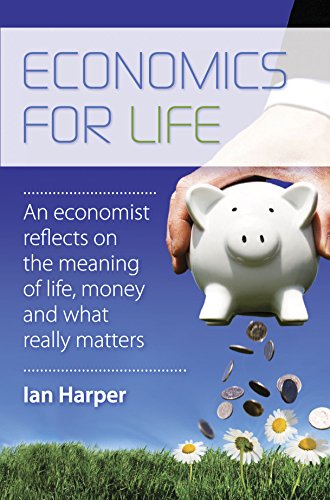
Economics For Life:  An Economist Reflects On The Meaning Of Life
by Ian Harper.
Published by Acorn Press, 2011, 184 pages

If Ian Harper had been American instead of an Australian, and if he been a professor at the University of Chicago instead of the Melbourne Business School, Economics for Life would have been a hit on The New York Times bestseller list.

As it is, Economics for Life won the 2011 Australian Christian Book of the Year, and it deserves to feature on Australian bestseller lists.

Put simply, Economics for Life:  An economist reflects on the meaning of life, money and what really matters is a gem of a book.  There's not really any other way of putting it.  In 170 pages it covers the history and philosophy of economics, Australia's economic development, the Global Financial Crisis, and finally why there's nothing in the Bible that says Christians have to be socialists.  It's a brilliant example of how you don't need three pages to make a point when two sentences will do.  Hayek and Schumpeter copied Adam Smith and didn't say anything in less than a thousand pages.  Harper is in the tradition of articulate economists like Frédéric Bastiat and Henry Hazlitt:  the English edition of The Law is a mere 75 pages and Economics in One Lesson comes in at 190 pages.

There's so much good and thought-provoking stuff in Harper's book it's difficult to know where to begin.  Perhaps as good a place to start as any is his discussion of how economists these days tend to pontificate, and how they "find themselves cast in the role of high priests".  Harper is far too polite to name names as examples of this ― but I will.  Think of Ross Garnaut or Nicholas Stern as examples of the phenomenon Harper is talking about.  The idea the public has of economics as a "science" and of economists as people who always recommend good policy gives economists enormous power.  Because an economist says it, it's almost unchallengeable.  The fact that anything an economist says is based on a series of assumptions, some of which might be unverifiable, gets forgotten.

Harper makes a point, too often forgotten, that economists have personal opinions, just as do doctors or nuclear physicists.  Differences about the meaning or significance of evidence can be the outcome of genuine differences of judgement, or they might be the result of personal opinion.  This leads him to a fascinating discussion of "consensus":

There is no agreed view among medical scientists, for example, about the specific causes of various forms of cancer, let alone what might cure or prevent it.  Indeed, people generally accept the wisdom of seeking a second opinion on serious medical issues without implying that the consultant they reject is incompetent or that medicine itself is quackery.  Climate science is another example ...

When the evidence doesn't fit the theory, the theory changes, as of course it did when the Copernican model of the universe replaced the Ptolemaic "consensus".  A consensus, that might be right or wrong can prevail in economics just as it can in climate science.  The point about consensus is that those who are proved wrong seldom admit they were wrong.  They have too much invested in the old system, and in fact their government funding might depend on a worldview that is at odds with the evidence.  Harper quotes two of the great scientific statements that explain how, in the face of this, consensus views ultimately do change.  Sir Peter Medawar, who won the Nobel Prize for Medicine in 1960 for his research on immunology, summed up how science works, "Science progresses ― funeral by funeral".  Or as another Nobel Prize winner and the founder of quantum mechanics Max Planck put it, "A new scientific truth does not triumph by convincing its opponents and making them see the light, but rather because its opponents eventually die and a new generation grows up that is familiar with it".

In the middle of the book is a chapter modestly titled "The Australian Economy in Historical Perspective".  It is 18 elegant pages of all you'll ever need to know about the country's economic history.  It's a story that has been told many times but Harper recounts it better than anyone else.  Wool, gold, and wheat made us rich, and they made us complacent.  In the 1880s Australia enjoyed the second-highest material living standard in the world (after New Zealand).  A hundred years later Australia had the fourteenth-highest living standard ― and that was thanks to tariffs and protection.

The Harvester judgement in 1907 set Australia on a course whereby the level of wages the government forced employers to pay was determined without any reference to the employers' ability to pay, i.e. without any reference to the productivity of labour.

What happened to the firm at the centre of the case, the Sunshine Harvester Company, is interesting.  As a result of the judgement the company's wages bill increased by 25 per cent.  Eventually the company stopped manufacturing anything in Australia and it became simply a distributor, and in 1955 it was bought by the Canadian multinational, Massey-Harris Ferguson.  As Harper ponders, "It is tempting to wonder whether, but for the Harvester Judgement, Massey Ferguson might now be known as the McKay Harvester Company with world headquarters in Sunshine, Victoria".

Harper's discussion of his time as chairman of the Australian Fair Pay Commission famously led to a Melbourne newspaper blasting out a headline "God to set minimum wage" after Harper said he prayed for guidance as to whether to accept the job.

After a working life devoted to economics and public policy, Harper concludes his book optimistically.

"As a Christian economist, I see my calling as helping to make this world an easier place to live in by releasing people from material want and deprivation.  I also want human beings to flourish and express the goodness of God in the gifts he has given them.  One need not look far at all to see how much remains to be done to meet the first of my goals, but this should not obscure the progress we have made towards the second."

Wednesday, April 18, 2012

Keep Green policies out of business

The Greens' strategy to build a business constituency will be successful, at least among the Australian and multinational companies whose rent seeking and vested interests are advanced by Greens policies.

Since being elevated to the party leadership, Christine Milne has outlined her interest in building better business relationships.

In a break from her predecessor, Bob Brown, she has said she will bring ''a stronger articulation of not only our vision for the country but how our economic strategy would support it''.

The Greens and Milne want a cosy relationship between big government and the ''progressive'' big businesses that fit their unreal vision of a Green Australian economy.  This will suit some businesses that like politicians to confuse policies that are in their economic interests, but are harmful to their competitors and a free, open and competitive marketplace.

Most of the Greens' economic message has been targeted and deliberately polarising — renewable energy is good, mining and fossil-fuel-dependent industries are bad.

The Greens support favourable regulations and taxation arrangements that help the former;  and unfavourable regulations and taxes that punish the latter.

Milne outlined what this means in practice on the ABC's 7.30 program earlier in the week when she argued that the government should ''get rid of those fossil fuel subsidies'' for the mining industry achieved through tax arrangements.

She was instrumental in negotiating the $10 billion Clean Energy Finance Corporation, which provides subsidised taxpayer finance for renewable energy projects that cannot raise capital in the market.

Believing in the Greens' economic vision also requires turning a blind eye to some unpleasant realities.

The wind turbines made by Milne's preferred ''progressive'' companies, such as GE and Vestas, are made from metals that were dug up by her equivalently identified ''rapacious'' mining companies that are ''thinking in the last century''.

But the real achievement of the Greens has been to use their environmental objectives to legitimise bringing government back into the centre of the economy.  Carbon pricing will have the same distorting economic influence as protectionism and foster the same rent-seeking behaviour that is achieved by businesses that seek to advance their interests through government policy.

The costs of carbon-based taxes and regulations are shouldered by businesses throughout the rest of the economy.  These added costs will make Australian businesses less competitive domestically and in export markets.

Any carbon price reduces international competitiveness, and yet Australia will need a high carbon price for the country to transition off fossil fuels, ensuring carbon price pain will be particularly acute.

As the carbon price is introduced, and increases, there will be a business constituency of companies and a green professional class that will rely on tighter regulation and a higher carbon price to advance their business interests.

But concurrently it will foster a counter-business constituency that will have to pay the cost.  The general instinct and theme of the Greens' policies is to regulate, adding costs onto businesses to advance political priorities.

Unsurprisingly most businesses are not likely to line up to toast Milne's success.

Those that do are likely to be the ones that see Greens policies as a vehicle to build the regulatory environment to help them do what business does best — make a profit.


ADVERTISEMENT

Sport as propaganda:  Bahrain's vile Grand Prix

The relationship between international sporting events and repressive governments can be truly vile.  The latest reminder of this is the decision by Formula One to hold the Bahrain Grand Prix for 2012 this weekend.

The race will be held smack in the middle of daily protests against the Bahrain regime — a regime which is trying to avoid being washed away by the same pro-democracy tide that has seen the end of many of its autocratic neighbours.

Formula One cancelled the event in 2011 because the Bahraini government was violently cracking down on pro-democracy demonstrations.  Since then, the regime has tried to rehabilitate itself.

Bahrain wants to stay one step ahead of the Arab Spring.  It commissioned an independent inquiry into allegations of torture and violence during the crackdown.  The inquiry reported in November last year, and recommended a range of modest judicial and policing reforms.

But Bahrain shouldn't get off that easily.  There are still 14 opposition leaders and hundreds of others in prison for participating in last year's protests.  There are still daily clashes between protesters and police.  There are still continuing human rights abuses.  Foreign reporters still have their entry into the country strictly limited.

The Bahrain Centre for Human Rights says there have been 31 deaths — including three from torture — since the independent inquiry released its recommendations.

Yet Formula One head Bernie Ecclestone claimed last week:  ''There's nothing happening.  I know people who live there and it's all very quiet and peaceful.''

Bahrain's rulers are using the Formula One race to rebuild their reputation.  The race is part of a ''normalisation'' campaign.  It provides the cover by which Bahrain can present a stable front to the world — and avoid serious reforms.

Yet the relationship between Bahrain and Formula One is hardly unusual.  Repressive states have long recognised that international sport is a potent propaganda tool.

The granddaddy of international sporting contests, the modern Olympics, has long been a friend of tyranny.  Virtually from birth, the Olympics was studiously, and shamefully, neutral about the political environment in its host countries.

During the Berlin Games of 1936, the Olympics' founder, Pierre de Coubertin, described the ''Hitlerian'' elements of that event as a merely the happy by-product of Germany celebrating ''in accordance with its own creative powers and by its own means''.

Supporters of the Olympics' bizarre ideology say its political know-nothingism would be better described as ''universality'' — a belief that all people of the world are entitled to participate in the Olympics, no matter what political system they have chosen.

But as one historian has written:  ''What this has meant in practice is that the [International Olympic Committee] has turned a blind eye to any sort of political crime committed by a member of the Olympic movement.''

Jean Todt, the president of the Fédération Internationale de l'Automobile, said this week that he and Formula One were ''only interested in sport, not politics''.

He might be, but his hosts are not.  For repressive governments, the purpose of holding an international sporting event is simple:  it confers political legitimacy and the approval of the foreign press.

Todt may imagine otherwise, but for host governments, international sport is entirely about politics.

When Moscow hosted the Olympics in 1980, it was an occasion to impress the world with Soviet superiority;  when Beijing did the same in 2008, the Chinese regime used the Games to show off its ''socialist modernisation'' project.

One infamous example of this phenomenon is how the brutal Argentinian military junta used the 1978 World Cup to solidify its domestic and international position.

The junta had seized control of the country just two years earlier.  It immediately directed its propaganda efforts to the Cup, as well as 10 per cent of the national budget.  Indicatively, one of the new regime's first priorities was to improve the foreign journalists' accommodation for the upcoming event.

The glamorous World Cup was held in the middle of Argentina's Dirty War, where tens of thousands of people were being murdered by the state.

The protestations that international sport is above tedious national politics are doubly false when we consider the money those governments pay to host major sporting events.  States are willing to spend big on premium carnivals.  And a cosy relationship with host governments is a key part of international sport's business model.

When it comes to human rights violations in Bahrain, Formula One cannot pretend to be neutral.

Amnesty International says ''the human rights crisis in Bahrain is not over''.  The International Crisis Group says Bahrain is ''sliding toward another dangerous eruption of violence''.

And it's hard to disagree with Human Rights Watch when it says the Formula One race gives Bahrain's rulers ''the opportunity they are seeking to obscure the seriousness of the country's human rights situation''.

If so, Formula One has to take some responsibility.


ADVERTISEMENT

Tuesday, April 17, 2012

Housing affordability key to northern growth

Northern Australia is suffering a housing affordability crisis.  But it doesn't need to be this way.  Recent media reports confirm this crisis.  It was reported in this newspaper that Karratha and Port Hedland had a housing shortage of 1531 and 1402 dwellings respectively.

One father of three said that rent for his three-bedroom home recently rose to $1600 a week.  ''I'm a local person, lived here all my life, the kids were born here but I can't afford to be in Port Hedland any more,'' he said.  ''There will come a time when there will be no one left.''

There are critical housing shortages in Darwin, many towns in the Pilbara, in Aboriginal communities and in many other towns and cities across northern Australia.

One local council in the Pilbara has seen rental prices balloon from $350 to $2000 a week over a three-year period.  The key driver of these price rises is an increase in demand for housing.  Most of this increase in demand comes from fly-in, fly-out workers.

In a submission to the parliamentary inquiry into FIFO workers, the Pilbara Regional Council concluded that ''the proliferation of FIFO in a community can have an extremely detrimental impact on local housing markets, particularly when resource-based, associated service businesses operate on the FIFO model''.

The underlying cause of this housing crisis is restrictive land release policies and slow planning approvals.  While governments can't end FIFO, they can increase land supply so that house prices don't drive out existing residents.

The scarcity of housing resulting from restrictive land supply, both in the owner and rental markets, is artificial.

It distorts market activity away from housing development and towards FIFO.

So ultimately the cost of this market distortion is borne in higher labour costs, fewer jobs and lower take-home pay.  This leads to a lack of economic diversity.  For instance, according to the Pilbara Regional Council, FIFO has a detrimental effect on local tourism:  ''Accommodation price pressures resulting from traditional tourist accommodation being used by FIFO workers have drastically reduced the financial viability of the tourism industry in the Pilbara.''

Solving the housing crisis does not call for special housing subsidies, price controls or public housing.

In order to reduce the cost burden of FIFO on businesses and communities, government agencies must free up more land for housing across northern Australia and let the private sector do the rest.

In this case, government agencies like WA's LandCorp should release far more land for residential development.

Another way governments might allow the private sector to rapidly increase housing supply would be the creation of special economic zones with less restrictive planning laws.  As part of the zones, governments should consider how crown land can be better used to encourage residential development.

Housing unaffordability is also partly responsible for the lack of population growth in northern Australia.  Access to affordable housing is one of the vital elements in any attempt to build a town and encourage people to put down roots in a community.

Ultimately, the vision should be of a thriving north, with regional cities across the Pilbara, Kimberley, Northern Territory and Far North Queensland to rival regional cities on the south-eastern seaboard in terms of population and economic activity.

Fixing the housing affordability crisis in mining towns is just one part of a broader set of policy challenges that need to be overcome to develop Australia's north and capitalise on its strategic advantage in the Asia-Pacific century.

But without affordable housing you will not attract human capital and without human capital the north will never realise its full potential.

Unless pioneering southern Australians turning towards the north for economic opportunities have somewhere to live, they will continue to congest our major cities and fly thousands of kilometres for work.  Encouraging permanent settlement of northern Australia is in the interests of both the south and north.

If towns and communities are to grow in northern Australia, tackling housing affordability must be given high priority.

Sunday, April 15, 2012

Secular world has a Christian foundation

The contemporary atheist movement has a scorched earth strategy — chop down Christianity, root and branch.  This strategy is entirely counter-productive.

Not satisfied to point out that elements of Christian belief are historically implausible, or that religion is scientifically unsubstantiated, the New Atheist movement wants to prove something more.  That Christianity has been a force for bad, that there is something fundamental about religious belief that holds back progress, approves of oppression, and stokes hatred.

Yet virtually all the secular ideas that non-believers value have Christian origins.  To pretend otherwise is to toss the substance of those ideas away.  It was theologians and religiously minded philosophers who developed the concepts of individual and human rights.  Same with progress, reason, and equality before the law:  it is fantasy to suggest these values emerged out of thin air once people started questioning God.

Take the separation of church and state — a foundation of the modern secular world, and a core of the political philosophy that atheists should favour above all else.  It was, simply, a Christian idea.

Early Christian philosophers thought seriously about what Jesus's words, ''Render unto Caesar the things which are Caesar's, and unto God the things that are God's,'' meant for the formation of political society.

St Augustine, writing as Rome fell, saw the City of Man and the City of God as clearly separate.  For Augustine, the religious and secular worlds were distinct.  The long conflict between the papacy and medieval European kings over the ensuing centuries reinforced this division.

When the father of liberalism, John Locke, argued for religious liberty, he noted there was no such thing in the gospels as a ''Christian Commonwealth''.  The Bible insisted on states ''with which the law of Christ hath not at all meddled''.

So, by the time Thomas Jefferson devised the formula of a ''wall of separation between church and state'', he was drawing on 1500 years of Christian thought.  The basic philosophy of modern secular democracy — that religious belief is a matter of individual conscience, not government — is a Christian idea.  Even more central to our modern identity is the idea that all individuals have human rights, that simply by virtue of being human we have basic liberties that must be protected by law.

This idea too has a deep theological origin.  Such mediaeval philosophers as Thomas Aquinas and his follower Francisco de Vitoria married biblical study with classical philosophy.

By doing so, they developed the concept of rights as we understand it today.  For these Christian thinkers, ''natural'' rights originated from God.  Humans formed societies in order to defend those rights.

Yet many modern human rights activists seem to believe that human rights sprang forth, full-bodied and with a virgin birth, in United Nations treaties in the mid-20th century.

Nothing could be further from the truth.  The idea of human rights was founded centuries ago on Christian assumptions, advanced by Biblical argument, and advocated by theologians.  Modern supporters of human rights have merely picked up a set of well-refined ethical and moral arguments.

Of course, it could not be otherwise.  The modern world is shaped by 3000 years of philosophical evolution.  And for half that time the dominant moral philosophy in the Western world has been a Christian one.  For most of our history, all the great thinkers have been religious.  So our secular liberalism will inevitably owe a huge amount to its Christian origins.

Ideas do not exist in a vacuum.  If we imagine they were invented yesterday, they will be easy to discard tomorrow.  So why are modern atheist agitators so eager to shed Western civilisation's Christian legacy?  Their reasoning — that atheism is attractive not only because it's accurate but because religion is morally bad — ironically resembles the simplistic good-versus-evil propaganda of history's most dangerous religious fanatics.  Yet many Christians defend their faith by simply citing the good works of their co-religionists.

Not only does this prove little (of course, some people are good, and some people are bad) it almost always ends in the tit-for-tat, your-team-killed-more-than-my-team debate.  Was Adolf Hitler a Christian?  Would an answer be at all meaningful?  Both sides do this.  Richard Dawkins claimed on ABC's Q&A last Monday that Christians were missing in action in the fight against slavery.  This is clearly wrong.  Has he not heard of the Christian abolitionist movement or William Wilberforce?  But it's a revealing error.

Surely, to argue for atheism, there is no logical need to denigrate past Christian accomplishment.

The anti-slavery argument that all humans were of equal moral worth won the day, and this was, to all concerned, a Christian argument.  To acknowledge the religious heritage of the modern world is to say nothing about religious ''truth''.  But while our age may be secular, it is, at the same time, still a deeply Christian one.  If atheists feel they must rip up everything that came before them, they will destroy the very foundations of that secularism.


ADVERTISEMENT