Showing posts with label Faith and Society. Show all posts

Sunday, October 25, 2020

If Our Restaurants Can Open Safely, So Can Our Churches

The Victorian Premier reassures the public that strict lockdowns are merely a reflection of him putting lives before the economy, but his plan to reopen has made it clear that that non-material goods have little place in the roadmap back to "COVID normal".

Lockdowns have undermined almost every civil society institution in this country.  They mandated the emptying of places of worship and that volunteers cease to perform work in many instances.  The financial hardship that resulted from this policy drained the pockets of donors and the charities they support.

Relief cannot come soon enough for civil society groups.  But in the road map laid out by the Premier, preference has been given to material and metropolitan values over non-material and community ones.

Since 16 September, regional Victoria has been under step 3 of the road map which means services such as beauty therapy, tanning, waxing, nail salons, spas, tattoo parlours and massage parlours can reopen if they adhere to hygiene practices such as the 4m2 rule, cleaning, signage and record keeping.  Community activities however, such as book clubs or craft groups, were limited to ten people and only in outdoor venues.

Last Sunday, the Premier announced further opening to allow Libraries and toy libraries to open up to 20 people indoors, but there was no mention of non-government community spaces.

Even more concerning is the treatment of places of worship.  Step three restrictions, allow restaurants, bars, cafes and pubs to open for indoor dining of up to 10 people (or even 40 for some venues) and up to 70 people for outdoor dining.  Compare this with the restrictions put on religious organisations, which are restricted to private worship only.  Private worship is defined as a household or a household bubble (up to five people from that household) plus a faith leader.  Public worship can only be conducted outside and with a maximum of 20 people.

There appears to be little public health justification for the inequitable treatment.  If anything, the hospitality industry is a more likely vector of this virus given that no one can eat or drink with a mask on and waiters go between groups to deliver food.  Conversely, most religious services can be conducted without contact and with a mask.

This is not to say that commercial activities shouldn't open up, but that religious and community groups should be treated the same way.

If there has been anything positive to come from the COVID-19 experience, it is that there has been a reassertion of federalism and state-based experiments in public policy.  If Victoria wants to know how to manage an opening up of both the private economy and civil society (and particularly places of worship) it should look across the border to New South Wales.

When NSW started to ease the lockdown restrictions, everything from cafes to churches were to open provided they had a COVIDSafe plan.  These are online forms that take 30 minutes to fill out and demonstrate how basic practices such as the 4m2 rule and face masks are going to be enforced on the premises to prevent the spread of the disease.  There is no reason why Victoria can't provide this kind of instruction.

Civil society needs to be granted the freedom to be a separate and distinct entity from the state.

People need meaning and connection as much as they need material comfort.  A road back to "COVID normal" that does not include religious observance and other civil society organisations is not a return to normal at all.

Friday, March 06, 2020

To The Victim, Belong The Spoils Of (This) Law

The government's proposed religious discrimination bill puts the shoe on the other foot, and now the activists who championed every other discrimination law are bemoaning the "divisiveness" of this one.

It is divisive, but so is all discrimination law.

The public consultation period for the second draft of the religious discrimination bill, which prohibits discrimination based on someone's beliefs (or lack thereof), has closed.

Last week the cacophony of complaints about this bill reached fever pitch.

People from former High Court judge Michael Kirby to Olympic swimmer Ian Thorpe have given their two cents' worth of outrage.

ACT Chief Minister Andrew Barr complained that it threatened human rights.  He goes on to ask why you would enshrine in legislation a particular privilege for a group of people to be able to espouse a view that will offend many, and to grant that legal privilege?

He is not wrong that this bill is a threat, but he is incorrect if he thinks basic liberties, such as the freedom to espouse views, be they religious or otherwise, are indeed a privilege.

This law, at least in part, originated because state and federal anti-discrimination laws systemically infringe freedom of speech (and particularly expression of religious ideas).

Instead of abolishing laws that violate basic freedoms, the government has decided that it is going to fix the problem of illiberal, convoluted anti-discrimination laws by enacting yet another illiberal, convoluted anti-discrimination law.

Doing the same thing over and again but expecting a different result was Albert Einstein's definition of insanity.  History will repeat itself and, just like the notorious section 18C of the Racial Discrimination Act, it soon will become a bureaucratic goliath that no government can or wants to control.

Discrimination laws are inherently discriminatory.  Discrimination laws operate by granting a right of action to one group against another, meanwhile carving out exemptions for some but not others.

Moreover, it fundamentally misunderstands the nature of individual rights.  It reverses the presumption that all Australians are entitled to be equally free, making some of us more free than others.  The Coalition may think it is giving religious freedom in this bill but in reality it is confiscating it.

The only way to protect religious freedom is by protecting the freedom of all Australians to think, speak and associate.  Freedom of religion is simply the use of these most fundamental freedoms for a religious purpose.  If the government truly wants to protect religious freedom it should repeal the laws that prohibit expression of religious and all other ideas (regardless of their origin) in the first instance.

The activists who initially were protesting against this bill because it would victimise people on the basis of gender and sexual orientation have found a new victim group — religious people.  The newest complaint is that the religious discrimination bill indeed permits religious discrimination.  Again, they are not wrong.  However, if this bill didn't allow places where religious people could associate exclusively with members of their religion, it would not protect religious people at all.

Freedom of association is intrinsic to the exercise of religion and civil society in general.  The issue is not that this bill allows too much freedom of association but that it limits it.

The ability to create a space exclusive to the exercise of one religion is contingent on meeting the criteria set out in the bill, as follows:  a religious body does not discriminate against a person under this act by engaging, in good faith, in conduct to avoid injury to the religious susceptibilities of adherents of the same religion as the religious body.

This vague and subjective wording does not properly protect freedom of association but is a recipe for litigation.

The Noosa Temple of Satan's submission amusingly demonstrates the problem with this bill.  The Noosa temple says it is a "waste of the federal government's time", but if it is passed the temple will use it "aggressively".

This bill could inflame sectarian tensions between different religious communities and non-religious groups.  Far from creating a society of religious tolerance, it could create a society of religious lawfare and one where the most sensitive win.

Anglicare Victoria tweeted that it opposes "the #ReligiousDiscriminationBill because it allows people to use faith as a means to cause harm to others".

Anglicare is right to oppose this bill but, as with all laws of this kind, the problem is not that it permits bigotry — it weaponises it.

Thursday, June 27, 2019

The Public's Fury At Being Told What To Do And Think Has Exploded With The Folau Fiasco

Trust the perennially sanctimonious Kerryn Phelps to capture in a couple of sentences why the Israel Folau saga has resonated with so many.  The one-time MP took to Twitter on Tuesday to share her thoughts on the matter.

"The haters and homophobes have been waiting since the YES vote for a trigger to set off a 'religious freedoms' campaign as revenge," she wrote.  "#Folau's contractual dispute gives them that trigger and a rallying point for bigotry dressed up as concern for 'religious freedom'."

It's a response that was as predictable as it was pious.  It's the kind of sneering elitism that "quiet Australians" in their thousands rejected last month.  Even those who disagree with what Folau said — and most do, myself included — recognise the treatment of Israel Folau for what it is:  The militant, with-us-or-against-us modus operandi of the professionally woke.

But the Kerryn Phelpses of the world do have a point in one respect.  This is not your garden variety free speech issue in the sense that nobody is being deprived of their rights by the state, per se.  The complexity in the Folau case is that all the players are private — not government — actors.

Maybe Rugby Australia did have the right to sack Folau as a matter of contract law (or maybe not, but that's for the courts to decide).  The likes of Qantas and ANZ can direct sponsorship money wherever they like, and they wouldn't be the first big corporates to engage in such asinine virtue-signalling.  GoFundMe is a private platform, and may very well have been within its rights under its own terms of service to boot out Folau's fundraising appeal, hypocritical and selective as that may have been.

But just because those organisations could have done what they did doesn't mean that they should have.  As a matter of public policy, the Folau affair is a dead end, but as a cultural issue, it is troubling.  It's another front in what the left derisively write off as the "culture wars", in a world in which what can and can't be said (by force of law or otherwise) is becoming increasingly limited.

And here is where Phelps is dead wrong:  The media feeding frenzy created by the Folau case is not a "rally point" seized upon by the right.  If the left are frustrated by the amount of attention Folau is getting — and no doubt they probably are — then they only have themselves to blame.

As many have noted, if Rugby Australia had simply issued a statement distancing themselves from Folau's views and moved on, then his original Instagram post would have been long forgotten by now.  But by overreacting, the Rugby Australia — and the "inclusivity" zealots egging them on — have turned one man's particular religious beliefs into a full-blown national brouhaha.

That said, there are those in the left who know how counterproductive the response to Folau's Instagram post have been.  Labor frontbencher Stephen Jones has pointed out that multiculturalism in practice means confronting — and tolerating — elements of some cultures with which we disagree.  And former President of the Australian Human Rights Commission Gillian Triggs — of all people — has voiced valid concerns about the Folau affair's implications for freedom of religious expression.

The reason that the Israel Folau case resonates is that it is so depressingly familiar.  It's a reflection of the fact that for all the talk about "inclusiveness" and "tolerance" and "diversity", picking on Christians is still okay, even fashionable.  It's a reminder of cases like Mark Allaby, who during the same-sex marriage debate was forced by his employer to choose between his day job at PwC and voluntary position on the board of the Australian Christian Lobby.

Regardless of its content, Israel Folau's Instagram post has morphed into an act of civil disobedience at a time in which a tiny elite is dictating the boundaries of acceptable opinion.  It has tapped into the frustration of we all feel when yet another advertiser is browbeaten into pulling advertising money from Sky News while we're all forced to fund the ABC.  The grating repetitiveness of climate debates in which anyone who goes against the zeitgeist is a "denier" and that anyone concerned about the costs of addressing it — as Shorten so infamously said — is "stupid".  The irritation we all feel when our bank or airline or supermarket gushes about every fashionable cause under the sun at the same time as they're apparently indifferent to customer service.

With Israel Folau, the dam seems to have burst.  At time of writing, the Australian Christian Lobby's fundraising page has, in less than 48 hours, raised something just shy of two million dollars.  It's safe to say that the vast majority of donors don't share Folau's religious beliefs, but they are defending with their wallets his right to air them.

And for many of us, there is the sense that what happened to Folau could happen to me next.

Friday, April 12, 2019

The Outrage Mob Is Out To Get Folau

The outrage mob is out in force following rugby star Israel Folau's latest social media comments.  The mob wants to more than disagree with Folau's opinion, as is our right in a free society.  It wants to ban him from expressing it, which is totalitarian.

On Wednesday, a Rugby Australia spokesman branded Folau's comments about sexuality and religion "unacceptable", and said its integrity unit had been "engaged in the matter".  Now it has signalled its intention to sack him.

Folau shared on his Instagram account an image which said to "drunks, homosexuals, adulterers, liars, fornicators, thieves, atheists, idolators" that "Hell awaits you!  Repent!  Only Jesus saves."

In the caption to the image Folau provided quotes from the Bible, and added:  "Those that are living in Sin will end up in Hell unless you repent.  Jesus Christ loves you and is giving you time to turn away from your sin and come to him."

By all accounts, these opinions are a manifestation of Folau's religious beliefs.  Many people would profoundly disagree with what was said, and find such sentiments deeply offensive.

Should he lose his job for expressing a genuine religious belief?  One held not only by many Christians, and also those of other faiths.

The outrage that followed has far exceeded Folau's supposed wrongdoing.  On Instagram, Australian soccer player Sam Kerr wrote:  "Australia, we should not let athletes or ANYONE preach this hate in our country".  Prominent club level Aussie rules player Jason Ball called the comments "downright dangerous".  In this paper, Peter FitzSimons declared Folau needed to "repent" for his wrongthink before being allowed to play again.

The authoritarian desire to impose ideological orthodoxy on Australians is demonstrated in how our national flag carrier, and the sponsor for the Wallabies team, intervened in this situation.  Qantas said of Folau's comments in a statement released on Thursday afternoon that:  "These comments are really disappointing and clearly don't reflect the spirit of inclusion and diversity that we support."

While Qantas says it believes in diversity, it doesn't believe in the right of someone to express a religious viewpoint.  Qantas is hypocritical.  It has partner airlines such as Qatar Airways and Emirates, owned and operated by repressive regimes the Qatar and Dubai, respectively.  Qatar imprisons those deemed guilty of homosexual acts, and the United Arab Emirates (of which Dubai is a part) punishes homosexuality with the death penalty.

There is a genuine fear in many fields about the tyranny of corporate social justice policies, and Qantas's decision to intervene in this case shows why.

The NSW Waratahs — Folau's employer — may be entitled under the terms of his contract of employment to sack him.  But whether it should is a different question.

Friday, January 19, 2018

Dignity Is Attained Through Opportunity, Not Redistribution

The most important task of public policy is to ensure the next generation of Australians have more opportunities to flourish than the last.  But declining business investment, worsening school results, family breakdown, and youth joblessness suggest we are failing in this task.

This week, the left-leaning McKell Institute contributed to this important debate with the release of their report Mapping Opportunity:  A National Index on Wages and Income.

Unfortunately, the report misses the mark.

First, the report asserts "inequality in Australia is at a 75-year high" based on the share of income earned by the top 1 per cent.  But this measure has many shortcomings.  It is a pre-tax measure which doesn't account for the extra income low-income earners receive from welfare or the loss of income to high-income earners from taxes.  It doesn't account for other transfers from government and non-government organisations (such as medical care).  And it counts individuals rather than households, even though most people organise their financial affairs within a family unit.

A better, although still deficient, measure of inequality is the Gini coefficient, which accounts for the effect of taxes and transfers.  The best estimate of the Gini coefficient is provided by the Household, Income, and Labour Dynamics in Australia Survey undertaken by Melbourne University's Melbourne Institute.  This measure shows that income inequality is lower today than 15 years ago, when the data set begins, and is around the average of comparable OECD nations.

Second, the report says "Australia's minimum wage is declining".  But the measure used is the minimum wage as a percentage of the median wage.  This isn't the minimum wage;  the minimum wage is the minimum wage, and it has been increasing.  According to the Fair Work Commission, the weekly minimum wage in Australia was $374.4 in 1998, compared with $694.9 today — an increase of 22 per cent in real terms.  And according to the OECD, Australia's minimum wage is equal second highest in the OECD.

Third, the report says wealth inequality is higher than income inequality.  This is true, but largely the result of misguided public policy.  Low interest rates, high immigration and housing supply restrictions have raised property prices, and low interest rates and compulsory superannuation have elevated share prices.  All of this disproportionately benefits the wealthy.  Moreover, the report ignores that Australia has one of the most equal distributions of wealth in the developed world, according to the 2017 Credit Suisse Global Wealth Report.

Fourth, the report says Australia has a "declining middle class with the few at the top becoming richer and the poor getting poorer".  The rich are getting richer, but so are the poor, the middle, and everyone else.  According to the Australian Bureau of Statistics, real incomes for those in the bottom quintile grew by 58 per cent from 1994-2016.

Fifth, the report asserts "income inequality can give rise to a wide range of social problems ...".  Inequality certainly is a problem where it is the result of unfair cronyism rather than reward for hard work.  But the report fails to say what level of inequality is acceptable.  There is seemingly no limiting principle, with the implication that only perfect equality can be considered just.

This has several bizarre implications.  It implies that a society in which everyone is equally poor is better than one in which everyone is rich to unequal degrees.  It implies that Australia would be worse off if an unemployed person found work and earned a high wage.  It also implies that Bill Gates should be prevented from moving to Sydney in the interest of ensuring the Gini coefficient doesn't increase.

Instead of focusing on inequality, public policy should be directed towards providing individuals the opportunity to live good and flourishing lives, regardless of how this affects income distribution.  As we demonstrate in my November 2017 report, Understanding Inequality in Australia, this will often involve less government, not more.

Cutting taxes will increase job opportunities, reducing red tape will make it easier to start a business, and increasing school choice will improve education standards.  While taxes and transfers may make Australia more equal in a narrow sense, they also reduce individuals' access to opportunity and higher living standards.

However, more important than policy are institutions, cultural norms, and ways of life.  Time-honoured truths are as relevant today as ever:  pursuing a career, obtaining a good education, getting and staying married, participating in community and religious organisations, and eschewing crime and drugs and alcohol dependency are all necessary if people are to reach their potential and live a dignified life.

This knowledge, available to humans for millennia, has been erased in our modern times by an expansive state crowding out the institutions that passed this knowledge on, such as family, religion, and community.

To guide the next generation of Australians towards a life of opportunity and fulfilment, and to be flourishing, we need to rebuild the institutions of civil society.  This is work that we can only do for ourselves — we just need government to let us get on with it.

Monday, November 20, 2017

The West's Unstoppable March Toward ''Yes''

The outcome of the same-sex marriage poll is probably one of the least surprising things to have happened this year.

It is simply the logical culmination of two streams, which neatly came together last Wednesday at 10.00 am, when the Bureau of Statistics' chief statistician announced the results in front of a sea of rainbow flags, and balloons spelling out the word LOVE.

The first stream is the fact that the view of Western society on the matter of same-sex relationships has evolved and western society has become increasingly accepting of such relationships, as well as the right of the state to endorse them through civil partnerships.

In Australia, civil partnerships have been recognised for over forty years.  De facto relationships, between individuals of the same-sex, and as defined in the Federal Law Act 1975, have had many of the same rights and benefits as married couples.  Once recognised as being in a de facto relationship, gay couples have been able to enter into a registered relationship such as a civil union or domestic partnership.  When the bill to legalise same-sex marriage goes through, those 47,000 same-sex couples will now be able to tie the knot.

The second stream which explains why the public voted for same-sex marriage, is the long-term denigration of religion and the morality that goes with it, in particular, the Christian faith.  This has been taking place since the seventeenth century, when the founders of modern Western thought freed science and philosophy from religion, which they perceived to be based on blind faith, and laid the groundwork for the secular State.

The results of this philosophical revolution have come about slowly and gradually, over the course of the centuries.  In the 1860s, Karl Marx famously criticized religion for being the "opium of the masses", which he proposed was being used against the working classes by their oppressors.  In his Communist Manifesto, Marx focussed on marriage, proclaiming that the "abolition" of marriage and the family, central Christian ideas, were necessary if society was going to be transformed.

Since then, society has been well and truly transformed as Marx hoped it would.  Christianity has become increasingly marginalised in our society, its disappearance accelerated during the cultural revolution of the 1960s and 1970s, when it became very unfashionable.

As Christianity has rescinded, the State has taken over the traditional role once occupied by the church, and having naturally set aside the traditional moral element of marriage, is now involved in tying this special bond between two people;  couples no longer need the church to get married.  Christians will argue that because marriage is a Sacrament, the State's actions have no relevance anyway because the law cannot make or unmake a Sacrament.

Now that the State has assumed this function, Wednesday's result should be viewed as the response by over seven million people to a continuation of social change in the West which has been in motion for over four centuries.

Saturday, September 02, 2017

Lack Of Same Sex Protection

The (thankfully) former president of the Australian Human Rights Commission Gillian Triggs suggested recently that the same-sex marriage debate was taking place in a "post-truth" climate and disputed claims there were insufficient protections for freedom of speech and religion.

On the first point, Triggs is completely right.  But in making the second point Triggs is engaging in a bit of post-truth of her own.  Aside from Triggs, Attorney-General George Brandis and other members of parliament have all now asserted that the Australian Constitution will adequately protect freedoms if the Commonwealth Marriage Act is amended.

To understand how shallow this assertion is, one only needs to ask:  how exactly did the Constitution protect the Catholic Archbishop of Hobart, Julian Porteous, who was dragged before Tasmania's equal opportunity agency in 2015 for circulating an argument against changing the meaning of marriage?  Regardless of whether you intend to vote Yes or No in the plebiscite, we are entitled to know the consequences of what a change to the marriage laws would be.  This requires the political class to be honest with voters.  Instead, Brandis tells us that he won't "be tricked" into a "broader debate about religious freedom".

This attitude is surprising.  The Attorney-General was unhesitating in slamming One Nation Senator Pauline Hanson for offending "religious sensibilities" by wearing an Islamic cultural garment in parliament — to the delight of Labor and the Greens — but just days later was blasé about legal impediments potentially being placed on Australians with religious and traditional beliefs.

The only one engaging in trickery here is Brandis.  As the chief legal officer of the Crown, he surely understands that all Acts of Parliament, regulations and the common law form a single, interconnected body of law.  So while the Attorney-General may believe the marriage debate should be held in isolation, there is an inevitable question that must be acknowledged as to how a change to the Marriage Act would affect other areas of law.

Traditionalist and religious Australians are not asking for special treatment:  the right to hold and proclaim a particular world view in a community of like-minded believers is a foundational Western freedom.  The government redefining marriage, in combination with existing anti-discrimination laws, threatens to undermine this fundamental freedom.  In other words, at the core of the same-sex marriage debate is a question of whether we risk Australia's liberal democracy becoming less liberal as the price for changing the Marriage Act.

The Commonwealth and the states have a variety of laws prohibiting discrimination because of the sexual orientation or marital status of a complainant, which would give people standing to take individuals or organisations to court for their refusal to conform and comply.  In addition to laws prohibiting discrimination in the provision of services, sexual orientation "vilification" is prohibited in the state laws of Tasmania, New South Wales, Queensland and the Australian Capital Territory.

The most notorious example so far of how these laws interact with traditional values was the complaint against Archbishop Porteous.  The complaint was not terminated but was ultimately withdrawn by the complainant last year.  Australians who believe in the traditional meaning of marriage are rightly concerned they, like Archbishop Porteous, will be compelled to conform to the new vision of marriage.

They are concerned that while commentary on heterosexual marriages will remain unrestricted, that same liberty will not apply to commentary on the institution of same-sex marriages.

Recent data would suggest these concerns are shared by many Australians.  A Newspoll published in the Australian on 21 August found that 62 per cent of Australians want to see "guarantees in law for freedom of conscience, belief and religion" if the government legislates for same-sex marriage.

The political class's attempt to sidestep this crucial issue by alleging the constitution protects religious freedoms is egregious.  What they are referring to is Section 116 of the Constitution, which provides that "The Commonwealth shall not make any law ... for prohibiting the free exercise of any religion".  Read literally, Section 116 refers to laws that have a direct, explicit purpose of restricting religious practices, rather than laws that incidentally affect those practices.  And obviously no one is proposing to explicitly undermine religious freedoms.

The High Court has consistently defined Section 116 narrowly, ever since a 1912 decision where the Court found that religious objections were no excuse to compulsory military service.  In the 1997 case of Kruger v Commonwealth, the Court reaffirmed that Section 116 will only apply where a law has a purpose to prohibit religious freedom, with Justice Mary Gaudron stating that "it makes no sense to speak of a constitutional right to religious freedom in a context in which the Constitution clearly postulates that the States may enact laws" that restrict that same freedom.

To understand why we are so fortunate Professor Triggs is no longer the AHRC president, she called this "one of the best protected rights under Australian law".  Even if Section 116 could provide protection, it could apply only to Commonwealth laws.  Most litigation for sexual orientation discrimination or vilification would be brought forward under state anti-discrimination laws.  This is because those laws typically apply to a wider range of acts and have a lower threshold.  The Constitution would provide no protection under such litigation.

This issue has been framed as a matter of equality.  But this cannot be the case as long as the equal expression of religious and traditional beliefs goes unprotected.  By ignoring these concerns, the pro-change movement's call has made itself vulnerable to being described as an illiberal movement.  Unless and until it addresses them, that is a characterisation that rightly will not change.

In the absence of broad protections, the government redefining marriage, in combination with these existing anti-discrimination laws, will likely undermine the right to hold, act in accordance with, and proclaim a particular opinion.  Voters deserve better than to be told by the Attorney-General that these freedoms are "not what this is about".

Friday, May 19, 2017

Integration, Not Segregation Is Best.  There's No Need For Privacy Curtains

THE decision by Auburn Council in NSW to install "privacy" curtains at a new public swimming pool in Auburn is a disgrace and completely at odds with Australian values.

Belgravia Leisure, which operates the Council run Auburn Ruth Everuss Aquatic Centre, has said that it decided to erect the curtain to "overcome cultural barriers and encourage Muslim women to use the pool".

After decades of struggle to achieve gender-equality between men and women, the Auburn Council's decision to divide the sexes in the pool with a giant curtain is an immensely backward move.  It is a giant step in the wrong direction.

By installing the curtain in the aquatic centre, Auburn Council is basically introducing gender apartheid in NSW at the expense of unwitting rate payers.

The segregation of men and women in public spaces is totally unacceptable.  One hundred years ago Governments in this country would require men and women to bathe at separate times or compel women to use bathing machines at the beach.

We should have now moved on.

It is the local rate payers of Auburn who have been effectively compelled to subsidise an initiative that segregates people and divides the community.

In 2011, Monash City Council in Victoria extricated $45,000 from local rate payers in order to build a screen at the Clayton public pool so that Muslim women could have female only swim sessions.

Multiculturalism is about integration not segregation.  Segregation is not only offensive but it promotes unnecessary divisions among the community and can hold some citizens back.

Auburn Council's actions are contrary to the very views that the Australian Government is seeking to promote and instil in our citizens, particularly through the Turnbull Government's revamped citizenship test which poses questions about expected norms of behaviour between men and women in Australia.

A curtain does not just divide men and women in a public pool, it divides communities and it divides Australia.  Men and women are equal and segregation is wrong.  These are not controversial ideas.  Public spaces should be free from discrimination and this includes public swimming pools paid for by local ratepayers.

As Australians, we want to encourage people to come to this country to enjoy the freedoms which have been hard fought and won.  People come to Australia because they know that it's a free country.  This type of regressive scheme undermines the fabric of our society.

Thursday, December 08, 2016

Green-Left Legerdemain Doesn't Make Religion Relevant

It has long been obvious that the political agenda of some Catholic organisations and schools rest solidly within the Green-left advocacy model, particularly in its increasing reliance on identity politics.  Noel Pearson has rightly highlighted the soft bigotry of many of these groups when he notes:  "they need blacks to remain alienated from mothers bosoms, incarcerated in legions, leading short lives of grief and tribulation — because if it were not so against whom would they direct their soft bigotry of low expectations."

Nevertheless, it is fundamentally against the interest of the Catholic Church which seeks to speak to all Australians, to allow this feigned victimhood to take root within its primary school educational system.  Just this month, grade five students from St James Primary in well-heeled Brighton, Victoria, have been encouraged to write "persuasive letters to their local member in response to the challenges on Nauru and Manus Island.  The letters were an attempt to present a child's view on the detention issue and draw to the attention the concerns of our future Goldstein constituents.  They will be voters in 6/7 years", writes the principal in the school newsletter.

When we have Catholic principals and teachers recruiting activists at ten years of age, it is time to ask serious questions on the suitability of such potentially biased educational offerings.  To claim this activity as "reflection and critical thinking" is educational vandalism remarkably similar to the educational offerings that have befallen Cuba and North Korea.  Naturally, all this is acclaimed as part of the umbrella of diversity, with one exception:  diversity of opinion!

The St Vincent de Paul Society has also been drawn sharply to the left of politics under its CEO John Falzon.  The perpetuation of low expectations for indigenous Australians is clearly evident in the opinions of the CEO when he wrote in Perth's Catholic newspaper, The Record:  "There is a deep wound in Australia, it is a wound that is known by different names, colonisation, dispossession, coercion, control … It is still with us.  The policies that the government enshrines as legislation are policies built on the falsehood that the wound does not exist … They are policies that continue to harm, to hurt, to humiliate, to degrade, to punish, to control, like all forms of colonisation, they deny the full humanity of those who are subject to them."

This negative view of indigenous Australians as oppressed and continually held captive by colonial masters is a viewpoint that allows for little creativity or future solutions.  Here is just another organisation that in Pearson's terms encourages "low expectations"; indeed this reliance on alleged oppression encourages no expectations, apart from ever-more taxpayer funded entitlements.

Marcia Langton, the foundational chair for Indigenous Studies at the University of Melbourne could well be talking directly about the attitudes of the St Vincent de Paul Society when she wrote in The Monthly last May:  "Aboriginal leaders face the very difficult problem of trying to shift recalcitrant people from welfare to work.  What solutions do the Greens and inner-city progressives have, apart from arrogantly and heartlessly accusing these leaders of being assimilationist.  The simple answer is none."

It is time that some Catholic organisations moved beyond the politics of "identity".  A world view that paints some groups as belonging within an oppressed category and others as belonging to the evil oppressors only encourages demands for more help and entitlements from government and enshrines permanent failure.  Fortunately, many indigenous Australians and refugees advocates now realise the perversity of those secretly ensuring failure through the creation of victims and the bigotry of low expectations.

The Catholic Church is currently in permanent crisis, the results of clergy abuse scandals and the ill-advised uptake of leftist causes in many of its agencies and schools.  Death by a thousand cuts waits unless the Church can again speak to mainstream Australia.  The great dilemma facing modern Australia is the one million Australians who want more hours of work, particularly the "34 per cent of underemployed part-time workers aged 15-19 who," according to the ABS, "have experienced insufficient work for one year or more."

Unemployment, underemployment and youth employment must be the foundation of Catholic society justice concerns, yet the Church is largely invisible in this space.  How does a Church speak honestly on the value of marriage, raising a family, home ownership and participation in Catholic life when it is muted on the foundational question of work.

The Australian community is largely sympathetic to the past accomplishments of thousands of Catholics and their direct focus on the needs of mainstream Australia.  Hospitals, education, nursing homes, palliative care all attest to this energy and purpose.  Now is the time for a serious reconnection with the mainstream.  Where better to commence than with our talented young Australians who desperately need support in entering the workforce and making a contribution to our nation.

Friday, August 12, 2016

ABS Census Farce Reminds Us Statistics Are The ''Eyes Of The Bureaucrat''

In 1961, Murray Rothbard, the most important libertarian economist of the 20th century, wrote about the evils of government statistics.

"Statistics are the eyes and ears of the bureaucrat, the politician, the socialistic reformer.  Only by statistics can they know, or at least have any idea about, what is going on in the economy ... How could the government impose price controls if it didn't even know what goods have been sold on the market, and what prices were prevailing? ... Cut off those eyes and ears, destroy those crucial guidelines to knowledge, and the whole threat of government intervention is almost completely eliminated ... It is difficult to see what, for example, the central planners at the Kremlin could do to plan the lives of Soviet citizens if the planners were deprived of all information, of all statistical data, about these citizens.  The government would not even know to whom to give orders, much less how to plan an intricate economy."

For Rothbard, the easiest way to cut the size of government is to abolish government statistics.  "Statistics, so vital to statism, its namesake, is also the state's Achilles heel."

When Nick Xenophon and the Greens advocated boycotting parts of Tuesday night's census, they probably didn't realise how far they were advancing the cause of anarcho-capitalism in Australia.  They also might not have realised how their stance on the census was so completely at odds with the other things they say.

So for example, Xenophon enthusiastically supports the federal government-owned Australian Submarine Corporation helping build $50 billion worth of submarines — yet the $470 million census run by the Australian Bureau of Statistics, a federal government agency, is "a monumental failure of a government program of the first order".

Meanwhile the Greens are eager for the government to take ever-increasing amounts of people's income through higher taxes, yet they're not happy when the government wants to keep people's personal details on a database for four years.

Still, one doesn't have to be a full-blown Rothbardian to have grave concerns about the census.  And no matter how muddle-headed Xenophon and the Greens might be sometimes, their call for a boycott of elements of the census was absolutely right and appropriate.  It was only after they were willing to take the extreme step of a boycott that the government and the mainstream media finally paid attention to the grave privacy risks of the census.  This was despite the fact that many (including myself) had for months been talking about the unprecedented invasion of privacy posed by the census.

Until now the failure of the census has been portrayed as a technology stuff-up.  But it's also a story of the unrestrained arrogance of government bureaucrats and the reluctance of ministers to challenge those bureaucrats.

It's unacceptable for the Bureau of Statistics to want to hold in perpetuity the personal details of individuals as revealed in the census.  Yet it appears no minister has thought to challenge the bureau's demands.  The supposed justification for the ABS keeping personal data is that it will provide for a "richer and dynamic statistical picture of Australia".  Again, until Nick Xenophon and the Greens started speaking out about the census, no one had bothered to ask the ABS what such gobbledygook means.

No one has asked questions even more basic — such as why the government should know what a person's religion is.  Sure, it's interesting to know the percentage of the population practising Zoroastrianism, but just because something is interesting to social science researchers doesn't mean citizens should be coerced into handing over such information to the government on pain of a fine for non-compliance.

If we are to have a census, it should be voluntary.  (For that matter, voting should be voluntary too.)

Even better than making the census voluntary would be to abolish it all together.  Which is what a number of other countries, including Britain, have done.  In 2010 then Canadian prime minister Stephen Harper, in an effort to strengthen people's privacy, abolished his country's compulsory census.

At least something good has come out of the census debacle.  Australians now have a much better understanding of the limits of technology — and of the limits of government.

Tuesday, May 06, 2014

Wilson in the White House

Wilson
by A. Scott Berg
Putnam Adult, 2013, 832 pages

The presidency of Woodrow Wilson from 1913 to 1921 was not good for the cause of liberty.

Wilson was clearly infected by the "progressive" ethos of the era.  He was strongly interventionist, pushing for legislation to reduce the length of the standard working week, to restrict child labour and to provide disability insurance.  He attempted to reconcile this greater role for government with the traditional Jeffersonian ideas on which his Democratic Party was based, by arguing that the Declaration of Independence no longer provided answers for contemporary problems.  He was confident that were Jefferson still alive he would recognise that, unlike in 1776, all men were no longer created equal.  As with most "if so and so were alive today" arguments, this one is not very convincing.

Wilson's presidency was also a disaster for blacks, as he promoted measures which delivered greater segregation throughout the public service.  Furthermore, it was a period of rising racial tensions and Wilson did little to stop increasing numbers of lynchings and other attacks on blacks.  And, once the United States entered the war, he imposed an income tax and introduced the Alien and Sedition Acts, measurers which were as heavy-handed an attack on free speech as those promulgated by John Adams in 1798.

Yet, in some respects, Wilson's Democrats were better for the cause of liberty than their Republican contemporaries.  The Democratic platform on which Wilson stood in 1912 was headlined by a call for the immediate lowering of the "high Republican tariff" which was "the principal cause of the unequal distribution of wealth".  The election of the Republican William McKinley to the presidency in 1896 had marked a shift to higher tariffs (as well as immigration restriction and foreign adventurism), which continued under the following Republican presidents, Teddy Roosevelt and William Howard Taft.  One Republican senator had secured a high tariff on imported textiles forcing people to buy over-priced products, a lot of which came from mills owned by the very same senator.

Wilson himself was a committed free-trader.  As a young lawyer in Georgia he addressed a visiting Tariff Commission to explain how the tariff unfairly taxed the agricultural sector in the South and West.  His eight years in the White House provided something of a pause in the onward march of protectionism.  Within months of his departure from office in 1921, the Republican-controlled Congress introduced the highest tariffs in American history.

In a range of other policy areas, Wilson also had sound views.  He had an instinctive dislike of debt describing it as "short-sighted finance";  vetoed anti-immigration bills, supported votes for women, and opposed Prohibition, the first constitutional amendment to reduce citizens' rights.

This biography provides clues to the development of Wilson's approach to politics and policy, but they are often confusing ones.  Author A. Scott Berg describes the young Wilson as "an avowed Federalist ― an ardent admirer of Alexander Hamilton;  a believer in dominant central government", but later writes that "Wilson challenged the Hamiltonian doctrine that those with the biggest asset in the government should serve as trustees for the rest of the nation".

Similarly, when it came to British figures, Wilson appears to have been a man of eclectic tastes admiring Gladstone and Bright, but also being "inspired" by some of Thomas Carlyle's ideas.  Wilson would be far from the only individual to harbour such a diverse range of likes, but this work would have benefitted from a greater effort from the biographer to weigh these seemingly contradictory views and assess what they all meant for Wilson's intellectual development.

Wilson's career prior to becoming a politician had largely be spent on university campuses, principally Princeton, where he had been professor of politics and the author of several works on aspects of American history.  He secured his first political office as governor of New Jersey just two years before he ran for the presidency.

When, in 1912, Wilson became the first Democrat to win a presidential election for twenty years, he was greatly assisted by a split in the Republican Party.  Incumbent President Taft had to compete with both Wilson and previous Republican President Roosevelt, now running under the banner of the Progressive Party.  Wilson won easily getting 42 per cent of the vote compared to Roosevelt's 27 and Taft's 23, which gave him a then record 435 Electoral College votes.

Wilson's rapid rise meant he was a comparative political cleanskin, who believed that he did not owe anything to anyone.  Upon his election, he readily dispatched numbers' men and others seeking preferment, telling one who claimed that his work had helped Wilson gain office that, "God ordained that I should be the next president of the United States.  Neither you nor any other mortal could have prevented that."  Imagine if Tony Abbott had said that!

Wilson commented that "it would be the irony of fate if my administration had to deal chiefly with foreign affairs", which of course was what happened once the fatal shot had been fired at Sarajevo.  He took what can be seen as a centrist approach to US participation in the war, not rushing to join the fray as some, such as Roosevelt, urged, nor remaining in the isolationist camp for the duration.

Given that Wilson took America into the war the following year, the irony was that his main selling point in his 1916 re-election campaign was that "he kept us out of war".  It was a particularly close election, Wilson defeating the Republican Charles Evans Hughes by just 277 Electoral College votes to 254, a result achieved by winning California's thirteen delegates, with a margin of just 3,806 votes.

Perhaps more than for the war itself, Wilson is remembered for his post-war internationalist vision, which was frustrated by other nations at the Peace Conference and then by Republicans in the Senate.  While Wilson was prepared to compromise at the former to secure the Treaty of Versailles, he was unwilling to make concessions to secure Senate ratification of the League of Nations.  He believed he would have been able to bring enough pressure onto wavering senators but for the collapse of his health while on a barnstorming tour of western states in September 1919.

A stroke soon after his return to Washington meant that Wilson remained largely incapacitated for the balance of his presidency.  As Berg comments, "Presidents traditionally speak of the isolation of the White House, but none has been as removed as Woodrow Wilson ― confined for months to a bed, and hearing no direct news."

Berg has received acclaim for biographies of characters such as literary editor Max Perkins, film producer Samuel Goldwyn and aviator Charles Lindbergh, plus flak for a memoir of his twenty year friendship with Katharine Hepburn published just twelve days after her death.  While this is his first political effort, he did have a long-standing interest in Wilson stemming from the 11th grade when his mother gave him a book called When the Cheering Stopped which dealt with Wilson's decline.  He has now provided his own evocative description of this extraordinary situation.

The difference between Wilson's abilities before and after his stroke is given greater emphasis in this study by Berg's particularly high regard for his subject's pre-stroke talents.  This is captured best when Berg describes how Wilson put together his speech to Congress arguing that the United States should enter the war:

For this momentous address, he summoned the country's most successful speechwriter, one of its foremost historians, one of its first political scientists, one of its most elegant wordsmiths, a spiritual thinker to provide moral grounding, and, finally, his most trusted stenographer to get it all down on paper.  There in the second-story study, Woodrow Wilson sat alone.

In fact, this was not even true, as his second wife Edith was with him at the time.

In most other matters, both public and personal, Berg takes Wilson's side, for instance accepting that he did not have an affair with the infamous Mrs Peck.  Despite the sympathy of the author there remains something slightly unappealing about Wilson, a man who ended up falling out with his closest confidants at both Princeton and the White House ― Jack Hibben and Colonel House ― when they eventually disagreed with him.

The blurb for this book says that "you can't understand the United States in the 20th century without understanding Woodrow Wilson".  Don't let the hyperbole put you off.  Wilson is definitely important and this work is a highly readable account of his life.

Sunday, January 26, 2014

Taking Freedom Seriously

The System of Liberty:  Themes in the History of Classical Liberalism
by George H. Smith
Cambridge University Press, 2013, 231 pages

One of the great legacies of Western Civilisation has been the emergence of the philosophical doctrine of liberalism (sometimes referred to today as libertarianism).

The evolution of the key philosophical themes of liberalism, warts and all, is the subject of an important book written by libertarian scholar George H. Smith, The System of Liberty:  Themes in the History of Classical Liberalism.

With its emphasis on the primacy of the freedom of individual actions in the economic and social realms, liberal philosophy stands in stark opposition to the historical and contemporary manifestations of authority, including slavery, religious servitude, monopoly, legal privilege, war, and statism.

The material comforts and the widespread social freedoms enjoyed by the common man and woman today ― although constantly threatened by socialists, progressives, and paternalists ― owes its existence to tireless intellectual efforts by those outlining the possibilities for human progress inherent within the liberal idea over at least hundreds of years.

Furthermore, it is no coincidence that industry, science, arts and culture have flourished in those parts of the world whereby liberal ideals attained their greatest acceptability.

Despite the great practical benefits of liberalism, important tensions and disagreements nonetheless emerged amongst self avowed liberals concerning the applicability ― if not the very meaning ― of key concepts and issues.  These are still being played out today.

Internecine philosophical debates among liberals led to the splintering of liberal thought into "old" and "new" varieties, contributing to philosophical confusions and later wavering public acceptance of liberal ideas during much of the twentieth century.

To illustrate the thematic structure of The System of Liberty, this review will highlight three topics from the book explaining how liberals addressed conceptual difficulties, the first being the amorphous notion of the "public good" in the presence of persistent political power.

Many philosophers have long argued that the presumption of liberty can be annulled, invalidated or overridden on exceptional occasions by political authorities when those actions are consistent with promoting the public good.

George Smith identifies several liberals who associated themselves with such an idea, including David Hume and Adam Smith, and even those more commonly associated with natural rights liberalism, such as John Locke.

The intent of the natural rights appeal to the public good is not to extend the sphere of coercive state intervention, but to restrict its scope.  As Smith describes it:

The principal function of the public good in natural rights liberalism was to restrict the activities of government to the enforcement of rights.  For these liberals, to say that a government ought to further the public good means that a government ought to protect the natural rights of its citizens in normal circumstances.  Natural rights were conceived as the primary constituents of the public good.

However, a difficulty with accepting a natural rights public good concept based upon Locke's writings is that Locke himself identified the public good in various contexts, the most controversial of which was justifying a "prerogative power" overriding the principles of justice, in exceptional cases, when this conforms with the public good.

As Smith rightly observes, this idea immediately begs several important questions that remain as points for discussion:  which criteria can be used to justify the "exceptional" case to stifle individual liberties?  Further, who decides which rights can be extinguished in favour of the public good?

The System of Liberty refers in detail as to how these initial debates, which can be traced as far back to the fourteenth century writings of William of Ockham (of Ockham's razor fame), subsequently informed the intense debates between liberals of natural rights and utilitarian persuasions over the accepted scope of government.

Smith illustrates how concerns that public good notions could override fundamental liberties have also informed political debates, for example the dispute over including a "general welfare" clause in the American constitution between James Madison and the anti federalists.

In an important chapter called "The Anarchy Game", Smith appraises the commonly used technique of critics who contend that liberalism is delegitimised as an acceptable philosophy, since it ultimately implies an endorsement of Hobbesian anarchy.

John Locke's intellectual nemesis, the absolutist Sir Robert Filmer, engaged in the anarchy game by challenging the core tenet of "social contract" theory that government is constituted by the consent of the governed.

Filmer not only stated that no government in history was established by the unanimous consent of the governed, but if people could break away from existing states to form their own then each individual could become his or her own king, the very essence of anarchy itself.
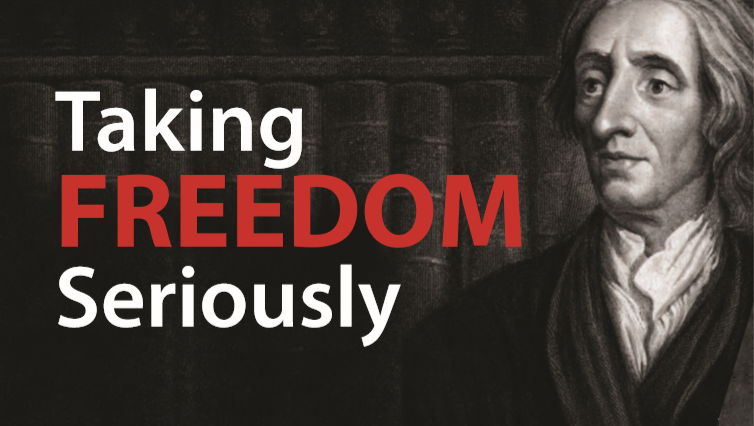
Smith explains that Locke ingeniously responded to Filmer's challenge by presenting an intellectual counterattack.

According to Locke, since it is impossible to identify the legitimate heirs of biblical Adam's patriarchal authority, absolutist governments of his day necessarily stood upon the quicksands of anarchy, since they lacked God-given legitimacy as Filmer described it.

In any case, Locke claimed it an absurdity that people would willingly join in a civil society only to be made worse off, as the absolute sovereign has their way with expunging economic and personal liberties at will.

While Locke may have used the anarchy game to full effect in his critique of absolutism, Smith argues that subsequent usage of the anarchy game, particularly by Edmund Burke in his critique of the French revolutionaries of 1789, engendered a decline in the prominence of Lockean theories within the broader liberal paradigm.

One of the more thought provoking themes covered in The System of Liberty concerns what George Smith refers to as "The Radical Edge of Liberalism", or the use of resistance or revolution to rectify the situation of a government which does not respect individual liberties.

Support for the use of resistance against illiberal legislation, or revolution of a tyrannical government altogether, cannot only be found in the works of Locke, but of Adam Smith, David Hume and Edmund Burke, although the criteria and circumstances in which these acts could legitimately apply vary among these writers.

For example, Adam Smith suggested that people can take up armed resistance when the abuse of governmental power becomes "gross, flagrant, and palpable", say when a government exceeds the feudal benchmark of a tax confiscating at least a third of people's wealth.

The author of the American Declaration of Independence, Thomas Jefferson, contended that persistent abuses of inalienable individual rights ― that of conscience, property and life itself ― would give legitimate ground to the overthrow of a government, thus representing liberalism's radical edge.

Illuminating the rich tapestry of liberal thought, The System of Liberty also brings to light the contributions of some lesser known, yet influential, participants in the unfolding philosophical debates over the meanings of freedom and liberty.

A highlight of the book is the nuanced interpretation of the work of prominent nineteenth century English liberal Herbert Spencer, who is falsely derided by most people today as a heartless "social Darwinist" with scant regard for the unfortunate.

As Smith helpfully reminds us, Spencer was steadfastly dedicated "to improving the economic and social conditions of the lower and middle classes", who were deleteriously affected by government interventions.

With regard to the "survival of the fittest" concept attributed to Spencer, it was not intended as a value judgment but as a description of those behavioural traits and characteristics more conducive to survival within a given society.

For example, the habits of work and thrift are commonly associated with the development of a dynamic, market based economy, with the benefit of previously untold levels of wealth accessible to the masses.

Even so, it is not possible for everyone to escape the stifling grasp of absolute poverty, and so voluntary charity is commended by Spencer, as a system simultaneously drawing upon our humanitarian instinct of concern for others while also providing incentive for donors and beneficiaries alike to access new economic opportunities.

On the other hand, bureaucratic state enforced charity, now referred to euphemistically as the "welfare state", not only drains productive potential because of the staggering fiscal burdens it imposes, but serves to encourage inappropriate behaviours and values, such as indolence and "cheating" the welfare system.

George Smith also reminds us of the British "voluntaryist" movement, including Edward Baines, Richard Hamilton and Auberon Herbert, who adopted Lockean self ownership doctrines when arguing for such reforms as the separation of education and state, and even the introduction of "voluntary" taxation systems.

Filled with insight befitting a scholar with a reputation as one of the leading libertarian thinkers in the world today, George Smith's The System of Liberty has been opportunely written at a time when liberal ideas, once again, seem to be on the rise.

Surveys around the Western world reveal a great distrust of government;  international student liberty groups have emerged;  pro-liberty think tanks are proliferating;  and even nominally liberal conservative political parties are facing an internal insurgency by principled members with strong beliefs in free markets and social freedoms.

As perhaps the most important book in liberalism written in 2013, The System of Liberty serves as the perfect intellectual accompaniment for the liberal resurgence taking root.

Friday, November 22, 2013

Liberty Understood

Realizing Freedom:  Libertarian Theory, History and Practice
by Tom G. Palmer
Washington: Cato Institute, 2009, 532 pages

On the inside cover of this book, Tom Palmer, a recent guest of mine in Australia, is introduced as someone who has lived his life by one ideal:  "Liberty is for everyone".  In addition to fuelling his academic life, the pursuit of this ideal has pushed him to smuggle books into the Warsaw Pact and the Soviet Union, and in recent years to lecture across the oligarchies and new democracies of the Middle East.  Realizing Freedom:  Libertarian Theory, History and Practice is a collection of essays, papers, submissions and articles that Palmer has written defending the concepts of individual liberty and free market capitalism.

The book is divided into four sections:  Theory, History, Practice and Books and Ideas.

Theory, the first, is the least engaging of the four sections, however it is still interesting and Palmer's intellect shines through.  Palmer is a libertarian, and this section features his works outlining libertarian philosophy and the dangers that collectivism and statism pose to the freedom of the individual.

The most important of these is his essay "No Exit:  Framing the Problem of Justice", which critiques the views of the influential communitarian John Rawls and the threats to liberty and justice his ideas would lead to.  Though not as important, the most entertaining is "Twenty Myths About Markets", where twenty common criticisms of the free market are articulated ― views everyone has heard countless times ― and dismisses them point by point.  It is arguably the most enjoyable essay outside of Practice.

Although Palmer touches on many ideas critical to liberalism, the most constant theme of Palmer's collection is the importance of the protection of property rights, and this is very present in the Theory section.  Palmer believes property rights are both the key to an economically free and productive society and the most misunderstood concept of the free market system.

Misunderstood in the sense that collectivists often confuse the idea of "limited government" in liberal thought as meaning "weak government".  Government should be limited, says Palmer, but it should not be weak.  Weak governments can be persuaded against protecting the property rights of those it represents, and if that is allowed to happen, the economic freedom of the individual is lost.

In the History section, Palmer critiques the Marxist interpretation of history and explains how a liberal interpretation is more accurate, as well as outlining how the modern concept of liberty has been cultivated over time.  Palmer sees history more as a struggle between the individual and the state rather than class-based, focusing on the separation between church and state, the limiting of the powers of kings and the rise of constitutionalism as essential developments in human history.  These are summarised in an article on mankind's biggest achievements of the last millennium, written by Palmer in 1999.  Though that article certainly comes close, it is Palmer's 1990 article on the collapse of socialism in the Soviet Union which is no doubt the standout of this section.

Those sections are enjoyable to read and well argued, but it is the Practice section of the book that is the most illuminating and reflective of Palmer's skills as a writer, thinker and campaigner.  This section includes Palmer's writings on the state of liberal thought in the modern world, and because of his extensive travel and experiences, he offers an insight extremely few people can hope to match.

For example, his article "Six Facts About Iraq" was penned after having "been to Iraq three times since the fall of Baghdad".  Whereas any writer could criticise the Egyptian government for imprisoning a student for blogging, Palmer's article is different because he had met and was in contact with the blogger, knew the background of the story, and had extensive knowledge of Egypt's political climate from his travels within the country.

This section also includes a speech Palmer delivered to members of the Iraqi National Assembly in 2005 on the problems of implementing democracy on a nation not used to it.  It is an incredibly interesting article that is intelligent and nuanced, but it stays with the reader for the envy it inspires towards Palmer's life.  What an existence it must be to travel from oppressed people to oppressed people and helping to fight for a system of governance that allows individuals to pursue happiness without fear of a tyrannical government.

The fourth and final section of the book, Books and Ideas, is a mix of reading guide and more libertarian theory.  The first article of this section is a collection of books Palmer believes is essential reading for students of classical liberalism.  It is an exhaustive list and Palmer has clearly put deep thought into it.  The rest of the articles are book reviews, though not mainly for books he likes.  These do turn into defences of libertarianism and individualism, however they are separated from the works in Theory because these are far more conversational in prose, and are at times exceptionally funny when exposing half-baked collectivist and statist philosophies, and nonsensical attacks on libertarianism.

Overall, Realizing Freedom is a book which serves as a glowing testament to a fierce campaigner for individual liberty and economic freedom.

A Conservative Titan

Edmund Burke:  Philosopher, Politician, Prophet
by Jesse Norman
London: William Collins, 2013, 320 pages

British Conservative MP Jesse Norman has written an excellent book about Edmund Burke.  It is a book in two parts, the first a reasonably straightforward biography of the subject and the second an analysis of his ideas, with a diversion into Norman's own political manifesto.

Norman joins a number of British MPs who have written biographies of former politicians, Roy Jenkins and William Hague being the best known.  Another recent example was Bill Cash whose biography of John Bright I reviewed in October 2012.  Cash tried to convince his readers that the demonstrably liberal Bright was a conservative;  Norman has the simpler task of justifying his view that "Burke is not a liberal".

Norman is essentially correct that despite occasional flashes of liberalism, Burke was a conservative.  He was influenced by the Enlightenment but never really of it and, as Norman puts it, Burke's "extraordinary achievement to be the first and greatest critic of modernity itself".

However, at the same time it is important to recognise that Burke was a Whig and many of the positions he adopted during his career were indeed quite liberal.  Burke was sympathetic to free trade, winning praise from Adam Smith;  he opposed British oppression in Ireland and India;  and he supported the American Revolution.  He also had an understanding of the role of a member of parliament way more sophisticated than many of his modern counterparts for, as he told the electors of Bristol in his famous 1774 victory speech, "your representative owes you, not his industry only, but his judgement;  and he betrays instead of serving you, if he sacrifices it to your opinion".

Burke served in the House of Commons for 29 years from 1765 to 1794, and while he only held office for a brief period, his career demonstrates that holding office and having lasting significance are two entirely different things.  Given his comparatively humble Irish roots, it was a tribute to Burke's intellect and writing skills that he came to be seen as a potential gained access to some of the leading cultural groups in London, mixing in clubby fraternity with the likes of Samuel Johnson, Joshua Reynolds and David Garrick.  However, his key patron was to be the Marquis of Rockingham, who engaged Burke as his private secretary, and then a few months later secured Burke a "pocket borough" in parliament.

At that time, Rockingham was in government, but he was not to be there for very long, being out of power for the next 16 years.  Norman gives great weight to the return of Rockingham and his Whig followers to government in 1782 describing it as "an extraordinary moment not just in Britain's political history but that of the world".  The fact that a parliamentary grouping, which had been on the opposition benches since 1766 had remained intact, remains in Norman's eyes "a remarkable and woefully under-recognised achievement".  This oversight is probably explained by the fact that Rockingham himself died within months of regaining the Treasury benches and, without him, the grouping fell apart, with the faction headed by Charles James Fox, and still including Burke, ending up in coalition with the dreaded Tory Lord North.

Norman describes Burke as the "main architect" of the Rockingham Whigs but, when the proto-party finally collapsed, it was because Burke walked out on it.

The party ended on 6 May 1791 when Burke announced to the Commons that his friendship with Fox was at an end, due to their wildly differing interpretations of the French Revolution.  Fox saw the French attempting to accomplish what the English had achieved in the Glorious Revolution of 1688 and ensure the end of tyrannical monarchical rule.  He believed that the Whigs had a duty to "support the transition to a new and stable constitutional order".  In contrast, Burke saw something radical and sinister, a case he made in his most famous book Reflections on the Revolution in France which was published in 1790.  Events in the next few years in France seemingly vindicated Burke, but the fact that the French Revolution got diverted into Jacobinism does not mean that this was the inevitable outcome.

To engender sympathy for Burke's position on the French Revolution, Norman paints it in the colours of Jean-Jacques Rousseau.  Thus Burke's views are juxtaposed against one of the least palatable philosophers in history.  Of course, this leaves out a vast range of positions, particularly liberal ones.  What lifts Norman above the role of pamphleteer is that he has the decency to point out to his readers that "in some ways the two men [Burke and Rousseau] had more in common than either might have cared to admit".  In similar vein to his use of Rousseau, Norman selects Jeremy Bentham as the apogee of liberalism, an odd choice, but one which allows him to what he clearly regards as the most favourable representation with Burke's conservatism.

Another disappointing characterisation comes when Norman tries his hand at some American political history.  He describes it as "astonishing" that, as Secretary of State, Thomas Jefferson undermined President George Washington and later tried to destroy the reputation of his former friend President John Adams.  He fails to mention that Jefferson had highly principled reasons for his concern about Washington, who had become overly influenced by the centralising Alexander Hamilton, while it was hard not to take strong issue with Adams when he was promoting the Alien and Sedition Acts, gross violations of civil liberties.

Late in the book, there is a whole chapter which is only tangentially about Burke.  Rather it uses Robert Putman's ideas about "social capital" as the launching point for Norman to outline his personal political philosophy.

Norman is smart enough to understand the benefits of liberal individualism, but also conservative enough to find fault with many of them and, intriguingly for a conservative, attacks liberal individualism for being Westerncentric.  According to Norman, "liberal individualism mistakes the true order of priority between the individual and society".  It does so because it places too much emphasis on rationalism when other factors, such as emotional attachment to our own community or country, or respect for habit and custom, should be given precedence.  It is another false dichotomy.  One can be a liberal individualist and also recognise that Burke's "little platoons" are a valuable part of making society work cohesively and enjoyably.  It is just that liberals do not want to make membership of little platoons compulsory.

For Burke and Norman, a free society is the product of a well-ordered society, not as liberals would see it being the other way around.  Given the number of well-ordered societies which have not had much liberty, history would hardly seem to support their case.

Norman generally handles the interaction of the public and private Burke well.  He is alert to some of Burke's faults, such as his reputation as a bore, relating that he gained the nickname "dinner bell" for his ability to clear the House of Commons when speaking.  Only once do his writing standards slip, which occurs when explaining why Burke was not a catch for his wife, as he had few prospects just "warmth, energy and talent" but, in a seeming attempt at chick-lit, comments that "the beautiful thing is that this was all she needed".  However, he redeems himself for this soppy sentence by writing a brilliant line about one of the most famous Tories of all, Benjamin Disraeli of whom he observes that "faithful to the principles of a lifetime, Disraeli then reversed himself completely".

While only having been an MP since 2010, Norman, who had previously worked in banking and academia, had already had a political impact with books such as Compassionate Conservatism (2006) and The Big Society (2010) earning him the description of "the preeminent intellectual theorist of Cameronism".  Yet, in his parliamentary career, he has led the biggest backbench revolt against Prime Minister David Cameron over reform of the House of Lords, resulting in a spirited altercation between the two men which helped win Norman the award as Spectator Parliamentarian of the Year for 2012.

While liberals will take issue with many of Norman's arguments, this is a well-written and thought-provoking book, highly recommended for anyone with an interest in the development of political ideas.

Dawn Of A New Class

Liberty's Dawn: A People's History of the Industrial Revolution
by Emma Griffin
Yale University Press, 2013, 320 pages

We can thank Charles Dickens for the way the term "Industrial Revolution" brings to mind the image of a grimy-faced Oliver Twist or a hungry David Copperfield roaming the mean, dirty streets of London.  In fact, Dickens' portrayal of the miserable life of the poor in Victorian England is now so entrenched that the term "Dickensian" has become a byword to describe that period of history.

It certainly makes for a good story.  The characters of Dickens' novels leap vividly from the pages ― wicked industrialists, petty criminals, cold bourgeois women, virtuous labourers and suffering children all trying to get by in times of great social and economic upheaval.  There can be little doubt the novelist deserves his place among the great literary masters.

Yet how accurate are Dickens' novels when it comes to reflecting the human experience of the Industrial Revolution and its aftermath?  If we take Dickens' word for it (and most people seem to these days), the lives of the working poor during this period were miserable indeed, with few redeeming features.  As it turns out, however, many people who lived through the Industrial Revolution tell quite a different tale about their experiences, a fact we now know thanks to a controversial new book by Emma Griffin.

Liberty's Dawn examines the autobiographies of nearly 350 working class people who lived the majority of their years between the end of the eighteenth century and the middle of the nineteenth century in Great Britain.

What Griffin uncovers in the crumbling, yellowed pages of these varied works is a unheralded fact:  the Industrial Revolution actually helped lift people out of poverty and delivered a better quality of life.  It may seem obvious, but it is a key fact that is too often overlooked in the bleak narrative usually painted about the lives of the poor during this time.

Of course, this is not to say that people, particularly children, didn't experience hardship or exploitation during the Industrial Revolution (Dickens' novel David Copperfield was, after all, partly autobiographical).  But the overarching theme that weaves its way through the tales of these autobiographies is that of self improvement ― that life finished up better than it had started and that the writers were able to take up new opportunities for both economic and social participation that had never presented themselves to the previous generation.  In short, things were getting better.  The mere act of writing their autobiographies demonstrates that these people were not so down-trodden and marginalised as we may believe.

The common experience of the men who left the land for work in the factories and warehouses of the nascent industrial hubs was that the work they performed there was "better than the labour which had consumed their fathers' energies ― and often their own early labours as well," according to Griffin.  There is a certain romanticism associated with pre-industrial rural life that leads us to believe people's lives were simpler, healthier and better than the lifestyles brought on by mechanisation and industrialisation.  The problem with this view is that it is not reflected in the first hand accounts of workers who experienced the change.  For our autobiographers, "rural roots were something to escape, not glorify".  Throughout the book we hear stories of the dissatisfaction of rural life.  Jobs were too few, and what jobs there were paid too little.  Agricultural wages were unreliable, hard to come by and barely enough to eke out the most basic existence for a man and his family.

These works, both published and unpublished, paint a rich and detailed picture of the lives of working people during the Industrial Revolution.  It says something about how little attention has been paid to the voices of these ordinary people that many of the autobiographies, before Griffin turned her attention to them, were "locked away gathering dust in the strongrooms and vaults of local history libraries and country record offices."

The harsh reality of rural life helps explain why so many people abandoned villages and hamlets for the industrial towns and cities springing up across the country at this time.  Factory work was not pleasant or easy, particularly by today's standards, but it paid well and importantly, it paid regularly.  It seems our autobiographers did not find work in the big city to be so objectionable as we might think.  As Griffin writes, "implicit in the accounts of good wages and plentiful work is a relative judgement about the alternatives that were available."

Industrialisation had two very important effects on the economy that are often neglected in the tales of woe about Victorian workers.  The first is that the new urban workforce, armed with better wages, created unprecedented demand for consumer goods.  They needed food, clothes, housing and the other staples of life ― and so new jobs sprung up to create and bring these goods to the cities.  Skilled workers enjoyed an increase in their demand for products.  As one autobiographer who was the son of a shoe-maker wrote, the trouble with the poverty of pre-Industrial Britain was that there were "plenty of feet requiring comfortable shoes, though too little money in circulation to pay for them".  Industrialisation fundamentally transformed this equation.  The barriers to entry into the skilled professions began to break down.  Once the craft of the privileged few, opportunities to enter the ranks of the carpenters, shoe-makers and other artisans were opened up to more poor people than ever before with the advent of industrialisation.

The second effect that is often largely ignored is the shift in employee/employer relations that occurred at this time.  The scarcity of employment opportunities before industrialisation left workers with little choice but to submit to the whims of their employers.  Many of the autobiographers describe an almost master-servant relationship with the landowner for whom they worked as an agricultural labourer.  Industrialisation shifted this power balance significantly.  Many of the autobiographies tell tales of young men leaving a position of employment to seek better wages or better conditions.  In fact, many of the autobiographers paint the leaving of one job to seek a better one as a watershed moment in their lives.

Walking away from a job, however awful and low-paying, was unheard of before the Industrial Revolution got going.  Once it did, deference and submission gave way to autonomy and independence ― things which the working poor rarely achieved while struggling under the yoke of rural poverty.  We should not underestimate the powerful social changes unleashed by this shift in the balance of power.

Of course, not all sections of society benefitted immediately and to the same extent as some of those whose positive experiences are documented in the book.  Women, for example, made up few of the autobiography writers and there is little evidence to suggest that industrialisation changed the rates of female workforce participation or increased wages for women at that time.  It must be pointed out, however, that this was largely the result of enduring cultural norms relating to marriage and motherhood, rather than factors arising due to the Industrial Revolution.  Griffin contends that women were unable to take advantage of the opportunities presented by industrialisation due to "the weight of existing social structures and cultural expectations".

Similarly, the experience of the Industrial Revolution by children certainly offends our modern sensibilities of what a childhood ought to be.  The image of young children working long, tough hours on the factory floor is one that has captured the imagination of many and contributed to the bleak picture that comes to mind when we think of early industrialisation.  As with women, however, child labour is more a function of Victorian era culture than any unique features of the Industrial Revolution.  Certainly the number of children working grew rapidly as a result of industrialisation, but Griffin points out this is a result of the fact that there were now more opportunities for parents to send their kids to work ― a tendency they had already exhibited before the onset of the Industrial Revolution.  Sadly, there was nothing new or particularly remarkable about sending young children to work at that time ― the difference the Industrial Revolution made was that there were more jobs to go around.

The dark and grim palate usually used to paint the Industrial Revolution leads us to mostly overlook the enormous social change it unleashed.  All too often we ignore the fact that while women and children certainly suffered before and during the Industrial Revolution, it was industrialisation that fundamentally transformed our societies and made them what they are today.  The concepts of feminism and child welfare simply did not exist as we know them until industrialisation paved the way for radical social change.

Liberty's Dawn highlights how this radical social change, wrought by the Industrial Revolution, increased the social participation of working class people.  This was partly due to a "flowering of new educational opportunities".  Night schools, Sunday schools, mutual improvement societies and mechanics' institutes sprung up during this period and provided new opportunities for working class people to gain literary and numeracy skills.  More than that, though, they provided opportunities for self-advancement.  These organisations, rudimentary though some were, required some organisational capacity.  Someone had to manage the day-to-day running, and that meant new chances to learn new skills.  Keeping books, managing enrolments, teaching your peers ― these are just some of the skills and knowledge picked up by the working class people who became involved in these organisations.  In short, these organisations didn't just provide education ― they provided leadership opportunities.  It's hard to overstate just how important this was to improving the social participation of working people.

It's no coincidence, then, that this period also coincided with the birth of political engagement by working class people.  It's often assumed that working people mobilised into a political force at around this time in response to poor working conditions.  Griffin provides a counter-narrative to this idea, arguing that such mobilisation would never have been possible before industrialisation unleashed new opportunities for social and political participation for working people.  She writes that "the flowering of clubs and societies at this time was not a symptom of the workforce's growing discontent but of new levels of freedom, confidence and autonomy."

Griffin points to the story of Thomas Dunning to illustrate this point.  Dunning was born to a poor single mother with few prospects of social mobility.  A kindly stepfather took pity on the young boy and taught him the craft of shoe-making ― allowing him to take advantage of increased demand for shoes and get by.  What's remarkable about Dunning though, is his modest rise through various political activist organisations in his area ― making secretary of his local branch of the Chartist Association, and becoming involved in many other causes to represent the interests of local working people.  Griffin points out that Dunning's story "captures nothing less than a social revolution".  A man like Dunning would never have been able to avail himself of such opportunities had he been born in the same conditions a century earlier.

The difference between their own lives and those of their parents and previous generations was a key reflection of many of the autobiographers.  It is striking how similar these reflections are ― they celebrate what they see to be significant and material progress in their lives.  They are upbeat and proud of their achievements.  Liberty's Dawn is controversial only because we can draw only one conclusion by studying these primary sources ― that the Industrial Revolution brought "immediate and tangible benefits for large sections of the labouring poor".  These benefits do not just include significant increases in the quality of life they experienced, although this was certainly significant.  These benefits also included autonomy, independence and a level of social and political participation unknown to these classes before industrialisation.

The Industrial Revolution marks a key turning point in history.  From the revolution to today, people have come to expect to see a level of material progress within their lifetimes.  Before industrialisation, progress within and between generations was painfully slow.  As one of the autobiographers concludes, "I only wish [my parents] had each lived to enjoy and to see the improvements I see".  Another writes he wishes his ancestors could "revisit the earth and see the domestic alterations, commercial improvements, and the wonderful and astonishing activities of life."

These are not the words of men who have lived miserable, down-trodden lives.  These are the words of confident and proud people who appreciate that the world they live in has improved immeasurably over the course of their lifetime.  That is the true legacy of the Industrial Revolution.

Saturday, August 24, 2013

Bigger Is Not Always Better

To Promote the General Welfare:  The Case for Big Government
by Steven Conn
New York: Oxford University Press, 2012, 256 pages

I thought it was only classical liberals who ― when attempting to caricature socialists ― spoke of the government as a "saviour".  I was wrong ― advocates of big government have become a parody of themselves.

To Promote the General Welfare:  The Case for Big Government is a collection of essays defending the idea that government should play a dominant role in our lives.  Steven Conn has brought several scholars together to write on a range of areas including transport, education, banking, housing and the arts.

The great tales of government success in To Promote the General Welfare fall well short of reality.  Often, deep defects in government programs are papered over as mere teething problems.  Complications are ironed out in the end and government always comes out as the good guy.

The immense failures of the US government over the years are either completely ignored or viewed through a warped lens where government can do no wrong.  There is no mention of prohibition, the utterly embarrassing state of the US criminal justice system, the unintended consequences of massive ethanol subsidies or the costly war on terror.

The flawed perception of government as benevolent is far from a new idea.  Nor is it novel to claim that policies which haven't worked are a result of implementation or funding issues rather than the philosophy behind the program itself.  In fact, many of the examples of government programs examined in the book are reminiscent of Milton Friedman's famous observation that if a government program fails it receives additional funding.

But that's not all Friedman said.  He went on to contrast government with private enterprise ― "if a private company fails it goes out of business".  This simple message about competition is an idea that lies at the heart of the free market.  It is perhaps unsurprising that advocates of big government ― who are hostile to the idea that problems can be solved through voluntary exchange and without government interference ― therefore feel compelled to attack it.

With a chapter title that could only come from a book advocating socialist ideals, "Transportation and the Uniting of a Nation" informs readers about the effects of deregulation of interstate transport.  One of the most obvious positive outcomes was lower costs to the consumer.  But we are also told about "bankruptcies, layoffs, slashed wages and ― for smaller markets and smaller shippers ― diminished service or higher rates".  The argument is that free markets have both good and bad outcomes and government's essential role is to step in and fix the bad stuff.

For these authors, sometimes government doesn't even need to go that far.  Just having some goals can be enough to pronounce success.  A key George W. Bush legacy in education policy is the No Child Left Behind program.  NCLB mandates testing children for proficiency in reading and math and penalises schools that fail to demonstrate improvement.  Simply having the "goal of educational equality" is enough for the authors to give the federal government marks.  This bizarre analysis leads the authors to make statements such as the following:  "whether [NCLB] has 'worked' or not is in some sense beside the point:  it has underscored the problem, which is always the first step towards solving it."  Considering NCLB is the most expensive federal education program the US has ever embarked upon, the idea that it is simply an exercise in identifying a problem would fill even the mildest taxpayers with outrage.

Examples like this can be found throughout the book and they highlight the extremely shallow analysis that the authors have engaged in.

The authors have fallen into the same traps that big government advocates always fall into ― they emphasise the benefits of government programs without taking proper account of associated costs, they judge policies by intentions rather than outcomes and they think government spends money that grows on trees.

These fallacies add up to a complete mis-judgement of the success not only of particular programs but of government intervention overall.

The irony of this book is that government very rarely promotes general welfare ― and less so the bigger government becomes.  We have hundreds of years of history and stacks of empirical evidence that clearly demonstrate this point.  Instead, government hands out favours in accordance with the preferences of those who wield political influence.

The apparent paradox of the market is that the best way to promote general welfare is for individuals to pursue their own self-interest.  The voluntary exchange between individuals that naturally arises has always been the best way of achieving both individual satisfaction and general welfare.