Thursday, February 20, 2014

Dud tax proves nanny does not know best

The nanny state's experiment with behavioural taxation has failed.  Such taxes are causing countless unintended consequences without achieving their original policy aim.

The primary objective of such taxation is to artificially increase the price of a product and thus persuade individuals to consume less of it.

But it is operating under a flawed ''government knows best'' assumption.  The motivation is, in principle, completely illiberal;  the government interferes with the rights and freedoms of individuals to make choices about their own consumption.  And the efficacy of behavioural taxes is questionable.  Although the taxes can change consumer behaviour, they also contribute to perverse and unintended consequences.  The taxation of alcohol is the obvious example.

Australia has a complicated and inconsistent form of behavioural tax in the form of an alcohol excise, with three separate taxing regimes:  differing rates of excise for different beverage types;  the wine equalisation tax;  and Customs duty.  The GST is applied to retail sales on top of all other taxes.

The nanny statists would have us believe there is an alcohol epidemic in Australia, and a binge-drinking crisis.  Yet long-term trends show that Australian alcohol consumption is declining.  Australian Bureau of Statistics figures show that per capita consumption has actually fallen more than 20 per cent during the past 40 years.  Beer consumption has almost halved during the same period.

Although total consumption has decreased, the consumption of one product category — spirits and ready-to-drink mixed beverages — has moderately increased.

It was perhaps this trend that prompted the Rudd government in 2009 to legislate a 70 per cent increase in the excise imposed on RTDs, a measure that was backed by the nanny state lobby right around the country.  We were told the ''alcopops'' tax would curb heavy binge drinking among young consumers and prevent associated alcohol-related injuries and diseases.

Research shows that significant behavioural taxes may influence moderate drinkers, but not the heavy drinkers that the policy was aimed at.  Similarly, such taxes appear to be less effective with young people who have higher disposable incomes.  The alcopops tax certainly prompted a rapid decline in consumption of RTDs as they became relatively more expensive.

However, the evidence is that consumers simply substituted privately mixed spirits, white wine and cider.  Unsurprisingly, young consumers mixed their own spirits and cocktails to avoid the additional cost of the alcopops tax, allowing them to established their own alcohol to mixture ratios.  This potentially increased the amount of alcohol that they consumed overall.

Increasing the price of alcohol also led young people to ''preloading'', or to consume large volumes of cheaper alcohol at home before going out to a bar or a club.

Perhaps more alarming is the evidence to suggest that the alcopops tax led consumers to substitute illicit drugs such as cannabis and ecstasy for the alcohol.  Research conducted by the University of Queensland identified that there was no reduction in the consequences associated with alcohol, such as alcohol-related hospital admission rates.

The effectiveness of behavioural taxation does not improve when applied to other consumer products.  In 2011, the Danish government introduced the world's first explicit ''fat tax'' as a measure to promote healthier lifestyles.  It was scrapped after 15 months after research showed Danes simply switched to cheaper brands or went over the border to another country to shop.

The rising cost of tobacco taxes can similarly prompt consumers to switch from legal products to illegal ''chop-chop'' or counterfeit tobacco products.

Tuesday, February 18, 2014

The great corporate welfare con-versation

It's a worry that we're having pretty much the same economic debates in the 21st century as Adam Smith was in the 18th century.

After all, the intervening centuries of experimentation have surely demonstrated one principle beyond doubt:  do not give welfare to private corporations.

Corporate welfare is economically ineffective, politically corrupting, and morally dubious.

It lowers our living standards, entrenches privileged corporate interests, and enriches some at the expense of all.

And yet here we are.  The Abbott government has spent the last few months debating whether it should stump up cash for Qantas, SPC Ardmona, Toyota, Cadbury, and now the entire farm sector.

Qantas is likely to get a government debt guarantee.  SPC Ardmona's request for money was declined by the Commonwealth, and accepted by the Victorian government.  Toyota left before the Abbott government could formally decline further subsidies.  Cadbury got a dozen or so million as part of an election promise.  Australian farmers are about to get a big wad of cash packaged up as drought relief.

All in all, that's not a bad success rate for the rent-seekers.  If you were a struggling business, why wouldn't you chance your arm?  Why not ask for a bailout?

Firms fail all the time.  It's hard to measure, but we could guess from page 40 of this paper that, say, one in 20 businesses fail every year.

The unknown question is how the political system will respond.  If the dollar or interest rates are unpredictable, then the Australian parliament is doubly so.

It is tempting to use taxpayers' money to ''save'' jobs.  The benefits of doing so are highly visible, and the costs are diffused across the population.  There's always a clamour to intervene.  Many people view government as a deus ex machina — an opaque and limitlessly powerful entity that can fix problems with the strong of a pen ... if only it had the ''will'' to do so.

So the fact these claims on the taxpayers' dollar seem to have all come at once has made an interesting test of the Abbott government.  Especially after its shaky first few months.

But governments are temporary things.  More important is the longer-term dynamic:  That of the parliament unsure how to relate to the private sector in an era when their biggest interventionist tools have been decommissioned.

For most of the 20th century, Australian industry was protected by large and complex tariffs.  The theory was that protecting manufacturers against cheap imports would grow the economy and encourage exports.  Exports being better than imports.  Building cars better than riding the sheep's back.

(Tariffs and subsidies are two sides of the same coin.  Tariffs transfer wealth from consumers to producers.  Subsidies transfer wealth from taxpayers to producers.  The Productivity Commission collapses both into the phrase ''effective assistance''.  The PC is too ... PC ... to call it all ''corporate welfare''.)

Old-school protectionism has no serious supporters today.  For all the hand-wringing about neoliberalism, the intellectual case for protectionism fell when the tariffs did.

Yet the political calculus that supported Australia's corporatist industry policy remains.

Voters liked protectionism because the gains (keeping out foreign competition) were obvious, and the costs (lower standards of living, more expensive consumer goods, a slower economy) were harder to see.

Furthermore, corporatism was a vehicle through which politicians could share their vision of the future.  Our political class has always declared it wants to shift the economy from primary industry to manufacturing.  Both Kevin Rudd and Tony Abbott said they want Australia to ''make things''.

In other words, they're in denial of the fact that a government overseeing an open economy is not able to decide what that economy looks like.

And that denial leads to haphazard, confused and unpredictable policy.

Take the distinctions the Abbott government is trying to draw between the corporate welfare it is willing to pay and that which it is not.  It insists that Cadbury (welfare application successful) is different from SPC (welfare application denied).

In an important way, Tony Abbott is right.  Cadbury is different from SPC.  Cadbury is being paid to build ''tourism infrastructure''.  Tourism is a bottomless pit of government spending:  A unique policy area where no spending can be too much and where no evidence needs to be produced that the spending is effective.

In this way Australian governments have camouflaged traditional industry assistance to fit the economic philosophy of the times.

After all, it wasn't an accident Kevin Rudd recast car subsidies as ''green'' car subsidies.  He wanted to pretend Labor's customary support of automotive unions was instead part of its climate change plan.

Likewise, the government's drought assistance package is old industry policy in a new guise.  20th century Australian governments aggressively regulated and protected the agricultural sector.  They controlled production volumes, stabilised prices, and imposed marketing boards.

Most of those direct interventions have been eliminated.  Now agricultural subsidies come at arms-length, disguised in the form of periodic drought packages, and wrapped in rhetoric about national disasters.

Yes, we have learned a lot since Adam Smith's day.  But economic knowledge and political incentives are very different.  The government simply cannot resist the political demand for corporate welfare.


ADVERTISEMENT

Friday, February 14, 2014

No minister would be the best plan

Given that successive Coalition and Labor industry ministers have spent the past 30 years doing basically just one thing, deciding how much money to give to car companies, Toyota's demise means there's now no need for an industry minister.

Since the federal election, Labor's spokesman on industry, Kim Carr, has spent more than half his time talking about the car industry, at least as measured by the number of press releases he's issued.  Given that car workers comprise just 3 per cent of the number of people employed in manufacturing in Australia, that's an awful lot of attention bestowed upon them by Carr.

The federal Industry Minister, Ian Macfarlane, has spent only slightly less time talking about cars than his opposition counterpart.

Ministers for industry should instead have been called ministers for the car industry.  Or to be even more accurate, they should have been called ministers for the unionised employees of the car industry.

The problem with having an ''industry minister'' is that like all ministers, industry ministers want to do things — and the easiest thing for them to do is give out money.  In an ideal world, there wouldn't be an industry minister.

All firms and all sectors of the economy should be treated equally.  Car manufacturing is worth about $5.5 billion to the Australian economy.  Hairdressing and beauty services are worth about $4 billion, but hairdressers and beauticians do not get their own minister.

The industry minister could be replaced in cabinet by something Australia has never had before — a ''minister for consumers and taxpayers''.

This minister could go into the media and explain that an end to automotive subsidies and the abolition of tariffs would reduce the cost of a new car by up to $2000.  They would point out that last year more than a million new cars were bought in Australia.

They would also say that scrapping the customs duty on imported second-hand cars would reduce their cost by $12,000.


GOVERNMENT PLAN ''OXYMORON'

This minister could do other things as well.  They could talk about how families prefer their food to be cheaper and that when government regulators stop competition between retailers, food prices go up.  This minister could likewise talk about how families like discount vouchers for their petrol.

Another reason not to have an industry minister is that then the government wouldn't be expected to have an ''industry plan''.  (Of course an industry plan from the government is a oxymoron anyway.)

After Toyota announced it was closing, the opposition demanded a ''jobs plan'' from the government.

In the letters page of this newspaper on Wednesday, a law academic from the University of New South Wales called for a plan B to ensure the country's manufacturing capacity after the car makers leave.  And they've been demands for things like a ''research plan'' to deal with the potential loss of $700 million the car industry spends annually on research and development.

Thirty years ago this year John Button as industry minister started work on this ''Button Plan'' to help the car industry cope with a reduction in tariff protection.  The plan worked for a little while, but it came at a huge cost to consumers and taxpayers.  And, as we've seen this week, Button's plan failed, as all government plans do.

It should be obvious the country does not need a research plan to make up for the automotive industry R&D that could be lost.  Spending money on research and development for locally built cars is like spending money to make a better typewriter.  It's an interesting exercise, but commercially futile.

There is not much of a market for typewriters — or locally built cars.

After all the experience the world has had since 1917 of governments' economic plans, it might be thought that some lessons have been learned.  Apparently not.

Economic plans are as popular now as they've ever been, and they're just as unsuccessful as they've ever been — as the workers at Ford, Holden and now Toyota have discovered.

No number of industry ministers could have saved car making in Australia.


ADVERTISEMENT

Wednesday, February 12, 2014

Divining the meaning of elections is a mug's game

What does the Griffith by-election mean?  What is its deeper, broader significance for the trajectory of the Abbott Government, and, through it, Australian politics?

In Fairfax papers, Peter Hartcher said Labor's win suggests ''the people are reserving their judgment on Tony Abbott's government''.  The victor, Terri Butler, thinks, ''We've said to Tony Abbott:  hands off Medicare''.  Tony Abbott believes it's ''a poor result for Bill Shorten''.  A Labor pollster reckons, ''The by-election showed Labor too has some way to go to build trust with many in the electorate.''

Of course none of them have any idea what the Griffith result means.  Politics is all about converting ignorance into popularity.

There are two theories about what drives a by-election result.  The first, and most appealing, is the referendum theory.  This says that a by-election reflects the electorate's satisfaction or dissatisfaction with a government.  Polls are necessarily hypothetical — they can only ask people how they might vote.  By-elections are definitive.

The second theory is that a by-election is all about local candidates.  In the off-election season (and assuming the by-election won't topple the government), voters are free to think more about the personality of individual politicians.  Without the national significance, voters are more interested in local issues.

But in an important way, it doesn't matter which theory is most true.  What matters is which theory the political class believes.

Pundits like the referendum theory because it makes by-elections more significant;  more worthy of their scrutiny.  Losers like the local candidate theory because it's all about creating exceptions to national trends — ''that by-election was unique because the candidate had a strong local profile, well-known in their community ...'' etc, etc, etc.

Of course, much of the nonsense of Australian politics is self-interested nonsense.  But the desire to impose narrative on disparate and complex events isn't just driven by the political necessity to spin in their favour.

We have an innate human desire to create order where there is disorder — to create meaning from the muddle of history.

The question at the front of this column — what does the Griffith result mean? — is an example of exactly that.  Commentators who try to answer it aren't just filling word counts and news pages, but are trying to make the world intelligible.

Too bad that meaning-seeking is utterly futile.  At best it lulls us into a false sense of security that we understand more than we do.  At worst it's a confidence trick.

Philip Tetlock influentially argued in his 2005 book Expert Political Judgment that political experts — pundits, pollsters, analysts, consultants — are no better at making predictions than the general public.

Tetlock found that while a little knowledge about a subject can help us improve our predictions about political events, having a great deal of knowledge is actually counterproductive.

When the book was published, most people focused on why it was so hard to get experts to make bets — that is, put money on the line — to back their predictions up.

But what was more important, and more interesting, was why experts are incredibly bad at predictions.  It's that our social system is far too complex to even read, let alone understand well enough to forecast its future.  The most learned expert can grasp only a few small elements of a political order.

When it comes to understanding infinitely complex systems, learning doesn't create authority, it creates overconfidence.

Far from being harmless, our demand for narrative and meaning in politics creates heroes where there are none.

The political class builds up elaborate mythologies about great election campaigns and great election strategists to explain the twists and turns of political fortune.  There are giants of Australian politics who can read the ''mood'' of the electorate, who have a unique vision into what the battlers or working families want.

But these giants are more like soothsayers than scientists.  Statistical chance is just as plausible an explanation for short term political change.

There's a parallel here with financial markets.  Eugene Fama won the economics Nobel last year for his bubble-bursting empirical work on the efficient market hypothesis, which suggests most success in the share market is determined by random chance.

Every fund manager claims to consistently beat the market.  Yet statistically speaking, somebody has to be Warren Buffett, and somebody has to be Gil Gunderson.  It's the same in politics.

Hopefully Terri Butler doesn't actually believe Griffith was a referendum on Medicare.  Hopefully Peter Hartcher doesn't believe the by-election can reveal anything deep about the aggregated opinions of the Australian electorate with any degree of certainty.

Hopefully they realise the game that they are playing:  trying to impart meaning on events no person can possibly understand.


ADVERTISEMENT

Friday, February 07, 2014

Take control of your business

Rejecting SPC Ardmona's application for $50 million in government ''co-investment'' support, Treasurer Joe Hockey announced ''the age of entitlement is over, the age of personal responsibility has begun''.

SPC Ardmona was seeking the State and Commonwealth governments each to provide half of the $50 million.

Based on SPC's planned investment program, the $50 million was equivalent to a 25 per cent subsidy.

Previous governments have provided lavish funding to prop up firms in the motor industry, and to nurture those said to show promise in green and hi-tech areas.

This included the Bracks government's wasted millions for a windmill blade factory.

The Gillard government allocated spending in the current year of $111 million to underpin the car industry and $222 million for fruitless green energy businesses.

Earlier the Commonwealth spent $380 million on stillborn ventures in information and communications technology.

In the case of motor cars, even Labor could not find enough money to keep Ford going, while the Abbott Government has knocked back applications for hand-outs from GM and has signalled a similar response to Toyota should the firm seek support.

The kneejerk response when a business is in difficulty is why not preserve the jobs that are being threatened, especially when the firm itself has good prospects and links to many other businesses?

The brutal answer is that every dollar of government support or every regulatory favour for one firm comes at the expense either of other firms or out of the pockets of consumers.

And where the firm benefiting from subsidies is in the tradeable goods business, keeping it afloat means hurting other firms participating in international trade.  That's because supporting a failing firm raises the value of the dollar and makes exports more difficult and imports cheaper.

Nor is it possible, as in the case of SPC, to claim that support is necessary because the firm is being hit by unfairly priced cheap imports.  Such a claim is no more legitimate than claims by Japanese coal producers that they are suffering from cheap Australian exports or by European cattle growers that they are being harmed by cheap Australian beef.  Upholding claims like these would mean the end of world trade.

Clearly governments cannot involve themselves in ''co-investment'' in all businesses.

The 25 per cent subsidy sought by SPC, applied to firms across the economy would cost some $60 billion a year, bringing a budget deficit far worse than in troubled economies like Greece!

And if the support were to be selective, rather than across-the-board, how would favoured activities be chosen?  This is an issue of special concern given Australian governments' lamentable records in picking business winners.

Taxpayer support to Ford and GM went to businesses with overgenerous wage costs and working conditions.  But the support was even more detrimental.

In supporting firms where management has acceded to excessive wage rates, featherbedded employment conditions and micro management by union controllers, governments harm overall productivity within the economy.

Failing firms need to review their operations not call for taxpayer assistance.

Where their distress stems from pandering to union monopolies and incurring excessive production costs, management's solution is clear — take control of your own business!


ADVERTISEMENT

Tuesday, February 04, 2014

Bob Dylan's Super Bowl ads create heartbreak — again

On Sunday, legendary singer Bob Dylan was the face and voice of the 2014 America Super Bowl commercials, lending his voice to Chobani and the Chrysler 200 advertisers.

So Bob Dylan now writes songs to sell yogurt and cars to people who watch football.  This is utterly unacceptable to many boomers, it seems.  He has sold out his legacy, his reputation, his precious brand, they say.  How dare he?

First of all, it's his brand, not ''ours'' — and one that has been built, to a degree, on confounding expectations — so he can do with it what he will.

But what is a reputation and brand such as Dylan's worth?  Many millions and more, but this is true of most highly successful professionals and businesses.  The brand of a company such as Disney or Coca Cola is worth billions.

Brands are valuable because they are reputational capital that matters to consumers in various ways, whether assuring quality or some caché.  Brands are hard to build, and easy to lose.  They are in essence a costly information signal that carries value in proportion to what it signals, which in his case means not selling out.

Theoretically, he won't be able to do this again and again — or maybe he will.  People tend to forget that in 2007 he appeared in an ad for the Cadillac Escalade, a vehicle made by Chrysler's rival GM:

In 1965 he made a promise to a reporter that if he ever sold out, he'd do it with ''ladies' garments'', and followed through for Victoria's Secrets in 2004.  Clips of Dylan playing Forever Young backed a Pepsi commercial with Will.I.Am in the 2009 Super Bowl.

At 72, Dylan's getting old, and so is his core audience.  His brand is a capital asset that is an input into generating income streams from, for example, touring, music sales, or appearances.  But he does not earn money directly from his brand, only from what it can do (it is a capital asset in that sense, like a building that he might rent out).

Now at some point, as with a building, the owner will decide it's worth more to someone else than the value he can generate from it.  At that point, it's worth selling.  I don't know what Dylan was paid for the recent ads, but I would hope a lot.

This looks to me simply like a rational choice, from the perspective of Mr Dylan.  It's his house, and if he chooses to sell it he can.

But the real issue here is the public disappointment that seems to be erupting through the social media.  People are upset because they feel betrayed.  Words such as ''ironic'', ''crazy'' and cries of ''sellout'' are being used to describe his performance.

Of course, Dylan's no stranger to backlash.  His famous 1966 performance at Manchester Free Trade Hall was hailed with with the cry of ''Judas'', with fans insulted the acoustic folk artist had ''gone electric''.

Fans — it would seem — bought the music, listened to it, wore the T-shirts, went to the concerts, worshipped at that seemingly everlasting temple, and now it's being pulled down.

That loss is real in the devaluation of a seemingly incorruptible asset they thought they had, and because of the investment in personal identity that fans subsequently made.  But here's the thing:  that asset was Dylan's all along.

You never owned that house;  you were just renting it.


ADVERTISEMENT

The ABC doesn't pass the Adam Smith test

The government is picking a fight with the media, actually its own wholly owned corporation, the ABC.  It would be easy to simply dismiss this as being simply a case of ''Another government;  another stoush with the media''.  But there is more to this fight — the ABC is not just another media outlet, it forms part and parcel of the government.  This stoush raises questions as to the role of government generally.

The latest flashpoint is a story about naval personnel allegedly torturing boat people on the high seas.  The Prime Minister took the view that the ABC was instinctively taking sides against Australia.  In short the ABC was being unpatriotic.  Subsequently an efficiency study of the ABC has been announced.  This could easily be interpreted as being some sort of ''punishment''.

The problem is that it isn't clear that having the ABC being ''patriotic'' is a good idea.  I'm happy to accept that government would like a patriotic media — and a pro-government media while we're at it.  I would expect, however, that the Australia Network — the media organisation that broadcasts to the region — should broadcast pro-Australian propaganda (if it broadcasts at all).

I'm even happy to accept that taxpayer funds should be carefully and wisely expended and that ''efficiency studies'' should be the norm and not a ''punishment''.

To my mind the question is why we have an ABC at all?  The argument we see a lot these days is that the industry is in trouble, business models are failing, and the government needs to step in.  People making that argument could attempt an appeal to Adam Smith — although they never do.  He had argued that government should undertake those activities that are ''advantageous to a great society'' while not actually being profitable.

While we know the ABC is not profitable — by choice — it isn't clear that having a public broadcaster is advantageous to a great society.  This may strike many readers as being somewhat counter-intuitive.  After all public broadcasters exist to entertain, educate, and inform.  Economists refer to this line of logic as the ''public interest'' argument.

There is a ''public choice'' argument too;  public broadcasters facilitate the diversion of public resources to political elites and narrow interest groups or distort and manipulate information to benefit and entrench those elites.

In a paper published in the prestigious Journal of Law and Economics a group of Harvard University and World Bank economists untangled those two arguments using an extensive database of 97 countries, including Australia.  They found that the data tends to support the notion that public broadcasting is an elitist activity that benefits political elites.

Surely not in Australia?  We keep hearing that the ABC is a one of our most trusted institutions.  Well, yes.  But what does that actually mean?  ABC audiences are small.  On 2013 television figures over 75 per cent of audiences were watching something other than the ABC.  Not too much entertaining there.  Most damning, however, is that the ABC did not make it into the top 5 news and current affairs shows.  So much for educate or inform.

A bigger issue is that it isn't clear that the ABC occupies any market niche that the private sector doesn't or couldn't occupy.  Even emergency radio broadcasts can be subcontracted out.

Of course there is no reason why the ABC couldn't be profitable if it were run on a commercial basis.  Several media organisation are profitable and don't have anything near the lavish taxpayer support that the ABC enjoys.

In short, the ABC doesn't meet Adam Smith's criteria for government support.

It is true that some business models within parts of the (print) media industry are under threat.  Here, however, it isn't clear that having a government owned media organisation is an innovative solution to that problem.  Generally we accept that industries evolve over time and, from time to time, entire industries may cease to exist as we know them.  It may well be the case that the media, in order to survive, will have to move to a patronage model.

Patronage is well-known as a model in Australia — The Conversation has a consortium of universities as patrons, Crikey has Eric Beecher, the local version of the Guardian has Graeme Wood, The Monthly has Morrie Schwartz.  Fairfax could have Gina Rinehart if it wanted.

Need I point out that the ABC itself has the federal government as its patron?  Although, as I have argued above it isn't clear this is in Australia's best interests.

The thing is this;  if it is honest the efficiency audit will find a large sprawling organisation with a small audience and no apparent reason for its existence other than political inertia.


ADVERTISEMENT

PM's ABC critique masks deeper security debate

Sometimes the backdrop is more interesting than the performance.

It was significant that, when Prime Minister Tony Abbott launched his critique of the ABC last Wednesday, he singled out the ABC's apparent promotion of the National Security Agency leaker Edward Snowden, who he described as ''a traitor ... who has betrayed his country''.

Because it's easier to argue about the ethics of whistleblowing or the role of public broadcasting than come to terms with the radical changes in the politics and governance of national security over the past decade.

As James Paterson wrote in Fairfax papers last week, the case for ABC privatisation isn't altered one bit by whether the network is pro-Australia or not.

(The hysterical fears about Malcolm Turnbull's efficiency review are also a bit much.  The ABC is a $1.2 billion piece of public policy.  Public policy ought to be constantly reviewed — especially public policy that big.)

No, what we are seeing is the antipodean wing of a bigger debate about the place of national security in an open society.

The Indonesian spying revelations and the National Security Agency surveillance scandal are elements of this larger issue.

And with the military secrecy focus of Operation Sovereign Borders, the Abbott government has managed to drag asylum seeker policy into the national security net.

National security has always been an insiders' game — a privilege of political power.  Politicians who win government are suddenly taken into the tent.  They're granted the right to hear secrets kept from the people who elected them.

This is both an honour and a terrible responsibility:  Those politicians inevitably get the blame if anything goes wrong.

Their responsibility makes them risk-averse and more sensitive to the desires of intelligence bureaucracies than other bureaucracies.  It's easier to say no to the deputy secretary of the Education Department than the director general of ASIO.  It's easier to bring innovative ideas from outside government to education than to the black box of national security and intelligence.

This has always been the case.  What's changed is the size of that black box.

It's hard to overestimate the significance of the September 11 terrorist attacks for the development of the modern national security state.

With a decade's hindsight, it has been as big a deal as the introduction of standing armies in the 19th century — a permanent, impossibly ambitious mass intelligence operation on a constant war footing.

Hence the United States' historically unprecedented surveillance program, where a secretive bureaucracy hoovers up the world's internet and phone records under the theory that almost anyone, anywhere is potentially a terror suspect.

The program is either unconstitutional or questionably constitutional.  Either way, it certainly exceeds its legislative mandate.

At the end of last month a bipartisan government commission found the National Security Agency was misusing powers in its collection of phone records.

It's pretty damning.  Congress only permitted the collection of material related to ongoing investigations, and, even then, the agency given this power was the FBI, not the NSA.  Nor could the commission identify any terrorist attack that had been directly thwarted by the use of this program.

This is all before we get to the grave civil liberties consequences of the mass data collection.

Of course, much of what we know about it comes from the Edward Snowden leaks.  It doesn't matter whether you think Snowden is a traitor or hero or something in-between.  It is undeniably true that had those leaks not occurred, we would be none the wiser about the Obama administration's probably illegal, unquestionably disturbing, and obviously dangerous security program.

It's an interesting hypothetical as to whether, even had September 11 never occurred, governments would have sought and acquired such powers anyway.

But that's the key:  The NSA surveillance is only possible thanks to technological developments that enable such huge amounts of information to be collected, stored and processed.

And, conversely, it is those technological developments that have made it possible for the new era of whistleblowers and leakers to have the impact they have had.

Daniel Ellsberg had to photocopy the Pentagon Papers by hand on a very new and unfamiliar Xerox machine.  It took him and a colleague all night.  By contrast, Bradley Manning easily transferred a quarter of a million documents onto a blank CD while pretending to lip-sync a Lady Gaga song.  Uploading them to WikiLeaks would have been even quicker.

As explosive as they were, the Pentagon Papers were only an internal history of the Vietnam War up to 1967 — not the raw material of diplomacy and intelligence we're seeing today.

There's another important development that has been somewhat obscured by the political contest surrounding our new era of leaks.

What we're seeing is not the surreptitious transfer of secrets from one country's intelligence agency to another country's intelligence agency — as has been the historical norm — but the very open transfer of secrets from intelligence agencies to the public sphere.

All the political sound and fury has been over the release of information to voters.  In other words, the opening of the national security black box to democratic scrutiny and debate.

The Indonesian spying scandal was a particularly stark demonstration of that dynamic.  Indonesia knows we spy on them, as we know they have spied on us.  The political problem is that the Indonesian public now know too.

These leaks will keep happening.  Maybe not from Snowden or Manning, but the next person.  Embarrassing disclosures about the secret inner workings of the national security state is the new normal.  It's not necessarily a good or a bad thing — it just is.

And democratic governments are just going to have to learn to deal with it.


ADVERTISEMENT

Friday, January 31, 2014

End the cotton wool culture for kids

A lot of nonsense has been written lately about young people, alcohol and violence.  But there's one particular bit of nonsense that stands out.  It's this statement from Michael Daube in The Sydney Morning Herald last week:  ''Today's youth have vastly more freedom than before, and are much more affluent''.  Daube is a professor of health policy at Curtin University and one of the country's leading public health experts.  Daube was arguing for more restrictions on the sale of alcohol and tighter regulation of licensed premises in NSW.  He didn't point out in his article that in NSW the rate of violent incidents on licensed premises and alcohol-related assaults have both been falling.  Nor did he point out that per capita alcohol consumption in Australia has been going down.  Yet this didn't stop him calling for even more government controls on how people spend their money and their leisure time.

It's true that today's youth are more affluent than in the past, but if Daube thinks youths have more freedom then he hasn't been to a school, or a children's sports event, or a playground lately.

Belgian Gardens State School in Townsville banned children doing cartwheels and handstands in the playground — even if they did them on the grass.  According to the principal, ''gymnastic activities'' were classed as a ''medium risk level 2'' in the Queensland Activity Risk Management Guidelines.

Mount Martha Primary School in Victoria banned children from touching each other after some students suffered playground injuries.  The school said a ban on students playing tiggy and doing high fives was ''not an overreaction''.  A student at the school who put his arm around a friend who was winded was punished by being forced to walk around the school grounds with the teacher on yard duty.


BANNING TRADING CARDS

It's not just physical danger that children are being protected from.

Last year Southmoor Primary School in Melbourne banned students from trading football cards.  The principal said that ban would ''protect our little ones'' and would ''spare younger students the distress of bad trades''.  Apparently younger students were getting upset because sometimes older students made ''unfair'' trades with them.

Somehow, someone somewhere once decided that younger children playing sport should not be allowed to know the score.  It's now a widespread practice.  Last year I was coaching my son's cricket team in a neighbourhood tournament conducted by the local cricket association.  In response to a request from one of the children to be told what the score was, I made the mistake of telling him how many runs had been scored and how many wickets had fallen.  Unfortunately this exchange was overheard by one of the event organisers who said the child should have been told the score was unimportant and the only thing that counted was having fun.

To no avail did I try to explain that the child's idea of fun was in fact to know whether his team was winning or losing.  A further attempt to explain that every single boy and girl playing the game was keeping score in their head anyway was similarly unsuccessful.

These are not isolated examples.  Some are extreme, but they're all representative of how society and the government now treat children, regardless of whether they're in primary school or are teenagers.  Supposedly for their own good, children are wrapped up in metaphorical cotton wool and are protected from the risk of physical harm or psychological distress.  The inevitable result is that children lose the capacity to experience a sense of adventure or responsibility or self-control.  Social media and binge drinking are some of the few opportunities for self-expression young people have left.

Today's youth are less free than previous generations.  It's ironic that ''resilience'' is the new buzzword in education given that schools and society are determined to take away from young people the very freedoms that will allow them to learn resilience.  If the behaviour of young people is as big a problem as Michael Daube claims, then the way to improve their behaviour is to give young people more freedom, not less.


ADVERTISEMENT

Thursday, January 30, 2014

Ignore the hysteria:  it's time we privatised the tone-deaf, left-leaning ABC

No media organisation is above criticism — even from a prime minister.  That's especially the case when the media organisation in question is funded by taxpayers.

The reaction to Prime Minister Tony Abbott's criticism of the ABC has bordered on the hysterical.

Former ABC managing director David Hill told Fairfax Media Abbott's criticism was ''dangerous''.  The Age's political editor Michael Gordon labelled it ''astonishing''.  The Guardian's Katharine Murphy warned darkly that things might ''escalate''.

The ABC is not such a faultless organisation that it should be above criticism.  As a media outlet totally funded by taxpayers, it deserves much greater scrutiny, and has special obligations to be rigorously fair, balanced and impartial.  As an organisation, it has shown itself to be tone deaf when it comes to the legitimate concerns of many Australians, that it leans to the left and is not a welcome home for conservatives or classical liberals — particularly among its salaried employees.

In many ways the ABC has made a rod for its own back.  Its defenders are right to argue that it should not be an uncritical cheerleader for Australia, and that it should place the pursuit of truth above nationalism.  The ABC was perfectly entitled to report on revelations from Edward Snowden on the growing apparatus of state surveillance in much of the Western world.  It was a legitimate news story unquestionably in the public interest, and ignoring it would have done Australians a disservice.

But at the same time as it claims to be a news organisation dedicated to the pursuit of truth at home, it also assures Australians that it is best placed to sell our wares abroad.  In bidding — aggressively — for the Australia Network tender, the ABC opted to become a tool of diplomacy on behalf of the federal government.  The ABC is set to receive $223 million over 10 years to promote Australia's interests in our region.

That's not an appropriate role for any media organisation — public or private.  It hopelessly conflicts its news gathering operation and opens the ABC up to criticism that it undermines Australia's interests through its reporting.  That's why it is in the ABC's best interests that the federal government is now considering axing the Australia Network service altogether.  The Abbott government should go a step further, and privatise the ABC — but not because it is unhappy with their journalism.

Ultimately the case for reforming the ABC does not rest on one week of reporting.  If there was ever a case for a taxpayer-funded state broadcaster, it doesn't exist today.  Australians have at their fingertips access to more news from more varied sources than ever before.  Online, every niche interest and point of view is well covered.  And as private media companies continue to struggle with profitability, the continued lavish funding of the ABC only serves to undermine their business model further.

Tuesday, January 28, 2014

The Olympics:  a tool for autocrats since 1936

Another Olympics, another repressive state using the Olympics to boost its international reputation and gain legitimacy at home.

This time it's Russia and the Sochi Winter Olympic Games.

When will it sink in that repression is not a regrettable anomaly in some host nations, but a central feature of the Olympic package?  That the Olympic movement feeds, legitimises, and even encourages political authoritarianism?

Here's the rap sheet for Sochi.  The 2012 presidential election, which put Vladimir Putin back in the Russian presidency, was surrounded by allegations of fraud.  His government met the resulting mass protest movements with a suite of legislation designed to suppress dissent, free speech, and free assembly.

The prosecution of members of the band Pussy Riot was just the most highly publicised attack on political and religious dissent in the last few years.

Amnesty International estimates that 4,000 people across Russia were detained for protesting in 2012 alone.  International non-government organisations engaging, however vaguely, in ''political activity'' are required to register as ''foreign agents'' and are subject to routine harassment.  Foreign journalists are intimidated and sometimes banned.

Then, of course, there's Russia's ''gay propaganda'' law, which makes it illegal to suggest that gay relationships and heterosexual relationships are in any way equal.

All this is on top of the usual forced evictions, construction and development corruption, and extra-legal environmental damage that is par for the course for any Olympics held outside the very richest countries.  Putin promised a ''zero waste'' Olympics as part of its bid back in 2007;  apparently the Olympics committee is unable to detect outrageous nonsense when they hear it.

Indeed, it was clear during 2007 that Putin's Russia was an illiberal Russia.  This chronology by FreedomHouse shows how political repression has increased since Putin's first election to the presidency in 2000.

But by now there is a well-established Olympic media cycle.  Negative stories are aired before the games commence.  The opening ceremony is 10 days away.  The next week and a half will, no doubt, be full of exposures of Putin's political perfidy, about the environmental and economic cost of the Sochi Olympics, warnings that Sochi's infrastructure isn't up to speed, fears about terrorism, and revelations of waste and mismanagement.

But those tales subside the moment the opening ceremony wraps up.  Unless there is a major political, logistical, or security crisis, the international coverage of the Sochi games will immediately focus on the sport.

Athletic performances will wash away the political stench.  Putin and his government will be the beneficiaries.  They will be photographed with sports stars and visiting celebrities.  They will feed off the praise of organisers and fans and athletes, for whom there is no world outside the Olympic villages and stadiums.

All the pre-Games bad press will be chalked up to anti-Russian sentiment.

That's the Olympic calculus — repressive regimes have to tolerate a few months of quiet and steady negativity, which is more than adequately compensated by a fortnight of blisteringly positive press.

Western complaints about Russia's anti-gay law will not take the shine off Putin's Olympics.

Defenders of the Olympics make much of the one historical instance where the games bought genuine, welcome political change:  Seoul, in 1988.  South Korea's democratisation dates roughly from that time.

But this is not much of a defence.  The country was at the time of its bid in 1980 controlled by a repressive military dictatorship, who wanted the Olympics to legitimise its rule.

As this 2004 paper makes clear, at best, the Olympics can be seen as a catalyst, rather than a cause, of South Korea's democratisation.  There were many factors pressuring the country towards change.

And anyway, the International Olympic Committee had no problem being used for authoritarian propaganda.  From the Olympic movement's perspective, it was just a happy accident that South Korean democracy emerged from South Korean dictatorship.

There's simply no reason to believe the Olympic movement cares about political freedom, and many reasons to believe it is happy to be a tool of the world's worst regimes.

The 2007 assessment of the Sochi bid (here, page 9) is a masterpiece of amoral detachment.  In its assessment of Russian politics, the only factor it feels worth relating is the overwhelming political support for holding the games, as if democratic debate about the virtues of the Olympics would be would be a negative.

It's true that the repression in Russia is now less than the last time Russia hosted the games in Moscow in 1980.  Or than that of Berlin in 1936, or even Beijing in 2008.

But it's no coincidence that the three most brutal totalitarian dictatorships of the twentieth century have each been granted an opportunity to host the Olympics.

Or that many other undemocratic nations have used the games to build legitimacy at home and aboard.

The Olympics movement simply doesn't care that it — and all the athletes who compete in their events — is being used as pawns in an authoritarian political game.


ADVERTISEMENT

Sunday, January 26, 2014

How Entrepreneurs Fuel Creative Destruction

Knowledge and Power:  The Information Theory of Capitalism and How it is Rovolutionizing our World
by George Gilder
Regnery Publishing, 2013, 400 pages

In 1983, Peter Drucker wrote "it is [Joseph] Schumpeter who will shape the thinking and inform the questions on economic policy for the rest of this century, if not the next thirty or fifty years".  George Gilder would agree.  Gilder is one of the world's most influential supply-side economists.  His previous works, particularly his 1993 book The Spirit of Enterprise, have drawn heavily on Schumpeter's theory of creative destruction.  Much of his latest offering, Knowledge and Power:  The Information Theory of Capitalism and how it is Revolutionizing Our World, does the same.

Knowledge and Power is a challenging and powerful critique of standard blackboard economics and its focus on order and equilibrium.  Gilder's project is to map information theory ― with its emphasis on dynamism and disorder ― onto traditional economic interest like competition and markets.  The key, for Gilder, is to create an economics of information with human creativity and new technology the central element of progression and human development.

According to Schumpeter, creative destruction is the process of industrial mutation "that incessantly revolutionises the economic structure from within, incessantly destroying the old one, incessantly creating a new one", a process that is "the essential fact about capitalism".  In the same way that Schumpeter's entrepreneurs are creators of opportunities, Gilder's entrepreneurs are creators of knowledge ― the central actors in a capitalist system he sees as an information system.  In unveiling his information theory of capitalism, Gilder argues that in an economy "everything useful or interesting depends on [these] agents of change".

Information theory was created by Claude Samuels and Alan Turning in the 1930s and is a branch of applied mathematics relating to the qualification and transmission of information.  Pertaining to economics, Gilder sees the key insight of information theory to be the grading of information by the degree it is unexpected ― i.e. its entropy.  He sees the entrepreneur as an agent of change constantly involved in the process of trial and error in an attempt to create surprising, high-entropy information that will disrupt the status quo and generate growth beyond what was previously available.

A symbolic example of this process is Qualcomm, a corporation encountered by Gilder in 1993 through his work as a journalist for Forbes ASAP.  At the time, Qualcomm was working on a method of information transfer to overcome the restrictions imposed by the physical carrying capacity of an analogue connection.  Seemingly restricted by the laws of physics, Qualcomm was able to overcome these issues by moving into a system of code-based wireless transfer.  In his book The Qualcomm Equation, Dave Mock notes that Gilder's early support of the company's investigations gave it credence and helped it win investment ― to the ire of those "who contended that code-based wireless was a complete fraud with the subversive intention of mulcting billions of dollars from unsuspecting investors".

Qualcomm's transformation of the "physical scarcity of 'bandwidth' into an abundance of wireless communications" is a clear example of the creative destructive power of entrepreneurs.  By "transcending the laws of physics by the laws of information" the company was able to act as a key force for economic growth.

Through their discovery of new knowledge, Gilder places the creative entrepreneur at the very centre of economic growth and progress.  He contends a key failure of economics thus far has been its inability to grasp this idea, a failure that has seen economists "council governments to attend to everything except what matters most:  the environment for innovation".

Through his application of information theory, Gilder also stresses the important role a small but effective government can play.  As a low-entropy actor, government ― through the protection of trade routes, reasonable regulations, stable currencies, modest taxation and reliable protection of property rights ― provides the predictable base from which high-entropy activities can occur.  By providing a clear and stable channel for the movement of information, limited and steady government provides the environment for innovation by private citizens and operators.  Unfortunately, Gilder finds this is seldom the case.  In most countries, government is the most common source of destructive noise that interrupts the channel from which entrepreneurs discern information.  As a centripetal power, government's attempts to impose order distract entrepreneurs from their purpose, while obtaining by fiat the entrepreneur's rightful profits.

Which brings us to the central thesis of Gilder's book:  that power must not be taken away from those with the knowledge to use it effectively.  That is, successful entrepreneurs who have created businesses and driven the growth of jobs, markets and wealth ― and all the positive societal benefits that stem from them ― have thus proven themselves the most capable to reinvest the profits.  Capitalism succeeds, therefore, not with a system of sticks and carrots, but by linking knowledge and power.

To illustrate this point, Gilder tells the story of Warren Buffet and his concern that his personal tax rate of seventeen per cent was unfairly lower than that of his secretary.  Leaving aside the validity of this statement, and his failure to take into consideration corporate income tax and other levies, Gilder argues that this is exactly the way it should be as wealth can only grow when those who created it remain in control of it.  As such capitalism prevails because it assigns the exacting task of re-investment "to people like Warren Buffet rather than to people like his secretary".

With this key point, Gilder also articulates the clear misunderstanding that underpins socialism.  By attempting to seize capital and redistribute it to the population, socialism disconnects knowledge and power.  This, according to Gilder is the great secret of capitalism, "detached from a capitalist, there is no capital".

At the heart of Gilder's thesis is the refreshingly optimistic idea that growth and development are truly unlimited.  As the real source of wealth is knowledge, new players and technologies will always emerge that will disrupt old paradigms and continue to drive prosperity.  Gilder's writing can sometimes take a conversational tone as he moves from topic to topic whilst picking-up and dropping threads of thought in a somewhat arbitrary fashion.  But the text represents a new and interesting take on the school of economics and an impassioned defence of the morality and power of the free market.

The Post-Ideology Premier

Nick Greiner:  A Political Biography
by Ian Hancock
Connor Court Publishing, 2013, 480 pages

There is no doubt that Nick Greiner was one of the best premiers of any Australian state in the second half of the twentieth century.

The New South Wales Government he led from 1988 to 1992 introduced a range of worthwhile reforms in areas including financial management, industrial relations and education, as well as beginning to privatise some state-owned assets.

Greiner was clearly more principled than the average politician.  His new biographer Ian Hancock describes how, at times, Greiner was so blasé about the political consequences of his reforms that he even alarmed some Treasury officials.  Yet, while Greiner was principled, he made it clear that he "wasn't an ideologue in the Thatcher sense" and rebuffed attempts by journalists to categorise him as a supporter of "small government".  Greiner was what some might call a principled pragmatist.  In the jargon of the 1980s, he could be considered an "economic rationalist", but with different motivations to many others to whom that description was applied.  Soon after he became Opposition Leader in 1983, Greiner appointed Gary Sturgess to his staff.  In Quadrant that year, Sturgess explained the difference between himself as a libertarian, bringing a rights-based philosophy to the consideration of policy and those, like Greiner, who were "consequentialists".  The latter group may have come to many of the same policy conclusions, but did so because they could see practical benefits.

In many ways, Greiner's outlook is summed up by the title of his 1990 Deakin Lecture "Australian Liberalism in a Post-Ideological Age", a title with a touch of the Fukuyama's "End of History" about it.  In that lecture, Greiner referred to laissez-faire as a "silly dogma" and argued that liberalism needed to remain "largely non-ideological".  On the other hand, he also made it clear that he was opposed to populism, as exhibited by his predecessors from both side of the political divide, Bob Askin and Neville Wran.

Greiner saw government as akin to a corporation and described himself as the Managing Director of NSW Inc.  Hancock describes how the experience of doing an MBA at Harvard made Greiner receptive to "managerialism".  Introducing this practice delivered benefits such as making government departments focus on outputs, rather than process, but it also had some misguided aspects.  Greiner followed the example of the Cain Labor government in Victoria by creating a Senior Executive Service within the public service.  There are undoubtedly examples where SES level public servants have increased the quality of the public service, but the biggest legacy of the change is that public services around the country have become top-heavy with highly paid bureaucrats, whose contribution to the public good is probably no greater than their more humbly paid predecessors.

There were definitely practical benefits to many other Greiner reforms with reduced debt and significant efficiencies in government trading enterprises.  The very fact that Greiner initiated a commission of audit and then after three years had a review to assess how the government had performed against the audit was itself a level of accountability that had been sorely missing until then.  While pursuing industrial relations reform, Greiner also recognised that vested interests lurked in plenty of places outside the trade union movement and hence attempted measures like the deregulation of conveyancing to break the lawyer-monopoly.

In the period when Greiner was premier, one of the best chances for significant reform of the Australian Federation came along as Labor prime minister Bob Hawke pushed for a New Federalism.  Being neither a strident supporter of states' rights nor a centralist, Greiner was able to bring an open mind to this debate and worked well with Hawke.  Hancock rightfully devotes a whole chapter to New Federalism and regards it as the best hope for a more rational model of Commonwealth-state relations.  Unfortunately, New Federalism became a victim of the leadership contest between Hawke and Paul Keating, as the latter used the process as a stick with which to beat the former.

On social policy, Greiner was an instinctive liberal, for instance he supported Neville Wran's 1984 private member's bill to decriminalise homosexuality, not, as Wran argued, to bring the law in line with contemporary standards, but because "he saw the existing law as wrong in principle, irrespective of time and context".  Greiner opposed there being "some common morality enforced by the State", instead arguing that there should be "mutual tolerance of different moralities".

Another important aspect of the Greiner legacy was the new approach he adopted to campaigning, bypassing the Liberal Party organisation and using his own hand-picked team.  One can have some sympathy for his view that there were some underperformers in the organisation, while still seeing that there were grave risks in having your campaign run by a group of fifteen, only two of whom were party members.  A classic of the genre of the non-party type was Ian Kortlang, who may have brought military precision to aspects of Greiner's campaign, but showed that he lacked some political smarts with his role in the dumping of John Howard as federal leader in 1989.

In the end, Greiner's own downfall came from an aggregation of poor political decisions.  He allowed his wife to be put forward as a director of Elcom, the government-owned electricity retailer;  he appointed another MP, whose seat was abolished in a redistribution, as agent-general to London and, above all, he called an early election.  There are many analogies with Jeff Kennett and the 1999 Victorian election.  In both cases, the poor result was not a result of policy rejection, but poor politics, with a premier making too many decisions that looked arrogant.  Presented with a hung parliament, Greiner was able to successfully negotiate with independents and continue in government ― unlike Kennett.

However, worse was to come post-election through the person of Terry Metherell.  Metherell had been forced to quit Cabinet in 1990 when charged by the Tax Office with failing to declare interest on a lump of assessable income.  He had expected to be reinstated after the 1991 election, but Greiner did not do so.  A few months later, Metherell spat the dummy and announced he would become an independent.  Given the hung nature of the parliament this was highly inconvenient, so a couple of former colleagues and continuing friends of Metherell came up with the idea that he might resign his safe seat in exchange for a senior role in the public service.

Amazingly, this hare-brained scheme was sanctioned by Greiner, and once announced, unsurprisingly died a pretty quick death in the court of public opinion.  The problem for Greiner was that this was not the only pseudo-court he had to consider.

As part of his plan to differentiate himself from the previous Labor government, Greiner had set up the Independent Commission Against Corruption (ICAC).  Its head, Ian Temby QC, decided to investigate Greiner.  He found Greiner guilty of corruption, a finding which was later overturned, but by then Greiner had been forced to resign.

The best question about the ICAC decision was asked by the Independent who was most supportive of Greiner, Tamworth MP Tony Windsor.  Windsor wondered if "given the Temby decision, had he, Windsor, been guilty of corrupt conduct in using his position to secure concessions from the Greiner government?"  It is clear that if the ICAC ruling was consistently applied then no MP would be able to claim a political win by bringing services or infrastructure to their electorate at the expense of another.  Maybe Temby was onto something!

Hancock is a generally sympathetic biographer, although he certainly recognises faults in his subject, as indeed does the subject himself who participated in many interviews with the author.  The book is called "a political biography", but it has a significant amount of personal material.  There is much about the influence of his family and how certain Hungarian influences remained in an overall assimilationist environment.

When this book is added to his earlier work on John Gorton, Hancock must now be considered in the first rank of Australian political biographers.  There is so much dross written about politics that it is a delight to read a book by an author who combines detailed research with an understanding of politics and tells his story in a logical chronological narrative.  Not only does Hancock deserve praise, but so do the Public Policy Institute of Australian Catholic University and Connor Court Publishing for their Government, Policy and Politics series of which this forms a part.  Nick Greiner:  A Political Biography will be hard to beat as the best Australian political book of 2013.

Taking Freedom Seriously

The System of Liberty:  Themes in the History of Classical Liberalism
by George H. Smith
Cambridge University Press, 2013, 231 pages

One of the great legacies of Western Civilisation has been the emergence of the philosophical doctrine of liberalism (sometimes referred to today as libertarianism).

The evolution of the key philosophical themes of liberalism, warts and all, is the subject of an important book written by libertarian scholar George H. Smith, The System of Liberty:  Themes in the History of Classical Liberalism.

With its emphasis on the primacy of the freedom of individual actions in the economic and social realms, liberal philosophy stands in stark opposition to the historical and contemporary manifestations of authority, including slavery, religious servitude, monopoly, legal privilege, war, and statism.

The material comforts and the widespread social freedoms enjoyed by the common man and woman today ― although constantly threatened by socialists, progressives, and paternalists ― owes its existence to tireless intellectual efforts by those outlining the possibilities for human progress inherent within the liberal idea over at least hundreds of years.

Furthermore, it is no coincidence that industry, science, arts and culture have flourished in those parts of the world whereby liberal ideals attained their greatest acceptability.

Despite the great practical benefits of liberalism, important tensions and disagreements nonetheless emerged amongst self avowed liberals concerning the applicability ― if not the very meaning ― of key concepts and issues.  These are still being played out today.

Internecine philosophical debates among liberals led to the splintering of liberal thought into "old" and "new" varieties, contributing to philosophical confusions and later wavering public acceptance of liberal ideas during much of the twentieth century.

To illustrate the thematic structure of The System of Liberty, this review will highlight three topics from the book explaining how liberals addressed conceptual difficulties, the first being the amorphous notion of the "public good" in the presence of persistent political power.

Many philosophers have long argued that the presumption of liberty can be annulled, invalidated or overridden on exceptional occasions by political authorities when those actions are consistent with promoting the public good.

George Smith identifies several liberals who associated themselves with such an idea, including David Hume and Adam Smith, and even those more commonly associated with natural rights liberalism, such as John Locke.

The intent of the natural rights appeal to the public good is not to extend the sphere of coercive state intervention, but to restrict its scope.  As Smith describes it:

The principal function of the public good in natural rights liberalism was to restrict the activities of government to the enforcement of rights.  For these liberals, to say that a government ought to further the public good means that a government ought to protect the natural rights of its citizens in normal circumstances.  Natural rights were conceived as the primary constituents of the public good.

However, a difficulty with accepting a natural rights public good concept based upon Locke's writings is that Locke himself identified the public good in various contexts, the most controversial of which was justifying a "prerogative power" overriding the principles of justice, in exceptional cases, when this conforms with the public good.

As Smith rightly observes, this idea immediately begs several important questions that remain as points for discussion:  which criteria can be used to justify the "exceptional" case to stifle individual liberties?  Further, who decides which rights can be extinguished in favour of the public good?

The System of Liberty refers in detail as to how these initial debates, which can be traced as far back to the fourteenth century writings of William of Ockham (of Ockham's razor fame), subsequently informed the intense debates between liberals of natural rights and utilitarian persuasions over the accepted scope of government.

Smith illustrates how concerns that public good notions could override fundamental liberties have also informed political debates, for example the dispute over including a "general welfare" clause in the American constitution between James Madison and the anti federalists.

In an important chapter called "The Anarchy Game", Smith appraises the commonly used technique of critics who contend that liberalism is delegitimised as an acceptable philosophy, since it ultimately implies an endorsement of Hobbesian anarchy.

John Locke's intellectual nemesis, the absolutist Sir Robert Filmer, engaged in the anarchy game by challenging the core tenet of "social contract" theory that government is constituted by the consent of the governed.

Filmer not only stated that no government in history was established by the unanimous consent of the governed, but if people could break away from existing states to form their own then each individual could become his or her own king, the very essence of anarchy itself.
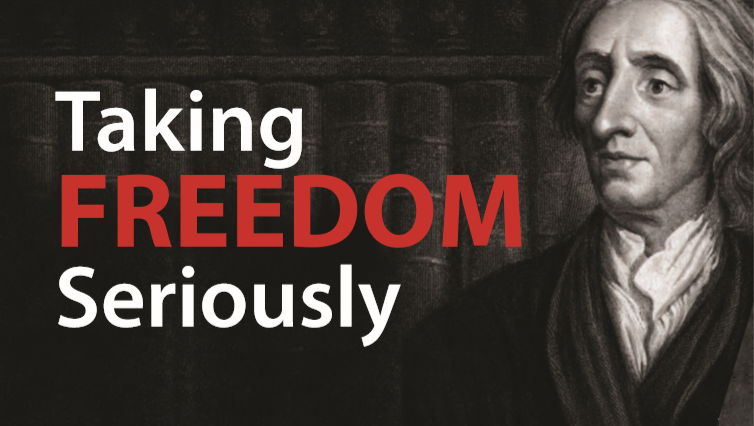
Smith explains that Locke ingeniously responded to Filmer's challenge by presenting an intellectual counterattack.

According to Locke, since it is impossible to identify the legitimate heirs of biblical Adam's patriarchal authority, absolutist governments of his day necessarily stood upon the quicksands of anarchy, since they lacked God-given legitimacy as Filmer described it.

In any case, Locke claimed it an absurdity that people would willingly join in a civil society only to be made worse off, as the absolute sovereign has their way with expunging economic and personal liberties at will.

While Locke may have used the anarchy game to full effect in his critique of absolutism, Smith argues that subsequent usage of the anarchy game, particularly by Edmund Burke in his critique of the French revolutionaries of 1789, engendered a decline in the prominence of Lockean theories within the broader liberal paradigm.

One of the more thought provoking themes covered in The System of Liberty concerns what George Smith refers to as "The Radical Edge of Liberalism", or the use of resistance or revolution to rectify the situation of a government which does not respect individual liberties.

Support for the use of resistance against illiberal legislation, or revolution of a tyrannical government altogether, cannot only be found in the works of Locke, but of Adam Smith, David Hume and Edmund Burke, although the criteria and circumstances in which these acts could legitimately apply vary among these writers.

For example, Adam Smith suggested that people can take up armed resistance when the abuse of governmental power becomes "gross, flagrant, and palpable", say when a government exceeds the feudal benchmark of a tax confiscating at least a third of people's wealth.

The author of the American Declaration of Independence, Thomas Jefferson, contended that persistent abuses of inalienable individual rights ― that of conscience, property and life itself ― would give legitimate ground to the overthrow of a government, thus representing liberalism's radical edge.

Illuminating the rich tapestry of liberal thought, The System of Liberty also brings to light the contributions of some lesser known, yet influential, participants in the unfolding philosophical debates over the meanings of freedom and liberty.

A highlight of the book is the nuanced interpretation of the work of prominent nineteenth century English liberal Herbert Spencer, who is falsely derided by most people today as a heartless "social Darwinist" with scant regard for the unfortunate.

As Smith helpfully reminds us, Spencer was steadfastly dedicated "to improving the economic and social conditions of the lower and middle classes", who were deleteriously affected by government interventions.

With regard to the "survival of the fittest" concept attributed to Spencer, it was not intended as a value judgment but as a description of those behavioural traits and characteristics more conducive to survival within a given society.

For example, the habits of work and thrift are commonly associated with the development of a dynamic, market based economy, with the benefit of previously untold levels of wealth accessible to the masses.

Even so, it is not possible for everyone to escape the stifling grasp of absolute poverty, and so voluntary charity is commended by Spencer, as a system simultaneously drawing upon our humanitarian instinct of concern for others while also providing incentive for donors and beneficiaries alike to access new economic opportunities.

On the other hand, bureaucratic state enforced charity, now referred to euphemistically as the "welfare state", not only drains productive potential because of the staggering fiscal burdens it imposes, but serves to encourage inappropriate behaviours and values, such as indolence and "cheating" the welfare system.

George Smith also reminds us of the British "voluntaryist" movement, including Edward Baines, Richard Hamilton and Auberon Herbert, who adopted Lockean self ownership doctrines when arguing for such reforms as the separation of education and state, and even the introduction of "voluntary" taxation systems.

Filled with insight befitting a scholar with a reputation as one of the leading libertarian thinkers in the world today, George Smith's The System of Liberty has been opportunely written at a time when liberal ideas, once again, seem to be on the rise.

Surveys around the Western world reveal a great distrust of government;  international student liberty groups have emerged;  pro-liberty think tanks are proliferating;  and even nominally liberal conservative political parties are facing an internal insurgency by principled members with strong beliefs in free markets and social freedoms.

As perhaps the most important book in liberalism written in 2013, The System of Liberty serves as the perfect intellectual accompaniment for the liberal resurgence taking root.

Capitalism In Ancient Rome

The Roman Market Economy
by Peter Temin
Princeton University Press, 2012, 320 pages

Enthusiasts of Ancient Roman history have long been struck by a peculiar absence.  As David Hume wrote, "I do not remember a passage in any ancient author, where the growth of a city is ascribed to the establishment of a manufacture."

Yes, there was much trade in the ancient world.  There were markets.  But the power of the Roman state and the paucity of evidence for industry, manufacture, and integrated markets has led many historians to conclude, as the great Moses Finley did, that "ancient society did not have an economic system which was an ancient conglomeration of markets."

Peter Temin's The Roman Market Economy is a clever, extended attempt to demonstrate otherwise.

Temin, an emeritus professor at MIT, is one of the world's most prominent economic historians.  He's written studies on the Great Depression, the economics of slavery, and industrialisation in the United States.  One book also published this year by Temin and a co-author, Hans-Joachim Voth, concerns early goldsmith banking in eighteenth century Britain.

In The Roman Market Economy, Temin's goal is to apply the standard techniques and theories of modern economics to the ancient world.

Of course such standard techniques and theories are broadly Keynesian.  Their application is usually rewarding, but, as we shall see, occasionally problematic.

Temin offers some tests to determine how much of a market economy Ancient Rome really was.  Were the level of prices determined by supply and demand, suggesting that trade dominates the economy?  Was there an integrated market ― in other words, did a price change in one region effect a price change in another region?  And was anonymous exchange common?  It's easy to make trades with people we know personally.  But were contracts and law ― formal and informal ― developed enough to facilitate trade among people outside a group of trusted friends?

The questions are hard to answer.  Certainly there are no data sets of the sort that economists are used to handling.

The first question is whether Rome was an integrated market, rather than a collection of local markets connected only by politics.  We have a small sample of wheat prices from around the Mediterranean region.  Some of those prices survived in the writings of Cicero and Polybius, others from scattered inscriptions.  It's a very small sample, in fact ― there are just six of them.  But they appear to be random.  We can compare those regional prices with prices in the city of Rome.

Temin uses a regression analysis to demonstrate that the prices in Rome and the rest of the empire track each other nicely, once transport costs are accounted for.  This suggests a unified Roman market.  There's no reason to believe prices would follow each other if markets were small and isolated.

From this Temin fills out our understanding of the market for grain, drawing on a large secondary literature.  Roman contract law was highly evolved, which was essential in ensuring the reliability of suppliers and agents.  Commercial partners sued each other when relations went sour.  Merchants developed mechanisms to prevent cheating.  Reputation mattered.

One confounding factor in determining how much of a true market the grain trade was in Rome is the substantial state intervention.  The state provided wheat to a certain proportion of the inhabitants of the city of Rome ― the annona.  This is the bread in bread and circuses.  It's not clear how many citizens received grain;  Temin suggests between fifteen and fifty per cent, leaning towards the lower figure.

Whatever the relative size, this was a significant distortion of the agricultural market.  However, in keeping with general Roman political economy, the annona was contracted out ― private merchants brought the wheat into the city on government contracts.  Another intervention was periodic grain handouts in times of hardship, as well as occasional price controls.  As Temin points out, the fact the emperors sometimes chose to impose price controls suggests the market was fairly dynamic and responsive to supply and demand.  Otherwise why bother?

Merchants needed finance.  Ancient Rome had a relatively sophisticated banking system.  One of our best sources is the Sulpicii, a collection of financial tablets discovered in Pompeii in the late 1950s.  These suggest that the Sulpicii took deposits, lent to third parties, acted as brokers for their clients, transferred funds between accounts, and changed money;  remarkably similar to modern banking.  We know there were a wide range of services and institutions providing financial services in the ancient world.  Temin compares the degree of financial sophistication to that of eighteenth century London ― in other words, extraordinary.

Agriculture was one big market in the ancient world.  Labour was another.  But Rome was a slave society ― intuitively, there can be no meaningful "labour" market where forced labour dominates.  Temin here is provocative and interesting.  Not all slave societies are the same.  We tend to think of slavery monolithically, projecting our cultural understanding of slavery in the American south onto all societies with slaves.  Slaves in Ancient Rome were more connected to the broader labour market than they were in South Carolina in 1860.

Of course Roman slavery was cruel and brutal, particularly for those who worked in certain industries.  Slaves were captured in war, or born into the condition.  But for some, slavery was closer to what we would describe as indentured servitude.

People need incentives to work, and slaves were subject to positive and negative incentives.  The evidence suggests that positive incentives were more common in Ancient Rome than elsewhere.  Slaves could earn wages.  They could be highly skilled, educated, and take managerial roles.  They could act as agents for the masters.

Most importantly, they could buy their freedom.  Manumission ― the act of freeing a slave ― was more prevalent than in any other slave society.  One scholar estimates that ten per cent of slaves were freed every five years.  In the American South that figure was 0.2 per cent.  Ex-slaves, at least in the cities, tended to have been educated in bondage.  Once free, they filled the ranks of merchants and administrators.  Slaves and ex-slaves operated in the same labour market as free individuals.

Temin is understandably on less sure footing when he moves from microeconomics to the macroeconomy.  The standard account of long term growth ― most recently and compellingly detailed by the University of California's Gregory Clark in Farewell to Alms ― classifies growth into the pre- and post-Industrial Revolution.  Before industrialisation, the world was stuck in a Malthusian Trap.  Innovation and discovery only led to population growth, not a growth in income and living standards.  After the industrialisation, income and living standards shoot up.

Temin is constrained by theoretical orthodoxy to apply this model to the Roman economy.  It doesn't fit very well.  There was technological development in the Roman empire, and there was income growth as well.  He concludes that the Malthusian dynamic operates over a period of centuries, rather than in the short term.

But if a society can enjoy economic growth for hundreds of years ― a growth only interrupted by military invasion and political collapse ― how can it be described as Malthusian?  If the Malthusian model can turn itself off for centuries and entire civilisations at a time, it's not clear how useful the model is.  Temin's final trick is to calculate Roman GDP.  Such a figure is only meaningful if markets are broad and sophisticated, which he has demonstrated.  He concludes that per capita GDP was around $1000 ― roughly the same as enjoyed by Europeans in 1700.  This is obviously tentative and speculative and relies on too many assumptions to list, but paints a fascinating picture if even half true.

Macroeconomics aside, Temin is very convincing.  Rome had market economy.  What lessons should we take from that?

First of all, Roman living standards were high.  Extraordinarily high, compared to living standards centuries after.  One strand of ancient historiography in the last half century has been to downplay the significance of the fall of Rome;  suggesting that the Empire melted away, rather than experienced the catastrophic collapse of our cultural memory.  In a 2005 book The Fall of Rome and the End of Civilization, the archaeologist Bryan Ward-Perkins establishes a sudden drop in material well-being that occurred alongside the barbarian invasions and the fall of the West.  Temin's evidence illustrates just what was lost.

Temin's argument has implications for political economy more generally.

Karl Polanyi made an influential argument in the 1940s that there was nothing "natural" about the market economy.  In his view, the market economy was imposed by the state during the eighteenth and nineteenth century.  Capitalism was a political project:  "laissez-faire was planned".

For Polanyi, the pre-market world was one where goods and services were primarily distributed by the principles of reciprocity (the gift economy) or redistribution (state control).  Trade was a minor element of these economies.  When it occurred it was dependent on personal relationships.  Anonymous exchange was rare.

This argument underpins the often heard claims by far left academics and activists that capitalism is inflicted on societies by those with power, rather than the spontaneous result of any innate human desire to trade.

Polanyi's thesis has not held up well.  Temin's book offers one illustration why.  Markets and trade were certainly not "imposed" on Ancient Rome.  There's no evidence that the Roman state wanted to upset an earlier gift economy and create markets;  no reason to believe Roman politicians sought to break the chains of communal reciprocity and replace them with self-interest.

Yet Rome was a market economy nonetheless.  In the absence of better evidence, we can only conclude that it was such an economy because participants in that economy desired it to be so.  Those who produced, bought, sold, transported, invested, lent, and innovated in Rome's integrated economy were not different to us.  Ancient Romans wanted to improve their living standards and pursue their own goals.  The market economy allowed them to do so.

Eye on the prize

Prizes are a common feature on the cultural economy landscape.  In Australia there is the famous Archibald Prize for portraiture, there are numerous prizes for literature and poetry, the AFI Awards in film and television, the Walkley Awards for journalism, and so on.

Prizes can be entertaining spectacle;  they can guide consumers to what is new and best;  they make a fine vehicle for a generous benefactor;  and they surely nudge cultural producers, whether they will admit it or not, closer to excellence.  Yet a case can be made that, due to the interaction of three emergent effects, we'd actually be better off without them.

First, prizes function for consumers as what sociologists call ''judgement devices''.  An overarching feature of the cultural economy is the continuous production of novel products that are of uncertain quality:  they are pure experience goods.  In most markets, such as for furnishings, shoes or cars, the price of a product is a reliable guide to quality.  But an awful movie has much the same ticket price as something brilliant.  A few years ago some colleagues and I looked at the role of the choices of other consumers as a judgement device in what we called social network markets.  Prizes also fulfil this role, but through the mechanism of an expert panel rather than wisdom-of-crowd effects.

Second, prizes introduce a discontinuity between winners and other nominees (also-rans) that distorts perceptions of underlying differences in quality:  consecrating a select few, and throwing the near winners back into the vast pools of mediocrity.

Third, because prizes are awarded by juries of experts — usually with different tastes and preferences than mass audiences (preferring stories about righteous courage in overcoming historical injustice, say, than street-racing robot fighting aliens) — prizes are costly to go after in terms of market risk.  If you try and fail, you end up with not only no prize, but also with something without much market appeal.

When we think about the effect of prizes, we usually have in mind a single-valued reward structure — that is, simply rewarding excellence that has already happened.  But as Gabriel Rossman and Oliver Schilke in a paper just published in the American Sociology Review (an ungated version of the paper is available here) explain the problem is that prizes are actually bimodal in their reward structure because of what economists (following the work of Gordon Tullock) call an all-pay auction.

In an earlier piece I was bullish on prizes, but the issue is complex.  The thing about prizes is that we need to consider not only the benefits to those who win, but also the costs to the losers.  Everyone pays to enter, in sacrificing market appeal, but only a few take the prize, and receive the consumer pay-off;  for the rest, they're now in a worse position than if they had never sought the prize.

Fittingly for this time of year Rossman and Schilke's research focuses on Oscar nominated Hollywood films.  Their method is to identify films that are seeking prizes by constructing and estimating an index they call ''Oscar appeal'' (which correlates well with actual Oscar nominations).  They then study the correlation between that index and a film's financial returns (box office revenues divided by production cost).

They find that Oscar appeal splits into two categories:  those that do receive nominations (and that tend to make money) and those that don't receive nominations (and that tend to lose money).  But the interesting thing is that ''taken together these two types of movies are no more or less profitable than movies with low Oscar appeal''.  In econ-speak, this means that ''the Oscars follow the structure of a Tullock lottery and seem to exhibit rent dissipation.''

Economists tend to be sceptical of the value of artificially created rents by government, such as exclusive licensing, or preferential purchasing provisions, because of rent-dissipation in all-pay bidding to obtain these benefits.  But what is significant about this research is that it extends this economic critique to the domain of prizes, which are a prominent mechanism in the cultural economy (and also in the academic research economy:  a research grant is also a prize!).

Should we abandon prizes?  The counter-factual world without prizes would mean fewer prize worthy films, which means less breadth in the field, but this only occurs if prize-seeking is actually costly in terms of market risk.  The take-away is simply that nothing is for free, including prizes;  or more specifically at the industry level that prize seeking strategies do not produce above-market returns.


ADVERTISEMENT