Tuesday, March 06, 2018

Ask The States Why Money Isn't Spent On Schools

It's almost budget time.  That means that every rent-seeker in the country is off to Canberra with their begging bowl:  Please Mr Morrison can we have some more?  To be fair to Morrison there are an infinite number of worthy causes calling out for increased expenditure.

Take national security, for example.  We live in a dangerous world where any number of ideologues and self-proclaimed religious fanatics want to kill us.  While it isn't clear that diesel submarines are the solution it does seem sensible that the federal government spend money on defence.

But is there an argument for increased federal expenditure on education and health?

Here the situation becomes complicated by our federal system of government.  As much as Australians are in denial about federation, the fact is that Australia is a federation, and education and health are largely state responsibilities.

Rather than run to Canberra for increased school spending, parents and teachers (read teacher unions) should focus their effects closer to home.

This year the Australian Education Union is claiming that the Turnbull government is funding ballet centres and orchestra pits in private schools while public schools require buildings.

In the very first instance the arts are a very important component of any education and it reflects poorly on the education union to suggest otherwise.

The far more important point, however, is that the union argument is highly misleading.  This is not a case of the federal government funding the haves at the expense of the have-nots.

The federal government tops up parents who chose to fund their own children's education.  The state governments finance the education of those students whose parents either cannot afford to pay for their own children's education, or are too cheap to pay for their own children's education.  Historically the quantum of public (both federal and state) money going to schools has favoured public schools over non-public schools.

Yet many people criticise the federal government for underfunding public schools.  Much is being made of the Turnbull government cutting $1.9 billion from school funding.  They should look in the first instance to their own state government.

The NSW government, for example, has $5.4 billion surplus.  The federal government has a $23.6 billion deficit.  To the extent that NSW public schools need capital improvements, or don't have ballet centres or even orchestra pits, that is because NSW has chosen not to spend the money.

Now there is no good reason why Australian taxpayers should fund NSW public schools when the NSW government has chosen not to do so.

Blaming Canberra for all the ills of the world is cheap and lazy politics — especially given our federal system of government.

While it is true that Canberra raises the bulk of tax revenue and the states are responsible for the bulk of social expenditure the presence of state surpluses while the federal budget is in deficit implies that education unions in those states should be looking to their own state government for increased education funding.

Saturday, March 03, 2018

No Sex Please, We're Progressive

The Prime Minister's recent puritanical edicts regarding relationships between ministers and their staff do not have roots in conservative Christianity, but in progressive Leftism which has an historical precedent dating back to the Victorian era.

In 1888, English publisher and writer Henry Vizetelly was prosecuted for obscene libel after he translated Émile Zola's La Terre.  The following year, Vizetelly was fined £200 and imprisoned for three months for having dared to reissue Zola's novels.  This rather dampened the spirits of Vizetelly's colleagues, who promptly fell into a slump of self-censorship in order to avoid the same fate.

The writer's arrest and imprisonment came about because he had been targeted by an organisation called the National Vigilance Association which had been formed just three years earlier for the "enforcement and improvement of the laws of the repression of criminal vice and public immorality".  Judging from the 27 boxes of minutes, annual reports, correspondence and campaigning files it left in its wake, the National Vigilance Associate was, if nothing else, thoroughly vigilant.

That the National Vigilance Association blossomed during the Victorian century would surprise few.  Victorianism remains synonymous with prudishness, priggishness and puritanism.  In a recent lamentation penned by Matt Ridley for the Times, he described our current generation of intolerant and censorious millennials as new "Victorians".

Ridley is only partially right.  What would surprise most people today is that the most intolerant and censorious Victorians did not hail from mainstream society, but rather from its radical fringes.  Counter-intuitively, the puritanical movement was spearheaded by feminists, socialists, and trade unionists.

Today's progressives have more in common with (mostly female) zealots who were hell-bent on policing the morals and behaviour of their fellow citizens for much of the 19th century in Britain.

The ultimate aim of this moralising minority was the attainment of Utopia.  The Victorian radicals were inspired by an anti-sensualist, highly rationalist movement which had emerged amid the excesses of 18th century Regency Britain.  Its underlying philosophy, grounded in Gnosticism, was that lust was both a primitive and sensual urge which obstructed the pursuit of equality.

For the feminist, the inequality between the sexes could be overcome if women relinquished such encumbrances as male desire.  Indeed, the 18th century feminist and philosopher Mary Wollstonecraft argued that reproductive inclinations rendered women weaker because they risked becoming "prey to their own senses".

For the Victorian socialist, the working classes could only attain true socio-economic equality through the attainment of "respectability" which was equated with puritanical attitudes towards sex.  For example, one particular socialist community in Surrey which adhered to the utopian philosophy of Robert Owen, a 19th century reformer, dictated that married members should not have sex more than once in two or three years.

Victorian progressives were highly skilled at employing both politics and the law by forming themselves into powerful and effective lobby groups.  In the 1860s, they organised a number of social purity campaigns to undertake a moral cleansing of society by attempting to abolish a range of sexual activities including prostitution.  By the 1880s, feminists, Fabian socialists, and labour organisations had so much control over London that they were referred to as "Municipal Puritans".

Victorian Londoners were compelled to endure years of repression and interference at the hands of an activist minority who dictated the rules and regulations for human relationships.  The hounding, arrest and subsequent death of Oscar Wilde was the tragic apogee of this movement's moral policing.

It is no coincidence that the aggressive puritanism, general illiberalism and political correctness we are witnessing in 2018 is coming not from the conservative Right, but from the progressive Left.  As history repeats itself, the most moralising individuals in our society today are feminists, Marxists and other Utopians.  Theirs is the voice of an extremist minority;  yet their tentacles of influence extend through academia, government and the media.  Take a look at any HR code of conduct in any public organisation and one will essentially find a set of ethical, moral and social behavioural codes which the employee is compelled to adopt in the workplace.

According to the managing director of its commercial operations, Formula One's "grid girls" must be banned because "they no longer reflect modern day societal norms".  This is symptomatic of contemporary Victorianism.  The #MeToo movement aims to bring all manifestations of male sexuality under control by re-defining normal desires as pathological.  It should come as a shock to nobody that the Greens have given Malcolm Turnbull's Big Brother sex ban the loudest and most enthusiastic support.

Malcolm Turnbull declared at a press conference earlier this month (presumably after gaining counsel from his wife) that "most of the ministers ... most of the bosses in the building ... are men and there is a gender, a real gender perspective here".  By employing the language of identity politics, which is taken straight out of our humanities departments, the Prime Minister is signalling that he believes, as did our 19th century feminists, in the idea of a patriarchy.  He believes that men hold power to the exclusion of women, and until this power is equalised, evenly distributed, or taken away from men altogether, Utopia will remain elusive.

We have arrived at a time in our nation's history when politicians are now dictating what should and should not happen between consenting adults.  This is a massive illiberal overreach of government.  The fact that it is prepared to sacrifice personal freedoms in the name of equality reveals that the present government is not a conservative, but a progressive one.

Monday, February 26, 2018

Top Three Lefty Unis

From the sandstones to the concrete monstrosities, Australia's university students are returning to lecture halls and classrooms in coming weeks.  This provides an opportune time to ask:  are our publically funded universities adequately guarding freedom of expression?  Are our universities allowing the voicing of competing perspectives in the pursuit of knowledge and truth?

My Free Speech on Campus Audit 2017 found, from analysis of over 165 policies and actions, mounting evidence of censorship.  Thirty-four of Australia's 42 universities are hostile to free speech, seven threaten free speech, and just one, the University of New England, supports free speech on campus.  From violent protests against speakers, to university policies that prevent hurt "feelings", the atmosphere on campus is often not friendly to freedom.

Some universities are standouts — and not in a good way.  As found by the Free Speech on Campus Audit, here are, in reverse order, Australia's "top" three worst campuses for free speech:

  1. JAMES COOK UNIVERSITY

    James Cook University's treatment of Professor Peter Ridd is, quite frankly, embarrassing.  The hounding of a professor for discussing science belongs more to the time of Galileo than to modern Australia.  Last year, Ridd appeared on Sky News with Alan Jones to talk about the IPA's book, Climate Change:  The Facts 2017.  "The science is coming out not properly checked, tested or replicated and this is a great shame because we really need to be able to trust our scientific institutions and the fact is I do not think we can any more," Ridd said in relation to science about the Great Barrier Reef.

    For these comments Ridd was given a "Final Censure" and gag order that would prevent him from making these sorts of comments in future.  Ridd refused to accept them and is now fighting James Cook in the courts.  Ridd's experience sends a signal to fellow students and academics alike to not express a view outside of the university-approved groupthink.

    The treatment of Ridd is just one part of the story.  In the past, James Cook University ousted climate sceptic Bob Carter from his adjunct professorship.  In another case, students were expelled from a residential college because they made jokes about religion during a music competition.  James Cook University has also recently introduced a policy that prevents speech that "makes a person feel offended".  Hearing an idea that is the opposite of your own can often feel offensive — meaning this policy in effect curtails the ability for students and academics to explore controversial ideas.

  1. CHARLES STURT UNIVERSITY

    Charles Sturt University maintains more policies that threaten freedom of expression than any other university in Australia.  The university has a 1,600 word policy on when, where and how flags should be flown, however it does not have a policy dedicated to free intellectual inquiry on campus.

    The university does have a policy that prevents "offensive language", and, extraordinarily, "sarcasm".  This threatens genuine debate and discussion in class if, in the subjective view of the accuser, a comment was offensive or sarcastic.

    The university's "Anti-Racism Policy", a laudable goal, is seething with ideology.  The policy claims racism is "best understood when acknowledging the context of power, oppression and privilege".  This is an explicit identity politics definition of racism which is heavily contested, rejecting the traditional definition of racism:  the harbouring of specific racist beliefs.  The policy also requires that curriculum design be "culturally inclusive", preventing the at times necessary criticism of culture.

    Charles Sturt University is introducing a new requirement for "Indigenous Australian Content in Courses" by 2020.  This means all students, whether they are studying cybercrime, creative arts, or law will be taught topics like "The Dreaming as worldview and law".  This content, which must be centrally approved, re-purposes the university from a place about exploring ideas, to teaching narrow topics in every course in an uncritical manner.

    The university also tells students that they are "expected to value" political causes such as "social justice including ethical practice and global citizenship" and "economic, social and environmental sustainability, including the responsible stewardship of resources".  I dare not imagine the response to expressing a non-leftist view in class.

  1. UNIVERSITY OF SYDNEY

    Between the actions of staff, students and administrators, there has been more silencing of speech at the University of Sydney than any other university in the country.  The University of Sydney was found to be the most hostile university to free speech in my Free Speech on Campus Audit 2017.

    In the past, the student union has attempted to ban student clubs including a men's mental health society, the Brotherhood Recreation and Outreach, and threatened to deregister Christian clubs, speakers have been violently protested and in other cases banned from campus, academics have been sacked, and the university almost refused to host the Dalai Lama to avoid damaging ties with China.

    In just the past year, the student union attempted to block the screening of the controversial Red Pill film because, it was claimed, that showing a video could "physically threaten women on campus".  The university has charged security fees to conservative students which are not charged for the activities of other student groups.  Meanwhile, a protest against No campaigners in the same-sex marriage plebiscite turned violent, requiring police attendance.  The University of Sydney has also refused to provide students with a venue to host Australian Christian Lobby head Lyle Shelton.  In another case, a student was told he could not link anti-Israel sentiment to anti-Semitism in class.  The university administrators have also succumbed to demands for censorship, apologising after complaints were made by Chinese international students about a map in a lecture which showed disputed territory inside India rather than China.

The protection of free expression speaks to the very essence of a university, whose role in society, to increase knowledge and discover truth, requires the ability to freely debate ideas.  Australia's universities are often failing in this task.  Let's hope they can do better in 2018.

Friday, February 23, 2018

Malcolm Turnbull's Sex Ban Signals All The Wrong Virtues

Before Malcolm Turnbull prohibited his ministers from having sexual relations with their staff, there's a few dozen things he should have banned first.

For example, he could have banned ministers wasting taxpayers' money.

That way we wouldn't be spending $50 billion on submarines that won't be operational for 30 years.  Or he could have banned ministers breaking their election promises by introducing retrospective laws.  That way we wouldn't have had the superannuation tax debacle.  Or he could have banned ministers from introducing any new regulation unless they also abolished two old regulations.  That way we'd be on the path to shrinking the country's largest industry — red tape.

If it's a question of who would provide a greater benefit to the Australian public — a philandering minister who slashes government spending and cuts the size of her department in half, compared to a minister who's been happily married to the same person for 30 years and who faithfully follows the advice of her left-leaning bureaucrats — the choice is not even close.

If the Prime Minister really wanted to send a message about the need for ministers to abide by some notion of "community" standards he could install breathalysers in Parliament House.

If you're not allowed to drive a car over .05 you shouldn't be allowed to vote on a law if you're over .05 either.  In 2014 the then Victorian state Labor leader Daniel Andrews made an election promise to introduce random breath testing for politicians and judges.  It's a promise Andrews has since forgotten.

The Prime Minister's ban on ministers' personal relationships should be treated as the joke it is.

The ban is neither "liberal" nor "conservative" — it's virtue signalling, pure and simple.

There's many explanations why 64 per cent of Australians say they support the ban.  One reason might be that Australians just don't like politicians.


THE DEATH OF COMMON SENSE

It's easy to poke fun at what the PM's done, but there's a serious point about the whole thing.  The ban is yet another further step towards the death of common sense in politics and in public life.

The truth is there will be many situations where a relationship between a minister and one of their staff members is clearly inappropriate, for instance where there's the potential for the exercise of favouritism.  But there will be be other occasions where such personal relationships won't cause a problem.

Out in the real world the operations of the public service, schools, and hospitals would grind to a halt if ever a ban on relationships between bosses and their subordinates was instituted and enforced.

One consequence of the PM's ban is that if ever a minister did form a relationship with a staff member, one of them, most likely the staff member would be forced leave their job.  Which is not very different to what happened in the Commonwealth public service until 1966.  Up until then if a woman employed in a permanent position got married they'd be required to leave the public service.

The Prime Minister's desire to have the government control the personal relationships of employers and employees is another manifestation of the overweening desire of politicians of both the left and the right to regulate what we can say, who we can ask out for a date, and what and when and where we can eat and drink.

It's no surprise that the federal Sex Discrimination Commissioner Kate Jenkins welcomed the ban.  The commissars at the Human Rights Commission never miss an opportunity to tell people what to do and how to behave.

The application of common sense, as ill-defined as that term might be, is a better way of managing workplace relations, than through the imposition of a prime ministerial decree.

Certainly common sense is fuzzy, but so are personal relationships.  Sometimes hard and fast rules are necessary, but sometimes they're not.

When he announced his ban Turnbull said he would insert a sentence in his Ministerial Code of Conduct that said, "Ministers need to exercise their judgment and their common sense in complying with the both the principle and the spirt of the standard and their letter".

Despite these fine words, the Prime Minister's ban flies in the face of common sense.

Tuesday, February 20, 2018

I Dare An ABC Journo To Check Just One Fact Of Global Warming

The Australian Broadcasting Corporation (our ABC) — the main source of news and information for Australia's ruling elite — often begins its broadcasts with the claim it's free of bias and agenda'.  I can't think of a more inappropriate and untrue description.  ABC journalists will justify the claim with reference to sourcing information from only the most trustworthy of institutions and experts.  The problem, of course, is that so many of our institutions have lost-their-way, and so many of our experts take a wholly partisan approach to the most controversial of issues — particularly global warming.

As Scott Hargreaves explained recently, the average Australian, like the average Brit and American, has mostly lost confidence in experts.

This potentially makes the job of the journalist all the more exciting.  Rather than just parroting an authority, they have the opportunity to find out why almost half the population has chosen to disregard expert opinion on a range of issues — including global warming.

Global warming is actually not a hard issue to dissect because fundamentally it relies on evidence of there being a general trend of temperature increase — and measuring temperatures is not rocket science.

Of course, there is nowhere on earth where the mean global temperature anomaly can be measured.  So, steer-clear when this statistic is mentioned by an expert — you can probably dismiss it as something entirely contrived, like say the virgin birth.

When I suggest journalists dig-around:  I mean for the raw temperature measurements from individual weather stations.  Most politics is local, and as you will discover along this journey, the global mean temperature as so often reported by experts is actually a contorted amalgamation of thousands of abused local temperature series — unless the expert is referring to the satellite record, which is another story.

Indeed, while the Australian Bureau of Meteorology often refers to ACORN-SAT ... SAT in this context is actually an acronym for "Surface Air Temperatures".  Not SATellite.  (The previous Minister, Greg Hunt, was often muddled on this issue.)

To be clear, the Bureau relies entirely on surface air temperatures for reporting climate variability, and it has very significantly changed the way it measures these temperatures over the last few decades ... without showing us that the new method is in any way comparable with the old method.

Meanwhile, the Bureau keeps claiming new record hot days, which are reported by our ABC without any scepticism.

The change-over from mercury thermometers to electronic probes in automatic weather stations has been occurring for more than two decades, but alarm bells only started ringing for me last year when I discovered that rather than averaging one-second readings from the electronic probes over at least one minute as is standard, the Bureau records the highest one-second reading as the maximum temperature for that day.  To be clear:  when the Bureau reports, for example, that "37.7 degrees Celsius is a new record for Mildura" as they did last September, they are not referring to the daily average, or the temperature after the probe starts beeping to signify it has steadied — they are referring to an instantaneous one-second spot reading.

Because electronic probes are much more sensitive than old-style mercury thermometers to fluctuations in temperature and because temperatures can fluctuate on a hot day by up to two degrees Celsius in less than one minute at places like Mildura, this very dubious method of calibration will likely result in new record hot day — even for the same weather.

Since I raised this issue with Minister Josh Frydenberg last year, the Bureau has not denied that they use this non-standard method for recording temperatures, but they claim it results in the same temperatures as would be recorded from a mercury thermometer because they have "custom-made probes" with a longer than normal time constant.

It would seem reasonable to assume that given the Bureau have been changing-over from mercury thermometers to custom-made probes at its over 600 weather stations for some time now, and because they are relying on a novel method for calibration there would be lots of reports — so many parallel studies — to demonstrate that the new method is above-board.  I mean, it would be ridiculous if some of the catastrophic global warming so often reported by experts via our ABC were just a consequence of a new method of recording temperatures!  This should be all very easy to check, except that the Bureau has been far from forthcoming with the relevant data, as detailed in a recent blog post.

And I'm more than happy to make all my correspondence with the Bureau available to ABC journalists should they decide to do some research into this issue — should they choose to convert from true believers to genuine truth seekers ... free of bias and agenda.

Thursday, February 15, 2018

Censure Of Professor Peter Ridd Over Comments Of Scientific Integrity A Troubling Development

Academic freedom is one of the core values of our ­society, which is why the case of Professor Peter Ridd is so troubling.

The attack on Professor Peter Ridd's academic freedom to discuss scientific integrity may very well mark the end of the Enlightenment at one of Australia's universities.

Ridd has been issued a "Final Censure" by James Cook University for expressing an opinion within his field of scientific expertise.  He was also ordered to keep silent about concerns related to quality assurance in Great Barrier Reef policy science.

The censure was in response to comments by Ridd on Sky News in an interview with Alan Jones to promote the Climate Change:  The Facts 2017.

In the interview, Ridd questioned the quality of science from "organisations like the Australian ­Institute of Marine Science, even things like the ARC Centre of Excellence for Coral Reef Studies".

"The science is coming out not properly checked, tested or replicated and this is a great shame because we really need to be able to trust our scientific institutions, and the fact is I do not think we can anymore," Ridd said.

Ridd has worked at James Cook University, where he completed his PhD, since 1989.

He is a lecturer and researcher in physics and marine geophysics with more than 100 peer- ­reviewed articles to his name, and has undertaken extensive research on coral reefs.

"I just don't think they're very ­objective about the science they do, I think they're emotionally attached to their subject and, you know, you can't blame them — the reef is a beautiful thing," Ridd said on Sky News.

James Cook University has claimed Ridd's remarks denigrated the university.  Nothing could be further from the truth.  There is nothing more essential to a functioning ­university than scientific debate.

This is the very purpose of the university.  James Cook University's code of conduct explicitly states staff must "value academic freedom, and ­inquire, examine, criticise and challenge in the collegial and academic spirit of the search for knowledge, understanding and truth".

James Cook's actions have a serious chilling effect on scientific debate by discouraging academics and ­students from discussing controversial topics.

In a David and Goliath battle, Ridd has chosen to not lay down in the face of threats.  Ridd has lodged Federal Court action to assert his academic freedom to discuss scientific integrity.

It is only through debate, claim and counterclaim that we can hope to find truth.

The fundamental role of the university is to encourage debate, not to stifle it with preposterous claims and disciplinary action.

This is the essence of the Socratic method, the process of argumentative dialogue between opposing perspectives, on which the Enlightenment and our universities are built.

The only way to discover the truth is to stimulate critical thinking through debate.  This freedom also is explicitly protected in Ridd's enterprise agreement, which guarantees his right "to participate in public ­debate and express opinions about ­issues" within his field of competence.

If our university professors are ­incapable of questioning and debating science we are bound to enter a new Dark Age.  The restriction of scientific debate, the claim that certain hypothesises can no longer be tested and ­retested, marks the end of progress.

The fundamental role of the university is to encourage debate, not to stifle it with preposterous claims and disciplinary action.

From the UK to North America to Australia, however, universities have become hotbeds of censorship and are lacking essential viewpoint diversity.

Last year a recording emerged of Canadian university tutor Lindsay Shepherd being aggressively reprimanded by senior academics for ­simply playing a debate in a communications class featuring psychology professor Jordan Peterson.

Meanwhile, protests against guest speakers, such as Charles Murray and Milo Yiannopoulos, on American college campuses have turned violent.  My Free Speech on Campus Audit 2017 found that eight in 10 Australian universities have policies or have taken action that limit free intellectual inquiry.

In the past, QUT students were dragged through Federal Court for questioning the existence of a separate computer lab for indigenous students.  Meanwhile, last September a protest turned violent against a "No to same-sex marriage" stall at the University of Sydney.

Australia's universities are public institutions, established under state and federal law, and receive most of their funding through government grants and state-subsidised loans.  Their role is to serve the public interest through teaching and research, which can only be undertaken by encouraging dynamic debate about issues of public concern.

James Cook University is failing in this task by preventing the expression of an expert opinion.  The university must withdraw all sanctions against Professor Peter Ridd.

Friday, February 09, 2018

Turnbull's 18C On Steroids

Rahm Emmanuel, one-time Chief of Staff in the Obama Administration, once said:  "You never let a serious crisis go to waste ... It's an opportunity to do things you think you could not do before."

It would seem that the Turnbull government is using the perceived crisis of "foreign influence" in our political system to tweak federal electoral regulations in its favour.  In doing so, the government has unleashed 18C on steroids.  It is not only compromising freedom of speech, but also opening up a range of unintended consequences for a swag of civic groups unrelated to the political process.

The Electoral Legislation Amendment (Electoral Funding and Disclosure) Bill was rushed into Parliament late last year, ostensibly in response to the Sam Dastyari affair.  Its supposed purpose is to ban political donations from foreign sources, which it does.

But critically, there is more to the bill than that.  Not only does it tighten the existing provisions of the Commonwealth Electoral Act, but it also vastly extends its application to a range of new entities.

Currently, electoral law applies almost entirely to political parties, their associated entities, and candidates.  In its bill, the government is seeking to apply many of the Act's requirements to "non-party political actors".  That is, groups other than political parties that actively campaign in elections.

Clearly, the government is going after political irritants.  Many within the Coalition are adamant that their electoral woes are the fault of increasingly energetic "non-party actors".

But using the power of the state to silence political opponents is something one would expect from a left-wing government, as the Gillard government attempted to do with Stephen Conroy's draconian media laws.  As was the case with Section 18C of the Racial Discrimination Act, conservatives, classical liberals and libertarians alike should be extremely concerned at the restrictions on freedom of speech in this bill.

A Liberal government worthy of its name should aim to increase freedom of political communication, not restrict it.  Instead, the government's bill is the latest in a series of electoral "reforms" made over the years that have chipped away at free speech in the political sphere.  Electoral regulation is necessary, but it should be limited to establishing the structures through which free and fair elections take place.  But over time, electoral law has become less concerned with regulating the conduct of elections and more preoccupied with "managing" the broader political debate.  Dressed up in motherhood buzzwords like "transparency" and "accountability", these laws presume that voters, if left to their own devices, will make impulsive or misguided decisions at the ballot box.  To encourage "informed" choices, it is argued, the state must keep debate "fair" by enforcing rules about the way in which political parties disseminate their message.  This notion is as dangerous as it is erroneous.  Freedom of communication is indispensable in a truly free electoral system.  To regulate speech is to regulate the very essence of democracy.

Worse still the bill, as currently drafted, will go far beyond its intentions.  The vast majority of the entities that will be affected have absolutely no engagement with the political process.  Under the bill, an organisation will need to register as a "politcal" and "third party campaigner" if it incurs a certain amount of "political expenditure".  Such expenditure may include "[t]he public expression, by any means, of views on an issue that is, or is likely to be, before voters in an election".

Of course, every conceivable issue may be "before voters" at an election, given that people cast their vote for all manner of reasons.  This means that any organisation expressing an opinion on any public policy matter whatsoever could end up being brought within the remit of the Electoral Act.  The bill could affect, for example, a charity expressing a view on homelessness, an indigenous organisation opining on the state of remote communities, or a sporting club lobbying council to upgrade parks and leisure facilities.

The bill will therefore impose a substantial compliance burden on civil society.  Requirements include registration with the AEC, filing annual financial returns and all manner of red tape surrounding the acceptance of donations.  Non-compliance may attract criminal penalties, and many requirements are duplicated from those that already exist under charities and non-profits law.  The result will be a substantial "chilling effect" on public debate, one that will not be limited to the Left.

The Catholic Archdiocese of Sydney, for example, claims that the bill "will adversely affect the practice of its religion in material ways".  The church warns that "accepting anonymous donations ... will be impractical, engaging in advocacy ... will be limited and curtailed and ... the freedom of priests to preach the word of God and speak to relevant issues of social significance will be undermined."

Curiously, media organisations are among the few exemptions to the new requirements.  That means that an opinion expressed by, say, the head of a religious charity would be considered "political activity", but the opinion of a presenter on the ABC would not.  A blog post on the website of an industry association like the National Farmers Federation would be caught by the Electoral Act, but not an opinion piece in the Guardian.  There is no good reason for this arbitrary double standard.

Perhaps the worst aspect of the bill is the precedent that it sets.  For the first time, civic groups will be forced to register with a government statutory authority for no other reason than mere speech.  This is fundamentally undemocratic.  Genuine democracy means more than just the ability to cast a vote every few years.  It means the freedom to express an opinion on public policy matters without interference from the state.  Upon toppling Tony Abbott in 2015, Malcolm Turnbull promised a "thoroughly liberal government, committed to freedom".  If the Prime Minister had a shred of sincerity back then, he would abandon this thoroughly illiberal law now.

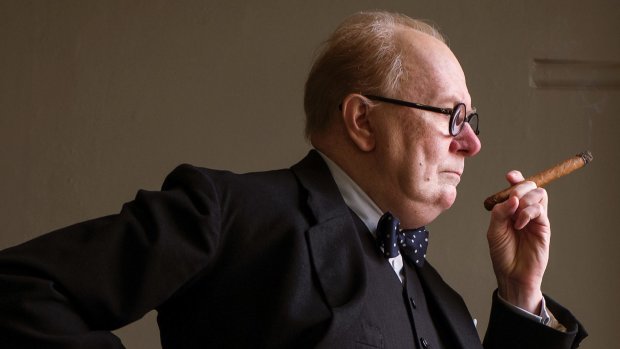
Why Darkest Hour, A Film About Winston Churchill, Is An International Success

US founding father John Adams was right when he said "facts are stubborn things".  Individuals in history are stubborn things too.

Academic historians at modern-day universities might believe and inculcate in their students the idea that the past is the product only of the inexorable forces of class, race and gender.  However, the book-reading and film-going public know better.

Which is why the shelves of airport bookshops are crammed with historical biographies.  And that's why Darkest Hour, a film about how Winston Churchill became British prime minister in 1940, is an international success.  Its gross receipts of $100 million are less than the $1 billion earned by the The Last Jedi, but Darkest Hour is a dialogue-heavy political drama with no special effects (unless you count make-up) and its only action sequences involve Churchill in his bathtub.

Individuals make history, just as it is individuals who found great companies, who make scientific breakthroughs, and who write great symphonies.  The "force of history" is a phrase that appears in postmodern humanities textbooks, but it is just as meaningless as a similar term, "the right side of history".

The results of the annual Edelman Trust Barometer survey were published in this newspaper on Tuesday.  Respondents who said they trusted chief executives increased from 26 per cent in 2016 to 39 per cent last year.  Part of the reason for this is assumed to be the growing number of bosses making public pronouncements on social issues.  Regardless of whether you happen to agree or disagree with the stance that chief executives take on particular questions at least they are choosing to exercise some leadership.  Successful business leaders don't just wait for the forces of global capitalism to crash into them.


CENTRAL MESSAGE

A central message of Darkest Hour is that individuals make history by the choices they make.  In April 1940 Neville Chamberlain could have chosen for Britain to reach a peace with Hitler and cede Europe to Nazism.  In May 1940 Winston Churchill chose to fight.  As dire as Britain's position was after the fall of France, Churchill succeeded in convincing the British people that they weren't helpless and that their defeat was not inevitable.

The notion that individuals have power over history, and indeed have power over their own lives, is an optimistic and positive one.  Yet it's a notion diametrically opposed to how history is taught in Australian universities.  More broadly, the claim that the way we live is the result of the choices we make cuts across the prevailing narrative of nation states and their political systems as merely bobbing corks on the tide of the inevitability of globalisation, liberalisation, and homogenisation.

Last year I reviewed all of the 746 undergraduate history subjects taught at the 35 Australian universities offering history programs.  Forty-two subjects covered the First World War;  48 covered Nazism, Fascism, and Communism in the 20th century;  51 covered the Second World War;  and 39 subjects dealt with the Cold War.

The name "Winston Churchill" didn't appear once in the content of any of these subjects.  Which is perplexing given his responsibility for the Dardanelles campaign in 1915, his role as the world's foremost opponent of the totalitarian ideologies in the inter-war period, his prime ministership from 1940 to 1945, and then in 1946 his "Iron Curtain" speech usually taken to mark the beginning of the Cold War.  In fact Churchill doesn't appear in any of the descriptions of the 746 history subjects taught last year at Australian universities.


IDENTITY POLITICS

In tertiary institutions individuals have been replaced by ideologies.  The most common themes in those 746 subjects are, in order, Indigenous issues, race, gender, the environment and identity.

The ideology of identity politics and the categorisation of people into pigeon holes according to personal characteristics that they had little or no role in choosing for themselves is that there's no room for choices.

"Race" and "identity" might help comprehend the origins of totalitarianism, but they can't explain how Churchill became prime minister, and they certainly can't explain how fascism came to be defeated.

It's sad that someone wanting to know how the civilised world was saved in 1940 by the choices that Winston Churchill made would learn more from going to the movies than from enrolling in history at an Australian university.

Friday, January 26, 2018

Don't Let The Loony Left Spoil Our Party

If you were a tourist attending the Australian Open, and you happened to have been perusing the papers in between sets, you would be forgiven for thinking that the entire country is suffering from a collective identity crisis.

This is because every year, like clockwork, a minority of apparatchiks of the Left up the ante and push to change the date of Australia Day.  Every year, as January 26 gets closer, their voices become more strident as they call to change the date of our national holiday.

This week, Research Now released a poll, which asked the simple question "Do you think Australia Day should be celebrated on 26 January?"  Seventy per cent of Australians agreed, while only 11 per cent wanted the date changed.

This poll (along with many others) highlight just how spectacularly out of touch some left-leaning groups are with greater part of the population.  Preoccupied with identity politics, hell-bent on dividing rather than uniting Australians in the face of opposition from the general populace, this minority will continue to channel its considerable energies into pushing for change, whether the people want it or not.

Last week, for example, Pat Cash said that he will most definitely not be partaking in festivities on Friday because he is exceedingly embarrassed to be an Australian.  He, along with his fellow proponents of change, refer to Australia Day as "Invasion Day" because for them it represents violence, bloodshed and generations of suffering.

Recently, Professor Tony Birch, self-described "Author, Activist, Academic" admitted the underlying anti-colonialism that is behind much of the campaign and postulated that changing the date "will do nothing to shake Australia from its colonial settler triumphalism".  This comment reveals that even if Australia Day were to be celebrated on another day, the thirst for change will never be satiated.

This negative view of Australia's history is not shared by the majority of the Australian people.  In the Research Now poll, when respondents were asked if Australia has a history to be proud of, 76 per cent agreed with this statement, while only nine per cent of Australians disagreed.

Upon changing the date of its citizenship ceremonies, Darebin Council's consultation of the community comprised asking 81 out of 200 from a total of 146,000 ratepayers.  That's just 0.5 per cent of the population.  Furthermore, on its website, the good people at the council are now actively encouraging rebellion, suggesting that people "go to work on January 26 and take a different day off".

This is exactly the kind of divisive behaviour we have come to expect from left wing councils such as Darebin.  Thankfully, local councils do not have the power to set public holidays.  The Research Now poll, found that only 23 per cent of Australians support local councils in moving citizenship ceremonies from Australia Day, which proves that Darebin Council is completely out of step with ordinary Australians.

Last year, Sue Bolton socialist councillor at Darebin City Council, stated that celebrating Australia Day "was like celebrating the Nazi holocaust".  Over at the University of Western Australia, the student guild's vice president also compared the celebration of Australia Day to celebrating genocide.

Incidentally, Triple J's hottest 100 is now going to be played on Saturday 27 January.  This is Holocaust Memorial Day, on which day "the world remembers the millions of people who have been murdered ... during the Holocaust, Nazi persecution and in subsequent genocides in Cambodia, Rwanda, Bosnia and Darfur".  The crew at Triple J really should have consulted their calendars before deciding upon this particular day in January.

While no one would seriously deny that there have been terrible injustices inflicted on Indigenous people through the course of white settlement, January 26 which marks the arrival of the first white settlers at Sydney Cove.  It was the day that the ships of the First Fleet weighed anchor and left their initial landing point of Botany Bay for the superior harbour of Port Jackson and the fresh water of the Tank Stream.

The First Fleet did not bring with it genocide or a holocaust.  It was not a floating flotilla of death.  It brought with it centuries of accumulated knowledge and the foundations of our political system and cultural heritage.  The British on board brought with them the universal values of Western Civilisation which can be applied universally to all humans, no matter their class, gender or race.

Whether we like it or not, each and every one of us in this country are both beneficiaries of, and participants in Western Civilisation.  Moreover, as the Research Now poll showed, the majority of Australians do like it — 87 per cent in fact, like it a lot.  Like all civilisations, Western Civilisation has its light and dark pages.  Those individuals who want to focus solely and entirely on the dark pages are completely and utterly out of touch with the rest of the country, which is quite clearly not suffering from an identity crisis at all.

Wednesday, January 24, 2018

Let's Honour Our Western Heritage Without Shame

The overwhelming majority of Australians are not only proud to be Australian, but they are also proud of their history.  Furthermore, the majority of Australians want to continue celebrating ­Australia Day on January 26, as they have done since 1935.

The results of a poll recently commissioned by Research Now reveal that 76 per cent of Australians are proud of their history, while 87 per cent are proud of being Australian.  When asked if Australia Day should be celebrated on January 26, some 70 per cent agreed that it should, while only 11 per cent believe that it should not.

The poll results confirm what most of us know — that the left-leaning groups obsessed with identity politics are completely and utterly out of step with what the majority of Australians want when it comes to our national day and our colonial past.

This push to change the date of Australia Day is emblematic of a deep shame held by a minority of the population about Australia's colonial history, which by inference also means that they are ashamed about Western civilisation, because the two are inextricably linked.

This vocal minority appears to be determined to foist its shame on the rest of the population by first changing the date of Australia Day and then abolishing it altogether so that their collective guilt might be at least partially ameliorated.

While no one would seriously deny that there have been terrible injustices inflicted on indigenous people through the course of white settlement, it is extremely shortsighted to dismiss the fact that Australia as a modern nation only exists because of Western civilisation and we continue to benefit from its legacy.

This country was founded on institutions and principles established in Britain and Europe over the course of centuries, and we are extremely fortunate to have inherited them.  Modern Australia is one of the most successful nations in the world, and a country that continues to attract people from every corner of the globe precisely because it was founded on the ­institutions and principles of Western civilisation.

In 1788, the British colonists brought with them centuries of ­accumulated knowledge and the basis of our cultural heritage.  They brought with them the values of liberty, inquiry, toleration, religious plurality and economic freedom.  They brought with them Christianity, which had positioned the individual as the locus of meaning, sovereignty and significance.

Equality of man, individual dignity and the abolition of slavery were all bequeathed to the world by Christianity and Christian thinkers.

The men and women on the First Fleet brought with them the precious institution of the rule of law.  The importance of the rule of law had left a deep impression on the British people, and it was this impression that travelled to Botany Bay.  The rule of law, as the broad set of principles vital to the order and stability of society, is considered to be one of the most effective guards against the wielding of arbitrary power.  They brought with them the notion of a liberal democracy.

The early settlers brought with them inquiry and rationalism of the Age of Discovery, the scientific mind and empiricism of the scientific revolution, the liberal values of equality before the law, freedom of speech of the Enlightenment, and the economic foundation of our modern prosperity laid by the industrial revolution.

In short, Western civilisation is distinct from other civilisations because it is the only civilisation that has given us, and the rest of the world, institutions that can be applied universally.  This is not ­because they are Western but ­because they are human.

Its institutions are applicable to all of us, no matter our gender, race or class.  January 26 marks the foundation of modern Australia and the arrival of these institutions on our shores.  It needs to be celebrated by all Australians, both indigenous and non-indigenous, fifth-generation or first-generation.  Rather than being ashamed of it, we should be proud of it.

Monday, January 22, 2018

Time For A Freedom Fight Back In Our Universities

"Who has been too scared to express their opinion in a tutorial?" I asked a room packed with students last month.  Every student hand immediately popped up.  "Who here has not written their actual opinion in an assessment to get a higher mark?" I asked next, with the same overwhelming response.

That was at the Mannkal Sun Rises in the West II conference, but these students' stories have eerie similarities to I've heard as I've been speaking about free speech on campuses all over Australia.  Again and again, I have been told about people feeling too uncomfortable to express their viewpoints, aggressive activists policing language and interrupting events, and academics dictating what opinions can and cannot be expressed.

Self-censorship is an insidious danger to our universities, and it is spurred along by real censorship and the threat of penalties under insidious speech policies.  Everyone is worse off.  The student who does not express themselves in class is prevented from fully developing their ideas and being challenged when they are wrong.  The other students are prevented from hearing new ideas and receiving an educational experience.  The same loss of learning opportunity applies when students are prevented from hearing a speaker on campus.

My recently released Free Speech on Campus Audit 2017 has identified evidence of increasing censorship at Australia's universities, as well as the growing number and scope of speech codes since the last Audit in 2016.  The Audit found, from analysis of university policies and actions, that 34 of Australia's 42 universities are hostile to free speech on campus, an increase from 33 in 2016.  Seven threaten free speech on campus, and just one university, the University of New England, completely protects free speech on campus

Australia's universities are facing a serious cultural turning point.  The free speech crisis gripping the higher education sector across the Anglosphere has arrived in Australia.  Universities are increasingly becoming hotbeds for a censorious culture in which ideas are not explored for fear of making students feel uncomfortable.  The situation in Australia may not have reached the dogmatic heights of US and British campuses but it is certainly on the same cultural track, and, if not addressed, will only worsen in the future.

University policies prohibit a wide variety of speech, including "insulting" and "unwelcome" comments, "offensive" language, and, in some cases, "sarcasm" and hurt "feelings".  These policies are, in effect, speech codes that discourage students and academics alike from expressing a potentially controversial idea.  In the process of genuine debate, many ideas can, in the eye of the beholder, cause offence and hurt feelings.  In practice these policies require students to read each other's minds, to assess the subjective individual sensitiveness of each other.

In the face of potential punishment, and social ostracism, it is much easier to just not make comments in the first place.  The easy life for many students is to just be quiet in class, write what they are supposed to in essays and exams, and just try to get their degree as quickly as possible.

In addition to the chilling effect of university policies, there is growing evidence of censorious actions on campus.  The number of universities where there has been action by administrators or students to limit the diversity of ideas has increased from nine to 16 since my 2016 Audit.  In one case, the University of Sydney student union attempted to block the screening a film, Red Pill, because, it was claimed, the mere showing of a video could "physically threaten women on campus".  In another case, student activists violently attacked a "No" campaign stall during the same-sex marriage plebiscite campaign.  The University of Sydney, which was found to be the most hostile campus for free speech, has also required conservative students to pay costly security fees which are not charged for the activities of other student groups.

The failure to protect freedom of expression is seriously imperilling the very purpose of Australia's universities.  It is impossible to discover truth, the underlying purpose of a university, if ideas cannot be debated.  As J.S. Mill wrote in On Liberty:  "Both teachers and learners go to sleep at their posts as soon as there is no enemy in the field".

The Socratic method, in which ideas are contested by people with differing worldviews in pursuit of the truth, necessitates the ability to freely explore ideas — even terrible ones.  It is the role of the university to teach students to explore ideas, to foster critical thinking and the examining of different perspectives, and in the process cause discomfort on the way to understanding.  It is only under disinfectant of sunlight that good and bad ideas can be separated, and we can strive to improve society.

As the US Supreme Court opined in 1957, "To impose any strait jacket upon the intellectual leaders in our colleges and universities would imperil the future of our Nation. ... Scholarship cannot flourish in an atmosphere of suspicion and distrust.  Teachers and students must always remain free to inquire, to study and to evaluate, to gain new maturity and understanding;  otherwise, our civilization will stagnate and die."

The news, however, is not all bleak.  We are on the cusp of a new free speech revolution on campus.  The instinctual reaction of a growing number of students and academics is to fight back against censorship, to freely express themselves without fear or favour.  Students are organising events on controversial topics and refusing to bow down to pressure.  Academics are speaking out and fighting for their academic freedom.

The radicals on campus today aren't the hive mind leftist establishment;  they are the freethinking warriors for free speech.  The more intellectual freedom is under attack;  the freedom fight back will only grow stronger.

Friday, January 19, 2018

Dignity Is Attained Through Opportunity, Not Redistribution

The most important task of public policy is to ensure the next generation of Australians have more opportunities to flourish than the last.  But declining business investment, worsening school results, family breakdown, and youth joblessness suggest we are failing in this task.

This week, the left-leaning McKell Institute contributed to this important debate with the release of their report Mapping Opportunity:  A National Index on Wages and Income.

Unfortunately, the report misses the mark.

First, the report asserts "inequality in Australia is at a 75-year high" based on the share of income earned by the top 1 per cent.  But this measure has many shortcomings.  It is a pre-tax measure which doesn't account for the extra income low-income earners receive from welfare or the loss of income to high-income earners from taxes.  It doesn't account for other transfers from government and non-government organisations (such as medical care).  And it counts individuals rather than households, even though most people organise their financial affairs within a family unit.

A better, although still deficient, measure of inequality is the Gini coefficient, which accounts for the effect of taxes and transfers.  The best estimate of the Gini coefficient is provided by the Household, Income, and Labour Dynamics in Australia Survey undertaken by Melbourne University's Melbourne Institute.  This measure shows that income inequality is lower today than 15 years ago, when the data set begins, and is around the average of comparable OECD nations.

Second, the report says "Australia's minimum wage is declining".  But the measure used is the minimum wage as a percentage of the median wage.  This isn't the minimum wage;  the minimum wage is the minimum wage, and it has been increasing.  According to the Fair Work Commission, the weekly minimum wage in Australia was $374.4 in 1998, compared with $694.9 today — an increase of 22 per cent in real terms.  And according to the OECD, Australia's minimum wage is equal second highest in the OECD.

Third, the report says wealth inequality is higher than income inequality.  This is true, but largely the result of misguided public policy.  Low interest rates, high immigration and housing supply restrictions have raised property prices, and low interest rates and compulsory superannuation have elevated share prices.  All of this disproportionately benefits the wealthy.  Moreover, the report ignores that Australia has one of the most equal distributions of wealth in the developed world, according to the 2017 Credit Suisse Global Wealth Report.

Fourth, the report says Australia has a "declining middle class with the few at the top becoming richer and the poor getting poorer".  The rich are getting richer, but so are the poor, the middle, and everyone else.  According to the Australian Bureau of Statistics, real incomes for those in the bottom quintile grew by 58 per cent from 1994-2016.

Fifth, the report asserts "income inequality can give rise to a wide range of social problems ...".  Inequality certainly is a problem where it is the result of unfair cronyism rather than reward for hard work.  But the report fails to say what level of inequality is acceptable.  There is seemingly no limiting principle, with the implication that only perfect equality can be considered just.

This has several bizarre implications.  It implies that a society in which everyone is equally poor is better than one in which everyone is rich to unequal degrees.  It implies that Australia would be worse off if an unemployed person found work and earned a high wage.  It also implies that Bill Gates should be prevented from moving to Sydney in the interest of ensuring the Gini coefficient doesn't increase.

Instead of focusing on inequality, public policy should be directed towards providing individuals the opportunity to live good and flourishing lives, regardless of how this affects income distribution.  As we demonstrate in my November 2017 report, Understanding Inequality in Australia, this will often involve less government, not more.

Cutting taxes will increase job opportunities, reducing red tape will make it easier to start a business, and increasing school choice will improve education standards.  While taxes and transfers may make Australia more equal in a narrow sense, they also reduce individuals' access to opportunity and higher living standards.

However, more important than policy are institutions, cultural norms, and ways of life.  Time-honoured truths are as relevant today as ever:  pursuing a career, obtaining a good education, getting and staying married, participating in community and religious organisations, and eschewing crime and drugs and alcohol dependency are all necessary if people are to reach their potential and live a dignified life.

This knowledge, available to humans for millennia, has been erased in our modern times by an expansive state crowding out the institutions that passed this knowledge on, such as family, religion, and community.

To guide the next generation of Australians towards a life of opportunity and fulfilment, and to be flourishing, we need to rebuild the institutions of civil society.  This is work that we can only do for ourselves — we just need government to let us get on with it.

Friday, January 12, 2018

Australian Politicians Must Help Restore Faith In Democracy In 2018

In 2018 policy and politics in Australia will probably be exactly like it was in 2017.  Confused, confounding and contradictory.  Because the policy positions of the major parties on so many key issues are nearly identical, whether there'll be a federal election during the year and whether there'll be a change of government is almost irrelevant.

Australian politics is caught in the slipstream of a phenomenon impacting on liberal democracies around the world.

"Populism" is what it's usually termed, but a more accurate summation of what's happening would describe the frustration of voters with politics "as usual".  It's the perceived failure of political and policy elites to improve people's standard of living, a lack of trust in "experts" and the sense that individuals are powerless to bring about change.

In Australia the Liberals and Labor are reacting to these trends by shifting their economic policies to the left, just as the Tories and the Labour Party are doing in Britain.

In contrast while President Trump's rhetoric on trade might be left-leaning, his policies on tax, red tape and energy are firmly at the centre-right, or even libertarian end of the political spectrum.  Contrary to popular belief, responding to the concerns of "populism" doesn't necessarily require moving to the left.

The two most interesting events of liberal democracy in the last decade, Brexit and Donald Trump, are manifestations of populism at the ballot box.  Our system of compulsory voting has so far shielded the major parties from from the electoral reality of populism — although the South Australian state election in March and Nick Xenophon might prove that theory wrong.

Australia hasn't, however, been able to avoid the policy reality of this populism.  So for example, Malcolm Turnbull and Bill Shorten have decided it's popular to attack the banks.

Formulating coherent policy when trying to be populist can be problematic.

To wit, at the same time as the Coalition says it wants to cut corporate tax rates, it's imposed a bank levy and a regulatory regime on the sector that amounts to quasi-nationalisation.  The Coalition says it wants to one day cut personal income tax — but last year it announced it was increasing the Medicare levy.


LACK OF EVIDENCE

Politicians and policymakers love talking about "evidence-based policy".  However neither the Coalition nor Labor are willing to explain what evidence shows that reducing this country's emissions of carbon dioxide will make any difference to the world's climate.

Meanwhile Australians live with the evidence of ever-escalating power prices.  According to KPMG, 42,000 Australian households are in "energy poverty".

The biggest national news story over the summer holidays has been gang violence in Victoria.

First, the Victorian Police said it did "not accept for a minute that we do have gangs".  A few days later the police said the exact opposite.  Last month Victorians were told by police that the actions of a man who drove his car into pedestrians outside Flinders Street train station and who subsequently talked about "the mistreatment of Muslims" were not "of a terrorist nature".

When the civil institutions of a democracy become partisan and political it's inevitable that trust in democracy wanes.

If any Australian taxpayer attempted to duck and weave the application of the Income Tax Assessment Act the way federal MPs are trying to avoid the consequences of the High Court's citizenship decisions, they'd be confronted by the full weight of the Australian Taxation Office in the Federal Court.  Voters have every reason to think there's one law for their elected representatives and one law for everyone else.

It should be no surprise at all that the 2017 Lowy Institute Poll revealed only 60 per cent of Australians believe "Democracy is preferable to any other kind government".  According to a survey of Australians between the ages of 16 and 25 commissioned in 2016, only 31 per cent of young people in this country believe it is important to live in a democracy.

Whether Australians have lost faith in democracy itself, or only in democracy as it's currently practised is a moot point.  The dissatisfaction is real.  That dissatisfaction will not be going away anytime soon.

Monday, January 08, 2018

Alcohol Tax Hurts Us All — Not Just Boozers

Australians are expected to lose a record $404 billion in taxes in 2017-18.  Yet this is not enough for some.  Under plans submitted to the Turnbull government by anti-alcohol lobbyists, Australian drinkers would be hit with a $29 billion tax slug over a 10-year period.

The Foundation for Alcohol Research and Education (FARE) has proposed a raft of tax hikes on alcohol in its 2018-19 pre-budget submission to the Commonwealth government.  These proposals include increasing the alcohol tax that applies to cask wine, raising the alcohol excise on draught beer, and imposing an across-the-board 10 per cent tax increase on all alcohol.

According to figures provided in FARE's own submission, these proposals would see 47 per cent of the total cost of a carton of Victoria Bitter made up of taxes.

The anti-alcohol lobby group has justified its measures on both public health grounds and improvements to the Commonwealth government's budget bottom line.  However, there are good reasons to be sceptical of these claims.

It is certainly true that excessive alcohol consumption leads to a range of negative implications, including on individual health, family life, and medical services.  These aren't trivial costs and need to be taken seriously.  However, the term "personal responsibility" is not mentioned even once in FARE's pre-budget submission.

This is disappointing, because no one is forced to consume alcohol.  It is a personal choice people make, having regard to both the costs and benefits of such an action.

To suggest otherwise — that people are hopelessly addicted to alcohol — is to infantilise them and pretend as if they do not have the autonomy or capacity to change their behaviour.  In effect, this attitude actually excuses irresponsible behaviour.

Australians have for years been inundated with information about the potential negative effects of alcohol consumption.  Many understand these negative effects and choose to drink anyway.  Some may object to this.  But Australians are a free people in a free society, where we are free to make own decisions.

At some point, even lobby groups such as FARE must respect individual autonomy and the freedom for individuals to make decisions that others may object to.  Besides, it isn't even clear that higher taxes on alcohol would lead to a net improvement to health outcomes.  Yes, the higher cost of alcohol would reduce consumption of alcohol, everything else being equal.  But we don't live in the world of economic models.  We live in the real world where everything is not equal.

As the price of alcohol rises people, particularly those intent on a "good time", will substitute to other substances, some far more potent and cheaper than alcohol.

If the price of booze goes up, many turn to other substances.

Anyone who has been to a music festival where a can of Carlton Draught can cost $15 will have seen this substitution effect in action.  This is not a way of excusing such behaviour, but of recognising reality.  Any serious analysis needs to take into account such effects.

There are a range of other concerns with the proposed tax hike.  It is a heavy handed measure that will affect everyone who enjoys a drink, from a glass of wine with dinner to a beer at a barbecue, not just binge drinkers.

Higher taxes would also disproportionately affect lower income individuals and working families living in Western Sydney, while the proposal to increase the tax rate on draught beer to that of packaged beer would have a negative effect on the hospitality industry, including the employment prospects of many young Australians.

However, what is perhaps more galling about FARE's pre-budget submission is the claimed benefits to the Commonwealth government's budget bottom line.  FARE claims its proposal will bring $2.9 billion each year in extra revenue.

It also complains that the current differential tax treatment of wine compared with beer and spirits results in about $1 billion in lost revenue per year.

Yet, at the same time, FARE is happy to drain Treasury's coffers by taking handouts from taxpayers.

According to FARE's own Annual Financial Reports, the lobby group has received more than a million dollars in taxpayer handouts in the past four financial years alone.

Strikingly, some one-third of its total 2015-16 revenues and other income came from government subsidies.  Perhaps rather than slugging long-suffering taxpayers and hardworking Australian families with higher taxes, FARE could lead by example and hand back the millions it has taken from the same people they now want to tax.

Of course, such a course of action would require personal responsibility, something the anti-alcohol lobby isn't too fond of.

Saturday, January 06, 2018

How To Win The West (Back)

In the last few months, the concept of "Western Civilisation" has received significant coverage in the Australian press.  In the aftermath of the announcement that healthcare and media entrepreneur Paul Ramsay had bequeathed a considerable sum of money towards its promotion, Western Civilisation appears to have re-entered the public consciousness.  This is a very good thing indeed.

There are a some individuals on the Left however, who do not consider this to be a very good thing at all.  In fact, in some circles it is considered to be a very bad and completely retrograde thing.  The unwelcome news, it appears, has raised many a hackle and caused a substantial amount of umbrage to be taken.

In such circles, the declaration by the Ramsay Centre for Western Civilisation that it will fund two universities — each to offer a Bachelor of Arts devoted wholly and unapologetically to the study of Western Civilisation — has been met with the same disbelief, outrage and anger as if they'd triumphantly announced plans to fund a BA in White Supremacy.

This reaction is largely due to the fact that those on the Left now openly associate Western Civilisation and all its trappings with whiteness.  This was amply demonstrated in July, when, during a speech extolling the virtues of Western Civilisation, President Trump asked his Polish audience if the West had the will to survive.  His detractors immediately linked his question with race by accusing him of suffering from racial and religious paranoia.

Given that the Left now automatically associates whiteness with bigotry, racism, privilege, oppression and supremacy, the act of defending Western Civilisation has itself become indefensible.  We are living through a remarkable time in our human history, where the Left tells us first to be ashamed of that history, and then to disregard it altogether as something utterly offensive.

This view was expressed last month by Professor Catharine Coleborne, Head of Humanities and Social Sciences at the University of Newcastle.  In her article in the state-funded Conversation, she decried the launch of the Ramsay Centre as something to be very, very worried about.

The concept of Western Civilisation, she stated, is unfashionable and "past its use-by date" because quite simply, it does not reflect the diversity of the classroom.  Eventually, she continues, universities will just have to accept that classes and lectures will be virtually indistinguishable from a general assembly of the United Nations.

In other words, Western Civilisation is too white a unit of study for non-white students and thus should be done away with.  Professor Coleborne neglects to mention that the presence of such diversity in Australian universities is a direct consequence of Western Civilisation.

And despite the fact that the University of Newcastle was founded as recently as 1965, its staff and students are direct beneficiaries of a very Western Civilisation institution indeed, albeit in a modern form, whose roots go back to medieval Europe.

The fact that the institution has survived since 1088 is of course testament to its strength.  By occupying the post of Head of Humanities and Social Sciences, Professor Coleborne is actively participating in a tradition of scholarship and erudition which she considers to be outdated, moribund and of little relevance to Australia.  This, I would argue, makes her position, and those of like-minded colleagues, rather untenable.

Every student taking a history degree in Australia, regardless of race, should be taught about the glories of Western Civilisation.  While other civilisations indeed have claims to particular virtues and achievements, there are aspects of Western Civilisation which have universal importance because they give the human race (even imperfectly) rights and freedoms which apply to all.

While no-one these days would seriously argue that Western Civilisation, or any other civilisation for that matter, has been perfect, it does not mean that it should be cast aside.  As Niall Ferguson points out, "as is true of all great civilisations, that of the West was Janus faced;  capable of nobility and yet also capable of turpitude".  To ignore the "nobility" altogether, because the student you happen to be teaching was not born with white skin, is utterly absurd and does the student an immense disservice.

Unfortunately, the fact that the Head of Humanities and Social Sciences at one of our universities associates Western Civilisation with race is hardly unsurprising.  Professor Coleborne is part of a coterie of academics occupying positions in Western universities who appear to despise Western Civilisation and everything that goes with it.  Focussing on the "turpitude" of a civilisation is a very easy thing to do if you choose to view "the past through the critical lens of the present" as indeed claimed by Professor Coleborne on her webpage.

However, this critical lens has been employed for such a long time that many academics are incapable of looking at the past any other way.  Indeed, identity politics has become the new scientific tool of many historians.  Despite Marx's Theory of Historical Materialism, historians are not, and should not try to be, scientists.

In The Idea of History (1946), Oxford philosopher R.G. Collingwood proffered the following gem:  "History", he wrote, "offers something altogether different from [scientific] rules, namely insight".  The total dependence upon a thoroughly modern invention of identity politics to analyse our history, means that this precious insight is lost.  How can we weed out bad ideas and develop the good, if we insist on restricting our thinking to the unsophisticated classifications of race, gender and class?  How can society continue to progress if we choose to observe the world through such narrow and limited prisms?  I suspect that much of the anguish on the Left arises from the fact that it had presumed the concept of Western Civilisation, at least in academia, to be long since dead and buried.

This latest development in NSW however, has rudely and violently interrupted its ideological reverie of a brave new world without it.

Friday, January 05, 2018

Red Tape Costs Billions, So Let's Black-list It

The government should make 2018 the year to rid us of burdensome, silly regulations.

As Coalition MPs enjoy the summer respite after a tumultuous year in politics, Malcolm Turnbull is gearing up to reset the national agenda with a focus on economic prosperity.

To that end, the Prime Minister should put red tape reduction at the top of his list of new year's resolutions.

Unlike the mooted cuts to company and income tax welcome as those would be cutting red tape wouldn't take one cent off the budget's bottom line.

My research indicates that unnecessary regulation costs the Australian economy $176 billion — every year.

Without red tape, the Australian economy would be 11 per cent larger and annually, the average household would be $19,300 better off.

As Senate Red Tape Committee chairman David Leyonhjelm has said, this cost is "reflected in businesses that are never started, jobs never created and the time lost adhering to bureaucratic requirements".

By world standards, Australia's red tape problem is woeful.  According to the World Economic Forum, we rank 80th in the world when it comes to burden of government regulation.

This is miles behind countries such as the US (12th), New Zealand (22nd) and Britain (32nd), putting us in the same league as jurisdictions such as Kyrgyzstan (77th), Bangladesh (78th) and Iran (83rd).

It's no wonder that business investment as a percentage of gross domestic product is lower than it was when Gough Whitlam was in the Lodge.

And when it comes to our rate of entrepreneurial growth, Australia ranks dead last among the 32 countries in the OECD.

Meanwhile, once-thriving titans of Australian industry are throwing up their hands in frustration.

Frank Lowy, founder of the Westfield property empire, cited overregulation as a key reason for accepting a takeover offer from French multinational Unibail-Rodamco late last year.

"I was sick and tired of all the useless formalities," Lowy said.

"It took away a lot of the pleasure.  Most of that boxticking that was created over the last 15 years or so was a waste of time.

"It didn't add value.  It stifled entrepreneurship."  Getting out, Lowy said, would be "less demanding on my time, body and soul".

Lowy is not alone.  Nor is Australia's red tape crisis limited to the big end of town.

Aspiring hairdressers in NSW, for example, must complete 847 hours of study and can expect to part with up to $9970.

Opening a restaurant in the same state requires the completion of 48 separate forms and the acquisition of 72 licences.

Builders are so preoccupied with compliance that it is taking them more than 20 hours on jobs that otherwise would take six.

Meanwhile, average building approval times vary wildly between cities, ranging from just five business days in Cairns to 118 in Launceston.

To be sure, the Coalition has runs on the board when it comes to cutting red tape.

Biannual "repeal days" occurred under the Abbott and Turnbull governments, scrubbing more than 50,000 pages of regulation off the books in the program's first year alone.

But the government's red tape reduction program appears to have ground to a halt, publishing its last annual report in March 2016.

Fortunately, there are plenty of international examples the Turnbull government can use to jump-start its regulatory reform efforts.

Many jurisdictions have had success with variants of the "one-in-two-out" model — that is, for every new regulatory requirement introduced, the government is required to eliminate two.  This model has been used perhaps most successfully in the Canadian province of British Columbia, where the government has cut red tape by 48 per cent, scrapping more than 160,000 individual regulatory requirements since 2001.

More recently, US President Donald Trump's one-in-two-out executive order — signed just under a year ago — vastly exceeded its target, taking out 22 old regulations for every new one introduced.

The Key government in New Zealand took a qualitative approach, inviting Kiwis to submit examples of "loopy rules" that drove them crazy.  Among the most egregious was a requirement on owners of a bus depot that had no walls to install four exit signs to assist passengers in finding their way out in the event of a fire.

Many Australians would have similar red tape horror stories.

Hundreds of thousands of unnecessary, costly and downright bizarre regulations are sitting on our books.

Malcolm Turnbull should make 2018 about slashing this jungle of red tape and unleashing prosperity for all Australians.

Wednesday, January 03, 2018

Public Safety Must Always Be The Priority

Under pressure, Victoria Police have now finally admitted that gangs of young people from African backgrounds are causing fear and havoc in Melbourne's streets.

But despite that, Victoria's police chief seems to think arresting people is somehow unfair.  Acting Chief Commissioner Shane Patton appears to spend more time fretting about the "human rights" of juvenile rioters than he does about the interests of communities being terrorised and individuals being assaulted, robbed and worse.

As reported in the Herald Sun this week, gangs have destroyed the community centre at the suburb of Tarneit.  Residents are routinely intimidated and even assaulted by gang members and are desperate for a concerted police response.

In that, they are certainly not alone.

Recently a house party in Werribee turned feral as gang-affiliated youths trashed a property, smashed windows and damaged cars.  Police arriving on the scene dispersed the crowd and inexplicably declined to arrest anyone.

The violence in Werribee followed a rampage at St Kilda beach the previous week in which up to 60 young people of similar heritage engaged in a violent brawl which followed a series of assaults and robberies in the area.

Not coincidentally, that week also saw a young man who had been accused of a series of armed robberies being allowed by a judge to travel to his native Sudan while on bail.

Apparently these poor benighted "children" can't help but act out violently amid the terrible oppression of modern Australia — which is, after all, only one of the most prosperous and stable democracies in human history.

Lost in all this hand-wringing about fairness is any concern for the rights and interests of victims and community members.

When the police have to worry more about identity than community safety, it is the innocent who suffer.  And though it shouldn't matter, we might do well to note that the victims of this violence are themselves very often immigrants as well.

No-one is blaming the police officers out there working on the streets.  It is their leadership that is to blame — a leadership that is appears too busy currying favour with the government and hunting promotions to stick up for the men and women in uniform who are actually protecting the public.  We need the police leadership to urgently deliver this message to the government:  let our officers do their jobs.

Similarly, when the judiciary disregards community standards, it abandons its duty to victims.  Our criminal justice system exists to defend the rights of individuals and keep the community safe.  That means punishing criminals.

It is hard not to see in all of this a collapse in our traditional standard of equality before the law.  We are moving towards a system based on different rights for different people, based on their membership of multicultural groups.

No judge, for example, would give someone on bail permission to travel to Bali with the boys — so why should a trip to Sudan be considered acceptable?

Apart from the continuing violence, the other great shame of this weakness towards violent thugs is that it makes reforming our criminal justice system that much harder.

There are good reasons to believe that we could use alternative punishments like community service, home detention and restitution to victims more frequently and effectively.  The incarceration rate, for example, has already increased 38 per cent over the past decade, with costs rising every year.

But making that case for alternative punishments is almost impossible when obvious wrongs like rioting and armed robbery go unpunished and when so many people seem to think that punishment is a dirty word.

Political interference in policing and weak judges, both supposedly motivated by concern for human rights and fairness, actually make good, sensible reform more difficult.

This is just one more way in which self-serving leftist do-goodery corrupts the criminal justice system.

Time To Reopen Debate

Our universities are restricting speech like never before in a misguided attempt to protect students' feelings

Australia's universities are becoming increasingly hostile to intellectual freedom, threatening their truth-finding mission.  My Free Speech on Campus Audit 2017 systematically analysed more than 165 policies and actions at Australia's universities.

The audit found that 34 of Australia's 42 universities are hostile to free speech on campus.  Seven of Australia's 42 universities threaten free speech, and just one, the University of New England, fully supports freedom of expression.

The level of censorious activity on campus has escalated in the past year.  At the University of Sydney, a Christian student stall against same-sex marriage during the postal survey was surrounded by protesters in an incident that turned violent.

Sydney University's student union tried to block the screening of a film, Red Pill, because, it was claimed, the mere showing of a video could "physically threaten women on campus".

Monash University become Australia's first to formally introduce trigger warnings in course guides, and withdrew a textbook after a quiz question offended Chinese international students.

Meanwhile, university policies make section 18C of the Racial Discrimination Act look like child's play.

Universities vaguely forbid "offensive" behaviour without even the 18C requirement that it "reasonably likely, in all the circumstances" to cause offence, or the 18D exemptions for genuine purposes.

James Cook University, for example, explicitly prevents "unintentional offensive language".

And many universities go even further.

Federation University prevents hurting another person's "feelings".  The Australian National University prohibits behaviour that is "unwelcome".  La Trobe University's new policy on bullying forbids "unintentional offence" and "emotional injury".

RMIT University forbids students from behaving in an "offensive" manner that makes "any others feel unsafe".  The University of Queensland, Western Sydney University, and Charles Sturt University ban "sarcasm".

These policies hinder robust debate.  It is impossible to discuss ideas without potentially causing unintentional offence or hurting someone's feelings.

Rules such as these also epitomise a growing culture in which students and academics self-censor, erring on the side of caution to avoid offending people in the first place.

Australian universities are not even meeting the legal requirement to protect intellectual freedom.

In 2011, the Gillard government amended the Higher Education Support Act 2003 to require universities, as a condition of funding, to introduce "a policy that upholds free intellectual inquiry in relation to learning, teaching and research".

My Audit found that just eight of Australia's 42 universities have a stand-alone intellectual freedom policy.

Australian campuses have not reached the dramatic censorious heights of American colleges.  However, we are walking down the same dangerous path.

Australia's universities, just as much if not more so than the US, have largely become a monoculture in which there are only a limited set of acceptable ideas.

This is damaging to students, who are exposed to fewer perspectives and will, as a consequence, lack the intellectual resilience necessary outside of the narrow ideological bubble of a university.

It also defeats the entire purpose of a university in the first place.  Universities depend on the contest of ideas, the debate in which good ideas beat the bad ones on the way to truth.  This is why there is a growing backlash against campus censorship.

New York University social psychology professor Jonathan Haidt has founded Heterodox Academy, a network of scholars that advocate for viewpoint diversity.

It now has more than 1400 academics from across the Anglosphere, including 21 in Australia.

The premise of Heterodox Academy is built on Haidt's moral foundations research which has established that conservatives, libertarians and progressives prioritise different fundamental values and therefore have divergent world views.

Progressives prioritise care and fairness;  libertarians focus on liberty;  and conservatives give higher priority to loyalty, authority and sanctity.

Haidt stresses the yin and yang of different moral foundations.  Progressive, libertarian and conservative thinkers are complimentary.  Their different natures can challenge each other, taming extremity in the pursuit of truth.  For example, progressive thinking, which by instinct rejects the status quo, can be improved and moderated through debate with conservatives, who seek to protect the tradition and the group.

Today's politically correct academia mostly attract one sort of thinker:  A conforming politically correct progressive leftist.

Whether or not you share this world view, this is a matter of serious concern.

A fully functioning university depends on the presence of people with a diversity of viewpoints to challenge each other, to point out flaws in logic and reasoning, and to ask different questions.

It essential that the minority of students and academics with a different perspective are able to express themselves freely.

A monoculture supported by university speech-code policies, established from a postmodernist ideological framework that sees speech as dangerous rather than something to be welcomed, make this difficult.

It is incumbent on our universities to show that they are open for debate.  This starts with introducing the missing intellectual freedom policies, reforming censorious policies highlighted by my Audit, and, making clear declarations that they value intellectual freedom.

Australia's intellectual health and future prosperity begins with protecting free speech on campus.