Monash University, the first Australian university to introduce trigger warnings, appropriately begins their "#CHANGEIT" advertising campaign by declaring "SOME OF YOU MAY FIND THE FOLLOWING DISTURBING".
 This warning is followed by alt-right figure Richard Spencer being punched in the face, and clips of war zones, extreme weather, poverty, fires, guns, pollution, pandemics, fast food, Wall Street, Donald Trump, and protesters calling for a treaty with Aboriginal Australians and the shutting down of Manus Island.
The theme of the campaign is "Don't like it, change it". Monash declares, for example, that "If you don't like Australia Day, Change It", sticking their middle finger up at the 70 per cent of Australians who in fact do like Australia Day and do not want the date changed.
The corporate social justice warriors of Monash University are something to behold. In one breathe they're promoting innocuous scientific research. In the next, they're calling for a "revolution". In an accompanying video, one student proudly declares that they want to "to get rid of capitalism". You know, the system that has produced such immense wealth that means the taxpayers can afford to fund universities like Monash to the tune of billions of dollars.
Monash says "Rebellion strongly encouraged". But they only endorse a single type of progressive left rebellion. At no point is Monash encouraging rebellion against identity politics which seeks to dehumanise and separate us. There is no encouragement of rebellion against undemocratic supernational institutions like European Union, as was embodied by the Brexit campaign. There is no encouragement of rebellion against red tape that is destroying small businesses, families, and communities. There is no encouragement of rebellion against groupthink at universities.
There is nothing wrong with a campaign that seeks to inspire students to help improve the world. The real concern is the presentation of only a progressive left idea of change.
If a university wants to show themselves to be open to intellectual debate and discovery, to pursuing truth and progress, they should appreciate there are a variety of ideas about how to improve the world.
The biggest achievements in humanity during the last 30 years has come not from calling for "rebellion". Progress has come from the adoption of the free market and free trade in the developing world. This may not be as dramatic as a punch to the face — but it is responsible for lifting over a billion people out of poverty. Showing a middle-class Chinese person enjoying the fruits of economic development may not be as sexy as violence — but it might actually teach students something useful.
Advertising campaigns such as Monash's Change It, and Sydney University's "Unlearn" campaign, alienate those with conservative, classical liberal and libertarian perspectives. What if you are a conservative student or academic who thinks that some of the institutions we have inherited should not be changed? Or a libertarian who thinks the change we need is more freedom?
Monash University is not doing well in promoting different perspectives. Monash was the equal third most hostile university to free expression in my Free Speech on Campus Audit 2017. The university recently introduced a social media policy that forbids students, in activities both related to the university and personal usage, from making comments that "might be construed" to be "offensive". Ironically, a student criticising the Monash campaign on Facebook could potentially be falling foul of the policy. So much for "rebellion".
The overwhelmingly negative response to the campaign on the Monash University's Facebook page, and other youth Facebook groups is indicative of how the campaign is already putting off many.
"Why do you promote someone being assaulted in the first frames of your video?" a student asks. "I saw a bit of Palestinian terrorist throwing rocks. So it's a lefty video to incite violence. Self-defeating, isn't it?" one young person writes. "Monash should change their name to Marxist university," another says.
Universities will only endure with community support if they are places of learning where all ideas can be contested in pursuit of truth and progress. Explicit ideological tropes are below our places of higher learning.


 "If you have a child in early learning, please keep them home on 27 March", bleated the website of United Voice, the childcare sector union, "and register your support to be a part of securing the best outcomes for every child and their educator".
 Women in debating do not need a leg up or your pity. As someone who competed at a state level in high school I found that the most intelligent, engaging and ferocious debaters were quite often female, and had the ability to intimidate even some of the most seasoned of their male counterparts. This infantilisation of women suggests that these masters of rhetoric are unable to be heard due to a dominating male presence, which is both insulting and untrue.
 But for all of this, there's one mistake he didn't make. He didn't throw into chaos the plans of tens of thousands of self-funded retirees — which is what Malcolm Turnbull and Scott Morrison did with their retrospective changes to superannuation in the 2016 federal budget, and which is what Bill Shorten and Chris Bowen are now threatening to do with
  Russia's attempted murder of former double agent Sergei Skripal and his daughter, Yulia, isn't the first time it has undertaken a targeted killing on British soil.
 South Australia already has one of the most reckless energy policies in Australia, with heavy confiscation of taxpayer funds and forced cross-subsidisation feeding the present 50 per cent renewables target.
 If they simply can't help themselves they should leave the bench, and, if they truly want to pursue their political ambitions, become politicians.
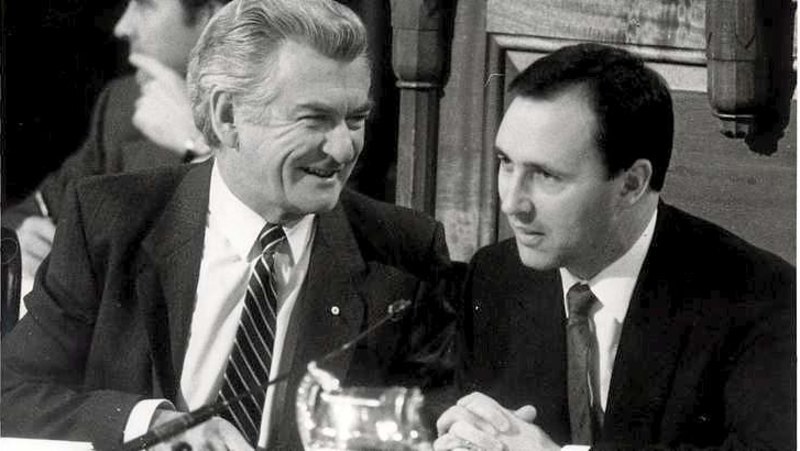 The differences are quite clear and stark.
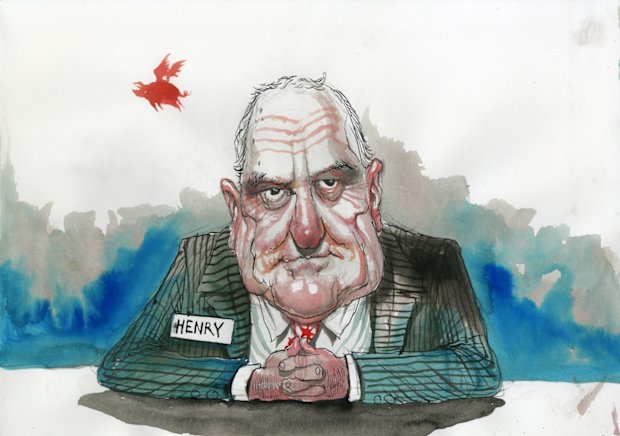 If business isn't careful it will go the way of Christianity.
 The atmosphere in the UK is still intensely divided, with
  Mandatory food labelling is a bureaucrat's dream and a consumer's nightmare.
 Take national security, for example. We live in a dangerous world where any number of ideologues and self-proclaimed religious fanatics want to kill us. While it isn't clear that diesel submarines are the solution it does seem sensible that the federal government spend money on defence.
 In 1888, English publisher and writer Henry Vizetelly was prosecuted for obscene libel after he translated Émile Zola's La Terre. The following year, Vizetelly was fined £200 and imprisoned for three months for having dared to reissue Zola's novels. This rather dampened the spirits of Vizetelly's colleagues, who promptly fell into a slump of self-censorship in order to avoid the same fate.
 My Free Speech on Campus Audit 2017 found, from analysis of over 165 policies and actions, mounting evidence of censorship. Thirty-four of Australia's 42 universities are hostile to free speech, seven threaten free speech, and just one, the University of New England, supports free speech on campus. From violent protests against speakers, to university policies that prevent hurt "feelings", the atmosphere on campus is often not friendly to freedom.
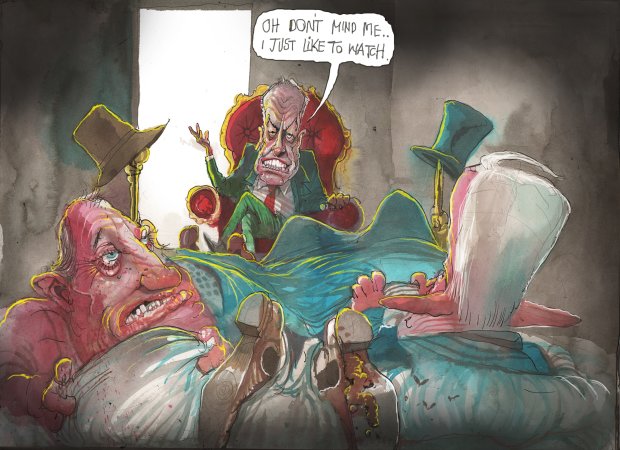 For example, he could have banned ministers wasting taxpayers' money.
 As Scott Hargreaves explained recently, the average Australian, like the average Brit and American, has
  The attack on Professor Peter Ridd's academic freedom to discuss scientific integrity may very well mark the end of the Enlightenment at one of Australia's universities.
 It would seem that the Turnbull government is using the perceived crisis of "foreign influence" in our political system to tweak federal electoral regulations in its favour. In doing so, the government has unleashed 18C on steroids. It is not only compromising freedom of speech, but also opening up a range of unintended consequences for a swag of civic groups unrelated to the political process.
 Academic historians at modern-day universities might believe and inculcate in their students the idea that the past is the product only of the inexorable forces of class, race and gender. However, the book-reading and film-going public know better.