Friday, September 28, 2018

Universities Have A Duty To Protect Free Speech

Australia's universities are public institutions with a corresponding legal responsibility to uphold free expression.

This point was made by former High Court chief justice Robert French last week in his Austin Asche oration for Charles Darwin University and the Australian Academy of Law.

French outlined the possibility that universities are covered by the constitutional freedom of political communication.  "To the extent that universities, operating under the authority of acts of parliament which create them, make legal rules affecting freedom of speech, those rules would have to comply with the implied freedom," French said.

The implied freedom to political expression is primarily a negative freedom from state action.  It prevents governments from limiting the ability to discuss matters fully, frankly and robustly, as required for a functioning representative government.

Intellectual freedom at universities to explore ideas in the pursuit of truth is essential for a functioning democracy, and therefore falls under the remit of the implied freedom.

According to legal scholars this applies to executive actions.  Law academics Joshua Forrester, Lorraine Finlay and Augusto Zimmerman have argued that the "implied freedom [of political communication] is to be treated as a relevant consideration when exercising executive power".

Universities are public institutions, created by state, and occasionally commonwealth, law.  For example, the Australian National University is established by the Australian National University Act 1991.

University policies are akin to regulation.  ANU policy, such as the Vice-Chancellorship Statute 2013 and the Discipline Rule 2018, are in the Federal Register of Legislation.  University administrator actions, in the context of these policies, are akin to exercising executive power.

The idea that public universities should come under constitutional free speech protections is settled law in the US.  The US Supreme Court has consistently found that First Amendment free speech rights apply to public universities.

In a 1957 case, the court wrote:  "To impose any strait jacket upon the intellectual leaders in our colleges and universities would imperil the future of our nation ... Teachers and students must always remain free to inquire, to study and to evaluate, to gain new maturity and understanding;  otherwise our civilisation will stagnate and die."

The US courts have also consistently found that speech codes — university policies which punish, forbid or heavily regulate speech — are unconstitutional.  In a 1991 case involving the University of Wisconsin student magazine, the federal district court found that it "amounts to governmental thought control" to prevent speech merely because it "demeans" people.  Other court decisions have struck down policy which prevents "unintentional offence".

My Free Speech on Campus Audit 2017 found that such policies are commonplace at Australian universities.  La Trobe University's Student Behaviours Policy defines bullying to include "unintentional ... offence".

Federation University's Equal Opportunity and Valuing Diversity Policy defines discriminatory harassment to include "unintentional behaviours" that offend.

The treatment of security fees by the US courts also provides guidance to Australia's current debates.  The University of Sydney has attracted controversy for charging $475 to the Sydney University Liberal Club to host psychologist Bettina Arndt to speak on campus sexual harassment issues.  This follows previous occasions in which conservative students were forced to pay for security, including a $760 fee for an event on the "Dangers of Socialism" that was not protested.

The US Supreme Court has found that it is an infringement on free speech to affix a price tag to speech because of its content.  This court found in Forsyth County v Nationalist Movement (1992) that "speech cannot be financially burdened, any more than it can be punished or banned, simply because it might offend a hostile mob".

This is why the University of California at Berkeley paid half a million dollars to secure events with provocateur Milo Yiannopoulos and conservative Ben Shapiro.

The extension of the implied freedom to political communication to universities would ultimately be a matter for the High Court of Australia in response to a specific case.

Nevertheless, the fact that universities are public institutions subject to the Constitution indicates that French's remarks are on a strong legal standing.  Australia's universities, if they are to fulfil their basic function to teach and research, must be open to debate with voices from all sides.

As Unis Stifle Free Speech, We Need A Law To Stop The Rot

The federal government needs to introduce US-style campus free-speech legislation to safeguard free intellectual inquiry and open debate at Australia's universities.

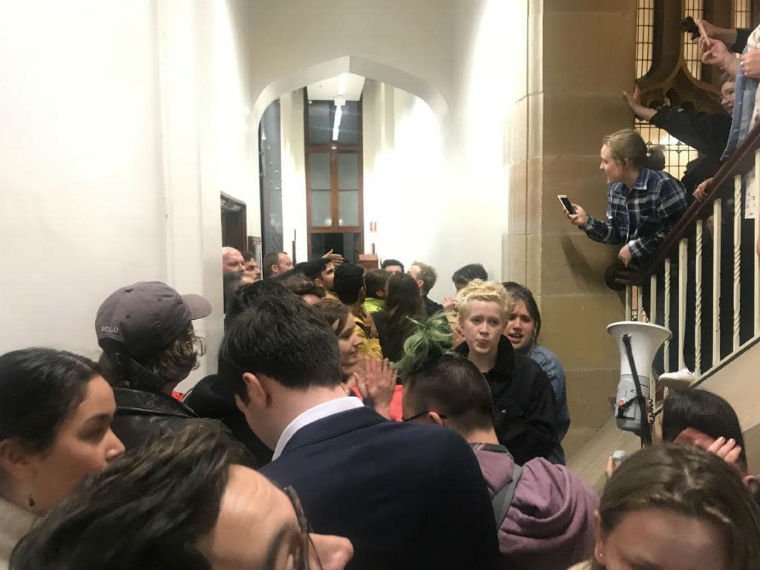
We are in the midst of a campus free-speech crisis.  Universities have cancelled speakers, censored academics and charged special security fees for conservative speakers.  This month a police riot squad was called to the University of Sydney in response to students violently disrupting an event with psychologist Bettina Arndt.

Earlier this year geophysicist Peter Ridd was sacked by James Cook University after expressing a contrary position on the health of the Great Barrier Reef.  Last year Monash University and the University of Sydney ­capitulated to demands for course content censorship — including a quiz and a map — by nationalistic Chinese international students.

Also last year, the University of Sydney Union attempted to block the screening of The Red Pill because, it was claimed, the mere showing of the video could "physically threaten women on campus".  In 2015, the University of Western Australia rejected Bjorn Lomborg's Consensus Centre after he was targeted by students, academics and media for his views on climate change policy.

These are not isolated incidents.  Academics have voiced concern about the progressive mono­culture at our universities jeopardising research and teaching.  Students with a different perspective are too scared to express their contrary opinion.

Meanwhile, risk-adverse university bureaucracies succumb to censorious demands.  Universities also maintain policies that chill free speech by preventing insulting or unwelcome comments, offensive language or, in some cases, sarcasm and hurt feelings.

Activist students are couching their demands for censorship in the language of safety — the absurd claim that merely hearing an idea can make people unsafe.

In recent weeks this logic reached the federal Labor opposition.  Opposition universities assistant spokeswoman Louise Pratt declared the "welfare" of students and staff was more important than "promoting debate".  Despite the mounting evidence to the contrary, Pratt also said:  "I don't think there's a problem on campuses in relation to free speech."  This is a big change of tune from Labor.  In 2011, the Gillard government amended the Higher Education Support Act 2003 to require universities to "have a policy that upholds free intellectual inquiry in relation to learning, teaching and research" as a condition of receiving federal funding.

This protection, however, has proven vague and has never been enforced.  My Free Speech on Campus Audit 2017 found that just eight of Australia's 42 universities had a stand-alone policy that protected intellectual freedom.

Universities are mostly public institutions, built on public land, established by state law, and they receive the bulk of their funding from the taxpayer and state-­subsidised loans.  The public has an interest in ensuring they are able to fulfil their fundamental role:  free debate in the pursuit of truth.  Federal Education Minister Dan Tehan has said the Morrison government is concerned that free speech is under threat.

In response to serious threats to campus free speech, a dozen US states, from North Carolina and Wisconsin to Missouri and Virginia, have legislated to safeguard free expression on campus.  Legislation has been introduced, but not passed, in a further dozen states.  This legislation has included provisions that:

  • Require university policies uphold free expression, in the spirit of the University of Chicago's statement on free expression, which states that "it is not the proper role of the university to ­attempt to shield individuals from ideas and opinions they find unwelcome, disagreeable, or even deeply offensive".
  • Allow academics and students to express themselves freely in both the classroom and public debate.
  • Prevent universities from cancelling speakers invited by the campus community.
  • Mandate disciplinary sanctions for students or others who repeatedly interfere with the free-speech rights of others.
  • Oblige universities to remain neutral on issues of public debate, and therefore encourage a wide array of viewpoints.
  • Necessitate an annual report to the public on the handling of free-speech matters.

Australia should adopt similar legislation.  This would not be a radical departure from the status quo which, following the Gillard government amendments in 2011, already requires universities to uphold intellectual freedom.  This new law merely would give teeth to existing provisions by empowering the Tertiary Education Quality and Standards Agency, which regulates the sector, with a specific mandate.

Federal law, and even university policies, cannot alone fix what is fundamentally a cultural and structural problem.  However, they are important to send a signal to administrators, academics and students that the purpose of a university is to freely explore ideas, not to mollycoddle.

Putting Australia First

Standing before a room full of foreign leaders and dignitaries, United States President Trump delivered a blistering rebuke of the unelected global elite who seek to undermine national sovereignty.

Addressing the United Nations General Assembly on Tuesday, President Trump added a new flavour to his now familiar America first slogan.

Instead of just America first, it is to be Poland first, Italy first, and Australia first.  America, Poland, Italy, and Australians are to be government by, for, and for the benefit of Americans, Polish, Italians, and Australians.  "We reject the ideology of globalism and embrace the doctrine of patriotism", stated Trump.

Such statements have been backed up with actions.

Under President Trump, the US has withdrawn from the Paris Climate Agreement and the UN Human Rights Council, refused to participate in the Global Compact on Migration, and refused to recognise the legitimacy of the International Criminal Court.

Collectively, these global compacts, treaties, and courts, would have handed control of American energy and immigration policy and legal proceedings from Americans to unelected international bureaucrats.

However, it would be a mistake to think these changes means America will become isolationist.  Rather, the Trump Doctrine could be summed up as sovereignty with cooperation and is defined by the following:  bi-lateral trade deals with friends rather than opaque multi-lateral trade deals through international organisations.

Nation defence based on mutual provision of resources rather than being underwritten by America.

Acceptance of the right of other nations to chart their own future.

Respect for the culture, history, and traditions of the people of other nations.

Realism in international affairs rather universal liberalism.

And scepticism of the motivates behind, and effectiveness of, international organisations such as the UN.

Naturally, President Trump was greeted with mocking laughter by the global elite when he outlined the successes of his administration.  Notably, though, no one was laughing during Iran President Hassan Rouhani's highly entertaining speech, during which he took a thinly vailed swipe at President Trump when he decried leaders with "xenophobic tendencies resembling a Nazi disposition".

Perhaps that's because such accusations are common talking points of the political left and the global elite.  Something they share in common with Iranian dictators, along with their love of censoring the speech of their political adversaries.

What the global elite don't understand is that the Trump Doctrine reflects, rather than creates, a rapidly changing international order.

The primacy of nation-states is being reasserted across the globe.

In Hungary the 2018 elections saw Viktor Orban's ruling coalition returned with a two-thirds majority on a platform of lower immigration.

In Italy around two-thirds of the vote in the 2018 election when to populist, euro-sceptic, and parties wanting lower immigration.

In Poland the governing party has based its policies on Polish national pride with the slogan "getting up off our knees".

The Swedish election earlier this month saw the conservative Swedish Democrats receive their highest vote share in history.

The vote for Britain to leave the European Union in 2016 was a reassertion of control by the British of domestic laws, immigration, and trade policy.

The election of President Trump in 2016 was also about national sovereignty.  Handing control of the American Republic back to the American people from the permanent political class in Washington D.C., Brussels, and Paris.

There is much to learn in Australia from President Trump's successes.

The first is that there is nothing racist about shaping policy that puts Australian citizens ahead of non-citizens.  That is the whole purpose of having a nation with boarders.

Australian citizens mean everyone from the indigenous whose heritage goes back tens of thousands of years, to tenth generation Anglo-Australians, to recently arrived immigrants.

Healthy patriotism is the antidote to divisive identity politics.

Second is to exit the Paris Climate Agreement.  The Agreement hands control of our energy policy to unelected international bureaucrats;  will impose a cost of at least $52 billion according to my research;  and will not make a difference to the global climate.

Third is to take immigration seriously.  Many Australians are uneasy about the size and composition of our immigration program.  And simply shifting immigrants to regions is insulting.  It diverts the problem and is an affront to freedom association and freedom of movement within our national borders.

In putting Australia first, Government ministers would do well to remember these words from President Trump's address.

"The passion that burns in the hearts of patriots and the souls of nations has inspired reform and revolution, sacrifice and selflessness, scientific breakthroughs, and magnificent works of art.

Our task is not to erase it, but to embrace it.  To build with it.  To draw on its ancient wisdom.  And to find within it the will to make our nations greater, our regions safer, and the world better."

Thursday, September 27, 2018

We Can't Even Get The Australia Day We Have Right

Nationals Senator Bridget McKenzie is only the latest politician to mistakenly suggest that Australia Day celebrates the arrival of Captain Cook on our shores, as reported in her hometown paper, here.  This was in the context of responding to the Prime Minister's idea that Australia Day's status could be preserved while another day is selected to honour our indigenous peoples.

One Australian politician who would have been horrified by the apparent gaffe is former NSW Premier, Sir Joseph Carruthers.

Carruthers was fascinated by the English explorer, Captain James Cook, and raised funds to have him memorialised in Sydney, in London, and in Hawaii.  In 1930, only two years before he died, Carruthers produced Captain James Cook R.N.:  One Hundred and Fifty Years After.

Also to mark the sesquicentenary of Cook's death, Carruthers had represented Australia at the dedication of a bronze tablet in the surf at Kealakekua Bay, Hawaii, with the inscription "Near this spot Capt. James Cook met his death Feb. 14, 1779".  The memorial to Cook, built earlier, can be seen here.  Carruthers' role in the commemoration, as part of a global committee, is described here.

The current Commonwealth Government has also chosen to honour Cook's memory and his connection to Australia, and particularly his first landing at Australia, in Botany Bay, on 29 April 1770.  In April 2018, it joined with the NSW Government to announce plans to upgrade facilities at the landing site (which happens to be in the electorate of the then Treasurer, now Prime Minister, Scott Morrison MP).  This is apparently part of wider commemorations planned to mark the 250th anniversary of Cook's first Pacific voyage, in which he reached Australia via Tahiti and New Zealand and mapped the east coast of "New South Wales", claiming it formally in the name of King George III, on 22 August 1770.

Senator McKenzie clearly missed the Media Release issued by way of a critical response in the name of Greens Senator, Sarah Hanson-Young, as well as the subsequent media coverageSenator Hanson-Young's Media Release said, "Despite an important national debate about changing the date of Australia Day away from Captain Cook's landing at Botany Bay, the government has decided to spend taxpayer money it is stripping from the ABC on yet another monument to Captain Cook on the land of the Dharawal people."  (Media reports also indicated the release was issued by a staffer, and Senator Hanson-Young had not read it).

It is not only Sir Joseph Carruthers who would be disappointed elected officials (and/or their advisers) could appear to be so confused between the voyages of Captain Cook and the arrival of Arthur Phillip and the First Fleet 18 years later.  The case for historical education and a solid understanding of our British inheritance remains strong.

Readers interested in how Captain Cook laid the groundwork for Arthur Phillip will also be interested in Keith Windschuttle's review of a fascinating new book, Lying for the Admiralty (Rosenberg, Sydney, 2018), relevant to the topic.

Western Civilisation "Not Welcome Here"

In 2017, following the wishes of the late Paul Ramsay, a businessman and philanthropist who made his fortune in the healthcare industry, the Ramsay Centre for Western Civilisation was set up in Australia.  Paul Ramsay was deeply concerned that Australians are not being taught about Western Civilisation either at school or university.  So he left part of his $3.4 billion fortune so that something would be done about it.  I have been keeping a close watch on developments.

The Ramsay Centre has devised a Bachelor of Arts in Western Civilisation based on great books and works of art, to be taught in partnership with universities.  Since its launch however, the Ramsay Centre has encountered almost nothing but open hostility and resentment from potential university partners.

At the University of Sydney, staff some months ago launched a "Keep Ramsay out of USYD" petition.  The same staff are currently having conniptions because their Vice-Chancellor has now announced that he'll consider taking the Centre's $64 million grant if it gives the university complete control over the curriculum, the reading list, and the academic appointments involved with the Bachelor of Western Civilisation.

Prior to this, the Australian National University pulled out of negotiations at the 11th hour when its Vice-Chancellor cited concerns about academic autonomy following a very public and acrimonious pushback against the program from several ANU academics and the Tertiary Education Union.

A few weeks ago, I was invited to attend a University of St Andrews alumni drinks in Melbourne.  The evening began promisingly enough.  A smart bar hotel bar, eight individuals of various ages and occupations, gathered together with the prospect of a pleasant evening of reminiscing ahead.  Amid the usual exchange of pleasantries, I discovered that my one of my fellow attendees was a senior university administrator.  I detected a slight look of discomfort from him.  Any bonhomie that might have existed at the commencement of the evening vanished as soon as he asked me what I thought about the Ramsay Centre for Western Civilisation.

The rejection of a Bachelor of Arts in Western Civilisation is predicated on the absurd notion that anyone who wants to talk about or study Western Civilisation must be a white supremacist.  In some academic circles, Western Civilisation is held responsible for all evils in the world, past, present and future.

Earlier this year, the Dean of Arts at Newcastle University wrote a piece for The Conversation in which she stated that Western Civilisation is past its used by date and that it's too "white" to teach in multi-cultural classrooms.  The University of Sydney academics leading the charge, claim that the BA will "pedal racism disguised as appreciation for 'Western Culture'".  At a National Tertiary Education Union forum, former University of Sydney chair, sociologist and gender theorist Raewyn Connell, told her audience that the curriculum "has racism embedded in its agenda."

When I articulated to my fellow alumnus that I had not been surprised at the response from Australian universities — given the antipathy displayed towards Western Civilisation by many academics — he did not think this hostility to be a bad thing.  When I added that I thought all students studying an undergraduate degree in history, or any humanities degree for that matter, should be required to do a foundation course in Western Civilisation, he was shocked and horrified.  From his point of view, knowing about what happened during the Scientific Revolution or the Enlightenment is an irrelevancy and a waste of students' time.  For him, history is about "issues", not knowledge.

It was at this point that I realised that just how far universities, especially the humanities departments, have strayed from their original purpose.  From the Renaissance until the 1960s, the humanities, derived from the expression "studia humanitatis" or the study of humanity, made it their purpose to make sense of and understand the world through the great traditions of art, culture and philosophy.  There appeared in the 1970s and 1980s however, a range of "new humanities" subjects which rejected this tradition.  The new humanities were underpinned by a range of radical post-structuralism and post-modernist theories which had been conjured up in the previous decade by a predominantly French group of philosophers such as Jacques Derrida, Louis Althusser, Michel Foucault, as well as the psychiatrist, Jacques Lacan.

The new humanities maintain that for the last 500 years, Western Civilisation has got it wrong when it comes to knowledge, truth and science.  These fields tend to claim that both knowledge and truth are not absolute, but are relative.  For example, there is no objective truth and truth is dependent on who is speaking it and in what context.  Insofar as science is concerned, they claim that scientific theories don't really provide us with what we could call knowledge but are actually "invented" rather than discovered.

History as a discipline best exemplifies the influence of the postmodernists and their ilk on the humanities.  Many historians have enthusiastically embraced the idea that truth is no longer within the historian's grasp and that it's impossible to use history to add to knowledge about humankind.  This is the kind of thing which would normally signal the death knell for any discipline, but historians have risen from the ashes and have forged for themselves a new purpose — the attainment of social justice.

This is not social justice in the Enlightenment sense, which meant equality before the law and equal rights, but social justice in the activist sense, where the ultimate goal is to achieve perfect equality by destroying "oppressive" institutions and rearranging society.  The historians' new role is to tell the inequality narrative of the oppressed and the oppressor through the lens of class, gender, and race.  Matthew A. Sears, associate professor of classics and ancient history at the University of New Brunswick believes that ancient Greek sculptures epitomise racism and white supremacy, and that history is "about politics", it's main purpose being to "better understand the human condition and shed light on questions of contemporary relevance."

This approach has its origins in the nineteenth century, when Georg Hegel constructed his worldview of history into a narrative about stages of human freedom.  His was the view that history was simply the process of moving towards the realisation of such freedom.  Later that century, Karl Marx's built on Hegel's new paradigm with his theory of historical materialism, proposing that society's productive capacity and social relations of production determined both its organisation and development.

Both Hegel and Marx essentially denied the role of individual human agency, treating the past as the product of inexorable forces and trends which were primarily of a material and economic nature.  "Society" wrote Marx, "does not consist of individuals, but expresses the sum of interrelations, the relations within which these individuals stand.''

Karl Marx essentially created the template of identity politics for the study of history with his notion that human society is in a constant state of struggle and a zero-sum contest for power.  In the 1960s, his model was adopted by British historian Eric Hobsbawm who deliberately re-wrote the history of the "long 19th century" as being a century of class struggle.  Hobsbawm successfully transformed history as an academic discipline into a vehicle for social policy.

Since the 1970s, historians have embraced Marx's template and applied it to their own particular historical fields, re-writing the past from the point of view of class, gender, and race.  These new histories have gradually replaced the traditional canon of historical subjects which once upon a time formed the basis of an undergraduate degree in history in Australia.

In 2017, a study of all 746 history subjects taught in Australian universities revealed that 244 of those subjects were devoted entirely to class, gender, and race.  Many were a pastiche of identity politics in which the stunning complexity of the past is increasingly reduced to a very limited range of themes.  Students at Melbourne university can take "A History of Sexualities" in which they discuss "how the gendered body and sex have been simultaneously linked to social liberation and control".  At the Australian National University, students can consider "the concept of 'race' within the contexts of the development of scientific knowledge in 'Human Variations and Racism in Western Culture, c. 1450-1950'."  A keyword search of all the history subject descriptions taught in 2017 reveals that there were more instances of the words gender and race than there are Enlightenment or Reformation.

What is more, a perusal of the University of Sydney's history faculty staff profiles reveals that 20 of the 32 staff have variously identified gender and sexuality, racial thought, women's history and power as their current historical fixations.  The left-wing leitmotifs of class, race, and gender have replaced the essential core subjects which explain the political, intellectual, social and material basis of the history of Western Civilisation.

This approach is not only boring and repetitive, it is fundamentally anti-intellectual.  Students in Australia are not being given a "positive formation" by their universities, which is exactly what the Ramsay Centre is attempting to rectify.  Instead, they are being taught a narrow, one-dimensional view of the world seen through the prism of identity, over a curious and inquiring three-dimensional view of the world which opens the mind.

Students studying the humanities are not only finishing their degrees with a distorted view of the world in which the past is viewed as a contest between the oppressors and the oppressed, but they are imposing this particular worldview on society as they find employment in schools, government, and the corporate world.  These days, for example, it's becoming increasingly difficult to work out where gender departments finish and governmental departments or the corporate world begin, so blurred are the lines between them.

Since the 1960s, universities have been leading their students fairly and squarely down a path of un-education, unlearning and enlightenment, and they should be called to account.  Now these students, filled with an ideological fervor and driven by social justice, are leading the rest of society down the same path, whether society wants it or not.

Friday, September 21, 2018

Gender Quotas Are Simply UnLiberal

The story of Scott Morrison since he became Prime Minister a few weeks ago is very much the story of a boss in the modern-day Australian workplace.

On one hand Morrison is attempting to do his best in the face of an external threat — the Labor Party — to his business.

Meanwhile, he has the internal challenge of managing a team of staff — Liberal MPs — comprising a sizeable proportion of those who think they could do his job better than he can.  The team also includes a small but loud minority of individuals who appear committed to acting not as members of Parliament carrying the authority and responsibility of such a role, but as 19-year-old members of the "snowflake generation" currently populating university campuses around the country.

In common with a growing number of teenage undergraduates, some federal Liberal MPs seem to believe having their feelings hurt or their opinions challenged is "bullying" and that the theories of identity politics require MPs and candidates to be categorised according to their gender, race and class.

The issue of bullying in workplaces is serious and real, but when MPs throw the term about as a political weapon and a slur to publicly accuse their colleagues — but then refuse to provide the evidence to support such claims — they are trivialising the issue and making it more difficult in the future for real victims of real bullying.


DEFINITION OF BULLYING

Liberal MPs should know better.  The definition of "bullying" under the Fair Work Act is repeated unreasonable behaviour towards a worker that creates a risk to health and safety.  A colleague arguing with you about who should be the next prime minister is unlikely to be bullying.  And in the world of politics it's not unreasonable for it to be pointed out to some MPs by other MPs that how they vote in a leadership contest could have consequences for their preselection.

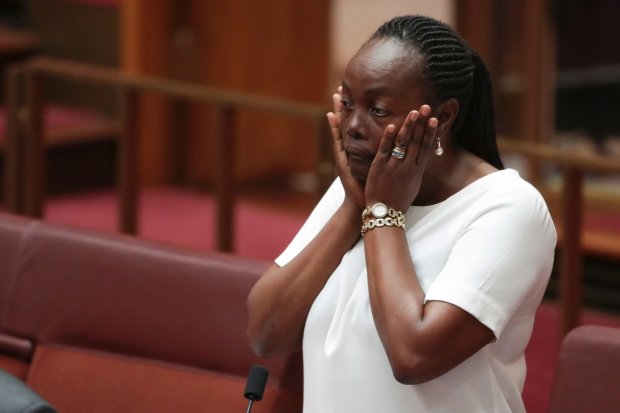
Liberal MPs should stop and ponder the consequences of their bullying claims, for not only victims of bullying, but also for anyone accused of bullying.  Liberal senator Lucy Gichuhi said of the leadership dispute:  "Everything was happening so fast.  And that in itself is a form of intimidation because we were supposed to make a very important decision within a very short time."

Presumably from now on any employee anywhere asked to make an important decision "too quickly" will be entitled to claim that they were "intimidated".

As ridiculous as it sounds there might actually be some merit in the Liberals having an inquiry into bullying because then at least bosses would know what bullying is and isn't.

Liberal MPs wanting to play identity politics, however, is a much bigger issue for the Liberal Party.  The suggestion, for example, that the Liberal Party should now adopt gender quotas cuts across every single philosophical principle the party stands for.  Providing equality of opportunity by encouraging more women to stand for Parliament for the Liberals is entirely appropriate.  But enforcing an equality of outcomes is a very different question.


APPLIED CONSISTENTLY

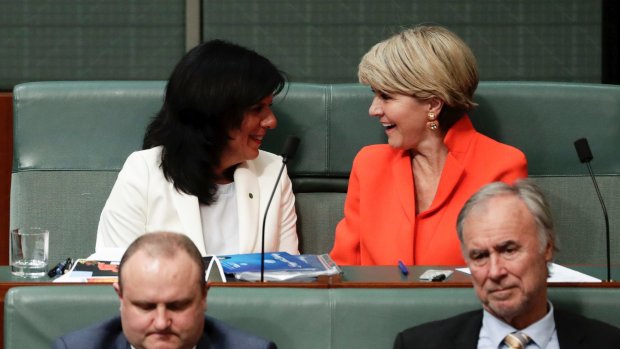
Julia Banks, a Liberal MP who supports gender quotas and who has announced her retirement at the next federal election, said in Parliament last week that, "the concept that this [gender quotas] will begin that path to destruction of micro quotas depending on people's sexuality or ethnicity is ludicrous.  We are talking about quotas for women, who represent more than half our population."

The suggestion that if a category of identity possessed by more than half the population is not represented in at least half of all candidates, then the balance should be redressed through quotas, is at first glance not unreasonable.  But it raises the question of whether gender is the only identity that should be treated in such a way.

According to the most recent census, 52.1 per cent of Australians identify as Christian.

For Banks' formula to be applied consistently, if ever less than half of Liberal MPs were Christian, the Liberals would be forced to create a quota guaranteeing a certain number of Liberal Christian MPs.

It remains to be seen whether the Liberals imposing quotas for Christians would be as popular as the party creating quotas for women.  Especially if such a quota was suggested by Scott Morrison.

National Curriculum Changes Should Sound Alarm Bells For Parents

THE changes to the national curriculum announced by the Australian Curriculum Assessment and Reporting Authority (ACARA) last week should sound some very loud alarm bells for Australian parents.

If adopted, the changes mean that future generations of children will be in danger of finishing school and turning into adults who know nothing at all.

Over the next couple of years, ACARA has promised to add a range of impractical and ideological "21st century skills", with a shift to "critical" and "creative" thinking.

Apparently, students will be taught things like how to "develop curiosity, imagination, resilience and self-regulation", how to "respect and appreciate the ideas, perspectives and values of others" and how to "care about the well-being of their friends and families, their communities and the planet".

This comes despite the fact that the curriculum is already overcrowded, unbalanced, ideologically-biased, systematically hostile to Western Civilisation and failing school children around the nation.

One of the most problematic things about it is the existence of the three cross curriculum priorities of "Sustainability", "Aboriginal and Torres Strait Islander histories and cultures", and "Asia and Australia's engagement with Asia".

While they might be worthy topics of investigation, they are incorporated into every subject whether relevant or not.

And students are hearing the same thing in every subject.

If ACARA succeeds in watering down the curriculum even further, children graduating from Australian schools will be very well versed in sustainability and social justice issues, but might not be able to work out basic fractions, know who wrote Hamlet and when, or tell you why Australia is a liberal democracy.

You only need to look at world rankings to see just how useful these "soft skills" and competencies have been to children so far.

Since 2015, Australia has performed incredibly poorly in world rankings.

Reading literacy has fallen from 4th to 16th, mathematics has plummeted from 7th to 25th and science has dropped from 4th to 14th.

According to the Organisation for Economic Co-Operation and Development (OECD) at the age of 15, fourteen per cent of Australian students are functionally illiterate.

That means that they would not understand the instructions on a packet of headache tablets.

Twenty per cent of Australian youth lack basic arithmetic skills, and would fail to determine how much petrol is left in a tank by looking at a gauge.

The government's solution to the problem is to throw money at it.  Between 2018 and 2027, under its "Quality Schools Package" it will spend a whopping $243.5 billion, plus an extra $5.1 million on science, technology, engineering and maths (known fashionably as STEM).

There is no doubt that this will result in falling standards, embarrassingly low world rankings and general ignorance.

It is clear that Australian children are being been "un-educated" at a terrifying pace and money is clearly not the solution.

The focus of modern education is on vague "skills" and "competencies", whereas 60 or 70 years ago, it was about knowledge and facts.  It might be boring to learn your times tables, but you can't do long division without them.  They give you a foundation for the rest of life.

The rejection of knowledge stems from the progressive left, which believes that education makes people less free.

This idea comes from the romantic but completely misguided notion developed by 18th century French philosopher Jean-Jacques Rousseau, who famously announced that "man is born free, but is everywhere in chains" meaning that but institutions like education get in the way of this freedom.

But the opposite is true.

By encouraging young people to read the great books that the Western Canon has given us, by inspiring them to learn about historical events and by teaching them how to read and write, you give them freedom to think for themselves and to undertake real critical thinking.

As a matter of logic, you can't teach children to think critically unless they have something to think about.

People become inquisitive and begin to think critically when they know things, and they can apply this knowledge in different ways.

Rather than following educational fads as ACARA is proposing, Australia should return to the true purpose of education.

And that means furnishing people with knowledge.

For years, standards and real knowledge have been sacrificed by politically correct ideologues who are more interested in teaching students what to think than how to think.

It is knowledge that gives people the tools to get good jobs and makes them decent citizens.

If the government truly understood this reality, it would be spending $243.5 billion on making sure that students are given real knowledge rather than continuing headlong down this path of unlearning which will be to the detriment of Australian society.

Friday, September 07, 2018

Scott Morrison's Politics Must Have Some Policy

"Dare to be different" is an advertising slogan employed in some form or another by companies like Honda to sell cars and Apple to sell computers, and by practically anyone who's ever printed a T-shirt.

If the Liberal Party is to have any chance of winning the next federal election Prime Minister Scott Morrison must not only say he's different from Malcolm Turnbull — from the Labor Party — he must also prove it.

The first part of that task is talking about politics.  The second part is committing to policies.

On Thursday in Albury, the spiritual home of the Liberal Party, in a speech to the Menzies Research Centre, the Prime Minister delivered an unscripted speech about his personal and political philosophy.

Perhaps inevitably the speech was the proverbial curate's egg.  Some parts were outstanding, such as when he made the obvious but important point that "the best form of welfare is a job".

Other parts were trite, such as when he remarked that "as Australians, we look after our mates".

And yet other parts were trivial, such as when he foreshadowed the federal government would ban plastic food wrappings.

Other than when he talked specifically about Robert Menzies and the Liberals there wasn't a lot Morrison said that a Labor MP would disagree with.  Any Labor MP, if they'd been in the audience, would have applauded enthusiastically when Morrison said that the government would remain in the Paris agreement on climate change.

And as good as the PM's remarks are about work and welfare, until they're turned into policy they remain just words.

The point is that, although admittedly he's only been in the job two weeks, the Prime Minister has yet to establish what the main policy differences are between him and Bill Shorten.

Yesterday the PM talked of the need to create "a noble society" and "a caring society".  Whether such a society is very different from a society built on the idea of "the common good" (which is the title of Bill Shorten's book) is unclear.


SIGNIFICANT DIFFERENCE

Morrison will point to differences such as the Liberals' policy of reducing the corporate tax rate for smaller companies to 25 per cent, while Labor's policy is a tax rate for such companies of 27.5 per cent.  That is merely a distinction without much difference.

To take energy policy, for example, if Morrison announced that Australia was withdrawing from the Paris agreement in an effort to bring down household electricity prices then for the first time since the Coalition was elected in 2013 would there be a significant and easily understood policy difference on climate change between the Liberals and Labor.

If Morrison said that he supported at least an investigation into establishing a nuclear power industry in this country that would be another difference.

Under Malcolm Turnbull's leadership the Liberal Party deliberately narrowed the policy differences between it and Labor.  Liberal MPs acquiesced to the strategy partly because they thought that saying what they actually believed in would prove electorally unpopular and also because many Liberal MPs were in broad agreement with what Labor wanted to do.

If the Liberals' leadership vote between Morrison and Peter Dutton is taken as a proxy for the Liberal party room's views on climate change, about half of Liberal MPs have views more closely aligned with those of Labor MPs than with the other half of the Liberal party room.

Turnbull's approach to politics didn't only result in claims of the Liberals as "Labor-lite", it produced a mere one-seat victory at the 2016 federal election.

While it might be true that in an electoral system with compulsory voting such as we have in Australia, elections are determined by so-called "swinging" voters in the so-called "centre", it doesn't necessarily follow that the two major parties must offer identical policies to gain the support of such voters.

Nor does it follow that if a policy is popular with a political party's "base" it will therefore be unpopular with swinging voters.  John Howard's policies were supported by many more people than just rusted-on Liberals.

The Prime Minister has to be careful not to spend so much time doing politics that he forgets it's policies that ultimately make a difference to people's lives, not platitudes.

Thursday, September 06, 2018

ScoMo, Scrap Snowy 2.0

Only politicians could think it's a good idea to spend billions of dollars pumping water uphill to generate electricity in a land with enough coal to last 1,000 years.  Yet that is exactly what the federal government is doing.

Flying in by helicopter, donning a leather jacket with snow-capped mountains in the background, former prime minister Malcolm Turnbull revealed his grand nation-building project "Snowy 2.0".

The new Snowy project is essentially an extension of the original Snowy Hydro Scheme, commissioned by the Chifley government in 1949.  The original participants were the Commonwealth, NSW and Victorian governments, but in a related move the Commonwealth has recently brought out the two state governments for $6.2 billion, and become sole shareholder.

The aim of Snowy 2.0 is to pump huge amounts of water from an existing Snowy Hydro reservoir through reversible turbines into a new power station to be built 1km under the mountains, then on to another existing reservoir, via 27km of tunnels.  What could possibly go wrong?

There are already more problems than there are shovels in the ground.

Firstly, the cost.  It was originally claimed that the scheme would cost about $2 billion, but Snowy Hydro Limited acknowledged it could be up to $4.5 billion.  The final cost would be anyone's guess.

The feasibility study alone cost $29 million.  And having a feasibility study into a government project is like flipping a two-headed coin.  There is no way the government's preferred option will lose out.

The second problem is the hypocrisy.  The government shows no interest in building and nationalising coal-fired assets, but now wants to run and greatly expand a nationalised hydro-electricity project.  If, as is claimed, it is an arms-length commercial venture, then what was the former PM doing in that helicopter, and declaring it a "nation-building project"?

Thirdly, Snowy 2.0 isn't expected to become operational until 2024-25, assuming no delays.  A wildly longer lead time than other alternatives.

Fourthly, Snowy 2.0 will be a net user of energy, as it takes more electricity to pump the water than is generated by releasing it.  The way in which this has worked commercially in the past is to buy electricity in off-peak times and sell in peak times when prices are higher.  However, there is no guarantee the historic size of the difference between peak and off-peak prices will hold into the future, particularly given the massive changes taking place in the energy market.

Meanwhile, Australians are suffering from high energy prices now.  Retail electricity prices have risen by more than 120 per cent in real terms over the past decade, while wholesale prices have tripled in the last three years.

These price rises are primarily the result of heavy-handed government interference supporting renewables through the Renewable Energy Target at the expense of more reliable, affordable coal-fired power.  Unfortunately, Snowy 2.0 will only give us more government interference, more picking winners, and a greater burden on taxpayers.

Monday, September 03, 2018

Blaming Jeff For Our Energy Mess Is A Joke

Blaming your problems on the previous government is poor form.  But blaming your problems on something that another government did over 25 years ago is, to put it politely, taking the mickey.  Yet that is exactly what Daniel Andrews did recently when he effectively blamed former premier Jeff Kennett for the spiralling energy prices that have occurred on his watch.

"Privatisation has not worked," Andrews declared in his "state of the state" speech, alluding to the Kennett Government's sale of Victorian energy assets in the early 1990s.  "The scales need re-setting, privatisation and de-regulation has gone too far".

This despite the fact that the Andrews Government has raked in billions of dollars from privatisation when it suits them, including $9.7 billion for leasing the Port of Melbourne and a windfall of $2.9 billion just this week for flogging off the land titles office.

Let's see this for what it is:  A cop-out, and an extremely weak one at that.  Facing thousands of electricity-starved Victorians in November, Andrews is looking for something — anything — to deflect blame from his catastrophic energy policies.

Andrews is right about one thing:  Power bills are soaring, up by a whopping 20 per cent, or $500 per year for the average family.  But Victorians are not mugs, and few will forget Labor's disastrous stewardship of energy policy that has created this mess.

It doesn't take a Nobel prize-winning economist, for example, to realise that taking a fifth of the state's electricity supply offline would lead to shortages and, in turn, increase prices.  Yet that is exactly what the Andrews Government did by taking the wrecking ball to Hazelwood Power Station.  At the time of its closure, Hazelwood supplied 20 per cent of Victoria's energy, affordably and reliably.  That is until the Andrews Government — for purely ideological reasons — whacked a $252 million tax on the brown coal needed to run it, forcing the operator to close down the plant.

In short, because of Daniel Andrews' vendetta against brown coal, Victoria has walked away from a cheap and plentiful source of power.  To make up the shortfall, Victorian consumers have had to effectively purchase more expensive power from elsewhere, largely by importing it from interstate.  As the Australian Energy Regulator noted in March:  "The exit of Hazelwood removed a significant low cost fuel generator which was largely replaced by higher cost black coal and gas.  Victoria changed from being a net exporter of relatively cheap brown coal generation, to being a net importer."

Worse still, the Andrews Government has kept the handbrake on other sources of cheap power.  Not content with wasting our brown coal, the government has foolishly maintained a moratorium on onshore gas exploration.  This is despite dire warnings from the Australian Energy Market Operator that without an increase in supply, Victorians could face severe gas shortages within just three years.

And for all that, the premier has the chutzpah to blame Kennett-era privatisation for an energy crisis that has flared up more than two decades later.  According to Daniel Andrews, everything would be fine, if only Victoria's electricity assets were still owned by the state government.  But given all the stuff-ups that have occurred in the last four years alone, does anyone seriously think that greater government involvement in the energy market is the answer?

Make no mistake, Australia's energy woes have occurred as a direct result of over a decade of government interference.  Privatisation in Victoria made no difference to electricity costs, with prices remaining relatively stable from the early 1990s until the tail-end of the 2000s.

But from 2009, electricity prices around the country rose rapidly as the Rudd Government massively expanded the renewable energy target.  Whereas previously, power companies were free to buy electricity from whichever source was cheapest, Rudd's turbo-charged RET forced retailers to purchase energy from unreliable and uncommercial sources like wind and solar.  Meanwhile, investment in conventional sources like coal tanked as revenue was effectively redirected elsewhere.  Power prices were pushed even higher in the ensuing decade of government tinkering, ranging from Julia Gillard's carbon tax to the ongoing chaos surrounding the so-called national energy guarantee.

Meanwhile, state governments have made things worse with their own forays into energy policy.  Then-Premier Jay Weatherill famously boasted about his state's "big international experiment" with a crazy 50 per cent renewable energy target.  South Australians saw the results of this "experiment" first-hand when power prices soared and the blackouts started.

Not that Victoria is too far behind, with the Andrews Government committed to its own renewable energy target of 40 per cent by 2025.  According to the relevant government website, this pointless green gesture will "establish Victoria as a leader in renewable energy".  That will be of great comfort to consumers, no doubt, as they shiver through another harsh Victorian winter.

Is Safetyism Destroying a Generation?

In recent years behaviours on university campuses have created widespread unease.  Safe spaces, trigger warnings, and speech codes.  Demands for speakers to be disinvited.  Words construed as violence and liberalism described as "white supremacy".  Students walking on eggshells, too scared to speak their minds.  Controversial speakers violently rebuked — from conservative provocateurs such as Milo Yiannopoulos to serious sociologists such as Charles Murray, to left-leaning academics such as Bret Weinstein.

Historically, campus censorship was enacted by zealous university administrators.  Students were radicals who pushed the boundaries of acceptability, like during the Free Speech Movement at UC Berkeley in the 1960s.  Today, however, students work in tandem with administrators to make their campus "safe" from threatening ideas.

Jonathan Haidt and Greg Lukianoff's new book, The Coddling of the American Mind:  How Good Intentions and Bad Ideas Are Setting Up a Generation for Failure, persuasively unpacks the causes of the current predicament on campus — which they link to wider parenting, cultural and political trends.  Haidt is a social psychology professor at New York University and founder of Heterodox Academy.  Lukianoff is a constitutional lawyer and president of the Foundation for Individual Rights in Education.  In 2015, they wrote The Atlantic cover story of the same name.

Haidt and Lukianoff's explanation for our era of campus craziness is primarily psychological.  In sum, a well-intentioned safety culture which has led to "paranoid parenting", and screen time replacing unstructured and unsupervised play time, has created a fragile generation.  Haidt and Lukianoff focus on people born after 1995, iGen or Generation Z, who began attending college in the last five years — just when things started to escalate.

This cohort is experiencing a dramatic rise in anxiety, depression and suicide.  When they arrived on campus, in an increasingly polarised political climate, they were unprepared to be intellectually challenged.  They — or at least the "social justice" activists of this generation — responded by creating a culture of censorship, intimidation and violence, and witch hunts against non-believers.  Universities, led by risk adverse bureaucracies, are treating students like customers and allowing an aggressive, censorious minority set the agenda.


THE DANGERS OF SAFETY CULTURE

Haidt and Lukianoff focus on the unintended consequences of safetyism — the idea that people are weak and should be protected, rather than exposed, to challenges.  Safety culture has the best of intentions:  protect kids from danger.  It began with a focus on physical safety — removing sharp objects and choke hazards, requiring child seats, and not letting children walk home alone.  Safety, however, has experienced substantial concept creep.  It now includes emotional safety, that is, not being exposed ideas that could cause psychological distress.  Taken together, the focus on physical and mental safety makes young people weaker.

Humans are what author and statistician Nassim Nicholas Taleb calls "antifragile".  We "benefit from shocks;  [humans] thrive and grow when exposed to volatility, randomness, disorder, and stressors and love adventure, risk, and uncertainty".  Peanuts are a case in point of needing to be exposed to danger to build resilience.  From the 1990s, parents were encouraged to not feed children peanuts, and childcare centres, kindergartens and schools banned peanuts.  This moratorium has backfired.  The LEAP study (Learning Early About Peanut Allergy) found that not eating peanut-containing products during infancy increases allergies.  The researchers recruited 640 infants with a high risk of developing peanut allergy.  Half were given a peanut-containing product.  The other half avoided peanuts.  The study found that 17 per cent of those who did not consume peanuts developed an allergy by age 5, compared to just 3 per cent of those who did consume the peanut-containing snack.  Our immune system grows stronger when exposed to a range of foods, bacteria, and even parasites.

Antifragility applies to emotional health as well.  When you guard children against every possible risk — do not let them outside to play or walk home alone — they exaggerate the fear of such situations and fail to develop resilience and coping skills.  Stresses are necessary to learn, adapt and grow.  Without movement, our muscles and joints grow weak.  Without varied life experiences, our minds do not know how to cope with day-to-day stressors.  Measures designed to protect children and students are backfiring.  Fragility is a self-fulfilling prophecy.  If you think certain ideas are dangerous, or are encouraged to do so by trigger warnings and safe spaces, you will be more anxious in the long run.  Intellectual safety not only makes free and open debate impossible, it setting up a generation for more anxiety and depression.

Haidt and Lukianoff use an array of data that shows a shocking increase in American youth anxiety, depression, and suicide in the last five years, but particularly for young women.  By 2016, one out of every five American girls met the criteria for having experienced a major depressive episode in the previous year — an increase of almost two-thirds over five years.  There has also been an increase in male suicide by one-third, and female suicide has doubled since the early 2000s, reaching the highest recorded since 1981.

Notably, it is not just the American mind that has been coddled.  Consistent with Haidt and Lukianoff's findings in the United States, there has been a substantial increase in youth mental health issues in other Anglosphere countries such as Britain and Australia.

In July, Britain's National Health Service reported a record 389,727 "active deferrals" for mental health among people aged 18 or younger.  The crisis is more pronounced among women, who have experienced a 68 per cent rise in hospital admissions for self-harm over the past decade and a 10 per cent growth in anxiety.  Another survey found a doubling in self-reported mental health problems among university students between 2009 and 2014.

Mission Australia's Youth Mental Health report has found that a 23 per cent of young Australians have a probable serious mental health, an increase from 19 per cent just five years ago.  A separate Mission Australia survey in 2017 found that for the first time mental health is the number one issue of national concern for young people in Australia.  Meanwhile, the suicide rate among young Australians grew by 20 per cent over the last decade.


FEELINGS OVER DEBATE

There is a link between rising mental health issues, safety culture and campus trends.  It is notable how often students put censorious demands in the language of feeling safe.  Students demand trigger warnings because ideas are emotionally challenging, safe spaces to hide away from scary situations, and the disinvitation of controversial speakers to feel safe on campus.  While it is important to show courtesy in public debate, it is patently absurd to suggest that simply hearing an idea you dislike makes you unsafe in any meaningful way.  As the old saying goes, "sticks and stones may break my bones, but words will never hurt me".  In fact, the opposite is true, post-traumatic growth is a real phenomenon:  difficult situations do make us stronger.

While America has experienced the worst of campus craziness, over-parenting and rising mental health issues correlate with similar university trends across the Anglosphere.  In Britain, speakers are "no platformed", and songs and newspapers are banned.  In Canada, teaching assistant Lindsey Shepherd was reprimanded for showing a debate in class.  In Australia, universities are adopting trigger warnings, succumbing to demands for censorship to protect "feelings", and on some occasions protests have turned violent.  In New Zealand last month a free speech debate was interrupted by protesters.

In recent weeks La Trobe University in Melbourne, Australia almost banned sex researcher Bettina Arndt from speaking about sexual assault issues on campus.  While the university reversed their earlier decision, it nevertheless informed students that counselling would be available — solidifying the idea that the mere existence of a contrarian voice necessitates therapy.  Students have continued to demand censorship of Arndt on the basis that her ideas make them feel "unsafe".

In recent days the La Trobe Student Union's student representatives released a statement calling for Arndt to be prevented from speaking.  The statement mentions the word "safe" a total of nine times.  One of the student representatives explicitly declared that "What Arndt chooses to speak on makes me feel incredibly unsafe ... The university is currently allowing this event to go ahead under the pretence of free speech, however I do not think free speech should come at the expense of student safety".  This is not the language of radicals — this is young people appealing to authority figures for protection.

Safety culture undermines the entire purpose of a higher education.  Universities exist to challenge students, to expand their worldview and develop their critical thinking.  This is done by hearing and responding to ideas that make us feel uncomfortable.  Efforts to censor speakers because they make some people feel "unsafe" prevents the necessary process of argument and counter-argument in the pursuit of finding the truth.

Debate on campus is already undermined by the lack of viewpoint diversity — most academics come from a similar political pedigree, meaning students have fewer opportunities to be challenged in the first place.  A lack of exposure to different ideas means a much more limited and weaker education.  As British philosopher John Stuart Mill wrote, "He who knows only his own side of the case knows little of that".  In other words, to make an argument thoughtfully, it is necessary to understand the counterfactual of one's own argument.


EMOTIONAL REASONING AND GOOD VERSUS EVIL

The encouragement of cognitive distortions also undermines academic pursuits.  For example, the claim often made in academic fields such as critical race theory that "all white people are racist" is an overgeneralisation that can lead to both anger and aggression in students who believe it.  Haidt and Lukianoff argue that the focus on feelings is a symptom of a culture that encourages emotional reasoning:  letting feelings guide our interpretation of reality.  Students are being taught to engage in thought patterns that make the world appear more threatening — such as focusing on a worst possible outcome, overgeneralising, assuming that one knows what other people are thinking, and only seeing the negative in situations.  These are the precisely the same cognitive distortions that lead to anxiety and depression (e.g. the world is a dangerous place for a person like me, everyone I know hates me, etc).

Another untruth that has become prominent within academic and wider public discourse is the notion that life consists of many small battles between good and evil.  In this framing, it is presumed that one's opponent has the worst possible intentions, creating feelings of victimisation, anger, hopelessness in students who believe it.  The notion of "microaggressions" presumes many innocent comments — such as "I believe the most qualified person should get the job" — are hiding underlying racist sentiments.  Encouraging students to be concerned about unintended sentiments ensures that they are always suffering.  And in practice, it means students do not speak their minds for fear of being misinterpreted as sexist, racist or homophobic.  This is not an environment conducive to freely exploring ideas.

Haidt and Lukianoff recommend confronting this challenge by following the proven method of cognitive behavioural therapy (CBT).  Considered the gold standard of psychological therapy, CBT focuses on not letting your feelings and cognitive distortions consume you.  Exercises that are used in CBT help people to understand that situations are not black and white.  Not every ambiguous interaction is designed to hurt you.  Catastrophic thinking in response to negative events is largely within our control.


HOPE FOR THE FUTURE

The Coddling of the American Mind is both an enlightening but disquieting read.  We have a lot of challenges in front of us.  Safety culture is embedded into parenting styles.  Mental health issues among young people are rapidly increasing.  A censorious culture is the norm on campus.  Universities are facilitating a self-destructive culture not only through speech codes, but in teaching simplistic theories about human society.  Academics far too often pursue social justice causes over empirical inquiry.  New ideas — like speech is violence, and therefore it is justifiable to use violence against speech — are downright frightening.

Haidt and Lukianoff conclude by offering a wide array of useful suggestions for students, parents, teachers, schools, and colleges — from choosing a college that clearly prioritises intellectual freedom, to increasing unstructured and unsupervised play time for children, and reducing screen time.  They effectively mix together diagnoses of the problem, and some ideas for how to fix it.

But more fundamentally, we should not discount an entire generation.  Every action has an equal and opposite reaction.  Safety culture and censorship is engendering its own backlash.  Arguably, more than any time in recent history, we are seeing an intellectual renaissance outside of traditional institutions such as the university.  The more that some students — and administrators — seek to censor contrarian views, the more the mischievous instinct will play out, online and elsewhere.

At least from my experience on campuses across Australia, young people are thirsty to partake in the battle of ideas, challenge orthodoxies, and investigate dangerous ideas.  While there are some who violently shut down opposition, there are many others who reject the imposition of safety culture.  The challenges are not insurmountable.

Tuesday, August 28, 2018

Daniel Andrews' Alternative Reality

Here we go again.  Today, Daniel Andrews announced a plan to build a new suburban railway system even though he has no idea how much it will actually cost, who is going to pay for it, and how long Victorians will actually have to wait until it is finished.  This is another pragmatic, yet pie in the sky announcement which typifies the Andrews government.  Victorian taxpayers have already been saddled with a $330 million tax burden after the premier abrogated contractual responsibilities by cancelling the contract to build the East-West Link.  The reality is, as now confirmed by Infrastructure Victoria, that this project would have been a very good idea after all.

But the Andrews government appears to be operating in a different kind of reality, a reality in which it is blatantly more concerned with social engineering than it is with the kind of scientific and mathematical engineering which gets roads and tunnels built.  These days, it's becoming increasingly difficult to work out where gender departments finish and governmental departments begin, so blurred are the lines between them.

In Victoria, the Department of Premier and Cabinet has decided that one of the best uses of taxpayers' money is to come up with an inclusive language guide, which is to be disseminated to the Victorian entire public service.  Accessed via the "Equality" page of the department's website and introduced jointly by the Minister for Equality and the Commissioner for Gender and Sexuality, it's exactly the kind of social activism that Victorians have wearily come to expect from the present incumbents of a state government.  This Orwellian newspeak is continuously piped in directly from our academic centres into the echo chamber of the government, bypassing the common sense of the people.

The inclusive language guide is essentially an exposé of the post-modern radical gender theory that has been peddled in across the humanities as unquestionable orthodoxy since the 1960s.  Inclusive language rests on the concept of gender, which is a vague social construct whose ever-changing definitions are increasingly untethered to traditional concepts of biological sex.

According to DPC's guide, "Gender identity refers to the way in which a person understands, identifies or expresses their masculine or feminine characteristics within a particular sociocultural context."  Back in 1949, Simone de Beauvoir wrote that "one is not born but becomes a woman".  The guide's authors, undoubtedly university graduates, have clearly been worshipping at the altar of the high-priestess of gender theory.  There is no doubt that they will also be acolytes of Judith Butler, who decided in 1990 that the perception of gender had become outdated, posing instead that gender is nothing but a performance.

The guide also makes reference to "misgendering", which it defines as "using language to refer to a person that is not aligned with how that person identifies their own gender or body".  Having thus established an arbitrary and whimsical crime, the department then goes on to helpfully explain just how such a misdemeanour can be avoided.  It explains;

Some people prefer to be described with their first name only or a non-binary pronoun such as "they" rather than a gendered pronoun.  Others prefer no pronoun at all.  Also be aware that some gender-neutral pronouns exist, such as "zie" and "hir".  If unsure, you can ask someone directly what their preferred pronoun is in a respectful manner.  If you do make a mistake, apologise promptly and move on ... try to avoid making the same mistake again.

Confused?  Not for long!  The Victorian Department of Health and Human Services has come up with an initiative called "They Day".  In order to clarify things, it has mandated that every first Wednesday of the month, its 10,000 employees are to use gender-neutral pronouns such as "they" and "them" rather than "he" and "she".

"They Day" is a considerable misnomer.  Under the auspices of inclusion, DHSS is effectively fostering exclusion and division, which of course is one of the many ugly characteristics of the post-modern theory of identity politics which is currently blighting our social, political and corporate landscape.  What possible course of action will those employees who are uneasy with language compulsion now face?  If they do go work but refuse to participate, the chances are that they will be disciplined and re-educated at the hands of the pronoun politburo.  And while this option might be sustainable in the short term, it certainly you won't be in the long term because before they know it, the first Wednesday of the month will turn into all Wednesdays of the month, and then in no time at all, "They Day" will become "Every They Day".

Those who choose to avoid work every first Wednesday of the month will be singling themselves out as dissidents.  In the short film made to accompany "They Day", viewers meet a selection of employees sporting "they/them" badges while enthusiastically extolling the many virtues of the gender-neutral pronoun.  One participant, who could perhaps be considered a veteran in this business because "they" and "them" have been her pronouns of choice for ten years now, gushes to camera "I love gender-neutral pronouns ... when people use them, I feel affirmed and I like myself".  Another says "they [the pronouns] make me happy".

With language and comments such as these, it's not difficult to see where this is going for future "They Day" dissenters.  Absentees will be cast immediately as haters, whose unwillingness to comply with the directive will be taken as proof of their wretched misanthropy.  After all, what kind of a person is anti-happiness?  What sort of individual wants their co-workers to hate themselves?  According to the bureaucrats at DHSS, it's the kind of person who "misgenders" in casual conversation with their colleagues during staff morning tea.

When it comes to forging a career for yourself in the Victorian public service, it appears the best thing you could do is to undertake a Bachelor of Arts in Gender and Cultural Studies at an Australian university.  Indeed, on the University of Sydney's Gender and Cultural Studies department webpage, future students are promised that a wide range of career of options will be opened up to them.  Certainly, three years of study in the department will get you on the payroll of a government department faster than you can spell LGBTQI.

These latest initiatives from the Andrews government confirms that it more committed to imposing radical gender theory on the society, at the society's expense, than it is to solving the Melbourne's growing congestion problem.

Wednesday, August 22, 2018

You Think The Coalition Is Bad?  Look At Labor's Policies

Politics in a stable democracy should be boring, even relaxed and comfortable.  Yet since the fall of the Howard government in 2007 Australian politics has been exciting — almost a blood sport.  The population is certainly not relaxed nor comfortable.  Malcolm Turnbull as Prime Minister appeared well on his way to changing all that.  Re-election looked possible, even likely.

The shenanigans in Canberra now suggest the next prime minister will have a short tenure before Bill Shorten becomes prime minister.  Ordinarily a change in government can be a good thing.  Every now and again you have to throw the bastards out and give the other mob a go.  Unfortunately we can't throw them all out at the same time.

Yet that might not be the case at the coming election.  Despite the Labor Party having, on paper, a formidable economics team some of their attitudes and tax policy ideas require some very careful analysis and scrutiny.  The downside of 27 years of continuous economic growth is policy complacency.

For many Australians, the economy will just keep growing no matter what economic silliness emanates from Canberra.

Taxation is no longer seen as a necessary evil to finance public services — and a lot more besides — but rather as a punishment.  Regulation, too, is seen as punishment for poor behaviour.  In this age of "social licence to operate" it seems there are many industries and people in need of punishment.  But regulation and taxation impose costs on the economy that ultimately must be borne by someone.  Very often those who bear the costs of regulation and taxation are poor and the more vulnerable members of society.


POOR POLICY

We are going to hear a lot about inequality over the next while.  To be clear:  inequality is more of a political problem than an economic problem.  It becomes an economic problem when policies designed to reduce inequality lead to poor economic policy.

This will very quickly become apparent as Labor further re-regulates the labour market.  To argue, as Australian Council of Trade Unions boss Sally McManus does, that our current industrial relations system introduced by the last Labor government is inadequate to protect workers from big business completely misses the point:  big business itself is being disrupted by technological change.

As Australia transforms from a financial and physical capital-dominated economy to a human capital-dominated economy it makes no sense to lock in antiquated 19th-century notions of class warfare where unionism empowers the weak against the strong.  This will simply benefit entrenched interests and disadvantage the young and entrepreneurial.  The so-called gig economy is not a conspiracy against workers, it is an opportunity to work for many otherwise unemployed people.

Take, for example, company tax rates.  When last in office Labor had a policy of reducing company tax rates.  Then they recognised the positive impact this would have on economic growth and employment.  Now, in opposition, reducing company tax rates is a give-away to the top end of town.  Hopefully Labor will rediscover the benefits of company tax cuts when back in office.

The idea of reintroducing double taxation on company dividends is particularly poor.  Double taxation distorts both financing and investment decisions.  While somewhat complex, the dividend imputation system introduced by the Hawke-Keating government was an excellent reform that Labor should be championing not dumping.

Then there is the idea of tinkering with negative gearing.  All sorts of ideas have been floated here — having a cap on the number of properties, or grandfathering existing properties, and what not.  Somehow many people have become fixated on the notion that tinkering with the tax system will make housing "more affordable".  That somehow the tax system is to blame for high housing prices.  Why has nobody thought of blaming low interest rates for high prices?  Has nobody in Canberra realised that high prices could be a market signal to increase supply?


TOO MUCH TINKERING

The fact is that being a landlord is one of the few small-business opportunities available to thousands of Australians on middle incomes.  People who work at day jobs — schoolteachers, police, nurses and the like — and want to save and invest a bit more for their retirement or kids and don't want to do so through the superannuation system.  A system itself subject to far too much tinkering over the years.

Too many of Labor's current policies look like they're out to punish ambition and/or self-funded retirees.  Whether they get to implement these policies will depend on the makeup of the Senate.

The issue well worth exploring, however, is how and why we have got to this situation.

Since 2013 Malcolm Turnbull, Scott Morrison, Tony Abbott and Joe Hockey have held the levers of power and occupied the bully pulpit.  Yet in that time none of them has made a serious coherent argument for small government with low taxes and reduced regulation.  Rather we have heard of tax rorts, fair shares, base erosion, cry-me-a-river, and they make no apology.  That's all very nice, yet there is now no reason for the electorate to fear a Labor government that will also increase taxes, and bring in new levies, and regulate industries that have fallen out of favour.

It will be government as usual after the next election.

Tuesday, August 21, 2018

Peter Dutton Will Not Solve The Existential Crisis Of The Liberal Party

Tuesday's Liberal leadership ballot settles nothing.  Malcolm Turnbull's victory margin of 48 votes to 35 practically guarantees another challenge to the Prime Minister, if not from Peter Dutton than from any number of contenders.

Neither does yesterday's vote settle the fundamental question the Liberal Party has been been grappling with since the retirement of John Howard and Peter Costello.  For a decade the Liberal Party has struggled with the question of what should be its philosophy and its principles.

It is undeniable that over the last 10 years, the Liberal Party and its policies have drifted from the free market and centre-right towards the centre.  When a political party of the centre-right moves towards the centre, by definition it is moving towards the left.

Political commentators play up the differences between Malcolm Turnbull as a "moderate" and Peter Dutton as a "conservative", and while there might be differences of policy emphasis between the two, the reality is that the main factions of the Liberal Party are on a unity ticket when it comes to the direction of the party.


TRADITIONAL PARTY VALUES

The so-called "Praetorian Guard" of the "right" in the federal Liberal Party, Peter Dutton and Mathias Cormann, have aided and abetted the Liberals' embrace of higher taxes and higher government spending.  And on issues that are supposedly important to "conservatives" like freedom of speech, Dutton or Cormann have said nothing.

The Liberals have endorsed the massive social welfare programs first advocated by Labor, such as the so-called "Gonski reforms" and the national disability insurance scheme.

To pay for this new spending the Liberals have increased income taxes, levied special taxes on the banks and attempted to retrospectively impose higher taxes on superannuation.

Key sectors of the economy such as finance and banking, and energy, are now subject to a level of government control that's unprecedented.  The Liberals have shunned undertaking any major reform to either industrial relations or the level and extent of red tape.  Cutting company tax, while a worthwhile initiative, seems to be the only economic policy of the Liberals to speak of.

Meanwhile the Liberals have steadfastly refused to engage in any sort of debate about changes to the the direction and nature of the country's culture.  The Liberal Party is afraid to defend either freedom of speech or freedom of religion, and most Liberal MPs are unwilling to confront growing community unease about rapid population growth, immigration and levels of cultural cohesion.


POLICY PRIORITIES

Peter Dutton might win more votes for the Coalition in Queensland than Malcolm Turnbull, and that's certainly a good enough reason for 35 Liberal MPs to vote for him, but as yet it is unclear what government policies would change if Dutton instead of Turnbull were prime minister.

No doubt Dutton will have the chance to ponder this in the coming weeks as he contemplates whether to challenge Turnbull again.

Dutton will have to decide for example whether he would take Australia out of the Paris Climate Change Agreement, whether he'd abandon company tax cuts and put the money into personal income tax cuts instead, and whether he'd abolish the Australian Human Rights Commission.  If he didn't do these things, as a minimum, there's no point him becoming prime minister.

Whether he could actually get any of these policies through the Coalition party room, let alone Parliament, is beside the point.

The point is that at least he'd be arguing for them and he'd create a point of difference between the Liberals and Labor.  At the moment that point of difference is barely discernible.

What's happening to the Liberals in Australia is not very different from the situation facing the Conservative party in Britain.

The senior echelons of the parliamentary party feel they must follow popular opinion down the path of more government intervention in the economy and a bigger role for the state in civil society.

MPs feel they must pursue this strategy to get re-elected.  Rank-and-file party members, the so-called "base", are resisting.

Here in Australia climate change policies are the touchstone issue, while in Britain it's Brexit.

In the same way as the Tory leadership in Britain has tried to turn Brexit into merely a technocratic matter, rather than an issue of principle, the Liberals have happily argued around the finer points of the National Energy Guarantee without answering the question of what effect implementing the NEG will have world's climate.


LOST IN DETAILS

In years to come political historians in this country will ponder how it could be that a prime minister could nearly lose their job over the question of whether a government-mandated reductions in carbon dioxide emissions should be enforced through legislation or regulation.

Seemingly this is the narcissism of small differences, but it is precisely because they have lost the willingness of fight to either each other or the Labor party over big issues, that they fight over small issues.

Since John Howard lost the prime ministership in 2007, the Liberals have avoided asking themselves whether they want to join with Labor in leftward drift of politics and policy in this country because they actually believe that is the direction in which Australia should be heading, or because they feel there's no viable alternative to bigger government and higher taxes.

Democratic politics always involves compromise, but what's happened to the Liberals in recent years is that they've stopped arguing for their principles.

The idea that a Liberal government would, to use the exact words of ministers, wield a "big stick" and not shirk from "heavy-handed intervention" against energy companies who are deemed to be charging too high prices sits oddly with the alleged free market principles of the Liberal Party.

Energy companies are doing nothing more than responding to the policy settings that the Liberals themselves have determined.

Peter Dutton or anyone else becoming prime minister between now and when the Coalition is likely to lose the federal election won't solve what is verging on an existential crisis for the Liberals.

Thursday, August 16, 2018

Tim Soutphommasane and the Exacerbation of Race Politics

In his final speech as Race Discrimination Commissioner, Tim Soutphommasane declared that "race politics is back" and asserted that the "biggest threats to racial harmony ... come from within our parliaments and from sections of our media."

But I would argue that Soutphommasane has overlooked his own contribution to racial discord.  The political left's obsession with identity politics undermines the critical social norm of treating people as individuals, triggers an angry reaction which feeds white identity politics and increases divisions in our society.

Soutphommasane has previously responded to critics by arguing that, "Division is caused not by our response to racism;  the real division is caused by racism itself."  Racism is divisive, true, but Soutphommasane has also played a part in fuelling identity politics.

Identity politics is the idea that society is defined by the power dynamics between groups primarily based on race, gender and sexuality.  It asserts that institutions are inevitably shaped by the hierarchies of these groups that persist over time.  White nationalists claim that these hierarchies — especially that of race — are legitimate sources of political authority.  The identarian left claim that these hierarchies must be dismantled through state action.

While their goals are very different, the underlying analysis is the same:  politics is a game of power played between groups whose identities can be constructed, understood and analysed.  What gets lost in this analysis is the fact that individual identity is irreducibly complex.  Individuals are much more than just their skin colour, sexuality, or gender.  This is what makes thinking and judging at the individual level so valuable.

The role formally held by Soutphommasane is legally mandated to highlight racial issues in Australian society — that is, it exists to promote a form of identity politics.

During his time in the job Soutphommasane encouraged complaints to the Human Rights Commission against the cartoonist Bill Leak, supported a proposal which would reverse the onus of proof in complaints of racial discrimination, and campaigned against the abolition or amendment of section 18C of the Racial Discrimination Act.  Soutphommasane has repeatedly asserted that racism drives debates about China, immigration, integration, crime and free speech.  He has called for "ramping up our efforts to fight racism".

Soutphommasane's focus on race, I would argue, does not make people less bigoted;  rather, it keeps the focus on group characteristics.  This approach has counterproductive implications.

In the first instance, while is important to create a strong societal norm against racism, it does not achieve much to simply label people "racist".  New York Times columnist Margaret Renkl recently wrote that the best way to combat racism is to build understanding with conversations:  "Being called a racist almost never causes a racist to say, 'Oh, wow, you're right'."  Renkl's theory is supported by research which has found that the most effective and long lasting method to reduce prejudice is deep interpersonal conversations.  These dialogues force people to think about their views, builds empathy and reduces the likelihood of a combative response.

Furthermore, it is unhelpful to insert race into and presume racist motivations behind policy debates.  Soutphommasane said that concerns about Chinese Communist Party influence in Australia "smacks of The Yellow Peril revisited" — which is effectively to say, if you are concerned about Chinese state influence, racism must motivate you.  This claim is despite evidence of substantial Communist Party operations outlined by Clive Hamilton.  This policy debate does not need to be about racial divides — after all, many Chinese Australians express concern about Communist Party.  Hamilton himself criticised those who see everything "through the lens of race, gender and sexual orientation" in "a kind of competitive piety, verging on the sanctimonious."

Inserting racial elements into policy debates unnecessarily increases racialisation in Australian society.  And the more you focus on racial difference, the less tolerant and more tribal people become.  In this case, it pits Australians of Chinese background against the rest, rather than addressing the question of foreign influence operations.

The focus on race also triggers a defensive response that unites the alleged bigots against the very people the anti-racists are trying to protect.  When people feel like their family, community and nation are under threat they become more intolerant.  Perceived threats against the dominant group — including calling them a bunch of "racists" and "bigots" — triggers a defensive response which increases racial prejudice, dislike of minorities and anti-immigrant sentiment.

In other words, the politics of identity on the left fuels white identity politics on the right.  American political scientist Mark Lilla, who comes from the progressive left, wrote in the New York Times shortly after the election of Donald Trump that the left's "own obsession with diversity has encouraged white, rural, religious Americans to think of themselves as a disadvantaged group whose identity is being threatened or ignored".  Identity politics was key to Trump's victory.  "Those who play the identity game should be prepared to lose it," Lilla concludes.

Since Lilla wrote those words, the identity politics has continued to fester on both sides.  Last weekend marked one year since the "Unite the Right" rally in Charlottesville, Virginia, during which a car driven into the crowd murdered counter-protestor Heather Heyer.  This week, Katter's Australia Party Senator Fraser Anning's maiden speech expressed nostalgia for an ethnically discriminatory immigration system, called for immigration that reflects Australia's historic "European Christian composition" and an end of Muslim immigration.

Meanwhile, last week it emerged that newly hired New York Times editorial board member, Sarah Jeong, had written a series of tweets critical of white people.  Jeong wrote that "white people are bullshit", that "The world could get by just fine with zero white people" and "#CancelWhitePeople".  Jeong's defenders asserted racism reflects "institutional power" — and because white people have "power" her comments were not racist.

This convenient redefinition contradicts the plain understanding of racism:  "Prejudice, discrimination, or antagonism directed against someone of a different race based on the belief that one's own race is superior."  It is also unhelpful — Jeong's behaviour feeds the white supremacist narrative that there is a conspiracy against them, endangering more tribal white racism in response.

Jeong has unintentionally shown the symmetry between the far right and the identarian left, who both relentlessly focus on defining and dividing people by their group membership.  British Conservative Dan Hannan wrote:

"The alt-right and the woke Left are not opposites when it comes to race.  They both define people by ethnic identity.  The real anti-racists are the classical liberals who see everyone as an individual."


TREATING PEOPLE AS INDIVIDUALS

The University of Western Australia's "Courageous conversations about race" seminar, which was presented to hundreds of academics and students, declares the need to "Keep the spotlight on Race".  The handout associated with the seminar calls for "racial consciousness" which means accepting that, "Race permeates everything in modern Australian society 100%".  The handout also rejects the notion that, "Everyone should be treated equally and judged solely on the basis of merit and their accomplishments.  Race/cultural background are irrelevant."

This seminar reflects a historic shift on the political left.  In the post-war era, liberals sought to protect the oppressed by securing rights at the individual level.  This is the approach of the UN Universal Declaration of Human Rights, which outlines rights held by all individuals not special rights held by some groups.  Canadian political philosopher Will Kymlicka points out:

"Rather than protecting vulnerable groups directly, through special rights for the members of designated groups, minorities would be protected indirectly, by guaranteeing basic civil and political rights to all individuals regardless of their group membership.  Basic human rights such as freedom of speech, association and conscience, while attributed to individuals, are exercised in community with others, and so provide protection for a minority's group life.  Where these individual human rights are firmly protected, it was felt, no further minority-specific rights are needed."

In recent decades the identarian left has rejected colour blindness and treating people as individuals because they claim it allows for the continuation of structural inequality.  Harvard University academic Amy Chua notes:

"A shift in tone, rhetoric, and logic has moved identity politics away from inclusion — which had always been the Left's watchword — toward exclusion and division.  For much of the Left today, anyone who speaks in favor of group blindness is on the other side, indifferent to or even guilty of oppression."

Chua argues that this approach pits groups against each other, increasing tribal tensions.

Downplaying the importance of race was precisely the strategy of U.S. civil rights campaigner Martin Luther King, Jr. King promoted a constrained forms of identity politics that demands equal treatment as an individual no matter what group you are a part.  King's "I Have a Dream" speech appealed to America's creed "that all men are created equal".  He dreamed of a nation where people "will not be judged by the color of their skin but by the content of their character".  King strategically used America's unifying national symbols — in this case, quoting from the Declaration of Independence — to call for everyone to be treated equally.  He sought not a rejection of the past, but a full realisation of America's founding principles in a way that transcended race.

King understood that the best way to protect members of oppressed groups is to treat people as individuals, and aspire towards a future where none of this matters.  This is practically impossible when you just focus on race.  As Harvard political theorist Yascha Mounk writes, the logic of identity politics on the left "would ensure that all members of society are forever defined by the colour of their skin or the province of their ancestors".  While it may be difficult to achieve, we should not simply give up on a society that judges people as individuals and does not focus group membership.

When we stop respecting people as individuals, the result is ugly politics.  Jacinta Nampijinpa Price, an Alice Springs councillor and Country Liberal candidate for Lingiari, has faced dehumanising identity politics.  Price has attracted substantial hatred for speaking against changing the date of Australia Day.  Bill Nicholson, of the Wurundjeri Tribe Land and Compensation Cultural Heritage Council, called for her to "die a painful death" and described her as a "sell out coconut".  This is a form of prejudice — prejudging Price's views on the basis of her skin colour, not on the basis of the value of her argument.  This reduction of Price's experience to an arbitrary category is precisely what undermines our individual humanity and reasoned argument.


NOT DOING THE RACISTS' WORK FOR THEM

The identity politics mantra is most commonly observed during "culture war" debates about history, symbols such as the flag and southern cross, and national practices such as Australia Day and Anzac Day.  These debates are both extremely divisive, and stroke tribalism on both sides.

Political psychologist Karen Stenner has found a latent authoritarian switch in some people's brains that is triggered by criticism of the nation, encouragement of diversity over unity and allowing immigration without limits and integration.  Stenner argues that the most effective response is to build group solidarity around common themes:

"Ultimately, nothing inspires greater tolerance from the intolerant than an abundance of common and unifying beliefs, practices, rituals, institutions, and processes.  And regrettably, nothing is more certain to provoke increased expression of their latent predispositions [towards authoritarianism] than the likes of "multicultural education", bilingual policies, and nonassimilation."

In Australia's case, there has been unhelpful efforts to link certain rituals and practices exclusively to "white Australia".  Filmmaker Warwick Thornton said that the Southern Cross has become "very racist nationalistic emblem" and compared it to the swastika.  Singer-songwriter Dan Sultan said on Q&A that Australia Day is "racist".  The Greens now support changing the date of Australia Day, and some local councils are refusing to hold citizen ceremonies on 26 January.  Earlier this year comedian Catherine Deveny dismissively labelled Anzac Day "Bogan Halloween".  Soutphommasane himself has asserted that discussion of "middle Australian values" and concerns that "cultural Marxism" is "undermining Western civilization" are signs of white identity politics.

These claims, which exclusively link key national symbols to white Australia, create an "us versus them" mentality that pits white Australia against the rest.  Ironically, the ends of the identarian left and the goals of white nationalists are identical:  making the symbols of Australian nationhood, middle Australian values and Western civilization exclusively associated with white Australians.

In fact, most Australians have an inclusive idea of what it means to be Australian.  The Pew Research Centre found that relatively few think that to be truly Australian you must be born in Australia (13%) and few think that you must be Christian (also 13%), the religion traditionally associated with European heritage.  Australians do believe that speaking English (69%) and sharing Australia's customs and tradition (50%) are important — however, these can be learned by someone of any race.

It is essential to emphasise the inclusivity of Australian values, symbols and institutions — not to unnecessarily racialise them.  It is doing the racists' work by linking middle Australian values and Western civilisation to a single race.  The core ideas of the West, from respect for individual rights to the rational scientific method, are universal not racial.  Furthermore, we should be associating middle Australian values with tolerance and giving people a fair go, not white supremacy.


SAFEGUARDING AUSTRALIA'S SUCCESS

Australia is an economic, social and cultural success story.  We have achieved this as a nation of immigrants from across the world.  Demographer Bernard Salt points out that a very high proportion of our communities are migrants.  In Sydney, 42% of urban residents were born overseas, substantially higher than New York (29%), Paris (22%), Berlin (13%), or Tokyo (2%).  Immigrants contribute to Australia's economy and social fabric.

Meanwhile, racist attitudes are relatively uncommon.  The World Values Survey found just that 5% of Australians say that they would feel uncomfortable being neighbours with someone of a different race.  In comparison to our region, 11% of Chinese, 22% of Japanese, 26% of Indians and 40% of Thais, do not want to live next to someone of a different race.

Although Australia is an inclusive society, we must do all we can to not exacerbate racial tensions with counterproductive rhetoric or policies.  We must strive to treat people as individuals and reject group-based identity politics on all sides.