The story of the resignation from NAB of its chief executive Andrew Thorburn and its chairman Ken Henry after the Hayne royal commission is instructive.
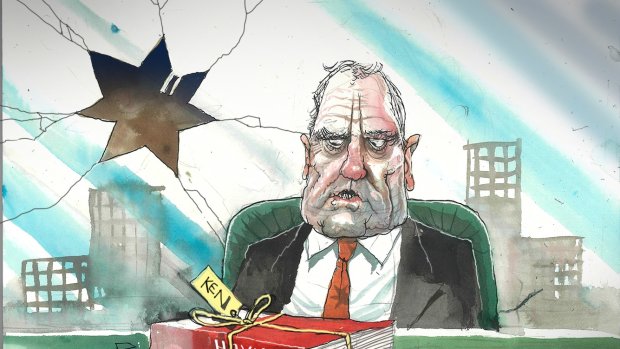
NAB got it the wrong way around. Thorburn and Henry should have stayed and it should have been the board that quit.
The board of NAB caved into pressure from two sources — politicians wanting a scalp from the royal commission and the media lynch mob.
This is exactly the sort of pressure that shareholders pay company directors to resist. In the long run, appeasement never works. The NAB board should have refused to accept the resignations of Thorburn and Henry and given them their full and public support — any director who felt unable to do so should have stepped down.
There may be reasons for their resignations not yet publicly disclosed, but for all intents and purposes it looks like the NAB board felt it had to accept the resignations because Thorburn and Henry were singled out in a few sentences in the final report of the royal commission.
According to Commissioner Kenneth Hayne: "Having heard from both the CEO, Mr Thorburn, and the chair, Dr Henry, I am not as confident as I would wish to be that the lessons of the past have been learnt. More particularly, I was not persuaded that NAB is willing to accept the necessary responsibility for deciding, for itself, what is the right thing to do, and then having its staff act accordingly."
DANGEROUS PRECEDENT
The commissioner is entitled to his opinion — and Thorburn and Henry are entitled to challenge that opinion. Whether the commissioner was going beyond his terms of reference in stating his feelings as to whether NAB executives had demonstrated sufficient guilt and remorse for their own and their predecessors' misdeeds is another question.
Thorburn and Henry did absolutely nothing wrong when they gave their evidence to the royal commission. In this country (at least for the time being), you're allowed to defend yourself when you're in the witness box, whether at a royal commission or in a court of law. Likewise, witnesses are under no obligation to accept the assumptions of the questions from the lawyers interrogating them.
In his evidence, Henry acknowledged his own and the bank's failings — but at the same time he made it clear he wasn't willing to endorse the imputation that the bank as an entire organisation and the bank's staff as a whole were to blame for the mistakes of a few. He was widely criticised for the manner and tone in which he defended the bank and its staff. While Henry's supposed "arrogance" was minutely dissected in the media, the substance of what he said, namely that the overwhelming majority of the bank's employees were good people trying to do the right thing, was almost entirely ignored.
The NAB board has set a dangerous precedent for every other bank — and indeed for every other big business in Australia. What the NAB board has effectively said is if you're an executive and you upset the government and its regulators by having the courage to defend yourself and your staff against them, then your job is at risk.
The fight between big business and government is only just beginning. New legislation imposes jail of up to 15 years for individuals guilty of corporate crimes, and penalties of up to $525 million for companies guilty of civil offences.
The Coalition has spent the past few years bashing big business, and if Bill Shorten wins the federal election big business will be bashed even harder. What could happen under a Labor government will be bad for Australia, but if company boards follow the precedent set by NAB, those boards will only have themselves to blame for what happens to their businesses.


 The Australian Psychological Society (APS), Australia's peak body for psychologists, has signalled that it is likely to follow the path of the of the American Psychological Association (APA), and adopt something similar to the APA's newly-released Guidelines for Psychological Practice for Boys and Men.
 This is the key finding of a new Queensland Productivity Commission report on incarceration and reoffending.
 If, however, they would like to know more about becoming a political activist, race relations or LGTBQ rights, they should ideally do a BA in Australian History. This is because Australia's history has been re-packaged and re-labelled by ideologically-driven academics and presented to undergraduates as a social and political commentary on contemporary issues rather than as a study of actual history. Students are, in short, being swindled.
 Titled "I'm amazed they approved me: CBA lashed for lending to the naive", the article began as follows.
 To put books into pigeonholes based on the class, race or gender of the author, the subject matter of the book, or the identity of the student, is disastrous. All school students should be exposed to great literature, because the great books speak to each and every one of us about our human condition. They speak to us about being rich, being poor, being happy and being sad.
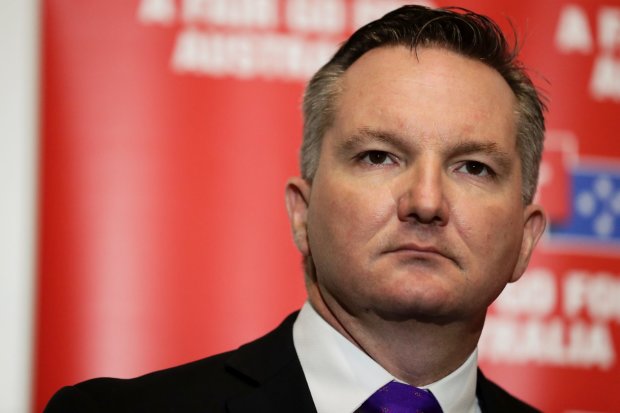
 In response to those who will face higher taxes under Labor's proposed changes to Australia's dividend imputation system, Bowen said they were "entitled to vote against us".
 The Liberal Democrat Senator from NSW was one of precious few voices in Canberra who could be relied upon to advocate for the freedoms of all Australians.
 It is well known and understood that double taxation of corporate income gives rise to economic distortions.
 According to the ATO data some 21 per cent of the Australian population report receiving franked dividends in that year.
 "Whereas for contemporary Europeans, colonialism is just one of our middle-ranking, midway sins, for Australians, colonialism has become the nation's founding, original sin. And not because like European nations it stands accused of having plundered other countries in its search for wealth, but because it stands accused of plundering itself — of being a colonialist project still sitting on its colony," he writes.
 There is a direct correlation between the version of our history taught in universities, and the story that is yearly trotted out to Australians in the lead-up to January 26.
 Indeed, you'd likely wind up mistakenly thinking that there is a groundswell of anger from mainstream, everyday Australians who believe that Australia Day is by far the most pressing issue facing Australians in 2019.
 The poll found that last year 17 per cent of young Australians between the ages of 18-24 said that Australia Day should not be celebrated on January 26. This year's poll shows that, that number has plummeted to just 8 per cent. They, like the majority of Australians know that there are more important issues to think about.
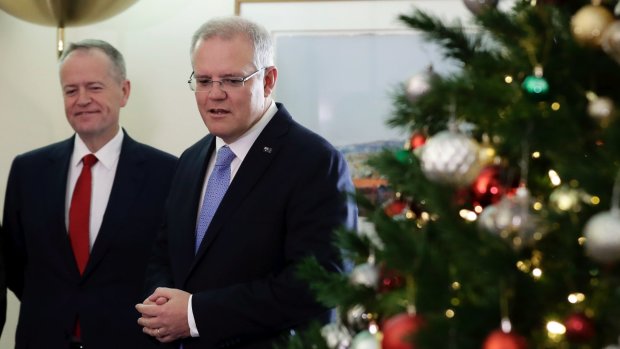 The Liberals will spend a lot of time talking about Labor's policies on two particular issues — border protection and taxes.
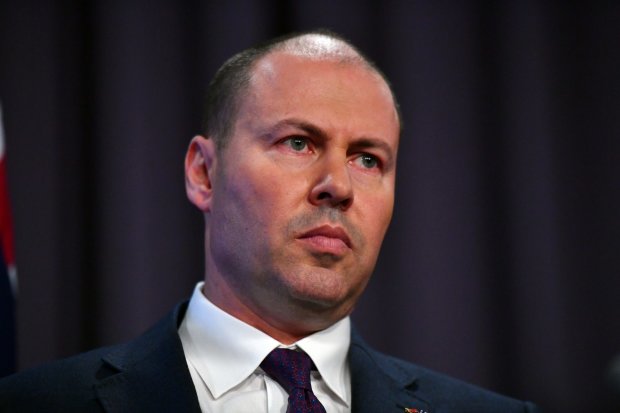 The sense of frustration among Liberals that they appear to be gaining little electoral advantage from Labor's proposals to further increase taxes might have something to do with the fact that it was the Liberals who first started down the road to higher taxes when they introduced the so-called "deficit levy", which increased the top personal income tax rate (including the Medicare Levy) to 49 per cent.
 This week Harwin touted the NSW government's policy of net zero emissions by 2050, argued for the integration of climate and energy policy, and decried the lack of co-operation between state governments and the Commonwealth.
 Despite the prohibition, people continued to hold clandestine religious services, as well as to sing their favourite carols. In effect, Christmas went underground, although perhaps not quite underground enough. An MP at the time complained that he had been deprived of a good night's sleep on Christmas Eve by his neighbours' noisy preparations for "the foolish day".
 That yesterday in London
  The Morrison government's proposed Commonwealth Integrity Commission, designed to sit above the multitude of other special purpose integrity oversight agencies, is a repudiation of bedrock principles of the English legal system.
 Meanwhile, in a Melbourne kindergarten, four-year-olds were recruited by their teacher to protest against refugee rights on Nauru.
 Now, by