Monday, January 21, 2019

Australia Day Discord Devised By Academe

To understand the self-loathing narrative pushed on us by some Australians about the date of our national day, you need only examine the way Australia's history is being taught.

There is a direct correlation between the version of our history taught in universities, and the story that is yearly trotted out to Australians in the lead-up to January 26.

And the historical themes preoccupying the academic community tend to frame public debate as well as policy decision making.  The themes are based on class, race and gender, which are of course the Left's trope du jour.

In my audit of Australian history teaching at universities — Australian History's Last Stand — by far the most dominant theme is identity politics.  The report found that of the 147 subjects taught across 35 universities last year, a total of 102 either focus on or make reference to class, race and gender.  This means the vast majority of subjects offered by history departments employ the lens, to a greater or lesser extent, of identity politics through which to view our past.

It is almost impossible for students to study this nation's past without encountering the modern obsession with class, race and gender.  It appears that our history has been enlisted to support political causes by academics who are more concerned with rewriting the past through identity politics than they are with a narrative motivated by professional concerns.

It hasn't always been so.  Historians such as Manning Clark, Geoffrey Blainey, Allan Martin, John Hirst and Stuart Macintyre might have been divided by politics, but they all shared a traditional approach to the discipline of history.  They saw their roles with clarity, which was to understand and study Australian society, agreeing that history is about the expanse of time in which human beings have lived and acted.

All operated under the assumption they were able to paint a fairly accurate picture of past events by using a linear model of historical thinking and sifting through historical evidence.  However, in the 1960s there appeared a range of radical post-structuralist and postmodernist theories invented by a group of mostly French philosophers who essentially rejected such notions of the linear model, historical evidence, objective truth and knowledge.

Perhaps the most influential of these was Michel Foucault, philosopher, historian, social theorist and inventor of the neologism power-knowledge.  He proposed that knowledge is power, and history is fiction, and the historian's only role is to be social commentator and political activist.

The approach to Australia's history in academe carries all the hallmarks of Foucault's radical postmodernist theory.  Many individuals who specialise in Australia's history have wholeheartedly embraced the idea that they are political activists and social commentators whose self-proclaimed role is to rewrite the past as a way of empowering minorities and the oppressed.

The problem is that history is distorted when it becomes a conscious vehicle for advancing contemporary political agendas.  In Australia's case, much of our history is not only being distorted but is being ignored completely.  Because the story of our success as a modern nation based on the ideas of liberalism is almost absent from the university curriculum, it is completely omitted from the narrative being pushed by the anti-Australia Day lobbyists.

There is little if any discussion of the fact that Australians laid the foundations of one of the world's most successful liberal democracies, which has achieved unprecedented levels of personal freedom and social equality and which continues to attract people from all over the world.  There is little, if any, recognition of Australia as a beneficiary of Western civilisation.

But you only need to look at the result of the recent poll conducted by Research Now to understand just how wide is the divide between academe and the nation, and how mainstream Australians regard themselves and this country.

The results showed that 75 per cent of Australians want to keep Australia Day on January 26, that 76 per cent are proud of Australia's history and 88 per cent are proud to be Australian.  Moreover, 92 per cent think freedom of speech is important and 77 per cent believe freedom of religion to be an important value.

There is clearly no identity crisis among the majority of Australians who turn out in force each January to celebrate this country's past, present and future.

Wednesday, January 16, 2019

Anti-Australia Day Activists Claim There Is A Groundswell Against January 26.  Polling Says Otherwise

If your only way of finding out about what's happening in this country is either by listening to ABC or reading the Guardian, you'd think the entire country is embarrassed about being Australian, wracked with guilt about Australia's history and overwhelmingly opposed to celebrating Australia Day on January 26.

Indeed, you'd likely wind up mistakenly thinking that there is a groundswell of anger from mainstream, everyday Australians who believe that Australia Day is by far the most pressing issue facing Australians in 2019.

However, a poll conducted by Research Now, has revealed that this is exactly the opposite to what mainstream Australians really think about themselves as Australians, their history and their values.

In fact, Australians are fundamentally optimistic and positive about being Australian.

The results of the poll show that 87 per cent of Australians are proud to be Australian, while a tiny 3 per cent are not.

When it comes to Australia's history, 76 per cent of the respondents believe this country has a history to be proud of, while only 11 per cent did not.

The polling also found that 75 per cent of Australians think that we should continue to celebrate Australia Day on January 26 while only 10 per cent actually want the date to be changed.  Chances are that if you polled the Canberra Press Gallery with the same questions, the numbers would be significantly different.

These results expose the massive divide between the majority of Australians and the minority of vocal individuals who continually push the narrative of national self-loathing and self-flagellation on to everyday Australians.

The results simply reveal that there is an enormous disconnect between what Australians think about themselves, and what we are being told Australians think about themselves.

Every year, when Australia Day comes around, elements of the media, the political class and a small but noisy group of activists on Twitter, pull out all stops to impose their own version of Australia's history on the nation.

They are, however, completely and utterly out of touch with mainstream Australia.

Not only are they out of touch, but it seems that the more strident they are in their opposition and the more they obsess about changing the date, the more that Australians want to keep the date.

When Research Now asked the same question about Australia Day in 2018, 70 per cent of Australians were favour.  This year, the number has gone up to 75 per cent.  The poll also shows that young people are not being drawn to the divisive argument of opposing our national day.

The more this vocal, activist minority pushes its agenda down their throats, the less inclined everyday Australians are to go along with it.

The poll found that last year 17 per cent of young Australians between the ages of 18-24 said that Australia Day should not be celebrated on January 26.  This year's poll shows that, that number has plummeted to just 8 per cent.  They, like the majority of Australians know that there are more important issues to think about.
The incessant hounding of the public by activists is having the opposite effect than they intend.

Similarly, our political class likes to present the issue of freedom of speech and freedom of religion as fringe cultural issues being pushed by a small number of conservatives.

Yet again, the poll reveals that the opposite is true.

When asked what they thought about these values, a whopping 92 per cent of the respondents considered freedom of speech to be an important Australian value while 77 per cent said freedom of religion was an important Australian value.

Again, this exposes the disconnect between mainstream Australians and our political class.

Many of the left-wing activists that will be taking part in protests on January 26 have moved on from the change-the-date campaign and are advocating the abolition of Australia Day all together.  These activists will never be happy until there is no celebration of our successful, liberal, prosperous, modern nation.

Prime Minister Scott Morrison is right when he says there is a majority of "quiet Australians'' who aren't obsessed with the issues pushed by the Canberra bubble or a noisy minority.  He was right to come down hard on radical local councils who are refusing to hold citizenship ceremonies on Australia Day.

The Federal government is correct to insist that citizenship ceremonies should be celebrated on the 26th because it is the federal government that gives councils the power to hold them.

The government is perfectly entitled to take away that power from rebellious councils such as Darebin in Victoria, which last year actively encouraged people to go to work on January 26 and take another day off.

Critics of the Prime Minister's decision have said this is a "public relations stunt designed to further divide this country'' but the refusal to participate in celebrating Australia as a united country is the truly divisive force.

January 26 marks the foundation of modern Australia and it should be celebrated by all Australians.  Rather than being ashamed of it, we should be proud of it.

On January 26 the majority of Australians will be rejecting the overwhelmingly negative rhetoric about this nation's history.

They will not be out in the streets in force, but they will be with friends and family, celebrating what it is to be Australian.

Friday, January 11, 2019

Federal Election:  A Paltry Policy Battleground

With this year's federal election now only a few months away, the main themes of the Liberals' campaign are becoming clear.

The Liberals will spend a lot of time talking about Labor's policies on two particular issues — border protection and taxes.
It's says a great deal about the Liberals' policy development processes (or lack thereof) that after more than five years in power they're left with basically just those two things to campaign on.  The Liberals are terrified to talk about industrial relations, they don't have an energy policy and on questions of values such as freedom of speech and freedom of religion they can't agree among themselves on a position.

Meanwhile, the two big social policy initiatives pursued by the Liberals, namely significant increases in funding for education and disability services were instituted by the Labor Party as the "Gonski" reforms and the National Disability Insurance Scheme.

The Liberals are likely to have more political success talking about border protection than taxes.  The Coalition has shut 19 immigration detention centres and there are approximately 1300 people in detention.  In July 2013 there were 10,000 people in detention.

The differences between Liberal and Labor are less obvious when it comes to taxes.

Over their five years in office the Liberals have increased existing taxes and introduced their own new taxes — which is exactly what Labor plans to do too.


LIBERALS ARE FRUSTRATED

The sense of frustration among Liberals that they appear to be gaining little electoral advantage from Labor's proposals to further increase taxes might have something to do with the fact that it was the Liberals who first started down the road to higher taxes when they introduced the so-called "deficit levy", which increased the top personal income tax rate (including the Medicare Levy) to 49 per cent.

Since then, of course, the Liberals have increased the rate of tax on superannuation savings (in the process breaking an explicit election promise), introduced the bank tax and abolished the GST-free threshold on imported low value goods.

The Liberals have been reduced to trying to convince voters that when they raise taxes it's necessary and it's good policy, but when Labor raises taxes it's unnecessary and is bad policy.  It's certainly true that Labor's plans to restrict negative gearing, increase capital gains taxes and eliminate cash rebates for dividend imputation credits are of a different nature to the kind of tax increase pursued by the Liberals, and have potentially far-reaching consequences, but it is still the case Labor is merely following down a road a first trod by the Liberals.

Treasurer Josh Frydenberg is correct to point that if a future Labor government reintroduces an increase in the top rate of personal income tax to 49 per cent, Australia's top marginal rate will be among the highest in the world and it will cut in compared to other countries at a relatively small multiple of average weekly earnings — 2.2 times.

The trouble is, it was the Liberals who raised the top marginal rate of personal income tax to 49 per cent in in 2014 as a temporary "deficit levy".  Before that the last time the highest marginal rate of personal income tax was 49 per cent was in 1988.

As yet neither the Liberals nor Labor have talked about taking the top marginal rate back to 60 per cent, which is what it was when Bob Hawke became prime minister after Malcolm Fraser.  Perhaps Australian taxpayers should be thankful for small mercies.

The Liberals' tax problem is part of a bigger challenge they'll have in prosecuting their economic case.  For example, the government is fond of saying that since it was elected more than 1.2 million jobs have been created.  But as was reported on Tuesday, nearly all of the jobs growth in 2018 was in the public sector.  Over the year government jobs increased by 300,000 while the number of people employed in the private sector fell by 93,000.

At the next federal election the Labor Party is promising higher taxes and more government — which is not very different from the Liberal's track record since 2013.

Friday, December 21, 2018

Legal Rights Audit 2018

The erosion of the fundamental legal rights of all Australians have accelerated under federal law in 2018.

My report Legal Rights Audit 2018 revealed that the legal rights of the presumption of innocence, natural justice, the right to silence and the privilege against self-incrimination are explicitly breached by 358 separate provisions in Acts of federal Parliament.

By stripping away important principles like the presumption of innocence, the right to silence, and the privilege against self-incrimination, our legal system will not achieve just outcomes.

The fact that there has been another substantial increase in legal rights breaches proves it is a systemic problem.

The Morrison government must make it a priority to reverse course and address our legal rights problem.

These findings are a huge blow to the idea that Australia’s legal system is built on the rule of law.

Thursday, December 20, 2018

Businesses And Workers Pay A High Price For Zero Emissions Targets

Don Harwin is to be credited for his role as the state's Minister for Energy and Utilities.  But his recent suggestions for the future of energy and climate policy in Australia are misguided.

This week Harwin touted the NSW government's policy of net zero emissions by 2050, argued for the integration of climate and energy policy, and decried the lack of co-operation between state governments and the Commonwealth.

Interestingly, Harwin also argued for the need to "avoid unnecessary market interventions or distortions" — which is strange given that he is apparently unconcerned with the distortion caused by the $4.8 billion in subsidies that the renewables sector receives each year.

The definition of "unnecessary" appears to mean any intervention that favours coal, while all interventions that favour renewables are conveniently considered to be "necessary".

Mr Harwin also states that the NSW government "did not in principle oppose" the now-abandoned clean energy target or the emissions intensity scheme and was "quite happy to support" the National Energy Guarantee.

However this, too, appears inconsistent with the desire to avoid unnecessary market interventions, as each proposal was the functional equivalent to a carbon tax and would have ushered in mammoth amounts of government regulation.

This is because the only way that NSW could ever get close to the net zero emissions target is through substantial taxpayer-funded favouritism of the renewables sector.

And this spells one thing:  higher prices for consumers and businesses.

Over the past 10 years the share of wind and solar in the National Energy Market has grown from around 2 per cent to 10 per cent.

At the same time, over that period residential electricity prices have risen a staggering 110 per cent.  This is five times the rise compared with economy-wide inflation — which has increased by just 22 per cent.

This means that Australia now has the fourth-highest electricity prices in the world, according to the Australian Competition and Consumer Commission (ACCC).

That is despite the fact that Australia has over 1000 years' worth of coal, 30 per cent of the world's uranium deposits, and an abundance of onshore and offshore gas.

This is wreaking havoc on industry.

An ACCC report from 2017 gave the example of a retail grocer whose electricity bill increased by 53 per cent in just one year.

And BlueScope steel, which employs 6000 Australians, saw its electricity and gas costs rise by some 92 per cent in just two years.

All told, more than 65,000 jobs have been destroyed in the energy-intensive manufacturing sector in the past decade, in part because of high and rising electricity prices.

That is 18 jobs lost each day — 18 fewer Australians who are able to experience the dignity of work.

Mr Harwin doesn't mention these people or businesses.

Perhaps that's because they don't count to policy-makers obsessed with reducing emissions.

What is worse is that these economic and social costs are being imposed without a discernible environmental benefit.

Australia accounts for just 1.3 per cent of global emissions from human sources.  NSW accounts for just a fraction of that — and humans account for just 3 per cent of all emissions from human and non-human sources.

Even the entire Australian economy shutting down would make no noticeable difference to global emissions or the global climate.

Sitting underneath emission reduction policies is the idea that there is an inevitable global transition taking place from coal to wind and solar.  But this is demonstrably false.

Global spending on renewable energy declined by 7 per cent in 2017;  the largest drop in 15 years

China recently removed targets for the construction of solar farms and issued orders for local governments not to approve solar farms that need subsidising.

There are some 2240 coal-fired power stations currently in operation around the world.

A further 708 have been announced, or have received pre-permission or permission to be constructed.

A report released by the International Energy Agency on Tuesday found that coal still provides the largest source of electricity in the world and will continue to do so for some years.

And the jewel in the crown of the environmentalists, the Paris Climate Agreement, is disintegrating.

The largest emitter of greenhouse gases, China, is completely unconstrained by the agreement and is expected to increase its emissions by 150 per cent by 2030 on 2005 levels.

The second-largest emitter, the United States, has announced it will exit the agreement.

And not one of the nations in European Union, who are collectively the third-largest emitters of greenhouse gases, are on target to meet their emission reduction targets.

This wrangling over energy policy gets to a much deeper divide within the Coalition at the state and Commonwealth level, which in turn reflects a divide within the Australian electorate.

It is a contest between Penrith and Paris.

Between lower power prices and lower emissions.

And between the hardworking suburban working- and middle classes and the inner-city elites.

The permanent political class in Canberra and on Macquarie street have for years disregarded the interests of anyone who lives more than 10km from the city.

Whether on energy, population growth or the culture wars, the interests of the out-of-touch elite has taken precedent.

Now is the time for the NSW and Commonwealth governments to provide leadership by getting out of the Paris Climate Agreement, removing subsidies and allowing Australia's resources sector to flourish.

Tuesday, December 18, 2018

Tyranny Of The T-bone

While England was in the middle of tearing itself apart during the Civil War, Oliver Cromwell and his fellow puritans were so profoundly offended by the singing of Christmas carols that they passed an Act of Parliament in 1644 to ban it.  Three years later, in June 1647, the Long Parliament passed an ordinance which abolished the celebration of Christmas altogether.

Despite the prohibition, people continued to hold clandestine religious services, as well as to sing their favourite carols.  In effect, Christmas went underground, although perhaps not quite underground enough.  An MP at the time complained that he had been deprived of a good night's sleep on Christmas Eve by his neighbours' noisy preparations for "the foolish day".
By the 1650s, Cromwell had cracked down on adultery, swearing, fornication and drunkenness.  Pubs all over the country were boarded up as "dens of Satan", racehorses were confiscated from their owners and fighting cocks, bears and dogs were slaughtered.  As Thomas Babington Macaulay would later quip, the puritans were concerned less with the pain of the animal than the pleasure of the spectator.  Finally, dancing, playing cards, traditional games and joyous celebrations at country weddings also became illegal activities.

It might not come as a complete surprise that Cromwell and his ilk, who believed that they were part of the elect while everyone else was doomed to Hell, were not universally popular.  By suppressing anything remotely pleasurable, they did not endear themselves to the unelected.  The daughter of a Wiltshire church warden lamented that "we had a good parson here before but now we have a Puritan.  A plague or a pox on him that ever he did come hither".

Unfortunately, there are members of society today who appear to be doing their damnedest to replicate the austere and joyless world of 17th century Cromwellian England.  And many of them seem to work at People for the Ethical Treatment of Animals.  This week, they have made an important announcement regarding Christmas:  "Look out Australia, the meat-free revolution is here ...!"  Turkeys are out and tofu is in.  Apparently "it's never been easier to enjoy a cruelty-free Christmas feast."

Are the good folk at Peta really driven by a genuine concern for the wellbeing of turkeys or is it something else?  Their recent attempt to get Bunnings to replace its meat sausages with vegan versions at its ubiquitous sausage sizzle suggests that there is more to it than that.  To paraphrase Macaulay, they are less concerned with the welfare of animals than they are the pleasure of the men who shop for hardware.

Driven by equal measures of intolerance and religious fervour, these new puritans are determined that life in Australia should be devoid of all joy and colour.  The American journalist and satirist, H.L. Mencken joked that puritanism is "the haunting fear that someone, somewhere, may be happy".  This modern-day morality dictates that smoking, drinking, and sugar, things which do make some people happy, are deeply sinful and thus should be expunged from society.

Carnivores beware.  The next pursuit on the growing list of transgressions is the act of eating meat.  The anti-meat taskforces argue that it is not only contributing to climate change and environmental degradation but that meat is actually being used by the patriarchy to oppress women.  Ladies, it turns out that we are being subjugated by steak and tyrannised by T-bones.

This latest insanity has of course been simmering away in the humanities departments of Western universities for decades.  In 1990, Carol J. Adams, American feminist-vegan, animal rights activist and Yale graduate responsible for introducing women's studies into the University of Rochester while she was an undergraduate in the 1970s, wrote a book entitled The Sexual Politics of Meat:  A Feminist-Vegetarian Critical Theory.

The New York Times hailed it as a "bible of the vegan community".  In this work, she proposed that "male dominance and animals' oppression are linked by the way that both women and animals function as absent referents in meat eating and dairy production, and that feminist theory logically contains a vegan critique ... Patriarchy is a gender system that is implicit in human/animal relationships."  Adams made the highly questionable connection between meat and gender which has since been embraced by subsequent generations of academics.

Last year, for example the Journal of Feminist Geography published a peer-reviewed study produced by an academic who went to South America to interview all three of Argentina's vegetarians and who concluded that due to the toxic masculinity of meat, women have to fight back against the patriarchy by rejecting it.

Most recently, Shareena Z. Hamzah, a postdoctoral researcher at Swansea University has recommended in an article for the Conversation that in order for women to stop being oppressed and to wrestle power back from men, society needs to modify its language.  From now on, we should cease using meaty metaphors.  Idioms such as bringing home the bacon, flogging a dead horse, and the elephant in the room will henceforward be considered hate speech.

All this madness has come about since the humanities rejected their original purpose in the 1960s.  Derived from the expression studia humanitatis or the study of humanities, for 500 years, their purpose had been to make sense of and understand the world through the Western tradition of art, culture and philosophy.

In the 1970s and 1980s however, there appeared a range of "new humanities" subjects which rejected this tradition.  The new humanities were underpinned by a range of radical post-structuralism and post-modernist theories which had been conjured up in the previous decade by a predominantly French group of philosophers.

Rather than making sense of the world, academics employed in humanities departments are now flooding it with absolute nonsense which is daily encroaching on our lives.

But just as Cromwell and his cronies failed to stop the English from celebrating Christmas, drinking beer and dancing around the maypole in the 17th century, these new puritans will not stop us from enjoying our sausages and steak in the 21st century.

Friday, December 14, 2018

When Politicians Desert Their Voters

These days much is made of the so-called "crisis of democracy" in the West.  At one level it's hard to disagree with the view that even if democracy is not in crisis, at a minimum it is facing some not-insubstantial challenges.

That yesterday in London 200 Tory MPs could vote to keep in power Theresa May, a Prime Minister who is implementing Brexit in a way clearly contrary to the wishes of the British people as expressed in a referendum, is reasonably clear evidence that something somewhere isn't working.

Brexit itself, Donald Trump's election and the implosion of politics in France, Italy and potentially Germany are all assumed to be examples of the "crisis".  Certainly one way of viewing what's happening in many countries is as a challenge to democracy.

It's not democracy that's in crisis — it's politics in crisis.  The two are very different things.

Democracy is an idea.  Politics is the putting of ideas into practice.  The concept of one person one vote, of self-government and of the right to remove and replace those who rule over us is as powerful and as relevant as it's ever been.  In Venezuela people are willing to die for democracy.

When politicians and the public agreed with each other on the main issues relating to economics, politics and culture, as they did in Western liberal democracies for most of the second half of the 20th century, the process of government was relatively straightforward.

Over time the inevitable happened.  The major political parties came to resemble each other, as did the politicians representing those parties.

David Goodhart, the British political analyst, describes this process brilliantly in his 2017 book The Road to Somewhere — The Populist Revolt and the Future of Politics.  As Goodhart analyses it, politics in countries such as the UK (and by implication the United States and Australia) looked increasingly like a contest between Tweedle Dum and Tweedle Dee and "conventional party politics has become narrower, less ideologically distinct, more insider dominated, both in personnel and also in the interests represented".

The problem for the major political parties is that on many issues the politicians and the public no longer agree with each other, and parties have no way of responding to this change.  On free trade and immigration, for example, the gulf between elite political opinion and that of the average voter in the average Western liberal democracy is growing, partly because political elites have always assumed the people would always agree with them and so have stopped making the arguments for their position.

And instead the frustration of voters has been expressed through support for the minor parties.


LICENSING OF RELIGIOUS PRACTICE

At the same time as the major political parties became more alike they came to see politics as merely, as Theresa May famously said, "getting the job done".  To be successful a politician had only to display technical competence.

Sometimes, though, reconciling different values and beliefs doesn't lend itself to managerialist solutions.

So, for example, yesterday in an attempt to protect "religious freedom" the Morrison government announced it would legislate to prevent discrimination on the basis of religion.  In essence what the government proposes is that, to remedy the problems of existing state-based anti-discrimination law interfering with the exercise of religious beliefs, it will introduce its own additional federal anti-discrimination laws.

There are numerous problems with such a proposal, including the fact the federal government would be engaging in the de facto licensing of religious practice.

Despite what Liberal and Labor politicians believe, energy and climate change policy doesn't lend itself to a managerialist fix either.  The choice between lower carbon emissions and lower energy prices is ultimately determined according to the principle of what subjective value is to have priority.

In America, on the right Donald Trump blew up the Republican Party after he realised (by accident or design) that what Republican voters wanted was different from what their party was offering.  On the left Bernie Sanders nearly blew up the Democratic Party.  In Britain Jeremy Corbyn is doing something similar to the Labour Party.

In Australia it remains to be seen whether our system of compulsory voting can continue to temper the Trump and Brexit-like convulsions of other countries.

Integrity Body Has Limited Power Now But Just Watch This Space

The only way to ensure vested interests in the federal government don't misuse their power is to ensure the federal government doesn't wield so much power in the first place.

The Morrison government's proposed Commonwealth Integrity Commission, designed to sit above the multitude of other special purpose integrity oversight agencies, is a repudiation of bedrock principles of the English legal system.

Wide-ranging anti-corruption agencies too often turn into kangaroo courts.  Tackling corruption is on its face a highly virtuous mission, and agencies committed to this are always under threat of elevating this mission above inconveniences such as complying with the rule of law and respecting the legal rights of individuals caught up in their investigations.

In NSW, the Independent Commission Against Corruption has left a trail of destruction in its wake since its establishment in 1988.  It has proven much better at destroying lives and careers than it has at tackling real criminality.

Its pursuit of Australian Water Holdings in 2014 ended the political career of then premier Barry O'Farrell for failing to remember receiving a bottle of wine.

A magistrate in 2016 dismissed allegations of misconduct against former emergency services commissioner Murray Kear from an incident in 2013.

ICAC also has displayed a tendency to exceed its defined authority, as the High Court found in the commission's pursuits of former NSW premier Nick Greiner in 1994 and former crown prosecutor Margaret Cunneen in 2015.

To its credit, the federal government is trying to avoid the excesses of NSW's ICAC by limiting its power and scope.  It may not realise how vulnerable those designs are:  Bill Shorten immediately responded yesterday by calling for a federal ICAC to have more power and a wider scope.  The Coalition has given it the keys to do this.

The proposed Commonwealth Integrity Commission is a new bureaucracy, and the nature of bureaucracies is to grow in size and power across time.  Members of a bureaucracy are, just like people in other sectors of the economy, motivated by increased job and financial security.

As US economist William Niskanen once observed, the bureaucrat is "not entirely motivated by the general welfare or the interests of the state".  In other words, a bureaucrat working at a federal ICAC will have a natural incentive to increase the size and prestige of ICAC, and to justify its existence by pursuing cases that don't necessarily merit the attention in the first place.  As former High Court justice Dyson Heydon noted in a 2010 case, special purpose quasi-judicial bodies tend to "lose touch with the traditions, standards and mores of the wider profession and judiciary" while becoming "overenthusiastic about vindicating the purposes for which they were set up".

On the other hand, the incentive for politicians is never to criticise ICAC lest they be criticised as weak on corruption.

When the High Court in 2015 ruled the NSW ICAC had gone too far with its powers, the state rewarded ICAC with retrospective statutory validation for past investigations.

When a government passes laws to approve its past mistake, is it any wonder that Australians have had a gutful of politics as usual?  Just 46 per cent of Australians have trust and confidence in the federal government, down from 82 per cent in 2008, according to recent research published by Griffith University and Transparency International.

Less than 50 per cent of Australians aged between 18 and 44 believe democracy is preferable to any other form of government, according to the Lowy Institute.  Meanwhile, voters increasingly are rejecting the major parties in elections across the country.

What is at issue is that an out-of-touch governing elite has ­effectively rigged the political and economic system for its own ­benefit.

This elite does not necessarily break any laws but acts as a successful business model that confers more power on itself at the expense of tax-paying Australians.

These vested interests permit only the policies that support their interests, usually characterised by a greater role for regulators in the economic life of Australians.

This is why Australia's red-tape burden is equal to about 11 per cent of its GDP, or why the federal parliament has passed more than 5000 new pages of legislation this year, or why the number of provisions that undermine fundamental legal rights such as the presumption of innocence or the right to silence are persistently increasing.

Another layer of bureaucracy within the federal government will only add to this problem.

The federal government's decision to capitulate on a federal ICAC is a signal it has accepted the size and scope of the state must always increase.  The result is domineering government and a populace that enjoys shrinking freedoms.

Wednesday, December 05, 2018

Literacy And Numeracy Skills Are Declining As Students Are Taught To Be More Politically Active

Last week, thousands of angry and emotional schoolchildren carrying an array of crudely-made placards bearing messages of varying degrees of originality took to the streets of Sydney to protest against the Morrison government's "lack of action" on climate change.

Meanwhile, in a Melbourne kindergarten, four-year-olds were recruited by their teacher to protest against refugee rights on Nauru.
These baby-faced campaigners were pictured holding up a selection of signs with catchy slogans such as "Locking Up Our Children is Never the Answer", "No Child Should Live Like This" and "Political Leaders Must End this Harm".

However, the lack of Clag, along with the level of sophistication of both vocabulary and poster design, suggests that just maybe these preschoolers might not have made their own posters.

In the world of today's educationalist which is dominated by Left-wing and out-of-touch ideologues, you're never too young to protest.

Apparently if you're able write your own name, albeit in a thick blue pencil, stand on one foot for more than nine seconds, or draw a person with a body, you're old enough to be a political agitator.

What we are seeing is evidence of the degree to which Australian children, from preschool to Year 12, are being actively politicised in our classrooms by ideologically obsessed individuals masquerading as professional educators.

But the educator's job is to educate children, not indoctrinate them.

The students participating in the #SchoolStrike4Climate were clearly encouraged by their teachers to dodge their lessons to engage in a political activism.

These men and women are brazenly and energetically enlisting their charges in a political struggle against the current government.

Many teachers are far more concerned with creating legions of mini-me social justice warriors than they are with ensuring that their students actually know how to read and write.

Falling standards in reading, science and mathematics across every economic quartile and in all schools is testament to the fact they believe education to be about developing a social identity rather than acquiring knowledge.  Since 2015, Australia has performed abysmally in world rankings.

Reading literacy has seen us fall from fourth to sixteenth in the world, from seventh to twentyfifth in maths, and in science from fourth to fourteenth.  Much of this is due to the fact that Australian children are being uneducated at a terrifying pace, thanks largely to our flawed National Curriculum.

The first major problem is the existence of three cross-curriculum priorities which refuse to go away.

They are "Sustainability", "Aboriginal and Torres Strait Islander histories and cultures", and "Asia and Australia's engagement with Asia".

The curriculum has been deliberately designed so they are in every subject.  You'll find them in English, mathematics, science, humanities and social sciences, the arts, technologies, health and physical education, and languages.

For example, in English students will "develop the skills necessary to investigate, analyse and communicate ideas and information related to sustainability, and to advocate, generate and evaluate actions for sustainable futures".

In maths, children are taught to "develop the proficiencies of problem-solving and reasoning essential for the exploration of sustainability issues and their solutions".

In the meantime, five-year-olds in science class are being taught about how "Earth's resources are used in a variety of ways" while in Level 2 mathematics, algebra is taught by "using models such as linking blocks, sticks in bundles, place-value blocks and Aboriginal bead strings ..."

The second major problem with the curriculum is with their so-called General Capabilities.

These would on face value seem to be an attempt to teach children useful values, which is of course a very good thing.

However, rather than instructing them about the values around individual rights, parliamentary democracy and equality before the law, it turns out that these capabilities are simply a regurgitation of the Left's favourite tropes of identity politics, environment and social justice.

Take "Personal and Social Capability".

In this capability, students will "gain an understanding of the role of advocacy in contemporary society and build their capacity to critique societal constructs and forms of discrimination, such as racism and sexism".

In "Ethical Understanding", they are told that "complex issues require responses that take account of ethical considerations such as human rights and responsibilities, animal rights, environmental issues and global justice".  This is not education.  This is propaganda.

Next week, the University of Melbourne Graduate School of Education is hosting the 6th World Curriculum Studies Conference.  Unsurprisingly, there is an entire session devoted to man-made climate change.

It's also no wonder that according to the Organisation of Economic Co-operation and Development, 14 per cent of 15-year-old Australian students are functionally illiterate, and would not understand the instructions on a packet of headache tablets.

What's more is that 20 per cent of Australian youth's arithmetic skills are so bad that and they wouldn't be able to work out how much petrol is left in a tank by looking at a gauge.

Prime Minister Scott Morrison is spot-on when he says that there should be less activism and more learning in the classroom.

Let's start by depoliticising education by getting rid of these dangerous, ideologically driven fads and Left-wing platitudes masquerading as values and return to the fundamentals of what education is all about.

Tuesday, December 04, 2018

Turnbull's Act Of Woeful Hypocrisy

It is disappointing that Malcolm Turnbull appears to be taking part in the same headline-grabbing antics for which he has criticised others.  When his efforts to get clean air and run with a political narrative were disrupted by an intervention by Tony Abbott, prime minister Turnbull and his supporters were rightly frustrated and would blame his conservative rival for many of the government's problems.

Now, by publicly calling on Prime Minister Morrison to bring forward the federal election, and intervening in Liberal Party factional matters, Turnbull is allowing his legacy to become entangled in the same personal bitterness and vitriol he so despised as prime minister.  It is an act of woeful hypocrisy.

There is no doubt that the revolving door of prime ministers has caused instability over the past decade.  From this instability has flowed policy paralysis, which has led into the federal Liberal Party lacking a reform agenda to rally around.

What the Liberals have to understand is that a cultural narrative is just as important as an economic narrative.  A cultural narrative also needs to go beyond wearing a lapel pin.

Turnbull's key mistake was focussing solely on economic matters, and even there he disappointed.

His reasons for toppling Abbott were solely about an economic message and Newspolls.  His signature tax policy was to return a portion of income tax to the states, a good policy to address a serious issue of fiscal imbalance.  Yet he disappointed many by ruling it out just a few days later.

But more fundamentally, Turnbull as prime minister was not interested in culture.  He once said that he supported protecting religious freedom just as much as he supported same sex marriage, only to flick the issue off to the review for someone else to deal with.

If a leader is purely focussed on economic policy, then who is there to defend religious schools that could soon lose the right to teach their ethos according to their faith?  Who will stand up for freedom of speech on campus?  Who will stand up for workers once every coal mine in Australia is run out of town?  And who will argue for literacy and numeracy in schools, over trendy activism?

It was only after a fierce effort by those that believe in freedom of speech that Turnbull was prepared to put a bill to the Senate to deal with 18C, something his predecessor was unable to do;  Turnbull should be credited for this.

But his latest entry into the public consciousness is unhelpful and hinders the party from building the holistic story that can capture the imagination of voters.  Voters will support a party with a coherent plan and a vision for the nation's future.

Many journalists and commentators are running the line that the Liberal Party lost in the Victorian state election because the party was too right wing on issues such as climate and energy policy.

This is wrong.  The exact same journalists and commentators were not as forthcoming with an equal analysis of the left of politics after Labor's defeat at the 2013 federal election, or the defeat of the Labor government in South Australia, both largely based on climate and energy policy.

Mainstream Australians want lower power prices rather than global warming gesturing.

They don't think it should be illegal to offend somebody.  They find identity politics grotesque and anti-ethical to the spirit of egalitarianism and merit-based selection.  They want lower taxes for themselves and for their children through lower debt.  And they want to celebrate Australia Day, sing Christmas carols at Christmas time, and for their children to receive a first-rate education regardless of the income of their family.

If the Liberal Party can rally behind a united economic and cultural message to sell to voters, without being distracted by former leaders, it will go a long way to winning the next election, whenever that may be.

Tuesday, November 27, 2018

Victorian Election:  Liberals In A Wilderness Between Longman And Wentworth

The disastrous showing of the Liberal Party at the Victorian state election has spawned the same number of theories as the total of seats the Liberals are likely to lose.

The left wing of the Liberal Party, the Labor Party, and the ABC are already saying Matthew Guy's Liberals lost because their policies were too "right wing" for a supposedly progressive state like Victoria.
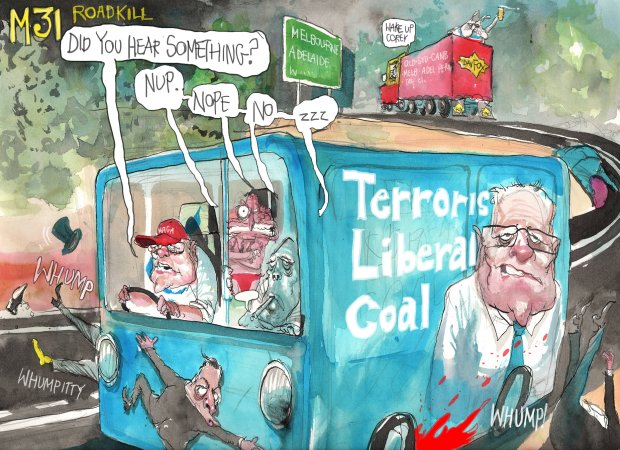
Climate change is given as the evidence for such a claim — but the reality is somewhat different.  True, the Liberals said they would scrap Victorian Labor's renewable energy targets, but only because the Liberals said they supported national, not state-based, emissions targets.  For all intents and purposes the two parties' positions on climate change were indistinguishable.

There's nothing "right wing" about the Liberals promising, as they did, to have the government hand out half-price fridges and TVs to cut emissions.  Nor is there anything particularly "liberal" about such policies either.  "Redistributive semi-socialism" might be a better description for it.

It might be that the removal of a left-leaning Liberal prime minister in Malcolm Turnbull might have changed some Liberal votes in Victoria, but that doesn't change the fact that the Victorian Liberals had been behind Labor in the polls for the past five years.

If the Victorian Liberals had promised to implement an aggressive program of cutting state taxes, reducing the size of the public service, controlling lawless trade unions, winding back Labor's Nanny State regulations, and building a coal-fired power station then maybe there would be some merit in the left's claims against the Liberals.  Unfortunately the Liberals promised none of these things.

The Liberals campaigned aggressively on law and order, but Labor responded by pointing out that many of the things the Liberals said they would do, Labor was already implementing.

On top of all of this, Victorian voters contrasted the do-nothing approach to infrastructure of the Coalition Baillieu and Napthine administrations between 2010 and 2014, and the build- everything-immediately, regardless of the cost, approach of the Andrews government over the past four years.

These are all by now well-documented problems with the Liberals' election strategy.  A more fundamental problem for the Victorian Liberals was that the public sensed a lack of clarity of what the Liberals stand for.  And as has been witnessed since Saturday from the way state and federal Liberals are talking about what the election loss means, a number of Liberal MPs don't know what their party stands for either.


IDENTITY CRISIS

After nearly three decades of uninterrupted economic growth, what used to be the Liberals' election-winning mantra of fiscal prudence and responsibility seems to be no longer working — either at the state or federal level.  The Liberals are as enthusiastic about big-spending social programs as is Labor.  Unfortunately though for the Liberals, because most of these programs are Labor initiatives the Liberals don't even get electoral benefit for implementing them.

The Liberals, both state and federal, are at risk of not knowing what they stand for because they are now trying to appeal to two constituencies with very different belief systems.  The concerns of those in inner-city, wealthy, and cosmopolitan electorates like Wentworth in Sydney are different from those in working-class electorates like Longman in Brisbane.

This phenomenon played out in the Victorian state election.  Leafy, affluent seats in Melbourne's eastern suburbs swung viciously against the Liberals, while in some country and regional areas the swing against the party was practically non-existent.

The Liberals might have to realise that because an electorate has always been Liberal it doesn't mean it always will be, or should be in the future.  In an ideal world the Liberals would continue to use their "broad church" appeal to gain the support of both the Wentworths and the Longmans.  Once the Liberals could do this — whether they still can, is an open question.

It is not clear whether those Liberals who want their party to move to the left and embrace higher taxes and bigger government are saying so because they genuinely believe it, or because they think that is what is now required to win elections in Australia.  To avoid having a debate about ideas, some Liberals are now claiming ideas don't matter and the party should aim to be merely practical and pragmatic.

While the Liberals now engage on their necessary soul-searching they should remember that if you don't even attempt to fight the battle of ideas you will be guaranteed to lose.

Friday, November 23, 2018

LGBTIQX-Men

Stan Lee's contribution to modern pop culture was nearly without comparison.  His creations in the pages of Marvel Comics — the Fantastic Four, Spider-Man, the Incredible Hulk, Iron Man, the Daredevil and many more — have infused Western mythology.

Few writers could write the aspirational hero better than Lee, and his creations have said more about responsibility, leadership, integrity and living in service to others, than anything produced in recent years.  Lee did not re-invent the wheel, but how his characters strove to do the right thing — where the "right thing" was a universal and objective ideal, in contrast to the subjective morality of today — made the characters cultural touchstones.

The themes were at once recognisable and broadcast to a mass audience what was good about the West:  The Fantastic Four faced the same problems any normal family struggled with.  Iron Man was the story of unashamed masculinity and heroic capitalism.  The Mighty Thor was a god but had to learn the importance of humility.  The pairing of power and responsibility is related to the century's old doctrine of noblesse oblige, and leaders and thinkers throughout history have expressed similar views.  Only Lee catapulted it into modern popular consciousness in Spider-Man's first appearance in the pages of Amazing Fantasy 15 in 1962, with the narration "with great power there must also be — great responsibility!"

Lee's death at the age of 95 last week marked the end of an era in publishing characterised by relatable but complex characters, universal themes, and genuine escapism.

More than anyone else, Lee pulled superhero comic books into the mainstream.  Marvel Comics under his leadership not only became the dominant comic book publisher, but also led to enhanced cultural legitimacy for the medium.  He hustled for decades to bring his creations to television and film, an effort which only found significant success with the release of X-Men in 2000, which has ultimately given birth to the superhero blockbuster era.

Despite undoubtedly making many people a great deal of money, Lee's story goes to show that no good deed goes unpunished.  His final years were riddled with accusations of elder abuse at the hands of his associates who hoped to profit from his work.  Meanwhile, Lee was being dragged to conventions to sit for hours on end for speculative collectors hoping to inflate the value of their wares by collecting his signature.  Shockingly, it was revealed earlier this year that Lee's own blood was stolen in order to mix it with ink to sign Black Panther comic books, to be paired with "a certificate of authentication that details the item as a 'Hand-Stamped Signature of Stan Lee using Stan Lee's Solvent DNA Ink'."

It was not enough that terrible people attacked Stan Lee, the person.  They also allowed his legacy to be almost obliterated.  As the face of Marvel Comics for decades, Lee built the superhero comics industry into a powerhouse.  The X-Men, created by Lee in 1963, had within three decades become one of the hottest intellectual properties in the world.  The launch of a new X-Men series in October 1991, which moved over seven million copies in that month alone, remains an industry record.

Marvel Comics is barely a husk of what it once was.  Now a subsidiary of Disney, it remains one of the two large publishers only by virtue of the fact that the same sickness has overrun the entire comic book industry.  Radical leftists whose only qualification for creative writing is sending out "woke" comments on Twitter have invaded the industry, and now use it as a platform for progressive political proselytising and virtue-signalling.  Social justice warriors are a destructive force in a creative industry.  The storylines are heavily agenda-driven, and existing intellectual properties are persistently devalued and transformed to fit the political proclivities of the writers and artists.  Major characters guilty of the crime of being white men — Iron Man, Wolverine, the Hulk, Hawkeye and others — have been replaced to increase diversity representation.  Iceman was a founding member of the X-Men and a heterosexual man for decades before he was abruptly transformed into a flamboyant homosexual.  Thor was incoherently written out of his own book, and was replaced by a female character.  X-Men has become a hotbed of left-wing politics, under the historical revisionism of the series being an allegory for civil rights struggle and homosexuality.  Only a progressive could be so cruel as to equate a homosexual with a mutated human.

Identity politics cannot coexist with a system of appointment by merit.  The idea that a character should only be written by someone who shares the same physical features, and can only be appreciated by an audience who also share those features is plainly absurd but has taken root in many creative industries, perhaps none more so that in comic books.

This was illustrated in August when Marvel announced that academic Eve Ewing would write Ironheart, a new series based on the black teenage girl who replaced Iron Man.  In a healthy comics industry, a writer whose only creative writing experience is in poetry would never be given a brand new series at a leading publisher.  But when an online petition (that failed to reach its target of 5,000 signatures) encouraged Marvel to employ Ewing because she shared Ironheart's skin colour, that was enough.

Identity politics also cannot coexist with a system based on competency.  Writers that share the politics of the editorial staff but fail to sell books will always find new work.  Iceman under gay writer Sina Grace was cancelled in late 2017, only to be resurrected under the same creative team in June 2018.  Kelly Thompson, whose female Hawkeye series was cancelled after 16 issues, launched a new series in August starring the same character.  Chelsea Cain's feminist Mockingbird series from 2016 was cancelled by Marvel after just eight issues, only for the writer to be given another new series — which itself was cancelled after the writer only managed to hand in 4 scripts over a period of two years.

Last week we mourned the loss of Stan Lee, but for true believers, the industry limps on, infected with an ideology that values propaganda over capitalism.

Daniel Andrews:  A Threat To A Twenty-First Century Economy

Melbourne prides itself on its cafe culture, vibrant laneways, quality restaurants, and marquee sporting events.  This dynamic and cosmopolitan lifestyle that Melburnians enjoy owes much to the rise of flexible business models built around independent contracting and casual work arrangements, but it is under threat from the Andrews government's proposals designed to restrict the sharing economy.

These proposals have received little attention, but if implemented would put services like food-delivery, ride-sharing, and letting handyman jobs through Airtasker at risk, for the sake of favouring the union agenda to move all Victorians into the award system.  In particular, new laws would regulate if not eliminate key sections of the sharing economy, further restrict the labour-hire industry, and strike a blow at the hospitality industry through punitive laws covering so-called "wage theft".

Most concerning is the promised inquiry into the "gig economy", with the Premier justifying it with reference to "wages and conditions being offered to workers", a phrase that effectively denies that participants are independent contractors.  Framing the inquiry this way demonstrates the government's opposition to participants enjoying the flexibility that comes with the sharing economy, and suggests any recommendations by the inquiry are pre-ordained.

For example, currently Uber drivers earn money from trips made and control their own hours and conditions.  If the unions get their way, online platforms would be forced to directly employ workers, pay wages and dictate hours.  This would destroy the business model that has revolutionised the way Melburnians move around the city, which created an alternative to the highly regulated taxi industry.  It could also wipe out the food delivery services that are currently enjoyed by hundreds of thousands of busy Victorians, and which have expanded the opportunities for many entrepreneurial cafes and restaurants.

New labour hire laws secured by the government in 2018, set to come into effect next year, will add more red tape to the already beleaguered industry.  The licensing system being introduced was justified by the actions of a few rogue firms, regarding offences which were already illegal.  The issue could have been solved with better enforcement of existing laws, without burdening the industry with licensing fees and compliance costs.  The regulations line up with the anti-labour hire views of the ACTU's Sally McManus who has said:  "you've got to take away the incentive for employers to use labour hire".

Daniel Andrews has also promised to crack down on employers who are underpaying wages and entitlements with the introduction of new "wage theft" laws.  The eagerness to create new laws instead of enforcing the existing laws is concerning, especially when they would duplicate and possibly conflict with laws administered by the Fair Work Commission.

After its restoration by the Rudd/Gillard government the award system small businesses have to grapple with is fantastically complex, which makes errors virtually inevitable.  While employees should be able to get back any underpayments, there should be no in-built assumption that every breach is "theft".  Threatening jail time and massive fines will further deter employers from taking on the casual or part-time employees needed to service the needs of our twenty-four-hour city.  If we make compliance too hard and too risky for our world-class hospitality sector, Melbourne's hard-earned reputation will be lost.

Should the Andrews government be returned, we will see reduced opportunities for those thousands of Victorians who have shown a preference to work flexibly and as independently as possible.  The Liberal Party should put on record their opposition to these measures, and develop policy that will undo long-standing barriers to employment.  Rather than buckling to the union movement's self-interested demands, we need to foster a business environment that encourages innovation and opportunity and meets the needs of the lifestyle wanted by Victorians.

Thursday, November 22, 2018

Loans Are A Wrong And Risky Way To Help Small Business, Mr Treasurer

The Federal Government's proposed $2 billion small business loan scheme is the wrong response to a real problem.

The decline of small businesses in Australia presents a substantial policy challenge.
In 2017 there were 6,000 fewer new businesses than a decade earlier, despite Australia's working age population growing by 20 per cent, according to my recent report.  Over the same time period, the number of Australians employed in a small business declined by seven per cent.

This means many of Australia's best and brightest are opting to work for larger, more established firms, which are typically less dynamic, entrepreneurial, and innovative than their smaller competitors.

In an attempt to avert this decline, the government has proposed a $2 billion government-run small business loan fund.  The fund would buy small business loans issued by non-big four banks and other financial organisations, with the intended effect of expanding the availability of credit to small businesses and lowering its cost.

While the government has its sights set on the right problem, the proposed solution is off the mark.  History is replete with examples of government-backed financing going bad, fast.

The State Bank of South Australia, the Victorian Economic Development Corporation, and the State Bank of Victoria via the subsidiary merchant bank Tricontinental all sought to expand the availability of credit to increase growth and all failed spectacularly.

The State Bank of South Australia, for example, was established in 1984 and lasted just seven years before its collapse in 1991 brought the South Australian government to the brink of bankruptcy.  The key cause, according to a report by the South Australian Auditor-General delivered in 1993, was "it grew too fast".  Risky lending, lack of oversight, and poor management resulted in the bank taking on too many bad loans.

The Victorian Economic Development Corporation, meanwhile, was so poorly managed that its Board didn't even have a policy on prudential lending limits and risk exposures, according to a report undertaken by the Victorian government in 1988.

The exemplar of government finance gone bad, of course, is the United States' Fannie Mae and Freddie Mac which are quasi-government financial institutions.  At the behest of government regulation, Fannie and Freddie were forced to purchase a certain number of home loans from low income and minority borrowers to expand home ownership.  The problem was that there wasn't enough creditworthy borrowers for Fannie and Freddie to meet the governments lending requirements.  This forced them to lower their lending standards and promulgate bad loans which ultimately brought the US financial system to its knees.

No one is suggesting the small business loan facility would produce a similar outcome in Australia.  But the fundamental problems which brought down Fannie and Freddie, and the State Banks of South Australia and Victoria, will plague the small business loan facility.

And that fundamental problem is one of skin in the game.

The risk of lending is not lowered just because it is backed by taxpayers.  Rather, the risk is transferred from the private sector to the public at large.

In the commercial world, if a loan goes unpaid and there is insufficient collateral to recoup the loss, then it is the business — its workers, shareholders, and customers — which suffers the consequences.  The losses are contained within the sphere of that commercial enterprise, and not socialised to the broader public who had nothing to do with the transaction.

And the prospect of losing money and being out-competed by other lenders provides a powerful incentive to ensure the overall lending portfolio is both profitable and sustainable.

Conversely, there is no market-based incentive mechanism when it comes to government-backed finance.  Most likely, the new small business fund will provide lending based not on sound economics, but political favours and cronyism.  The temptation to channel funds to politically beneficial causes will be too great and drown out any offsetting commercial liability from such an undertaking.

Rather than funnelling more money we don't have and injecting yet more government into the financial sector, governments interested in boosting small businesses should instead be more focused on how they can get out of their way.

Study after study shows that red tape, government regulation, and bureaucratic interference are the key enemies of small business.  For example, 48 per cent of respondents to a survey published by Westpac earlier this year said that regulation was the highest hurdle to business success in Australia.  The next highest response was the 14 per cent of respondents who believed high business taxes was the biggest factor hampering business success.

And it is small businesses that bear the brunt of red tape.  They are less likely to have the lawyers, accountants, and human resource departments that are needed to navigate the array of licenses, permits, and conditions needed to set up or expand a business.

Treasurer Josh Frydenberg is right to recall the words of former Prime Minister Sir Robert Menzies who saw small business owners as "the strivers, the planners, the ambitious ones".  But the words of another great leader, former US President Ronald Reagan, are just as important:  "government is not the solution to our problems.  Government is the problem".

Small business owners know what they are doing.  The best thing the government can do is get out of their way.

Friday, November 16, 2018

The Heavy Hand Of Free Speech

The British philosopher Sir Roger Scruton in a recent speech remarked that modern-day universities are increasingly reverting to the role they played in the Middle Ages.

Medieval universities, according to Scruton, studied dogma and were "devoted to identifying and extirpating heresies".  Individuals were sometimes able to express those heresies so that they could be examined in order to be proved wrong, but — "you were not in any real sense free to affirm them.  It would be quite misleading to say that the medieval university was devoted to the advancement of free enquiry."

As Scruton goes on to explain, the suggestion that the purpose of a university "was to advance knowledge regardless of where it might lead, and to make knowledge available to the rising generation" is a recent idea dating from the beginning of the 19th century, and by the publication of JS Mill's On Liberty in 1869, "it was widely accepted that free expression of dissenting views is important in all areas of enquiry, and not just in the natural sciences".

This is the context in which to view the announcement by Dan Tehan, the federal Education Minister, of a review into freedom of speech at Australian universities to be conducted by former chief justice of the High Court, Robert French.  Such a review is overdue and welcome and should be embraced by university administrators.

All too predictably though, the response of the lobby group representing the tertiary sector was that of the bureaucrat.  But, said Universities Australia, there were "more than 100 policies, codes and agreements that supported free intellectual inquiry".  Which of course proves nothing.  Famously, Enron's business ethics guidelines ran to more than 60 pages.  Presumably all Australia's banks have corporate responsibility policies, but as the Hayne royal commission has established merely having a policy doesn't mean it is actually put into practice.

A number of university policies are directly opposed to the idea of freedom of speech.  James Cook University, the university that sacked Professor Peter Ridd for the heresy of questioning the quality of climate change research in this country, has a "Bullying, Discrimination, Harassment and Sexual Misconduct Policy" that applies to all students and staff.  The definition of "harassment" includes making "a person feel offended" and it can result from a single incident.  It would be difficult to imagine a discussion about current American politics in a first-year international relations tutorial that wouldn't end up with at least one person, somehow being offended.  The possibility that a student could be accused of harassment for offending another student by saying for example "I think President Trump is doing a good job" is precisely the sort of thing Robert French should be turning his mind to.  He can do this after he reviews incidents such as police being called to Sydney University when left-wing students tried to shut down a public lecture by Bettina Arndt.

Universities Australia has criticised those calling for an inquiry into freedom of speech at Australian universities as appearing "to want government to override university autonomy with heavy-handed, external regulation and red tape".  Yes.  If heavy-handed government regulation is what's required to ensure freedom of speech and freedom of academic inquiry at Australia's universities then so be it.

University "autonomy" as interpreted by Australian academics means them spending other people's money on things they and their friends and the colleagues agree with.  There's nothing objectionable in Simon Birmingham, the former education minister, vetoing $4.2 million of government grants to universities for various humanities projects.

One of the projects denied funding by the minister was "Double Crossings:  post-Orientalist arts at the Strait of Gibraltar", which examined the way painters and photographers represented Muslim and Christian cultures.  The project's proponent, Professor Roger Benjamin, professor of art history at Sydney University, should be absolutely entitled to have the academic freedom to undertake such research.  But that doesn't mean he's entitled to taxpayers paying $223,000 for his travel to London and Tangier to do so.

If Australia's universities and academics really want to be autonomous they can be — all they have to do is hand back the more than $10 billion of taxpayer funding they get each year.

Thursday, November 15, 2018

A Chance For Universities To Think Again

Free speech is fundamental to what it means to be a university.  It is fundamental to undertaking researc­h and ensuring students can grow intellectually.

The government's announcement that former chief justice Robert French will lead an inquiry into freedom of speech at universities is welcome and important.  Australia's universities should embrace the opportunity to ­review and improve their policies and institutional culture.

Federal Education Minister Dan Tehan has said French will review codes of conduct, enterprise agreements and strategic plans, the effectiveness of the existi­ng legal framework, and international approaches to the promotion of freedom of express­ion in higher education.

Our universities are failing to protect free intellectual inquiry.

My Free Speech on Campus Audit 2017, which assessed more than 165 policies and actions at Aust­ralia's 42 universities, found that four in five have policies or have taken action hostile to free speech.  It also found that just eight of Australia's 42 universities have stand-alone policies on freedom of expression, as mandated by the Higher Education Support Act 2003.

University policies prevent "insulting" and "unwelcome" comments, "offensive" language and, in some cases, "sarcasm".

Curtin University's student conduct policy, for example, define­s harassment as "any form of unwanted or unwelcome behavi­our that is offensive to you".  La Trobe University defines bullying to include "unintentional ... offence" and insists students not use language that causes "emotional injury".  A dozen universit­ies, including the Australian National University, Monash and UNSW, maintain blasphemy provisio­ns which forbid offending on the basis of religion.

There have also been a number of concerning incidents.

James Cook University sacked Peter Ridd after he expressed a contrarian opinion on the science behind the Great Barrier Reef.  The riot squad was called to the University of Sydney because of a violent protest against psycholo­gist Bettina Arndt.  The university charged students a security fee to host the event, encouraging the censorious "heckler's veto".  ­Victoria University cancelled an event featuring the screening of a film critical of the China-funded Confucius Institutes.

French will be able to develop a sector-led code of conduct inspired by the University of Chicago.  The Chicago Statement says that "it is not the proper role of the university to attempt to shield individuals from ideas and opinions they find unwelcome, disagreeable, or even deeply offensive".  While welcoming criticism of invited speakers, it also concludes it is wrong to "obstruct or otherwise interfere with the freedom of others to express views".  Following the precedent set by a dozen US states, Australia should legislate the Chicago statement principles.

Policy reform is welcome and important.  Nevertheless, the challenge faced by Australia's universities is broader and deeper.

Australia's universities are lacking viewpoint diversity — differen­t perspectives challenging each other in the pursuit of truth.  This leads to a culture of censorship in which individuals who speak out are treated as heretics, and proposals such as those of the Ramsay Centre for Western Civil­isation are vehemently opposed.

The lack of viewpoint diversity also leads to self-censorship.  ­Earlier this month Andrew Marzon­i wrote in The Washington Post that "academia is a cult ... rooted in submission to a dogma manifested by an authority ­figure" in the form of tenured professor­s.  University of Adelaide senior lecturer Florian Ploeckl has warned that "funding is easier and more plentiful if you pick the right topic, publishing is easier if you don't rock the boat, and life in the department is easier if you see the world in the same way your colleagues do".

The purpose of a university is undermined by a culture that can't handle dissent.  Research depend­s on individuals with differen­t perspectives challenging each other's findings to defeat motivated reasoning.

Reforming policies is an important first step, but Australia's universities have a long journey ahead to once again become bastions of free intellectual inquiry.

Monday, November 12, 2018

Goodbye Old Blue-Ribbons, Hello New Heartland

The Liberal Party's dramatic loss in the Wentworth by-election last month reveals an irreconcilable philosophical divide within the Party.

Self-styled "moderates" within the Party are the first to write history, claiming a more credible stance on addressing climate change is required for the Liberals to hold seats such as Wentworth.  They are right.  The proportion of left-leaning voters in seats such as Wentworth in Sydney and Higgins and Kooyong in Melbourne is sizable and growing.  The Liberal Party must naturally adopt more left-leaning policies to hold these seats.

Lots of time has been wasted writing negative analysis about former prime minister Turnbull.  But he was welcomed into the Party after having first unsuccessfully sought a spot with Labor and was welcomed back after almost quitting after he lost the leadership to former Prime Minister Tony Abbott in 2009.

Turnbull knew his electorate like the back of his hand.  Wealthy inner-city voters want to reduce greenhouse gas emissions, favour international climate agreements such as the Paris Climate Agreement, can endure the associated higher cost of power given their relatively high incomes, and are more concerned about refugees and funding for the Australian Broadcasting Corporation than petrol prices and traffic congestion.

The problem for the Liberals is not individual personalities.  It is that the "broad church" philosophy doesn't work politically or from a policy perspective in today's environment.

This problem is revealed in the fact that the gap in voters' priorities between Wentworth in Sydney's east and Lindsay in its west, or Higgins in Melbourne's inner east and Frankston in its south-east is growing.  And so too is the gap between the policy preferences in the moderate and conservative factions within the Liberal Party.

There have always been disagreements within both the Labor and Liberal Parties.  Disagreements can be healthy when they lead to rejuvenation, development of better policy, and the formation of a new consensus.

However, it is one thing to disagree over effective marginal tax rates, and quite another to disagree over matters that go the heart of the Party and the nation.

The divisions within the Liberal Party are over climate change;  the role of government in the electricity market;  how much national sovereignty will be sacrificed to international bodies;  the size, scale, and composition of the immigration program;  freedom of speech and freedom of religion;  the aggressiveness with which political correctness ought to be resisted;  what is taught in schools;  whether multiculturalism or assimilation of migrants is preferable;  and how foreign influence should be tackled.

In short, the disagreement goes to the very heart of who we are as a nation.

Holding Wentworth and Linsday at the same time is evidently no longer possible.  So be it.

The choice for Liberal Party is obvious:  either double-down and focus on re-capturing Wentworth and nostalgically holding onto "blue ribbon" seats which are becoming ever darker shades of green.  Or re-imagine the Liberal Party as a workers' party which unashamedly promotes the interests of working-class and middle-class Australian workers and families.

Working-class and middle-class Australians are largely unrepresented politically.  Labor has abandoned their traditional working-class base in their pursuit of identity politics, environmentalism, multiculturalism, identity politics, and a big immigration program.  But they have been able to hold onto many working-class seats because the Liberals have not been able to bring themselves to alter their policy agenda because they are so desperate to keep seats like Wentworth.

Consequently, the lives of many working and middle-class Australians are worse today than a decade ago.  Real wages in the private sector haven't risen for three years.  The cost of essentials such as child care, health insurance, and electricity are rising due to government regulation.  Commute times and congestion are worse.  Housing is unaffordable.  Taxes are rising.  And many are uneasy about two decades of rapid demographic change.

In practice, the conservatives within the Liberal Party need to form a voting bloc, develop a list of non-negotiable policies around energy, immigration, and the culture wars that will make the Party attractive to workers, and cross the floor in Parliament when needed.

Two recent major victories for conservatives came only after they threatened to cross the floor:  the scuttling of both the China-Australia extradition treaty and the National Energy Guarantee.

The Liberal Party should let Labor, the Greens, and left-leaning independents exhaust their resource fighting to take seats such as Wentworth.  Let them represent the out-of-touch elites.

This would allow the Liberal Party to take on mainstream policies more readily.

The Liberals can easily capture 20 per cent of Labor's vote in Western Sydney if they adopt a coherent policy agenda that puts working and middle-class Australians ahead of the political, cultural, and economic elites.

Now is the time for the Liberal Party to recognise the changing nature of the Australian electorate, adopt a policy agenda which reflects this change, and not get nostalgic over the "blue ribbon" seats of the past.

Wednesday, November 07, 2018

UTAS Risk To Freedom Of Expression And Human Rights

The University of Tasmania's draft behaviour policy is a serious threat to freedom of expression and basic legal rights.

The bedrock of university life is the ability to freely explore ideas.

It is only through the process of claim and counter-claim that it is possible to separate good ideas from bad and discover the truth.

Across the Anglosphere, from American liberal arts colleges to British universities and Australian campuses, a culture of censorship is forming.

Speakers are violently protested if not banned altogether, students are demanding protection from ideas they dislike, and academics are concerned that there is a lack of diversity of viewpoints.

In this context, university administrators should be doing all they can to protect free expression.

The University of Tasmania, however, appears to be heading in precisely the wrong direction.

The University's draft policy states that community members are expected to "behave and communicate in a manner that does not offend".

Avoiding causing offence may be an admirable goal.

Nevertheless, often when exploring ideas offence is taken rather than intended.  The hearing of an idea with which one disagrees can be offensive.

The feeling of offence is often unavoidable but necessary in the process of understanding, learning and developing ideas.

Australian National University chancellor and former foreign minister Gareth Evans declared earlier this month that "Lines have to be drawn, and administrators' spines stiffened, against manifestly un­conscionable demands for protection against ideas and arguments claimed to be offensive".

The proposed policy also lists 18 "protected attributes", ranging from gender, race, family and sexual matters to religion and political belief.

It then states that community members are forbidden from engaging in conduct which "offends, humiliates, intimidates, insults or ridicules" on the basis of these attributes in the eyes of a "reasonable person".

The inclusion of religion and political belief in the grounds that individuals cannot offend goes well beyond existing speech limitations in state and federal law.

The Anti-Discrimination Act 1998 (Tas.) includes an extended list of protected attributes.

However, it is notable that Section 17(1) only forbids offensive conduct associated with gender, relationship status and family responsibilities.

It does not prevent the causing of offence based on political belief or religion.

The inclusion of religion and political belief is an extraordinary overstep.

The causing of offence is not uncommon when discussing religion or politics.  Criticism of an individual's religion and political beliefs can be offensive — such as stating that a political opinion is invalid, immoral or inhumane or making a joke about religious belief.

This speech, however, can also be genuine part of intellectual debate and social commentary.

The policy states that an example of discriminatory harassment is "Making derogatory comments or taunts about a person's religion".

It may be derogatory, for example, to criticise the lack of acceptance of homosexuality in Leviticus, a Christian text, or to raise concerns about Mohammed's multiple wives in the Koran, the Islamic text.

The prevention of negative remarks about religion, akin to the blasphemy laws of the past, is a historical anachronism in Western liberal democracies such as Australia which value free expression.

My Free Speech on Campus Audit 2017 ranked the University of Tasmania one of the highest in Australia for freedom of expression.

The University is one of few with a commendable stand-alone policy that explicitly protects intellectual freedom.

If the university adopts the draft policy, however, the institution would be downgraded from an Amber ranking to a Red ranking in the Audit.

A further issue of concern with the policy is the removal of basic legal rights.

In Australia, an individual accused of sexual assault is innocent till proven guilty beyond reasonable doubt by a jury of their peers.

The draft policy, however, adopts a much lower threshold of the "balance of probabilities" for sexual assault misconduct allegations — meaning that the event is more likely than not to have taken place.

It is inappropriate for a university — which lacks the evidence gathering and judicial skills of the criminal justice system — to be making determinations of a student's guilt on sexual assault.

This raises the possibility that a member of the community is found not guilty by the courts in normal legal process and yet be punished secondarily by the university.

The University of Tasmania is a public institution, established by Tasmanian law and largely funded by the taxpayer and state-subsidised loans.

The University has a moral and legal responsibility to safeguard free expression and basic legal rights.

Friday, November 02, 2018

The Liberal's Church Without A Pontiff

Two weeks on, the Wentworth byelection result continues to be the Rorschach test of Australian politics in 2018.  Pundits and politicians are interpreting the outcome to mean whatever they want it to mean.  The loss of what was assumed to be a safe Liberal seat has been taken by left-leaning Liberal MPs to mean their party must "do more" on climate change for example, while right-leaning Liberal MPs claim that whatever happened in Wentworth doesn't mean anything anyway because the electorate isn't representative of the rest of the country.

Those Liberal MPs who lament the demise of Malcolm Turnbull argue that while under his leadership the party was behind in the polls the situation was not irretrievable.  They argue the Liberals and and their policies should shift to "the centre" (i.e. to the left of where they are now) to cater to the drift leftward of voters' preferences.

Those Liberals MPs responsible for the former PM's downfall reply that first there's no evidence Turnbull would have performed any better at the next election than he did at the last.  The Coalition under Turnbull as "the pragmatic centrist" lost 14 seats at the 2016 federal election.  Under the Abbott "the unelectable man of the hard-right" the Coalition won a total of 25 seats over two federal elections.

The debate over what Wentworth means for the Liberals is a proxy war over the future direction of the party.  It's a battle that gives every sign of being carried on for years to come — and while the Liberals are in opposition in Canberra.

One of the challenges the Liberals face as they ponder their future policy directions is they've got no process for debating and resolving philosophical differences.  The fight between the "wets" and the "dries" in the late 1970s and 1980s took more than a decade to be resolved in favour of the "dries".

In simple terms, at the federal level the parliamentary leader of the Liberals sets the party's philosophical direction and Liberal MPs then follow it.  In the modern-day Liberal Party the way to change a policy is to change the leader.


"CULTURE WARS"

Giving the Liberal leader effective carte blanche to make policy might not be a problem when that leader is Robert Menzies or John Howard.  But it is a problem when that leader is Turnbull.

Howard is correct when he says the Liberal Party was at its best when it operated as a "broad church", encompassing the variety of the non-left philosophical traditions in Australia.  Whether the Liberals can continue as a single political party that's a "broad church" party is an interesting question.

A "broad church" requires its adherents to subscribe to some common aims and objectives, that ideally for a political party would be more than just winning elections.

For much of the Liberal Party's history those aims and objectives were broadly agreed upon and centred on national security and economic policy.  Now the issues of national security have fractured into an argument about asylum-seekers and the level of immigration.  On economics, the Liberals have largely replaced the notion of fiscal restraint and smaller government to enter into a contest with Labor as to who can impose the most effective regulations.

Added to all of this is what to the Liberals is largely uncharted territory, namely the debate the nature of the country's traditions and values, the so-called "culture wars".

On all of these questions there is "liberal", "libertarian" and "conservative" perspective.  Sometimes those perspectives all align to produce a single agreed-upon policy, but increasingly they don't.  The suggestion that every policy challenge is susceptible to a solution through the application of non-ideological pragmatism is misguided.  Whether for example taxes should go up or down can ultimately only be decided according to values and philosophy.

What's forgotten by those Liberals who argue the party should abandon ideology is that such a statement is itself a statement of ideology.

The maintenance of a centre-right political party as a "broad church" requires the skills of a Menzies or a Howard.  No political party or system is sustainable if it can only be operated by a once-in-a-generation political impresario.

Thursday, November 01, 2018

Minister's Veto Exposes The Rot Within The Humanities

The news that former federal education minister Simon ­Birming­ham vetoed several hum­anities research projects submitted to the Australian Research Council last year has sparked a flurry of protests by the academic Left.

The real cause of the offence and outrage is because these academics have been outed to the public.

Academics employed in hum­anities departments have cried that this was a case of unwarranted political interference that posed a serious threat to academic freedom.  However, this has nothing to do with political interference by a politician or academic freedom, as they claim.

Taxpayers have been given a glimpse of just how their money is being misspent, and just how far the humanities departments have strayed from their original purpose.

Birmingham's veto of several humanities research projects should be met with thanks by hardworking taxpayers.  His decision to scrap a total of 11 proposals submitted to the ARC last year has not only saved taxpayers $4 million but also has helped to expose what is going on in our universities.

His commonsense vetoing revealed just how corrupted the various humanities disciplines have become.  It is fine for academics to research whatever they want, but not at our expense.

Birmingham simply was using his common sense and doing what his position required of him.  This is not a parody — some of the projects he decided to scrap were entitled "Beauty and ugliness as persuasive tools in changing China's gender norms", "Post-orientalist arts in the Strait of Gibraltar" and "Writing the struggle for Sioux and US modernity".

These research projects are a complete and utter waste of time and money, bad scholarship and bogus education.  The only error of judgment in what was an excellent decision was to keep his decision quiet rather than publicising the rot in the humanities departments.

It turns out that Birmingham was just doing his job.  He was not, as opposition innovation, industry, science and research spokesman Kim Carr put it, "pandering to knuckle-dragging right-wing philistines".

An examination of the application process for funding as explained in an infographic on the ARC website entitled "I have applied for a grant from the ARC.  What happens to my application?" shows the last two stages involved:

  • Recommendations to the minister in which the minister for education determines proposals for funding and the budget for each proposal.
  • The minister for education and training determines proposals for funding and the budget for each proposal.

It is a pity that in his time in office Birmingham did not choose to veto yet more risible projects, such as "A history of women as consumers" using "Filipino elite and migrant women between 1902-2010", and "Modern women and poetry of complaint, 1540-1660".

From the Renaissance until the 1960s, the humanities, derived from the expression studia humanitatis, or the study of humanity, made it their purpose to make sense of and understand the world through the Western tradition of art, culture and philosophy.  There appeared in the 70s and 80s, however, a range of "new humanities" subjects that completely rejected this tradition and that are underpinned by a range of radical post-structuralism and postmodernist theories.

This is just the latest case that exposes the corruption of humanities departments by an academe that is obsessed with radical identity politics.  Most notably, three academics in the US pulled off a highly successful grievance studies hoax by having several fake papers accepted by respectable and referred journals.

They discovered in the process that in making absurd and horrible ideas fashionable, they managed to have them accepted.

One paper proposed that dog parks were "rape-condoning spaces".  Another, published in a gender studies journal, was a reworking of part of Mein Kampf, entitled "Our Struggle is My Struggle:  Solidarity Feminism as An Intersectional Reply to Neoliberal and Choice Feminism".

One of the most wicked examples is a paper presently waiting for revisions and that espouses the chaining of privileged students to the classroom floor.  If it weren't so profoundly disturbing, it would be laughable.

In their journey of enlightenment and discovery, the hoax's authors also showed there was a religious element to this entire business.

Certainly, the response in Australia has been one of intense moral outrage, horrified that an outsider or nonbeliever, a mere politician at that, has dared to venture into the sacred and unknowable world of the humanities.  The main tenets of this new cult of identity politics are that privilege is sin, whiteness is bad and Western civilisation is responsible for all evils in the world, past, present and future.

This religious fervour was displayed on Monday night at the University of Sydney when a group of academics gathered to argue against the introduction of a Ramsay Centre for Western Civilisation course on the grounds that the centre, and thus by default Western civilisation, was "structurally, institutionally, morally and epistem­ically violent to other know­ledges".

The fact this is the pervading orthodoxy in academe is even more of a reason as to why we need a bachelor of arts in Western civilisation.