Friday, October 19, 2018

Jerusalem A Decision Too Big For Wentworth

The Liberals should stop trying to play identity politics.  They're not very good at it and they should leave that sort of thing to the Labor Party.  The race/class/gender/religion card is a dangerous one to play, especially when it comes to foreign policy.  There should only ever be one thing that determines Australia's foreign policy, namely what's in our national interest.

Make no mistake.  The decision of Prime Minister Scott Morrison to consider moving Australia's embassy in Israel from Tel Aviv to Jerusalem is welcome and should be supported.  It is a powerful and proud statement of Australia's support for democracy and freedom in the Middle East.  Jerusalem is Israel's capital city and that is where Australia's embassy should be located.

It is naive to think that in the short-term it won't produce some negative repercussions, but it is always in Australia's long-term national interest to stand with democracies.  The fact that if Australia was to relocate its embassy to Jerusalem, it would be one of only a handful of countries to do so is irrelevant.  The justice of an issue should not be decided by a vote of the so-called "international community".  The "international community" might have its place, but most of its members are not democracies.

The problem with the government announcing considering moving Australia's embassy to Jerusalem is not the decision itself.  It's the way the decision was made that's the problem.  It's the right decision but for all the wrong decisions.  On the surface at least, it looks like a decision of politics not principle.  Which is a tragedy.

The decision risks forever being portrayed by those opposed to it as motivated by identity politics, as the Liberals face a crucial byelection in a seat whose population is 12.5 per cent Jewish.  The decision risks being portrayed as the Liberals appealing to the identity of voters who are Jewish.  Whether anyone in Wentworth, Jewish or not will change their vote because of what the government announced is arguable anyway.


A BYELECTION PLOY?

Just a few months ago the secretary of the Department of Foreign Affairs and Trade said that Australia's embassy "will remain in Tel Aviv" and the decision of the Trump administration to relocate the American embassy to Jerusalem "had not been helpful".  Morrison, in his previous role as treasurer said in July about a possible move:  "It's not the Government's policy.  It's never been under review and we're not doing it."  Now, four days before the Wentworth byelection the government has reversed that position.

The fact the Prime Minister hasn't actually announced he's moving the Australian embassy in Israel, only that he's "open to" doing so, similarly risks presenting the decision as a byelection ploy.  Presumably if the government undertakes a review of the merits of moving the embassy there's a chance that in the end it will decide to keep the embassy where it is.

Understandably Morrison is doing everything he can to win the Wentworth byelection and stay in office.  But some policies are too important to be decided and announced in the middle of byelection campaigns.  One of the Prime Minister's great strengths is that he's not going to die wondering.  Unlike his predecessor Morrison actually wants to defeat the Labor Party.  But victory, either tomorrow or at the next federal election, as nice as it would be for the Liberals, is not an end in itself.

The Liberals should want to win elections so they can implement policies in the national interest, like moving the Australian embassy to Jerusalem.  It shouldn't be the other way around.  Hopefully the Liberals never think that our country's involvement in the politics of the Middle East is a means to the end of domestic politics.

If this week's announcement from the government truly was based on principle the test will come, not if the Liberals hold Wentworth tomorrow, but if they lose it.  If the Liberals lose Wentworth and we never hear again about the embassy being moved, the PM will have succeeded in revealing that the Liberals' commitment to furthering democracy and freedom around the world is as skin deep as a byelection campaign promise.

Sexual Assault Too Serious A Crime For A Campus Verdict

A basic legal right is that if you are accused of something as serious as sexual assault, the case against you must be proved beyond reasonable doubt.  Australia's universities are stripping away this basic legal right by determining such cases at the much lower threshold of the "balance of probabilities".

In August, the University of Sydney established a policy that says the standard or proof for "sexual assault and sexual harassment is 'on the balance of probabilities', which requires satisfaction on the evidence that the matter found to have occurred is more likely to have occurred than not".

The University of Tasmania has released a draft behaviour policy that similarly emphasises that sexual misconduct will be determined "on the balance of probabilities".  This is inconsistent with legal principles.

The new policies follow campaigns by some well-intentioned groups, including End Rape on Campus Australia.

EROC Australia argues that because universities are not adjud­icating whether the law has been broken but merely whether a university policy has been breached, the threshold for proof should be "substantially lower".

This, it says, would make "the university complaints process a more accessible avenue for survivors seeking some form of redress and acknowledgment of their experi­ence".

The argument does not take into account the seriousness and consequences of a university finding an individual committed sexual assault.  It cannot be compared to a university deciding whether a student has plagiarised — this is a university effectively adjudicating a criminal matter.  A finding of guilt in a criminal matter such as sexual assault is a tattoo on your forehead from society that we unquestionably, with complete certainty, condemn your actions.

This is why the threshold for proving guilt in such a crime is set so high.

It is far beyond the role and capacity of university administrators to make determinations on allegations of sexual assault.  University of Technology Sydney deputy vice-chancellor Shirley Alexander is right when she says "penalties for sexual assault are determined by the criminal justice system, not universities".

In practical terms, a university is in no way equipped in legal powers or the technical capacity of the police to gather evidence about a crime.  Nor does it have the judicial skills to undertake a fair trial on such a serious matter.  There are criminal courts under despotic reg­imes that have a greater capa­city to investigate criminal matters than a university administrator.

Universities Australia's new guidelines on sexual assault and harassment, which encourage the lower threshold, argue that the "understanding of, and responses to, sexual assault and sexual harassment — or any form of violence against women — need to evolve from a purely legal approach to one that prioritises the needs of the person who experiences the ­violence".

The assertion that a "legal approach" does not prioritise the rights of a victim is absurd — but our judicial system also respects the right of the accused to a fair trial and the presumption of innocence.  Our criminal justice system exists to balance the rights of victims and the accused, which is precisely why it has the capacity to make findings of guilt.

Universities effectively making criminal determinations undermine the basic legal rights that individuals are innocent until proven guilty by a jury of their peers.

As former chief justice Robert French wrote in a 2011 judgment:  "The presumption of innocence has not generally been regarded in Australia as logically distinct from the requirement that the prosecution must prove the guilt of an accused person beyond reasonable doubt."

A university finding could prejudice a criminal trial.  If a case is highly publicised, it raises questions as to whether a jury can fairly try a person who already has been labelled as guilty by another public institution.

This raises the possibility that a member of the community is found not guilty by the courts through the normal legal process yet is punished secondarily by a university.

The US campus experience has shown how lowering the threshold and expanding the definition of sexual misconduct has disastrous implications for due process.

Emily Yoffe, contributing editor at The Atlantic, wrote that the Obama-era Title IX instruction to universities, which included lowering the threshold for guilt to more likely than not, had led to "adjudications that assume guilt, rely on junk science, gut fundamental fairness, engage in racial animus, and disregard the effects of ending men's education and crushing futures".

This is why the Trump administration reversed the requirement that colleges lower the criterion to "more likely than not".

Yoffe, normally a left-wing critic of the Trump administration, welcomed the reform.

A university does have a responsibility to determine whether an individual is a threat to safety on campus following allegations of inappropriate conduct.  A determination that an individual is a danger to the university community could be made at a lower threshold of guilt.

Notably, this does not require a university to make a determina­tion as to what in fact happened.  This may sound like quibbling over semantics but it is a key distinction between a public institution that takes seriously its duty of care and one pretending to be a court that determines criminal liability.

Every human rights lawyer in Australia should be distressed by this attack on fundamental legal rights.  The federal government must not let students and staff be stripped of their legal rights by university administrators.

Wednesday, October 17, 2018

Moving Embassy To Jerusalem Could Spark Peace Process

The Morrison government's announcement that it will now consider recognising Jerusalem as the capital of Israel is a welcome reiteration of our liberal democratic values in foreign policy.

Australia's embassy is currently in Tel Aviv, which is a fine city — it is a modern cosmopolitan commercial and cultural hub with beautiful beaches and fabulous night life.  But it is not Israel's capital.

Israel's capital is Jerusalem.  Jerusalem is the home of Israel's parliament, the Knesset, the administrative apparatus and the President and Prime Minister.

Israel is the only country that does not get to select its own capital and have that recognised by other nations.  It would be strange for Australia's American embassy to be located in New York and not Washington, DC, or our British high commission to be in Manchester and not London.

A decision to move the embassy would be a welcome affirmation of Israel's right to self-determination like any other nation.

A relocation would follow the lead of the United States under President Donald Trump.  However, the idea is not new.  American presidential candidates have promised it for decades, both Democrats and Republicans including presidents Bill Clinton, Barack Obama and George W. Bush.

In Australia, Senator James Paterson's maiden speech in 2016 declared that, "It would be a symbolic but important step for Australia to formally recognise Jerusalem as Israel's capital city and to move our embassy there."

The Liberal Party's federal council also passed a motion calling for the embassy to be moved.

The Morrison government has reiterated its support for a negotiated two-state solution to the Arab-Israeli conflict.  In recent days, however, it has been claimed that Australia moving the embassy undermines the peace process.  The sad reality is that there are currently no negotiations that moving the embassy could undermine — since the Palestinians are refusing to meet without preconditions.

A potential positive result of Australia and other countries moving their embassies to Jerusalem is that it places pressure on the Palestinians to finally return to the negotiating table.  It also helps address a potential sticking point by pressuring the Palestinians to recognise Israel's right to exist and the thousands-of-years-long bond between the Jewish people and Jerusalem.

Nevertheless, it is important to not exaggerate the implications of moving the embassy.  The religious and historical sites of the Old City in Jerusalem can continue to be accessed by people of all religions.  The facts on the ground, that is, Israel's claim to and physical location in Jerusalem, will continue.  The proof that moving the embassy does not change the reality on the ground already exists.  Following initial protests, there has been no change in the situation in Israel following the US decision earlier this year.

The notion that moving the embassy undermines a future peace settlement is based on a fundamental misunderstanding of history and the peace process.

Israel's capital has been located in Jerusalem since 1950, following the events of the Independence War in which a coalition of Arab states rejected the United Nations partition plan that included both a Jewish and a Palestinian state.  This is notably before the 1967 war that unified West Jerusalem with the east that includes the Old City.

Australia's embassy would inevitably be located in West Jerusalem after a peace settlement.  There is no scenario in which a peace agreement would not include a recognition of Israel's capital in West Jerusalem — with an open possibility for a Palestinian capital located in the east of the city where Australia could locate a Palestinian embassy.

The international community's approach to Israel, most commonly from nations not part of the liberal democratic family, has been one of demonisation.  UN Watch calculated that of the 97 United Nations resolutions criticising countries between 2012 and 2015, a whopping 83 were against Israel.

This is substantially more condemnation than of hermit state North Korea, economic basket case Venezuela, or Saudi Arabia where the big human rights breakthrough in recent months is that women will be able to drive for the first time.

There are some that will never recognise the right of the Jewish people to self-determination;  there are some who will continue to target the one Jewish state for special criticism and treatment.

Australia's foreign policy should be driven by our values — not by the potential for backlash from nations that are both less liberal and less democratic than ourselves.  Israel is the only functioning liberal democracy in the Middle East.  It deserves our moral and symbolic support.  In an increasingly polarised world, we will only be respected by our neighbours and allies if we stay true to our beliefs.  Now is not the time to waiver.

As Winston Churchill is often quoted as saying, "You have enemies?  Good.  That means you've stood up for something, sometime in your life."

An Australian decision to move the embassy would right a historical wrong, stay true to our liberal democratic values, and put the State of Israel on an equal footing with the rest of the international community.

Friday, October 12, 2018

Brett Kavanaugh's Confirmation Is A Win For Women

Brett Kavanaugh's confirmation to the Supreme Court is a win for women.  It is a win for the rule of law, which all peaceful and just societies are built upon.  Central to the rule of law is the presumption of innocence until proven guilty.  This evolved from Clause 39 of Magna Carta and remains the central pillar of justice in Western legal systems.

During the past few weeks, this basic legal and ethical principle has been besieged by a push to #BelieveAllWomen.  This phrase was written is sky high letters on banners at protests, hashtagged and quoted by the most virtuous of Twitter personalities and, most worryingly, was even regurgitated by some members of the Senate.  But what would be the long-term ramifications if our society did away with due process and really did "believe all women"?

Well to begin with to believe all women implies that all women are the same, or similar enough that they can all be thrown into one category.  Moreover, it implies that all women are inherently honest, at least when it comes allegations of sexual misconduct.  In doing so it places women back upon the pedestal that the first two waves of feminism successfully took them down from.

When women fought for their rights and equal treatment it was on the presumption that women are just as capable as men.  And of course we are, women are just as intelligent and complex as their male counterparts, but that also means they are just as capable of lying, manipulating and doing all of the Machiavellian things that are part & parcel of human nature.  Women fought for equal treatment, not special treatment.  To obtain the legal status of men means you take on the legal and personal responsibilities as well, meaning that your testimony must be corroborated before guilt can be determined.

The presumption of innocence exists and operates effectively in societies not only because it is just but also because it is logical, as it is intrinsically difficult to prove a negative.  It is a critical thinking exercise perhaps best explained by the philosopher Bertrand Russell in his famous teapot analogy.  Meant to be a criticism of religion, Russell explained that if the onus of proof is not placed upon the person asserting a claim anything can be "true" as long as it cannot be disproven.  The example he used was an assertion that there is a very small teapot revolving around the earth.  Negative proof would assume that teapot's existence until enough facts to the contrary could be gathered.

Senate Minority Leader Chuck Schumer openly stated that "there's no presumption of innocence" in regards to Brett Kavanaugh.  Considering Kavanaugh's accuser could be believed despite not providing the date, location or any corroborating evidence to counter Kavanaugh's detailed diaries and repeated clearance by FBI investigations into his background, it felt at times that Kavanaugh might as well have been attempting to disprove there was a teapot revolving around the earth.  He was not fighting against evidence but an emotional belief that bordered on the dedication of the most devoutly religious.

No matter who you believe in this case, you must remember the legal system is not based on belief, or who you want to believe or who you should believe because of their gender, it is based on evidence and due process.  Justice is and should remain blind, especially in circumstances where partisanship places blinkers on people's views.

If we do believe all women and make it the responsibility of the accused to prove their innocence, this would set a dangerous precedent and undermine the justice of our legal system.  Due process is there to ensure that the innocent do not get punished, as a state that punishes the innocent cannot claim to be just.  This is not to say that Kavanaugh definitely did not assault Ford, but right now it cannot be proven that he did so in the eyes of the law and, just as importantly, of society he is innocent.

To dismantle traditional safeguards in order to make it easier for survivors of sexual assault to proceed through the legal system may seem like a good idea at face value, but it is a concept that is open for misuse and manipulation.  Public condemnation can never take the place of a fair trial and testimony must be given equal weight regardless of gender.  I could not stand by and see my brother, father or son cut off from the protections of the law.

Thursday, October 11, 2018

Regulators, The Royal Commission And Crony Capitalism

The Royal Commission into Misconduct in the Banking, Superannuation, and Finances Services Industry has uncovered some inexcusable behaviour.  Charging client's fees without providing services, pressured selling of insurance to a man with down syndrome, and thousands of breaches for providing unsolicited advice and insurance are just a few examples highlighted in the Royal Commission's interim report released last Sunday.

Almost as damning has been the lack of response from regulators.  According to the Royal Commission, "[w]hen misconduct was revealed, it either went unpunished or the consequences did not meet the seriousness of what had been done."

But what most observers haven't pieced together is that business misconduct and regulator inaction are two sides of the same coin:  crony capitalism.

Crony capitalism is an economic system where government and business are linked.  Governments provide favours to certain businesses, such as through direct subsidisation, favourable tax treatment, or erecting regulatory barriers to market entrants which stunts competition.

Those businesses return the favour by building a factory in a marginal seat, providing donations, or promotion of a broader political agenda through advertising.

Crony capitalism was epitomised by the Global Financial Crises of 2007-08 in the United States where banks were bailed out with taxpayer dollars at the expense of working-class Americans.

Some ideologues have tried to place the crises at the feet of free markets.  However, there is nothing free about a market where government confiscates workers' hard-earned income and uses it to bail out multi-billion dollar businesses and line the pockets of wealthy executives.

Capitalism proper, by contrast, is a system of profit and loss, risk and reward, intense competition between businesses, government neutrality, and level legal playing fields.

By definition, there is no room for government favouritism, special favours, or backroom lobbying in a capitalist system.  These are all hallmarks of cronyism.  And Australia's financial sector is far more cronyist than it is capitalist.

Banks in Australia can profit without providing good customer service as a substantial part of their market share is guaranteed by government.

The "four pillars" policy prevents underperforming banks from being merged with or acquired by better performing banks.

Compulsory superannuation provides financial institutions with a guaranteed revenue stream.

The myriad of prudential and corporate regulations shields the big firms from smaller would-be competitors who cannot afford the expensive accountants, lawyers, and human resource departments to sift through the paperwork and red tape.

The implicit government guarantee of the major four banks who are "the too big to fail" means in the event a bank was to go under they would be bailed out by taxpayers, as occurred in the United States.

Finally, there is the issue of regulatory capture, where regulators act to advance the interest of the businesses they regulate rather than forward the "public interest" however defined.

Regulatory capture is unavoidable as staff from regulators routinely work for the businesses they once regulated.  Regulatory officials do not want to be too harsh on businesses lest they undermine their future employment prospects.

This all gets to a broader point about the proper role of government.  The more a business relies upon government for its commercial success, the more incentive there is for that business to lobby for favourable treatment.

Even the left-wing, taxpayer funded Grattan Institute found in a recent report that corporates in highly regulated industries donated the largest share of all donations in 2015-16 and 2016-17.  The report also stated that "highly regulated industries lobby hardest", and found that 45 per cent of clients on the federal lobby register in 2018 represented clients in highly regulated industries, compared with 15 per cent in less regulated industries.

The logic of these findings is to reduce the size, scope, and reach of government interference.

Banks should stand on their ability to meet the needs of consumers, shareholders, and employees, not through lobbying, rent-seeking, and special favours.

To achieve this, superannuation should be made voluntary.  This would force financial institutions to offer better services to entice workers to give up their hard earned money, rather than automatically receiving a slice.

The four pillars policy should be abolished.  This would put underperforming banks on notice that they are at risk of being taken over.

Government should make it clear that banks will not be bailed out if they fail.  The "too big to fail" policy results in the socialisation of losses and the privatisation of profits.

And red tape and regulation should be slashed by, perhaps counter-intuitively, reducing the role of the major financial and corporate regulators.

The failures of Australia's financial system highlighted in the Royal Commission's interim report are substantial.  But they are an unavoidable consequences of a crony capitalist system that is designed to benefit big business, big regulators, and big government at the expense of consumers, shareholders, and employees.

Free market capitalism, buttressed by highly competitive markets and the real threat of commercial failure, is the best way to safeguard and protect consumers.

This means substantially reducing the role of government putting banks at the mercy of the market.

Tuesday, October 09, 2018

Reds On The Red Carpet

For the hundreds of millions of people worldwide who watched Apollo 11 land on the moon in 1969, there are few moments more iconic than the vision of astronauts Neil Armstrong and Buzz Aldrin planting the American flag into the lunar surface.

While the first steps by man on an extraterrestrial surface were a magnificent accomplishment for the human race — indeed a "giant leap for mankind" — it was the planting of the flag which proved a powerful symbol of the West's technological superiority over the Communist powers in the East.

So it is no surprise that a supposedly anticipated new film about the life of Armstrong and the Apollo 11 mission reportedly neglects to include a scene portraying that very moment.  The star of First Man, Ryan Gosling, went as far as to suggest that the film's purpose was to transcend "countries and borders".

This can of course be contrasted with the words of US president John F. Kennedy in 1962, who committed the United States to putting men on the moon:  "For the eyes of the world now look into space, to the moon and to the planets beyond, and have vowed that we shall not see it governed by a hostile flag of conquest, but by a banner of freedom and peace."

That mainstream Hollywood would do this is a natural consequence of the shift of funding from domestic to foreign sources.  Much ink has been spilled discussing the growing power of non-Western money, and in particular how red China is flexing its muscle to see changes in the industry.  Unfortunately, the analysis is usually superficial, and lacks an appreciation for the strategic importance of Hollywood as a means of presenting and spreading Western ideals around the world.

China is a huge and increasingly wealthy country.  Studios frequently see China as an opportunity to supplement falling audience numbers in the United States.  China is also a totalitarian and hypersensitive regime that won't hesitate to censor content, so giving Hollywood access to its market doesn't come without a cost to film producers.

Pleasing Chinese audiences (or more accurately, censors) is now a priority for Hollywood studios.  And there is a litany of examples that demonstrate what this looks like in reality:  the 2012 remake Red Dawn, originally to feature a Chinese invasion of the American mainland, was edited at the last minute to feature North Korean armed forces.  In 2013's Iron Man 3, classic supervillain Mandarin was re-imagined from a Chinese-born evil genius to a drunken British actor, who was actually a diversion for the true villain of the story — a white male, of course.

2014's Transformers 4 was partly filmed in Hong Kong and featured the resolute Chinese Communist Party standing against invading robots, while the Americans flounder.  This years' Avengers 4 collected over $1.3 billion from non-US sources during its cinematic run, making it one of the biggest financial success stories in film history.  The rumours that a representative of the Chinese Communist Party was present on the set of that film is strongly reminiscent of political commissars assigned to Soviet military units to ensure the correct political opinions were being adhered to (or the Commonwealth government's proposal to embed agents from the Australian Securities and Investment Commission in financial institutions to "proactively" enforce regulations ...)

Given all this, it's not too strange to hear veteran martial arts actor Jackie Chan himself note that "these days, they ask me, 'do you think the China audience will like it?'  All the writers, producers — they think about China.  Now China is the centre of everything."

Surrendering artistic integrity in the pursuit of Chinese audiences proves that Hollywood is as profit-driven and capitalistic as any other.  The hypocrisy of then producing films that usually portray economic liberalism in the worst possible light is bad enough.  But the consequences of this shift present special problems for the West.  Hollywood is unique due to its role as a source of "soft power", which refers to economic and cultural influence in international affairs.  While the impact on the content of the films is frequently analysed, the strategic ramifications of China effectively colonising an important source of Anglo-American soft power receives too little attention.

Historically, the US relies on Hollywood to underwrite Pax Americana, the post-war peace characterised by widespread Anglo-American cultural norms and the economic and military position of the United States.  By popular acceptance, Hollywood became the lens through which the United States and its allies were seen by the rest of the world.  Through this, the US has been able to spread its values around the world, such that American archetypes have become globally-understood tropes.

This is not to say that American cultural values are perfect or that Pax Americana has been without flaws.  The West rightly coalesced around the United States after the Second World War as it was obviously superior to the powers of the Warsaw Pact as a force to protect liberty and economic prosperity.

Since the end of the Cold War, the cultural rot within the West has become more pronounced.  It is just one symptom of this problem that Hollywood does not recognise its role as custodian of a uniquely Western tradition.  The values that were once a feature of Hollywood must now be sacrificed to accommodate the prejudices of the Chinese market and the sensibilities of the Chinese Communist Party.

The West is now in the position of effectively disseminating the propaganda of the Chinese Communist Party.  This is not an accident.  The Peoples Republic has not been shy about its aggressive efforts to build up its own soft power, and Hollywood is undoubtedly a part of that agenda.  Closer to home, a report of an investigation launched by Prime Minister Malcolm Turnbull in 2016, allegedly outlining "brazen" Chinese government infiltration at every layer of the Australian government, remains classified.

What's happening in Hollywood isn't just a nuisance for consumers;  it's an underestimated threat to the West.  It's not easy to predict what a fall of Pax Americana would look like, but one should not expect a Hollywood ending for Australia.

The Left's Libricide

Recently, Erik Jensen, founding editor of the Saturday Paper and convener of the Horne Prize for essays, had been so struck by what he considered to be an intolerable amount of "chauvinism and condescending accounts" contained within the essays themselves, that he set about changing the guidelines for submission.

Without consulting any of the four judges or the paper's proprietor, Mr Jensen decided that henceforward, the prize would no longer accept essays by non-Indigenous writers about the experience of the "First Nations Australians" and it certainly would not accept essays about the LGBTQI community from people who "have not had direct experience of this community".

Happily, Mr Jensen's meddling was outed by a journalist, and his guidelines were decried as thoroughly untenable by sensible people around the country.  Two of the judges, David Marr and Anna Funder immediately resigned on the grounds that such restrictions were injurious to both their profession and to freedom of speech.  "If we're not going to accept whites writing about Indigenous experience," asked Marr, "how can we have whites judging Indigenous writing?"

Following the brief controversy, the editor scrapped his guidelines.  This is just as well, because as a member of the white male patriarchy, Mr Jensen would have to have disqualified his own book on feminist novelist and poet, Kate Jennings.

While this might well have been a small victory for common sense, the entire episode reveals the effect of identity politics on freedom of speech.  This was raised two years ago by Lionel Shriver, when she donned a Mexican sombrero at the Brisbane Writers' Festival and delivered a speech in which she dared to point out that taken to their logical conclusion, identity politics and cultural appropriation would spell the end for writers of fiction.  In that memorable address, she brought into sharp focus the potentially devastating effect on literature this ubiquitous movement would have, if it were permitted to continue unchecked.

Naturally enough, Shriver's address incurred the unassuageable wrath of the Left, which was exemplified by Yassmin Abdel-Magied who, ostensibly overcome with the "stench of privilege in the air" marched out of the hall mid-speech and then penned a breathless article for the Guardian about just how offended she had been by Shriver and her attitude which had "dripped with racial supremacy".

In the last two years however, Shriver has dramatically changed the way in which she approaches her craft.  These days, the author admits that she assiduously avoids incorporating non-white protagonists into her stories lest she be called a racist.  Essentially, Shriver has felt it necessary to censor and curtail her imagination, thought and expression.  The experience has also set her on a very different and rather unexpected path in that she has become a regular contributor to the Spectator.

In her life-changing speech, Shriver also remarked with optimism that she hoped cultural appropriation and identity politics would be nothing more than a passing fad.  Unfortunately, this latest attempt by the editor of the Saturday Paper to impose identity politics on the Horne prize suggests otherwise.

It is difficult not to see identity politics and cultural appropriation as anything other than pre-emptive book burning.  History is replete with instances of mass libricide committed by totalitarian regimes.

On 10th May 1933, German students gathered in Berlin to burn books which contained "unGerman ideas".  Truth, rational thinking and knowledge, the cornerstones of Western civilisation, were condemned by students and professors alike in favour of mysticism, speculation and collective thinking towards a common goal.  As the propaganda minister Joseph Goebbels gave a rousing speech, encouraging the students to commit "to the flames the evil spirit of the past", they incinerated 20,000 volumes among which were works by Ernest Hemmingway, Thomas Mann, H.G. Wells, Marcel Proust and Emile Zola.

When Mao Zedong proclaimed that "Revolution is not a dinner party!" and unleashed his red terror, any volume which failed to conform to party propaganda, among them sacred texts and Confucian writings, were torched.  Libraries were ransacked and destroyed, and in a matter of just a few weeks, 5,000 years of Chinese civilisation was annihilated.  In contrast, more than a billion copies of the Little Red Book were printed and distributed to be used by students to accuse their own teachers of betraying the party.

In the 1970s, communist authorities in Vietnam posted lists of banned books in an effort to root out all remnants of the "decadent South".  People were so terrified of being found with prohibited material and subsequently denounced, that they rushed to throw their books onto the ever growing pyres of paper.  Under the Khmer Rouge, most of the books, bibliographical records and newspaper collections of the national library were burned because they were deemed to contain information contradictory to the Khmer Rouge view of history.  Nearly all of Cambodia's 60 librarians were killed between 1975 and 1979, and the capital's library was gutted and used as a pigpen.

Back in 2012, when al-Qaida invaded Mali, it destroyed monuments and libraries in Timbuktu dating back seven centuries.  Ancient manuscripts, which covered a range of subjects from astronomy, poetry, music, medicine and women's rights were seen as pagan writings, condemned as sinful and tossed into the flames.  Mercifully, not all of sub-Saharan Africa's rich medieval history was lost, thanks to the heroic efforts of a librarian and his band of conspirators who over a six-month period, smuggled out manuscripts hidden under soft drinks and vegetables, in donkey carts.

In Ray Bradbury's prophetic classic novel Fahrenheit 451 set in a not-too-distant future, books are burned by a special task force of firemen.  In our not-too-distant future, this pre-emptive book burning will be carried out by the social justice brigade rather than the Fire Brigade.  It is they who will be throwing our books onto the flames.

Monday, October 08, 2018

The Great Divide Driving Voter Disgust

Australians are frustrated, disengaged and pessimistic.  There is widespread and growing dislike of politicians, the political process and lacklustre policy outcomes.  Australians think that the system is being stacked against them, their communities, families and potential for human flourishing.

"Public satisfaction with our democratic processes and public trust in the politicians we elect are at some of the lowest levels ever recorded," Professor Ian McAllister of the Australian National University surmised after the 2016 election.  Just a third of Australians are satisfied with the way that democracy is working.  Three-quarters think that "our government does not prioritise the concerns of people like me" — among the highest in the developed world.

Australia's shambolic political predicament is caused by a new divide driven by different identities, lifestyles and cultures.

Inners base their identity on educational and professional achievements.  They have degrees and live in the inner-city with professional jobs.  They value change, autonomy and diversity.  Their politics is cosmopolitan liberal.  Inners are a minority but dominate the upper echelons of Australian society — from politics and the bureaucracy to the media, civil society, universities and corporates.

Outers base their identity on family, community and nation.  They value stability, safety, and unity.  They live in the suburbs, have low to middle incomes and less education.  Outers are under relentless pressure in our ever-changing world.  They are marginalised, politically, culturally and economically in today's graduate-dominated knowledge economy era.

In the past self-identifying working class Australians voted overwhelmingly for Labor, and middle class Australians mostly choose the Liberal Party.  In 1970, political scientist Robert R. Alford wrote that "Australia's politics have been dominated by class cleavages before and since its foundation as a nation in 1901".

This is no longer the case.  A self-identifying working class voter is now more likely to vote for the Coalition than Labor, according to data from the Australian Election Study;  many middle class voters now opt for Labor and the Greens.  The Inners-Outers divide overlaps and often overrides the traditional left-right class distinctions of yesteryear.  Working class Outers who feel disillusioned by Labor's strong Inners focus are increasingly voting for the Liberals;  meanwhile, middle class Inners who are disappointed by the conservative political right are opting for Labor and the Greens.

The major parties cannot be all things to all people.  The Liberal Party struggles to simultaneously speak to the voters of Wentworth and western Sydney.  The Labor Party struggles to speak to inner-city Melbourne at the same time as North Queensland.  The outcome is insincerity and opportunism, which drives further frustrations, instability and fracturing across the political spectrum — including voting for the Inner parties, such as the Greens, and Outer parties, such as One Nation.

We should welcome the influence of Inners in many fields.  Inners-led campaigns on issues ranging from racial equality and women's liberation to gay rights have made Australia a more tolerant, interesting and forward looking society.  Nevertheless, Australian politics is too Inners centric.

Inners have come to dominate Australia's political, economic and cultural institutions.  Inners lead, staff and influence both major parties.  Since the "consensus" driven reform era of the 1980s, policymaking has become an iceberg.  On the surface, politicians, bureaucrats, corporate leadership, trade unionists, journalists and academics — who went to similar universities, live in near identical suburbs and have comparable values — argue about a narrow set of policy options.

Australia is not alone in these trends.  The "Inners" and "Outers" are inspired by British author David Goodhart's The Road to Somewhere.  Goodhart argues Britain is split into two tribes:  the Anywheres, the educated, mobile middle class, which values autonomy, openness and fluidity;  and the Somewheres, the less educated, more rooted, working class which values security and group identity.  Charles Murray's Coming Apart identified how America's educated elite are living geographically, politically and socially separate lives to those who have less education.

British magazine The Economist celebrated its 175th anniversary last month by declaring that the liberal creed is on the defensive.  From Donald Trump to Brexit, movements are defining themselves in opposition to a "liberal elite".  The association between liberalism and elitism is undermining core premise of liberalism, that all individuals are morally equal.

Inners pursue technocratic and paternalistic governance by the supposedly best and brightest, that is, decision making by themselves.  Process is often lacklustre.  Yesterday I released a report in conjunction with the new Democracy Foundation's Evidence Based Policy Research Project which found that Australian state and federal governments are failing to follow best practice policy-making — they are making policy on the run without full analysis and consultation.

Meanwhile, the growth and complexity of the regulatory state empowers Inners to make policy in their interests, often excluding Outer voices.  Managerialism may have mostly been a technical success — it has been 25 years since a recession — but it has not stopped many feeling helpless, disengaged and governed over.  Outers are frustrated and losing faith in a political system dominated by people unlike themselves.

Australia should respond to these challenges in a pluralist manner.  Both Inners and Outers are legitimate voices and should be allowed to contribute to the national debate.  The century long centralisation of power in Canberra must come to an end.  It is time for a localism agenda to empowers local communities towards for inclusive decision making at the state, city and local level.

The challenge in the years ahead will be to find and strengthen what unites us.  We will be stronger if a divided Australia can learn to live together.

Friday, October 05, 2018

Evidence Based Policy Research Project

The Evidence Based Policy Research Project commissioned free-market think tank the Institute of Public Affairs, and progressive think tank Per Capita Australia, to analyse 20 public policies using the ten criteria of the Wiltshire test for good policy making.

This research project was commissioned ‘to coax more evidence-based policy decisions by all tiers of Government by reviewing and rating 20 high profile government decisions against the Wiltshire business case criteria’. These policies were assessed for good process, not based on the outcome or even intention of the policies.

The IPA found that Australia’s governments, both state and federal, are failing to undertake best practice policymaking. This failure is undermining the quality of public policy and is having a detrimental impact on faith in public institutions.

The IPA and Per Capita agreed that the policies that came closest to best-practice decision-making processes were legalising Uber in Queensland, voluntary assisted dying legislation in Victoria, criminal justice reforms in NSW and access to medical cannabis legislation in Victoria.

IPA Director of Policy said Simon Breheny:

“The Institute of Public Affairs was proud to participate in this project alongside Per Capita. In an era of declining public trust in politicians, democracy and institutions, it is essential now more than ever that policymaking is undertaken in a thorough and consultative manner. Good policy process – from actually undertaking cost-benefit analysis to having a detailed plan for how a policy will be rolled out – is not a left-right issue; it is an issue of basic competency.”

“While values and principles are paramount to decide what direction policymaking should take, if not combined with careful analysis of the problem and gathering of disperse knowledge, outcomes can be dire. We have found that far too often decisions are being made on the fly without proper process, and the Australian people are suffering the consequences.”

This research was funded by a former Secretary of the NSW Treasury, Percy Allan, EY and the Susan McKinnon Foundation.

Reform ABC And Unis By Funding Cuts

In a public debate in Canada a few months ago with the psychologist Jordan Peterson and the philosopher Sam Harris, Bret Weinstein, the American evolutionary biologist, got to the heart of the crisis engulfing some of our society's key cultural and political institutions.

"We've arrived at a place in history where the sense-making apparatus that usually helps us figure out what to think about things has obviously begun to come apart — the political parties, the universities, journalism — all of these things have stopped making sense, and alternative sense-making networks have begun to rise," Weinstein said.

The story that's emerged this week of three university academics having their hoax research papers on gender and race published in academic journals is evidence for Weinstein's argument.

The journal Gender, Place & Culture published one of those hoax papers, on the topic of the sexual behaviour of dogs in dog parks.  One reviewer supported its publication but said more attention should be paid to the question of "black feminist animal studies".  The point is not only that such a paper was published, but that papers that were not intended as a joke have been bestowed with academic credibility.  Last year the same journal published a "feminist posthumanist" analysis of what squirrels ate "to question and retheorize the ontological given of 'otherness'."

Such examples of academics no longer making sense could be dismissed as isolated, one-off cases if it wasn't for the fact that an attitude that gives us a feminist posthumanist critique of squirrel food morphs into something else.  Like the opinion expressed by someone like Catharine Coleborne, the Dean of Arts at the University of Newcastle in New South Wales, who last year claimed that universities should not teach the concept of "Western Civilisation" because to do so perpetuated notions of hierarchy, inequality, gender difference and elitism.

When traditional political parties stop making sense, the alternative sense-making networks Weinstein describes produce Brexit, Donald Trump and democratic populism.  But at least those traditional political parties have started a process of reflection and analysis.  There's no guarantee that, say, here in this country the Liberal and Labor parties will exist in their current form in 20 or 30 years.


THREAT OF EXTINCTION

The government doesn't guarantee the future of political parties, unlike what the government and taxpayers do for universities and journalism (or to be more precise, the ABC).  Which explains why although political parties have sought to reform themselves and maintain their relevance to the public, universities and the ABC have not, for the simple reason they see no need to.

Some of the work of the ABC still helps Australians figure out what to think about things, but it is an ever-diminishing proportion of what the ABC does.  If it didn't already exist there's little chance a government of any persuasion would decide to spend a billion dollars a year inventing it.

The pity of the debacle at the ABC which has seen the managing director sacked and the chairman resign is that from all appearances it wasn't the product of a difference of opinion about principle.  By all accounts the chairman wanted a journalist sacked because he thought doing so would help get the ABC more money from the government.  Such is what taxpayer-funded journalism has turned into.

In the absence of the threat of extinction, there's no impetus for the ABC to undertake any sort of reform such as — for example — airing a wider diversity of political viewpoints.  Which is why it is pointless for any Coalition MP to talk about reforming the ABC unless they support the ultimate sanction of denying the ABC government funding if the ABC doesn't change.

The same principle applies to publicly funded universities.  Any private organisation is free to provide or deny a platform and an audience to whosoever it wishes.  But publicly funded universities are in a different category entirely.  With public funding should come at a minimum a commitment from university administrators to the free expression of ideas without the threat of violence.

Australia's public universities and the ABC are probably the two institutions that since the 1980s successive federal Coalition governments have complained the most about.  Yet for decades Coalition governments have left universities and the ABC to do as they've pleased.

Friday, September 28, 2018

Universities Have A Duty To Protect Free Speech

Australia's universities are public institutions with a corresponding legal responsibility to uphold free expression.

This point was made by former High Court chief justice Robert French last week in his Austin Asche oration for Charles Darwin University and the Australian Academy of Law.

French outlined the possibility that universities are covered by the constitutional freedom of political communication.  "To the extent that universities, operating under the authority of acts of parliament which create them, make legal rules affecting freedom of speech, those rules would have to comply with the implied freedom," French said.

The implied freedom to political expression is primarily a negative freedom from state action.  It prevents governments from limiting the ability to discuss matters fully, frankly and robustly, as required for a functioning representative government.

Intellectual freedom at universities to explore ideas in the pursuit of truth is essential for a functioning democracy, and therefore falls under the remit of the implied freedom.

According to legal scholars this applies to executive actions.  Law academics Joshua Forrester, Lorraine Finlay and Augusto Zimmerman have argued that the "implied freedom [of political communication] is to be treated as a relevant consideration when exercising executive power".

Universities are public institutions, created by state, and occasionally commonwealth, law.  For example, the Australian National University is established by the Australian National University Act 1991.

University policies are akin to regulation.  ANU policy, such as the Vice-Chancellorship Statute 2013 and the Discipline Rule 2018, are in the Federal Register of Legislation.  University administrator actions, in the context of these policies, are akin to exercising executive power.

The idea that public universities should come under constitutional free speech protections is settled law in the US.  The US Supreme Court has consistently found that First Amendment free speech rights apply to public universities.

In a 1957 case, the court wrote:  "To impose any strait jacket upon the intellectual leaders in our colleges and universities would imperil the future of our nation ... Teachers and students must always remain free to inquire, to study and to evaluate, to gain new maturity and understanding;  otherwise our civilisation will stagnate and die."

The US courts have also consistently found that speech codes — university policies which punish, forbid or heavily regulate speech — are unconstitutional.  In a 1991 case involving the University of Wisconsin student magazine, the federal district court found that it "amounts to governmental thought control" to prevent speech merely because it "demeans" people.  Other court decisions have struck down policy which prevents "unintentional offence".

My Free Speech on Campus Audit 2017 found that such policies are commonplace at Australian universities.  La Trobe University's Student Behaviours Policy defines bullying to include "unintentional ... offence".

Federation University's Equal Opportunity and Valuing Diversity Policy defines discriminatory harassment to include "unintentional behaviours" that offend.

The treatment of security fees by the US courts also provides guidance to Australia's current debates.  The University of Sydney has attracted controversy for charging $475 to the Sydney University Liberal Club to host psychologist Bettina Arndt to speak on campus sexual harassment issues.  This follows previous occasions in which conservative students were forced to pay for security, including a $760 fee for an event on the "Dangers of Socialism" that was not protested.

The US Supreme Court has found that it is an infringement on free speech to affix a price tag to speech because of its content.  This court found in Forsyth County v Nationalist Movement (1992) that "speech cannot be financially burdened, any more than it can be punished or banned, simply because it might offend a hostile mob".

This is why the University of California at Berkeley paid half a million dollars to secure events with provocateur Milo Yiannopoulos and conservative Ben Shapiro.

The extension of the implied freedom to political communication to universities would ultimately be a matter for the High Court of Australia in response to a specific case.

Nevertheless, the fact that universities are public institutions subject to the Constitution indicates that French's remarks are on a strong legal standing.  Australia's universities, if they are to fulfil their basic function to teach and research, must be open to debate with voices from all sides.

As Unis Stifle Free Speech, We Need A Law To Stop The Rot

The federal government needs to introduce US-style campus free-speech legislation to safeguard free intellectual inquiry and open debate at Australia's universities.

We are in the midst of a campus free-speech crisis.  Universities have cancelled speakers, censored academics and charged special security fees for conservative speakers.  This month a police riot squad was called to the University of Sydney in response to students violently disrupting an event with psychologist Bettina Arndt.

Earlier this year geophysicist Peter Ridd was sacked by James Cook University after expressing a contrary position on the health of the Great Barrier Reef.  Last year Monash University and the University of Sydney ­capitulated to demands for course content censorship — including a quiz and a map — by nationalistic Chinese international students.

Also last year, the University of Sydney Union attempted to block the screening of The Red Pill because, it was claimed, the mere showing of the video could "physically threaten women on campus".  In 2015, the University of Western Australia rejected Bjorn Lomborg's Consensus Centre after he was targeted by students, academics and media for his views on climate change policy.

These are not isolated incidents.  Academics have voiced concern about the progressive mono­culture at our universities jeopardising research and teaching.  Students with a different perspective are too scared to express their contrary opinion.

Meanwhile, risk-adverse university bureaucracies succumb to censorious demands.  Universities also maintain policies that chill free speech by preventing insulting or unwelcome comments, offensive language or, in some cases, sarcasm and hurt feelings.

Activist students are couching their demands for censorship in the language of safety — the absurd claim that merely hearing an idea can make people unsafe.

In recent weeks this logic reached the federal Labor opposition.  Opposition universities assistant spokeswoman Louise Pratt declared the "welfare" of students and staff was more important than "promoting debate".  Despite the mounting evidence to the contrary, Pratt also said:  "I don't think there's a problem on campuses in relation to free speech."  This is a big change of tune from Labor.  In 2011, the Gillard government amended the Higher Education Support Act 2003 to require universities to "have a policy that upholds free intellectual inquiry in relation to learning, teaching and research" as a condition of receiving federal funding.

This protection, however, has proven vague and has never been enforced.  My Free Speech on Campus Audit 2017 found that just eight of Australia's 42 universities had a stand-alone policy that protected intellectual freedom.

Universities are mostly public institutions, built on public land, established by state law, and they receive the bulk of their funding from the taxpayer and state-­subsidised loans.  The public has an interest in ensuring they are able to fulfil their fundamental role:  free debate in the pursuit of truth.  Federal Education Minister Dan Tehan has said the Morrison government is concerned that free speech is under threat.

In response to serious threats to campus free speech, a dozen US states, from North Carolina and Wisconsin to Missouri and Virginia, have legislated to safeguard free expression on campus.  Legislation has been introduced, but not passed, in a further dozen states.  This legislation has included provisions that:

  • Require university policies uphold free expression, in the spirit of the University of Chicago's statement on free expression, which states that "it is not the proper role of the university to ­attempt to shield individuals from ideas and opinions they find unwelcome, disagreeable, or even deeply offensive".
  • Allow academics and students to express themselves freely in both the classroom and public debate.
  • Prevent universities from cancelling speakers invited by the campus community.
  • Mandate disciplinary sanctions for students or others who repeatedly interfere with the free-speech rights of others.
  • Oblige universities to remain neutral on issues of public debate, and therefore encourage a wide array of viewpoints.
  • Necessitate an annual report to the public on the handling of free-speech matters.

Australia should adopt similar legislation.  This would not be a radical departure from the status quo which, following the Gillard government amendments in 2011, already requires universities to uphold intellectual freedom.  This new law merely would give teeth to existing provisions by empowering the Tertiary Education Quality and Standards Agency, which regulates the sector, with a specific mandate.

Federal law, and even university policies, cannot alone fix what is fundamentally a cultural and structural problem.  However, they are important to send a signal to administrators, academics and students that the purpose of a university is to freely explore ideas, not to mollycoddle.

Putting Australia First

Standing before a room full of foreign leaders and dignitaries, United States President Trump delivered a blistering rebuke of the unelected global elite who seek to undermine national sovereignty.

Addressing the United Nations General Assembly on Tuesday, President Trump added a new flavour to his now familiar America first slogan.

Instead of just America first, it is to be Poland first, Italy first, and Australia first.  America, Poland, Italy, and Australians are to be government by, for, and for the benefit of Americans, Polish, Italians, and Australians.  "We reject the ideology of globalism and embrace the doctrine of patriotism", stated Trump.

Such statements have been backed up with actions.

Under President Trump, the US has withdrawn from the Paris Climate Agreement and the UN Human Rights Council, refused to participate in the Global Compact on Migration, and refused to recognise the legitimacy of the International Criminal Court.

Collectively, these global compacts, treaties, and courts, would have handed control of American energy and immigration policy and legal proceedings from Americans to unelected international bureaucrats.

However, it would be a mistake to think these changes means America will become isolationist.  Rather, the Trump Doctrine could be summed up as sovereignty with cooperation and is defined by the following:  bi-lateral trade deals with friends rather than opaque multi-lateral trade deals through international organisations.

Nation defence based on mutual provision of resources rather than being underwritten by America.

Acceptance of the right of other nations to chart their own future.

Respect for the culture, history, and traditions of the people of other nations.

Realism in international affairs rather universal liberalism.

And scepticism of the motivates behind, and effectiveness of, international organisations such as the UN.

Naturally, President Trump was greeted with mocking laughter by the global elite when he outlined the successes of his administration.  Notably, though, no one was laughing during Iran President Hassan Rouhani's highly entertaining speech, during which he took a thinly vailed swipe at President Trump when he decried leaders with "xenophobic tendencies resembling a Nazi disposition".

Perhaps that's because such accusations are common talking points of the political left and the global elite.  Something they share in common with Iranian dictators, along with their love of censoring the speech of their political adversaries.

What the global elite don't understand is that the Trump Doctrine reflects, rather than creates, a rapidly changing international order.

The primacy of nation-states is being reasserted across the globe.

In Hungary the 2018 elections saw Viktor Orban's ruling coalition returned with a two-thirds majority on a platform of lower immigration.

In Italy around two-thirds of the vote in the 2018 election when to populist, euro-sceptic, and parties wanting lower immigration.

In Poland the governing party has based its policies on Polish national pride with the slogan "getting up off our knees".

The Swedish election earlier this month saw the conservative Swedish Democrats receive their highest vote share in history.

The vote for Britain to leave the European Union in 2016 was a reassertion of control by the British of domestic laws, immigration, and trade policy.

The election of President Trump in 2016 was also about national sovereignty.  Handing control of the American Republic back to the American people from the permanent political class in Washington D.C., Brussels, and Paris.

There is much to learn in Australia from President Trump's successes.

The first is that there is nothing racist about shaping policy that puts Australian citizens ahead of non-citizens.  That is the whole purpose of having a nation with boarders.

Australian citizens mean everyone from the indigenous whose heritage goes back tens of thousands of years, to tenth generation Anglo-Australians, to recently arrived immigrants.

Healthy patriotism is the antidote to divisive identity politics.

Second is to exit the Paris Climate Agreement.  The Agreement hands control of our energy policy to unelected international bureaucrats;  will impose a cost of at least $52 billion according to my research;  and will not make a difference to the global climate.

Third is to take immigration seriously.  Many Australians are uneasy about the size and composition of our immigration program.  And simply shifting immigrants to regions is insulting.  It diverts the problem and is an affront to freedom association and freedom of movement within our national borders.

In putting Australia first, Government ministers would do well to remember these words from President Trump's address.

"The passion that burns in the hearts of patriots and the souls of nations has inspired reform and revolution, sacrifice and selflessness, scientific breakthroughs, and magnificent works of art.

Our task is not to erase it, but to embrace it.  To build with it.  To draw on its ancient wisdom.  And to find within it the will to make our nations greater, our regions safer, and the world better."

Thursday, September 27, 2018

We Can't Even Get The Australia Day We Have Right

Nationals Senator Bridget McKenzie is only the latest politician to mistakenly suggest that Australia Day celebrates the arrival of Captain Cook on our shores, as reported in her hometown paper, here.  This was in the context of responding to the Prime Minister's idea that Australia Day's status could be preserved while another day is selected to honour our indigenous peoples.

One Australian politician who would have been horrified by the apparent gaffe is former NSW Premier, Sir Joseph Carruthers.

Carruthers was fascinated by the English explorer, Captain James Cook, and raised funds to have him memorialised in Sydney, in London, and in Hawaii.  In 1930, only two years before he died, Carruthers produced Captain James Cook R.N.:  One Hundred and Fifty Years After.

Also to mark the sesquicentenary of Cook's death, Carruthers had represented Australia at the dedication of a bronze tablet in the surf at Kealakekua Bay, Hawaii, with the inscription "Near this spot Capt. James Cook met his death Feb. 14, 1779".  The memorial to Cook, built earlier, can be seen here.  Carruthers' role in the commemoration, as part of a global committee, is described here.

The current Commonwealth Government has also chosen to honour Cook's memory and his connection to Australia, and particularly his first landing at Australia, in Botany Bay, on 29 April 1770.  In April 2018, it joined with the NSW Government to announce plans to upgrade facilities at the landing site (which happens to be in the electorate of the then Treasurer, now Prime Minister, Scott Morrison MP).  This is apparently part of wider commemorations planned to mark the 250th anniversary of Cook's first Pacific voyage, in which he reached Australia via Tahiti and New Zealand and mapped the east coast of "New South Wales", claiming it formally in the name of King George III, on 22 August 1770.

Senator McKenzie clearly missed the Media Release issued by way of a critical response in the name of Greens Senator, Sarah Hanson-Young, as well as the subsequent media coverage.  Senator Hanson-Young's Media Release said, "Despite an important national debate about changing the date of Australia Day away from Captain Cook's landing at Botany Bay, the government has decided to spend taxpayer money it is stripping from the ABC on yet another monument to Captain Cook on the land of the Dharawal people."  (Media reports also indicated the release was issued by a staffer, and Senator Hanson-Young had not read it).

It is not only Sir Joseph Carruthers who would be disappointed elected officials (and/or their advisers) could appear to be so confused between the voyages of Captain Cook and the arrival of Arthur Phillip and the First Fleet 18 years later.  The case for historical education and a solid understanding of our British inheritance remains strong.

Readers interested in how Captain Cook laid the groundwork for Arthur Phillip will also be interested in Keith Windschuttle's review of a fascinating new book, Lying for the Admiralty (Rosenberg, Sydney, 2018), relevant to the topic.

Western Civilisation "Not Welcome Here"

In 2017, following the wishes of the late Paul Ramsay, a businessman and philanthropist who made his fortune in the healthcare industry, the Ramsay Centre for Western Civilisation was set up in Australia.  Paul Ramsay was deeply concerned that Australians are not being taught about Western Civilisation either at school or university.  So he left part of his $3.4 billion fortune so that something would be done about it.  I have been keeping a close watch on developments.
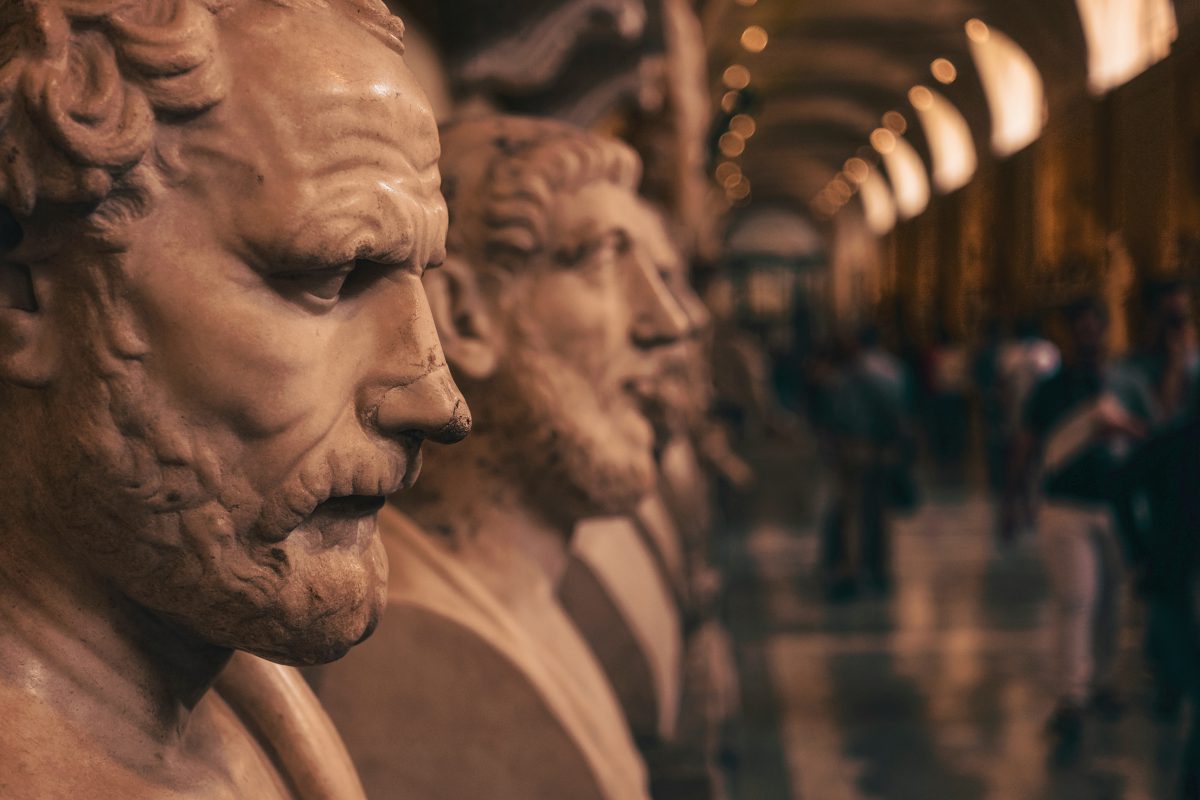
The Ramsay Centre has devised a Bachelor of Arts in Western Civilisation based on great books and works of art, to be taught in partnership with universities.  Since its launch however, the Ramsay Centre has encountered almost nothing but open hostility and resentment from potential university partners.

At the University of Sydney, staff some months ago launched a "Keep Ramsay out of USYD" petition.  The same staff are currently having conniptions because their Vice-Chancellor has now announced that he'll consider taking the Centre's $64 million grant if it gives the university complete control over the curriculum, the reading list, and the academic appointments involved with the Bachelor of Western Civilisation.

Prior to this, the Australian National University pulled out of negotiations at the 11th hour when its Vice-Chancellor cited concerns about academic autonomy following a very public and acrimonious pushback against the program from several ANU academics and the Tertiary Education Union.

A few weeks ago, I was invited to attend a University of St Andrews alumni drinks in Melbourne.  The evening began promisingly enough.  A smart bar hotel bar, eight individuals of various ages and occupations, gathered together with the prospect of a pleasant evening of reminiscing ahead.  Amid the usual exchange of pleasantries, I discovered that my one of my fellow attendees was a senior university administrator.  I detected a slight look of discomfort from him.  Any bonhomie that might have existed at the commencement of the evening vanished as soon as he asked me what I thought about the Ramsay Centre for Western Civilisation.

The rejection of a Bachelor of Arts in Western Civilisation is predicated on the absurd notion that anyone who wants to talk about or study Western Civilisation must be a white supremacist.  In some academic circles, Western Civilisation is held responsible for all evils in the world, past, present and future.

Earlier this year, the Dean of Arts at Newcastle University wrote a piece for The Conversation in which she stated that Western Civilisation is past its used by date and that it's too "white" to teach in multi-cultural classrooms.  The University of Sydney academics leading the charge, claim that the BA will "pedal racism disguised as appreciation for 'Western Culture'".  At a National Tertiary Education Union forum, former University of Sydney chair, sociologist and gender theorist Raewyn Connell, told her audience that the curriculum "has racism embedded in its agenda."

When I articulated to my fellow alumnus that I had not been surprised at the response from Australian universities — given the antipathy displayed towards Western Civilisation by many academics — he did not think this hostility to be a bad thing.  When I added that I thought all students studying an undergraduate degree in history, or any humanities degree for that matter, should be required to do a foundation course in Western Civilisation, he was shocked and horrified.  From his point of view, knowing about what happened during the Scientific Revolution or the Enlightenment is an irrelevancy and a waste of students' time.  For him, history is about "issues", not knowledge.

It was at this point that I realised that just how far universities, especially the humanities departments, have strayed from their original purpose.  From the Renaissance until the 1960s, the humanities, derived from the expression "studia humanitatis" or the study of humanity, made it their purpose to make sense of and understand the world through the great traditions of art, culture and philosophy.  There appeared in the 1970s and 1980s however, a range of "new humanities" subjects which rejected this tradition.  The new humanities were underpinned by a range of radical post-structuralism and post-modernist theories which had been conjured up in the previous decade by a predominantly French group of philosophers such as Jacques Derrida, Louis Althusser, Michel Foucault, as well as the psychiatrist, Jacques Lacan.

The new humanities maintain that for the last 500 years, Western Civilisation has got it wrong when it comes to knowledge, truth and science.  These fields tend to claim that both knowledge and truth are not absolute, but are relative.  For example, there is no objective truth and truth is dependent on who is speaking it and in what context.  Insofar as science is concerned, they claim that scientific theories don't really provide us with what we could call knowledge but are actually "invented" rather than discovered.

History as a discipline best exemplifies the influence of the postmodernists and their ilk on the humanities.  Many historians have enthusiastically embraced the idea that truth is no longer within the historian's grasp and that it's impossible to use history to add to knowledge about humankind.  This is the kind of thing which would normally signal the death knell for any discipline, but historians have risen from the ashes and have forged for themselves a new purpose — the attainment of social justice.

This is not social justice in the Enlightenment sense, which meant equality before the law and equal rights, but social justice in the activist sense, where the ultimate goal is to achieve perfect equality by destroying "oppressive" institutions and rearranging society.  The historians' new role is to tell the inequality narrative of the oppressed and the oppressor through the lens of class, gender, and race.  Matthew A. Sears, associate professor of classics and ancient history at the University of New Brunswick believes that ancient Greek sculptures epitomise racism and white supremacy, and that history is "about politics", it's main purpose being to "better understand the human condition and shed light on questions of contemporary relevance."

This approach has its origins in the nineteenth century, when Georg Hegel constructed his worldview of history into a narrative about stages of human freedom.  His was the view that history was simply the process of moving towards the realisation of such freedom.  Later that century, Karl Marx's built on Hegel's new paradigm with his theory of historical materialism, proposing that society's productive capacity and social relations of production determined both its organisation and development.

Both Hegel and Marx essentially denied the role of individual human agency, treating the past as the product of inexorable forces and trends which were primarily of a material and economic nature.  "Society" wrote Marx, "does not consist of individuals, but expresses the sum of interrelations, the relations within which these individuals stand.''

Karl Marx essentially created the template of identity politics for the study of history with his notion that human society is in a constant state of struggle and a zero-sum contest for power.  In the 1960s, his model was adopted by British historian Eric Hobsbawm who deliberately re-wrote the history of the "long 19th century" as being a century of class struggle.  Hobsbawm successfully transformed history as an academic discipline into a vehicle for social policy.

Since the 1970s, historians have embraced Marx's template and applied it to their own particular historical fields, re-writing the past from the point of view of class, gender, and race.  These new histories have gradually replaced the traditional canon of historical subjects which once upon a time formed the basis of an undergraduate degree in history in Australia.

In 2017, a study of all 746 history subjects taught in Australian universities revealed that 244 of those subjects were devoted entirely to class, gender, and race.  Many were a pastiche of identity politics in which the stunning complexity of the past is increasingly reduced to a very limited range of themes.  Students at Melbourne university can take "A History of Sexualities" in which they discuss "how the gendered body and sex have been simultaneously linked to social liberation and control".  At the Australian National University, students can consider "the concept of 'race' within the contexts of the development of scientific knowledge in 'Human Variations and Racism in Western Culture, c. 1450-1950'."  A keyword search of all the history subject descriptions taught in 2017 reveals that there were more instances of the words gender and race than there are Enlightenment or Reformation.

What is more, a perusal of the University of Sydney's history faculty staff profiles reveals that 20 of the 32 staff have variously identified gender and sexuality, racial thought, women's history and power as their current historical fixations.  The left-wing leitmotifs of class, race, and gender have replaced the essential core subjects which explain the political, intellectual, social and material basis of the history of Western Civilisation.

This approach is not only boring and repetitive, it is fundamentally anti-intellectual.  Students in Australia are not being given a "positive formation" by their universities, which is exactly what the Ramsay Centre is attempting to rectify.  Instead, they are being taught a narrow, one-dimensional view of the world seen through the prism of identity, over a curious and inquiring three-dimensional view of the world which opens the mind.

Students studying the humanities are not only finishing their degrees with a distorted view of the world in which the past is viewed as a contest between the oppressors and the oppressed, but they are imposing this particular worldview on society as they find employment in schools, government, and the corporate world.  These days, for example, it's becoming increasingly difficult to work out where gender departments finish and governmental departments or the corporate world begin, so blurred are the lines between them.

Since the 1960s, universities have been leading their students fairly and squarely down a path of un-education, unlearning and enlightenment, and they should be called to account.  Now these students, filled with an ideological fervor and driven by social justice, are leading the rest of society down the same path, whether society wants it or not.

Friday, September 21, 2018

Gender Quotas Are Simply UnLiberal

The story of Scott Morrison since he became Prime Minister a few weeks ago is very much the story of a boss in the modern-day Australian workplace.

On one hand Morrison is attempting to do his best in the face of an external threat — the Labor Party — to his business.
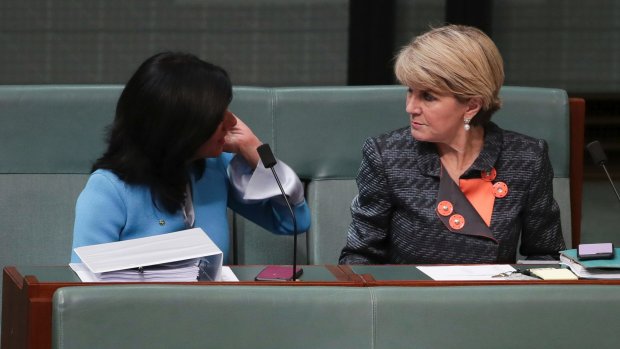
Meanwhile, he has the internal challenge of managing a team of staff — Liberal MPs — comprising a sizeable proportion of those who think they could do his job better than he can.  The team also includes a small but loud minority of individuals who appear committed to acting not as members of Parliament carrying the authority and responsibility of such a role, but as 19-year-old members of the "snowflake generation" currently populating university campuses around the country.

In common with a growing number of teenage undergraduates, some federal Liberal MPs seem to believe having their feelings hurt or their opinions challenged is "bullying" and that the theories of identity politics require MPs and candidates to be categorised according to their gender, race and class.

The issue of bullying in workplaces is serious and real, but when MPs throw the term about as a political weapon and a slur to publicly accuse their colleagues — but then refuse to provide the evidence to support such claims — they are trivialising the issue and making it more difficult in the future for real victims of real bullying.


DEFINITION OF BULLYING

Liberal MPs should know better.  The definition of "bullying" under the Fair Work Act is repeated unreasonable behaviour towards a worker that creates a risk to health and safety.  A colleague arguing with you about who should be the next prime minister is unlikely to be bullying.  And in the world of politics it's not unreasonable for it to be pointed out to some MPs by other MPs that how they vote in a leadership contest could have consequences for their preselection.
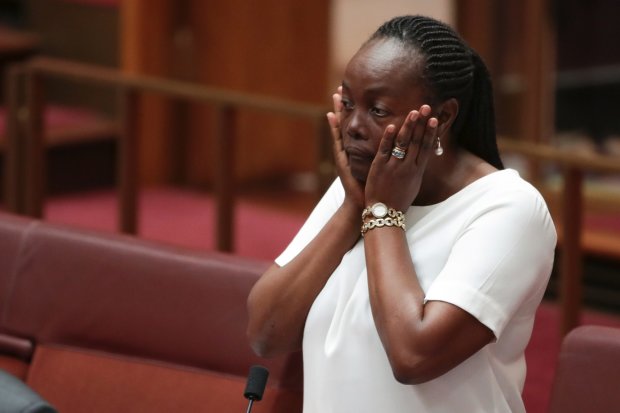
Liberal MPs should stop and ponder the consequences of their bullying claims, for not only victims of bullying, but also for anyone accused of bullying.  Liberal senator Lucy Gichuhi said of the leadership dispute:  "Everything was happening so fast.  And that in itself is a form of intimidation because we were supposed to make a very important decision within a very short time."

Presumably from now on any employee anywhere asked to make an important decision "too quickly" will be entitled to claim that they were "intimidated".

As ridiculous as it sounds there might actually be some merit in the Liberals having an inquiry into bullying because then at least bosses would know what bullying is and isn't.

Liberal MPs wanting to play identity politics, however, is a much bigger issue for the Liberal Party.  The suggestion, for example, that the Liberal Party should now adopt gender quotas cuts across every single philosophical principle the party stands for.  Providing equality of opportunity by encouraging more women to stand for Parliament for the Liberals is entirely appropriate.  But enforcing an equality of outcomes is a very different question.


APPLIED CONSISTENTLY

Julia Banks, a Liberal MP who supports gender quotas and who has announced her retirement at the next federal election, said in Parliament last week that, "the concept that this [gender quotas] will begin that path to destruction of micro quotas depending on people's sexuality or ethnicity is ludicrous.  We are talking about quotas for women, who represent more than half our population."

The suggestion that if a category of identity possessed by more than half the population is not represented in at least half of all candidates, then the balance should be redressed through quotas, is at first glance not unreasonable.  But it raises the question of whether gender is the only identity that should be treated in such a way.

According to the most recent census, 52.1 per cent of Australians identify as Christian.

For Banks' formula to be applied consistently, if ever less than half of Liberal MPs were Christian, the Liberals would be forced to create a quota guaranteeing a certain number of Liberal Christian MPs.

It remains to be seen whether the Liberals imposing quotas for Christians would be as popular as the party creating quotas for women.  Especially if such a quota was suggested by Scott Morrison.

National Curriculum Changes Should Sound Alarm Bells For Parents

THE changes to the national curriculum announced by the Australian Curriculum Assessment and Reporting Authority (ACARA) last week should sound some very loud alarm bells for Australian parents.

If adopted, the changes mean that future generations of children will be in danger of finishing school and turning into adults who know nothing at all.
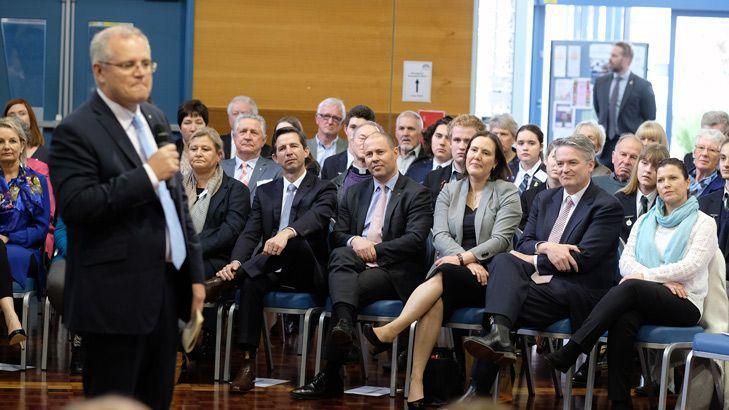
Over the next couple of years, ACARA has promised to add a range of impractical and ideological "21st century skills", with a shift to "critical" and "creative" thinking.

Apparently, students will be taught things like how to "develop curiosity, imagination, resilience and self-regulation", how to "respect and appreciate the ideas, perspectives and values of others" and how to "care about the well-being of their friends and families, their communities and the planet".

This comes despite the fact that the curriculum is already overcrowded, unbalanced, ideologically-biased, systematically hostile to Western Civilisation and failing school children around the nation.

One of the most problematic things about it is the existence of the three cross curriculum priorities of "Sustainability", "Aboriginal and Torres Strait Islander histories and cultures", and "Asia and Australia's engagement with Asia".

While they might be worthy topics of investigation, they are incorporated into every subject whether relevant or not.

And students are hearing the same thing in every subject.

If ACARA succeeds in watering down the curriculum even further, children graduating from Australian schools will be very well versed in sustainability and social justice issues, but might not be able to work out basic fractions, know who wrote Hamlet and when, or tell you why Australia is a liberal democracy.

You only need to look at world rankings to see just how useful these "soft skills" and competencies have been to children so far.

Since 2015, Australia has performed incredibly poorly in world rankings.

Reading literacy has fallen from 4th to 16th, mathematics has plummeted from 7th to 25th and science has dropped from 4th to 14th.

According to the Organisation for Economic Co-Operation and Development (OECD) at the age of 15, fourteen per cent of Australian students are functionally illiterate.

That means that they would not understand the instructions on a packet of headache tablets.

Twenty per cent of Australian youth lack basic arithmetic skills, and would fail to determine how much petrol is left in a tank by looking at a gauge.

The government's solution to the problem is to throw money at it.  Between 2018 and 2027, under its "Quality Schools Package" it will spend a whopping $243.5 billion, plus an extra $5.1 million on science, technology, engineering and maths (known fashionably as STEM).

There is no doubt that this will result in falling standards, embarrassingly low world rankings and general ignorance.

It is clear that Australian children are being been "un-educated" at a terrifying pace and money is clearly not the solution.

The focus of modern education is on vague "skills" and "competencies", whereas 60 or 70 years ago, it was about knowledge and facts.  It might be boring to learn your times tables, but you can't do long division without them.  They give you a foundation for the rest of life.

The rejection of knowledge stems from the progressive left, which believes that education makes people less free.

This idea comes from the romantic but completely misguided notion developed by 18th century French philosopher Jean-Jacques Rousseau, who famously announced that "man is born free, but is everywhere in chains" meaning that but institutions like education get in the way of this freedom.

But the opposite is true.

By encouraging young people to read the great books that the Western Canon has given us, by inspiring them to learn about historical events and by teaching them how to read and write, you give them freedom to think for themselves and to undertake real critical thinking.

As a matter of logic, you can't teach children to think critically unless they have something to think about.

People become inquisitive and begin to think critically when they know things, and they can apply this knowledge in different ways.

Rather than following educational fads as ACARA is proposing, Australia should return to the true purpose of education.

And that means furnishing people with knowledge.

For years, standards and real knowledge have been sacrificed by politically correct ideologues who are more interested in teaching students what to think than how to think.

It is knowledge that gives people the tools to get good jobs and makes them decent citizens.

If the government truly understood this reality, it would be spending $243.5 billion on making sure that students are given real knowledge rather than continuing headlong down this path of unlearning which will be to the detriment of Australian society.

Friday, September 07, 2018

Scott Morrison's Politics Must Have Some Policy

"Dare to be different" is an advertising slogan employed in some form or another by companies like Honda to sell cars and Apple to sell computers, and by practically anyone who's ever printed a T-shirt.

If the Liberal Party is to have any chance of winning the next federal election Prime Minister Scott Morrison must not only say he's different from Malcolm Turnbull — from the Labor Party — he must also prove it.

The first part of that task is talking about politics.  The second part is committing to policies.

On Thursday in Albury, the spiritual home of the Liberal Party, in a speech to the Menzies Research Centre, the Prime Minister delivered an unscripted speech about his personal and political philosophy.

Perhaps inevitably the speech was the proverbial curate's egg.  Some parts were outstanding, such as when he made the obvious but important point that "the best form of welfare is a job".

Other parts were trite, such as when he remarked that "as Australians, we look after our mates".

And yet other parts were trivial, such as when he foreshadowed the federal government would ban plastic food wrappings.
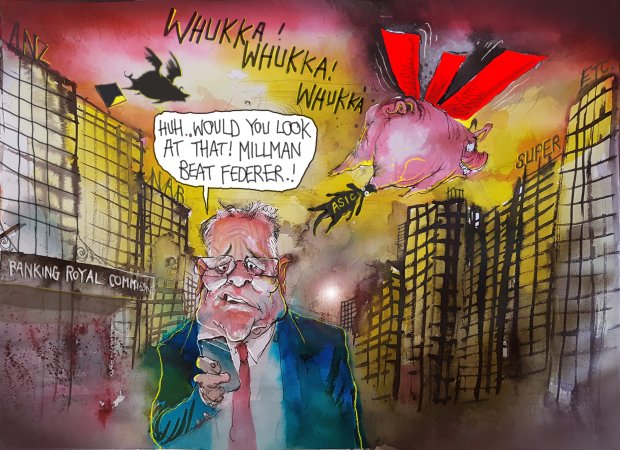
Other than when he talked specifically about Robert Menzies and the Liberals there wasn't a lot Morrison said that a Labor MP would disagree with.  Any Labor MP, if they'd been in the audience, would have applauded enthusiastically when Morrison said that the government would remain in the Paris agreement on climate change.

And as good as the PM's remarks are about work and welfare, until they're turned into policy they remain just words.

The point is that, although admittedly he's only been in the job two weeks, the Prime Minister has yet to establish what the main policy differences are between him and Bill Shorten.

Yesterday the PM talked of the need to create "a noble society" and "a caring society".  Whether such a society is very different from a society built on the idea of "the common good" (which is the title of Bill Shorten's book) is unclear.


SIGNIFICANT DIFFERENCE

Morrison will point to differences such as the Liberals' policy of reducing the corporate tax rate for smaller companies to 25 per cent, while Labor's policy is a tax rate for such companies of 27.5 per cent.  That is merely a distinction without much difference.
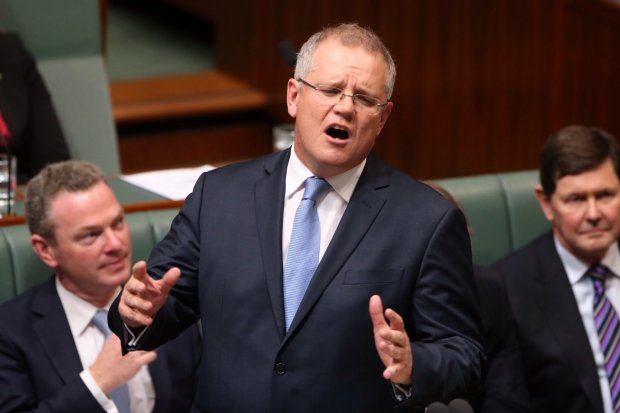
To take energy policy, for example, if Morrison announced that Australia was withdrawing from the Paris agreement in an effort to bring down household electricity prices then for the first time since the Coalition was elected in 2013 would there be a significant and easily understood policy difference on climate change between the Liberals and Labor.

If Morrison said that he supported at least an investigation into establishing a nuclear power industry in this country that would be another difference.

Under Malcolm Turnbull's leadership the Liberal Party deliberately narrowed the policy differences between it and Labor.  Liberal MPs acquiesced to the strategy partly because they thought that saying what they actually believed in would prove electorally unpopular and also because many Liberal MPs were in broad agreement with what Labor wanted to do.

If the Liberals' leadership vote between Morrison and Peter Dutton is taken as a proxy for the Liberal party room's views on climate change, about half of Liberal MPs have views more closely aligned with those of Labor MPs than with the other half of the Liberal party room.

Turnbull's approach to politics didn't only result in claims of the Liberals as "Labor-lite", it produced a mere one-seat victory at the 2016 federal election.

While it might be true that in an electoral system with compulsory voting such as we have in Australia, elections are determined by so-called "swinging" voters in the so-called "centre", it doesn't necessarily follow that the two major parties must offer identical policies to gain the support of such voters.

Nor does it follow that if a policy is popular with a political party's "base" it will therefore be unpopular with swinging voters.  John Howard's policies were supported by many more people than just rusted-on Liberals.

The Prime Minister has to be careful not to spend so much time doing politics that he forgets it's policies that ultimately make a difference to people's lives, not platitudes.