Monday, June 27, 2016

Digital economy offers wealth of opportunity

Australia needs simpler, more flexible rules and regulations to become more agile in a digitally disruptive world.

With the click of a button, or a swipe of a finger, more and more Australians are purchasing goods and services through a "digital economy" consisting of the internet, cloud computing, sensors, and smartphones.

Digital platforms such as Uber and Airbnb are assuming a greater foothold in the Australian services sector, despite regulatory and other impediments, and our internationally high smartphone and tablet uptake rates suggests considerable room for more digital growth.

It is reasonably straightforward to figure out why the digital economy has taken off, with one of its most important benefits being its capacity to reduce transaction costs, or the costs of engaging in market exchange.

Thanks to a digital platform the owners of idle and underutilised assets, such as empty seats in a car or spare rooms in a house, can more easily find people prepared to pay money to use the available capacities.

And this reduction in transaction costs aids the expansion of market opportunities between willing sellers and willing buyers, as indicated by a Deloitte Access Economics study that 61 per cent of UberX rides nationally would not have taken place in the absence of the digitally enabled service.

One of the more amazing implications of recent digital innovation is that it empowers owners of varied consumption goods to reconceptualise them as capital goods which may generate returns, a particularly significant development for low and middle-income families seeking new income streams.

The availability of diverse products for consumers stands as a substantial benefit from the emergent digital economy but, as incumbent taxi drivers and hoteliers have made clear, the onset of digital platforms for accessing alternative goods and services can conceivably be disruptive for some.

Complaints by suppliers affected by digital disruption, whose economic existence have long been insulated by high barriers to entry, harkens back to Joseph Schumpeter's "gales of creative destruction" threatening to outdate conventional ways of making and selling things.

The temptation is for those whose enterprises are being digitally disrupted to seek policy refuge by government, often in the form of punitive regulations against the new digital upstarts, but recent experience around the world is showing such an approach futile.

A recent report by the Productivity Commission sheds important light upon the challenges faced by public sector regulatory agencies, contending with perceived (by, ultimately, non-existent) trade-offs between digital agility and the interests of those already in the marketplace.

Most sensibly, the commission has come out in favour of not condemning the likes of Uber and Airbnb to a premature end at the hands of regulators.

As the commission says in its digital disruption report, "getting the most from technological change requires an adaptive regulatory approach".

One of the key recommendations is that governments should avoid the temptation to merely extend existing regulatory approaches to the digital world, "particularly where new entrants present negligible risk to consumers or others".

Rather, the commission suggests that digital disruption presents a fresh opportunity for government "to reassess risk and adjust regulation accordingly".

In this context governments should provide "fixed-term exemptions from regulatory requirements that inhibit the entry of new businesses", or at least apply a "regulatory sandbox" whereby some regulations are lifted for a sample of customers and subject to risk-based criteria.

The commission recognises there is some potential for existing mandatory standards to lock in existing technologies and hamper innovation, so lighter-touch standards are needed that are "outcome focused and not overly complex or prescriptive".

What is also interesting about the commission's report on digital disruption it that it duly recognises the interconnected ways in which our complex and overbearing regulatory state can affect the incentives for people to get involved in the digital economy.

Can the existing workplace relations system, with its tendency to dictate quite prescriptive terms and conditions of employment across the Australian economy, accommodate the desires and interests of people who want flexible working roles enabled by digital platforms?

Trade unions and other selected interest groups have long railed against the emergence of part-time and casual work, and are equally hostile to independent contractors, but the question posed here will take on greater importance as the digital economy assumes greater popularity.

The interplay of economic and political interests have yielded vast differences in fortunes for the digital economy around the world, with the ACT legalising ridesharing services last year serving as an interesting case study.

As a condition of Uber's entry into Canberra's transport market the ACT government invoked criminal history and driver history checks, even though Uber already imposes self-regulation in these respects, and is aiming at accreditation requirements for ridesharing services.

Uber and other ridesharing service operators must also install cameras in their vehicles, to the extent that consumers are allowed to pay for the service in cash.

The ACT reforms substantially reduce taxi licence fees and remove red tape restrictions around uniforms and cleanliness, while taxi drivers retain an ability to pick passengers off the street and at taxi ranks.

What has taken place in Canberra is a far cry from the outright bans and punitive fines seen in Europe and elsewhere, but the horses-for-courses changes don't necessarily come across as the unambiguous deregulation needed to put all market participants on an equal footing.

Because it is well known that much innovation occurs at the boundaries of industries, occupations and technologies, we should ideally seek regulations that are not only technology-neutral but also industry-neutral and occupation-neutral.

Otherwise, what looks like sensible precautionary regulation for a new industry today may, as industries evolve, become the unwarranted red tape of tomorrow.

And we should guard against slippage in commitments to competitive neutrality principles in regulation-making, especially in the event that certain operators attempt to convince future governments their competitive vulnerabilities are of political importance.

As was the case with the steam engine of yesteryear, people will use technologies introduced today to creatively discover new ways to truck, barter and exchange.

Like the entrepreneurs that challenge them, Australian regulations must be simple and even-handed, yet flexible, so that there's enough room for disruption to fit in.


ADVERTISEMENT

Friday, June 24, 2016

Red tape the big hurdle for the mining industry

This week the Mining Business Outlook 2016 by Newport Consulting outlined the challenges and opportunities facing 50 of Australia's most prominent mining leaders.

The report demonstrated beyond a doubt that cutting unnecessary red tape on mining is essential if governments are concerned about the future growth and prosperity of Western Australia.

A quarter of respondents to Newport Consulting cited red tape as a critical area for government to act.

This comes after Gina Rinehart's comments last week that Australian politicians don't have the guts to cut red tape.

The scope of Australia's red tape problem is difficult to grasp because it stems from many different regulators and is made up of thousands of different pages of legislation.

However, my research has found that red tape costs the Australian economy as a whole at least $176 billion dollars every year in foregone economic output.

That means if red tape were an industry, it would comprise a larger portion of our economy — 11 per cent of GDP — than any other industry.

One of the most telling impacts of our red tape problem is how it impacts new mining projects.  Those mining companies prospecting, investing and seeking new opportunities spend a remarkable amount of time and money dealing with government.

One prominent example is the Roy Hill Iron Ore project by Hancock Prospecting, which had to work through over 4,000 government licenses, approvals and permits before production even began.  Many of these obligations are duplicated across jurisdictions, especially between state and federal governments.

According to the government's registry, Australian businesses and individuals are now burdened by over 30,000 licenses, permits and approvals.  Small and big businesses spend more and more of their time complying with red tape, taking their attention off serving their communities.

This red tape burden leads to serious delays in getting projects up and running.  In 2012, research for the Minerals Council of Australia by Port Jackson Partners found that Australian thermal coal projects experienced 1.3 years' additional delay relative to the rest of the world.

Every minute our mining companies spend pandering to government is a minute they don't spend hiring an additional employee, or discovering new innovative and efficient processes.

The costs of compliance activities only seem to be getting worse.  A Deloitte Australia report estimated that in 2006 the mining workforce spent 7.6 per cent of its time undertaking compliance activities.  By 2011 that number had increased to 8.9 per cent.

It's no wonder Australia is in the bottom half of the world in terms of the burden of government regulation in the World Economic Forum's Global Competitiveness Report.  We now sit behind many of our major competitors including the United States, Singapore and China.

Australia cannot afford an international reputation of regulatory complexity and onerous government control.  Australian governments should be facilitating our miners to compete in global markets and export our high quality resources.

To be clear, unleashing Australia's miners into a new era of prospecting, investment and innovation doesn't mean removing all licenses and permits.  It means cutting out the wasted time and money spent on compliance benefitting no one but bureaucrats.

Indeed, as the Productivity Commission noted in 2013, many environmental processes could be "greatly reduced without lowering the quality of environmental outcomes".

If it is successful, the Western Australian government's new red tape reduction plan — the #ShredTheRed campaign — will drive growth.  The plan includes a dedicated parliamentary repeal week, where for one week parliament is restricted to cutting red tape, rather than passing new rules and regulations.

But there is a risk with these sorts of plans.  The WA government will have to work hard to maintain its momentum.  It needs to continue to lift unnecessary red tape burdens on business long after those weeks are over.

A real economic growth plan — a plan that enables WA to continue its enormous contribution to our economy — should focus on shorter approval processes, removing regulatory duplication, and dramatically reducing the complexity of rules.

Governments need to free the resources industry to employ, grow and compete.  Cutting mining red tape will not only lead to higher investment, encourage innovation, and stimulate employment.  It will unleash Australian prosperity for years to come.


ADVERTISEMENT

Thursday, June 23, 2016

It's time to kill parallel import restrictions

Abolishing parallel import restrictions on books isn't neoliberal ideology, as Tim Winton, Richard Flanagan and Magda Szubanski claim — it is social justice reform.

It is a reform that would deliver lower book prices to Australians by removing a rent-seeking benefit to the multinational publishing industry.

Currently, Australian booksellers are prevented from importing books manufactured overseas if the book has been published by an Australian copyright holder within 30 days of overseas release.  In effect, Australian publishers are granted a monopoly over any book they choose to publish and are protected immediately from foreign competition.

Parallel import restrictions are an effective tariff on international trade, similar to the archaic tariffs that were abolished under the Hawke-Keating government.  We now have a wealth of evidence to confirm this.

In 1998, the New Zealand government took the brave decision to remove import restrictions on books.  A 2012 review of that reform by Deloitte Access Economics commissioned by the NZ Ministry of Economic Development found that book prices are lower in New Zealand than in Australia and that the changes "had little impact on overall creative effort in the New Zealand book industry".

Australian authors claim the changes will decrease profitability in the Australian market and will result in fewer Australian books being published.  This claim is not backed up by evidence.  The same report found that the number of new New Zealand book titles published annually has remained fairly steady, and that the share of authors in overall employment and income earned by publishers actually increased following the changes.

The Prices Surveillance Authority report 1989, the Australian Competition & Consumer Commission reviews in 1999 and 2001, the comprehensive Productivity Commission report in 2009 and, more recently, the Harper review all found that removing import restrictions would make books cheaper for consumers, and recommended their abolition.  The Harper review's recommendation was accepted by the Turnbull government.

The draft Productivity Commission report into intellectual property recommends that the Australian government abolish parallel import restrictions on books, saying there is no new evidence that changes the case for removing the remaining restrictions and that it is the analogue equivalent of geoblocking.

Reading and literacy are a social good.  Removing these restrictions will mean libraries and schools can order more books, families will be able to buy more books for their kids, university students won't have to struggle to buy textbooks, and local bookstores will be able to compete on a level playing field with Amazon, to the benefit of small businesses and the consumer.

Labor's recent arts policy announcement had a piece both ways but slanted towards taking the side of the publishers without clearly stating its position.

This is a disappointing development as it slows what was rising bipartisanship on the issue.  Labor's student wing, the National Union of Students, launched a campaign against the laws, as they recognise that PIRs make textbooks substantially more expensive for struggling students.  Labor shadow treasurer Chris Bowen brought the proposal to cabinet under the Rudd government and is a known supporter of the changes, along with former Labor ministers Bob Carr and Craig Emerson.

Emerson said of the reform:  "Cheaper books for kids in poor communities is a good social reform."  He also said that multinational book companies put pressure on local authors and publishers to oppose the removal of restrictions.  Authors like Tim Winton are lining up to be that very face.

A famous Australian like Winton is a much gentler face to argue for the status quo than that of a large multinational publishing giant that uses this archaic tariff to make profits at the expense of Australian consumers.

At the recent book industry awards, Richard Flanagan launched an attack on the government's position, with an emotive plea to vote against the Liberal Party.  This is a disappointing worldview from Flanagan to completely dismiss the struggle many Australians face with book prices.

Attempts to derail the government's attempt to abolish parallel import restrictions on books recall the fear campaign ran by Peter Garrett and John Farnham in 1998 when the Howard government abolished parallel imports on CDs.  Did the music industry in Australia die as they suggested it would?  No.  Did CDs almost halve in price?  Yes.

We are in an age of digital disruption where businesses have had to adapt to adjust to a changing consumer climate.  The prominence of Amazon has been around for quite some time.  Australians know they can buy books cheaper from Amazon, and they do.  Yet our retailers have no opportunity to adapt due to import restrictions inflating the price of our books.  When the Prime Minister talks of the needs to be an agile economy, this is exactly the type of reform that does that.

The jig is up.  This is a case of out-of-touch authors teaming up with big business at the expense of the consumer — book-loving Australians.


ADVERTISEMENT

Wednesday, June 22, 2016

Brexit would be good for the UK and good for Europe

This week's referendum on whether the UK remains with, or leaves, the EU is primarily about democracy and the right of a sovereign people to live under their own laws.

A vote to leave would be a positive outcome for the UK, but would also send an important message to the EU that it is headed in the wrong direction, its people are unhappy, and urgent institutional reform is required.

Democracy is, at its heart, the process by which personal freedom of expression finds its voice.  A nation's executive and legislative system, its courts, its police and armed services, and the laws they pass, interpret and enforce, form a framework that governs how its citizens live and interact with each other.  A properly functioning nation-state and democracy must have the ability to perform these functions.  Unfortunately it is clear that the citizens of the UK no longer enjoy these privileges.

Over the last 25 years in particular, the EU has extended its grip over not just trade and competition policy but social policy, energy, public health, transport and even to culture, tourism, education and youth.  The sovereignty of the UK's parliament and courts is increasingly subject to the European Commission and its Convention on Human Rights, Court of Human Rights, Charter of Fundamental Rights and Court of Justice.  In areas where EU and British laws are inconsistent, EU law prevails.

The real reason why EU regulations, such as banning curved cucumbers and bananas or requiring restaurant olive oil to be served in separate containers, are so absurd is that the EU is barely decades old yet already sees its role as micro-managing behaviour, literally down to the dining-table level.

Yet the UK has never voted for Europe as it is.  The UK's often cited 1975 referendum was about staying with the then Common Market, rather than signing up to a federalist super-state.

The arrogance of the European project, with its un-elected Commission, opaque decision-making and onward march of centralism, is also likely responsible for some of the peculiar arguments that have been deployed against independence.  Apparently, if the British leave they will be unable to secure their own trade deals, prevent the mass migration of large businesses to the continent, protect their own borders and will even be responsible for the end of Western civilization.  But if the fifth-largest economy in the world, and successful NATO and UN Security Council member, which has successfully exported its language, parliamentary democracy, legal system, literature, and even civil society all over the world over many hundreds of years can't make it on its own, then who can?

Even when UK Prime Minister David Cameron tried to get a commitment from European leaders in early 2016 to some governance, competitiveness and freedom of movement reforms in advance of the referendum, they considered their position so comfortable that he was arrogantly rebuffed.

Of course, democratic traditions in the EU have never been strong, given that French and Dutch rejection of a European Constitution in 2005 led to the back-door Treaty of Lisbon in 2009 and the Irish and Danes were required to vote again after initially rejecting the Treaties of Lisbon, Nice and Maastricht.

The EU's argument that its ongoing existence and even greater integration is necessary to maintain the peace in Europe is seriously dated, and highlights how its 20th century thinking is hurting its prospects in the rapidly changing 21st century.  The EU's inability to manage its own financial system or its own borders, deal with its intractable competitiveness problems, or satisfactory deal with overseas crises such as the Ukraine are topical cases in point.

That Austria's disputed presidential election run-off last month was between the Freedom Party and the Greens, or that National Front leader Marine Le Pen tops most polls for next year's French presidential election, demonstrates that the British are not alone in their distrust of Europe's institutions.  The EU is in desperate need of competition, and for the development of an alternative agenda to ever-closer integration and centralisation.  Brexit is the way for Europe to be saved from itself.  An independent Britain that chose tax and spending reform, workplace deregulation, free trade and cheap energy, and was better off than those countries remaining in the EU, would be an important symbol of the potential of alternative policies.

Of course if the newly independent UK's parliament wished to mirror the EU's existing economic and social policy, it would be free to do so.  In fact Australia's thirty-year-old trade agreement with New Zealand proves that countries can have a close economic relationship without political or currency union.

On 16 August 1950 at the Council of Europe, then Opposition MP Harold Macmillan said on the prospect of joining the European Coal and Steel Community:  "(f)earing the weakness of democracy, men have often sought safety in technocrats.  There is nothing new in this ... But we have not overthrown the Divine Right of Kings to fall down before the Divine Right of Experts."

That argument is as strong today as it was 66 years ago.


ADVERTISEMENT

The Greens soft drinks tax:  illiberal, ineffective, regressive

This Greens' proposed soft drink tax is not only an affront to individual choice, it would do little to address obesity and, in practice, amounts to an attack on poorer Australians.

Greens leader Richard Di Natale has announced a new policy for a 20 per cent tax on sugary sweetened drinks to tackle obesity.  The new impost will apply to water-based drinks with more than 5g of sugar per 100ml, increasing the price of a 2 litre bottle of drink by about 45 cents.

Taxing soft drinks, using the coercive power of the state to manipulate individual behaviour, is patently paternalistic.  The policy treats parents as fools who are unable to raise their own children, and adults as mugs incapable of making their own consumption decisions.

The policy flies in the face of the Greens' supposed social liberalism, however this should come as surprise coming from the party that has previously proposed banning junk food advertising.

Various studies have also seriously questioned the effectiveness of such taxes on overall rates of obesity.

A study published in Journal of Public Economics found that although the tax may slightly reduce consumption, "this reduction in soda consumption is completely offset by increases in consumption of other high-calorie drinks".  Another study published in Contemporary Economic Policy similarly found that sugary drink taxes do not have a substantial impact on population weight.

Although increasing the cost of soft drinks may reduce their consumption, it does little to change overall dietary decisions.  If we make one product more expensive, individuals looking for a sugar hit can, and will, swap to other unhealthy drinks and food.

The Greens' policy would, for example, push up the price of regular Coke though not change the cost of Diet Coke and Coke Zero, which contain no sugar.  In reality these alternate beverages are not particularly healthier.

Perhaps the biggest injustice of the tax will be who it impacts the most:  the poor.

A study of French dietary habits published in the American Journal of Agricultural Economics found that fat taxes are "extremely regressive".  That is, they have a far bigger impact on lower income households who have the least capacity to pay for the additional impost.

The regressive nature of taxes that seek to discourage conduct was explored in John Stuart Mill's seminal work of political philosophy, On Liberty, first published in 1859.

Mill argued that we should only tax goods to make them more difficult to obtain if we support total prohibition, because:  Every increase of cost is a prohibition, to those whose means do not come up to the augmented price.

This is particularly potent point:  the wealthy can easily pay the extra 20 cents for a can of drink.  It is only relatively poorer members of our society who will suffer under the Greens' policy.  And, as the tax does not change habits or appetite, they will likely substitute to other unhealthy consumption.

The final practical justification of such a tax is that it is necessary to address the societal and public health costs of obesity.  However, an investigation of a 20 per cent sugary drink tax by the Obesity Policy Coalition earlier this year found that the tax would raise $10 billion over 25 years, and save just $480 million in government expenditure over the same period.  This makes it far more of a tax grab than a way to compensate for government service delivery costs.

Obesity is a complex problem, impacted by changing cultural habits and best addressed through voluntary changes in individual behaviour:  the classic formula of improving your diet and getting more exercise.

Although a tax on sugary drinks might sound like an easy solution, it would be extraordinarily paternalistic, ineffective and have a regressive impact on poorer Australians.


ADVERTISEMENT

Tuesday, June 21, 2016

Rio's financial crisis reveals the moral bankruptcy of the Olympics

The Olympic movement likes to affect an image of sporting valour and nobility.  But it is the epitome of government waste, almost always doing great harm to its host and taking a real human toll.

The mayor of Rio de Janeiro would like the world to know that the economic crisis engulfing Brazil "in no way delays the delivery of Olympic projects and the promises assumed by the city of Rio."

Other non-Olympic promises are in jeopardy.  On the weekend Rio's state governor declared a state of financial emergency.  The city faces "a total collapse in public security, health, education, transport and environmental management" if it does not receive funding from the federal government of Brazil.

What a contrast.  On the one hand, Rio's politicians have absolute confidence they will deliver this year's summer Olympic games, which begin on August 5.  On the other hand, they have almost no confidence they will be able to provide their citizens with the basic functions of government.

Rarely is the moral bankruptcy of the Olympics so starkly put.  Bread and circuses both consume scarce resources.  What should we think of governments that put circuses first?  What should we think of the circus?

Brazil is in the middle of an economic and political crisis.  The Brazilian economy has been in recession since the start of 2015.  It has shrunk a massive 5.4 per cent since this time last year.  Brazil's inflation rate is around 10 per cent.  The only silver lining is that the economy shrunk by slightly less than experts had predicted.

Brazil's recession is having social consequences.  The cash-strapped Rio state government cut the police budget by a third, reversing advances in crime reduction made since the turn of the century, and raising concerns about tourist safety during the Games.  Unemployment is at 11 per cent and growing, and 24 per cent of young people are unemployed.  This is the worst economic crisis in Brazil since the 1930s.

The political crisis is almost as calamitous as the economic one.  President Dilma Rousseff has been stood down while she is impeached by Brazil's senate.  Rousseff is formally accused of manipulating the government budget to hide the size of the deficit.  (Simply servicing Brazil's debt costs 7 per cent of the country's GDP.)  But she's also tied up in a major corruption scandal concerning a state-owned oil company.  The interim president is also tied up in a corruption scandal.  Indeed, up to 30 per cent of the country's politicians might be implicated in a corruption scandal shortly.

It could well be that the Rio Olympics go off without a hitch.  News stories about delayed projects and panicked construction are as much a part of the Olympic ritual as the torch relay and parade of nations.

But outside the athlete's village and ticket-only areas will be a country straining to foot the enormous Olympic bill.

Hosting the games is a terrible economic deal at the best of times.  Hosting the games when you're a developing economy in the middle of a serious recession is its own scandal.

The woeful economics of the Olympics are clear-cut and, outside the corridors of political power, uncontroversial.  A paper published in the Journal of Economic Perspectives in May this year summarising a mass of scholarship and analysis found that the Olympics are almost always a "money-losing proposition".

The influx of tourism rarely compensates for the decline of economic activity displaced by the Games, and rarely translates into long run tourism increases.  It is true that hosting an Olympics encourages governments to invest in infrastructure, but the bulk of those funds are spent on uneconomic specialised venues that cities struggle to utilise once the closing ceremony is finished.  Only construction and development companies gained from the Sydney Olympics, as Sinclair Davidson has found.

The economics are even worse for developing countries.  To avoid disaster host cities need extremely capable and non-corrupt management, as well as the political stability to facilitate that management.  These sorts of institutions are sadly lacking in poorer nations.

Hosting the Olympics is particularly dangerous for countries that lack tight control over government expenditure.  For instance, the Athens games in 2004 exacerbated Greek fiscal profligacy — while the Olympics did not cause the Greek economic crisis, the stadiums and infrastructure stand as monuments to the reckless spending that did.

Brazilian governments spend 41 per cent of the country's GDP, which, as the Wall Street Journal pointed out in April, approaches the sort of spending levels seen only in mature social democracies like Germany and Norway.  It is just not a country with the institutions to manage the extreme political and economic pressures of Olympic hosting.

It is galling, then, that the International Olympic Committee has been encouraging bids from developing countries.  Even a failed bid can be extremely expensive – the "low cost" bids for the 2024 games cost about $AU80 million each.

This money of course comes not from the politicians who flank their bids and take box seats at opening ceremonies.  It comes from the taxpayers of the bidding countries, and from the public services not provided as scarce resources are redirected towards stadiums and ceremonies.

The Olympic movement likes to affect an image of sporting valour and nobility.  But it is the epitome of government waste, almost always doing great harm to its host and taking a real human toll.  Once the athletes have gone home, let us hope Brazil can recover from this recklessness quickly.


ADVERTISEMENT

Tuesday, June 14, 2016

Comprehensive reef protection plan could begin with Science Ombudsman

Prime Minister Malcolm Turnbull has just announced a $1 billion plan to protect the Great Barrier Reef.  He describes the plan as the "largest ever" financial investment in the reef, and as a "comprehensive plan".  But Graham Lloyd was reporting in the Weekend Australian that there are major problems with quality assurance when it comes to scientific research concerning the Great Barrier Reef.

If Peter Ridd, a professor at James Cook University, risks being disciplined simply for querying the veracity of claims regarding damage to individual coral reefs, how can Mr Turnbull be sure that this new fund is targeting real priority issues?

Water quality has been identified as a key issue, with runoff from agriculture needing to be curtailed.  But a decade ago, when I was a member of a high level Queensland Government Reef Protection Taskforce, the evidence for any impact from agriculture on the reef was wanting.  Sure, there was evidence of grazing and sugarcane having an impact on the water quality in adjacent rivers and streams, but not on corals.

That taskforce was formed by the Queensland government in response to a campaign launched on World Environment day in 2001 by the World Wide Fund for Nature (WWF).  In the first year, the campaign targeted the fishing industry claiming it was the greatest threat to the reef.  In the second year, sugarcane farming was identified as the greatest threat to the reef.

I was the sugar industry representative on the Taskforce, and in order to bring my industry onboard, I wanted to be able to show the Canegrowers Ltd Board the best evidence that we were impacting the reef.  The science representative on the Taskforce, Christian Roth, was tasked with coordinating the development of a science statement in consultation with experts at the CRC Reef Research Centre, the Department of Natural Resources and Mines, and James Cook University.

The first 3-page science statement was developed for the Taskforce to provide a "consolidated view of our current understanding of the impacts of terrestrial run-off on the Great Barrier Reef World Heritage Area".  This document presented to the Taskforce on the 12 November 2001 discussed threats to the reef, but provided no reference of actual damage to the reef.

Several Taskforce members noted this fact, with the following comments being made by Taskforce members at that meeting:

'So the widespread impact (of terrestrial run-off on the Great Barrier Reef) is not substantiated.'

'Let's put the anecdotal data together as a science paper.'

'But the scientists have tried very hard to prove there is an impact.'

'Let's not get hung up on the science.'

'Let's go forward on the basis of the precautionary principle.'

'Let's bring science along with a balanced view from other things.'

'This document (the science statement) has been written for this Taskforce and should not go to Cabinet.'

It is easy for science to be bulldozed by politics.  Indeed, the final scientific statement, eventually endorsed by the taskforce, claimed an impact from agriculture on the Great Barrier Reef even though there was no evidence ever provided to support this claim.

A decade ago, there were newspaper headlines claiming dugongs were being killed by a dioxin, which was from pesticide runoff from sugarcane farms.  Two years later, the National Research Centre for Environmental Toxicology concluded that the dioxin of concern was naturally occurring and common in soils along the entire Queensland coastline, including in regions beyond sugarcane cultivation.  Yet even after this clarification and after the information had been passed on to senior bureaucrats, the false claim of elevated levels of fat-soluble pesticides in dugongs was repeated in their influential briefing papers and reports.

Professor Ridd has suggested that the solution is the establishment of an independent agency to check the science before governments commit to spending hundreds of millions of dollars.

This could perhaps begin with the establishment of a science ombudsman with the resources to investigate and attempt to resolve complaints about scientific integrity and freedom.  The exact role of the Ombudsman would be defined by a constitution, and in the first instance might be restricted to the investigation of universities.

It is university research which has precipitated the massive investment, ostensibly in actions that will result in actual reef protection.  As Universities are federally funded the establishment of such an office by Mr Turnbull could be seen as prudent, especially if he intends to make such a massive investment in practical measures that will result in reef protection.  Indeed, such an office could be established with an investment of less than $ 2 million, less than 0.2 percent of the new $1 billion announcement.

Professor Ridd would be the perfect candidate for such a position, he understands science and the need for organized skepticism.


ADVERTISEMENT

Australia isn't immune to the Brexit debate

The European Union represents the worst inclinations of modern government — heavily bureaucratic, deliberately undemocratic, meddling and interventionist.  Australian policymakers should not imagine that British discontent with Brussels has no lessons for them.

It is not always a good idea to draw an opinion on the domestic affairs of other countries.  But in the case of the upcoming British referendum on June 23 to withdraw from the European Union, Australians should be paying close attention.

The pathologies that have led to the Brexit vote are not unique to Europe — there are deep lessons for Australian policymakers too.

At its heart Brexit is a contest between technocracy, red tape and administrative power on the one side, and democracy and sovereignty on the other.  In other words, what we see in the byzantine bureaucracies and agencies of the EU is an extreme form of trends that are common across all Western liberal democracies.

Polling this weekend showed the vote to withdraw from the EU has a 10-point lead over the vote to Remain, with 55 per cent of respondents supporting Leave.

This finding is important not just because of what it suggests about the outcome of the vote.  The received wisdom has been that voters primarily concerned about immigration — the free movement of people across Europe has never been more controversial than after the Syrian refugee crisis — would vote Leave.  Voters primarily concerned about the economy would vote Remain.

Modelling done by the UK Treasury has claimed that British households would be £4,300 worse off in 2030 if the country had left the EU than if it had stayed.  This result is derived from the apparent decline in openness to trade and foreign investment that withdrawing from the EU might bring.

But the weekend's polling shows that the Leave argument is making significant inroads into the group of voters who see the economy as paramount.

As Dan Hannan, a British member of the European Parliament and supporter of Brexit has pointed out, catastrophic claims about the decline of trade and openness resulting from a Leave vote are nonsense.  Withdrawal will not be instantaneous following a successful referendum.  Rather, the referendum is a mandate for the British government to negotiate withdrawal;  to forge new trade agreements and arrangements while simultaneously stepping back from Europe-wide ones.

There are two distinct visions of European unity.  One has perversely flourished, and the other has become distorted beyond recognition.  The first is the dream of a government of Europe — a transnational European equivalent of the bureaucracies and political institutions that run national governments.

This first project, it must be said, has been an enormous success.  The EU has a parliament, courts, a monetary system, and an enormous administration.  One 2008 estimate of the number of bureaucrats working in EU institutions — the EU itself is cagey on its total staff — came to 170,000.  This is more than the British army.

But it's one thing to create a government, it's another to create a responsible, legitimate government.  Even the EU acknowledges that it suffers from a perceived democratic deficit — that the citizens of Europe do not feel they are able to reject the administrations and policies that rule them.

While the European Parliament is an elected body, the six other key European institutions are not.

The European Council, the Council of the European Union, the European Commission, the Court of Justice of the European Union and the European Central Bank are all at one or more steps removed from popular control.

In this sense EU institutions are the natural end point of a trend that affects Australian administration as well — the spread of administrative and regulatory independence designed to keep politics out of policymaking.  But this comes at the expense of democratic control.

The second vision of European unity was as a free trade bloc.  The 1957 Treaty of Rome conceived of Europe in distinctly classical liberal terms, allowing goods, services, capital and labour to move across borders.  This was an enormous achievement at the time, given the economic source of so much intra-European antagonism.

The perversion of the ideal of European free trade occurred with the development of the common market.  Properly understood, a country with its markets open to free trade is still able to write its own rules about the conditions in which goods and services are produced and sold within the borders of that country.  However, the European common market developed in such a way that widened its focus to the regulatory constructs within each country that make it harder to sell (for instance) an Italian product produced according to Italian standards in France, where French standards apply.

The common market aimed to eliminate these differences.  Unfortunately it did so by imposing pan-European regulatory requirements across the whole continent.  Without the constraints provided by democratic institutions, the EU has been an enormous source of new regulation and red tape — what is understood by European citizens as EU meddling and domestic interference.

One think tank calculated that since 1957 the EU had passed and incredible 666,879 pages of law.  In some states up to 84 per cent of national legislation involves the implementation of new and adjusted EU rules.  Analysis based on the British government's own regulatory impact statements show that red tape coming from Europe costs the British economy at least £33 billion (AUD $63 billion) a year.

The European Union represents the worst inclinations of modern government — heavily bureaucratic, deliberately undemocratic, meddling and interventionist.  Australian policymakers should not imagine that British discontent with Brussels has no lessons for them.


ADVERTISEMENT

Saturday, June 11, 2016

The election bidding war over school education funding ignores how to get a better "bang for the buck" from existing resources.

Since the 1963 federal election debate concerning state aid for non-government schools, both major parties have fought intensely over how much tax funding should be allocated to Australian schools.

In 2016, the Bill Shorten-led federal opposition has attempted to gain the upper hand by committing to spend even more than the record-spending Abbott-Turnbull government has done over the past three years.

By their own account, Labor's funding commitment of $37.3 billion over 10 years is intended to conform to the former Rudd-Gillard government's interpretation of what "giving a Gonski" is all about on needs-based funding.

Casting aside the issue about how the schools package will actually be funded, with Treasury indicating further tobacco excise hikes, to help pay for spending, may deliver less revenue than anticipated, the opposition has enunciated doubtful modelling interpretations to advance its cause.

Shorten insists that a 2015 OECD study, Universal Basic Skills:  What Countries Stand to Gain by respected education academics Eric Hanushek and Ludger Woessmann, confirms that additional funding for schools will necessarily deliver massive economic gains in the long run.

The Hanushek-Woessmann study estimates the economic returns from attaining basic skills through education, enabling future workers to become more productive and adaptable ("agile", one might dare say) in a globalised economy.

The study encompasses 76 countries, including Australia, and the modelled scenario discussed here assumes full schooling participation and each student attaining a minimum of 420 points on the international PISA test (or the country's mean score, whichever is higher) by 2030.

In a rare, nevertheless welcome, canvassing of academic-quality analysis in an election campaign the Labor schools policy recites the OECD study to say, "high-school graduates with the basic skills needed ... by 2030 ... would be the equivalent of adding 2.8 per cent of our GDP today".

But as is often the case in the heat of an election campaign, Bill Shorten recently overcooked the case by claiming his party's education policy, incidentally not considered in the OECD study, would immediately boost GDP.

Embarrassingly for the opposition, Hanushek himself was drawn into the campaign discourse to correct the record, stating that "if we increase the achievement of somebody in secondary school today we will not see it in today's GDP".

Another misinterpretation potentially exacerbated by Labor's school-funding campaign is that, somehow, the federal opposition Gonski-inspired spending largesse would induce the universal access and improved test scores needed to achieve the 2.8 per cent GDP gain by 2030.

Now, most agree that improving the quality of schooling for young people would most certainly deliver economic gains, but what do Hanushek and Woessmann actually say about funding issues in their OECD paper?

It is true more facilities and a greater, high-quality teaching workforce would be needed in future, and that isn't costless, "but higher spending is not necessarily the same as higher achievement, as the record across countries shows".

Hanushek-Woessmann go further to add, "numerous programmes and policies that sound good and that have been introduced by governments in good faith have turned out to be ineffective at raising achievement, leading to increased cost with little gain".

The publication of the 2015 OECD paper isn't the only occasion in which these esteemed researchers have cast doubts over the link between increasing funding and better student outcomes in the school setting.

In their impressive recent book, The Knowledge Capital of Nations, Hanushek and Woessmann note that "simply providing more resources gives little assurance that student performance will improve significantly.'

To be more precise, the authors indicate "how money is spent is more important than how much money is spent".

Going back a decade ago, Eric Hanushek noted an array of econometric and experimental studies, not to mention observations of aggregate school outcomes, suggests "overall resource policies have not led to discernible improvements in student performance".

These kinds of assessments resonate in the Australian context, given the observations made by many education experts and policy commentators that rapid growth in schools funding by governments since 2000 has not necessarily delivered substantial academic improvements.

Recent rounds of PISA international testing, used as the basis of analysis in the Hanushek-Woessmann OECD study, reveal Australian rankings in the likes of reading, mathematics and science have slipped, both absolutely and in comparison with other OECD members.

An oft-cited empirical study by former academic, and now senior Labor politician, Andrew Leigh and Chris Ryan illustrates a long-term trend of declining school productivity, as real per student school expenditure rises amidst declining literacy and numeracy test achievements.

The point made here is not that resourcing considerations do not matter in school education policy, a proposition belied by the fact that finances are, in fact, necessary to at least cover the fixed costs of providing schooling services throughout Australia.

The issue is that there is immense scope for improvement in the school sector once it is appreciated that, following Hanushek, "much remains to be learnt about when and where resources are most productively used".

An elevated, "better bang-for-buck" policy discussion could open up interesting reform possibilities, such as government schools managed by parents and other community members rather than bureaucrats, and encouraging philanthropic financing of education and for-profit schooling.

Other prospective aspects of schooling reform include deregulating teaching labour markets and better rewarding the best teachers, and cutting red tape to allow principals to manage their schools better.

One of the great tragedies of schooling policy in Australia is the creeping centralisation of policy control and finances, preventing states from experimenting even more with alternative models of schooling provision and funding to produce better outcomes for students.

So, less intervention from Canberra in education policy should also be in the reform mix.

It seems instinctive for the voting public to rally behind greater schools funding to signal how much we care about kids, so, in that sense, the politicians adding billions to the spending tab are simply trying to grant us our wishes.

But caring for kids isn't inconsistent with also demanding that hard-earned taxpayer money be spent on schools more efficiently and effectively, especially if we're concerned about preparing young Australians for the future.

And we can't forget the affordability aspects, either, with government budgets already overspent leaving our children lumbered with public debt.

Let's demand more from politicians than this spend-a-thon, and elicit ideas about better outcomes from existing finances already spent upon schooling.


ADVERTISEMENT

Thursday, June 09, 2016

Why Oliver Curtis shouldn't go to jail for insider trading

Last week, Sydney socialite Oliver Curtis, who has attracted headlines through his marriage to public relations adviser Roxy Jacenko, was convicted of insider trading.

Curtis is now looking at up to five years in prison and a fine of up to $220,000.  This might seem fair enough to some, or even too lenient.  Indeed, the Greens have been arguing that the penalties for white collar crime are too soft.  But as a society we should debate whether prison is the best way to punish Curtis and other white-collar offenders.

Curtis's crime was making trades in contracts for difference based on information procured for him by his equities trader friend, John Hartman.  Hartman pleaded guilty to insider trading in 2010 and served 15 months in prison.

However, it is becoming well understood that Australia locks up too many people.  The national incarceration rate has grown by 40 per cent in the last decade.  And prison sentences are incredibly expensive.  Prison in Australia costs on average $100,000 per prisoner per annum.  It's one thing to be outraged by Curtis and insider trading.  It's another thing for taxpayers to be asked to pay for his punishment for the next five years.

The key consideration in sentencing is proportionality:  the punishment must fit the crime.  White-collar criminals, whose crimes often involve a breach of trust, are usually held to account for the damage they cause to both their victims and to public confidence in the financial system.

But there is evidence that markets do not respond one way or another to high-profile cases like this one.  Perhaps the public already considers the financial system to be rigged.  Or perhaps the public's faith in the integrity of white-collar workers is unshakeable, though that is probably less likely.  Either way, the public don't take much notice of cases like this when they are making investment decisions.  The market's reputation does not depend on Curtis going to jail.

White-collar offenders normally pose no physical threat to the community and generally have a history of prior good character.  Putting them in prison does nothing to keep us safe.  So when courts give prison sentences to white collar criminals, those sentences are usually justified on the basis that public outrage demands such a punishment and that prison might have some general deterrence effect.

Both of these needs can be serviced without society having to incur the steep cost of imprisonment.

As it stands, the maximum fine that Curtis may pay would barely cover the cost of sending him to prison.  Why would we want to pay to keep Curtis locked up when we could be making him pay us?

Curtis should have to pay a fine sufficiently large that it hurts him and communicates the public's outrage.  And if this were a tort, which arguably it should be, Curtis would have to make restitution.  He should have to do so here as well.

The fine should also communicate to the financial industry that it needs to be more vigilant in policing itself.  Just as batsmen get hit in the head more often now that they wear helmets, our financial industry seems to think that regulation alone will protect it.

Combined with losing the ability to work in his chosen profession and the public shaming to which he has been subjected, a fine and restitution would likely be as effective a deterrent as prison.  If something stronger is needed, home detention should be an option.

It might be argued that this is unfair because it allows wealthy offenders to buy their way out of prison.  But there is a genuine principle at stake.

Whatever their social status, nonviolent, low-risk offenders, should be given the chance to avoid prison.  Our skyrocketing incarceration rate is not lowering the amount of crime or reoffending and it is costing a fortune.  National expenditure on prisons is $3.6 billion per year.

The cynical push by the Greens to appear tough on white-collar crime will only make this problem worse.

Lastly, we should wonder about the role of the Australian Securities and Investment Commission in the Curtis case.  Curtis' offending took place between 2007 and 2008.  After Curtis's accomplice turned him in in 2009, it took more than six years to secure his conviction.

A recent review of ASIC's capability revealed that it spends more on enforcement actions than comparable overseas regulators.  ASIC also struggles to perform all of its expected functions.  Its resources are tied-up in pursuing lengthy, high-profile criminal cases, which do not contribute to achieving its strategic purpose.

The fact that ASIC is a poorly functioning regulator does not mean, as the Turnbull government thinks, that ASIC needs more money.  Instead, rather than headline-chasing, ASIC should focus more on prevention and education.  It would be aided in these tasks if government would cut red tape and give ASIC fewer regulations to police.

Oliver Curtis broke the law and should be punished.  White-collar offenders like Curtis should have to pay large fines, make restitution, and forfeit their right to work in positions of trust.  Justice, however, does not require that we jail non-violent, low risk offenders.  We ought to think again.


ADVERTISEMENT

Wednesday, June 08, 2016

The case for a company tax cut is rock solid — and Labor knows it

Labor may have reversed its position on company tax cuts because we're nearing an election, but that doesn't change the fact that a cut would be good for the Australian economy.

To read most election comment you'd be forgiven for believing that what was until very recently a bipartisan consensus — that there was a strong case for Australia's company tax rate to be cut — was in fact a mass delusion.

In 2010 Wayne Swan as treasurer declared that, "Reducing company tax will create new jobs and grow the economy right around the country" and was open to a reduction in the rate from the current 30 per cent to 25 per cent.  Chris Bowen was arguing for a 25 per cent rate as recently as September last year.

But now that the Turnbull Government has announced a reduction to 25 per cent to be phased in over the next decade, Swan says there's "no case for a company tax rate" because multinational companies are avoiding their tax and to suggest otherwise has something to do with Margaret Thatcher and Ronald Reagan and "trickle-down economics".

For their part, Bowen and Bill Shorten now describe the 25 per cent rate as a $50 billion giveaway to big companies.

This is a rather damning indictment of the current Labor leadership, which has abandoned a long-held position simply to paint the Coalition as pro-big business during an election campaign.

Still, why blame a politician for acting like a politician?  The populist argument against company tax cuts is just too easy to make.  What's remarkable is not that Labor has reversed its view but that successive governments actually managed to reduce the company tax rate from 49 per cent in the late 1980s to 30 per cent today.

The case for a corporate tax cut is rock solid.  It's about ensuring that the Australian economy is internationally competitive.  A competitive economy attracts foreign investment — and with that investment comes growth and jobs.  By contrast, an uncompetitive economy is a declining economy.

As the Rudd government's Henry Tax Review pointed out, in 2001 the OECD average corporate tax rate was 32.5 per cent.  At that time Australia's 30 per cent rate was a good effort.  But now the OECD average is about 25 per cent, and Australia's rate hasn't changed.

A word has to be said here about our system of dividend imputation.  Under dividend imputation, investors receiving a dividend are credited for tax already paid on company profits.  This avoids profits being taxed twice — first as company tax and then as personal income tax when dividends are returned to shareholders.

You often hear that dividend imputation makes the 30 per cent headline rate meaningless, as a reduction in company tax would be automatically made up by a corresponding increase in income tax collection.  But that only holds true for domestic shareholders.  Foreign companies have foreign shareholders who do not benefit from dividend imputation.  And it is foreign companies we want to attract — along with their money and jobs and economic activity.

Indeed, the fact that we need a dividend imputation system at all partly demonstrates why the company tax is a bad tax.  In truth no "company" pays tax.  Companies are made of people and people pay tax — whether those people are company's customers, shareholders, workers or management.

Who ultimately pays what proportion of the company tax is a matter of great controversy.

Last year Chris Bowen accepted that the bulk of the company tax was paid by workers.  If, alternatively, investors pay the bulk, then it's worth remembering that through compulsory superannuation we're all investors.  If management pay the bulk — and you sometimes see arguments that the company tax is a de facto tax on wealthy managers — then it is a wildly indirect way of taxing the rich.

This confusion and complication is why every serious investigation into tax points out that the company tax is one of the most inefficient — that is, wasteful — taxes available to government.  (See Chart 1.5 of the Henry Review.)

Yet Australia relies on this inefficient tax for its revenue (18 per cent of the total tax take as of 2013) more than any other OECD country (with the exception of Norway, where company tax provided about 22 per cent of the total tax take).

In that light, Wayne Swan is exactly wrong to argue that multinational tax avoidance means we shouldn't reduce the company tax rate.  I've argued in the past that avoidance is for the most part a non-problem.  But to the extent that company tax is being avoided, it is because other jurisdictions — like Singapore — offer much more welcoming tax environments than Australia does.

Our extreme reliance on company tax makes us particularly vulnerable to corporate tax avoidance and demonstrates how uncompetitive Australia has become for investment.

Labor used to understand this.  Given how close they are to winning government, it's a real worry they no longer do.


ADVERTISEMENT

Let's get rid of this suffocating bureaucracy

Politicians often claim Australia can be "the food bowl of Asia".  Why, then, do they keep wrapping our farmers in red tape?

The Federal Government recently released its yearly score card of changes in the costs of regulation it imposes, the annual red tape reduction report.
A minor $66 million in regulatory savings were listed in the agriculture portfolio throughout 2014-15.

A great divide is opening between the realities of agribusiness and the commands of bureaucrats.

Red tape means farmers must consult tens of thousands of dictates sprawled over hundreds of Acts and instruments.

There are two ways to attack this regulatory problem.

First, by hacking away at the complex body of regulations farmers ­already must obey.  Unfortunately, it takes serious political courage to rouse such a period of deregulation.  An easier mechanism is to stop new regulations before they are made law.

One example of this necessity is the current furore over Queensland's native vegetation laws.

Years of to-ing and fro-ing, a few election promises, and a change of government later, the Queensland Government is once again aiming at tree-clearing laws.

Drawing on populist images of a chain between two bulldozers, these laws, among other things, will remove "relevant purpose" of clearing exceptions for high-value agricultural land.

Tightening vegetation laws will stifle our most productive lands, damage our global competitiveness and erode farmers' already weak property rights.

Bad regulations like these too often slip through the cracks, adding to the underlying stock of regulation.

Red tape is creeping into almost every facet of farm life, draining the productive and entrepreneurial life out of our farmers.

If Australia's $53 billion agriculture industry is going to survive, and indeed flourish, the Government must get out of the way.


ADVERTISEMENT

Friday, June 03, 2016

Let all voices be heard, however distasteful

The decision of La Trobe University to suspend Marxist academic Roz Ward following her Facebook comments is more complex than it first appears.

Last week Ward, in a personal Facebook post, stated the Australian flag was "racist" and that it should be replaced with a "red one" — effectively calling for a communist revolution.  The fact Ward is a co-founder of the Safe Schools program is an entirely separate issue.  At stake is intellectual freedom on Australian campuses.

However, it is worth first considering how hypocritical her left-wing defenders are when it comes to freedom of speech.  The National Tertiary Education Union has called the move an "anti-intellectual, anti-democratic attack" akin to the Soviet Union.  However, it seems its belief in academic freedom is reserved only for the comrades it agrees with.  The union does not speak out when non-Marxist academics are under fire.

For instance, these warriors for free speech were nowhere to be seen when esteemed University of Sydney poetry professor Barry Spurr was forced to resign in response to a political campaign by students.  Even more striking, the NTEU was actively opposed to the Bjorn Lomborg-led Australian Consensus Centre at the University of Western Australia because he didn't play along with the fashionable thinking on how to respond to climate change.

That hypocrisy notwithstanding, Ward should be free to express her views, no matter how absurd they are.

The very essence of university life is that academics and students are able to ponder a diverse range of ideas, free from political pressure or fear of repercussions.

Although it may be legally permissible for La Trobe to stand down Ward for breaching her employment contract — we should defend absolutely her right to sign such a contract — that does not mean we should welcome this turn of events.  A university should not be standing down academic staff for expressing their political opinions.

The irony is the Australian flag Ward called "racist" represents the kind of free society that permits her to make such a comment in the first place.  History proves that there are very few countries that have flown the red flag that would offer her such liberty.

There is also nothing wrong with Marxists in our universities.  Indeed, if our universities began removing academics simply for professing a Marxist viewpoint, that purge would obliterate most social science faculties.

The key issue facing universities is not one outspoken Marxist but the lack of alternative, non-Marxist voices.  This episode is a chance to examine the importance of balancing Marxists in academe with liberal, libertarian and conservative perspectives.

Such a balancing might prevent the sort of absurdity presented by the University of NSW's Diversity Toolkit, which instructs staff and students to say Australia was "invaded", not "settled".  That guide, which made national headlines in March, told students not to say that "Aboriginal people have lived in Australia for 40,000 years", because this "tends to lend support to migration theories and anthropological assumptions".

When we observe the direction universities are going, it is clear Ward is a victim of the sort of the politically correct culture now sweeping campuses.

My Free Speech on Campus Audit 2016 found that four out of five Australian universities have policies or have taken action that unambiguously infringe free speech.  In the name of shutting down differing perspectives, or even just political correctness, everyone's speech is now under threat on campus.

Just last month the Catholic Society at the University of Sydney had an event repeatedly interrupted by protesters, and the microphone disconnected multiple times, for having a speaker who endorsed relationships between men and women — a not particularly offensive notion.

Foreign Minister Julie Bishop has been interrupted during an address on campus, and assaulted by students when exiting the venue.  Former Liberal MP Sophie Mirabella was shouted down and physically confronted during a guest lecture at the University of Melbourne.  Tony Abbott, when he was prime minister, was forced to cancel a visit to Deakin University because of the security and logistical issues posed by student protests.

Meanwhile, university policies prohibit a wide variety of speech, including "insulting" and "unwelcome" comments, "offensive" language and, in some cases, "sarcasm" and hurt "feelings".  These policies seriously chill free speech by discouraging students from making provocative statements.  Anything, at any time, can cause a feeling of offence.  This should not be prevented.

When a university administrator or group of students forbids certain ideas from being expressed they are assuming an impossible infallibility of their viewpoint.  They are preventing the ability for criticism to help develop ideas and find the truth.

Indeed, they are punishing everyone else by forbidding them from hearing the alternative perspective.

Ultimately, freedom of speech is meaningless if it applies only to those with whom you agree.  It works only if you defend the right of people you fundamentally disagree with to express ideas you find deeply offensive.  This is an absolute necessity to a healthy intellectual environment on campus, and robust national debate.

Finally, much has been made of Ward's involvement in the controversial Safe Schools program.  Given her radical political views, the Victorian government should have never placed her on an advisory committee or allowed her views to influence the program.  But that disgrace is a reflection on the Victorian government.

Marxists at universities and Marxists designing government programs for children are totally different issues.

Universities are places for adults, not children.  We must respect young adults enough to allow them to hear differing views and come to their own conclusions.  The role of universities is to challenge students, and accordingly help them develop their capacity to reason and separate the good from the bad.


ADVERTISEMENT

Why opportunity means more than fairness

We've heard a lot about "fairness" in this election campaign.  Both sides talk about it.  Malcolm Turnbull says "fairness" is an "absolutely critical" part of his economic agenda.  Meanwhile Bill Shorten says he thinks economic growth comes from "fairness".  No politician has ever defined what fairness means — which is maybe why so many politicians talk about it.  No Australian politician has ever said whether it's fair or not that when a person's income reaches just over double average earnings the government then takes half of that income.

One of the words missing from the campaign so far is "opportunity".  Fairness is about income redistribution.  Opportunity is about giving people a go.  The history of the modern world since the Second World War is that opportunity provided to individuals through capitalism and free markets has taken more people out of poverty than the supposed fairness of socialism.

Politicians are more comfortable talking about fairness than opportunity because the victories of capitalism and free markets are taken for granted.  It's hard to think of the last MP from either of the major two parties brave enough to launch a full-throated defence of free markets.

Between 1990 and 2010 the number of people living in extreme poverty in the world fell by one billion.  That outcome was because of free markets — not fairness.  China's own brand of capitalism has got 680 million out of poverty in the last three decades.

Yet for all the good that capitalism and free markets have done, economic freedom invariably loses the moral argument.  Lower taxes and smaller government to provide "opportunity" gets defeated by higher taxes and bigger government to provide "fairness".  Part of the reason capitalism and free markets are so often on the losing side of the moral argument is they are portrayed as promoting selfishness and self-centredness.  Such a caricature is powerful — but it's not correct.  An exchange in a free market is a win-win situation.  Both the buyer and the seller are better off after the transaction than before it, otherwise they wouldn't have made the trade.

Human relationships flourish in societies where free markets prevail, because free markets need individuals to interact with each other.  It is no coincidence that the most free market country in the world, the United States is also the home to the world's most diverse and vibrant civil society.  America is built on the idea of opportunity, not fairness.

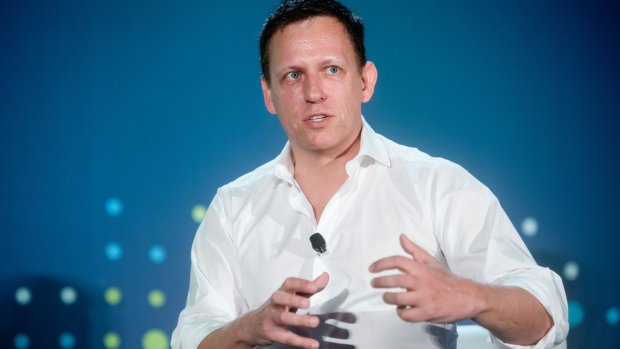
Peter Thiel is probably the embodiment of modern capitalism.  He's the 48-year-old co-founder of PayPal who on the latest estimates is worth $2.8 billion.  When Facebook was just beginning he bought 10 per cent of the company for $500,000.  That investment later came to be valued at $1 billion.  Thiel is an avowed libertarian who has written passionately about "confiscatory taxes" and "totalitarian collectives".  And he's a big supporter of Donald Trump.

Yet for all of this Thiel puts at the centre of his political beliefs the importance of maintaining deep and long-lasting personal relationships.

A few weeks ago Thiel gave the commencement address at Hamilton College, a small liberal arts college in New York state.  What he said confounds all the stereotypes of capitalism and free markets.  He talked about a particular cliché which is constantly repeated, but wrong.  He said that in fact people should not "Live each day as if it were your last".  And he went on to explain:

"The best way to take this as advice is to do exactly the opposite.  Live each day as if you will live forever.  That means, first and foremost, that you should treat the people around you as if they too will be around for a very long time to come.  The choices that you make today matter, because their consequences will grow greater and greater.  That is what Einstein was getting at when he supposedly said that compound interest is the most powerful force in the universe.  This isn't just about finance or money, but it's about the idea that you'll get the best returns in life from investing your time in building durable friendships."

In those few sentences Thiel summed up the essence of capitalism and the free markets.


ADVERTISEMENT

Wednesday, June 01, 2016

ANZ's Aitken call shows companies and social fads don't mix

Companies should have the power to hire and fire whomever they like.  Bell Potter Securities is well within its rights to let Angus Aitken go.  But this episode raises concerns about the future of robust debate in Australia.

On Tuesday last week Gus Aitken sent an email to investors with a sell recommendation on ANZ stock.  His assessment about the future of the bank was based partly on the appointment of a new chief financial officer, which he labelled "one of the dumber appointments I have seen".

Aitken's language was coarse.  He certainly wasn't setting out to win friends in investment banking — the sector from which the new ANZ CFO was drawn — stating that "former investment bankers tend to be crap at most things in the listed world".

But this has always been Aitken's style.  In January last year, he sent an email about mining giant Rio Tinto asking "what the f*** is wrong with these morons?"  In another note in September 2015 his financial advice on Woolworths stock was supplemented with the statement that "The last few CEO's of Woolworths have been completely uninspiring as retailers in my view".

What this demonstrates is that Aitken has a history of brutal honesty, bordering on corrosiveness.

In the latest case, his analysis caused ANZ's head of public relations to tweet a copy of Aitken's note along with the comment "Sexism alive + well in stockbroking?"  But readers of Aitken comments to that point may never have known the gender of ANZ CFO.  He didn't refer to her gender, and he didn't use her name.  Labelling his critique sexist is a long bow.

Despite these facts, Bell Potter decided to let Aitken go.

There must be space for robust debate.  Robust debate means strong statements and strong responses.  But following this episode questions have been raised about the appropriateness of Bell Potter's response to Aitken's conduct.

And it raises a serious point about the role corporate entities have come to play in controversial social and political debates.

Companies in 2016 are feeling more pressure than ever before to support fashionable political causes.

Back in 1970, when asked about the social responsibility of a corporation, Milton Friedman famously answered "a corporation's responsibility is to make as much money for the stockholders as possible".  No doubt if he was still alive today his view would be strengthened by the sight of large companies falling over themselves to sign up to the latest social fad.

One of the best examples of this is Qantas' support for the proposal to recognise Aboriginal and Torres Strait Islanders in the Australian Constitution.  This is a deeply controversial political issue.  And it is highly unlikely the company will be able to account for an increase in profits due to its support for this cause.

Another recent example is Telstra's support for gay marriage.  In a statement earlier this year, Telstra CEO Andrew Penn could not have been clearer, declaring, "Telstra supports marriage equality".

What does this mean for Qantas employees concerned about dividing Australians according to race?  Or Telstra employees who believe in the traditional definition of marriage?

One thing is for sure — as companies are increasingly used to pursue and enforce social change, so too will the instances of employees being let go because they don't comply with the accepted position on contestable political issues.

Aitken won't be the last to fall foul of this new form of corporate social engineering.  And this development should concern us all.  While a company ought to have the right to make employment choices free from encumbrances of the state, its major responsibility is as a vehicle for maximising profit.  Friedman's dictum on the role of corporations should not be forgotten.


ADVERTISEMENT

Tuesday, May 31, 2016

Why we're seeing less pork barrelling this election

Sure, there's still the usual cash splash on playgrounds and intersection upgrades, but for the first time since the GFC our major parties realise the seriousness of the budget deficit and are toning down campaign spending promises.

When you boil them down to their essence, Australian election campaigns are really just elaborate pork barrel road shows.  For all the talk about vision and ideology, politics is about what pleases marginal electorates, not philosophy.

Bill Shorten was in Western Australia last week doling out $45 million for Perth's Wanneroo Road.  Malcolm Turnbull was there a few days later, announcing his own Wannaroo Road upgrade, but a slightly cheaper one — just $20 million.

I complained about this pattern in the 2013 election.  Shorten and Turnbull are competing to head the government of a $1.6 trillion economy — Australia is one of the richest countries in the history of the world — and their job application involves dribbling out money for grade separations.

And yet there's something different about this election.  It's not that the pork barreling isn't happening.  Coalition and Labor candidates are dutifully travelling their electorates to announce minor environmental projects, CCTV installations and community centre upgrades.  But at a national level there's a slight feeling of embarrassment about the whole charade.

Fundamentally both major political parties know that every new spending promise — every new security camera, every new fence around a local park — is a further setback to repaying the national debt.

This week Shorten announced that Labor would not promise to restore the Schoolkids Bonus, which had been scrapped by the Coalition, and refused to guarantee it would restore money to the pension that the Abbott government had cut.

These announcements constitute a dramatic reversal of years of Labor rhetoric.  Both the Schoolkids Bonus and the pension changes were essential elements of the attack on the Coalition as being unfair to low and middle income earners.

Tony Abbott and Joe Hockey made the changes on the grounds that cuts had to be made to the Commonwealth budget if it was ever to return to surplus.  Now finally at the end of the Coalition's first term in government Labor has conceded the point — yes, perhaps cuts, even uncomfortable, unpopular cuts, need to be made.

No doubt Shorten has known this for some time.  Labor in government was unable to restore the surpluses they promised, but were nonetheless willing to reduce spending in ways that hurt them politically.  Recall the cuts to single parent payments which so agonised Labor's own supporters.  Shorten must feel he has a non-trivial chance of becoming prime minister, and needs to start tamping down expectations.

This is the first election since the Global Financial Crisis in which the reality of deficit politics is beginning to dawn on both major parties.  Neither party has a plan to bring the budget back to surplus, but they are starting to accommodate it.  It seems unlikely either side will give the sort of blanket "no cuts to health, education, the ABC, SBS" promise that Abbott did so fatefully on the eve of 2013.

Both Labor and the Coalition announced tax increases before the campaign begun.  We saw in the debate on Sunday night that the Coalition is still trying to deal with the fallout from its retrospective superannuation changes.  Tax increases are not ideal electoral politics, and the last thing the economy needs is a heavier tax burden.  But the increases were probably necessary to give at least some patina of credibility on all the spending promises that were to be announced — at least in the absence of expenditure reduction.

Shorten says that his backtrack on the Schoolkids Bonus and pension changes came after the release of the Treasury's Pre-Election Economic and Fiscal Outlook.  This is nonsensical.  PEFO — one of the rituals which makes up Australian elections — did not forecast anything significantly different from the 2016 budget.

But PEFO represents Treasury's "best professional judgement" on the state of the economy, undiluted by the political needs of its masters.  The Coalition in opposition is sometimes willing to second-guess Treasury.  Labor is not.

PEFO made two claims that have been obvious for a while but look particularly devastating when expressed in an official Commonwealth document.  First, without either tax increases or spending reductions there will be no sustained budget surplus.

Second, budget forecasts are based on an assumption that economic growth will return to its long run average.  If that assumption does not hold — if, say, we go into an economic downturn — then the budget is going to be in a dire state.

The upshot of PEFO is that no side can believably maintain the traditional laissez faire approach to campaign spending promises.  Sure, there's the usual money for playgrounds and intersection upgrades.  But the 2016 election carnival has an unusually depressing tone.  The Australian political class is learning to live with deficit politics.


ADVERTISEMENT

Saturday, May 28, 2016

Time to call compulsory super experiment off

The compulsory superannuation system is a policy experiment failing everyday Australians and should be scrapped.

The Turnbull government's Budget-time announcement of tax increases applied to superannuation accounts has not only aggrieved Liberal Party supporters, who thought their leaders stood for lower taxes.

The superannuation tax increases, including a $500,000 lifetime cap on non-concessional contributions backdated to July 1, 2007, have sparked a broader discussion within the community about the efficacy of Australia's unique compulsory superannuation regime.

Mandating all employers to contribute a portion of wages to a superannuation fund, presently 9.5 per cent and expected to incrementally rise to 12 per cent by 2025, compulsory superannuation has undeniably shifted from its inflation-fighting rationale during the 1980s Accord era.

The defenders of the system these days invariably refer to the need to underwrite a decent income for Australians in retirement, to take fiscal pressure off the age pension and to augment our national savings.

It is probably unreasonable to pin so many public policy ambitions upon one initiative, but when all is said and done the compulsory superannuation regime, now into its 24th year, is, nonetheless, falling short of the numerous hopes set for it.

Of course, it is impossible to appreciate the full extent to which compulsory superannuation equips older Australians with a financially secure retirement, at least until after the full complement of the "baby boom" generation elect to finish working.

But the best actuarial forecasts show that, under compulsory super, many Australians will miss out on being able to retire on an adequate stream of income, replacing between 60 to 80 per cent of their working income.

Lower income earners will, by and large, receive their pension, and high income earners should be able to fund their own retirement, leaving middle income earners (often with large, outstanding mortgages upon retirement age) struggling with retirement income inadequacies.

Making matters worse, successive governments have undermined adequacy by taking it upon themselves to tax superannuation, both at the contribution and accumulation stages, mainly for recurrent spending purposes of questionable value.

There is a myth that the policy progenitors of compulsory superannuation wanted to tear down the Age Pension retirement income pillar, in other words ensuring that superannuation acts as a substitute for the tax-financed public pension.

But former prime minister Paul Keating originally indicated that compulsory superannuation is actually meant to stand as its own retirement income pillar, alongside the pension.

It was a deliberate policy act that workers lose wages for an eventual superannuation payout yet at the same time, as taxpayers, feel the financial pinch of propping up the pay-as-you-go pension system as the population ages.

The 2015 Intergenerational Report illustrates that without reform, commonwealth spending on the pension is projected to rise from 2.9 per cent of GDP in 2014-15 to 3.6 per cent in 2054-55, even in the presence of compulsory super arrangements.

The share of part-rate pensioners in the Age Pension pool is expected to rise over coming decades but exactly what a part-pension will look like, and how affordable it would be, as elderly Australians become even more politically influential by mid-century is an open question.

The $2.046 trillion (roughly 127 per cent of GDP) in assets held by superannuation funds is widely seen as a triumph for the system's capacity to augment our national savings, increasing the pool of funds potentially investable in productive capital.

But one person's augmentation of the national savings pool through financial repression is another person's artificial expansion of the Australian finance sector, reminiscent of a "picking winners" policy diminishing funds competition and impeding financial flows to more productive uses.

Even if we accept that compulsory superannuation improves aggregates savings, it should also be understood this outcome has come at the cost of crowding-out private, voluntary savings — the third, and final, pillar of retirement income that is all too often ignored.

Australian estimates suggest an additional dollar of money forcibly transferred from pay packets into superannuation accounts has been offset by reduced voluntary savings by between 17 cents and 75 cents, with official estimates settling at 30 cents in the dollar.

Compulsory superannuation distorts other elements of economic choice in important ways.

The current superannuation arrangement reduces the capacities of working individuals and families, particularly those on low and middle incomes, to use their rightfully-earned income for more consumption, or for additional investment in education and training programs.

The effective liquidity constraints upon consumption, investment, or voluntary savings would most certainly represent significant welfare losses for those affected, as indicated in a 2002 study by academics Ross Guest and Ian McDonald.

Labour market economists have also noted the superannuation guarantee poses as an additional on-cost associated with employing labour, in turn reducing the demand for labour on the part of employers.

Rather than governments keep making workers lose salary to save more, apparently for their own good, much later in life, and having those forced savings vulnerable to tax grabs, perhaps we should take retirement income policy in a different direction?

The alternative suggested here would be to end compulsory superannuation altogether, ensuring Australians who best know their own circumstances can save as much for their retirement as they see fit.

Instead of increasing the superannuation guarantee rate to 12 per cent, or even 15 per cent as some suggest, in the medium term, the rate should be wound back over time.

This reform wouldn't abolish superannuation but, rather, change the second retirement income pillar to make super contributions voluntary, instead of mandatory, encouraging fund managers to compete for our superannuation dollars.

People with their wages locked up in super accounts against their will should have a right to access at least a part of these funds during their working lives, say, for the purpose of laying down a first house deposit or to finance their higher education expenses.

Reformers should tighten up Age Pension means tests and raise eligibility age to life expectancy to make welfare affordable and well-targeted, and radically cut taxes on saving (including for superannuation) to encourage, but not mandate, thrift.

Australian politicians, deeply afflicted by the short-termism of triennial election battles, lack sufficient knowledge to determine the "optimal" rate of saving for a population, against the background of international financial mobility, in the longer term.

In that vein, we should eschew the political mentality that it is legitimate, even dignified, for governments to paternalistically dictate our most important economic decisions, including when, why and how to save.


ADVERTISEMENT