Friday, September 09, 2005

Submission to the Review of National Pipelines Access Regime

Submission to the Ministerial Council On Energy's
Review of National Pipelines Access Regime


INTRODUCTION

We confine ourselves to one aspect of the review, namely,

Comment is invited on the relative merits of the following options for improving the investment climate for greenfields gas pipelines:

  1. the Commission's proposal to permit developers of pipelines to seek an upfront test of whether a new pipeline is likely to meet the coverage tests, and to obtain a binding ruling for a fixed period of 15 years if the tests would not be met;
  2. implementing a price regulation "holiday" for greenfields pipelines for 15 years;
  3. whether non-price obligations should be applied to greenfields pipelines that have a price regulation "holiday".

It is our view that the weaker proposals of the Productivity Commission would frustrate the essentially deregulatory intent of the proposals set out in the COAG Energy Market Review, the Parer report.


ADMINISTRATION OF COVERAGE

For the reasons set out in the MCE Paper, placing a need to obtain a no-coverage ruling would reduce certainty and lead to protracted negotiations between the proponent and the ACCC.  It might also alert other parties to an opportunity that the proponent had spotted and lead such other parties, who may not have needed to expend the same amount of resources searching for the opportunity, to offer alternative more intrusive regulatory arrangements.

Such arrangements are always likely to be more welcomed by bodies that have regulatory control as their main business.  Seeking a binding ruling from a body that has a clear interest in maintaining regulatory controls which boost its own influence would exacerbate our concerns about any proposals that approached the greater regulation espoused by the Productivity Commission.  At the very least, the approach would need to be to a disinterested party and not to the ACCC which would be administering the regulations.

The deficiencies of the present arrangements were becoming clear at the time of the application for the revocation of the coverage over the pipelines serving Sydney.  In 2000 we argued,

"An additional pipeline brings new competition.  This means the basic premises on which the competition policy arrangements are set for infrastructure do not apply.  The regulatory arrangements are posited on natural monopoly, an oxymoron where new competition actually emerges.  Regulation in those cases contains all the inevitable downside costs but no upside benefits." (1)

In our submission to the PC's review of the Competition Policy Agreements (2), we maintained that there had been a fundamental policy change as a result of the Hilmer report and its acceptance by COAG.  We argued that since the agreement of governments in the competition reforms to curtail their assumptions of monopoly provisions in major areas of the economy, there had been no constraints on new developments.


CRITERIA FOR COVERAGE

All new pipelines by definition are greenfield sites and should, therefore, not be regulated.  In order to develop a taxonomy for policy we argued,

"There are six important classifications of essential service or bottleneck infrastructure that may justify a difference in regulatory policy approach:

  1. That which has been built without any market protection, especially that built since 1995 which is almost by definition "entrepreneurial" rather than regulated.
  2. That which introduces new competition, albeit is not identical to existing facilities.
  3. Privately built infrastructure built prior to 1995 that enjoyed no government protection.
  4. That which is owned by the private sector but was built under a regime that offered protection from competition.
  5. That which was owned by a government but has since been sold under contractual terms to the private sector.
  6. That which was built by and remains owned by a government."

We argued that the only case for regulatory control concerned the fourth, fifth and sixth of these since the others had been built under a regime where they had no privileges.  The main issue is how to remove the constraints of regulatory intrusion over those pipelines that were built under some monopoly provision and remained with market power.  The effluxion of time is likely to whittle away at that power and criteria for abandoning regulation in those circumstances are necessary.

Of course, we recognised, drawing off long practices that governments will assert some controls to ensure some sort of common access to monopolies if their "essential facility" nature became significant.  Such controls have been seen since ancient times in the administration of ports, railways and, more recently, telecommunications.  In most instances, telecommunications appears to be a recent case in point, the controls can be lifted and freedom of commerce fully restored as technology erodes an "essential facility's" market power.

The case of access holidays covers new investment built without any assistance.  We repeat our contention in our earlier paper

"Where there are no regulatory restraints on competition, we see the most promising conditions under which entrepreneurs seek out new needs or seek the meeting of existing needs more cheaply.  The outcomes of new infrastructure built under such conditions epitomise the gains made by competitive processes.  For, although mistakes in competitive strategies are inevitable from time to time and excessive or wrongly sited infrastructure will be built, the outcome of the process of free market decision-making offers us the best use of resources and the widest scope for the application of human ingenuity.  If excessive building occurs, unless there is (illegal) collusion the mistakes cannot be retrieved from the consumer.

"Indeed, in such circumstances the consumer obtains windfall gains as the rivals seek to cut their losses by expanding their market shares and in the process driving down the price.

"Infrastructure built by private enterprise in the "post-Hilmer" era should not be required to grant access or be subjected to price restraints.  The builders of such infrastructure are responding to a profitable opportunity that they foresee, one that, by definition, also confers gains on the buyers of the service.  The two parties obtain a mutual gain.  The sharing of the gain is one for bargaining between the parties but the consumers of the goods that the facility supplies cannot be worse off since without it they would not have that particular access route and perhaps not the product that the access delivers.

"For its part, the owner of the new facility in this "post-Hilmer" era, cannot obtain gain from it by virtue of some form of government granted privilege.  The owner will, moreover, usually be building a project that carries some economic risk.  Such risk may emanate from a failure of the market to develop in the predicted way, new competitors, or the "howling gales of creative destruction" stemming from a technology that renders existing approaches archaic.

"Thus, in deciding to push ahead with the facility, the supplier had no lien on the idea and no lock on the supply itself.  Once built, the facility is not protected from imitators.  It may be that a successful facility becomes immensely profitable, like Microsoft Word.  But it can only do so if it provides value in excess of that which imitators and new approaches provide.

"Such mutual gain is at the heart of the private enterprise system.  Attempts to "redistribute" it can only harm the process.  This can be illustrated in the case of a new pipeline.  The owner of the pipeline will usually have considered a spectrum of alternative market projections (and perhaps a spectrum of cost projections).  There is uncertainty and, implicitly or explicitly, the owner will weight each scenario in making his investment decision.  If his threshold is a rate of return of 15% and he is considering scenarios that might yield rates ranging from 25% to 5% but provide a weighted average rate of 15%, cutting off the potential to earn the higher rates will reduce the weighted average to something less than the threshold.  The regulatory action would then eliminate the commerciality of the project.  In such a case, the sponsor and the customers would both be losers.

"Even if, in this case, a new developer were to arrive and build the pipeline, that developer would have done so in the light of the experience gained by the original developer.  The process would still result in an inferior outcome because the regulatory process would have demonstrated a cost in originating new ideas and will deter investment in searching out new opportunities.

"We have seen an example of this with the Central West gas pipeline.  This was a marginal project which required a Commonwealth grant in order for its owner, AGL, to justify its go-ahead.  The ACCC required AGL to lower its prices based on a rate of return on capital of 7.5% compared to a rate it sought (and had been agreed by the users) of 10%.  Although such an outcome brings lower costs to the customers in the area, the decision undermines entrepreneurship.  It has no place in a situation where there is no monopoly.  AGL had no franchise to supply gas to the area in question.  It has many rivals in Australia seeking opportunities to find new markets.  The outlet is from the Moomba to Sydney pipeline, largely owned by AGL but operated by EAPL as a totally independent entity.  Had an AGL rival approached EAPL they would have secured the same conditions as those gained by AGL.

"AGL had determined that the customers for the pipeline would be willing to pay $2.78 per gigajoule in 2004 but the ACCC has determined they must pay no more than $2.32.  Intervention to reduce a price sought by an enterprise in this way is a sure route to economic stagnation.  At best it will lead to the entrepreneur engaging in wasteful deception to try to persuade the regulator that his costs are really higher or his market weaker than he has said they are.  Most likely, it also sends a message to all businesses looking at expanding networks under the ACCC's oversight that they must please more than the target customers.  Hence, the decision of the ACCC to cut the price of using the pipeline in this way will have a sobering effect on other worthwhile ventures."

We set out similar cases in considerations covering duplicated facilities.  We see any extension of a pipeline to be a Greenfield pipeline which automatically qualifies for absence of regulation.  Where the pipeline is part of an extant system that is covered by regulatory provisions for expansion to meet demands of new customers that are defined contractually, then those obligations should, of course, remain.

Parer recognises that when a regulator places obstacles in the way of a new facility being constructed, there is a loss to the economy.  The case for new pipelines to be free of price regulation is no less strong than that for new bakeries, car plants or any other facilities that have no government franchise.  Regulation that closes off market entry by insisting that incumbents underprice their services is just as harmful to a healthy economy as regulation that forbids competition.

Although the regulators will maintain that they are simply ensuring a price that gives a fair return to the provider, they cannot but set a price above that which the market would justify.  This is because no customer is obliged to pay the price that the pipeline is obliged to supply the service.

It follows that, though it might be said that the facility may, once completed, enable its owner to extract "monopoly" prices, this cannot be the case.  A new facility is introduced in a situation where life went on peacefully and productively.  Whatever price the new facility requires cannot leave the customers worse off since they have the choice of not accepting its services at the price sought.  And, indeed, if the facility is able to earn very high returns, this simply demonstrates that it is highly innovative or that its builder was taking a considerable risk.  In either case it is both premature and counterproductive to tax away these gains with regulatory measures.

Requiring new pipelines to be regulated is gratuitous and contrary to efficiency.  New pipelines enjoy no exclusivity and by definition have no franchise or monopoly.  For gas customers they can only bring benefits.  Unless or until a facility can be regarded as "essential", regulating it will impede its development and any redistributive changes the regulation might bring would not compensate for the reduced level of efficiency that regulation entails.  The new pipeline competes for customers in the same way as all other goods and services and has no lien on the consumer dollar.


REMOVAL OF COVERAGE

It should be accepted without further analysis that once a new pipeline has a regulatory holiday, any existing pipeline with which it is engaged in serious competition should be immediately removed from regulatory coverage.  To do otherwise is to penalise the existing pipeline with paperburdens and inflexibilities that its new rivals don't have.  In all likelihood, as the regulator cannot impose a higher than competitive market price (since the customers would migrate to the new provider), the incumbent pipeline will have its price set too low by the regulator.  This is likely to harm the abilities of both pipelines to operate according to the optimum interaction of customer and supplier.

Sadly, the regulatory authorities have not always exhibited such common sense wisdom and have sought to maintain coverage, for example over the Moomba to Adelaide pipeline after the SEA gas line was commissioned and the Moomba to Sydney pipeline after the Duke pipeline was commissioned.  Hence we consider that provision should be made explicit to extend parallel regulatory holidays to pipelines that compete for the same customers where such a provision is agreed for a Greenfield pipeline


CONCLUSION

While there is a case for pipelines originally built under franchise protection remaining under regulatory control until new competition emerges, this is not so with the post 1995 era pipelines.  Post 1995 era pipeline developers rely on market discovery and business acumen to profitably meet consumer needs, just like entrepreneurs contemplating any other investment.  Setting more onerous terms for new pipeline developments will bring sub-optimal levels of capital expenditure on them.

Accordingly, we would recommend a regulatory holiday of 15 years for all new Greenfield pipelines.  Such pipelines should have neither price guidelines or determinations nor non-price obligations.  Existing pipelines that serve the same markets as the Greenfield pipeline should automatically have their coverage revoked.


ENDNOTES

1Price and Access Regulation of Gas Transmission Pipelines, A Submission Regarding the Regulatory Considerations of the NCC and ACCC on the Eastern Gas Pipeline and the ACCC on the Central West Pipeline, Energy Issues Paper No. 13 February 2000.

2Review of Competition Policy, The Productivity Commission's inquiry into Clause 6 of the Competition Principles Agreement, December 2000.

Left to sink or swim, it's our ag that could drown

I enjoyed a meal of crawfish with farmers in Louisiana a few years ago, where the locals boasted the Port at New Orleans was the fifth largest in the world.

Vast quantities of grain and oil seed, including genetically modified (GM) cotton and GM soybean, were shipped down the Mississippi and to the world via New Orleans.

Along comes Hurricane Katrina and New Orleans is no longer a busy port but a city reeling under gale force winds, a tidal surge and then a crime wave.

New Orleans is built on a delta and deltas tend to sink when the supply of sediment for delta and wetland building is less than the rate of subsidence due to natural geological processes.

Levee banks, built to contain flood waters, have significantly reduced the supply of sediment to New Orleans and surrounding wetland areas.

The levees are designed to keep the water within the main river channel of the Mississippi so the sediment is dumped at the extreme end of the delta.

It was over that meal of crawfish that I learnt that the sediment eventually slides down the continental slope to fan onto the deep ocean floor.

Among the news reports over the last few days there has been comment that New Orleans is three metres below sea level.

The farmers had joked the city could one day slide into the Gulf of Mexico.

I have previously written that the Murray-Darling Basin River drains 14 percent of the landmass of Australia and that the mighty Murray has an average annual flow, including diversions for irrigation, of 14 million megalitres.

Compare this to the Mississippi River which drains 41 percent of the United States and has an average annual flow of 405 million megalitres.

There is no equivalent of New Orleans in Australia and there is no great port at the bottom of the Murray River.

Adelaide is about 100 kms to the west.

There are holiday houses on the lake system that sits at the bottom of the Murray and then a series of barrages build to keep the lake's water fresh, and beyond that, a dredge working to keep the Murray's mouth open.

The Murray-Darling Basin is the food bowl of Australia but when you compare total agricultural production in Australia to the US we really are insignificant.  We produce about 34 million tones of what the World Resource Institute classifies as cereals;  the US produces 334 million tones.

We produce about four million tones of meat, they produce 37 million tones.

Our mighty Murray River and its dependent farming communities are puny in the global scheme of things.

And on reflection it is perhaps more likely that Australian agriculture will be let to slide into oblivion through corrosive state and federal government policies, than New Orleans will be left to slide into the Gulf of Mexico.


ADVERTISEMENT

Wednesday, September 07, 2005

Cash and contentment:  the truth

According to the new gurus of happiness, most of us are mugs.

We spend our lives pursuing money, wealth and the good life for ourselves and our children only to find that it makes us unhappy.  Indeed, as a society we are a failure.  Our pursuit of economic growth and wealth has only led us down the path of unhappiness.

All the good things of life, from washing machines to plasma TVs to reliable and safer cars to modern medicine, have made us unhappy.  And it has led to an epidemic of depression, environmental destruction and social dislocation.

Of course, the "money is evil" claim is not new.  It has been the rallying cry for collectivist movements through the millennia.  The Bible, Karl Marx, Timothy Leary and Greenpeace all rail against the innate evilness of the pursuit of money.

What's new is the so-called science of subjective happiness, which is a growth area in our universities.  It is providing apparent evidence supporting the old claim that money does not make you happy and the collectivists are using it in aid of their every cause -- often to the point of absurdity.  Happiness researchers have undertaken thousands of surveys around the world over many decades assessing happiness and its cause.

They have come up with, at least superficially, some surprising findings.  Neither income nor wealth correlate with happiness.  Surveys have found virtually the same level of happiness between the very richest Americans and the Maasai herdsman of east Africa living on less than $1 a day.  Surveys in Japan found that between 1960 and 1987 per capita income increased fourfold while the level of happiness remained unchanged.  Other studies found a negative relationship between income and level of happiness and a slight positive relationship between wealth and level of happiness.

This is surprising because the evidence is that most people clearly would choose to live the life of Donald Trump than a Maasai herdsman.  Most people -- whether it be through education, entrepreneurship or the lottery -- seek greater wealth and go to great lengths to avoid poverty.

And research shows people on low incomes suffer disproportionately from things such as obesity, depression and early death, which would tend to make people unhappy.

So what gives?  The problem lies in people's innate tendency to be happy, but not too happy or too unhappy.

Research shows people are highly resilient.  We can adjust and find happiness in extreme conditions.  Research has shown that quadriplegics eventually report the same level of happiness as the able-bodied and winners of lotteries, after a period of euphoria, revert to their pre-rich state of happiness.  Our level of happiness does not change much with our circumstances -- whether it be money, wealth, age, peace, social capital or friendships.

In short, happiness is not a good empirical measure of people's desires, wellbeing or lifestyle choices for public policy purposes.

Its use leads to all sorts of silly ideas such as those offered by Prof Mirko Bagaric on these pages last week.  He suggests crippling tax rates of 75 per cent on people earning more than $70,000 so as to stop such people from "earning vast sums of money" and becoming unhappy.  He and his joint author claim this will not only make us a happier society, but make the wealthy happier by making them poorer.

The proposal has a few problems.  First, it is mad.  No one believes an extra quid makes them unhappy.  Second, it would lead to the ousting of any government that proposed it.  Third, it would lead to mass tax evasion.

More vigilant happiness researchers caution against jumping to the clearly absurd conclusion that less money leads to happiness.  Many have spent their careers researching poverty and know it's not a happy state.  They know that while people may be happy with their lot in life, they'd prefer to improve it with a bit more money.

While income and wealth don't necessarily make one happy, they sure help.

We know this from the choices of Australians at the ballot box, at schools, in their choice of jobs and at home.  This is reality, and a happy one.


ADVERTISEMENT

Friday, September 02, 2005

Uncovering the truth about markets

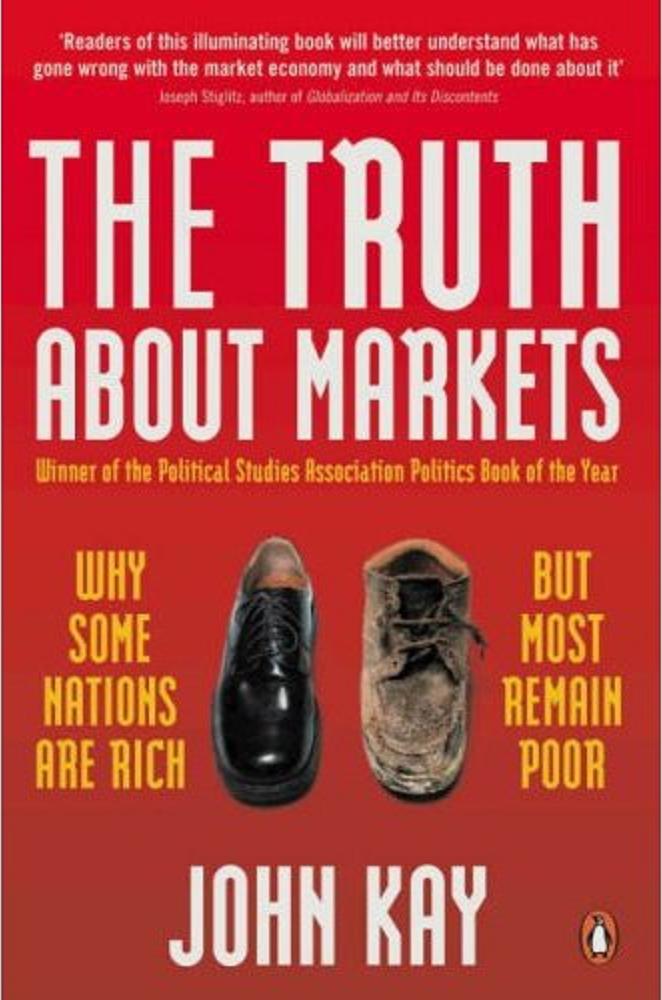
The Truth about Markets:  Why some nations are rich but most remain poor
By John Kay.
(Penguin UK, 2004, 496 pages)

For someone untutored in economics, it is easy to be perplexed by the question:  how did Australia manage to enjoy uninterrupted economic growth for a period of 14 years?

It is the same question that John Kay attempts to answer on a grand scale in his much-acclaimed book, The Truth about Markets:  Why some nations are rich but most remain poor.

The explanation for Australia has been given in its most elegant form by Gary Banks, the Chairman of the Productivity Commission.  The relaxation of constraints on our economy -- such as floating the dollar, reducing tariffs, forcing competition, privatising government business and freeing up the labour market -- has stimulated action.  But what did we actually do?  These explanations always seem to be the equivalent of giving the patient plenty of fresh air or some really nasty medicine to treat the symptoms.  Thus it was a delight to discover The Truth about Markets and to be carried to a fuller explanation of economics in its broadest context.

Successful economies are very complex.  It is not merely the availability of capital, labour and technology that creates success, but rather social, political and cultural institutions interacting in an economic environment.  The book is a mix of example and explanation with a few scattered statistics.  Starting with a list of 19 rich countries, it is striking to see that only six are outside Europe -- Australia, Canada, the United States, Japan, Singapore and Hong Kong.

New Zealand is not on the list and is described as on the way down.  "If ever a country has been run by economists, it was New Zealand.  From 1984 to 1999 New Zealand followed policies of privatisation and deregulation. ... During this period the country experienced the worst economic performance of any rich state".

Various fundamental issues are discussed, sometimes with delicious illustrations.  The UK Whitehall mandarins are not spared as Kay describes the nuclear planning disaster of Advanced Gas Cooled Reactors.  Nor, for that matter, are idiosyncratic tycoons treated any better.  Kay eloquently illustrates how the scale of economic and business decisions determines big success and big failure.  But, on the other hand, he contrasts this with the Hayekian tenets of diverse, independent decision-making and spontaneous order in the Information Age.

It is distressingly easy to find Australian examples of centralised planning of the sort Kay criticises.  From railways and dams to ethanol and windmills, our politicians continue to pick winners.

But the prize would probably go to those who have sought to regulate communications and media.  They have an almost perfect record of getting things wrong -- starting with early radio regulations of one receiver set to a radio station through to the introduction of high definition digital television.

Perhaps the most interesting chapters cover the attempted development of the poor states, as Kay's analysis helps illuminate the economic forces that created the established rich states.  The discussion of early theories of development and whether countries can be lifted to the wealth and standards of the richest states shows how the complications of economic growth frequently confound the best and brightest of planners.  This does not bode well in the medium term for our nearest neighbours.  His conclusion says it all.

Rich states are the product of -- literally -- centuries of co-evolution of civil society, politics and economic institutions, a co-evolution that we only partially understand and cannot transplant.  In the only successful examples of transplantation -- the Western offshoots -- entire populations and their institutions were settled in almost empty countries.

Kay's conclusions are controversial -- any explanation of institutional economics is bound to be -- but it is a stimulating and fascinating book with clear explanations helped by some of the best examples drawn from the way we live now.

The strange allure of cruel dictatorships

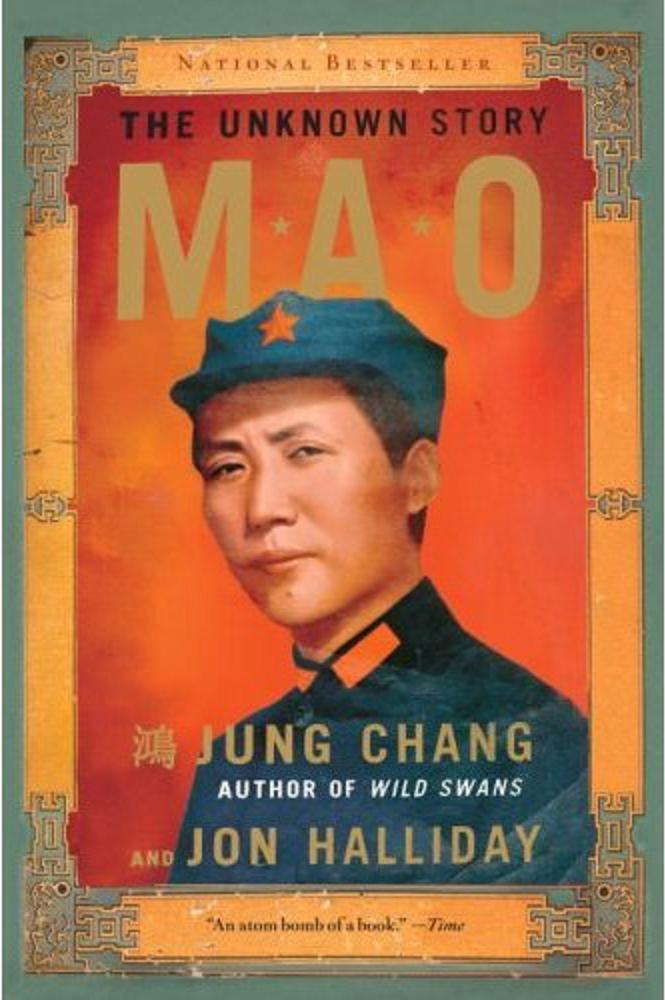
Mao:  The Unknown Story
By Jung Chang and Jon Halliday.
(Jonathan Cape, 2005, 814 pages)

To much fanfare and international recognition, Jung Chang, author of the all-time best selling non-fiction work Wild Swans, and her British husband Jon Halliday have co-authored a definitive history of Mao Tse-tung.  The book has already been flagged as the best political history published this century.  This is not mere historical revisionism;  it indeed could claim to be the definitive corrective of just exactly how monstrous a tyrant Mao was.  Relentless in its depiction of the biggest mass murderer of the twentieth century -- more than 70 million deaths in peacetime -- it focuses very much on Mao the man.

Although just over 800 pages and with copious notes and documentation, this book is for the general public.  It reads as a compelling narrative and is told in the accessible style of Wild Swans.  One of the strengths of the book is that there is no facile moralising.  The authors simply describe a man according to the lights of the people who knew him, or who met him.  This has not stopped the inevitable apologists claiming that it is a calculated demolition job.  After all, Chang's own family were victims, so this must be her "revenge".  In response, Chang is at pains to point out that the book overwhelmingly rests on documented facts and primary sources.  She explained in one Melbourne interview that "the book is not a polemic.  It is a straightforward story with facts.  Readers can draw their own conclusions".

Between them, the authors travelled through China and interviewed over 150 family relatives of Mao, his friends, colleagues, personal staff and members of the top echelon of the Party.  These people had never before talked about Mao on the record.  Although the authors give the reader little alternative explanation or a wider historical context for Mao's actions, it is hard to resist the picture put before us.

The compelling conclusion is simply worse than most of us could imagine:  Mao was totally cynical and unscrupulous.  He survived precisely because he was more ruthless than anyone else he encountered, including Stalin.  Mao, from these direct accounts, had a seamless life of cruelty waged against friend, foe and family alike.  To make the assessment worse, it turns out that there was not even a vestige of ideological belief -- Marxist or communist -- nor idealism of any sort.

The most chilling assessment of Mao was given in detail by the man himself.  In 1918, at the age of 24, Mao wrote in his diary:

People like me only have a duty to ourselves;  we have no duty to other people ... Of course there are people and objects in the world, but they are all there only for me ... Some say one has a responsibility for history.  I don't believe it.  I am only concerned about developing myself ...

On death and killing others:

Human beings are endowed with the sense of curiosity, why should we treat death differently.  Don't we want to experience strange things?  I think this is the most wonderful thing ...

Right from his earliest years, the story traces Mao's psychopathology and his cruelty to others.  It starts with him as a child with his immediate family, then moves to his professional colleagues and allies as they were systematically betrayed for Mao's personal hunger for power, money and domination.  He was totally pragmatic.  Very early in his long life, he had found an easy way to obtain money and do no real work.

Mao's treachery is illustrated during the course of the Long March, where he made his troops march for months through fruitless detours -- thus sacrificing thousands of scarce fighting men -- to serve no other purpose than to advance his bid for leadership.  In another episode near Banyou in 1935, Mao connived, lied and menaced to force Kuo-tao, then military supremo of the main communist force at the time, to take his troops through marshes where there was neither food nor villages.  Mao even urged him "to bring all the wounded and sick who can manage to walk" in a deliberate desire to inflict maximum suffering.  Mao's aim was simply to stall him and consolidate his own position.

In the Great Leap Forward, many of the disasters and hare-brained ideas could have been avoided altogether if it were not for Mao.  He simply did not listen to expert advice.  Rules and commonsense were cast aside when steel mills were required to double production.  As Chang writes, "Mao set the tone for discrediting rationality by saying the "bourgeois professor's knowledge should be treated as dogs' fart, worth nothing, deserving only disdain, scorn, contempt ... As a result, so many of the efforts, at the cost of hundreds of thousands of lives and the suffering of millions, came to nothing.  Backyard furnaces produced steel that was unusable.  Canals and irrigation schemes, often dug with bare hands, were abandoned as useless because of a lack of planning and analysis.  The famous drive to eliminate sparrows caused ecological disaster;  pleas from scientists were ignored.  Over four years from 1958, about 100 million peasants were coerced into such projects, moving a quantity of earth and masonry equivalent to excavating 950 Suez Canals, mostly using their own hammers, picks and shovels, and providing their own food and shelter.  Mao knew precisely and proudly just how many deaths went with each billion cubic metres of soil.  When senior officials in the Gansu province appealed against "destroying human lives" in these projects, Mao had them condemned and punished as a "Rightist anti-Party clique".

The great purges that typified Mao's rule are described in brutal detail.  His distinctive form of terror was to get people to use it against each other.  He perfected this method in Yenan, where everyone was coerced into the exercise of criticism and self-criticism by confessing and implicating each other in terrible "wrongs".  This method, with associated horrendous torture and slow and terrifying death, was extended from Mao's closest colleagues to the whole of China.

Mao's megalomania, his mind-boggling use of resources for his own comfort -- massive and expensive houses built throughout China that he barely used, entire factories set up to ensure him of his own supply of a particular rice, or elaborate printing works constructed to print exclusive editions of just five copies for himself -- are truly stupefying.

One surprising anecdote for this reviewer was the extent to which Mao succeeded in manipulating Richard Nixon through the famous "ping pong" diplomacy and subsequent first trip to Beijing, and just how shoddy was the humiliating treatment Nixon endured in private meetings with him in front of Kissinger.  The book also shows just how much this meeting and the subsequent seduction of the United States played in projecting a benign image of Mao so much at odds with what we now know.

What is left today of this legacy?  Three decades after his death, Mao Tse-tung is still officially endorsed by the present Chinese government, with his bland face hanging in Tiananmen Square and adorning every banknote.  Although it is certainly true that China has changed from the bad old days, the recent defection of a Chinese diplomat in Australia is a contemporary reminder of the nature of the Chinese Communist Party and the way it deals with minorities such as the Falun Gong.  Moreover, the recent demand for independent Chinese bloggers to register with the government -- together with Microsoft's recent admission that its Chinese blog site would block titles such as "freedom" and "democracy" in the country's efforts to control the Internet -- are signs that there is still a long way to go.

One wonders if a book like this will dent the popularity of Andy Warhol's Mao silk-screen prints that passed the $100,000 mark at the New York auction houses some years ago.  However, when some critics can claim that the book is "part of an ideological offensive by capitalism to destroy not just the legacy of Maoism but also the idea of the planned economy and socialism", there is certainly resilience and chutzpah amongst the believing classes in the West.

Dancing on the grave of employment

Chris Berg reviews
Independence and the Death of Employment
By Richard J. Wood
(Voltan, 2005, 207 pages)

William is a 24-year-old shearer from Queensland.

I've worked on shearing teams which are staunch in their observance of the [industrial] Award.  They have the 3 minute bell which is a warning to all the shearers that the end of the run will happen in 3 minutes and they have to finish up their last sheep ... They do not do any weekend work or extra hours during the week or any hours outside the exact allocated hours in the Award ...

However, this is too restricted for me.  I would rather have the choice whether I wanted to work weekends.  I believe it is up to the individual ... I believe that if I want to work weekends then that should be okay.

This attitude is repeated in dozens of industries all around the country.  Independent contractor status is, as Richard Wood's new book Independence and the Death of Employment makes clear, increasingly seen as a more flexible alternative to traditional, heavily regulated employment structures.

And independent contracting status, while the most obvious manifestation of this new attitude to work, is by no means the only one.  Wood notes the existence of "independent employees" -- workers who work in firms, and are nominally under the command-and-control contract and structures of employment, but in their "actions, desires, thoughts and ambitions" are independent none the less.  These workers can be a firm's greatest asset but also its greatest weakness:  endlessly creative and innovative if the incentives are right, but resistant and often resentful at having their actions controlled.

Wood's book is a comprehensive, paradigm-shifting overview of these and a countless range of other issues, essentially trying to answer the basic question, "what is employment?"

Most economists tend to think of employment as a work-for-pay relationship.  But Wood suggests that this is incorrect.  He alleges that employment is a relationship of legal and behavioural control -- precisely the argument that the labour Left have been pounding away at for centuries.  The evolution of legal precedent and the formalisation of industrial relations in dedicated bodies has rigidly defined employment in this way.

Employment law distorts many of the objectives of work regulation.  In the context of the law, employees are considered witless and lacking in control.  The employer is supposed to be responsible for their witless employees.  Independence and the Death of Employment controversially argues that employment degrades human beings and removes responsibility.

Employers take the blame for employees' actions -- discrimination or for breaking work safety instructions.

But this is merely the framework with which the legal system approaches employment.  Wood's argument is that the experience of employment is quite the opposite.  Independent contractors and the phenomenon of "independent employees" belie the fact that a job is more than mere servitude.

Career desires, power urges, ego trips and personal self-interest are the dominant motivations in the firm.  Individuals in the firm will be ambivalent toward the firm's making losses if the individual is unaffected.

Economists have long recognised this as an agency problem -- managers, for example, don't always operate in the interests of shareholders.  But the solution is not more highly regulated employees but allowing greater independence, which workers are already striving for, to create the appropriate incentives for mutual benefit.

And the legal framework and regulatory impulses of government which surround employment must catch up.  These are changes that are being made already -- sometimes against great resistance.  The Queensland shearers' desire to practise as independent contractors formed the backdrop to an eighteen-month legal case between the Australian Workers Union and the State of Queensland.

Independence and the Death of Employment is a combination of manifesto, self-help book, and rigorous analysis.  It represents a massive shift in thought on labour regulation and employment, and will be heavily scrutinised and criticised by analysts from across the political spectrum.  But whatever change it represents in intellectual thought, it is dwarfed by the massive change in how Australians work today.

I'm sad because you have a red Ferrari

Happiness:  Lessons from a New Science
By Richard Layard.
(Alan Lane, 2005, 310 pages)

Seven hundred and fifty actors and actresses have ever been nominated for an Academy Award -- those who won an Oscar lived, on average, four years longer than those who had been nominated but didn't win.

How happy you are in the your twenties is a good predictor of how long you will live.

The Himalayan country of Bhutan had banned television and public advertising until 1999.  When the ban was lifted, the crime rate rose and drug-taking increased.

According to Richard Layard, an economist at the London School of Economics, former adviser to the Blair Government in the UK, and now a member of the House of Lords, "happiness" can be scientifically determined by measuring electrical activity in the brain.  We might not know exactly what happiness is, but we know it when we've found it.

It is with information such as this that Layard constructs his argument that the goal of government should be happiness for all.  Money doesn't buy happiness, therefore governments should abandon their concentration on economic growth and instead focus on generating happiness.  The way to do this is for governments to create the concept of "the common good" whereby individuals stop competing with each other and instead learn to co-operate.

Layard suggests, presumably in all seriousness, that a solution to the problem of competition for status and money is "a collective agreement to limit the race of all against all" -- but he says that, sadly, such an agreement would never work because "there are just too many people to make such an agreement possible".  Layard doesn't seem too bothered by the fact that such an agreement would involve interference with individual rights on an almost unprecedented scale.

He freely acknowledges that his greatest happiness for all principle is utilitarian in the extreme, and utilitarianism has always had problems accommodating personal liberty.  Layard discusses the legacy of the first great utilitarian, Jeremy Bentham, who claimed that the best society was one in which the citizens were the happiest -- "the greatest happiness for the greatest number".  Such a philosophy was profoundly egalitarian because the happiness of the richest person had the same weight as the happiness of the poorest, but the problem with utilitarianism -- and the reason why Bentham's disciple John Stuart Mill rejected it -- was because it was fundamentally illiberal.

On a strict application of utilitarianism, if society were comprised of three people, and two people gained happiness through the infliction of pain on a third, there would be nothing objectionable in such an outcome.  There is no scope in utilitarianism for individual rights.  Similarly, in Layard's preferred society, individuals shouldn't be allowed to work to earn money to buy a red Ferrari, because he believes, first, that red Ferraris don't make people happy anyway, and second, that those of us who don't have red Ferraris are jealous of those who do.  What Layard would like to do is not necessarily prohibit us from buying red Ferraris (although one suspects he wouldn't be averse to such a ban).  He suggests that taxes should be increased so that individuals are discouraged from working too hard, and he says that taxes are good because "they are holding us back from an even more fevered way of life".

Layard cites various studies which show that, while in recent times we have got wealthier, we haven't got any happier -- and that people may actually be less happy than they were in previous decades.  For example, the incidence of clinical depression has increased since the Second World War.  From this he concludes that increased wealth is the cause of many of our problems.  But even though events may correlate, that obviously doesn't mean that they are casually related.  It could just as easily be said that the creation of the modern welfare state has resulted in a higher rate of depression.

For those who believe that the fall of the Berlin Wall signalled the triumph of liberal political ideas and free-market economics -- think again.  In a feature about him on ABC Radio earlier this year, Layard announced that civil servants in Britain were "taking some interest" in his ideas.

Baby boom or baby bonus?

What, no baby?  Why women are losing the freedom to mother, and how they can get it back
By Leslie Cannold.
(Curtin University Books, 2005, 336 pages)

"There is never a convenient time to have a baby", the young mother said to me, "and once you get over that, it's fine".

According to Leslie Cannold, it's far from fine.  The hurdles that Australian society places before women of child-bearing age mean that many will never have children.  The problem is not a lack of desire to reproduce, but circumstances that stifle the birth rate.

What, no baby? is well researched and scholarly, and written with humour and flair.  It includes a thorough but non-obtrusive literature review and engaging personal interviews.  Cannold considers recent media commentary on women's childlessness.  This includes a well-deserved bucketing of journalist Virginia Haussegger who, in 2003, wrote in The Age that it was feminism's fault that she was not a mother, and that no-one told her she would run out of time to get pregnant.

Australia's birth rate has declined for decades, and Cannold considers the women behind the statistics.  Few have made a genuine choice, she says, that is, "a decision a person makes when she has a full range of possible options from which to select, and is equally free to choose any one of them".

Her assumption is that most women want to work and mother, or must do so.  Little consideration is given to women who want to opt out of the workforce after starting a family.  In fact, Cannold makes the provocative statement:  "When women do nothing but nurture, they miss out on the sense of mastery that comes from meaningful and valued involvement in the work of society".

The most family friendly nations -- where women have comparatively generous paid maternity leave;  access to low-cost childcare;  support to maintain paid work;  and male partners who significantly contribute to domestic chores -- are those with the highest birth rates.  Cannold seems to believe that the societal conditions mean that women, knowing of the support structures available to them, are confident to become mothers.  I wonder if this could be too simple an assumption.  Leaving aside the reinforcement effect of the policies, did they cause the behaviour, or did they follow it?

Australia's now-rising birth rates also offer a practical challenge to Cannold's thesis that a significantly more family friendly society is the answer.

In the twelve months to September 2004, 255,000 births were recorded in Australia -- the highest number of annual births in almost a decade.  This rise preceded the Federal Government's $3,000 baby bonus, which commenced in July 2004, and it is expected that annual birth figures will continue to rise.

In fairness to Cannold, it's unclear whether Australia's recently increasing birth rate is a true reversal of the trend.  It may represent a catch-up for women of my generation, who have delayed rather than discounted having children, but will probably still have fewer children than our mothers' generation.  The current rise in births may yet taper out.

For Cannold, there are two groups of "circumstantially childless" women:  thwarted mothers and those who wait and watch.

A thwarted mother wants a child, but is stopped by practical barriers.  This may be the breakdown of a long-term relationship, just as children were planned, as the thwarted mother-to-be approaches her late thirties.  For waiters and watchers, the circumstances are never quite right.  "They neither pursue [motherhood] nor actively avoid it;  they simply wait to see how their feelings and their circumstances develop".

It's not clear how changes to government policy, or more supportive partners, could really make this group get on with it.  Is the answer really that many don't want to be mothers, but don't feel comfortable admitting it?  There are practical problems with assessing this, and Cannold rightly criticises a post-feminist tendency to label almost all childless women as having chosen this outcome.  Nonetheless, surely it is not the role of governments actively to push women to have children when, frankly, they seem very half-hearted about the prospect of being mothers.

Aside from this reservation, What, no baby? is a strong and considered contribution to the debate.

Wednesday, August 31, 2005

Deregulation is no pipe-dream

Premier Peter Beattie campaigns in elections as Queensland's Sir Galahad, saving voters from his own government's depredations.  Incongruous as this may be, it differs little from the detachment of our elected leaders from their own decisions and outcomes when addressing business regulation.

Politicians recognise that red tape ties people up in needless and usually counterproductive activities.  And they see red tape as costly.  Yet they see themselves as only vaguely connected to these outcomes.

Moreover, their deregulation proposals are often coupled with new proposals and rules for business.

Thus, doffing its hat to deregulation, the ALP federal platform says that Labor will introduce "business regulation only to the extent necessary to protect the public interest and the interests of employees, shareholders and investors".  But even that insipid assault on regulation is qualified;  in the next breath the platform announces a plethora of new policies for environmental enhancement, job creation and pursuing the new Holy Grail of "corporate social responsibility".

The federal government's arsenal of deregulatory measures, under prodding by the Business Council of Australia, is reportedly being revived.  This is in contrast to many of its policies which exhibit a curious wish to micro-manage.

On climate change, there are some 50 different regulatory measures designed to reduce the level of emissions of carbon dioxide.  Yet the most junior graduate recruit could easily demonstrate that, if reducing carbon dioxide emission was a worthwhile policy goal, all of these programs should be jettisoned and replaced by a single carbon charge.

Similarly, the federal government seems intent on increasing the Australian Competition and Consumer Commission's regulatory role extending it to every price proposal Telstra makes and threatening to set it loose on the Queensland ports.

This is notwithstanding the ACCC's failings in economic expertise when it comes to other areas that fall within the commonwealth's bailiwick, such as airports and gas pipeline regulation.

Recently, influential ALP policy innovators have been most active in revisiting the issue of regulation.  Shadow treasurer Wayne Swan has publicly recognised "the creeping tide of regulation and the inadequacy of procedures to ensure the benefit of any new regulation outweighs the cost to business".  He also foreshadows proposals to reform the regulatory impact statements process.

The Bracks government assumed a high profile in promoting regulation reform even before the Business Council.  With the Victorian Competition and Efficiency Commission, Victoria has tough vetting machinery to police new regulatory proposals.  That agency, in its first major review, questioned the merits of a poster-child piece of government regulation, the five-star energy efficiency requirements for new housing.

Premier Steve Bracks and Treasurer John Brumby have also called for a "third wave of national reform".  This is bigger on concepts than on detailed reform measures.  And its deregulatory thrust is inconsistent with the Victorian government's frequent inability to resist pressure groups' calls for new restrictions, whether in the form of banning genetically modified food technology or delaying approvals for an upgraded coal-fired power station.

With his record, Bracks's challenge to Prime Minister John Howard to support a 25 per cent cut in regulation smacks of chutzpah.  Even so, he deserves high marks for placing the matter on the table.

Regulation is not some abstraction that politicians have discovered and can eradicate.  It gives expression to the laws that politicians themselves make.  It is idle for those in government to rail against regulations that prevent farmers from chopping down a tree, or a new radio station from operating.

Twenty years ago, the first commonwealth regulation review list included export controls.  The prices that companies negotiated for coal and other mineral exports needed ministerial approval.  In those days, politicians and public servants thought they had superior commercial skills to businesses.

We have made progress in liberalising businesses to make their own pricing decisions.  But environmental, consumer and workplace regulations continue to mount, and new deregulatory initiatives are needed to restore a more limited form of government with all the advantages this brings in terms of personal and economic freedom.


ADVERTISEMENT

Sunday, August 28, 2005

Economic mentoring in Asia pays off big time

BHP Billiton's announcement this week of a record $8.66 billion profit is cause for celebration and reflection.

Millions of Australians own shares in the big Australian and thus share its profits.

BHP Billiton is also one of the largest contributors to government revenue including taxation, royalties and fees.

While credit for BHP's success must be given to the Chinese, and the management and staff of the firm past and present, decisions by governments also contributed.

One of the remarkable facts accompanying the profit announcement was that China has replaced Japan as our major trading partner for resources.

The Australian Government's approach toward China has helped.

Three decades ago when the country was still under the sway of the Mao administration, Australia began a policy of dialogue focused on encouraging China to join the world economy and encouraging other countries to let them do so.

After Deng Xiaoping gained power in the late 1970s, Australian governments continued to urge China along the path of economic liberalism.

Its policy was to emphasise the need for economic freedom over political freedom, knowing that increased wealth would provide the best path towards eventual political freedom in China.

Then BHP (now BHP Billiton) and CRA (now Rio Tinto) were closely associated with the government policy and dialogue and it is paying off -- for China, the firms and Australia.

One of the few negatives in the BHP's announcement was the $266 million writedown against the hot briquette iron facility in the Pilbarra.  This closes the book on the project and brings its total lose to date to $1.7 billion.

It also highlights the last vestiges of old, failed policy.

For decades, governments saw resources not as source of export wealth in itself, but as means to developing down-stream industries.

Of course, the market saw little sense in building steel mills in the Pilbara.  To fix this "market failure" governments used a array of measure, including tax and royalty incentives, condition on mineral leases, infrastructure and preferential access to government deals, to induce miners to become processors.

The policy failed.  It not only resulted in series of dud processing plants, but slowed development of resource and distracted management from the real game.  The policy was, quietly, down graded in the 1990s to the benefit of the overall economy as well as the resource sectors.

BHP has also been one of the key beneficiaries of the economic reforms in particular industrial relations reform.

The mining sector led the adoption of individual workplace agreements allowed firstly under the WA state legislation and then under federal legislations.

Indeed, this former bastion of union influence is now virtually a non-union shop and largest adopter of the individual agreements.

This was achieved not by force but through choice.

The workforce decided that the higher wages and more flexible arrangements available under individual agreements suited them best.  It was Rio Tinto not BHP that led the way in IR reform.

Nonetheless, BHP eventually saw the gains being made by its arch-rival and jettisoned its long held partnership with the union movement.

This decision has paid off greatly for BHP and the nation as a whole.


ADVERTISEMENT

Friday, August 26, 2005

Technology can help save environment

Not so long ago the sale of Telstra was all about the environment.  Remember Senator Meg Lees from the Australian Democrats lamenting the level of service in the bush, but also suggesting there was opportunity for negotiation if the proceedings of the sale could go to saving the environment?

In 2002 she suggested the money from the sale of T3 could be spent on salinity.

The initial sale of Telstra enabled the establishment of the "Natural Heritage Trust".  Back in 1996 John Anderson suggested this would be a "one billion dollar investment in natural capital".

I have never believed that throwing government money at problems fixes them, but for the sake of everyone in the bush who has never experienced the joys of broadband internet, I hope that I am wrong this time around.

Federal politics has changed with the arrival of Barnaby Joyce and the demise of the Democrats.

Politics of the environment is also changing.

The new Australian Environment Foundation (AEF) was registered in February, launched in June on World Environment Day, and recently recruited Aussie icon, gardening guru, part-time farmer and pioneer environmentalist, Don Burke to the role of chairman.

Like other AEF members, Don Burke sees the environment as dynamic -- ever changing.

He says we must learn to ride change.  The new group is set to challenge the status quo.

The AEF has already ruffling feathers, with the Australian Conservation Foundation (ACF) threatened to take the AEF to court over trade mark infringement.  While the names are similar, the logos and philosophies of the two groups are poles apart.

Imagine an environment group that cared about people -- people and their aspirations are one of six core AEF principles.

The AEF also respects technology, recognising that appropriate and innovative technological solutions can fix environmental problems.

The AEF accepts that environmental protection and sustainable resource use are generally compatible -- so we don't necessarily need to chase timber workers, horse riders and bee keepers out of healthy forests.

The first campaign for the AEF focuses on the Australian education system and the need for science to underpin environmental education nationally.

How the politics of Telstra and the environment can change, oh so quickly.

Readers interested in AEF activities can contact info@aefweb.info or visit www.aefweb.info.


ADVERTISEMENT

Wednesday, August 24, 2005

Bracks' Third Wave hard one to catch

As a public relations exercise, the Bracks Government's "A Third Wave of National Reform" was a roaring success.

It received national coverage after its release on August 14 and was given high praise from business and pro-reform commentators, while the many critics of reform were studiously silent.

The praise from reformists such as Hugh Morgan of the Business Council is not surprising -- one of the lessons of the past 20 years is that agreement on reform produces the best outcomes.

Even though the Labor Party has been in denial over the past 10 years, Mr Bracks' Third Wave not only publicly applauds past reforms, it claims them for his party and expresses the need for another wave of reform.

The Third Wave document also highlights the need for a renewal of the National Competition Process (NCP).

The NCP has been very successful in its achievements and in the way they were accomplished.  It induced the states to open their business enterprises to competition, and this contributed -- more than any other reform -- to Australia's recently improved competitiveness.  NCP also induced the states to subject thousands of business regulations to a public-interest test.

The key to its success was its process.  It was carried out on a national basis with monetary incentives and was supported by an independent, non-political review board.

On the other hand, the process became a symbol of hate to many socialists, and few states would have carried it out without the monetary incentives and the opportunity to shed the blame on an outside body.  Moreover, the national approach stopped state governments from watering down the process.

The NCP process is coming to an end;  the challenge now is to invigorate it with a new program and a new funding arrangement.

Mr Bracks highlights the need for this and adds to the debate about a renewed agenda, but is he a credible leader of reform?

Not if he is judged on his record to date.  His government is a master of the endless study;  a government of process rather than results.  It has also proven to be highly malleable to vested-interest groups -- particularly those of the green and union varieties.

Nonetheless, he can change and others can lead.  What he has done is start a dialogue on the renewal of the NCP, and that is a worthwhile contribution.

In term of priorities, Mr Bracks is more or less correct.  A renewed NCP should focus on business regulation and expand into key government services such as health, education and welfare.

Mr Bracks is also correct, albeit for the wrong reason, that industrial relations should not be part of the package.  IR is without question a major national reform issue.  Business, big and small, is demanding reform.

However, Labor governments are proving incapable of acting in the public interest on this issue -- they are far too beholden to a union movement desperate to maintain its monopoly powers.

Thus, cross-government agreement, which is an essential part of NCP, is not possible.  Instead, the only way forward with IR is the route being pursued by the Howard Government -- that is, for the Commonwealth to assume control over the system and implement essential reforms.

It is in its process and aims that Mr Brack's Third Wave is decidedly muddled.

The main focus of the health strategy is to reduce the incidence of chronic diseases by preventive action, to reduce obesity, smoking, alcohol abuse and physical inactivity.  These are all worthwhile aims, but they are not profound, new or sufficient.  Governments have pursued these aims for decades and it is absurd to suggest that the health costs associated with the population's ageing can be addresses by banning smoking or encouraging physical exercise, or that keeping people healthy will keep them in the workforce, even at 80 years of age.

The health system is the last bastion of socialism and protected monopolies.  Opening it to competition, personal choice and responsibility and market-based systems is the key task and it is consistent with the NCP philosophy.  The Third Wave document contains a few throwaway lines in this direction, but basically avoids the real game and stays with the status quo.

The Third Wave's approach to education is similarly muddled.  The document does contain some ideas that are part of an effective reform agenda, such as paying teachers by performance, funding people, not schools, and funding according to outcomes, not a school's ownership.  However, its main focus is simply on increasing participation, on spending more public funds on formal education -- preschool, high school, TAFE and university.  Again, not profound, new or enough.

While Bracks' Third Wave document falls far short of being a blueprint for reform, it is a tentative start.

Given the current stage of the political cycle, nationally and in Victoria, we need to get on with the job.


ADVERTISEMENT

Let's distinguish between dumping and differential pricing.

Zone Severn's letter (Business Age 19/8) in response to my article on dumping confuses dumping with differential pricing.  Companies set different prices to meet particular market situations;  we see it daily in petrol prices, which vary considerably from suburb to suburb.

An example of alleged dumping under review by the Australian Customs Service concerns seven or eight different producers of carpet backing that may be selling at a lower price in the Australian market than in their own markets.  This is no more dumping than when Australian farmers get a lower overseas price for beef or wheat than in Australia.

In both cases, the producer is meeting the competitive conditions.  The constraint on this is the ability to reimport product sold into low priced markets.  This is as potent an antidote to price differentiation as the ability to shop around for lower-priced petrol in another suburb.  It limits the seller's scope to price according to customer needs, but will never prevent differential pricing.

Price is far from the sole consideration in the marketing mix, but there is no shortage of entrepreneurs who are keen to spot opportunities for arbitraging prices and no shortage of buyers who will use them, bypassing the normal supplier.


ADVERTISEMENT

Tuesday, August 23, 2005

Occupational Health and Safety Act 2000

Response to the New South Wales Review of the Occupational Health and Safety Act 2000 --
Based on the Review Discussion Paper June 2005


1. SUMMARY OF RESPONSES

We have identified numerous faults in the NSW OHS laws.

In summary, the laws:

  1. Apply different measures of work safe responsibility and liability to different persons in the workplace, thus encouraging unsafe work cultures.
  2. Distort, rather than apply, the internationally accepted principles of OHS legislation, where parties are to be held liable for what they "control" within bounds of what is "reasonable and practicable".

Specifically the laws breach notions of justice by:

  1. Creating presumption of guilt for certain parties and presumption of innocence for others, even though the offences in question are identical.
  2. Denying full rights of appeal.
  3. Conducting OHS prosecutions in a jurisdiction (the Industrial Relations Court) which is not competent for that purpose.
  4. Allowing parties (unions) who have conflicts of interest to conduct prosecutions.
  5. Encouraging conflict of interest by allowing unions who prosecute OHS breaches to collect up to half of the resulting fines.

Our response to the Discussion Paper discusses the following questions from the Paper:

Question 3.
Comment is sought on issues in regard to the scope of the general duties.

Answer:
Part 2 of the OHS Act describes the general duties.  It is the flaws in the design and structure of Part 2 that distort the accepted international principles of OHS.  The 2000 OHS Act is consequently compromised.

Question 4.
Are the general duties appropriate for securing the objectives of the OHS Act?

Answer:
No.

Question 6.
Comment is sought on the issues associated with the defences on the OHS Act?

Answer:
The discussion paper attempts to argue that because the tests of "control" within the bounds of "reasonable and practicable" form the basis of defences under the Act, that the internationally accepted principles of OHS have been applied.  This argument is, in fact, a demonstration of the distortion of the international OHS principles rather than an application of them.


2. THE OHS ACT 2000 IN CONTEXT

In Australia, work safety laws are primarily the responsibility of State governments.  In March 2005, however, Australia assumed an obligation to adhere to international OHS principles under an international treaty.

The international obligations are set out in Convention 155 of the International Labour Organisation.  Signatory countries are required to adopt OHS laws that apply liabilities and responsibilities according to what people "control" within what is "reasonably practicable" for them to do.  This is in accord with the "Robens" principles referred to in the Discussion Paper.  These guiding principles impose obligations on all parties involved in all aspects of work situations.  No-one is exempted.


3. CULTURE OF PREDETERMINED GUILT

The NSW OHS Act 2000 appears to reflect a perspective that presumes that workplace injury and death are, by their very nature, the 'fault' of a specified class of persons.  Those who are regarded as being responsible for death and injury are assumed to be employers.

It is one thing for such a perspective to exist.  It is another thing for this view to be the basis of OHS legislation.  But this is the position in NSW.  The NSW legislation of 2000 has predetermined employer guilt built into the fabric of its design.

This legislative structure, which posits employer guilt, breaches key notions of justice.


4. HOW THE PREDETERMINED GUILT IS CREATED

Employers and the self-employed in NSW are charged with an absolute OHS obligation under the Act which is not measured against what they "control" or contained within the parameters of what is "reasonably practicable".

Div 1

8 Duties of employers
"An employer must ensure the health, safety and welfare at work of all the employees of the employer." [Extends to "people"]

9 Duties of self-employed persons
"A self-employed person must ensure that people ... are not exposed to risks ... etc"

The legislative use of the word "must" creates an absolute liability for safety, as there is no consideration granted for "control" in the context of what is "reasonable and practicable".  This legislative framework creates a presumption that employers and self-employed persons are to be singled out as the guilty parties where an OHS incident occurs.  The Act automatically apportions guilt to both legal categories once an incident occurs.  There is no consideration given to the reality of practical control in determining guilt.  It is an Act of clear legislative discrimination.

There is, however, some consideration of "control" for persons who supply or manage premises, supply plant and equipment and so on:

Div 1:
10. Duties of controllers of work premises etc.
(1) A person who has control of premises used by people as a place of work must ensure that the premises are safe and without risks to health."

And in relation to plant or substances responsibility exists

"...only to matters over which the person has control..."

Only employees are accorded "reasonableness" in their actions:

Div 3:
20 Duties of employees.
(1) "An employee must, while at work, take reasonable care..."

In its structure, the NSW Act applies OHS obligations in a totally inequitable and discriminatory manner:

  1. Employers and the self-employed are assumed to have total control over their workplaces and are, therefore, presumed to be the parties to whom guilt will attach when a breach occurs.
  2. Controllers of work premises and suppliers are allocated obligations over what they control.
  3. Only employees are allocated obligations according to what they can reasonably contro.

It is in the realm of penalties that the inequitable standards become even more glaring.

Employers, the self-employed and suppliers, as individuals, face large penalties and even jail for breaches of the Act:

Div 1
Individuals up to 750 penalty units ($82,500)
Individual 2nd offence 2 years jail.

Individuals who are employees face comparatively (and mockingly) small penalties and no prospect of jail:

Div 3
Employees up to 45 penalty units

The stark difference between the penalties applied to individuals as employers and the penalties applied to individuals as employees demonstrates a systemic bias and inequity within the Act.  The Act sends powerful signals to some people at work that they have comparatively minimal obligations under OHS and that other people have heavy obligations.  It encourages a work culture of liability and responsibility transference, where "others" are seen as responsible for safety instead of each individual person.  This must lead to dangerous work cultures where responsibility for safety is not shared.

But the NSW Act is not content to stop at that point.  It moves on to apply the "fall guy" principle.  Where a corporation breaches the OHS Act, directors and managers are automatically found guilty of the same breach.  No evidence or facts are needed to determine guilt.

Div 4
Clause 26. Offences by corporations
  1. "If a corporation contravenes, whether by act or omission, any provision of this Act or the regulations, each director of the corporation and each person concerned in the management of the corporation is taken to have contravened the same provision...."
  2. "A person may be proceeded against and convicted under a provision pursuant to subsection (1) whether or not the corporation has been proceeded against or been convicted under that provision."

5. DEFENCE DISTORTION

The only occasion in which the Robens principles or ILO Convention 155 are granted any sort of consideration lies in the defence that managers, directors or corporations (who are already presumed guilty) can attempt to mount to disprove their guilt.

Clause 28:  Defence
Must prove "it was not reasonably practicable for the person to comply ...", "the person had no control ..." and "impracticable".

The fact that "control" within the bounds of what is "reasonably practicable" is a basis for individuals to "un-prove" their guilt is a distortion of the Robens principles, Convention 155, and normal justice, rather than an application of them.


6. DENIAL OF JUSTICE

Normal processes of justice are distorted (and sometimes removed) in situations where not only fines but potential jail terms are involved.

Trial is not before a jury and not before a proper Court that has a background and expertise in matters of normal justice.  Instead, judgment takes place before the peculiar institution of the NSW Industrial Relations Commission, which has been heavily criticized on more than one occasion by the NSW Supreme Court for stepping beyond its expertise and its brief.  And there are no appeals to decisions of the Full Bench of the IRC.

The NSW OHS Act also gives NSW unions the power to undertake prosecutions.  And there is an added hook because the NSW Fines Act 1999 Sect. 122 allows for payment of a share of a fine to go to the prosecutor.  This creates compromised prosecutions if:

  1. Unions have political, industrial and other agendas against employers.
  2. Unions have financially vested interests in seeking, initiating and undertaking prosecutions for financial gain.

7. ORIGINS OF THE CURRENT SITUATION

It would appear that aspects of the legislation are predicated on a view which continues outdated notions of class consciousness and class warfare within the work environment.  The employment relationship is assumed to be one in which the employee is powerless.  The employer is assumed to be all-powerful and controlling.  These notions should not be transferred to the area of work safety.

Under the employment contract, the law of vicarious liability involves the transfer of liability of personal actions from the employee to the employer.  This may serve sound commercial purposes, but on work safety issues it is an invitation to death and injury.

The bedrock of safe work cultures, systems and behaviours must be that individuals are held liable and responsible for situations and actions over which they personally have reasonable and practical control.  Legislation that distorts this foundation contorts work behaviours and invites unsafe workplaces.


8. CONCLUSION

Work safety is too important an issue for games to be played with it.  Laws cannot make people behave safely.  But laws can set the frameworks within which work cultures, systems and behaviours are formed.  The laws must imbue people with confidence that obligations and responsibilities are applied equitably, fairly and with common sense.  The principles of justice must apply.  Transference of liability and transference of obligations cannot be allowed to occur.  If the law fails in these areas, people will conspire to avoid their obligations for fear of the unjust laws.  This sets the scene for work cultures that are endemically unsafe.  People's well-being and lives will be placed at risk.

The Robens principles and Convention 155 have laid the international standards for OHS regulation, based on accountability for that which persons actually "control" within the confines of what is "reasonably practicable".

NSW should amend its OHS Act to align the central structure of the Act (under General Duties) so that offences under the Act for all persons in the work situation are judged against what persons actually control within the parameters of what is reasonable and practicable.

Splitting Telstra is not the right move

Last week, the US Federal Communications Commission abandoned its decade-long experiment with forced access sharing.  Under this process the four so-called "baby bell" phone companies were required to open their phone lines to competing broadband retailers, rather like Telstra's ADSL must be opened to its rivals.

As the former chief executive of US West, the baby bell that served the US Midwest, Sol Trujillo is intimately aware of the harmful effects that forced access policies have on telecommunications services.  In the name of competition, access requirements also disingenuously known as unbundling make an entire industry subservient to regulators, rather than the market and consumers.

Telstra's last attempt to change prices for high-speed internet, involving the introduction of the entry level $30 per month price early last year, was subject to vigorous action by the Australian Competition and Consumer Commission and Telstra's retail rivals seeking to have the price increased.

This was punishing the customer to preserve the competitors and was just as odious as the policies that US regulators have unanimously decided are harmful to true telecommunications competition.

Telstra's decision last year to lower the cost of home broadband should have been welcomed around the country.  Instead, a pricing arrangement which resulted in a massive surge in ADSL uptake was greeted with threats of a multimillion-dollar fine and a brutal series of condemnations in the press.

Telstra's basic broadband pricing has not changed in 1½ years, probably as the result of lessons learnt from last year's ugly fight.  Such stagnant pricing in such a dynamic sector is not the sign of healthy competition.

The most harmful effect of forced access regulation is on infrastructure.  The telecommunications market does not have the same stability as electricity or water;  the steady progression of new communication technologies requires significant infrastructure investments to meet consumer demands.

It is clear that allowing competitors to leech off Telstra's copper wire network at a nominal rate that ensures their profitability, means that there are poor incentives to invest in newer, more advanced infrastructure.

To argue that the capital required to build such a network is so large that no company would possibly do so is fallacious.  One need only look at the sudden explosion in aviation competition with the advent of Virgin Airlines to recognise this fact.

In telecommunications we can be confident that this will emerge in the US now that price shackling has been abandoned.  Not only do the existing regulations dissuade young competitors from developing new services, but they give Telstra a significant disincentive to upgrade lines.  This point was made clear in a Senate committee earlier this year in a discussion on comparable broadband speed.

Telstra's reluctance to roll out fibre optic cable to the home a technology which will rocket broadband speeds to among the best in the world is based not upon a lack of desire to do so, but a fear that the ACCC will force the company to open its lines at a rate which could make the roll-out a poor investment.

This is the regulatory environment Trujillo faced in the US, and this is the one he faces in Australia right now.  However the recent developments here have not followed the positive developments in the America.

While recent Australian debate has focused on the National's rent-seeking demands for future-proofing, it is the operational separation of Telstra into a wholesale and retail division which threatens to be the legacy of the coalition's compromise.

If it goes through as planned, separation will lock in the regressive forced access regulation.  Telstra Wholesale will be no more than a province of the ACCC empire controlled not by consumer demand but by an ACCC managed cartel of parasitic competitors trying to suck concessions from the one provider of significant communications capital that the country has.

The timing of the US decision is fortuitous for the federal government and those who will draw up the new arrangements for the final sale of Telstra.

We can look to the US, and their momentous decision to end this regulatory arrangement, for ideas on how to progress.


ADVERTISEMENT

Wednesday, August 17, 2005

Insurance company whips up a storm

There are corporations that just want to be loved.  Philanthropy used to be the preferred vehicle, now it's corporate social responsibility.  The danger of corporations involving themselves in social responsibility is that they may begin to play the role of government, either in service provision or deciding public priorities.  At the very least, they are distracted from their core responsibility by messing around with "community stakeholders" and lose value for their real stakeholders, owners, workers and customers.

Take for example the decision by Insurance Australia Group, Australia's largest insurance company, to employ Lynette Thorstensen.  She is head of community and environment for IAG and a former chief executive of Greenpeace Australia and director of the Greenpeace International climate-change campaign based in Amsterdam.

Promotional material for a corporate social responsibility conference to be held in Sydney reads, "Lynette draws on her depth of experience to share how to build a business case and get support and buy-in from the board and other key stakeholders".  Well, IAG certainly bought into a debate when it bought Thorstensen.

A number of companies have been applauded for entering the public debate over climate change;  it was their "buy-in" to corporate social responsibility.  The impact of man-made greenhouse gas on the climate is, however, not certain.  Even less so is the correct response to the phenomenon.  Undaunted, last year's winner of the Ethical Investor sustainable company of the year award, IAG, argues that there is a strong relationship between rising global sea temperatures and the ferocity and frequency of storm events.  It has said that "the link between insurance and environmental risk is even clearer when considering that 19 out of 20 of Australia's major insurance payouts have been related to weather events".

But no empirical relationship has yet been observed between modest temperature changes of a degree or so and the frequency or intensity of such events.  The evidence that increases in atmospheric greenhouse gases have warmed the seas or caused wild weather is tenuous.

It may also be true that the traditional source of damage to property, from fire and chemical spills and the like, has become much better managed in recent years.  In other words, the sources of destruction that are possibly not man-made are more in evidence because of the excellent management of risk by governments and insurance holders of those that are.

By contrast, an insurance company cannot change the climate, especially using a poor policy instrument such as the Kyoto Protocol, but it can change the climate for customers.  IAG is using the data to scare people to take out insurance.  In other words, it is doing what it normally does, drum up business but in this instance it is using the cover of the greenhouse issue.  IAG is indulging in public policy debate in order to win customers.  The Kyoto policy is being used as a "dog-whistle" on climate change to have people take out insurance on weather damage to their properties.  Good for business, bad for public policy.

On that basis, what is IAG to make of the Asia-Pacific Partnership on Clean Development and Climate, which Australia has announced in conjunction with the United States, China, India, Japan and South Korea?

The statement released by the partners makes it perfectly clear that Kyoto means sacrifice, and sacrifice will be felt not only by wealthy resource-rich countries such as Australia, but also by poor countries.  Development and poverty eradication are urgent and overriding goals internationally as well.

The World Summit on Sustainable Development made clear "the need for increased access to affordable, reliable and cleaner energy".  The international community agreed in the Delhi Declaration on Climate Change and Sustainable Development on the importance of the development agenda in considering any climate change approach.  Greenpeace, of course has no time for the Partnership on Clean Development.

Should IAG sack its climate-change campaigner and substitute her with a development campaigner from Oxfam or World Vision?  Or should it go about its business, providing insurance for those who want it, and assessing risks accurately in order to set the best premiums?  Dabbling in public policy can be an awful messy business.


ADVERTISEMENT

Tuesday, August 16, 2005

Sheltering business saps competition

Many people confuse dumping with straightforward cost advantages.  Writing in these pages last week, Martin Feil showed himself to be among this group.

Anti-dumping actions force overseas suppliers either to raise their prices or see a special tax placed on their imports.

Dumping is where a company seeks to knock out a competitor with artificially low prices and then recoups its losses in higher prices.  The predator must have deep pockets and be able to prevent a newcomer (or the original victim) entering the market to take advantage of the higher prices.  Nobody has ever documented credible evidence of a successful knock-out-and-subsequent-price-gouge predatory strategy.

In many areas Australian suppliers are not competitive against overseas rivals.  This can be due to higher labour costs (clothing), inability to exploit economies of scale (computers) or costly raw materials (as may be the case with artificial fibres).  Obviously these disadvantages cannot extend to all internationally tradeable goods and services, otherwise we could not pay for imports.

Mr Feil's confusion is perhaps excusable as many government agencies appear to share it.  Australian Customs has been prosecuting a case against polypropylene carpet-backing fabric exported from Belgium, Colombia, Britain, Saudi Arabia and the US.  Customs said dumping had occurred but never explained how such a varied group had formed and how it could hold together as a cartel to raise prices on the demise of the Australian supplier.  Clearly, the Australian producer has a problem competing with all these suppliers.

In another case, Canadian grinding machinery was said by Customs to be selling in Australia at an 80 per cent discount to the price in Canada.  If this were so, enterprising traders would be shipping the machines back to Canada quick smart and undercutting the supplier's domestic market price.

Pharmaceutical manufacturers have the devil's own job preventing the re-import of concessionary priced treatments back to developed-country markets.  The Canadian grinding-machine supplier could surely have fared no better.  Clearly, the Australian supplier had lost competitiveness.

What the government anti-dumping agencies are doing is using a World Trade Organisation rule to impose "temporary" restrictions to prevent a local company going under in the face of a sudden product glut.  As world trading profiles change, anti-dumping agencies have to keep modifying the bases on which they intervene in trade to, on the one hand, mollify domestic loser companies and on the other, to avoid tit-for-tat actions and reprobation in the WTO.

China's long march to becoming a market economy has been the touchstone of dumping policy.  China is becoming such a dominant force in world manufacturing that the old ability to class its exports as dumped products would overwhelm anti-dumping systems.  We would seriously damage the economy if we used such action on a large scale to shelter Australian suppliers from competitive rivals.  Australian companies have to hold their own against the best in the world if we are to improve or even retain living standards.

While anti-dumping action is really only a means of protecting a domestic supplier from overseas competition, a company's loss of competitiveness is not unusual.  Bankruptcies and restructurings are testament to rivals, domestic or not, displacing incumbent suppliers.  Even when the assailant of such failing companies is a domestic rival government occasionally try to bolster them.  But just imagine if Virgin was taking market share from Qantas, and was required to raise its prices to even things up!

Not that there is no precedent for Australian government agencies requiring companies to increase their prices.  Those people who buy the cereal Shredded Wheat might wonder why it has come from the US when we have ample ingredients here.  Part of the reason is that labour restraints have left the food processing industry unable profitably to renew its facilities.  But the main reason is that under Professor Allan Fels the former Prices Justification Tribunal refused to allow Arnotts, the Australian producer's dominant competitor, to raise its prices.  This forced Arnotts to "dump" its product and, in the process, drive its rival business out of the market.

For the most part, we recognise competition on the level playing field as the key driver of efficiency and the intercession of government as a key driver of industrial decay.  Indeed, the economist Schumpeter argued that it was not "that kind of [static price] competition which counts but the competition from the new commodity, the new technology, the new source of supply strikes not the margins of the profits and the output of the existing firms but at their foundations and their very lives".  Taking the chill out of the cold shower of competition might have a place but it can also convert us into a moribund economy.


ADVERTISEMENT

Sunday, August 14, 2005

Car industry at the crossroads

The Australian car industry is at a crossroads similar to the one it faced 20 years ago when the tariff wall began to fall.

The test will be whether its workplace culture -- particular in the component sector -- is up to the task of taking on the world.

The threats facing the industry are large and numerous.  The recent commodity driven rise in the exchange rate has stripped away a key source of competitiveness.

The world car industry is struggling under huge overcapacity, with a raft of manufacturers facing a near-death experience, including GM, Ford and Mitsubishi.

This is forcing a focus on efficiency like never before.  China is rapidly become the future centre of the car industry, with three out four cars over the next 50 years forecast to be built and sold in China.

On top of this, the local tariff for vehicles and components has been cut to 10 per cent from 15 per cent and is scheduled, subject to a review, to go to 5 per cent by 2008.  The effective tariff rate has been further reduced by free trade agreements with the US and Thailand.

On the positive side the industry did not just survive the reduction in tariffs but came though it smaller but much stronger.

Back in the 1980s the Australian car industry was a cosseted backwater producing poor quality cars at exorbitant cost protected by effective tariffs of more than 100 per cent.

Since then industry has slowly but surely become more world competitive in quality and price, with exports now accounting for 30 per cent of domestic production.

But there is no scope for resting on laurels.  Over the past year, despite near-record sales and levels of local production, more than 1000 jobs have been shed from the local component manufacturers, and some are forecasting that another 2000 could go, mostly in Victoria.

The key problem lies with the workplace culture.  While improvements have been made, the industry is still held back by inflexible work practices, multiplicity of unions, excessive industrial action and a general reluctance to change.

While enterprise-based agreements have been widely adopted, these have done little to improve this culture or add to flexibility.

Proposed changes to IR laws may help, but as the Productivity Commission has made clear, responsibility for better workplace relations lies largely with the industry.

Let's hope they are up to the challenge.  After all, taxpayers are investment billions in the industry in the form of subsidies, and thousands are jobs are at stake.


ADVERTISEMENT