Friday, April 07, 2006

Denying Good News about Salt

The Australian Parliament's Senate Environment Committee has just released a report about salinity, concluding we need to accept that salinity is part of the Australian environment and that we'll have to live with it.

The challenge, according to the Senators, is to do more to repair and improve the damage that has already been done.

The problem of rising groundwater in the NSW Riverina once seemed unmanageable.  In 1990 123,300 hectares was considered at high risk of salinity because the water table was within two meters of the surface.

At that time it was predicted that if the irrigators did nothing, by 2006 228,700 hectares would be lost to salt.

If the irrigators committed to a $473 million program with $150 million from the state and federal governments it was predicted that only 182,620 million hectares would be lost.

The irrigators therefore got stuck into the program in the early 1990s, including the implementation of drainage works often involving water recycling systems to reduce recharge to the groundwater and improve water use efficiency.

The actual area now affected by shallow water tables is just 3,758 hectares -- this is just two percent of the area that the NSW government thought would be affected under the most optimist scenario.

However, this and other good news stories have been omitted from the Senate report, which reads as though hardly anything has been done.

The report recommends an extension of funding for the National Action Plan for Salinity and Water Quality -- a project that began in 2001 with a budget of $1.4 billion.

But it's unclear from the Senate report how this $1.4 billion has actually been spent.

The Senate report repeats the old finding from the National Land and Water Audit's Australian Dryland Salinity Assessment 2000 that 17 million hectares of Australian farmland could be lost to dryland salinity by 2050.

Yet various recent reports including from CSIRO scientists have shown the 17 million hectare figure to be a gross exaggeration.

As Mick Keogh, the Australian Farm Institute's executive director, recently explained:

"Increasingly, researchers are concluding that many of the assumptions and much of the data used in generating this estimate were wrong, or should not have been used.
"There are suggestions, for example, that some State salinity assessments used to calculate the national estimate overstate the current extent of salinity by factors of between three and seven times, let alone the projected future extent.
"Several of the state reports had no reliable data to base estimates on, and many made assumptions about future groundwater levels -- a critical element in salinity assessments -- that defy the laws of gravity and science, and are not supported by available data".

At some point in time, the Australian community and the Australian Senate must accept that farmers have learnt how to manage salt.

No, it hasn't gone away, but the area affected by salinity is contracting and this is a good news story everyone should be shouting about.


ADVERTISEMENT

Wednesday, April 05, 2006

Heavy Metalism and Liberalism

"But the fact is unless you are a politician, shut up.  What do they [musicians] know about politics?  (With a southern accent)  Oh well I'm gonna vote for a guy that gonna raise taxes on the fucking rich.  You stupid twat.  You are in the upper income bracket in America, you are gonna get taxed.  And when small business owners get taxed, jobs are lost".

-- Dave Mustaine, frontman of Megadeth, Heavy Metal spokesperson for sound taxation policy (apparently).

Heavy Metal is a curious music.  Largely dismissed as nothing more than distorted drivel, it remains a black smudge on the grandiose landscape of musical culture.  It is seen as immature by many, repulsive by a few, and just downright horrible by most.  All of these judgements are in their own way correct.  There is nothing creatively or musically remarkable about the genre -- with one exception.  In a time when popular music appears strongly aligned with the Left, Heavy Metal finds itself as a hotbed of classical liberals.  Some things in life, it would seem, just don't make sense.


LEFTISM IN POPULAR MUSIC

In 2004, then Presidential-aspirant Howard Dean graced the cover of popular music's seminal journal, Rolling Stone.  "The next few weeks will determine whether or not the year's most extraordinary political story has legs", began the article.  "Unlike most politicians, who work hard to seem like your best friend, Dean ... projects a refreshing quality of seeming not to really care if you like him".  Rolling Stone was more accurate than it thought, and Dean bombed out of the presidential candidacy accordingly.  Likewise, the Australian edition of Rolling Stone would interview Mark Latham and Peter Garrett during the last Federal election.  The Age would write, "Opposition Leader Mark Latham's appearance on the cover of this month's Rolling Stone ... is another reminder that rock can be a powerful platform for politicians".  Latham would go on to lose the Federal election and quit politics altogether.

It is not that Rolling Stone has a remarkable ability in getting it wrong on almost everything -- although this is definitely a point worth exploring on another day -- but it is that a leftist culture seems to pervade the popular music establishment.  In 2004, three compilation albums were released, Rock Against Bush, Vols 1 & 2, and the Australian equivalent, Rock Against Howard.  Both were equally as effective in the sense that they both equally failed.  What was more significant, however, and somewhat disappointing, was the number of popular musicians who offered their services to the project.  In the United States, anti-Bush sentiment would eventually culminate in a nation-wide tour, aptly titled "Vote For Change".


HEAVY METAL AND INDIVIDUALISM

But while soft-rocker Bruce Springsteen and grunge-rockers Pearl Jam toured the nation trying to convince voters of their political righteousness, others chose to stay at home, unimpressed.  "If you're listening to a rock star in order to get your information on who to vote for, you're a bigger moron than they are", insists Alice Cooper.  "Why are we rock stars?  Because we're morons.  We sleep all day, we play music at night and very rarely do we sit around reading the Washington Journal".

Megadeth vocalist Dave Mustaine had similar sentiments:  "The fact that people would vote based on who a celebrity endorses is just stupid.  Don't vote for Bush because I'm voting for him.  Don't vote for Kerry because you hate me".  Lars Ulrich, drummer of the most commercially successful Heavy Metal act ever, Metallica, would comment, "We're one of the last remaining full-on bands.  We don't use the band as a vehicle for individual political statements".

These honest, self-effacing statements are a surprising feature of the Heavy Metal genre.  But this is not the whole story -- this most unlikely of genres exhibits elements of individualist or liberal political thought.

Jeffrey Arnett's Metalheads:  Heavy Metal Music and Adolescent Alienation, is a study that attempts to discover the appeal of Heavy Metal music, particularly to teenagers.  The results points to a strong correlation between Heavy Metal and individualism:

The belief system that underlies heavy metal songs has its roots in American individualism.  In heavy metal songs, the right of the individual to do whatever he or she pleases is enshrined among the highest values.  Self-fulfillment and self-expression are held high whereas self-restraint and self-denial are scorned as the values of the timid, the dull, and the humorless.

Ayn Rand would be proud of Arnett's conclusion.  And there is ample evidence to support Arnett's claim.

In 1974, the world welcomed Rush, a Canadian progressive rock trio that would draw its inspiration from Ayn Rand's philosophy to produce an immense catalogue of songs that detailed the virtues of individualism and the evils of collectivisation.  The opening track from their sophomore effort Fly By Night is titled "Anthem", obviously drawn from Rand's own novel, which contains the lyrics:

Well, I know they've always told you

Selfishness was wrong

Yet it was for me, not you, I came to write this song

Rush would go on to become one of the most influential musical acts of their time, the most notable Heavy Metal band to cite their influence being Metallica.

The theme of self-empowerment equipped with a "Carpe Diem" mantra can be found in countless Heavy Metal songs.  Although individualism should be a prominent focus when looking at Heavy Metal, critics of the genre identified a much more sinister protagonist as the centre of lyrical discussion.


MILTON TO MAIDEN

In the Spring of 1985, the Parents' Music Resource Centre (PMRC) was formed with the intention of protecting America's youth from music that was deemed inappropriate and harmful.  The PMRC would produce a list of 15 songs that promoted or glorified violence, sex, drugs and the devil.  Heavy Metal featured prominently, and indeed, most songs from the list actually were offensive, albeit tunes that only a minority of listeners would hear (the market for extreme vulgarity isn't terribly large).  Perhaps the most interesting inclusion was the Twisted Sister song "We're Not Gonna Take It", a song more concerned about retaining individual liberty than beating up your next door neighbour.

In response to the public perception that Heavy Metal was bringing violence and satanic glorification into the family home, a Christian Metal band emerged on the scene:  Stryper.  "So many bands give the devil all the glory -- it's hard to understand", sings Michael Sweet in the song "From Wrong to Right".

But does the devil get all the glory?  John Milton received similar criticism for his portrayal of Satan in Paradise Lost.  William Blake would famously write that Milton was "of the Devil's party without knowing it".  Likewise, British rockers Iron Maiden would find themselves at the receiving end of attacks by several Christian groups, following their 1982 release The Number of the Beast.  "They obviously hadn't read the lyrics", says bassist Steve Harris.  "They just wanted to believe all that rubbish about us being Satanists".  Perhaps if the Christian pressure groups had continued to listen to the Maiden catalogue, they may have been surprised to find several songs supporting Christianity, such as fan favourites "Sign of the Cross" and "Judgement of Heaven".  For the literary folk, Iron Maiden's 14-minute epic "Rime of the Ancient Mariner", a rock version of the Coleridge poem, is equally as fascinating.

The influence of literature in Heavy Metal is perhaps another indicator of the values encompassed in the genre.  Though not conservative in a political sense, many Heavy Metal artists appear to be drawn towards topics that encourage fundamental Western values.


INDIVIDUALISM IN NICHE GENRES

Individualist and liberal thought is not restricted to Heavy Metal, of course.  Many niche genres, dismissed for their sonic or lyrical abrasiveness by popular media and culture, can feature artists who extol these values.  Punk rock may be forever connected with the Sex Pistols "Anarchy in the UK", or the Joy Division's neo-nazi motif, but much "anarchism" in punk music is actually misinterpreted libertarianism.

The hardcore punk band Corporate Avenger advocate "personal responsibility and compassion for others".  The title track from their album Taxes are Stealing contains the lyrics:

The IRS was not there the other day when I was unloading truck after truck into that hot fucking warehouse

The IRS was not there the other day when I was pulling weeds in the fucking hot sun

The IRS was not there when I needed money to pay my bills, but they sure as fuck were there on Friday to take almost half my pay again and again and again and again!

Hardcore Punk bands can be offensive -- a staple of the genre is the strength of their venom -- but it would be a mistake to assume that they are always pushing hard-Left values upon their audience.  The contribution of these bands to liberal or conservative political support does not deserve to be dismissed because of their niche appeal.  Similarly, in the elusive genre of Heavy Metal, the fundamental values of individualism, liberty and freedom are being promoted by the very groups that are slammed for defying such values.  As Noel Coward wrote, "Strange how potent cheap music is".

Sunday, April 02, 2006

The Foundingest Father of them all

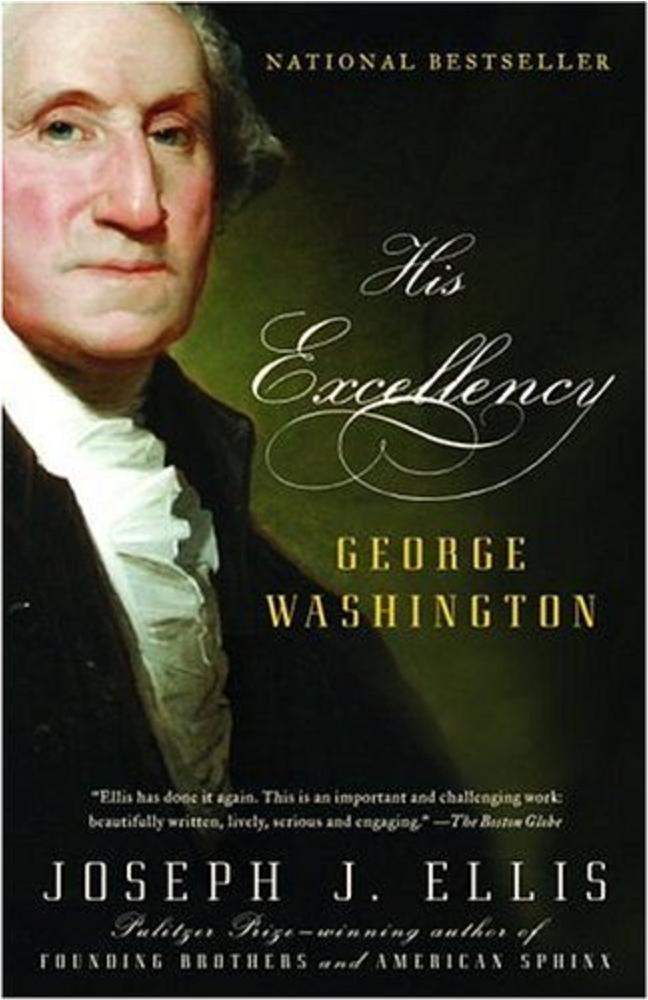
His Excellency George Washington
by Joseph J. Ellis
(Knopf, 2004, 352 pages)

"It seemed to me that Benjamin Franklin was wiser than Washington;  Alexander Hamilton was more brilliant;  John Adams better read;  Thomas Jefferson was more intellectually sophisticated;  James Madison was more politically astute.  Yet each and all of these prominent figures acknowledged that Washington was their unquestioned superior".

Our first glimpse of Washington is usually through the tale of the cherry tree ("I cannot tell a lie, I did cut it with my little hatchet").  This, of course, never happened.  Despite its fabrication, however, it comes extraordinarily close to depicting the essence of Washington's character.  His Excellency is itself a tale, a true one, of a man with remarkable judgement and unmatched leadership.

It is Ellis's analysis of such leadership that will give the book relevance for many readers, but it is the origin of Washington's qualities that will make His Excellency such an important contribution to America's history.  Ellis has not only produced, in his own words, "a fresh portrait tightly focused on Washington's character", but a blueprint for leadership.  A Prince for nice guys.

Unlike the hypothetical Prince, however, Washington lived and breathed as we do today.  Ellis places great weight on Washington's lack of education -- the first President only received the equivalent of our grade-schooling.  Ellis argues that his judgements during the key moments of American history "derived in part from the fact that his mind was uncluttered with sophisticated intellectual preconceptions".

Unlike Jefferson, Washington knew that the French Revolution would end in blood.  And unlike several of his revolutionary brothers, Washington knew that "nations were driven by interests rather than ideals".  In a prophetic letter to his friend Lafayette, Washington would predict that "however unimportant America may be considered at present, there will assuredly come a day when this country will have some weight in the scale of Empires".

Where exactly this quality of judgement derived from has been much debated by historians.  Although we can never conclusively understand the psychology of Washington, Ellis has nonetheless been able to trace particular experiences that would have shaped his beliefs.  The failure of the Continental Congress to provide sufficient resources to Washington during the War of Independence seemed to have stemmed his determination to create a legitimate central government.  His commercial relations with the British Merchant Robert Cary meant that his beloved Mount Vernon would be economically dictated to by a company thousands of miles away.  The increasing failure of his tobacco crops to provide a sufficient income saw him switch to the production of wheat, as opposed to those who simply demanded higher prices (there was no "fair trade" 200 years ago).  Washington's grasp of simple economics allowed him to be one of few who would die without debt.

Such "rock-ribbed" realism would become the backbone to Washington's decisions.  The Jay Treaty, a highly controversial agreement with the British that would remove redcoats from the frontier and improve commercial relations with Britain (an act that the newly liberated populace would regard as semi-betrayal) is such an example.  This would pale by comparison, of course, to the monster predicament of American slavery, "the one issue with the political potential to destroy the republican experiment in its infancy".  Washington's decision to halt the slavery debate until 1808 could be seen as a moral failure by contemporary historians.  But Ellis stands strong on the grounds that Washington had one priority in sight:  Cement the nationhood of the United States of America.

Had Machiavelli been around to witness the ascent of Washington, perhaps The Prince would read a little differently today.  He may have noticed, for instance, that the power of an individual can long exceed death.  Washington's vision lingers on because it was a shared vision, moulded from real life experiences, and not simply the ambitions of one man.  As Ellis explains:

Unlike Julius Caesar and Oliver Cromwell before him, and Napoleon, Lenin, and Mao after him, he understood that greater glory resided in posterity's judgement.  If you aspire to live forever in the memory of future generations, you must demonstrate the ultimate self-confidence to leave the final judgement to them.  And he did.

Australia SOLVED

Australia Fair
Hugh Stretton
UNSW Press, 2005, 294 pages

For a mere $75 billion per year, Hugh Stretton knows how an Australian government can easily provide large doses of addictive social engineering.  Stretton proposes a suite of policies to do "whatever it takes in our changing historical conditions, by old and new means, to keep Australia fair.  Contrive full and shared employment ... Continue women's progress to genuine equality at home and at work ... reduce the scale of our inequalities".

The first chapter in Stretton's book is "Leaders", with a fulsome tribute to "Nugget" Coombs in his capacity as Keynesian social engineer and benefactor of the Aborigines.  This conveniently sums up a number of the problems with the book.

As far as economic policy goes, his solutions are massively out of date.  The bubble of Keynesian demand management has collapsed, leaving the problem of explaining how anyone ever thought that inflation could be traded off against unemployment, without addressing the fundamentals of productivity and the abuse of trade union power.

Underpinning Stretton's policy proposals is the assumption that the role of government is to channel resources from one group to another group according to the preferences of the policy-maker -- instead of allowing the maximum scope for choice by people to make their own plans to achieve their desired lifestyles.

Stretton is so captivated by the idea of fairness (usually called "social justice") that he has been blinded to the most obvious dangers of the unintended consequences that arise from the perverse incentives generated by schemes such as the proposed parent wage (a minimum wage for anyone who stays home to look after a child up to the age of seven).  One can envisage communities of single parents, suffering from the same collapse that has occurred in tribal communities -- circumstances which presumably inspired this book to be written in the first place.

The arguments for this massive programme appear at first sight to be well organised and backed by a prodigious display of statistics.  Stretton has been reading and writing for over 60 years of professional life and the bold sweep of his vision tends to distract attention from the errors and muddled thinking in the details.

Stretton projects an image of fairness with a chapter "How not to argue" (refrain from parody when presenting the arguments of opponents), but he is too committed to his agenda to be diverted even to consider small government or deregulatory options.  His policy prescriptions veer off in the direction of big government interventions like a heavily biased bowling ball.  For example, his section on the environment would be improved by a realisation of the way that property rights and market forces can promote conservation, rather then the reverse as he appears to believe.  This tendency to selective vision is exemplified by his uncritical acceptance of the deeply-flawed research of Michael Pusey.

The chapter on "National Objectives" urges essentially Scandinavian levels of intervention and cradle-to-grave welfare, then a chapter on "Work" demands full employment.  "Every consideration of economy and humanity should drive us to see that there is paid work for everyone who wants it".

Stretton's attitude toward labour policy is particularly blind.  Instead of engaging with the free-market case for the elimination of minimum wages, he simply dismisses such policies out of hand.  "[Some] oppose most minimum wage requirements, claiming falsely that they always reduce employment and economic growth (opposite effects are just as frequent)".  No evidence is cited and he proceeds to consider the array of interventions that might "retain particular industries or limit foreign ownership of them".

He writes that we have "long had the world's best institutions for debating and determining the wages and conditions of paid work" (p.113), forgetting that the wage-fixing system was an immediate cause of mass unemployment in the Great Depression, when adjustments to award wages were out of proportion to other market prices.  Similarly, the Aboriginal stock-workers in the Northern Territory were swept out of employment by an "equal wage" case, decided by distant judicial figures against the advice provided by people who knew the industry.  Examples of misguided wage-fixing in twentieth-century century Australia are easy to come by.

Education is another area where Stretton appears to have hugely inflated expectations of the gains to be made by increased government spending.  He would have every public school funded to the level of the non-Catholic private schools.  Unfortunately, the shortcomings of public education have next to nothing to do with funding.  During the last three decades, the quality of public education declined precipitously while funding increased (in real terms per capita).  This decline has been caused by a range of policies and cultural factors, not least the infamously militant teachers unions.  No account of public education in recent times is complete without paying attention to the way that the teachers unions resisted or sabotaged efforts to obtain accountability and quality in public schools.  Stretton provides no strategy to address this key problem.

As to the universities, he has legitimate concerns about the incursion of the micro-managers, but it should be noted that the decline of the universities is not a recent event.  They were subverted by excessively rapid growth and the politicisation of the social sciences and the humanities, both of which happened on his watch -- or at least the watch of his generation of senior academics, planners and administrators.

The wide range of policies canvassed in the book presents a challenge to readers and reviewers who have not been working actively on a similarly wide front.  For that reason, I will refrain from comment on his suggestions for superannuation and his speculation on the many thousands of people who might be required in the schools, hospitals and the building industry to make good his programme.  No doubt his ruminations about a form of fiat money to be issued by the Commonwealth for certified public works will raise a storm of protest from some quarters.  It appears that he has undimmed confidence in the potential for Keynesian demand management to handle the inflationary pressures that his schemes will generate.

At the end of the book he returns to the theme of full employment because unemployment is the single most important contributing factor in poverty and disadvantage.  It may help to shelve some disagreements for a moment and take a stand on this common ground -- the need to ensure something approaching full employment of all those who are able to work.  This is where welfare, wage-fixing and taxation policies need to work together, with the elimination of minimum wages so that nobody is priced out of a job, and a reduction in the de facto tax rate when a welfare recipient takes up paid work.  Progress in this area could achieve major gains that Stretton would applaud -- that is, major improvements in the prospects of the least affluent people.  Unlike his pie-in-the-sky scenario, this policy mix involves virtually no government outlays.  This looks like the best kind of win/ win outcome and one hopes that Stretton and his colleagues might revisit some of their core beliefs and especially consider the way that full employment is rendered illegal by minimum wage regulations.

How to win friends, influence people and also be a premier

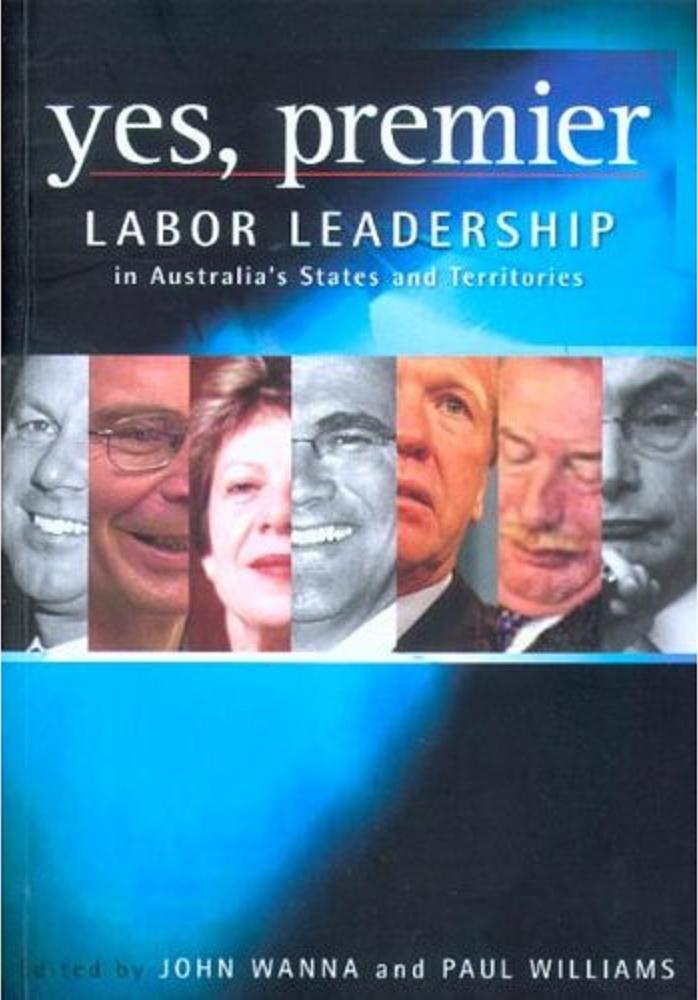
Yes, Premier:  Labor leadership in Australia's States and Territories
John Wanna & Paul Williams (eds.)
UNSW Press, 2005, 276 pages

It was bound to happen.  Although it must have been irresistible to publish an anthology about the royal flush of ALP State leaders, it's surely a book with a great chance of becoming very dated, very quickly.  And so it was, for two of the premiers featured in Yes, Premier have already exited:  Bob Carr and, far more unexpectedly, Geoff Gallop.

The essays in Yes, Premier focus on the leaders who have been at the helm in each Australian State and Territory since 2002 when, for the first time since Federation, each government has been held by the ALP.  It examines how each premier or chief minister rose to power, and their political "style".  It also provides personal details and biography.

Ironically, given his recent departure, the chapter on Geoff Gallop highlights the narrow professional experience of each office holder, before entering politics.  This is most starkly drawn in one of the book's useful tables, which contrasts each premier's and chief minister's résumé.  Here we see three journalists (Bob Carr, Mike Rann and Clare Martin) four unionists (Carr once again, along with Steve Bracks, Paul Lennon and Jim Bacon), and three political staffers (Bracks and Rann, as well as Jon Stanhope).  There's no significant business or private-sector experience, and minimal academic achievement.  Geoff Gallop, whose qualifications include a D.Phil. from UWA and an MA from Oxford, is the one notable exception.

Yes, Premier has in several ways drawn out the similarities and differences between the premiers and chief ministers -- such as the tendency of many to emerge after long periods in opposition, or initial terms of minority government.  For example, despite the sometimes contrary tendencies of contemporary voters, many of the State and Territory Labor parties have transformed initial uncertainty into majority government and consecutive election wins.  Usefully, Wanna and Williams continually ask to what extent Labor's good fortune in each State and Territory has been assisted by the Coalition's domination at federal level.

Yes, Premier is well researched using contemporary primary sources.  It's not clear though that the conclusions reached in the final chapter, "Leaders and the leadership challenge", are supported by the preceding chapters.  Certainly the featured leaders have similar trajectories, and the argument that crisis-management has become a political norm has merit.  But it's less sustainable to argue that eight features, identified by Wanna and Williams, comprise a "new form of state/ territory leadership".  While some of these have clear application (such as "embracing accountability", in part as a response to the cavalier approach to economic management that blighted many ALP governments of the 1980s), others are far less obvious.

Watching the current internal conflicts of the Victorian ALP as it administers State and Federal pre-selections, it is hard to argue that machine politics have declined, and that relative independence has been achieved from the traditional Labor power base, the union movement.  This section of the book seems a long way removed from the reality of Labor politics that is being played out today in a relatively public fashion, for all to see.

In other ways, it's an idealised view of democratic processes as seen in State politics ("leaders have initiated and championed extensive processes of community consultation and participation, as part of the new politics of engagement more seriously with citizens").  Several of Wanna and Williams' eight features could equally apply to federal politics:  it's arguable that John Howard shows "cautious pragmatism", "anticipatory and receptive leadership" and, most of all, "the cultivation of ordinary populism".

Shaping Europe

Postwar -- A history of Europe since 1945
By Tony Judt
(Penguin, 2005, 608 pages)

This book is a most remarkable and readable history.  Tony Judt has woven a rich, 800-page tapestry of European recovery with an overall pattern of leaders successfully avoiding the mistakes of the interwar years, binding their countries together first by expanded intra-European trading, then to the technocratically conceived European Community and so to the present European Union.

Like any good tapestry, there are asymmetries and errors in the pattern as each country develops.  The pile is deep with colour -- The Who, the Sex Pistols, "brutalism" in architecture, the cinema and the intelligentsia all make their contribution, as do the dry facts of population and economic statistics.  In short -- or long -- the book is a "tour d'horizon" and a fascinating read.

Judt begins at the end of 30 years of "civil war" amongst the nominally Christian states of Europe, where some 60 million citizens met their death as soldiers or civilians.  It is extraordinary to those of us born too young to experience these events that societies could be so driven by their leaders.

The central countries are France and Germany, both starting with a troubled body politic.  For the Germans, how to deal with the Nazi legacy?  The immediate post-War generation "never mentioned the war".  It was left to the next generation to confront the issue, as Germany became the economic powerhouse of Europe.

For the French, the Vichy regime with Nazi collaboration was treated similarly.  Paris became the intellectual centre of Europe, and for Jean-Paul Sartre and his colleagues, socialism had historical inevitability.

The remarkable growth of Europe was propelled by the post-War baby boom.  This generation grew to adulthood in the 1960s.  They were better educated than their parents, had their own independent income and spent it on clothes and their own culture of music and film.  The increasing student numbers in the '60s put great pressure on universities, which expanded mightily.  It was a time of student rebellion which led Isaiah Berlin to write, "The rebellion of the unrepentant bourgeoisie against the complacent and oppressive proletariat is one of the queerest phenomena of our time".

Perhaps the most striking political events had started in the 1956 Hungarian uprising and culminated in the Gorbachev perestroika of 1987.  The collapse of the Soviet empire and the Soviet Union finally occurred in a peaceful manner, something that could not have been accomplished from the outside.  The evidence of economic and political failure destroyed the belief of the intelligentsia that socialism was inevitable.  Hardliners in France held on, as did those in Eastern Europe who hoped the collapse of the Soviet Empire would permit the birth of true socialism.  They were ignored.

Europeans accomplished the European rebirth.  European culture was protected.  The French sheltered their film industry and, more particularly, their language.  But as the European Union expanded, the role of the French language ceased to be central and English became the universal language of second choice.

This history also touches on the loss of three great empires:  the British, French and Russian.  The British had some practice at losing parts of their empire, but were greatly troubled by Northern Ireland.  The French had the trauma of North Africa, and the Russians suffered the most rapid collapse.  These countries, as middle ranking powers, turned back to Europe, with Britain and Russia on the edges and the French at the centre again, as in the nineteenth century.

These events occurred on the far side of the planet and we did not experience them directly.  However the events did shape Australia with the waves of immigration that brought our great post-War expansion in people, culture and achievements.

This European story has been brilliantly told.  It will be told many times.  The Polish saying, "The future is certain, only the past is unpredictable" will no doubt apply.

Saturday, April 01, 2006

Wastrel states have squandered their reform bonus

Treasurer Peter Costello should hold the line on competition payments when he meets his state counterparts today.

A new wave of public sector reform is certainly long overdue.  However, pumping more money into the already overfunded and failing states will not advance the pace of reform.

The case for competition payments to states is starkly different today than a decade ago when National Competition Policy was first established.  At that time many states were in a weak budgetary position and short of the funds needed to facilitate structural change.  Most states, led by Jeff Kennett in Victoria, were in a reforming state of mind, so any money given for reform was likely to be spent on reform.  There was a widely held view that the states lacked a tax that would expand with growth and would not adequately share in the benefits of reform.  There was also the cynical, yet sadly accurate, view that the states would act only if paid to do so.

Now all states, with perhaps the exception of NSW, are in good fiscal shape, with low debt and surplus budgets.  None of them are in a reforming state of mind, unless you call throwing money at every problem and interest group "reform".

Importantly, the states have and are continuing to reap a huge reform bonus.  The idea that the states lacked a growth tax was always nonsense.  Payroll tax, land tax and conveyance fees, even in the distorted form levied by the states, are growth taxes.  And, of course, the states have received the proceeds of the GST for going on six years.

Between July 2000 and the end of June 2005, the states' revenues exceeded initial expectations by $70 billion.  To put this into context this is nearly three times what the states are demanding from the commonwealth over the next 10 years to undertake the next wave of reform.

These windfalls have been generated by the application of high taxes on a fast growing, reform-charged economy -- in short, they constitute a reform bonus

Even NSW, the state that has whinged the loudest about lack of funding, has received a revenue windfall of $20 billion over the last five years.

Of course the states are aware of this largesse and where it came from:  past reforms.  However, they have decided to consume it rather than invest in more reform or new infrastructure.

About $65 billion or 94 per cent of the states' reform bonus has been consumed by additional, recurrent spending.  The majority of this has gone on more and higher-paid public servants.

Less than 6 per cent of the bonus has been used to fund new infrastructure.  Queensland has allocated the largest share (32 per cent) of its bonus to infrastructure, NSW and Tasmania the least, which is zero.

On the reform front, the states have done little more than was required to get the NCP payments and the GST revenue.  Despite being awash with cash, no state has gone beyond what was forced on them by the commonwealth.

The electricity industry remains in public ownership in NSW and Queensland, which is distorting investment decisions in the national electricity market.

All states confront major structural challenges in their public hospitals, mental health programs, public schools, TAFE and public transport systems.  Yet with few exceptions they have done little more than pump more money into failing systems.

Even though the NCP process achieved much, it had serious flaws and left much to be done.  Its regulation review process had holes large enough to drive busloads of bureaucrats through, and most the states have done so.  During the 10 years of NCP, the volume of state laws and regulation has increased by 75 per cent.  New, flawed laws and regulations were passed without real scrutiny including in town planning, agricultural biotechnology, native vegetation management, alternative energy, occupation health and safety, and industrial relations.

While the states have taken and consumed the bounty from the GST revenue, they have failed to meet the letter, let alone the spirit, of the GST agreement.  No state has eliminated in full the ranges of taxes agreed to under the GST deal.  Moreover no state has used its bonus to reform its remaining tax system.

The states do not need more money.  Indeed, if they get more they are likely to consume it.  Rather, they need to start using their reform bonuses for reform.

Costello's response to his state colleagues should be:  "You have got the money, be responsible, deliver the action or give it up".


ADVERTISEMENT

Friday, March 31, 2006

Don't be too transported with delight

We should not be blinded by the euphoria over public transport's success in servicing the Commonwealth Games.  Public transport can work well when lots of people are converging on a common destination and can operate smoothly (if at a cost) if it vastly increases its staffing.  Even before the Games started, there were claims of an imminent resurgence of (presumably commercially viable) light rail and suggestions that it is car users not public transport users who are subsidised.  And there have been many suggestions that the steady decline in the share of public transport is being or could easily be reversed.

In his article (Business, 7/3), Joshua Gans suggested an approach involving road pricing and making public transport free, for which he accepts an estimate of costs at $340 million a year.  He believes these two policies could considerably relieve congestion.

It might well make sense to charge more accurately for the costs of the road space used at the time of that use.  This is notwithstanding that people already pay twice as much in fuel and registration taxes as governments spend on roads.

That said, road pricing is a one-sided approach.  Public transport is even peakier than road usage.  Would it not make equal sense to charge public transport users in a similar manner to road users?

This would be even-handed;  and surely this is preferable to having governments making people's choices for them.  As public transport is highly peaked (and in any case fares cover only 20 per cent of the costs) the logic would be to charge considerably more for peak-hour travel.

A further problem is one of monopoly.  As government has the exclusive power to allow or to prevent the building of new roads, might it not see road pricing as a taxation bonanza?  The prospect of obtaining increased tax revenue would prove irresistible to some governments and encourage them to allow a scarcity of road space to develop.  Governments' enthusiasm for this would be constrained only by fears that they might deprive the city of the transportation services it needs to flourish.

These matters aside, although free public transport would certainly attract more patronage, it would not attract as many as its advocates think.  This can be tested by observing the transport choices of workers in the public transport industry, who already actually travel for free.  The number of workers' cars parked at tram, train and bus terminals is testimony to the attractions of car travel even to people who are far from affluent and work within the industry itself.

Sadly for those favouring public transport, the tide of demographic history is a swift current running against them.

Public transport needs high concentrations of people.  A rule of thumb is that rail-based systems require 40,000 people per square kilometre to be viable.  Such a system therefore works, after a fashion, in Hong Kong, which has that population density.  Express bus systems need 26,000 per sq km.

Melbourne's density is 1500 people per sq km and reaches only 5500 even in the densest suburb (Port Phillip).  On top of this, concentration levels have been falling for decades in spite of land rationing by successive governments, which is designed to promote denser urban living.  Even an intensification of this government-created shortage of land would not reverse this trend.

The estimates of what is required for a viable public transport system with growing patronage levels are also being pushed up due to the changing nature of work places.  More and more trips are cross-town.  These trends are exemplified by a declining share of employment in central areas, where radial public transport systems work best.  The proportion of jobs in central Melbourne fell from 55 per cent to 28 per cent of the total between 1961 and 2001.  In that latter year, the central business district accounted for only 10 per cent of jobs.

This has immense ramifications for planning, especially road development and public transport.  Not only is Melbourne getting less dense but the trip profile is becoming far more dispersed and difficult to jam into a public transport service.

The car is the preferred means of transport unless parking is expensive.  Trying to discriminate against it not only offends against personal choice but will reduce the value of the city and jeopardise its future attractiveness as a living, working and leisure centre.


ADVERTISEMENT

Thursday, March 30, 2006

Labor has lost touch with what matters to Australians

It is easy to blame your enemies when something goes wrong.  For many in the ALP, the fact that their party hasn't won a federal election since 1993 is entirely the fault of right-wing commentators in the tabloids and on talkback radio.

In two public speeches over the previous fortnight, Julia Gillard, aspiring Labor leader and its health spokeswoman, has explained her understanding of the conspiracy.  The commercial media has an "overwhelming pro-Howard bias", and the Government has "stacked" public bodies such as the ABC and the High Court.  According to her, the outcome of all this is that the ALP has lost the debate about Australian culture and values.  Her solution is to vigorously "fight the right" and for her party to start talking about its own values.

Gillard's analysis provides a convenient excuse for the failures of the ALP, but it is fundamentally wrong.

To begin with, the ABC after a decade of the Coalition is no different from how it has always been, and the Government has probably appointed to the High Court as many judges who vote Labor as who vote Liberal.  A key public institution that Gillard did not mention, our taxpayer-funded universities, continue to be overwhelmingly populated by academics who are anything but right-wing.

If the right really does have the sway Gillard imagines, then it might be expected that this would be reflected in state politics.  But it isn't.

Australia has wall-to-wall state Labor governments.  The difference is that at the state level the ALP is largely conservative and pragmatic, while federally the left of the ALP has largely taken control of the party's debate about values.

It is not Labor's opponents that are making federal Labor unelectable.  It is Labor and its values that are making the party unelectable.  And the proof of this is revealed in the attitude Gillard displayed last week.

She made great fun of John Howard as a throwback to the 1950s and "the monocultural world he remembers, of white picket fences shielding white families".  In 1988 John Howard's policy statement Future Directions famously featured a father and a mother and their two children standing outside a house surrounded by a picket fence.  For as long as Gillard remains obsessed with the colour of the faces and the colour of the fence, there's no hope for Labor.

The images of Future Directions are of three things:  a job, a family and a home.  Gillard might laugh and think that the desire for those things is old-fashioned, but that just demonstrates how out of touch she is.  And if she believes that it is only white Anglo-Saxons that aspire to those things, she is sadly mistaken.  From the 1940s to the present, migrants and refugees of every skin colour have come to this country in search of the very things that Gillard scoffs at.

The irony of Labor's situation is that it was once proud to champion the values of prosperity, family and the economic security embodied in a home of one's own.  Now it seems that it would prefer not to talk about them.

Certainly the nature of the family has changed since the 1950s, but the reality is that individuals would still prefer to live in a loving and caring family relationship.  One of the few groups in society not afraid to discuss the role of the family are the evangelical Christian churches, and it is no coincidence that Labor is profoundly uncomfortable in dealing with them.  Rather than trying to understand the rise of the new Christian churches and their attraction to hundreds of thousands of Australians, Labor simply dismisses them as the "religious right".

During the last federal election campaign, the ALP could not counter the claim that the Coalition was the better at handling the economy.  So instead, what the ALP did was to imply that any voter concerned with their home mortgage interest rate was only being selfish.  There are significant elements of the Labor Party that have always held in contempt the skills of effective economic management, but whether they like it or not, it is the economy that is the source of people's employment.

Joblessness in a household is one of the major causes of family break-up.  In her speech to the Fabian Society last week, Gillard did not once mention the economy.

She spoke of the need for Labor to offer "a vision of the future based on values that endure".  Eventually Labor will understand that those enduring values are centred on people's work, their family and their home.


ADVERTISEMENT

Sunday, March 26, 2006

Victoria must play role in tax reform

The Commonwealth Games are nearly over.  They have been well managed, great fun and the athletes have been magnificent.

But have you ever wondered how the Government has been able to foot the very sizeable bill with almost effortless ease?

Well, Steve Bracks and his team have experienced one of the largest revenue windfalls in this State's history and they are actively spending it, including on the Games.

From 2000-01 to 2004-05, the Bracks Government received a revenue windfall of $17.6 billion, or a 20 per cent increase in expected revenue.

The main generator of this largesse has been the State's own taxes.

When the GST was first introduced in 2000, the tax cuts as part of the GST deal were expected to result in sharp cuts in state tax revenue.  This was not expected to be recovered for at least seven years.

The prediction turned out to be far off the mark.  The economy boomed.  The State's three growth taxes -- payroll tax, land tax and conveyancing fees -- pulled in money at a record rate.  Total tax receipts were $7 billion or 18 per cent higher than expected over the past five years.

Then there was the GST.  Over the first five years of its existence, revenue from the GST and other Commonwealth grants exceeded expectations by $4 billion.

In the main, the Bracks Government has done little more than maintain the status quo on tax and GST.

It has twice, with great fanfare, announced tax cuts.  However, these have been minor changes with little impact on revenue collections.  And it inherited the GST deal and has met its commitments.

The Kennett Government undertook many reforms but did nothing on tax.  It raised a number of non-business taxes to help reduce the budget deficit.  It subsequently did not lower these or other taxes, so the Bracks Government inherited one of the most aggressive state tax systems.

As such, Steve Bracks has been able to do little while the money has rolled in at an increasing rate.

The Bracks Government, meanwhile, has increased receipted fees, fines and user charges by 25 per cent over the past five years.

A small proportion of the revenue windfall -- $2.4 billion or 19 per cent -- has been spent on expanding the State's infrastructure base.  The rest -- $15.2 billion -- has been consumed.

About a third of the windfall has been consumed on more and higher-paid staff including front-line staff.  But for every additional teacher, nurse, doctor and police person hired, the Bracks Government has hired an additional bureaucrat.

The remainder of the windfall has been consumed in an ongoing spending spree, including the Games.

Ron Walker has warned that we may suffer a bout of depression when the party is over.  I suspect he is right.


ADVERTISEMENT

Saturday, March 25, 2006

Let business get on with it

We would be better off if the government stopped meddling in R&D.

Who was in charge of the development of personal computers?  The answer, of course, is that nobody was in charge.  The evolution of computers is the story of individual firms competing to make better products to meet the needs of consumers.

Politicians and industry lobbyists should remember this obvious truth whenever they talk about the need for national leadership on science and technology.  The point about the evolution of computers is made by English economist John Kay in his recent book The Truth About Markets and it highlights the perils of thinking that all that is required to turn Australia into the research and development (R&D) capital of Asia is a little bit of planning.

Occasionally government can assist in commercialising technology.  However, most of the time government only succeeds in getting in the way, and indeed this is one of the main findings of a study by the Business Council of Australia released last week.  The report found that corporate governance procedures are "killing" innovation and the "accountability industry" is creating a risk-averse culture within companies, while high levels of personal tax restrict the capacity of firms to attract highly qualified people from overseas.

The Productivity Commission's inquiry into science and innovation policy announced earlier this month could take the Business Council's report as its starting point.  The issues the commission will examine include the impediments to "the effective functioning of Australia's innovation system" and the impact of R&D spending on the country's economic performance.

The commission might consider whether it is even appropriate for Australia to have an innovation system at all.  Innovation is the last thing that can be squeezed into a system -- particularly a system run by the government.

In its first term the Howard government cut back allowable deductions for private R&D spending to stop the rorting of the scheme.  The outcry was so loud and continued for so long that in 2001 the coalition was forced to invent Backing Australia's Ability, which promised $50 billion of government spending on science over 10 years.  That additional money was far in excess of what had been saved as a result of the coalition's earlier decision.

A draft report from the commission is due within 12 months, although it shouldn't take it that long to establish three basic facts.

First, there is no relationship between a country's spending on research and its economic growth.

According to the Organisation for Economic Co-operation and Development in 2003 (the most recent year for which data is available), Australia devoted the equivalent of 1.6 per cent of its gross domestic product to R&D expenditure.  The comparable figure for the United States was 2.6 per cent, for other countries in the OECD it was 2.2 per cent, and in Sweden, usually cited as the paragon of R&D virtue, it was 4 per cent.

However, when it comes to average annual growth rates over the 10 years to 2004 the story is very different.  Growth in Australia was 3.7 per cent, in the United States it was 3.3 per cent, and across the OECD it was 2.6 per cent.  Sweden's growth rate was little better than average at 2.8 per cent.  Australia's record over that decade was no fluke and wasn't simply the result of the mining and energy boom of the past few years.  Clearly there are many more factors to economic success than just R&D spending.

Second, the level of national spending on R&D is an outcome of the structure of a country's economy.  Australia doesn't have, for example, the high-tech military or aerospace industries that sustain high levels of R&D.  For the foreseeable future the services sector will be an important driver of growth for our economy, but on traditional measures, services generate relatively little R&D.

Third, there is no relationship between a company's spending on research and its business success.  As the Business Council report recognises, it is one thing to spend money on research but it is an entirely different thing to create wealth from research and ultimately to make a profit on it.  The most innovative firms are not necessarily the ones with the largest research budgets.

While it is unfashionable to say so, the best way that government can encourage companies to undertake R&D is to get out of the way.  The only problem is that governments find it much easier to spend money than to remove the regulations that prevent businesses from going about their business.


ADVERTISEMENT

Thursday, March 23, 2006

Can the future be made future-proof?  Directions for telecommunications, media, and public policy

HV McKay Lecture on Technology,
Melbourne, 7 March 2006


It is a great privilege to deliver the H.V. McKay Lecture on Technology for 2006.  H.V. McKay has been one of my heroes for more than 10 years.  I learned of Hugh McKay in Lismore during a lecture tour around Australia in 1995, when I visited nine cities -- beginning in Melbourne and ending in Cairns.

In Lismore I discussed with state and local leaders how regional institutions are used in the US to improve the quality of life in sparsely-populated regions of the American West -- a region very much like Australia.  During these discussions, I learned about Australia's Royal Flying Doctor Service.  McKay's support for the RFDS inspired me to learn more about him and I was fascinated by his biography. (1)  McKay's business interests focused on manufacturing farm machinery, where he operated the nation's largest industrial plant in the early 1900s.  But he also pioneered advances in mass production techniques;  and he stands out as one of Australia's early large-scale exporters, selling his invention, the Sunshine harvester, around the world -- from Argentina and New Zealand to Chile, Russia and South Africa.

McKay's sensibilities are very relevant to contemporary Australia -- not the least because of his unending commitment to make investments to advance the national interest.  McKay used much of the wealth he accumulated from his wide-ranging business interests to finance public interest projects like the Flying Doctors.

He also showed a strong interest in major infrastructure projects -- including social infrastructure such as parklands, schools, libraries and other public buildings.  In the spirit of the evening's namesake, I want to use my time to address some of the lessons from the life of H.V. McKay including:

  • how inventions can change the course of a life and a society.
  • why investments must be profitable.
  • the importance of building social and physical infrastructure.
  • our civic responsibility to focus on improving standards of living.
  • the quality of life for all Australians, no matter where they live.

AUSTRALIAN CULTURE

Even though I have been out of Australia for about eight months, people still ask me, "What has surprised you most?"  I spoke in Canberra in early December last year to answer that question in relation to government and politics.  Tonight, I would like to answer that question in relation to Australian culture.

Aspects of Australian culture that I have enjoyed the most include events at the Opera House, Aussie sports and Aussie films -- from The Castle and The Nugget to more recent releases, such as The Oyster Farmer.  Of course, I should include the made-for-TV episodes of Kath & Kim.  Truth-to-tell, I have watched only four of the 24 episodes -- a gift of my Aussie cultural guru.  As for the remaining 20 ... can't really say when I will get to them.

I love the movie The Castle.  As you know, it's a theme I keep coming back to -- mums and dads trying to save their property from Government confiscation.  When I recently reminded a friend of mine of the important lessons from the The Castle -- including the fact that the mums and dads beat the system -- he said, "Remember, it's only a story."


FUTURE-PROOFING

Still, there are a couple things about the culture of public discourse that both surprise and fascinate me.  One, in particular, is "future-proofing" -- and especially the way elected and civic leaders, the media and the public in general appear to accept this notion of "future proofing".  I had never heard this phrase before outside of Australia.

It is a curious and bewildering phrase to my way of thinking.  There are lots of things I want to be "proofed" from.  I want to be:

  • bullet proof.
  • fire proof.
  • burglar proof.
  • water proof.
  • fool proof -- especially fool proof.

But "future proof?"  Those words suggest you don't want to be surprised or that somehow you want to control the future.  It's like saying you don't want anything to change.  If that is the case, that would be a very boring life.  Imagine, no more:

  • surprise birthday parties.
  • inventions.
  • revolutions.
  • marriage -- or for real surprises, marriages.
  • kids.
  • family life.
  • work and bosses.
  • politics.

Almost everything that makes life interesting involves surprises.  Think about the world of technology, where we are surprised all the time.  New technologies -- like the micro chip -- are not only surprises, but, even more importantly, they typically have impacts and consequences that were never anticipated by their inventors and pioneer users.

Consider the railway.  The application of technologies that were integrated into what we call the modern railway included things like:

  • trackage.
  • rolling stock.
  • steam engines.

The invention of the railway led to many surprising innovations -- including:

  • the Pullman sleeping car.
  • Westinghouse air brake.
  • electronic signalling systems.
  • refrigerated freight cars.
  • remote electronic switching.
  • standardised rail separations that permitted the inter-connection of passenger and freight cars from one railway to another.

But the real economic, social and cultural importance of the railway extended way beyond improvements that were made in the technologies and practice of moving rail cars over fixed trackage. (2)

The impact of the railway was huge and had enormous spillover effects.  For example:

  • The railway had major economic impacts, especially in the economic development of the US, Russia, Canada, Australia and other large, continental countries.  Reason:  Railways reduced the costs of transportation and increased the speed to market -- especially for agricultural goods that were often produced in the hinterland.
  • The railway led to social inventions.  For example, the need to develop reliable railway schedules led to the establishment of time zones -- which occurred first in the US and quickly spread to the rest of the world.
  • The railway led to the demographic decentralisation of society, with human settlements able to prosper away from seaports and inland waterways. (3)
  • You can even make the case the railway led to what we call the "green revolution" -- advances in agriculture that ended famine and starvation that were regular features of life in India, China and many other parts of the world.  But that is a story for another time. (4)

Consider the automobile.  The impact of the automobile is much bigger than:

  • electric starters.
  • power steering.
  • paved roads.
  • traffic control signals.

The biggest impacts were cultural, changing the way we live, work and play.  The automobile led to:

  • drive-in movies.
  • motels.
  • more sexual freedom.
  • drive-through fast food.
  • suburbs.
  • sprawl.
  • more personal freedom and mobility.

The same goes for the compass.  The compass was more than a better way to find your course around on the planet especially on the oceans where the traveller-navigator had no landmarks for using dead-reckoning methods of navigation.

The improved ability to navigate on the oceans created by the compass led to: (5)

  • the ability to sail in all kinds of weather since the compass relieved the navigator of the need to be able to see the stars or track the shoreline.
  • the construction of larger ships because the compass dramatically reduced the dangers of running aground, (6) and the ability to sail long distances, opening up global trade routes which, in retrospect, we now know, sparked unprecedented wealth creation. (7)

The point is that future proofing can't be done ... and shouldn't be done.  Policies required by future proofing will inevitably prevent innovation and stifle creativity.

This is not to say we shouldn't practice risk mitigation and risk management -- e.g., "fix the roof while the sun is shining" or strategies for adaptation in the light of new technologies or changing consumer needs.  But these are dynamic, outwardly-focussed concepts and are very different from the static and defensive concept of "future proofing" as it used in Australia. (8)

Static, defensive, micro-managed notions of the future are bewildering to me because, to my way of thinking, man was created to make the world a better place.  That means to change things,

  • to invent things.
  • to upgrade, advance, and perfect.
  • to engage in a process of continuous improvement. (9)

THE FUTURE DOESN'T NEED PROOFING

Indeed, both non-religious secular philosophies and most of the world's great religions affirm that we are created -- or evolved, take your pick -- to make the world a better place and especially that little part we can influence -- our kids, our family life, our communities, the enterprises we work in -- to leave that part of our world a little better that we found it.

So, I would think that the worldviews that most of us hold -- whether secular or religious -- would throw doubt at the notion of being "proofed" against the future.

Of course, I understand that those who call for "future proofing" in Australia are concerned that some people -- especially those in the bush -- might be "left behind" by the process of change.


PUT FAITH IN MARKET MECHANISMS

But market mechanisms, not more government controls, remain the best way to ensure progress -- in the case of telecommunications, that new and better services continue to be delivered to everyone.  If market forces are not used, the alternative will be -- favoured companies, favoured technologies or government-owned or government-directed facilities.  Government intrusion that tries to "pick winners" or decide how private enterprises should plan, manage and deploy capital is asking for future agony, not future proofing -- as innovation is stifled and investment dries up.

In fact, if you encourage investment, leave the market to innovate, and remove barriers to the deployment of new technologies and services, the often-regretted digital divide will be bridged.  Where natural markets do not exist, vouchers or other market-based mechanisms can be used to create market forces that will attract private sector providers to provide services in rural and remote areas that are otherwise beyond commercial arrangements.

Where markets are imperfect there is a role for Government to make sure the benefits of new technologies is shared as widely as possible.  However, this role is not to be a builder or operator that will freeze consumers into a static system.  The last thing we need is a communications "industrial policy" with a technology and service delivery bias based on onesize-fits-all, the default approach of government.

Keeping up with the future requires change, innovation and removing barriers to investment.  It didn't take government "future-proofing" for Hugh McKay to develop the Sunshine Harvester which brought enormous benefits to rural and regional Australia.  And, today, no amount of "future proofing" is going to keep rural and remote Australia from falling behind if all they have is a government-driven network built piecemeal by a government-funded private company "consortium".  Instead, rural and remote Australia need what the rest of Australia needs:  A wall-to-wall, full-service Next Generation Network (NGN).


SUSTAINABILITY

"Sustainability" is another concept that is widely used around the world -- including the US, but especially in Australia.  The notion of sustainability -- that you shouldn't do anything that is not sustainable over a long period of time -- is now commonplace.  It sounds so good, so ... well ... simple.  But the opposite is true.  Moreover, those who talk about sustainability almost always overlook central ideas of economics -- especially markets and price -- and that is why they are so often wrong.

Pricing and market mechanisms are pretty good at allocating resources.  And they are pretty good at signalling to consumers when they should start looking for substitutes.  That's why, where free markets are allowed to operate, that most societies are able to cope.  And that's why it is correct to say that "We will never run out of oil".  There are two reasons:

  • First, as the price for oil increases, guess what, we find more of it.  The reason:  The size of a mineral reserve is an economic concept, not a physical concept.  The higher the price of oil, copper, iron ore -- or even broadband services -- the more you will get.  When oil rose from $3.00/barrel to $40/barrel, we started finding new sources of oil and gas all over the world -- from Prudhoe Bay and the North Sea to Mexico and Venezuela.
  • Second, as the price of oil or any other commodity goes up, inventive people start looking for substitutes.

There are all kinds of examples:

  • coal for wood.
  • plastic for copper tubing.
  • ethanol (grain) for petrol.
  • aluminium studs for wooden studs in home building.

This basic consideration -- understanding the role of prices and markets -- was ignored in the famous Limits to Growth studies led by Dennis Meadows and the Club of Rome in the early 1970s.

It is also found in the present time in the writing of Jared Diamond in his best-selling book, Collapse:  How Societies Choose to Fail or Succeed.  In this book Diamond shows how careless use of resources led to the collapse of civilisations, but in nearly every case critical decisions were shaped by tribal leaders and other "wise men" who were undisciplined by prices and markets.

There is another problem with embracing the ideas of sustainability and future proofing too closely.  The reason is this:  If public policy embraces only those actions that aresustainable, then somebody, someplace has to decide what is sustainable.  If public policy is going to embrace future proof, then somebody, someplace has to be given the power to say what technologies or practices will work in the future and what will not.  When a society goes down this road, it risks turning its future over to the experts.  And what happens is predictable:

  • problems get professionalised.
  • issues get nationalised.
  • solutions get bureaucratised.
  • grassroots civic leaders lose control of their lives and their communities. (10)

In the end, the victim is democracy and self government.  We should not be afraid of change.  We should not be afraid of trying things that may not work forever.  We should have confidence in our ability to adapt and to change things that are not working.  Still, we should not over-estimate our ability to know the answers.  Because the answers are more likely to be an incremental process of trial and error.

Rather than upholding the notion of absolute future proofing, the best that we can do is pass on to the next generations an environment that nourishes creativity and innovation.  That's why you hear me so often talking aboutthe dangers of regulatory intervention.


CONCLUSION

In closing, let me end with a story.  One of my colleagues has a beach house at Pt. Lonsdale -- about 120km by road from Melbourne via Geelong at the entrance to Port Phillip Bay.

Alongside the town cricket ground is the "Marconi Memorial".  The text on the memorial reads as follows:

From This Spot
On 12 July 1906
The First Overseas Wireless Messages
Were Sent By:
Lord Northcote, Governor General;
Sir R. Talbot;
Hon. A. Deakin, Prime Minister;
Hon. A. Chapman, Postmaster General;  And,
Hon. R.A. Crouch M.P.
For Corio
...
Equipment
Supplied and Operated By
Marconi Wireless Coy Ltd.

That was 100 years ago -- a century.  Marconi Wireless is now owned by Ericsson, which is headquartered in Sweden.  The Postmaster General (PMG) no longer heads up the telephone company;  instead it is governed by an independent board of directors, has 1.6 million Aussie shareholders, and provides advanced telecommunications services to people, businesses, government and communities in Australia.

Lots of changes.  However, during these past 100 years, one thing hasn't changed:  The old PMG -- now called Telstra -- is still the only company that provides telecommunications services to all Australians, no matter where they live.  And all this happened without future proofing.


REFERENCES

1.  See J. Lack, "The Legend of H.V. McKay", Victorian Historical Journal, vol. 61, pp. 124-157.

2.  This account draws on Peter Drucker, "The Age of Transformation".  The Atlantic, November, 1994.

3.  In the US, for example, the railway led to the opening of the American West and transformed the U.S. into a truly continental country, enriched by natural resources and cultural diversity that were found west of the Mississippi River.

4.  The railroad's contribution to the "Green Revolution" happened in the US.  The link:  the establishment of the land grant college with departments of agriculture, agriculture experiment stations and the agricultural extension service including university-based county agents probably the most sophisticated and most successful institutions for systematic innovation and technology diffusion in the history of human civilisation.  This all happened because members of Congress from the Midwest and Atlantic regions of US needed to be given "inducements" for the many benefits that were being given to the railroad for the benefit of Western states and territories.

5.  On these points, see, for example, Amir D. Aczel.  The Riddle of the Compass:  The Invention that Changed the World, New York:  Harvest Books, 2001;  or Alan Gurney.  The Compass:  A Story of Exploration and Innovation.  New York:  W.W. Norton, 2004.

6.  In The Compass:  A Story ... Gurney writes that "the cry of 'breakers ahead!' was the first warning that the navigating officers had made a dreadful mistake in the dead reckoning ..."

7.  This story is told most recently in Thomas Friedman.  The World is Flat:  A Brief History of the Twentyfirst Century.  New York:  Farrar, Straus, 2005.

8.  The term "future proofing" was first used in telecommunications, as far as I can see, in the Estens Report.  See Regional Telecommunications Inquiry, Connecting Regional Australia (Dick Estens, Chairman), Department of Communications, Information Technology and the Arts, Canberra, 2002.  For a contemporary rendition, see Helen Coonan, "Connect Australia:  Future Proofing the Nation".  Address to the Sydney Institute, August 23, 2005.

9.  Recognising, of course, that you will never get there because the inevitability of progress and perfectibility of man are false hopes.

10.  This is exactly what happened in the US at the turn of the last century, when the Progressive Movement advanced "reforms" at every level of government that took power from the people and elected institutions and gave it to elites, primarily professional elites.


Wednesday, March 22, 2006

Losers need to refocus

The Liberals face a formidable set of hurdles to win any state government in the foreseeable future.  This is possible only if they go back to basics and set out to win the policy agenda.

NSW Liberal Nick Greiner did it from deep opposition in the late 1980s.  Victorian Liberal Jeff Kennett did it in the early '90s, albeit with the help of Joan Kirner.  And federally the Howard Government won an election in 1998 that focused tax reform on the GST.

The flaws in the approach of the ALP state governments not only exist but will grow more severe in the years ahead.  Exposing these and developing alternatives is the Liberals' opportunity -- and the purpose of an opposition.  Unfortunately, the Liberals appear to be adopting a low-profile approach to the big issues, trying to outspend and out-regulate the ALP.

There is no doubt that the GST combined with a reform-charged economy has made oppositions' tasks difficult.  Since the introduction of the GST in July 2000 the state and territories have received a tax-grant windfall of $50 billion.  That is, the GST and their own taxes have generated $50 billion or 12.5 per cent more revenue than predicted back in 2000-01.  On top of that, most governments entered the century in good fiscal shape with little debt, budget surpluses, few loss-making enterprises and slimmer public services.  This has provided state governments with the capacity to spend big and be fiscally responsible at the same time.

And spend they have.  The states have used the windfall gain from commonwealth tax generosity, overwhelmingly on wages and other recurrent programs.

This has allowed them to soothe the concerns of virtually every interest group and put more resources into health, education and police.  It also allowed them to undertake record levels of capital spending funding without going heavily into debt.

In situations such as this, it is hard for an under-resourced opposition to make a mark, to be heard and to be taken seriously.  This applies at the federal level as much as the state.  The Howard Government has gone on its own spree, which has helped keep the ALP in opposition federally.

However, the task of demonstrating fiscally deficient approaches is far from impossible and will get easier.  The easy money of the past five years has made for sloppy, uncreative government.  Moreover, while the leadership of all current ALP governments is conservative and mainstream, the left wing of the party still holds sway in a number of policy areas and is being given a great deal of head.  The union movement, which is rapidly becoming dominated by public-sector unions, holds too much sway over ALP governments.

Twenty years ago, Greiner began developing the arguments for and approaches to putting state business enterprises on more competitive, transparent and neutral footing.  In so doing he attacked what was then a key edifice of government -- the big-spending, all-powerful government business enterprises.  He started this task from opposition.  It helped him win government.  Of course, the idea spread and changed the government in every state for the better.

A similar task now needs to be developed and articulated for schools and hospitals.  The focus needs to be on empowering consumers with choice, information and funding.  This is not as radical as it sounds.  The commonwealth government has been moving along this path for decades with funding for private schools, private health providers and, more recently, private health insurances, and it has proven to be popular.

The states have been reluctant partners in this reform.  They have tended to concentrate on empowering the state's providers -- health department, school bureaucracy, nurses and teachers unions -- rather than patients, parents or their agents.  Their reluctance has led to lower quality, higher cost and less suitable services.

The starting point needs to be a debate on concepts.  The debate on fiscal management is not over.  The fact is that the lion's share of the tax-grant windfall received by the states to date was a one-off.  It was generated by the consumption and housing booms.  As these booms fade, as they already have in NSW, revenue growth will slow, exposing unsustainable commitments, particularly on staffing.

Most state governments have made the classic error of using temporary funds to fund long-term commitments.  Over the past five years staffing levels have increased by 12 per cent and the wages bill by a massive 50 per cent across the state sector.  On top of this most states have locked in increases in wages.  The dilemma of growing budget deficits and excessive staffing levels confronting Morris Iemma in NSW is likely to spread to other states.  This should be natural ground for the Liberal Party to occupy.

There is also a need to focus on regulation reform.  The fact is that the states are the main generators of red tape.  During the past decade the body of state laws and regulations has grown more rapidly than in the commonwealth and become more intrusive and expensive.

The agenda for Liberal revival at the state level is available.  It needs leadership and long-term commitment.


ADVERTISEMENT

Tuesday, March 21, 2006

Whoever said that laws had to be logical?

Whoever said that laws had to be logical?  In NSW however work safety laws seem to be going to extremes to prove that logical has no role to play.  Take this example.

If you buy a microwave oven, as a consumer you are able to rely on consumer laws in the event the microwave blows up and injures someone.  The microwave manufacture could face prosecution but you wouldn't.

But if you run a business, even a small one and you take the same microwave to work and it blows up and injures someone you will be prosecuted.  Why?  Simply because NSW work safety laws introduced in 2000 state that anyone running a business "must ensure" the safety of all workers.

The words "must ensure" are unique to NSW.  They create a god-like responsibility on business owners and managers to never have a work safety incident.  Plenty of people have been prosecuted under the laws.  And the statistical chance of defending a prosecution is about 100 to 1 against you.

It's not surprising then that there are firms sending promotional flyers around NSW inviting you, to pay them, to check your business microwave ovens.  Imagine the money spinner "checking" thousands of perfectly good microwaves every six months!

But here's the real problem.  If you have received one of these flyers and ignore it, and a work microwave happens to blow up, the fact of receiving the flyer and ignoring it becomes evidence of your guilt.

As one Central Coast manager is now contemplating, it's probably safer to throw the canteen microwave away.  But then you'll probably be prosecuted under NSW industrial relations laws for failing to provide worker amenities.

At least one thing is consistent in NSW this sort of "logic" is consistently illogical.

Agriculture Isn't Bad:  A guide to food, its production and the environment

Facts

Download PDF

Wednesday, March 15, 2006

Gridlock?

The Queensland Government has foreshadowed major changes in its electricity businesses.  Its two retail distributors, Energex and Ergon, though active as retailers in the southern states, face little home state competition.

The Government is now committed to opening the retail market fully to interstate firms.  It has, however, stated a determination not to sell the lines businesses, a resolve strengthened by the blackouts stemming from inadequate investment.

In leaving unsaid its intentions regarding the retail operations, the Government has created an expectation for possible sale.  One issue, whether or not retailing is to be sold, is whether consumers should have a single retailer or the choice of Ergon and Energex.

Dwarfing these issues is the matter of generation.

In the 10 years from 1990, the state built only one major power station and its precarious balance of supply and demand was immediately revealed once the electricity market went live during 1998.

Shortages that had been hidden were immediately reflected in wholesale prices that were double those of the southern states.

Remedying this was essential.  And, since Queensland, along with parts of NSW, probably has the lowest cost abundant quantities of coal in the world -- remedying this was straightforward.

Over the five years to the end of 2005, Queensland increased its electricity generating capacity by a quarter, adding 2100 mW.  In that period, Queensland accounted for two thirds of the new capacity within the Australian National Electricity Market.

Having already overhauled Victoria as a producer the state is now fast catching up with NSW.  New projects include Babcock and Brown's 450 mW Braemar peaking plant and CS Energy's 750 mW Kogan Creek.  These two plants comprise most of the National Electricity Market's expected new capacity.

There are, however, some dark clouds surrounding the apparently comfortable picture of generation.

As part of its initial catch-up in capacity, the Government encouraged private investment to enter the market.  A Shell-dominated consortium built the 850 mW Millmerran power station in 2002.  That consortium also took a half share with the Government's CS Energy in the 920 mW Callide C station, which was completed a year earlier.  The 450 mW Tarong North, started in 2000 and completed in 2003, also had a mixture of Government and private funding.

Soon after entering the market, Shell clearly felt its investment had turned sour and steadily sold down its interest.

The final one quarter share went for $US226 million in December 2003 to China Huaneng Group.  Perhaps the Chinese bought well, but the transaction valued investments that had cost some $2.2 billion at only $1.2 billion.

It was an unexpected continued building of capacity that led to this devaluation of worth.  There is much to be said in favour of new infrastructure investment.

However, investments undertaken on non-commercial terms using government funds will undermine all investments.

The latest of these investments was the decision (announced in May 2004) to build Kogan Creek.

Queensland's electricity growth is rapid and will be spurred on further by the Aldoga aluminium smelter, which will start operations in late 2006.

Even so, the production growth is outstripping demand.

The private sector businesses argue that the Queensland Government, having enticed investment into baseload power, has then accepted non-commercial rates of return from the power stations it owns.

Energy Minister John Mickel has declared that he sleeps easier if he has 25 per cent surplus generation capacity.  Well and good.  But a corollary of such a supply margin is a collapse in prices and in the value of assets.

This financial year spot prices in Queensland have been 30 per cent below those of NSW.  And prices in NSW were themselves considerably reduced by the export of surplus power from Queensland.

Even so, the more attractive prices across the Tweed have encouraged the Queensland Government to seek more robust transmission capacity to take advantage of NSW prices.  But state-owned NSW generators see their market as being infected by surplus Queensland capacity and low prices from oversupply.

The irony is that in establishing a more robust link with NSW, the original rationale for new investment -- a 25 per cent surplus -- is lost.  The stronger the link, the less Queensland can rely on its own capacity to be dedicated to its market.

More importantly, the loss of profits by private sector investors has left them shy about the future, especially to baseload power.  This risks the creation of a vicious circle under which all future investments will be state funded.

The Government will then be trapped into management of an industry that, unlike distribution, does not have monopoly characteristics as justification for public ownership.

Electricity is one of the last industry sector playgrounds for politicians.  But their posturing and overriding of market forces brings risks of instability.  Politicians must exit the power industry and do so quickly or see a renewal of the waste and inefficiencies that the national market was established to combat.


ADVERTISEMENT

Tuesday, March 14, 2006

Self-employed are coming up smiling

It won't surprise many people but it may annoy some.  International research has shown that self-employed people are happier at work than the employed.

Why will this fact annoy some people?  Because the idea of self-employment is deeply confronting to people who are wedded to traditional ideas of labour regulation.  These ideas maintain that workers are always powerless and always under the control of bosses.

Self-employed people are in fact independent.  They control themselves and their work.  They are businesses of "one" and their own boss.  Oddly, this idea is offensive to many with an ideological commitment to the politics of the "wage slave".  Some union officials even declare that independent contracting is always a sham.

And when research shows that the self-employed are happier at work than employees, even the labour regulators can react with denial.

There's a simple explanation.

Self-employed people are independent contractors.  What distinguishes them from employees is that they earn their living using the commercial contract instead of the employment contract.

These two forms of contract are starkly different and are regulated differently.

Regulation under employment contracts makes lawful the fixing of labour prices and allows for monopoly control of labour arrangements.  That's what industrial agreements effectively do.

However, regulation of commercial contracts forbids price control and monopoly creation -- this is a result of the Trade Practices Act, for example.

When an individual works under a commercial contract they must accept that they cannot collude with other individuals to fix prices.  Employees, however, organise with unions to force businesses to pay set prices.

Unions say that self-employed people compete with, and undermine, the ability of employees to fix labour prices.  Consequently, independent contractors are seen as a threat to unions' political power.  This explains unions' suspicion and even hatred of independent contractors.

But with a surprising 28 per cent of the private-sector workforce in Australia now working as independent contractors, this is a movement that cannot be ignored.  And this shift to independence at work is world-wide.

The research on happiness -- "Being Independent Raises Happiness at Work", comes from Zurich University in Switzerland and was published in the Swedish Economic Policy Review.

The research was undertaken in response to the recognition of the global rise of independent contractors.

It is based on a 23-country survey supplemented by further detailed attitudinal surveys from several European countries.

The key findings show that greater happiness has a direct link to greater independence and autonomy.

This happens even though independent contractors earn, on average, marginally less than employees.

Further, employees looking for happiness at work value the same work characteristics as enjoyed by the self-employed.

And the findings are the same across different cultures.

The researchers say this has important implications for economic theory and government policy.

The findings force a rethink in the standard economic concepts of human wellbeing.  They unsettle the idea that price is everything in economic activity.

People put a non-monetary value on being independent.  This is similar to the value people put on democracy.

Consequently, governments have to take a radically different approach to self-employment because most often government policies discriminate against the self-employed.  This happens in many different ways.

The NSW Government, for example, recently sued independent contractors for workers compensation premiums when they subcontracted work to other independent contractors.  Yet all of Australia's workers compensation schemes ban self-employed individuals from registering in the schemes.

In addition, considerable numbers of employed people aspire to be self-employed.

The researchers refer to this as latent entrepreneurship that, if released, holds the prospect of increased creative economic activity.  They reason that, with changes in technology and production organisation, more self-employment is likely.

For independent contractors the research is no surprise.  Being independent at work is normally the result of a conscious decision, frequently made for lifestyle purposes, often to achieve a better family-work mix.

People seek the satisfaction of being their own boss, but it should not be assumed that independent contracting is work perfection.  In fact, being self-employed can be hard work.  You have clients to look after rather than an employer who is supposed to look after you.  You sometimes work for nothing in the hope of picking up new business.  In effect, you make an investment in your own belief in yourself and it is this self-belief that produces a marginal increase in work happiness.

That this is treated with disdain by some unions and regulators is unfortunate -- it is a human approach to work that should be welcome.


ADVERTISEMENT