Tuesday, May 06, 2014

Wilson in the White House

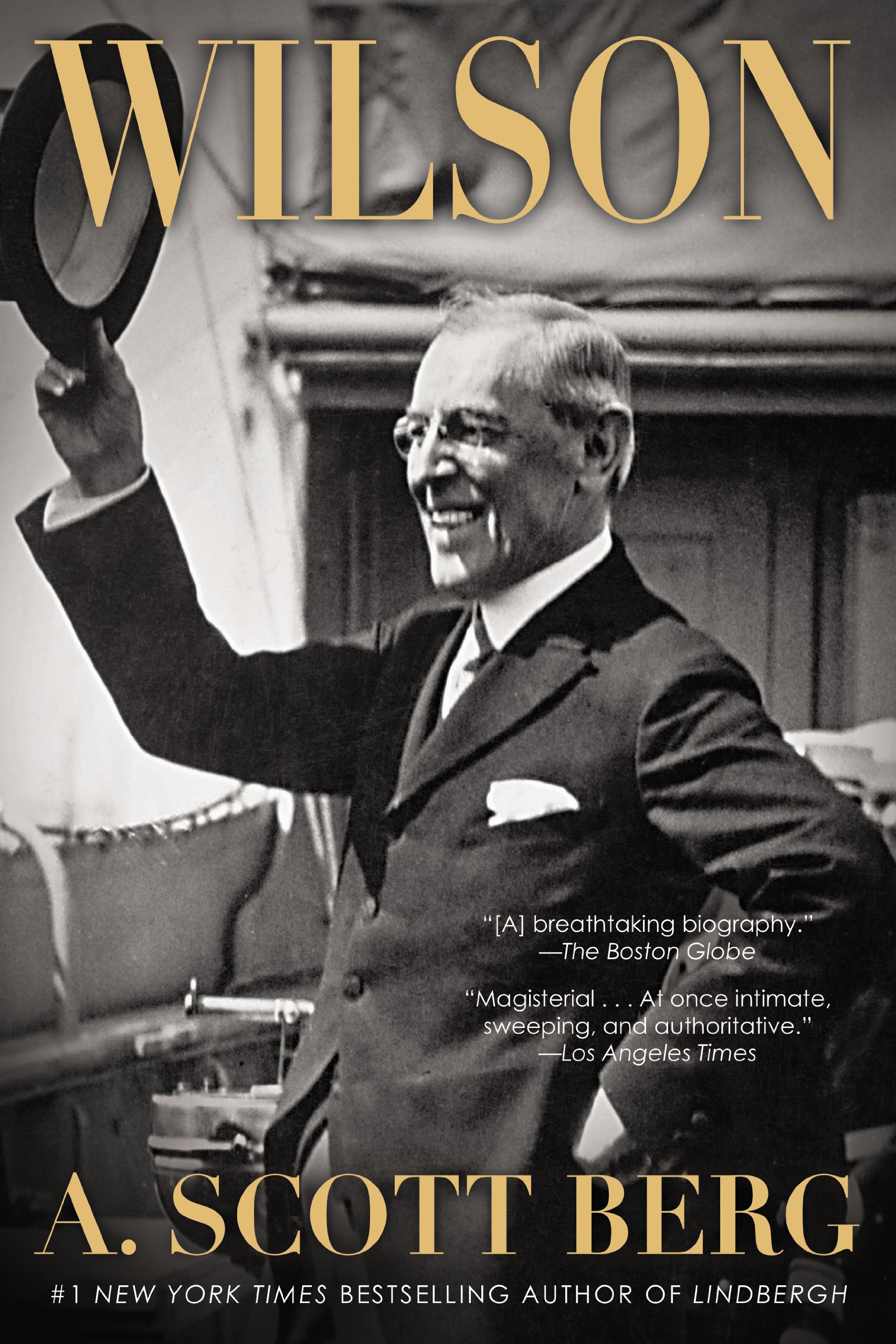
Wilson
by A. Scott Berg
Putnam Adult, 2013, 832 pages

The presidency of Woodrow Wilson from 1913 to 1921 was not good for the cause of liberty.

Wilson was clearly infected by the "progressive" ethos of the era.  He was strongly interventionist, pushing for legislation to reduce the length of the standard working week, to restrict child labour and to provide disability insurance.  He attempted to reconcile this greater role for government with the traditional Jeffersonian ideas on which his Democratic Party was based, by arguing that the Declaration of Independence no longer provided answers for contemporary problems.  He was confident that were Jefferson still alive he would recognise that, unlike in 1776, all men were no longer created equal.  As with most "if so and so were alive today" arguments, this one is not very convincing.

Wilson's presidency was also a disaster for blacks, as he promoted measures which delivered greater segregation throughout the public service.  Furthermore, it was a period of rising racial tensions and Wilson did little to stop increasing numbers of lynchings and other attacks on blacks.  And, once the United States entered the war, he imposed an income tax and introduced the Alien and Sedition Acts, measurers which were as heavy-handed an attack on free speech as those promulgated by John Adams in 1798.

Yet, in some respects, Wilson's Democrats were better for the cause of liberty than their Republican contemporaries.  The Democratic platform on which Wilson stood in 1912 was headlined by a call for the immediate lowering of the "high Republican tariff" which was "the principal cause of the unequal distribution of wealth".  The election of the Republican William McKinley to the presidency in 1896 had marked a shift to higher tariffs (as well as immigration restriction and foreign adventurism), which continued under the following Republican presidents, Teddy Roosevelt and William Howard Taft.  One Republican senator had secured a high tariff on imported textiles forcing people to buy over-priced products, a lot of which came from mills owned by the very same senator.

Wilson himself was a committed free-trader.  As a young lawyer in Georgia he addressed a visiting Tariff Commission to explain how the tariff unfairly taxed the agricultural sector in the South and West.  His eight years in the White House provided something of a pause in the onward march of protectionism.  Within months of his departure from office in 1921, the Republican-controlled Congress introduced the highest tariffs in American history.

In a range of other policy areas, Wilson also had sound views.  He had an instinctive dislike of debt describing it as "short-sighted finance";  vetoed anti-immigration bills, supported votes for women, and opposed Prohibition, the first constitutional amendment to reduce citizens' rights.

This biography provides clues to the development of Wilson's approach to politics and policy, but they are often confusing ones.  Author A. Scott Berg describes the young Wilson as "an avowed Federalist ― an ardent admirer of Alexander Hamilton;  a believer in dominant central government", but later writes that "Wilson challenged the Hamiltonian doctrine that those with the biggest asset in the government should serve as trustees for the rest of the nation".

Similarly, when it came to British figures, Wilson appears to have been a man of eclectic tastes admiring Gladstone and Bright, but also being "inspired" by some of Thomas Carlyle's ideas.  Wilson would be far from the only individual to harbour such a diverse range of likes, but this work would have benefitted from a greater effort from the biographer to weigh these seemingly contradictory views and assess what they all meant for Wilson's intellectual development.

Wilson's career prior to becoming a politician had largely be spent on university campuses, principally Princeton, where he had been professor of politics and the author of several works on aspects of American history.  He secured his first political office as governor of New Jersey just two years before he ran for the presidency.

When, in 1912, Wilson became the first Democrat to win a presidential election for twenty years, he was greatly assisted by a split in the Republican Party.  Incumbent President Taft had to compete with both Wilson and previous Republican President Roosevelt, now running under the banner of the Progressive Party.  Wilson won easily getting 42 per cent of the vote compared to Roosevelt's 27 and Taft's 23, which gave him a then record 435 Electoral College votes.

Wilson's rapid rise meant he was a comparative political cleanskin, who believed that he did not owe anything to anyone.  Upon his election, he readily dispatched numbers' men and others seeking preferment, telling one who claimed that his work had helped Wilson gain office that, "God ordained that I should be the next president of the United States.  Neither you nor any other mortal could have prevented that."  Imagine if Tony Abbott had said that!

Wilson commented that "it would be the irony of fate if my administration had to deal chiefly with foreign affairs", which of course was what happened once the fatal shot had been fired at Sarajevo.  He took what can be seen as a centrist approach to US participation in the war, not rushing to join the fray as some, such as Roosevelt, urged, nor remaining in the isolationist camp for the duration.

Given that Wilson took America into the war the following year, the irony was that his main selling point in his 1916 re-election campaign was that "he kept us out of war".  It was a particularly close election, Wilson defeating the Republican Charles Evans Hughes by just 277 Electoral College votes to 254, a result achieved by winning California's thirteen delegates, with a margin of just 3,806 votes.

Perhaps more than for the war itself, Wilson is remembered for his post-war internationalist vision, which was frustrated by other nations at the Peace Conference and then by Republicans in the Senate.  While Wilson was prepared to compromise at the former to secure the Treaty of Versailles, he was unwilling to make concessions to secure Senate ratification of the League of Nations.  He believed he would have been able to bring enough pressure onto wavering senators but for the collapse of his health while on a barnstorming tour of western states in September 1919.

A stroke soon after his return to Washington meant that Wilson remained largely incapacitated for the balance of his presidency.  As Berg comments, "Presidents traditionally speak of the isolation of the White House, but none has been as removed as Woodrow Wilson ― confined for months to a bed, and hearing no direct news."

Berg has received acclaim for biographies of characters such as literary editor Max Perkins, film producer Samuel Goldwyn and aviator Charles Lindbergh, plus flak for a memoir of his twenty year friendship with Katharine Hepburn published just twelve days after her death.  While this is his first political effort, he did have a long-standing interest in Wilson stemming from the 11th grade when his mother gave him a book called When the Cheering Stopped which dealt with Wilson's decline.  He has now provided his own evocative description of this extraordinary situation.

The difference between Wilson's abilities before and after his stroke is given greater emphasis in this study by Berg's particularly high regard for his subject's pre-stroke talents.  This is captured best when Berg describes how Wilson put together his speech to Congress arguing that the United States should enter the war:

For this momentous address, he summoned the country's most successful speechwriter, one of its foremost historians, one of its first political scientists, one of its most elegant wordsmiths, a spiritual thinker to provide moral grounding, and, finally, his most trusted stenographer to get it all down on paper.  There in the second-story study, Woodrow Wilson sat alone.

In fact, this was not even true, as his second wife Edith was with him at the time.

In most other matters, both public and personal, Berg takes Wilson's side, for instance accepting that he did not have an affair with the infamous Mrs Peck.  Despite the sympathy of the author there remains something slightly unappealing about Wilson, a man who ended up falling out with his closest confidants at both Princeton and the White House ― Jack Hibben and Colonel House ― when they eventually disagreed with him.

The blurb for this book says that "you can't understand the United States in the 20th century without understanding Woodrow Wilson".  Don't let the hyperbole put you off.  Wilson is definitely important and this work is a highly readable account of his life.

The Tragedy of Mitt

Mitt
by Greg Whiteley
Netflix, 2014

One scene in Mitt sees the titular figure turn to an aide and declare that the United States "is following the same path as every other great nation, which is we're following greater government, taxing rich people, promise more stuff to everybody, borrow until you go over a cliff, and I think we're a big risk of approaching a tipping point over the next five years."

A cursory glance at the economic situation of the United States holds Romney's words to be true.  A frank conversation about the ideological path of the United States should be the centrepiece of every coming election.  However, this powerful stand against big government and Keynesian economics only comes as Romney is drafting his concession speech in the 2012 election race.

True, this documentary does not dwell on the closed-door political meetings and the plotting out of election strategies.  Paul Ryan appears for thirty seconds, and even then it is at the film's climax.  Greg Whiteley, the director, executive producer and lead cameraman of Mitt, instead uses the documentary to show the audience the Mitt Romney he got to know through the campaign trails.

Mitt follows Romney through his two campaigns to become President of the United States.  Whiteley has complete access to both Mitt and the Romney family during this time, and documents their time on the campaign trail.  The interviews are held on whims in hotel rooms, campaign cars and lobbies, showing how open the family are to Whiteley.  These interviews are personal and candid, a seeming release for the family to express their own views without needing to be on message.

One memorable interview sees Josh Romney, Mitt's son, answer whether he wants his father to run for President.  Josh cannot articulate his own opinion on this, having instead to give his pre-rehearsed media-friendly opinion, before providing his own translation as to what his thoughts actually are.  "What better guy is there than my dad? ... This is the guy for the moment," he says.

But is he correct?  Was Mitt Romney the best man to run for President?  This documentary shows you every side of Romney's character.  We see him at his highest highs and lowest lows, at his most hopeful and at his most humble.

A lasting impression the documentary leaves is the stark divide between Romney's public persona and his private self.  Romney was often criticised in his presidential run for being wooden and pre-rehearsed when in public.  In contrast, the private Mitt was candid, warm and very charming.  That Mitt spends every waking moment with his adoring family, discusses "Oh Brother, Where Art Thou?" with his stylists and listens to stand-up comedy on "This American Life" podcasts before debating Barack Obama.

The public Mitt is (or the other way around ...) strong-willed, self-assured and determined, whereas the private Mitt is (... here) very critical of himself, and at times defeatist.  This is the side of Mitt that has created the most headlines since this documentary's release, and it is very jarring.  An early debate in the race for the 2008 Republican nomination goes strongly in Mitt's favour, yet Mitt thought he "was dying" on stage and is visibly stunned that he won over the crowd of undecided voters.  After his first debate against Obama, where Romney humiliated the President, Romney quickly reminds everyone Obama would be better next time.

If Romney is (was?) not confident in his own abilities, why should the American people be (have been?)?

The issue that he speaks of most through the documentary is the rise of big government in the United States and the pressure it is putting on the business world.  He sees that the Obama administration doesn't "know how hard it is for business to succeed", and adds regulations under the assumption that business will carry on.  "Never having been there, they don't understand."

As Romney explains to Whiteley in the campaign bus, he wants to get in front of people and say "Washington is broken" and that "I can turn it around", but his advisers talk him out of it and instead persuade him to keep using "change" in speeches, which he does.

The one time he does indulge in his private grievances to the voters became the infamous "47%" scandal.  Whether his remarks were correct or not, the incident generated a lot of negative press for Romney, and the documentary shows how much the negative publicity shook him personally.

A practice debate afterwards sees Romney rehearsing an explanation for the remark, before stopping himself, believing a tough discussion about America's future won't help him.

Romney was gagged from truly engaging with his voters about the bleak future of the United States, because his advisors did not think it was grounds on which a President could win.

But it surely is.  Washington is broken, and the American people are wise to it.  Only one nation in the midst of the Global Financial Crisis saw people take to the streets and demand the government have less power over the economy rather than more.

One day a Republican will win a Presidential election on the values Mitt Romney has about economics.  Unfortunately for him, that person is not Mitt Romney.

You can't just tax your way to a surplus

In 1979, the free market economist Milton Friedman reviewed Margaret Thatcher's first budget in his Newsweek column.  Like Australia today, Britain faced a serious long-term budget problem.  Like Tony Abbott, Thatcher had been voted in to fix it.

Friedman thought her budget was excellent — a rare example of financial prudence in a highly imprudent decade.  It was chock-full of privatisations and tax reforms.  The sort of stuff Thatcher became legendary for.

But, alongside the tax reductions and spending cuts, the Thatcher budget also increased Britain's sales tax to compensate for some lost revenue.

This was a problem.  As Friedman wrote, "From the long-run point of view, it seems to me preferable to resort to a temporarily higher level of borrowing rather than a possibly permanently higher level of indirect taxes."

In other words, if the unpalatable choice is between a deficit and a tax hike, then a slightly prolonged deficit is the lesser of two evils.

Thirty-five years later, the Abbott Government's proposed deficit levy is supposed to be a temporary measure — perhaps limited to four years.

Abbott should listen to Friedman.  "Temporary" taxes are rarely temporary.  Once introduced, they have a habit of staying high and sticking around.

After all, Australia's income tax itself was only meant to be short-term thing.  The Commonwealth Government introduced the income tax during the First World War in order to pay for the high cost of military participation.

Of course, as the Commission of Audit demonstrated dramatically last week, the choice the government faces is not between a prolonged deficit and higher taxes.  The Government could cut spending and abandon its Direct Action and paid parental leave schemes.

There is something faintly ludicrous about a Government fighting its budget battle on two fronts.

For the free market right, the deficit levy is not just a broken promise — we've come to expect broken promises in Australian politics — but a betrayal by a leadership team that, for the last six years, has been claiming to favour low taxes above everything else.

For the left, the Commission of Audit represents a fundamental attack on the Australian social democratic settlement.

The audit commission report is remarkable.  It is incredibly rare to see major government reports so explicitly driven by philosophical beliefs about the proper scope of government.

This is something Australian politics could do with more of, not less.  Bold premises, radical conclusions.  It's similar in a way to what came out of Kevin Rudd's 2020 Summit, but the audit commission is more coherent and doesn't bother pretending to be the result of Ruddian consensus politics.

Yet to what end?  The Abbott Government won't do much with the report.  What is radical in the audit commission is unlikely to be adopted.  The policies which will be adopted have been floating around forever.

There is no way that this Government will be returning income taxes to the states.  Sure, Tony Abbott has gone through an evolution of his views on federalism since he wrote his 2009 book Battlelines.  He is apparently no longer a myopic centraliser.  But there is no one in Government with appetite for such epoch-making reforms.

The things that will be adopted — like selling Medibank Private — have been obvious low-hanging fruit for many years.

So in many ways the audit commission reveals the Abbott Government's lack of reforming ambition rather than its radicalism.

The deficit levy underscores that timidity.  Don't be fooled by the recent polls.  Compared to cutting spending, raising taxes is the easy option.

The basic political economy problems with deficits and taxes are similar.

The reason it's important to return the budget to surplus is to ensure that there is constant pressure on politicians to spend only what the tax system brings them.  This is because every political incentive goes the other way.  The best way to ensure a voting bloc supports you is to offer them financial support.  Unchecked, governments want to spend more than they tax.

The only real constraint on this runaway spending dynamic is the fiscal norm that says budgets need to be returned to surplus.  Short-term governments rarely worry about long-term consequences.

So it is important that we reduce the deficit as soon as possible.  But not by any means possible.

Because, as Milton Friedman cautioned Margaret Thatcher, while the long-term dynamic of forgiving budget deficits would be bad, the medium-term dynamic of introducing higher taxes would be far worse.

Yesterday morning Tony Abbott said "in the long run the voters will thank us for doing what is absolutely necessary".

Maybe.  But in the long run voters should have no confidence that this Government — or a future Labor government — will happily forego the new stream of revenue the deficit tax will provide.


ADVERTISEMENT

Australian History at the Crossroads

The Cambridge History of Australia,
Volume 1 Indigenous and Colonial Australia
Volume 2 The Commonwealth of Australia

Edited by Alison Bashford and Stuart Macintyre
Cambridge University Press, 2013, 636pp and 644pp

Australia History Now
Edited by Anna Clark & Paul Ashton
NewSouth Publishing, 2013, 317pp

If you have not had some sort of contact with a humanities department of a university in the past quarter of a century you may not have encountered post-structuralism, or heard of linguistic or cultural turns.
Thus, you may be blissfully unaware that, as one young historian described his experience around the year 2000, in "tutorials and seminars at the University of Melbourne, the vocabulary of post-structuralism was everywhere in the undergraduate curriculum".  He explained that so strong was this influence that by the start of the twenty-first century "cultural and linguistic turns had transformed the writing of history".

Post-structuralism, and its mate post-modernism, assert that there can never be a historical truth, because the words we use to describe the past inherently bias our understanding of it.  We can ditch one proponents of the linguistic turn theorise that there is no such thing as historical objectivity, and that the past does not actually exist beyond our own textual representations of it.  In practice, the various turns have meant the decline of writing history with narrative and also of the study of traditional parts of the discipline such as political and economic history.

However, it needs to be appreciated that having the opinion that post-structuralism is obvious nonsense does not necessarily make you a conservative fogey.  Australia's best-known contemporary left-wing historian, Henry Reynolds, has argued that post-modernism contributed to leaving historians defenceless in the ideological battles of the History Wars, while another prominent historian of the Left, Humphrey McQueen, has been described as remaining "grandly and effectively independent of the lunatic and transitory intellectual fashion of postmodernism".

McQueen has a particular significance in Australian historiography as he is responsible for the tearing down of the previous Old Left paradigm of Australian history which glorified the Australian worker and presented the Australian story as one of progress being delivered by unions and the Labor Party.  McQueen and his comrades ushered in an era of New Left dominance from the 1970s onwards, which argued that race and gender were other crucial factors that needed to be added to the study of history.

Without being too simplistic, it is possible to identify periods since the Second World War of Old Left, New Left and post-structural dominance of Australian history.  However, with the last of these having lost its grip, the question has to be asked whether history has entered a new identifiable stage.

To help this assessment, the history academy's finest have produced two new works ― the large two volume Cambridge History of Australia, and the slimmer single volume Australian History Now.  The latter volume is specifically designed for historians to navel gaze, while the former only has one chapter specifically dedicated to this purpose, the final one, written by Mark McKenna and entitled "The History Anxiety".

McKenna points out that opposition to post-structuralism is not the only thing that Reynolds and McQueen have in common.  They have both acknowledged that in writing history they were being "necessarily biased".  Reynolds has commented that his aim in writing history was not just to document past abuse, for "the purpose of intellectual endeavour is not just to understand the world but to change it".  Would that all their colleagues in the history profession were so honest!  One of the most striking aspects of the Left's involvement in the History Wars has been their mantra that they were innocent victims of a pre-emptive strike from the Right.

Their position is encapsulated in Tony Birch's chapter in "Australian History Now", where he argues that "it did not matter how conscientiously I and other scholars applied ourselves to our research, how 'balanced' we attempted to be ... we had not realised that the history war was a dirty war, a guerrilla war, with no rules and no respect for convention ... the historians were 'too polite' to win such debates".  More reasonably, the co-editor of the book, Anna Clark, makes the point that both sides could be pushed towards hyperbole by newspaper opinion editors looking for strongly argued pieces rather than balanced ones.  However, McKenna is satisfied that "the bulk of the profession refrained from such open declarations" of their political stances and "sobriety, objectivity, factual accuracy and distance were the watchwords that defined their disciplinary practice".

Yet this "disciplinary practice" clearly had an ideological base.  Marilyn Lake acknowledges that from the 1960s onwards, "generations of radical historians have critiqued the nation for its history of class oppression, racism, sexism and complicity with colonialism and genocide".  Quite a rap sheet!  And as for the rise in status of oral history in the 1970s and 1980s, Alistair Thompson explains that it was driven by "political aspirations", as young historians were motivated by "concerns about inequality and oppression and sought to make a difference".

Likewise, the relatively new field of environmental history began with a "moral purpose".  Its proponents were determined to see nature "join the hallowed trio of race, class and gender as recognised determinants of human consciousness and social behaviour".  We learn from Tom Griffths that environmental history "challenges the anthropocentric, nationalistic and documentary biases of the craft of history".  Oddly, one might have thought that history appealed to its practitioners because it was anthropocentric, whereas those who wanted to study the natural world might want to study geology or botany.

Both volumes of the "Cambridge History" have chapters on the environment and unsurprisingly they are written by those of a dark green hue.  For instance, we learn that

"though the history of Australia is often understood in terms of economic growth, environmental failures are object lessons in the limits of growth, including extinction, the decline of populations of native species, crop failures, livestock losses, biological invasions and declining water quality."

No alternative views are presented to this sweeping statement.

More open for debate is the topic of the extent to which Indigenous Australians altered the landscape, in matters such as the demise of megafauna, or the impact of fire-stick farming.  There appears to be a sliding scale of virtue which places the environment at the good end, white capitalist colonisers at the other, with the Indigenous population somewhere between the two.

The extra focus on the environment does throw up some amusing ironies.  While traditionally the Left has been on the side of the land reformers against the squatters in the great nineteenth century battle over land, they now have to acknowledge that the squatters were actually better for the environment.

As one might expect there is a very strong emphasis on Indigenous dispossession in the "Cambridge History".  One reviewer of the work claimed that Aboriginal people were "by no means central to the story" on the basis that only three of the 47 chapters across the two volumes were specifically about them.  In fact, the authors of every chapter in the first volume include aspects of Indigenous experience.  There is a very strong legalistic approach to the treatment of dispossession climaxing in the Mabo and Wik decisions which are unquestioningly considered as correct and good.  In contrast, the Howard Government's 2007 Intervention is bad, although, at least here, the alternative views of Noel Pearson and Marcia Langton are noted.

Given the amount of focus on dispossession there is surprisingly little focus on the examples of pure racism which emerged more strongly in the late nineteenth century.  A typical example was whether Aboriginal children could access that proud boast of late colonial society ― free, compulsory and secular education.  By the 1890s, New South Wales had a policy that Aboriginal children could only go to school if "clean, clad and courteous", a policy which was replaced in 1902 by one which allowed an Aboriginal child to be excluded if just one white parent objected to his or her presence.

In contrast, on the frontier pastoralists had a strong economic incentive to use people from any ethnic group to get the work done, organised labour tended to view anyone other than white males as a threat.  As early as 1878 the crews of the Australasian Steam Navigation went on strike against the company's employment of Chinese seamen.  Unions were key drivers of the implementation of the White Australia Policy and their great champion, Henry Bournes Higgins, regarded protecting white men's wages as the reason why a minimum wage was required.  Even feminist historian, Ann Curthoys recalls in Australian History Now how shocked she was "to discover that those most interested in eugenics in the 1910s and 1920s were not from the extreme right" but from the Left, including many prominent feminists.

This racism grew at the same time as demands increased for a more active economic state and strikingly, "the legislative experimentation that took place in the late 1890s ... was also directed at re-establishing separate spheres between the sexes".  Wowserism increased at the same time with hotels and libraries forced to close on Sundays and public transport on the Sabbath being restricted to ferrying people to and from church.

The "Cambridge History" does not join these dots, perhaps in part because of its slightly disjointed format.  The two volumes are both structured with a section of chronological chapters (e.g. Expansion 1820-1850 or The Menzies Era 1950-66), followed by thematic ones (e.g. Education or Religion).  While the rationale for this approach is understandable it does create problems.  Issues are often covered in both sections and sometimes in more than one of the thematic chapters.  A bit more cross editing may have helped to prevent something like a full explanation of what actually happened at Myall Creek coming later in the volume than other references where that knowledge is assumed.  As well as repetition there is occasional contradiction.  For instance, one chapter says the Gold Coast replaced Newcastle as Australia's sixth biggest city in "the early 80s", while another claims this happened in 2007.

It is interesting the type of issues where historical debate is acknowledged.  There are several archaeological ones, such as whether stone tools were an imported or home-grown concept, and of course there is the perennial of Australian historiography, the Settlement debate, which divides historians between those who thinks colonisation in 1788 was driven solely by convicts, or whether economic factors such as the acquisition of flax and pine also played a part.

Pleasingly, there are several places which demonstrate that some more nuanced treatment of previously accepted aspects of the nation's history is appearing.  A good example is Penny Russell's chapter on "Gender and colonial society" which takes issue with two previous generations of Australian historians, represented by Russel Ward and Beverley Kingston, who drew a sharp distinction between English free settlers who still yearned for "home" and the convicts, native-born, Irish and the working class who were Australian nationalists.  Yet, as Russell explains, more recent research has shown that correspondence from convicts and the Irish exhibited as strong a sentimental attachment to "home" as did that of their middle class English counterparts.

Another area which has seen historical reinterpretation is the 1950s.  Judith Brett describes how the first wave of historians writing about the fifties was "driven by the Left's desire to explain Menzies' electoral dominance over Labor and to show the limiting effects of anti-communism".  More balanced recent scholarship has presented the decade's suburban idyll "not as the result of an anxious retreat into private worlds but as the expression of positive values and a shared sense of citizenship".

Without being cynical, it is hard not to see that reinterpretation of the 1950s in the light of contemporary debates about "neoliberalism", and the modern left's argument that before the economic reforms of the 1980s Australians were more community focused and less interested on materialism and consumerism.  Where the Menzies era was once damned as an era of selfishness and paranoia, it is now a lost golden age of shared values.  Either way, the political significance of historical interpretation is clear.

Another positive aspect of the Cambridge History is that it contains chapters which place Australia within broader geographic and international context, such as one on the British Empire and Asia-Pacific in volume one, and an excellent chapter called "Travel and Connections" in volume two.  The move to consider this sort of history is described as a "transnational turn", which perhaps indicates that if you turn often enough you end up back near where you started, when the likes of eminent Australian historian, Keith Hancock, was writing about the Commonwealth in the 1930s and 1940s.

The Cambridge History is at its best when it is showing these differing and broader interpretations but, in other places, there is a clear removal of alternative voices.  The list of general histories in the bibliography fails to include Geoffrey Blainey's "A Shorter History of Australia", while including the work of Manning Clark and a selection of other historians with a degree of homogeneity of outlook.  That is not to say that Blainey has been excluded altogether.  He gets appropriate recognition in specialist areas such as mining history but his "Triumph of the Nomads", surely the work that did the most to alter mainstream Australian attitudes towards pre-colonisation Aboriginal society, does not receive the attention it deserves.

One of the striking features of the Cambridge History is the absence of traditional social history.  One learns little about what people wore, what they ate and how they were entertained.  The Australian colonies, Victoria in particular, were world leaders in the rise of spectator sport in the later nineteenth century, but the reader learns nothing about this in the first volume.  In the post-Federation volume, writers such as Frank Bongiorno and Paul Strangio do better at addressing these sorts of areas.  Strangio is one of the few contributors to the Cambridge History not based in a History Department (he is a political scientist).  Fortunately, the editors of "Australian History Now" broadened their horizons beyond the academy, as some of the best points in the book are made by a school teacher and a museum curator.  The teacher, Paul Kiem, made the insightful point that:

Nowadays educationalists are fond of disparaging the didactic teaching and rote learning that are said to have prevailed at the time.  Paradoxically, out of this educational dark age large numbers of baby boomers were inspired to go to university to study history.

As community curator in the south-western New South Wales town of Hay, Martha Sear observed how, compared to an earlier period when both professional and amateur historians operated in proximity to each other, "since the 1970s, a curious gap has opened up between scholarly historians and their community counterparts".  In her experience, the progressives of the academy seemed to sneer at outsiders:

It seems a terrible irony that the era that produced social history, "history from below" and history of oppressed or marginalised groups, and that fostered theories of pluralism, difference and inclusion, has generated the sharpest critique of the history-making of the majority of Australians.

The Cambridge History will probably not do much to close the gap between the scholars and the rest.  Just to handle it in the bookshop required getting a staff member to unlock the cabinet where it was secured out of the reach of the hoi polloi, presumably because of its pretentious price tag of $325.  Clearly the publishers are not pitching their work towards the average educated Australian.

Yet, while in one sense the inaccessibility of the book to the public symbolises how the Australian story is told by the history profession, in another it is a shame that more people will not get to read it.  It contains quite a lot of evidence that there has been a small move to a more nuanced approach since the nadir of the post-structural turns of the late twentieth century.  And perhaps reflective of this is that some of the aging baby boomer contributors in "Australian History Now" seemed resigned to the fact that the revolution is not coming in their lifetime.

Maybe the trend will continue, or maybe there will be other turns.  However, I certainly would not yet be holding your breath if you are waiting for a liberal or conservative turn.

The three languages of arts and cultural funding

It is a truth universally acknowledged that the public funding of arts and culture will cause political strife.  Reasonable people just do not agree on this, and can be surprisingly quick to accuse others of ideological warmongering.

That's code of course for your own views being sound and sensible, while those of the other side are naïve, selfish, tyrannical, philistine, or just flat-out wrong in a way that is impervious to logic and evidence.  It's almost as if they're speaking another language.

The Three Languages of Politics is a short e-book by Arnold Kling, a US economist and blogger.  It will take perhaps an hour to read, and costs just A$2.  Or you can listen to a podcast here.  The book is about why intelligent, well-meaning people disagree so much, and so bitterly, about politics.  Kling's thesis is that they are, in effect, speaking different languages.

Kling frames his essay about three political tribes:  the left (known in the US as liberals), the right (conservatives), and libertarians.  Each views the political world along its own axis of discourse and understanding.

For the left, the political world is viewed in terms of:  oppressor — oppressed.

For the right, the worldview is on an axis of:  civilisation — barbarism.

For libertarians, the relevant axis is:  freedom — coercion.

These axes are largely incommensurable.  When one groups sees an issue — say, refugees — through the lens of civilisation-barbarism, and thus as about border protection, other groups do not even register that framework, seeing it instead as about freedom of movement, as libertarians might, or as an issue of oppression, as the left does.

The result is that political discussions become polarised and ill-tempered.  Kling offers these three axes as a kind of translation service that he hopes might enable each group to better understand how other groups see and discuss the world.

I think the same claim can be made about arts and cultural funding, which is equally dyspeptic in a similar three-languages way.  Following Kling, it may be useful, especially in the shadow of the upcoming budget, to attempt to put one's self in the mind of how the other side(s) thinks about these issues.

For conservatives, public funding of arts and culture is worthy when it supports the values of civilisation, which means a John Ruskin type view of the best of cultural heritage:  museums, galleries, botanical gardens and opera will always do well here.  What this group is hostile to are threats against that — barbarism — which come from the transgressive, edgy frontiers of arts and culture.

Those on the left see things almost exactly the other way, valuing the transgressive, edgy work precisely because it stands up for the oppressed, the outsider, the powerless minority view.  They don't see this as barbaric at all, but as a meeting of power against a hegemon, which for them is the real threat.

For conservatives, this is completely baffling.  The psychologist Jonathan Haidt explains in The Righteous Mind that there are simply different moral dimensions at work here.

Libertarians tend to be confused by both such perspectives, seeing the real threat coming from coercion, which appears from the left by way of compulsory tax contributions, and from conservatives in the drive to compulsory aspects of support for, say, the cultural canon.  They thus find themselves allied with the left in supporting the avant garde, but because of its experimental newness, not its power politics.

They usually hate that aspect.  And they support the right in market-facing endeavours, but because of what evolutionary economists call creative destruction, which is the tendency of the market order to generate cultural novelty from within, not from a desire to minimise political activism.

Now these are obviously almost cartoonish simplifications of actually complex and subtle positions, but I think that these axes can help make sense of the level of heat in so many debates about arts and cultural funding.

Take public broadcasting, for instance.  For the left — along the oppressor-oppressed axis — it is a near article of faith that a healthy and robust ABC and SBS is necessary to maintain a bulwark against the potentially oppressive forces of commercial mainstream media.  It is a necessary countervailing force.

But the right — along the civilisation-barbarism axis — doesn't see it that way at all.  They love some parts of it:  Sunday morning shows, ABC Classic, and regional news and talk especially.  But they despise the Ultimo productions of stacked Q&A panels and risible youth comedy that seem to represent encroaching barbarian hordes.  So for them, the ABC needs to be brought under control.

The libertarians — along the freedom-coercion axis — are the only ones who really want it dismantled.  But not because they don't value what it offers, whether its promise of countervailing media power or its projection of civilising influences.  They just don't like being forced to pay for it.

The problem with a political society that speaks three different languages is that we get easily lost about why we disagree.  The challenge is to try and see things from the other side's perspective rather than continue to shout in our own languages.


ADVERTISEMENT

Friday, May 02, 2014

Figures don't fly for proposed airport rail link

The Premier, Denis Napthine, has committed to building an airport-to-city rail link.  While opposition to this has featured pollution and flyovers, the key issue is the costs and the benefits.

These are to be revealed by Victorian Treasurer Michael O'Brien in next Tuesday's state Budget.

Meanwhile, Dr Napthine is in Canberra today where, aside from promoting a tax on single-use bottles, he is seeking support for infrastructure funding, especially on transport facilities.

The focus on infrastructure spending by governments is a welcome change from the policy approach five years ago.

During the 2008 global financial crisis Australian politicians and their advisers were calling for massive Budget deficits to stimulate demand.

Former Labor prime minister Kevin Rudd was elected as a John Howard style fiscal conservative with a younger "compassionate" face.

But he soon rebadged himself as a conventional Labor spendthrift who would tame the financial tornado by increasing spending at a rate that would bring blushes to the faces of previous vote-buying politicians.

So we had the cash handouts, new school halls, home insulation plans and other measures.

The federal Budget went from former Liberal PM John Howard's $20 billion surplus to a $55 billion deficit.  And we never saw the self-sustaining recovery that the spending was supposed to trigger.

Unlike hand-outs to individuals, government infrastructure spending can lift productivity, thereby offering a prospect of genuine economic growth.

Unfortunately, government infrastructure spending often ends up in creating unproductive white elephants.

We see this with the National Broadband Network on which $15 billion has been wasted to date and little can be expected from the remaining $45 billion of planned spending.

So we should pay particular attention to scrutinising a proposal like the airport rail link that the State Government has described as a "landmark" and "fantastic".

The airport link's cost is yet to be revealed but is likely to be some $2 billion.  In arguing for it, Dr Napthine says rail is becoming more competitive than road even over short distances and it is necessary because we need additional capacity.

Rail, however, is finding it increasingly difficult to compete with road.  That's largely because virtually all cities are becoming less concentrated both in terms of homes and workplaces.

Fifty years ago, half of all Melbourne's work travel was to the city centre.  Today it is only 12 per cent.

Fixed-track rail is inherently inflexible compared to road.  It is far inferior in door-to-door service and the gradually more diffuse nature of travel patterns places it at an inevitable disadvantage.

This increasingly dispersed trip pattern also disadvantages airport rail links.  Brisbane illustrates this.

Compared with Melbourne, it has less effective road network connections to the airport and its rail link is half the distance required by the Melbourne link.

Even so, rail carries only 5 per cent of the airport's traffic at a ticket cost of $16.  For Melbourne the SkyBus at $18 would be cheaper and faster.

The Tullamarine Freeway's capacity can be readily expanded, as illustrated by the Government's announced $850 million, 30 per cent capacity upgrade.

Michael O'Brien is among the more capable Victorian ministers.  But he has an awesome task to explain how the Tulla rail link can make economic sense.


ADVERTISEMENT

Commission of Audit and the arts — cuts are not galore

Over the past 20 years the size of government spending has grown, both absolutely and as a percentage of GDP.  Public sector debt has also increased substantially.  The cautionary tale of Greece indicates the dangers of this path.

In Australia, either taxes have to rise, which will lower the standard of living, or spending has to be cut.  The National Commission of Audit report focuses entirely on the latter.

The report broadly does two things.  First, as in the terms of reference, it provides "a thorough review of the scope, efficiency and functions of the Commonwealth government".  Second, it sets out a series of 86 recommendations covering the full range of commonwealth spending.

The government is not bound to follow these recommendations, but they provide a useful menu of options.

There seem to be two main findings.  The first is directed at what is called "vertical fiscal imbalance" but really is a boost for genuine federalism:  state spending needs to be balanced by the power to raise revenue.  This reversal of the increasing tendency toward centralisation is a very welcome development (provided that it is matched by a reduction in federal income tax).

The second is recognition that the biggest components of Commonwealth spending (aged pensions, defence, health) are also those that are growing the fastest, and therefore that nothing is solved unless these "third rails of politics" (a euphemism for controversial and/or untouchable issues) are firmly grasped.

Across many recommendations, the overarching approach is to increase the criteria for eligibility, or simply abolish the source of funding.  This signals recognition of the manifest unsustainability of decades of vote-buying growth in corporate and middle-class welfare.

Arts and culture doesn't feature prominently in the report.  This is simply because even the most swingeing of cuts to arts or cultural funding — say, cutting everything completely — would barely touch the levels of savings required to restore Australia's public finances.  When you need to feed an entire village, hunting a few mice isn't going to do it.

Nevertheless, not missing an opportunity, two clear warning shots have been fired into the haystack, possibly injuring a mouse or two.  The largest is recommendation 45, which focuses on the role of public broadcasting — specifically, the ABC and the SBS.

They make a familiar argument "that both organisations have the ability to improve their efficiency and better target expenditure than may currently be the case".  They suggest that this case is "underpinned by advances in technology, societal changes and an expectation of achieving efficiencies and value for money".  Furthermore, these developments "increasingly eliminate the traditional arguments for public broadcasting".

But the commission doesn't then go where this argument is seemingly headed.  They do not then recommend a noble retreat from public funding of national broadcasting.

Instead, they ask why these benefits from new technologies and increased competition have not translated into lower prices or reduced demand on the public purse.  They charge instead that the public broadcasters have captured these benefits for themselves, rather than handing them back to the public.

This is the language of the efficiency dividend.  The commission has put them on notice by proposing a benchmarking exercise that would attempt to estimate the size of this captured resource, which will then enter into future funding equations.

The other named arts and cultural funding consideration comes in relation to industry assistance — also known as corporate welfare — a most egregious form of public spending and always and everywhere well ripe for cutting.

Screen Australia is targeted here for "reduced levels of Commonwealth funding", specifically recommending that it "be halved and focused on areas of Australian content, including those with an historical perspective that might not otherwise be funded".

And that's it.  All things considered, it is utterly remarkable how soft the Commission has been on proposing cuts to arts and cultural funding.  And remember, these are just recommendations, which if history is our guide have only a small chance of becoming reality.  Things really could have been a lot worse.


ADVERTISEMENT

Thursday, May 01, 2014

The Panel:  Thomas Piketty's Capital

Thomas Piketty's new book presents an interesting historical account of aggregate global inequality, but its policy conclusions would spell danger for future economic prosperity.

The basic idea contained in the 696-page tome is that if returns accrued by capital owners grow faster than general growth in the economy, then this sows the seeds for growing income and wealth inequalities.

For Piketty, the basic corrective for such inequalities should be the implementation of steeply progressive income taxes, and wealth taxes that catch excessive capital returns globally.  What seems to have been overlooked in the present debate over the book is the similarities between Piketty's thinking and that of John Rawls, whose 1971 book, The Theory of Justice, enjoyed a similar rock star reception.

Piketty argues that "capitalism and markets should be the slave of democracy and not the opposite".  Such descriptions are reminiscent of the "property-owning democracy" model that Rawls hinted at in his 1971 work, and explained in subsequent literary efforts, which is conceived as compatible with inequality suppression.

However the problem with these approaches is this:  if respect for acquisition and disposal of capital is not entrenched within a regime of protections for basic liberties, the state can redistribute capital at will.  And if reducing inequality is the prime concern, as Piketty makes it out to be, then the obvious next step is to elucidate a high-tax policy menu endorsed in Capital in the 21st Century.

Anyone concerned about the material prosperity of all people, including the poor, should be reviled by such grand schemes to impoverish societies.  This is because what greater tax burdens do is slow down the rate of economic growth, or in other words stymie our increasing capacity to cooperate in creating value for other people whom we don't know intimately.

To express this somewhat differently, weakening economic growth means lost opportunities to feed, clothe, house, transport, educate, heal, and entertain people.

Now, these statements should not be regarded as a call to dismiss inequality out of hand entirely.  Classical liberals castigate income and wealth inequalities engendered by governmental tax and regulatory force, or maintained by discriminatory public sector subsidies, as an anathema to the fair and prosperous society we wish to live in.

Unfortunately, though, self-described socialists such as Piketty fail to see the hypocrisy of tackling inequality by invoking the injustice that is invariably political action itself.


ADVERTISEMENT

Tuesday, April 29, 2014

Taxes are no substitute for savings

The government is kite flying a one-off income tax surcharge for the budget, perhaps to be deceptively called a deficit levy, to side-step the "no new taxes" pledge.

Commonwealth expenditure has blown out as a result of long-term commitments made under Rudd and Gillard.  As a share of GDP, it grew from 23 per cent in 2007/8 to 26 per cent this year with that level set to increase gradually over the next decade.

The blowout began in 2008 with windfall payments to lower-income people that fuelled a splurge on flat screen televisions and poker machine gambling.

It progressed to school hall programs, "Building the Education Revolution", "pink batts" home insulation spending, and compensating lower-income taxpayers for the carbon tax.

All those spending decisions were in pursuit of kick-starting the economy by funding consumer spending increases that would, so the Treasury and others said, lead to a new burst of investment and higher incomes.  This would enable the debt from the spending to be paid back effortlessly.  That didn't work in Australia or anywhere else it was tried.  Instead, the spending cannibalised savings and detracted from underlying income growth.

The spending momentum will be maintained by Gonski-recommended educational outlay measures and the program for vastly increased funding for people with disabilities.  In these and other cases, including Bill Shorten's decision to increase payments to the largely government-funded care workers, the payment load is encased in a framework of income-redistribution and higher levels of debt.  The income redistribution involves soaking the better-off, the side effects of which are to adversely impact on savings, investment and work effort.


ONE-OFF CUTS OF LIMITED USE

One-off taxes can only be effective if they carry with them a strong perception that they will not indeed be repeated.  Once a tax is factored into perceptions, it brings adverse consequences in distorting spending, as firms and individuals start rearranging their activities to minimise the impact.  The tax will almost always bring diminished levels of income, though some may cite as exceptions one-off taxes by Jeff Kennett (part of the Victorian electricity market reforms) and a 1981 special UK bank tax Margaret Thatcher implemented.

Whatever the credibility of these two examples, they have no relevance as responses to correct current fiscal imbalances faced by the Commonwealth.  The present dilemma is a budget deficit that goes on forever, created by a spending splurge.  A one-off tax is no solution.

Nor is a more permanent increase in taxation.  The Rudd-Gillard governments ratcheted spending up to new levels and the response must involve spending cuts.  Unfortunately, though the Abbott government has said it will rein in spending, it has also indicated areas of increase, including on carbon emissions, paid parental leave and the (very necessary) increases in defence spending.

I have previously identified $22 billion in annual ongoing savings.  These have ranged from eliminating all but emergency foreign aid, through to privatising the ABC and SBS, and to making massive savings in environmental expenditures and industry handouts.  In addition to these are one-off savings from the negative value-added that is the $10 billion Clean Energy Finance Corporation.  Eliminating the waste of these programs takes us half way towards the required contraction in spending.

For the rest, some bounds to aggregate spending — rather like the tithe of old — must be found.

There is no limit to needy causes that justify government spending but each dollar outlayed on these creates an increase in the demand.

Each program inevitably expands to meet marginal cases beyond its original reach and some recipients opt to place themselves in the supported categories.

In addition, the tax load required to fund the programs reduces incentives to work on the part of those paying the taxes.

There may be areas where tax policies can be tightened — including increasing the age at which aged pensions cut-in and the $800 million a year that education expert Andrew Norton reckons is available from better administering student loan repayments.  But more is required and this means focusing saving measures on the 60 per cent of Commonwealth spending allocated to health, education and welfare.


ADVERTISEMENT

Unnecessary impediment to retrieving earth's riches

Major coal-seam gas developers Santos and AGL have agreed with the NSW government to ­obtain permission from landowners before engaging in any exploration for gas.  Federal Industry Minister Ian Macfarlane has referred to this de facto landowner veto over mining development as "an inelegant solution to an intractable problem".

Others have much greater concerns.  They see it as erecting yet another barrier to gas development in the state and spreading to other states and other minerals, undermining Australia's century-old "finders-keepers" mining regime.  That regime involves vesting minerals separately from the land under which they sit with mining rights being transferred from the crown to whoever finds the minerals.

Although some Canadian provinces such as Alberta have similar arrangements, most common law systems vest mineral ownership with the surface landowner.  This automatically resolves farmer-miner tensions, but it means giving a share of exploration success to a passive rent-collector.  The Australian system avoids this dilution of the rewards from success, giving greater incentive to active explorers.

The Australian approach to land ownership has created a very successful mining industry.  Until a few years ago, Australia ­accounted for 20 per cent of global exploration spending, a share that dwarfs our 5 per cent of the world's land mass.  Australia's performance has deteriorated in recent years (to 12 per cent).  This is largely because Australian mining has been battered by tax and regulatory decisions that have increased risks and added costs.  Among these was the Mabo decision in the 1990s, making many areas vulnerable to Aboriginal land claims.  More recently we have seen intensified environmental restraints, industrial relations laws that allow greater scope for union disruption and resource rent and carbon taxes.

The Abbott government is trying to undo these recent imposts but the new landowner veto rights put in place by the NSW government are a backward step.

While mining cannot take place in the 0.3 per cent of Australia that is urban development, mining and farming readily coexist.  Mining, being a highly concentrated activity, has a trivial effect on agriculture.  Naturally, landowners would prefer to be granted ownership of the sub-surface resources — who would look such a gift-horse in the mouth?  And mining interests fully compensate the landowner for damage and inconvenience.

Allegations that mining might bring more widespread damage by, for example, disturbing or polluting the water table are, however, unfounded.  Even a recent highly publicised leak of "uranium contaminated" water near Narrabri was simply water containing naturally occurring and highly diluted uranium that posed no health risk to humans, animals or plants.

Activists' opposition to unconventional gas extraction has brought barriers to the resource's development in Australia.  Although Australia shares a prospectivity potential comparable to the US, government restraints have led to gas exploration running at less than one-20th of the rate in America, where a gas bonanza has reduced the gas price to a quarter of its previous level.  The Victorian government has placed an indefinite moratorium on the search for coal-seam gas, while the NSW government sees the veto provided to farmers as a means of ­allowing it to unblock the severe impediments on exploration in the state.

Behind the different considerations over property rights and vetoes by landowners is a crucial industry policy issue.  In spite of regulatory incursions into the industry, mining has been the crucible of Australia's relatively good economic performance over the past decade.  Exploration has been strong — worth $4.4 billion in 2012-13, despite having dropped 30 per cent this year.

Direct employment in the industry of about 200,000 is vastly augmented by indirect employment.  According to Reserve Bank estimates, once these are taken into account the mining industry's share of the economy is about 18 per cent, with mining-­related jobs totalling more than one million.  In addition, at least until recently, cheap energy has added further benefits.

Mining and agriculture are both sectors of great potential for Australia.  They are natural fits with the markets in the growing Asian economies in addition to offering cheap energy for domestic businesses and households.  The contributions of these industries can be strangled by ill-­designed property rights as well as discriminatory taxes and regulations.

NSW faces an additional early risk of being marooned with a shortage of gas and high household prices.  Resolute government action to restore exploration incentives for gas is an important first step.

We should fear slow growth, not inequality

In 1979, the free market economist Milton Friedman reviewed Margaret Thatcher's first budget in his Newsweek column.  Like Australia today, Britain faced a serious long-term budget problem.  Like Tony Abbott, Thatcher had been voted in to fix it.

Friedman thought her budget was excellent — a rare example of financial prudence in a highly imprudent decade.  It was chock-full of privatisations and tax reforms.  The sort of stuff Thatcher became legendary for.

But, alongside the tax reductions and spending cuts, the Thatcher budget also increased Britain's sales tax to compensate for some lost revenue.

This was a problem.  As Friedman wrote, "From the long-run point of view, it seems to me preferable to resort to a temporarily higher level of borrowing rather than a possibly permanently higher level of indirect taxes."

In other words, if the unpalatable choice is between a deficit and a tax hike, then a slightly prolonged deficit is the lesser of two evils.

Thirty-five years later, the Abbott Government's proposed deficit levy is supposed to be a temporary measure — perhaps limited to four years.

Abbott should listen to Friedman.  "Temporary" taxes are rarely temporary.  Once introduced, they have a habit of staying high and sticking around.

After all, Australia's income tax itself was only meant to be short-term thing.  The Commonwealth Government introduced the income tax during the First World War in order to pay for the high cost of military participation.

Of course, as the Commission of Audit demonstrated dramatically last week, the choice the government faces is not between a prolonged deficit and higher taxes.  The Government could cut spending and abandon its Direct Action and paid parental leave schemes.

There is something faintly ludicrous about a Government fighting its budget battle on two fronts.

For the free market right, the deficit levy is not just a broken promise — we've come to expect broken promises in Australian politics — but a betrayal by a leadership team that, for the last six years, has been claiming to favour low taxes above everything else.

For the left, the Commission of Audit represents a fundamental attack on the Australian social democratic settlement.

The audit commission report is remarkable.  It is incredibly rare to see major government reports so explicitly driven by philosophical beliefs about the proper scope of government.

This is something Australian politics could do with more of, not less.  Bold premises, radical conclusions.  It's similar in a way to what came out of Kevin Rudd's 2020 Summit, but the audit commission is more coherent and doesn't bother pretending to be the result of Ruddian consensus politics.

Yet to what end?  The Abbott Government won't do much with the report.  What is radical in the audit commission is unlikely to be adopted.  The policies which will be adopted have been floating around forever.

There is no way that this Government will be returning income taxes to the states.  Sure, Tony Abbott has gone through an evolution of his views on federalism since he wrote his 2009 book Battlelines.  He is apparently no longer a myopic centraliser.  But there is no one in Government with appetite for such epoch-making reforms.

The things that will be adopted — like selling Medibank Private — have been obvious low-hanging fruit for many years.

So in many ways the audit commission reveals the Abbott Government's lack of reforming ambition rather than its radicalism.

The deficit levy underscores that timidity.  Don't be fooled by the recent polls.  Compared to cutting spending, raising taxes is the easy option.

The basic political economy problems with deficits and taxes are similar.

The reason it's important to return the budget to surplus is to ensure that there is constant pressure on politicians to spend only what the tax system brings them.  This is because every political incentive goes the other way.  The best way to ensure a voting bloc supports you is to offer them financial support.  Unchecked, governments want to spend more than they tax.

The only real constraint on this runaway spending dynamic is the fiscal norm that says budgets need to be returned to surplus.  Short-term governments rarely worry about long-term consequences.

So it is important that we reduce the deficit as soon as possible.  But not by any means possible.

Because, as Milton Friedman cautioned Margaret Thatcher, while the long-term dynamic of forgiving budget deficits would be bad, the medium-term dynamic of introducing higher taxes would be far worse.

Yesterday morning Tony Abbott said "in the long run the voters will thank us for doing what is absolutely necessary".

Maybe.  But in the long run voters should have no confidence that this Government — or a future Labor government — will happily forego the new stream of revenue the deficit tax will provide.


ADVERTISEMENT

Is Gen Y getting a raw budget deal?

Special interests representing older Australians are crying foul over prospective budget cuts, but we should spare a thought for the indebted and unemployed millennial generation.

The first budget of the Abbott government is due to be released within the next fortnight, and public speculation has well and truly reached fever pitch concerning exactly how the government intends to end "the age of entitlement".  The focal point of this speculation has centred upon certain expenditure programs, which are particularly sensitive to old age-related demands, in the areas of welfare and healthcare.

The government is proposing raising the age pension eligibility age threshold to 70 years by 2029, or reducing the maximum investment income one can earn before pensions are reduced.  Within the healthcare sphere the reform option of a modest Medicare co-payment of $6 has been put forward as a prospective aid to the overall fiscal consolidation task (the National Commission of Audit has recommended a $15 co-payment in its report released on Thursday).

Rather unsurprisingly, assorted interest groups representing the financial interests of pensioners and other retirees have generally reacted in a caustic fashion to these and other policy thought bubbles floating in the pre-budget air.

Seniors groups are among some of the most highly organised vested interests in the country, given the rapidly growing demographic representation of older Australians, and there seems little question their perspectives will hold even greater political sway in coming years.  But in this era of big government crippled by a structural budget emergency, policymakers and members of the general public should be very mindful of the fact that persistent growth in age-sensitive spending will hinder, rather than help, people in other age brackets.  Indeed, as the Abbott government looks to start partaking in the daunting exercise of budget repair, it should perhaps be thinking of the future prospects of Generation Y, or "Millennials", born from the early 1980s to early 2000s, first and foremost.

It is true that Australia's Millennials are among the wealthiest, healthiest and smartest cohort of young people history has ever seen, by virtue of the unparallelled economic and social starting points bequeathed to them by previous generations.  However, government policies, by and large, do seem to have let them down terribly, and this needs to change.

The worst aspect of federal policy to harm the interests of Millennials has been the rapid accumulation of government debts in Australia over recent years, as part of one of the fastest deteriorations in public sector balance sheets witnessed in the Western world.

The latest Mid-Year Economic and Fiscal Outlook statement, released last December, showed gross federal general government sector debt ballooning from $55 billion, in the last full year of the Howard government in 2007-08, to an estimated $310 billion this financial year and rising in the out-years.

Taking into account some of the more liquid asset holdings of the government, net debt has also skyrocketed, from minus $45 billion (implying a net financial asset position) in 2007-08 to $192 billion in 2013-14, and estimated to further rise to $281 billion by 2016-17.  The repayment of these debts will be shouldered, in the main, by the Millennial generation, and perhaps by generations that follow them, in the form of tax burdens that would be greater than would otherwise be the case.

That future taxation of Millennials without representation is being politically organised by baby boomer, and to a lesser extent Generation X, politicians seems reprehensible enough from a democratic accountability perspective, but this is by no way the end of the matter.

What makes the radical upscale in debt particularly odious for young people is that the borrowings would have largely, but not exclusively, been directed towards welfare handouts primarily benefitting politically powerful seniors, as well as mainly middle-aged families.  We know this is true, in one respect, by an examination of the structural composition of federal general government expenditures.

Social security and welfare spending alone accounts for 34 per cent of the total estimated general government expenditure of $412 billion this financial year.  If we add health and housing expenditure, much of which is subsequently redistributed to the states as tied grants, then this welfare state spending accounts for about half of the federal budget.

Most economists would tend to agree that government debts would be put to best use if their proceeds are being directed to genuinely productive, long-lasting infrastructure assets.  Putting aside the important question as to whether federal capital spending is productive in all instances, privatisation and other policy developments has meant that investment now makes only a fairly minor contribution to the overall federal government spending profile.

The notion that the debt boom has primarily not been to the advantage of Millennials is corroborated by statements in previous budget papers that borrowings were conducted to cover perceived revenue shortfalls, primarily affecting the general government sector that increasingly spends for redistributive reasons.  Finally, the Bureau of Statistics figures on the distribution of taxes and benefits across households illustrates that, on average, young households pay more in taxes than they receive in government cash transfers, whereas the reverse clearly applies for retiree households.

The debt-for-handouts political culture was excoriated by economists such as James Buchanan, who once characterised it as "placing claims against future incomes, with no future offsetting benefit stream".  Even more dramatically, Buchanan pictured the use of borrowings to finance the welfare state as "bequeathing negative capital value to future generations in our capacities as members of the body politic".

This fiscal harm meted out against the Millennials does not include other pressing policy problems, such as prescriptive labour market regulations contributing to unacceptably high youth unemployment rates, and housing taxes and land supply restrictions contributing to a lack of housing affordability.  While young people will perhaps always tend to do it tougher, since they are still building up their human capital base and generally discovering what life has to offer them, it is incumbent that government policies not hold them back, as they presently do in key respects.

The coming federal budget might well contain some spending-reduction measures baby boomers might not like, but they should at least accept that fiscal consolidation potentially presents an opportunity to short-circuit the politically induced conflict between generations.  Older Australians were themselves young and hampered in so many ways by authorities once, but it does not make it right that they use political processes to extend economic and fiscal discriminatory treatment against the Millennials.


ADVERTISEMENT

Tuesday, April 22, 2014

Election promises are there for the breaking

What are election promises for?  Who on earth do they convince?

Tony Abbott walked into a trap during the 2013 campaign when he excluded a bunch of policy areas from budget reductions.

Those include the pension ("no change to pensions"), the public broadcasters ("no cuts to the ABC or SBS"), Commonwealth health spending ("no cuts to health"), and Commonwealth education spending ("no cuts to education").  Watch the video, Abbott was unequivocal.

Now, to bring the budget back to surplus, the Government is looking at changing the pension and cutting ABC and SBS.

No one can forget the enthusiasm with which the Coalition pursued Julia Gillard for her "no carbon tax" pledge.

As a consequence, one theme of Abbott's stint as opposition leader was his attempts to bind his future acts in government.  But the Abbott obsession with promises predates Gillard's carbon tax backflip.  In 2010 he even physically signed a "contract" that the Fair Work Act would not be amended.

I've put the word contract in quote marks because a contract that cannot be enforced is not a contract at all.

That contract would mean nothing if the Coalition announced tomorrow that the Fair Work Act was going to be abolished.

This is the promises dilemma.  Elections are commitment games.  We vote for the candidates and parties whose values and policies are most appealing.  But how can we be sure they'll follow through?  All we have is their word — their assurance they will act in a certain way under certain circumstances.

Of course, commitment problems are common across all spheres of human endeavour.  In the marketplace we often pay up front for services to be rendered later.  But we have courts to enforce commercial contracts that have not been fulfilled.  In politics there is no institutional mechanism by which voters can enforce the pledges that their elected representatives have made.

H.L. Mencken famously defined an election as "an advance auction sale of stolen goods".  He was not cynical enough.  Voters bid without any guarantee that the auction will proceed to settlement.

So the mystery isn't why promises are broken, but why they are kept at all.

The most likely explanation is that politicians want to be re-elected, and a reputation for promise breaking is likely to damage their re-election chances.

But elections are weak discipline.  They're only held every three years.  And three years is a long time to wait to enforce a contract.  Elections are an imperfect control.  Sure, voters weigh up the honesty of candidates, but honesty is not the only factor that determines an election.  Sometimes it's better to re-elect a liar than risk a potential incompetent.

There are other constraints on breaking election promises.  A dissatisfied electorate, even in non-election years, can make it hard to pursue your agenda.  Politicians may even be constrained by personal ethics ... who knows?

This 2009 survey of election promise studies across Europe and the United States found that political parties kept on average 67 per cent of their campaign commitments.

The inherent difficulties of measuring political promises aside, 67 per cent is surprisingly high.  But how would voters react if they were plainly told that one out of three promises would be broken?  How would consumers feel if one out of three products were lemons?

If politicians really wanted to demonstrate a credible commitment to the electorate, as the economist Robin Hanson writes, they would post personal bonds — say to their homes — that would be forfeited if a promise was broken.  Then we'd know they had skin in the game.  Of course no politicians do this.

One objection might be that in a representative democracy we do not vote for representatives as agents to do specific enumerated tasks, but instead install independent delegates who we trust to follow their own conscience.

And it's exactly what the Abbott Government is claiming now — that its general mandate to fix the Australian budget trumps any nit-picking over what was said or wasn't said in opposition.

But then why the elaborate, interminably detailed promises?  The Abbott Government, like the Rudd government, released dozens of policy documents in the lead up to 2013 — full of specific itemised policies they planned to implement in government.

Here's one answer.  Parties don't see election promises as promises in the plain English meaning of the word.  Instead, promises are signals designed to express a deeper character of the political party.  When Abbott promised not to change the pension and not to cut public broadcasters he was trying to signal that his would not be a radical government;  that he was firmly targeting the median voter.

After all, why give the SBS promise?  Did it win any marginal votes?  Surely not.  But it did suggest to the electorate he had no secret plan to burn through Australia's institutions.  Promises like that increase the political cost of radical action.

This practice is of course deeply deceptive — election promises as signals rather than genuine commitments — but it's a deception we're used to.

Voters are rational.  We know campaign nonsense when we see it.  As this interesting 2004 paper points out, voters infer the true policy position of candidates for office despite the thicket of untruths.

Obviously Coalition failures deserve to be treated as harshly as Labor failures were.  Perhaps more.  The Coalition swore to be guided by higher ethical standards than its predecessors.

But let's not pretend to be surprised.  Australia is one of the world's oldest democracies.  We've been voting for broken promises for a very long time.


ADVERTISEMENT

Saturday, April 19, 2014

Attack on tobacco availability in ACT is wrong and sure to fail

Recent proposals for tobacco control are another instance in a long line of paternalistic, yet futile, attempts by political elites to force their preferences upon everyday Canberrans.

To great fanfare last year, ACT Health Minister Katy Gallagher launched the report Future Directions for Tobacco Reduction in the ACT 2013-2016 to coincide with World No Tobacco Day.

Following that release, a discussion paper canvassing options for restricting access to tobacco was distributed for public comment with a range of suggestions all intended to conform with a Council of Australian Governments objective to reduce smoking prevalence in Australia to 10 per cent by 2018.

In essence, there are two key ideas in the discussion paper intended "to minimise tobacco-related harms through a reduction in tobacco product availability".

The first is that existing tobacco licence holders, and prospective ones, should be liable for a significant escalation in the annual licence fee:  the current $200 would increase in future by increments of $200 or even $500 a year.  The discussion paper suggested that fee indexation could also apply, to provide "an incentive to a licensee to give up the license to sell tobacco".

The second is that a new regime of access restrictions would be added to the already prescriptive regulatory regime surrounding the sale of tobacco products in the ACT.  Some options presented include introducing a "fit and proper" person test for holding a tobacco licence upon application, and to restrict the time of day in which the sale of tobacco can actually occur — say, from 8.30am to 5pm, or two periods during a given day.

In addition, the proposal has been publicly canvassed to limit the amount of tobacco that customers can buy in any one transaction — ranging from, say, a single pack to a carton of cigarettes.

But the assertion made in the paper that these proposed policies would reduce tobacco consumption across Canberra is laughable, as it ignores the incentives of people to avoid highly discriminatory fiscal or regulatory treatments.

Recent research for Australia alludes to a discernible growth in the illicit tobacco market.  A report by consultancy KPMG says the share of tobacco consumption attributable to non-taxed, illicit products is close to 14 per cent.

The consumption of counterfeit, contraband or unbranded loose cigarettes has risen, although 70 per cent of the price of a legal pack is comprised of federal excise and plain-packaging laws have been ineffective in stamping out the illicit trade.

For a small, landlocked jurisdiction such as the ACT, it would appear highly likely that any measures to greatly restrict legal cigarette sales within Canberra would be easily nullified by a simple car drive across to Queanbeyan, Yass or elsewhere over the border.

And what would prevent people involved in the illicit tobacco trade from pocketing a healthy return for themselves, should the ACT government decide to try to restrict cigarette sales to certain times of the day?

The government places great weight on a paper first published last year, in the Tobacco Control journal, which claims South Australian moves to radically increase tobacco retail licences from $12.90 to $200 a year subsequently cut the total numbers of licences held.

While the conclusions of the study are debatable, given the lack of control variables — such as the effects of the 2008-09 global financial crisis on business entries and exits — the study did acknowledge that tobacconists might be harmed more severely than multi-product tobacco retailers, such as supermarkets and petrol stations.

If tobacco licence fee hikes, or restrictive licence quotas, were to be applied, this would greatly harm the continuing prospects of small-scale specialised tobacconists, relative to the already well-established supermarket chains in Canberra, that can more readily accommodate the consequences of any proposed changes put into effect.

When all is said and done, it seems the ACT government is locked in to a predetermined position, borne by a distaste of smoking practices enjoyed by a declining, but still considerable, cohort of Canberrans, regardless of the consequences.

The Gallagher government appears not to have paused to consider its policy settings in light of the experience of Canberra's own fraught history of paternalistic controls on certain lifestyle products, either.

In 1910, firebrand parliamentarian King O'Malley persuaded the federal government to issue an ordinance prohibiting the sale of alcohol in the Canberra area, thus enforcing his personal teetotalling preferences upon 1700-odd residents at the time.

But even O'Malley baulked at the idea of restricting the distribution and possession of alcohol in the Federal Capital Territory, given that wet Queanbeyan was right at Canberra's doorstep but under NSW state jurisdiction.

You don't see similar wisdom pervading the Gallagher government discussion paper on tobacco control, though, which implicitly, yet foolishly, treats the ACT as having closed borders.

The shipment of alcohol from NSW, and the subsequent enjoyment of these beverages within the ACT, meant that, according to a 1927 Canberra Times article on the "liquor farce", "liquor pours into the territory night and day".

O'Malley could initially persuade the then territories minister to impose a prohibition on local alcohol sales, but the paternalistic policy could not withstand the hordes of thirsty federal politicians and public servants relocating from Melbourne over a decade later.

Following a local referendum on the matter in 1928, one of the first actions of the federal government in the new Parliament House at the time was to end Canberra's alcohol prohibition law.

Surely much to the chagrin of O'Malley, who had long departed from the political scene by that stage, the repeal of prohibition struck a positive blow for freedom, as local hotels, clubs and "alcohol cafes" enjoyed the right to sell brew to Canberrans.

In advocating stringent restrictions on tobacco availability, the ACT government risks a repeat of the futile early 20th century alcohol prohibition exercise, thereby failing in meeting its own contemporary policy objectives.

The tobacco control proposals should be seen for what they truly are:  an illiberal attempt to impose arbitrary political preferences on ordinary citizens.

Although most Canberrans today are non-smokers themselves, it would be no foregone conclusion that, if they had a direct vote, they would restrict the freedom of smokers to continue legally indulging their harmful habits.

After all, not only did the people of Canberra vote in favour of ending alcohol prohibition, but they later voted against the very self-government that has since sought to impose nanny-state paternalism upon them at every turn.


ADVERTISEMENT

Friday, April 18, 2014

The new curriculum's rubbish history books

Ever since Christopher Pyne announced the review of the national curriculum in January this year, the national curriculum has been a topic of heated debate, and no area of the curriculum has received more attention than history.

On the one hand, proponents of the history curriculum — many of whom were directly involved in the drafting process — have accused Pyne of "politicising history" and have claimed the existing document is somehow immune to bias and is entirely objective.

On the other hand, critics of the national curriculum — myself included — have maintained that the existing curriculum is biased in many respects, and that it denigrates Australia's western heritage and reflects a distinctly socialist and materialist view of history.

While the debate rages on, the much-critiqued Labor history curriculum has already been rolled out into many Australian classrooms across the country.  Not only that, but a select number of national curriculum-compliant history textbooks are now appearing on booklists everywhere, all of which closely reflect the contents of the curriculum.

I came across the some of these textbooks while writing my own critique of the national curriculum, and purchased a number of them from Years 7 to 10 to see what they revealed about how the curriculum was being implemented in classrooms.  What I found was a selection of books which contained so many outrageous statements and factual errors that they were worthy of a critique on their own.

The errors and distortions found in these textbooks are not just problematic for their own sake:  they reveal the fundamental ideological biases of the national curriculum itself.

Most schools across Australia are now using at least one of them for Year 7 to 10 history classes.  Three that stand out as especially popular are the Jacaranda History Alive books (or the equivalent Retroactive series in New South Wales), the Oxford Big Ideas — History books, and the Pearson History series.

Given this, I took a sample of history textbooks from all the major publishers.  The sample included the Year 7 Pearson, the Year 8 Macmillan, the Year 8 Cambridge, the Year 9 Jacaranda, and the Year 10 Nelson/CENGAGE Learning.  I also had a look at the Oxford Year 7, 9 and 10, because these books most closely reflect the contents of the national curriculum and were written by some of the academics who were directly involved in the drafting process.

To be clear, not everything about these textbooks is bad.  The best of them are glossy, colourful, filled with bright and interesting images, and also very pleasant to leaf through.  And some are much better than others.  The content and quality of some sections is also excellent.  Usually, they provide very good — if somewhat superficial — introductions to World War One and World War Two, and generally they provide some excellent content on technological advances and changes in the economy during the Industrial Revolution.

Nevertheless, these history books often appear to be filled with factual errors, controversial statements, and unwarranted generalisations.

For example, just a brief survey of the Pearson Year 7 chapter on "Ancient Rome" reveals some of the fundamental problems that pervade most of the textbooks.  My short assessment of this 39-page chapter found 61 obvious factual errors.  These aren't statements that are debateable or contested in scholarship, although there were many of these as well;  there are 61 factual errors that can be refuted swiftly with easily available evidence.

Some of these were as simple as confusing "BC" and "AD" or citing the wrong dates.  For example, the textbook claims that the Romans built the main part of the Appian Way in 32 BC.  The correct date is 312 BC, around the time Rome established control over Italy.  It also says that Cicero became consul in 63 AD.  The correct date is 63 BC, before the Republic collapsed.  It also says in a timeline on page 222 that Caesar became consul in 50 BC and invaded "France, then Britain".  In actual fact, Caesar was consul in 59 BC, and after his consulship ended he led campaigns in Gaul, Germania, and Britannia in 58-50.  He returned to Italy and crossed the Rubicon in 49, thus beginning the Civil War.  Once again, the chronology in the textbook is wrong.

These errors are irritating, but not so irritating as to provide a completely warped version of Roman history.  Some of the other errors, however, do much more to distort the historical narrative.  One particular example is on page 217, where the following statement appears on the glossy page:

By 212 BC, part-citizens were given full-citizenship.  This meant that free-born men living in the Roman Republic now had citizenship, and therefore the right to be involved in politics.

This left me confused, wondering if I had missed something important in my own studies.  Why would Rome's Italian allies (socii) have gone to war largely over the citizenship early first century BC if they had already been full citizens?

In fact, the textbook had been referring to the Edict made by the emperor Caracalla of 212 AD — about four hundred years later.  The Edict did indeed grant full citizenship to all free men in the Roman provinces, but by that stage the circumstances were radically different.  The Republic was long gone and the empire was rapidly descending into a serious crisis.  In this increasingly turbulent period of Roman history, the only way the average citizen could reasonably expect to "elect" a government was to gain control of an army or stab the existing emperor in the back (indeed, Caracalla himself was assassinated by his bodyguard in 217 while urinating on the side of a highway).  Since there were no longer regular elections and the old Republican offices — including that of "Consul" — were mostly honorary, the Roman citizenship may not have meant much to the majority of people by that stage.  Caracalla's motives are contested by modern scholarship, but if Cassius Dio is anything to go by, it was done largely for administrative purposes, and not to confer then-redundant voting rights upon the inhabitants of the empire.

When dealing with Roman history, confusing "AD" and "BC" is an easy enough typing error to make, though an embarrassing one.  Unfortunately, the textbook qualifies this error when it says that the citizenship was granted to everyone living in the Roman Republic.  Even more unfortunately, the original error — "212 BC" — is repeated a second time on the following page.  This was evidently no mere typo.  Presumably, the people writing this textbook were genuinely confused and couldn't be bothered checking the facts.

These are only a handful of examples.  Other examples of the errors scattered through the those 39 pages include the repeated confusion of ancient legends with modern scholarship — as when it claims "historians generally agree that 753 BC was the year when Ancient Rome emerged as a town with political power" — and some generalisations so absurd they don't even need to be refuted — for example, "in small towns the amphitheatre usually provided the only entertainment," "all Romans went to the public baths," "most people lived in crowded apartment-style dwellings, up to six storeys high, called insulae" and "Romans thought of all people living outside the Empire as barbarians or uncivilised savages.  They had little regard for barbarians."

Elsewhere, the diagrams of Roman clothing look like they have been drawn from a cheap party costume catalogue.  They appear vaguely "Classical", but are certainly not accurate depictions of the standard garments Romans wore throughout most of the Empire's history.  The book cites the great historian Livy — who was actually quoting someone else — as evidence of "Rome's intentions in the Mediterranean region" in the early days of its expansion, many centuries before Livy was writing.

It asserts that "barbarians conquered all parts of the Empire, including the city of Rome" in the fifth century, suggesting that the writers were completely unaware that the eastern half struggled on in some form for another thousand years.  It says that "all Roman laws were called the Twelve Tables" — an error roughly akin to saying that all Australian laws are called "The Constitution".  It says that Cicero was the first plebeian consul in 63 AD.  Even putting aside the fact that the date is incorrect, this statement is completely wrong:  in fact, it had been required by law that one consul each year be of the plebeian order (i.e. not a patrician) ever since the Lex Licinia Sextia of 367 BC — just over three centuries before Cicero actually did become consul.

These are not mere errors.  Often they betray the authors' crude-Marxist assumptions about class divisions.  The textbook erroneously says that "the plebeians in Rome were the social class who were poor, uneducated and low in status".  This might have been the case before 367 BC, but by the late Republic, the plebeians no longer formed a strict "social class":  they are better described as all Roman citizens who were not patricians.  This included the hungry, landless masses of Rome, as well as many smallholders from the countryside, successful equestrian businessmen, and even some nobiles — men from consular families.  During the early empire, the distinction between "patricians" and "plebeians" became largely irrelevant, and wealth was a more important indicator of status.

For example, Marcus Licinius Crassus — popularly thought of as one of the wealthiest men of the ancient world — was technically of the plebeian order.  Equally, some patrician families were extremely poor by the dying days of the Republic.  The patrician dictator Lucius Cornelius Sulla grew up impoverished.  The other dictator of that century, the famous Julius Caesar (another patrician), was bankrupt for much of his early career.  He relied heavily on financial support from — guess who? — Crassus.

Roman society in the Late Republic may not have been especially mobile, but it was not simply a case of poor and oppressed plebeians being ruled over by wealthy and privileged patricians.  Yet the Pearson textbook (just like the Oxford textbook, oddly enough) ignores this.  It instead offers a simplified, highly-stratified, quasi-Marxist depiction of Roman history, in which no plebeian became consul until about a hundred years after the Republic had fallen.

The Pearson textbook is not the only one with significant errors, of course.  The Oxford Year 7 equivalent also has its fair share of outrageous statements, such as when it says "one must be born a Hindu to be a Hindu," insists that Jesus Christ was born in Nazareth, and refers to "a modern artist's depiction of Professor Binns, Harry Potter's History of Magic teacher".  I struggle to think of where anyone would find a depiction of Professor Binns that is not "modern".  It also refers to one "Cornelia Gracchus".  Note that "Gracchus" is a masculine form of the name, and therefore it does not agree grammatically with the name "Cornelia" and is very bad Latin above all else.  It also dates the construction of St. Peter's Basilica to 315 — which is slightly incorrect itself — and then follows it up immediately with an image of the existing 16th century St Peter's Basilica, as if to imply that it is the 4th century building.

The Year 8 Cambridge history is similarly not immune.  In one example, it says that "Christianity took hold in parts of the Byzantine Empire" and "by the eighth century Spain, North Africa and areas to the east had largely converted to Islam".  Never mind that the western half had not yet fallen when Theodosius I made Christianity of the Nicene Creed the sole official religion of the Roman Empire;  and never mind that the regions that supposedly "converted" to Islam by the eighth century were essentially conquered through military force — and some of them, like Spain, during the eighth century, not before.  It appears to be confused when it says that Venice was an important naval power by the eighth century, insists that Turkish Baths were an inheritance from Central Asia without mentioning the Greek/Roman/Byzantine influence, and implies that what is now France was divided between Burgundians, Visigoths and Franks when Charlemagne came into power (the Burgundian and Visigothic Kingdoms had both ceased to exist by that time).  A large image of the iconic 6th century Byzantine cathedral, Hagia Sophia, also features on the title page of a chapter on the Ottomans.

It is, of course, a time-consuming and futile exercise to detail every error and strange statement on every page of every textbook (and there are a lot of them).  How could they be this bad?  It probably has nothing to do with the fact that the writers are not qualified to write them;  seven of the fifteen authors listed in the Cambridge Year 8 textbook, at least, were professional historians.  Many of them hold prestigious academic posts at well-known universities, albeit mostly in gender studies and social history.  Yet in the internet age, even someone with very little background in history would be able to look up these topics online to get a more accurate account and see where these books are wrong.

What makes this even worse is the fact that none of the textbooks surveyed here contained a bibliography, let alone a basic referencing system.  Most of them fail even to cite the passage when it quotes primary sources — for example, it might say "Polybius, Greek historian" and this is about as far as it goes towards providing a proper reference.

Equally, they never explain where they found some of their more controversial arguments.  When the Pearson Year 7 textbook says that "some historians speculate that the shift from the hunter-gatherer way of life to the settled life of farming was one of the worst mistakes humankind ever made," it does not provide a reference or a bibliography to explain to which historians it is referring.  When the Nelson Year 10 says that "a review of the film (an Inconvenient Truth) by some climate scientists has found it to be factually correct," it does not indicate exactly which review this was and which "climate scientists" were involved.  Not only do the textbooks often include outright errors and controversial statements, but they routinely fail to back anything up by citing the sources.

Apart from the factual inaccuracies, it is important to note that the writers and publishers cannot be held entirely responsible for all the shortcomings of these textbooks.  The Labor government's national curriculum claims that Islamic civilisation "invented" the astrolabe, libraries and public hospitals, so any textbook author striving for historical accuracy is starting from behind.  The national history curriculum is extremely prescriptive, and does not leave much room to manoeuvre.  It is so detailed that, if it were actually enforced, it would essentially prevent teachers in affected schools from teaching much about civilisations and historical periods that are not explicitly covered in it.

All the Year 7 textbooks, for example, include a historical overview of the early migrations of humans and chapters on "historical skills", ancient Egypt, ancient Greece, ancient Rome, ancient China, and ancient India.  All the Year 8 textbooks include chapters on the Vikings, Medieval Europe, the Ottomans, Renaissance Italy, the Khmer Empire, Japan under the Shoguns, the Polynesians, Mongols, the Black Death and the Spanish conquest of the Americas.

All the textbooks also share the same notable omissions.  The two hundred years between the end of the Renaissance in Italy and the French Revolution are not really adequately covered in any of the textbooks, for example, because these years are only scantily covered in the curriculum.  There is usually little mention, therefore, of the Reformation, or the English Civil War, or the Glorious Revolution in these textbooks, and the rise of the British Empire is inadequately charted.  The curriculum includes "the spread of Christianity and Islam" in the overview content but does not mention the early Islamic conquests.  Generally, the textbooks do exactly the same.  Often, the writers seemed to omit the fact that Islam spread through military conquest at all, as if to imply that it spread without war through trade networks, like Christianity had centuries earlier — and yet, the spread of Islam was probably the single most important episode of the post-Roman Mediterranean up until Charlemagne was crowned emperor of the Romans on Christmas Day in 800 AD.

In most Year 9 textbooks, "liberalism" is omitted from the "key progressive ideas and movements," because the national curriculum also omits it (the Jacaranda History Alive 9 is an exception, but then sours this by implying that only those of the "middle class" could hold liberal values).  On the other hand, much attention is usually given to socialism and the trade union movement.  Most of the national curriculum's Australian history depth study in Year 9 is about the plight of indigenous people, and this is reflected in the textbooks.

Perhaps the most concerning omission in these textbooks, however, are the most recent parts of our history.  In all cases, the historical content in the textbooks essentially cuts off at the end of the unit on the Second World War, which varies in quality depending on the publisher but is usually more-or-less adequate.  One would expect these chapters to be followed by another on the post-war world and the Cold War.  This is not the case.  Instead, the Second World War chapter is always followed by chapters on protest movements — human rights movements, environment movements, immigration and refugee rights, and "pop culture" — all of which, with the exception of "pop culture" perhaps, regularly provide slanted and clearly political accounts of the events of the last half-century.  In none of these chapters does the Cold War feature as an important part of history.  In fact, at the most, the entire Cold War period is covered in the space of a few pages at the beginning of each book as part of the "historical overview" content, as prescribed by the curriculum.  The very few pages on the Cold War usually include a few basic facts about the Cuban Missile Crisis and the fall of the Berlin Wall, but virtually nothing on the conditions in the Soviet Union or why communism didn't work.  At any rate, a few pages and a few hours of history lessons is not really adequate to explain the Cold War and why it occurred, but the national curriculum and the textbooks based upon it leave very little scope to do more.

Since "Asia and Australia's engagement with Asia" is supposed to be one of the cross-curriculum priorities, it is further astounding that the curriculum and the textbooks fail to cover some important parts of Asia's recent history.  Japan's astonishing recovery after 1945 is left almost entirely unmentioned.  And there is only one mention of Mao Zedong in the Nelson Year 10 textbook:

In 1949 China, the largest nation on earth, fell to the communists when Mao Zedong led the Chinese Communist Party to victory.  Australia viewed communist China as the new threat to Asia.  The communists were often called "Reds", after the red flag that was the colour of revolution.  People spoke of "Red China" and of the expanding "red menace".

This is the extent of the explanation.  There is no attempt elsewhere in the book to explain why communism was a threat or the enormous harm it did.  The depth study on "Asia in the modern world" in Year 9 is the only one that is specifically about Asia in the modern era, and yet in some textbooks — especially the extremely popular Jacaranda History Alive — the chapter is almost entirely about the cruelty of the colonists to the Chinese, and how they were mistreated and forced to agree to unfair treaties.

The Jacaranda Year 9 textbook chapter ends with a section titled "Positive outcomes?"  In its words, "few historians disagree that during the nineteenth century there were not many positive effects of foreign influence in China".  However, this chapter cuts off when the communist party comes into power in 1949.  The curriculum and textbooks have very little, if anything, to say about what has happened there in the half-century since.  There is absolutely no attempt anywhere to explain that Mao oversaw one of the greatest atrocities of the twentieth century, or that the Chinese economy is only growing now because it has opened its borders to foreign (capitalist) markets.  Though it is supposed to have an "Asia" focus, the history curriculum and all of the textbooks based upon it miss the crucial elements of Asia's recent history.

These books are also often blatantly biased, appearing to cater to an environmentalist, socialist and sometimes almost Marxist agenda.  Above, I saw that both the Pearson and the Oxford textbooks include flawed sketches of Roman society and the characterisation of the plebeians and patricians as two static and rigid "social classes," while the reality was far more complicated.  I have also seen that the textbooks and the curriculum lack a detailed account of the reasons for the Cold War and what communism looks like when it is put into practice.

Perhaps the most astounding example of these textbooks catering to a certain agenda is in the Year 7 Pearson textbook, which makes the following comment on page 11 under the heading "A very successful way of life":

Some historians speculate that the shift from the hunter-gatherer way of life to the settled life of farming was one of the worst mistakes humankind ever made.  Studies by anthropologists of the few existing hunter-gatherer societies, such as the !Kung San of the Kalahari in Africa, show that they work far less hard than neighbouring farmers and have a better and more varied diet.

Archaeological evidence provided by Ice Age fossils from Greece and Turkey also shows that early humans were better off as hunter-gatherers.  In these places men had an average height of 175 centimetres and were strong and healthy.  Studies of later fossils show that by 3000 BC the average height was only 60 centimetres, and there is evidence of malnutrition and disease.  There is also some archaeological evidence that average life expectancy fell in the new farming societies.

This is followed by the following "learning activity" on page 15:

In a group of three, carefully read the section "A very successful way of life" ... Prepare a five-minute debate in the style of a television talk show on the topic:

Should modern humans return to the hunter-gatherer way of life?

At first, this looks like a joke, but the textbook appears to be suggesting that humans should never have abandoned the hunter-gatherer way of life and should never have settled or moved into cities, and that modern humans should become hunter-gatherers.  It appears to reflect a kind of anti-modernist or extreme environmentalist agenda.

Other examples of a socialist bias abound.  While there are usually better sections in the chapter of the industrial revolution that mention something about entrepreneurship, economics, and improving living standards, a large part of these chapters is usually spent describing the poor working conditions of the people involved.  Both the Jacaranda History Alive and the Oxford Big Ideas Year 9 books include extensive quotes from Marx and Engels on the working conditions.  These chapters usually include much on the trade unions, the Luddites, the Chartist movement, and — above all — socialism.  The Oxford Year 9 textbook says, "socialist theories became increasingly popular as the realities of an unrestricted capitalist economy saw increasing poverty among those who only had their labour to sell".  They also emphasise the environmental cost of progress.  In the words of the Oxford textbook, "the Industrial Revolution left humanity dependent on carbon fuels."

All of this is followed in the Jacaranda and Oxford books with a chapter on early Australia up to 1914, which concludes with a few pages on the labour movement.  The Oxford textbook has much to say about "economic imperialism", and on one page — in which it praises the work of International Labour Organization and World Vision — it implies that working in sweatshops is the same as slavery without providing any further explanation.

At times, the books seem to reflect radical views.  For example, in the chapter on the environment movement, the Nelson Year 10 textbook includes lengthy descriptions of events like the Blockage of Franklin Dam and Lake Pedder, and profiles of people such as Jack Mundey, Peter Garrett and groups like the Rising Tide Newcastle and Greenpeace.  It then insists that the debate over anthropogenic climate change is settled and that scientists find An Inconvenient Truth to be "factually accurate."

The chapter on immigration features a detailed profile and several pages on Arthur Calwell, who was "closely involved in and responsible for some very significant migration history," and especially to "overcome Labor's traditional resistance to large-scale migration".  Later, this is followed by another profile of Al Grassby — referring to his "legacy of tolerance and his work in fighting racial discrimination" — and a discussion of Whitlam's role in ending the White Australia policy.  While it does mention the role that Harold Holt played in ending the White Australia Policy and outline some developments that occurred in the Menzies era, it does not include a similar profile of Holt (or of Menzies, for that matter) and remarkably omits the fact that all of these developments occurred under Liberal governments.  It preaches the "multicultural" line by remarking that, after Whitlam and Grassby, "Australia was no longer to be a European outpost in Asia but would increasingly become an ethnically and racially diverse nation in the Asia-Pacific region," notwithstanding that the overwhelming majority of inhabitants still speak English as their mother-tongue and that Australia's institutions are essentially British.  At least the Nelson textbook arranges its narrow and selective version of history into a well-structured chronological narrative.

Australian parents should be deeply concerned about the quality of the mainstream textbooks that are currently being used in many classrooms across the country.  Yet the confusing structure, omissions, and bias inherent throughout these textbooks are all fundamentally due to the prescriptiveness of the national curriculum.  It is because of this that all are largely the same, and even the better fact-checked ones — for example, the Macmillan books — share the same shortcomings.

At least one thing is clear from this analysis:  a good introductory history textbook, aside from including a bibliography at the very least, would need to ignore the constraints of the national curriculum altogether.