Friday, September 10, 2004

Workplace future on the line

Just this week certification of an enterprise agreement for the Franklins supermarket chain was held up by the Australian Industrial Relations Commission because a clause in the agreement did not relate to an employment matter.

This certification delay, until clauses were removed, was the first and most immediate flow-on from a High Court ruling of late last week, the implications of which are far reaching.  The High Court's so called Electrolux decision ruled that a clause in an enterprise agreement is not valid if the clause does not relate to an employment relationship and consequently the entire agreement is invalid.

The Electrolux case involves a long series of court battles starting in the AIRC several years ago where the white goods manufacturer objected to having a clause inserted in its enterprise agreement that required it to force non-union employees to pay fees to unions.

Outwardly the case looked like backdoor compulsory unionism, but the Australian Industry Group, on behalf of Electrolux, took the issue through to the High Court asking one simple question:  does industrial relations law extend beyond direct employee-employer relationships to wider economic and social matters?

It's a question that cuts to the heart of how Australia conducts business and manages its economy.  Unions argue that non-unionist benefit from union negotiations and so should pay "bargaining agent" fees for the negotiation services.

But the broader social issue is whether someone can be forced to pay for services of a provider they don't wish to use.  Trade practices law makes such third line forcing illegal.

The AIG argued a technical issue before the courts that federal industrial relations legislation only relates to matters directly between the employee and employer.  So that would mean for example, that bargaining agent fees are separate commercial matters between unions and employees.

The High Court decision is that a union-employee fee is not a matter between employees and employers and so bargaining agents' fees cannot be included in enterprise agreements.

The implications go way beyond bargaining agents' fees because over the last decade unions have inserted into enterprise agreements all sorts of items covering managerial and other matters.  These include for example prohibitions on businesses using casuals, labour hire, AWA's, and giving union dominated work committees control over rostering, safety procedures and even mobile phone usage.

My "Capacity to Manage Index" measured these items discovering that under enterprise agreements there has been systemic reduction in managerial capacity to manage, particularly in food and auto manufacturing and commercial construction.

And this reduction in capacity to manage has come as a direct result of the union movement's decade long strategy of extending industrial relations jurisdiction into managerial and often social and political areas.

The High Court decision appears to undo all this.

But NSW unions claim the High Court ruling can be ignored in NSW.  The Electrical Trades Union has filed an application in the NSW Industrial Relations Commission to have a bargaining agent's fee inserted into an award for the electrical distribution company, Country Energy.

The ETU reasons that the definitional scope of the NSW industrial relations act covers "industrial matters" which is different to federal legislation which covers "employment relationships".

To the lay person it looks like semantic trickery.  But according to lawyers the definitional twist gives the NSW IRC almost unlimited ability to extend its powers to rule over commercial issues.  The NSW IRC has done this aggressively for some time.

A sharp divide now emerges.  Superior courts appear to be telling industrial relations courts to stick to employment issues and that managerial and commercial matters belong in other legal domains.

The Howard government has long fought to keep the industrial relations system to its accepted role of employee protections.  The AIRC however has supported unions in extending jurisdiction to commercial and managerial issues.  The High Court has said, "Enough!"

The federal opposition has lauded the NSW model as a vision of its policy intent.  How far they would apply this model and just where they would draw the line between employment and commercial law is unexplained.

The implications for how Australians do business are significant but unclear.  The distinctions on many levels are now stark.


ADVERTISEMENT

Thursday, September 09, 2004

Why Howard is Menzies' heir

The Prime Minister has not moved to the right.  It is the moral middle class that has moved to the left.

The claim that under John Howard the Liberal Party has moved away from its middle-class base is wrong.  In fact, the opposite has occurred.  The middle class is fracturing and sections of it -- those that place a higher priority on conspicuous compassion -- are shifting their political allegiance from the Liberals to the ALP, and increasingly to the Greens.

It is not that Howard has moved to the right, but rather that sections of the middle class have moved to the left.  Menzies rallied the middle class, what he famously called "the forgotten people", around some key issues on which there was community agreement.  The importance of the family, an emphasis on personal responsibility, and a stress on national security provided the bedrock of the Liberals' electoral support throughout the 1950s and '60s.  They are the same themes Howard has been talking about ever since he became prime minister.  And yet somehow, Howard is accused of abandoning the legacy of Menzies.  On the contrary.  Ideologically, Howard is the direct descendant of Menzies.

In the 1980s the terms of the economic debate in Australia shifted to the right.  Ideas such as financial deregulation and the elimination of tariffs, that were regarded as extreme a few years earlier, won widespread acceptance.  The development of "economic rationalism" has been widely documented.

What has received far less attention is what happened in other policy areas.  Middle-class attitudes on social issues moved to the left.  This was a process that began with the social revolution of the 1960s.  The goal of personal liberation replaced the traditional ties of commitment to family, the church, and to country.  Vietnam and Watergate dissolved allegiances to existing authority.

As the electorate moved to the left on social policy, so did both of our major political parties.  The Liberals, under Gorton, were well to the left of where they had been under Menzies.  In much the same way, Whitlam's ALP was more left-wing than it had been under Calwell or even Evatt.

By the 1980s, the protesters of the '70s had become the middle class.  The rise of parties outside of the mainstream, not just in Australia, but internationally, can be dated from the maturing of the leaders of radical student groups, nearly all of whom came from middle-class backgrounds.  At first, the outlet for their energies was the peace and nuclear disarmament movements.  Later the environment became their cause.  It is ironic that the prosperous conditions of the 1980s helped fuel the rise of the Greens.

As the middle class became financially more secure it could afford to express its concerns about matters other than the economy.  The Democrats and the Greens are an entirely middle-class phenomenon because only the middle class can afford the cost of their policies -- the working class can't.

This raises the issue of the reason for the attraction of John Howard to the so-called "working class".  To many academics and media commentators this is a mystery.  It shouldn't be.  Just as Menzies did, Howard expresses in simple terms the aspirations of those Australians who want a better life for themselves and for their children.  The difference between the two classes is not in their objectives.

What separates them is that in the 1950s, Menzies' message appealed to the middle class and the working class.  If it were not for the support of significant sections of the working class, Menzies could not have sustained his success.  Half a century later the message is the same, but while it continues to appeal to the working class it is becoming less attractive to sections of the middle class.

Menzies had a certainty of vision about communism, as Howard has a certainty of vision about the war on terrorism.  Both succeeded in infuriating their opponents.  It is true that some of the criticism directed at Howard, over, for example, his support for the Iraq war, has come from those who regard themselves as middle class.  That this is happening says more about the middle class than it does about the Liberal Party.  What has occurred is that the moral equivocating that characterised the left in Menzies' time is now also a feature of the middle class.

Despite what some might wish to believe, the middle class doesn't have a mortgage on morality -- and John Howard knows it.


ADVERTISEMENT

Sunday, September 05, 2004

Force is not friendly

There is no doubt that achieving a better blending of family and work is a top priority for many Australian families and businesses and for the community at large.

But the ACTU's approach, taken in its so-called Family Friendly test case launched in the Industrial Commission this week, is not the way to go.

As even the ACTU has recognised, many workplaces have made significant advances in becoming more family friendly.

The key has been the adoption of individual and enterprise-based agreements.  These agreements have given employees and employers the freedom and responsibility to structure work and conditions to meet their diverse and changing needs.

Under these agreements employers and employees have agreed to a raft of family friendly innovations.  They include:  allowing workers to vary hours and days of work;  shifting to part-time or casual work for a specified period;  trading off annual leave loading for longer annual leave;  time off in lieu of overtime and penalty rates;  and more flexible use of annual leave.

Of course, the ability of companies to accommodate these changes varies enormously, as do the needs and preferences of workers.  For example, a trucking firm which faces peak demand early in the morning cannot afford for its workers to flex-off to take their children to school.

While access to part-time work may suit some workers, others may place higher priority on longer hours with longer weekends.  Thus the ability to tailor work and pay conditions to meet the particular requirements of employees and businesses is of paramount importance.

The problem has been that companies relying solely on awards (mainly small private sector businesses) have been prevented from adopting family friendly arrangements.

Many awards have not been up-dated and prohibit trading off set conditions to improve flexibility.

For example, many awards prohibit shifting from full-time to part-time or casual work;  prohibit trading off annual leave loading and prohibit varying annual leave conditions.

Other awards place insurmountable bureaucratic barriers to the adoption of such measures.  What is more, the ACTU has been the main culprit for these anti-family conditions remaining in awards.

What the ACTU is seeking in the current test case is to remove flexibility and responsibility from employers and workers and force, through the commission, a prescribed set of new employee rights.

These include the right to five years of part-time work after returning from parental leave and the right to adjust start and finish times to accommodate school and after-care commitments.

While these rights may suit some companies and workers, they will not represent the best option for many more.

If successful, the ACTU's approach will override more suitable arrangements already agreed to and will restrict the ability of workers and businesses to develop more suitable arrangements.  It will also enforce conditions which some businesses will not be able to accommodate.

This will reduce employment, particularly for people with demanding outside commitments.

The ACTU approach of forcing prescriptive conditions on employees, from whom they have no mandate, and on employers, who they view as exploitative, is itself a major impediment to achieving family friendly workplaces.


ADVERTISEMENT

Friday, September 03, 2004

The Greens This Time Around

What about the environment vote this time around?  The analysis from the 1990 "Green" federal election is salutary.  Political scientists, Ian McAllister and Clive Bean concluded that the 1990 election saw "the emergence of ... environmental and quality of life issues", and asked "to what extent can this new focus ... be accommodated by the major parties".  Less often recalled, they also found that while Labor's victory depended in part on the second preferences of greens and Democrats, it was also due to a bias in the electoral system, which enabled Labor to win with a minority of the two-party preferred vote.

Well, it has been 15 years, and with the exception of a fleeting visit from a couple of WA Green Senators, Margetts and (Chamarette replaced) Valentine, and Organ in Cunningham (soon to be returned to the wild?), the green movement, in a parliamentary sense, is still very much the Brown (and Nettle) show.  This, despite a strong showing by independents since 1990.  How come?  First, the environment is not as partisan an issue as greens would like.  Both major parties have some green followers.  Second, despite the doomsday litany, it does not necessarily arouse great passion.  Without the global warming scare, the green campaign cupboard would be looking bereft.  Third, and consequently, the major parties have been able to accommodate the environment vote, principally by giving environmentalists policy access and funding.

The agreement by the Greens and Democrats to swap preferences in the Senate may see the Greens pick up sufficient to hold the balance of power.  If so, the price of legislation will rise considerably.  The prospects are less favourable in the House of Representatives.  When Michael Organ scored 23 per cent of the first preferences in the October 2002 by election for Cunningham, there were 13 candidates and no Liberal.  Whether the Greens could repeat the performance in Cunningham, or anywhere else is doubtful.  The Greens are supposedly polling well in North Sydney, a seat the Liberals lost before to Independent Ted Mack.  The Greens and Democrats combined scored varied from 11 to 16 per cent in the last three elections, but any increase for the Greens will be partially at the expense of the Democrats.

The Peter Garrett preselection for Labor in Kingsford Smith is a big a coup for the "accommodation" thesis.  It is also bizarre.  The electorate is too working class, too industrial, too labour for the former president of the Australian Conservation Foundation and member of the International Board of Greenpeace.  In May this year at an Australian Academy of Science Conference on the environment, Garrett railed against the "hot, heavy and wet economy that produces lots of greenhouse gases and wastes lots of water and uses lots of energy".  Welcome to Kingsford Smith!

The big story of the accommodation thesis is that environmental organisations are also charities and as such obtain financial support from the public through tax deductions.  They have close connections to the Greens political party and have advocated votes to other parties.  They also sit on a myriad of government committees across all levels of government, and increasingly engage the corporate sector.  They are essentially political activists, and provide an organisational base for the Greens which the Democrats never had.

Much to the chagrin of many members of caucus, the greens were never out of Graham Richardson's and the Prime Minister's offices prior to 1990 election.  Their reward was the establishment in 1992 of the Register of Environmental Organisations, which removed the need for amendments to the Income Tax Assessment Act every time an environmental organisation was granted tax-deductible status.  The grounds for removal of an organisation from the Register are revealing.  They are, among other things;  "not using donations to the public fund for the principal purposes of the environmental organisation".  If the principal purpose is to be politically active, it is difficult to see how partisan activity of the kind that environmental organisations are engaged in could ever disqualify them.

In a scorching critique by left wing think-tank, The Australia Institute, Taming the Panda:  The Relationship between WWF Australia and the Howard Government, it is clear that the game of pandering (excuse the pun) to green NGOs has grown in recent years.  "Over the last 11 years WWF Australia's total revenue and expenditure have risen by more than 500 per cent ... much of the increase attributable to Federal Government largesse".  Other green NGOs are (you guessed it!) green with envy.

Given the political role that many environmental NGOs have in determining preferences and endorsing parties it is interesting that the linkage between government funding and other sorts of patronage has not been examined more thoroughly.  It is rather accommodating.


ADVERTISEMENT

Farmers, Murray in election firing line

It is now official.  The federal election will be on October 9 and there is much talk about the Greens potentially holding the balance of power in the next parliament.

Environmental activists started their campaigning some weeks ago and the reputation of Australian farmers is going to take another battering.

The "dying" Murray River resonates as an issue and it will be played up during the election campaign as the environment vote is courted.

Sarah Moles, from the World Wide Fund for Nature (WWF), recently told over 200 people at a function in Brisbane about the "devastation" along the Murray River.

She said this should be a warning to all Australians that agricultural practice -- "white fella" agriculture as she described it -- is unsustainable.

While presenting no data, the WWF campaigner specifically and repeatedly mentioned Shepparton as a town in the southern part of the Murray Darling Basin that had been destroyed by salt.

In reality, Shepparton is a healthy regional centre proudly servicing many picturesque orchards, wineries and dairies in the Goulburn Valley.  The fruit cannery in Shepparton is the largest in the southern hemisphere.

The Murray River and its claimed ill-health is a national issue.  It reaches as far away as Darwin, with cotton growing banned by the Northern Territory government last November on the basis that irrigation and cotton had "devastated" the Murray River.

During the election campaigning The Australian Conservation Foundation (ACF), supported by Greenpeace and the Wilderness Society, plan to reinforce the concept of a "dying" Murray River and the need to take 1,500 gigalitres from irrigators -- irrespective of the facts of the matter.

The Australian Greens are asking, remarkably, for even more than the conservation groups.  Greens leader, Senator Bob Brown, is claiming irrigators along the Murray need to give up 3000 gigalitres of water (equivalent to six Sydney Harbours).

The National Farmers Federation (NFF) might have responded to this outrageous claim from Bob Brown with more outrage.  But instead the organisation helped legitimise his proposed big flush by promising dialogue with the Greens after the election (The Australian newspaper, August 5, 2004).

The NFF has a long history of doing deals with environmental activists on their terms.

In May 2000 the joint NFF-ACF plea for $6 billion to repair the Australian landscape from the ravages of agriculture was reported everywhere.

This stunt helped fix, in the Australian psyche, the concept of a landscape being destroyed by salt and agriculture.  This concept is increasingly exploited in activist campaigning including election campaigning.

For the first time in some years the banning of broad-scale tree clearing in NSW and Queensland does not feature in the election campaign documents of the conservation groups.

Then again, they have already convincingly won this one.

I often hear representatives from farm organisations claim a successful outcome from a negotiation on the basis that "it could have been much worse".

At some point these organisations need to understand that the Conservation Groups and the Greens only use the last negotiation as a jump-off point for the next round of concessional demands.

It could get much worse, particularly if the Greens end up with the balance of power after the election.


ADVERTISEMENT

Thursday, September 02, 2004

Life As Hazard

Culture of Fear:  Risk-Taking and the Morality of Low Expectation
by Frank Furedi
(Cassell, London, 1997, 184 pages, $35)

At the end of the peaceful nineteenth century, Nietszche reacted by exalting the via periculoso, living dangerously.  At the end of the traumatic twentieth century, we observe a retreat to a life of quiescence.  Examples of the world seemingly out of control proliferate:  AIDS, pollution, African genocide, global warming, embryo destruction, sexual abuse, Mad Cow disease, Gulf War syndrome, urban violence, cancers, terrorism ... the list is so long it sometimes seems that every form of human activity nowadays brings with it dreadful risks, that life itself is toxic.

Insecurity haunts many minds.  People withdraw into condominiums where electronic gates keep others from entering, neighbourhoods without neighbours.  AIDS causes fear of intimacy.  Every intimate transaction may contaminate us -- true love comes and goes, but herpes is forever.  Precautionary measures are taken when embarking on any new enterprise.  Trust is replaced by "stranger danger".  Worse than stranger danger is the claim that most crimes are committed by someone close to you.  Some parents in the US buy teddy bears with hidden cameras to catch violent babysitters.

These are primarily worries in our minds;  reality isn't half as bad.  As a result of a failure of nerve, whole communities can be so consumed by anxieties that a kind of hypochondriac society comes into being, where fear is the dominant emotion, and risk avoidance the dominant mode of action.  We struggle to upgrade our status from victim to survivor, from being "at risk" to being "in recovery".

The writer Peter Kocan directed my attention to Frank Furedi's book Culture of Fear (1997) as a seminal work analysing this new "avoidance of risk" syndrome.  Furedi, a UK sociologist and former revolutionary Marxist, begins with the paradox that we have actually never been safer, healthier and wealthier, but never so worried about ourselves and the future.  Today's worries stem not from ignorance, as in the past, but from the explosion of knowledge, as in the field of reproductive technologies.  Our worries are, as Furedi shows, free-floating, and unfocused.  We feel vaguely and chronically in a state of anxiety, and cast around for dire forecasts, such as global warming, to attach our worries to.

We are experiencing today an epidemic not of diseases but of anxiety about them.  Furedi points out that "more and more social problems have become medicalised -- that is, recast as medical problems over which people have little or no control".  Abused people are told that this will be a determining factor for the rest of their lives from which they may never fully recover.  Bad behaviour is now converted into some identifiable medical syndrome, like attention deficit disorder:

Uncertainty about issues, an inability to make decisions or the disappointments associated with setbacks in life are now routinely diagnosed as symptoms of some kind of anxiety disorder.  Such a diagnosis helps make sense of the difficulty that people have in coping.  The generic condition of "can't cope" becomes naturalised.  From this perspective, the attempt to assume a degree of control of one's life becomes a pathetic gesture, for we need help and not independence.

These conditions are then treated by a legion of therapists, carers, counsellors and welfare workers, about whom Furedi comments:  "Although such experts always claim to “empower” their clients, their every action has the effect of reinforcing people's lack of confidence in themselves".

Fortunately, the world isn't as hazardous as it looks.  Lobby groups, NGOs and the media run scare campaigns in which they grossly exaggerate the possibility of coming catastrophes unless we align ourselves to their preferred position.  Those who constantly watch TV believe violence is much more common than it actually is.  We have seen a bombing or a kidnapping every night in Iraq for months now, but we are rarely given the more optimistic overall picture.

Furedi reveals that scare campaigns on matters such as toxic shock syndrome and low sperm counts were widely believed, but later studies countering these extreme claims were barely mentioned.  Mobile telephone use was linked to cancer and low sperm counts -- a double whammy -- in the absence of evidence for either claim.  The flesh-eating Ebola virus deaths in Zaire shocked the world, but many more people died of sleeping sickness and malaria in Zaire during the same period, which went unreported.

Social workers make exaggerated claims about abuse, such as that one in four women have been raped.  This is done by expanding definitions of what constitutes sexual abuse (flirting equals sexual harassment) or by trawling for victims.  Thus the absence of abuse in a particular place will be seen as evidence that the abuse is hidden and secretive, so more resources will be thrown in to ramp up the numbers.  As Furedi comments:  "The possibility that the low rate of detection corresponds to the actual incidence of child abuse is simply not entertained".

A vicious circle of false perceptions can set in -- we retreat to our homes and experience much of life through watching TV, which falsely reinforces the view that there's a big, bad world out there which we best avoid.  This is a closed-circuit life, where everything has got out of proportion.  There is little way left of evaluating reality, or even getting in contact with it.

We have been faced by a barrage of propaganda campaigns in Australia, the latest being on same sex marriages.  In each case, an attempt is made to stampede us into taking up positions against our better judgement.  If we object, we are accused of "moral panic" or "backlash".  The concept of "moral panic" was devised in the 1970s by the left-wing UK sociologist Stanley Cohen, and, though now discredited, is still widely used by progressives as a term of abuse.  They put up an unlikely notion (such that it's OK to create and destroy embryos at will or that Australians have recently committed genocide) and when we object, we are accused of "moral panic".

Furedi takes the view that both Right and Left are prone to panics on topics that they abhor, but go quiet when they agree:  "one person's panic is another one's rational reaction".  A crucial case in England was the Cleveland babies episode in 1987, where social workers removed over a hundred children from their parents, claiming on flimsy evidence they had been sexually abused.  The public protested vigorously against the social workers' actions, and an enquiry found their diagnoses wrong and returned almost all of the children.  As Furedi comments, the social workers said they were the victims of a "moral panic", but the children were plainly the real victims in this episode.

Having low expectations and taking constant insurance against risks not only diminishes community life, but involves high transactions costs.  Terrorism is an example -- enormous sums of unproductive money now have to be spent on making buildings, travel and public figures safe.  Rights-based liberalism adds to the problem -- when you venture outside your well-fortified home and slip while shopping at Coles, you get the urge to sue.  Obsession with precautionary measures ends up in a position of self-loathing -- humanity itself is seen as the all-polluting villain.

In life, accidents do happen, things go wrong, sicknesses occur, every day has its up and downs, so it's pointless to try to insulate ourselves beforehand against all ills.  We can't litigate to ensure happiness.  Some suffering and loss is inevitable, and it's best to come to terms with these experiences rather than to evade them at all costs.  This is not to say that the world is a "vale of tears" to which we should be resigned, but that we aren't fully in control of things.  As Professor Ken Minogue has pointed out:

The technological spirit challenges this position.  Instead of the acceptance preached by religion, it preaches resistance, defiance, problem solving.  Its message is:  Let us guarantee the security of all people:  food, medical help, shelter, consolation by counselling, compensatory payments whenever disaster strikes -- all of these things will save people from bad luck, even the bad luck of having a bad character.

Furedi provides a convincing analysis of the fearful, risk-avoiding syndrome, which he sees as pessimistic, cynical and misanthropic.  As a convert to classical liberalism, he objects to the coercive moralism of both the traditional Right and the trendy Left, both of which exhibit puritanical strains.  But he himself believes that death and suffering have "no intrinsic meaning".  As a result, he is against restraint and an excess of precautionary measures, and in favour of experiment, such as open-ended reproductive technology research.  We can agree with him that we should hold our nerve and go ahead and face modernity with equanimity.  But once we are immersed in it, perhaps we should exercise discrimination and not simply, as he seems to prefer, go along with every new enterprise.

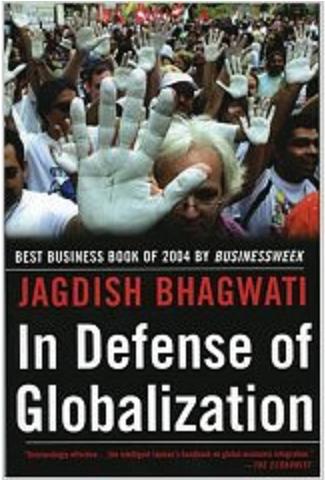
Trade and Rage

In Defence of Globalisation
by Jagdish Bhagwati
(Oxford University Press, 2004, 320 pages;  $62.95)

This eminently readable book is a synthesis of Professor Bhagwati's views on globalisation as expressed in his articles and speeches over the past few years.  As the doyen of trade economists, these opinions presented in one volume are a valuable addition to the ever-growing library on globalisation.  Most of his views are predictable for anyone who has followed Professor Bhagwati's distinguished career.  In particular, the reader's attention will be drawn to the contradictions he identifies in many familiar anti-globalisation arguments.

International economic interdependence (integration) has dominated economic development for the past 50 years, as it did during "La Belle Epoch" before 1914.  Only in the 1990s was the term "globalisation" fabricated, and its adoption has allowed all the world's malcontents to unite against this single "cause".  By focusing their attacks on globalisation, left-wing activists, nationalists, anarchists, environmental groups, communitarians, animal liberationists, church charities, etc., do not need to discuss their differences.

In the early stages of this volume, Bhagwati acknowledges that NGOs have captured the media-sensitive and sympathetic subjects of social justice and human rights as their territory.  It is a simple step from there to establish that since poverty and social injustices still exist under "capitalism", an alternative system of direct controls, regulations and planning must be tried.  History is irrelevant to NGOs!  However, Bhagwati explains how increasing prosperity from more efficient and more technologically advanced production and distribution could be used by NGOs to increase their chances of achieving their goals.

The economic analysis in the early chapters makes telling points against the anti-globalisation lobbies.  The long history of trade liberalisation established that net economic benefits are generated by trade.  So the policy question relates to distributing these gains within the community.  NGOs continue to argue that interdependence among nations restricts their ability to provide social welfare programmes to their citizens.  Any social welfare shortcomings, however, depend not on liberal trade policies but on domestic policy settings.

This kind of reasoning is evident in much of the criticism of globalisation (that is, any residual "bads" are enough to reject a policy).  For example, cultural damage has little to do with economic globalisation, and much more to do with advances in communications, travel and migration (in other words, enabling technology) that expand consumer choice (films, Internet, TV, books, etc.).  Any "loss" of indigenous culture, however, is surely compensated by access to other cultures, as marketing opportunities for all cultures expand.

As his argument progresses, Bhagwati modifies his views on NGOs.  In the early chapters, he argues that although environmental problems may be global, they are not necessarily the consequences of globalisation.  Later, he accepts the Kyoto Protocol without demur, even though the schedules for OECD countries to reduce their CO2 emissions will achieve little if developing countries are free to expand their output.  The CO2 reductions in the Kyoto Protocol were designed to suit EU interests, with no allowance for net energy exporters, such as Australia.  Moreover, the effects of increased CO2 emissions on climate are uncertain;  after all, climate warming could increase agricultural productivity in some regions.  The IPCC modelling of climate change has been seriously criticised because of its dubious assumptions (see Castles and Henderson, among others).

NGOs' opposition to genetically modified crops is treated gently, too.  Bhagwati argues that Europeans' fear of GMOs persuaded their governmentsand the EU Commission to introduce a moratorium on GM crops.  It has also generated support within Europe for adoption of "the precautionary principle", which would give blanket protection to EU farmers, and could be extended to almost any import (GM or not).  On this, Bhagwati comments, "... [this is] an open-ended approach to safety regulation, denying science the decisive role it ought to have" (page 152).  Similarly, he criticises "eco-labelling" as another form of anti-GM protection.

Multinational corporations' activities are analysed (chapter 12) to show that the alleged exploitation of workers and resources, and the corruption of governments in developing countries, are less widespread than NGOs claim and that, on balance, they contribute to economic development.  The benefits from this private investment are often greater than benefits from aid flows, which bring onerous terms for capital repayment and interest charges.  By establishing standards for corporate responsibility (CSR), Bhagwati believes these benefits should be enhanced.  However, he makes no mention of the hectoring "blame and shame" campaigns by some NGOs that infringe shareholders' rights.  And although he mentions favourably the UN's Global Compact (2001), which sets out standards for corporate behaviour, there is no suggestion that a similar concordance should be proposed to set standards for NGOs' statutes and reporting.

The Bretton Woods' twins (World Bank and IMF) have been under the lash from Bhagwati for some years for deregulating short-term capital flows too quickly, for failing to predict incipient problems and for reacting inappropriately and slowly.  He blames the IMF for the severity of the Asian financial crisis (1997) because Fund staff had encouraged de-regulation of short-term capital flows, but did not give any warning when short-term debt accumulated.  That financial disruption was painful, but it became a crisis because Asian governments had inadequate financial regulations and no prudential requirements for their financial institutions.  They were also committed to fixed exchange rates against the US dollar.  When the IMF assistance package was offered, it was immediately criticised and quickly amended.  However, it was the Fund board that approved the package.  As with other international institutions, World Bank and IMF policies are determined by their articles of association (agreements) and by their governing councils, drawn from member governments.

As one would expect, given the author's knowledge, the WTO is a recurring topic in this volume.  The WTO has been a major target for NGOs seeking to influence trade liberalisation as a key component of globalisation, and to sacrifice trade to other gods.  Bhagwati analyses the evils of trade sanctions, trade remedies (safeguards, antidumping, etc.), agricultural protection, dispute-settlement procedures and protection of intellectual property as impediments to growth in developing countries.  Like the Bretton Woods' institutions, the WTO is also facing demands for reforms.

In the final section, Bhagwati seems complaisant about NGOs and sees their attitude to globalisation as benign, despite his earlier scepticism.  He is optimistic that NGOs would be willing to compromise to draw up new policies, new institutions and "appropriate governance" to promote "the human face" of globalisation;  "... none of these difficulties is beyond resolution by compromise and good sense".  Since most NGOs make openended demands and have developed a life of their own, this is not a convincing line of argument.

Bhagwati concludes that globalisation is "a force for advancing several social agendas", that he believes "will yield better results if it is managed" (page 221).  To achieve what he calls "appropriate governance", based on new policies and institutions, he wants to incorporate NGOs into the negotiations, and to use them to monitor international co-operation.  This ignores recent experience with NGOs, and conflicts with his own views in earlier chapters.  Demanding changes to the constitutions and governance of international institutions is fraught with difficulties.  Arguments over the WTO and the Bretton Woods' institutions have shown that any amendments to a founding agreement or changes to the governing bodies are difficult to negotiate.

One proposal to elicit more support for economic globalisation from developing countries and NGOs would be to provide outside financial assistance to facilitate economic adjustments to external shocks, such as tariff reductions or falling export prices.  Bhagwati suggests that World Bank and IMF resources should provide such finance (page 223).  This was proposed also in the Declaration on Greater Coherence in Global Economic Policy-Making in the Uruguay Round Final Act.  International institutions guard their territory fiercely, however, so no progress was made towards institutional policy coordination.

After reading this volume, one is left wondering whether globalisation is in retreat.  Bhagwati's comprehensive survey leads him to seek to accommodate dissenting voices.  This can only offer opportunities to the anti-globalisation lobbies.  Already international political tensions, as well as NGOs' activities, are weakening the forces of global integration.  As terrorism raises security concerns, and increases communication and transport costs, international co-operation may be weakening.  Ultimately, globalisation depends on domestic economic policies and governments' commitments to policies that support the market economy:  property rights, the rule of law and free competition.  This makes some of the concessions offered in this volume worrying.

Friday, August 27, 2004

Union tears apart fabric of industry

The Textile Clothing and Footwear Union just don't get it!  The icon Australian clothing company Fletcher Jones has announced that, after 70 years, it will close their local manufacturing operations in Warrnambool, Victoria and Mt Gambia, South Australia.  In response, the union has accused Fletcher Jones of being un-Australian motivated only by higher profits, and by implication guilty of incompetent management.

What the union doesn't get is that, if any alleged managerial deficiencies exist, they are at least in part directly attributable to the union campaigns and regulations that flow from the campaigns.  The union movement across most sectors barely recognises the link between its activities, labour regulation and managerial competency.

The clothing manufacturing award is the only major Australian award that has not been subject to award simplification under the Workplace Relations Act.  It is long, hugely complex and constraining on management decisions.  Among its many clauses, it dictates rates to be paid, for example on the sewing of a button, determines how, when and if contracting out can occur and requires extensive reporting of activities to the union.

Running parallel to the award is outworker legislation in New South Wales and Victoria, which largely mirrors the complex award but goes further by controlling contracts between manufacturers and retailers, including extensive reporting to the union of contract details.

Supporting this industry controlling regulation is perhaps the most successful business intimidation campaign conducted in Australia, run by the union, heavily funded by state governments and co-ordinated with church and other groups.

The end result is the systemic destruction of entrepreneurial management flair within the industry.  The clothing sector in Australia now no longer cares about manufacturing locally because any entrepreneurial effort cannot produce results, given the risks posed by destructive regulation and brand attack.  The clothing sector is resigned to a future where some design is done locally and all manufacturing done off shore.  The manufacturing management capacity has been stripped from the industry.

The union blames tariff elimination.  They don't understand that domestic clothing manufacturing could have a future but only if management and entrepreneurship is free wheeling within the structures of normal commercial regulations.  The destruction of management capacity through labour regulation that has nothing to do with workers' rights destroys creative entrepreneurship.  Consequently, say goodbye to the industry and jobs!

It's this, that perhaps more than anything else, that has motivated the major industry association, such as Australian Chamber of Commerce and Industry, Australian Industry Group, Australian Mines and Metals Association, Housing Industry Association and the Business Council of Australia to express concern with the federal ALP industrial relations policy.  Each of these industry associations understands that for businesses and industries to prosper entrepreneurship and management capacity must be maximised.


ADVERTISEMENT

Wednesday, August 25, 2004

Long on Flaws, Short on Fixes

According to the ACCC's consultants, price and access regulation of gas and electricity networks has increased national wealth by somewhere between $2 billion and $11 billion.  On several occasions the ACCC's Energy Commissioner, Ed Willett, has cited these estimates.  The first time he did so they were faithfully reported by a naïve cadre of journalists, keen to ingratiate themselves with an ACCC ever willing to offer inside information in private briefings.

However, under scrutiny the ACCC's estimates have been demolished.  They stem from economic modelling based on price reductions mandated by the ACCC.  Illogically, the modelling would show even greater gains if the ACCC had required prices to be set at zero!  This carries particular weight in the light of a series of successful challenges to the price determinations the ACCC has set for gas pipelines.

The Productivity Commission's (PC) recently released Review of the Gas Access Regime included a scholarly dismantling of the ACCC's trumpeted estimated benefits from its price decisions.  The PC review is the latest in a series of reports the Commonwealth has commissioned into the regulatory arrangements for gas.  The PC rejects the ACCC's stoutly maintained view that its regulatory approach encourages rather than deters investment.  Like earlier reviews of gas, the latest PC Review recommended some deregulation of the present controls on the gas pipeline industry, especially with regard to new facilities.  Such recommendations have been endorsed by deregulatory rulings of Australian Competition Tribunal regarding the Eastern Gas Pipeline (Bass Strait to Sydney) and by the Minister Macfarlane on the Moomba to Sydney pipeline.

However, the PC's fine analysis is let down by the anodyne nature of its recommendations.  Following the series of earlier reviews and decisions, forceful and specific recommendations were needed from the Productivity Commission in order to operationalise a less intrusive regulatory regime.

Unfortunately the PC has largely relied upon setting overarching objectives which can be readily interpreted to support a wide range of positions.  Central to its recommendations is an objects clause, "To promote economically efficient operation and use of, and economically efficient investment in, the services of transmission pipelines ..." Any regulator would readily claim such wording as describing precisely how it currently operates.  Yet the PC is clearly dissatisfied with the decisions taken by regulatory agencies (the ACCC and National Competition Council)

The PC offers no guidance on when market disciplines provide better outcomes than regulation for existing networks and how (or whether) to provide a transition to a deregulated state.  It should, for example, have offered firm guidelines that regulation is unnecessary once a market is supplied by competing pipelines.

In addition, although it reiterates findings of other advisory bodies in recommending regulatory holidays for new pipelines, it advocates Ministerial discretion over such a decision rather than making it automatic.  This guarantees an additional regulatory hurdle.

Similarly, recognising the costly and lobby-intensive nature of the current intrusive price setting model, the PC also recommends a light handed monitoring option.  However its recommendations on this were somewhat weaker in its final report compared to the draft report.  The latter envisaged that the present approach of "access arrangements with reference tariffs would only occur in the more extreme circumstances".

Again, although it assesses that the price determinations by the ACCC have been inappropriately harsh to the supplier, the PC's solutions to counter these offer little promise of improvement.  Thus, the PC recommends that tariffs should be set to meet the efficient costs of providing access to the reference services and give a return commensurate with the risks.  This might amount to little more than an exhortation to the regulator to undertake the process it already considers it follows.

And the PC makes a suggestion that prominent people be assembled to develop a consensus position of how to set an agreed "capital asset pricing model" by Australian regulators.  It is doubtful that the desired consensus could emerge.

Unfortunately therefore, although the PC offers robust criticism of current heavy handed and intrusive regulatory practices, its report is remarkably short in offering future directions on how to correct this.  This is regrettable in view of the pivotal role most authorities consider that gas must take in Australia's energy policy.


ADVERTISEMENT

Sunday, August 22, 2004

This "Innovation" is a Charade

It is time to stop the charade!  The Victoria Government's innovation strategy is a destructive joke.

Last month I was at a conference attended by well-informed Australian and Asian business people, where Minister for Innovation John Brumby lauded the many supposed successes of his government's innovation strategy.

When he claimed that Melbourne was the centre of the funds management industry in the Asia Pacific region, ripples of suppressed laughter spread through the audience.

When he went on to brazenly claim that Melbourne had a thriving aeronautical industry, the laughter spread further.

OK, these are just harmless absurdities.  Moreover, the Bracks Government should not be held responsible for failing to turn Melbourne into a combination of Toulouse and Hong Kong.

However, when Mr Brumby went on to laud his government's actions on agricultural biotechnology and the food industry, the absurdities become serious.

These are two areas in which Victoria has a real and substantial industrial base and scope for expansion, but because of policies of the Bracks Government, they are going backwards.

The Bracks Government's recent decision to ban commercial trials of GM food crops, despite clearance on health, safety and marketing grounds, has effectively killed the agricultural biotechnology industry in the state.

Numerous research programs have already been stopped by the decisions.

Researchers may be willing to continue with pre-commercial research, but only if it is government funded.

And of course if this research ever gets to a commercial stage, it will need TO go elsewhere, resulting in Victorian taxpayers underwriting the commercial ventures of foreigners.

Victoria has a large food processing sector with much potential, but it also is going backwards.

This sector is currently undergoing a major restructuring worldwide.

Accordingly the Victorian industry faces a major challenge.

But the biggest impediment to the local industry successfully meeting this challenge is the inflexible nature of the industrial relations environment in the state, aided and abetted by the government.

These policy failures could be fixed quickly and cheaply.

Instead, the government not only avoids doing so, but pretends they do not exist and uses its $321 million Innovation Strategy to buy silence from the industry.

For example, in June it sent a huge contingent of bureaucrats and friends to BIO 2004 in San Francisco and launched its new Biotechnology Strategy.

Both at the conference and in the strategy itself, the government lauded its supposed successes in agricultural biotechnology, and blindly avoided mentioning the fact that it had just banned the technology for food crops.

At BioFest, a government subsidised conference, last week, Mr Brumby announced that he had lured a major international agricultural biotechnology conference to Melbourne in 2006.  This is like funding a "Life.  Be in It" campaign at the Melbourne morgue.

As for the food industry, the government has responded to the shrinking industry, not with improvements to the industrial relations climate, but with waves of bureaucrats and grants to help market food to Asia.

As if Cadbury Schweppes and Heinz need help in marketing.

The state's future would be much brighter if the government eliminated Innovations, gave the money back in the form of tax cuts, and instead simply allowed the private sector to get on with its business.


ADVERTISEMENT

Friday, August 20, 2004

Will Climate Warming Really Turn Off the Tap?

I agree that carbon dioxide levels are currently increasing and this could bring a warmer climate.

But I differ from Professor Tim Flannery and others (see The Land letters, August 12, pp 10, 11) about whether current trends will really bring doom and what we can do about it.

Over the past few decades there have been many studies of the effect of increasing carbon dioxide levels on plant growth and it is all good news for farmers.

CSIRO has stated that:  "The direct effects of increased carbon dioxide in the atmosphere will probably have a substantial positive impact on Australian agriculture and forestry".  For example, doubling of carbon dioxide levels over the next 100 years could increase growth rates in wheat and barley by 30 to 40 per cent (CSIRO Media Release, 97/122).

Professor Flannery and the doomsayers would argue "but we won't have the water to grow the crops".

Indeed, the recently signed and much trumpeted National Water Initiative infers it is going to get drier and "water access entitlement holders are to bear the risks of any reduction or less reliable water allocation arising from reductions to the consumptive pool as a result of seasonal or long-term changes in climate".

Yet about 100 Australian climatologists recently predicted that it will generally getter wetter as it gets warmer (Australasian Science, June 2004).

The bottom-line appears to be that there is no coherent picture of regional climate change and this is especially the case when predicting rainfall.

So what should we do?

The new age environmental fundamentalists believe that the road to salvation -- more usually referred to as sustainability -- is paved with feeling guilty, using wind power and taking water off irrigators and giving it back to the environment.

These mystical medications are unlikely to cure potential real world dilemmas.

I am optimistic that technology will eventually solve our fossil fuel dependence and in this way address the issue of carbon dioxide emissions.

But there is still the possibility -- the worst case scenario -- that rainfall will be reduced across southern Australia.

The National Farmers Federation recently suggested the solution lay in initiating research into new crop varieties that can handle reduced rainfall and a hotter climate.

Biotechnology offers the potential for more drought tolerant GM crops.  There are currently research program focused on drought tolerance.

But State Governments have banned the commercialisation of new GM food crops following intense lobbying from environmentalists.

Last year the Wentworth Group of Concerned Scientists, of which Professor Flannery is a member, were asking all irrigators to voluntarily give up 10 per cent of their water allocation without compensation.

I wonder what the Wentworth Group's position is on supporting an increase in water use efficiency of say 10 per cent through the development and commercialisation of new GM crop varieties?

I suggest we confront the future, including climate change, with our eyes open to all the possibilities, a positive mind set, and a capacity to innovate.


ADVERTISEMENT

Thursday, August 19, 2004

Critics go overboard, voters unimpressed

"The electorate will render its judgement accordingly".

John Howard's political hero, Robert Menzies, once said that if 12 people witnessed a car accident there would be at least six different versions of what happened.  There are only two versions of what the Prime Minister was or wasn't told on the night of November 7, 2001.

Put simply, the first version is that of Mike Scrafton, a former Defence official who claims he said to the Prime Minister that there was no evidence of children being thrown overboard from an asylum-seekers' boat.  The second version is that of Howard, who maintains he was told only that the evidence was inconclusive.  To support his public statement that children had been thrown overboard the Prime Minister relied on a report from the Office of National Assessments.  That report was later found to be incorrect.

For those who see duplicity in everything Howard does, Scrafton's comments have been taken as "proof" that the Prime Minister lied, but this ignores a number of issues.  It is quite possible that Scrafton thought he was saying one thing while the Prime Minister understood him to be saying something either different or more ambiguous.  Such misunderstandings are common and not just confined to politics.  Even if Scrafton had been as definite in his opinions as he claims he was, there remains the issue that an Office of National Assessment report contradicted him.

One doesn't necessarily have to believe in the post-modern idea that "there is no such thing as truth" to appreciate the difficulty, or even the impossibility, of establishing precisely what was said and what was thought to have been said three years ago.  As to the whole sequence of events of the children-overboard affair, the fact that the Senate inquiry into the affair split along party lines indicates at the very least that there are two, or more, sides to the story.

The effort of the Opposition and numerous journalists and academics to get to the truth of the matter is understandable, but will ultimately prove to be fruitless.  The process by which politicians and governments, and indeed individuals in everyday life, make decisions is complex and isn't explicable in the few simple sentences demanded by the media.

The obsession displayed by some of the Prime Minister's critics in their pursuit of him about children overboard has blinded them to one obvious question.  Does the electorate care?  On the face of it, the answer is no.

This is not to argue that it is irrelevant whether politicians lie, or that the merits of any question are to be judged solely by reference to the opinion of the electorate about them.  The point is that our system of government provides a mechanism for resolving disputes such as this through a democratic vote at the ballot box.  Surveys conducted before and after the 2001 election indicated that if any one single event decided the outcome then it wasn't children overboard or Tampa.  It was the terrorist attacks on Washington and New York on September 11.  What these did was reinforce the public's desire for strength of leadership, which the coalition was perceived to have and which Labor wasn't.

Certainly an election is a blunt instrument for gauging the will of the community, but it is the best we've so far devised.  If what Scrafton said to Howard is as important as those who are calling for the Prime Minister to stand down believe it is, the electorate will render its judgement accordingly.

Not every person concerned by the questions concerning children overboard is of the Left political persuasion, but it would be true to say that the issue has become totemic for the Left.  The issue has been used to challenge the legitimacy of the Howard government.  There is nothing unique to those tactics and such a strategy conveniently ignores the reality of electoral outcomes.  Such an approach by the Left was applied in the 1950s against the Menzies government over the alleged manipulation of the defection of the Russian spy Vladimir Petrov.  Twenty years later it was employed against the Fraser government following Whitlam's sacking.

The circumstances of the federal elections of the 1950s, 1970s and 2001 share a common characteristic.  The public did not share the attitude of the Left in relation to the supposed malefactions of coalition governments.  In each case, at the election immediately after the government was supposed to have committed its travesty, the government was re-elected.  Perhaps those supposed travesties might have been more imagined than real.

Menzies came to within one seat of losing government, and Fraser was defeated in 1983, not because of the reasons for which they were hated by the Left, but because of self-inflicted wounds caused by poor economic decision-making.

That is the political lesson for Howard and Mark Latham.  If Howard wins the federal election it will be because his economic management is trusted.  If Latham wins it will be because the electorate has decided it is time for a change it won't be because of the revelations of the last few days.


ADVERTISEMENT

Thursday, August 12, 2004

Bold reform is just a few risks away

During the past eight years the coalition government can claim some important successes.  Financial management has been sound with the economy undoubtedly in a better condition than in 1996.  Growth has not just been fuelled by some fortuitous raw materials boom or a buoyant world economy.

The Asian economic collapse and the terrorist attacks of 2001 had a more dramatic effect on Australia than did the fall of the Berlin Wall.  But the coalition's ambitious international agenda has deflected its attention from a domestic program.

There is a sense that the coalition has lost its appetite for bold measures.  It is not that the government has been without policies far from it.  It is just that by the time many of its policies are implemented they are completely compromised.

After some early defeats in the Senate the coalition abandoned efforts at fundamental reform and opted for incremental change.  But in policy terms merely tinkering at the edges can sometimes make matters worse.  This is exactly what has happened, particularly in the area of corporate law.

If former industrial relations minister Peter Reith's original plan had been put into effect we would have gained a deregulated labour market.  In 1997 the coalition considered a double dissolution to get the legislation through but decided the risk wasn't worth it.  Seven years later the product of that decision is a labour market that is more centralised than that of even New Zealand.

Likewise the GST.  The government's original idea of using a consumption tax to fund a wholesale reduction in personal income tax, and aligning the top marginal personal rate with the corporate rate was a good one.  Instead the deal with the Democrats produced a new tax with additional regulation but without any substantial change in tax rates.

Last weekend the Australian Financial Review published its survey of the opinions of 17 chief executives of major companies.  (AFR, August 7-8).  About half said the government had run out of ideas and was suffering reform fatigue.

Here's an outline for a real reform agenda:

TAX

Start again.  Regard the tax system as a way to encourage enterprise, not as a mechanism for government control over taxpayers' lives.  Align the top marginal personal tax rate with the company tax rate at 30 per cent and increase the tax-free threshold to provide incentives for individuals to move from welfare to work.  This can be funded by a combination of expenditure reductions and if necessary an increase in the GST rate.  This would require an end to the automatic payment of GST revenues to the states.

INDUSTRIAL RELATIONS

Back to basics.  Reinstate the principle that individuals should be free to enter voluntary contracts, and should be bound by them.  Abolish the Australian Industrial Relations Commission.  Expand the coverage of Australian Workplace Agreements, with their enforcement being the responsibility of the federal court system.  Abolish the current unfair dismissal legislation and allow the conditions for termination of employment to be the subject of agreement between employer and employee.

BUSINESS

Encourage it, not persecute it.  As the side of politics committed to free enterprise the coalition should suppress the urge to join unions and certain talkback radio hosts who attack business at every opportunity.  The government should not allow its agencies to engage in gratuitous assaults on companies or involve themselves in general politicking.  The approach of the Australian Competition and Consumer Commission has done much to injure the public's attitude to companies.  Either reform the ACCC to limit its powers and restrict its anti-business campaign's or abolish it.  Tax legislation needs to be simplified.  It is so complex it can't be understood by taxpayers and allows the ATO excessive discretion.

CORPORATE REGULATION

Trust the market.  Re-establish the principle that the primary responsibility of a company is to its owners it is not to the community and it is not to stakeholders or interest groups.  Scrap Clerp and the Financial Services Reform Act.

SUPERANNUATION

It's a failure.  The area is complex, confusing and over-regulated.  Attempts to raise the national savings rates have been compromised by successive governments regarding superannuation as an area for revenue raising.

MEDIA

Another shambles.  Apply one simple principle the only role for government in the area is to help lower the barriers to entry of new players.  It is not the job of politicians to decide how many television stations there should be, what they can broadcast, and when.  The growth of new media is making the cross-media ownership laws obsolete and they should be scrapped, as should local content regulations.  The rest of Telstra should be sold with the money used to retire debt.  As long as the ABC remains in public hands it will continue to be accountable to no one but its own staff.  The coalition should either sell the ABC or stop complaining about its bias.

INDIGENOUS AFFAIRS

Continue reform.  Make reform on the basis that practical reconciliation will make meaningful improvements to people's lives whereas symbolic reconciliation won't.  There should be a shift of emphasis away from providing native title to communities towards having individuals possess freehold title, which they can buy and sell, and borrow against.

WELFARE

Full of contradictions.  Decide that the objective of welfare policy is to have every person who can work in work.  The introduction of Work for the Dole was a worthwhile first step.  If the incentives are right individuals will leave welfare for employment.  While in the short-term at least welfare reform could cost money, substantial savings can be made through the abolition of many measures of middle class welfare, for example the baby bonus.

In conclusion, there is no doubt that if the government controlled the Senate many of these policy ideals would now be in legislation.  But the existence of the Senate cannot continue to be used as an excuse to avoid reform.  In any case a double dissolution is available to a government that can't get its legislation passed.  Given that the coalition is unlikely to win a Senate majority in the foreseeable future, the question the government has to ask itself is, what is it willing to risk for real reform?


ADVERTISEMENT

Sunday, August 08, 2004

Who controls your contract?

Ladies and gentlemen.

There is an Internet online newsletter called "Workers Online".  It describes itself as "the official journal of LaborNet, a union portal sponsored by the Labor Council of NSW in partnership with Social Change Online" and "is recognised as a world-leader in union communications ... emailed to about 5,000 subscribers across the globe."

Late last month, Workers Online ran an editorial in response to a ruling released by New South Wales' highest court (Fish v Solution 6, July 21 2004).  The article began as follows:

Kill the Lawyers

What's left of the HR Nicholls Society must be popping the champagne this week, with a NSW court ruling that sees the triumph of their 20-year battle to kill industrial relations and replace it with a "rule of law".

It's such a good editorial that I shall quote it at length.

That's the upshot of this week's ruling by the NSW Court of Appeal that employment contracts have become so complex that the Industrial Relations Commission no longer has the expertise to deal with them.

It is an argument bizarrely circular in its logic -- it goes something like this.

The industrial relations jurisdiction was established to provide cheap, practical, negotiated settlements to workplace disputes free from the formal bonds of black letter law.

Industrial commissioners and advocates were traditionally practitioners rather than professionals, able to nut out conciliation by banging heads together and delivering an arbitrated outcome where necessary.

The system hummed along for the best part of 100 years delivering practical outcomes with bipartisan support until the neo-conservative ethos of union busting was imported into this country.

The prime attack weapon was the "rule of law" -- advocating for legislative change to the Trade Practices Act and corporations laws to shift employment and industrial matters out of the tribunals and into the courts.

The logic was venal, in tribunals the settlement was invariably a compromise, in the courts it was winner take all.  And with laws in your favour and the greater legal firepower that the wealthier party brings to the table, the odds suddenly shifted in favour of the boss.

Workers Online goes on to explain the horrors of the Howard period, then says:

Thanks largely to the Carr Government, NSW tribunals were not emasculated but retained a place where justice could prevail over these power relations.

In fact the industrial jurisdiction has extended so that workers whose conditions were set by contract, but were really just employees, could also avoid costly court litigation.

It was coincidental that, on the day the NSW Court of Appeal released the ruling that so inflamed Workers Online, I had an article published in the Australian Financial Review.

In part, I said:

The key point about NSW is that IR legislation introduced by the Carr government does not regulate relationships between employers and employees.  The legislative scope embraces "work in an industry".  This simple definitional shift away from normal employment regulation to regulation of "work" has turned the NSW Industrial Relations Commission into a powerful regulator of commercial transactions.  The implications of this comparatively recent and radical shift are now only being understood as the NSW Commission tests its new powers ...

The NSW Court of Appeal is unhappy.  A surprise twist in the NSW legislation is that appeals against decisions of the full commission are not allowed. ... The Supreme Court (has) stated it was "troubled by the continued intrusion of the NSW IR Commission into commercial contracts".  The court also expressed "grave doubts" as to the constitutional validity of denying people their right to appeal to the High Court of Australia.

In their ruling of 21st July, the NSW Court of Appeal denied the Industrial Relations Commission the jurisdiction to hear the case in question, stating that the Commission was largely comprised of judges from the specialist industrial bar and was an inappropriate forum for the dispute.  It explained that

Few, if any, of the members of the commission have substantial experience of commerce or of commercial law

And

The defect in the jurisdiction of the commission is patent, plain or clear.

This brief story -- comprising the tirade from Workers Online and the ruling of the NSW Court of Appeal -- is not the end of, but rather a major flash point in, a protracted and hugely important social and economic battle being waged in Australia.  In years to come, historians who choose to look at it will mark it as a defining point in the evolution of our society.  It is a process in which members of the HR Nicholls Society have been observers and bit players.  It is a process which has, as its centre, wholesale "cheating at Scrabble®".

The pocket history is that, for some 20 years, Australasian labour regulators have been trying by legislative means to rope the commercial contract into their net.  They failed in New Zealand.  They succeeded in New South Wales and Queensland.  They have had a little success in Victoria.  They are trying in South Australia and attempting to do it via the back door in Western Australia.  Legislatures are currently silent in Tasmania, although review is under way.  The federal ALP intends to do so in their jurisdiction if they win office.  NSW is the pack leader, with nearly a decade of legislative success and years of experimenting with implementation.  But, it would appear, the highest court in NSW has just put the whole process on hold -- perhaps even frozen its application for the moment.

The Scrabble® game and cheating involves a protracted but sophisticated technique of inventing new language, giving alien and contorted meaning to words with already established meaning, leveraging the contortions and new language in the public domain to create the impression of community will, and then plonking these words onto the legislative Scrabble® board to see what can be got through.

In the area of labour law, the most significant cheat Scrabble® words in play include

Dependent contractor, outworker, homeworker, employment deeming, triangular relationship, employee like, cascading contract.  The list can go on.

The cheat words roll over into other areas and include

Corporate manslaughter, corporate social responsibility, triple bottom line, and others

My focus, clearly, is the labour area.  In this forum and in many others, I have repeatedly sought to study and explain the cheating that is going on.  Today, I want to cut to the chase and look at the core of the cheating.  I then wish to enunciate the only way I think we can move forward to stop this foolish, self-delusional and socially and economically destructive legislative game.

To this end, Workers Online has provided a great service.  Its editorial contains all the elements of not only how Australian legislatures are engaged in wholesale cheating at Scrabble®, but most importantly why they are cheating.

Workers Online summarises the essential assumptions underpinning all labour regulation across the globe in the last 100 years thus:

  1. The employment relationship is one of unequal power -- employers are powerful;  employees are powerless.
  2. Employees must collectivise their efforts to redress this power imbalance.
  3. Employers are so all-powerful that the state must institutionalise and give special monopoly authority to the manifestation of employee collectives, that is, unions.

These assumptions are the air of every breathing moment of the labour lawyer and academic community, and constitute the principal formula that focuses the minds of the human resources management community.

Within our professional economics community, there exists strong tensions between those who reject the idea of the inequality of power in employment, those who are ambivalent or confused, and those who side with the labour lawyers.

It is now universally accepted that, over the last 15 years or more, labour arrangements have entered a phase of change not seen in the previous 100 years.  Workers Online reasons that this change is a con, a sham, a subterfuge designed by the bosses to reassert their position of power.

Their reasoning is that

  1. Trickery by way of the law is being used to stop workers accessing the protections available to them.  That is, that the law of contract is being used against workers.
  2. The people who use this trickery -- bosses, lawyers and judges -- pushed by the neo-conservative politicians and their string-pullers, are immoral at best, evil at worst.
  3. Legislatures must stop this legal trickery by rewriting law and imposing discipline on judges.

The headline "Kill the lawyers" is a scream of frustration at having their rewriting of law usurped.

But, most importantly, what can be noticed from Workers Online is the passionate, religious-like genuineness of their belief.  Let us put to one side the naked desire for old-fashioned rent-seeking which demands state monopoly privilege for the most conservative of institutions, the union movement.  Let us also forget that the unions' claim to be representative of all workers is wafer-thin and rejected by workers themselves.

Let us look, instead, at their central insistence that employment is an environment of unequal bargaining power.  On the inequality of power, the passion, the commitment, the genuine belief in this as a fundamental truth cannot be denied and must be respected.

And it is on this single point -- that is, on the perceptions of power -- that the entire cheating game hinges.  Assess this point accurately and every other item in the debate becomes clearer.  And on this point we find that all sides to the debate cheat at Scrabble®.

What I am about to say next, I have dared occasionally to say in forums of persons who are supposed to be on the employer side of the debate -- including HR Nicholls gatherings.  On every previous occasion that I have uttered what I am about to utter, I have raised ire, annoyance, resentment, anger and denial from a significant sector of the audience.  Lawyers write me off, CEOs choose to ignore me, human resource managers think I'm ignorant and economists think I'm strange and lack credibility.  I normally lose the attention of large parts of the audience because of a deep-seated, negative, emotional response.

The fact is that Workers Online is correct.  Employment is a contract of inequality in bargaining power.

The employer side of the debate cheats at Scrabble® by not accepting this single truth.  And the employers' cheating is the principal explanation as to why policy resolution is not being achieved, why the cheaters on the other side get away with what they do, and why economic development is more constrained that it need be.

The facts are clear for anyone who chooses to look.

Every superior court legal ruling that considers the contract of employment looks for a string of elements which, when tied together, identify one single thing:  does the employer have the right to control the employee?  And control denotes power.

The Independent Contractors of Australia have identified some 22 separate elements from which the courts will choose to test if an employment contract exists.  They include the traditional elements of intention, withholding of money for holidays and sickness, delegation, working for a result, capacity to create goodwill, and so on.

What surprises me is that, within the legal, labour economics and regulation fraternity, these "template" elements are treated as if they are disparate, disconnected and confusing.  As a result, they assert that the employment contract is ill-defined.  But when these elements are looked at and studied carefully, what emerges is a clear template directed toward finding one thing -- is there control?

For example:

  1. The withholding of wages for holidays and sickness is a control and power function.  Employees have income withheld from them so that the managerial class can use the money withheld as the bargaining tool for the organisation of non-work periods at the convenience and discretion of the managerial class.  This managerial power is thought necessary for the efficient operation of the firm, certainly on the Taylorist model of the firm.
  2. The inability of employees to create goodwill when they work is a control and power function.  The value of a firm is seen to lie substantially in the goodwill it creates around its activities.  The function of employees, it is reasoned, is to spend their time, effort, energy and, most importantly, their creativity in the building of goodwill for the firm -- goodwill which is owned by the firm.  Employees are not allowed to garnish goodwill for themselves because it diminishes that collective goodwill which is the property of the firm.  Or at least that's the Taylorist-modelled thinking.
  3. The inability of an employee to delegate is a control and power function.  An employee is not allowed to have someone else do their job in their place.  Power of delegation is exclusively vested in the managerial class to ensure managerial control of the firm.

Each of the 22 elements can be discussed in this way to show how the template is used by the courts to look for one thing -- control, and hence power.

In this setting, it is an unavoidable truth that that the employment contract is an evolved derivation of the master-servant relationship, and in the current context it is a contract that remains closer to master-servant than is often admitted.  Master-servant embodied a higher level of control than the current employment contract, but control and power remain the issue

The words of the great nineteenth-century American jurist Oliver Wendell Holmes remain closest to the truth, even when he described the employment contract this way in 1892:

There are few employments for hire in which the servant does not agree to suspend his constitutional rights of free speech, as well as idleness, by the implied terms of his contract.  The servant cannot complain, as he takes the employment on the terms which are offered to him.

Holmes's words have not dated.  No matter how much the convoluted processes of 20th Century legislative activism or common law evolution may pretend or appear to alter this legal reality, Holmes's words still describe the core fact of the employment contract and the expectations of it constituted within the law.

Workers Online is correct.

How do we know this?  Quite simply, the judiciary almost daily instructs the community through their published rulings on the law of employment contract.

Yes, the very black letter lawyers that Workers Online wishes (metaphorically) to kill concur with Workers Online.

Yet I find it incredible that if one talks to most practising lawyers, they will state that the employment contract is unclear.  Talk to almost any economist and complete ignorance of the ABCs of the contract of employment is nearly always displayed.  Yet these are the professions with most influence over parliamentary approaches to labour regulation.  It is ignorance of the simple fact that power lies at the heart of the contract of employment, which is the primary cause of our legislatures cheating at Scrabble®.

However, note that my remarks to date have been specifically about the facts of the employment contract.  The word "contract" is the critical item.

Now I need to paint the picture of the employment relationship.  Because, then, a different picture emerges.  "Contract" and "relationship" are different and understanding the difference leads us to understand how Scrabble® cheating has come about.

Simple, basic contract law teaches us that a relationship does not constitute a contract.  For a contract to exist, there must be a relationship, but that relationship must also have the key elements of intent, offer, clear terms, consideration and acceptance.  Take out any one of those elements and no contract exists, although the relationship may continue.

When the important difference between contract and relationship is understood, the confusion that exists in the labour regulation debate becomes clearer.

Economists focus on the employment relationship.  They assert that there is no predetermined or systemic power imbalance in the employment relationship.  They are correct.  But a finding at law on employment is a finding of a contract, not a relationship.  And regulation of labour is a process of legal regulation of contracts, not regulation of relationships.  But economists invariably fail to recognise this.

Pro free-market economists tend to make the fatal error of engaging in the public policy debate while missing the point that when they talk about labour regulation they must specifically consider the employment contract.  Instead, they wax lyrical about the behaviour of people in economic relationships, thinking that this is the same as employment contracts.  Consequently, their musings come to be ignored by legislatures.

It is this failure to play Scrabble® correctly, to distinguish between contract and relationship, which prevents economists and others within the "employer" camp from understanding the issues, winning the debate and moving towards better regulatory structures for all parties.

I'll repeat my point.  It is vital to understand that on labour issues that legislatures and the common law regulate contracts, not relationships.

I will qualify that by noting that in areas of equal opportunity, anti-discrimination and occupational health and safety, regulations embrace attempts to dictate relationships but get themselves into terrible difficulty as a result.  My comments today however do not stretch into those two areas but are confined to the core area of economic labour regulation described generically as industrial relations.

And, for emphasis, I'll repeat my point again.  Appreciate and openly accept the difference between contract and relationship, and that the employment contract is one of control and power, and we can move forward.

But I want to add another element into the Scrabble® mix.  On this additional element, economists and the employer camp are not cheating, but our friends at Workers Online and their followers are.

The commercial contract is a very different contract to the employment contract.  The commercial contract is a contract of equality.  It is a contract in which all parties have equal rights to control the contract and in which no-one has control over another.  This does not mean that the commercial relationship does not have elements of inequality of control, or that bargaining power inequalities do not exist.  In fact, they always will.  The vagaries of human nature are such that nothing in human relationships is ever equal.  But in the commercial contract, equality before the law is assured.

The evidence of the equality of the commercial contract is the same evidence that demonstrates the inequality of the employment contract.  And for the same reasons that the employer camp rejects the fact of the employment contract, the Workers Online of the world seem unable to accept, and refuse to fathom, the equality of the commercial contract.

In my personal life's choices, I reject the employment contract.  I am not alone.  Some 28 per cent of the Australian private-sector workforce earn their livelihood without recourse to the employment contract.  Some people are consciously and intellectually aware of why they are not "employed".  Most operate on instinct, an instinct perhaps surprisingly well enunciated by one of the 20th Century's greatest industrialists.

John Paul Getty once said:

When human beings relinquish their individuality and identity of their own volition, they are also relinquishing their claim to being human.

For those of us who work without the employment contract, Getty's words form the essence of the decision.  To be on an employment contract is to relinquish individuality and identity to the greater good of a firm and to become part of a firm.

The commercial contract enables humans to retain their individuality, identity and their humanity and simply to sell their services to the firm.  The firm can then do what it likes.

I will not today explore this area further because it involves a fundamental rethink about the nature of the firm, how an economy operates (including considerations of issues such as wage-induced inflation), and a very fundamental re-conceptualisation of commercial regulation in a free market economy.  They are issues to be touched on in my developing book.

But when Workers Online and its fellow travellers induce legislatures to cheat at Scrabble® and to create legislation the likes of which we have witnessed in NSW and Queensland (and which has been attempted or is being attempted in other States), Workers Online is the instigator of inequality, not the protector of equality.  To destroy the commercial contract by legislative means or to give tribunals the power at will to treat and regulate a commercial contract as if it were an employment contract, is to destroy a primary cornerstone of an equitable and fair society.

Workers Online does not understand this and, consequently, gravely misunderstands the decision of the NSW Court of Appeal.  In jurisdictionally pulling the NSW IR Court back toward its traditional employment contract matters, the Court was not acting in cahoots with evil employers seeking to usurp the rights of workers.  The Court was moving to protect the core contract that underpins economic equality in the community and upon which economic transactions and our economic prosperity are founded.  In their cheating at Scrabble®, Workers Online poses the gravest and greatest of threats to economic equality.

The HR Nicholls Society exists for one simple reason.  It is a network of people who hold to the view that current labour regulation regimes suppress the economic creativity of Australians.  As a result, our nation is less wealthy than it should be, the affliction of unemployment touches vastly more people than it should, and economic wealth is less equitably distributed than should be the case.  And the disease of poor labour regulation is global, not just local.

But if, in our quest, we consistently fail to deal with truths, we will never successfully make our points and see the changes that Australia sorely needs.  We must stop cheating at Scrabble® and accept the legal fact of control and power inequality that lies at the heart of the employment contract.  If we do that, we can advance the debate in a vastly more constructive way.


ADVERTISEMENT

Workers of the Future

There has been a silent revolution going on in the business of work which is now beginning to gain voice.

Workplace regulations have traditionally been based on the idea that employment is inherently a master-servant relationship.  That is, employers have the power to dictate the type and conditions of work, and thereby exploit workers.

The response, both here and abroad, has been to regulate the contract of employment separately, and differently, from other commercial contracts.

In Australia, this has led to the formation of special laws and courts to adjudicate employment contracts, and special negotiating rights to third parties such as peak employer groups and unions.

The focus of general contract law is to allow individuals freedom to contract;  bolstered by competition law to guard against monopolies or unfair advantage.

In employment law, the rights of individuals to enter into contracts for work are greatly restricted and co-operation and collusion between employees and employers are promoted while competition between workers is inhibited.

Some types of workplace and employee, for which the master-servant paradigm clearly does not fit, have long been allowed to operate outside the formal industrial relations system -- family owned and operated businesses, the professions and senior managers.

The home building industry has also been uniquely successful in keeping itself based on a system of individual contractors and therefore outside the industrial relations system.

Nonetheless, most other workplaces have traditionally been forced into the master-servant system, whether it fitted or not.

The situation is, however, changing.  The master-servant paradigm fits a shrinking proportion of workplaces -- in particular, it is often not appropriate for many of the fast-growing service industries such as IT, communications, personal, finance and householder services.

It also no longer fits the expectations of a growing number of younger and older people, who place a high priority on maintaining flexibility, control and independence.

The simply fact is that in the world of work, where brains and individual skills are paramount, these days workers are more often the master than the servant.

As a result, more people are operating outside the industrial relations system by being independent contractors.  Indeed, 25 per cent of the private sector work force is now independent contractors.

In contrast, only 17 per cent of private sector workers are members of a union.  Importantly, the movement to independent contracting is being driven in the main not by businesses seeking to avoid the restrictions of the formal system, but by people seeking an arrangement that best fits them.

Moreover, the movement to independent contracting is gaining force despite change in the formal system which allows greater personal choice such as individual contracts.

The problem has been that aside from the Housing Industry Association, independent contractors have not had a voice in policy circles.

That is, until the recent formation of Independent Contractors of Australia.  This has become an influential voice for contractors across industries and issues.

The inaugural ICA summit will be held on the August 24 in Canberra.

Judging by the quality of its speakers and participants, it is set to be a major event and policy makers are increasingly listening to the views of independent contractors.

This represents a potential sea change in the world of work.


ADVERTISEMENT

Friday, August 06, 2004

Forecast is for Hot Air and Guesswork

At last there has been some rain across the NSW grain belt.  But what is the longer term forecast?

On the 23rd June on ABC Television's 7.30 Report, Dr Tim Flannery, a member of the Wentworth Group of environmental scientists, predicted global warming is going to "affect Australia sooner and harder than anywhere else on the planet".  The impression was that we might be going to enter an "eternal drought".

Dr Flannery went on to suggest Perth may soon become a "ghost metropolis" as a consequence of water shortages induced by global warming.

My colleague, Professor Bob Carter, recently had a paper published in the influential American journal Science (Vol 304, pg 1659).

Professor Carter is a geologist who has been involved in the international ocean drilling program for many years.  In the paper he interprets the climate record for the last 4 million years from a sediment core taken off the coast of New Zealand.

Four million years is a long time!

Carter's interpretation of the data, and the cycles evident in his sediment core, fit closely with what are known as the Milankovitch Cycles.

These cycles last about 20,000, 40,000 and 100,000 years, and reflect changes in the tilt of the earth's axis and the eccentricity of its orbit as it circumnavigates the sun.

These cycles, along with significant events on earth, including volcanic activity associated with the pulling apart and stitching together of continents, have been used to explain past ice ages.

At the moment we are enjoying an inter-glacial warm period.

Looking at the cycles in Professor Carter's paper it would be reasonable to conclude that we will enter another ice age sometime soon -- in the next few hundred or so years.

While atmospheric carbon dioxide levels are currently rising, associated with fossil fuels burning, it is worth noting that it is generally accepted that carbon dioxide levels 500 million years ago were approximately 20 times higher than they are today.

Dr Flannery's comments on television were really a gross exaggeration of results from CSIRO Atmospheric Research climate modelling based on scenario modeling developed by the Intergovernmental Panel on Climate Change (IPCC).

However, the IPCC takes the view that "a coherent picture of regional climate change via available regionalisation techniques cannot yet be drawn".  CSIRO Atmospheric Research also acknowledges this, especially when predicting rainfall.

The Internet publication Coolwire has compared the Australian Bureau of Meteorology (BoM) three monthly rolling "Outlook" predictions for rainfall with the real world results.

Coolwire finds that even on a short three-month scale, the BoM modellers have problems getting the outlook to resemble the observation.

What reliability, then, for computer models which attempt to predict the whole planetary climate 100 years ahead?

Interestingly, on the same day that Flannery was telling Australia that Perth was in trouble, the city's dams were filling earlier than they have in the previous 4 years.

A couple of weeks later the Western Australian wheat belt was given a good soaking, raising the prospects of an above average season.

The only constant in the natural world is change.  So, one other thing that you can be quite sure about is that if you haven't had rain yet, the drought will break for you one day.


ADVERTISEMENT